4 tile patterns. Square, triangle, hexagon and mixed.
A graph, a task and a worked check
Free tessellation drawing worksheets with square, triangle, hexagon and mixed edge-to-edge patterns. Practice sheets and answers are free in PDF/SVG.
Choose Letter or A4, then download a student sheet first. Keep the separate reference or answer file closed until you have attempted the case. Every worksheet, SVG and answer is free without signup.
Choose your paper and download
Download paper size
Every worksheet and answer is free. No signup.
Free original resourceTE01
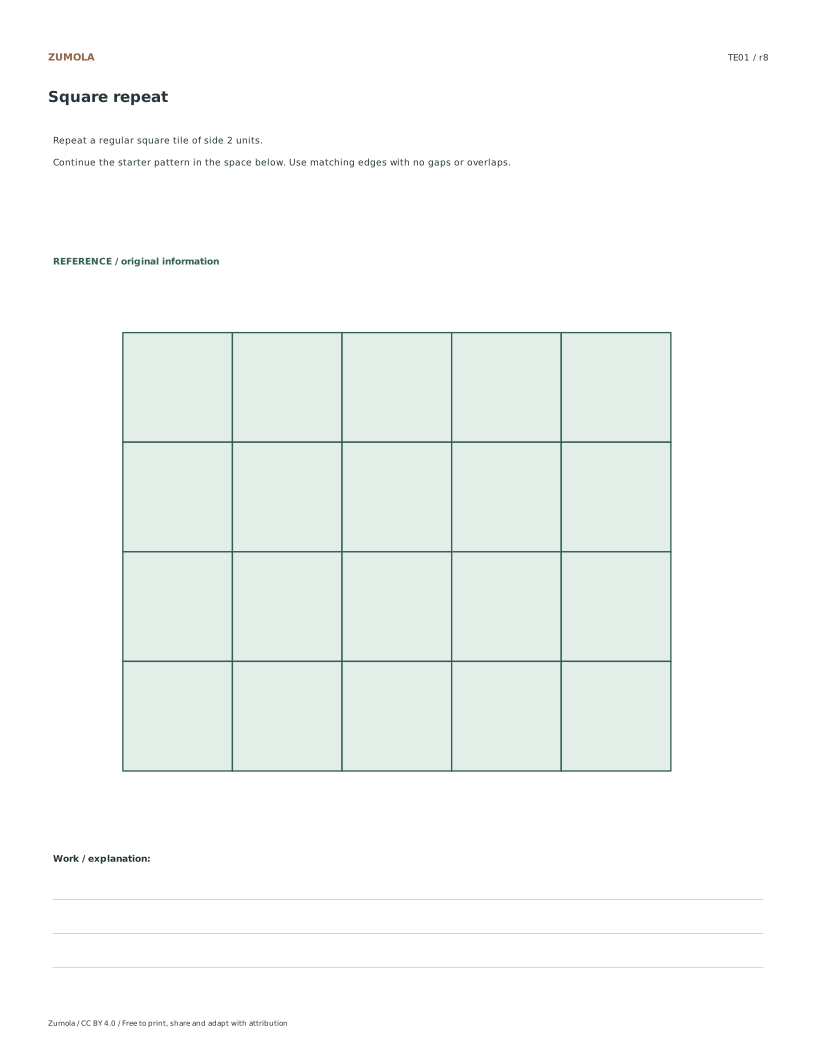
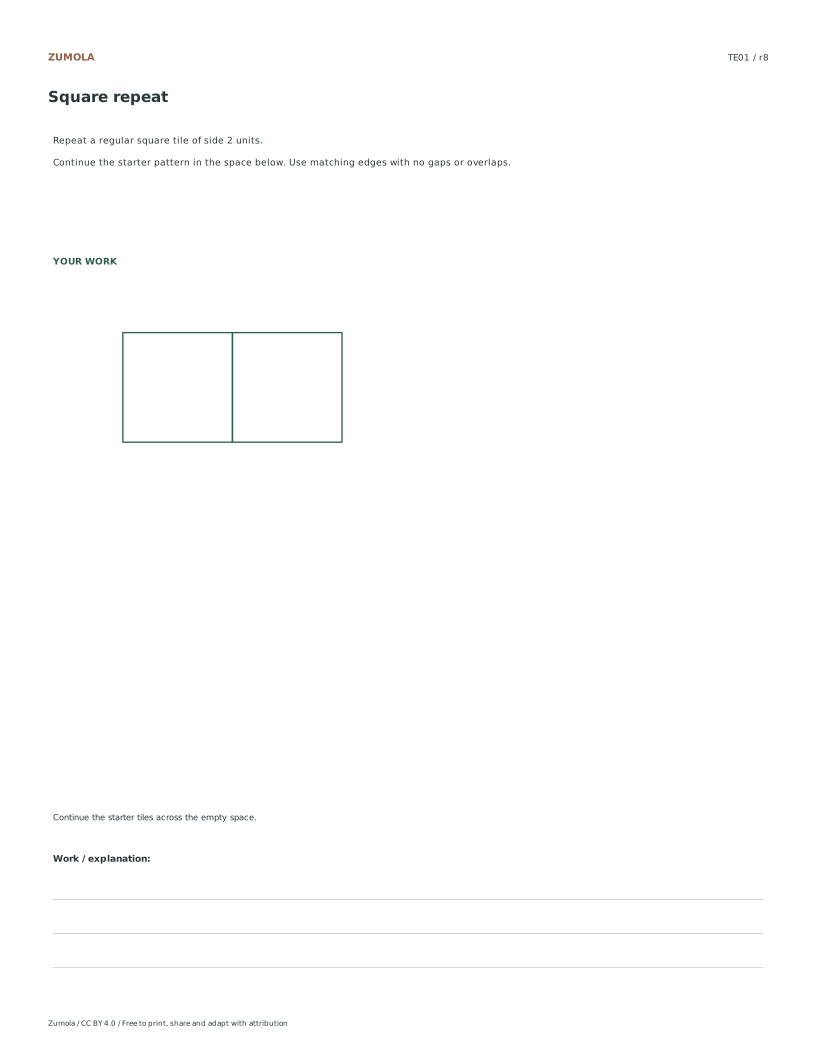
Square repeat
Original worksheet collection. Letter or A4 PDF and editable SVG.
Continue the starter pattern in the space below. Use matching edges with no gaps or overlaps.
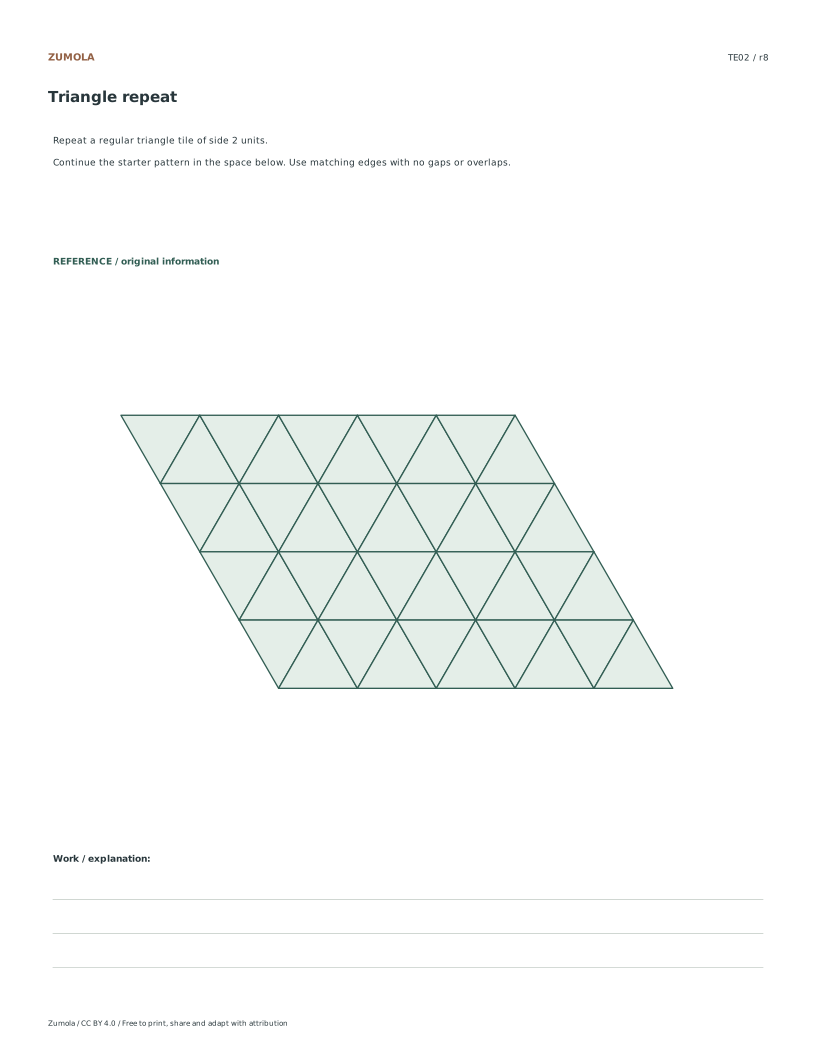
TE02
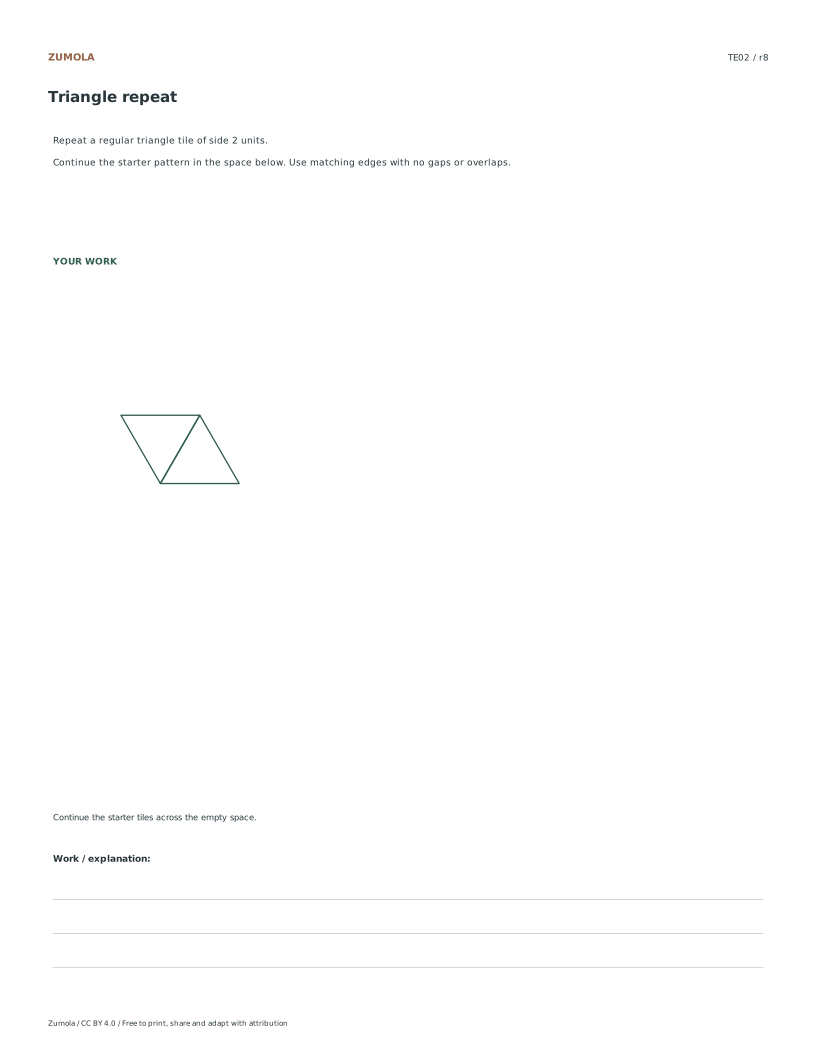
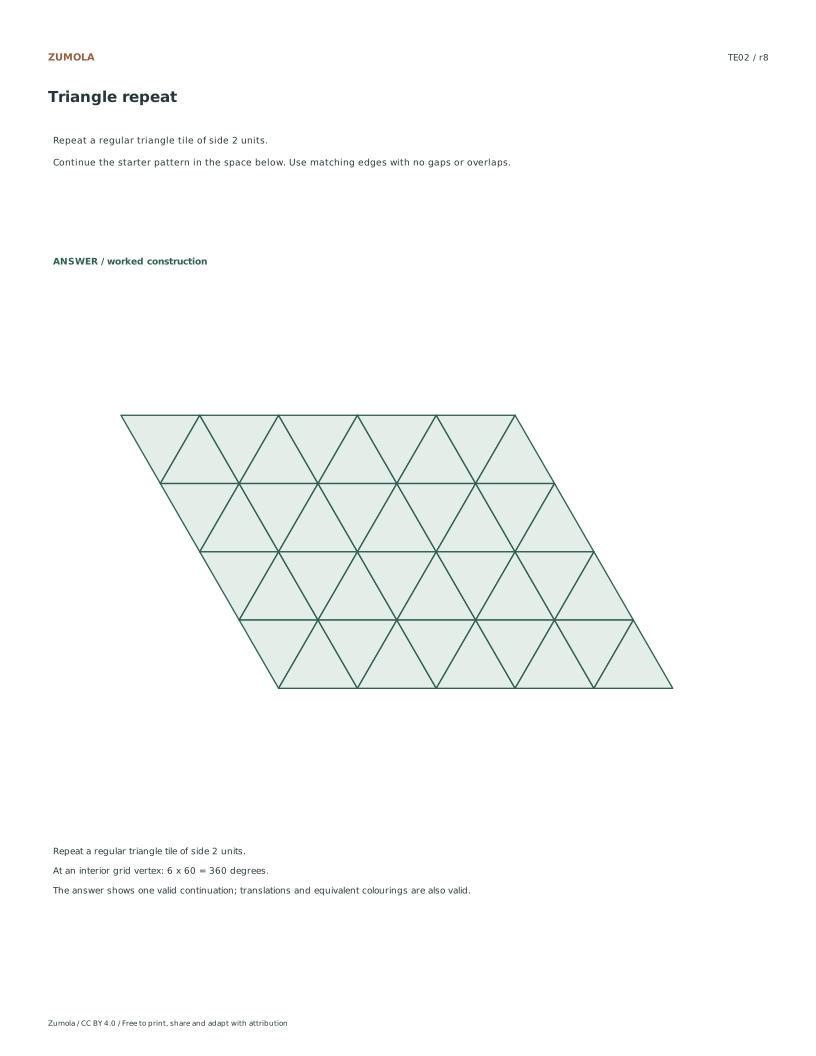
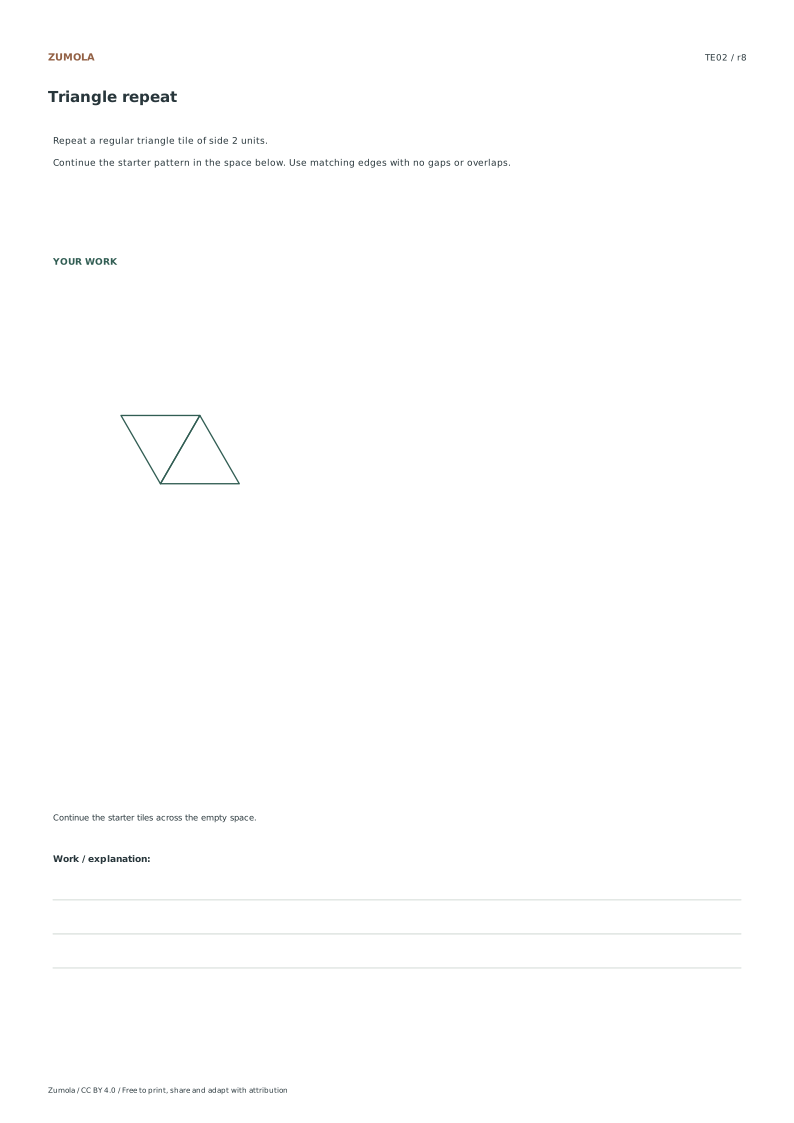
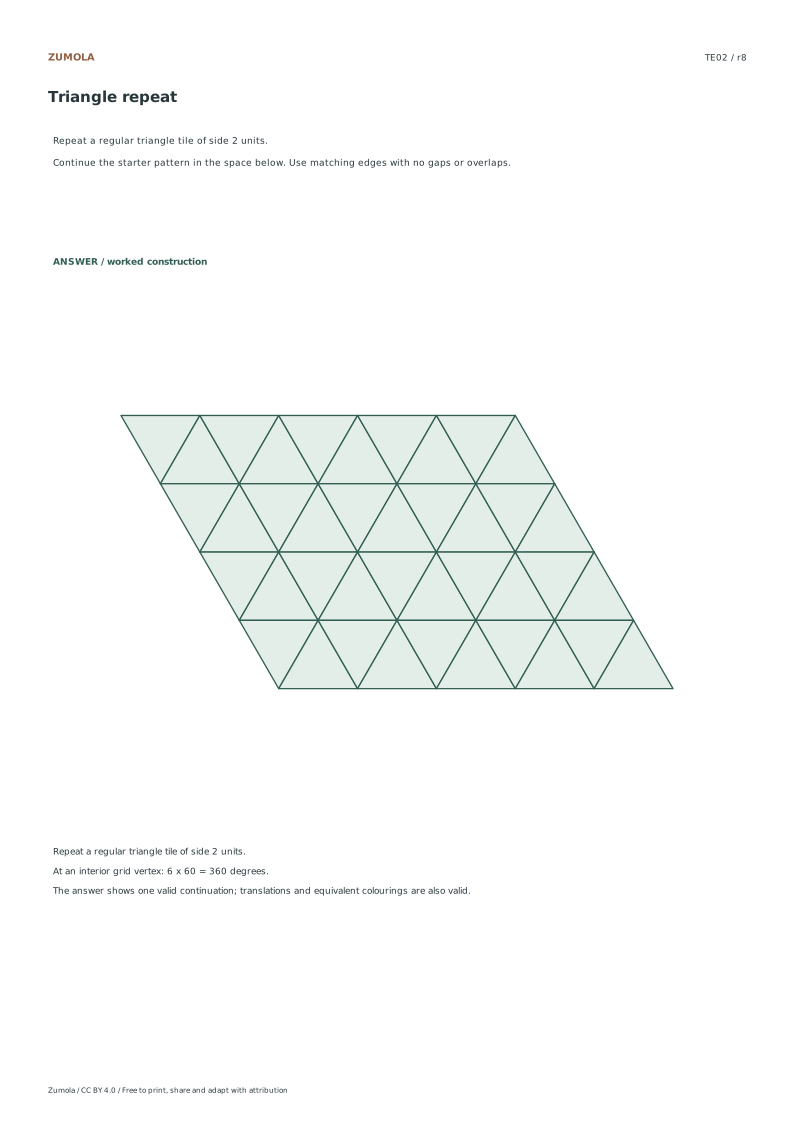
Repeat a regular triangle tile of side 2 units.
Continue the starter pattern in the space below. Use matching edges with no gaps or overlaps.
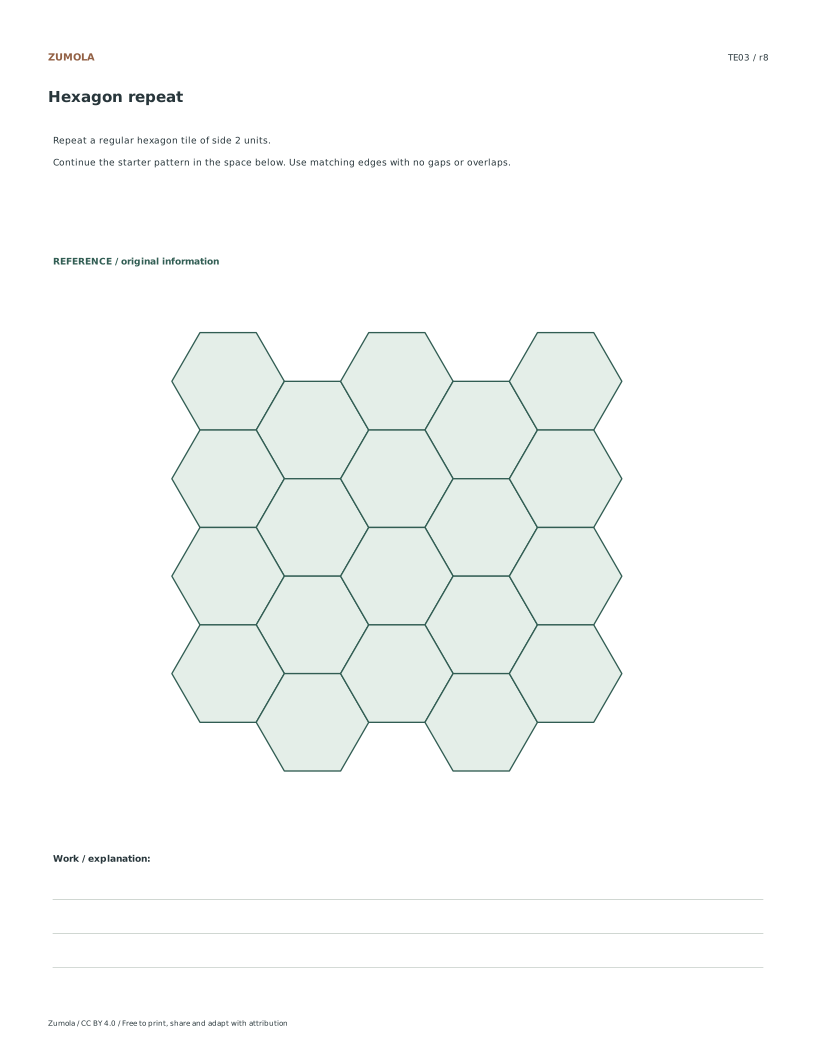
TE03
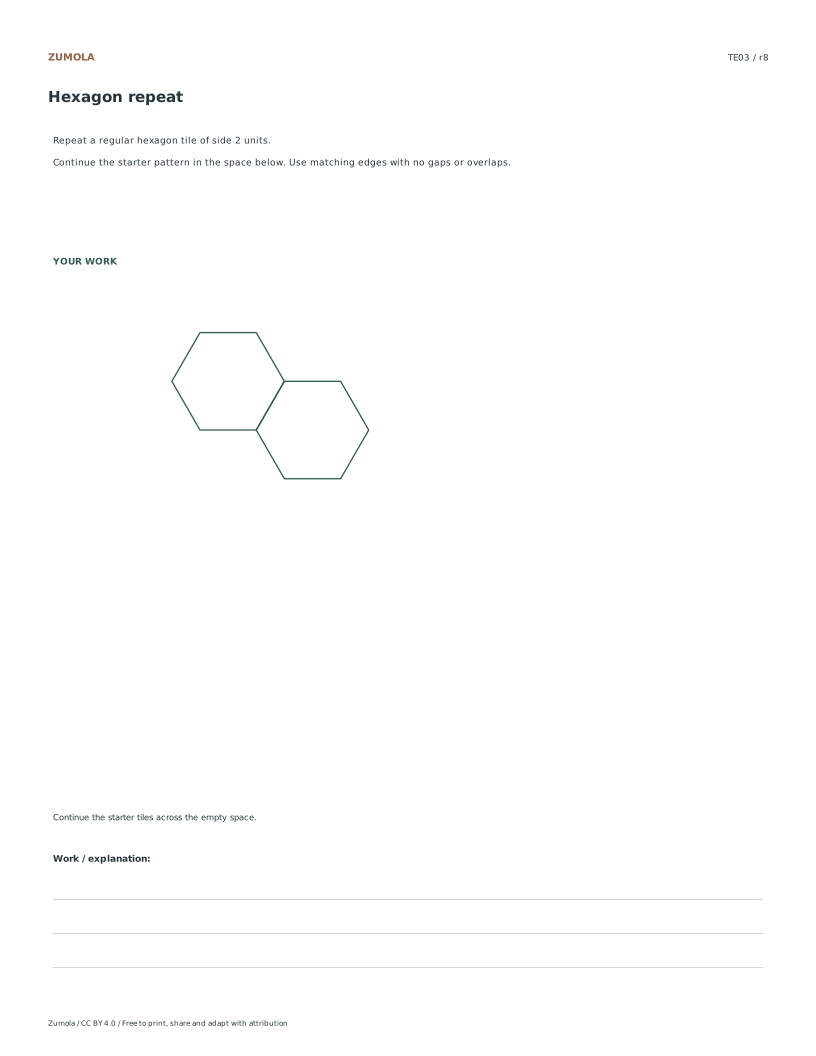
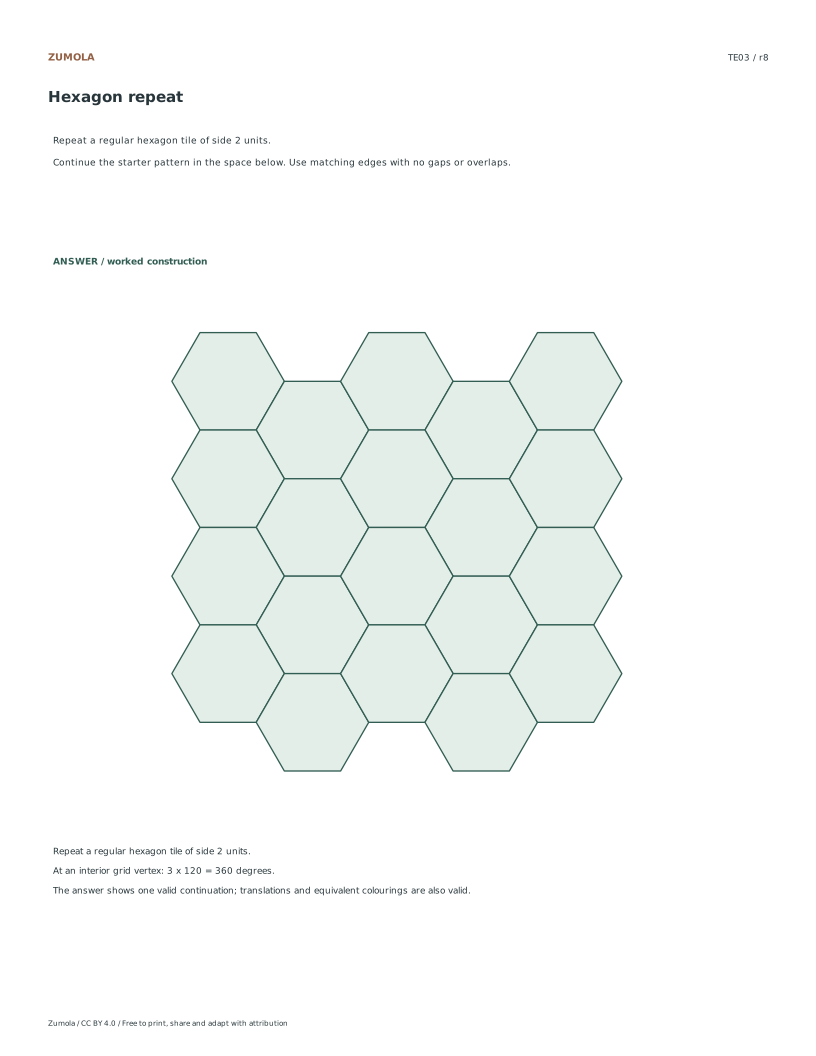
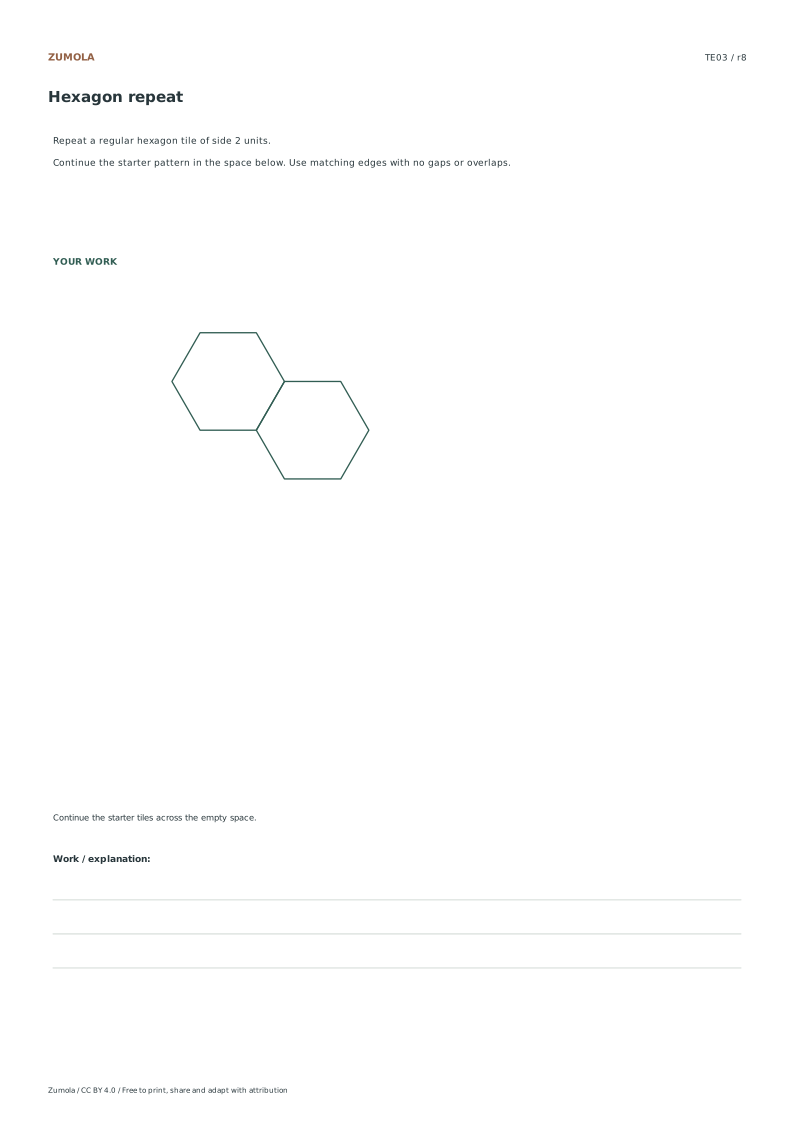
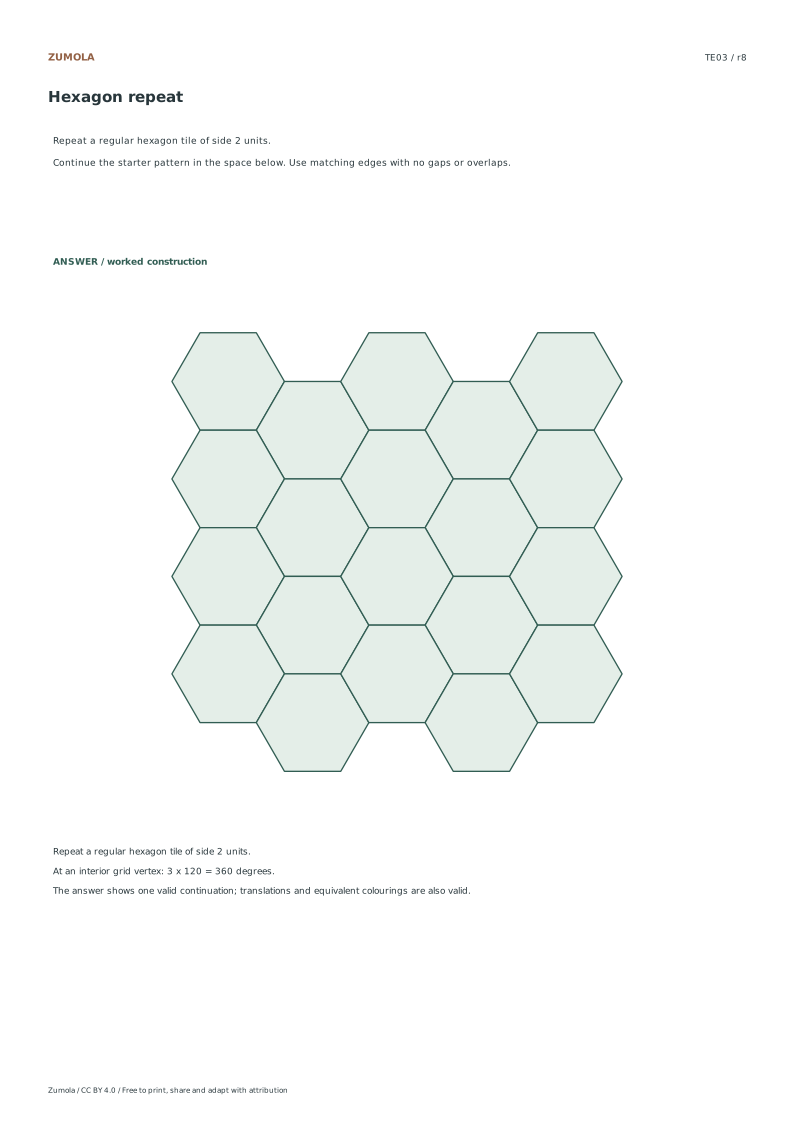
Repeat a regular hexagon tile of side 2 units.
Continue the starter pattern in the space below. Use matching edges with no gaps or overlaps.
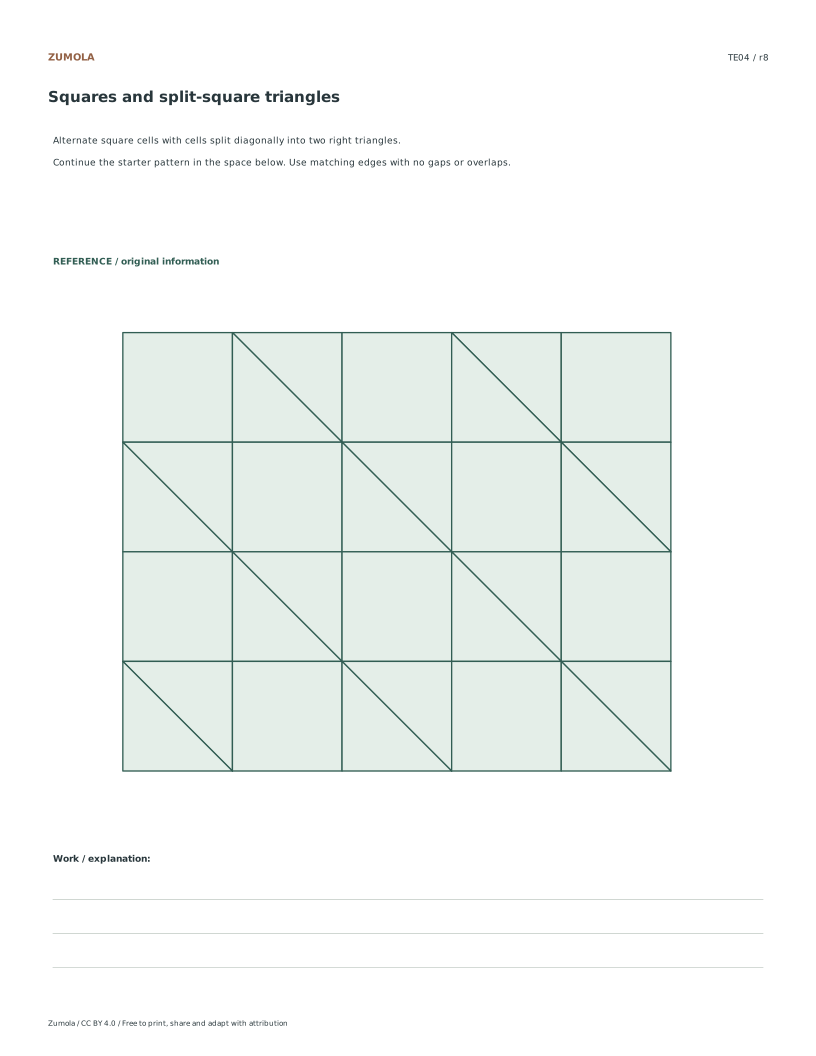
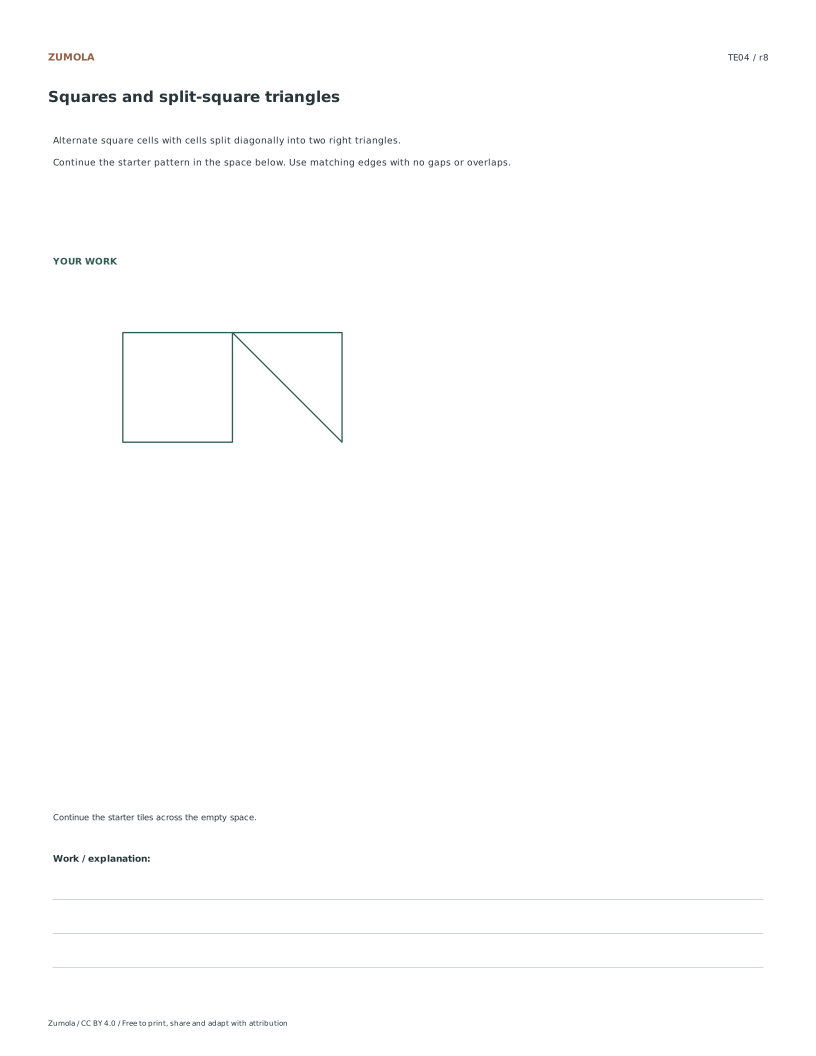
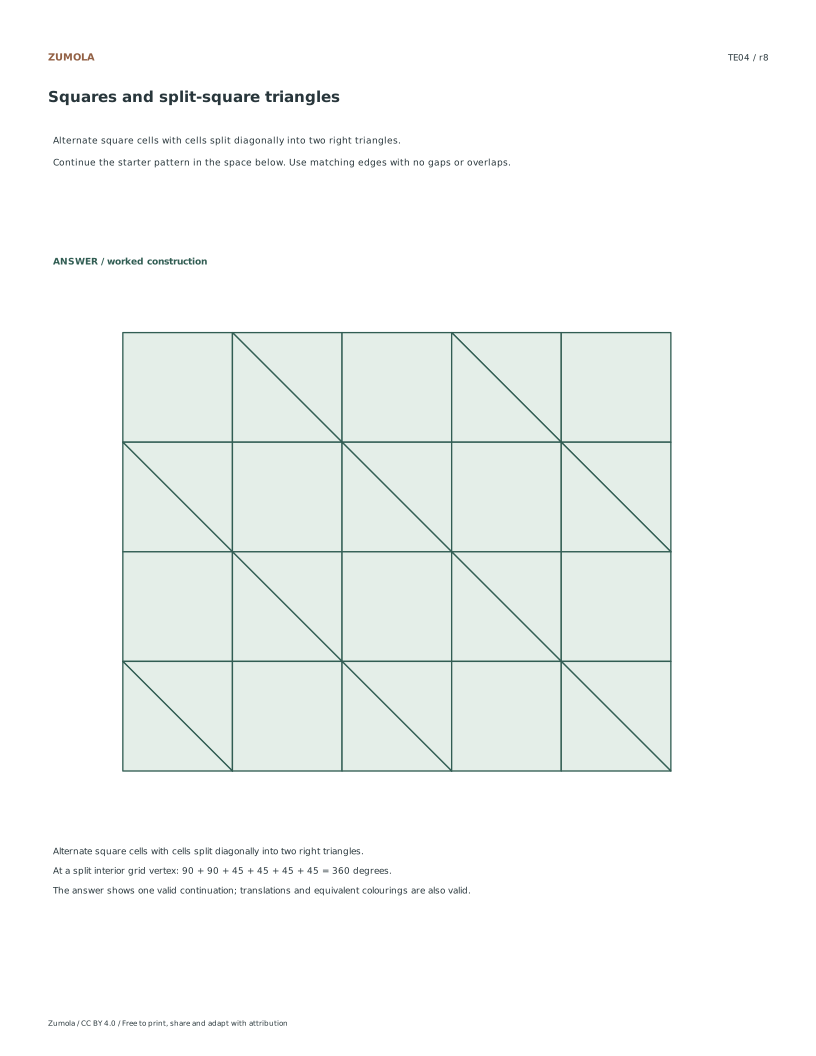
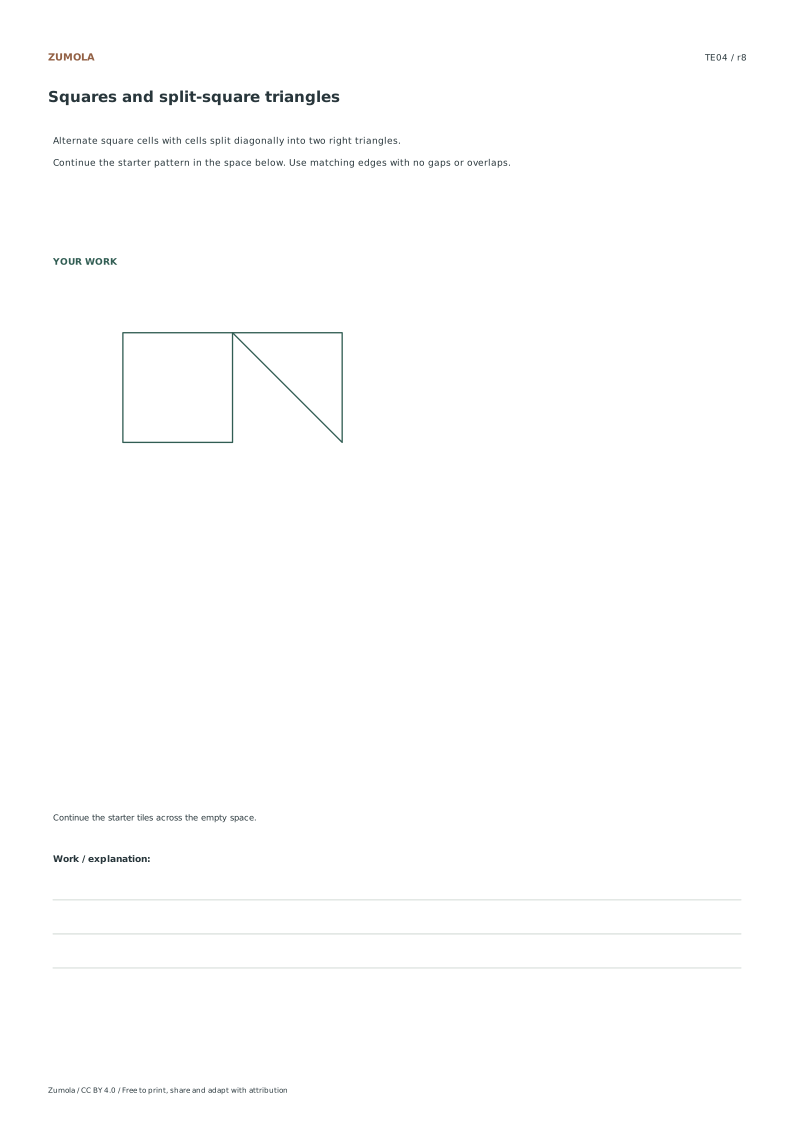
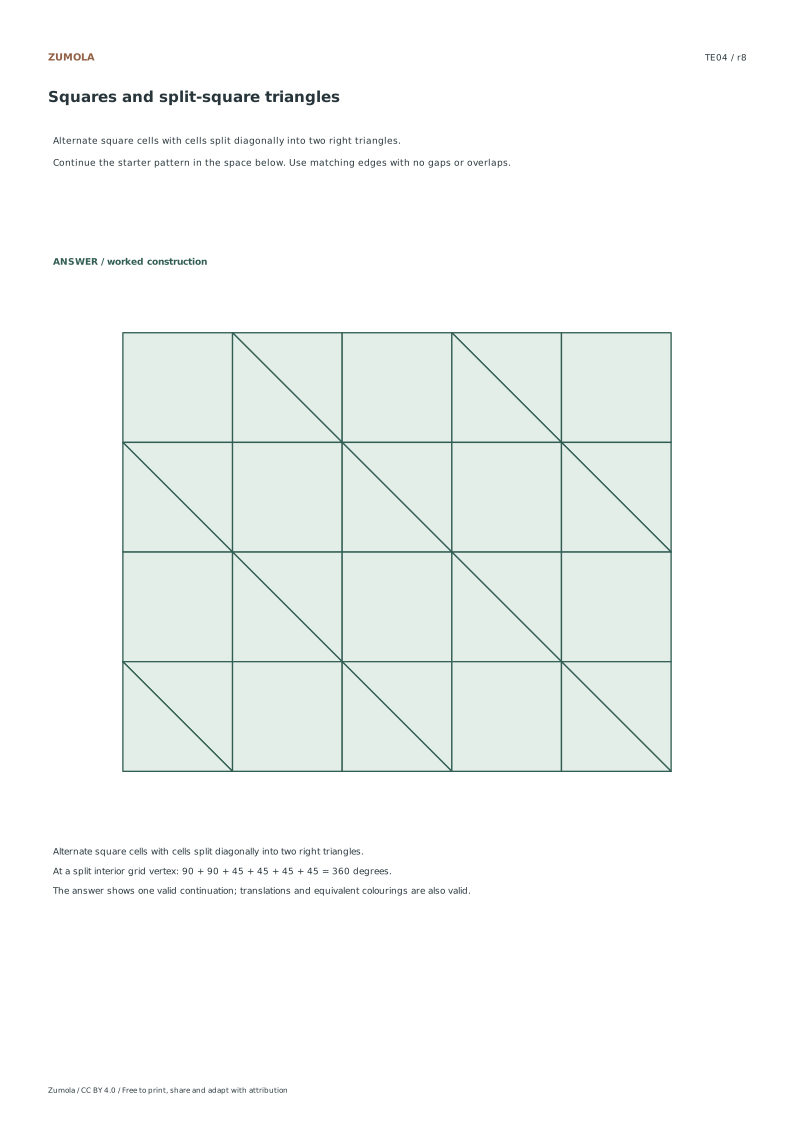
TE04
Alternate square cells with cells split diagonally into two right triangles.
Continue the starter pattern in the space below. Use matching edges with no gaps or overlaps.
Use the coordinates, dimensions and rules given for each case. Distances and areas are measured in grid units.
Check the first case
TE01: Square repeat
Step
Worked result
1
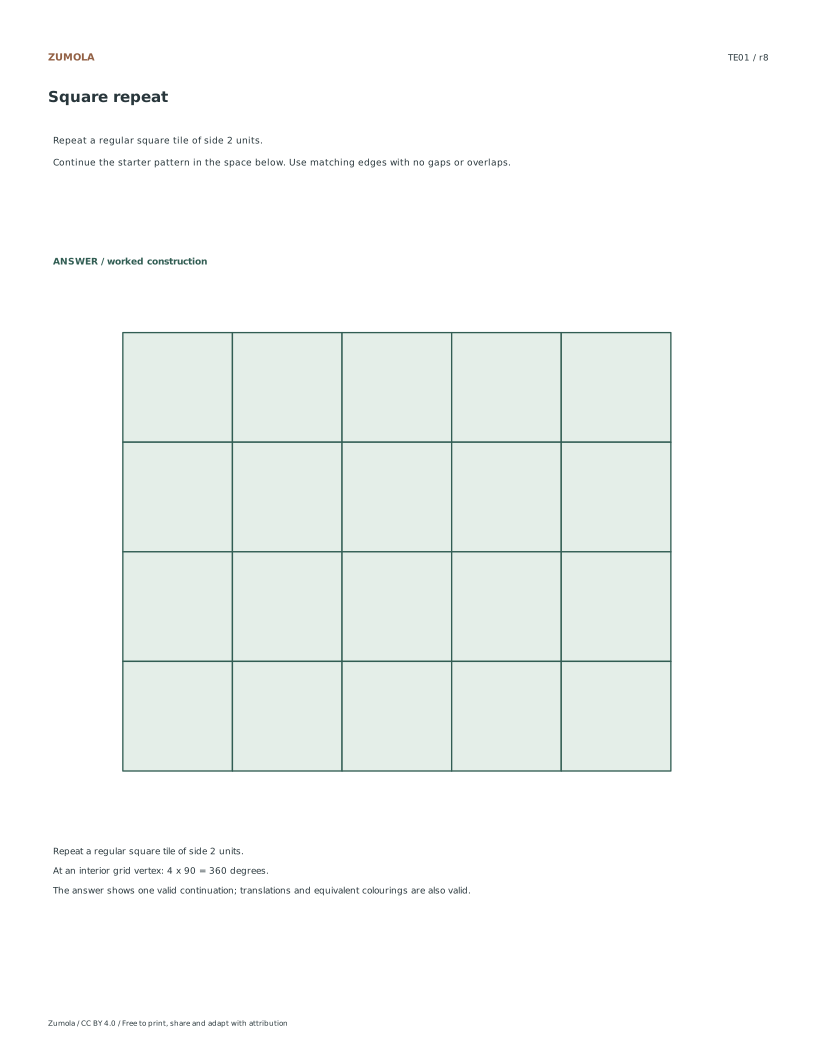
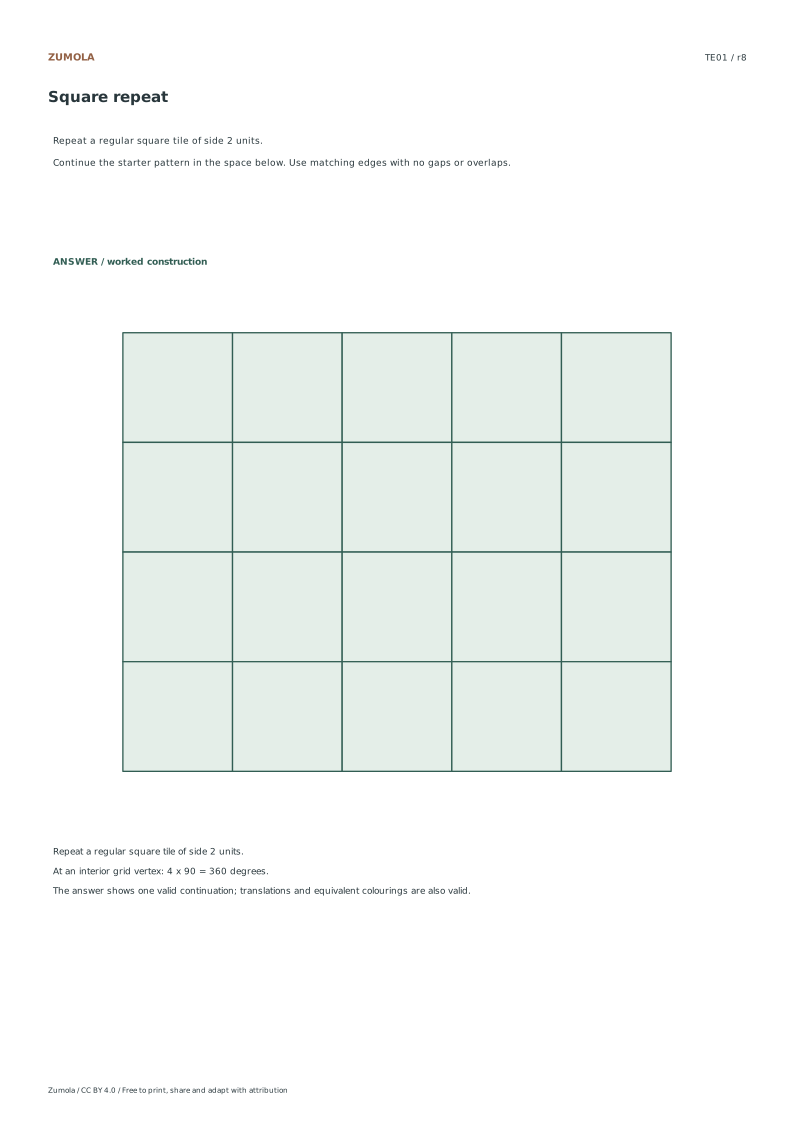
Repeat a regular square tile of side 2 units.
2
At an interior grid vertex: 4 x 90 = 360 degrees.
3
The answer shows one valid continuation; translations and equivalent colourings are also valid.
The first case shows the checking pattern. Individual answer files contain the completed graph or net and result for every case.
Work through the graph
Angle Sums at Interior Vertices
To check a tessellation, pick an interior vertex where tiles meet. For squares, four 90-degree corners give 4 x 90 = 360 degrees. For equilateral triangles, six 60-degree corners give 6 x 60 = 360 degrees. For regular hexagons, three 120-degree corners give 3 x 120 = 360 degrees. In the mixed pattern, a split vertex can combine two 90-degree corners and four 45-degree corners: 90 + 90 + 45 + 45 + 45 + 45 = 360 degrees. This sum is an example at a split interior vertex, not every vertex. Use these sums to verify no gaps or overlaps at that point.
Continuing a Starter Pattern
Start from the two starter tiles on the student page. Match each new tile edge to an existing edge of the same length. For the square tile of side 2 units, place copies so corners meet at grid vertices and four squares surround each interior vertex. For the triangle tile of side 2 units, six triangles meet at each interior vertex. For the hexagon tile of side 2 units, three hexagons meet. In the mixed pattern, alternate square cells with cells split diagonally into two right triangles. Translations and equivalent colourings are valid continuations; the answer shows one valid continuation.
Checking for Gaps and Overlaps
After drawing, inspect each interior vertex. Count the tile corners meeting there and add their angles. The total must be 360 degrees. For the square pattern, look for four 90-degree corners. For the triangle pattern, look for six 60-degree corners. For the hexagon pattern, look for three 120-degree corners. In the mixed pattern, a split vertex may show 90 + 90 + 45 + 45 + 45 + 45 = 360 degrees. Also check that every shared edge has matching length and no tile overlaps a neighbour. If a vertex sum is less than 360, a gap remains; if more, tiles overlap.
Checks that catch common errors
Watch for
Check instead
Assuming every interior vertex in the mixed tessellation must have the same angle combination.
The stated sum 90 + 90 + 45 + 45 + 45 + 45 = 360 degrees is an example at a split interior vertex, not every vertex. Check each vertex individually.
Using only three squares around an interior vertex and leaving a gap.
Four 90-degree corners are needed: 4 x 90 = 360 degrees. Three squares give only 270 degrees, leaving a 90-degree gap.
Placing five equilateral triangles around an interior vertex and overlapping tiles.
Six 60-degree corners are needed: 6 x 60 = 360 degrees. Five triangles give 300 degrees, so the pattern does not close without a gap or overlap.
Keep labels and margins readable
Choose the PDF that matches your paper. Print at Actual size / 100% and turn off Fit, Shrink and browser headers. SVG is editable but an editor can rescale it; the PDF is the simpler print route.
Useful answers
How do I know my tessellation has no gaps or overlaps?
Check interior vertices. Add the angles of the tile corners meeting there; the total must be 360 degrees. For squares use 4 x 90 = 360, for triangles 6 x 60 = 360, for hexagons 3 x 120 = 360. In the mixed pattern, a split vertex can show 90 + 90 + 45 + 45 + 45 + 45 = 360. Also confirm shared edges match in length.
Can I colour the tiles differently from the answer?
Yes. The answer shows one valid continuation; translations and equivalent colourings are also valid. The mathematical requirement is matching edges with no gaps or overlaps, and the correct angle sum at interior vertices.
Why does the mixed pattern use 45-degree angles?
Cells split diagonally into two right triangles create 45-degree corners at the split. At a split interior vertex, two 90-degree corners and four 45-degree corners can meet: 90 + 90 + 45 + 45 + 45 + 45 = 360 degrees. This is an example at a split interior vertex, not every vertex.
Are the answer files and editable graphs free?
Yes. The individual student, reference and answer files plus collection packs are free without signup. Credit Zumola under CC BY 4.0 when sharing or adapting.
The diagrams and exercises on this page are original Zumola resources.
Your analytics choice
Optional Google Analytics helps us understand which free resources are useful. It is off until you allow it. Drawing tools and downloads work with either choice. Privacy details