Free rotation worksheets on a coordinate grid with 90°, 180° and 270° turns. Separate student, reference and answer files in Letter/A4 PDF/SVG.
Choose Letter or A4, then download a student sheet first. Keep the separate reference or answer file closed until you have attempted the case. Every worksheet, SVG and answer is free without signup.
Choose your paper and download
Download paper size
Every worksheet and answer is free. No signup.
Free original resourceRO01
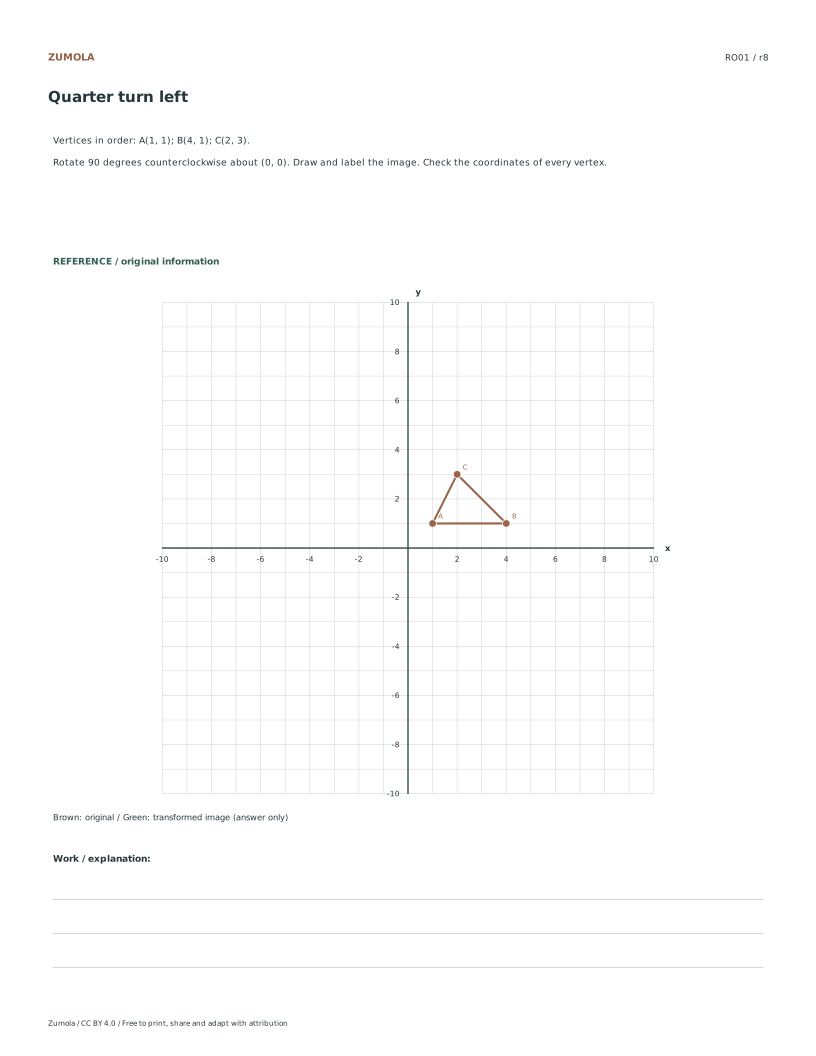
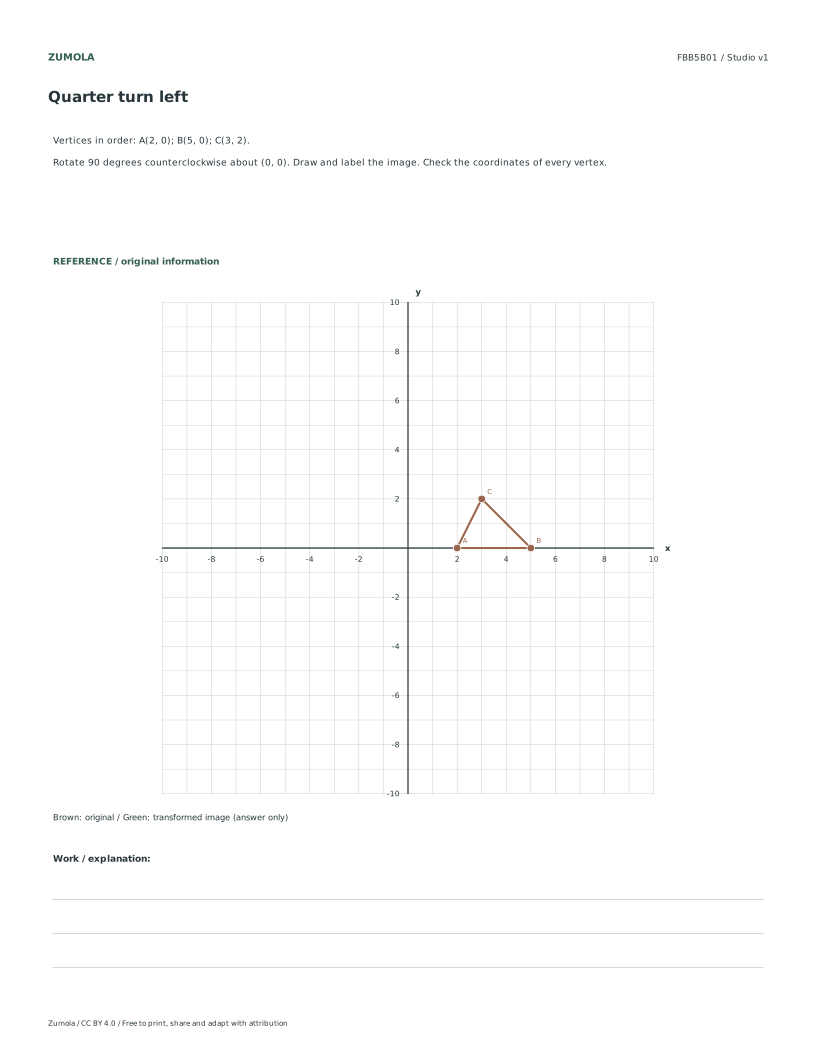
Quarter turn left
Original worksheet collection. Letter or A4 PDF and editable SVG.
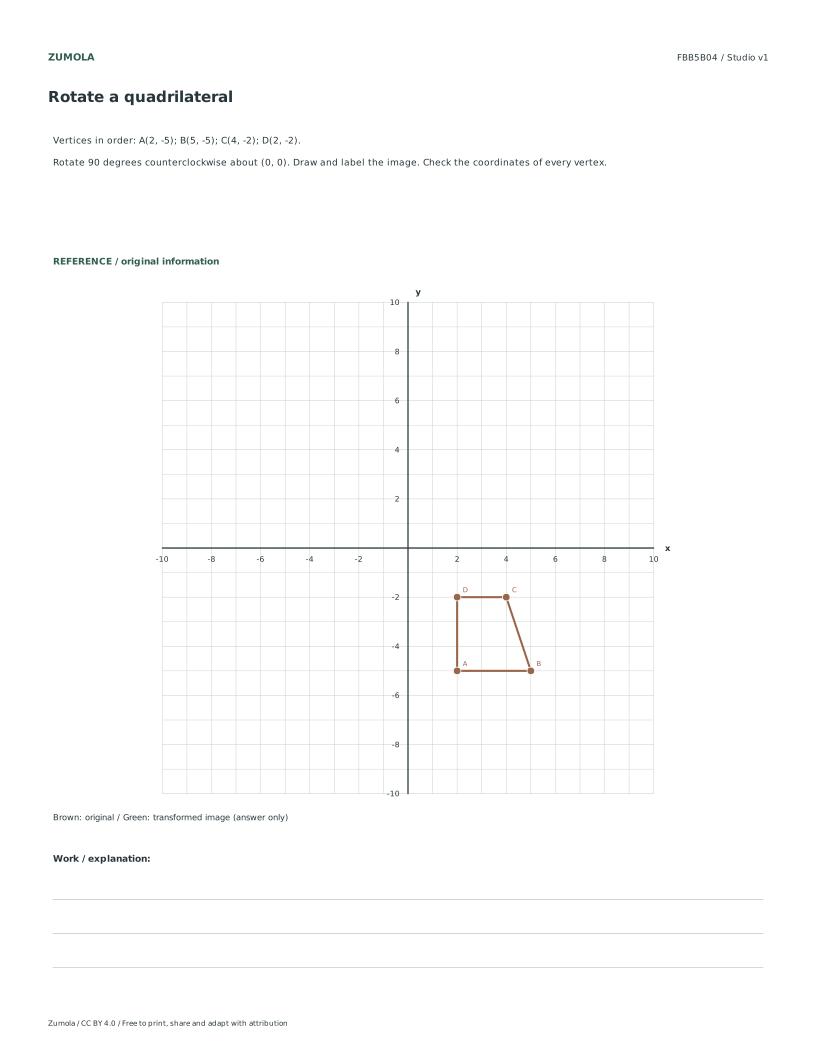
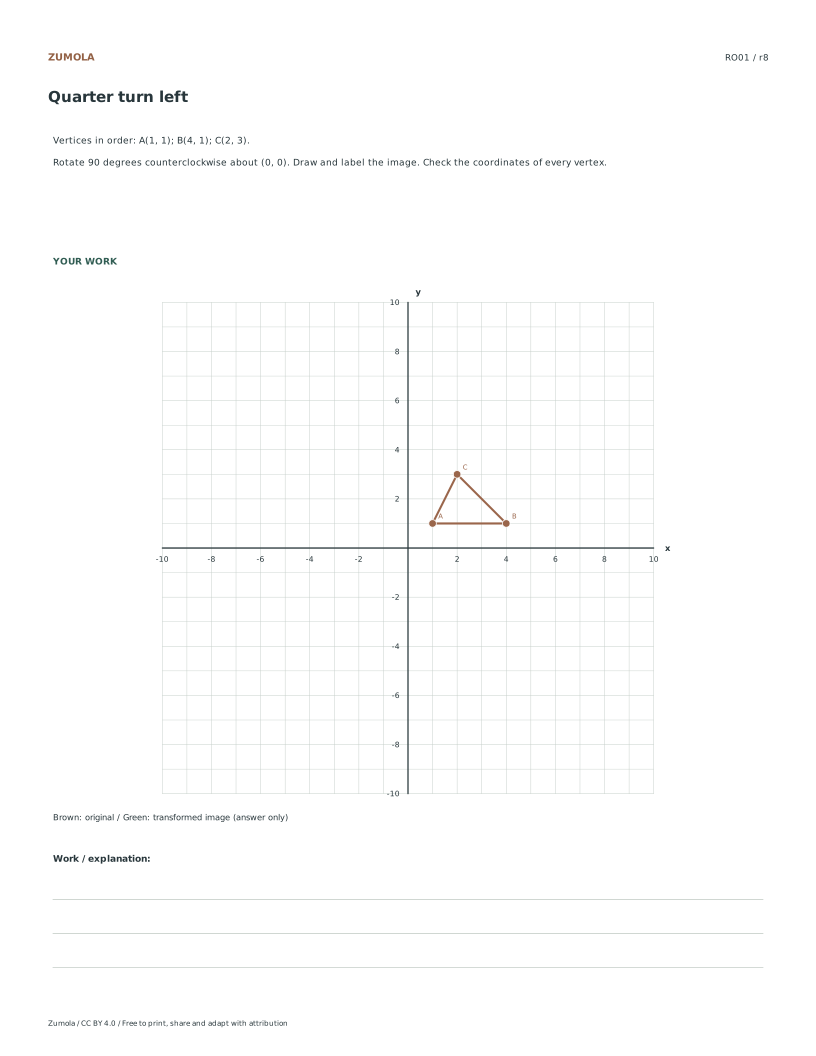
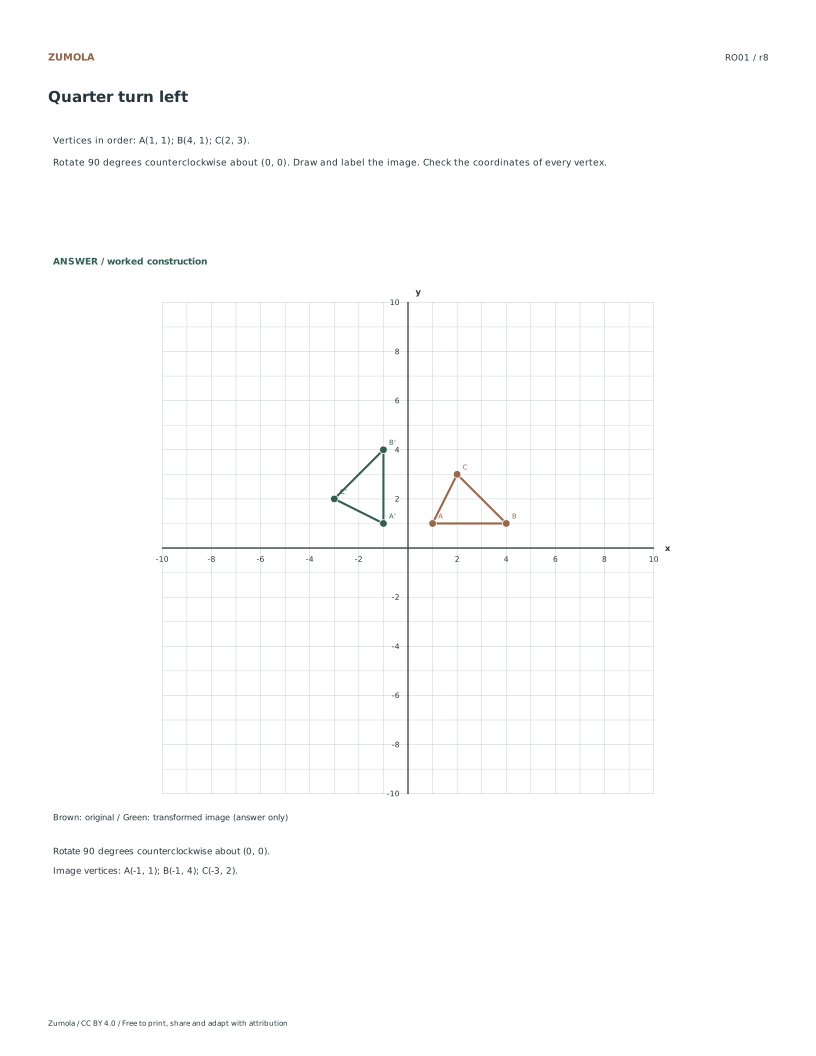
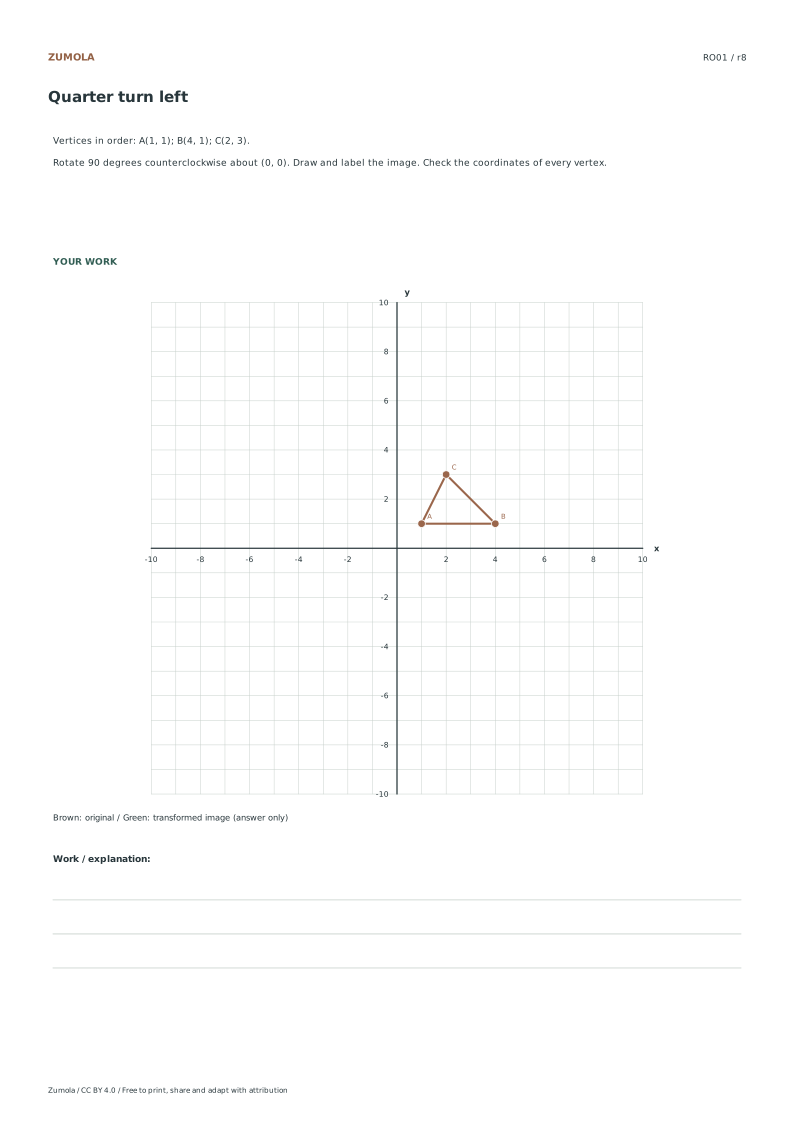
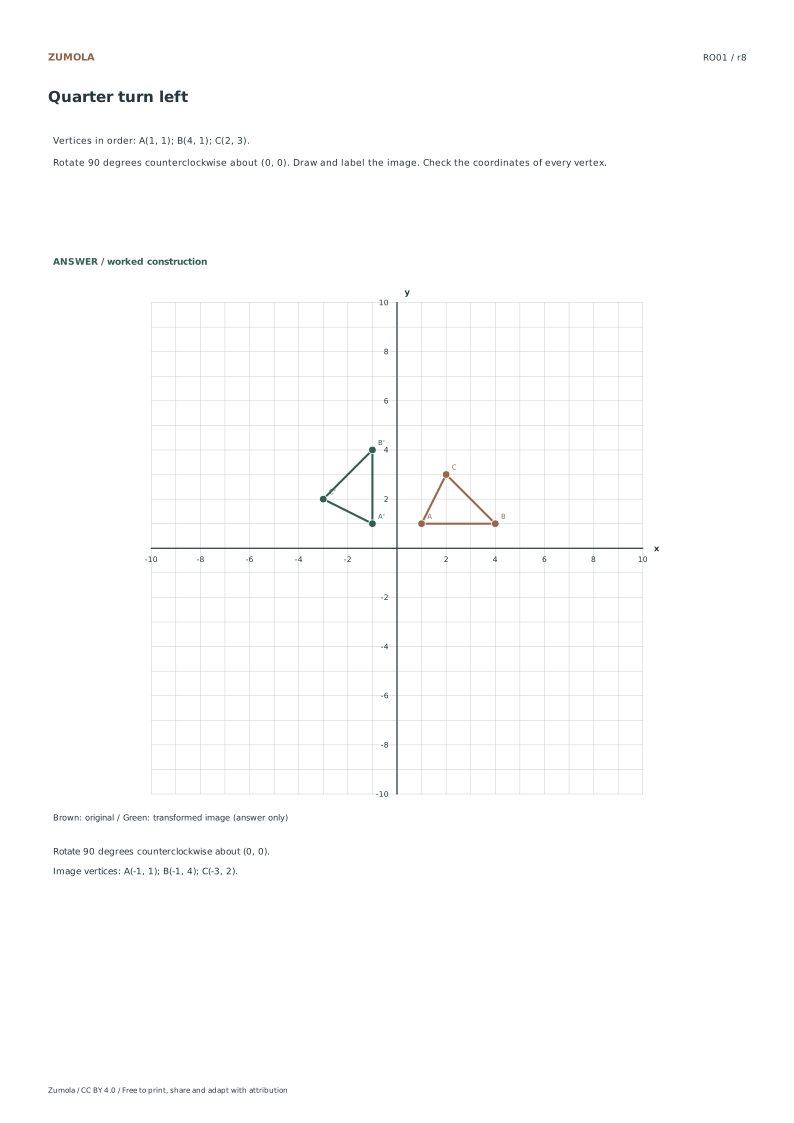
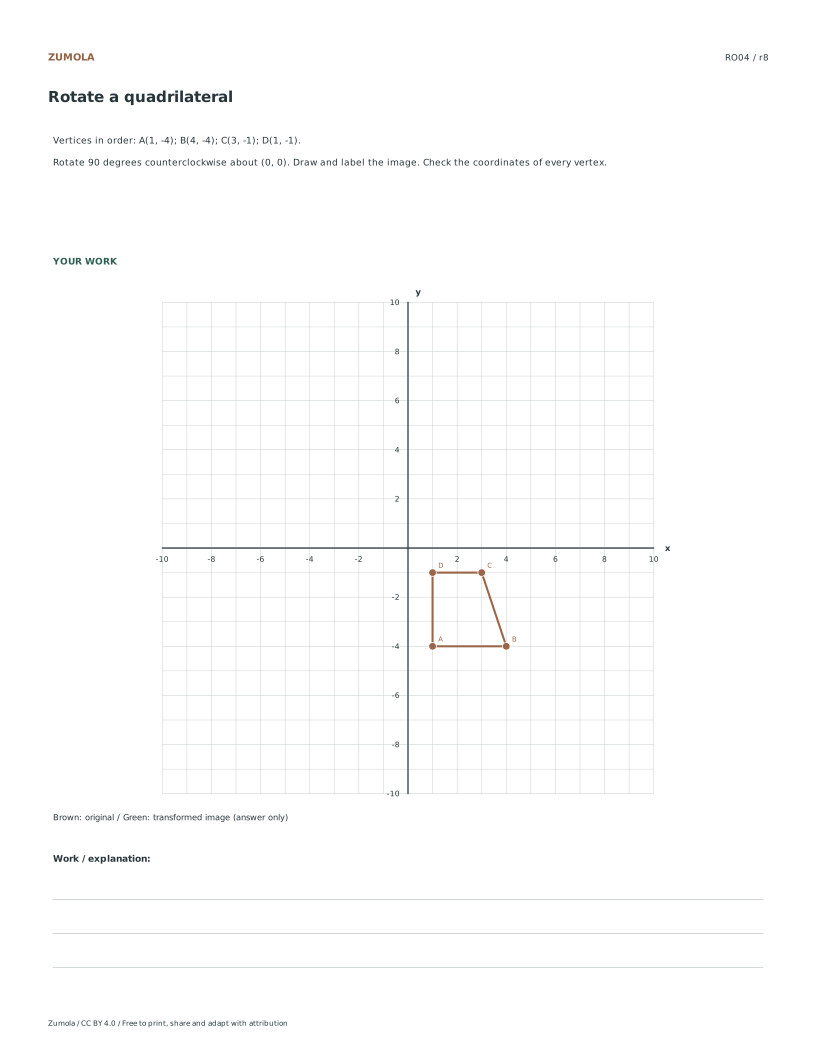
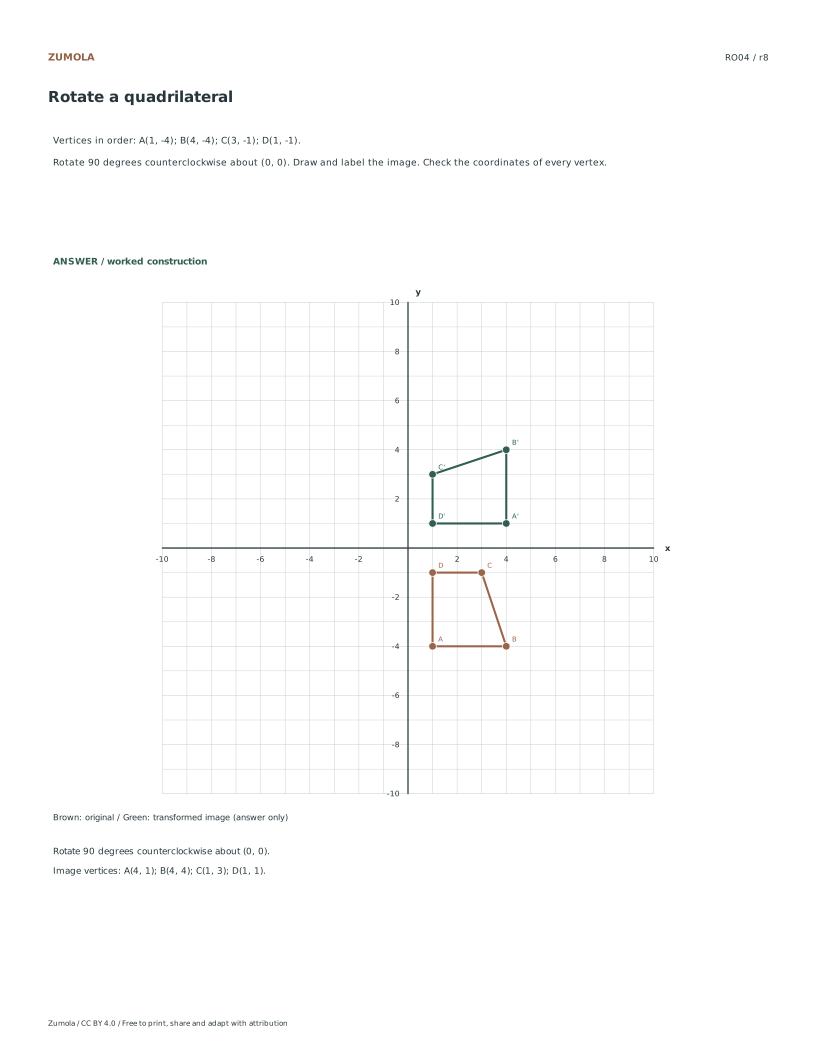
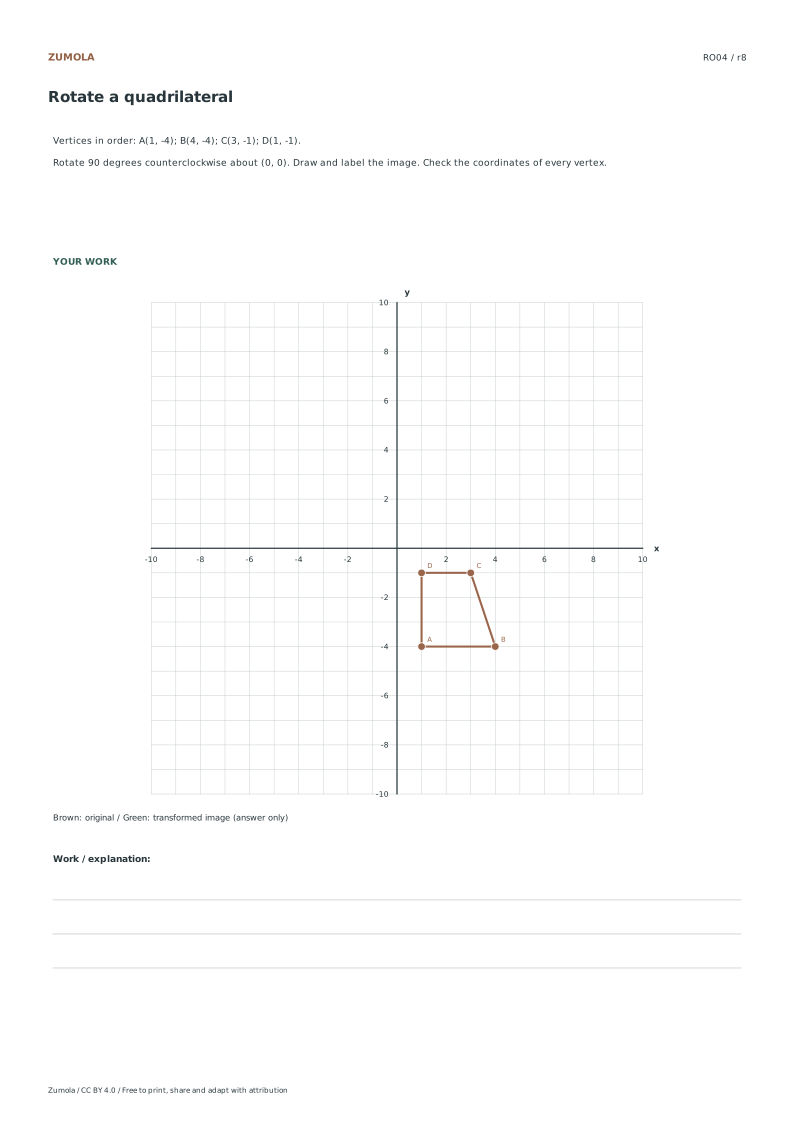
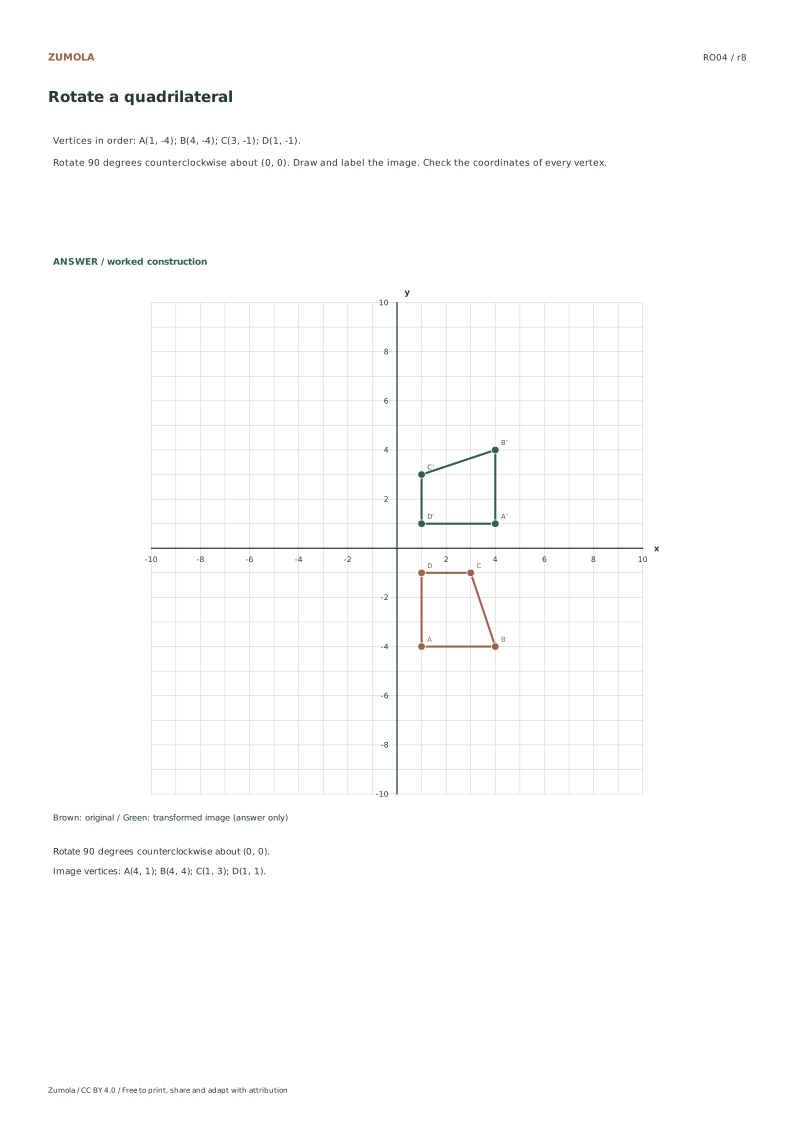
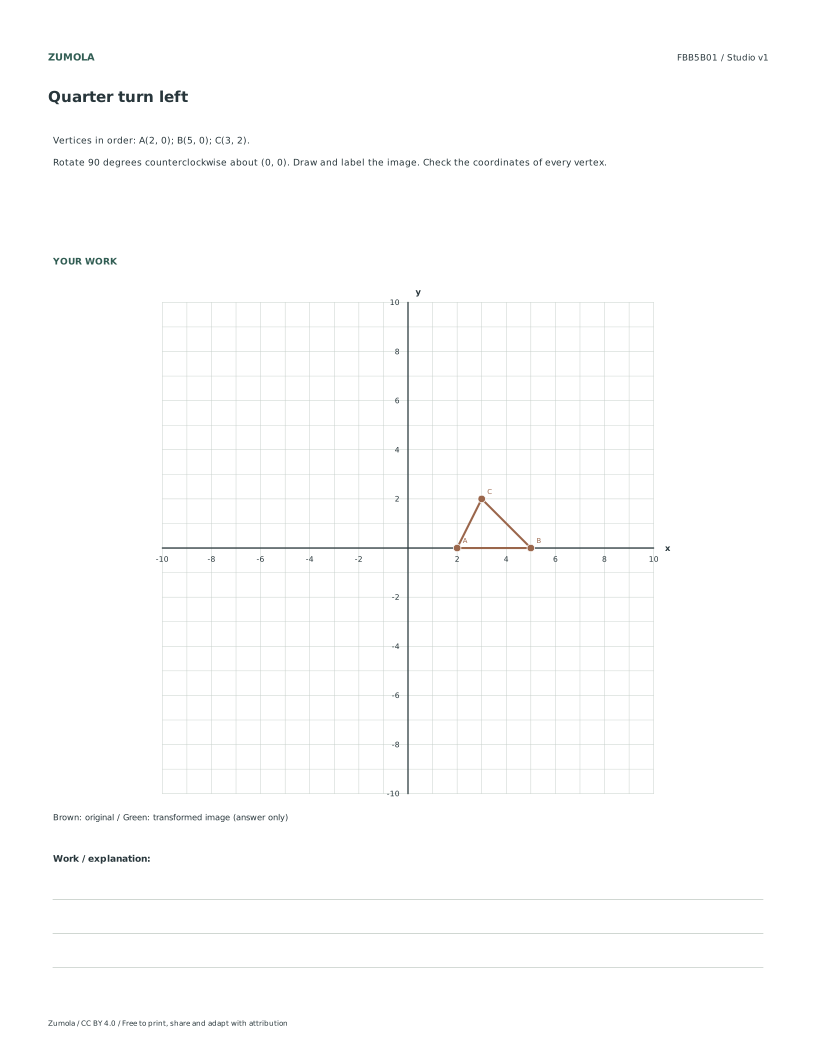
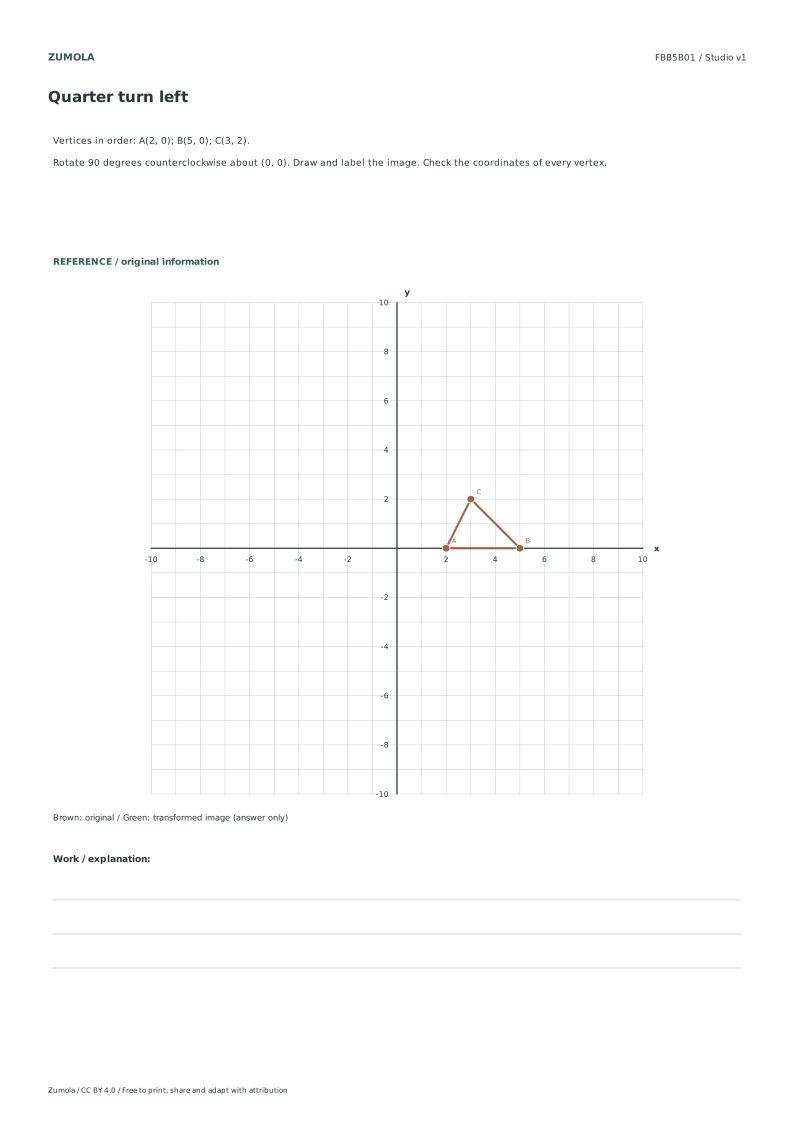
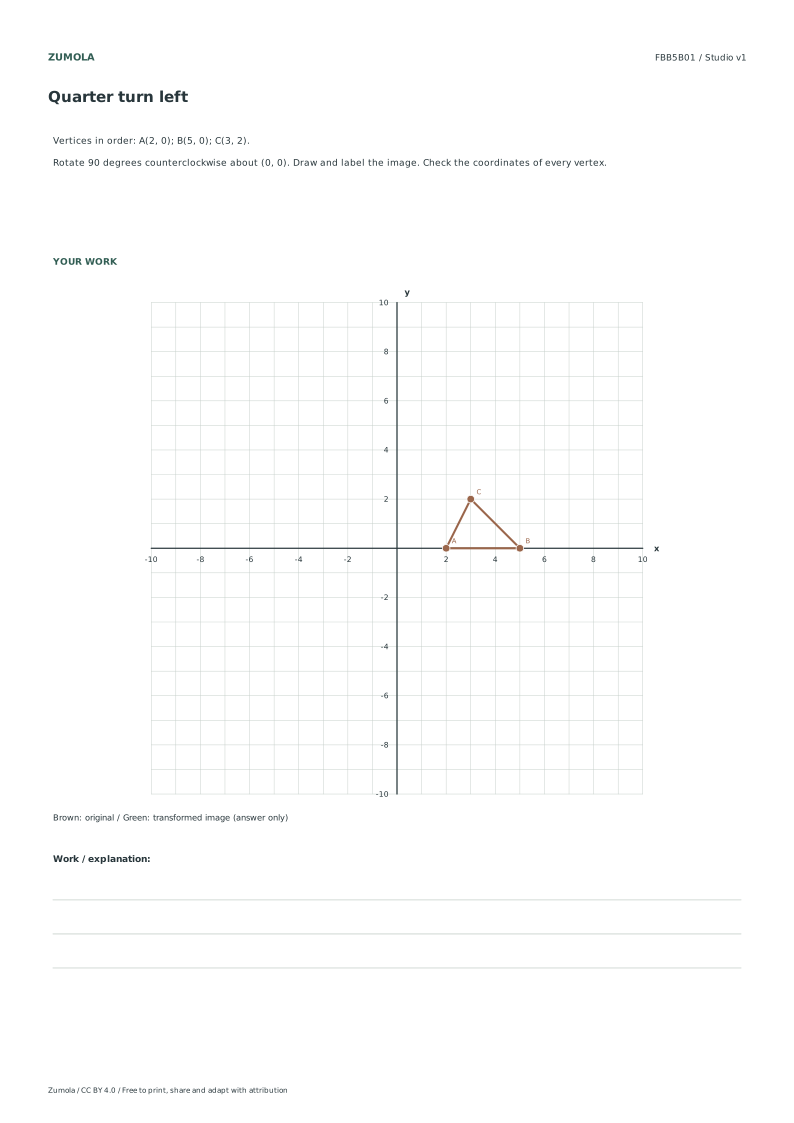
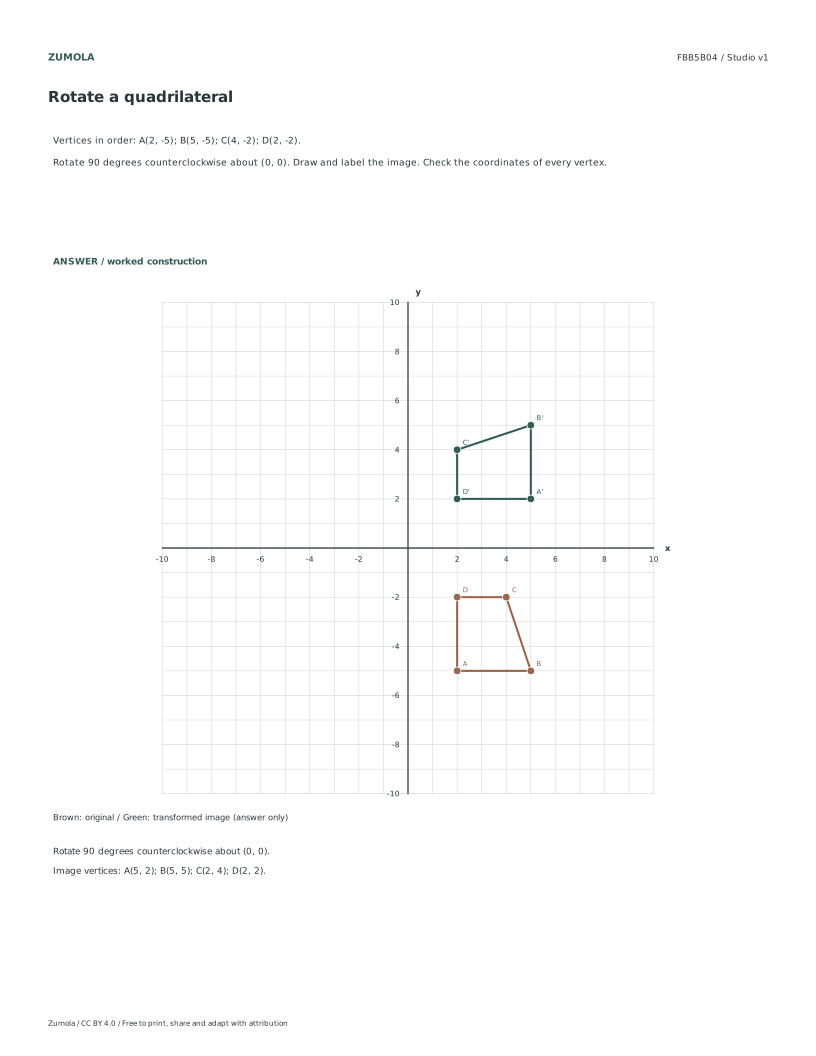
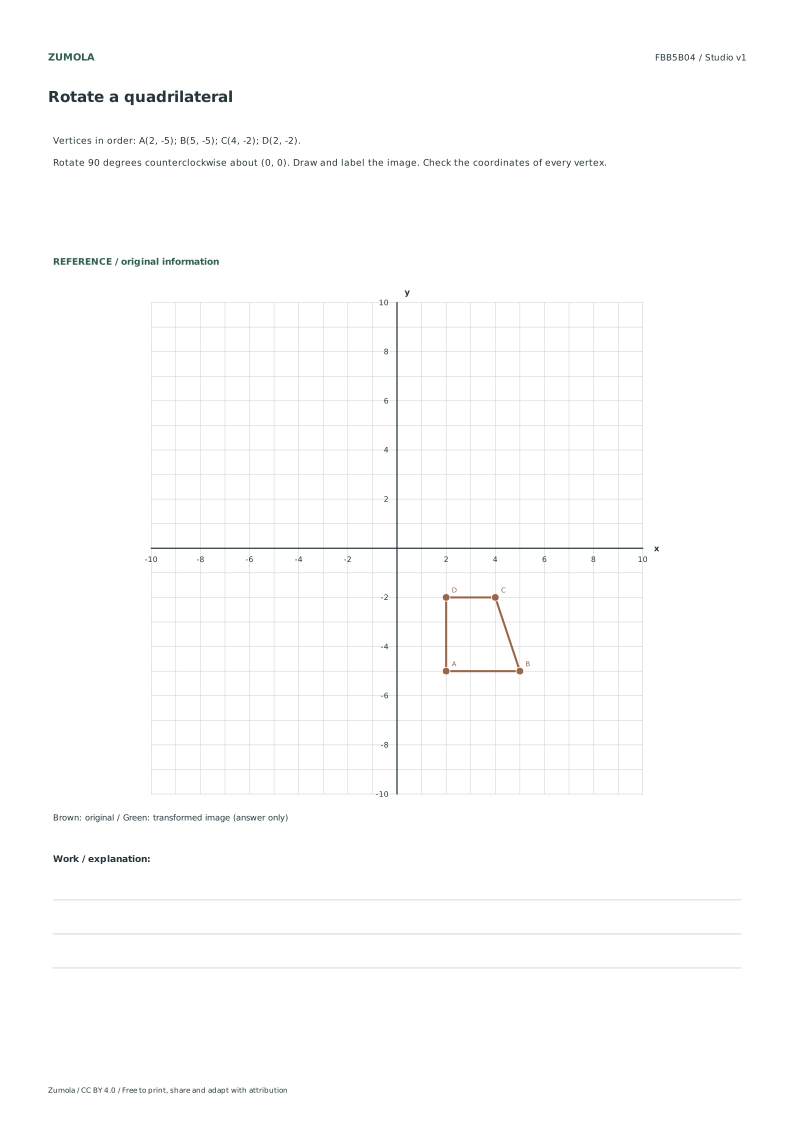
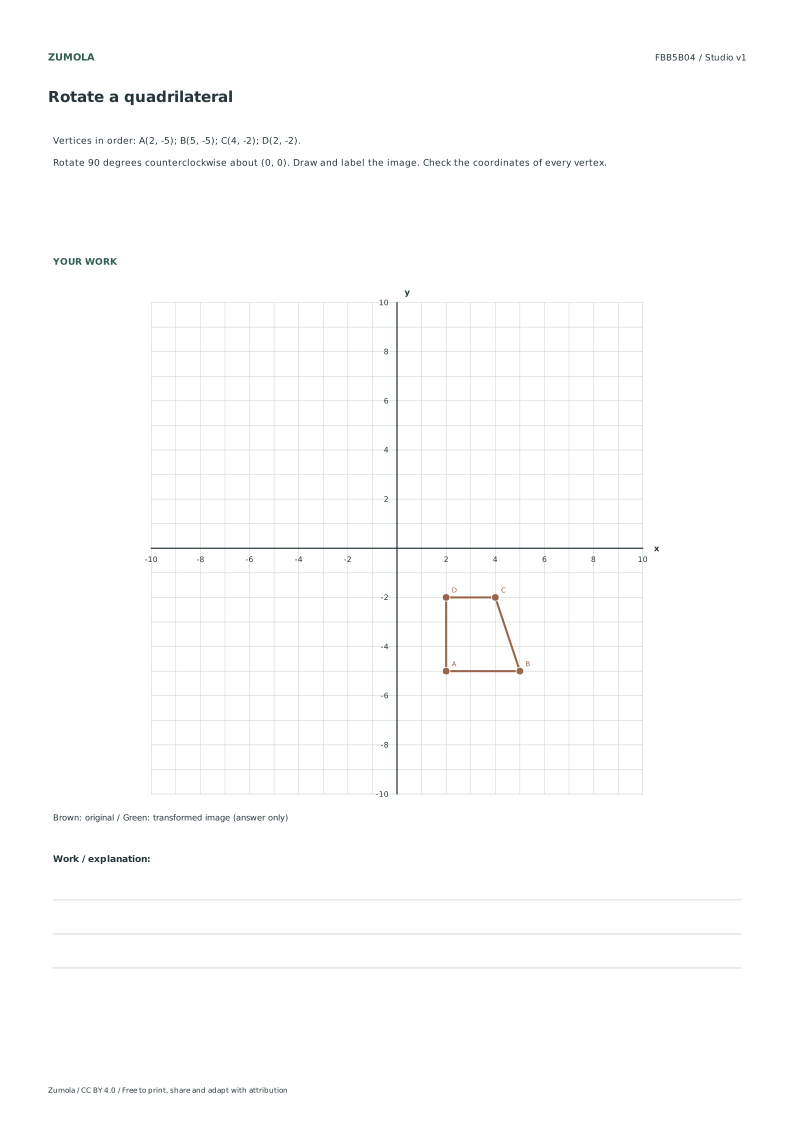
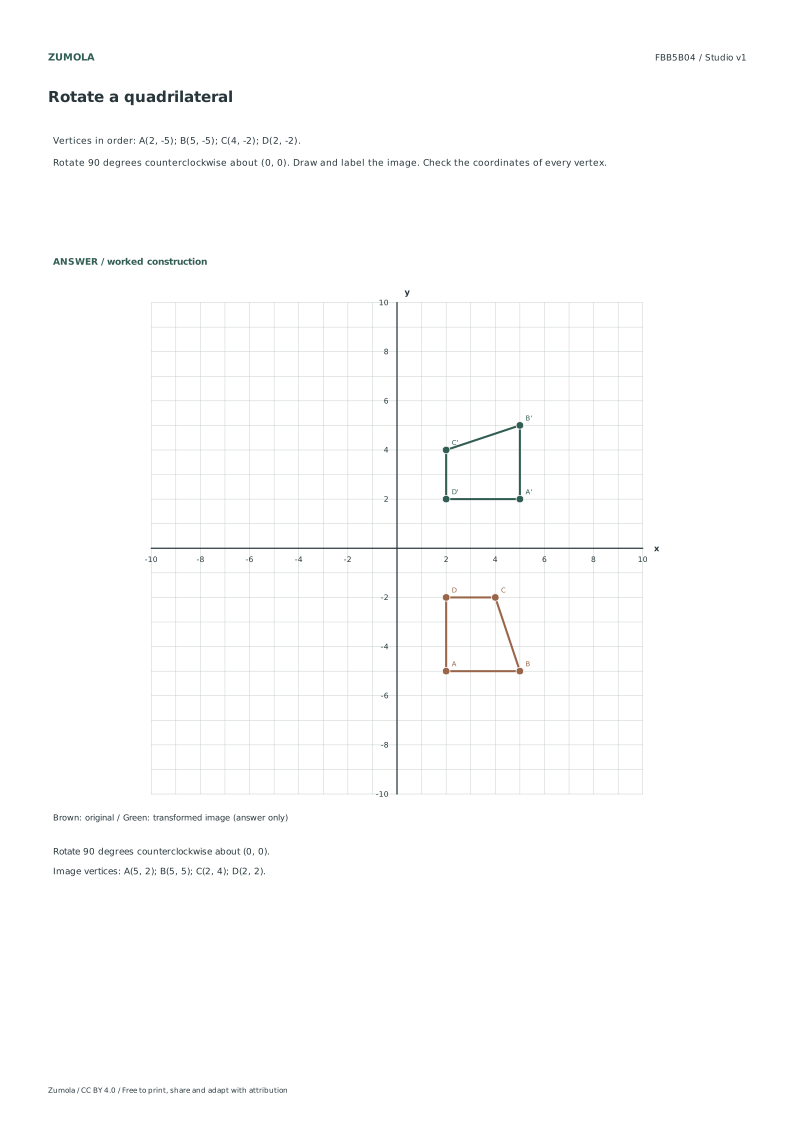
Rotate 90 degrees counterclockwise about (0, 0). Draw and label the image. Check the coordinates of every vertex.
Use the coordinates, dimensions and rules given for each case. Distances and areas are measured in grid units.
Check the first case
RO01: Quarter turn left
Step
Worked result
1
Rotate 90 degrees counterclockwise about (0, 0).
2
Image vertices: A(-1, 1); B(-1, 4); C(-3, 2).
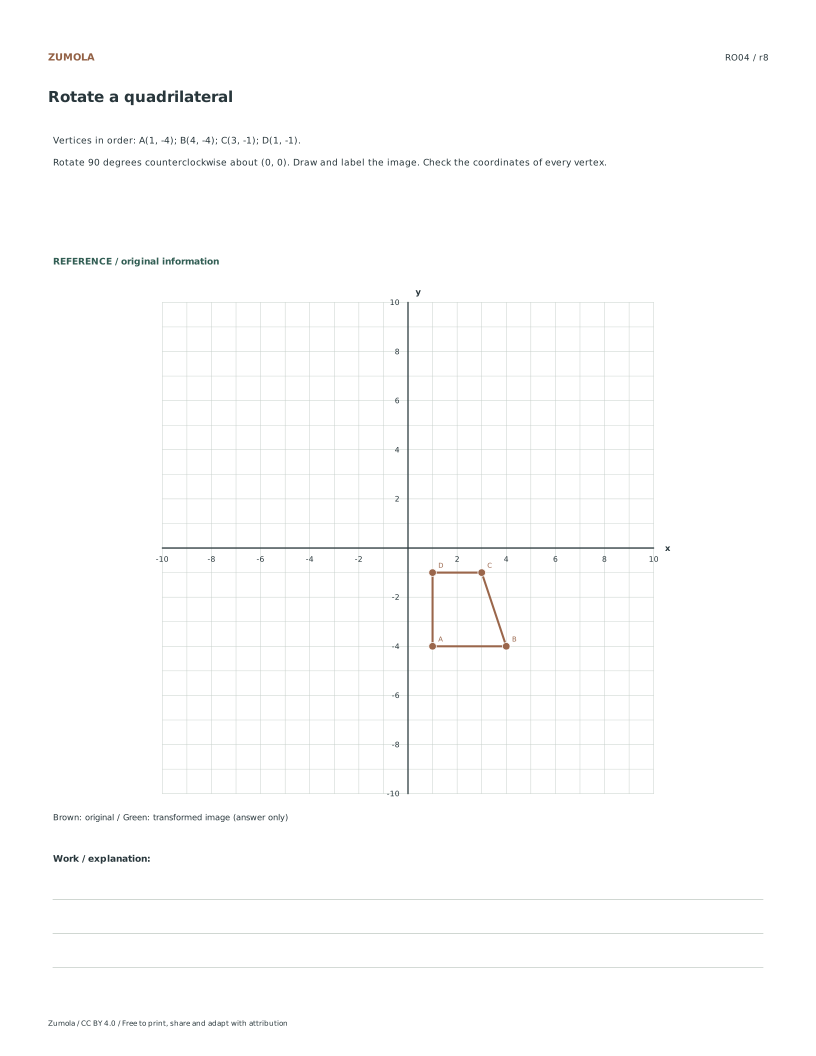
The first case shows the checking pattern. Individual answer files contain the completed graph or net and result for every case.
Work through the graph
Rotating Points and Shapes on a Grid
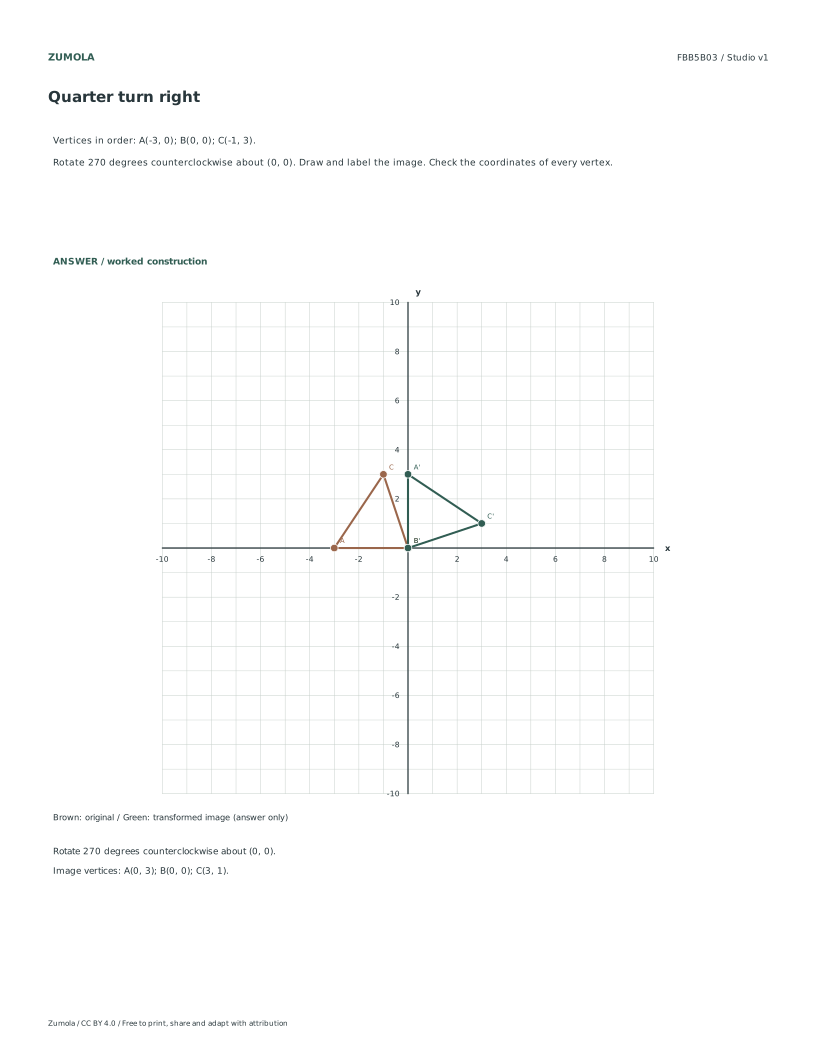
To rotate a point 90 degrees counterclockwise about the origin, swap its coordinates and change the sign of the new x-coordinate: (x, y) becomes (-y, x). For 180 degrees, change both signs: (x, y) becomes (-x, -y). For 270 degrees counterclockwise, (x, y) becomes (y, -x). Apply the rule to each vertex, then connect the image points in the same order. For example, rotating A(1, 1), B(4, 1), C(2, 3) 90 degrees counterclockwise gives A(-1, 1), B(-1, 4), C(-3, 2). Check that side lengths and angles are unchanged.
Checking Area After Rotation
Rotation does not change the size or shape of a figure, so the area stays the same. After finding the image vertices, you can verify by computing the area of the original and the image. For a triangle, use the shoelace formula or count grid squares. For example, the triangle with vertices A(1, 1), B(4, 1), C(2, 3) has area 3 square units. Its 90-degree counterclockwise image has vertices A(-1, 1), B(-1, 4), C(-3, 2) and also area 3 square units. If your computed areas differ, recheck the coordinate signs and the order of vertices.
Drawing and Labeling the Image
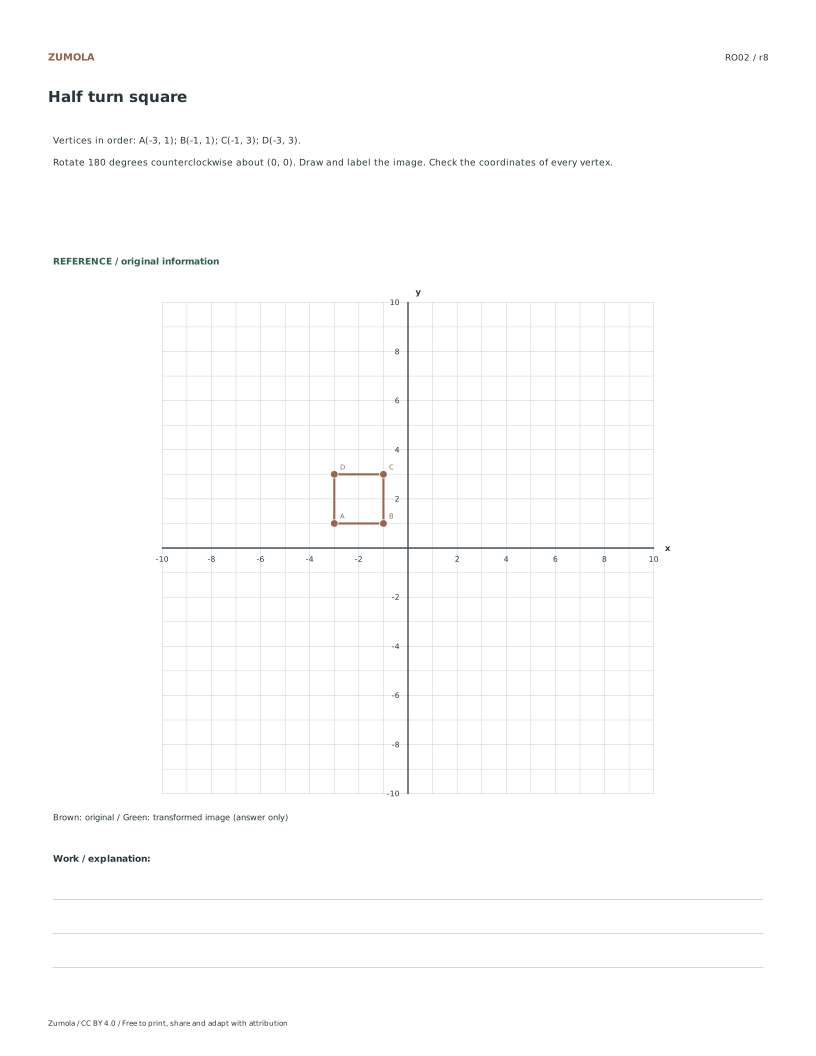
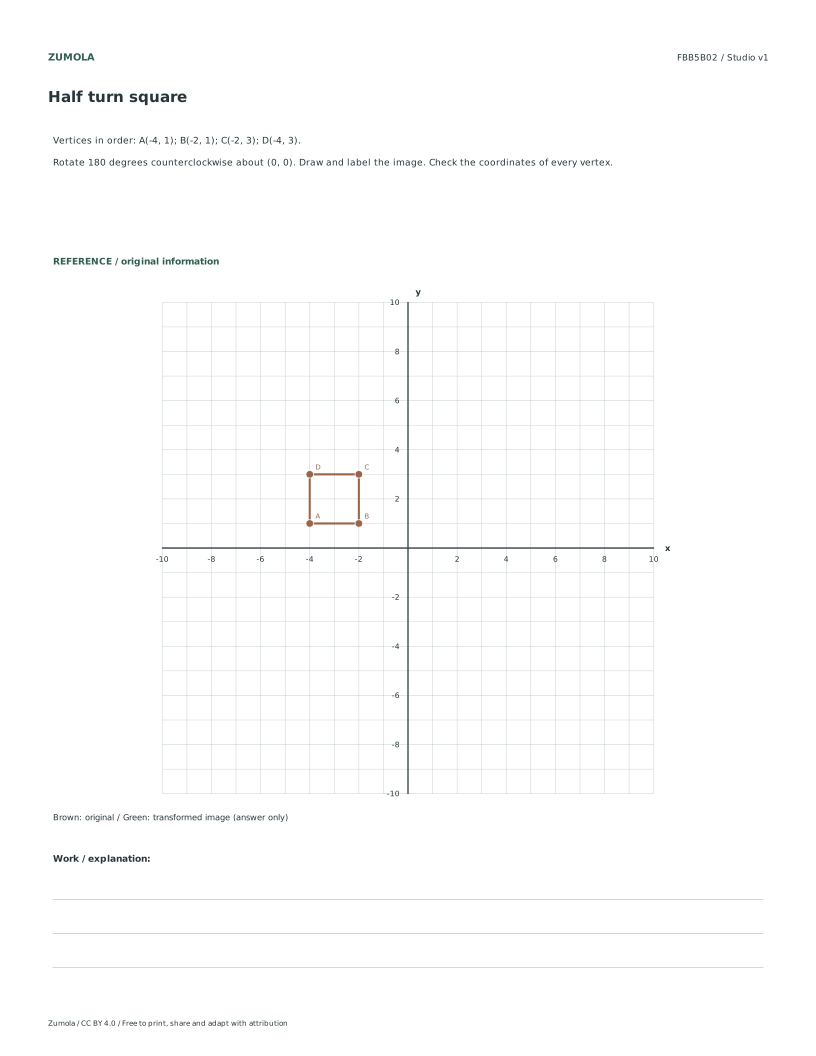
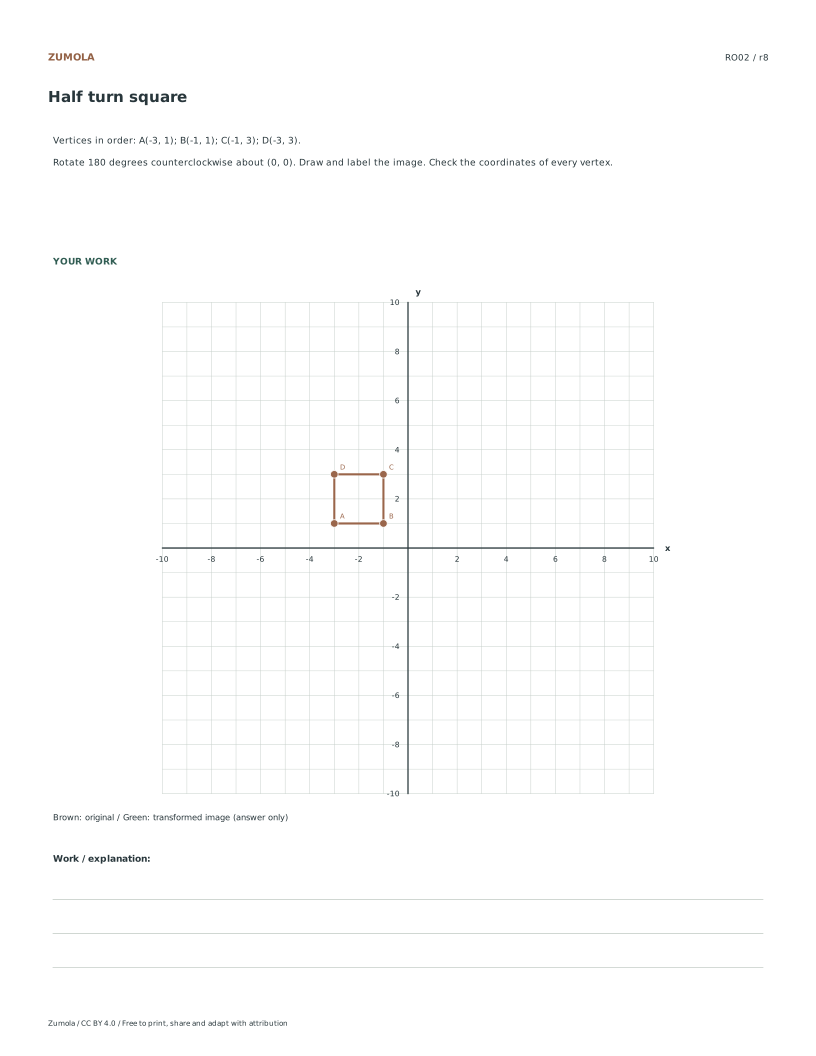
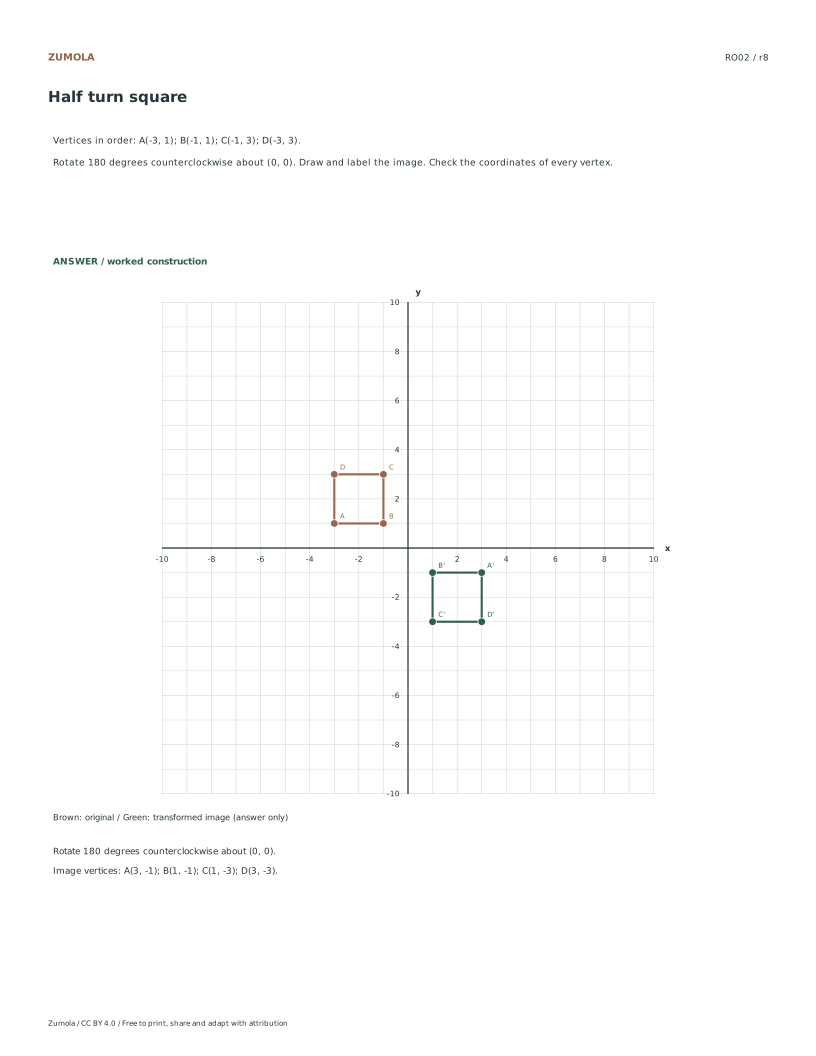
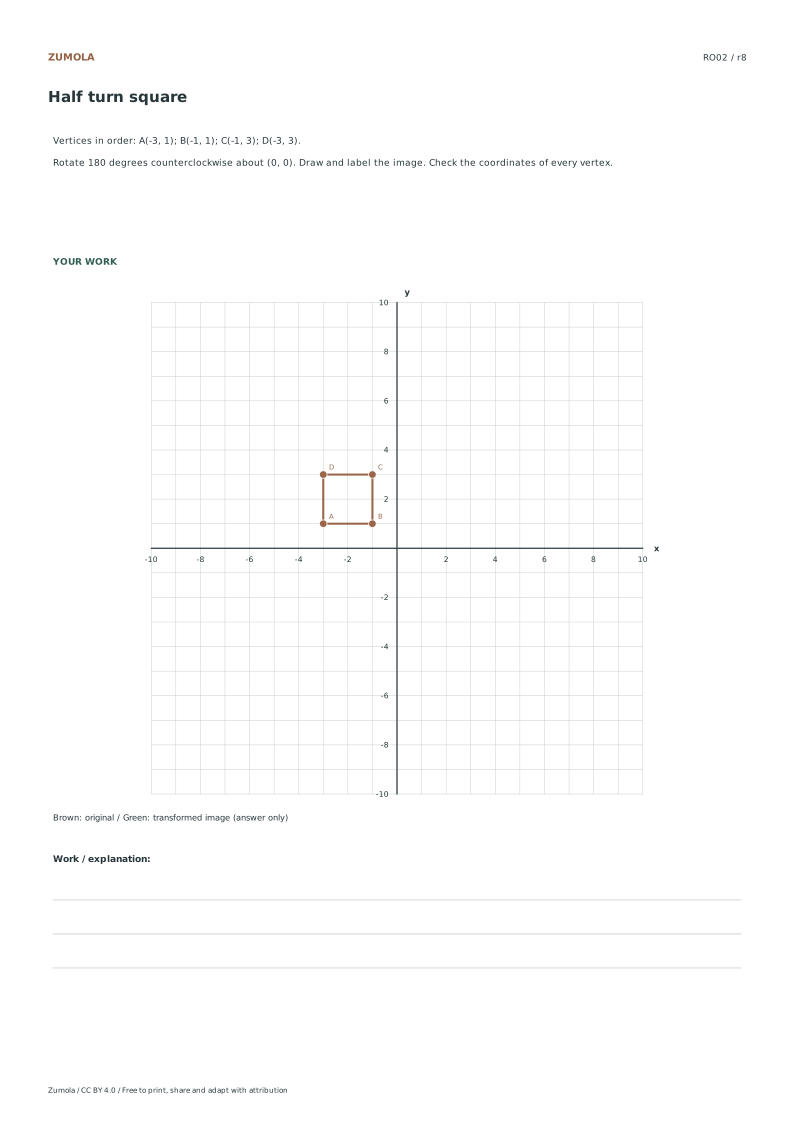
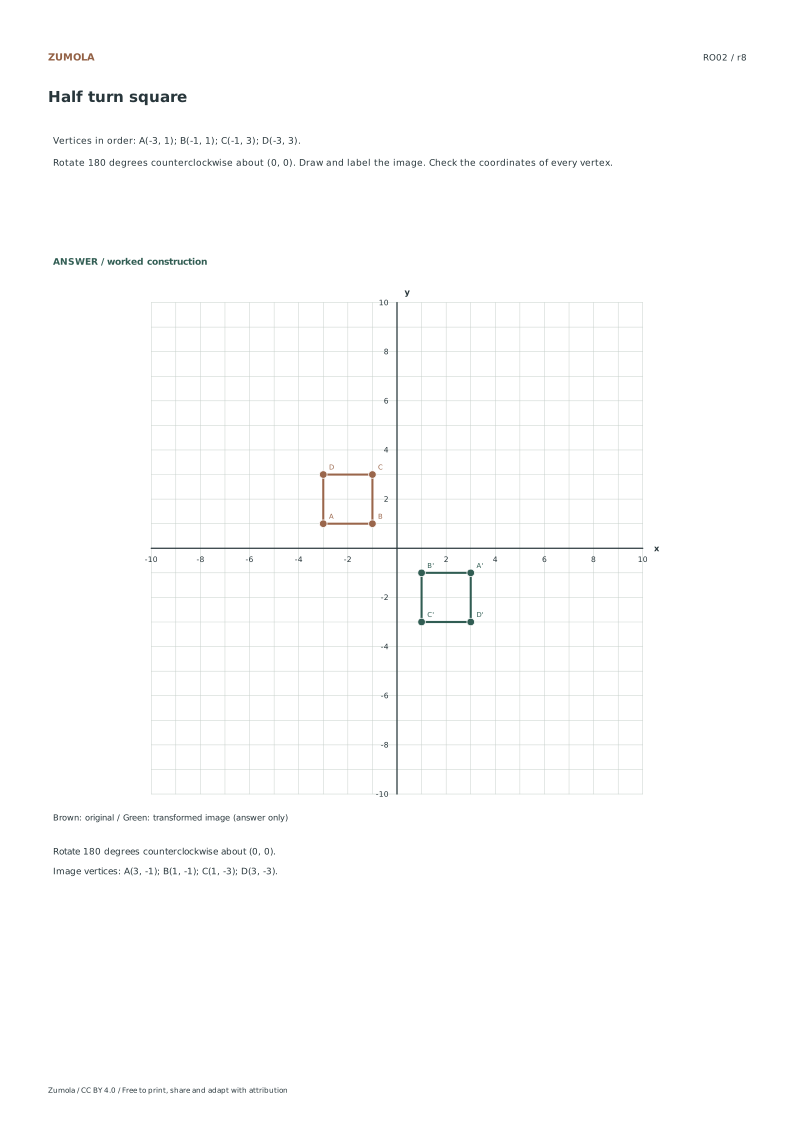
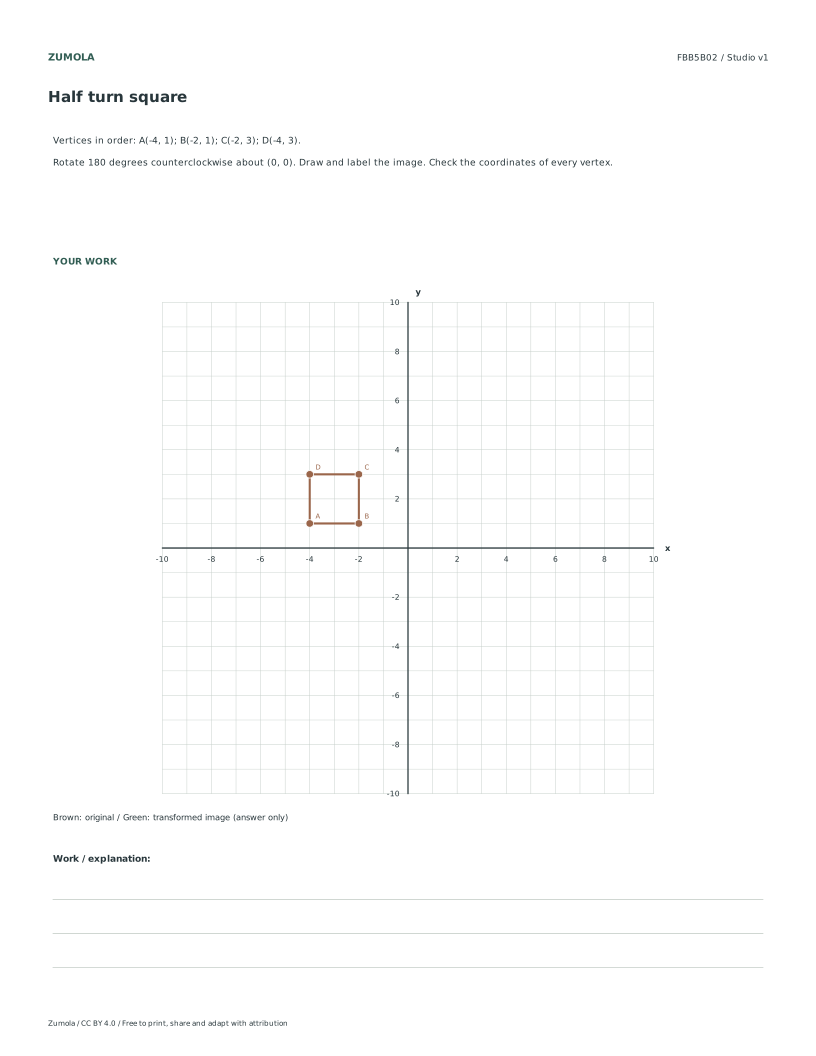
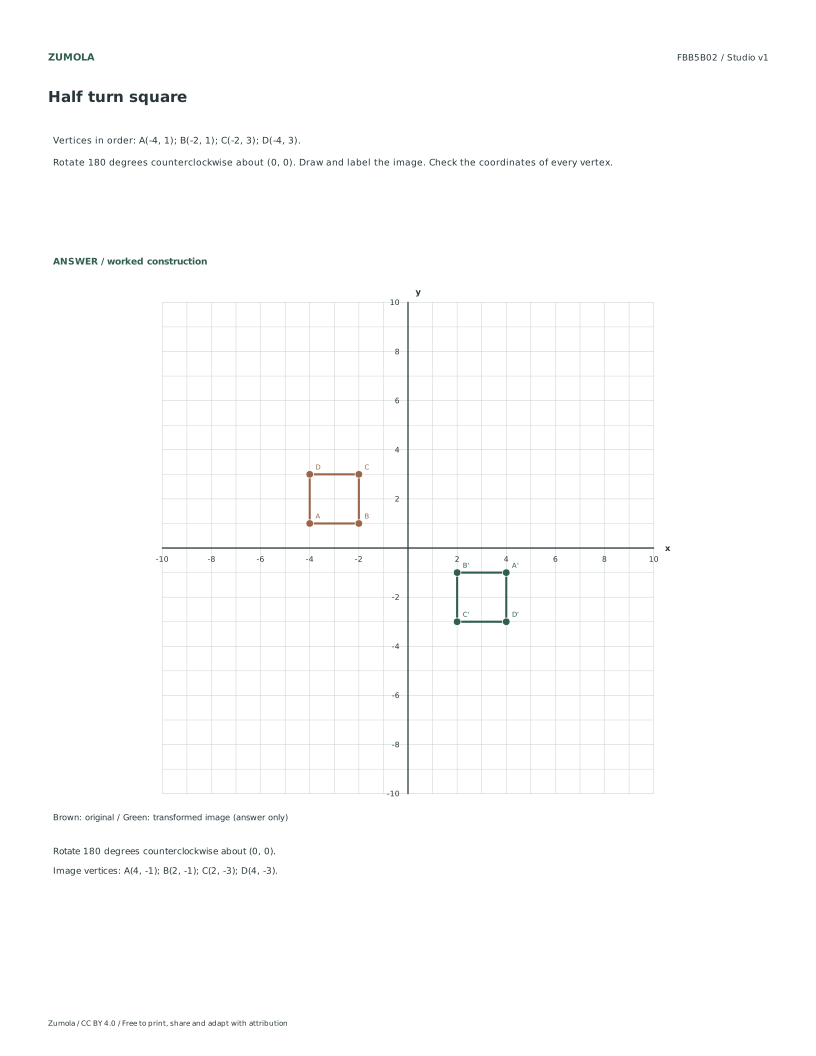
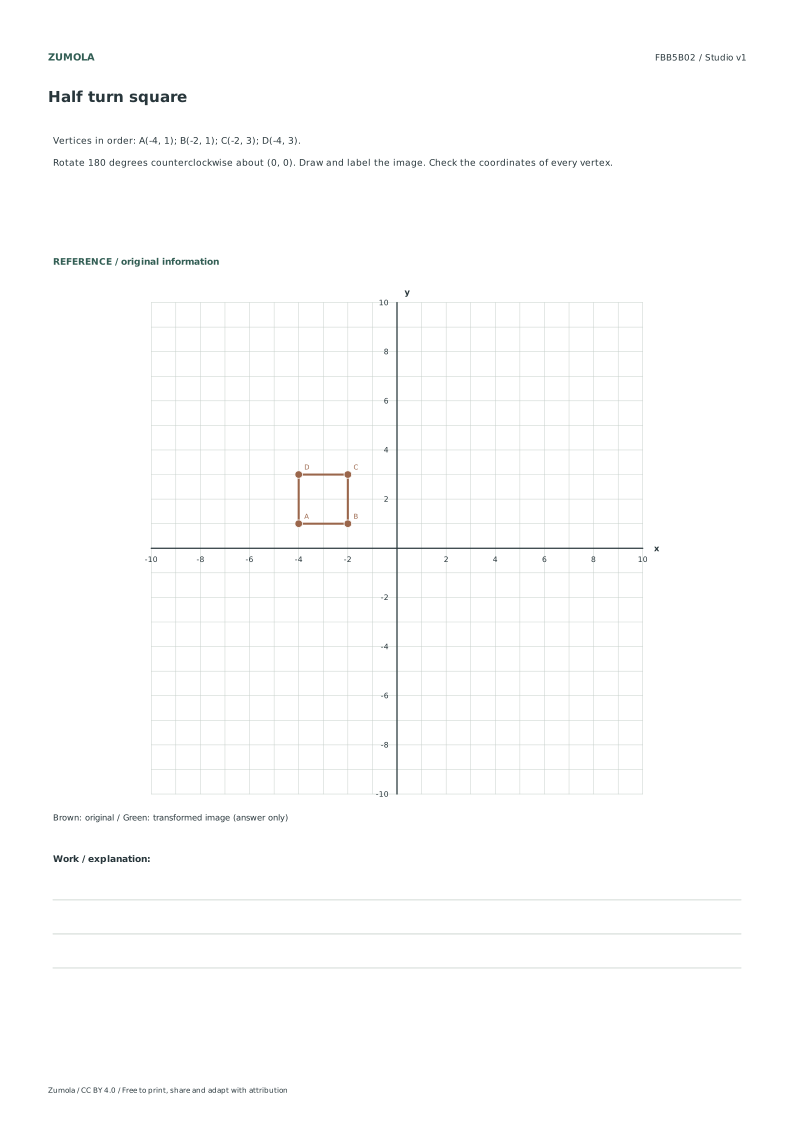
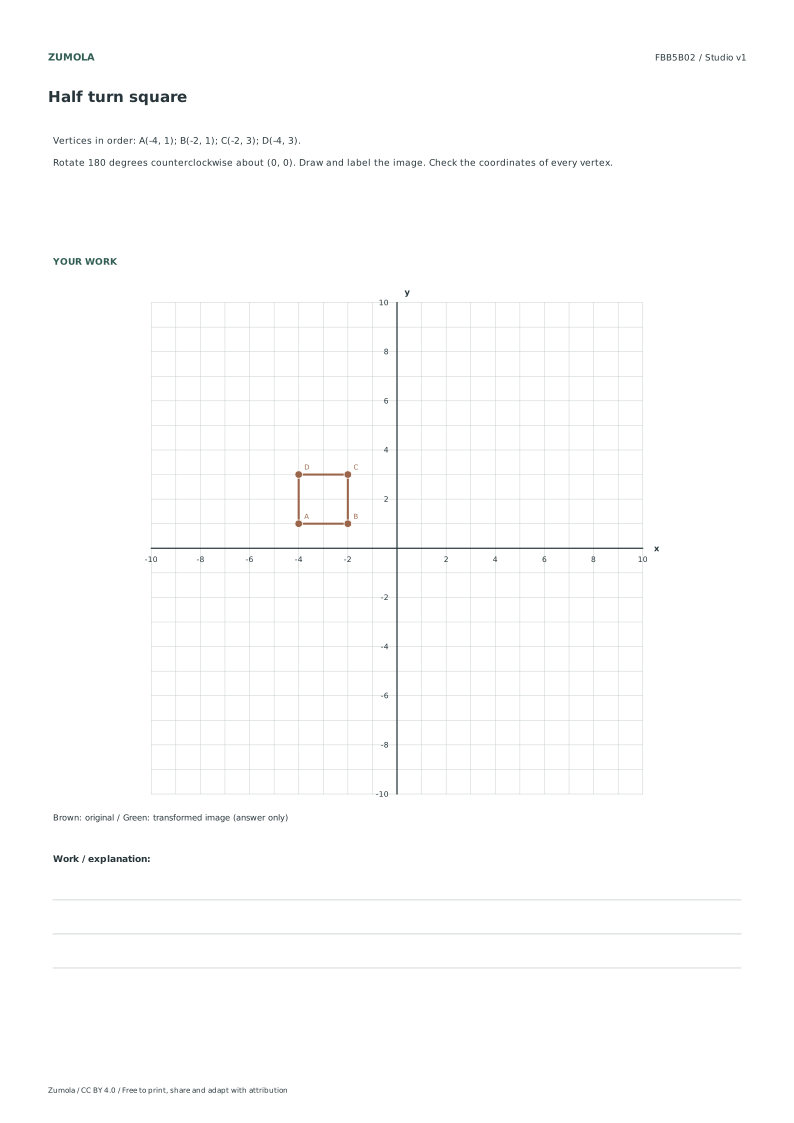
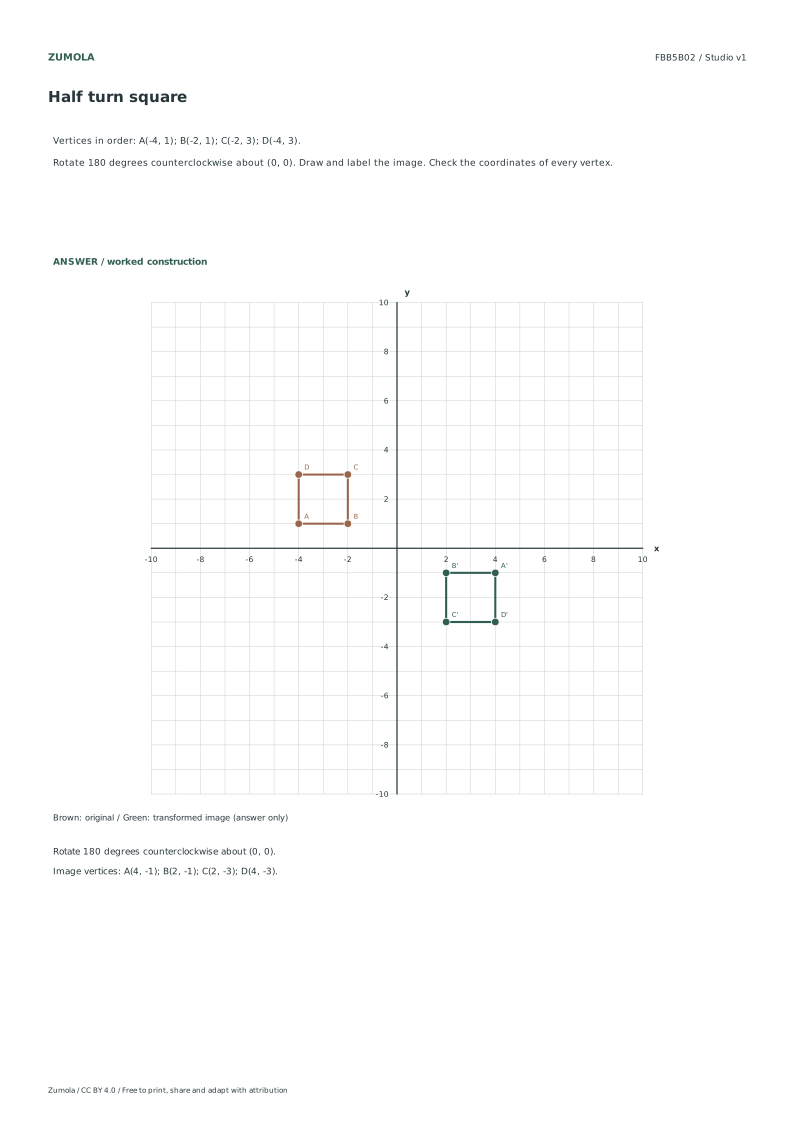
Plot the original vertices on a coordinate grid. Apply the rotation rule to each vertex to get the image coordinates. Plot the image points and connect them in the same order as the original. Label each image vertex with its prime notation, such as A', B', C'. For a 180-degree rotation of A(-3, 1), B(-1, 1), C(-1, 3), D(-3, 3), the image vertices are A'(3, -1), B'(1, -1), C'(1, -3), D'(3, -3). Ensure the image is the same distance from the origin as the original and that corresponding segments are equal in length.
Checks that catch common errors
Watch for
Check instead
Applying the 90-degree counterclockwise rule as (x, y) becomes (y, -x).
For 90 degrees counterclockwise, (x, y) becomes (-y, x). For example, (1, 1) becomes (-1, 1), not (1, -1).
Assuming that if two lines have slopes whose product is 1, they are parallel.
Parallel lines have equal slopes and different intercepts. A product of 1 does not indicate parallel lines; perpendicular lines have a slope product of -1.
Rotating a shape but changing the order of the vertices when connecting them.
Connect the image vertices in the same order as the original vertices to preserve the shape. For example, if original vertices are A, B, C in order, connect A', B', C' in that order.
Keep labels and margins readable
Choose the PDF that matches your paper. Print at Actual size / 100% and turn off Fit, Shrink and browser headers. SVG is editable but an editor can rescale it; the PDF is the simpler print route.
Useful answers
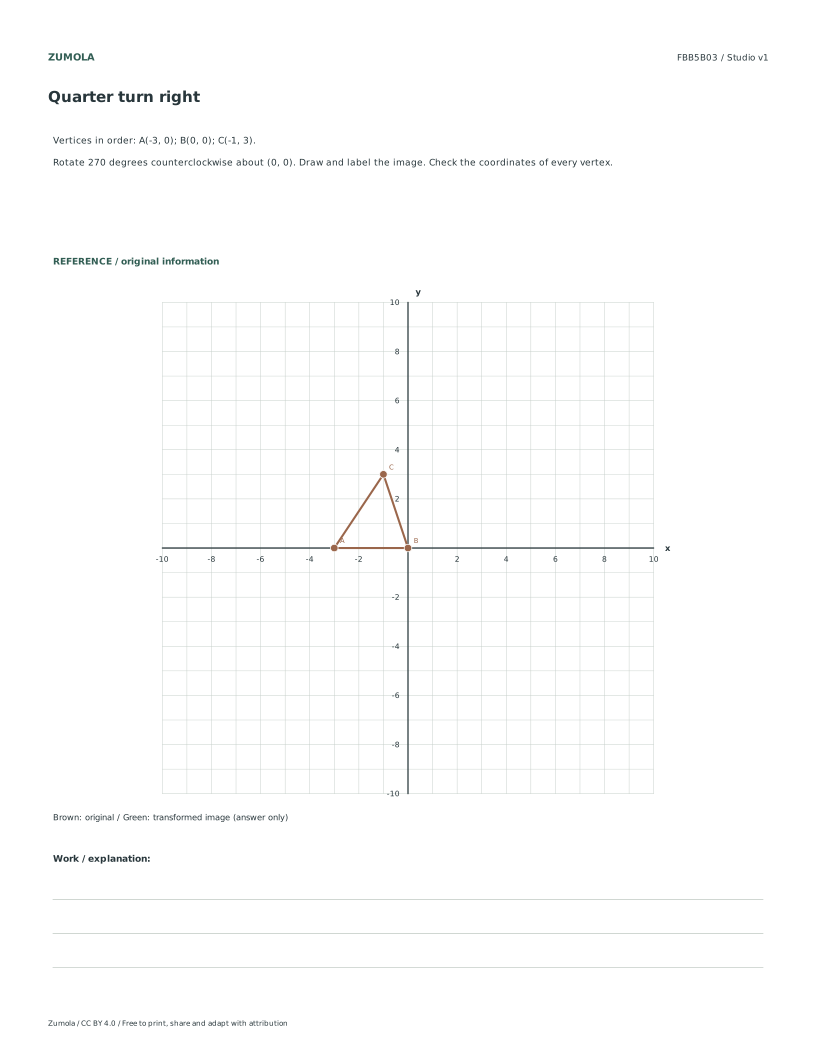
How do I rotate a point 270 degrees counterclockwise about the origin?
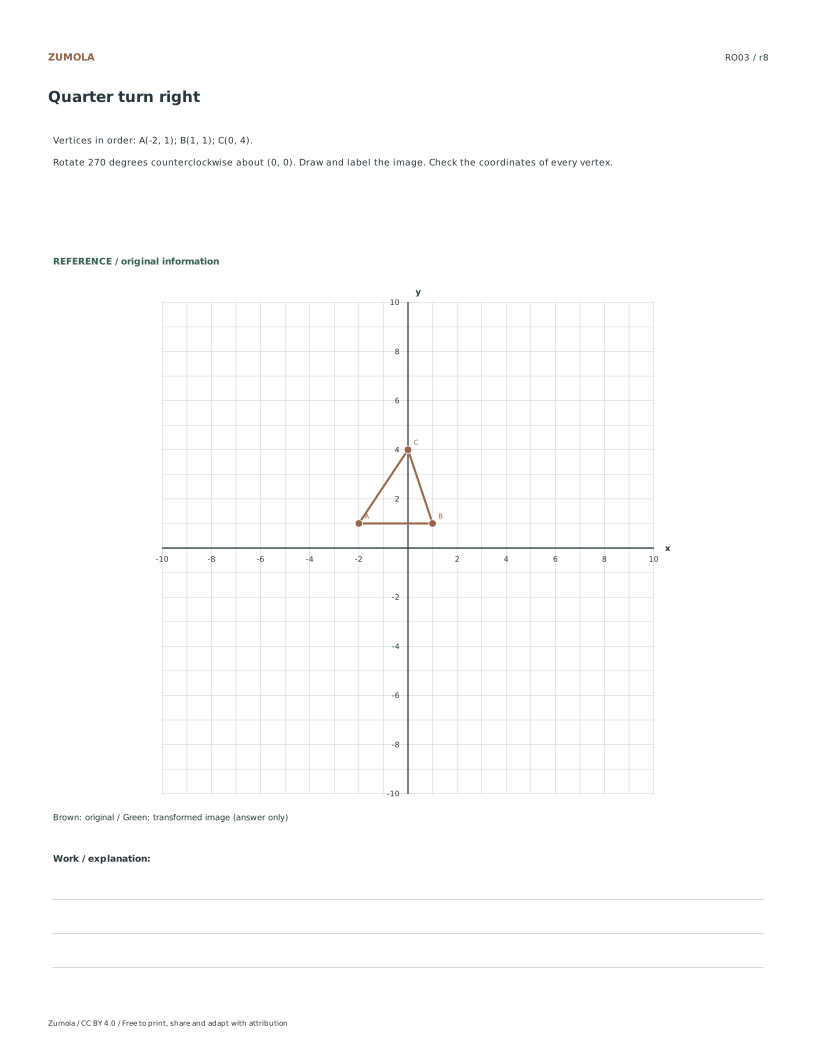
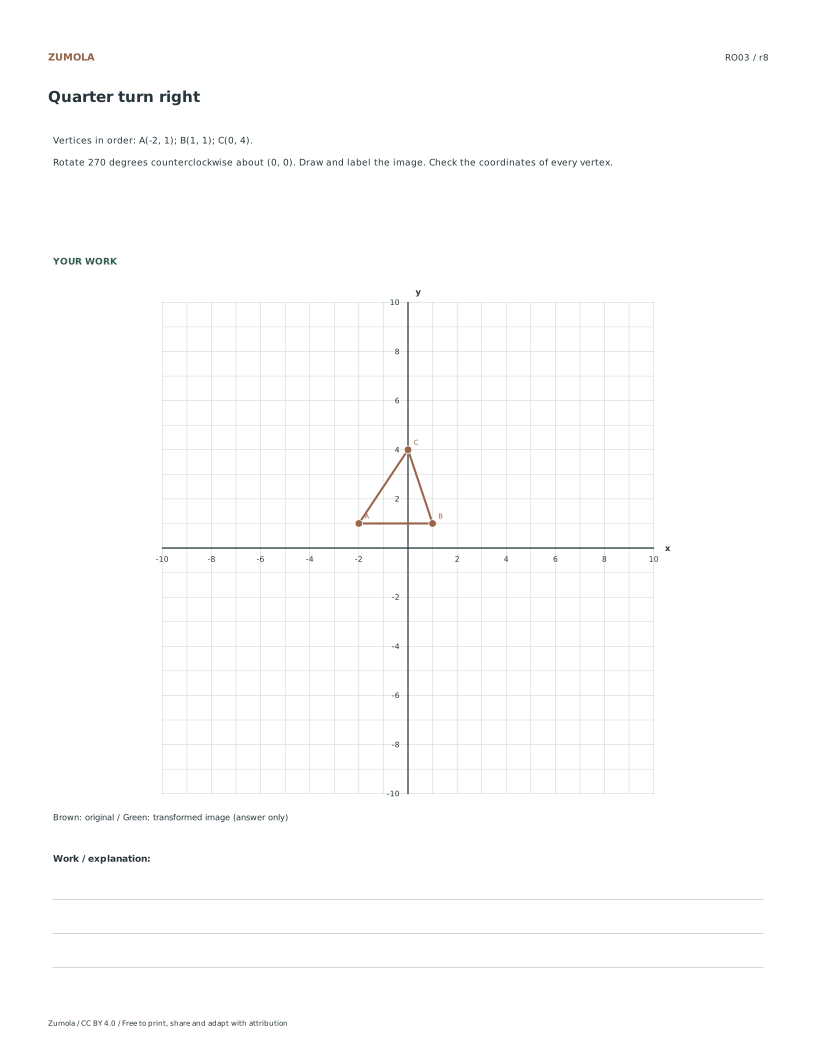
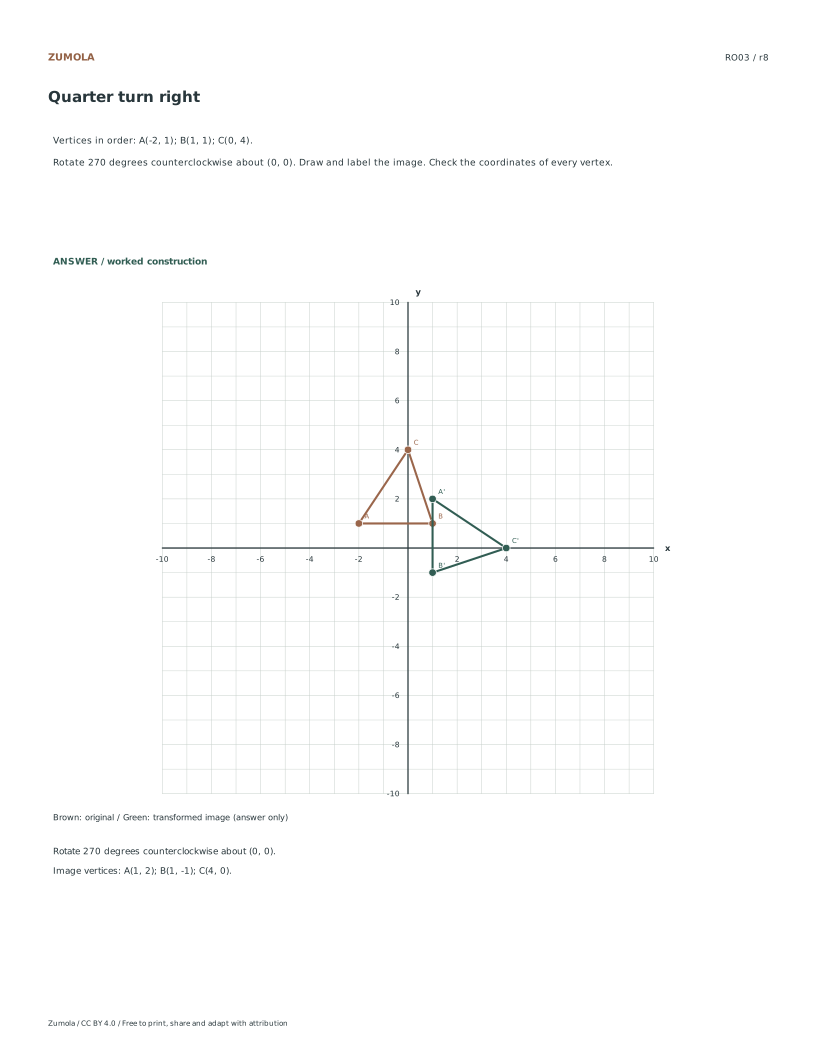
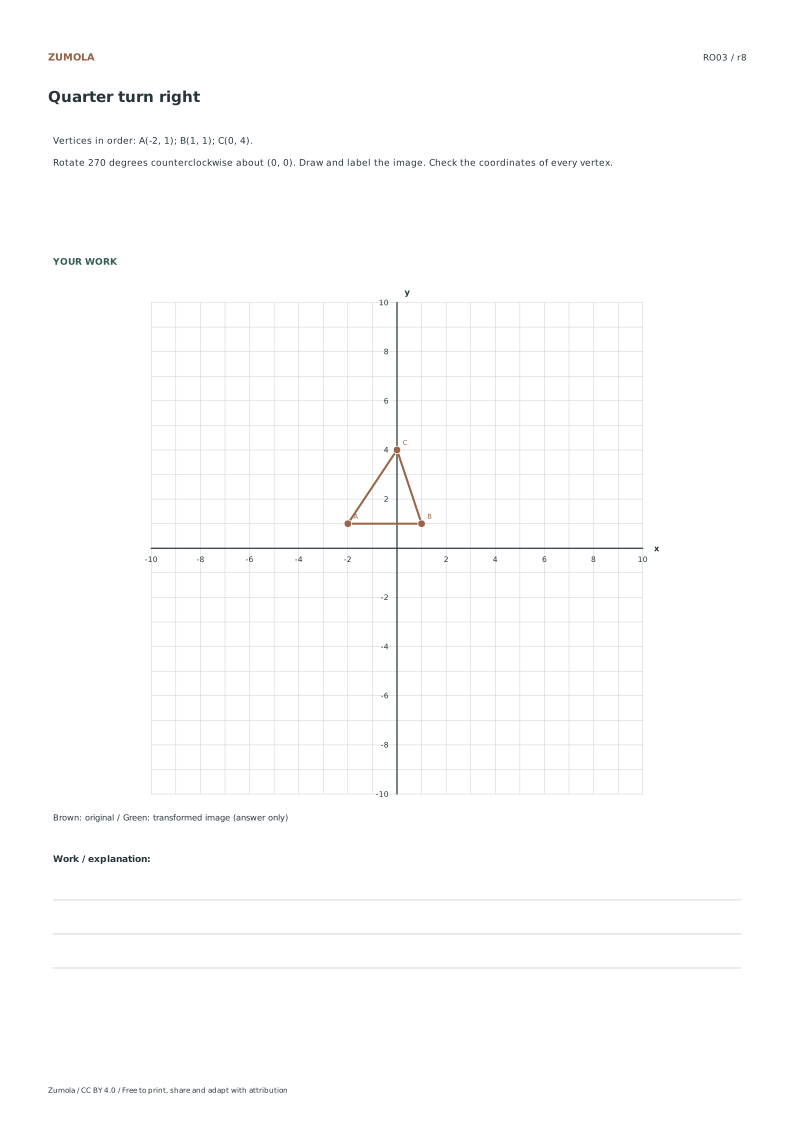
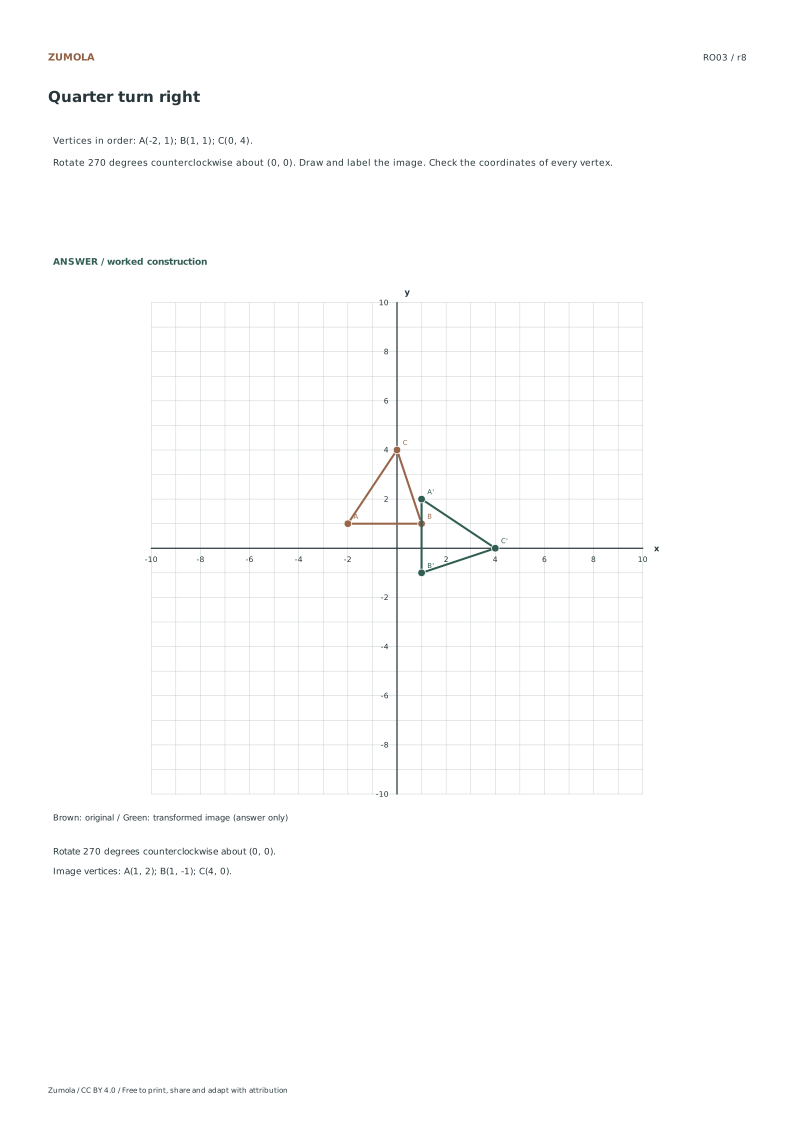
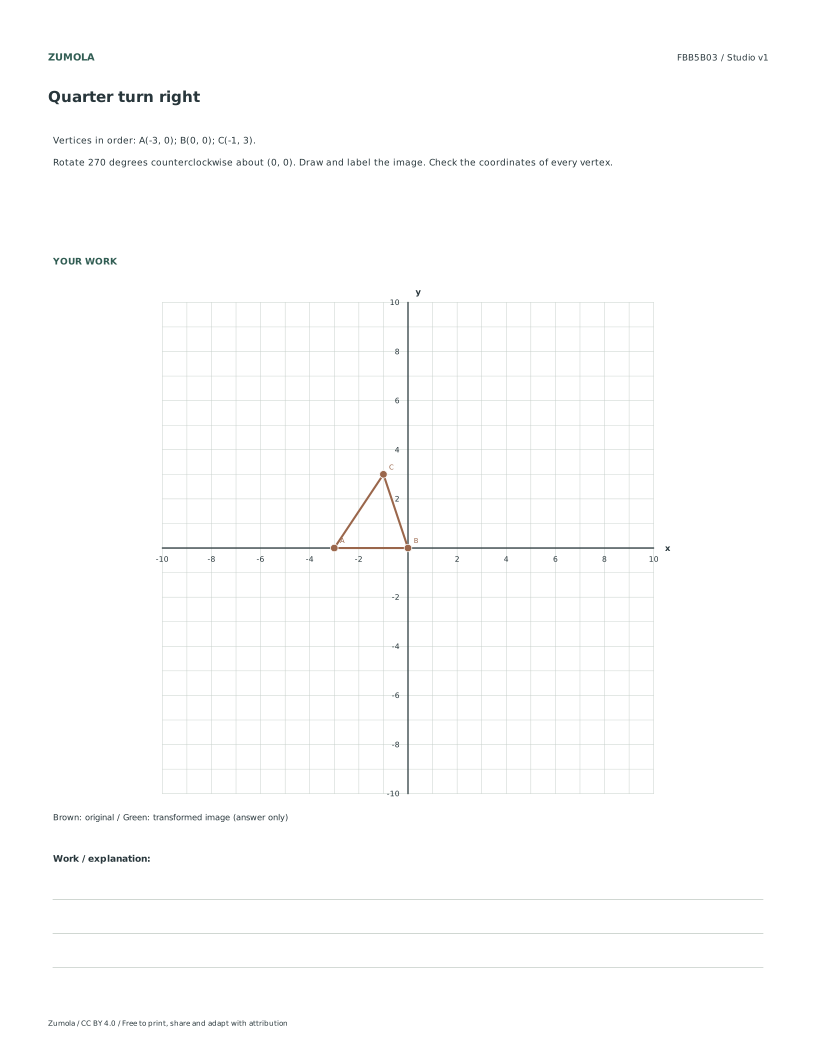
Use the rule (x, y) becomes (y, -x). For example, rotating A(-2, 1) 270 degrees counterclockwise gives A'(1, 2).
Does rotation change the area of a shape?
No. Rotation is a rigid transformation, so area is preserved. For instance, a triangle with area 3 square units still has area 3 square units after any rotation.
How can I tell if two lines are parallel from their equations?
Rewrite both equations in slope-intercept form. If the slopes are equal and the y-intercepts are different, the lines are parallel. If both slopes and intercepts are equal, they are the same line.
Are the answer files and editable graphs free?
Yes. The individual student, reference and answer files plus collection packs are free without signup. Credit Zumola under CC BY 4.0 when sharing or adapting.
To rotate a point 90 degrees counterclockwise about the origin, swap its coordinates and change the sign of the new x-coordinate: (x, y) becomes (-y, x). For 180 degrees, change both signs: (x, y) becomes (-x, -y). For 270 degrees counterclockwise, swap and change the sign of the new y-coordinate: (x, y) becomes (y, -x). Apply the rule to each vertex. For example, rotating A(2, 0) 90 degrees counterclockwise gives A'(0, 2). Plot the image vertices in the same order and connect them to draw the rotated figure.
Check the first new case
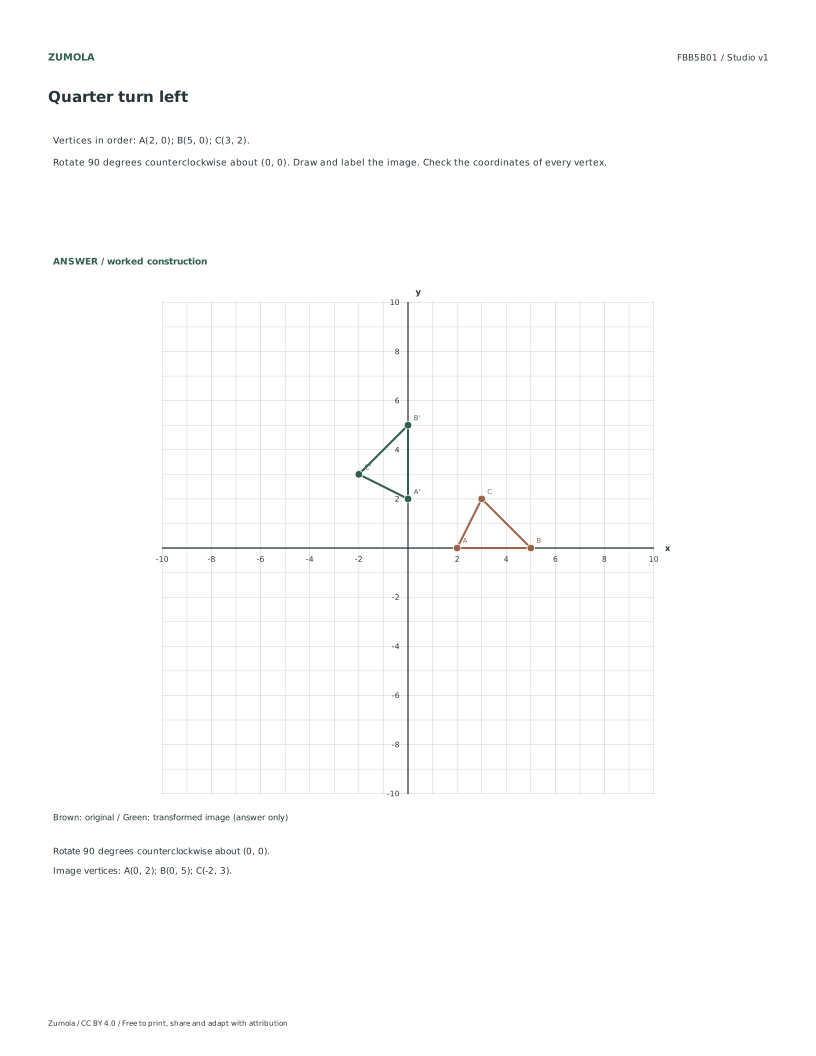
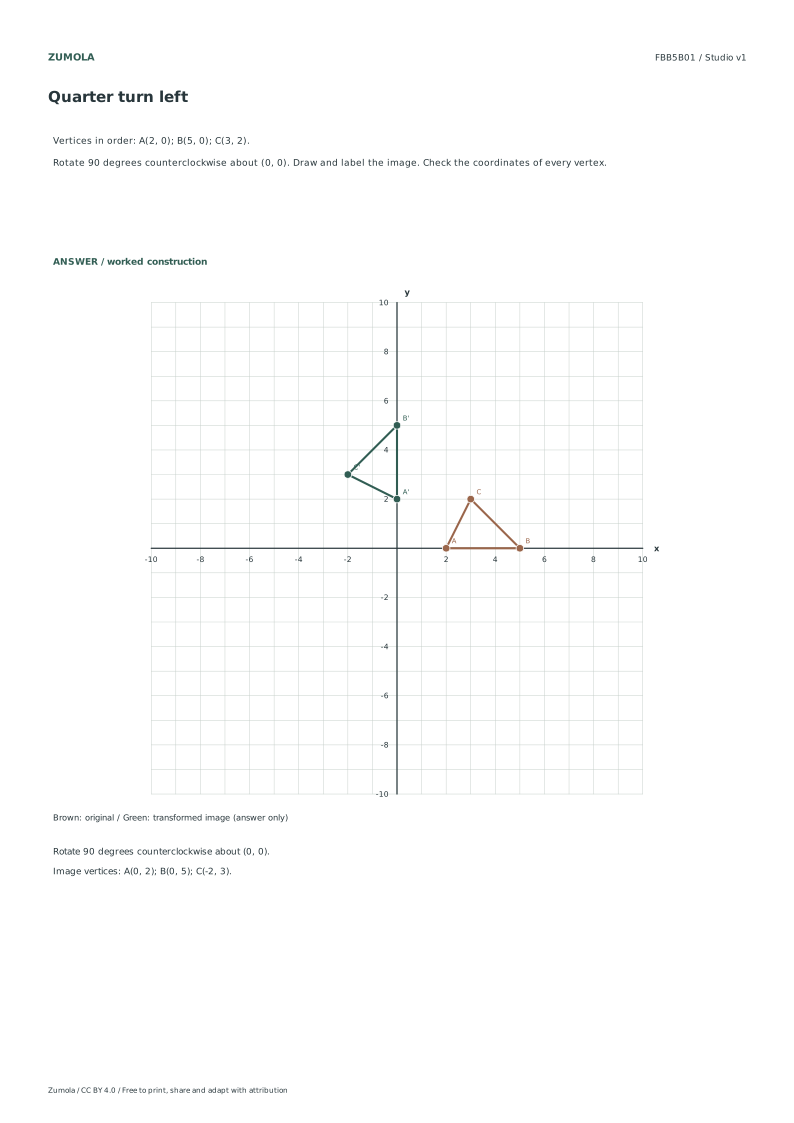
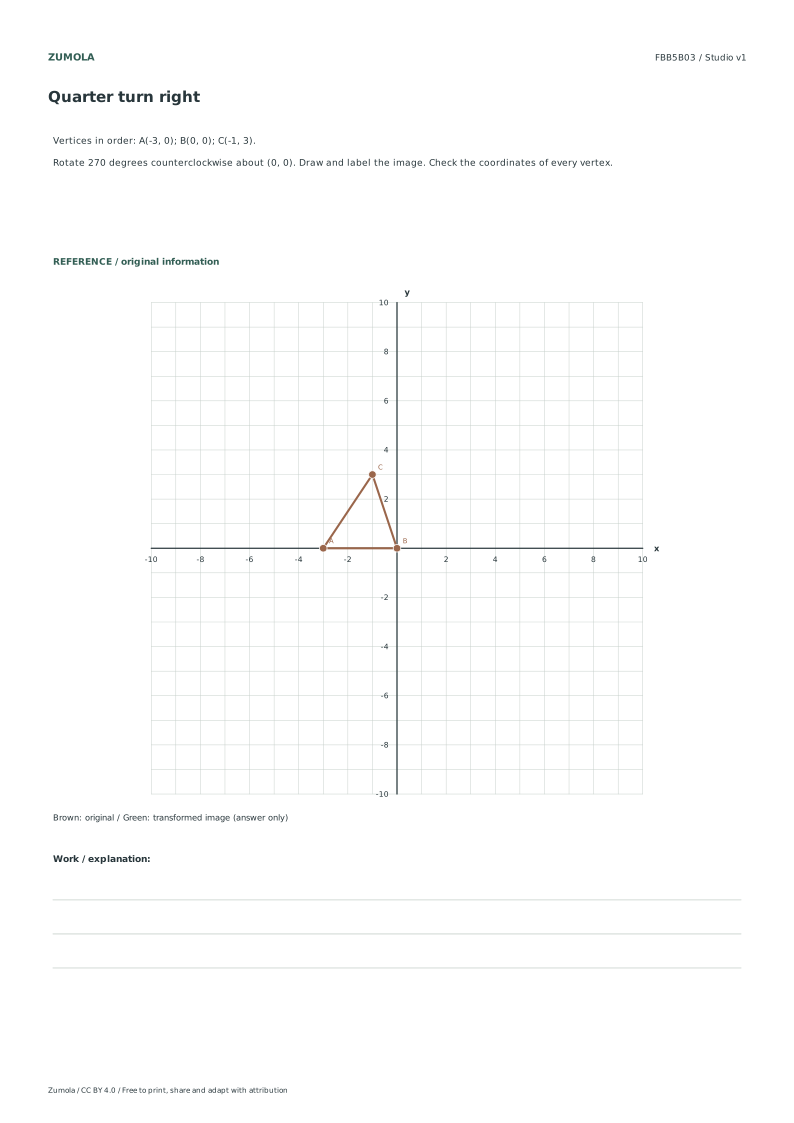
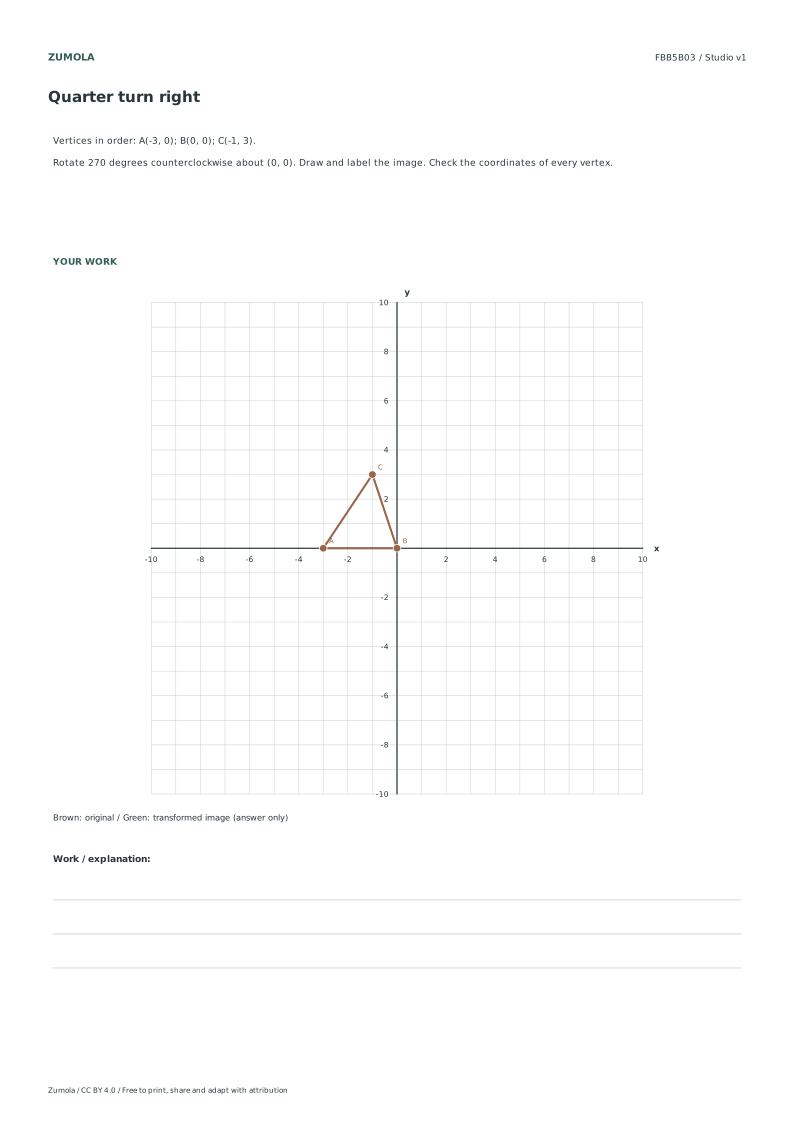
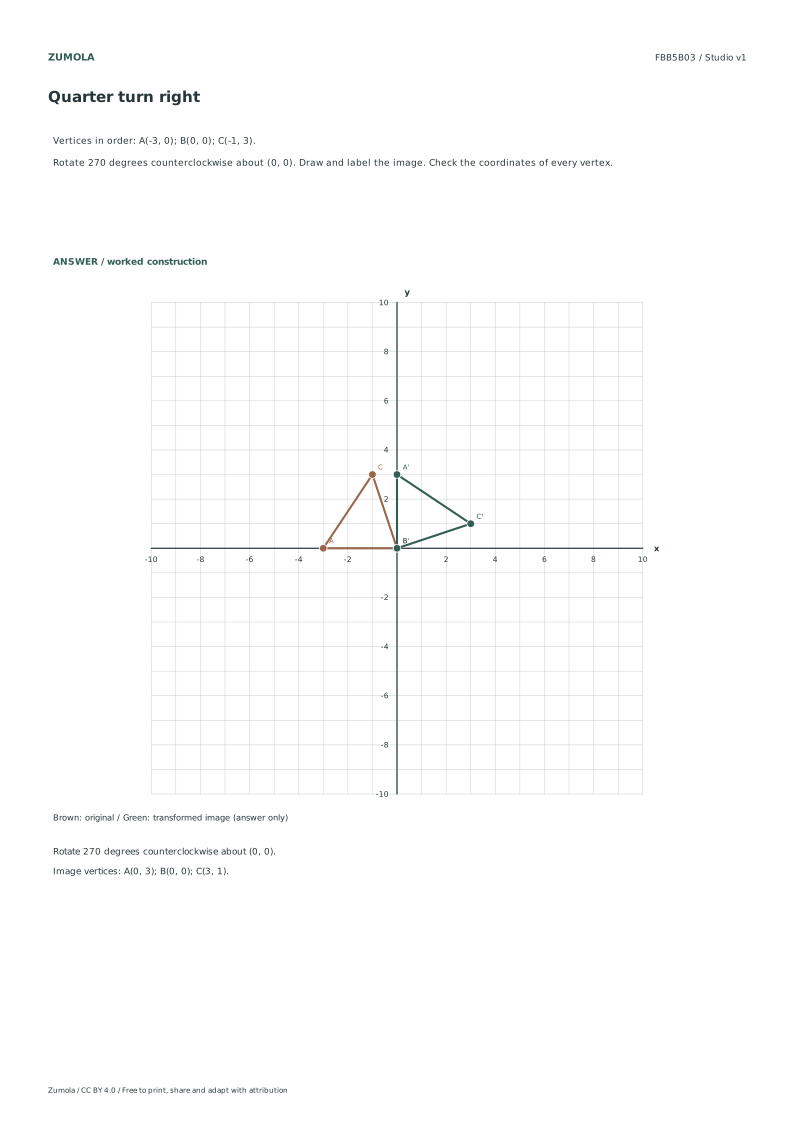
Vertices in order: A(2, 0); B(5, 0); C(3, 2).
Rotate 90 degrees counterclockwise about (0, 0).
Image vertices: A(0, 2); B(0, 5); C(-2, 3).
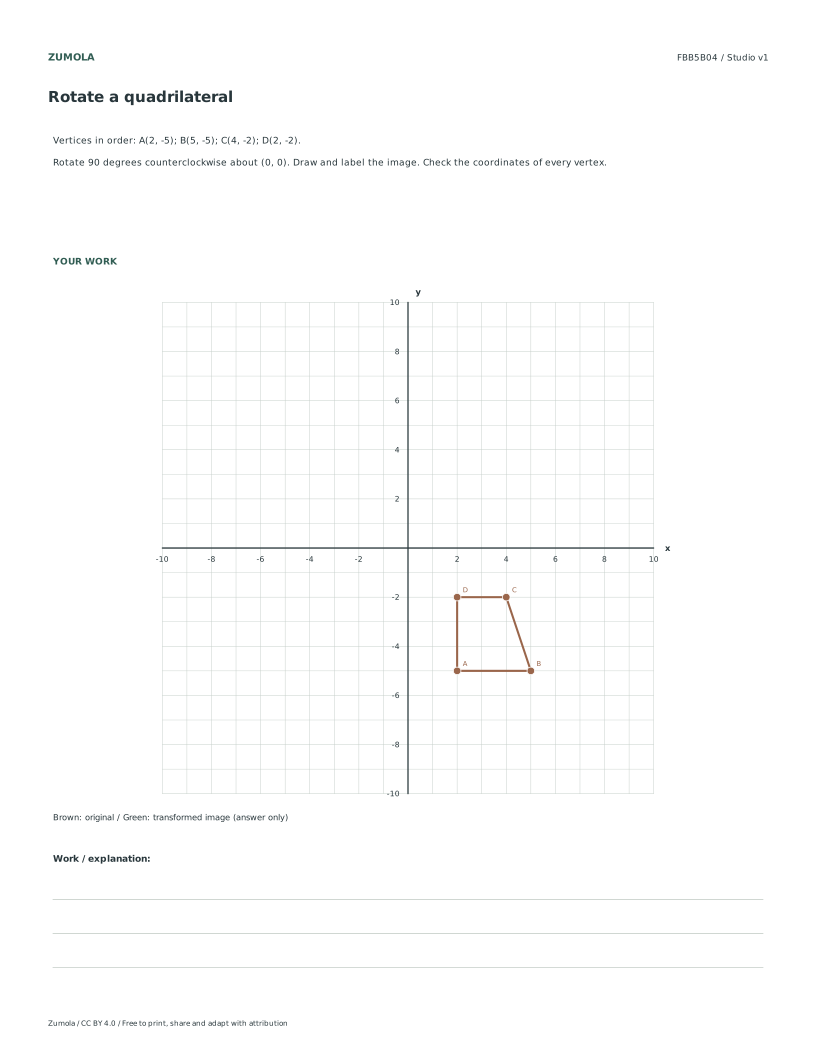
The answer PDFs include the completed drawings and checks for all four cases. Free original resources, CC BY 4.0. No signup required.
More ways to practice
Composite case: rotate then reflect
A composite transformation applies two rules in order. The order matters: rotating then reflecting usually gives a different image than reflecting then rotating. For a 90° counterclockwise rotation about the origin, the rule is (x, y) becomes (-y, x). For a reflection across the x-axis, the rule is (x, y) becomes (x, -y). Apply the first rule to every vertex, then apply the second rule to the results.
Keep a two-column table: original vertex, after rotation, after reflection. Label each image point with primes so the intermediate stage stays visible. If you skip the intermediate column, you cannot tell which rule produced an error.
Plot the original quadrilateral with vertices A(1, 1), B(4, 1), C(4, 3), D(1, 3).
Apply the 90° counterclockwise rule to each vertex: A becomes (-1, 1), B becomes (-1, 4), C becomes (-3, 4), D becomes (-3, 1).
Reflect those results across the x-axis: (-1, 1) becomes (-1, -1), (-1, 4) becomes (-1, -4), (-3, 4) becomes (-3, -4), (-3, 1) becomes (-3, -1).
Plot the final image and connect vertices in the same order as the original.
Measure side lengths of original and final image; a rotation and a reflection both preserve length, so corresponding sides must match.
Diagnostic checks that catch composite errors
Check orientation, not just position. A single rotation preserves orientation (the order of vertices around the shape stays the same). A reflection reverses it. After a rotate-then-reflect, the final image should be mirror-reversed relative to the original. If your final shape has the same orientation as the original, you likely applied the reflection twice or skipped it.
Check one vertex by an independent route. For the 90° counterclockwise rotation, the distance from the origin to each vertex must stay the same. A(1, 1) is at distance √2 from the origin; its rotated image (-1, 1) is also at distance √2. Verify this for at least two vertices with the distance formula.
Confirm each rotated vertex keeps its distance from the origin: compare x² + y² before and after.
Confirm the reflection only changes the sign of the y-coordinate.
Check that the final image is mirror-reversed compared with the original by tracing vertex order.
Recompute one vertex entirely from scratch without looking at your table.
Judging the drawing with a rubric
Rotation drawings have multiple valid presentations: grid lines may be light or heavy, labels may sit beside or above points, and shading is optional. Judge the mathematical content separately from presentation choices. A correct drawing with messy labels is still correct; a neat drawing with one wrong vertex is not.
Use the rubric to score process and result. Partial credit for a correct table with a plotting slip is reasonable, because the reasoning is sound and the error is mechanical.
Score vertex coordinates against the formula, not against visual similarity.
Score the intermediate rotation column separately from the final reflection column.
Score labeling: each image vertex should be distinguishable from its original.
Score the orientation check: did the student state whether orientation was preserved or reversed?
Try this example
Rotate the triangle with vertices P(2, 0), Q(4, 0), R(4, 3) by 90° counterclockwise about the origin, then reflect the result across the x-axis. List all coordinates.
Show the worked explanation
Rotation rule (x, y) to (-y, x): P(2, 0) becomes (0, 2); Q(4, 0) becomes (0, 4); R(4, 3) becomes (-3, 4). Reflection across the x-axis, (x, y) to (x, -y): (0, 2) becomes (0, -2); (0, 4) becomes (0, -4); (-3, 4) becomes (-3, -4). Final image vertices: (0, -2), (0, -4), (-3, -4). Check: P is at distance 2 from the origin and its rotated image (0, 2) is also at distance 2. The original triangle has vertices ordered counterclockwise; the final image is ordered clockwise, confirming the reflection reversed orientation.
Common mistakes
Applying the reflection before the rotation because the final shape looks plausible. Follow the stated order strictly and keep an intermediate column so each stage is visible and checkable.
Assuming a composite of rotation and reflection preserves orientation. State explicitly that rotation preserves orientation and reflection reverses it; check vertex order around the final shape.
Checking only one vertex and declaring the whole drawing correct. Verify every vertex with the formula and confirm at least two distances from the origin are unchanged by the rotation.
Check your work
Every vertex coordinate matches the rotation formula applied in the stated order.
The intermediate rotation stage is recorded separately from the final reflection stage.
Distances from the origin are verified as unchanged by the rotation for at least two vertices.
Orientation is explicitly identified as reversed by the reflection.
Image vertices are labeled distinctly from original vertices.
One vertex is recomputed independently as a cross-check.
Questions before you start
Does the order of a rotation and a reflection change the result?
Yes. Rotating then reflecting generally gives a different image than reflecting then rotating. Always apply the rules in the stated order and record the intermediate stage.
How do I know if my final image is correct without an answer key?
Check each vertex with the rotation formula, confirm distances from the origin are unchanged by the rotation, and confirm the reflection only flips the sign of the y-coordinate. Then check orientation: the final image should be mirror-reversed.
Can a rotation drawing be marked wrong for presentation choices?
No. Grid weight, label placement and shading are presentation choices. Mark coordinates, orientation and labeling clarity separately from neatness.
Optional Google Analytics helps us understand which free resources are useful. It is off until you allow it. Drawing tools and downloads work with either choice. Privacy details