Free original lessons
Draw a Halloween Ghost
This plate teaches one easy Halloween ghost drawing using a draped sheet shape and a choice of three simple faces. You will draw the body as a soft hanging cloth with a rounded head, wavy hem, and gentle side folds, then place a face that fits the mood you want. The worked example shows the full construction; the four tasks ask you to build, vary, redraw from reference, and check your own ghost.
Letter & A4
PDF & SVG
What you are drawing
The ghost is a sheet: a rounded top for the head, two soft side edges that fall like cloth, and a wavy bottom hem. Folds are short curved lines that suggest the cloth hanging, not sharp creases. The face is a small set of shapes placed in the upper-middle of the body so the ghost reads clearly at a glance.
Building the sheet shape
Start with a rounded head curve, then let the two sides fall downward with a slight outward drift. Close the bottom with a wavy hem made of two soft dips. Add one short fold line near each side to show the cloth hanging. Keep the outline continuous and soft; avoid straight edges and sharp corners.
Choosing a face
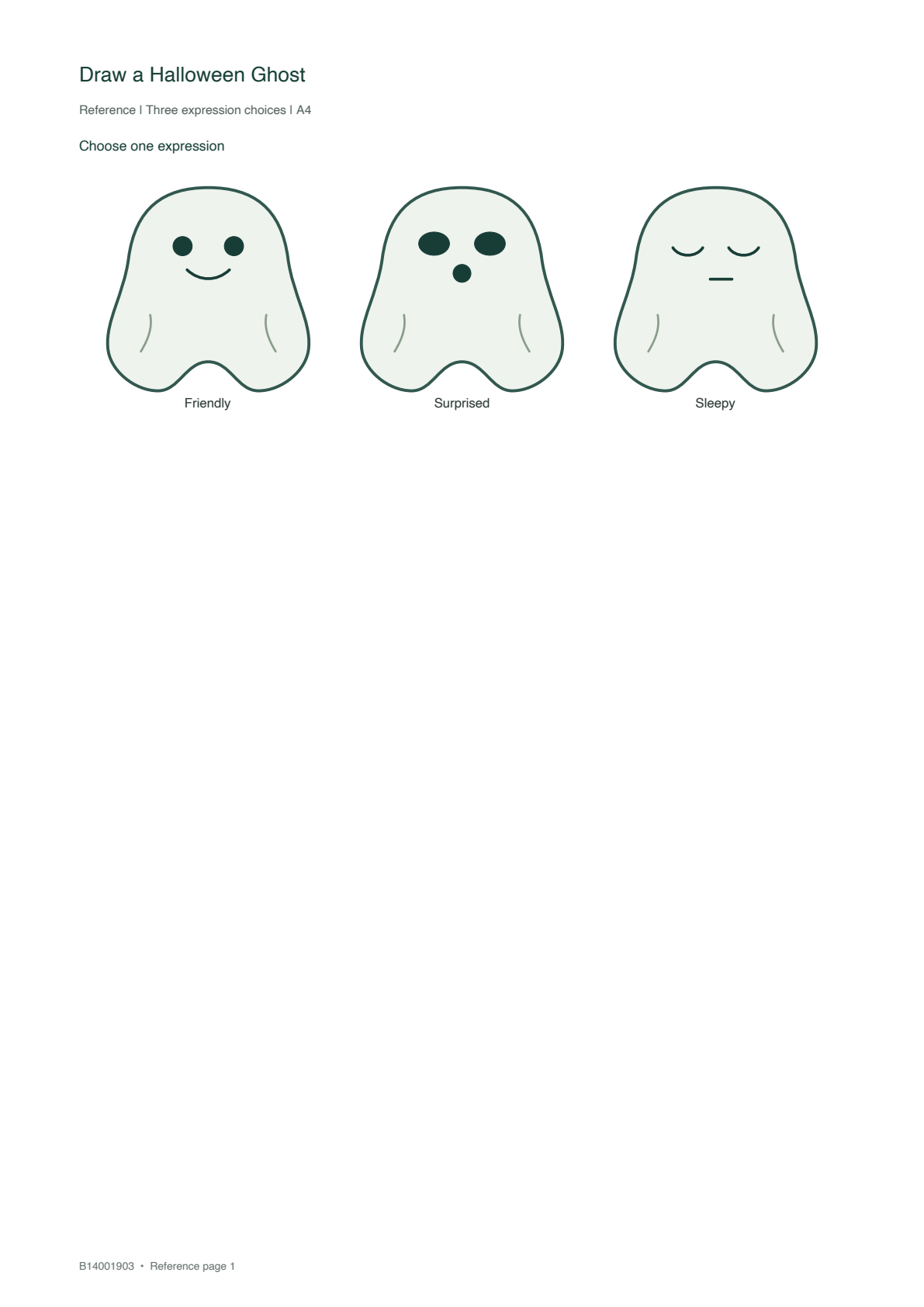
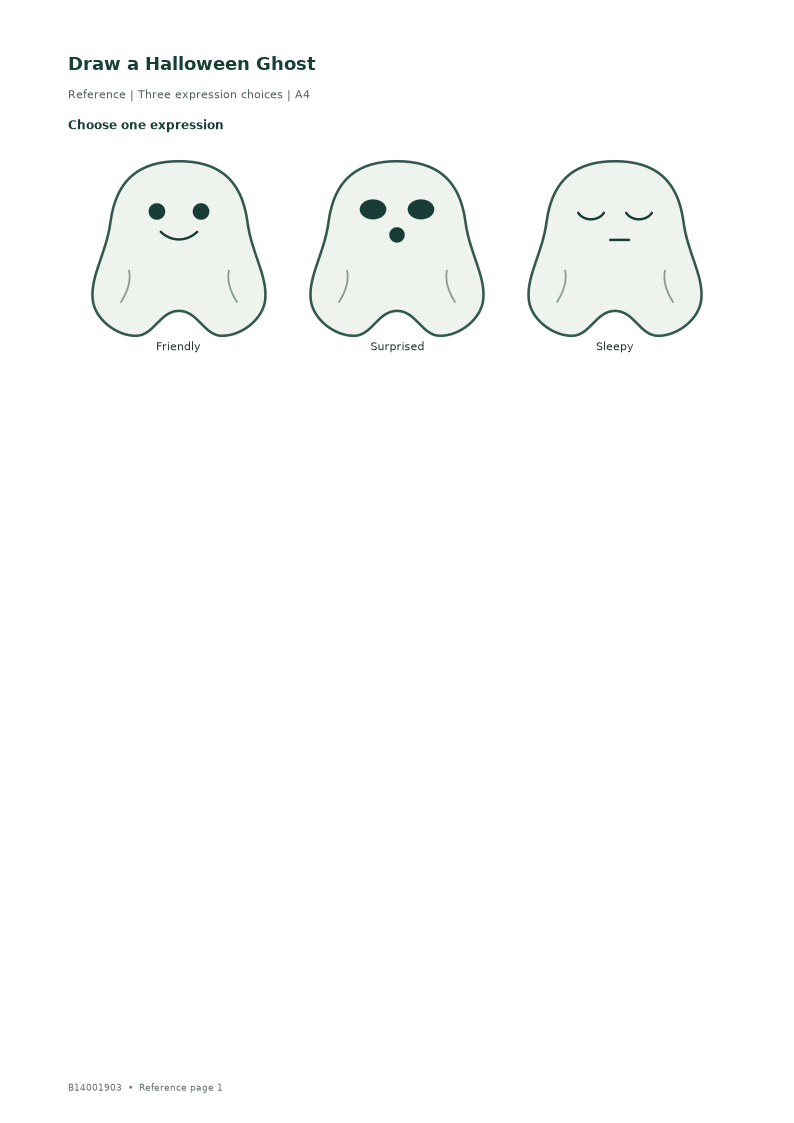
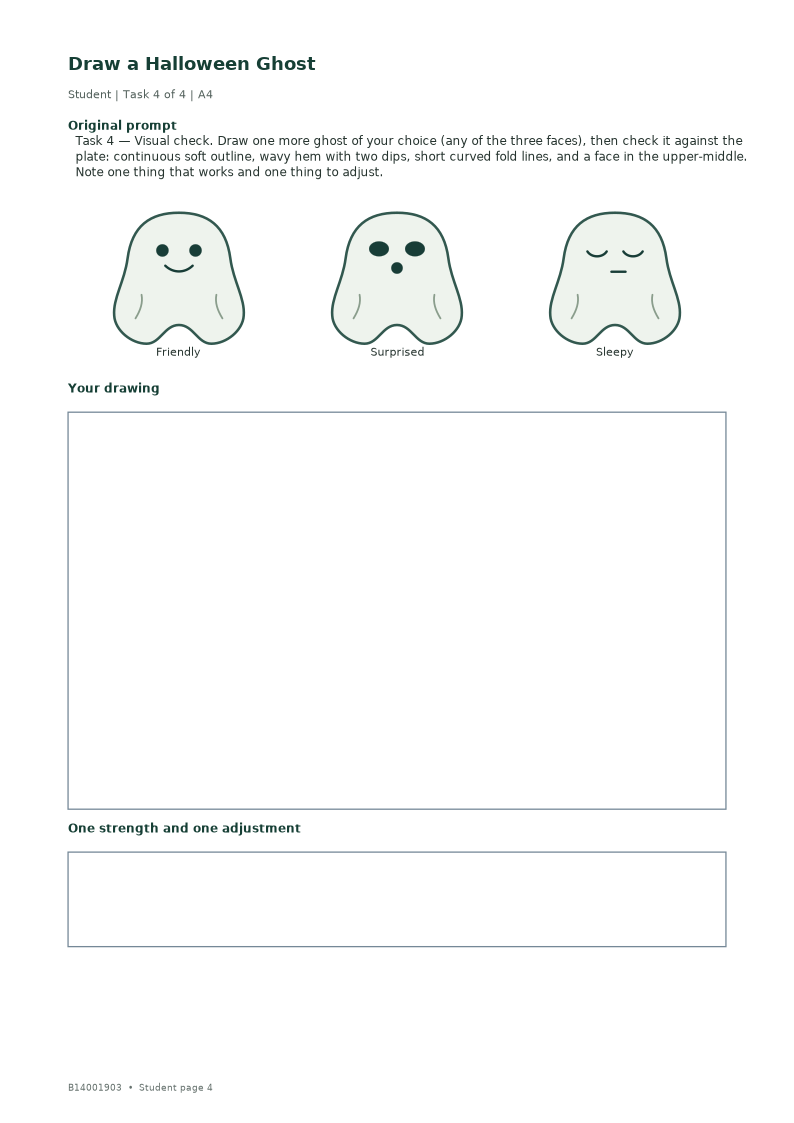
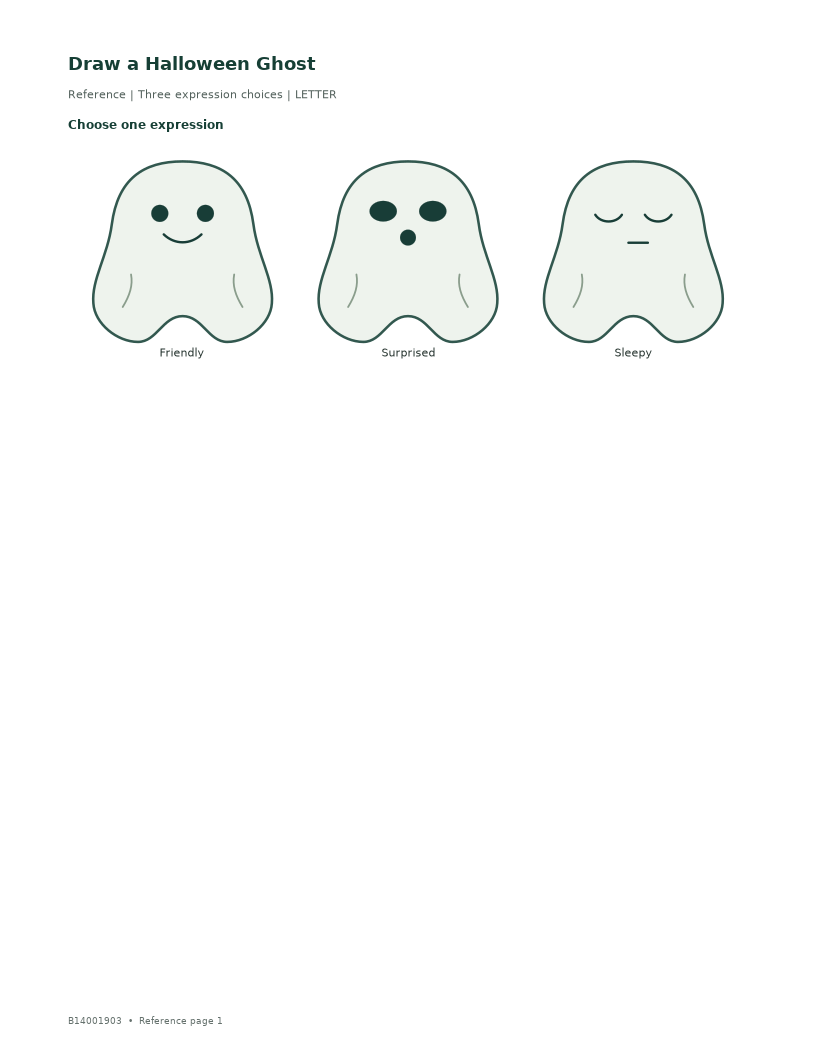
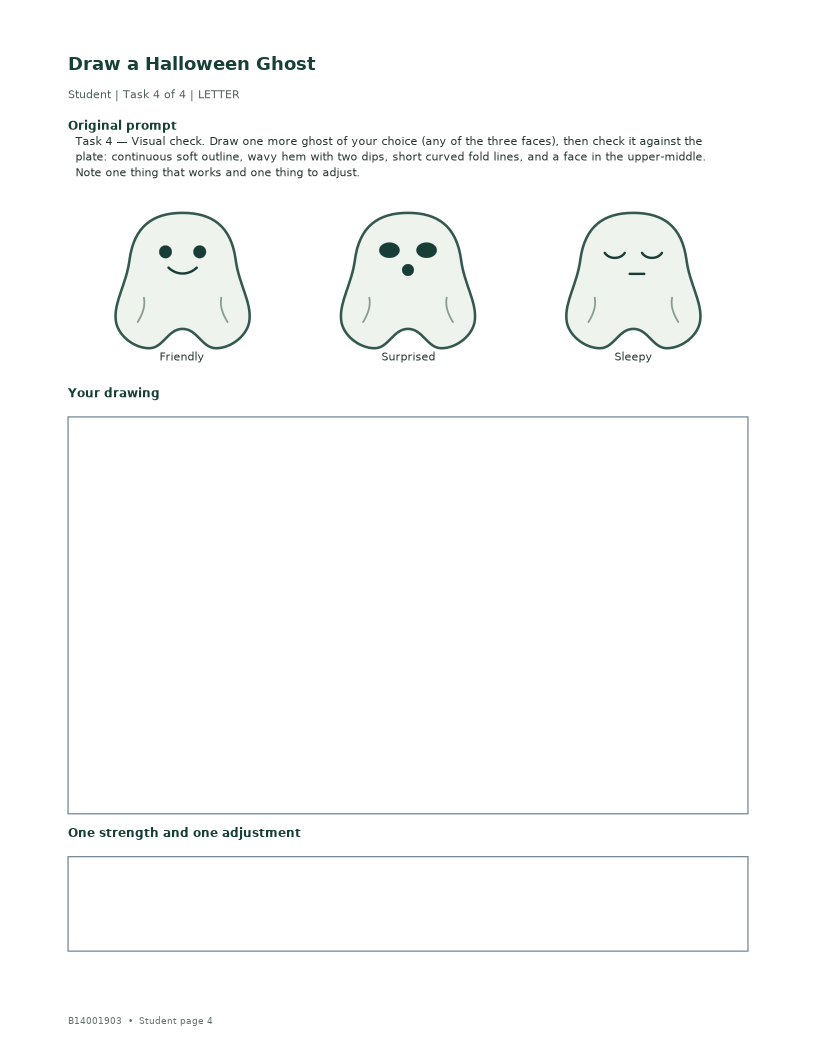
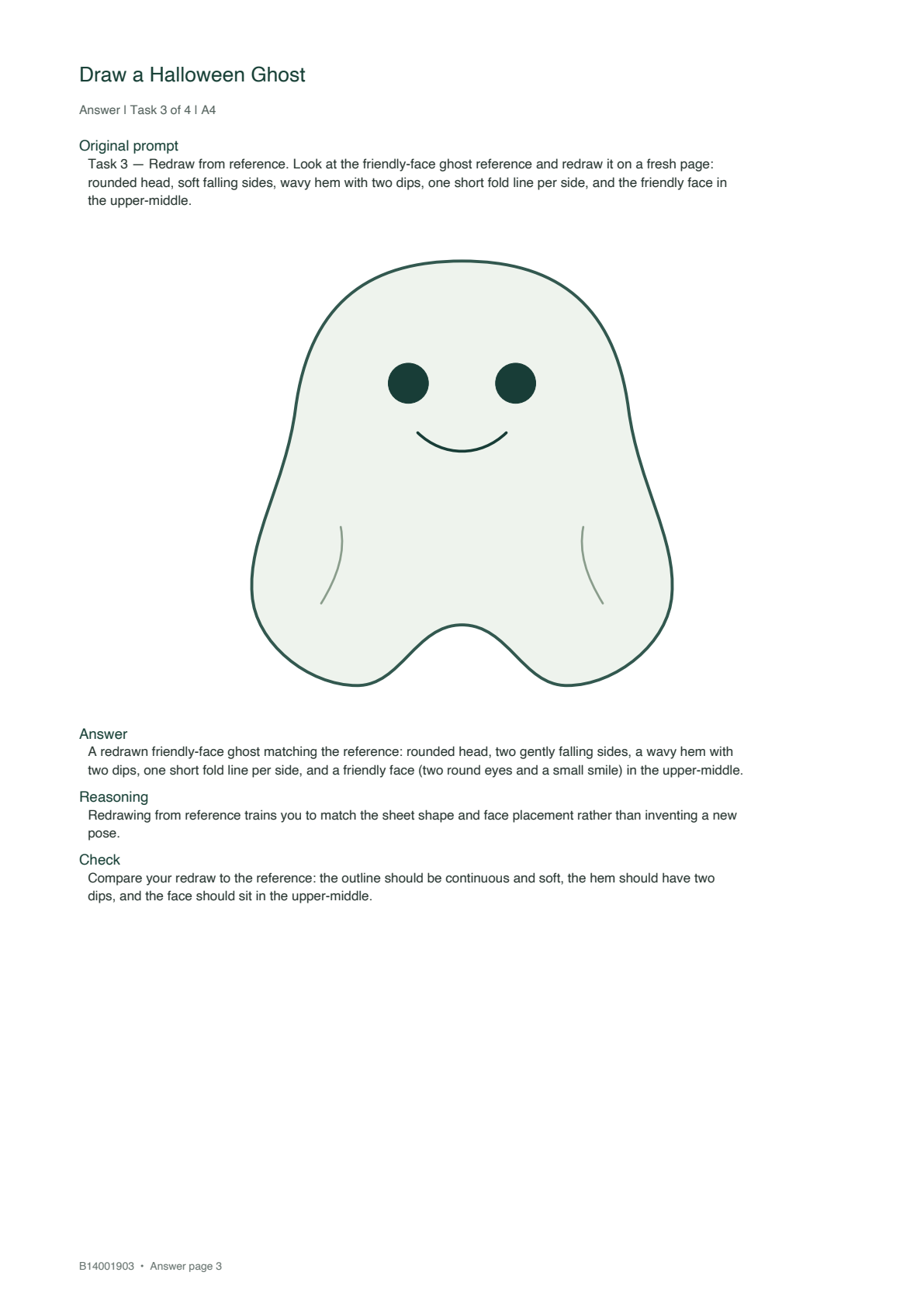
Three simple face options are offered: a friendly face with round eyes and a small smile, a surprised face with wide oval eyes and a small round mouth, and a sleepy face with closed curved eyes and a small flat mouth. Pick one option and place it in the upper-middle of the body. The face is a choice, not a rule; any of the three reads as a ghost.
Worked example
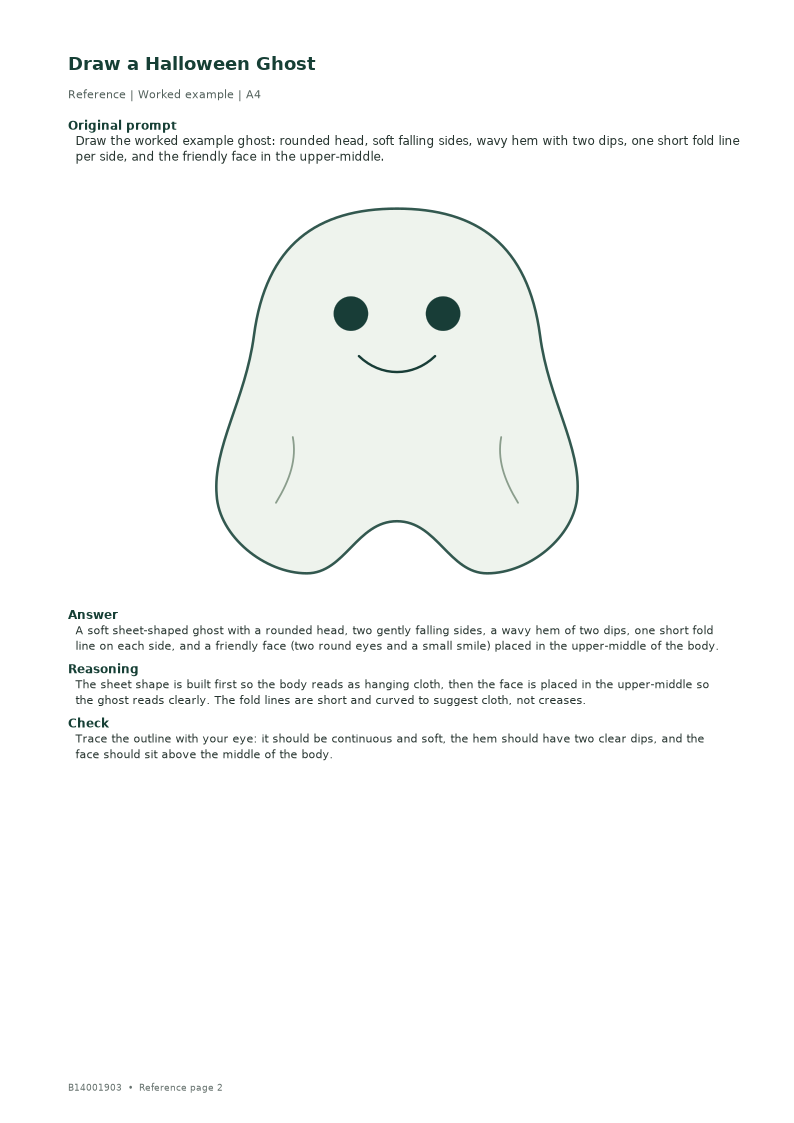
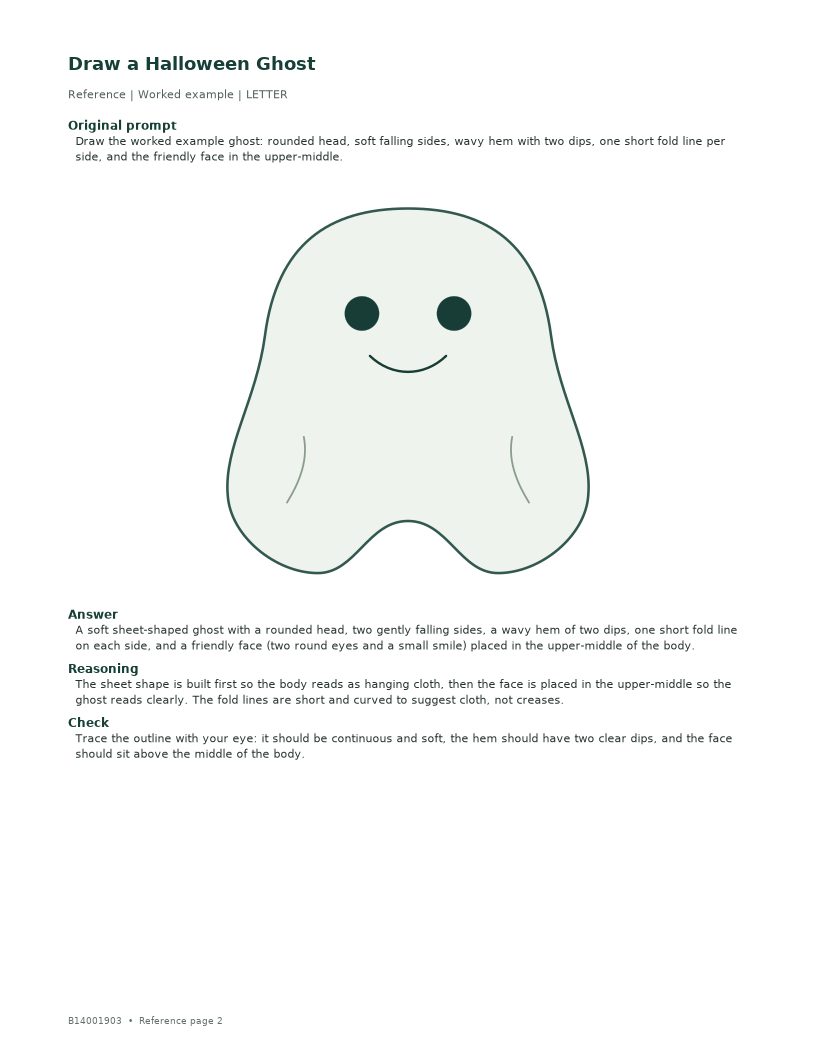
Worked example: draw a rounded head curve, let the sides fall with a slight outward drift, close the bottom with a wavy hem of two soft dips, add one short fold line on each side, then place the friendly face (two round eyes and a small smile) in the upper-middle. Check that the outline is continuous, the hem is wavy, and the face sits above the middle of the body.
Download the complete resource pack
All individual SVG pages (20)
- A4 reference page 1
- A4 reference page 2
- A4 student page 1
- A4 student page 2
- A4 student page 3
- A4 student page 4
- A4 answer page 1
- A4 answer page 2
- A4 answer page 3
- A4 answer page 4
- LETTER reference page 1
- LETTER reference page 2
- LETTER student page 1
- LETTER student page 2
- LETTER student page 3
- LETTER student page 4
- LETTER answer page 1
- LETTER answer page 2
- LETTER answer page 3
- LETTER answer page 4
Print at 100% / actual size. Use the stated scale on any schematic diagram; physical cutting templates are identified separately. A4 and US Letter are separate files. Free access, no signup; CC BY 4.0.
How to use these pages
- What you are drawing
- Building the sheet shape
- Choosing a face
- Worked example
Worked example
Example: Draw the worked example ghost: rounded head, soft falling sides, wavy hem with two dips, one short fold line per side, and the friendly face in the upper-middle.
Answer: A soft sheet-shaped ghost with a rounded head, two gently falling sides, a wavy hem of two dips, one short fold line on each side, and a friendly face (two round eyes and a small smile) placed in the upper-middle of the body.
Reasoning: The sheet shape is built first so the body reads as hanging cloth, then the face is placed in the upper-middle so the ghost reads clearly. The fold lines are short and curved to suggest cloth, not creases.
Check: Trace the outline with your eye: it should be continuous and soft, the hem should have two clear dips, and the face should sit above the middle of the body.
Four practice tasks and complete answers
Task 1
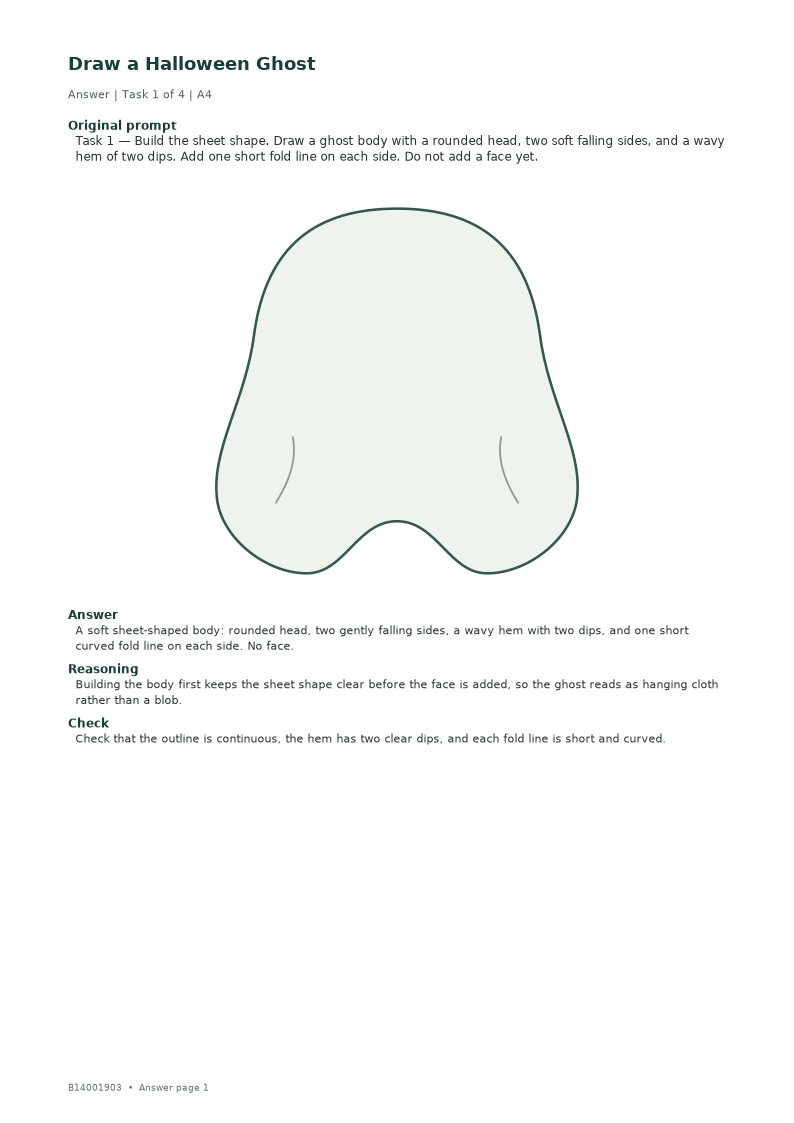
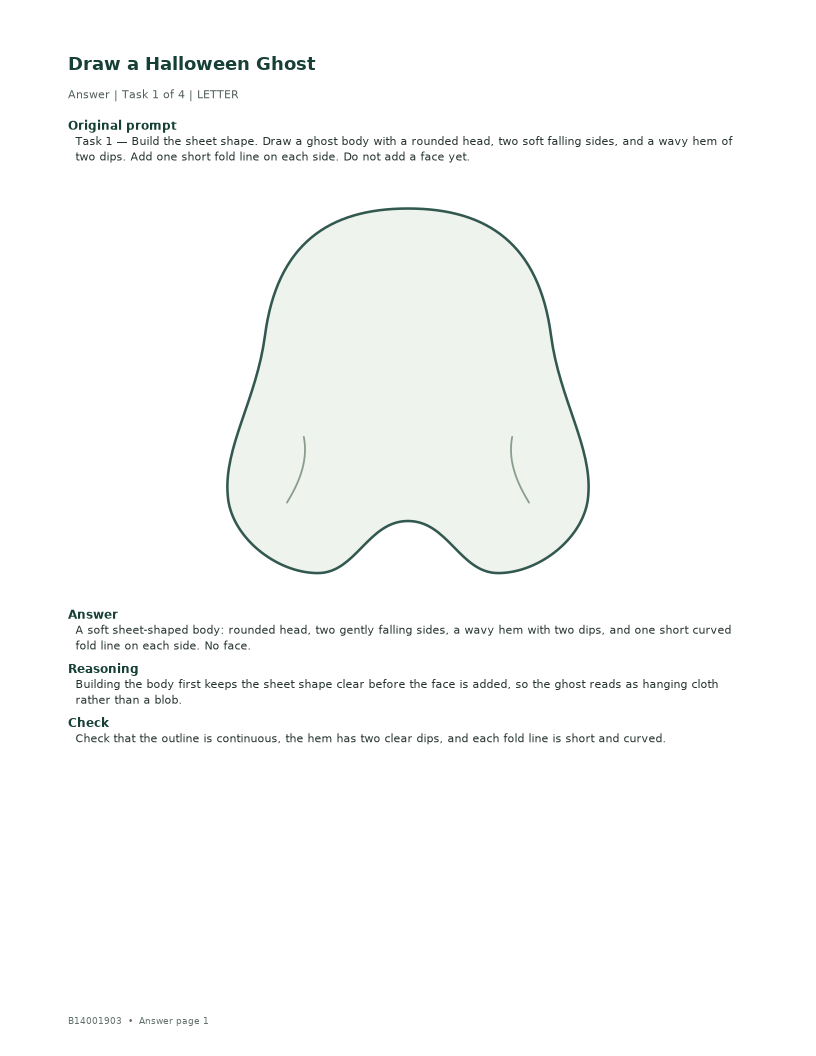
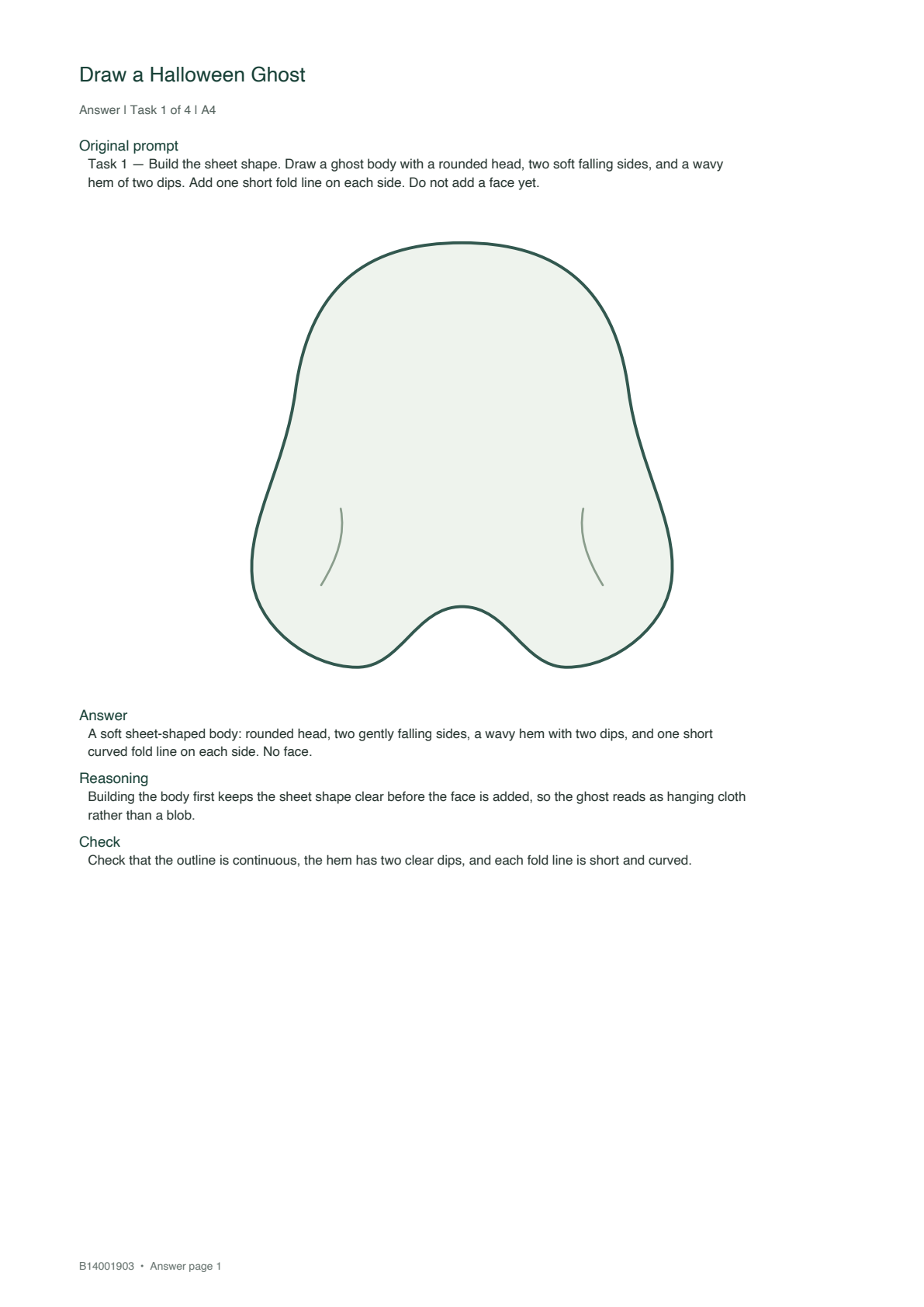
Task 1 — Build the sheet shape. Draw a ghost body with a rounded head, two soft falling sides, and a wavy hem of two dips. Add one short fold line on each side. Do not add a face yet.
Show answer 1
A soft sheet-shaped body: rounded head, two gently falling sides, a wavy hem with two dips, and one short curved fold line on each side. No face.
Building the body first keeps the sheet shape clear before the face is added, so the ghost reads as hanging cloth rather than a blob.
Check: Check that the outline is continuous, the hem has two clear dips, and each fold line is short and curved.
Task 2
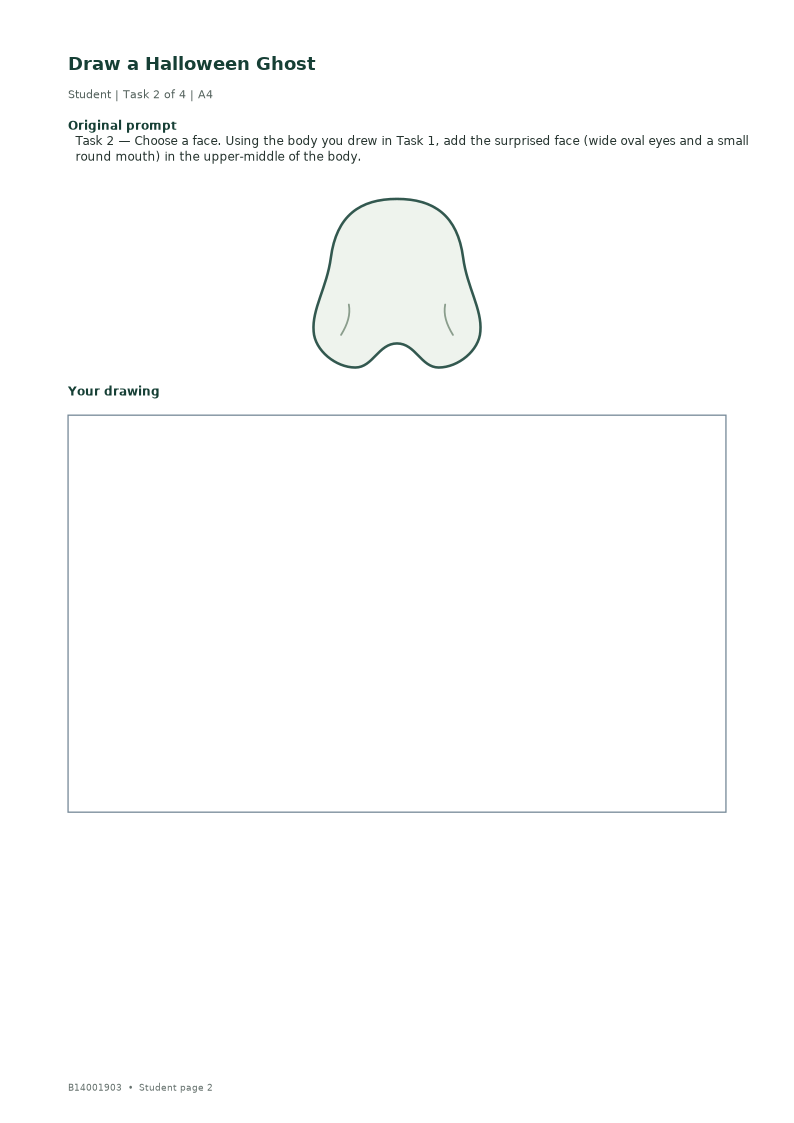
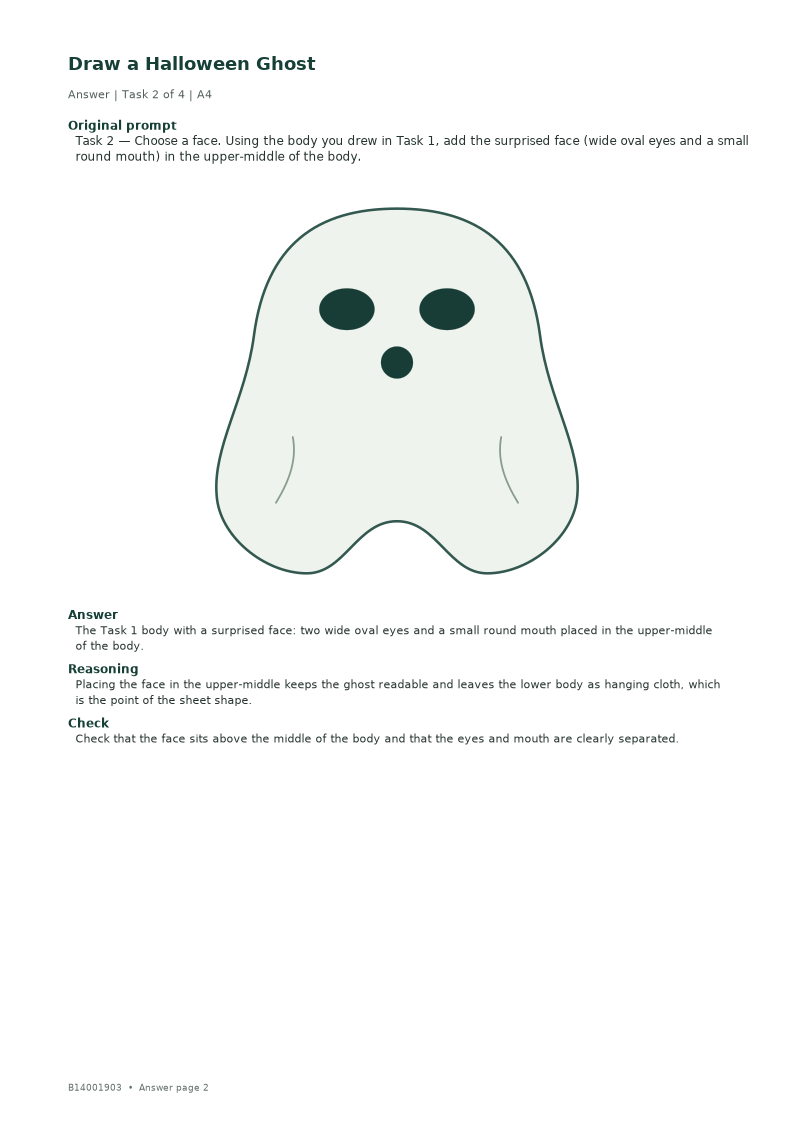
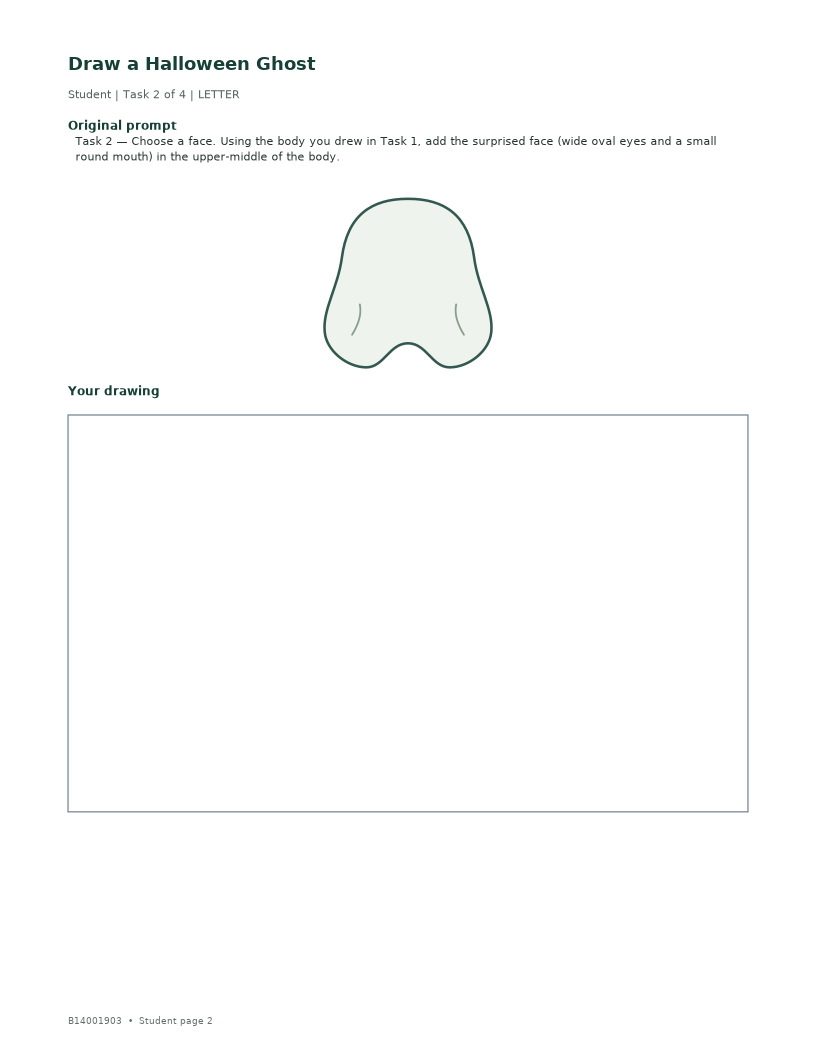
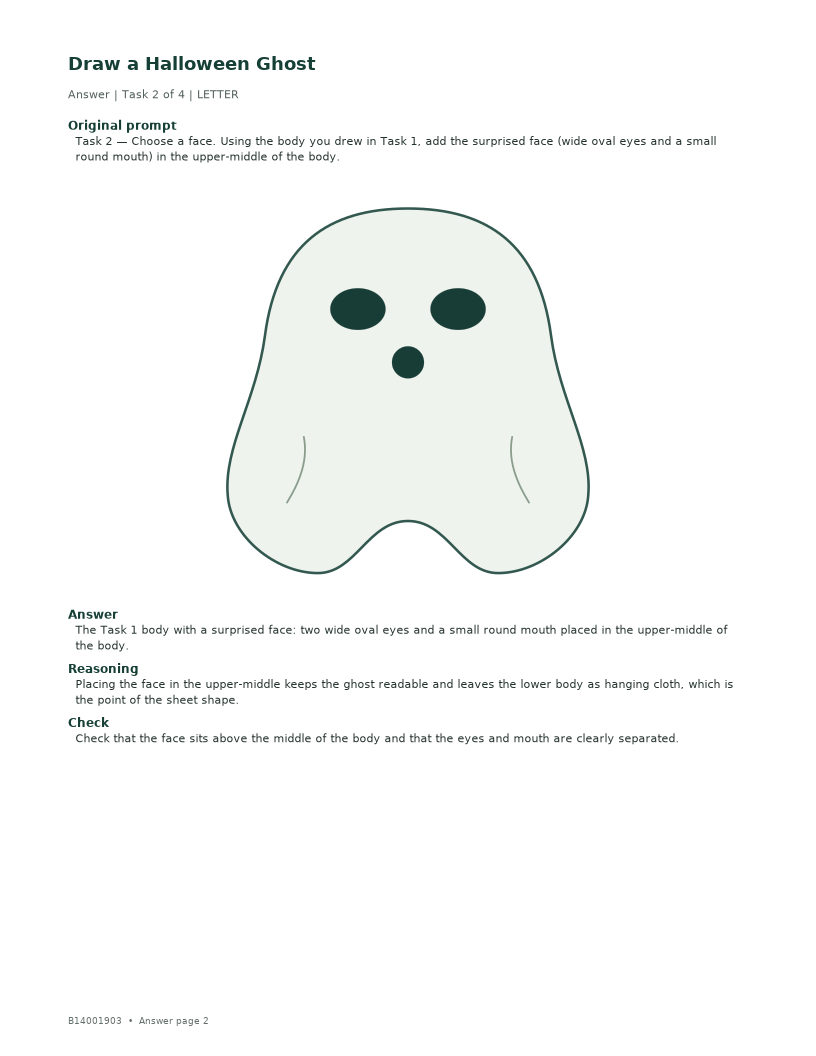
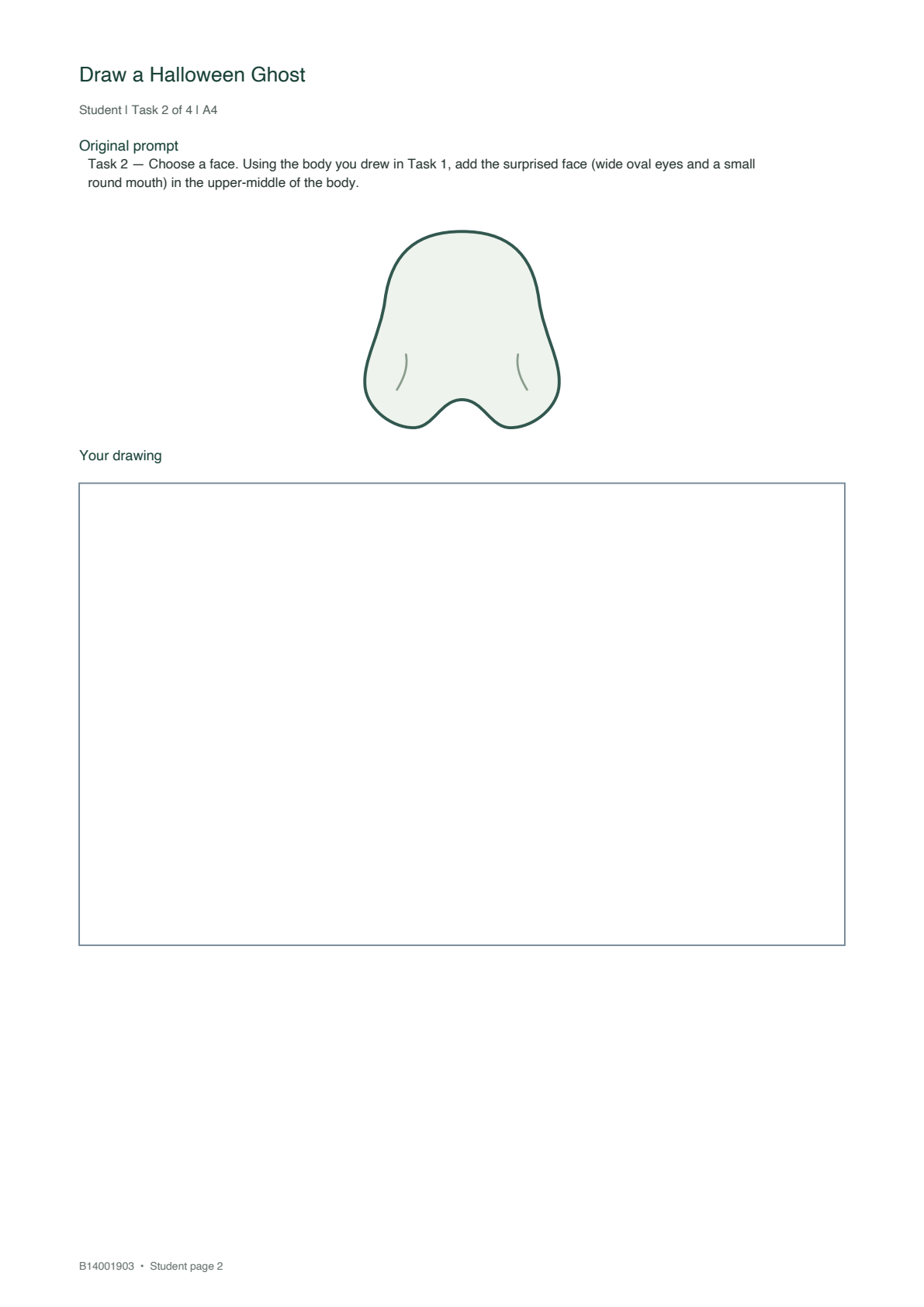
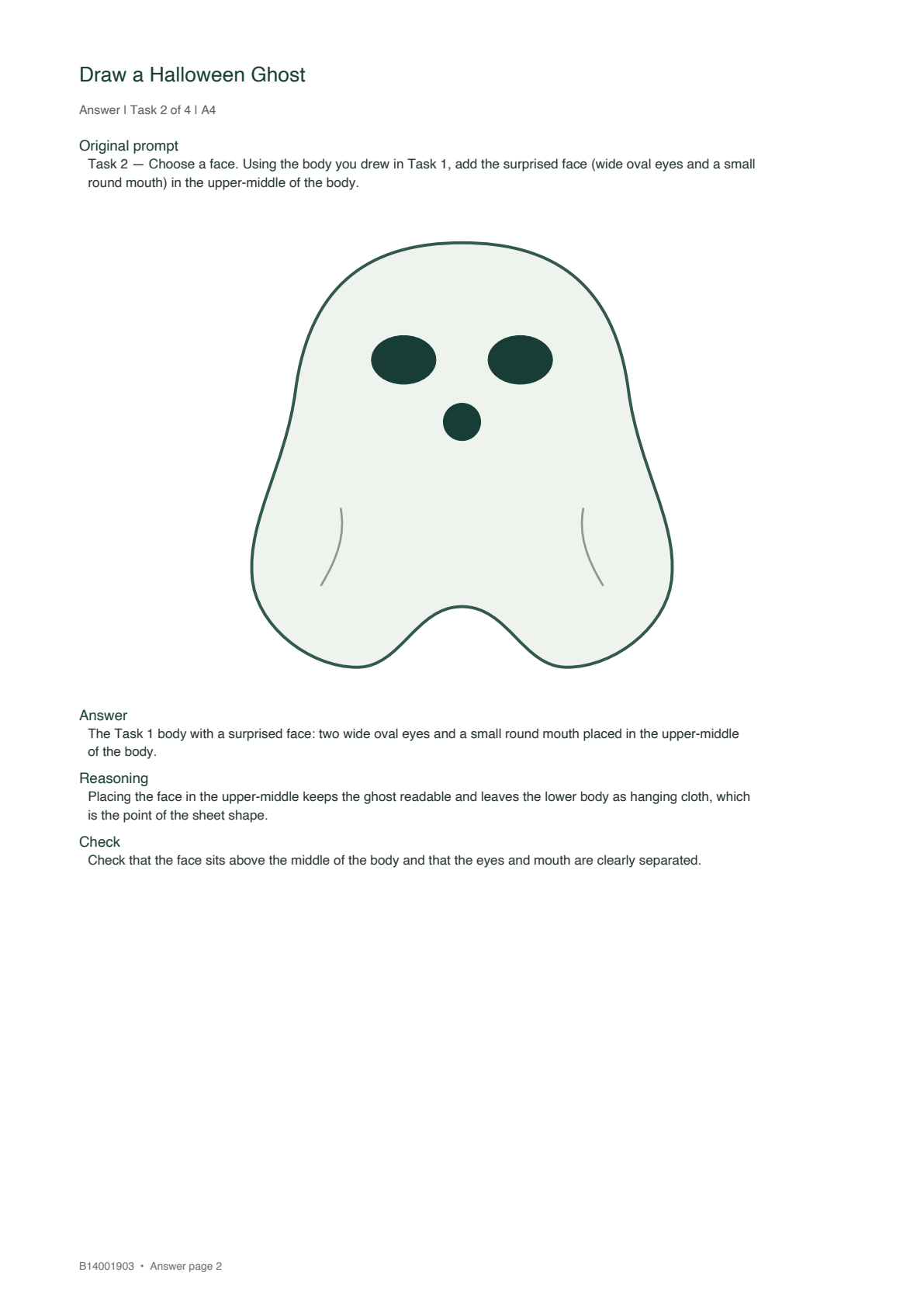
Task 2 — Choose a face. Using the body you drew in Task 1, add the surprised face (wide oval eyes and a small round mouth) in the upper-middle of the body.
Show answer 2
The Task 1 body with a surprised face: two wide oval eyes and a small round mouth placed in the upper-middle of the body.
Placing the face in the upper-middle keeps the ghost readable and leaves the lower body as hanging cloth, which is the point of the sheet shape.
Check: Check that the face sits above the middle of the body and that the eyes and mouth are clearly separated.
Task 3
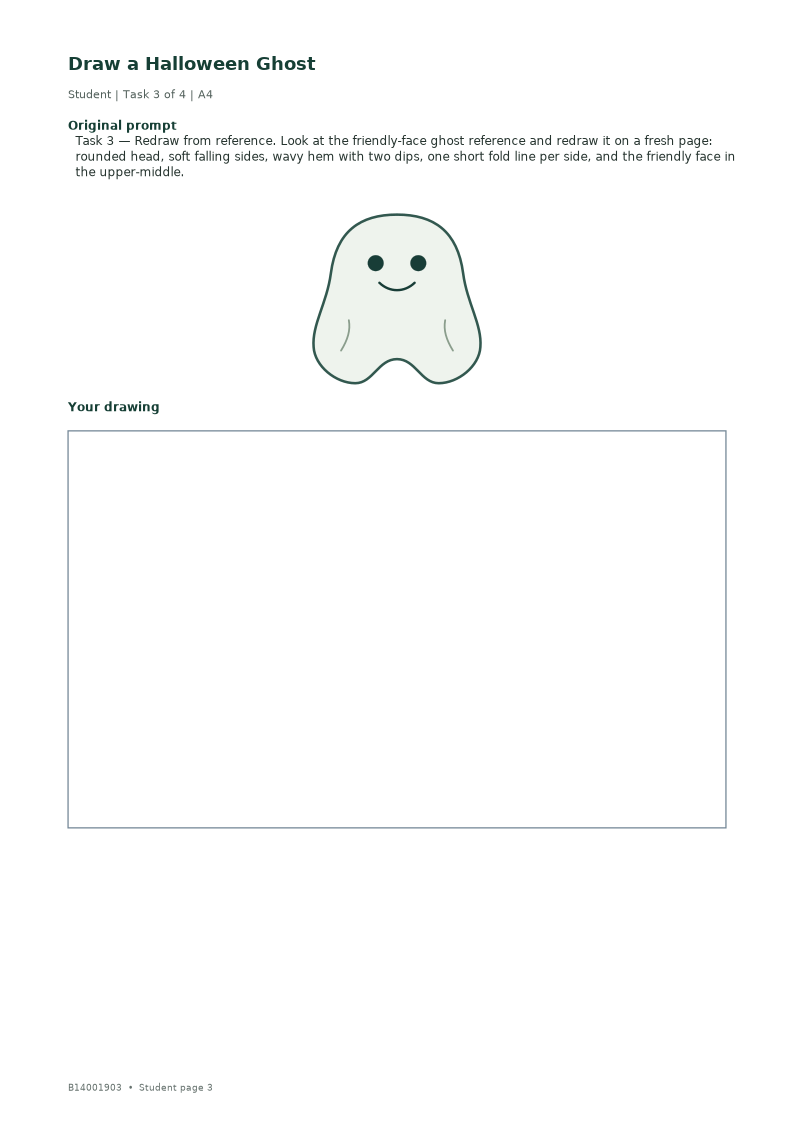
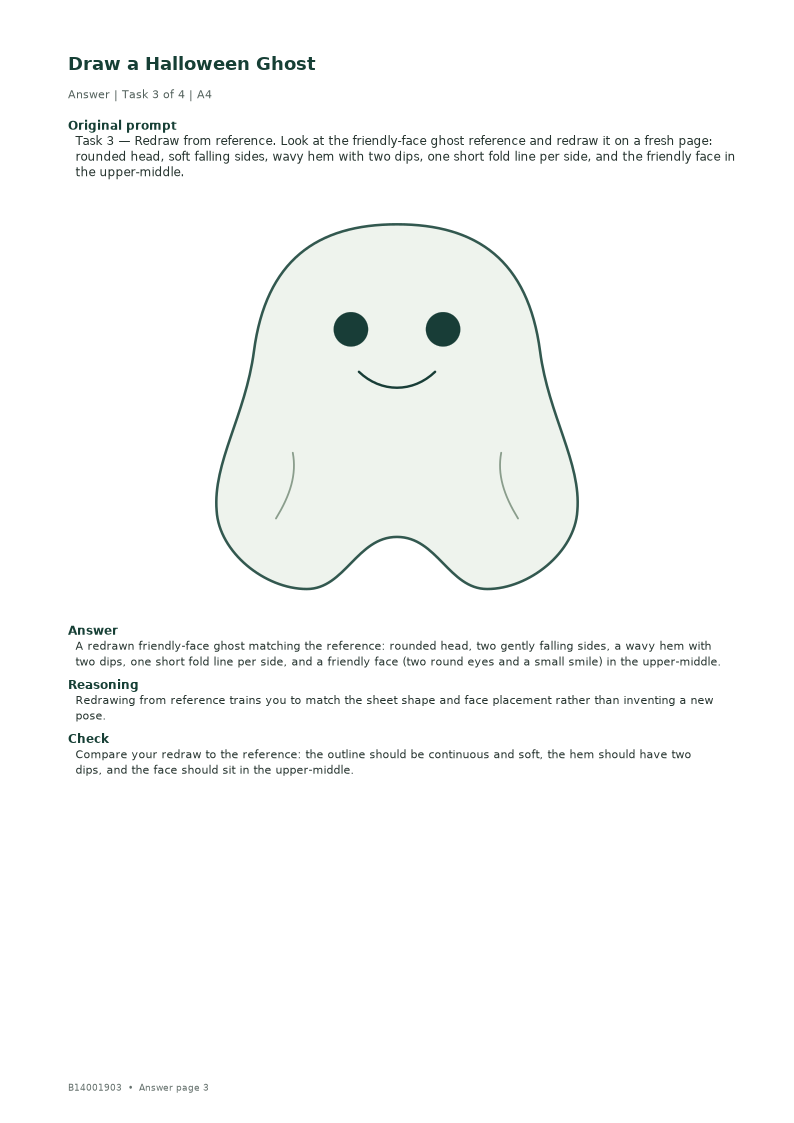
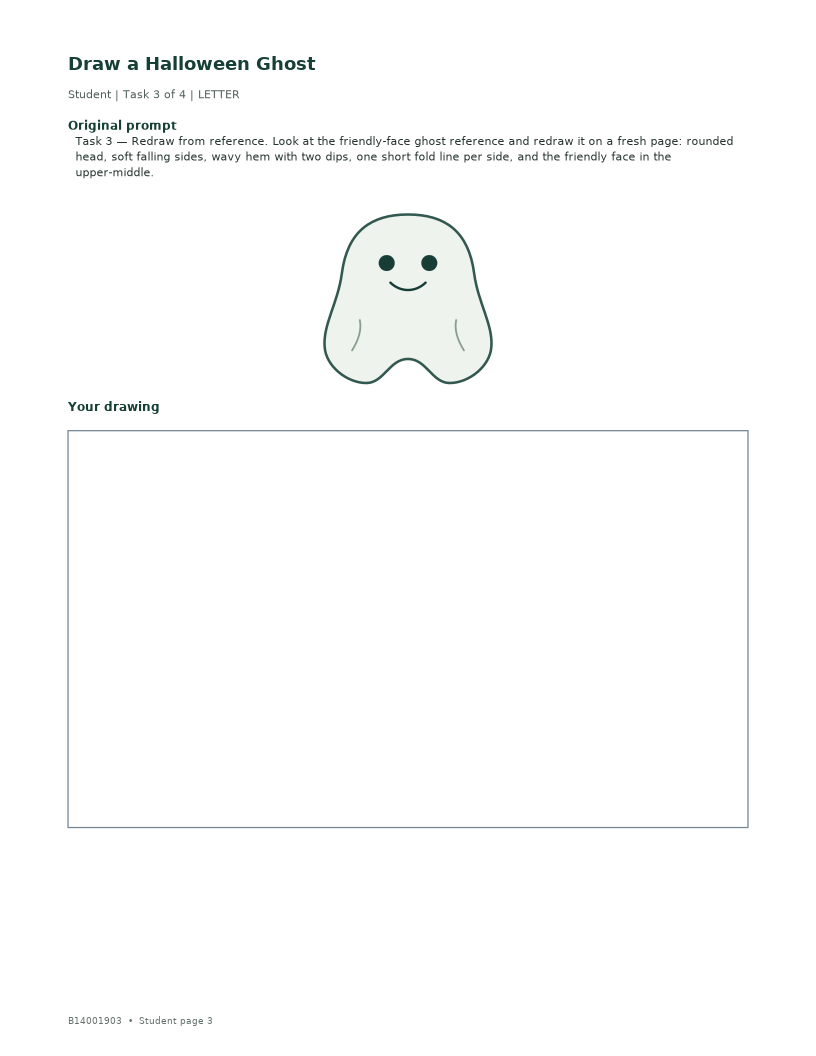
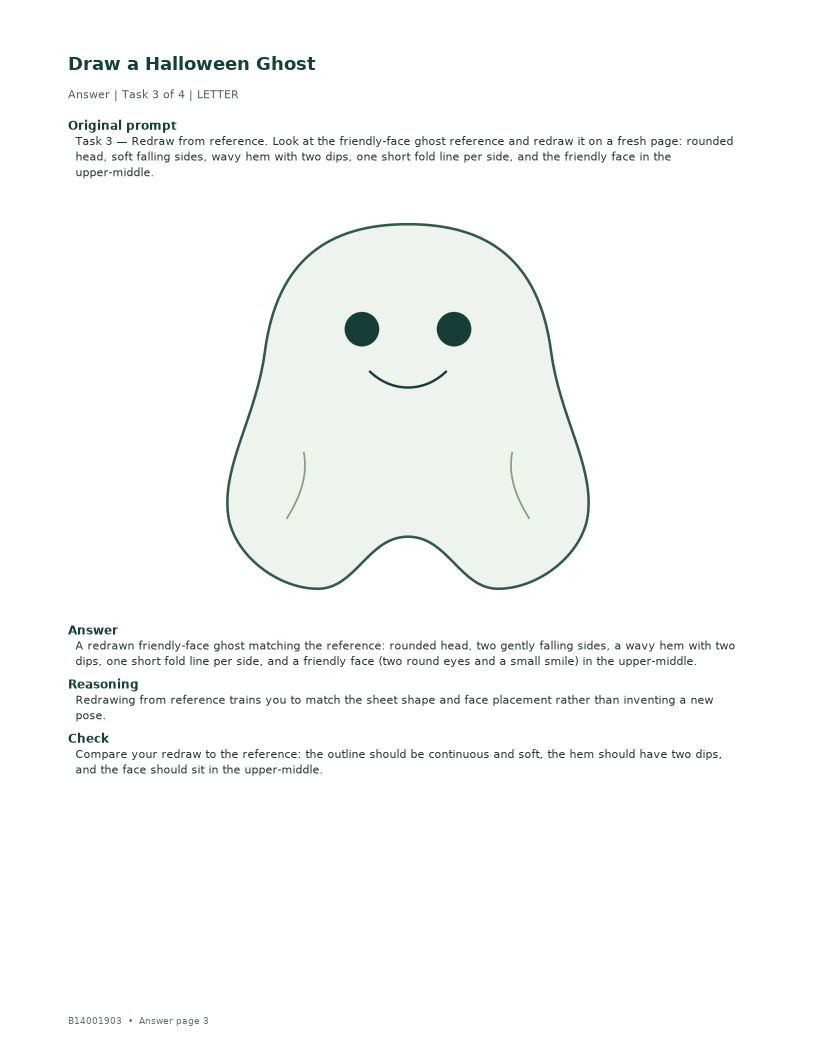
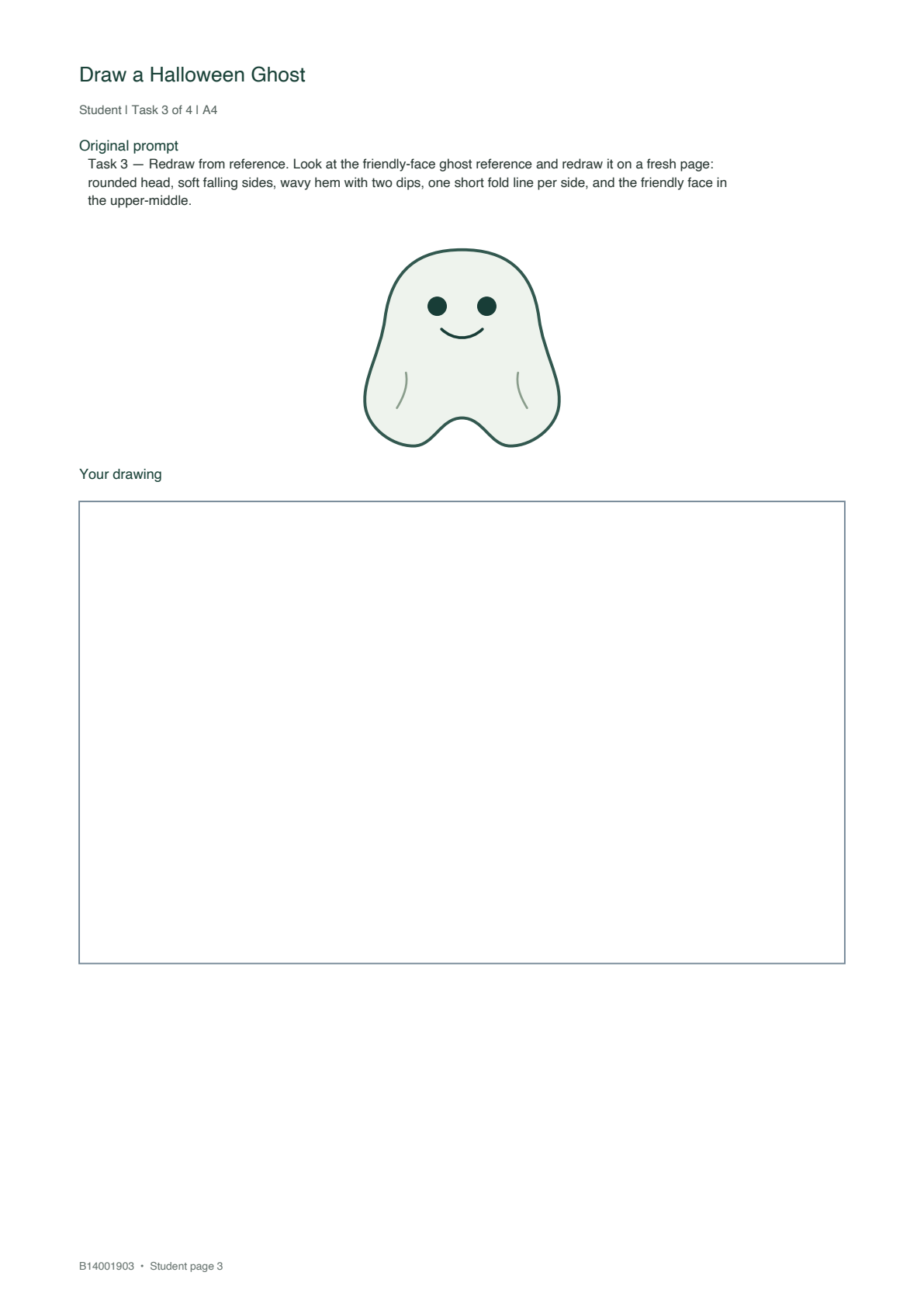
Task 3 — Redraw from reference. Look at the friendly-face ghost reference and redraw it on a fresh page: rounded head, soft falling sides, wavy hem with two dips, one short fold line per side, and the friendly face in the upper-middle.
Show answer 3
A redrawn friendly-face ghost matching the reference: rounded head, two gently falling sides, a wavy hem with two dips, one short fold line per side, and a friendly face (two round eyes and a small smile) in the upper-middle.
Redrawing from reference trains you to match the sheet shape and face placement rather than inventing a new pose.
Check: Compare your redraw to the reference: the outline should be continuous and soft, the hem should have two dips, and the face should sit in the upper-middle.
Task 4
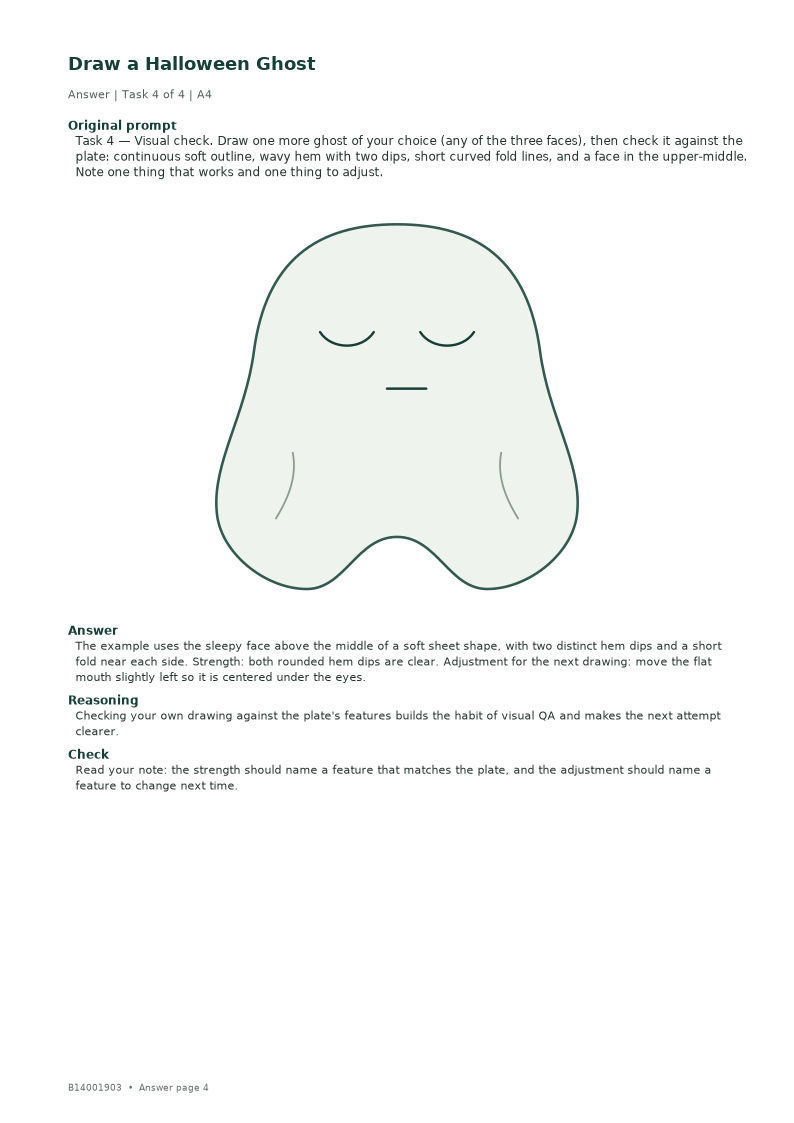
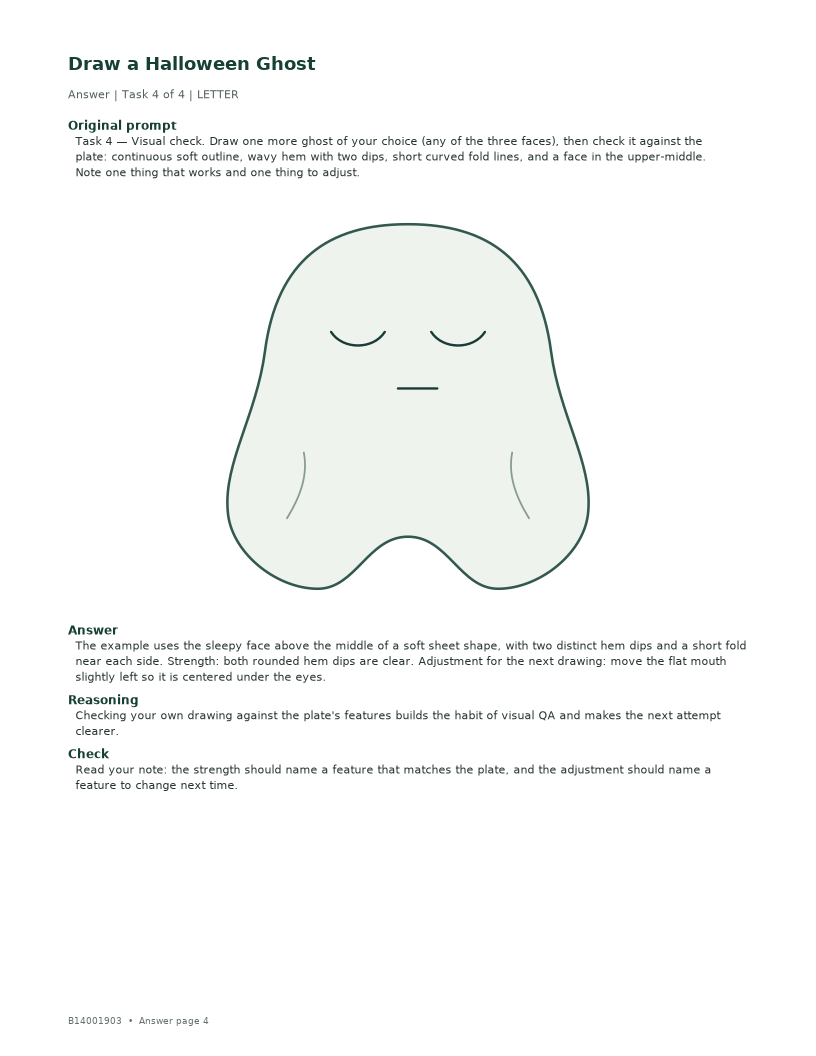
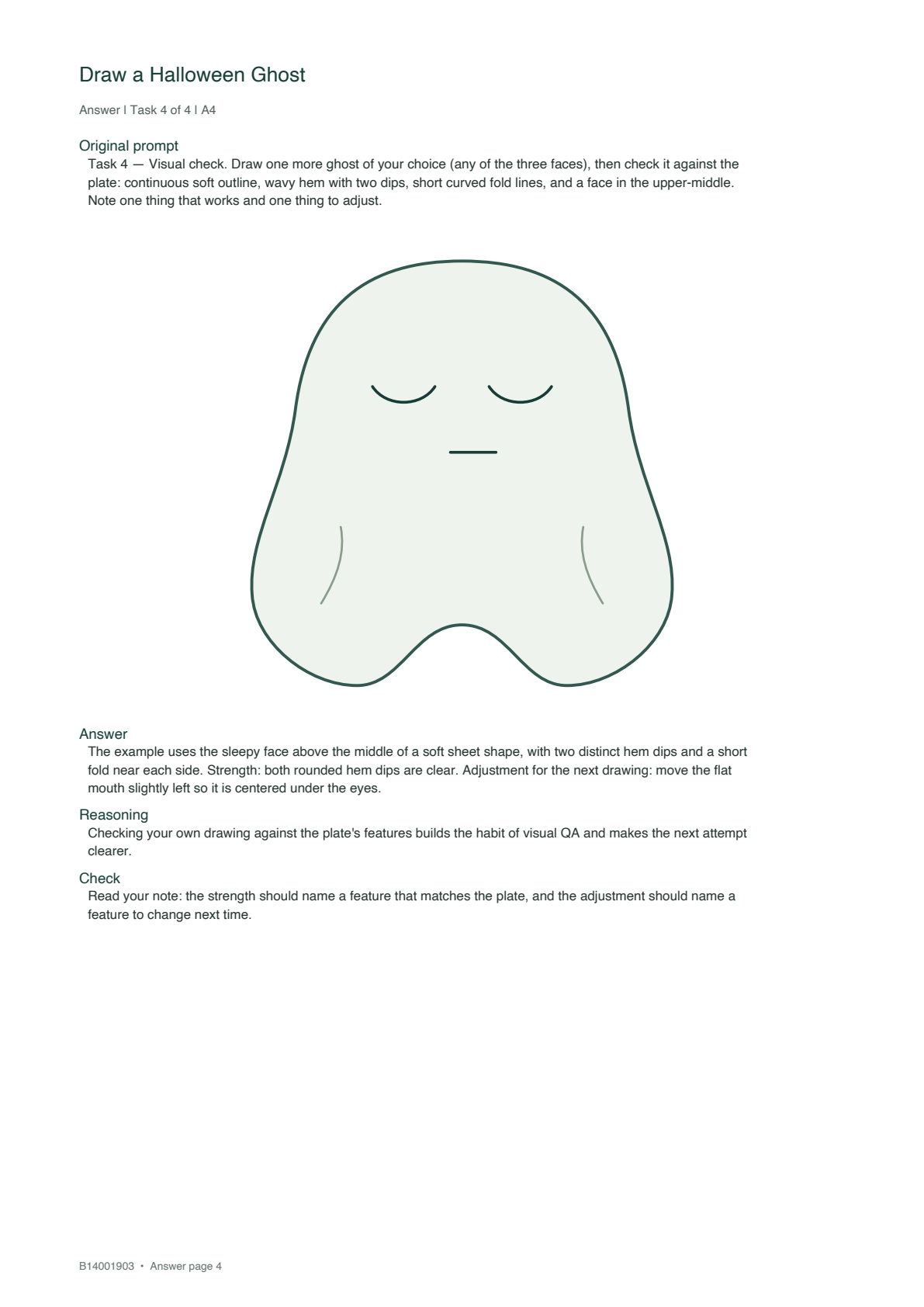
Task 4 — Visual check. Draw one more ghost of your choice (any of the three faces), then check it against the plate: continuous soft outline, wavy hem with two dips, short curved fold lines, and a face in the upper-middle. Note one thing that works and one thing to adjust.
Show answer 4
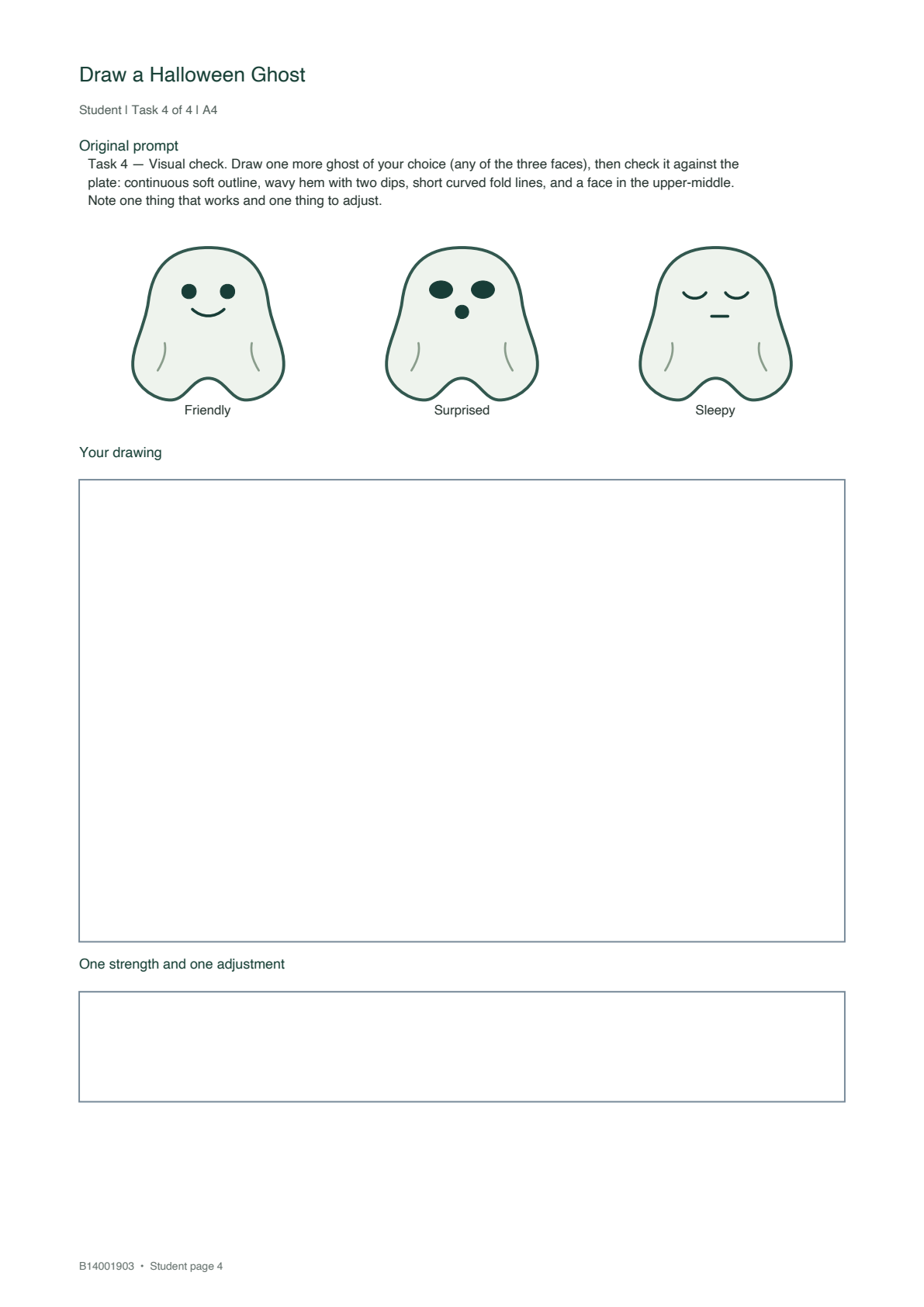
The example uses the sleepy face above the middle of a soft sheet shape, with two distinct hem dips and a short fold near each side. Strength: both rounded hem dips are clear. Adjustment for the next drawing: move the flat mouth slightly left so it is centered under the eyes.
Checking your own drawing against the plate's features builds the habit of visual QA and makes the next attempt clearer.
Check: Read your note: the strength should name a feature that matches the plate, and the adjustment should name a feature to change next time.
Useful checks
- Drawing straight sides and a flat bottom. Let the sides fall with a slight outward drift and close the bottom with a wavy hem of two soft dips.
- Placing the face too low or too high on the body. Place the face in the upper-middle of the body so the ghost reads clearly and the lower body stays as hanging cloth.
- Adding many sharp fold lines. Draw one short curved fold line near each side to suggest hanging cloth.
Questions about this resource
Do I have to use one of the three faces?
For free practice you can design your own face. The four tasks use specific faces or a choice among the three offered options.
How wavy should the hem be?
Two soft dips are enough to read as a hanging sheet; keep the dips rounded rather than sharp.