Free original lessons
Printable Paper Games
This pack teaches one classic paper game, tic-tac-toe, as a printable sheet you can hand out and play. You will learn the grid, the marks, the turn order, the win check, and a draw check, then practise on four ready-to-print sheets.
Letter & A4
PDF & SVG
What the sheet contains
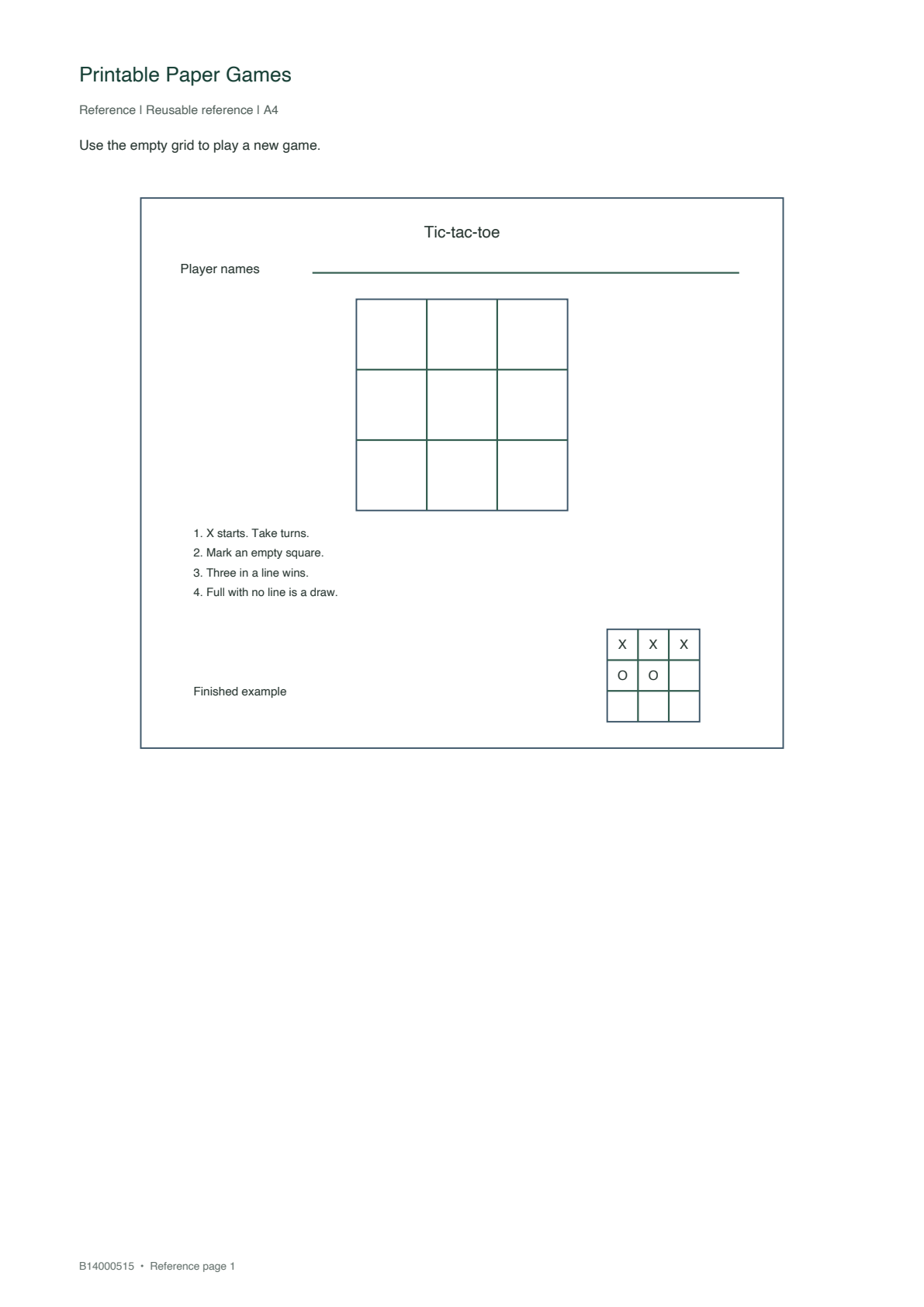
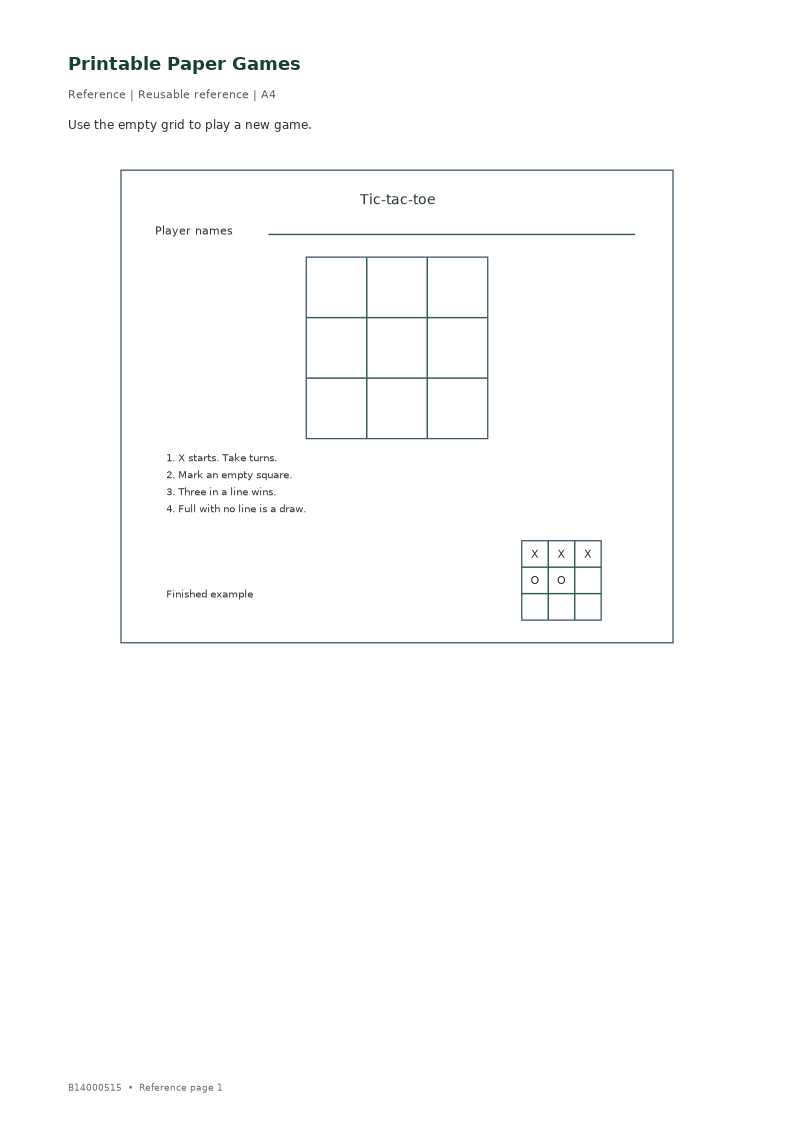
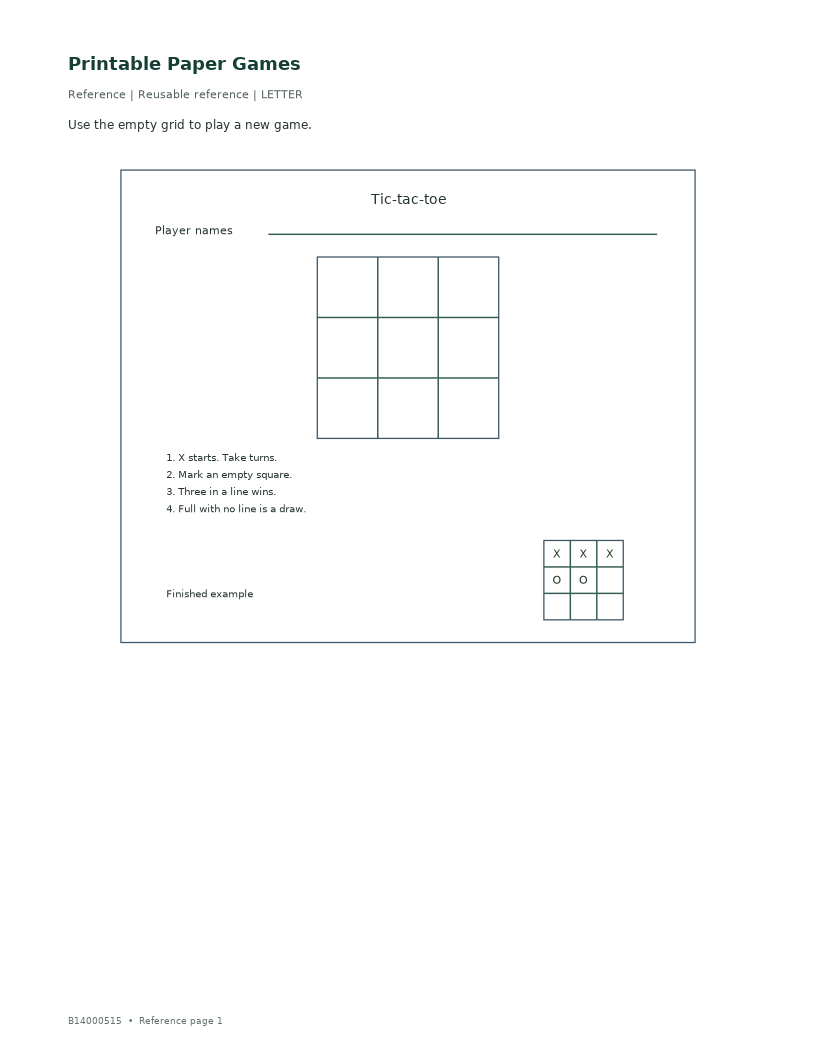
A tic-tac-toe sheet is a three-by-three grid of nine empty squares, plus a short rules line and a small filled example so a new player can see a finished game.
Two players share one sheet. One player is X and the other is O, and they take turns until someone wins or the grid is full.
Drawing the grid
Draw two vertical lines and two horizontal lines so they cross and make nine equal squares. Keep the lines straight and the squares the same size so the sheet looks tidy and is easy to read.
Leave a clear margin around the grid for the rules line and the player names.
Rules to print on the sheet
Rule 1: X goes first, then players alternate. Rule 2: a player may only mark an empty square. Rule 3: the first player to fill a full row, column, or diagonal with their own mark wins.
Rule 4: if all nine squares are filled and no one has three in a line, the game is a draw. Print these four rules in a short block under the grid.
Checking for a win
After each turn, look along the three rows, the three columns, and the two diagonals. If any line holds three of the same mark, that player has won and the game stops.
If no line is complete and empty squares remain, play continues. If the grid is full with no line, call it a draw.
Worked example
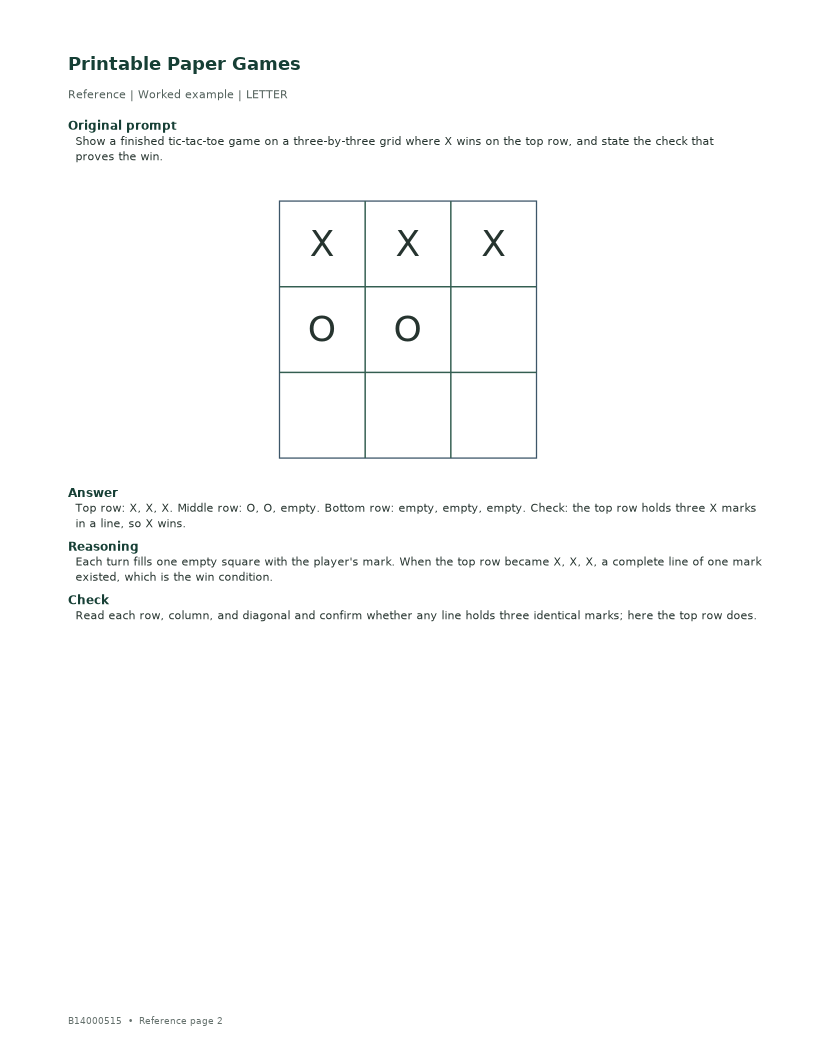
Play X top-left, O centre, X top-middle, O middle-left, then X top-right. Stop when X completes the top row. The O marks are in the middle-left and centre squares.
The check is simple: read the top row left to right and confirm all three marks are X. Because a full row of one mark is present, the game is over and X is the winner.
Download the complete resource pack
All individual SVG pages (20)
- A4 reference page 1
- A4 reference page 2
- A4 student page 1
- A4 student page 2
- A4 student page 3
- A4 student page 4
- A4 answer page 1
- A4 answer page 2
- A4 answer page 3
- A4 answer page 4
- LETTER reference page 1
- LETTER reference page 2
- LETTER student page 1
- LETTER student page 2
- LETTER student page 3
- LETTER student page 4
- LETTER answer page 1
- LETTER answer page 2
- LETTER answer page 3
- LETTER answer page 4
Print at 100% / actual size. Use the stated scale on any schematic diagram; physical cutting templates are identified separately. A4 and US Letter are separate files. Free access, no signup; CC BY 4.0.
How to use these pages
- What the sheet contains
- Drawing the grid
- Rules to print on the sheet
- Checking for a win
- Worked example
Worked example
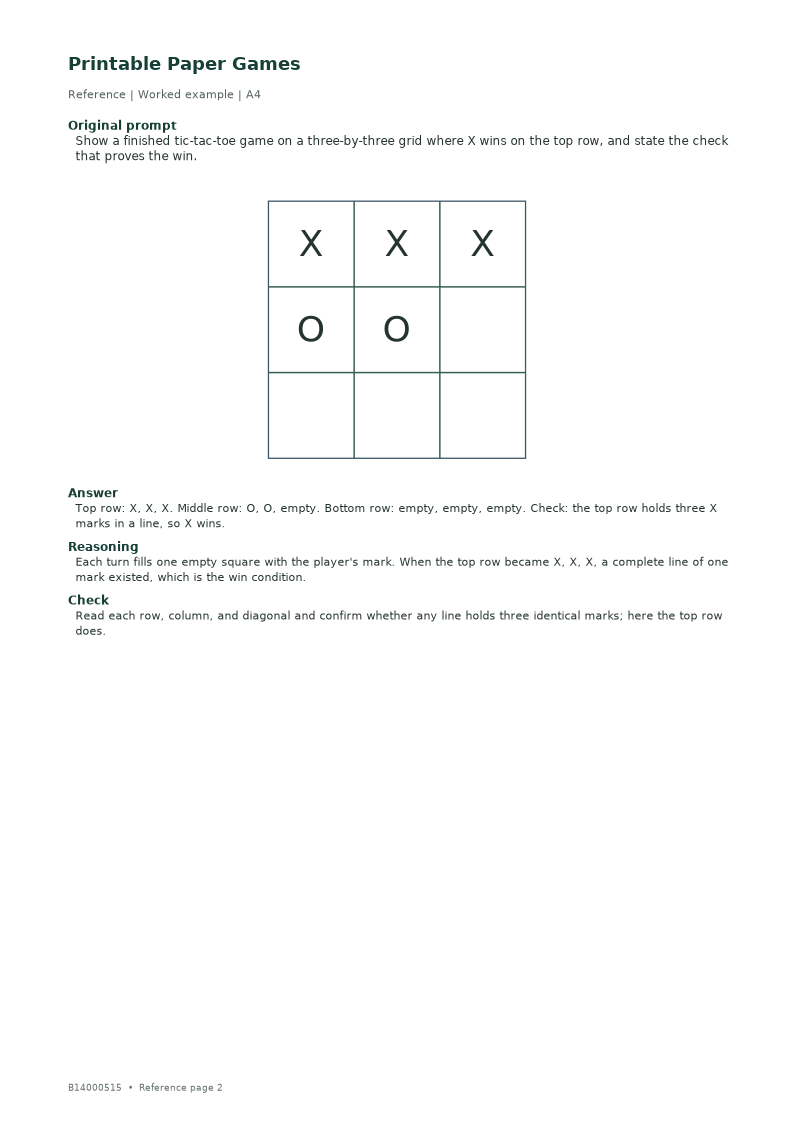
Example: Show a finished tic-tac-toe game on a three-by-three grid where X wins on the top row, and state the check that proves the win.
Answer: Top row: X, X, X. Middle row: O, O, empty. Bottom row: empty, empty, empty. Check: the top row holds three X marks in a line, so X wins.
Reasoning: Each turn fills one empty square with the player's mark. When the top row became X, X, X, a complete line of one mark existed, which is the win condition.
Check: Read each row, column, and diagonal and confirm whether any line holds three identical marks; here the top row does.
Four practice tasks and complete answers
Task 1
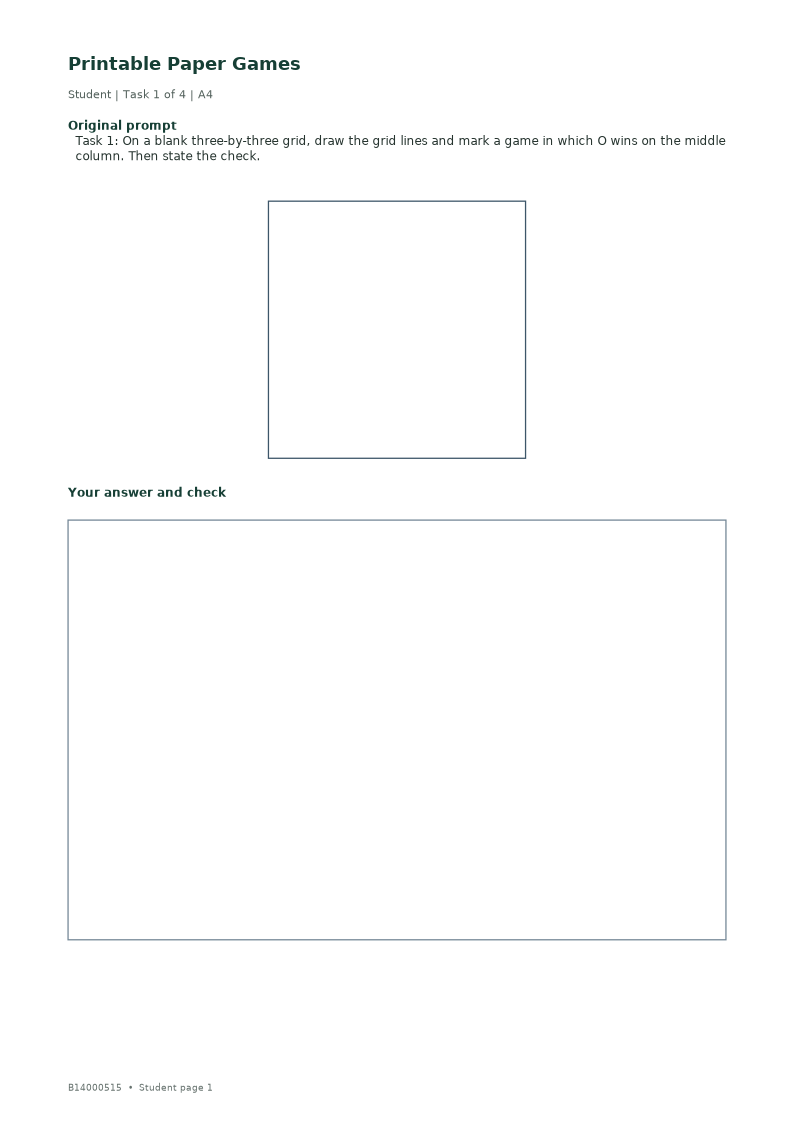
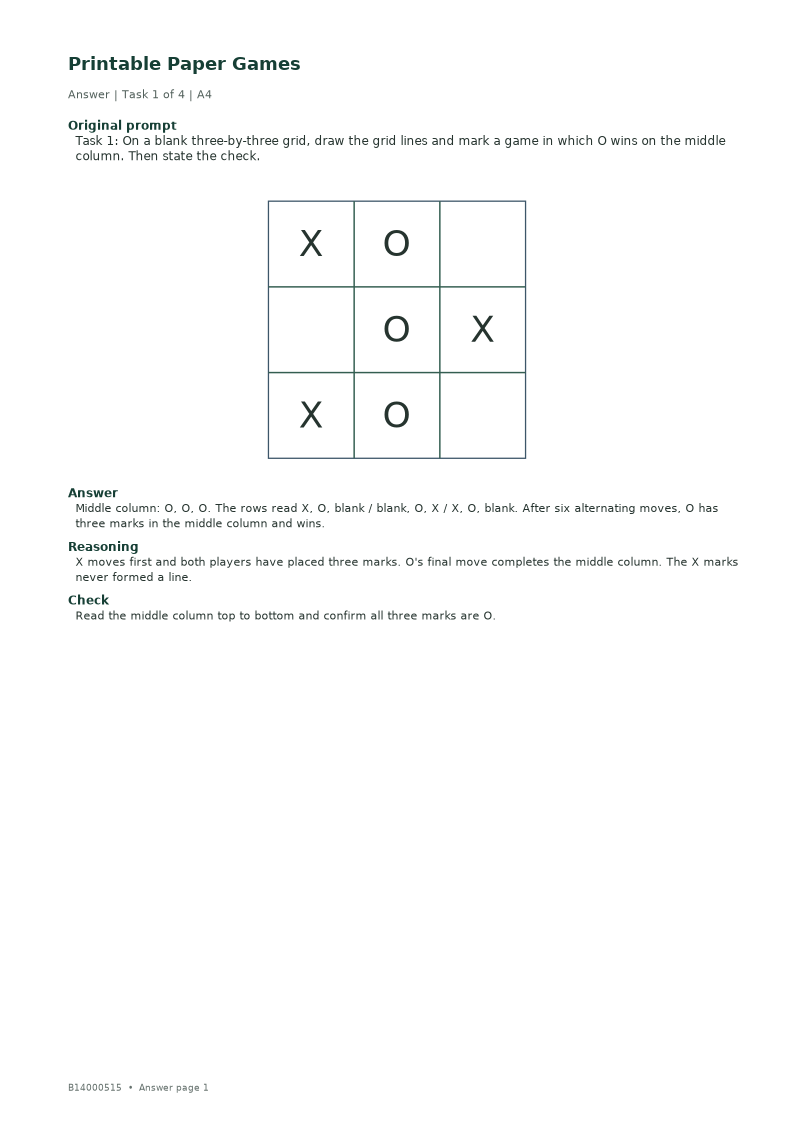
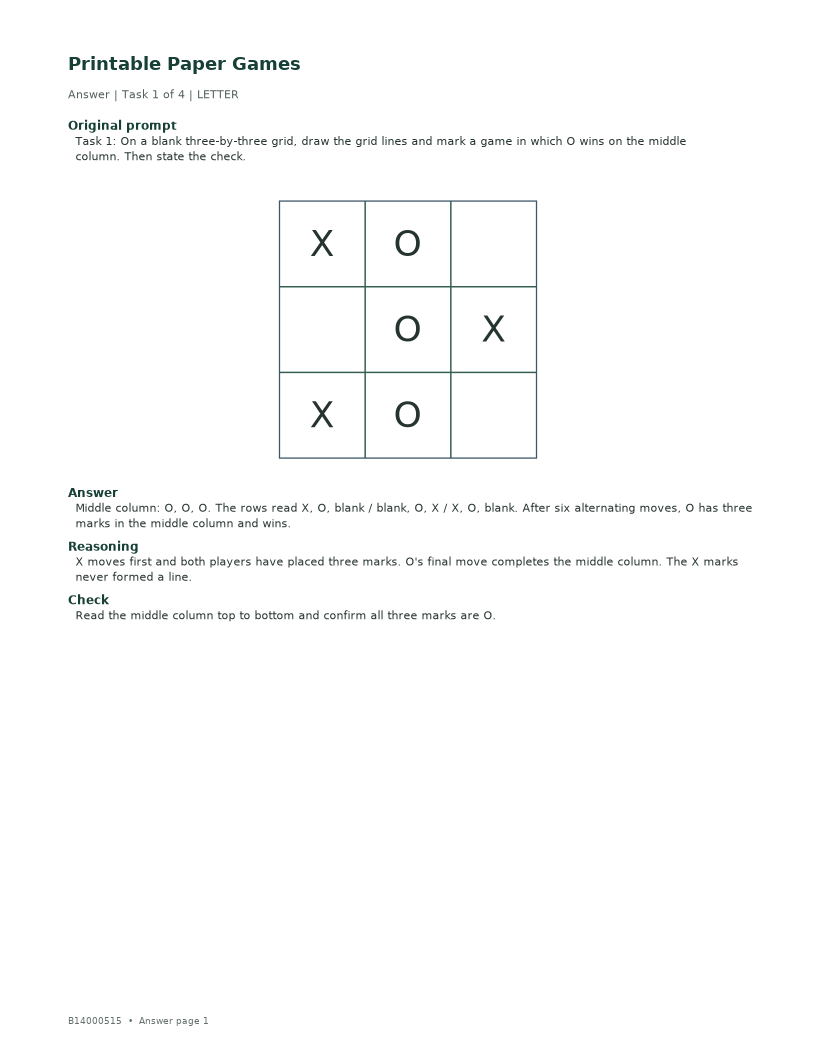
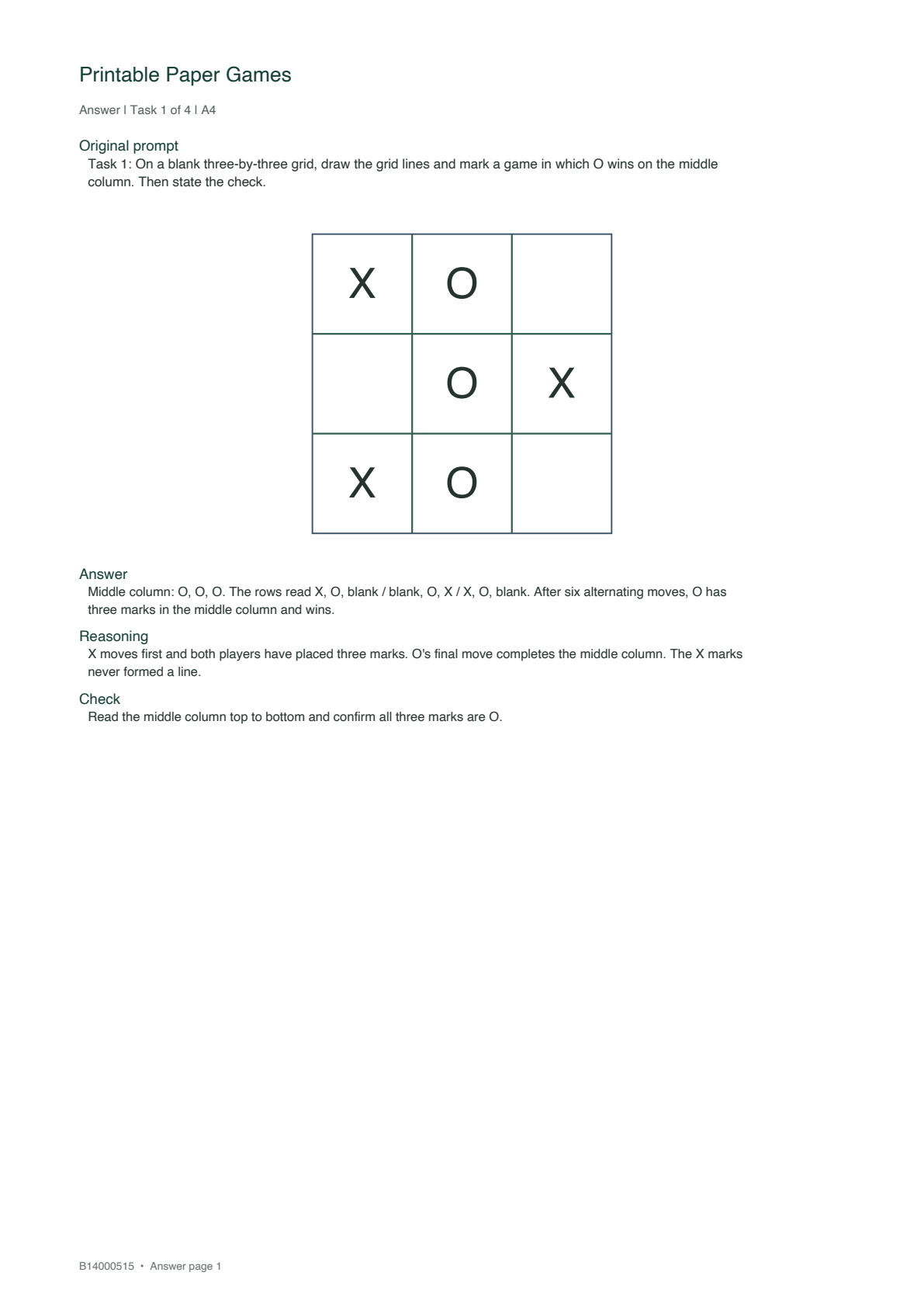
Task 1: On a blank three-by-three grid, draw the grid lines and mark a game in which O wins on the middle column. Then state the check.
Show answer 1
Middle column: O, O, O. The rows read X, O, blank / blank, O, X / X, O, blank. After six alternating moves, O has three marks in the middle column and wins.
X moves first and both players have placed three marks. O's final move completes the middle column. The X marks never formed a line.
Check: Read the middle column top to bottom and confirm all three marks are O.
Task 2
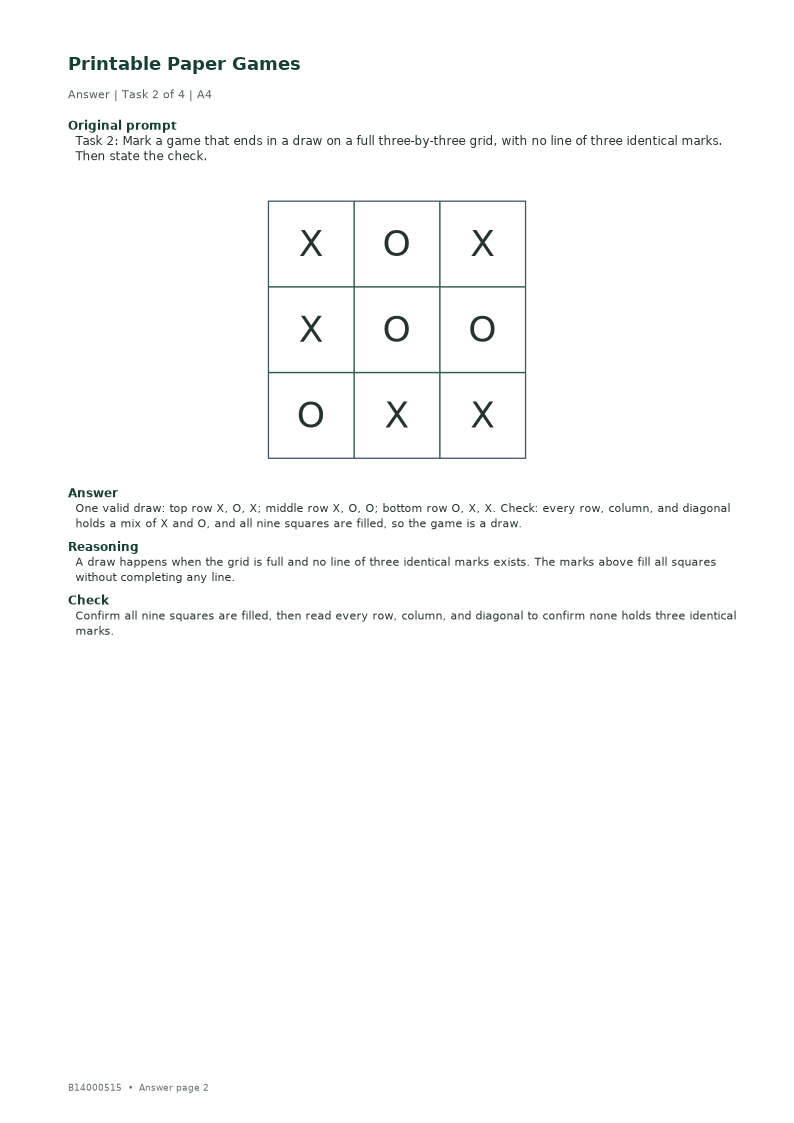
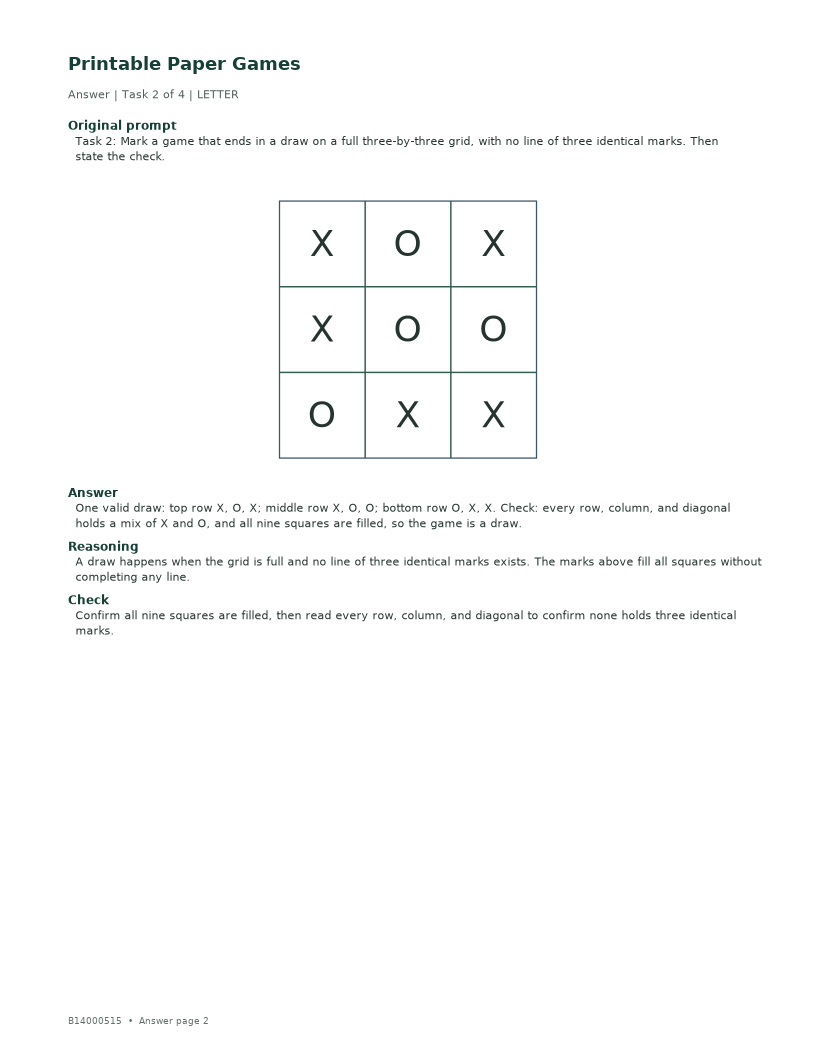
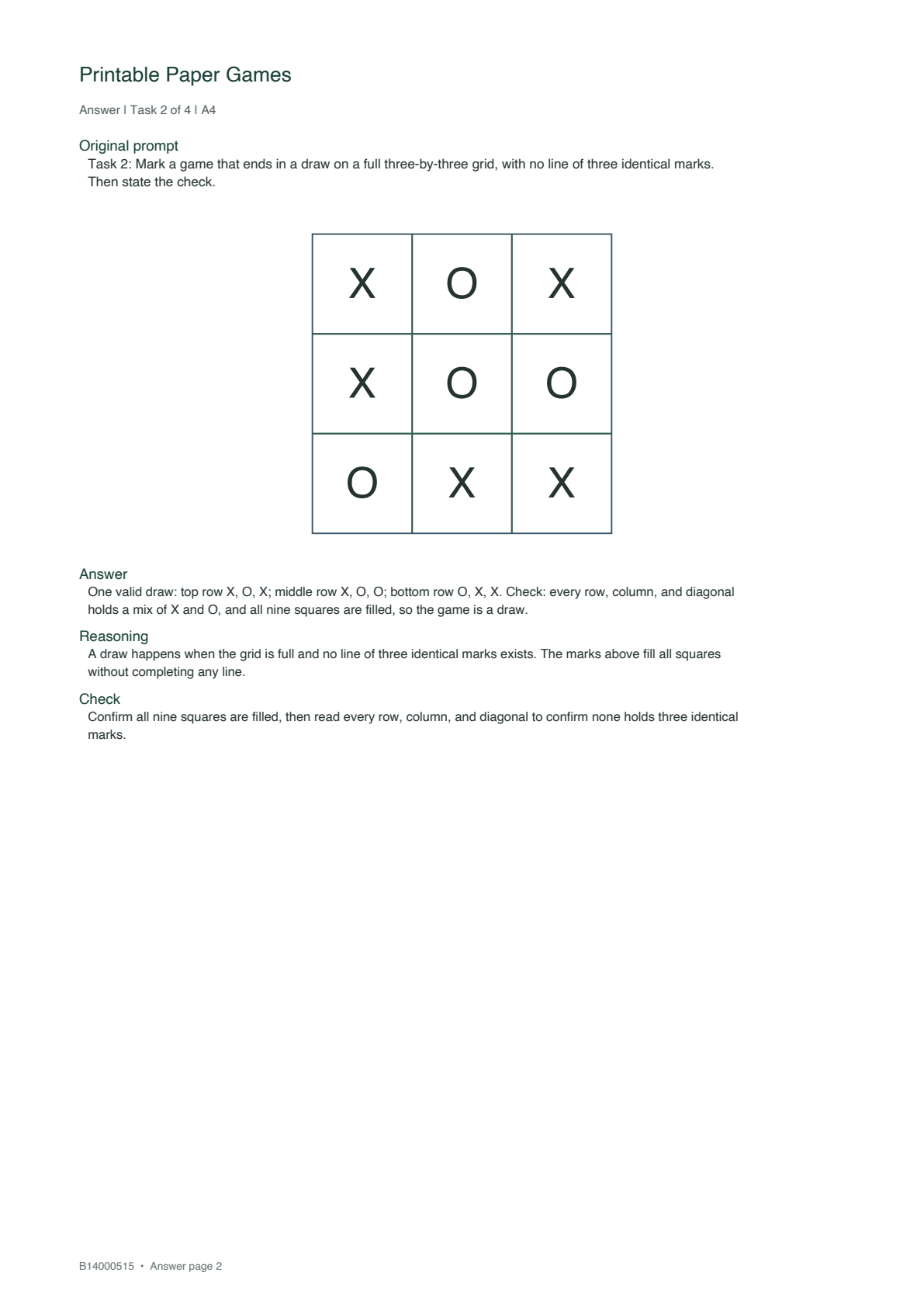
Task 2: Mark a game that ends in a draw on a full three-by-three grid, with no line of three identical marks. Then state the check.
Show answer 2
One valid draw: top row X, O, X; middle row X, O, O; bottom row O, X, X. Check: every row, column, and diagonal holds a mix of X and O, and all nine squares are filled, so the game is a draw.
A draw happens when the grid is full and no line of three identical marks exists. The marks above fill all squares without completing any line.
Check: Confirm all nine squares are filled, then read every row, column, and diagonal to confirm none holds three identical marks.
Task 3
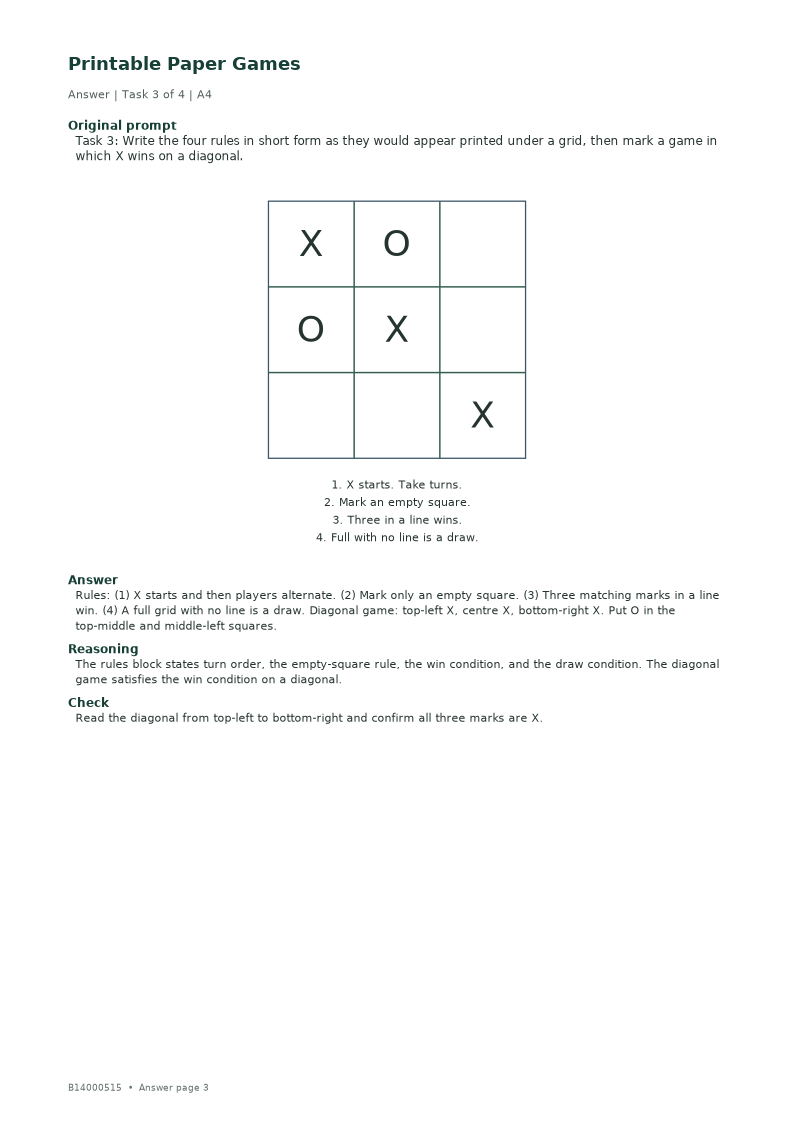
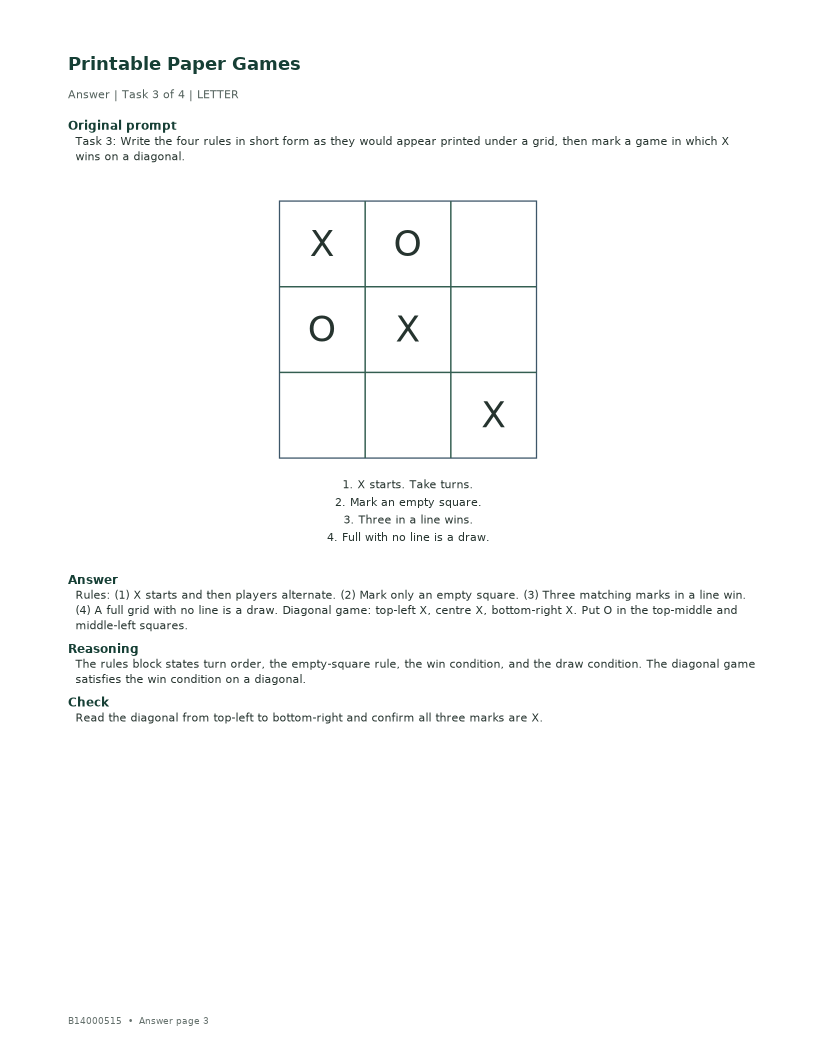
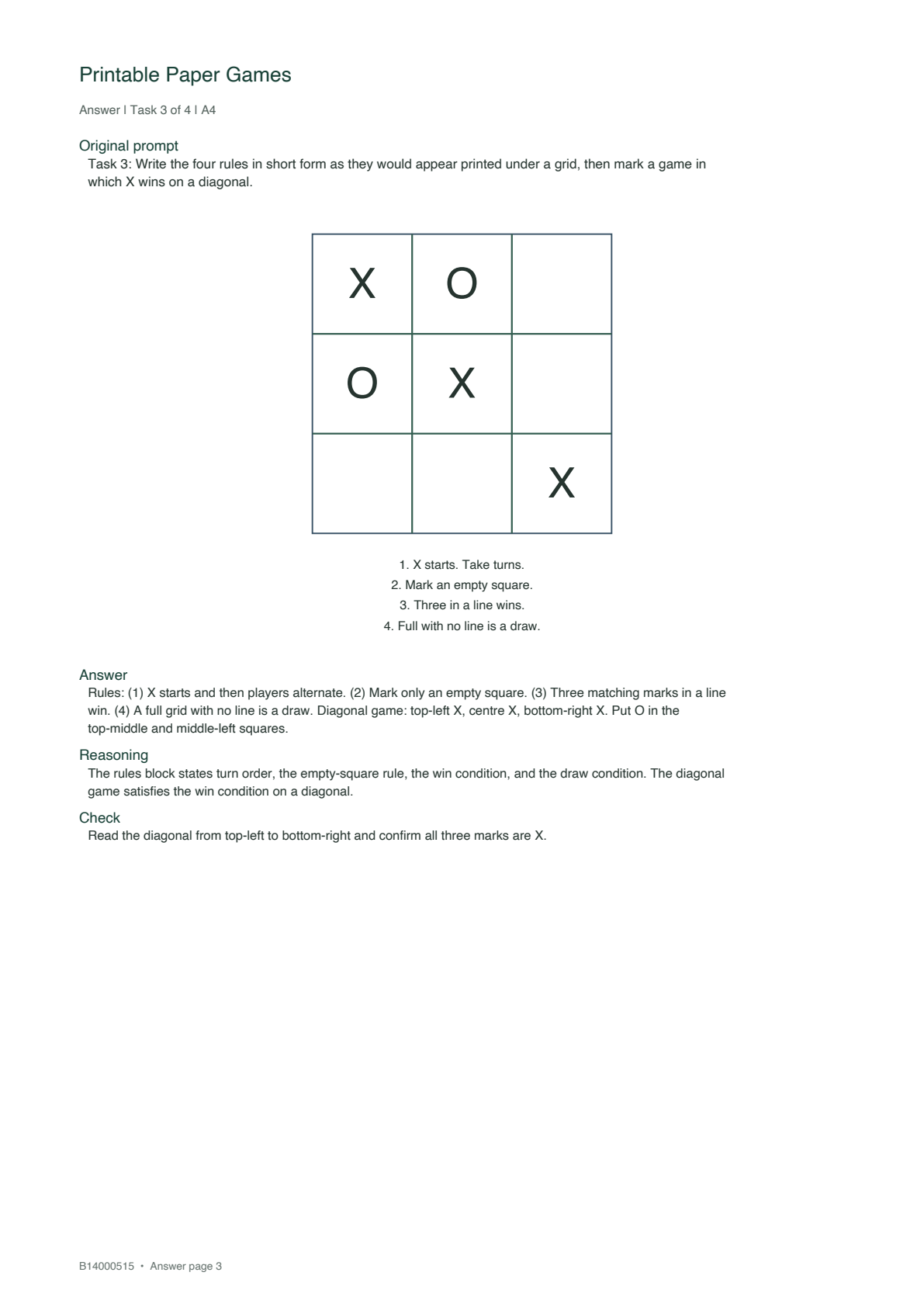
Task 3: Write the four rules in short form as they would appear printed under a grid, then mark a game in which X wins on a diagonal.
Show answer 3
Rules: (1) X starts and then players alternate. (2) Mark only an empty square. (3) Three matching marks in a line win. (4) A full grid with no line is a draw. Diagonal game: top-left X, centre X, bottom-right X. Put O in the top-middle and middle-left squares.
The rules block states turn order, the empty-square rule, the win condition, and the draw condition. The diagonal game satisfies the win condition on a diagonal.
Check: Read the diagonal from top-left to bottom-right and confirm all three marks are X.
Task 4
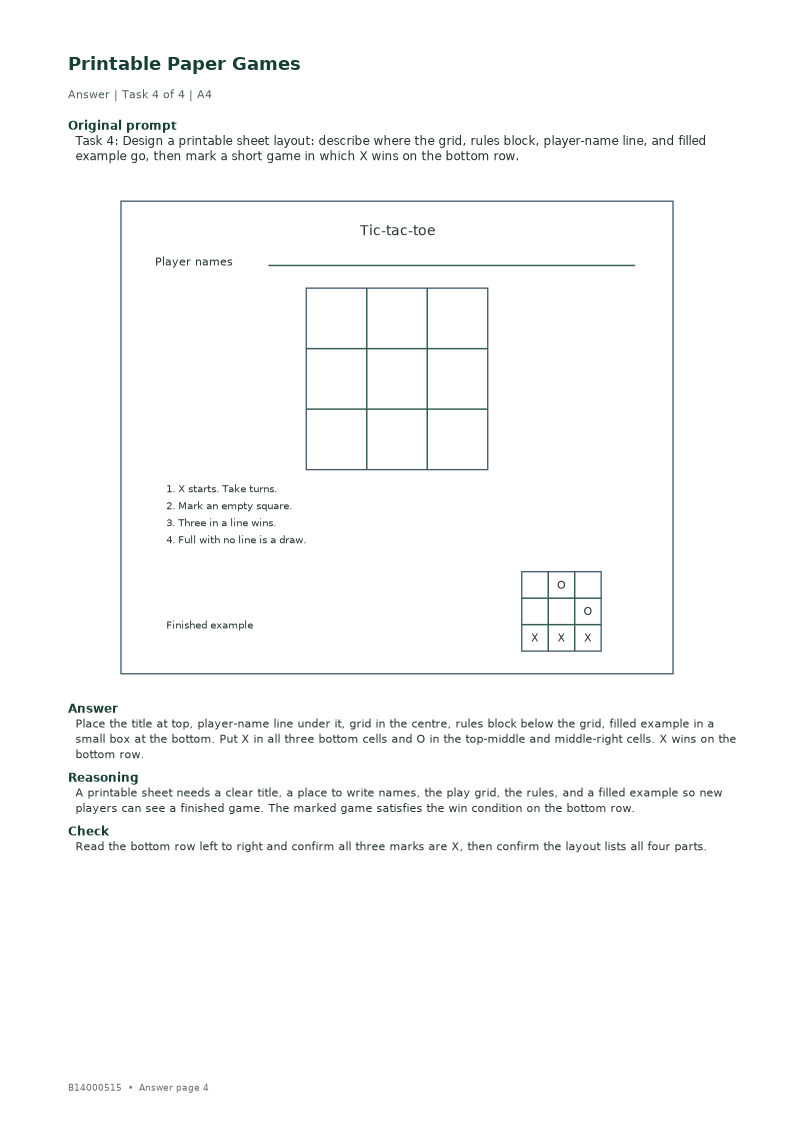
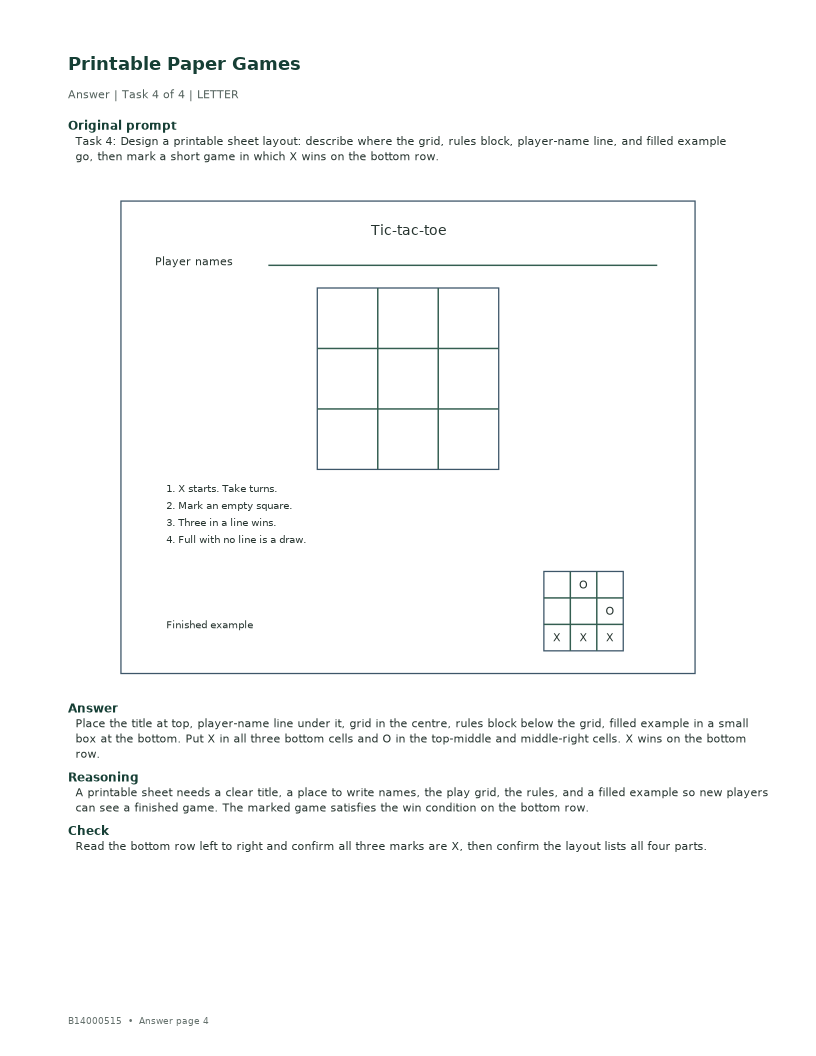
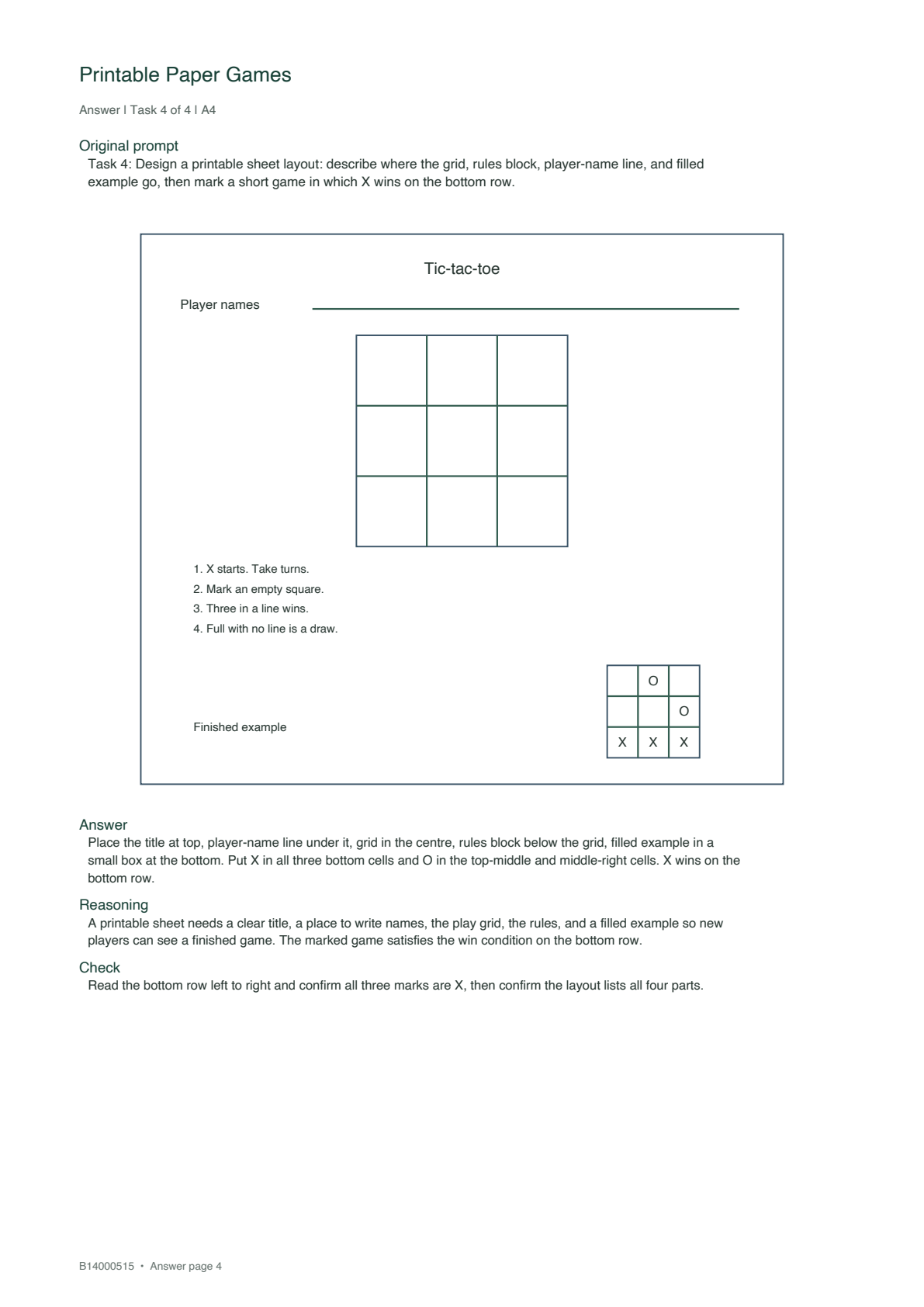
Task 4: Design a printable sheet layout: describe where the grid, rules block, player-name line, and filled example go, then mark a short game in which X wins on the bottom row.
Show answer 4
Place the title at top, player-name line under it, grid in the centre, rules block below the grid, filled example in a small box at the bottom. Put X in all three bottom cells and O in the top-middle and middle-right cells. X wins on the bottom row.
A printable sheet needs a clear title, a place to write names, the play grid, the rules, and a filled example so new players can see a finished game. The marked game satisfies the win condition on the bottom row.
Check: Read the bottom row left to right and confirm all three marks are X, then confirm the layout lists all four parts.
Useful checks
- Marking a square that already holds a mark. Only mark empty squares; check the square is blank before writing.
- Declaring a win when only two marks in a line match. A win needs three identical marks in one row, column, or diagonal; count the marks before calling a win.
- Calling a draw while empty squares remain. A draw requires all nine squares to be filled with no line of three; keep playing while squares are empty.
Questions about this resource
Who goes first?
X goes first, then players alternate turns.
What counts as a win?
Three of the same mark in a full row, column, or diagonal.
When is it a draw?
When all nine squares are filled and no line of three identical marks exists.