Free original lessons
Grid Drawing Anime
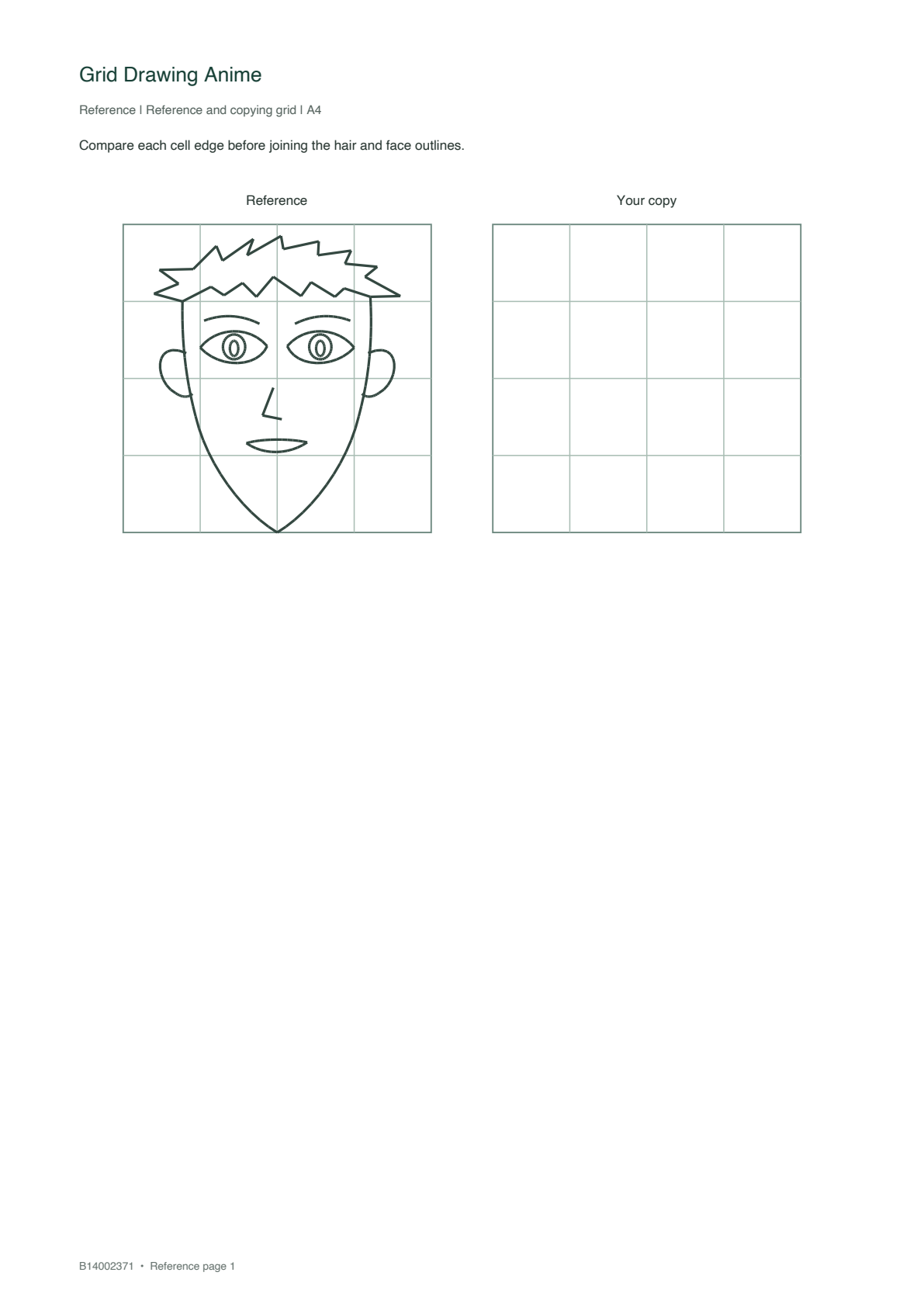
Grid drawing anime means copying a portrait square by square: you look at what occupies each cell of the reference grid, then draw that same content in the matching cell of the blank grid. This pack teaches that transfer with one worked example and four practice tasks.
Letter & A4
PDF & SVG
What grid-copy transfer is
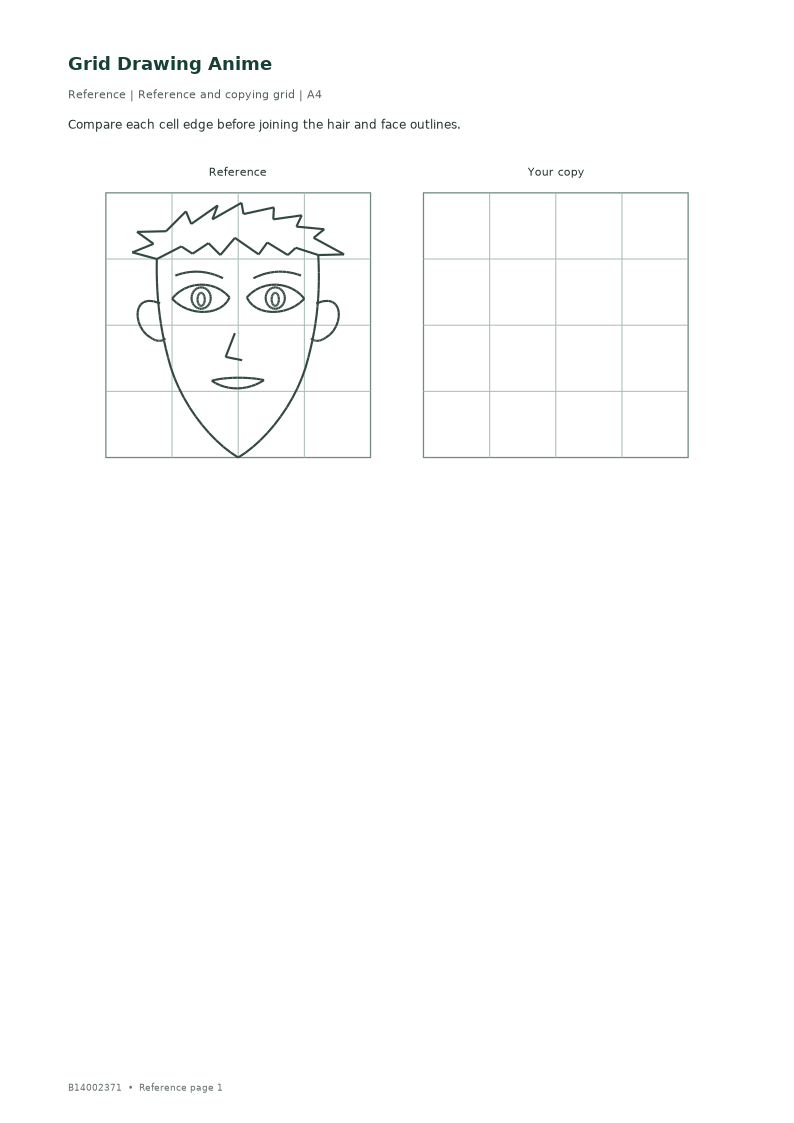
A reference portrait is placed under a grid of equal squares. A blank grid of the same size sits beside it. For each square you compare where the face features cross the cell edges, then reproduce those crossings and shapes in the matching blank cell.
The grid is a guide, not a ruler. You are matching position and shape by eye, cell by cell, so the finished copy keeps the same proportions as the reference.
How to transfer one cell
Step 1: pick one reference cell and note which features enter it and where they touch its edges. Step 2: find the matching blank cell. Step 3: lightly mark the edge crossings first. Step 4: join the marks into the feature shapes inside that cell. Step 5: compare the finished cell with the reference before moving on.
Worked example
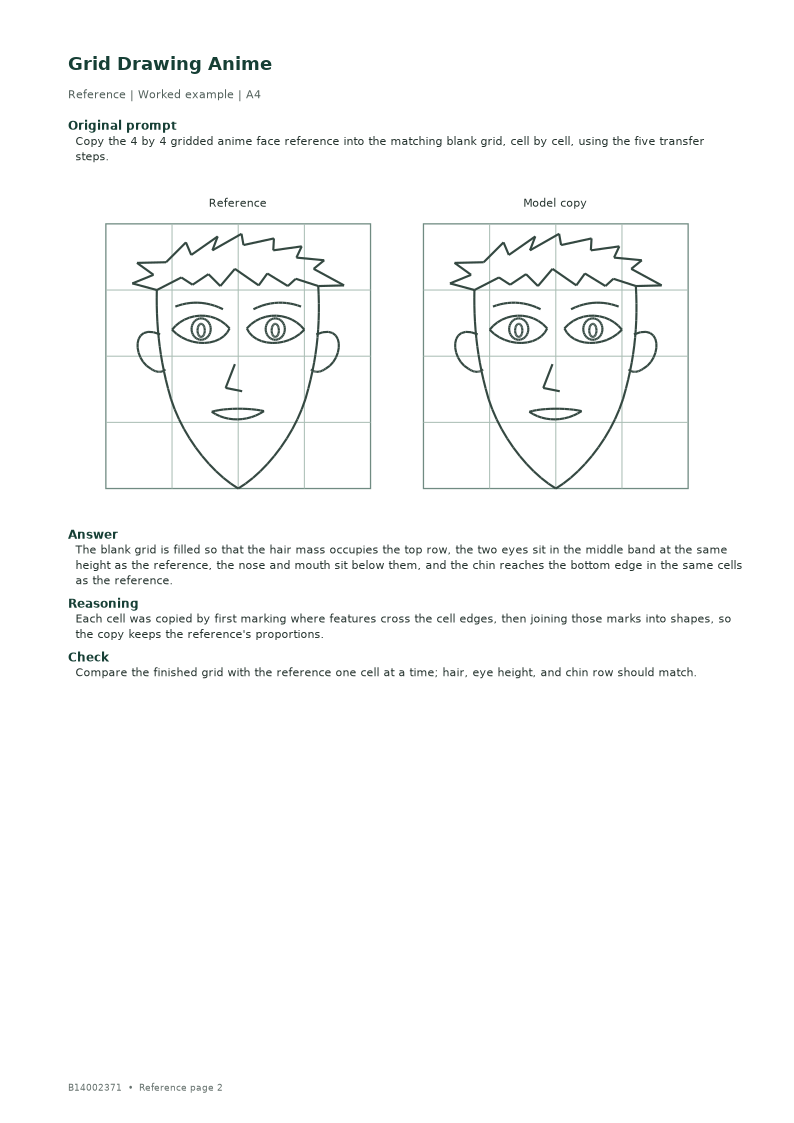
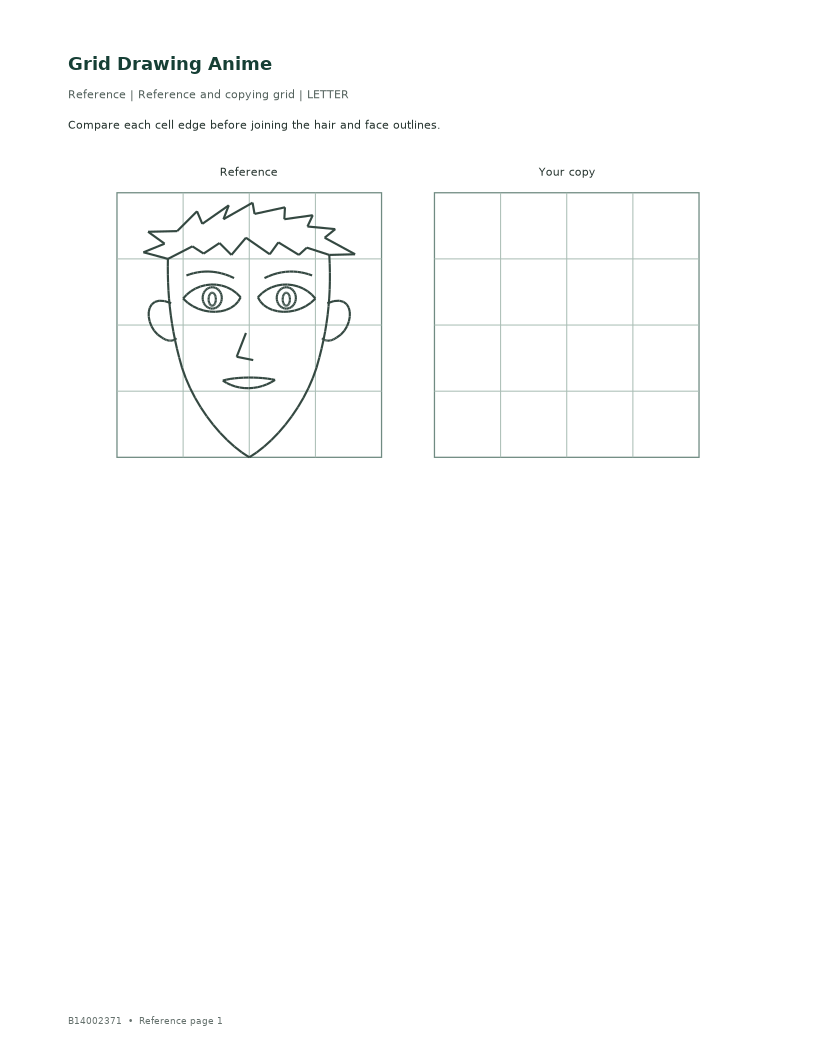
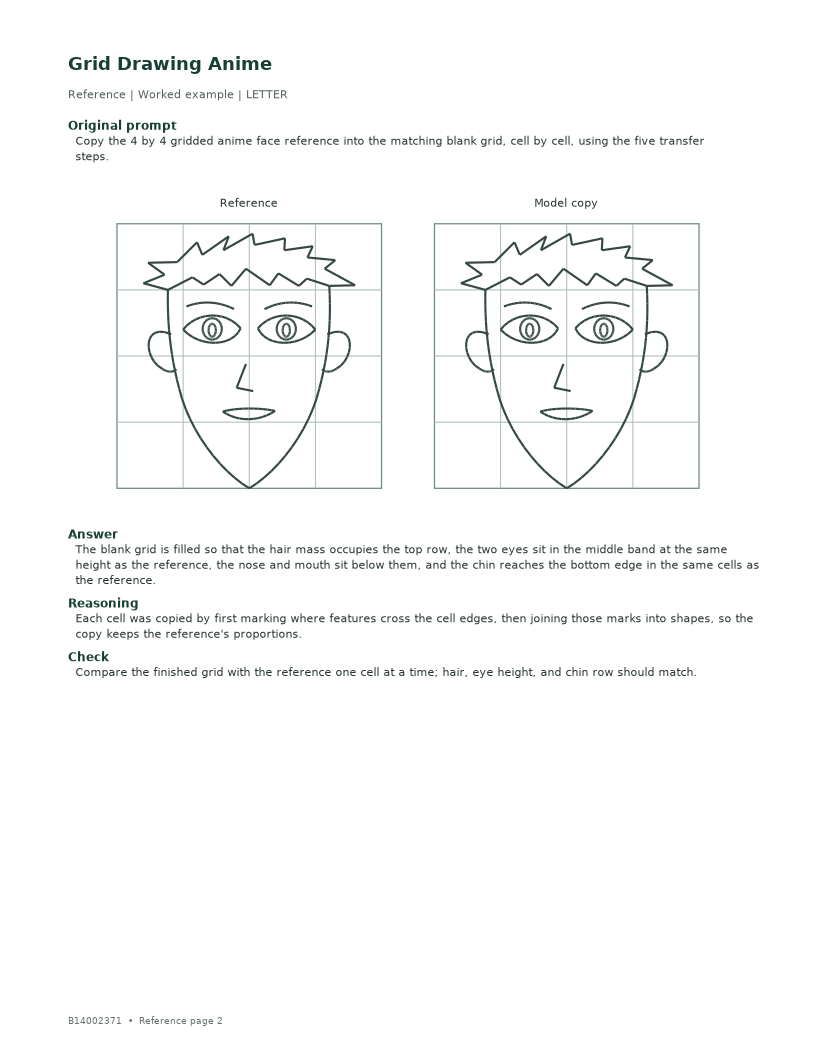
The worked example uses a 4 by 4 reference grid of a simple anime face: hair mass at the top, two eyes in the middle band, a small nose and mouth below, and a chin near the bottom edge. The blank 4 by 4 grid is filled cell by cell using the steps above.
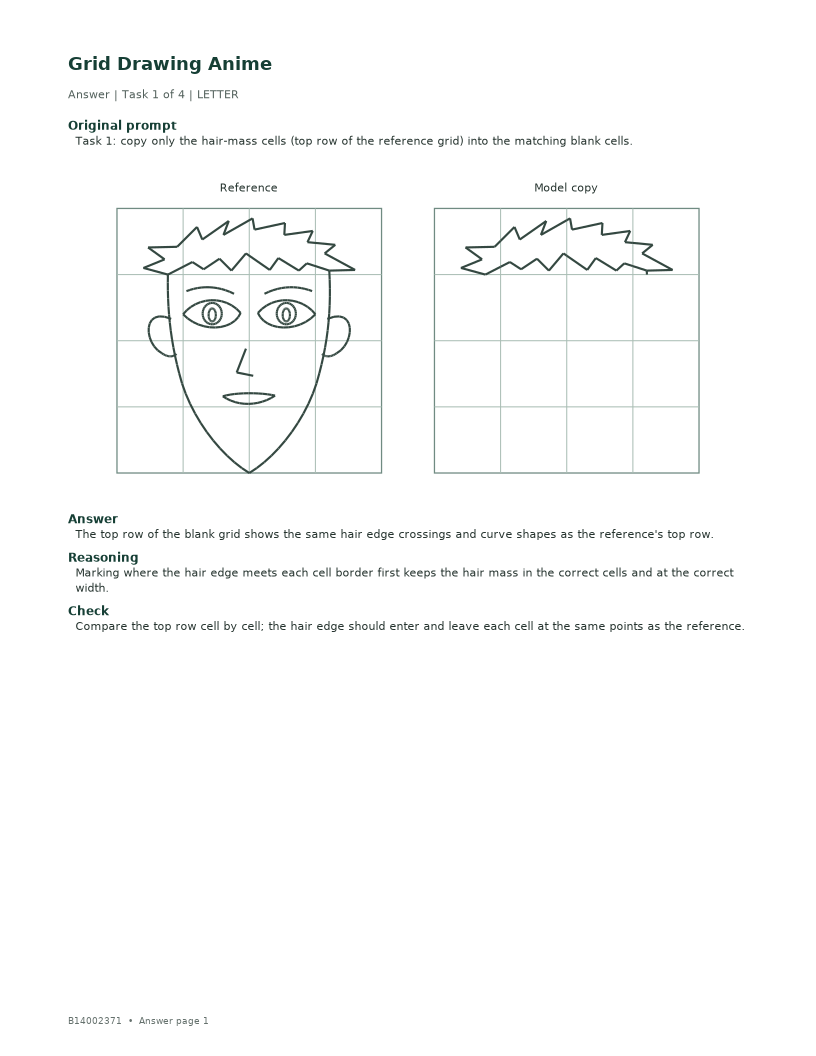
The hair outline in the top-left cell meets its right edge twice, once about halfway down and once near the bottom. Mark both points before connecting the zig-zag segments. On the second row copy the eye cells, matching each outer corner at its side edge. Compare the hairline, eye height and chin position cell by cell.
Practice tasks
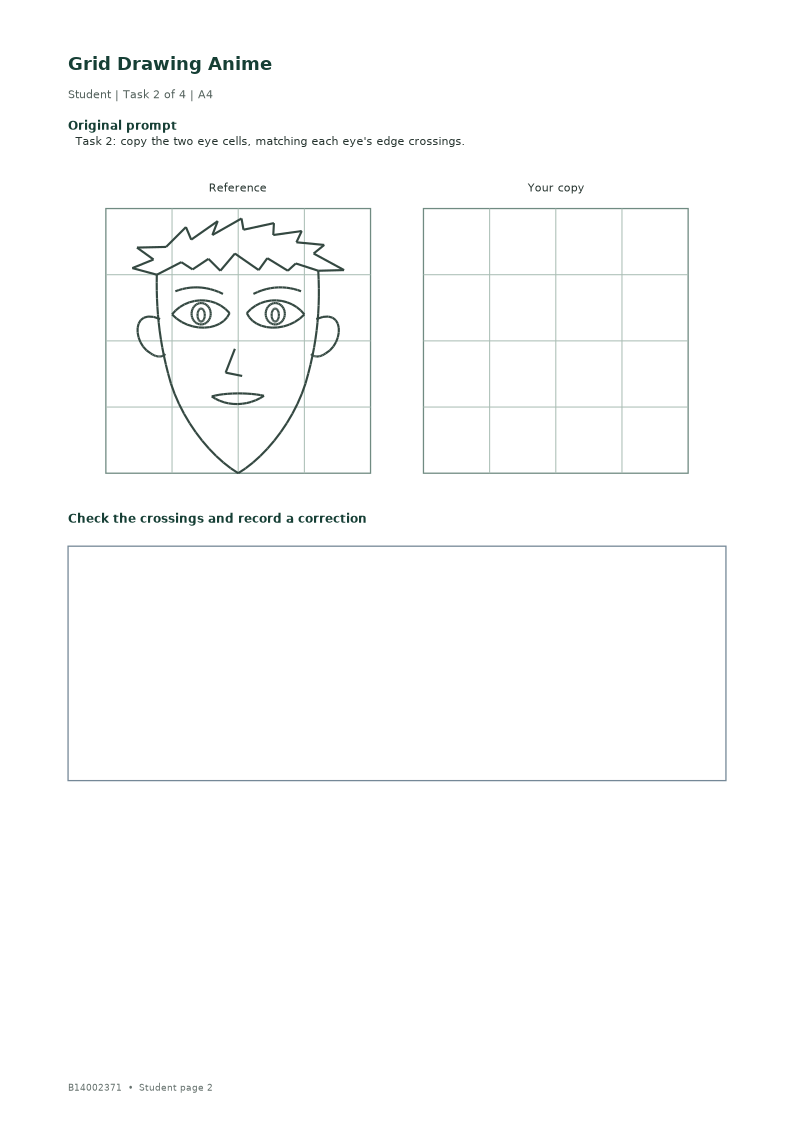
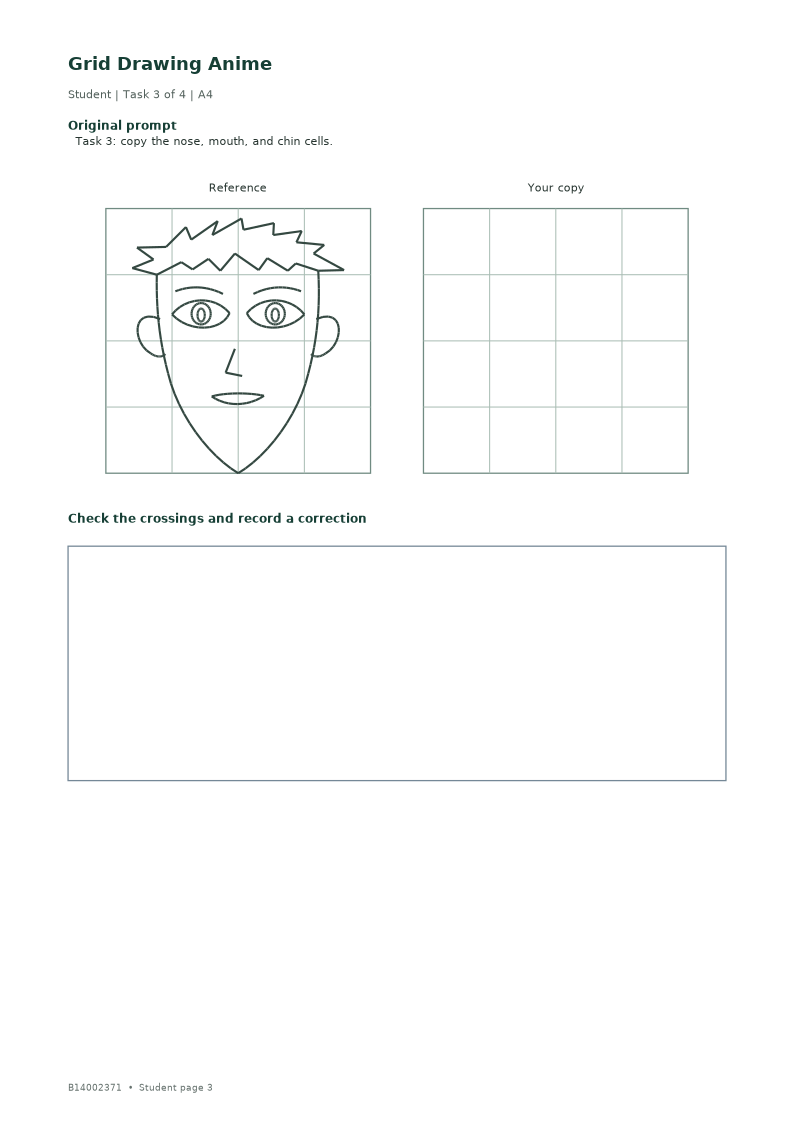
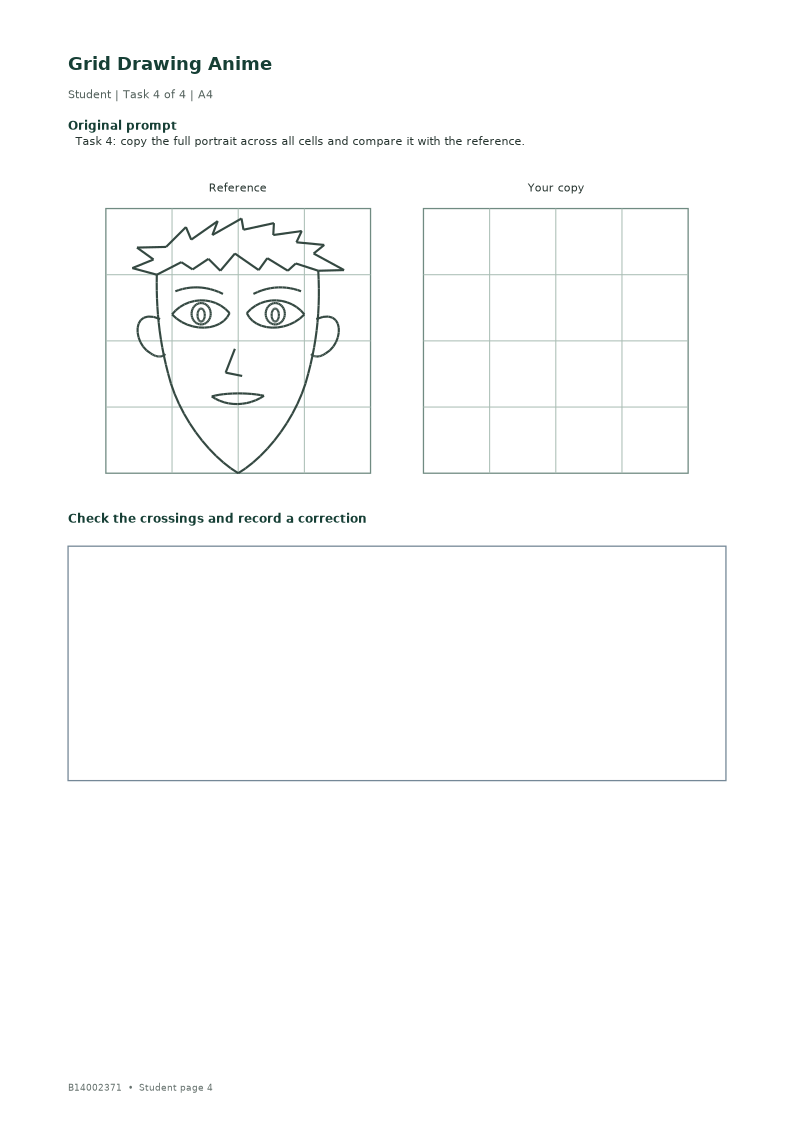
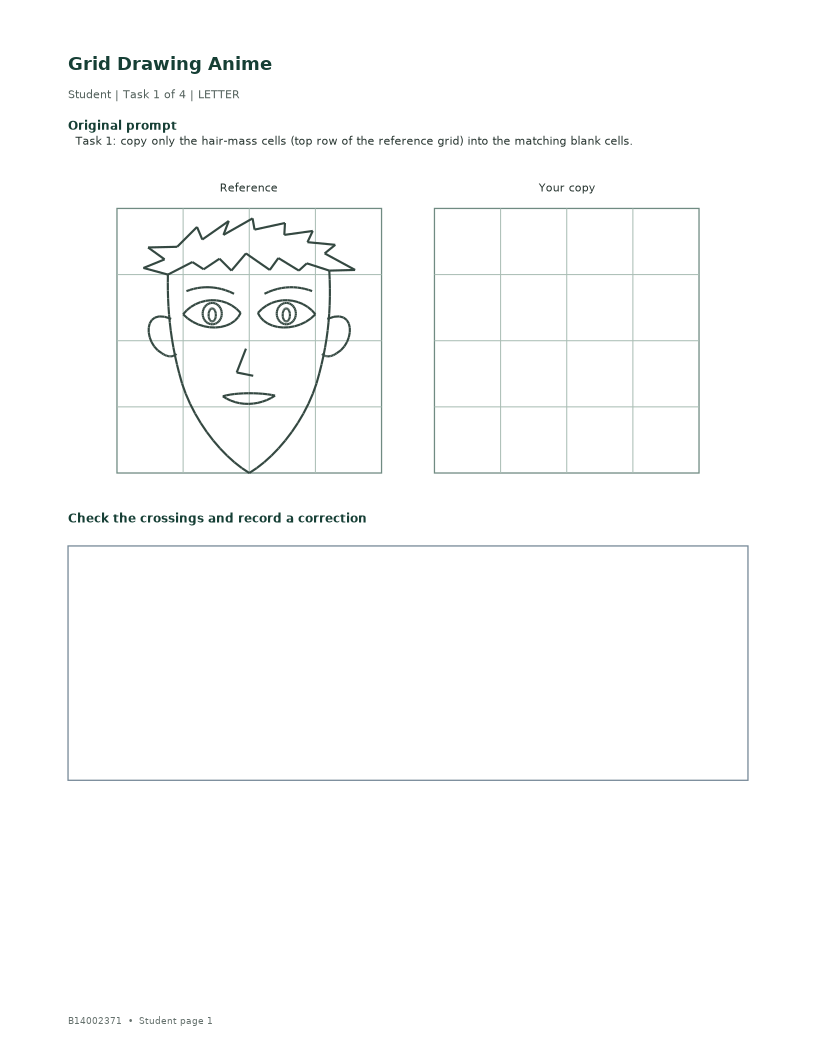
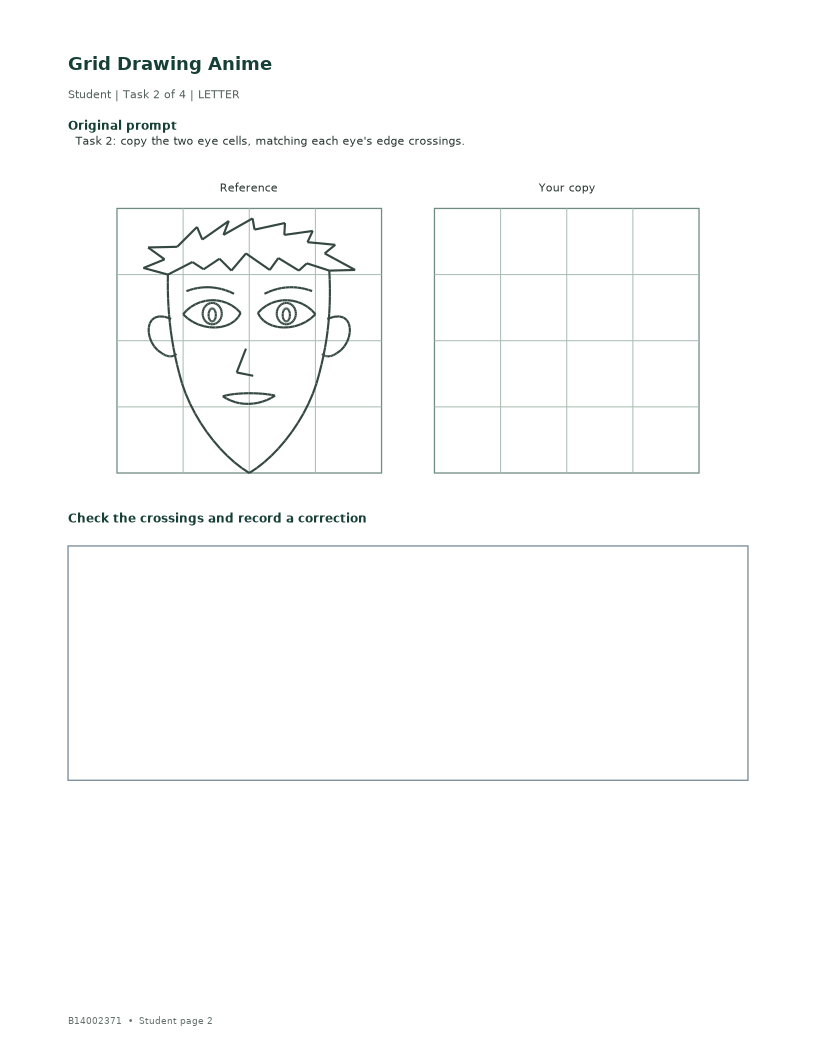
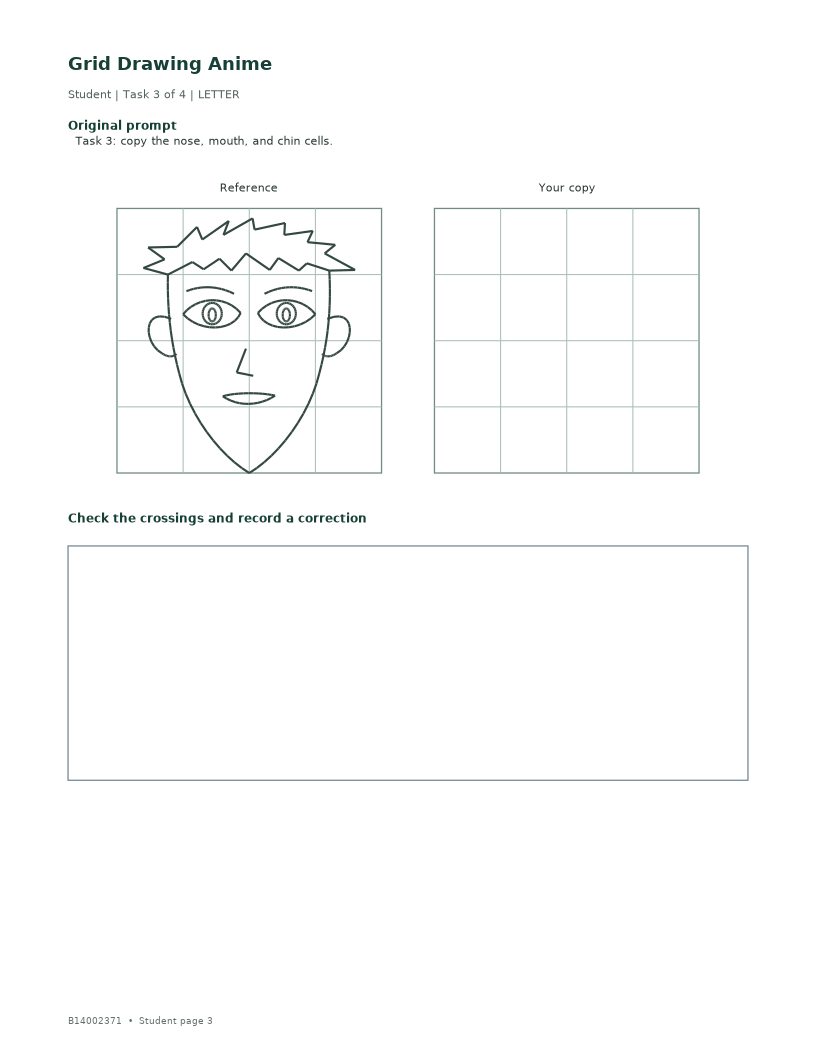
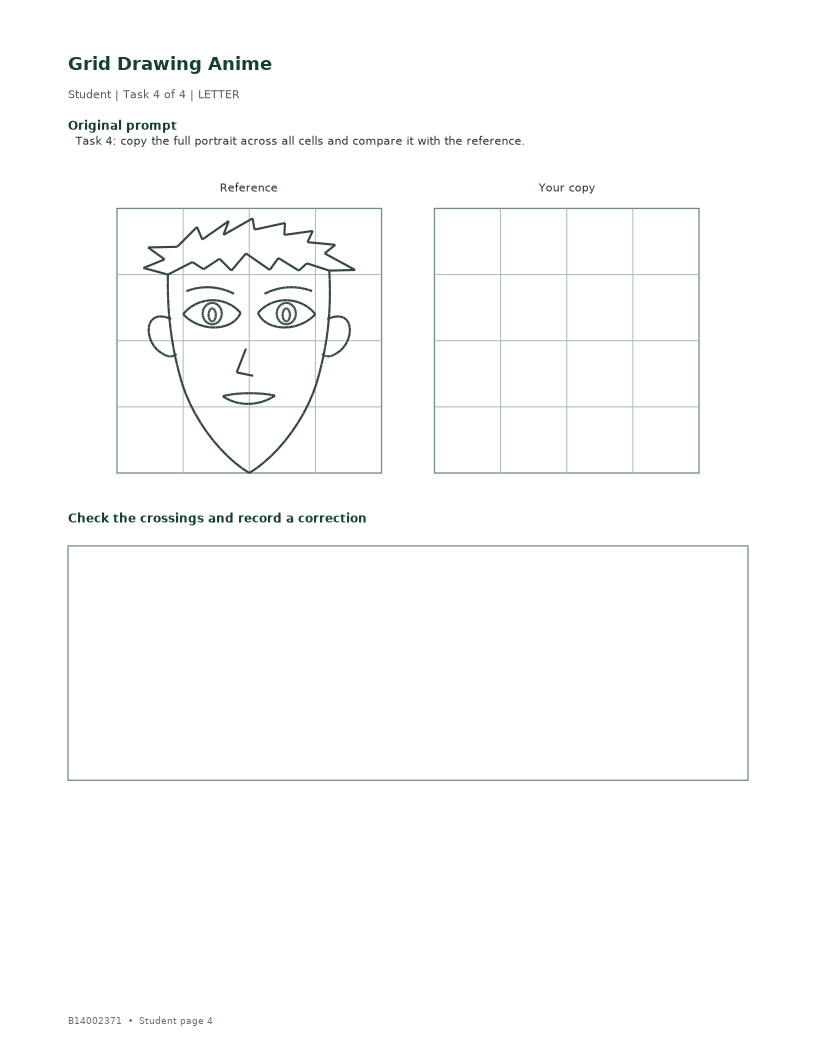
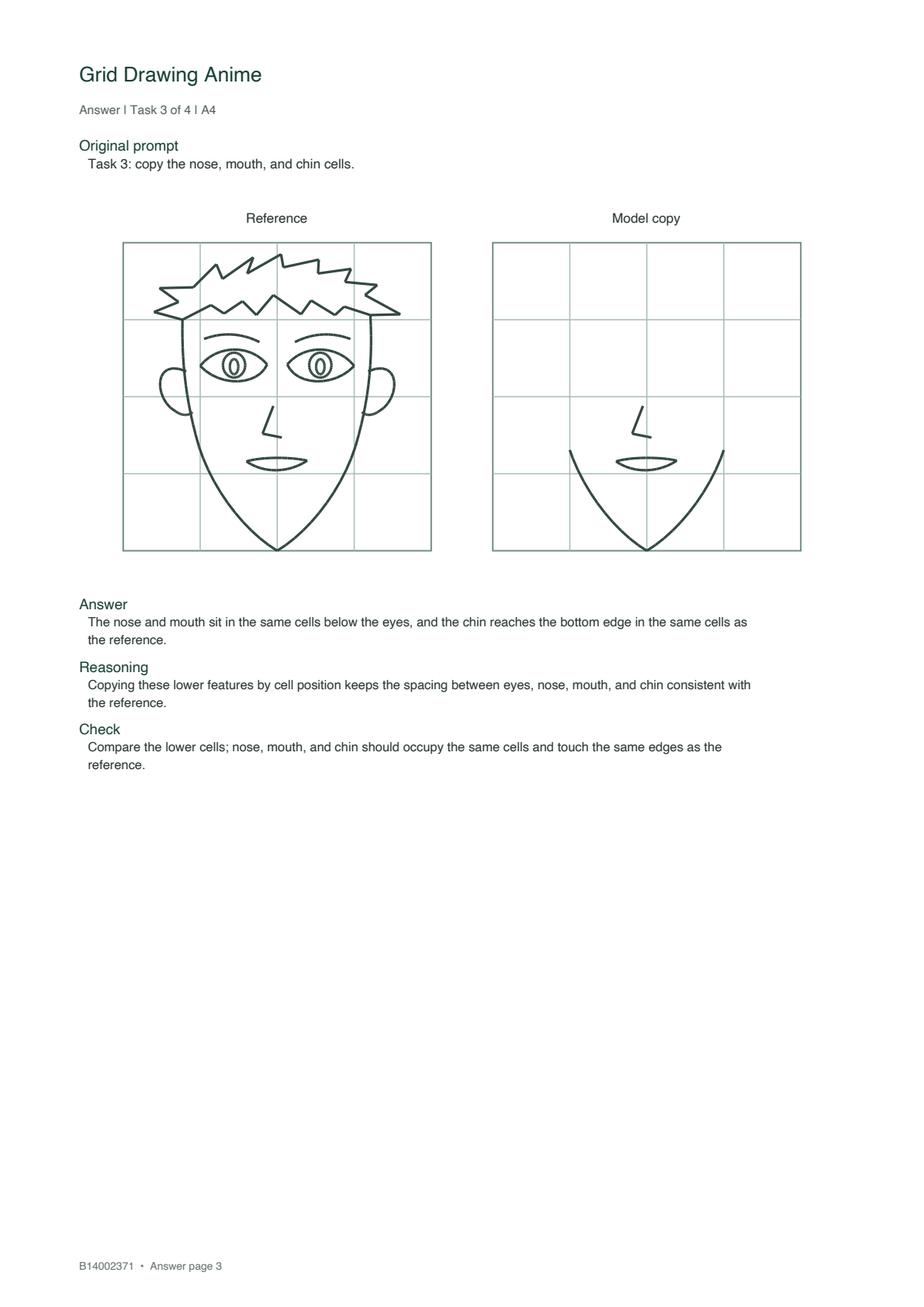
Task 1: copy the hair-mass cells only (the top row of the reference grid) into the matching blank cells. Task 2: copy the two eye cells, matching each eye's edge crossings. Task 3: copy the nose, mouth, and chin cells. Task 4: copy the full portrait across all cells and compare it with the reference.
Visual check
After each task, lay the finished grid beside the reference and compare one cell at a time. Check that features cross cell edges at the same points, that eye height matches, and that the chin sits in the same row. Correct any cell where a feature sits too high, too low, or too wide before continuing.
Download the complete resource pack
All individual SVG pages (20)
- A4 reference page 1
- A4 reference page 2
- A4 student page 1
- A4 student page 2
- A4 student page 3
- A4 student page 4
- A4 answer page 1
- A4 answer page 2
- A4 answer page 3
- A4 answer page 4
- LETTER reference page 1
- LETTER reference page 2
- LETTER student page 1
- LETTER student page 2
- LETTER student page 3
- LETTER student page 4
- LETTER answer page 1
- LETTER answer page 2
- LETTER answer page 3
- LETTER answer page 4
Print at 100% / actual size. Use the stated scale on any schematic diagram; physical cutting templates are identified separately. A4 and US Letter are separate files. Free access, no signup; CC BY 4.0.
How to use these pages
- What grid-copy transfer is
- How to transfer one cell
- Worked example
- Practice tasks
- Visual check
Worked example
Example: Copy the 4 by 4 gridded anime face reference into the matching blank grid, cell by cell, using the five transfer steps.
Answer: The blank grid is filled so that the hair mass occupies the top row, the two eyes sit in the middle band at the same height as the reference, the nose and mouth sit below them, and the chin reaches the bottom edge in the same cells as the reference.
Reasoning: Each cell was copied by first marking where features cross the cell edges, then joining those marks into shapes, so the copy keeps the reference's proportions.
Check: Compare the finished grid with the reference one cell at a time; hair, eye height, and chin row should match.
Four practice tasks and complete answers
Task 1
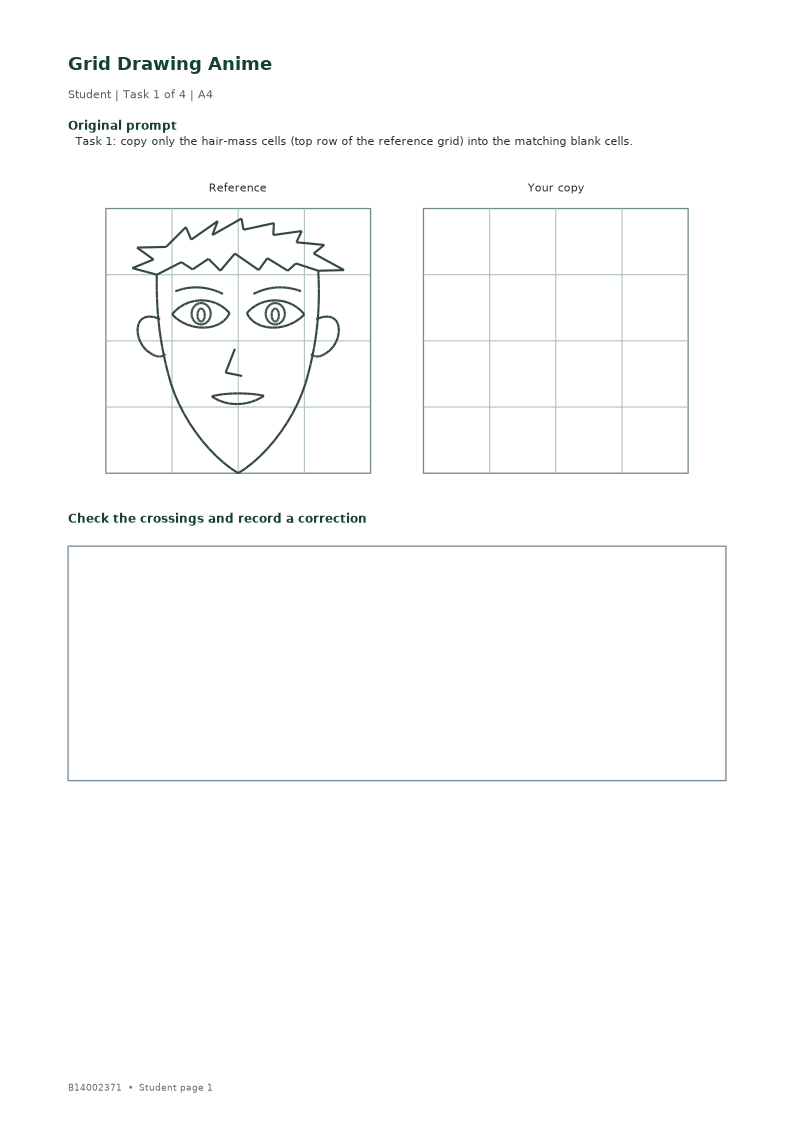
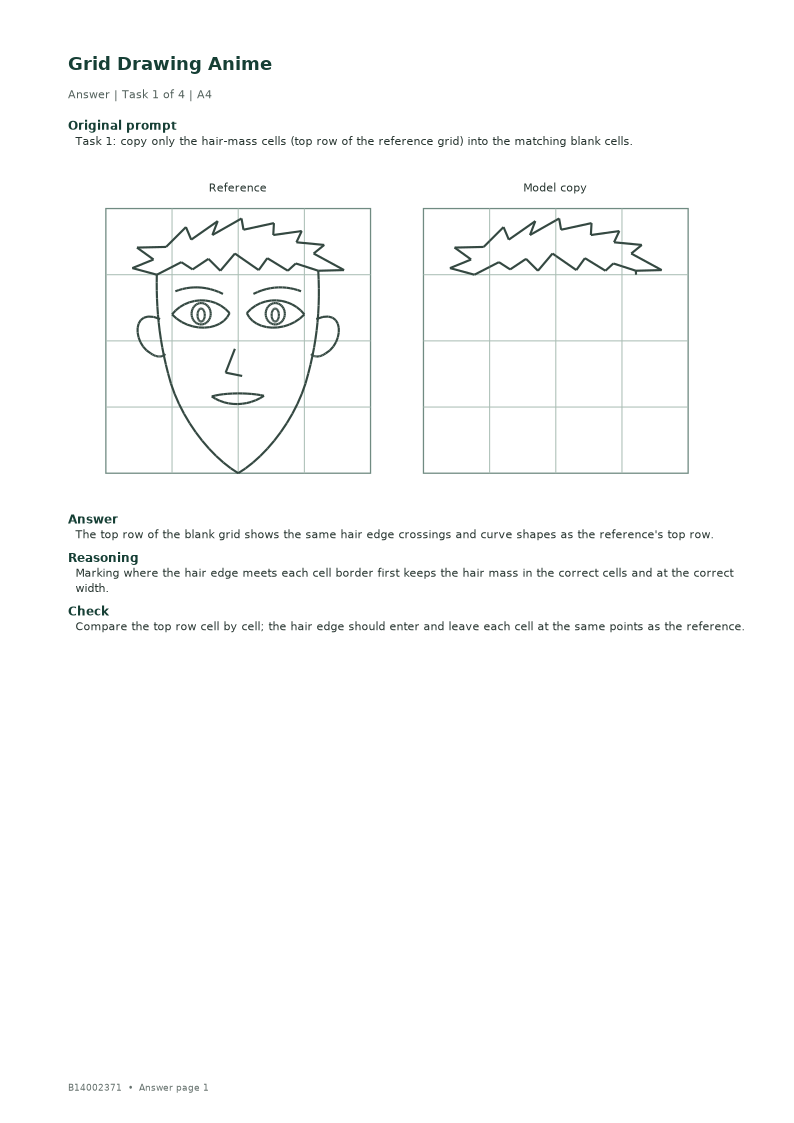
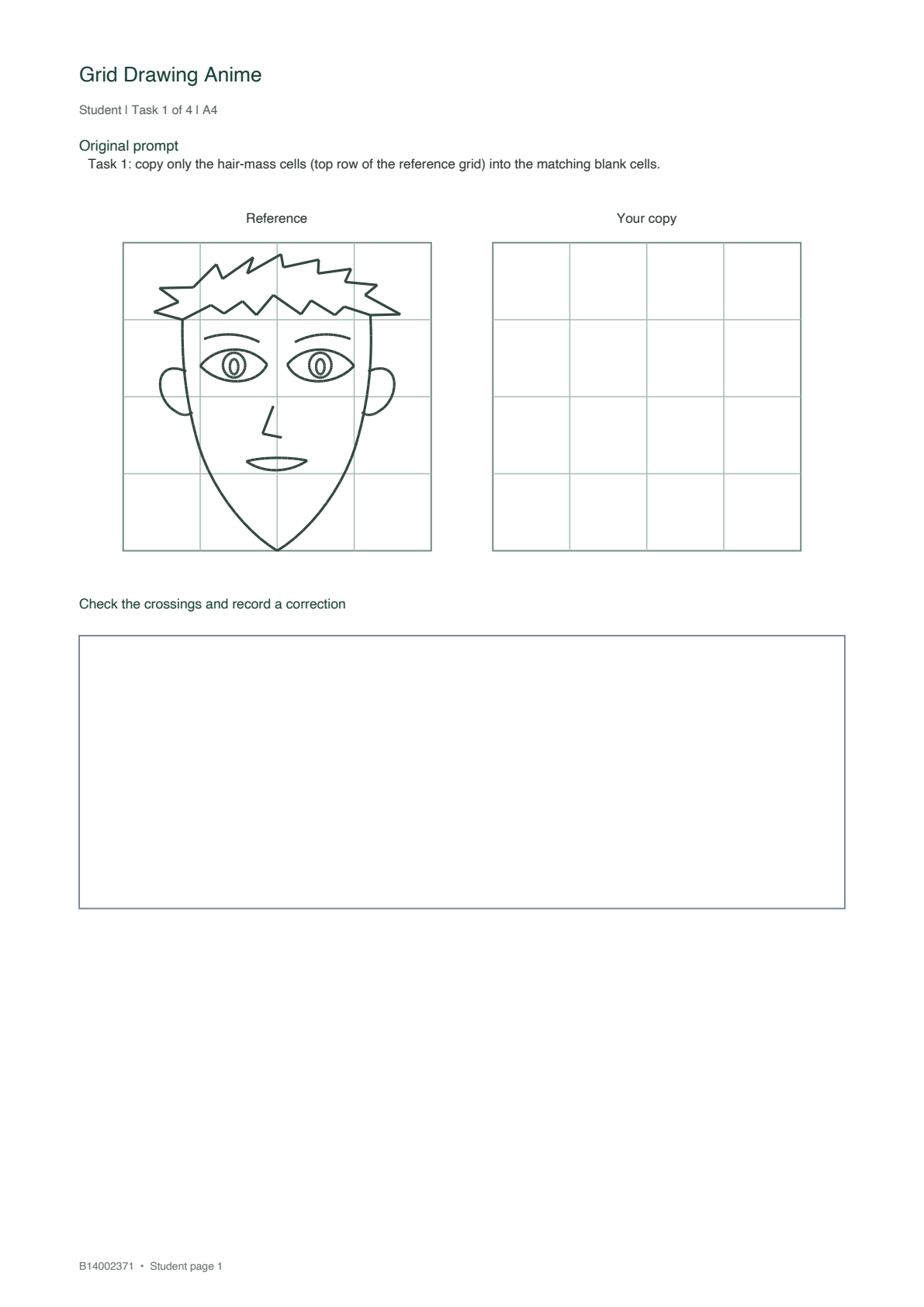
Task 1: copy only the hair-mass cells (top row of the reference grid) into the matching blank cells.
Show answer 1
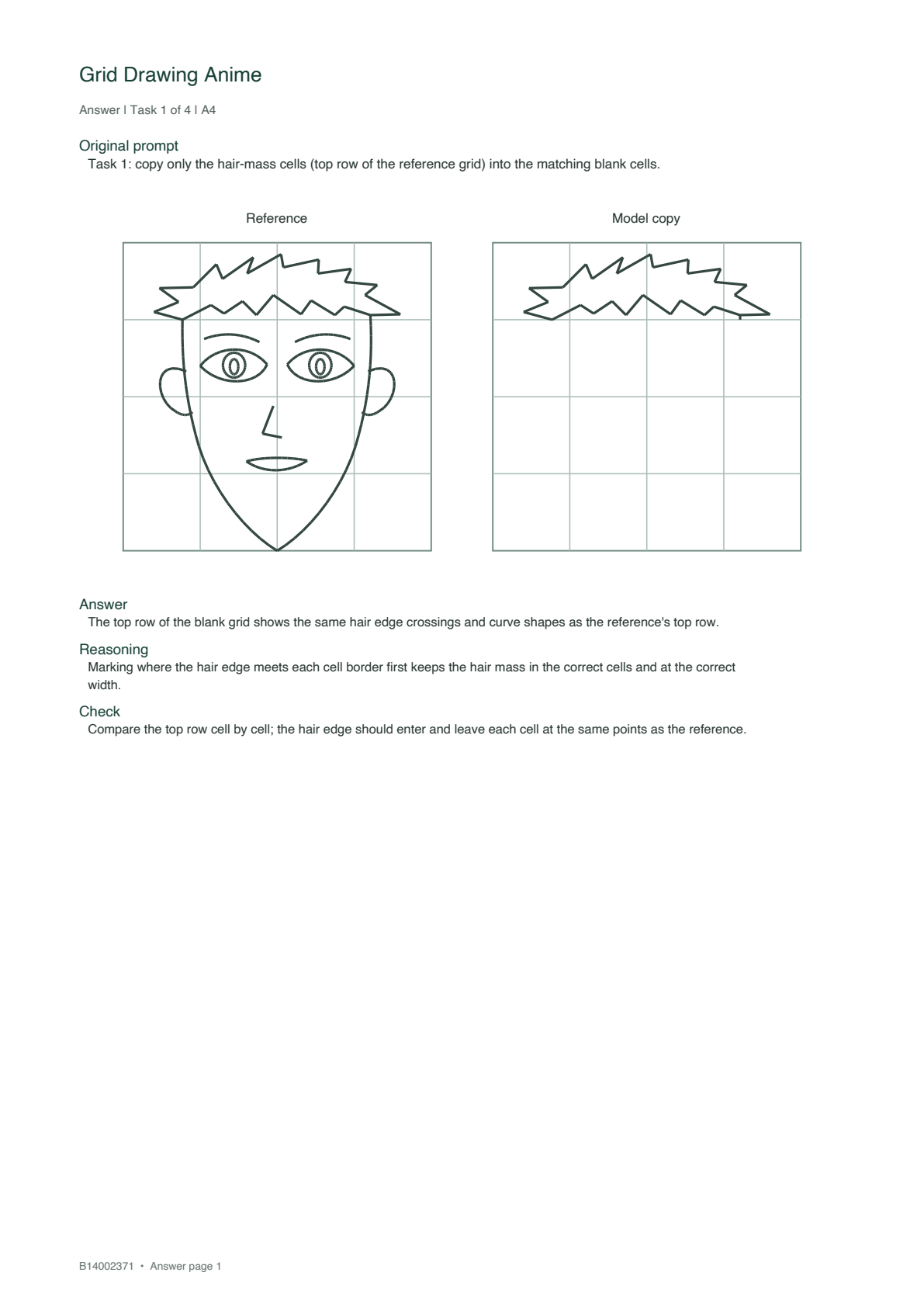
The top row of the blank grid shows the same hair edge crossings and curve shapes as the reference's top row.
Marking where the hair edge meets each cell border first keeps the hair mass in the correct cells and at the correct width.
Check: Compare the top row cell by cell; the hair edge should enter and leave each cell at the same points as the reference.
Task 2
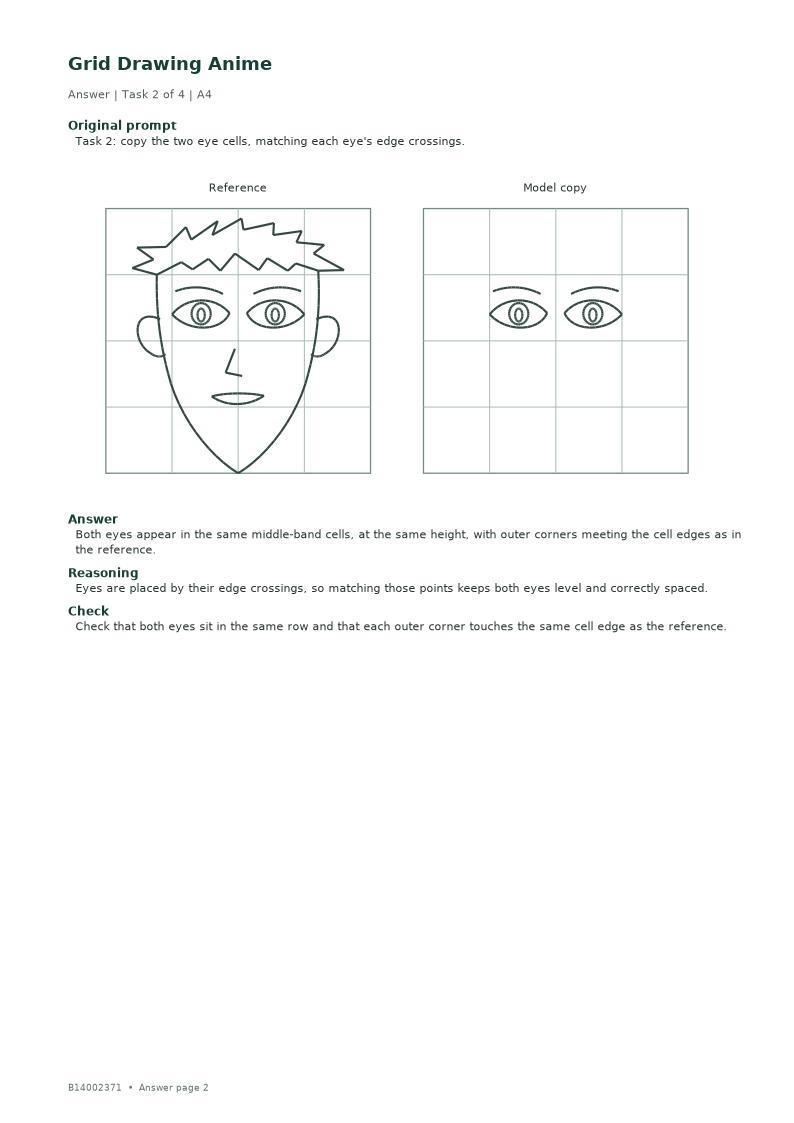
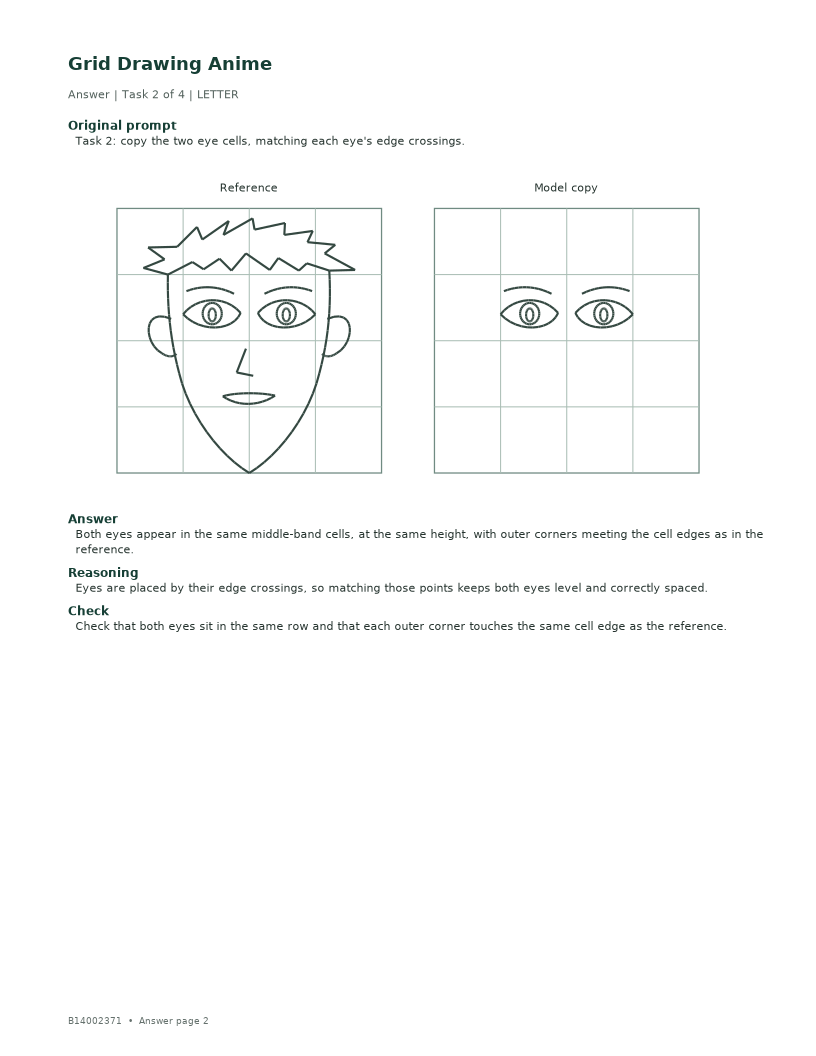
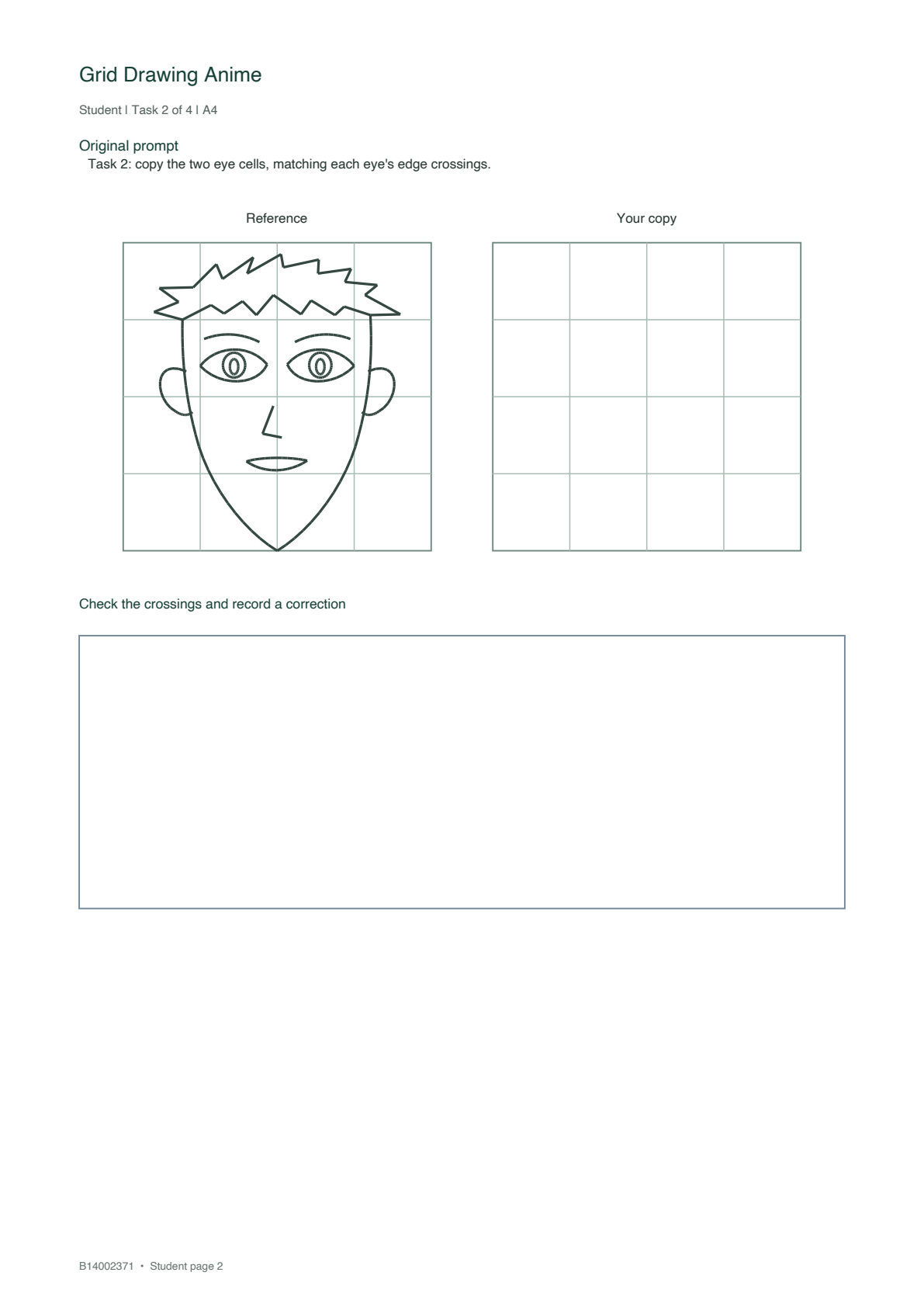
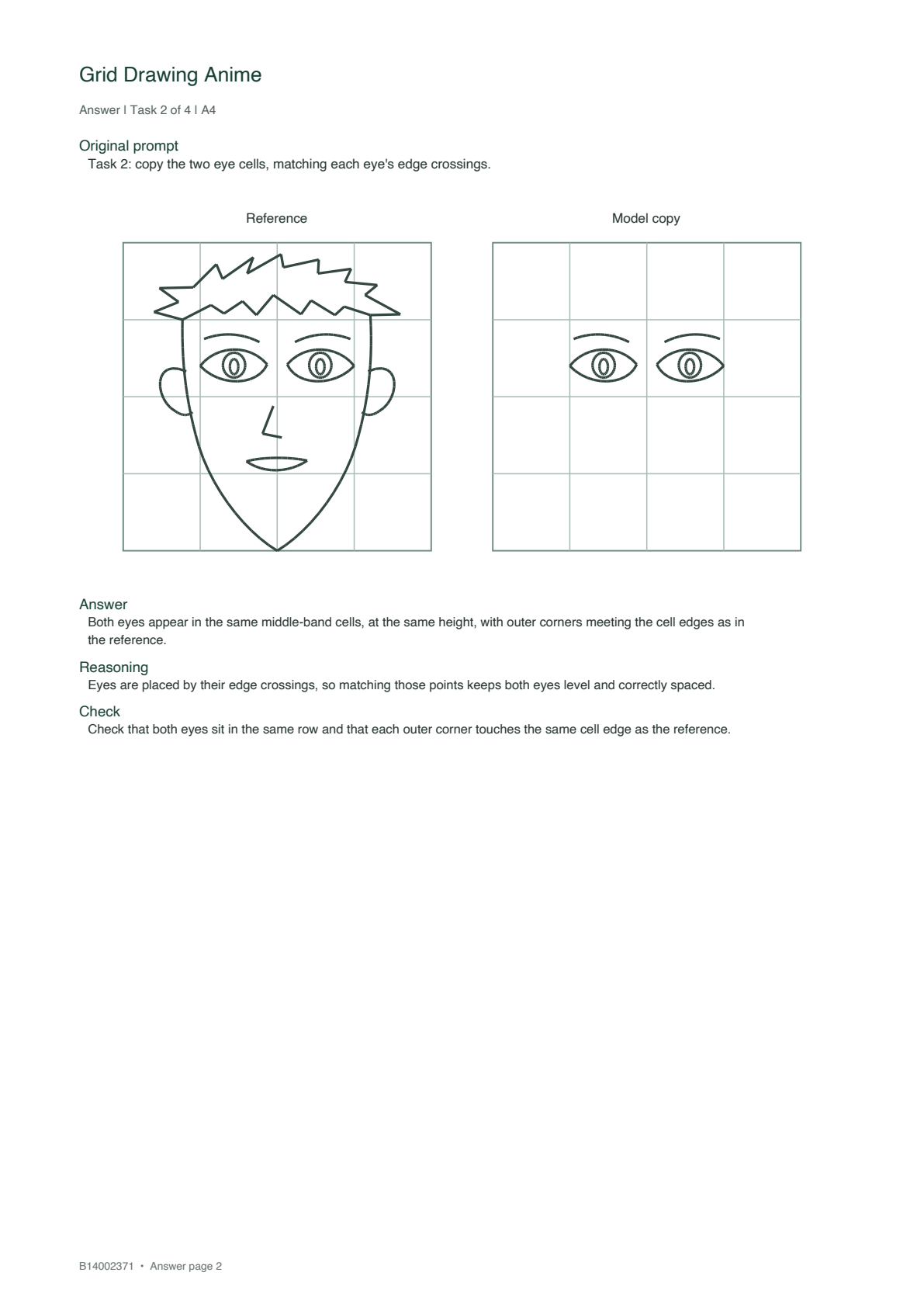
Task 2: copy the two eye cells, matching each eye's edge crossings.
Show answer 2
Both eyes appear in the same middle-band cells, at the same height, with outer corners meeting the cell edges as in the reference.
Eyes are placed by their edge crossings, so matching those points keeps both eyes level and correctly spaced.
Check: Check that both eyes sit in the same row and that each outer corner touches the same cell edge as the reference.
Task 3
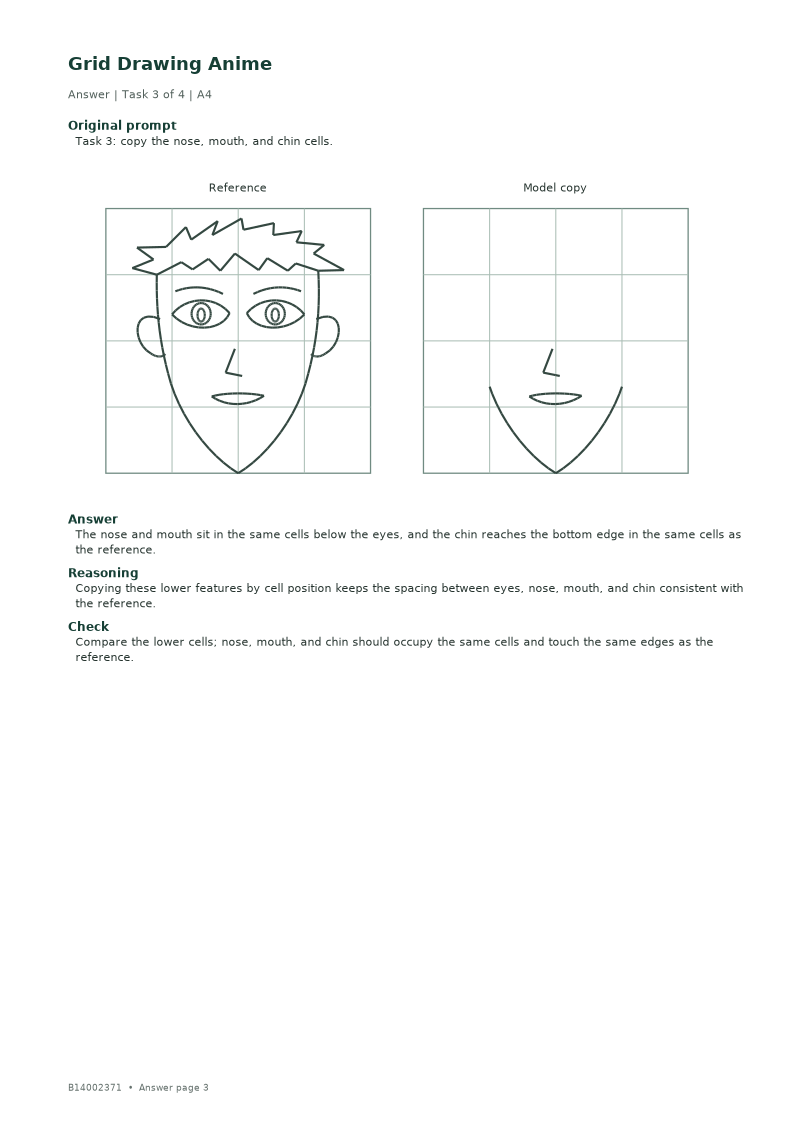
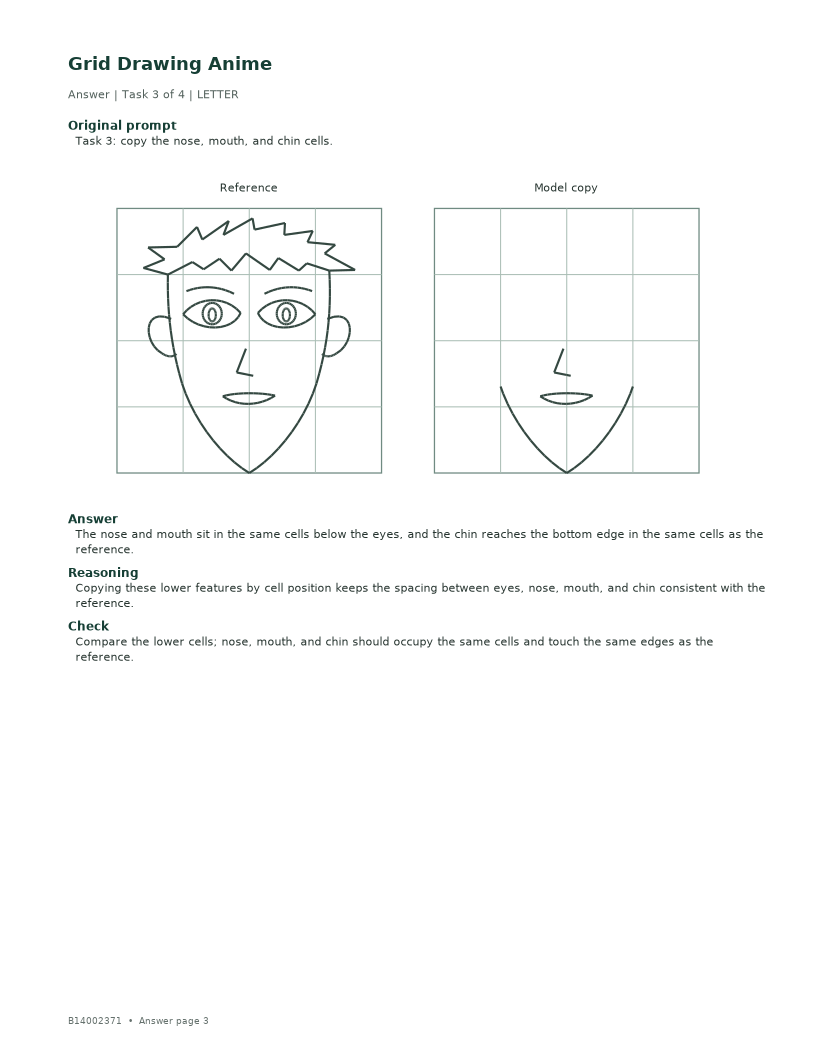
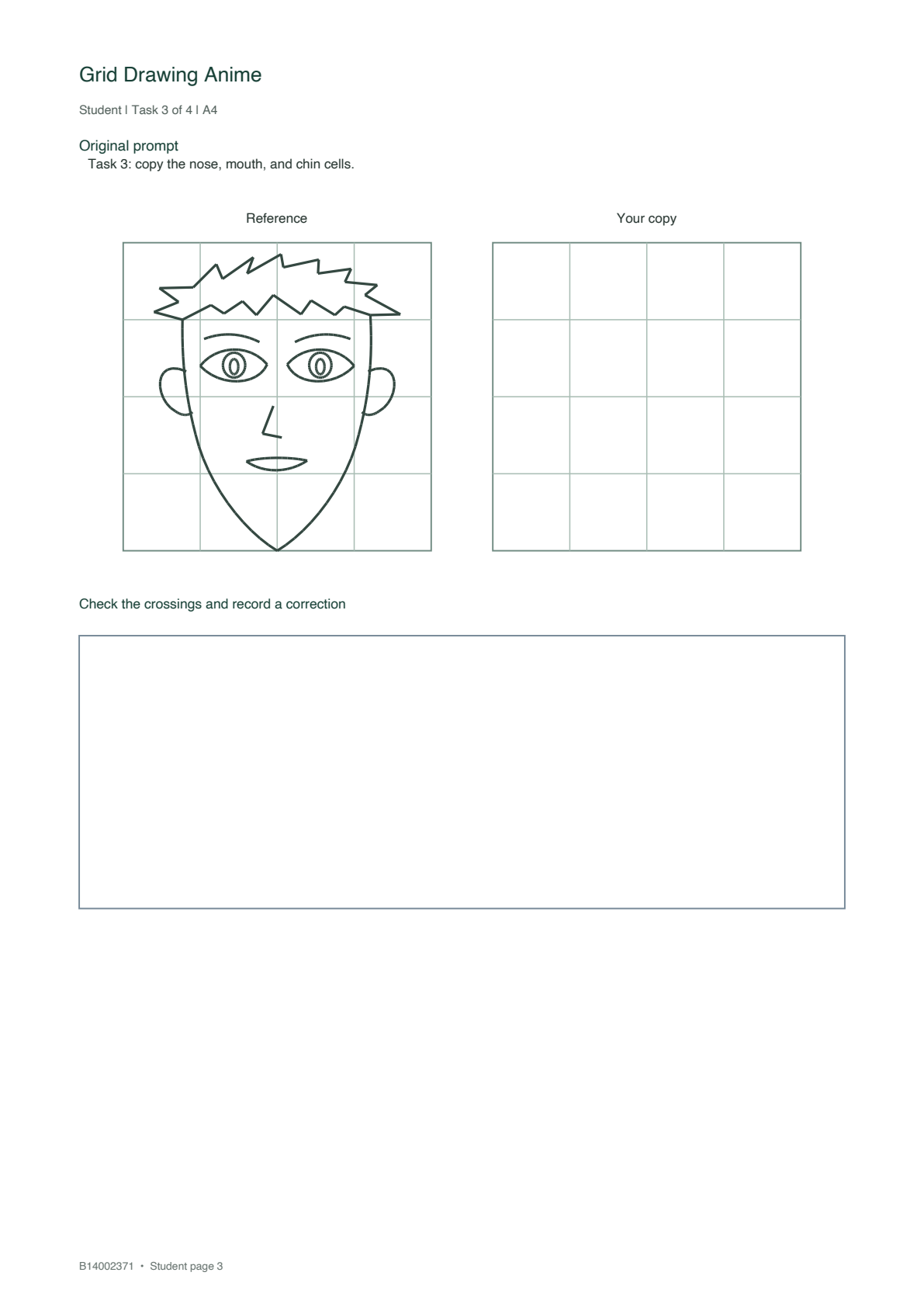
Task 3: copy the nose, mouth, and chin cells.
Show answer 3
The nose and mouth sit in the same cells below the eyes, and the chin reaches the bottom edge in the same cells as the reference.
Copying these lower features by cell position keeps the spacing between eyes, nose, mouth, and chin consistent with the reference.
Check: Compare the lower cells; nose, mouth, and chin should occupy the same cells and touch the same edges as the reference.
Task 4
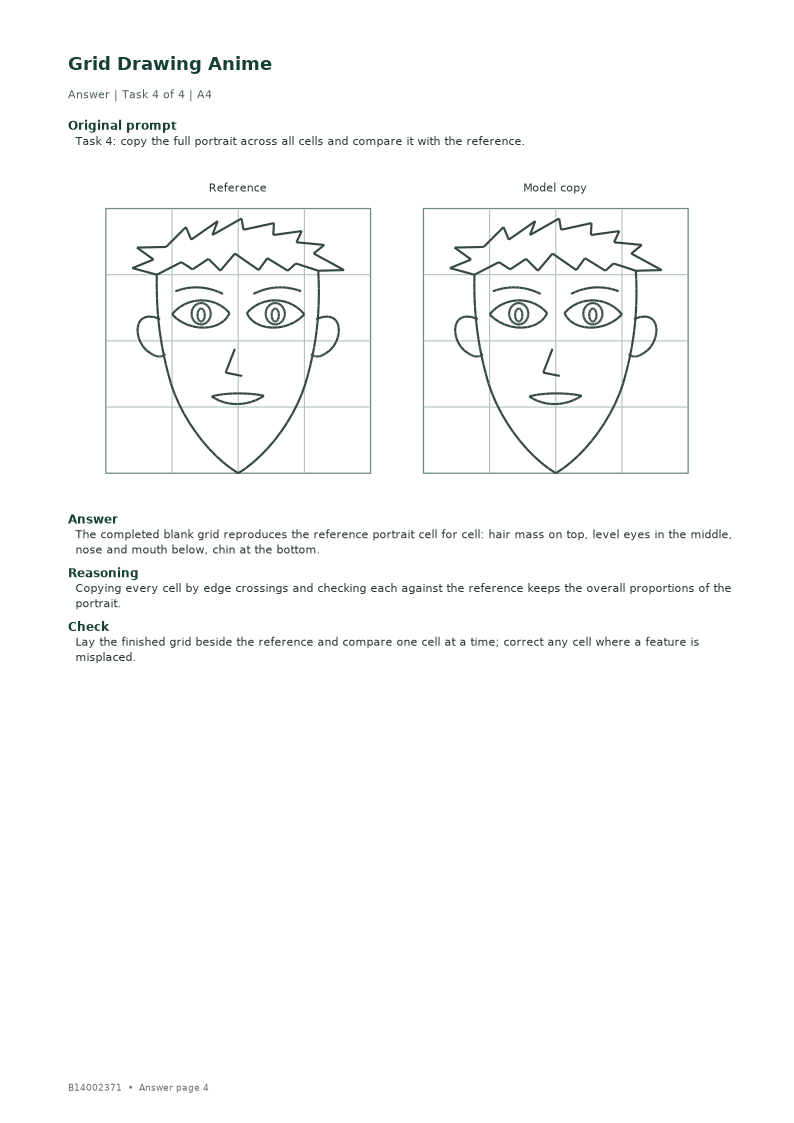
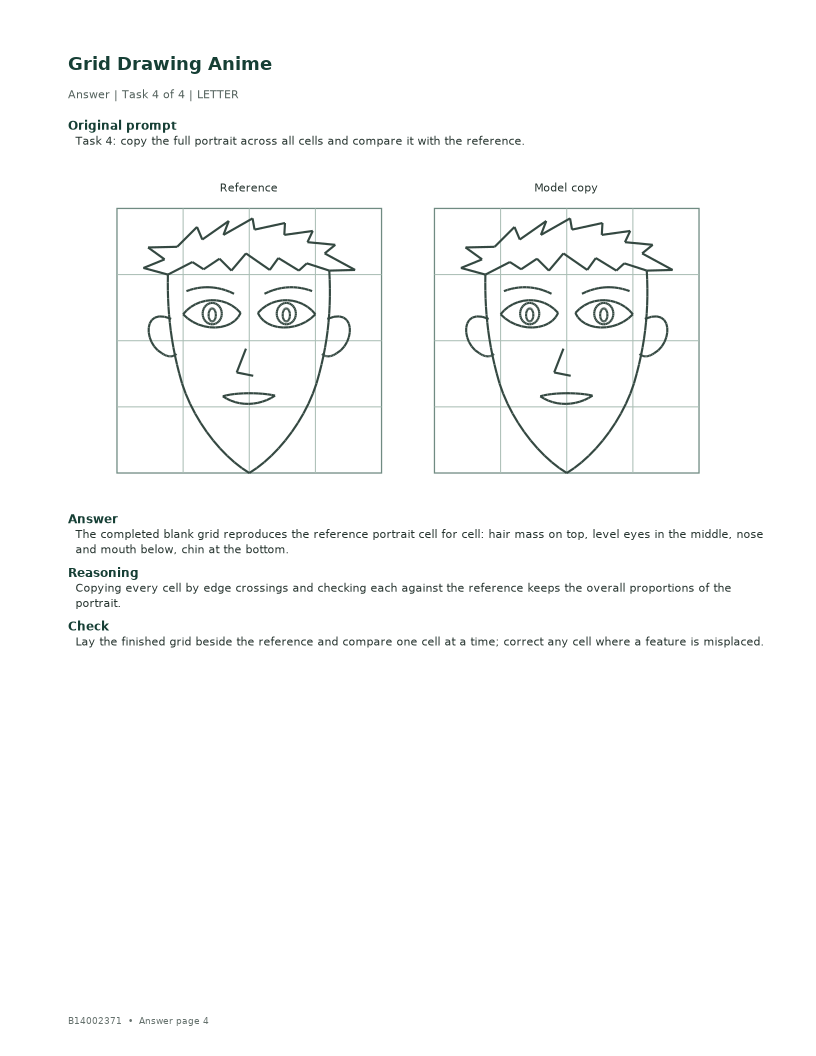
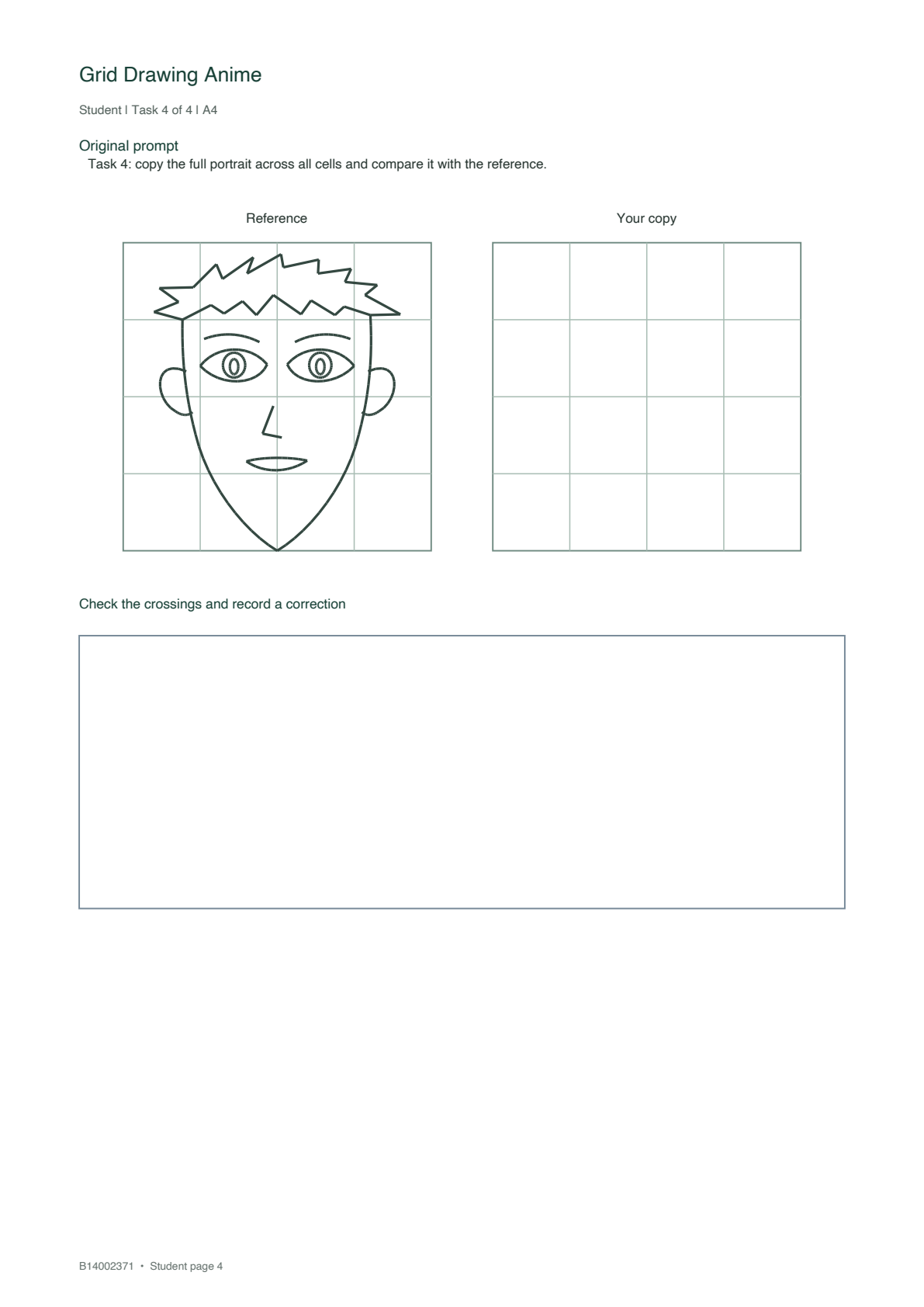
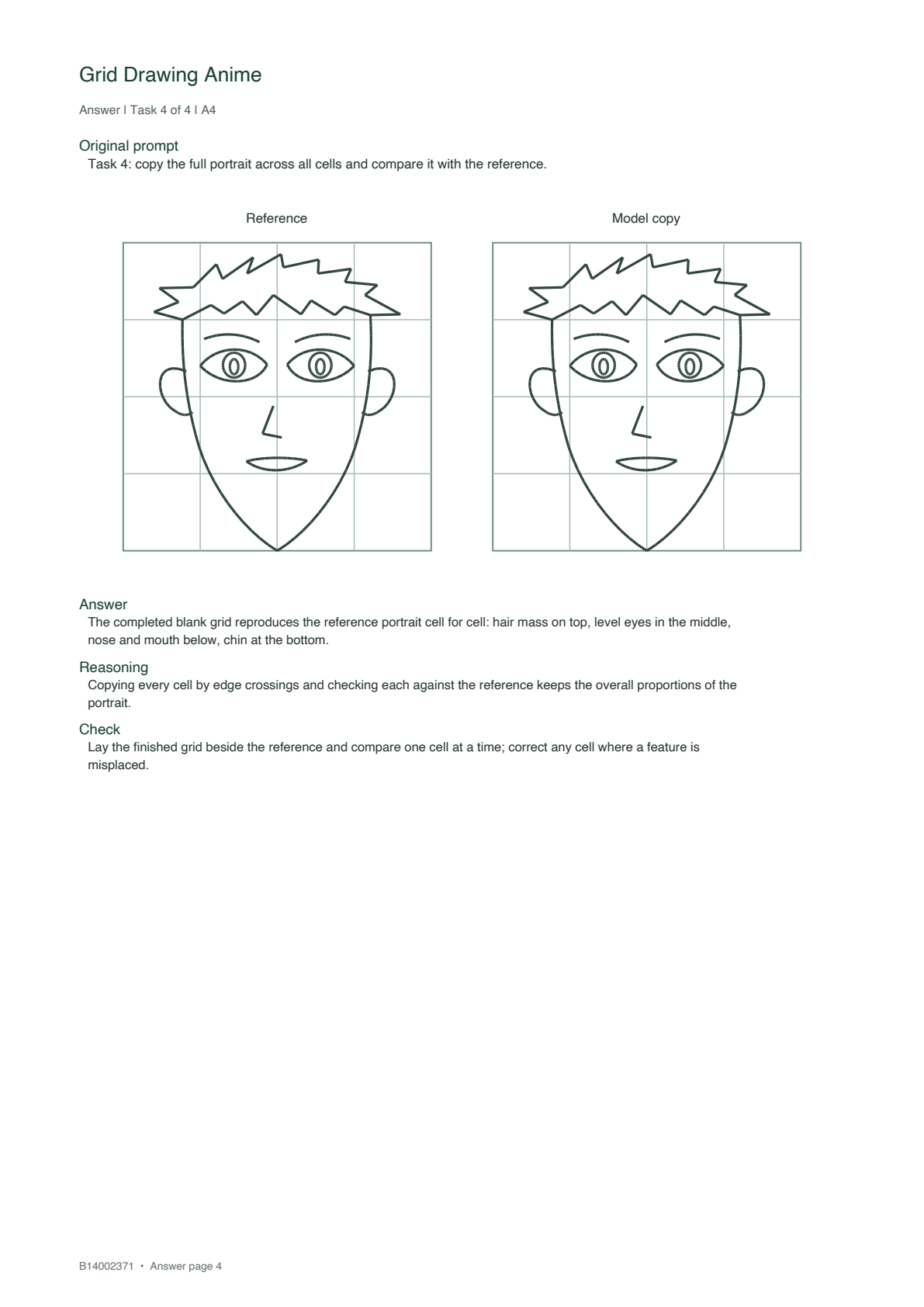
Task 4: copy the full portrait across all cells and compare it with the reference.
Show answer 4
The completed blank grid reproduces the reference portrait cell for cell: hair mass on top, level eyes in the middle, nose and mouth below, chin at the bottom.
Copying every cell by edge crossings and checking each against the reference keeps the overall proportions of the portrait.
Check: Lay the finished grid beside the reference and compare one cell at a time; correct any cell where a feature is misplaced.
Useful checks
- Drawing a whole feature from memory instead of matching cell edge crossings. Mark where the feature touches the cell edges first, then join the marks.
- Skipping the cell-by-cell comparison until the end. Compare each finished cell with the reference before moving to the next.
Questions about this resource
Do I need exact measurements?
No. Grid-copy transfer is done by eye, matching where features cross cell edges rather than measuring lengths.
Can I use a different grid size?
Yes, as long as the reference and blank grids have the same number of equal squares.