Free original lessons
Anime Gesture Drawing Practice: Pose Capture with Proportion Notes
Learn to capture anime-style gesture poses using timed passes and simple proportion notes. Includes drills, a worked example, and self-check rubrics.
Free lesson
Four exercises
Worked answers
Object Drawing Lessons
Gesture drawing for anime figures focuses on the flow and energy of a pose before details. This lesson teaches a repeatable method: establish a gesture line, mark key joints, then annotate stylized proportions such as head count and limb length. You will practice with timed passes and check your work against a clear convention. All measurements use a simple head-unit system; letter styles and line weights vary, so the rubric accepts valid alternatives. The goal is expressive, readable poses with proportion notes that support consistency across a sequence.
Practice materials: Printable downloads are not available for this lesson yet. Use the instructions and four exercises below.
Reference illustration
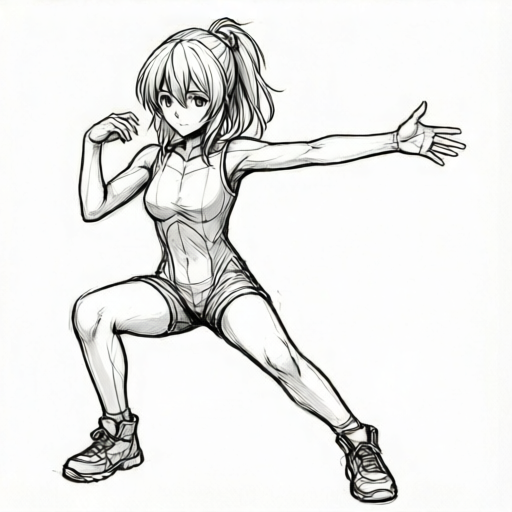
Use the stated measurements and conventions for each exercise.
Establishing the Gesture Line and Joint Map
Begin with a single flowing line that follows the spine and the dominant limb action. This line should curve through the torso and continue into the leading arm or leg, capturing the pose's direction. Keep it light and loose; you will refine it later.
Next, mark the major joints as small dots or short crosses: shoulders, elbows, wrists, hips, knees, and ankles. Place them along the gesture line where the body bends or connects. These marks act as anchors for proportion notes and help you avoid stiff, disconnected limbs.
Use a simple convention: head height is measured from the baseline of the chin to the midline of the top of the head (the skull's crown). This is the x-height for proportion counting. Letter styles and head shapes vary, so count head units from your own drawn head, not from a universal template.
- Draw a light gesture line from the top of the head through the torso to the supporting foot.
- Add joint dots for shoulders, elbows, wrists, hips, knees, and ankles.
- Mark the head unit: chin baseline to crown midline.
- Count how many head units fit from crown to floor along the gesture line; note it as a ratio such as 6.5 heads.
- Indicate limb length in head units, e.g., upper arm 1.2 heads, lower leg 1.8 heads.
Timed Passes: One Minute and Five Minutes
A one-minute pass captures only the gesture line and joint map. Do not erase; make decisive marks. The goal is to record the pose's action and the head-unit count quickly. A five-minute pass adds proportion notes and a second contour line for the torso and limbs, still without clothing folds or facial detail.
Use a timer and work in sets: three one-minute passes, then one five-minute pass on the same pose. Compare the passes to see whether the gesture line and joint positions remain consistent. Consistency is more valuable than polish at this stage.
For proportion notes, write short labels next to the joint map: head count, upper arm length, lower leg length, and torso length. Keep units consistent (head units). If you choose numerical values, label them as hypothetical examples for practice, not as standards.
- Set a timer for one minute; draw gesture line and joint dots only.
- Repeat for three one-minute passes, noting the head count each time.
- Set a timer for five minutes; redraw the gesture line and add proportion notes.
- Check that joint dots align with the gesture line and that head-unit counts match across passes.
- Label any numerical proportion values as hypothetical practice examples.
Annotating Stylized Proportions
Anime-style proportions are stylized, not realistic. You may lengthen legs, shorten the torso, or enlarge the head. The annotation system must be self-consistent: if you count 7 heads for a figure, use that same head unit for limb lengths. Write the head count first, then limb lengths as multiples of that head unit.
Use a small note field beside the figure: HC (head count), UA (upper arm), LA (lower arm), UL (upper leg), LL (lower leg), T (torso). For example, HC 7.0, UA 1.3, LA 1.1, UL 1.8, LL 1.7, T 2.2. These are hypothetical example values for practice; measure your own drawn head to derive your own ratios.
Keep annotations legible and separate from the gesture line. A consistent convention lets you compare poses across a sequence and spot proportion drift.
- Write HC and the head-unit count at the top of the note field.
- Measure each limb segment in head units using the same head unit.
- Record UA, LA, UL, LL, and T as multiples of the head unit.
- Check that the sum of torso and leg units roughly matches the total head count along the gesture line.
- Label all numerical values as hypothetical examples for the exercise.
Self-Check and Valid Alternatives
Check your drawing against three criteria: gesture line clarity, joint map accuracy, and proportion note consistency. Gesture line clarity means a viewer can trace the pose's action in one pass. Joint map accuracy means dots sit at bends and connections. Proportion note consistency means the same head unit is used throughout.
Valid alternatives exist. A head may be drawn rounder or more angular; the x-height convention (chin baseline to crown midline) still applies. Line weight may vary. You may use crosses instead of dots for joints. The rubric rewards internal consistency and readability, not a single universal answer.
If a note seems off, re-measure the drawn head and recompute limb lengths. Do not invent hardware or printer tolerances; measure your actual drawing tools and paper if needed, and label any chosen numerical values as hypothetical examples.
- Trace the gesture line with your finger; if it breaks, redraw it more decisively.
- Verify each joint dot sits at a bend or connection.
- Re-measure the head unit and recompute one limb length as a check.
- Compare three passes for consistency of head count and joint positions.
- Note any valid alternative choices (e.g., cross joints, varied line weight) in your self-check.
Worked example
A standing anime figure with one arm raised forward and one leg slightly back. Draw a one-minute gesture pass and a five-minute pass with proportion notes. Use a head unit measured from chin baseline to crown midline. Record HC, UA, LA, UL, LL, and T in head units. Label numerical values as hypothetical examples.
Worked answer
Gesture line: a curve from the crown through the torso to the supporting foot, continuing into the raised arm. Joint dots: shoulders, elbows, wrists, hips, knees, ankles. Head unit: chin baseline to crown midline. Hypothetical example notes: HC 7.0, UA 1.3, LA 1.1, UL 1.8, LL 1.7, T 2.2. Check: torso plus leg units (2.2 + 1.8 + 1.7 = 5.7) plus head and neck allowance roughly matches 7.0 heads along the gesture line. The raised arm's UA and LA sum to 2.4 head units, consistent with the drawn arm length. All values are hypothetical practice examples, not standards.
Four practice exercises
Exercise 1
A seated anime figure leaning forward with both hands on knees. Draw a one-minute gesture pass and record HC and joint dots. Use the chin-baseline-to-crown-midline head unit. State one check you will perform.
Show answer and check
Gesture line curves from crown through torso to hips, then to knees. Joint dots at shoulders, elbows, wrists, hips, knees, ankles. HC recorded as a hypothetical example such as 6.0. Check: verify each joint dot sits on or near the gesture line.
Why: The seated pose compresses the torso, so the gesture line should show a forward lean. Joint dots anchor the limbs. HC is measured from the drawn head using the defined convention.
Check: Trace the gesture line with a finger; if it breaks, redraw. Confirm joint dots at bends. Re-measure head unit and confirm HC note matches.
Exercise 2
A running anime figure with one arm back and one leg forward. Draw a five-minute pass with proportion notes: HC, UA, LA, UL, LL, T. Use hypothetical example values and label them as such. State one arithmetic check.
Show answer and check
Gesture line flows from crown through torso into the forward leg. Notes (hypothetical examples): HC 7.5, UA 1.2, LA 1.0, UL 1.9, LL 1.8, T 2.3. Arithmetic check: T + UL + LL = 2.3 + 1.9 + 1.8 = 6.0, which with head and neck allowance is consistent with HC 7.5 along the gesture line.
Why: Running poses have a strong diagonal gesture line. Proportion notes use one head unit consistently. The arithmetic check tests whether torso and leg units roughly match the total head count.
Check: Recompute T + UL + LL and compare with HC. Confirm all notes use the same head unit. Verify the gesture line remains traceable.
Exercise 3
A jumping anime figure with both arms up and knees bent. Draw three one-minute passes and one five-minute pass. Record HC in each pass and note whether the joint map stays consistent. Use the defined head unit.
Show answer and check
Gesture line arcs from crown through torso to the bent knees. Joint dots at shoulders, elbows, wrists, hips, knees, ankles. Hypothetical example HC values across passes: 6.5, 6.5, 6.4, 6.5. Joint map remains consistent when dots stay anchored to the gesture line.
Why: Repeated passes test consistency. Small HC variation is acceptable if the head unit is re-measured each time; large drift suggests inconsistent measurement.
Check: Compare HC values across passes; if variation exceeds about 0.3 head units, re-measure the head unit and redraw. Check joint dots against the gesture line in each pass.
Exercise 4
A standing anime figure with a long coat silhouette (no folds drawn) and one hand on hip. Draw a five-minute pass with proportion notes and one valid alternative choice. State how your rubric accepts the alternative.
Show answer and check
Gesture line from crown through torso to supporting foot, with a branch to the hand on hip. Notes (hypothetical examples): HC 7.0, UA 1.3, LA 1.1, UL 1.8, LL 1.7, T 2.2. Valid alternative: using crosses instead of dots for joints. The rubric accepts this because joints are clearly marked and anchored to the gesture line.
Why: The coat silhouette is captured as a simple contour without folds. Proportion notes use one head unit. The alternative joint mark is a valid stylistic choice under the rubric.
Check: Confirm the gesture line is traceable and joints are anchored. Re-measure head unit and recompute one limb length. Verify the alternative choice is noted and internally consistent.
Common mistakes
- Drawing details such as clothing folds or facial features during the one-minute pass. Restrict the one-minute pass to the gesture line and joint dots only; add notes in the five-minute pass.
- Using different head units for different limbs, making proportion notes inconsistent. Measure one head unit from chin baseline to crown midline and use it for all limb and torso notes.
- Placing joint dots away from the gesture line, creating disconnected limbs. Anchor each joint dot on or very near the gesture line at bends and connections.
- Treating stylized proportions as realistic standards and forcing a single correct answer. Accept valid alternatives; check internal consistency and readability rather than matching a universal figure.
Self-check rubric
- Gesture line is clear and traceable in one pass.
- Joint dots or crosses are anchored to the gesture line at bends and connections.
- Head unit is measured from chin baseline to crown midline and used consistently.
- Proportion notes include HC, UA, LA, UL, LL, and T in head units.
- Numerical values are labeled as hypothetical examples where chosen.
- Valid alternatives (head shape, line weight, joint marks) are accepted if internally consistent.
- One-minute and five-minute passes show consistent gesture line and joint map.
Questions and answers
What is the x-height convention for this lesson?
It is the distance from the chin baseline to the midline of the top of the head (crown). Use this as the head unit for proportion notes. Head shapes vary, so measure your own drawn head.
How many head units should an anime figure have?
There is no single required number. Choose a stylized head count, write it as HC, and use that same head unit consistently for limb and torso notes. Any numerical values you choose are hypothetical practice examples.
Can I use crosses instead of dots for joints?
Yes. The rubric accepts valid alternatives as long as joints are clearly marked and anchored to the gesture line.
What should I do if my three one-minute passes look different?
Compare the gesture line direction and joint positions. Redraw the pass that deviates most, keeping the same head count and joint map. Consistency improves with repetition.