Free original lessons
Easy Ball Drawing: Sphere Shading with Highlight and Cast Shadow
Learn to draw a single sphere with a highlight, core shadow, and cast shadow using a simple pencil convention, clear steps, and four practice tasks.
Free lesson
Four exercises
Worked answers
Object Drawing Lessons
This lesson teaches a reliable pencil convention for shading one ball so it reads as a solid sphere under a single light. You will place a highlight, a core shadow, reflected light, and a cast shadow, then check the result with simple geometry and value tests. The convention is explicit: x-height means the distance from the baseline to the midline of a letter, and letter styles vary, so treat all written labels as optional annotations rather than part of the drawing. All numerical values below are hypothetical examples chosen for practice; measure your own paper and pencil before relying on any number.
Practice materials: Printable downloads are not available for this lesson yet. Use the instructions and four exercises below.
Reference illustration
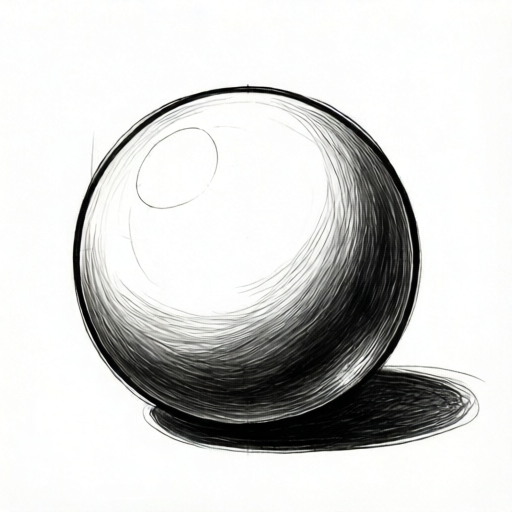
Use the stated measurements and conventions for each exercise.
Set up the sphere and the light direction
Draw a circle with a light pencil. Mark a small arrow from the upper left toward the circle to show the light direction. Decide which side of the ball faces the light; that side will hold the highlight. Keep the arrow outside the circle so it does not become part of the shading.
Mark the highlight as a small oval on the lit side, roughly one-fifth of the circle diameter across. This is a convention, not a rule: a smaller oval gives a tighter, glossier look, while a larger oval gives a softer, matte look. Both are valid if the value relationships stay consistent.
- Draw a circle about 8 cm across on plain paper.
- Draw a light-direction arrow pointing from the upper left toward the circle.
- Mark a small oval on the upper-left area of the circle for the highlight.
- Label the lower-right region as the cast-shadow zone with a light pencil note if labels help you.
Build the core shadow and reflected light
The core shadow is the darkest band on the ball, located on the side away from the light. It is not at the very edge; leave a thin lighter strip near the lower-right rim for reflected light. This strip is usually lighter than the core shadow but darker than the highlight side.
Shade in one direction with light pressure, then increase pressure in the core-shadow band. Keep the transition gradual: the highlight side should be nearly white, the midtones should be medium gray, and the core shadow should be the darkest pencil value on the ball.
- Shade the lower-right half of the circle with light pressure.
- Darken a curved band about 1 cm wide inside the lower-right edge for the core shadow.
- Leave a thin strip along the lower-right rim lighter than the core shadow for reflected light.
- Blend gently with a fingertip or soft brush if you want smoother transitions, then re-darken the core shadow.
Add the cast shadow and check the geometry
The cast shadow falls on the ground plane opposite the light. If the light comes from the upper left, the cast shadow extends to the lower right. Its near edge touches the ball at the base and its far edge is softer and lighter. A simple oval or wedge shape is enough for this lesson.
Check the geometry by drawing a faint line from the light arrow through the ball center to the cast shadow. The cast shadow should sit on the opposite side of the ball from the light. Also check that the highlight is on the lit side and the core shadow is on the dark side. These relationships matter more than any single value.
- Draw a soft oval on the ground plane at the lower right of the ball.
- Darken the part of the cast shadow nearest the ball and lighten the far edge.
- Draw a faint check line from the light arrow through the ball center to the cast shadow.
- Confirm the highlight, core shadow, reflected light, and cast shadow are on the correct sides.
Refine values and finish
Compare the darkest part of the core shadow with the darkest part of the cast shadow. In this convention the core shadow is usually the darkest area on the ball, while the cast shadow near the contact point can be similarly dark. Keep the highlight area free of pencil marks except for a very light gray edge.
Erase any stray labels if you want a clean drawing. If you keep labels, write them small and outside the sphere so they do not compete with the shading. A valid alternative is to use crosshatching instead of smooth blending, provided the value order remains: highlight lightest, midtones medium, core shadow darkest, reflected light slightly lighter than core shadow.
- Squint at the drawing to check that the ball reads as round.
- Darken the core shadow if the ball looks flat.
- Lighten the reflected-light strip if it competes with the highlight.
- Soften the far edge of the cast shadow and sharpen the near edge.
Worked example
A circle is 8 cm across. The light arrow points from the upper left. Describe where to place the highlight, core shadow, reflected light, and cast shadow, and give one value check.
Worked answer
Place the highlight as a small oval on the upper-left area, about 1.6 cm across as a hypothetical example. Put the core shadow as a curved band on the lower-right side, leaving a thin reflected-light strip near the lower-right rim. Draw the cast shadow as a soft oval on the ground plane at the lower right, touching the ball at its base. Value check: the highlight should be the lightest area, the core shadow the darkest on the ball, and the reflected-light strip between them in value.
Four practice exercises
Exercise 1
A circle is 10 cm across. The light arrow points from the upper right. State where the highlight, core shadow, reflected light, and cast shadow should go, and give one size example for the highlight.
Show answer and check
Highlight on the upper-right area; core shadow on the lower-left side; reflected light as a thin strip near the lower-left rim; cast shadow on the ground plane at the lower left, touching the ball at its base. A hypothetical highlight size is about 2 cm across, one-fifth of the diameter.
Why: The highlight faces the light, the core shadow is opposite the light, reflected light sits near the dark rim, and the cast shadow falls opposite the light direction.
Check: Draw a faint line from the light arrow through the ball center; the cast shadow should be on the opposite side. Confirm the highlight is on the lit side and the core shadow is on the dark side.
Exercise 2
A ball drawing has its highlight in the center, a dark band on the upper left, and a cast shadow on the upper left. The light arrow points from the upper left. List two corrections and explain the value order you want after correction.
Show answer and check
Move the highlight to the upper-left lit side and move the core shadow to the lower-right dark side. Move the cast shadow to the lower right, opposite the light. After correction the value order should be: highlight lightest, midtones medium, core shadow darkest on the ball, reflected light slightly lighter than the core shadow.
Why: The original placement contradicts the light direction. Correcting the sides restores the standard sphere convention.
Check: Squint at the drawing: the ball should look round with the darkest band away from the light and the cast shadow opposite the light arrow.
Exercise 3
You are shading a 6 cm circle with light from the upper left. You want a reflected-light strip about 0.5 cm wide near the lower-right rim and a core-shadow band about 1 cm wide inside it. Describe the order of these zones from the lower-right rim inward and state which zone is darkest.
Show answer and check
From the lower-right rim inward: a thin reflected-light strip about 0.5 cm wide, then a core-shadow band about 1 cm wide, then midtones toward the highlight side. The core-shadow band is the darkest zone on the ball.
Why: Reflected light sits near the rim on the dark side, and the core shadow is just inside it. The core shadow is darker than the reflected light.
Check: Compare pencil values: the reflected-light strip should be lighter than the core-shadow band, and the core-shadow band should be darker than the midtones.
Exercise 4
A cast shadow is drawn as a hard rectangle on the lower right of a ball lit from the upper left. The rectangle does not touch the ball. Describe two changes to make the cast shadow more convincing and give one value check.
Show answer and check
Change the rectangle to a soft oval or wedge that touches the ball at its base, and make the far edge lighter and softer than the near edge. Value check: the part of the cast shadow nearest the ball should be darker than the far edge, and the core shadow on the ball should remain the darkest area on the ball.
Why: A cast shadow contacts the object at its base and fades away from the contact point. A hard rectangle that does not touch the ball breaks the light logic.
Check: Trace a line from the light arrow through the ball center to the cast shadow; confirm the shadow is opposite the light and touches the base.
Common mistakes
- Placing the highlight in the center of the ball. Move the highlight to the side facing the light arrow, usually the upper left in this convention.
- Putting the cast shadow on the same side as the light. Draw the cast shadow opposite the light direction, so an upper-left light gives a lower-right cast shadow.
- Making the reflected-light strip as bright as the highlight. Keep reflected light darker than the highlight and lighter than the core shadow.
- Shading the entire ball evenly with one value. Build at least three values: light highlight side, medium midtones, and dark core shadow.
- Making the cast shadow a hard-edged rectangle. Use a soft oval or wedge that touches the ball at the base and fades away from the contact point.
Self-check rubric
- The drawing shows one sphere with a clear light direction.
- The highlight is on the lit side and is the lightest area on the ball.
- The core shadow is on the dark side and is the darkest area on the ball.
- A reflected-light strip is present and is lighter than the core shadow but darker than the highlight.
- The cast shadow is opposite the light and touches the ball at the base.
- The cast shadow fades away from the contact point.
- The value order is consistent: highlight lightest, midtones medium, core shadow darkest, reflected light slightly lighter than core shadow.
- Valid alternatives such as crosshatching or a larger highlight are accepted if the value relationships remain consistent.
Questions and answers
Do I need special pencils?
No. A standard graphite pencil and plain paper are enough. Use light pressure for midtones and heavier pressure for the core shadow.
Can I use crosshatching instead of smooth shading?
Yes. Crosshatching is a valid alternative if the value order stays correct: highlight lightest, midtones medium, core shadow darkest, reflected light slightly lighter than the core shadow.
How large should the highlight be?
A common convention is about one-fifth of the circle diameter, but a smaller or larger oval is valid if the shading relationships remain consistent.
What does x-height mean here?
X-height is the distance from the baseline to the midline of a letter. Letter styles vary, so if you add written labels, keep them small and outside the sphere; they are optional annotations, not part of the drawing.