Free original lessons
Realistic Glass Drawing: Rim Ellipse, Refraction, Cast Shadow
Learn to draw a realistic glass by mastering the rim ellipse, refraction lines, and cast shadow with clear steps, checks, and practice tasks.
Free lesson
Four exercises
Worked answers
Object Drawing Lessons
A realistic glass drawing depends on three measurable features: the rim ellipse, the refraction pattern through the glass, and the cast shadow on the surface. This lesson treats each as a checkable geometric problem rather than a single correct style. You will use a simple convention for judging proportions: x-height is measured from baseline to midline, and letter styles vary, so valid alternatives exist. All numerical values below are hypothetical examples; measure your own paper and glass before drawing. The goal is a convincing study of one clear glass, excluding bottles, handled cups, and general transparent-object shading.
Practice materials: Printable downloads are not available for this lesson yet. Use the instructions and four exercises below.
Reference illustration
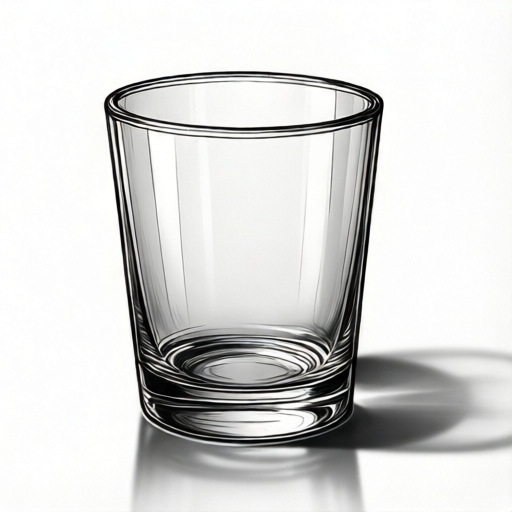
Use the stated measurements and conventions for each exercise.
Set up the glass and the rim ellipse
Place a clear cylindrical glass on a plain sheet of paper. Measure the rim width and the rim height as seen from your eye level. For a hypothetical example, the rim may appear 80 mm wide and 24 mm high, giving an ellipse ratio of about 3.3 to 1. Mark the rim center and draw a light horizontal midline. The rim ellipse is the top opening seen in perspective; its long axis is horizontal and its short axis is vertical. Keep the ellipse symmetric about the vertical center line.
Check the ellipse by measuring the half-width and half-height from the center. If the half-width is 40 mm and the half-height is 12 mm, the ratio is 3.3 to 1. A valid alternative is a slightly wider or narrower ellipse if your measured glass and viewpoint support it. Do not force a perfect circle; the ellipse must match your actual view.
- Measure the apparent rim width and height with a ruler held at the same distance as your drawing.
- Mark the rim center and draw a faint horizontal midline and vertical center line.
- Plot four points: left, right, top, and bottom of the rim ellipse.
- Connect the points with a smooth curve, checking symmetry against the center lines.
- Label the half-width and half-height values beside the ellipse for later checking.
Draw the glass body and refraction lines
From the rim ellipse, drop two vertical sides to the base. The base ellipse is usually shallower than the rim ellipse because it is farther from eye level. For a hypothetical example, the base may appear 80 mm wide and 16 mm high. Draw the base ellipse with the same center line. Refraction is the bending of light through the glass; represent it with a few vertical or slightly curved lines inside the glass body that shift where the glass thickness changes. These lines are not random decoration: they should align with the visible edges of the glass wall and the water line if water is present.
Use a convention for line weight: outline lines are firm, refraction lines are lighter, and shadow edges are soft. Check that every refraction line starts and ends at a plausible glass edge or water line. If a line crosses the whole body without a cause, remove it.
- Drop vertical sides from the rim ellipse to the base ellipse.
- Draw the base ellipse with a measured half-width and half-height.
- Mark the water line if present, using a horizontal line inside the glass.
- Add two or three refraction lines that follow the glass wall and water line.
- Check that refraction lines do not float without touching a glass edge or water line.
Place the cast shadow and finish
The cast shadow lies on the surface opposite the light source. Measure the shadow length and width relative to the glass base. For a hypothetical example, if the light comes from the upper left, the shadow may extend 60 mm to the right and be 30 mm wide at its widest. Draw the shadow as a soft shape that touches the base ellipse and tapers away. The shadow edge nearest the glass is darker; the far edge is lighter. Add a small contact shadow directly under the base to anchor the glass.
Check the shadow direction against your light source and the shadow length against your measured value. A valid alternative is a shorter or longer shadow if your actual light position differs. Finish by darkening the rim ellipse slightly where the glass is thickest and lightening the refraction lines where the glass is thinnest.
- Mark the light direction with a small arrow outside the drawing.
- Measure the cast shadow length and width on the paper surface.
- Draw the shadow shape touching the base ellipse and tapering away from the light.
- Darken the contact shadow under the base.
- Compare the shadow direction and length with your measurements and adjust.
Worked example
A clear glass is viewed from slightly above. The rim appears 90 mm wide and 30 mm high. The base appears 90 mm wide and 18 mm high. Light comes from the upper right. Describe the rim ellipse, base ellipse, refraction lines, and cast shadow placement.
Worked answer
Rim ellipse: half-width 45 mm, half-height 15 mm, ratio 3 to 1. Base ellipse: half-width 45 mm, half-height 9 mm, ratio 5 to 1. Draw both centered on the same vertical line. Refraction: two light lines from the rim edge to the water line, shifting slightly at the glass wall. Cast shadow: extends to the lower left, about 70 mm long and 35 mm wide, touching the base ellipse and tapering away. Contact shadow directly under the base is darkest.
Four practice exercises
Exercise 1
A glass rim appears 100 mm wide and 25 mm high. Calculate the half-width and half-height and state the ellipse ratio.
Show answer and check
Half-width 50 mm, half-height 12.5 mm, ratio 4 to 1.
Why: Divide the width by 2 and the height by 2. The ratio is half-width divided by half-height: 50 divided by 12.5 equals 4.
Check: Multiply the half-height by 4 to recover the half-width: 12.5 times 4 equals 50 mm.
Exercise 2
A base ellipse appears 80 mm wide and 20 mm high. A rim ellipse appears 80 mm wide and 28 mm high. Which ellipse is shallower, and by how many millimeters of half-height?
Show answer and check
The base ellipse is shallower by 4 mm of half-height.
Why: Base half-height is 10 mm; rim half-height is 14 mm. The difference is 4 mm.
Check: Add 4 mm to the base half-height to get 14 mm, matching the rim half-height.
Exercise 3
Light comes from the upper left. A cast shadow is measured at 60 mm long and 30 mm wide. Describe where to place the shadow relative to the glass base and what to check.
Show answer and check
Place the shadow to the lower right, touching the base ellipse and tapering away. Check that the shadow direction is opposite the upper-left light and that the length matches 60 mm.
Why: A shadow falls opposite the light source. The measured length and width guide the shape, and the contact point anchors the glass.
Check: Mark the light arrow and confirm the shadow points away from it; measure the shadow length against 60 mm.
Exercise 4
You have drawn three refraction lines, but one crosses the glass body without touching any edge or water line. What should you do, and why?
Show answer and check
Remove or redraw that line so it starts and ends at a glass edge or water line.
Why: Refraction lines represent light bending at glass boundaries; a line with no boundary has no cause and weakens the realism.
Check: Trace each refraction line with your finger; every line must meet an edge or water line at both ends.
Common mistakes
- Drawing the rim as a perfect circle instead of an ellipse. Measure the apparent rim width and height and plot four points before connecting them.
- Making the base ellipse taller than the rim ellipse. Measure both ellipses; the base is usually shallower because it is farther from eye level.
- Adding refraction lines that do not touch a glass edge or water line. Trace each refraction line to a visible edge or water line, or remove it.
- Placing the cast shadow on the same side as the light source. Mark the light direction first, then draw the shadow opposite it.
Self-check rubric
- Rim ellipse is measured and symmetric about the vertical center line.
- Base ellipse is shallower than the rim ellipse and shares the center line.
- Refraction lines touch plausible glass edges or water lines.
- Cast shadow is opposite the marked light source and touches the base.
- Measurements and units are labeled and consistent.
- Valid alternative proportions are accepted when supported by measurements.
Questions and answers
Do I need a real glass to do this lesson?
Yes, a clear cylindrical glass and a ruler are enough. Measure the apparent rim and base sizes directly from your view.
What if my ellipse ratio differs from the example?
Use your measured ratio. The example values are hypothetical; valid alternatives are expected when your glass or viewpoint differs.
How many refraction lines should I draw?
Two or three are enough for a study. Each must start and end at a plausible glass edge or water line.
How do I check the cast shadow?
Compare its direction with your marked light source and its length with your measured shadow length.