Free original lessons
Drawing a Buffalo Head: Horn Curve, Muzzle Shape and Eye Placement
Learn to construct a buffalo head from front and three-quarter views using a horn-curve guide, muzzle-shape steps and an eye-placement panel.
Free lesson
Four exercises
Worked answers
Object Drawing Lessons
This lesson teaches a repeatable construction for a buffalo head, focusing on three features that make the animal recognizable: the sweeping horn curve, the broad muzzle and the eye set low and wide on the skull. You will work from simple guide shapes rather than copying a finished picture, so the method transfers to front and three-quarter views. All measurements are hypothetical examples; measure your own paper and tools. Use a soft pencil, an eraser and a ruler. The convention for judging proportions is simple: compare distances by counting grid squares or pencil-lengths, not by absolute size. For art and handwriting, x-height means the distance from baseline to midline; letter styles vary, so accept any consistent, legible style. The practice strip asks for one front view and one three-quarter view, each built from the same guide sequence.
Practice materials: Printable downloads are not available for this lesson yet. Use the instructions and four exercises below.
Reference illustration
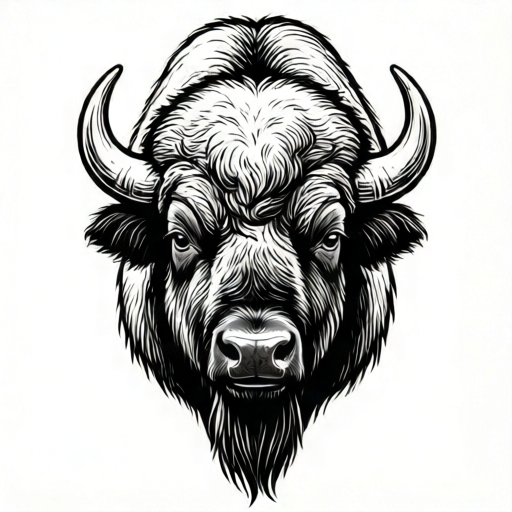
Use the stated measurements and conventions for each exercise.
Build the skull guide and horn curve
Start with a light oval for the skull, wider than tall. Mark a vertical midline and a horizontal midline. The horn bases sit on the horizontal midline, just outside the oval. Draw each horn as a curve that leaves the skull outward, then sweeps back and slightly down, ending in a rounded tip. The curve should be smooth, not a straight line with a bend.
A useful check is to compare the horn span to the skull width. In this hypothetical example, the total horn span is about 1.6 times the skull width. Adjust your own drawing to match your chosen proportion, and label that value as a hypothetical example if you write it down.
- Draw a light oval for the skull and mark vertical and horizontal midlines.
- Place two small circles for horn bases on the horizontal midline, just outside the oval.
- Draw each horn as a smooth outward-then-back curve ending in a rounded tip.
- Check that both horns mirror each other and that the span is consistent with your chosen proportion.
Shape the muzzle and place the eye
The muzzle is a broad, slightly rounded rectangle below the skull oval, narrower at the top where it meets the face. Draw it as two curved side lines and a soft lower edge. The nostrils are two small ovals near the lower corners, not centered.
The eye sits on the horizontal midline, about one-third of the way from the outer edge of the skull to the midline. Measure the half-width first: the distance from the outer edge to the midline is half the skull width, and the eye goes one-third of that half-width in from the outer edge. In a three-quarter view, the far eye is partly hidden by the muzzle bridge; draw only the visible portion. Keep the eye small relative to the skull; a common error is making it too large.
- Draw the muzzle as a broad rounded rectangle below the skull.
- Add two small nostril ovals near the lower corners of the muzzle.
- Mark the eye on the horizontal midline, one-third of the half-width in from the outer edge.
- In three-quarter view, draw only the visible part of the far eye.
Check proportions and finish the practice strip
Compare the muzzle width to the skull width. In this hypothetical example, the muzzle is about half the skull width. Compare the eye height to the horn base height; they should sit on the same horizontal midline. Erase construction lines lightly, then darken the final outline.
On the practice strip, draw one front view and one three-quarter view. Use the same guide sequence for both. For the three-quarter view, shift the vertical midline slightly and shorten the far horn curve. Accept any consistent proportion you choose, as long as you can state and check it.
- Compare muzzle width to skull width and eye height to horn base height.
- Erase construction lines and darken the final outline.
- Draw a front view on the practice strip using the guide sequence.
- Draw a three-quarter view on the practice strip, shortening the far horn curve.
Worked example
A front-view buffalo head is drawn on a grid where the skull oval is 6 squares wide. The horn span is chosen as 1.6 times the skull width. How many squares wide is the horn span, and where is the eye placed?
Worked answer
The horn span is 6 times 1.6 equals 9.6 squares wide. For the eye, first find the half-width: half of 6 is 3 squares from the outer edge to the midline. One-third of 3 is 1, so the eye sits about 1 square in from the outer edge, on the horizontal midline.
Four practice exercises
Exercise 1
On a grid, a skull oval is 8 squares wide. You choose a horn span of 1.5 times the skull width. How many squares wide is the horn span?
Show answer and check
12 squares wide.
Why: Multiply skull width by the chosen ratio: 8 times 1.5 equals 12.
Check: Count the squares across both horn tips and confirm the total is 12.
Exercise 2
A muzzle is drawn 4 squares wide under a skull 8 squares wide. Is the muzzle about half the skull width?
Show answer and check
Yes, 4 is half of 8.
Why: Compare the two widths using the same unit: 4 divided by 8 equals 0.5.
Check: Measure both widths in squares and divide muzzle width by skull width.
Exercise 3
An eye is placed 1 square from the outer edge of a skull that is 6 squares wide. Is that about one-third of the way from the outer edge to the midline?
Show answer and check
Yes. The outer edge to midline distance is half the skull width, 3 squares, and one-third of 3 is 1 square.
Why: The placement rule uses the distance from the outer edge to the midline, not the full skull width. Half of 6 is 3, and 3 divided by 3 equals 1, so an eye 1 square in from the outer edge matches the rule.
Check: Halve the skull width to get the outer-edge-to-midline distance, divide that by 3, and compare the result to the eye distance from the outer edge.
Exercise 4
In a three-quarter view, the far horn curve is drawn the same length as the near horn. What should you change?
Show answer and check
Shorten the far horn curve so it reads as partly hidden.
Why: In three-quarter view, the far side is foreshortened, so the far horn appears shorter.
Check: Compare near and far horn lengths; the far one should be visibly shorter while keeping the same curve direction.
Common mistakes
- Drawing horns as straight lines with a sharp bend. Redraw each horn as one smooth curve that leaves outward, then sweeps back and down.
- Making the eye too large or placing it above the horizontal midline. Keep the eye small and set it on the horizontal midline, one-third of the half-width in from the outer edge.
- Centering the nostrils on the muzzle. Move each nostril oval toward the lower corners of the muzzle.
- Using different proportions for the front and three-quarter views. State your chosen proportion, such as horn span equals 1.6 times skull width, and check both views against it.
Self-check rubric
- Horns are smooth curves that leave outward, sweep back and end in rounded tips.
- Horn span and skull width are compared using one consistent unit.
- Muzzle is a broad rounded rectangle below the skull with nostrils near the lower corners.
- Eye is small and placed on the horizontal midline, one-third of the half-width in from the outer edge.
- Front and three-quarter views use the same stated proportions.
- Construction lines are light and final outline is clear.
- Any consistent letter style is accepted; x-height is baseline to midline.
Questions and answers
Do I need to copy a finished buffalo head?
No. Build the head from the oval, midline, horn-base and muzzle guides so the method works for both views.
How do I judge proportions without a ruler?
Count grid squares or pencil-lengths. Compare horn span, skull width and muzzle width using the same unit.
What does x-height mean here?
X-height is the distance from baseline to midline. Letter styles vary, so accept any consistent, legible style.
Can I use different numerical proportions?
Yes. Any chosen values are hypothetical examples. State them and check both views against the same values.