Free original lessons
Dragon Drawing Construction: Body Masses, Wings, Horns, and Tail
Learn to draw a dragon by building body masses, spreading wings, adding horns, and shaping a tail. Includes a four-step method, practice tasks, and a rubric.
Free lesson
Four exercises
Worked answers
Object Drawing Lessons
This lesson teaches a reliable way to draw a dragon by constructing it from simple body masses rather than copying a finished image. You will place a torso, attach a wing pair with a clear spread, set a head with horns, and finish a tail. The method uses a convention: one head-length is measured from baseline to midline of your drawing area, and letter styles vary, so treat proportions as adjustable. All measurements are hypothetical examples; measure your own paper and tools. The goal is a coherent dragon that reads clearly at a glance, with wings, horns, and tail integrated into the body.
Practice materials: Printable downloads are not available for this lesson yet. Use the instructions and four exercises below.
Reference illustration
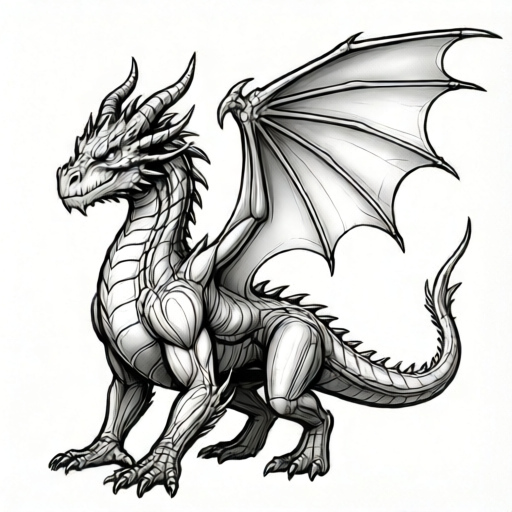
Use the stated measurements and conventions for each exercise.
Step 1: Body Masses and Ground Line
Start with a ground line and a torso mass. Draw a light horizontal baseline. Place an oval for the chest and a smaller oval for the hips, overlapping them slightly. Connect them with a curved spine line. This gives the dragon a stable stance before wings or horns are added.
Use a simple unit: let one head-length equal the distance from baseline to midline of your drawing area. For example, if that distance is 6 cm, make the chest oval about 1.5 head-lengths wide and the hips about 1 head-length wide. These numbers are hypothetical; adjust to your paper.
- Draw a light baseline across the lower third of the page.
- Draw a chest oval and a hip oval, overlapping by about one-third.
- Connect the tops with a gentle spine curve and the bottoms with a belly curve.
- Mark four leg attachment points: two near the chest, two near the hips.
Step 2: Wing Spread and Attachment
Wings attach at the shoulder area, just behind the chest oval. Decide a wing-spread angle before drawing. A clear convention is to measure the angle from the spine line: 45 degrees upward and outward is a moderate spread; 70 degrees is a wide spread. Label your chosen angle as a hypothetical example and keep both wings symmetric.
Draw the leading edge first as a curved line from the shoulder to the wing tip. Then add the trailing edge with two or three scallops. Keep the wing membrane inside the leading and trailing edges. The wing should not cover the head or the tail base.
- Mark the shoulder point on each side of the chest oval.
- Draw a leading edge at your chosen angle, equal in length on both sides.
- Add a trailing edge with two scallops per wing.
- Check symmetry by comparing wing-tip height to the baseline.
Step 3: Head, Horns, and Neck
Place the head at the top of the spine curve. Draw a wedge-shaped head with a blunt snout. Add two horns from the back of the skull, angling backward. Horn length can be about half a head-length; this is a hypothetical proportion, not a standard.
Connect the head to the chest with a neck that tapers. The neck should be thick enough to support the head but not wider than the chest oval. Add a simple eye and a nostril line to orient the face.
- Draw a wedge head at the spine top, snout pointing forward.
- Add two backward-angled horns from the skull rear.
- Draw a tapering neck from head to chest.
- Place one eye and one nostril line for orientation.
Step 4: Tail, Legs, and Final Check
Draw the tail from the hip oval, curving away from the wings. Taper it to a point. Add four legs as simple tapered cylinders with three toe lines each. Keep leg length about one head-length for a grounded stance; this is a hypothetical example.
Final check: the dragon should read as one creature. Wings attach at shoulders, horns sit on the skull, and the tail flows from the hips. Erase construction lines lightly and darken the final outline.
- Draw a tapering tail from the hip oval, curving away from wings.
- Add four tapered legs with three toe lines each.
- Erase construction lines and darken the final outline.
- Check that wings, horns, and tail do not overlap confusingly.
Worked example
Construct a dragon on a page where the baseline-to-midline distance is 8 cm. Use a moderate wing spread of 45 degrees from the spine, horns about half a head-length, and a tail that curves away from the wings. Describe the construction order and one check.
Worked answer
Draw a baseline. Make the chest oval about 12 cm wide (1.5 head-lengths) and the hips about 8 cm wide (1 head-length), overlapping by one-third. Connect with a spine curve. Mark shoulder points on the chest oval. Draw both leading edges at 45 degrees from the spine, equal length, then add two scallops per trailing edge. Place a wedge head at the spine top, add two backward horns about 4 cm long (half a head-length). Draw a tapering neck. Add a tail from the hip oval curving away from the wings, tapering to a point. Add four legs about 8 cm long with three toe lines each. Check: compare both wing-tip heights to the baseline; they should be equal.
Four practice exercises
Exercise 1
On a page with a baseline-to-midline distance of 6 cm, construct a dragon with a chest oval 9 cm wide and a hip oval 6 cm wide. Use a 60-degree wing spread from the spine. Describe the first four construction steps and state one symmetry check.
Show answer and check
Draw a baseline. Draw the chest oval 9 cm wide and the hip oval 6 cm wide, overlapping by one-third. Connect with a spine curve. Mark shoulder points and draw both leading edges at 60 degrees from the spine, equal length, then add two scallops per trailing edge. Check that both wing-tip heights match the baseline distance.
Why: The chest is 1.5 head-lengths and the hips are 1 head-length, following the lesson's hypothetical proportions. The 60-degree spread is a wide but valid choice. Symmetry is checked by comparing wing-tip heights.
Check: Measure both wing tips from the baseline; they should be equal within your drawing tolerance. Confirm the chest oval is wider than the hip oval.
Exercise 2
A learner draws horns 1.5 head-lengths long that cross the wing leading edge. Using the lesson's convention, describe a fix and a check. Assume a head-length of 5 cm.
Show answer and check
Shorten the horns to about half a head-length, about 2.5 cm, and angle them backward away from the wing. Check that the horn tips do not touch the wing leading edge and that both horns are similar in length.
Why: The lesson suggests half a head-length as a hypothetical starting point. Backward angling moves horns away from the wing spread. The check is visual and measurable.
Check: Measure each horn from skull rear to tip; both should be about 2.5 cm. Confirm no overlap with the wing leading edge.
Exercise 3
Construct a dragon with a tail that curves away from the wings. The hip oval is 7 cm wide. Describe how to start the tail and one check that the tail base is not too wide.
Show answer and check
Start the tail at the edge of the hip oval, on the side away from the wing spread. Taper immediately so the tail base is narrower than the hip oval. Check by comparing the tail base width to the hip oval width; the base should be visibly narrower.
Why: Starting at the hip oval edge integrates the tail with the body mass. Immediate tapering prevents an unbalanced look. The check uses a simple width comparison.
Check: Measure the tail base width and the hip oval width; the tail base should be smaller. Confirm the tail curves away from the wings.
Exercise 4
A dragon drawing has wings attached at the hips and a tail base wider than the hips. Describe two fixes and one overall balance check using the baseline.
Show answer and check
Move the wing attachments to shoulder points on the chest oval and keep both at the same height. Narrow the tail base so it is smaller than the hip oval and taper it to a point. For balance, compare the highest wing tip and the lowest tail point to the baseline; the silhouette should not lean to one side.
Why: Shoulder attachment is the lesson's convention for wings. A narrower tail base restores body balance. The baseline check tests overall silhouette stability.
Check: Mark shoulder points and confirm both wings attach there. Measure tail base width against hip width. Compare left and right wing-tip heights to the baseline.
Common mistakes
- Wings attached at the hips or neck instead of the shoulders. Mark shoulder points on the chest oval before drawing wings; keep both attachments at the same height.
- Horns drawn too long and crossing the wing leading edge. Limit horn length to about half a head-length and angle them backward, away from the wing spread.
- Tail base wider than the hip oval, making the body look unbalanced. Start the tail at the hip oval edge and taper immediately; keep the base narrower than the hips.
- Asymmetric wing spread causing a tilted silhouette. Measure both wing tips against the baseline and adjust the leading-edge angle to match.
Self-check rubric
- Body masses: chest and hip ovals overlap and connect with a clear spine and belly curve.
- Wing construction: wings attach at shoulder points, leading and trailing edges are present, and both wings are symmetric in spread.
- Horns: two horns sit on the skull rear, angle backward, and read clearly without crossing the wing leading edge.
- Tail: tail starts at the hip oval, tapers to a point, and curves away from the wings.
- Legs: four tapered legs with toe lines support the body and are similar in length.
- Overall readability: the dragon reads as one creature with no confusing overlaps; construction lines are erased or lightened.
- Convention note: one head-length is measured from baseline to midline; letter styles vary, so proportions may differ. Valid alternatives are accepted if the dragon reads clearly.
Questions and answers
Do I need to use exact measurements?
No. The numbers given are hypothetical examples. Measure your own paper and choose proportions that fit. The method works with any consistent unit.
Can I change the wing angle?
Yes. Any angle from about 30 to 80 degrees from the spine can work if both wings match. State your chosen angle as a hypothetical example and keep it consistent.
How do I know the dragon looks balanced?
Check that the head, wings, and tail do not crowd one side. Compare wing-tip heights to the baseline and keep leg lengths similar.
What if my horns look too small?
Horn size is a style choice. Try half a head-length as a starting point, then adjust. The rubric accepts valid alternatives if the horns read clearly.