Free original lessons
Draw a Flying Dragon: Spread Wings and Airborne Pose
Learn to draw an airborne dragon with spread wings using a clear pose diagram, body angle guide, and step-by-step construction. Includes practice tasks and a rubric.
Free lesson
Four exercises
Worked answers
Object Drawing Lessons
This lesson teaches a repeatable method for drawing a flying dragon with spread wings and an airborne pose. You will use a simple convention: x-height is measured from baseline to midline, and letter styles vary, so treat all proportions as adjustable guides rather than fixed rules. The goal is a believable flying silhouette with clear wing structure, a dynamic body angle, and readable limb placement. All measurements are hypothetical examples; measure your own paper and tools before drawing. No prior dragon drawing experience is required.
Practice materials: Printable downloads are not available for this lesson yet. Use the instructions and four exercises below.
Reference illustration
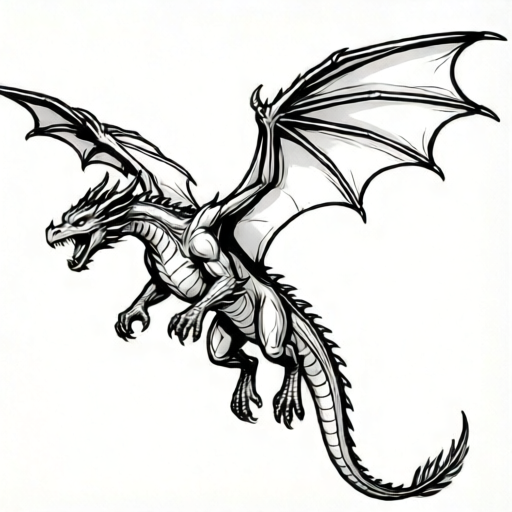
Use the stated measurements and conventions for each exercise.
Set Up the Pose and Proportions
Begin by deciding the dragon's flight direction. A three-quarter view from slightly below reads well for airborne poses because the wings can spread symmetrically while the body angles upward. On your paper, mark a baseline and a midline to establish your working x-height convention. For example, if your dragon body length is 12 cm from chest to tail base, use a wing span of about 18 cm as a hypothetical starting ratio. These numbers are examples only; adjust to your paper size.
Draw a light body axis line from the chest through the tail base, tilted upward at roughly 20 to 30 degrees from horizontal. This tilt suggests climbing flight. Place the shoulder joints on a cross line perpendicular to the body axis. The head sits forward of the chest, and the tail trails behind with a gentle curve. Keep all construction lines light so they can be refined later.
- Mark a baseline and midline on your paper to define your x-height convention.
- Draw a tilted body axis line for the chest-to-tail direction.
- Place shoulder joint marks on a cross line perpendicular to the body axis.
- Sketch the head, neck, torso, and tail as simple ovals and tapered shapes along the axis.
Build the Spread Wings
Each wing has three main parts: the arm (shoulder to wrist), the hand (wrist to wing tip), and the membrane that stretches between them. For a spread-wing pose, draw the arm segment angling outward and slightly forward from the shoulder. Then draw the hand segment continuing outward with a slight upward curve. The membrane connects the shoulder, wrist, and wing tip, with a gentle scalloped lower edge.
Use the same x-height convention to check wing symmetry. If the left wing spans 9 cm from shoulder to tip, the right wing should span a similar distance in a symmetrical pose. Mark the wrist joint on each wing before drawing the membrane. Add two or three finger-like support lines inside the membrane to suggest structure without drawing scale texture, which is outside this lesson's boundary.
- Draw the arm segment from shoulder to wrist on each side.
- Draw the hand segment from wrist to wing tip with a slight upward curve.
- Connect shoulder, wrist, and tip with a smooth membrane outline.
- Add two or three internal support lines per wing for structure.
Refine the Airborne Body and Limbs
With the wings and body axis in place, refine the torso into a streamlined shape that narrows toward the tail. The legs should tuck slightly backward and upward to suggest flight rather than standing. Draw the hind legs with the knees bent and the feet trailing, and the front legs shorter and closer to the chest. Keep the neck curved so the head leads the body direction.
Check that no limb hangs straight down as it would in a grounded pose. The tail can act as a counterbalance, curving opposite the body tilt. Erase construction lines gradually and darken the final outline. Remember that letter styles vary and x-height is baseline to midline; use these conventions only as consistency checks, not as universal standards.
- Streamline the torso from chest to tail base.
- Tuck the hind legs backward with bent knees and trailing feet.
- Position the front legs close to the chest.
- Curve the neck and tail to balance the body tilt, then darken final lines.
Worked example
A dragon flies upward at a 25-degree body tilt. Its body length from chest to tail base is 10 cm. Using a hypothetical wing span ratio of 1.5 times body length, find the total wing span and the approximate length of each wing from shoulder to tip.
Worked answer
Total wing span = 10 cm × 1.5 = 15 cm. Each wing from shoulder to tip = 15 cm ÷ 2 = 7.5 cm. Check: 7.5 cm + 7.5 cm = 15 cm, which matches the total span.
Four practice exercises
Exercise 1
A dragon has a body length of 8 cm from chest to tail base. Using a hypothetical wing span ratio of 1.5 times body length, calculate the total wing span and the length of each wing from shoulder to tip.
Show answer and check
Total wing span = 12 cm; each wing = 6 cm.
Why: Multiply 8 cm by 1.5 to get 12 cm total span, then divide by 2 for each wing: 12 ÷ 2 = 6 cm.
Check: Add the two wing lengths: 6 cm + 6 cm = 12 cm, which matches the total span.
Exercise 2
A dragon's body axis is tilted 30 degrees from horizontal. If the chest is 4 cm above the tail base along the vertical direction, what is the approximate horizontal distance from chest to tail base? Use the tangent relationship tan(30°) ≈ 0.58, and label the result as a hypothetical example.
Show answer and check
Approximately 6.9 cm horizontally.
Why: tan(30°) = vertical ÷ horizontal, so horizontal = 4 cm ÷ 0.58 ≈ 6.9 cm.
Check: Multiply the horizontal distance by tan(30°): 6.9 cm × 0.58 ≈ 4.0 cm, matching the given vertical distance.
Exercise 3
You draw a left wing with a shoulder-to-wrist segment of 3 cm and a wrist-to-tip segment of 4 cm. For a symmetrical spread-wing pose, what should the right wing's two segment lengths be, and what is each wing's total length?
Show answer and check
Right wing: 3 cm shoulder-to-wrist and 4 cm wrist-to-tip; each wing totals 7 cm.
Why: Symmetry requires matching segment lengths, so the right wing copies the left. Total per wing = 3 cm + 4 cm = 7 cm.
Check: Compare left and right totals: 7 cm = 7 cm, and each segment pair matches.
Exercise 4
A dragon drawing uses an x-height convention where the baseline-to-midline distance is 2 cm. The wing membrane's lower edge dips 1.5 cm below the wrist line at its lowest point. If the wrist line is 6 cm above the baseline, what is the height of the membrane's lowest point above the baseline?
Show answer and check
4.5 cm above the baseline.
Why: Subtract the dip from the wrist line height: 6 cm − 1.5 cm = 4.5 cm.
Check: Add the dip back to the result: 4.5 cm + 1.5 cm = 6 cm, matching the wrist line height.
Common mistakes
- Drawing wings as flat triangles with no wrist joint. Mark the wrist joint on each wing before drawing the membrane, then curve the hand segment outward.
- Making the body horizontal so the dragon looks suspended rather than flying. Tilt the body axis upward by 20 to 30 degrees as a hypothetical example and tuck the legs backward.
- Adding scale texture before the pose is resolved. Leave texture out entirely in this lesson; focus on silhouette, wing structure, and limb placement.
- Using mismatched wing spans that break the airborne balance. Measure both wings with the same x-height convention and adjust the membrane outline to match.
Self-check rubric
- Airborne pose is clear: body axis tilts upward and limbs do not hang as if grounded.
- Both wings are spread and include a visible wrist joint and membrane outline.
- Wing spans are consistent with the chosen x-height convention, allowing valid alternative proportions.
- Body, neck, and tail form a balanced silhouette with no scale texture added.
- Construction lines are light and final outline is readable.
Questions and answers
Do I need to draw a grounded dragon first?
No. This lesson focuses on the airborne pose with spread wings. A grounded winged dragon attachment study is outside the boundary, so start directly with the tilted body axis and spread wings.
How large should the wings be?
Use a hypothetical ratio such as wing span equal to 1.5 times body length, then measure your own paper and adjust. The ratio is a guide, not a rule.
Can I use different letter styles or proportions?
Yes. X-height is baseline to midline, and letter styles vary. Treat all proportions as adjustable conventions and check consistency rather than matching a single universal answer.
Should I add scales or texture?
No. Scale texture is excluded from this task. Keep the drawing focused on the flying pose, wing structure, and body angle.