Free original lessons
Draw a Housefly: Segmented Body, Six Legs, and Wing Veins
Learn to draw a housefly with clear head, thorax, and abdomen, six placed legs, and a traceable wing-vein pattern using simple checkable steps.
Free lesson
Four exercises
Worked answers
Object Drawing Lessons
This lesson teaches a reliable construction for a drawing of a housefly. You will build the insect from three body segments, place all six legs on the thorax, and trace a wing-vein pattern that reads clearly at small size. The method uses a defined drawing convention: the body is drawn as overlapping ovals, legs as jointed lines with consistent thickness, and wing veins as branching lines that never cross. Because handwriting and art styles vary, the rubric rewards correct placement and countable features rather than a single perfect outline. All measurements below are hypothetical examples; measure your own paper and tools before drawing.
Practice materials: Printable downloads are not available for this lesson yet. Use the instructions and four exercises below.
Reference illustration
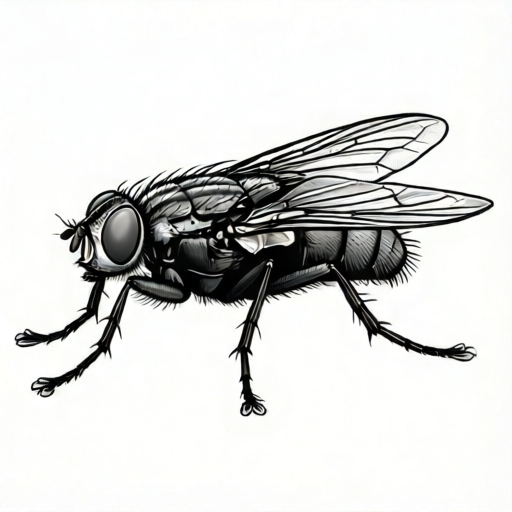
Use the stated measurements and conventions for each exercise.
Build the three body segments
A housefly body reads as three connected masses: a small head, a larger thorax, and an elongated abdomen. Draw them as overlapping ovals so the joins are visible. The head sits at the front, the thorax carries the wings and legs, and the abdomen tapers toward the rear.
Use a light pencil for construction lines. Keep the thorax the widest segment because it anchors both wings and all six legs. The abdomen should be roughly twice as long as the head but narrower than the thorax.
- Draw a small oval for the head, about one finger-width wide.
- Draw a larger oval for the thorax, overlapping the head by about one quarter of its width.
- Draw an elongated oval for the abdomen, overlapping the rear of the thorax.
- Check that the three ovals form a continuous body with no gaps between segments.
Place six legs on the thorax
All six legs attach to the thorax, not the abdomen. Draw three legs on each side, spaced evenly along the thorax. Each leg has a joint: a short upper segment angled outward and a longer lower segment angled downward.
Keep leg thickness consistent. A common mistake is attaching legs to the abdomen or drawing fewer than six. Count aloud as you draw: front left, middle left, rear left, then the same on the right.
- Mark three small dots along the left side of the thorax and three along the right.
- From each dot, draw a short upper leg segment angled outward.
- Add a joint, then draw a longer lower segment angled down and slightly back.
- Count all six legs and confirm each starts on the thorax.
Trace the wing-vein pattern
Draw two wings from the top of the thorax, angled outward and back. Each wing is a long oval. Inside each wing, draw a main vein running from base to tip, then add three or four branches that reach the wing edge without crossing each other.
The vein pattern is a convention, not a universal standard. What matters is that veins branch outward, stay inside the wing outline, and remain countable. Keep the same pattern on both wings so the drawing looks intentional.
- Draw a long oval wing on each side of the thorax.
- Draw one main vein from the wing base toward the tip.
- Add three or four branch veins that reach the wing edge.
- Check that no veins cross and that both wings show the same number of branches.
Refine and label the drawing
Darken the final outlines and erase construction lines. Add small antennae on the head and a few short hairs on the legs if you wish, but keep the three body segments, six legs, and wing veins clearly visible.
Label the head, thorax, abdomen, wings, and legs with short lines. Labels should point to the correct part without covering the drawing.
- Erase construction lines and darken the body, legs, and wing outlines.
- Add antennae to the head and optional short hairs to the legs.
- Label head, thorax, abdomen, wings, and legs.
- Do a final count: three segments, six legs, two wings with visible veins.
Worked example
A student draws a housefly with a head oval 2 cm wide, a thorax oval 3 cm wide, and an abdomen oval 4 cm long. They draw five legs and two wings with three veins each. Identify what is correct and what must be fixed.
Worked answer
Correct: three body segments in the right order, thorax wider than head, two wings with countable veins. Fix: add one more leg so there are six, and confirm all legs attach to the thorax. The abdomen length is acceptable because it is longer than the head but narrower than the thorax.
Four practice exercises
Exercise 1
Describe how to place six legs on a housefly drawing so that each leg is countable and correctly attached.
Show answer and check
Mark three dots on the left side of the thorax and three on the right, then draw a jointed leg from each dot.
Why: All legs attach to the thorax, and pairing three per side makes the count easy to check.
Check: Count the leg start points: six total, three left and three right, all on the thorax.
Exercise 2
A drawing shows a head 1.5 cm wide, a thorax 2.5 cm wide, and an abdomen 3 cm long. Is the segment sizing acceptable? Explain.
Show answer and check
Yes. The thorax is wider than the head, and the abdomen is longer than the head but narrower than the thorax.
Why: The convention requires the thorax to be the widest segment and the abdomen to be elongated but not wider than the thorax.
Check: Compare widths: thorax 2.5 cm is greater than head 1.5 cm; abdomen length 3 cm exceeds head width.
Exercise 3
Design a wing-vein pattern for one wing using one main vein and three branches. State one rule that keeps the pattern readable.
Show answer and check
Draw a main vein from base to tip, then add three branches that reach the wing edge without crossing each other.
Why: Branching veins that stay inside the wing outline and never cross remain countable and clear.
Check: Trace each vein: one main vein plus three branches, no crossings, all ending at the wing edge.
Exercise 4
A student labels the abdomen as the thorax and attaches two legs to the abdomen. List two corrections needed.
Show answer and check
Move the label to the correct segment and move the two legs so they attach to the thorax.
Why: Labels must point to the correct body part, and all six legs must start on the thorax.
Check: Check that the thorax label sits on the middle segment and that all six leg start points lie on the thorax.
Common mistakes
- Attaching legs to the abdomen instead of the thorax. Re-check each leg start point; all six must begin on the thorax oval.
- Drawing fewer or more than six legs. Count aloud in pairs: three on the left, three on the right.
- Letting wing veins cross or run outside the wing outline. Redraw branches so each vein ends at the wing edge without crossing another.
- Making the head larger than the thorax. Shrink the head oval so the thorax remains the widest segment.
Self-check rubric
- Three body segments are present and ordered head, thorax, abdomen.
- Thorax is the widest segment and carries all six legs.
- Exactly six legs are drawn, three per side, with visible joints.
- Two wings are present with countable branching veins that do not cross.
- Labels correctly identify head, thorax, abdomen, wings, and legs.
- Valid alternative styles are accepted if placement and counts are correct.
Questions and answers
How many legs should the housefly drawing show?
Exactly six, three on each side, all attached to the thorax.
Do the wing veins have to match a specific pattern?
No single pattern is required. Use a consistent branching convention with countable veins that stay inside the wing outline.
Can I use a ruler for the body ovals?
Yes, but freehand ovals are acceptable if the three segments remain distinct and correctly ordered.
What should I label on the finished drawing?
Label the head, thorax, abdomen, wings, and legs. Keep labels short and pointing to the correct part.