Free original lessons
Llama Face Drawing: Ears, Muzzle, and Wool Texture
Learn to draw a llama face by placing ears, eyes, and muzzle, then adding wool texture with simple stroke drills and a clear rubric.
Free lesson
Four exercises
Worked answers
Object Drawing Lessons
This lesson teaches a reliable way to draw a llama face using a few measured landmarks. You will place the ears, eyes, and muzzle before adding wool texture. Treat all measurements as proportions rather than fixed sizes, and label any numbers you choose as hypothetical examples. Work on plain paper with a pencil and eraser. Measure your own paper and adapt the proportions to it. The goal is a recognizable llama face with varied ear angles and believable wool density, not a single universal answer.
Practice materials: Printable downloads are not available for this lesson yet. Use the instructions and four exercises below.
Reference illustration
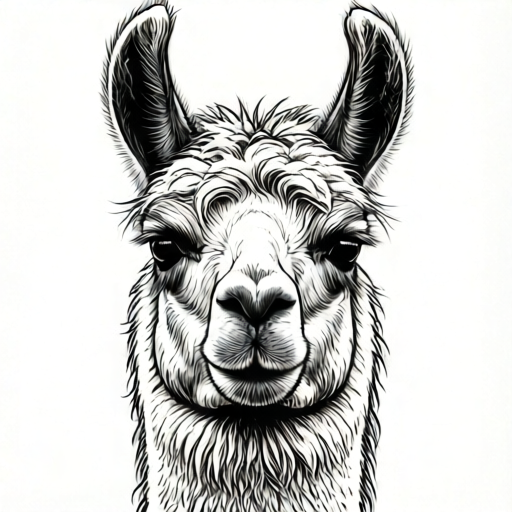
Use the stated measurements and conventions for each exercise.
Placing the Face Landmarks
Begin with a light oval for the head. Mark a vertical center line and a horizontal midline. The midline is your reference for eye height. Place two small eye marks on the midline, spaced about one eye-width apart. Below the eyes, mark the muzzle: a soft rounded rectangle that sits low on the face and extends slightly past the head oval. The muzzle is the anchor for the nose and mouth.
Ears sit high on the head. Draw two curved banana shapes rising from the top corners of the oval. Vary the ear angle: one ear can tilt outward and the other slightly forward. Llama ears are long and slightly curved, not triangular. Keep the ear bases close to the head outline so the face reads as one shape.
- Draw a light oval for the head and mark a vertical center line.
- Mark a horizontal midline for eye height and place two eye marks.
- Draw a rounded muzzle low on the face, extending slightly past the oval.
- Add two long, curved ears at the top corners with different angles.
- Check that the muzzle is centered and the ears are balanced before adding detail.
Wool Texture Strokes
Wool texture comes from short, overlapping strokes that follow the direction of the face. Use a soft pencil and make strokes about the length of a grain of rice. Start at the top of the head and work downward, letting strokes curve around the cheeks and muzzle. Do not fill the whole face with uniform scribbles; leave gaps so the eyes and muzzle stay clear.
Vary stroke density: denser wool on the cheeks and forehead, lighter wool near the muzzle and ears. A common mistake is making strokes too long or too straight. Short, curved strokes read as wool. Practice on a scrap paper with three rows: light, medium, and dense strokes. Then apply the medium density to the face.
- Practice three rows of short curved strokes: light, medium, dense.
- Start wool at the top of the head and work downward.
- Curve strokes around the cheeks and keep the muzzle area lighter.
- Leave gaps around the eyes and ears so features remain visible.
- Compare density: cheeks denser than muzzle, forehead medium.
Refining the Muzzle and Eyes
The muzzle should look soft and slightly rounded. Draw a small nose shape at the top center of the muzzle, then a gentle mouth line below it. Keep the mouth line short and slightly curved. The eyes are small ovals with a dark pupil; place them on the midline and check that they are level. If one eye looks higher, adjust before darkening.
Ear shape matters for llama recognition. Ears should be longer than they are wide, with a slight inward curve. Avoid making them too pointed or too round. Check the ear angle by imagining a line from the ear tip to the center of the head; the two lines should not be parallel. This variation makes the face lively.
- Draw a small nose at the top center of the muzzle.
- Add a short, gently curved mouth line below the nose.
- Draw two small oval eyes on the midline with dark pupils.
- Check eye level and adjust before darkening.
- Refine ear curves so they are longer than wide and not parallel.
Worked example
Draw a llama face on a sheet of paper about 15 cm by 20 cm. Use a head oval about 8 cm tall and 6 cm wide. Place the midline at about 4 cm from the top of the oval. Draw two eyes on the midline, a muzzle below, and two curved ears. Add medium wool texture on the forehead and denser wool on the cheeks.
Worked answer
A completed llama face with a centered oval head, level eyes on the midline, a low rounded muzzle extending slightly past the oval, two long curved ears at different angles, and short curved wool strokes that are denser on the cheeks and lighter near the muzzle. The face is recognizable as a llama and the wool texture is visible without hiding the features.
Four practice exercises
Exercise 1
On a 15 cm by 20 cm sheet, draw a head oval 8 cm tall and 6 cm wide. Mark a midline 4 cm from the top. Place two eye marks on the midline, 2 cm apart. Where should the muzzle go?
Show answer and check
The muzzle should sit below the eyes, centered on the vertical line, and extend slightly past the bottom of the head oval.
Why: The midline sets eye height. The muzzle is lower than the eyes and anchors the nose and mouth. Extending slightly past the oval gives the llama its characteristic soft snout.
Check: Confirm the muzzle is centered on the vertical line and sits below the eye marks, extending slightly past the bottom of the head oval.
Exercise 2
Draw two ears on the head oval from the previous exercise. One ear tilts outward and the other tilts forward. Each ear should be about 4 cm long and 1.5 cm wide at the base. Describe how to check the ear angles.
Show answer and check
The ears are long and curved, attached near the top corners. To check angles, imagine lines from each ear tip to the center of the head; the lines should not be parallel.
Why: Varied ear angles make the face lively. Long, curved ears distinguish a llama from short-eared animals. Non-parallel lines confirm the angles differ.
Check: Use a ruler to confirm each ear is roughly 4 cm long and 1.5 cm wide at the base (treat these as example proportions), then compare the imagined tip-to-center lines.
Exercise 3
Practice wool texture by drawing three rows of short curved strokes on scrap paper: light, medium, and dense. Each stroke should be about 0.5 cm long. Then apply medium density to the forehead and dense density to the cheeks of your llama face.
Show answer and check
Three rows show increasing stroke density. The forehead receives medium strokes and the cheeks receive dense strokes, leaving gaps around the eyes and muzzle.
Why: Short curved strokes read as wool. Varying density prevents a flat, scribbled look and keeps features visible.
Check: Count strokes in a 2 cm by 2 cm square on the forehead and cheek; the cheek square should have more strokes than the forehead square.
Exercise 4
Draw a complete llama face using the proportions from the first exercise. Add a nose and mouth on the muzzle, and wool texture. Then check your drawing against the rubric and list one adjustment you would make.
Show answer and check
A complete llama face with level eyes, low muzzle, varied ear angles, and varied wool density. One valid adjustment is to lower the muzzle or shorten a wool stroke that hides an eye.
Why: The rubric checks placement, ear shape, and wool texture. Adjustments improve recognition and clarity without requiring a single universal answer.
Check: Use the rubric as a checklist and confirm each item; note any item not met as the basis for your adjustment.
Common mistakes
- Ears drawn as short triangles. Redraw ears as long, curved banana shapes that rise from the top corners of the head.
- Muzzle placed too high or too centered. Lower the muzzle so it sits below the eyes and extends slightly past the head oval.
- Wool strokes too long and straight. Use short, curved strokes about the length of a grain of rice and vary density.
- Eyes not level or too large. Place eyes on the midline, keep them small ovals, and check level before darkening.
Self-check rubric
- Head oval is present and roughly centered.
- Eyes are level on the midline and small.
- Muzzle sits below the eyes and extends slightly past the head oval.
- Two long, curved ears rise from the top corners with varied angles.
- Wool strokes are short, curved, and varied in density.
- Features remain visible through the wool texture.
- Valid alternatives: ear angles may differ, wool density may vary, and eye size may vary slightly as long as level and small.
Questions and answers
Do I need special paper or tools?
No. Plain paper, a pencil, and an eraser are enough. Measure your own paper if you want to set proportions.
How many wool strokes should I use?
There is no fixed number. Aim for medium density on the forehead and denser on the cheeks, leaving gaps around features.
Can the ears be at different angles?
Yes. Varied ear angles are encouraged as long as the ears remain long, curved, and attached near the top corners.
What if my llama looks like an alpaca?
Check ear length and muzzle placement. Llama ears are longer and the muzzle sits lower; adjust those two features first.