Free original lessons
Draw a Pile of Coins: Overlapping Ellipses and Edge Shading
Learn to sketch stacked coins using overlapping ellipses, correct occlusion, and edge shading. Includes worked example, practice tasks, and a fair rubric.
Free lesson
Four exercises
Worked answers
Object Drawing Lessons
A convincing pile of coins depends on two skills: drawing each coin as an ellipse that respects perspective, and shading the curved edge so overlaps read clearly. This lesson breaks the process into measurable steps. You will use a simple convention: every coin is an ellipse with a visible top face and a side edge. When coins overlap, the nearer coin hides part of the farther one. Edge shading is a narrow band along the lower curve of each visible edge, darkest where the coin meets the coin below. All numerical values are hypothetical examples; measure your own paper and tools. The practice tasks are self-contained and can be solved from the text alone.
Practice materials: Printable downloads are not available for this lesson yet. Use the instructions and four exercises below.
Reference illustration
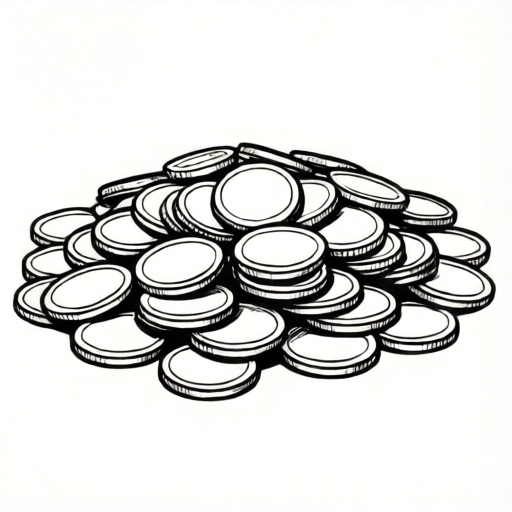
Use the stated measurements and conventions for each exercise.
Set the ellipse convention
Treat every coin as two parts: a top ellipse and a side edge. The top ellipse is a flattened oval. Its width is the coin diameter; its height is the apparent thickness of the top face, which depends on viewing angle. For this lesson, use a width-to-height ratio of about 3:1 for the top ellipse as a hypothetical starting point. The side edge is a curved band below the top ellipse, bounded by the same ellipse shape shifted downward.
Draw light construction lines first. Mark a center line for the pile. Place each coin's top ellipse so its center sits on or near that line. Overlap is decided by drawing order: draw the farthest coin first, then nearer coins on top. A nearer coin's outline interrupts the farther coin's edge. Never draw a complete ellipse for a coin that is partly hidden; draw only the visible arc.
- Draw a vertical center line and a baseline for the pile.
- Sketch the farthest coin as a full top ellipse plus a thin side edge.
- Sketch the next coin nearer, letting its top ellipse overlap the first; erase the hidden arc.
- Repeat for each coin, keeping ellipse proportions consistent.
- Add edge shading as a narrow band along the lower curve of each visible side edge.
Control overlap and occlusion
Overlap is the main cue that coins are stacked. A coin in front hides the lower part of the coin behind it. The visible boundary of the hidden coin stops where the front coin's top ellipse crosses it. Check each junction: the front coin's outline should be continuous, and the back coin's outline should stop cleanly at the crossing.
Use a simple test: trace the front coin's top ellipse with your finger. Any line from a back coin that crosses inside that ellipse is wrong and should be erased. This rule keeps the pile readable even when many coins overlap.
- Identify which coin is nearest the viewer.
- Draw that coin's full visible outline last.
- Erase any back-coin lines that fall inside the front coin's top ellipse.
- Check that each back coin's visible edge ends exactly at the front coin's boundary.
Shade the edge, not the face
Edge shading makes the side of each coin look curved. Keep the top face mostly light. On the side edge, draw a narrow darker band along the lower curve. The band is widest and darkest where the coin sits on the coin below, and it fades toward the left and right extremes of the ellipse. Use a hypothetical band width of about one-tenth of the coin diameter as a starting point, then adjust to your drawing size.
Do not shade the entire side edge evenly. A uniform band looks flat. Instead, vary pressure: darker at the bottom center, lighter at the sides. Leave a thin light line between the dark band and the top ellipse to suggest a rim highlight. This convention is one valid style; other consistent edge-shading styles are acceptable if they clearly separate top face from side edge.
- Outline the visible side edge of each coin.
- Mark the lowest point of that edge.
- Draw a narrow band along the lower curve, darkest at the lowest point.
- Fade the band toward the left and right ends.
- Keep the top face light and add a thin rim highlight if desired.
Build the pile from back to front
A pile looks chaotic if coins are drawn in random order. Work from the farthest coin to the nearest. This order guarantees correct occlusion without repeated erasing. Group coins into two or three layers: a back layer, a middle layer, and a front layer. Each layer can have two or three coins. Keep the center line as a guide so the pile does not drift sideways.
After drawing all outlines, check the pile as a whole. The nearest coin should have the most complete outline. Farther coins should show only partial ellipses. Edge shading should be consistent in direction: all dark bands on the lower curve. If one coin's shading contradicts the overlap, redraw that coin's edge band.
- Sketch the back layer coins first.
- Add middle layer coins, erasing hidden arcs.
- Add front layer coins last.
- Check that every visible back-coin edge stops at a front-coin boundary.
- Apply edge shading from back to front so front coins can overlap shading cleanly.
Worked example
Draw a pile of three coins. Coin A is farthest, coin B is middle, coin C is nearest. Use a top-ellipse ratio of 3:1 and a side-edge band of about one-tenth of the coin diameter. Describe the visible outlines and shading.
Worked answer
Draw coin A as a full top ellipse with a thin side edge. Draw coin B so its top ellipse overlaps the lower right of coin A; erase the part of A's outline inside B's top ellipse. Draw coin C so its top ellipse overlaps the lower left of B; erase the hidden part of B's outline. Shade each visible side edge with a narrow band along the lower curve, darkest at the bottom center. Coin C's band is drawn last and may cover part of B's band where they meet. The final pile shows three partial ellipses, with only coin C fully outlined.
Four practice exercises
Exercise 1
Two coins overlap. Coin 1 is behind, coin 2 is in front. Coin 1's top ellipse has width 60 mm and height 20 mm. Coin 2's top ellipse has the same dimensions and is shifted 15 mm right and 10 mm down. Describe which part of coin 1's outline is visible.
Show answer and check
Only the part of coin 1's outline outside coin 2's top ellipse is visible. The lower right arc of coin 1 is hidden where coin 2's ellipse covers it.
Why: The front coin's top ellipse defines the hidden region. Any back-coin line inside that ellipse must be erased. The shift of 15 mm right and 10 mm down places coin 2 over the lower right of coin 1.
Check: Trace coin 2's top ellipse. Confirm that no coin 1 line remains inside it. The visible coin 1 outline should stop exactly at coin 2's boundary.
Exercise 2
A coin's side edge is visible along its lower curve. The coin diameter is 40 mm. Using the hypothetical band width of one-tenth of the diameter, state the band width and describe where it should be darkest.
Show answer and check
The band width is 4 mm. It should be darkest at the lowest point of the lower curve and fade toward the left and right ends.
Why: One-tenth of 40 mm is 4 mm. The lower curve is closest to the coin below, so the shadow is strongest there. Fading toward the sides suggests curvature.
Check: Measure the band at its widest point; it should be about 4 mm. Check that the darkest area is at the bottom center, not evenly spread.
Exercise 3
You are drawing a pile of four coins in two layers: back layer coins A and B, front layer coins C and D. In what order should you draw the outlines, and why?
Show answer and check
Draw A and B first, then C and D. Within each layer, order does not matter much, but all back-layer coins must be drawn before front-layer coins.
Why: Drawing back to front ensures that front coins can cleanly hide back coins. If you draw a front coin first, you may later draw back-coin lines that incorrectly cross inside the front coin.
Check: After drawing, confirm that every visible back-coin edge stops at a front-coin boundary. No back-coin line should cross inside a front coin's top ellipse.
Exercise 4
A student shades the entire side edge of a coin evenly dark. The top face is also dark. Explain the problem and give one fix using the lesson convention.
Show answer and check
Even shading makes the side edge look flat, and a dark top face removes the separation between face and edge. Fix: keep the top face light and shade only a narrow band along the lower curve, darkest at the bottom center.
Why: The convention uses contrast between a light top face and a narrow dark edge band to show curvature. Uniform darkness destroys that contrast.
Check: Check that the top face is mostly light and that the dark band is narrow and concentrated at the lower curve. The coin should read as a curved edge, not a flat disc.
Common mistakes
- Drawing complete ellipses for coins that are partly hidden. Erase any arc that falls inside a nearer coin's top ellipse. Only the visible part of each coin should remain.
- Shading the entire side edge evenly. Vary the band: darkest at the bottom center, fading toward the sides. Keep the top face light.
- Using inconsistent ellipse proportions across the pile. Choose one width-to-height ratio for the top ellipse and apply it to every coin, adjusting only for deliberate perspective changes.
- Drawing coins in random order, causing confusing overlaps. Work from farthest to nearest. Draw back-layer coins first, then middle, then front.
Self-check rubric
- Each coin is drawn as an ellipse with a distinct top face and side edge.
- Overlaps are correct: nearer coins hide farther coins, and hidden arcs are erased.
- Edge shading is a narrow band along the lower curve, darkest at the bottom center.
- Top faces remain mostly light, with clear separation from side edges.
- Ellipse proportions are consistent across the pile unless a deliberate perspective change is explained.
- The pile reads as stacked coins, not as flat circles.
- Alternative consistent edge-shading styles are accepted if they meet the separation and overlap criteria.
Questions and answers
Do all coins need the same ellipse ratio?
For a consistent pile, yes. Use one ratio for the top ellipse, such as 3:1 as a hypothetical example. If you change the viewing angle, change the ratio for all coins together.
How dark should the edge shading be?
Dark enough to separate the side edge from the top face, but not so dark that it looks like a hole. Start with a narrow band about one-tenth of the coin diameter and adjust by testing on scrap paper.
Can I use a different edge-shading style?
Yes. The rubric accepts any consistent style that clearly distinguishes top face from side edge and respects overlap. The lower-curve band is one valid convention, not the only answer.
How many coins should a practice pile have?
Three to six coins is enough to practice overlap and shading. More coins increase difficulty but do not teach new principles.