HomeTwo-Cup Water Drawing: Rim Ellipses, Levels, Shadows Free original lessons
Two-Cup Water Drawing: Rim Ellipses, Levels, Shadows
Compare two water cups by drawing rim ellipses, water levels, and shadows. Includes guided steps, common fixes, and four practice tasks with checks.
Free lesson
Four exercises
Worked answers
Object Drawing Lessons
This lesson teaches a two-cup comparison drawing focused on three measurable features: the rim ellipse of each cup, the water level inside each cup, and the shadow each cup casts. You will use a simple convention: the rim ellipse is drawn as a closed curve whose highest point is the back rim and lowest point is the front rim; the water level is a second ellipse-like curve parallel to the rim, placed lower for a fuller cup. Letter styles and cup shapes vary, so the rubric rewards consistent comparison rather than one universal outline. All measurements below are hypothetical examples; measure your own paper and cup before drawing.
Practice materials: Printable downloads are not available for this lesson yet. Use the instructions and four exercises below.
Reference illustration
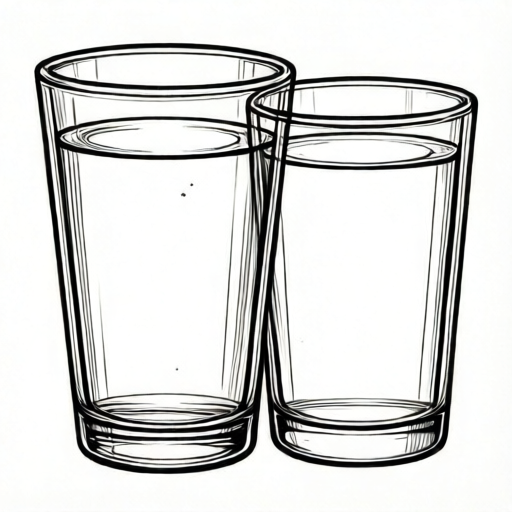
Use the stated measurements and conventions for each exercise.
Set the comparison frame
Place two cups side by side on the same surface. Decide which cup is nearer and which is farther; this controls the size of each rim ellipse. A nearer cup gets a slightly larger rim ellipse and a lower front rim point. Draw a light horizontal baseline for the table edge and a second light line for the back of the table if needed.
Label cup A (left) and cup B (right) lightly outside the drawing area. Mark the center of each rim with a small cross. These crosses are guides only and will be erased or left faint.
- Draw a light baseline across the page.
- Mark two center crosses for cup A and cup B, spaced apart.
- Decide which cup is nearer and note it beside the cross.
- Draw a faint vertical axis through each cross to keep the cup symmetrical.
Draw rim ellipses with a defined convention
For each cup, draw the rim as a closed ellipse. The back rim is the highest point of the ellipse; the front rim is the lowest point. The left and right extremes are the widest points. Keep the ellipse wider than it is tall. A nearer cup may have a slightly taller ellipse, but the difference should be small and consistent.
Check the two ellipses against each other: the nearer cup's ellipse should be larger overall, and both ellipses should share the same tilt if the cups sit on the same surface. If one ellipse looks like a circle, flatten it slightly.
- Draw the back rim as a shallow curve above the center cross.
- Draw the front rim as a matching curve below the center cross.
- Connect the left and right extremes with smooth side curves.
- Compare the two ellipses: nearer cup larger, same tilt.
- Erase the center crosses if they distract.
Place water levels and shadows
The water level is drawn as a second ellipse inside each cup, parallel to the rim. A fuller cup has its water ellipse closer to the rim; an emptier cup has it lower. Use the same tilt as the rim ellipse. Do not draw the water level as a straight horizontal line unless the cup is viewed exactly from the side, which is not the case here.
Shadows are drawn as a dark shape on the table opposite the light source. Decide one light direction for both cups. The shadow starts at the base of each cup and extends away from the light. The nearer cup's shadow may appear slightly larger. Keep shadow edges soft with short parallel strokes.
- Draw a water ellipse inside cup A, parallel to its rim.
- Draw a water ellipse inside cup B at a different height to show a different fullness.
- Mark the light direction with a small arrow outside the drawing.
- Draw each shadow starting at the cup base and extending away from the light.
- Compare water levels: the fuller cup's water ellipse is closer to its rim.
Compare and refine
Step back and compare the two cups as a pair. The rim ellipses should show a clear size difference if one cup is nearer. The water levels should be visibly different in height. The shadows should point in the same direction. If any of these comparisons is unclear, adjust the guide lines rather than redrawing the whole cup.
Use the rubric to self-check: rim ellipse convention, water level parallelism, shadow direction, and comparison clarity. Valid alternatives include different cup shapes, different water amounts, and different shadow lengths, as long as the comparisons remain consistent.
- Check rim ellipses: back high, front low, wider than tall.
- Check water levels: parallel to rims, different heights.
- Check shadows: same direction, starting at bases.
- Check comparison: nearer cup larger, fuller cup water higher.
- Erase unnecessary guides and darken final lines.
Worked example
Two cups sit on a table. Cup A is nearer and half full. Cup B is farther and nearly full. Light comes from the left. Describe the rim ellipses, water levels, and shadows.
Worked answer
Cup A has a larger rim ellipse with a lower front rim point. Its water ellipse sits about halfway down the cup, parallel to the rim. Cup B has a smaller rim ellipse and its water ellipse is close to the rim. Both shadows extend to the right, starting at each cup base. The nearer cup's shadow is slightly larger.
Why: The nearer cup appears larger, so its rim ellipse is larger. The fuller cup has its water ellipse closer to the rim. One light direction from the left makes both shadows point right. The comparison is clear because size, water height, and shadow direction are consistent.
Check: Verify that the nearer cup's rim ellipse is larger, the fuller cup's water ellipse is closer to its rim, and both shadows point away from the same light direction.
Four practice exercises
Exercise 1
Cup A is nearer and one-quarter full. Cup B is farther and three-quarters full. Light comes from the right. Describe the rim ellipses, water levels, and shadows for both cups.
Show answer and check
Cup A has the larger rim ellipse and its water ellipse is low, near the bottom quarter. Cup B has a smaller rim ellipse and its water ellipse is higher, near the top quarter. Both shadows extend to the left from the cup bases, with Cup A's shadow slightly larger.
Why: Nearer cup means larger rim ellipse. Fuller cup means water ellipse closer to the rim. Light from the right means shadows point left. The comparison is consistent because size, water height, and shadow direction all follow the stated conditions.
Check: Check that Cup A's rim ellipse is larger, Cup B's water ellipse is closer to its rim, and both shadows point left.
Exercise 2
Two cups are the same distance from the viewer. Cup A is empty. Cup B is half full. Light comes from the front. Describe the rim ellipses, water levels, and shadows.
Show answer and check
Both cups have similar rim ellipses because they are the same distance. Cup A has no water ellipse. Cup B has a water ellipse about halfway down, parallel to its rim. Both shadows extend backward from the cup bases, away from the front light.
Why: Same distance means similar rim ellipse sizes. Empty cup has no water level. Half-full cup has a water ellipse at mid-height. Front light makes shadows point backward. The comparison is clear because the water presence and shadow direction are consistent.
Check: Check that rim ellipses are similar in size, Cup A has no water ellipse, Cup B's water ellipse is at mid-height, and both shadows point backward.
Exercise 3
Cup A is farther and nearly full. Cup B is nearer and one-third full. Light comes from the left. Describe the rim ellipses, water levels, and shadows.
Show answer and check
Cup B has the larger rim ellipse because it is nearer. Cup A has a smaller rim ellipse and its water ellipse is close to its rim. Cup B's water ellipse is lower, about one-third down. Both shadows extend to the right, with Cup B's shadow slightly larger.
Why: Nearer cup B gets the larger rim ellipse. Fuller cup A gets the water ellipse closer to its rim. Left light makes shadows point right. The comparison is consistent because the nearer cup is larger and the fuller cup's water is higher.
Check: Check that Cup B's rim ellipse is larger, Cup A's water ellipse is closer to its rim, and both shadows point right.
Exercise 4
Two cups sit side by side. Cup A is nearer and two-thirds full. Cup B is farther and one-third full. Light comes from the back. Describe the rim ellipses, water levels, and shadows.
Show answer and check
Cup A has the larger rim ellipse and its water ellipse is about two-thirds up from the bottom. Cup B has a smaller rim ellipse and its water ellipse is about one-third up. Both shadows extend forward from the cup bases, away from the back light, with Cup A's shadow slightly larger.
Why: Nearer cup A gets the larger rim ellipse. Fuller cup A gets the water ellipse closer to the rim. Back light makes shadows point forward. The comparison is clear because size, water height, and shadow direction are all consistent with the stated conditions.
Check: Check that Cup A's rim ellipse is larger, Cup A's water ellipse is higher than Cup B's, and both shadows point forward.
Common mistakes
- Drawing the rim as a full circle instead of an ellipse. Flatten the circle vertically so the back rim is higher than the front rim and the shape is wider than tall.
- Drawing the water level as a straight horizontal line. Draw the water level as an ellipse parallel to the rim, with the same tilt and a lower front point.
- Making both cups the same size when one is nearer. Enlarge the nearer cup's rim ellipse slightly and lower its front rim point to show proximity.
- Pointing shadows in different directions. Choose one light direction and draw both shadows extending away from it.
- Placing the water level above the rim. Keep the water ellipse inside the cup, below the rim ellipse, and closer to the rim for a fuller cup.
Self-check rubric
- Rim ellipses follow the convention: back rim highest, front rim lowest, wider than tall.
- The nearer cup has a visibly larger rim ellipse than the farther cup.
- Water levels are drawn as ellipses parallel to the rims, not as straight horizontal lines.
- The fuller cup's water ellipse is closer to its rim than the emptier cup's.
- Both shadows start at the cup bases and extend away from one stated light direction.
- The two-cup comparison is clear at a glance without reading labels.
- Valid alternatives in cup shape, water amount, and shadow length are accepted if comparisons remain consistent.
Questions and answers
Do both cups need the same shape?
No. Different cup shapes are valid. The comparison should still show consistent rim ellipse convention, water level parallelism, and shadow direction.
How different should the water levels be?
Make the difference clear enough to see at a glance. A hypothetical example is one water ellipse near the rim and the other about one-third of the cup height lower.
Can I use a ruler for the ellipses?
A ruler can help with the baseline and center axes, but rim and water ellipses should be drawn freehand or with a light guide curve so they remain smooth.
What if my cups are transparent?
This lesson excludes glass refraction detail. Draw the water level as an opaque ellipse and keep the cup outline simple.