Free original lessons
Draw a Rainbow Trout: Body, Fins, and Spot Pattern
Learn a reliable layout for rainbow trout body shape, fin placement, and spotting, with a convention-based rubric that accepts valid stylistic variation.
Free lesson
Four exercises
Worked answers
Object Drawing Lessons
This lesson teaches a repeatable way to draw a rainbow trout from a side view. You will establish a streamlined body, place the dorsal, adipose, caudal, anal, pelvic, and pectoral fins in believable positions, and add a spot pattern that reads as trout rather than generic fish. The method uses simple proportional guides and a defined drawing convention so that your result can be checked fairly even when your line style differs from someone else's. All measurements are hypothetical examples you can scale to your paper. The focus is body layout, fin placement, and spotting; scale detail and background scenes are outside this task.
Practice materials: Printable downloads are not available for this lesson yet. Use the instructions and four exercises below.
Reference illustration
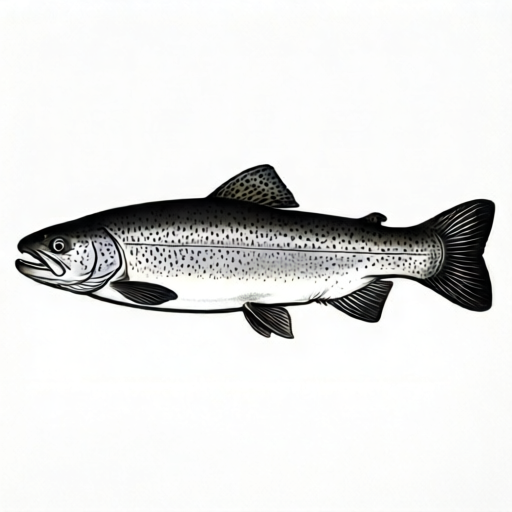
Use the stated measurements and conventions for each exercise.
Establish the body outline
Begin with a horizontal centerline. Mark a nose point and a tail-base point. As a hypothetical example, if the nose-to-tail-base length is 18 cm on your paper, place the deepest part of the body about 6 cm behind the nose. The body depth there might be about 5 cm, giving a length-to-depth ratio near 3.6 to 1. Rainbow trout are streamlined but not eel-like, so avoid a perfectly straight tube or an exaggerated teardrop.
Draw the back as a gentle curve that rises from the nose, peaks near the deepest point, then slopes down to the tail base. Draw the belly as a shallower curve that dips slightly behind the head and rises toward the tail base. Keep the nose rounded rather than pointed. The tail base should be narrower than the deepest body point but not pinched to a thread.
- Draw a horizontal centerline and mark nose and tail-base points.
- Mark the deepest body point about one-third of the body length behind the nose.
- Sketch the back curve and belly curve separately, then join them at nose and tail base.
- Check that the body depth is roughly one-third to one-quarter of the body length.
Place the fins by landmark
Use body landmarks rather than guessing. The dorsal fin sits on the back, roughly above the space between the pelvic and anal fins. The adipose fin is a small fleshy fin on the back near the tail base, behind the dorsal fin. The caudal fin attaches at the tail base and should be slightly forked or squared, not deeply forked like a mackerel. The anal fin sits on the belly close to the tail base. The pelvic fins sit on the belly about midway between the head and tail base. The pectoral fins sit just behind the head on the lower side.
Draw fins as thin triangles or rounded lobes with clear attachment points. A fin should touch the body at a base, not float. Keep the dorsal fin height roughly equal to one-third of the body depth at that point. The adipose fin should be noticeably smaller than the dorsal fin. The pectoral fin can overlap the belly line slightly, but its base must sit on the body.
- Mark the dorsal fin base above the midpoint between pelvic and anal fin positions.
- Mark the adipose fin base about two-thirds of the way from nose to tail base, on the back.
- Attach the caudal fin at the tail base with a shallow fork or squared edge.
- Place anal, pelvic, and pectoral fins on the belly and lower side using the landmark descriptions.
Build the spot pattern
Rainbow trout spotting is not a uniform grid. Use a convention: spots are small dark ovals or dots, denser above the lateral line and sparser below it. The lateral line is an imaginary line running from behind the head to the tail base, roughly along the middle of the body. Place spots in loose clusters rather than perfect rows. Vary spot size slightly, but keep most spots smaller than the eye. Leave the belly mostly clear.
As a hypothetical example, place about 20 to 30 spots on the upper half of the body, 5 to 10 near the lateral line, and fewer than 5 below it. These counts are examples, not a rule. The pattern should look irregular but balanced. Avoid spots on the fins unless you choose a stylistic convention that allows them; if you do, state that convention in your rubric.
- Draw a faint lateral line from behind the head to the tail base.
- Cluster most spots above the lateral line, varying spacing and size.
- Add a few spots near the lateral line and very few below it.
- Check that the belly remains mostly clear and that spots do not form a perfect grid.
Check and refine
Compare your drawing to the body layout: nose rounded, back curved, belly shallower, tail base narrow. Check each fin for a clear attachment point and believable size relative to the body. Check the spot pattern for density above the lateral line and sparseness below. If a fin floats or a spot cluster looks like a checkerboard, adjust before finalizing.
Use the rubric to evaluate layout, fin placement, and spotting separately. A drawing can be stylistically simple and still meet the layout criteria. The rubric rewards clear landmarks and consistent conventions rather than realistic shading or scale detail.
- Trace the body outline with your finger and confirm the deepest point is behind the nose.
- Point to each fin base and confirm it touches the body.
- Scan the spot pattern for grid-like rows and correct them.
- Score the drawing against the rubric before making final changes.
Worked example
A learner draws a trout with an 18 cm nose-to-tail-base length. The deepest body point is 6 cm behind the nose with a body depth of 5 cm. The dorsal fin is drawn 4 cm tall above the deepest point, the adipose fin is drawn in front of the dorsal fin, and spots are placed in even rows across the entire body. Identify the layout errors and state corrections.
Worked answer
The body proportions are acceptable: depth is about 0.28 of length, which falls within the suggested one-quarter to one-third range, and the deepest point is about one-third behind the nose. The dorsal fin is too tall; at that point it should be about one-third of the 5 cm body depth, so roughly 1.7 cm as a hypothetical target. The adipose fin is misplaced; it should sit behind the dorsal fin near the tail base and be smaller than the dorsal fin. The spot pattern is too uniform; spots should cluster above the lateral line, vary in spacing, and leave the belly mostly clear.
Four practice exercises
Exercise 1
A trout drawing has a nose-to-tail-base length of 20 cm. The deepest body point is 10 cm behind the nose and the body depth there is 8 cm. State whether the body layout meets the lesson's proportional guidance and explain why.
Show answer and check
It does not meet the guidance. The deepest point should be about one-third of the body length behind the nose, which is roughly 6.7 cm for a 20 cm body, not 10 cm. The body depth of 8 cm is 40 percent of the body length, which is deeper than the suggested one-quarter to one-third range.
Why: The lesson places the deepest point about one-third behind the nose and suggests body depth between one-quarter and one-third of body length. The drawing places the deepest point at half the body length and uses a depth of 0.4 times the length, so both landmarks are outside the guidance.
Check: Divide the nose-to-tail-base length by 3 to estimate the deepest-point position, and divide body depth by body length to check the depth ratio. Compare both results to the stated ranges.
Exercise 2
A learner places the dorsal fin above the tail base, the adipose fin above the deepest body point, and the anal fin on the back near the dorsal fin. Describe the correct placement for each of these three fins.
Show answer and check
The dorsal fin should sit on the back above the space between the pelvic and anal fin positions, not above the tail base. The adipose fin should sit behind the dorsal fin near the tail base, not above the deepest body point. The anal fin should sit on the belly close to the tail base, not on the back.
Why: The lesson uses body landmarks: dorsal fin on the back above the pelvic-anal region, adipose fin behind the dorsal fin near the tail base, and anal fin on the belly near the tail base. The learner's placements swap these landmarks.
Check: Point to each fin base and name the body region it touches. Confirm the dorsal fin is on the back, the adipose fin is behind the dorsal fin, and the anal fin is on the belly.
Exercise 3
A drawing shows 40 spots arranged in five even rows across the entire body, including the belly. Using the lesson's spot convention, describe two specific changes that would improve the pattern.
Show answer and check
First, remove or greatly reduce spots below the lateral line so the belly is mostly clear. Second, break the even rows by clustering most spots above the lateral line with varied spacing and slightly varied spot size.
Why: The convention calls for denser spotting above the lateral line, sparser spotting below, irregular spacing, and a mostly clear belly. Even rows across the whole body violate both the density distribution and the irregularity guidance.
Check: Draw a faint lateral line and count spots above and below it. Check that most spots are above, few are below, and that no perfect rows remain.
Exercise 4
A trout drawing has a body depth of 6 cm at the dorsal fin base. The dorsal fin is drawn 3 cm tall and the adipose fin is drawn 2.5 cm tall. Using the lesson's hypothetical proportions, state whether the fin sizes are consistent with the guidance and give corrected target heights.
Show answer and check
The dorsal fin is too tall. At a 6 cm body depth, one-third is 2 cm, so a hypothetical target dorsal fin height is about 2 cm, not 3 cm. The adipose fin should be clearly smaller than the dorsal fin, so 2.5 cm is too large; a hypothetical target might be about 1 cm or less.
Why: The lesson suggests dorsal fin height roughly one-third of local body depth and states the adipose fin should be noticeably smaller than the dorsal fin. The drawing uses half the body depth for the dorsal fin and nearly the same height for the adipose fin.
Check: Divide the local body depth by 3 to estimate dorsal fin height. Compare the adipose fin height to the dorsal fin height and confirm it is clearly smaller.
Common mistakes
- Making the body a symmetrical teardrop with the deepest point at the middle. Move the deepest point forward to about one-third of the body length behind the nose and make the belly curve shallower than the back curve.
- Floating fins that do not touch the body. Redraw each fin starting from a clear base on the body outline, then extend the fin outward.
- Placing the adipose fin in front of the dorsal fin. Move the adipose fin behind the dorsal fin and close to the tail base, keeping it smaller than the dorsal fin.
- Making the spot pattern a uniform grid across the whole body. Cluster most spots above the lateral line, vary spacing, and leave the belly mostly clear.
- Drawing a deeply forked tail like a fast pelagic fish. Use a shallow fork or squared tail edge that matches a rainbow trout's caudal fin shape.
Self-check rubric
- Body outline shows a rounded nose, a back curve peaking behind the nose, a shallower belly curve, and a narrow but not pinched tail base.
- Deepest body point is placed roughly one-third of the body length behind the nose, with body depth between one-quarter and one-third of body length.
- Dorsal fin base sits on the back above the space between pelvic and anal fin positions, with height roughly one-third of local body depth.
- Adipose fin is behind the dorsal fin, near the tail base, and clearly smaller than the dorsal fin.
- Caudal fin attaches at the tail base with a shallow fork or squared edge, not a deep fork.
- Anal, pelvic, and pectoral fins each have a clear base on the body and are placed according to the landmark descriptions.
- Spot pattern is denser above the lateral line, sparser below, irregular in spacing, and leaves the belly mostly clear.
- Any stylistic variation, such as spots on fins or a different spot count, is stated as a convention and applied consistently.
Questions and answers
Do I need to draw scales?
No. This task focuses on body layout, fin placement, and spotting. Scale detail is outside the boundary and is not required for a successful drawing.
Can I use a different spot count?
Yes. The counts in the lesson are hypothetical examples. Use a pattern that is denser above the lateral line and sparser below, and state your convention if you vary it.
What if my line style is loose or sketchy?
The rubric evaluates landmark placement and pattern logic, not line polish. A loose drawing can meet the criteria if the body shape, fin bases, and spot distribution are clear.
How do I know the fins are the right size?
Compare each fin to the body depth at its attachment point. The dorsal fin height should be roughly one-third of the body depth there, and the adipose fin should be clearly smaller than the dorsal fin.