Free original lessons
Draw a Shark: Fin Placement and Body Shape Construction
Learn to draw a shark by building a tapered body, placing dorsal and pectoral fins, and checking proportions with a simple convention.
Free lesson
Four exercises
Worked answers
Object Drawing Lessons
This lesson teaches a repeatable way to draw a shark using body shape construction and fin placement. You will set a baseline and midline, build a tapered body outline, position the dorsal fin and pectoral fins, and add a tail. The method uses a simple convention: x-height is measured from baseline to midline, and letter styles vary, so treat all measurements as guides rather than fixed rules. You will practice with four self-contained tasks and a worked example, then check your drawing with a rubric that allows valid alternatives.
Practice materials: Printable downloads are not available for this lesson yet. Use the instructions and four exercises below.
Reference illustration
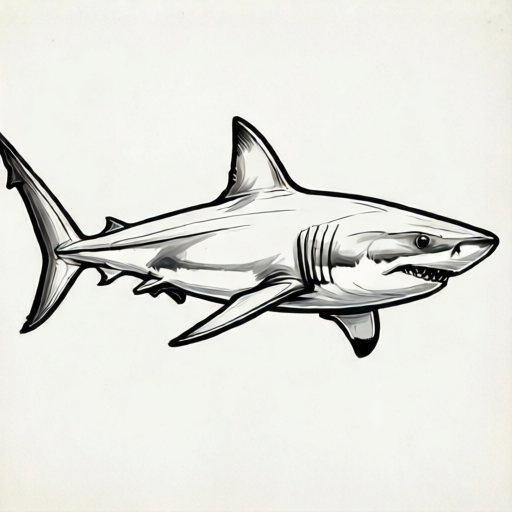
Use the stated measurements and conventions for each exercise.
Set the baseline and midline
Start with a horizontal baseline and a parallel midline above it. The distance from baseline to midline is the x-height for this drawing. Choose a convenient x-height, such as 4 cm, and label it as a hypothetical example. Keep all later measurements in the same unit.
Mark a body length along the baseline. A simple shark body can be about three x-heights long. Mark the nose end and tail end on the baseline, then draw a light vertical guide at each end.
- Draw a baseline and a midline above it; measure and label the x-height.
- Mark nose and tail positions on the baseline about three x-heights apart.
- Draw light vertical guides at the nose and tail marks.
Build the tapered body outline
The body is widest near the head and narrows toward the tail. On the midline, mark a point about one x-height from the nose for the widest part. Draw a smooth curve from the nose over the top to the tail, and a matching curve underneath. Keep the curves gentle; a shark body should look streamlined, not lumpy.
Check symmetry by comparing the distance from the midline to the top curve and to the bottom curve at three points: near the head, middle, and tail. They should be close, but small differences are acceptable in a sketch.
- Mark the widest point on the midline about one x-height from the nose.
- Draw the top body curve from nose to tail, passing near the widest point.
- Draw the bottom body curve from nose to tail, matching the top curve's taper.
- Compare top and bottom distances from the midline at three points.
Place the dorsal fin and pectoral fins
The dorsal fin sits on top of the body, roughly above the widest point or slightly behind it. Its base should be about one x-height long, and its height about half an x-height. Draw the front edge sloping back and the rear edge shorter, so the fin looks like a triangle with a curved trailing edge.
Pectoral fins sit on the sides, below the midline, near the head. Place one pectoral fin on the visible side, starting about half an x-height behind the nose. Its length can be about one x-height. A second pectoral fin may be shown on the far side as a smaller shape, but it is optional in a simple drawing.
- Mark the dorsal fin base on the top curve, about one x-height long.
- Draw the dorsal fin with a sloping front edge and a shorter rear edge.
- Mark the pectoral fin start below the midline, about half an x-height behind the nose.
- Draw the pectoral fin about one x-height long, angled slightly back.
Add the tail and final checks
The tail completes the body shape. At the tail end, draw a caudal fin with an upper lobe and a lower lobe. The upper lobe can be slightly longer. Keep the tail within about one x-height from the tail mark so the body does not look stretched.
Final checks: confirm the body tapers smoothly, the dorsal fin sits on the top curve, the pectoral fin is below the midline, and all measurements use the same unit. Erase light guides only after these checks.
- Draw the upper and lower tail lobes at the tail end.
- Check that the tail stays within about one x-height of the tail mark.
- Verify fin placement and body taper against the midline.
- Erase construction guides and keep the final outline.
Worked example
Draw a shark with an x-height of 4 cm. Use a body length of 12 cm, a dorsal fin base of 4 cm, a pectoral fin length of 4 cm, and a tail within 4 cm of the tail mark. Describe the construction steps and the final check.
Worked answer
Draw a baseline and a midline 4 cm above it. Mark nose and tail 12 cm apart on the baseline. Mark the widest point on the midline 4 cm from the nose. Draw smooth top and bottom curves from nose to tail, tapering toward the tail. Mark the dorsal fin base on the top curve, 4 cm long, starting above the widest point. Draw the dorsal fin about 2 cm high with a sloping front edge. Mark the pectoral fin start below the midline, 2 cm behind the nose, and draw it 4 cm long, angled back. Add tail lobes within 4 cm of the tail mark. Check that top and bottom distances from the midline are close at three points and that all measurements use centimetres.
Four practice exercises
Exercise 1
Using an x-height of 3 cm, construct a shark body 9 cm long. Mark the widest point 3 cm from the nose. Describe where the dorsal fin base should start and how long it should be.
Show answer and check
The dorsal fin base should start on the top curve above the widest point, which is 3 cm from the nose. The base should be about 3 cm long.
Why: The widest point is one x-height from the nose, and the dorsal fin sits above it or slightly behind. The base length equals one x-height, so 3 cm.
Check: Measure the distance from nose to widest point (should be 3 cm) and the dorsal fin base (should be about 3 cm). Confirm both use centimetres.
Exercise 2
A shark drawing has an x-height of 5 cm. The pectoral fin starts 2.5 cm behind the nose and is 5 cm long. Is the start position consistent with the lesson? Explain.
Show answer and check
Yes. The pectoral fin should start about half an x-height behind the nose. Half of 5 cm is 2.5 cm, so the start position is consistent.
Why: The lesson places the pectoral fin start about half an x-height behind the nose. With x-height 5 cm, half is 2.5 cm.
Check: Divide the x-height by two and compare with the stated start distance. Both values are in centimetres.
Exercise 3
Draw a shark with x-height 4 cm and body length 12 cm. The dorsal fin base is drawn 6 cm long. Identify the mistake and give a corrected base length.
Show answer and check
The mistake is that the dorsal fin base is too long. It should be about one x-height, so the corrected base length is about 4 cm.
Why: The lesson sets the dorsal fin base at about one x-height. With x-height 4 cm, a 6 cm base is too long by 2 cm.
Check: Compare the dorsal fin base to the x-height. The base should be close to 4 cm, not 6 cm.
Exercise 4
A shark sketch uses a 4 cm x-height. The tail lobes extend 8 cm beyond the tail mark. State whether this fits the lesson guide and give a corrected maximum tail extension.
Show answer and check
No, 8 cm is too far. The tail should stay within about one x-height, so the corrected maximum extension is about 4 cm.
Why: The lesson keeps the tail within about one x-height of the tail mark. With x-height 4 cm, 8 cm is twice the guide.
Check: Measure the tail extension from the tail mark and compare it with the x-height. It should be about 4 cm or less.
Common mistakes
- Making the body the same width from head to tail. Taper the body by narrowing the curves toward the tail; compare top and bottom distances from the midline.
- Placing the dorsal fin too far forward or too far back. Put the dorsal fin base above the widest point or slightly behind it, about one x-height long.
- Drawing pectoral fins on the midline instead of below it. Start pectoral fins below the midline, near the head, and angle them slightly back.
- Using different units for x-height and fin lengths. Choose one unit, label the x-height, and measure every part in that same unit.
Self-check rubric
- Body tapers smoothly from head to tail; top and bottom curves are close to symmetric at three check points.
- Dorsal fin base is on the top curve, about one x-height long, above the widest point or slightly behind it.
- Pectoral fin starts below the midline near the head and is angled slightly back.
- Tail lobes are present and stay within about one x-height of the tail mark.
- All measurements use one consistent unit; valid alternative proportions are accepted if the checks pass.
Questions and answers
Do I have to use exactly three x-heights for body length?
No. Three x-heights is a guide. You may use a different proportion if the body still tapers smoothly and the fins are placed consistently.
Can I show both pectoral fins?
Yes. Showing the far-side pectoral fin as a smaller shape is valid, but a simple drawing may show only the near-side fin.
What if my x-height is not 4 cm?
Any convenient x-height works. The 4 cm value is a hypothetical example; measure your own baseline-to-midline distance and keep it consistent.
How do I know the drawing is good enough?
Use the rubric: check body taper, fin placement, tail size, and consistent units. Small variations in curve shape are acceptable.