Free original lessons
Draw Coiled Snake Scales: Belly Bands vs Dorsal Scales
Learn to draw coiled snake scales by comparing wide belly bands with small dorsal scales, using a clear convention and checkable steps.
Free lesson
Four exercises
Worked answers
Object Drawing Lessons
This lesson teaches a reliable way to draw the two scale types visible on a coiled snake: the wide, overlapping belly bands on the underside and the smaller, repeating dorsal scales on the back and sides. You will use a simple convention for scale size and spacing, then compare both types on the same coil. The goal is not anatomical accuracy but clear, consistent visual distinction. All measurements are hypothetical examples; measure your own paper and tools. No downloads or files exist yet; the resource plan describes what is planned.
Practice materials: Printable downloads are not available for this lesson yet. Use the instructions and four exercises below.
Reference illustration
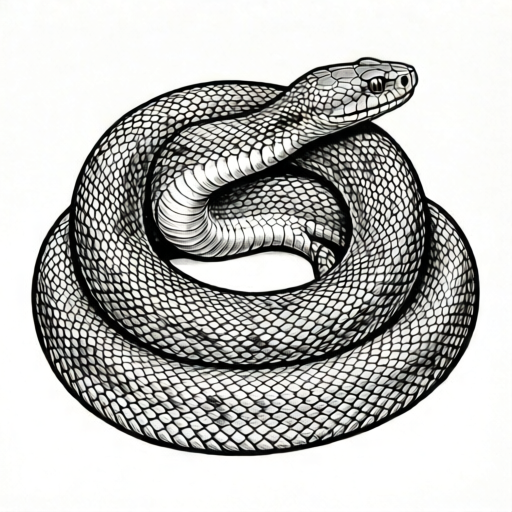
Use the stated measurements and conventions for each exercise.
Set a scale convention before drawing
Choose a unit for scale size. For example, let one small dorsal scale be 3 mm wide and one belly band be 12 mm wide. These are hypothetical values; measure your actual paper and pencil to confirm they fit. Write the values at the top of your page so every coil uses the same convention.
Define the belly band as a wide, slightly curved rectangle that overlaps the next band by about one third of its width. Define the dorsal scale as a small rounded diamond or oval that touches its neighbors without overlapping. Keep the same shape family across the whole drawing so the comparison stays clear.
- Draw a light coil outline: two curved lines that cross to suggest a loop.
- Mark the belly side with a dashed line and the dorsal side with a solid line.
- Write your chosen scale sizes at the top of the page.
- Test one belly band and one dorsal scale in a corner before filling the coil.
Draw belly bands on the underside
Belly bands run across the underside of the coil, roughly perpendicular to the body direction. Start at the inner edge of the coil and draw a wide band that curves gently with the body. Leave a small gap between bands, then draw the next band so it overlaps the previous one by about one third.
Keep band width constant along the visible belly. If the coil turns away, stop the band at the edge rather than wrapping it around the back. This keeps the belly and dorsal zones visually separate.
- Draw the first belly band from the inner coil edge outward.
- Add the next band with a one-third overlap.
- Repeat until the belly section is filled.
- Check that every band is the same width and direction.
Draw dorsal scales on the back and sides
Dorsal scales are smaller and repeat in rows. Begin at the top of the coil and work downward in staggered rows. Each scale should touch its neighbors but not overlap them. Use the same small shape throughout; slight variation is acceptable if the size stays consistent.
Where the coil curves, let the rows follow the curve. Do not force straight rows across a bend. Stop the dorsal scales where the belly zone begins so the two scale types do not mix.
- Mark three guide rows on the dorsal side.
- Draw one scale per row, then fill between them.
- Stagger each new row by half a scale width.
- Check that no dorsal scale crosses into the belly zone.
Compare and refine the two scale types
Place a small comparison key beside the coil: one belly band shape and one dorsal scale shape, each labeled with its chosen size. This key lets you and a peer check consistency without guessing.
Look for three differences: width, overlap, and direction. Belly bands are wider, overlap by about one third, and run across the body. Dorsal scales are smaller, touch without overlapping, and repeat in staggered rows. Adjust any scale that breaks these rules.
- Draw the comparison key with one example of each scale type.
- Check width: belly bands should be clearly wider than dorsal scales.
- Check overlap: belly bands overlap; dorsal scales touch.
- Check direction: belly bands cross the body; dorsal rows follow the curve.
Worked example
A student draws one coil with a belly zone on the left and a dorsal zone on the right. They choose a 12 mm belly band and a 3 mm dorsal scale. The first belly band is 12 mm wide and overlaps the next by 4 mm. The first dorsal row has five scales, each 3 mm wide, touching but not overlapping. Check the drawing against the convention.
Worked answer
The belly band width is correct at 12 mm, and the 4 mm overlap is one third of 12 mm, so the overlap rule is met. The dorsal scales are correct at 3 mm and touch without overlapping. The drawing passes the width, overlap, and touch checks. The only remaining check is direction: belly bands should cross the body and dorsal rows should follow the curve.
Four practice exercises
Exercise 1
On a coil with a belly zone on the bottom and a dorsal zone on the top, a student uses 10 mm belly bands and 2 mm dorsal scales. The first two belly bands overlap by 5 mm. Is the overlap correct for the stated convention?
Show answer and check
No. One third of 10 mm is about 3.3 mm, so a 5 mm overlap is too large for the convention.
Why: The convention sets belly band overlap at about one third of band width. 10 mm divided by 3 is about 3.3 mm. A 5 mm overlap is nearly half the band width, which breaks the rule.
Check: Divide the belly band width by 3 and compare the result with the drawn overlap. If the drawn overlap is much larger or smaller, adjust it.
Exercise 2
A dorsal zone shows three rows of scales. Row one has four scales, row two has four scales placed directly below row one, and row three has four scales directly below row two. Each scale is 3 mm wide and touches its neighbors. Does this meet the staggered-row rule?
Show answer and check
No. The rows are aligned, not staggered.
Why: The convention requires each new dorsal row to be staggered by half a scale width. Directly below placement means no stagger, so the rule is broken even though the scales touch correctly.
Check: Compare the position of a scale in row two with the scale above it in row one. If they line up vertically, the row is not staggered.
Exercise 3
A coil drawing has belly bands that stop at the visible edge and dorsal scales that begin where the belly zone ends. The belly bands are 12 mm wide and overlap by 4 mm. The dorsal scales are 3 mm wide and touch without overlapping. A peer says the drawing mixes the two scale types. Is the peer correct?
Show answer and check
No. The drawing keeps the zones separate and follows the width and overlap rules.
Why: Belly bands stop at the edge, dorsal scales start after the belly zone, and the sizes and overlaps match the convention. There is no mixing of scale types across zones.
Check: Trace the boundary between belly and dorsal zones. Confirm no belly band enters the dorsal zone and no dorsal scale enters the belly zone.
Exercise 4
A student draws a comparison key with one belly band labeled 12 mm and one dorsal scale labeled 3 mm. On the coil, the belly bands are 12 mm wide but the dorsal scales are drawn at 6 mm wide. The student says the key makes the drawing correct. Is the student right?
Show answer and check
No. The coil does not match the key.
Why: The key states 3 mm dorsal scales, but the coil uses 6 mm scales. A correct key must match the drawing; otherwise the comparison is misleading.
Check: Measure three dorsal scales on the coil and compare the average with the key value. If they differ, redraw either the key or the scales so they match.
Common mistakes
- Making dorsal scales the same width as belly bands. Return to your written convention and redraw dorsal scales at the smaller size.
- Letting belly bands wrap around the back of the coil. Stop each band at the visible edge and keep the dorsal zone separate.
- Drawing dorsal scales in straight rows across a curve. Let each row follow the coil curve and stagger the next row by half a scale.
- Overlapping dorsal scales like belly bands. Make dorsal scales touch at edges only; reserve overlap for belly bands.
Self-check rubric
- Belly bands are consistently wider than dorsal scales, matching the written convention.
- Belly bands overlap by roughly one third of their width.
- Dorsal scales touch without overlapping and repeat in staggered rows.
- Belly bands cross the body; dorsal rows follow the coil curve.
- A labeled comparison key shows one example of each scale type.
- Valid alternative shapes are accepted if width, overlap, and direction remain distinct.
Questions and answers
Do I need to measure exactly?
No. Choose simple values, write them down, and keep them consistent. The comparison matters more than exact numbers.
Can I use different scale shapes?
Yes. The convention allows any small rounded shape for dorsal scales and any wide band shape for belly bands, as long as width, overlap, and direction stay distinct.
How many coils should I draw?
One clear coil is enough to compare both scale types. Add a second coil only if it helps show the belly and dorsal zones.
What if my coil outline is uneven?
Redraw the outline lightly before adding scales. A clear outline makes the belly and dorsal zones easier to separate.