Free original lessons
Fish Scales vs Snake Scales: Side-by-Side Row Drawing
Compare fish-scale and snake-scale row construction with clear steps, a worked example, and four practice tasks using a simple drawing convention.
Free downloads
Letter & A4
PDF & SVG
Object Drawing Lessons
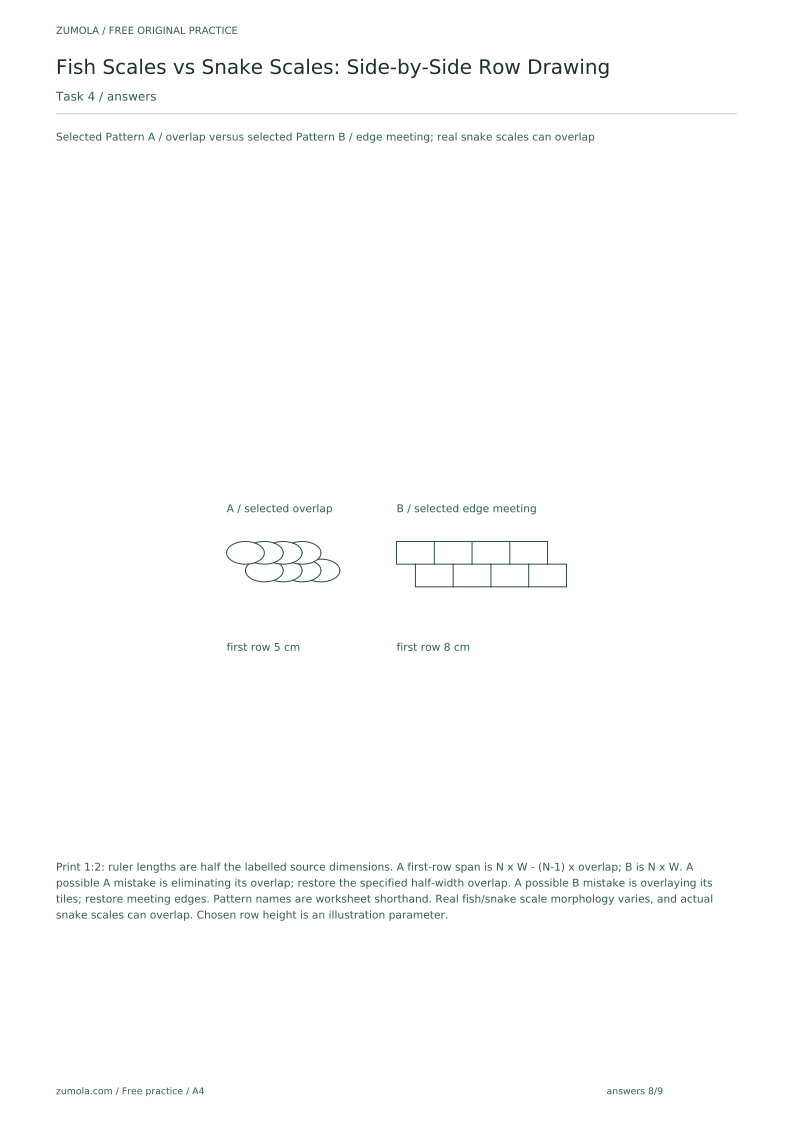
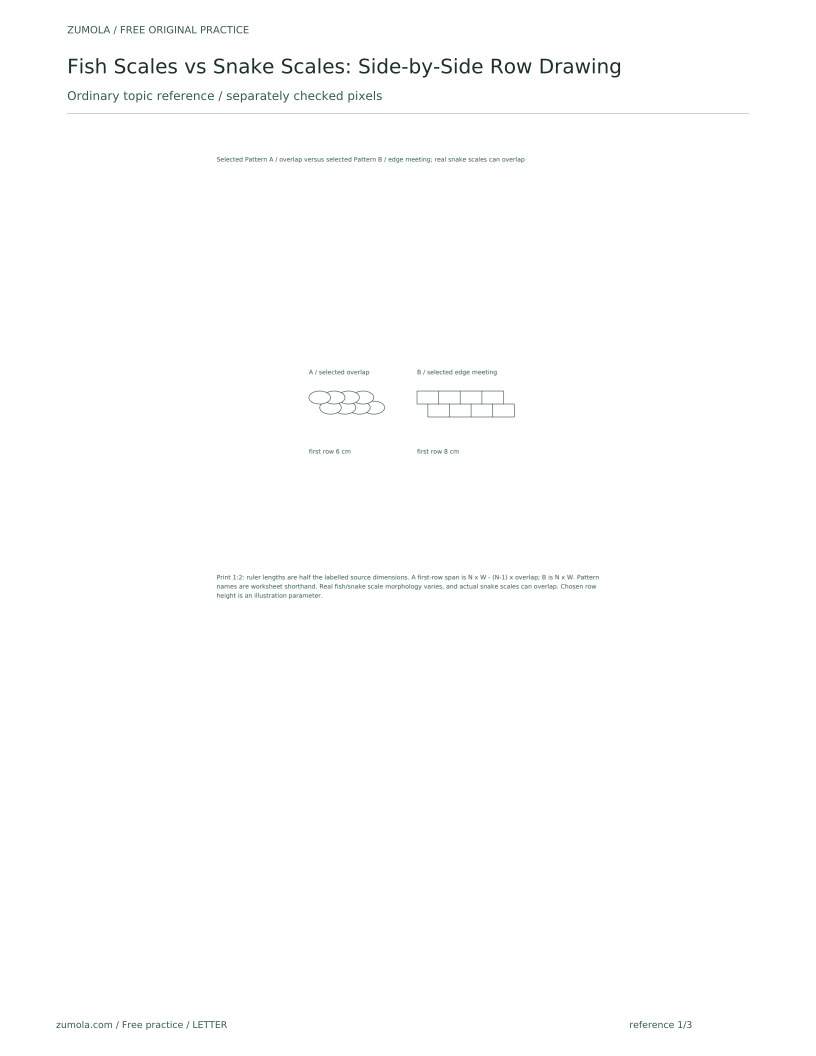
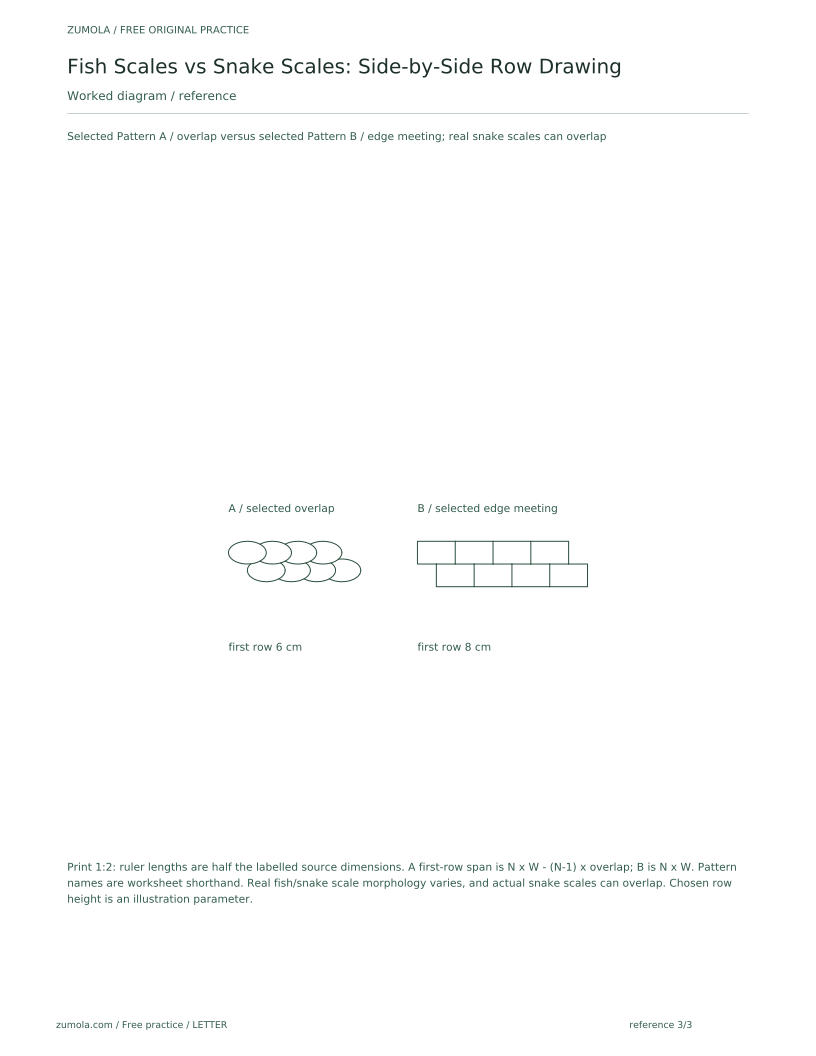
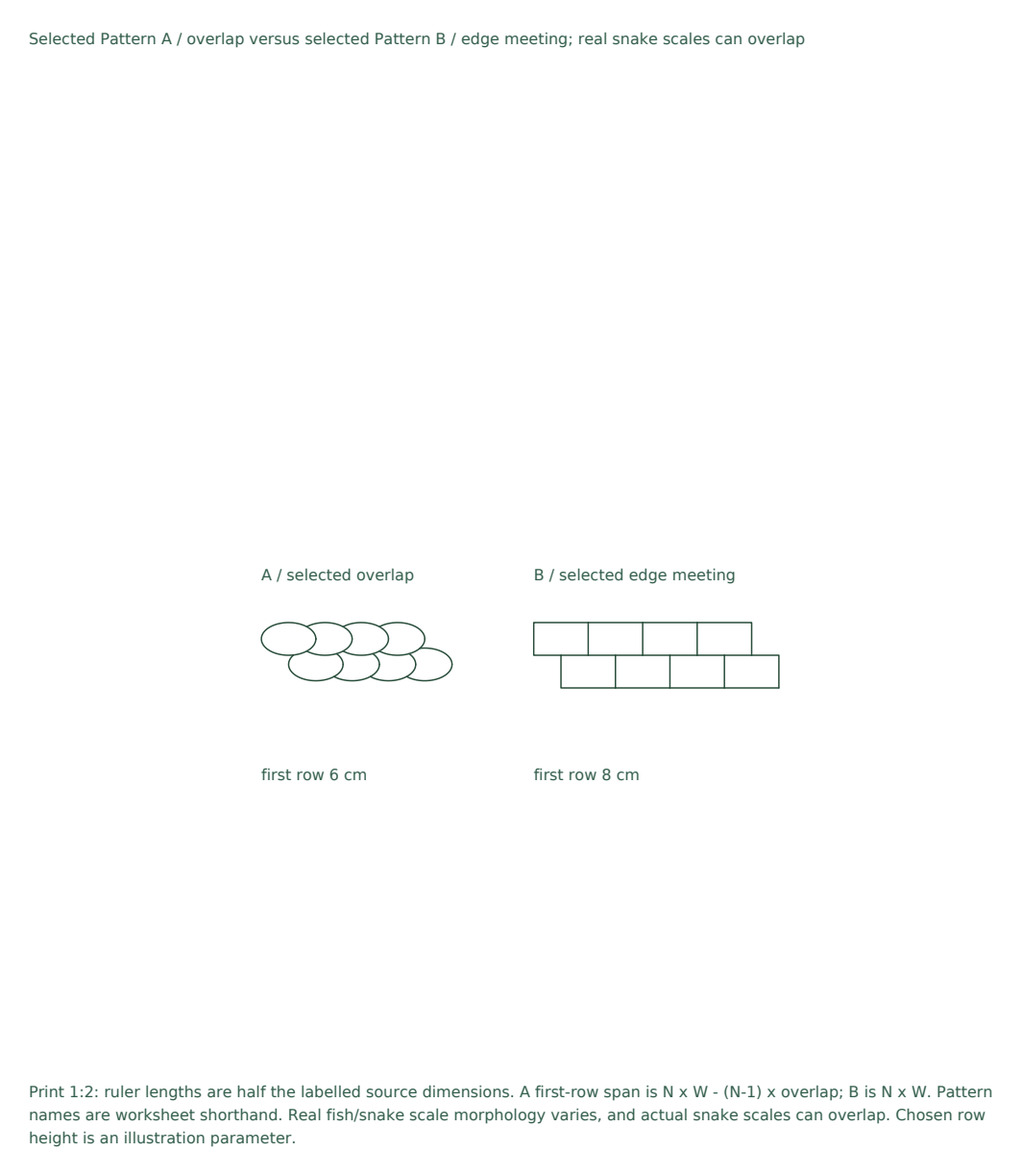
Compare two selected worksheet patterns: overlapping fish-style scales and a staggered edge-meeting snake-style pattern. These names are drawing shorthand, not a biological distinction: real snakes can also have overlapping scales. Throughout this lesson, fish-scale row means selected Pattern A and snake-scale row means selected Pattern B; the exercises compare those defined schematics rather than every species. Each illustrated scale has a baseline and a midline, and the distance between them is the chosen scale height. All numerical values are hypothetical classroom examples. Draw rows, compare their construction, and check the arithmetic and visible boundaries.
Practice materials: Download the free reference pages, practice sheets and separate answer keys below, in A4 and US Letter PDF and SVG formats.
Defining the two row patterns
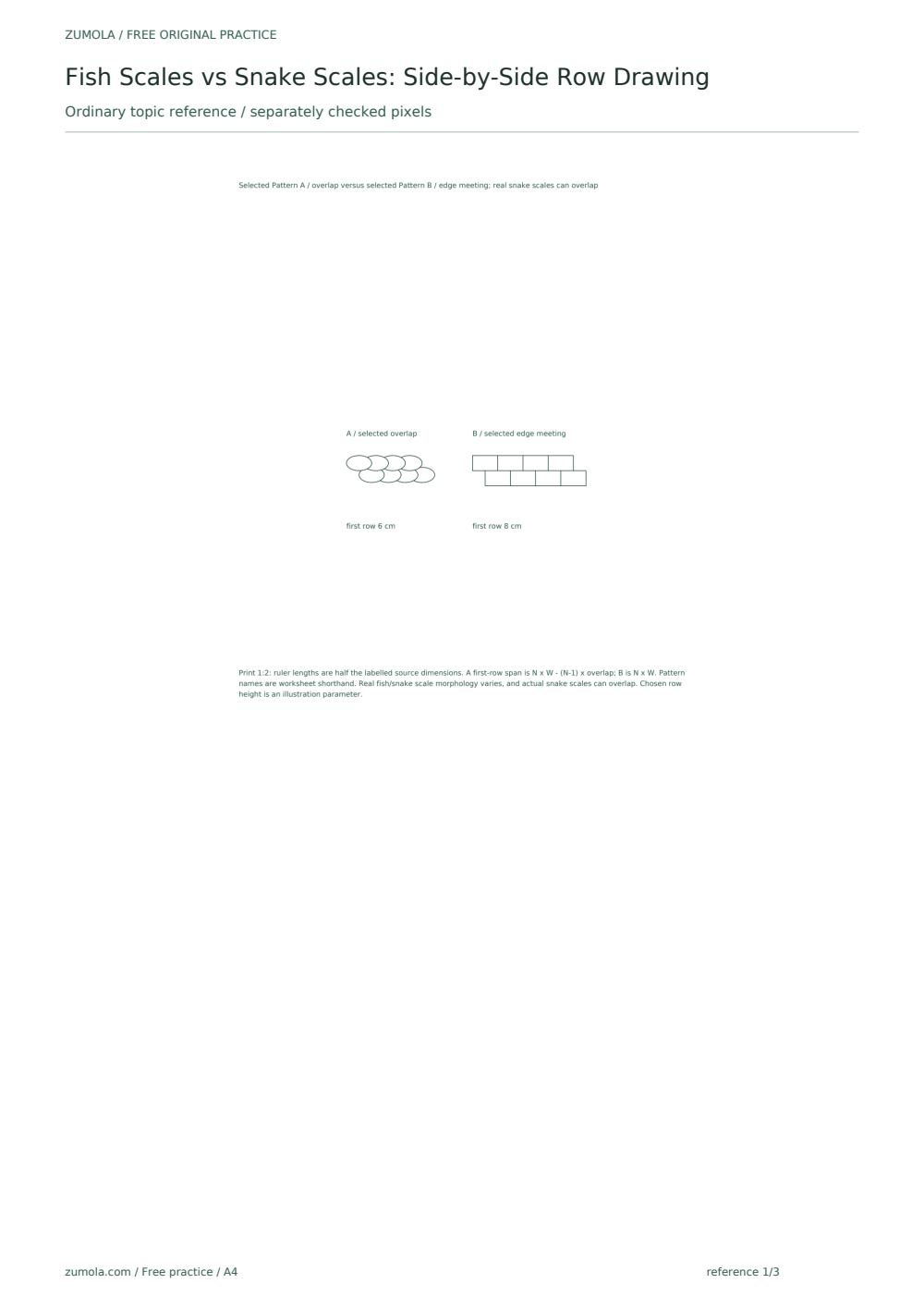
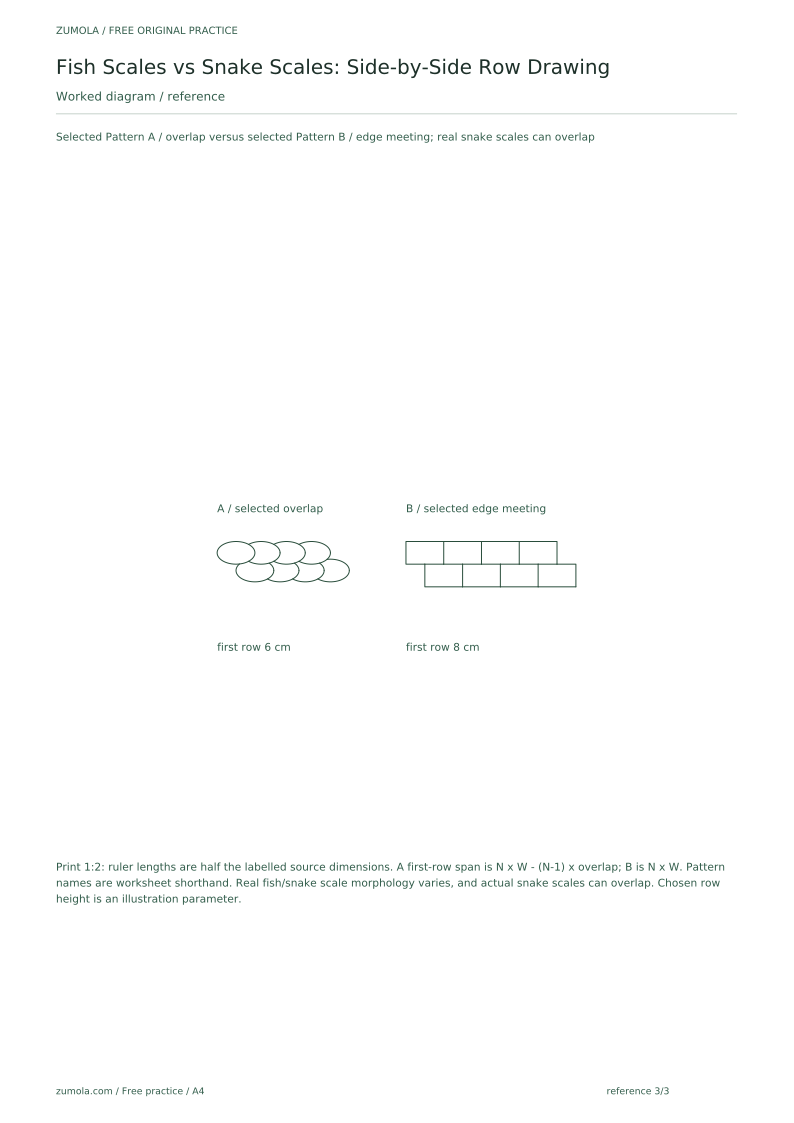
Selected fish-style Pattern A uses overlapping rounded shapes. Draw each next scale so one free edge remains visible and a part of the preceding shape is covered. Offset the next row by half a shape width. This is one simplified pattern, not a claim about every fish scale.
Selected snake-style Pattern B deliberately uses elongated or rounded-rectangle shapes meeting edge to edge. The next row is offset by half a width. This edge-meeting convention is chosen to contrast with Pattern A; it does not assert that real snake scales never overlap. Real scale morphology varies, including overlapping snake scales (Fauna of Australia, Squamata morphology chapter).
- Draw a horizontal baseline and a midline above it to set a consistent x-height for all scales.
- For fish scales, draw the first row as overlapping rounded shapes, each front scale covering about one third of the scale behind.
- For snake scales, draw the first row as shapes that meet edge to edge with no overlap.
- Add a second row below each pattern, offset by half a scale width, and compare how the rows connect.
Drawing fish-scale rows step by step
Use a simple convention: each fish scale is a rounded shape whose bottom edge sits on the baseline and whose top edge reaches the midline. The scale width is your choice; keep it consistent within a row. Overlap is the key feature. When you draw the next scale to the right, start it slightly behind the previous scale so the previous scale's free edge remains visible.
For the second row, shift the starting point right by half a scale width and place the row below so its top edge overlaps the bottom of the first row. Check that every scale in the second row sits between two scales above it. This creates the tiled look.
- Mark a baseline and midline; choose a scale width, for example 2 cm, and label it as a hypothetical example.
- Draw the first scale: a rounded shape from baseline to midline.
- Draw the next scale to the right, overlapping the first by about one third of its width.
- Continue across the row, keeping overlap consistent.
- Start the second row half a scale width to the right and below, overlapping the first row.
- Check that each scale in row two is centered under the gap between two scales in row one.
Drawing snake-scale rows step by step
For Pattern B only, choose an elongated or rounded-rectangle shape between the baseline and midline. Start each new shape exactly where the previous one ends. Edges meet without overlap under this selected worksheet rule; the rule is not a biological definition of snake scales.
For the second row, offset by half a scale width so each new scale sits between two scales above. The top edge of the second row touches the bottom edge of the first row. Check that meeting lines are clean and that no scale covers another.
- Mark a baseline and midline; choose a scale width, for example 1.5 cm, as a hypothetical example.
- Draw the first snake scale from baseline to midline.
- Draw the next scale immediately to the right, sharing the edge with no overlap.
- Continue across the row with consistent width.
- Start the second row half a scale width to the right, with its top edge touching the first row's bottom edge.
- Check that every scale in row two sits between two scales above and that edges meet without gaps or overlaps.
Comparing the two patterns side by side
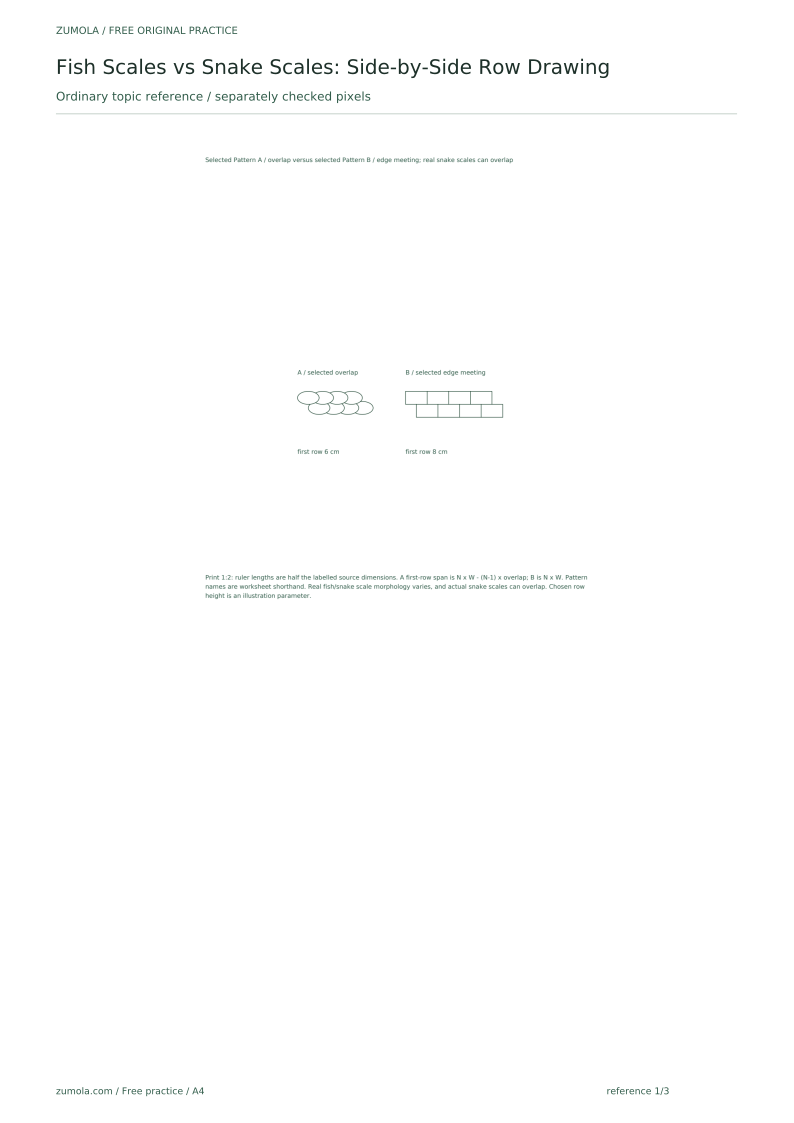
Place selected Pattern A and Pattern B on matching baselines and midlines. Compare overlap, half-width row offset, and the kind of visible boundary. Pattern A overlaps and occludes part of another shape. Pattern B meets edge to edge and has shared meeting boundaries. Do not infer that actual fish and snakes are distinguished by whether their scales overlap.
- Draw both patterns on one page with the same baseline and midline.
- Label the overlap on the fish-scale row and the meeting line on the snake-scale row.
- Count scales per row and note the offset for each pattern.
- Write one sentence describing the main visual difference.
Worked example
Draw one row of 4 fish scales and one row of 4 snake scales on the same baseline and midline. Use a scale width of 2 cm as a hypothetical example. For fish scales, overlap each scale by one third of its width. For snake scales, make edges meet. Then add a second row to each with a half-width offset and describe the difference.
Worked answer
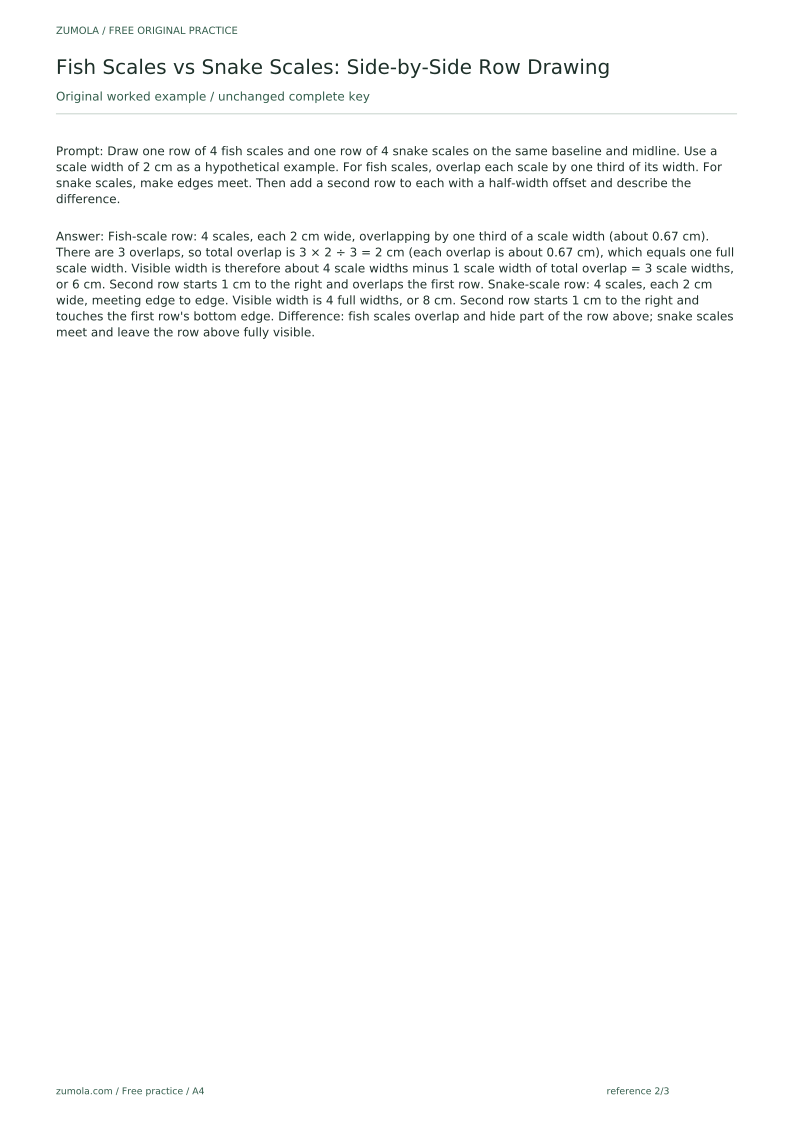
Fish-scale row: 4 scales, each 2 cm wide, overlapping by one third of a scale width (about 0.67 cm). There are 3 overlaps, so total overlap is 3 × 2 ÷ 3 = 2 cm (each overlap is about 0.67 cm), which equals one full scale width. Visible width is therefore about 4 scale widths minus 1 scale width of total overlap = 3 scale widths, or 6 cm. Second row starts 1 cm to the right and overlaps the first row. Snake-scale row: 4 scales, each 2 cm wide, meeting edge to edge. Visible width is 4 full widths, or 8 cm. Second row starts 1 cm to the right and touches the first row's bottom edge. Difference: fish scales overlap and hide part of the row above; snake scales meet and leave the row above fully visible.
Four practice exercises
Exercise 1
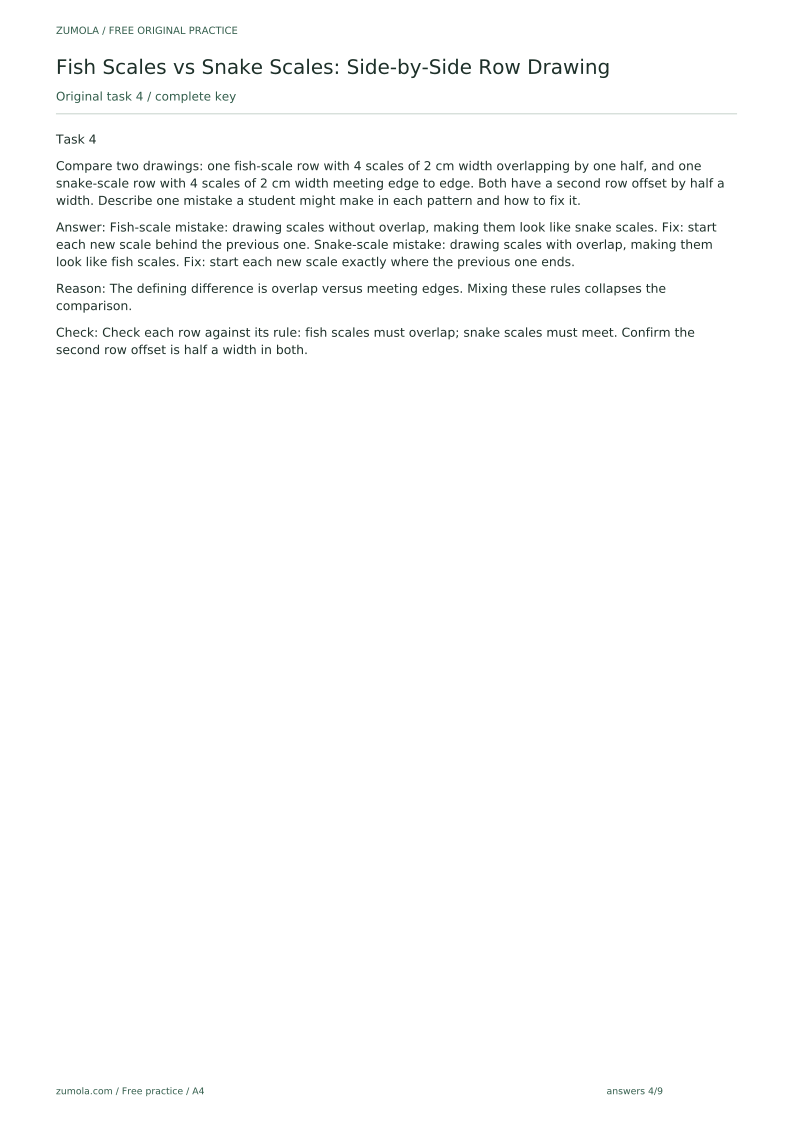
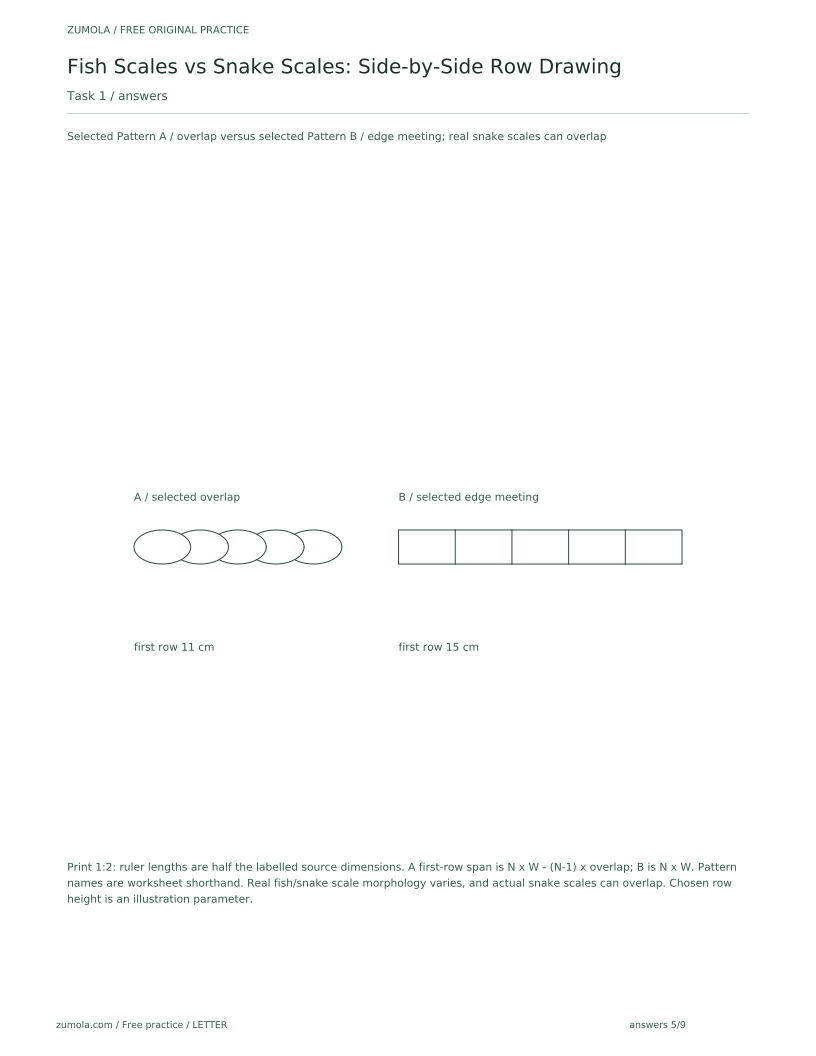
Draw a fish-scale row with 5 scales, each 3 cm wide, overlapping by one third. Then draw a snake-scale row with 5 scales, each 3 cm wide, meeting edge to edge. Use the same baseline and midline. Describe the visible width of each row using simple arithmetic.
Show answer and check
Fish-scale row: 5 scales, each 3 cm wide, with 4 overlaps of one third of a scale width (1 cm each). Total overlap is 4 cm, so visible width is 15 − 4 = 11 cm. Snake-scale row: 5 scales meeting edge to edge gives 5 full widths, or 15 cm. The fish-scale row appears narrower because of overlap.
Why: Each fish scale overlaps one third of its width (1 cm), so across five scales the row loses 4 × 1 = 4 cm of visible width, giving 15 − 4 = 11 cm.
Check: Count the scales and measure the visible width with a ruler. Confirm the fish-scale row is shorter than the snake-scale row by about 4 cm, which is the total overlap.
Exercise 2
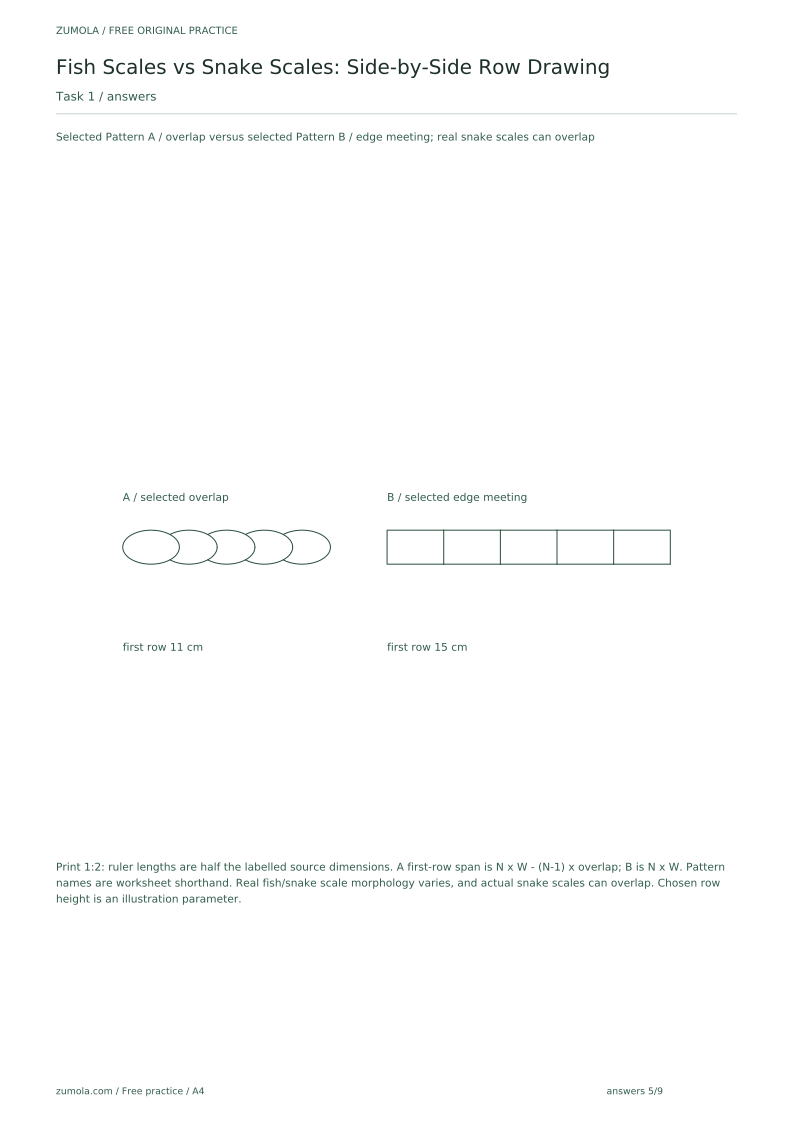
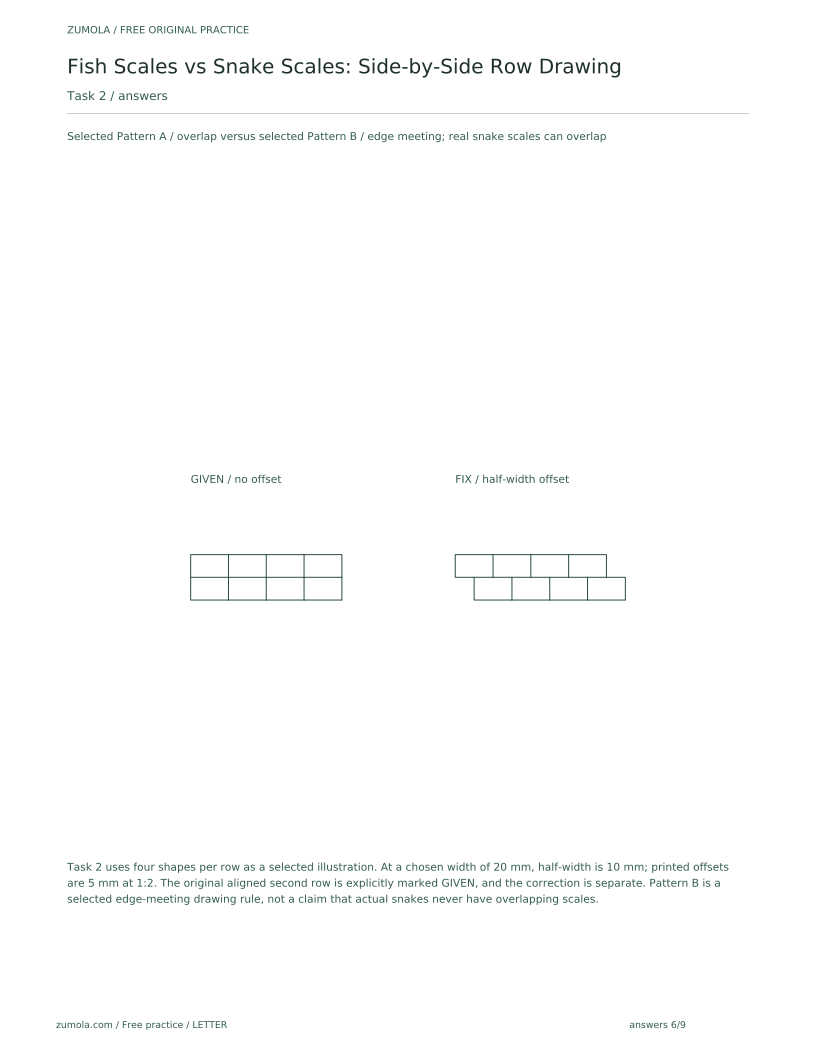
A student draws a second row of snake scales directly under the first row, with each new scale centered under one scale above. Is the offset correct? Explain and fix it.
Show answer and check
No. The offset should be half a scale width so each new scale sits between two scales above. Shift the second row right by half a scale width.
Why: A half-width offset creates the staggered nesting that defines snake-scale rows. Centering under one scale above removes the stagger.
Check: Pick a scale in row two and check whether it sits between two scales in row one. If it sits under one scale, the offset is wrong.
Exercise 3
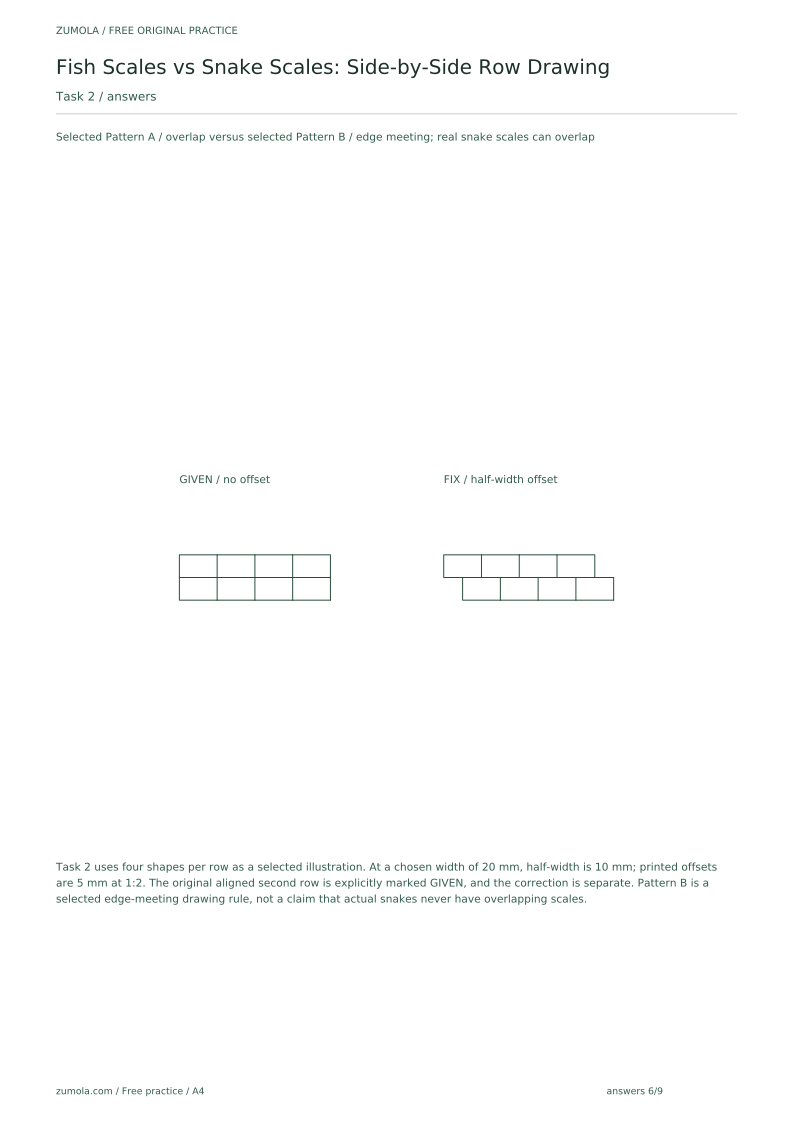
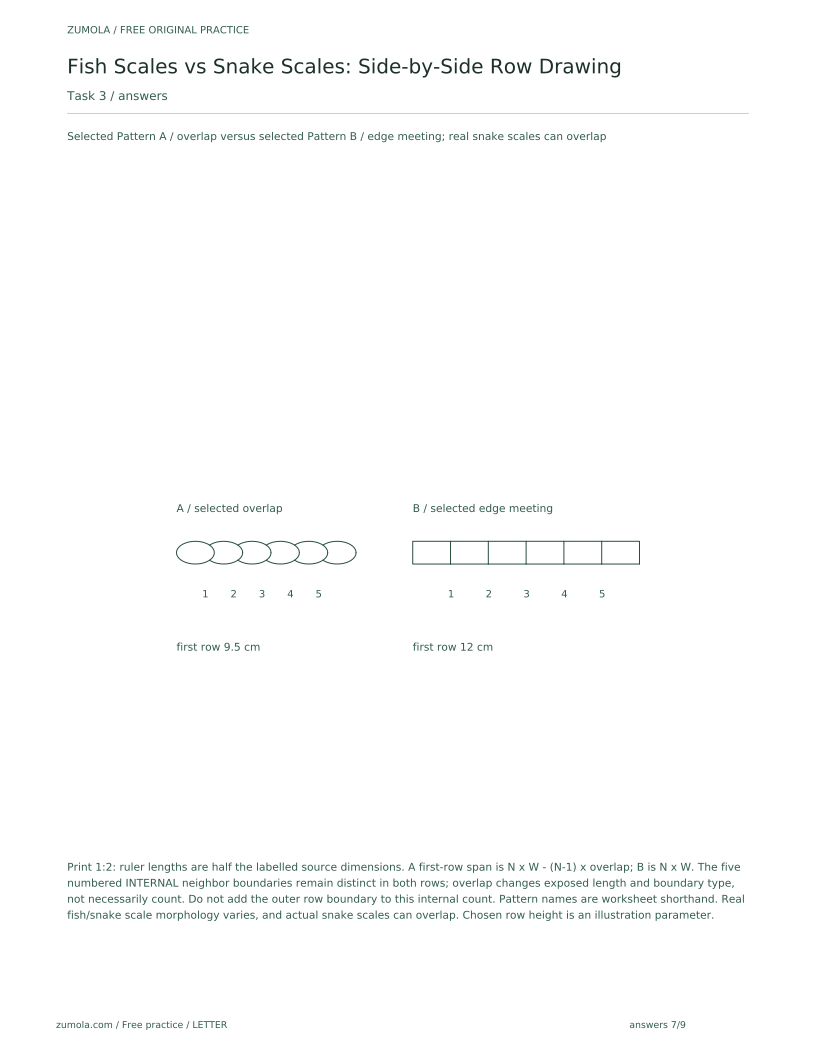
Draw a fish-scale row with 6 scales, each 2 cm wide, overlapping by one quarter of a scale width. Draw a snake-scale row with 6 scales, each 2 cm wide, meeting edge to edge. Which row has more visible scale edges? Explain using a simple count.
Show answer and check
Using distinct internal boundaries as the simple count, neither row must have more: six edge-meeting shapes give 6 - 1 = 5 shared interfaces, and a selected overlapping six-shape row can still show five distinct front free-edge boundaries. One-quarter overlap reduces how much of an underlying outline is exposed, but it does not by itself prove that a boundary disappears. Counting fully exposed original sides instead would be a different metric and requires specified shapes and occlusion. State the metric before claiming one row has more.
Why: There are five neighboring pairs in either six-shape row. Overlap changes visible extent and boundary type; the given one-quarter fraction alone does not determine a smaller count of distinct visible boundaries.
Check: Number the five neighboring interfaces or free boundaries in each selected drawing. Count distinct visible boundaries separately from their visible lengths or complete original perimeters. Do not count a hidden construction edge as visible.
Exercise 4
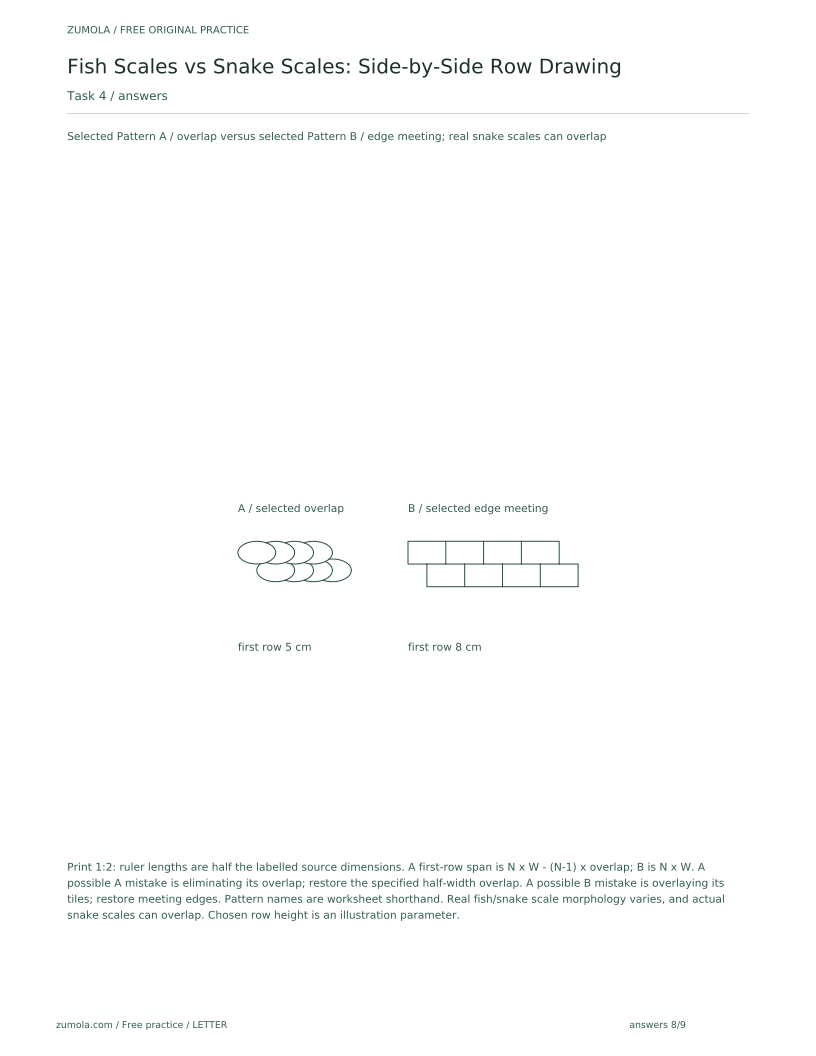
Compare two drawings: one fish-scale row with 4 scales of 2 cm width overlapping by one half, and one snake-scale row with 4 scales of 2 cm width meeting edge to edge. Both have a second row offset by half a width. Describe one mistake a student might make in each pattern and how to fix it.
Show answer and check
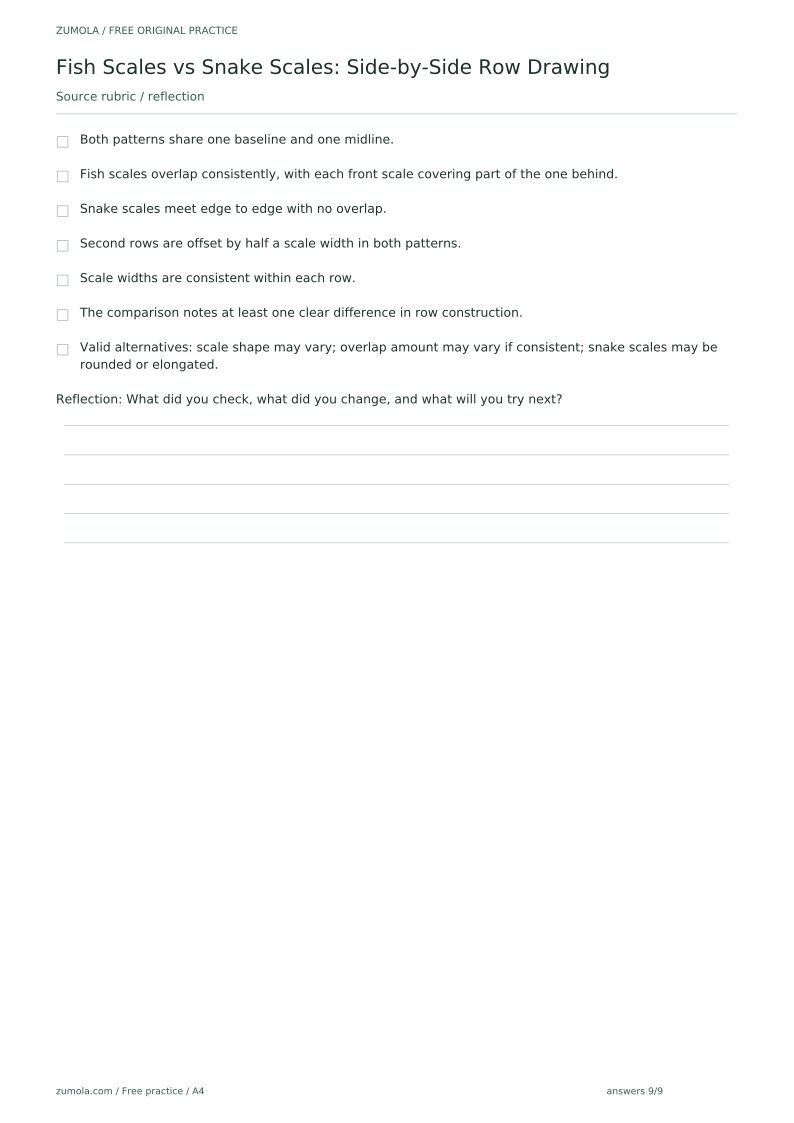
Fish-scale mistake: drawing scales without overlap, making them look like snake scales. Fix: start each new scale behind the previous one. Snake-scale mistake: drawing scales with overlap, making them look like fish scales. Fix: start each new scale exactly where the previous one ends.
Why: The defining difference is overlap versus meeting edges. Mixing these rules collapses the comparison.
Check: Check each row against its rule: fish scales must overlap; snake scales must meet. Confirm the second row offset is half a width in both.
Common mistakes
- Drawing fish scales without overlap, so they look like snake scales. Start each new fish scale slightly behind the previous one so the previous free edge stays visible.
- Drawing snake scales with overlap, so they look like fish scales. Start each new snake scale exactly where the previous one ends; edges should meet, not cover.
- Using different x-heights in the same row. Mark one baseline and one midline before drawing; keep every scale between them.
- Forgetting the half-width offset for the second row. Shift the second row right by half a scale width so scales nest between the ones above.
Self-check rubric
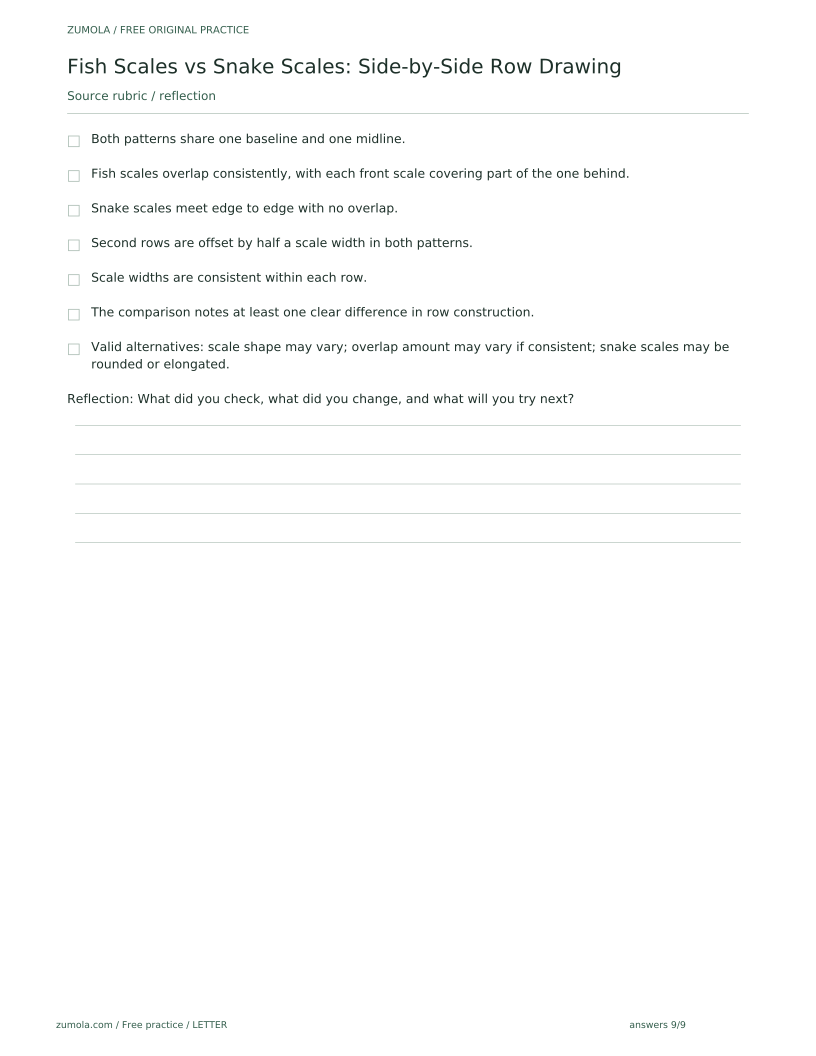
- Both patterns share one baseline and one midline.
- Fish scales overlap consistently, with each front scale covering part of the one behind.
- Snake scales meet edge to edge with no overlap.
- Second rows are offset by half a scale width in both patterns.
- Scale widths are consistent within each row.
- The comparison notes at least one clear difference in row construction.
- Valid alternatives: scale shape may vary; overlap amount may vary if consistent; snake scales may be rounded or elongated.
Questions and answers
Do fish scales and snake scales always look exactly like these drawings?
No. These are two selected drawing patterns. Actual fish and snake scales vary; snakes can have overlapping scales. The edge-meeting snake-style pattern is a worksheet comparison convention, not a biological rule.
What does x-height mean here?
X-height is the distance from the baseline to the midline. It sets a consistent scale height for your drawing.
Can I use different scale shapes?
Yes. The convention allows rounded, elongated, or rounded-rectangle shapes as long as you keep the overlap rule for fish scales and the meeting rule for snake scales.
How do I check my row offset?
Pick a scale in the second row and confirm it sits between two scales in the first row. If it sits directly under one scale, the offset is wrong.
Reference illustration
Free printable downloads
Choose a paper size. Practice sheets and answer keys are separate. Download every file free, without registration.
This standard pack covers the four original exercises, blank work areas, complete keys and necessary figures. Additional extension sets described in the lesson are outside this download.
PDF bundles
Individual SVG pages
Reference-page preview