Free original lessons
Drawing Facial Hair: Beard and Moustache Shape Construction
Learn to construct beard and moustache shapes with clear stroke direction, proportion checks, and a convention-based rubric that accepts valid stylistic alternatives.
Free lesson
Four exercises
Worked answers
Object Drawing Lessons
Facial hair is a shape problem before it is a texture problem. This lesson isolates beard and moustache construction from full face proportions and head hair. You will define an outer silhouette, an inner boundary against skin, and a stroke direction that follows the form. A simple convention keeps the work checkable: treat the x-height of your drawn letters as the distance from baseline to midline, and use that same unit to compare moustache depth, beard width, and gap sizes. Letter styles vary, so the convention is about consistent measurement, not a single correct look. All measurements below are hypothetical examples chosen for arithmetic clarity; measure your own paper and tools and label any values you adopt.
Practice materials: Printable downloads are not available for this lesson yet. Use the instructions and four exercises below.
Reference illustration
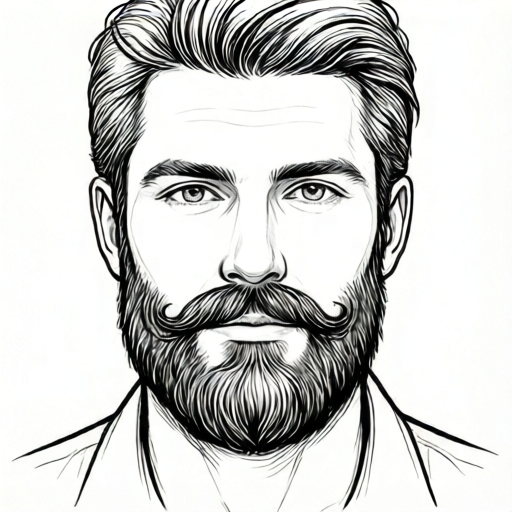
Use the stated measurements and conventions for each exercise.
Define the silhouette before adding strands
Start with two closed outlines: the outer edge of the facial hair and the inner edge where it meets skin. For a moustache, the inner edge runs under the nose and above the upper lip; for a beard, it runs along the cheek line and around the mouth. Keep these outlines simple and continuous so you can compare them.
Use one unit for every comparison. If your drawn x-height is 4 mm, then a moustache depth of 8 mm is two units. A beard side panel 12 mm wide is three units. These numbers are hypothetical examples, not standards. The point is that every ratio can be recomputed from your own measured unit.
- Draw a light horizontal baseline and a midline above it; measure the gap and record it as your x-height unit.
- Sketch the outer silhouette of the moustache as one closed shape, then the beard as a separate closed shape.
- Mark the inner boundary against skin with a second line, keeping a consistent gap from the outer edge.
- Check symmetry by folding the paper or measuring left and right widths from a center line.
Choose stroke direction that follows the form
Strokes should travel along the direction the hair appears to grow, not across the silhouette. On a moustache, strokes generally sweep outward from the center toward the tips. On a beard, strokes follow the jaw contour downward and outward. Direction guides are drawn as short arrows inside the shape, not as finished hair.
Vary stroke length deliberately: longer strokes near the outer edge, shorter strokes near the inner boundary. This creates a readable edge without inventing texture rules. If two valid styles differ, both can pass provided the direction is consistent within each region.
- Draw three short arrows inside the moustache showing outward sweep from center.
- Draw arrows inside the beard following the jaw line downward and outward.
- Add strokes in one region at a time, keeping length proportional to your x-height unit.
- Compare stroke direction on left and right sides; note any region where arrows conflict.
Compare variants with a measurement table
Create a small table listing variant name, outer width, inner gap, and depth in your unit. For example, a narrow moustache might be 6 units wide and 2 units deep; a full beard might be 10 units wide at the jaw and 4 units deep. These are hypothetical examples for practice arithmetic.
The table makes differences checkable. If two variants share the same outer width but differ in inner gap, the visual difference is in the skin boundary, not the silhouette. That distinction is the core skill of this lesson.
- List three moustache variants and three beard variants by name.
- Measure each outer width and inner gap in your unit and record them.
- Circle any pair that differs only in inner gap; describe the visual effect in one sentence.
- Re-measure one variant after a short break to confirm consistency.
Use blank outlines for deliberate practice
Blank face outlines are planned as practice supports, not finished worksheets. On a blank outline, place only the nose base and mouth line as reference marks, then construct one moustache and one beard variant per outline. Keep the face proportions out of scope: do not adjust eyes or head shape.
Practice in short rounds. Draw one silhouette, add direction arrows, then add strokes. Stop and check the inner gap against your unit before starting the next variant.
- Mark nose base and mouth line on a blank outline.
- Construct one moustache variant using the silhouette-first order.
- Construct one beard variant on a second outline.
- Record measurements and one sentence comparing the two variants.
Worked example
A learner measures an x-height unit of 5 mm. They draw a moustache 20 mm wide and 10 mm deep, and a beard side panel 15 mm wide. Convert each measurement to units and state which shape is deeper relative to its width.
Worked answer
Moustache width is 20 divided by 5 equals 4 units; depth is 10 divided by 5 equals 2 units. Beard side panel width is 15 divided by 5 equals 3 units. The moustache depth-to-width ratio is 2 to 4, or 0.5; the beard panel has no depth given, so only its width is comparable. The moustache is the shape with a stated depth, and its depth is half its width.
Four practice exercises
Exercise 1
Your x-height unit is 4 mm. A moustache is drawn 12 mm wide and 8 mm deep. Convert both to units and give the depth-to-width ratio.
Show answer and check
Width is 3 units; depth is 2 units; ratio is 2 to 3.
Why: Divide each measurement by 4 mm: 12 divided by 4 equals 3, and 8 divided by 4 equals 2. The ratio compares depth to width, so it is 2 to 3.
Check: Re-multiply: 3 units times 4 mm equals 12 mm, and 2 units times 4 mm equals 8 mm. Confirm the ratio by dividing 2 by 3.
Exercise 2
Two beard variants share an outer width of 5 units. Variant A has an inner gap of 1 unit; Variant B has an inner gap of 2 units. Describe the visual difference and state which has more skin visible inside the silhouette.
Show answer and check
Variant B has more skin visible inside the silhouette because its inner gap is larger; the outer width is unchanged.
Why: The outer silhouette is identical, so the difference lies in the inner boundary. A larger inner gap means more skin area inside the same outer width.
Check: Draw both variants on the same center line and measure the inner gap from the boundary to the center. Confirm B is wider by 1 unit.
Exercise 3
A learner draws stroke arrows on a moustache pointing inward from the tips to the center, then draws strokes pointing outward. Identify the inconsistency and state one fix.
Show answer and check
The arrows and strokes conflict in direction. Fix by choosing one direction, such as outward from center to tips, and redrawing the arrows to match the strokes.
Why: Direction guides must agree with the strokes so the form reads consistently. A conflict makes the texture ambiguous.
Check: Compare each arrow with the nearest strokes; if any arrow points opposite to the strokes, mark it and redraw.
Exercise 4
Your unit is 6 mm. A beard is 30 mm wide at the jaw and 18 mm deep. A moustache is 18 mm wide and 6 mm deep. Convert all values to units and state which shape has the larger depth-to-width ratio.
Show answer and check
Beard: width 5 units, depth 3 units, ratio 3 to 5 or 0.6. Moustache: width 3 units, depth 1 unit, ratio 1 to 3 or about 0.33. The beard has the larger ratio.
Why: Divide each measurement by 6 mm. Compare depth divided by width: 3 divided by 5 equals 0.6, and 1 divided by 3 is about 0.33.
Check: Re-multiply each unit value by 6 mm to recover the original measurements, then recompute both ratios.
Common mistakes
- Drawing individual hairs before the outer silhouette is closed. Close the outer and inner outlines first, then add direction arrows, then strokes.
- Using different units for moustache depth and beard width. Measure one x-height unit at the start and convert every measurement to that unit.
- Making stroke direction cross the silhouette edge. Keep strokes inside the shape and align them with the drawn direction arrows.
- Treating one letter style as the only correct look. Apply the convention consistently and accept any style that passes the rubric checks.
Self-check rubric
- Outer silhouette is a closed shape with no gaps.
- Inner boundary against skin is drawn as a separate continuous line.
- All measurements are converted to one recorded x-height unit.
- Stroke direction arrows are present and consistent within each region.
- Left and right widths are checked from a center line or by folding.
- At least one valid stylistic alternative is accepted when the checks pass.
Questions and answers
Do I need a full face to practice facial hair shapes?
No. Use a blank outline with only nose base and mouth line marks; full face proportions are outside this lesson.
What is the x-height convention here?
It is the measured distance from baseline to midline in your own drawn letters, used as a consistent unit for comparing shapes.
Are the numerical examples standards?
No. They are hypothetical examples for arithmetic practice; measure your own paper and tools and label your chosen values.
Can two different moustache styles both be correct?
Yes, if each passes the rubric: closed silhouette, consistent unit, coherent stroke direction, and a clear inner boundary.