Free original lessons
Black and White Negative Space: Stacked Chairs Drawing Study
Learn to draw stacked chairs by shading the surrounding negative space in black and white, using a clear convention and checkable steps.
Free lesson
Four exercises
Worked answers
Object Drawing Lessons
Negative-space drawing asks you to see the gaps between and around objects as shapes worth drawing. Stacked chairs are an ideal subject because their overlapping legs, seats, and backs create many enclosed and open gaps. In this black-and-white study, you will define a simple convention: the chairs remain white paper, and the negative space around and between them is filled with black. This forces you to observe the exact contours of the gaps rather than guessing at chair parts. You will measure actual equipment if you use any, label hypothetical numbers clearly, and check your work with arithmetic and visual tests. The goal is not a single correct image but a consistent, verifiable study of shapes.
Practice materials: Printable downloads are not available for this lesson yet. Use the instructions and four exercises below.
Reference illustration
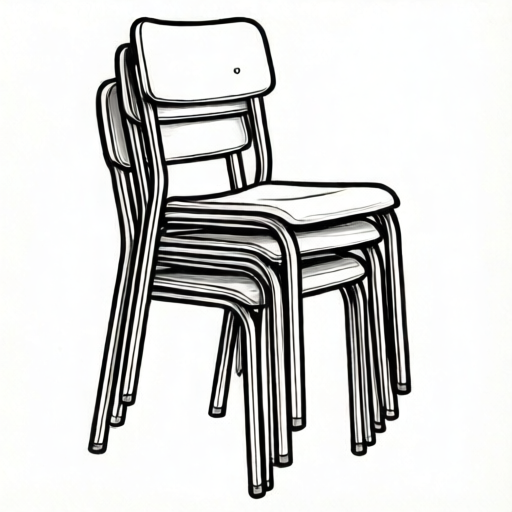
Use the stated measurements and conventions for each exercise.
Defining the black-and-white convention
Choose one convention and state it before drawing: chairs are white, negative space is black. This means every gap between chair parts—between two legs, under a seat, inside a backrest opening—is filled solid black. The chairs themselves receive no shading. If your subject has open spaces that show the background through the chair, those spaces are negative space and become black. This convention makes the drawing checkable: any black area should correspond to a gap, and any white area should correspond to a chair part.
Letter styles and handwriting vary, so do not treat any single outline as universal. Instead, use the convention to judge consistency. A valid alternative is to leave a thin white outline around each chair part to separate it from the black, as long as the outline is uniform and intentional. Another valid alternative is to use black for the chairs and white for the gaps, but then state that inversion clearly. The rubric below accepts any stated, consistent convention.
- Write one sentence stating which areas are black and which are white.
- Mark a small test square on scrap paper and fill it according to your convention.
- Check that every enclosed gap in the stacked chairs is assigned to the correct color.
Measuring the actual stacked chairs
Before drawing, measure the real chairs if they are available. Use a ruler or tape measure and record units consistently, for example centimeters. Measure the height of one chair from floor to seat top, the seat depth, and the vertical gap between stacked seats. These measurements help you place the negative-space shapes proportionally. If you are working from a described arrangement rather than real chairs, label all numbers as hypothetical examples. For instance, a hypothetical stack might have a seat height of 45 cm, a seat depth of 40 cm, and a vertical gap of 12 cm between stacked seats. These are examples only, not standards.
Do not invent printer tolerances or manufacturing standards. If you print a reference plate, measure the actual printed distance between two marks with a ruler and use that measured value. Record it as a measured value, not as a guaranteed tolerance.
- Measure seat height, seat depth, and one vertical gap; write each value with its unit.
- Measure the actual distance between two printed reference marks if you use a printed plate.
- Label any chosen numerical value as hypothetical if it was not measured from real equipment.
Finding and drawing the gap shapes
Work from the largest gaps to the smallest. The space under the bottom seat and between the front legs is usually a large, simple shape. The spaces between overlapping legs in a stack are narrower and may be partly hidden. Trace each gap slowly with your eye, then draw its outline lightly before filling it black. Keep the black solid and even; avoid smudging. If two gaps touch at a single point, decide whether they merge into one black shape or remain separated by a thin white line, and apply that decision consistently.
A useful check is to count the gaps you can identify before drawing and count the black shapes after drawing. They should match unless you intentionally merged shapes. Another check is to turn the drawing upside down; negative-space shapes often become easier to see as abstract forms when inverted.
- List the gaps from largest to smallest before drawing.
- Lightly outline each gap, then fill it black according to your convention.
- Count gaps and black shapes; reconcile any difference by noting intentional merges.
Checking proportion and consistency
Use simple arithmetic to check proportions. If your measured seat height is 45 cm and your drawing represents it as 9 cm, then 1 cm on the drawing equals 5 cm in reality. Apply that same ratio to the seat depth and gap measurements. If the numbers do not match, adjust the drawing or note the difference. Keep units consistent throughout; do not mix centimeters and millimeters without converting.
Consistency checks include: every black area is a gap, every white area is a chair part, the outline style is uniform, and the stated convention is followed everywhere. A valid alternative convention is acceptable if it is stated and applied without contradiction.
- Compute one scale ratio from a measured length and apply it to another length.
- Check that no chair part is accidentally filled black under your stated convention.
- Verify that any white outlines are uniform in width and intentional.
Worked example
A hypothetical stack has a seat height of 45 cm, a seat depth of 40 cm, and a vertical gap of 12 cm between stacked seats. In a drawing, the seat height is represented as 9 cm. Using the same scale, what length should represent the seat depth and the vertical gap?
Worked answer
Scale ratio: 45 cm real to 9 cm drawn, so 1 cm drawn equals 5 cm real. Seat depth: 40 cm real divided by 5 equals 8 cm drawn. Vertical gap: 12 cm real divided by 5 equals 2.4 cm drawn. Check: 9 times 5 equals 45; 8 times 5 equals 40; 2.4 times 5 equals 12. All units are centimeters and the ratio is consistent.
Four practice exercises
Exercise 1
A described stack shows three gaps: a large under-seat gap, a medium gap between two legs, and a small gap inside a backrest. Under the convention chairs are white and gaps are black, how many black shapes should appear if no gaps are merged?
Show answer and check
Three black shapes.
Why: Each gap is negative space and becomes one black shape under the stated convention. No merges are stated, so the count equals the number of gaps.
Check: Count the listed gaps (three) and count the black shapes in your drawing (three). They match.
Exercise 2
A hypothetical seat height is 50 cm and is drawn as 10 cm. A hypothetical seat depth is 35 cm. Using the same scale, what drawn length represents the seat depth?
Show answer and check
7 cm.
Why: Scale ratio: 50 cm real to 10 cm drawn, so 1 cm drawn equals 5 cm real. Seat depth: 35 divided by 5 equals 7 cm drawn.
Check: Multiply 7 cm drawn by 5 to get 35 cm real; the ratio matches the seat height ratio.
Exercise 3
You identify five gaps but draw only four black shapes. Under the convention, what is one valid explanation, and what check confirms it?
Show answer and check
Two gaps were intentionally merged into one black shape. The check is to note the merge and confirm that the merged shape covers both gap areas without filling any chair part.
Why: The convention allows intentional merges if noted. The count difference of one is explained by merging two gaps into one shape.
Check: Compare the gap list to the black shapes; verify the merged shape corresponds to exactly two listed gaps and no white chair part is filled.
Exercise 4
A drawing states that chairs are black and gaps are white. A viewer sees a white area inside a backrest opening. Is this consistent with the stated convention?
Show answer and check
Yes, if the backrest opening is a gap. Under the inverted convention, gaps are white, so a white gap is consistent.
Why: The convention is stated as chairs black and gaps white. A backrest opening is negative space, so it should be white under this convention.
Check: Confirm the stated convention and check that the white area is a gap, not a chair part. If it is a gap, the drawing is consistent.
Common mistakes
- Shading the chairs instead of the gaps without stating an inversion. State the convention clearly at the start; if you invert, write that chairs are black and gaps are white, then apply it everywhere.
- Leaving small gaps white because they are hard to see. List all gaps before drawing and check the count after filling; fill every listed gap or note an intentional merge.
- Mixing measured and hypothetical numbers without labels. Label every number as measured or hypothetical and keep units consistent.
- Using inconsistent outline widths around chair parts. Choose one outline width and apply it uniformly, or omit outlines entirely under a solid-fill convention.
Self-check rubric
- A convention is stated in one sentence and applied consistently.
- Every identified gap is either filled according to the convention or noted as an intentional merge.
- Measured values are labeled as measured; chosen values are labeled as hypothetical.
- Units are consistent and at least one scale ratio is checked with arithmetic.
- Outline style, if used, is uniform and intentional.
- The drawing is black and white only, with no color.
- Valid alternative conventions are accepted if stated and consistent.
Questions and answers
Do I have to fill every gap with black?
Under the stated convention, yes: every gap is negative space and becomes black. If you merge two gaps intentionally, note it and keep the merge consistent.
Can I use black for the chairs instead?
Yes, if you state the inversion clearly and apply it without contradiction. The rubric accepts any stated, consistent convention.
What if I do not have real chairs to measure?
Use a described arrangement and label all numbers as hypothetical examples. Do not present them as measured values.
How do I check my drawing without an answer key?
Count gaps before and black shapes after, check the scale ratio with simple arithmetic, and verify that your stated convention is followed everywhere.