Free original lessons
Draw Ripped Dragon-Scale Skin: Layered Rows and Tear Construction
Learn to draw overlapping dragon-scale rows interrupted by a convincing tear, with exposed underlayer and depth shading using a clear, checkable method.
Free lesson
Four exercises
Worked answers
Object Drawing Lessons
This lesson focuses on a small patch of dragon-scale skin, not a whole dragon. You will build overlapping scale rows, then interrupt them with a tear that reveals a darker underlayer. The method uses simple geometry and consistent units so you can check your work. All measurements are hypothetical examples; measure your own paper and tools. A convention is defined for scale size and tear width so that valid stylistic alternatives remain acceptable.
Practice materials: Printable downloads are not available for this lesson yet. Use the instructions and four exercises below.
Reference illustration
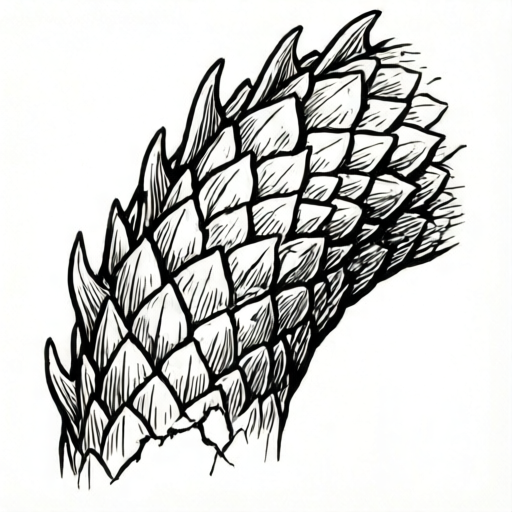
Use the stated measurements and conventions for each exercise.
Set the scale-row grid and convention
Work on a patch about 12 cm wide and 8 cm tall. Define one scale unit as 1 cm. Draw three horizontal row guides at 0 cm, 2 cm, and 4 cm from the top edge. Offset each row by half a unit (0.5 cm) from the row above to create a brick-like overlap. This offset is the convention: scales in row two sit between scales in row one.
Scale width may vary from 0.8 to 1.2 units, but keep the offset consistent. Draw each scale as a rounded shield: a curved top, two side edges, and a pointed or rounded bottom. Overlap the bottom of each scale over the top of the scale below by about one-third of a unit. This overlap creates the layered look.
- Mark the 12 cm by 8 cm patch boundary lightly.
- Draw row guides at 0, 2, and 4 cm from the top.
- Mark scale centers every 1 cm along each row, offsetting alternate rows by 0.5 cm.
- Draw rounded shield shapes around each center, overlapping the row below by one-third unit.
Construct the tear and exposed underlayer
Choose a tear path that crosses two or three scale rows. For this example, the tear runs from (4 cm, 1 cm) to (7 cm, 5 cm) in patch coordinates, where (0,0) is the top-left corner. The tear width is 0.6 cm at its widest and tapers to points at both ends. This is a hypothetical example; adjust to your patch size.
Inside the tear, draw a darker underlayer shape that follows the tear edges but sits 0.2 cm inside them. This underlayer represents skin beneath the scales. Along the tear edge, draw small broken scale fragments: short curved lines that follow the original scale edges but stop at the tear. Do not draw full scales inside the tear.
- Mark tear endpoints and a midpoint; draw two curved edges 0.6 cm apart at the midpoint.
- Taper both ends to points so the tear closes.
- Draw the underlayer shape 0.2 cm inside the tear edges.
- Add broken scale fragments along the tear edge, each no longer than 0.4 cm.
Shade torn-edge depth and check consistency
Shade the underlayer with a darker tone than the scales. Add a narrow shadow band 0.1 to 0.2 cm wide along the inside of the tear edge on the side away from your imagined light. Keep the shadow band parallel to the tear edge. On the scales adjacent to the tear, add a thin highlight along the broken edge to separate scale from underlayer.
Check that every scale row is interrupted by the tear, not crossed by a full scale. Check that the underlayer is visible only inside the tear. Check that the tear width at the midpoint is about 0.6 cm and tapers to points. These checks use simple arithmetic and consistent units.
- Shade the underlayer uniformly darker than the scale tone.
- Add a 0.1 to 0.2 cm shadow band inside the tear edge opposite the light.
- Add thin highlights on broken scale edges adjacent to the tear.
- Verify tear width at midpoint and taper at ends with a ruler.
Worked example
On a 10 cm by 6 cm patch, draw three scale rows with 1 cm units, offset alternate rows by 0.5 cm, and add a tear from (3 cm, 1 cm) to (6 cm, 4 cm) with a 0.5 cm midpoint width. Show the underlayer and one broken fragment per row.
Worked answer
Row guides at 0, 2, and 4 cm. Scale centers every 1 cm, rows two and three offset by 0.5 cm. Tear edges curve between the endpoints, widest 0.5 cm at the midpoint and tapering to points. Underlayer drawn 0.2 cm inside the tear edges. One broken fragment per row along the tear edge, each under 0.4 cm. Underlayer shaded darker; shadow band 0.1 cm inside the tear edge opposite the light.
Four practice exercises
Exercise 1
On an 8 cm by 6 cm patch, draw two scale rows with 1 cm units and a half-unit offset. Add a tear from (2 cm, 1 cm) to (5 cm, 4 cm) with a 0.4 cm midpoint width. Describe where the underlayer sits and how many broken fragments you add.
Show answer and check
Row guides at 0 and 2 cm; second row offset by 0.5 cm. Tear edges taper to points, widest 0.4 cm at midpoint. Underlayer sits 0.2 cm inside the tear edges. Add one broken fragment per row along the tear edge, each under 0.4 cm.
Why: The patch size sets the row spacing. The tear width is a chosen example value that can be checked with a ruler. The underlayer inset keeps the tear edge visible.
Check: Measure midpoint tear width with a ruler; confirm underlayer is inside the tear only; count one fragment per row.
Exercise 2
A student draws a tear that crosses three rows but leaves one full scale crossing the opening. Identify the error and state a fix using the lesson convention.
Show answer and check
The error is a full scale crossing the tear. Fix by erasing that scale and replacing it with a broken fragment that stops at the tear edge, keeping the row offset and overlap unchanged.
Why: The tear must interrupt rows; a full scale crossing the opening breaks the layered construction and hides the underlayer.
Check: Trace the tear path and confirm no complete scale outline crosses it; check that fragments are shorter than 0.4 cm.
Exercise 3
On a 12 cm by 8 cm patch with 1 cm units, place a tear from (4 cm, 1 cm) to (7 cm, 5 cm). The midpoint width is 0.6 cm. Calculate the underlayer inset if it is 0.2 cm inside each edge, and state the visible underlayer width at the midpoint.
Show answer and check
The underlayer inset is 0.2 cm on each side, so the visible underlayer width at the midpoint is 0.6 minus 0.4 equals 0.2 cm.
Why: Subtracting the inset from both edges gives the remaining visible width. This uses simple arithmetic with consistent units.
Check: Measure the tear midpoint width and the underlayer width; confirm the difference is 0.4 cm total inset.
Exercise 4
Design a shading plan for a tear on a patch lit from the upper left. State where the shadow band goes, its example width, and one highlight placement.
Show answer and check
Place the shadow band inside the tear edge on the lower-right side, about 0.1 to 0.2 cm wide. Add a thin highlight on the broken scale edges on the upper-left side adjacent to the tear.
Why: Light from the upper left casts shadow on the opposite inside edge. The highlight separates scale from underlayer on the lit side.
Check: Confirm the shadow band is parallel to the tear edge and on the side away from the light; check highlight is on the lit side.
Common mistakes
- Drawing full scales across the tear opening. Erase any scale that crosses the tear path; replace it with a broken fragment that stops at the tear edge.
- Making the tear a uniform-width slot. Taper both ends to points and vary width along the path; check midpoint width against your chosen example value.
- Shading the underlayer the same tone as the scales. Use a distinctly darker tone for the underlayer and keep the shadow band inside the tear edge.
- Ignoring the row offset so scales stack directly. Offset alternate rows by half a scale unit; re-mark centers before redrawing.
Self-check rubric
- Three scale rows are present with consistent half-unit offset between alternate rows.
- Scales overlap the row below by about one-third of a scale unit.
- The tear interrupts every row it crosses; no full scale crosses the tear opening.
- The underlayer is visible inside the tear and is darker than the scales.
- Broken scale fragments along the tear edge are short and follow original scale edges.
- A shadow band runs inside the tear edge opposite the imagined light.
- Measurements are consistent in units and any numerical values are labeled as examples.
- Valid stylistic alternatives in scale outline are accepted if offset and overlap remain consistent.
Questions and answers
Do I need to draw a whole dragon?
No. This lesson covers only a patch of scale skin with a tear. Full anatomy and face scales are outside the boundary.
Can scale shapes vary?
Yes. The convention fixes row offset and overlap, not exact scale outline. Rounded, pointed, or slightly asymmetric shields are valid if the overlap and offset are consistent.
How wide should the tear be?
Use a hypothetical example such as 0.6 cm at the midpoint, tapering to points. Measure your own patch and choose a value you can check with a ruler.
What if my paper is a different size?
Scale the units to your patch. Keep the one-third overlap and half-unit row offset as proportions, and label any numerical values as examples.