Free original resources
Ten Frame Printable: Show Number Bonds and Make Ten
Use a ten frame printable to show how a number splits into parts and combines to ten. Includes a worked example, common mistakes, and a marking rubric.
Free resources
Letter & A4
PDF & SVG
Letter & A4
PDF & SVG
Make it yours.
Free · no signup · calculated in your browser
Your free printable kit.
Original reference, student practice and separate worked answers. No account or payment.
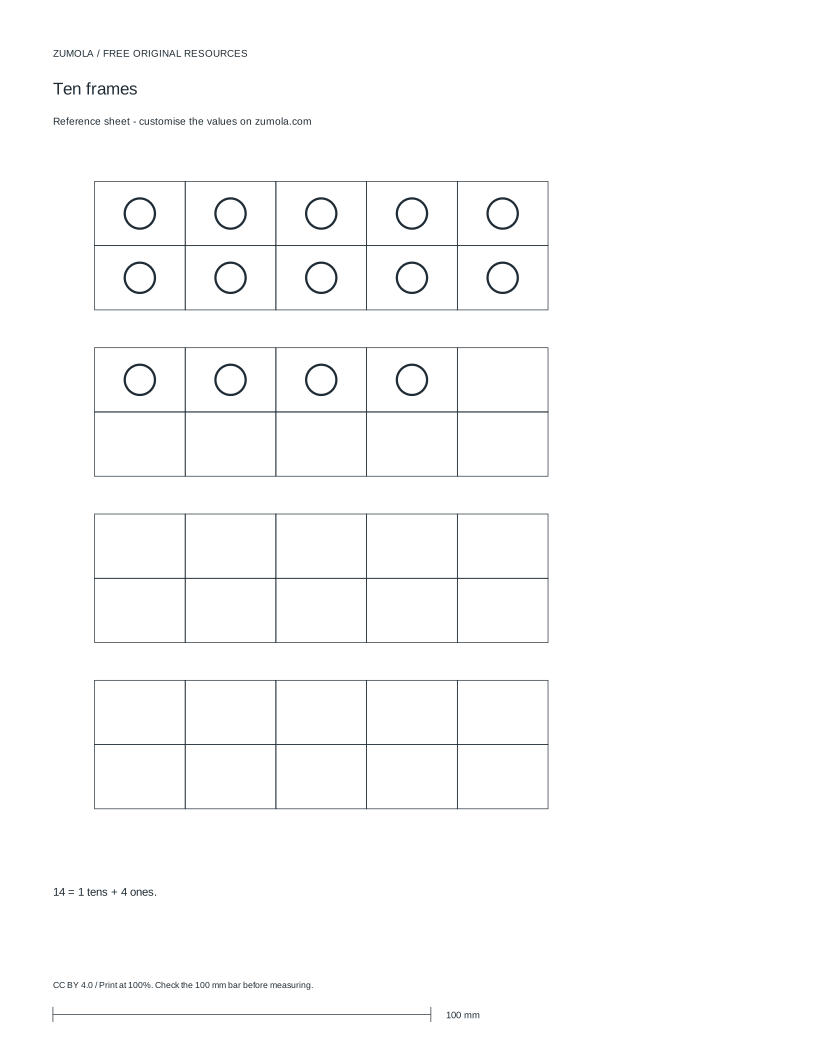
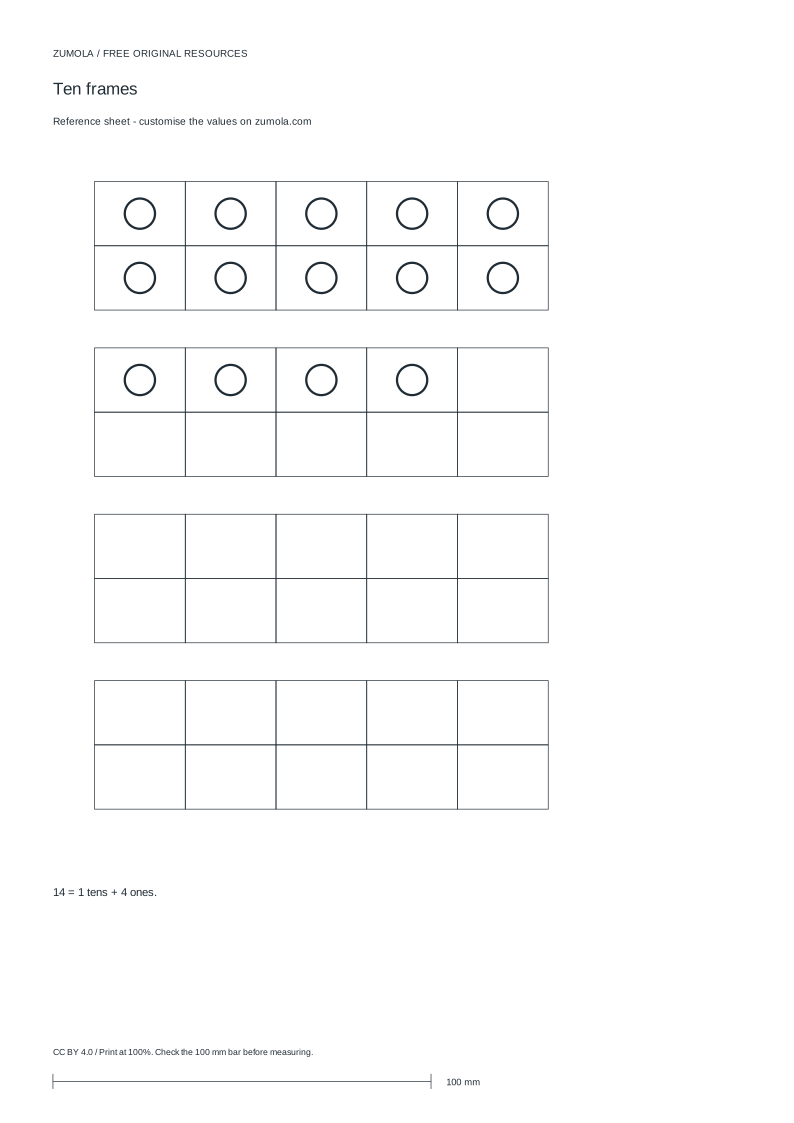
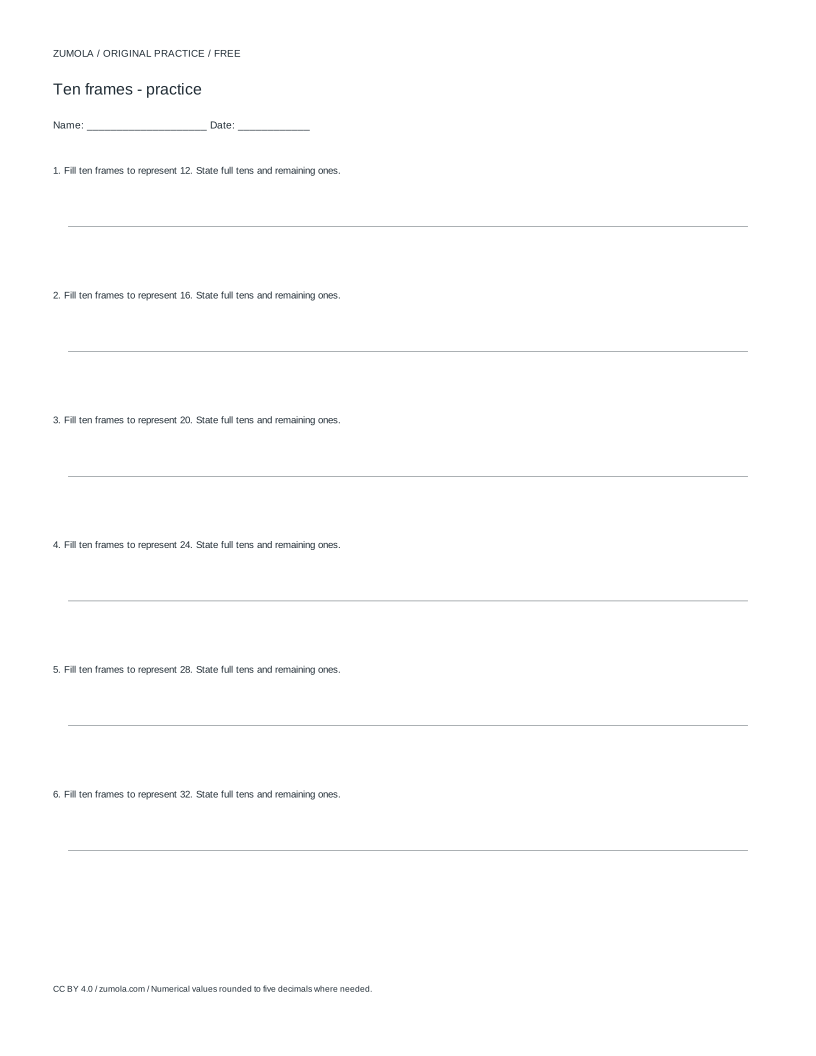
Practice worksheet
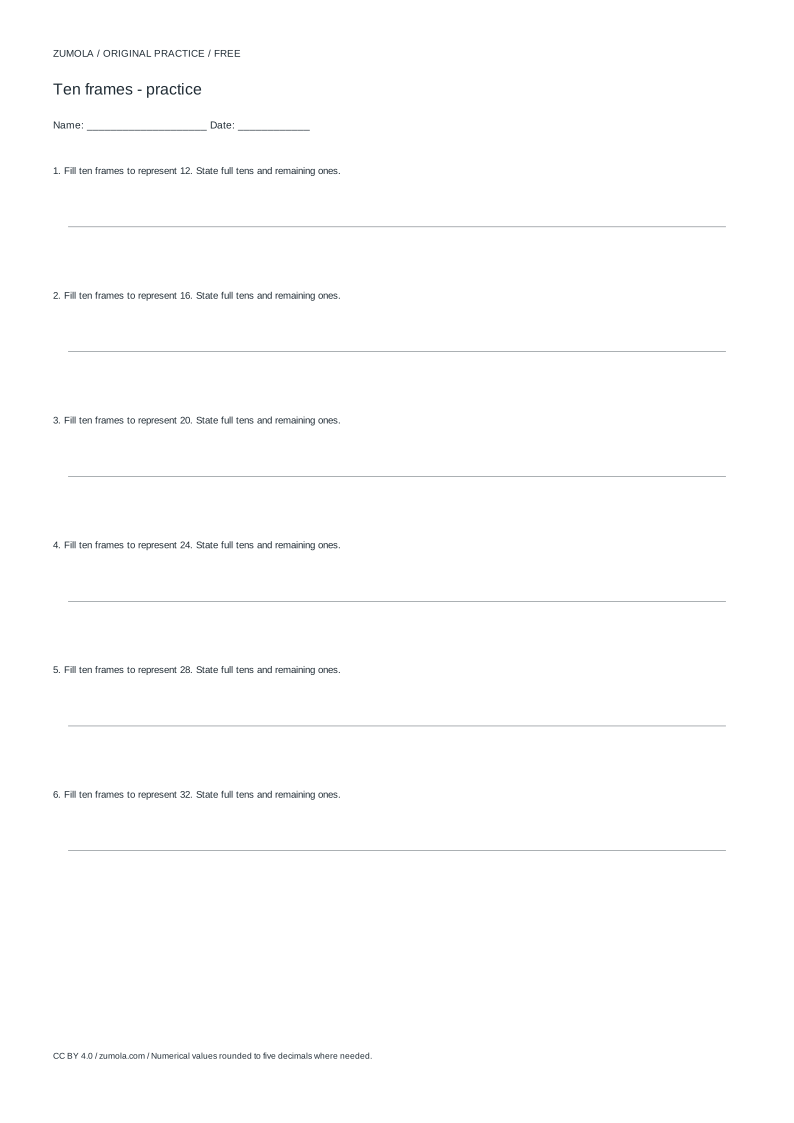
Worked answers / rubric
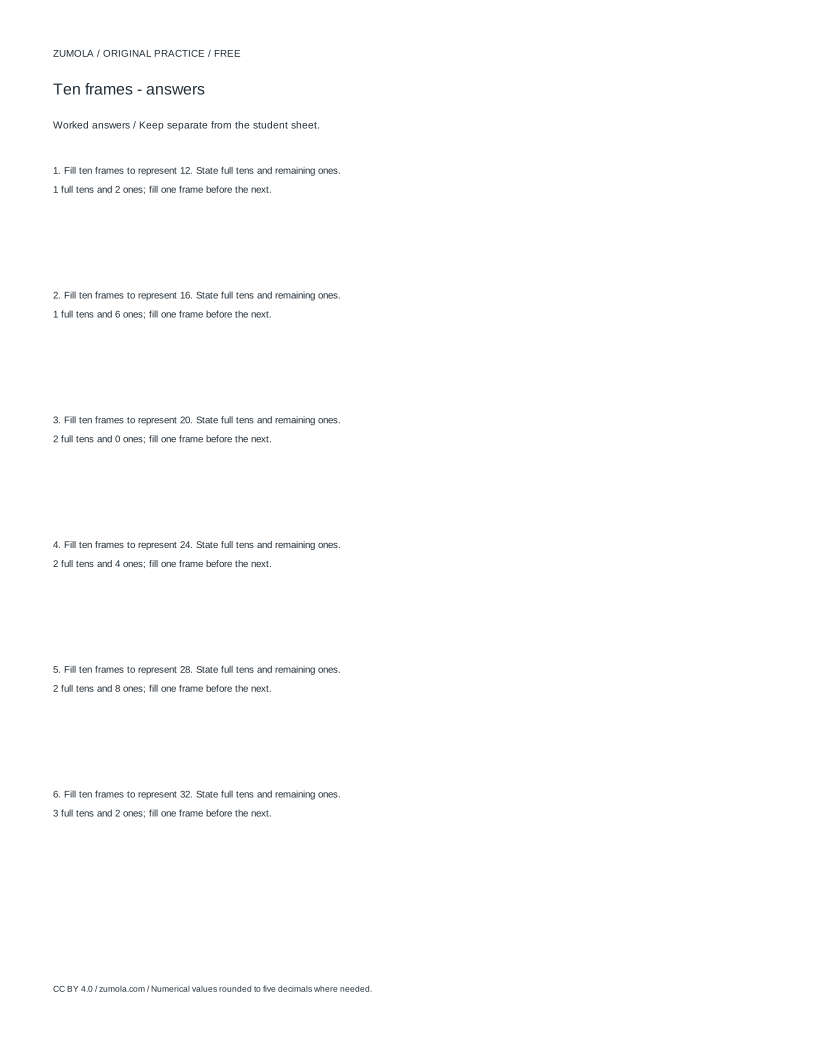
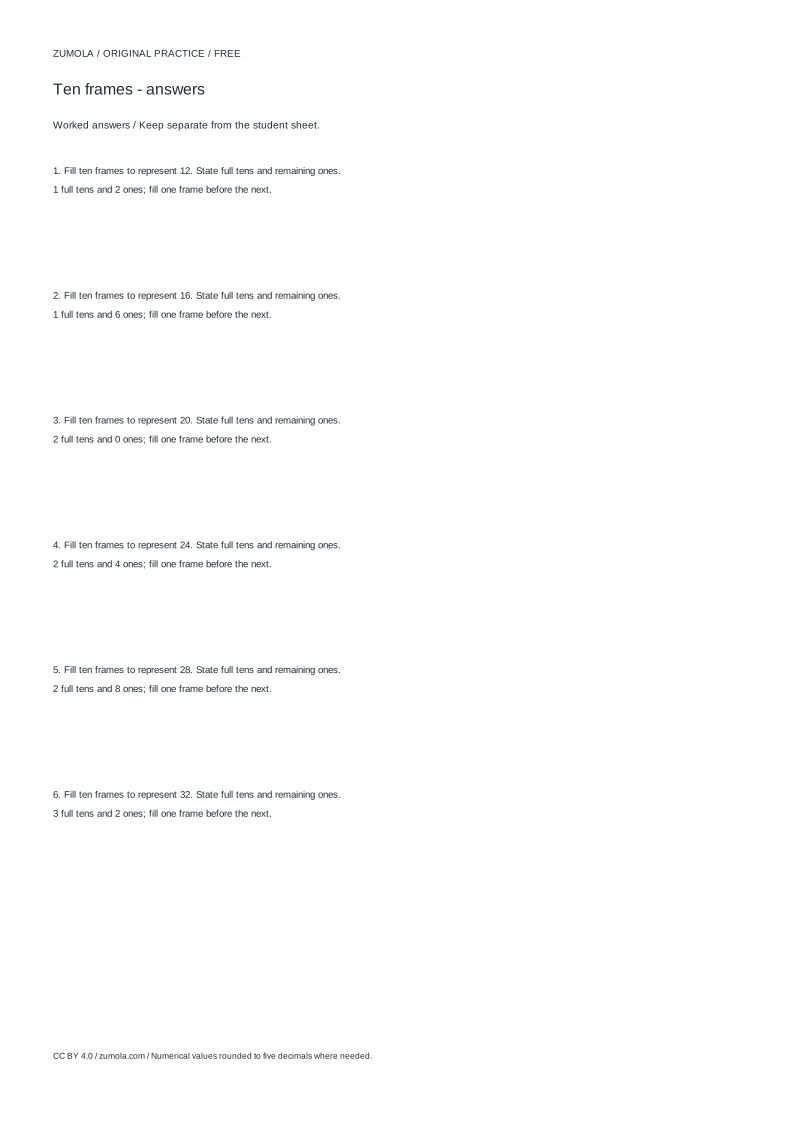
Print at Actual size / 100%. Check the calibration bar before using physical dimensions.
A ten frame is a grid of two rows and five columns, giving ten equal cells. It makes number bonds visible: you fill some cells, leave others empty, and read the two parts that together make ten. This page explains how to set up and read ten frame tasks for decomposition and composition, how to check answers with exact counts, and how to mark the work fairly. Print sheets at 100% only after checking a calibration bar.
How a ten frame shows decomposition and composition
A ten frame has ten cells in a fixed layout: five in the top row and five in the bottom row. Each cell holds one counter or mark. Because the total is always ten, the filled cells and the empty cells form a pair of parts. If four cells are filled, six are empty, so the bond is 4 and 6 make 10. This is decomposition: one number, ten, split into two parts.
Composition runs the other way. Given two parts, such as 7 and 3, place seven counters and then three more. The frame is full, so the parts combine to ten. The fixed two-row layout also supports quick recognition: a full top row is five, and a full frame is ten. Keep the frame orientation consistent so the five-and-five structure stays readable.
Ten frames work best for numbers from 0 to 10. For sums above ten, use two frames side by side and treat the second frame as the ones beyond ten. State clearly whether a task uses one frame or two, because the endpoint condition changes the answer.
- Draw two rows of five equal cells, or use a printed frame with ten cells.
- Decide the target: a number to split, or two parts to combine.
- Place one counter or mark per cell, starting at the top left and moving across.
- Count filled cells and empty cells separately.
- Write the bond as two parts and the total, for example 4 + 6 = 10.
Setting up printable tasks that stay checkable
A useful ten frame sheet states the task in words and leaves the frame blank for the learner to fill. For decomposition, give the total ten and one part, then ask for the missing part. For composition, give both parts and ask for the total. Keep the number range within 0 to 10 for a single frame.
Use exact counts rather than estimates. If a task says five counters are placed, exactly five cells should be filled. When marking, count cells rather than judging spacing or neatness. A correct bond must name two non-negative whole numbers whose sum is ten, and the filled cells must match those numbers.
If you print a sheet, check a calibration bar first and print at 100% so cell sizes stay consistent. Do not scale to fit, because uneven cells make counting harder. The frame itself is a counting tool, not an anatomy diagram; counters are abstract marks, not body parts.
- Write the total and the known part, or the two parts, above the frame.
- Leave all ten cells empty for the learner to fill.
- Ask the learner to record the bond as an equation.
- Check by counting filled and empty cells against the written numbers.
- For two-frame tasks, label the second frame as the part beyond ten.
Worked example and marking guidance
Suppose the task gives the total ten and the part three, and asks for the missing part. The learner fills three cells, leaving seven empty. The missing part is seven, because 3 + 7 = 10. The check is simple: three filled plus seven empty equals ten cells.
A second task gives parts six and four and asks for the total. The learner fills six cells, then four more. All ten cells are filled, so the total is ten. If a learner fills only nine cells, the count shows the error immediately, which is the main value of the fixed ten-cell layout.
Marking should use a rubric, because drawings and counter placement vary. Accept any arrangement that fills the correct number of cells, even if counters are not perfectly centered. The mathematical content is the bond, not the neatness of the marks.
- Read the given numbers from the task.
- Fill the stated number of cells.
- Count the remaining empty cells or the total filled cells.
- Write the bond equation.
- Compare the equation with the cell count.
Where ten frames stop being the right tool
Ten frames are a model for numbers up to ten, or up to twenty with two frames. They are not a general place value chart. For larger numbers, a place value table with separate columns for tens and ones is clearer, and multiplication facts should be checked independently rather than read from a ten frame.
When comparing fractions, the whole must be the same and the number of equal parts must match before any comparison is valid. A ten frame does not model fractions directly, so keep fraction tasks on fraction strips or equal-part diagrams. Mixing models in one task confuses the underlying idea.
- Use one frame for totals from 0 to 10.
- Use two frames for totals from 11 to 20, labeling the second frame.
- Switch to a place value table for larger whole numbers.
- Keep fraction comparison on equal-whole diagrams.
Try this example
A task gives the total ten and the part two. The learner must find the missing part using one ten frame.
Show the worked explanation
Fill two cells, leaving eight empty. The missing part is eight, because 2 + 8 = 10. Check: two filled plus eight empty equals ten cells, so the bond is correct.
Common mistakes
- Filling cells in a random pattern so the five-and-five structure is lost. Fill from the top left across the top row, then continue on the bottom row, so a full row always reads as five.
- Writing a bond whose parts do not add to ten, such as 4 and 5. Count filled and empty cells and confirm the two numbers sum to ten before accepting the answer.
- Using a ten frame for totals above ten without a second frame or a clear label. Add a second frame for numbers 11 to 20 and state that the second frame holds the part beyond ten.
Check your work
- The filled cells match the stated part exactly.
- The two parts written in the bond add to ten.
- Cells are filled in a consistent order that preserves the five-and-five layout.
- The equation is written clearly with the total and both parts.
- For two-frame tasks, the second frame is labeled as the part beyond ten.
Questions before you start
What is a ten frame used for?
It shows numbers up to ten as filled and empty cells, making number bonds and making-ten strategies visible and easy to check by counting.
Can I use a ten frame for numbers above ten?
Yes, with two frames side by side. The first frame holds ten and the second holds the remainder, so the total is ten plus the filled cells in the second frame.
How should I check a learner's ten frame answer?
Count the filled cells and the empty cells, then confirm the written parts add to ten. Accept any placement that fills the correct number of cells.