Free original lessons
Patterned Paper
This pack teaches how to make a printable patterned paper sheet whose motif repeats in a regular layout. You will choose a simple motif, place it on a grid so the repeat is even, and check that the sheet reads as continuous decorative paper rather than a random scatter.
Letter & A4
PDF & SVG
What a repeat motif layout is
A patterned paper sheet is decorative paper whose surface is covered by one motif repeated in a planned arrangement. The repeat is what makes the sheet look like paper rather than a single drawing.
The layout is the arrangement of the repeats: how the motif is spaced across the sheet and how the rows line up. A useful printable sheet has an even, predictable repeat so the pattern looks intentional when printed and tiled.
Building the repeat
Start with one simple motif that is easy to redraw, such as a small leaf, a four-petal flower, or a rounded diamond. Draw it once clearly, then use that same motif as your reference for every repeat.
Place the motif on an invisible grid of rows and columns. Keep the spacing between motifs consistent across the sheet, and keep each row aligned with the one above it. The grid is a construction aid, not a printed feature.
Worked example
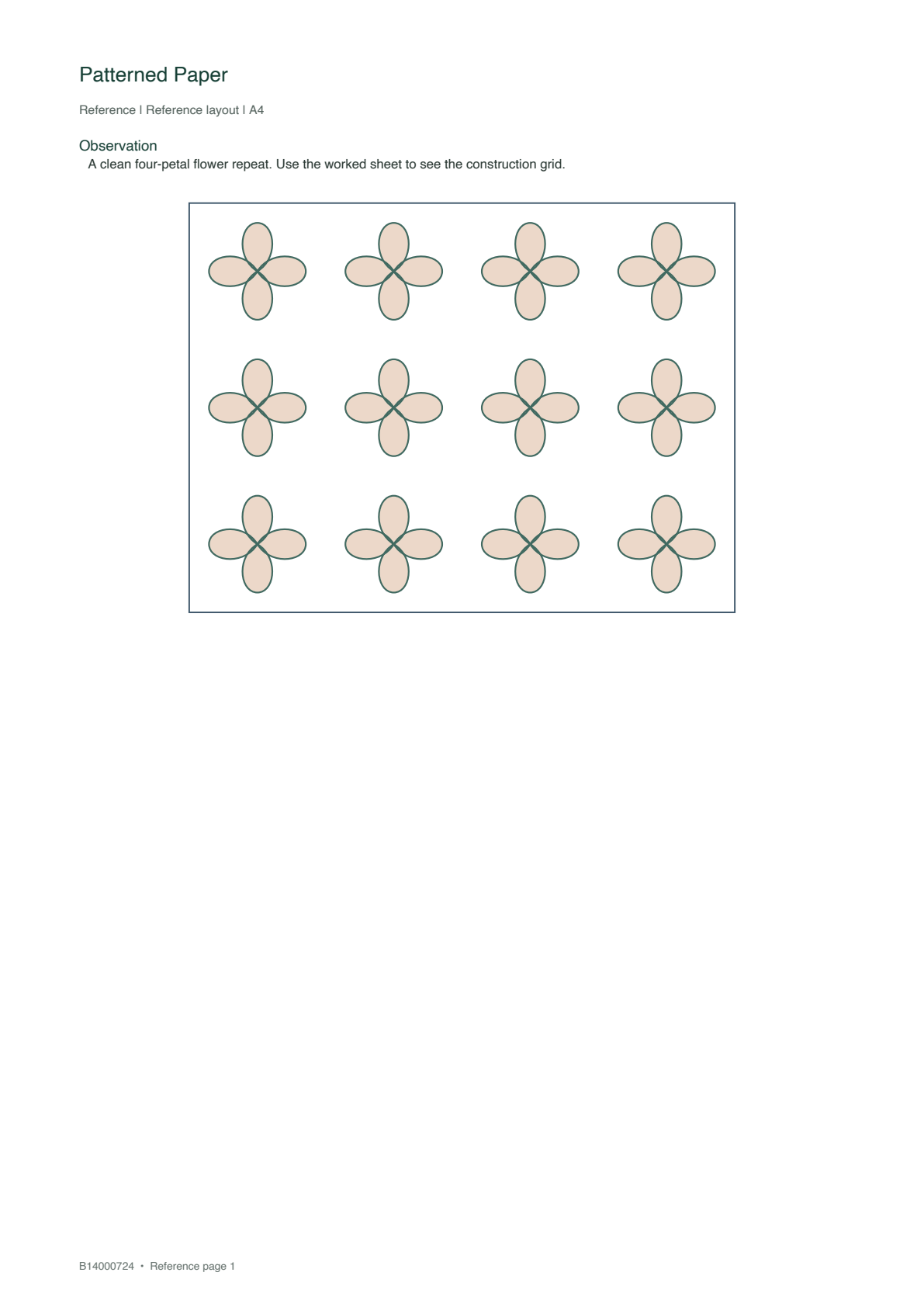
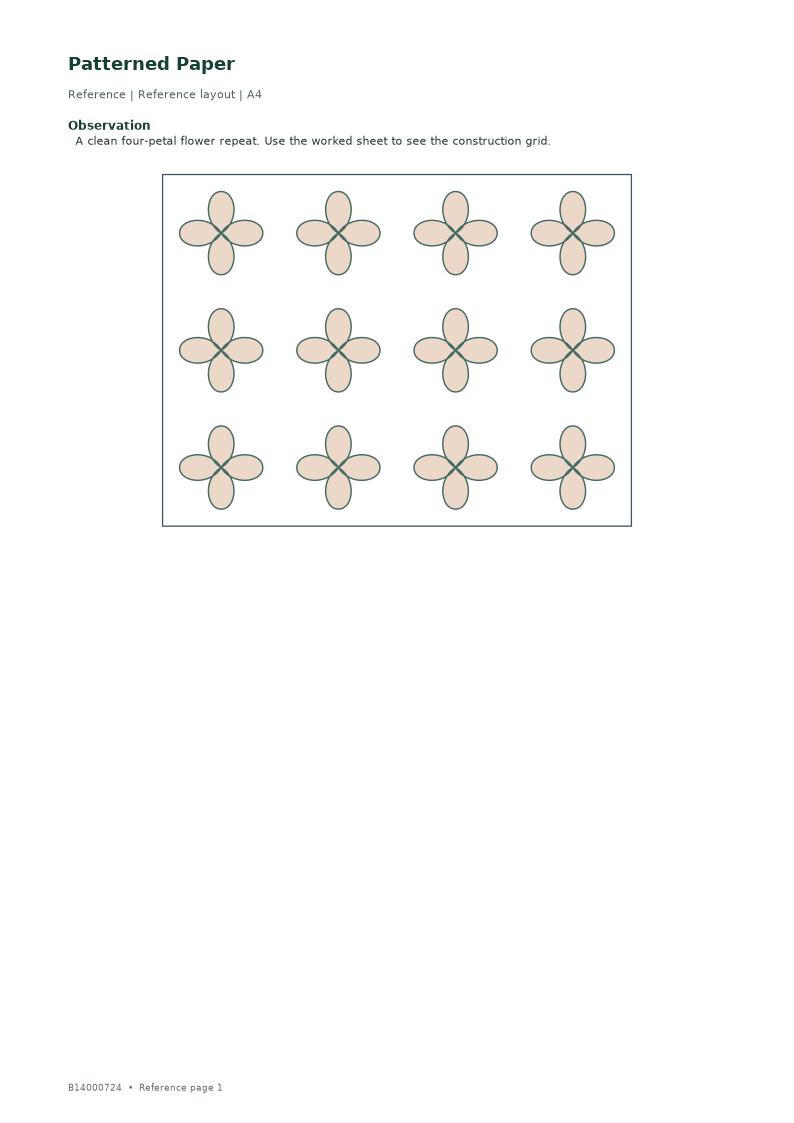
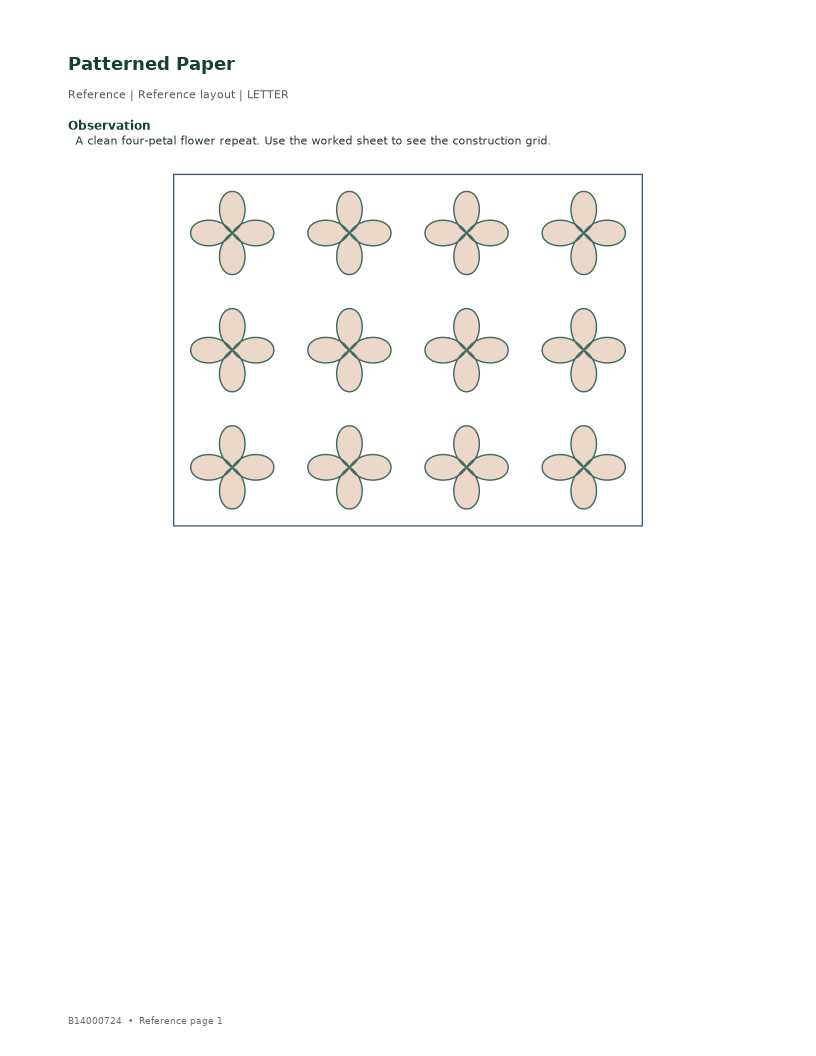
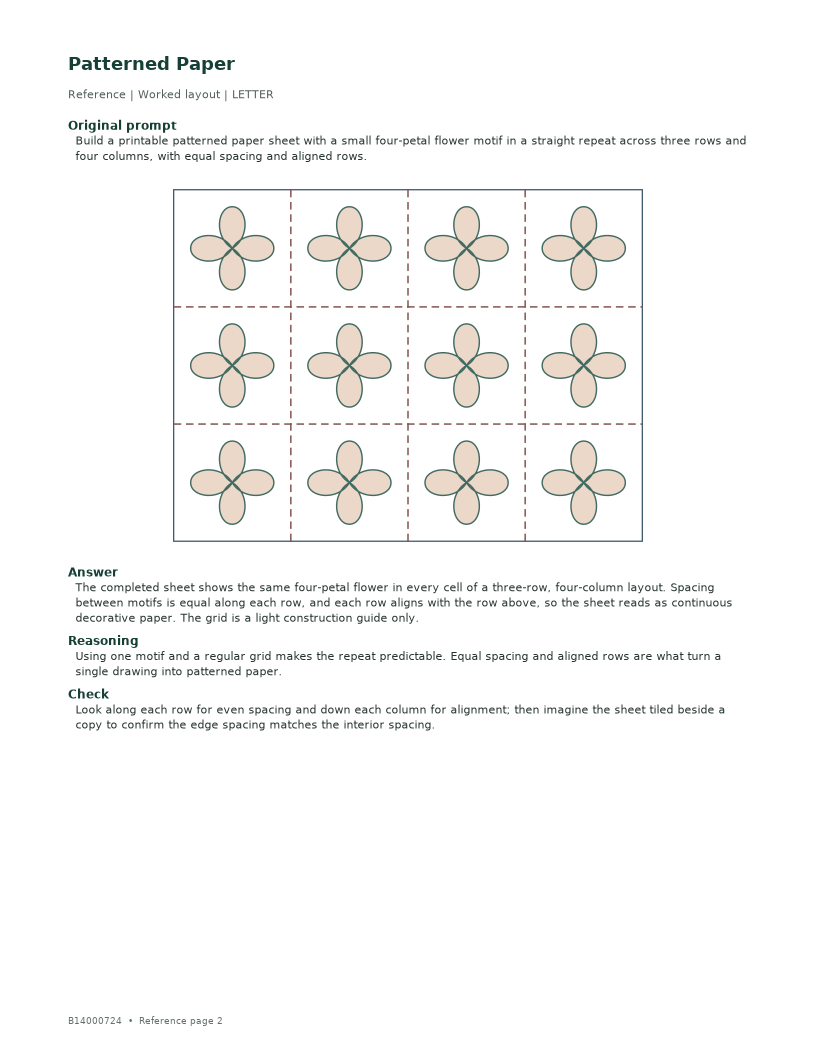
Worked example: a sheet using a small four-petal flower motif in a straight repeat. The motif is drawn once, then repeated across three rows and four columns with equal spacing, so every flower sits at the same position within its cell.
The filled example shows the completed sheet: the same flower appears in every cell, rows are evenly spaced, and the pattern reads as continuous decorative paper. The grid lines are shown only as a light construction guide and are not part of the finished sheet.
Checking your sheet
Check the repeat by looking along each row: the motifs should be evenly spaced and the same size. Then look down each column: the motifs should line up with the row above.
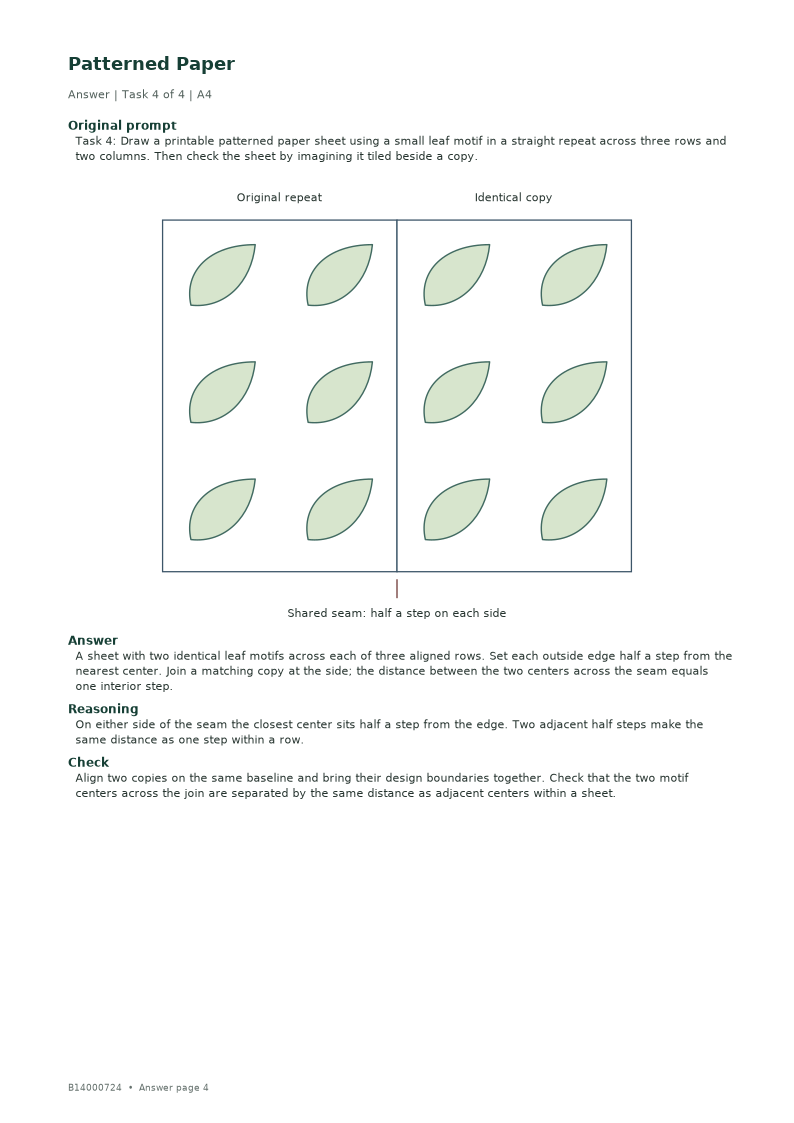
Arrange two copies with their design boundaries touching. With half a grid step between each edge and its nearest motif center, the gap across the join matches the interior motif spacing. Keep the sheet boundaries aligned to continue the rows.
Download the complete resource pack
All individual SVG pages (20)
- A4 reference page 1
- A4 reference page 2
- A4 student page 1
- A4 student page 2
- A4 student page 3
- A4 student page 4
- A4 answer page 1
- A4 answer page 2
- A4 answer page 3
- A4 answer page 4
- LETTER reference page 1
- LETTER reference page 2
- LETTER student page 1
- LETTER student page 2
- LETTER student page 3
- LETTER student page 4
- LETTER answer page 1
- LETTER answer page 2
- LETTER answer page 3
- LETTER answer page 4

Print at 100% / actual size. Use the stated scale on any schematic diagram; physical cutting templates are identified separately. A4 and US Letter are separate files. Free access, no signup; CC BY 4.0.
How to use these pages
- What a repeat motif layout is
- Building the repeat
- Worked example
- Checking your sheet
Worked example
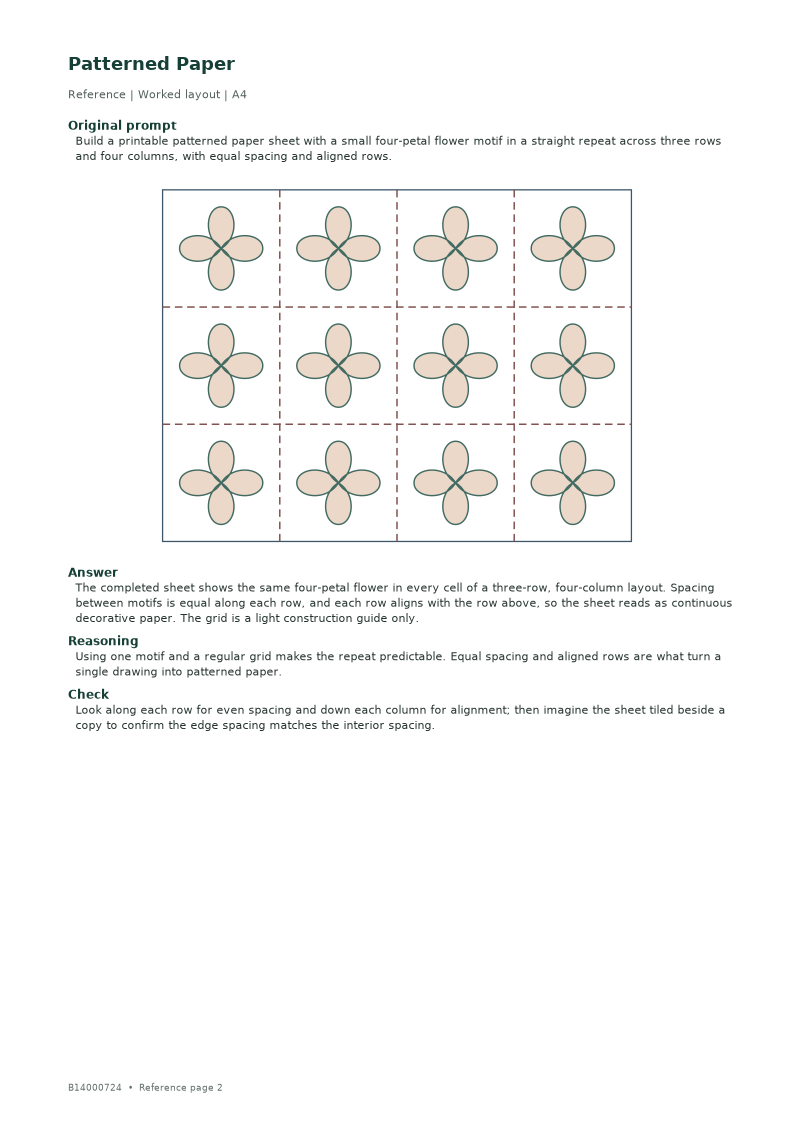
Example: Build a printable patterned paper sheet with a small four-petal flower motif in a straight repeat across three rows and four columns, with equal spacing and aligned rows.
Answer: The completed sheet shows the same four-petal flower in every cell of a three-row, four-column layout. Spacing between motifs is equal along each row, and each row aligns with the row above, so the sheet reads as continuous decorative paper. The grid is a light construction guide only.
Reasoning: Using one motif and a regular grid makes the repeat predictable. Equal spacing and aligned rows are what turn a single drawing into patterned paper.
Check: Look along each row for even spacing and down each column for alignment; then imagine the sheet tiled beside a copy to confirm the edge spacing matches the interior spacing.
Four practice tasks and complete answers
Task 1
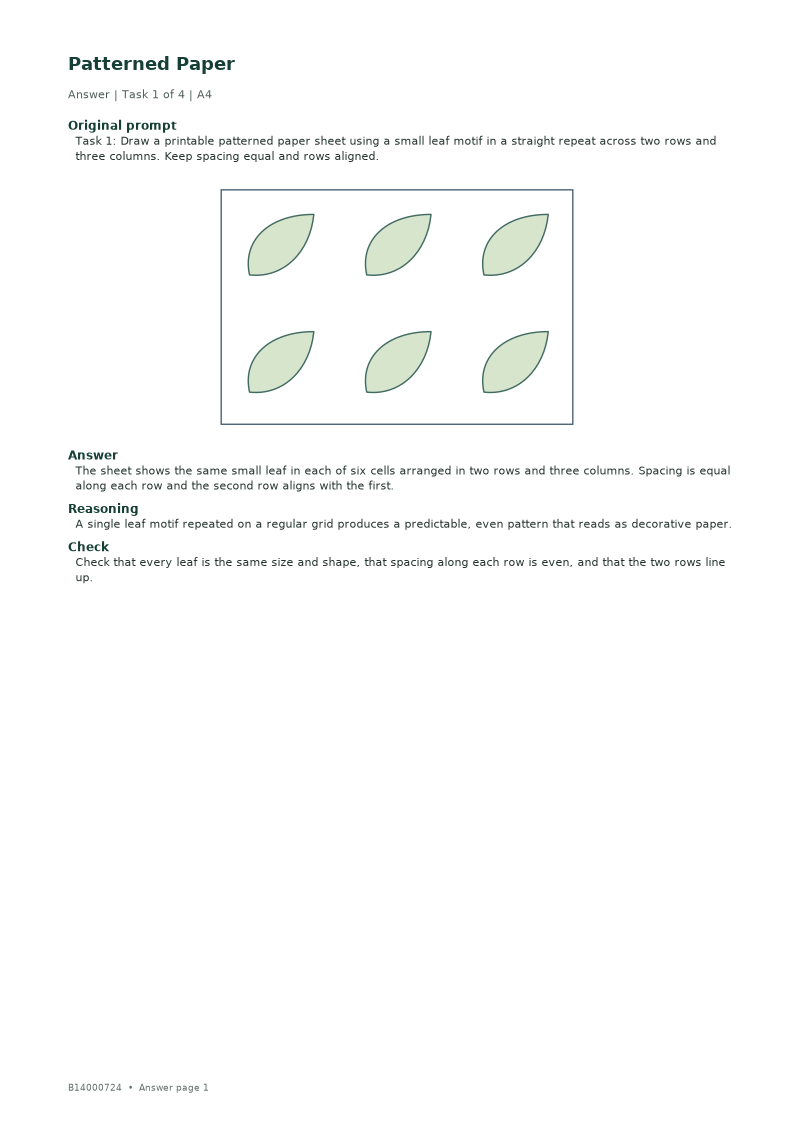
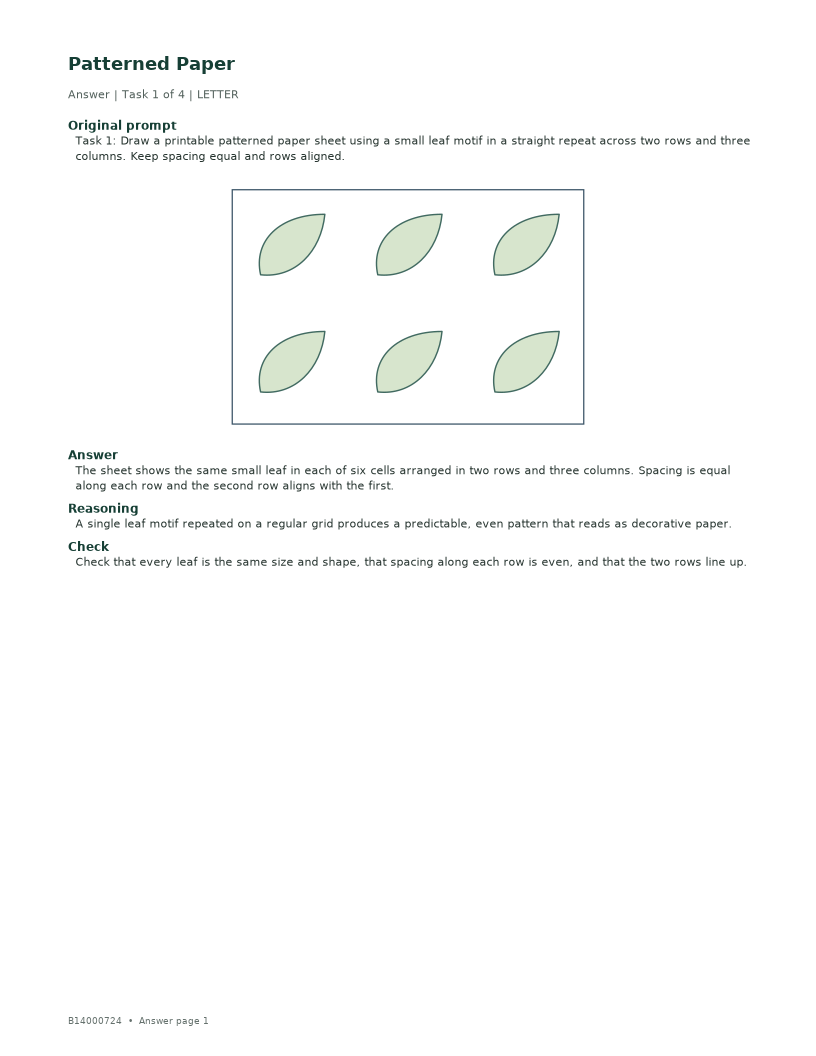
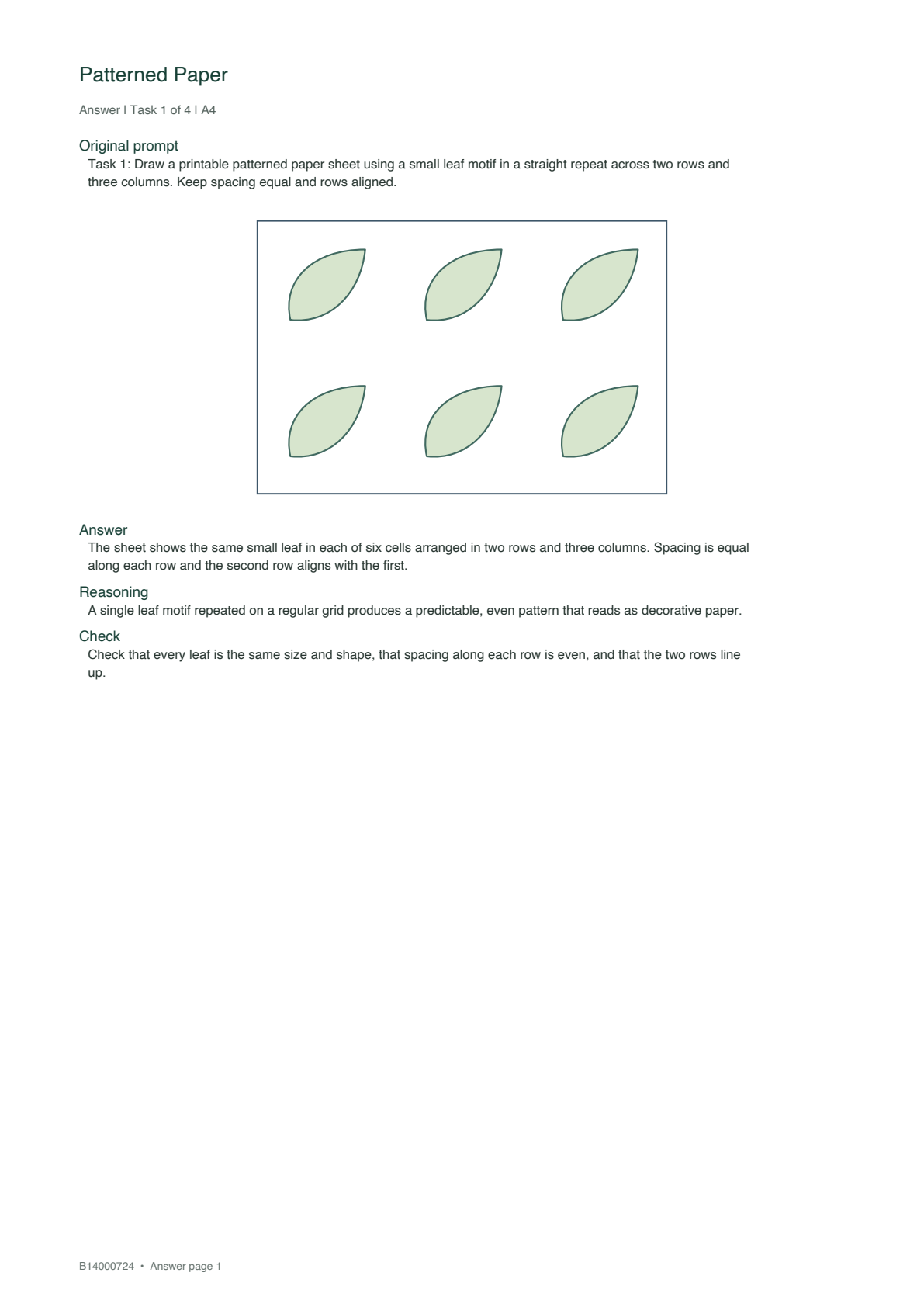
Task 1: Draw a printable patterned paper sheet using a small leaf motif in a straight repeat across two rows and three columns. Keep spacing equal and rows aligned.
Show answer 1
The sheet shows the same small leaf in each of six cells arranged in two rows and three columns. Spacing is equal along each row and the second row aligns with the first.
A single leaf motif repeated on a regular grid produces a predictable, even pattern that reads as decorative paper.
Check: Check that every leaf is the same size and shape, that spacing along each row is even, and that the two rows line up.
Task 2
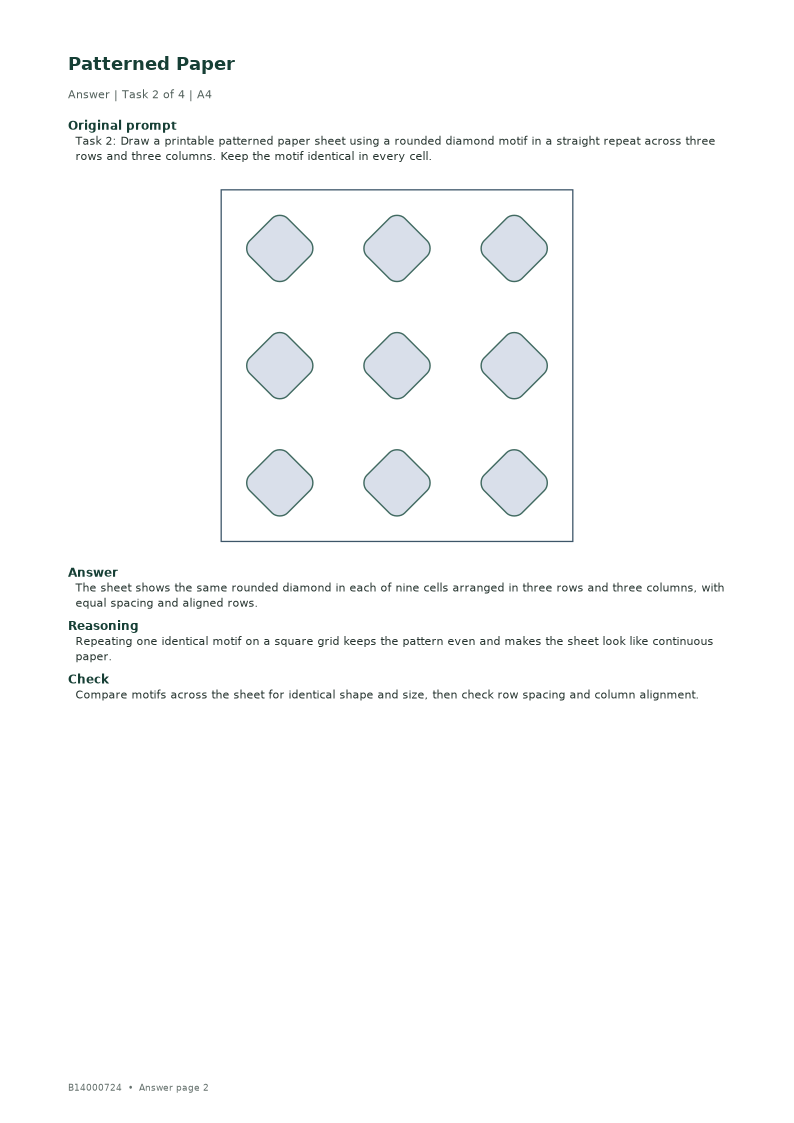
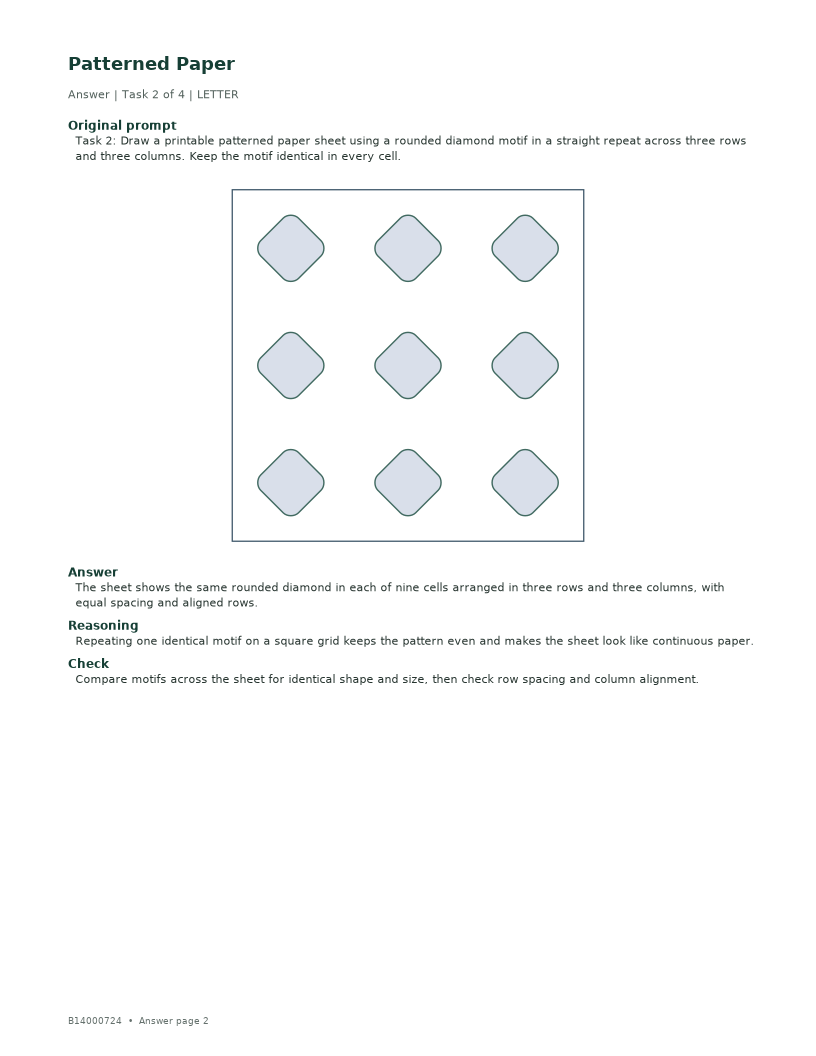
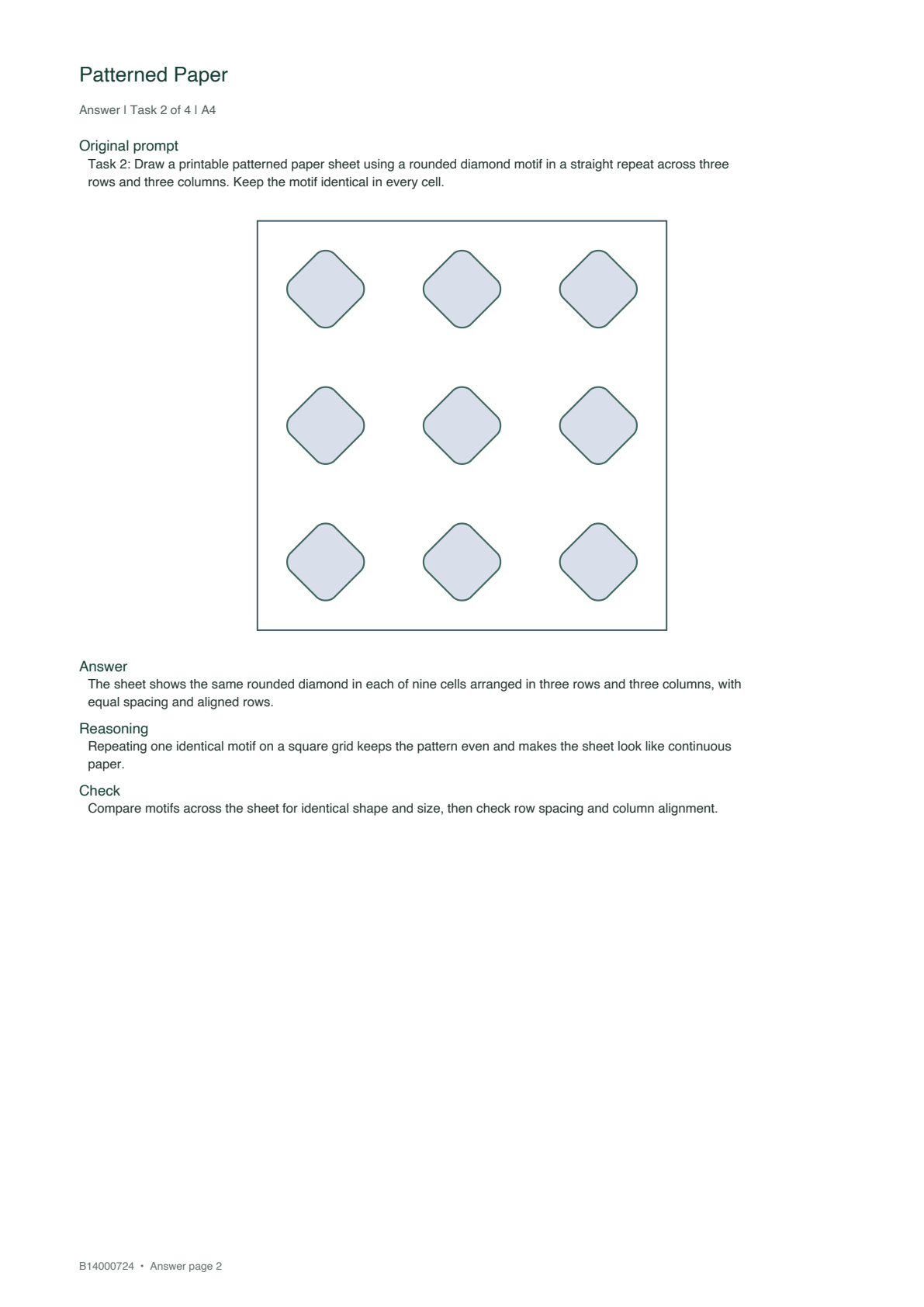
Task 2: Draw a printable patterned paper sheet using a rounded diamond motif in a straight repeat across three rows and three columns. Keep the motif identical in every cell.
Show answer 2
The sheet shows the same rounded diamond in each of nine cells arranged in three rows and three columns, with equal spacing and aligned rows.
Repeating one identical motif on a square grid keeps the pattern even and makes the sheet look like continuous paper.
Check: Compare motifs across the sheet for identical shape and size, then check row spacing and column alignment.
Task 3
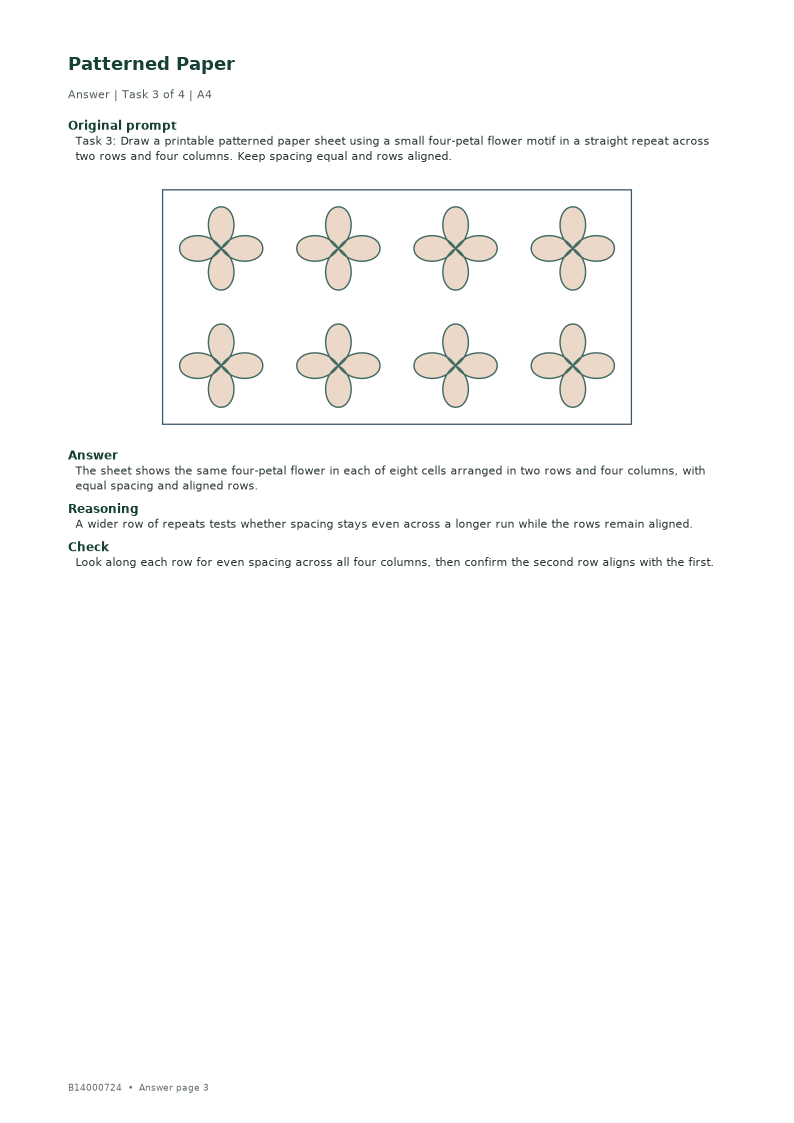
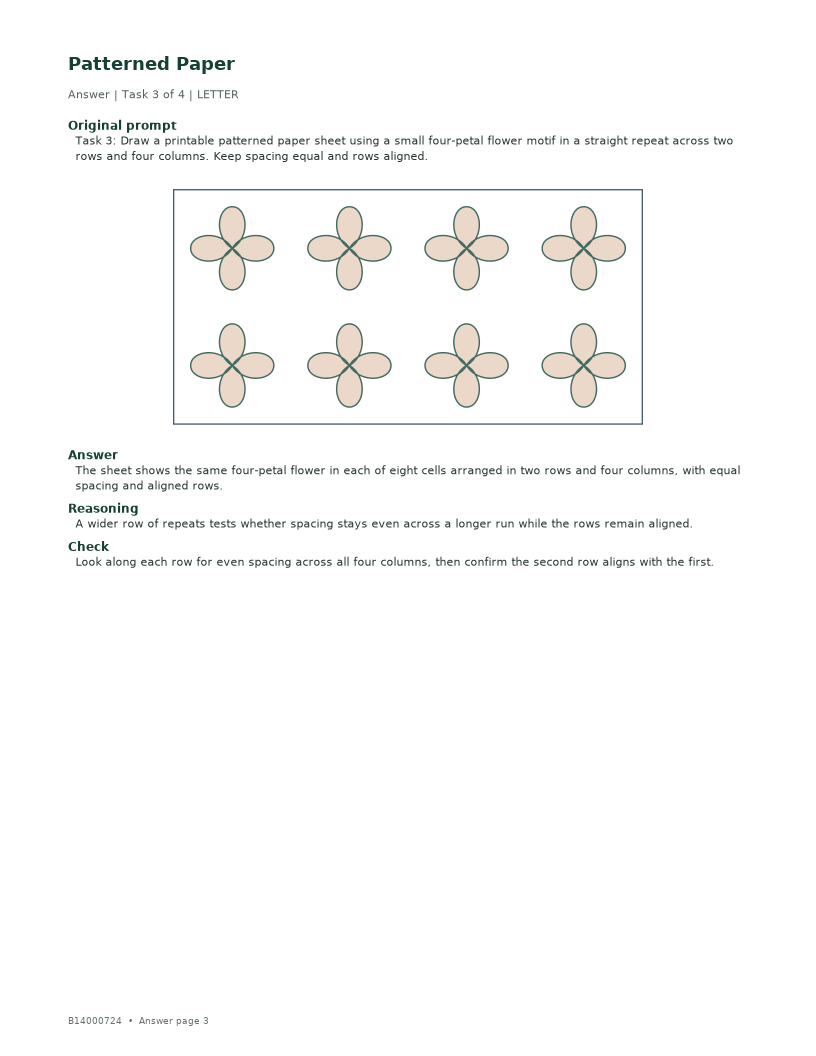
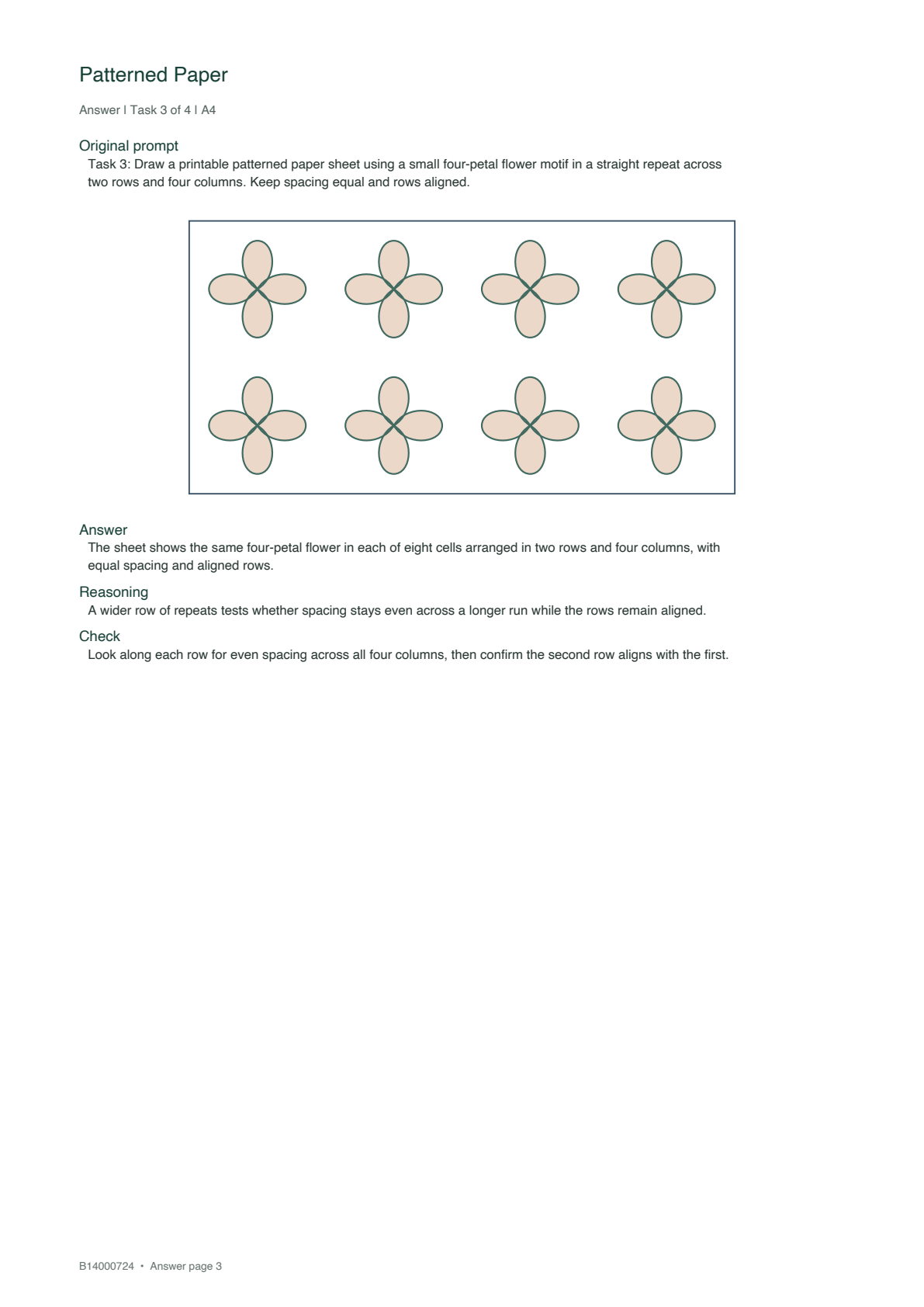
Task 3: Draw a printable patterned paper sheet using a small four-petal flower motif in a straight repeat across two rows and four columns. Keep spacing equal and rows aligned.
Show answer 3
The sheet shows the same four-petal flower in each of eight cells arranged in two rows and four columns, with equal spacing and aligned rows.
A wider row of repeats tests whether spacing stays even across a longer run while the rows remain aligned.
Check: Look along each row for even spacing across all four columns, then confirm the second row aligns with the first.
Task 4
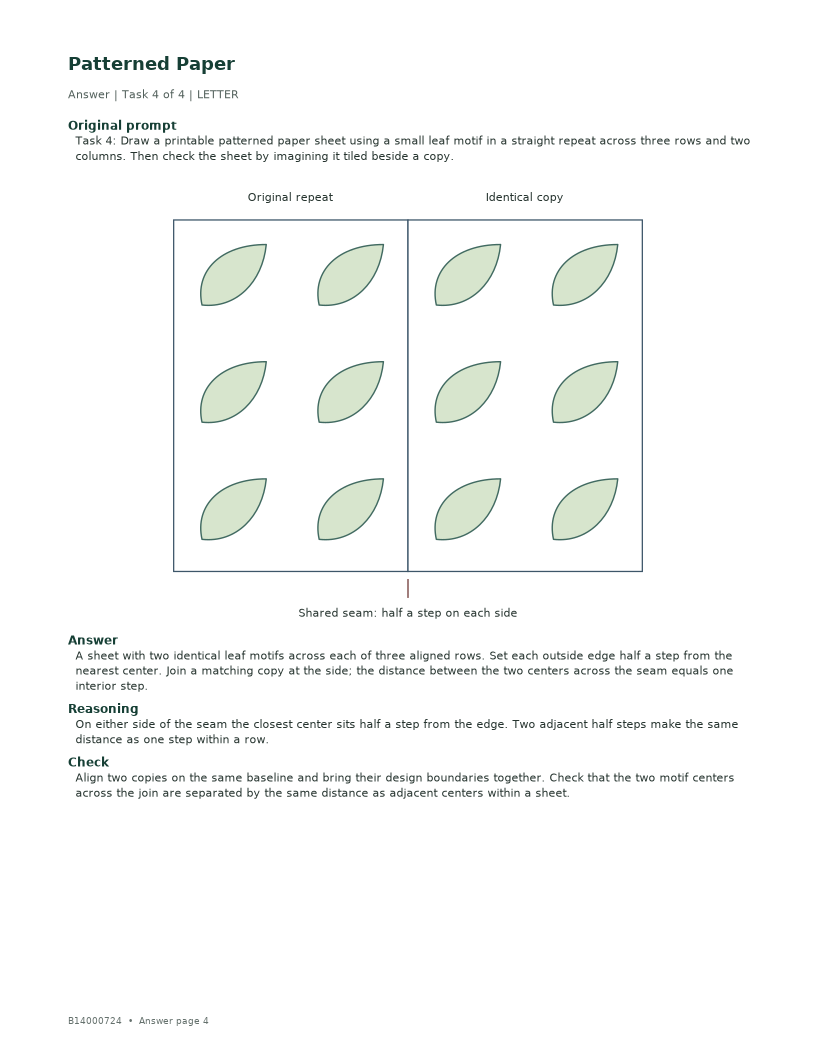
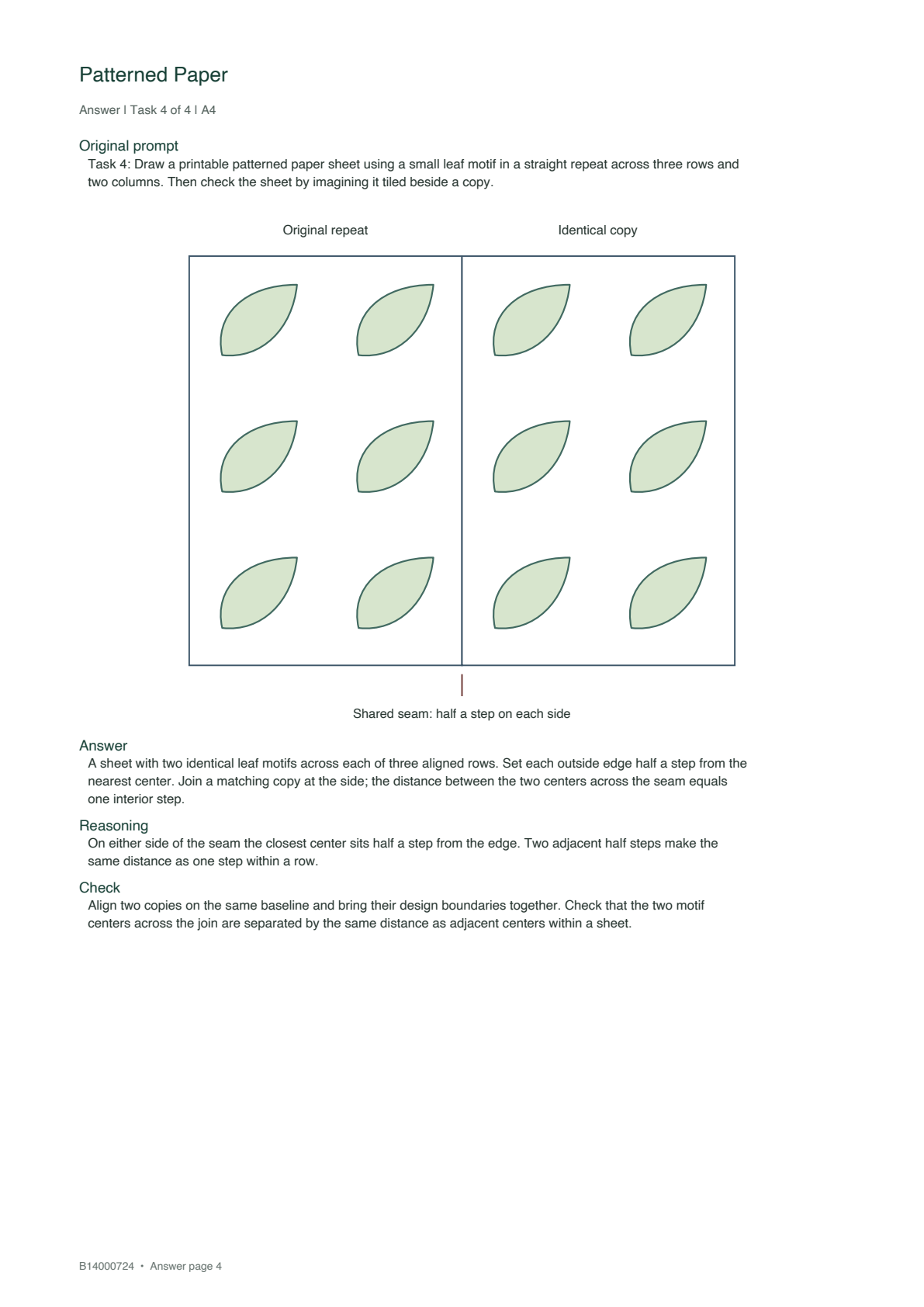
Task 4: Draw a printable patterned paper sheet using a small leaf motif in a straight repeat across three rows and two columns. Then check the sheet by imagining it tiled beside a copy.
Show answer 4
A sheet with two identical leaf motifs across each of three aligned rows. Set each outside edge half a step from the nearest center. Join a matching copy at the side; the distance between the two centers across the seam equals one interior step.
On either side of the seam the closest center sits half a step from the edge. Two adjacent half steps make the same distance as one step within a row.
Check: Align two copies on the same baseline and bring their design boundaries together. Check that the two motif centers across the join are separated by the same distance as adjacent centers within a sheet.
Useful checks
- Changing the motif slightly in each cell. Redraw every repeat from the same reference motif so all copies match.
- Letting rows drift out of alignment. Use a light grid as a construction guide and place each motif at the same position within its cell.
- Leaving uneven spacing at the sheet edges. Compare edge spacing with interior spacing, and adjust so the repeat would continue evenly if tiled.
Questions about this resource
Is the grid printed on the finished sheet?
No. The grid is a light construction guide used to place the repeats; the finished printable sheet shows only the motif pattern.
Does the motif have to be a flower or leaf?
No. Any simple motif that is easy to redraw consistently can be used; the flower and leaf are examples chosen for this pack.