Free original lessons
Skull Grid Drawing
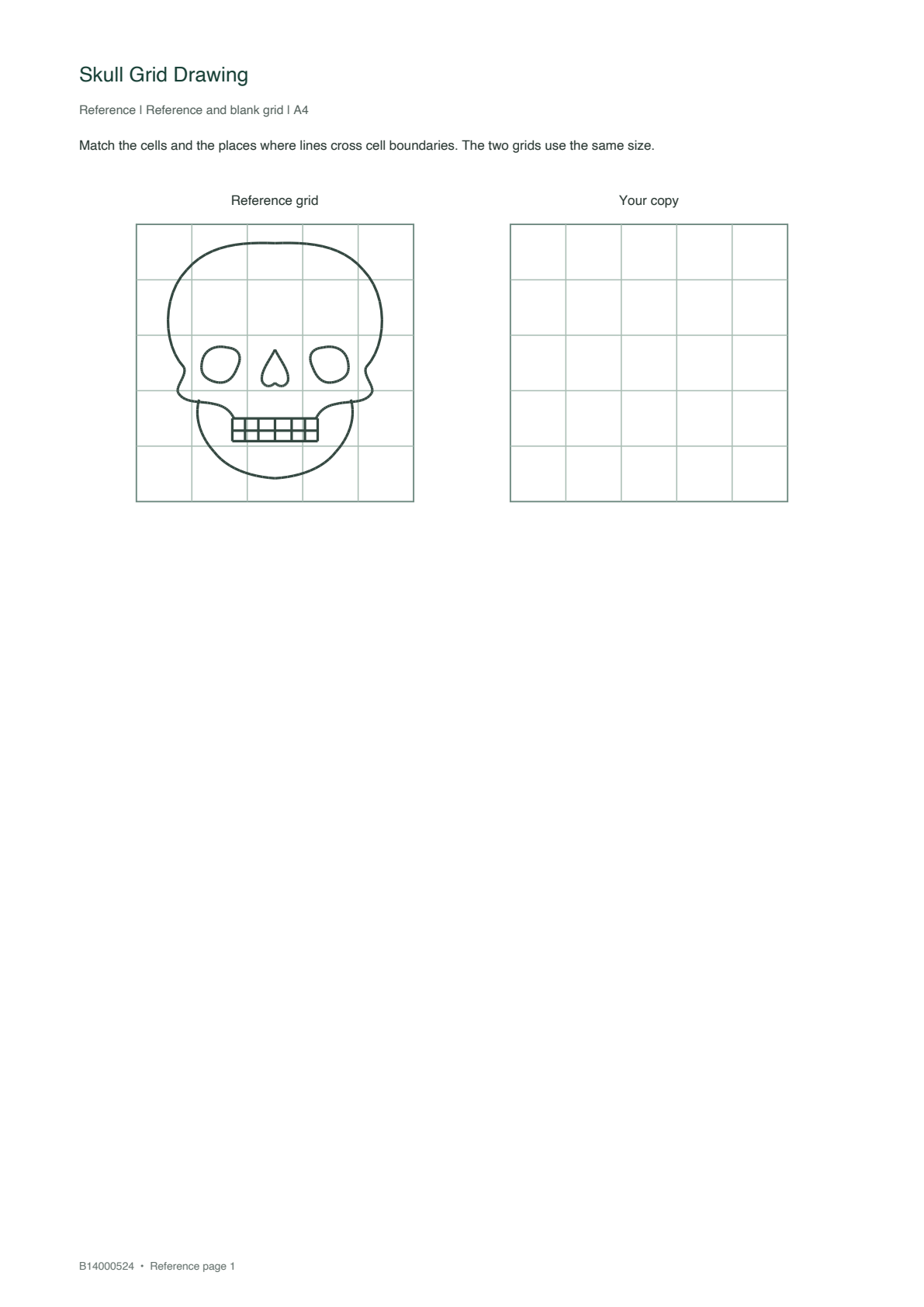
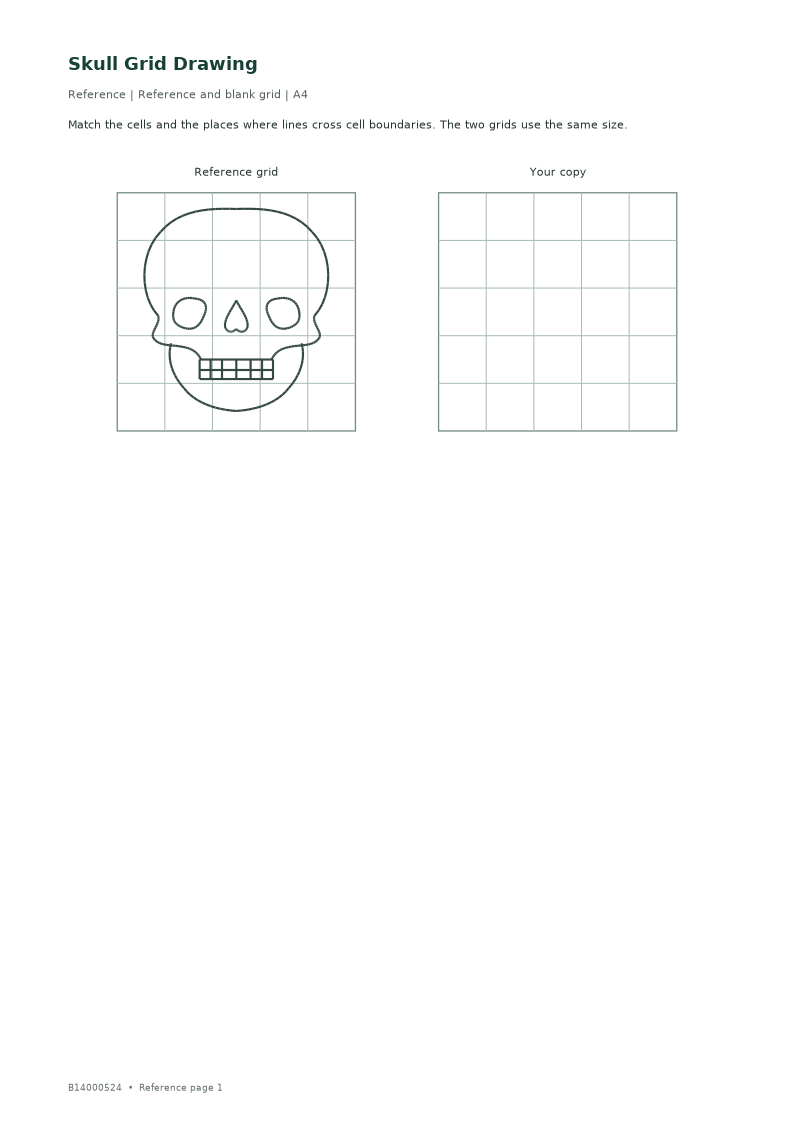
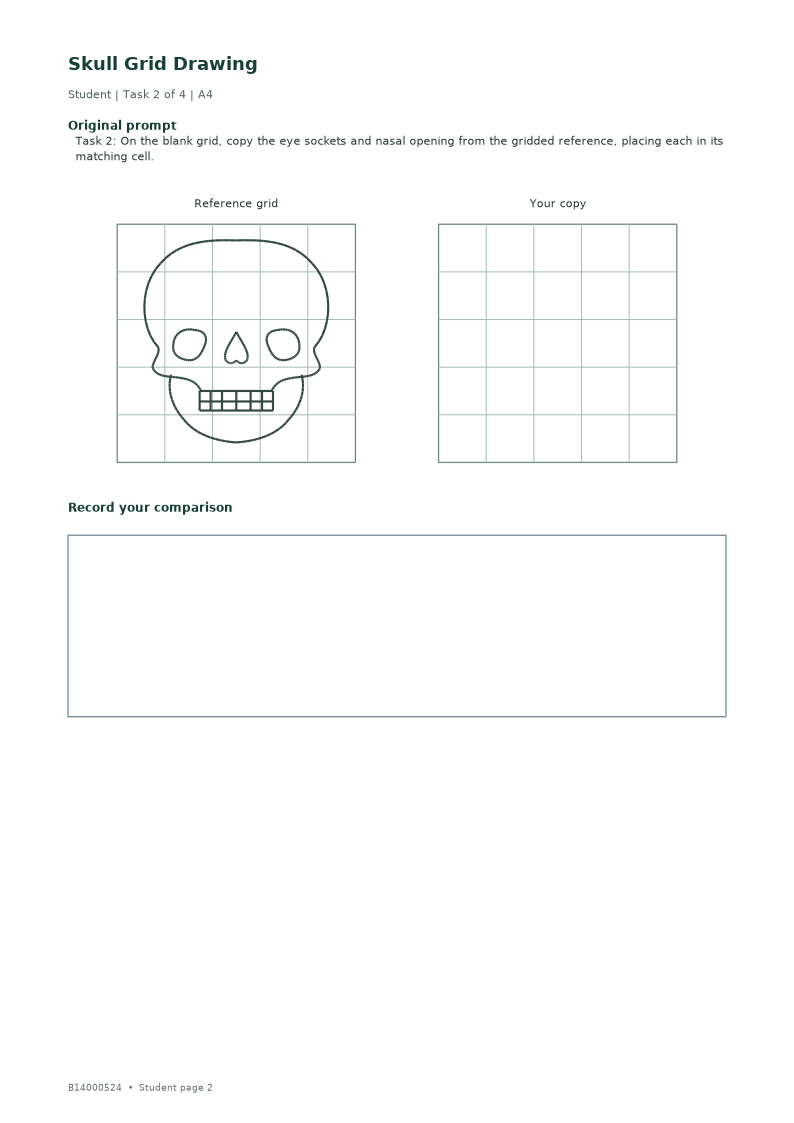
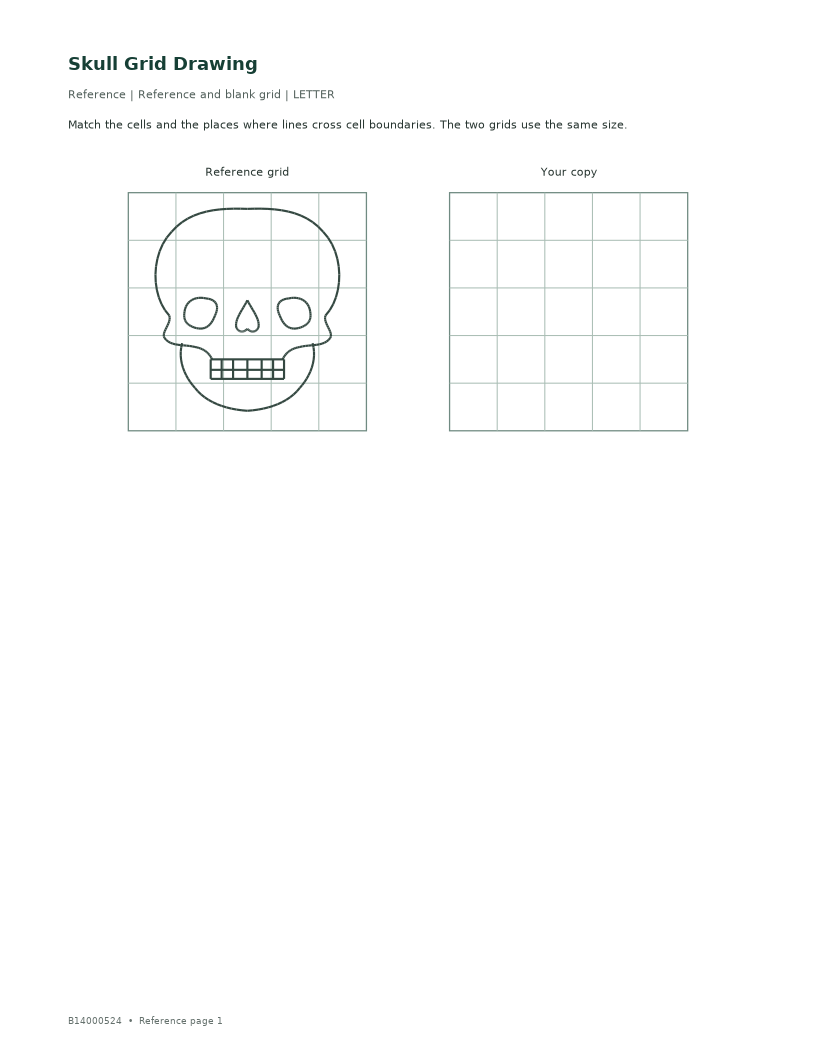
Copy a symmetric, stylized front-view skull from a 5×5 reference grid into a separate empty matching 5×5 grid. Count rows from the top and columns from the left, starting at 1. Keep the full reference visible beside the blank grid and compare matching cells directly. In this chosen teaching drawing, the two eye-socket loops lie wholly in row 3, columns 2 and 4, and the nasal opening lies in row 3, column 3. The other tasks transfer the upper cranium arc, cheekbones, and jaw; in the full drawing, the cheekbones meet the arc endpoints and the jaw forms the lower contour. This is an art lesson, not a clinical or anatomical reference.
Letter & A4
PDF & SVG
What skull grid drawing is
A skull grid drawing uses two separate, equally sized 5×5 grids: a front-view reference grid and a blank coordinate grid beside it. Each row and column is counted from the top-left, starting at 1, so a feature can be located and copied into its matching cell.
The method is observation and copying, not freehand invention. You look at what occupies each cell of the reference, then draw the same content in the same cell of the blank grid, checking that edges cross cell boundaries at the same points.
How to read the reference grid
Read the reference grid by naming each cell and noting what the skull does inside it. A cell may hold the top of the cranium, the eye socket, the nasal opening, the cheekbone, the teeth, or empty space.
Note where each skull edge actually meets a cell boundary in the reference. Transfer that visible crossing to the corresponding copy cell; do not assign a midpoint or other crossing that is not shown.
How to copy cell by cell
Work one cell at a time on the blank grid. For each cell, look at the reference, then draw only the part of the skull that falls inside that cell, matching where lines enter and leave the cell edges.
Keep the grid lines light so they can be erased later. Do not smooth or invent features between cells until every cell has been copied; the grid is what keeps the proportions honest.
How to check your copy
Check by comparing cell by cell: does each feature sit in the same cell on both grids, and do edges cross cell boundaries at the same points? A faithful copy matches cell content and boundary crossings, not exact line quality.
Keep the reference visible beside the blank copy grid. Compare corresponding cells one at a time, checking the feature content and the boundary crossings before moving on. Mark a mismatched cell for correction; do not cover the reference while checking.
Download the complete resource pack
All individual SVG pages (20)
- A4 reference page 1
- A4 reference page 2
- A4 student page 1
- A4 student page 2
- A4 student page 3
- A4 student page 4
- A4 answer page 1
- A4 answer page 2
- A4 answer page 3
- A4 answer page 4
- LETTER reference page 1
- LETTER reference page 2
- LETTER student page 1
- LETTER student page 2
- LETTER student page 3
- LETTER student page 4
- LETTER answer page 1
- LETTER answer page 2
- LETTER answer page 3
- LETTER answer page 4
Print at 100% / actual size. Use the stated scale on any schematic diagram; physical cutting templates are identified separately. A4 and US Letter are separate files. Free access, no signup; CC BY 4.0.
How to use these pages
- What skull grid drawing is
- How to read the reference grid
- How to copy cell by cell
- How to check your copy
Worked example
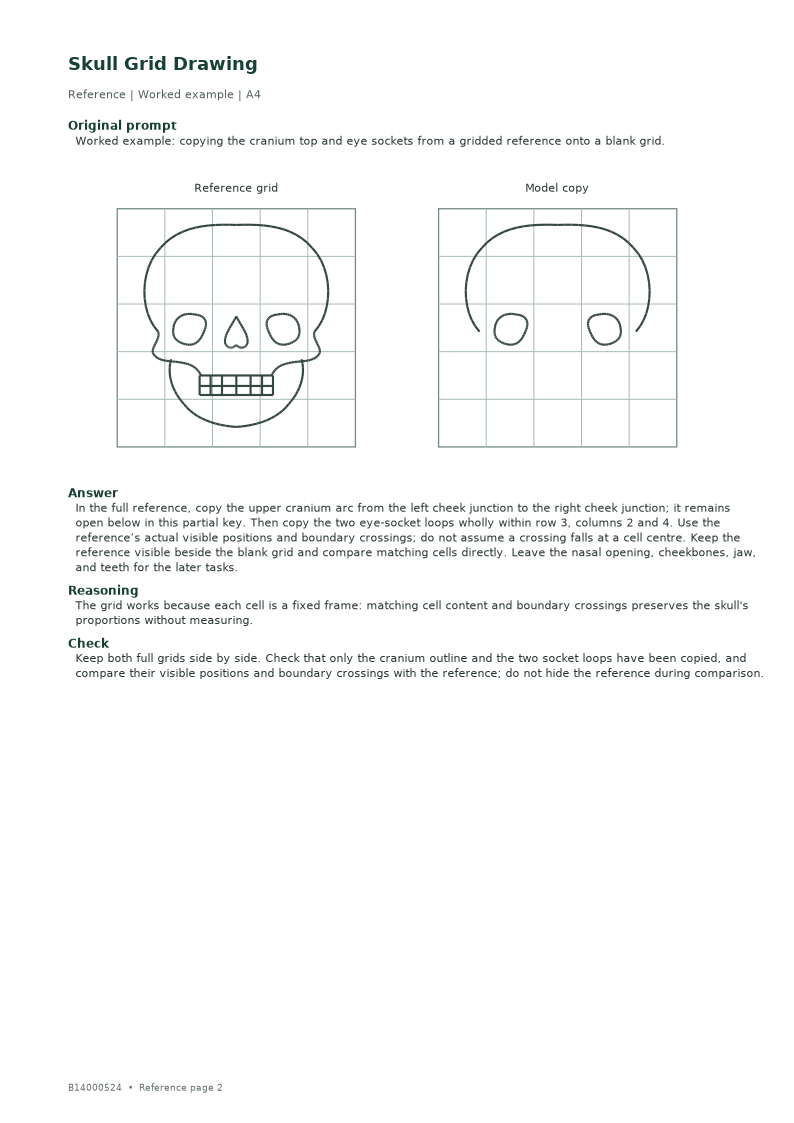
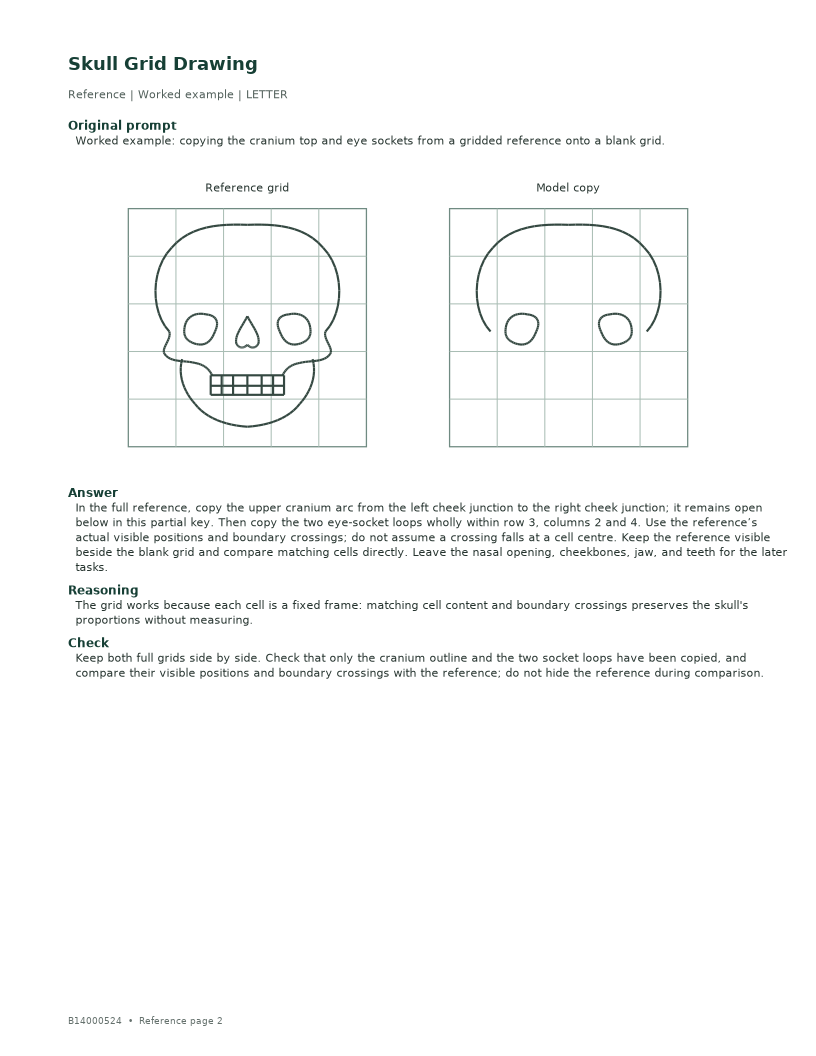
Example: Worked example: copying the cranium top and eye sockets from a gridded reference onto a blank grid.
Answer: In the full reference, copy the upper cranium arc from the left cheek junction to the right cheek junction; it remains open below in this partial key. Then copy the two eye-socket loops wholly within row 3, columns 2 and 4. Use the reference’s actual visible positions and boundary crossings; do not assume a crossing falls at a cell centre. Keep the reference visible beside the blank grid and compare matching cells directly. Leave the nasal opening, cheekbones, jaw, and teeth for the later tasks.
Reasoning: The grid works because each cell is a fixed frame: matching cell content and boundary crossings preserves the skull's proportions without measuring.
Check: Keep both full grids side by side. Check that only the cranium outline and the two socket loops have been copied, and compare their visible positions and boundary crossings with the reference; do not hide the reference during comparison.
Four practice tasks and complete answers
Task 1
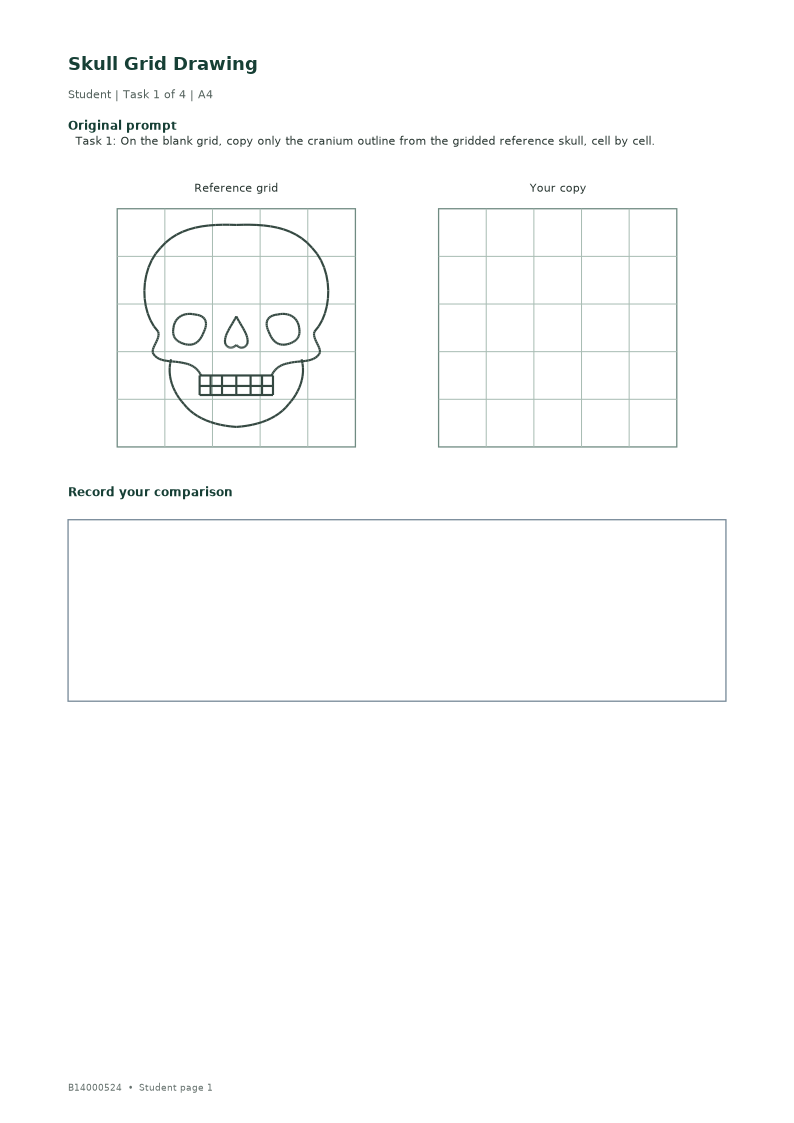
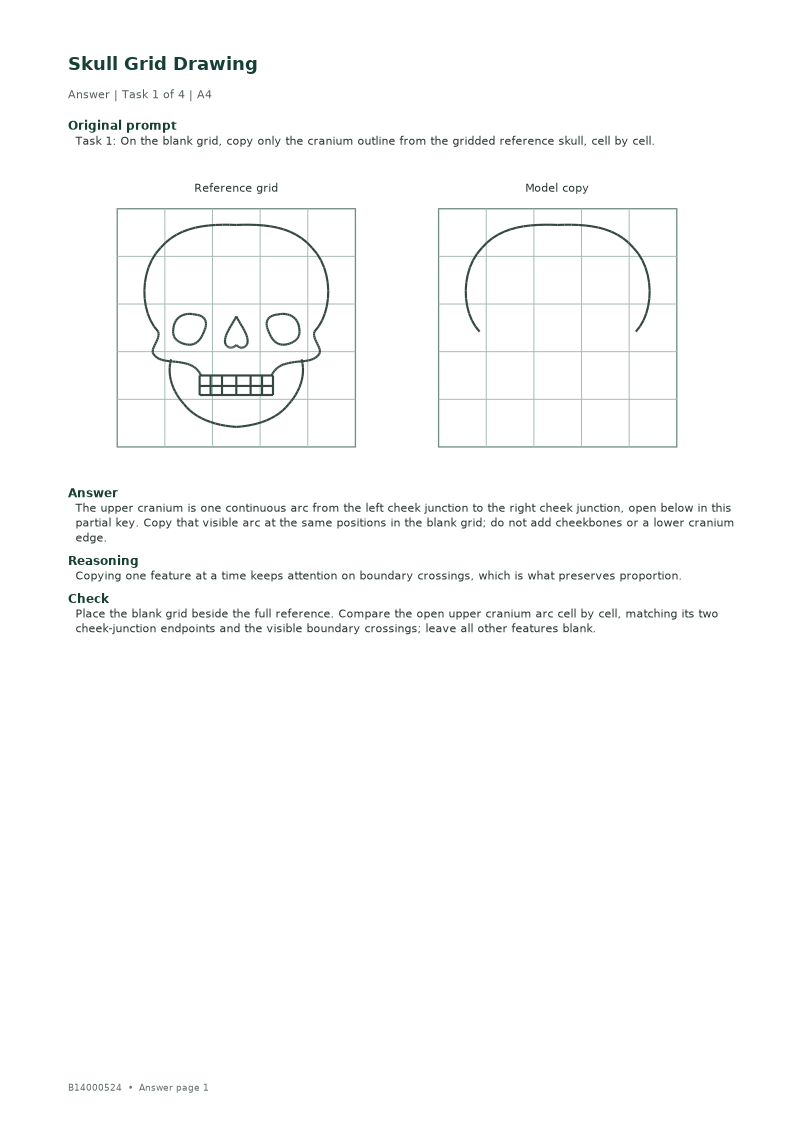
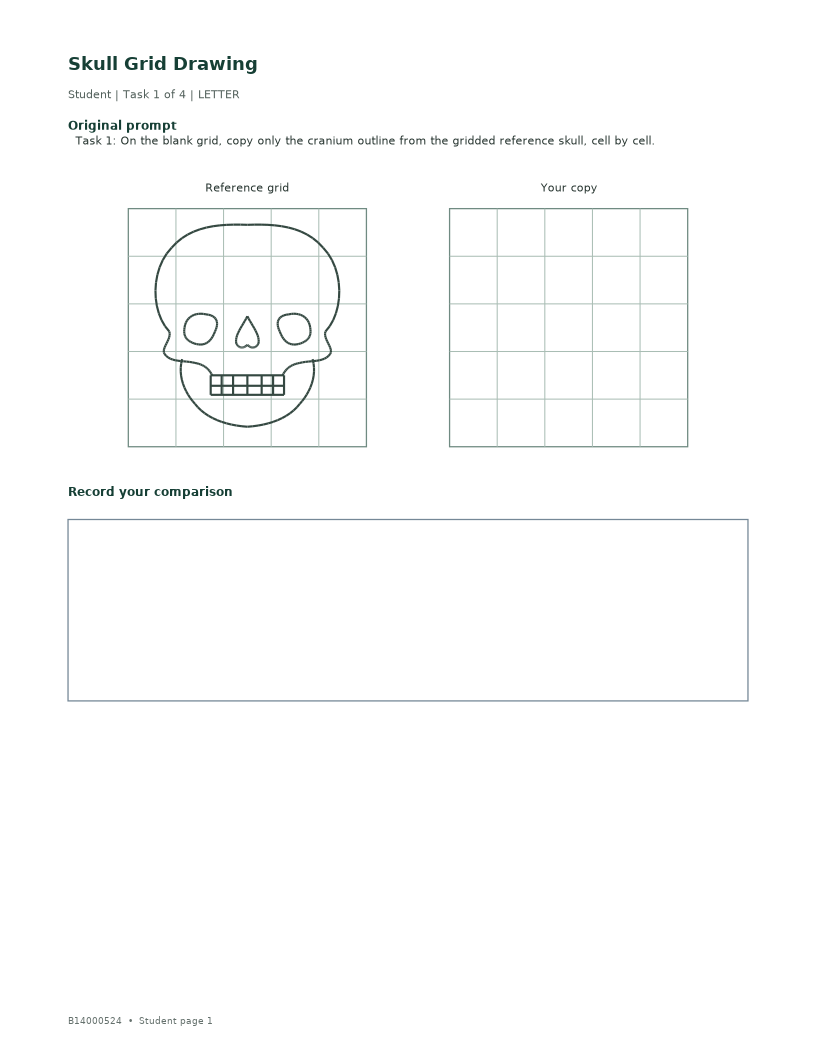
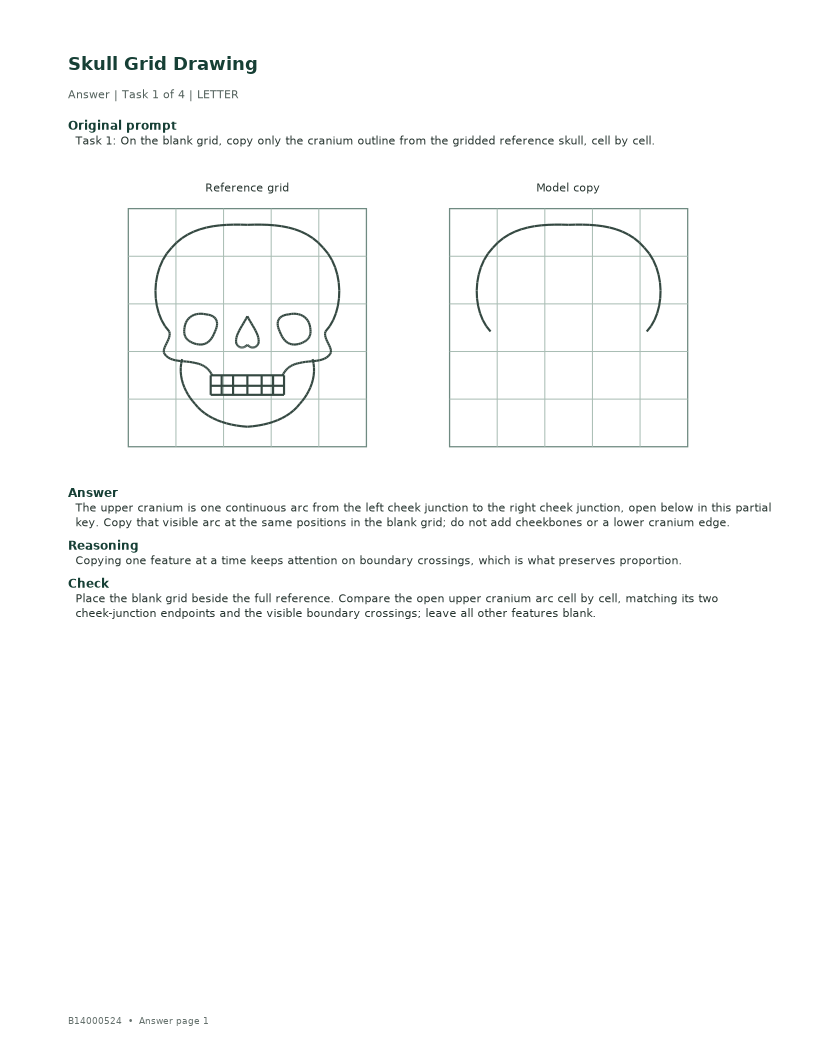
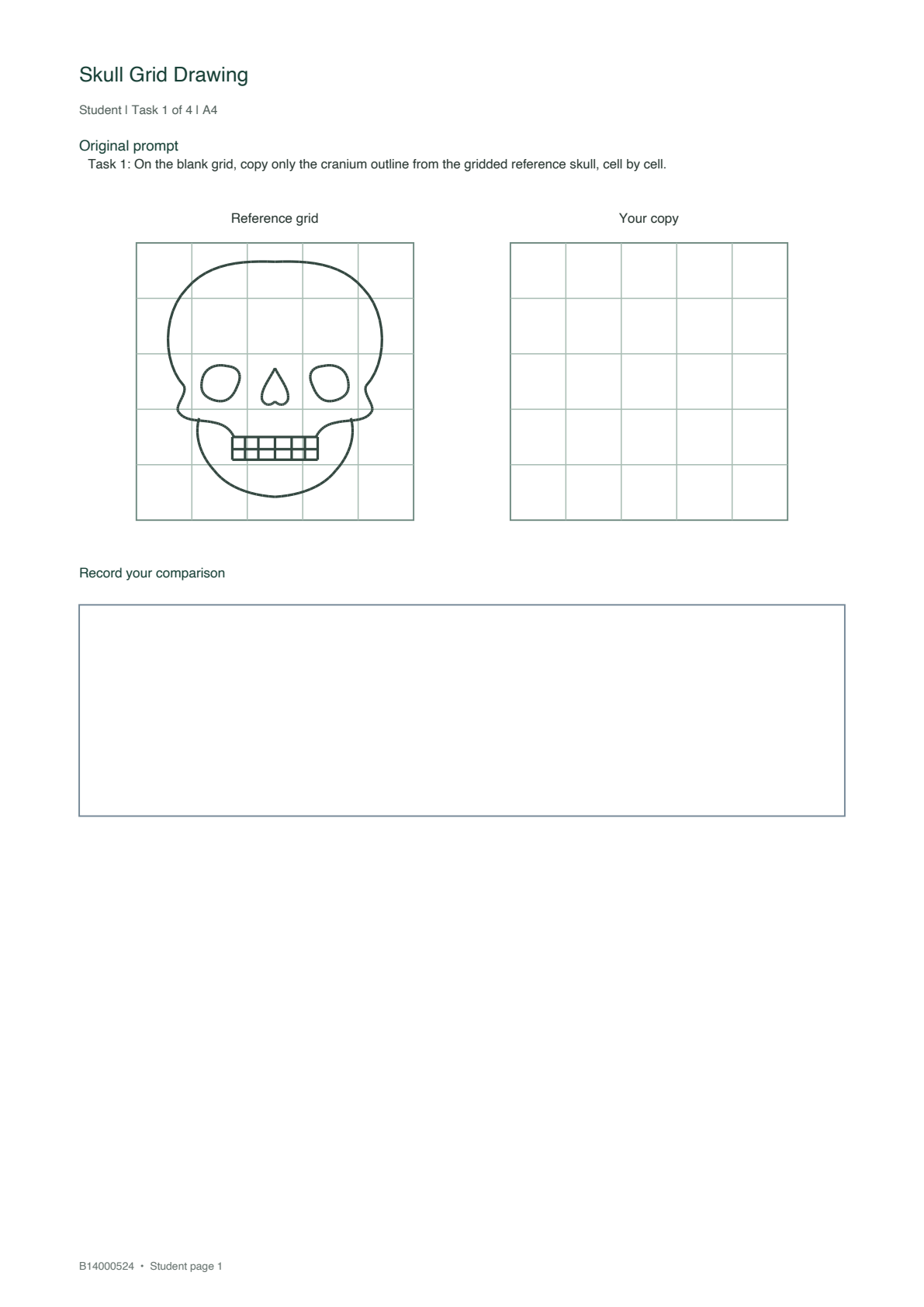
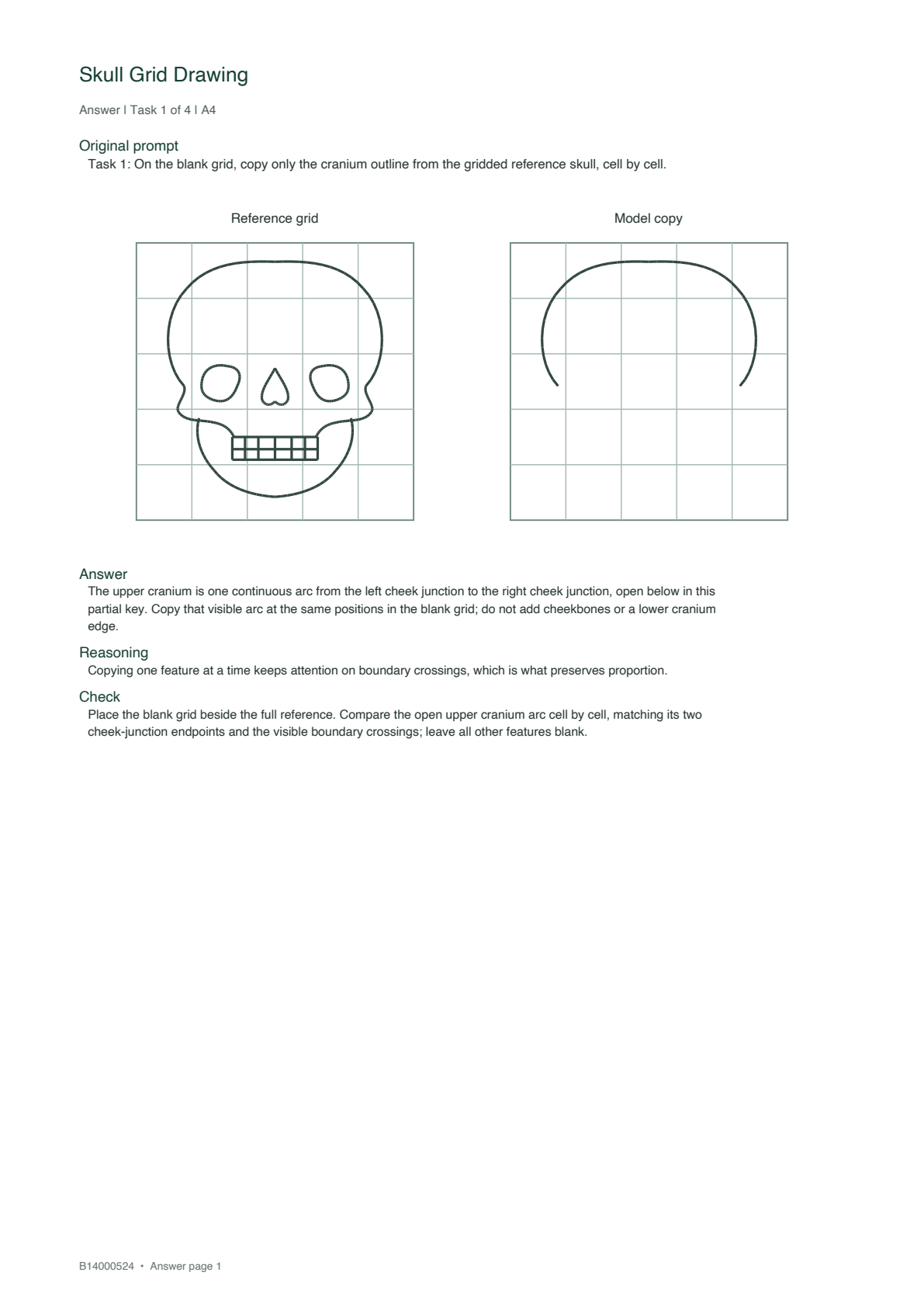
Task 1: On the blank grid, copy only the cranium outline from the gridded reference skull, cell by cell.
Show answer 1
The upper cranium is one continuous arc from the left cheek junction to the right cheek junction, open below in this partial key. Copy that visible arc at the same positions in the blank grid; do not add cheekbones or a lower cranium edge.
Copying one feature at a time keeps attention on boundary crossings, which is what preserves proportion.
Check: Place the blank grid beside the full reference. Compare the open upper cranium arc cell by cell, matching its two cheek-junction endpoints and the visible boundary crossings; leave all other features blank.
Task 2
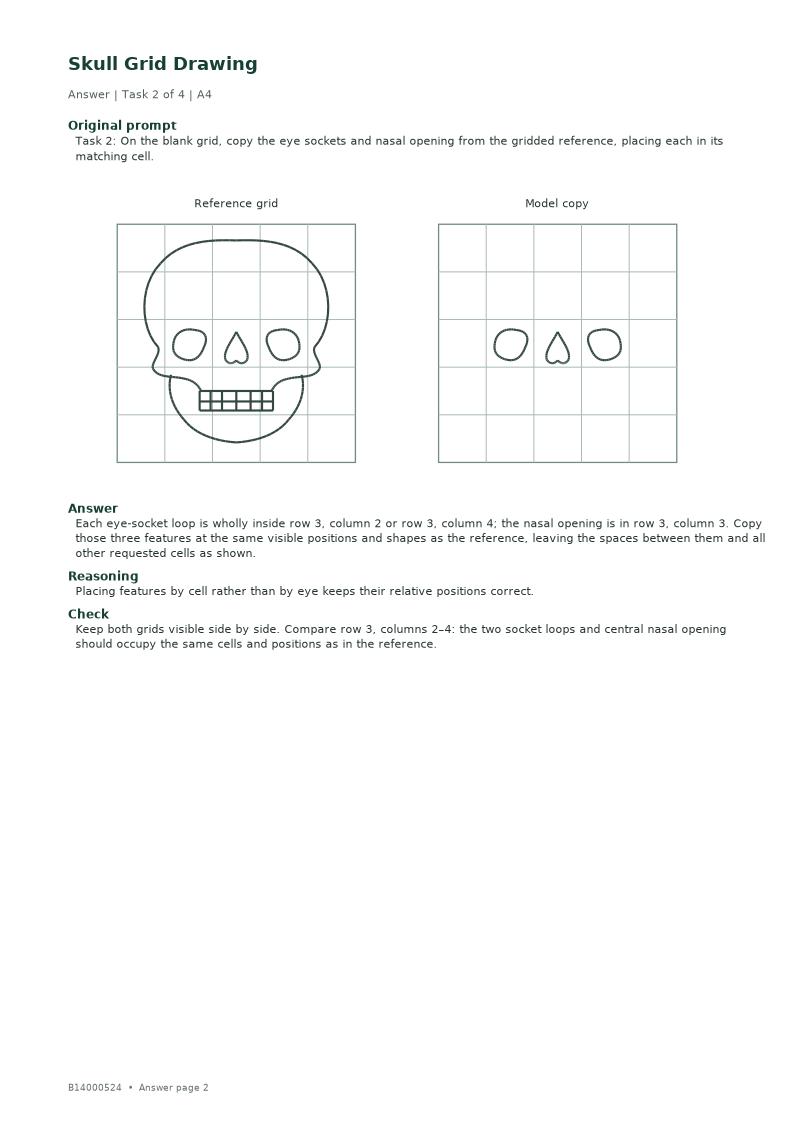
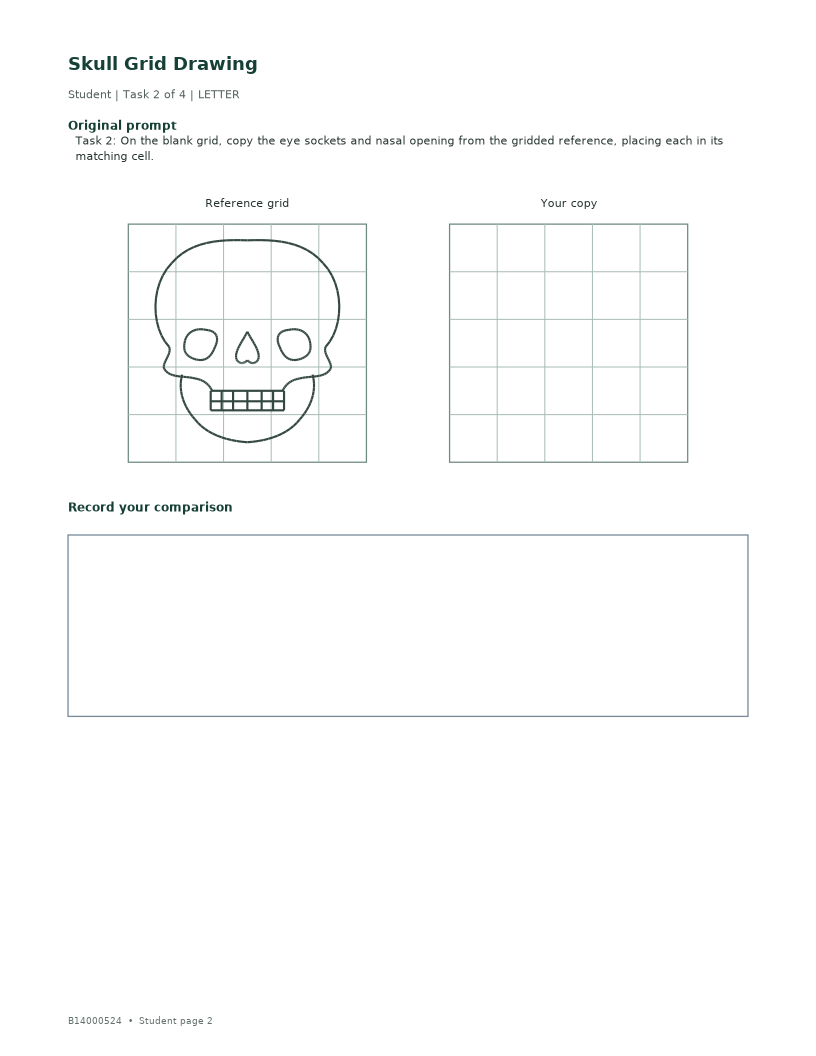
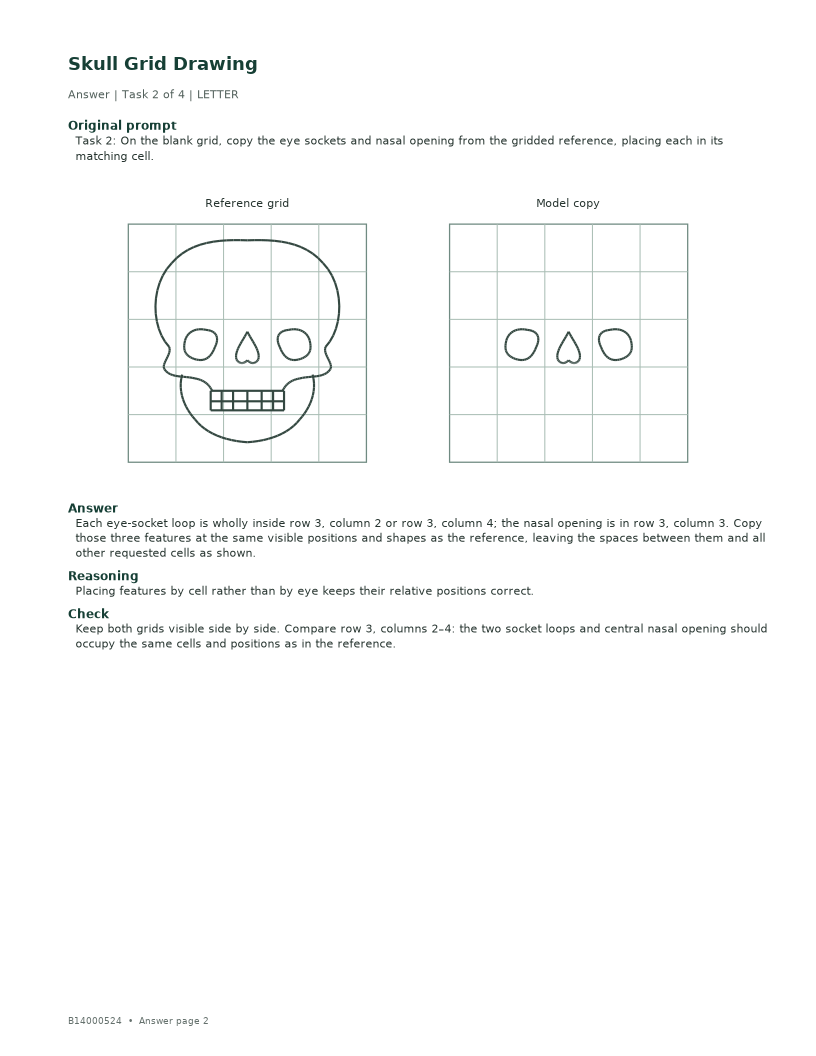
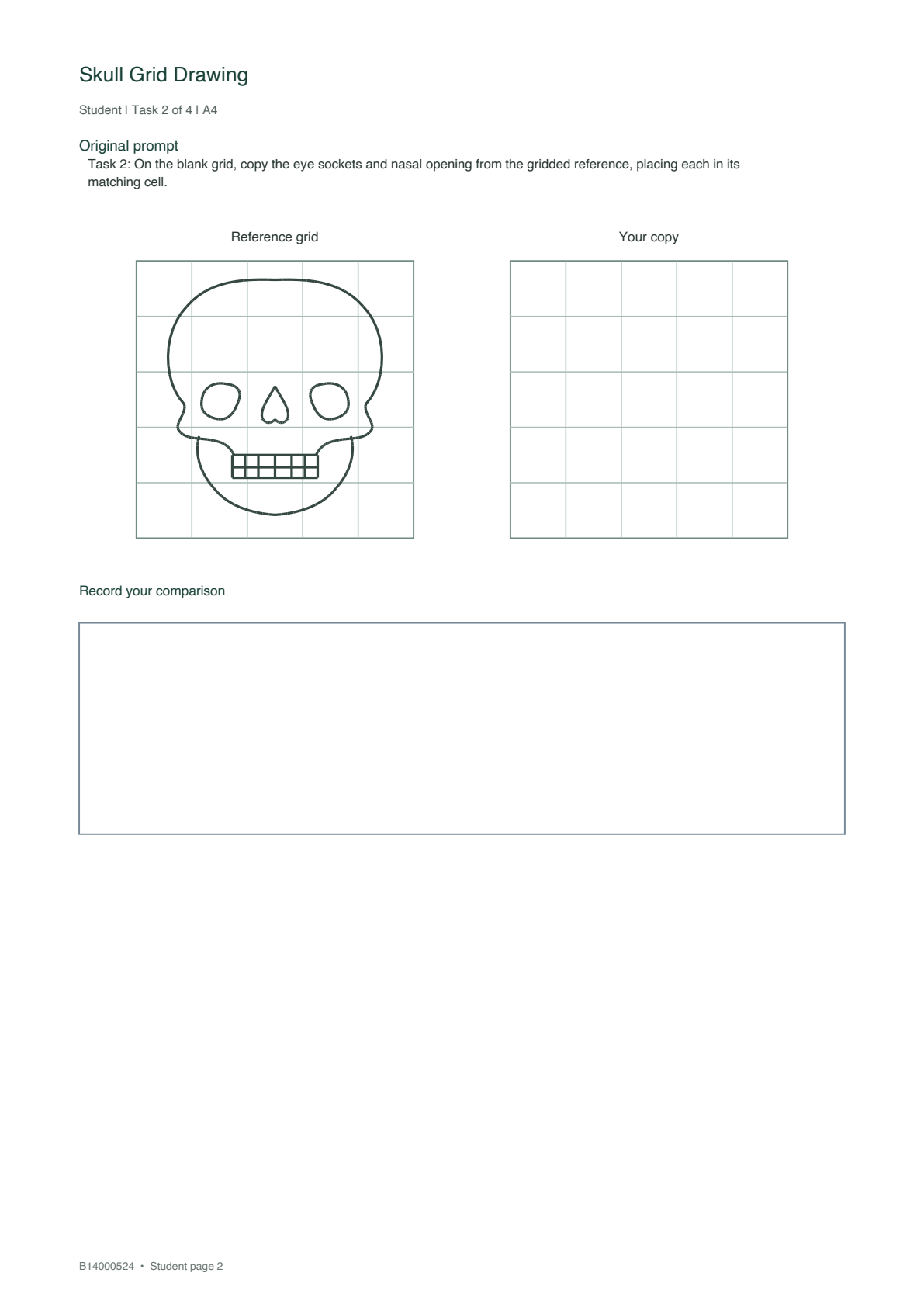
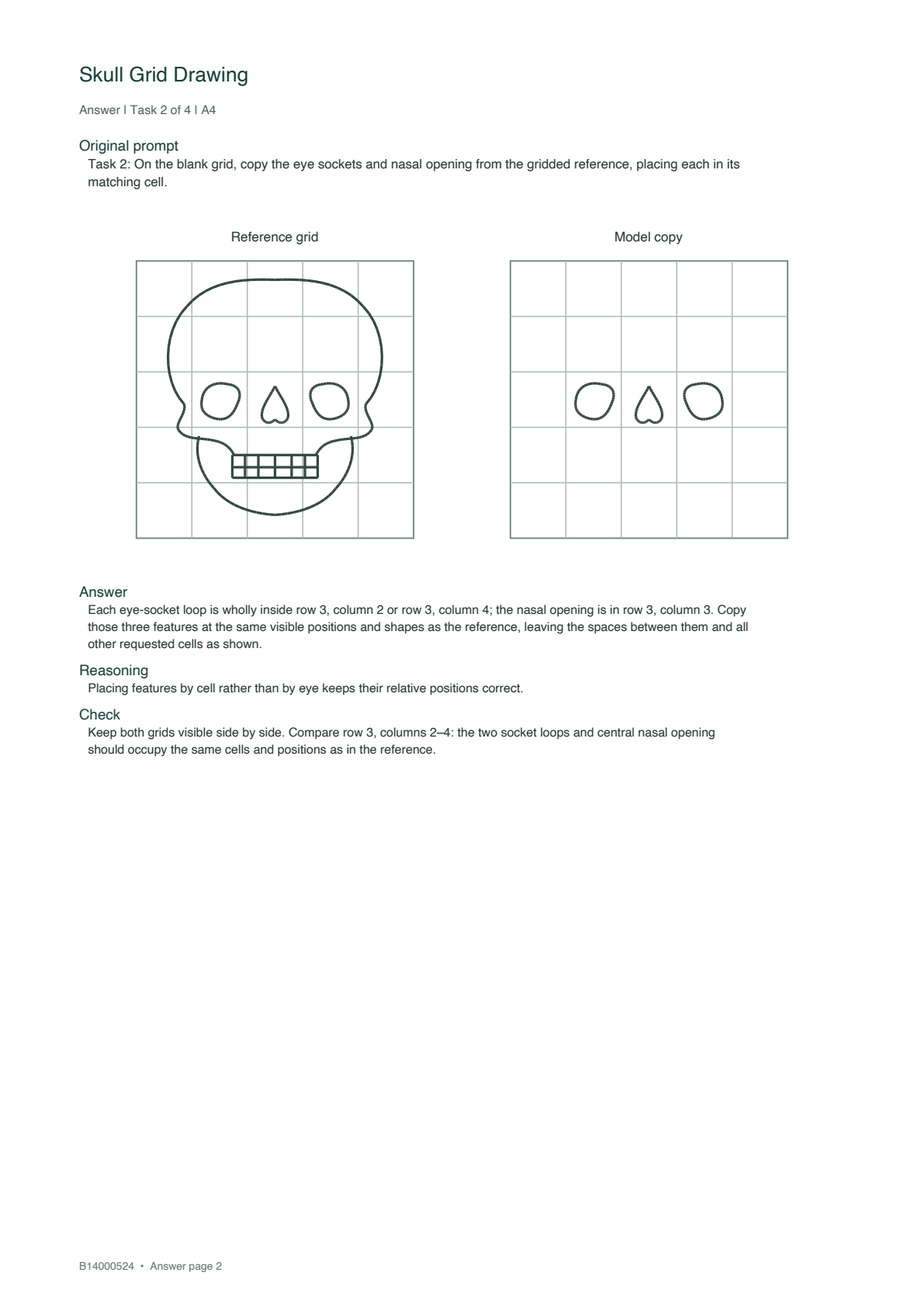
Task 2: On the blank grid, copy the eye sockets and nasal opening from the gridded reference, placing each in its matching cell.
Show answer 2
Each eye-socket loop is wholly inside row 3, column 2 or row 3, column 4; the nasal opening is in row 3, column 3. Copy those three features at the same visible positions and shapes as the reference, leaving the spaces between them and all other requested cells as shown.
Placing features by cell rather than by eye keeps their relative positions correct.
Check: Keep both grids visible side by side. Compare row 3, columns 2–4: the two socket loops and central nasal opening should occupy the same cells and positions as in the reference.
Task 3
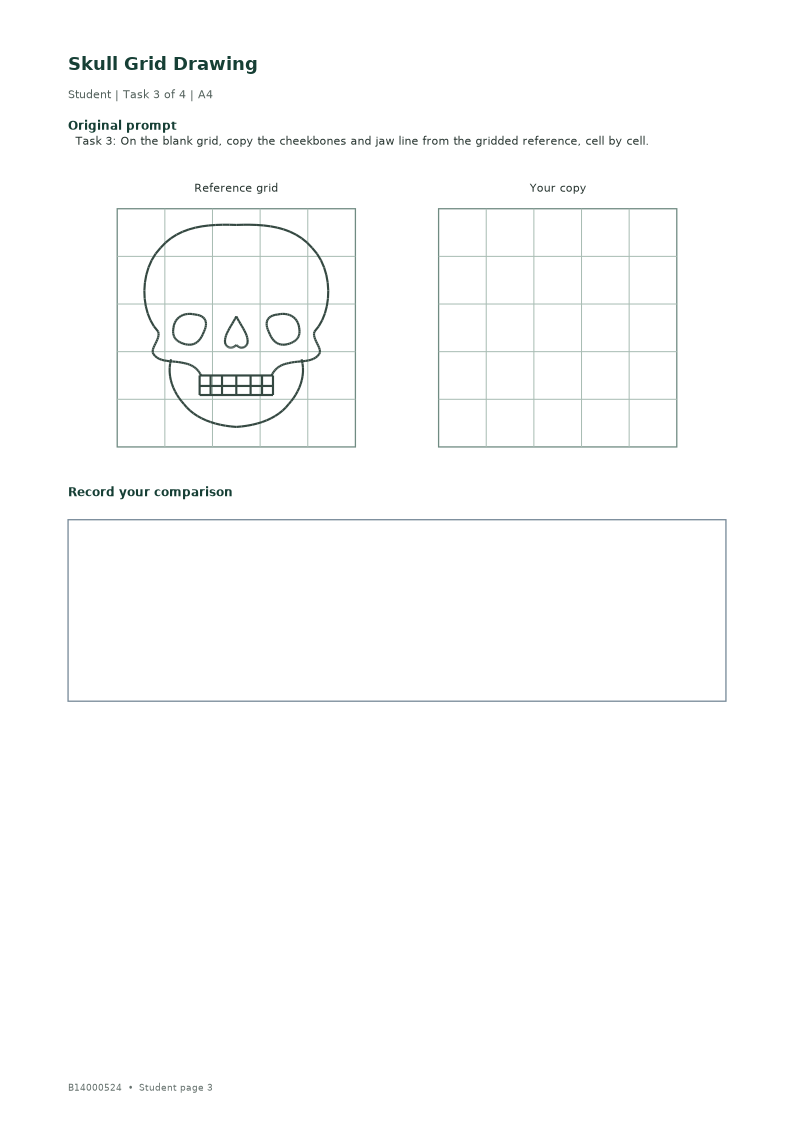
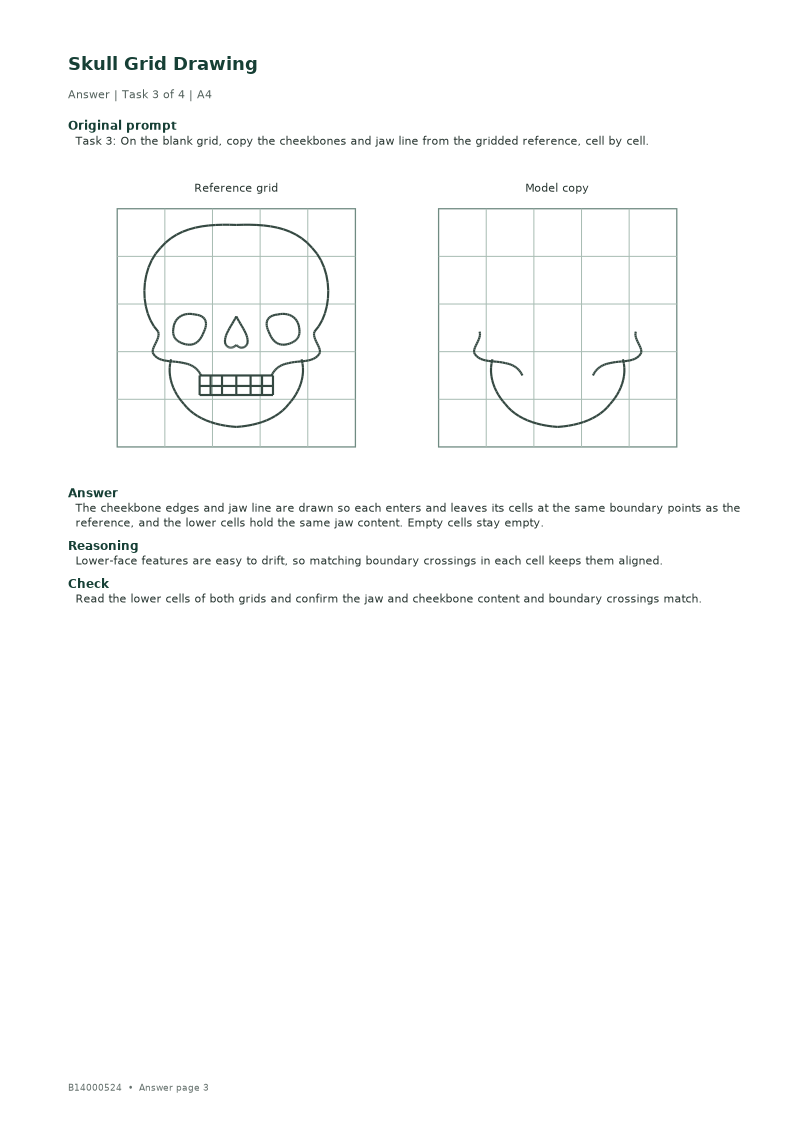
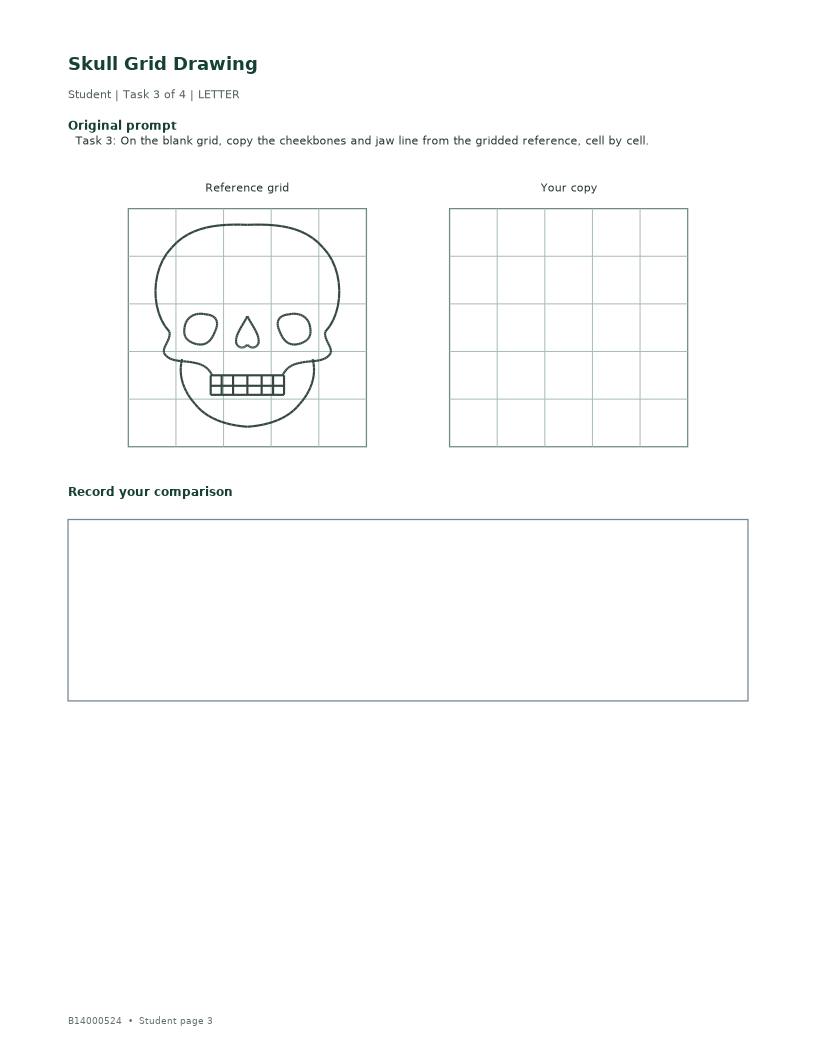
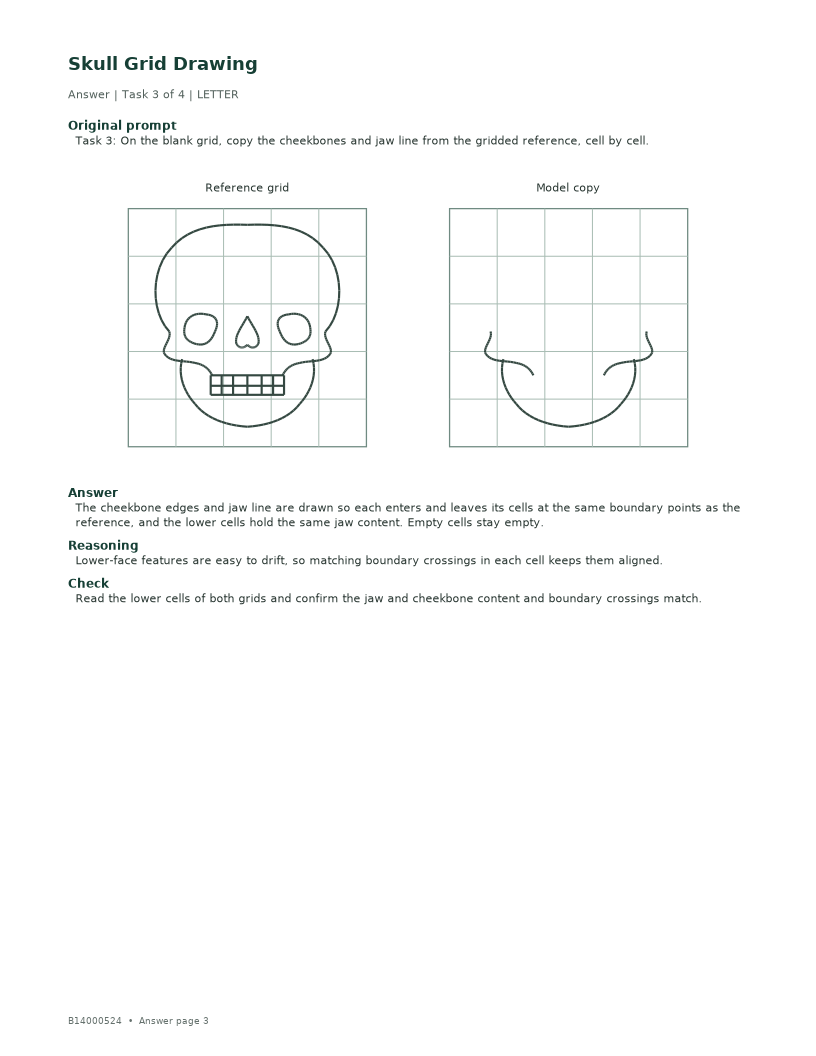
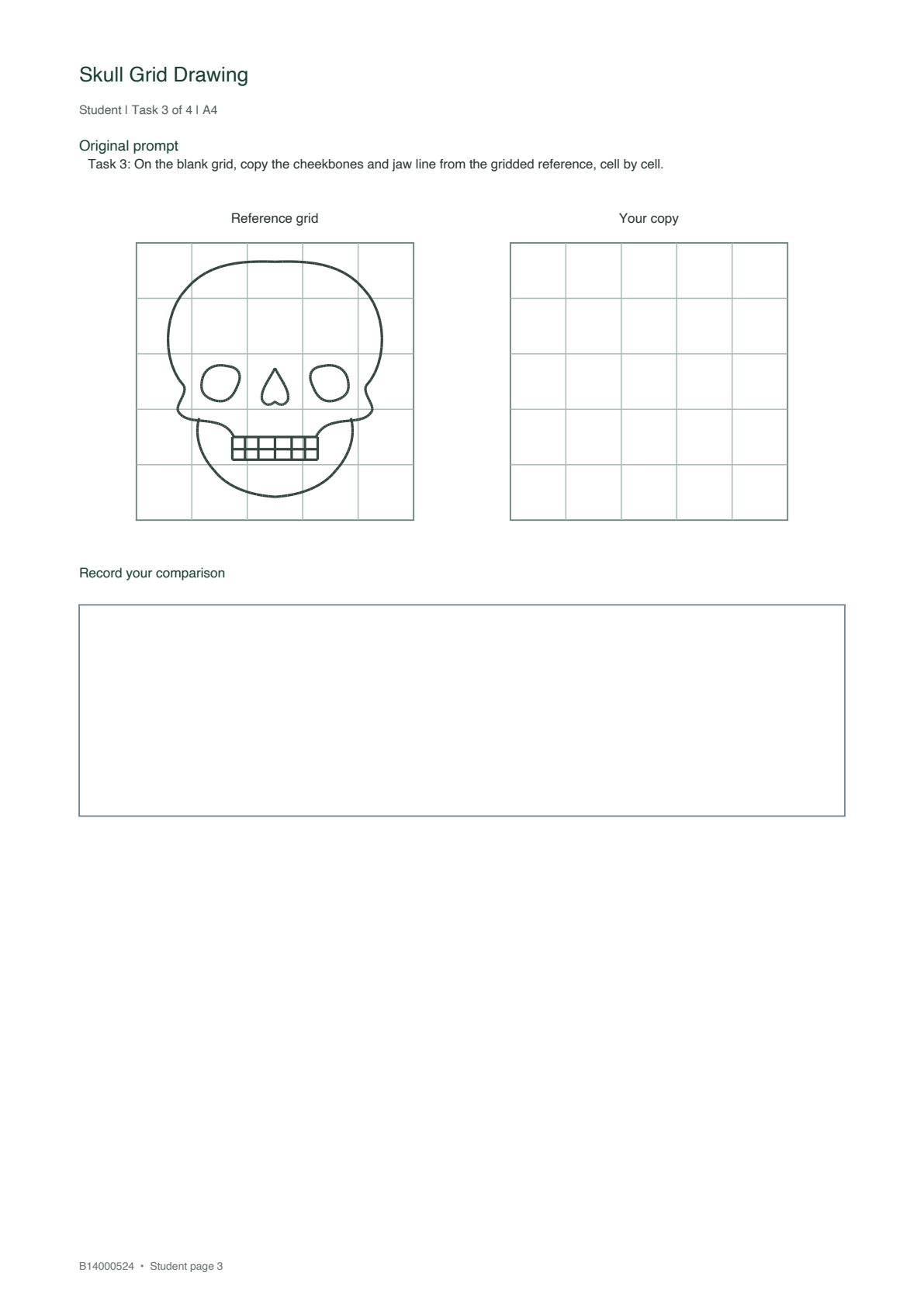
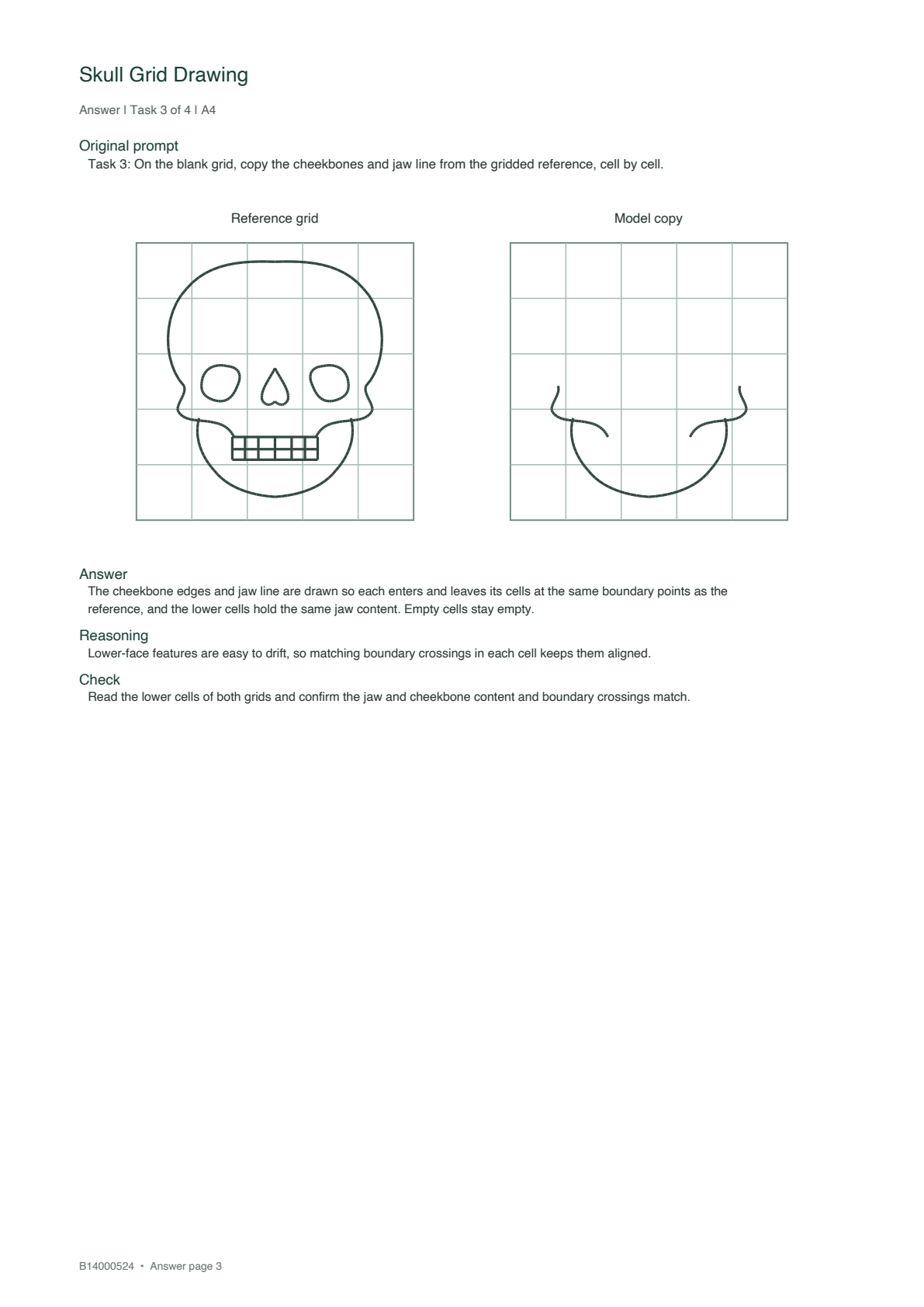
Task 3: On the blank grid, copy the cheekbones and jaw line from the gridded reference, cell by cell.
Show answer 3
The cheekbone edges and jaw line are drawn so each enters and leaves its cells at the same boundary points as the reference, and the lower cells hold the same jaw content. Empty cells stay empty.
Lower-face features are easy to drift, so matching boundary crossings in each cell keeps them aligned.
Check: Read the lower cells of both grids and confirm the jaw and cheekbone content and boundary crossings match.
Task 4
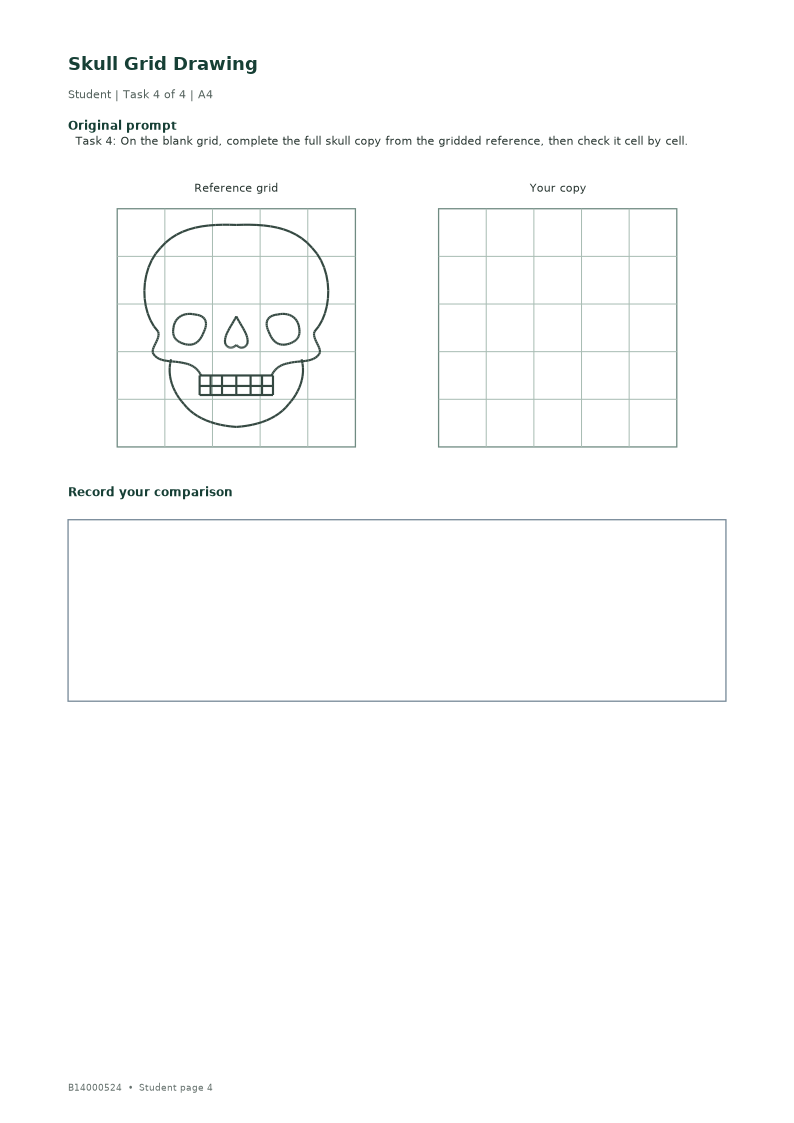
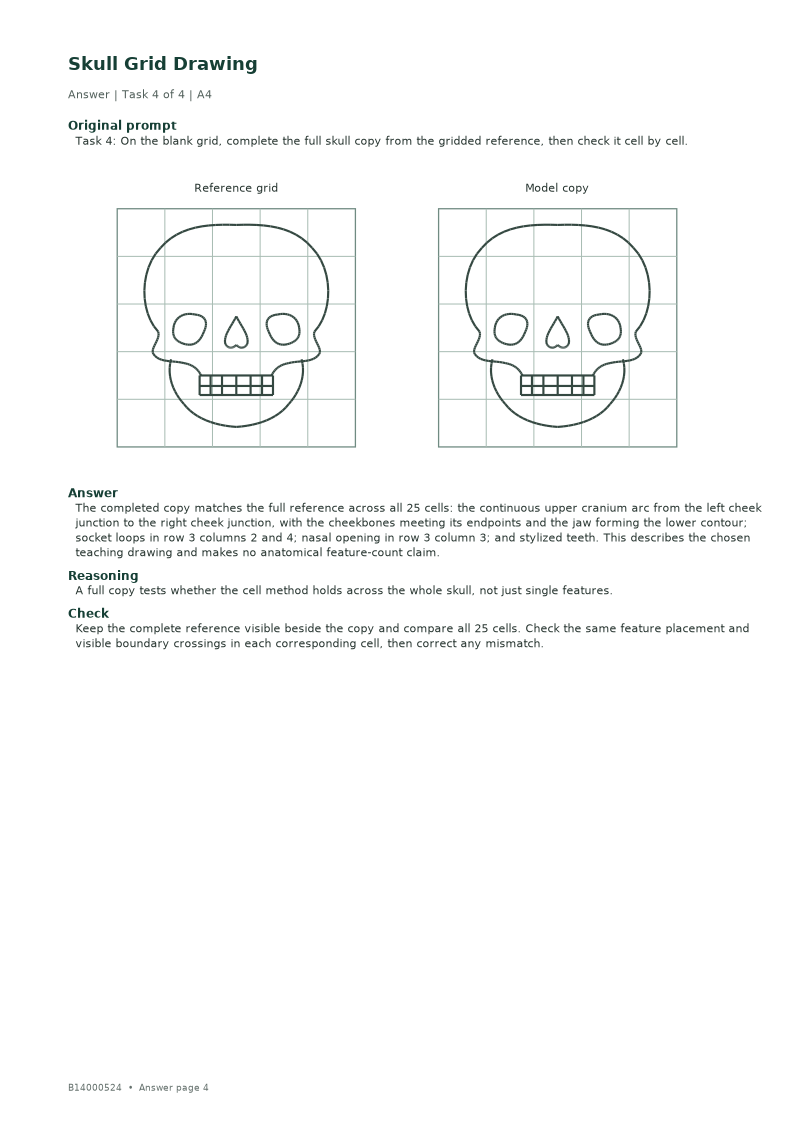
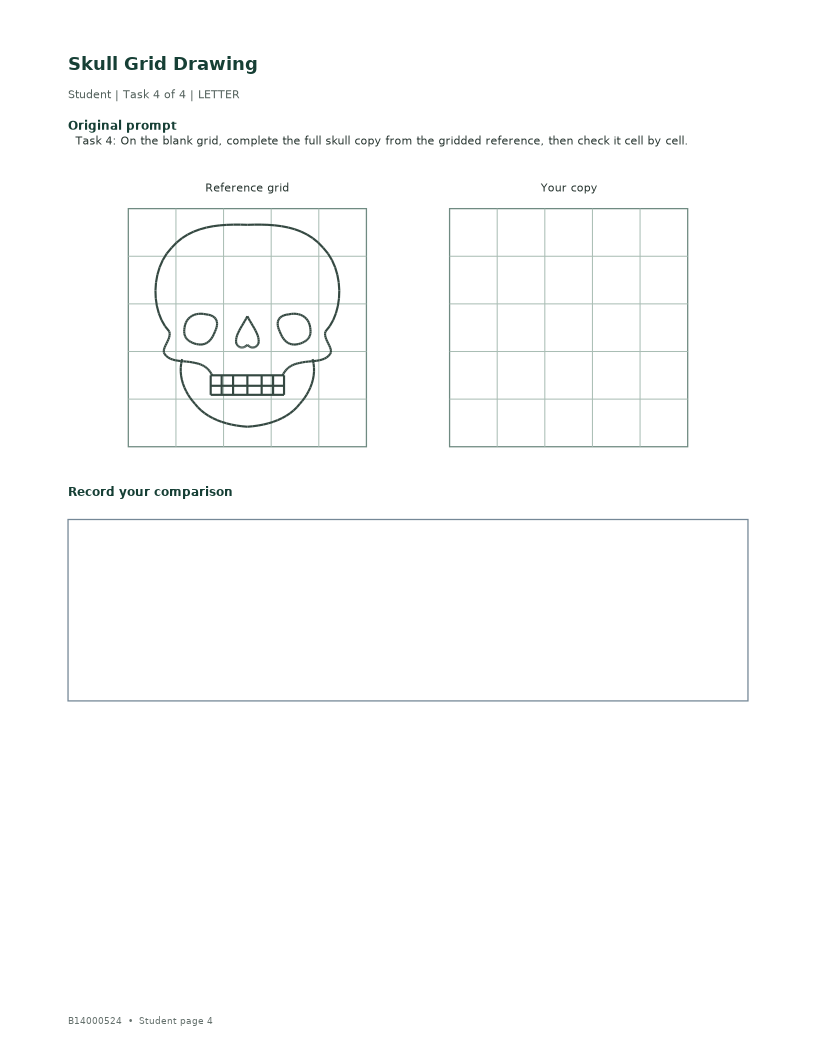
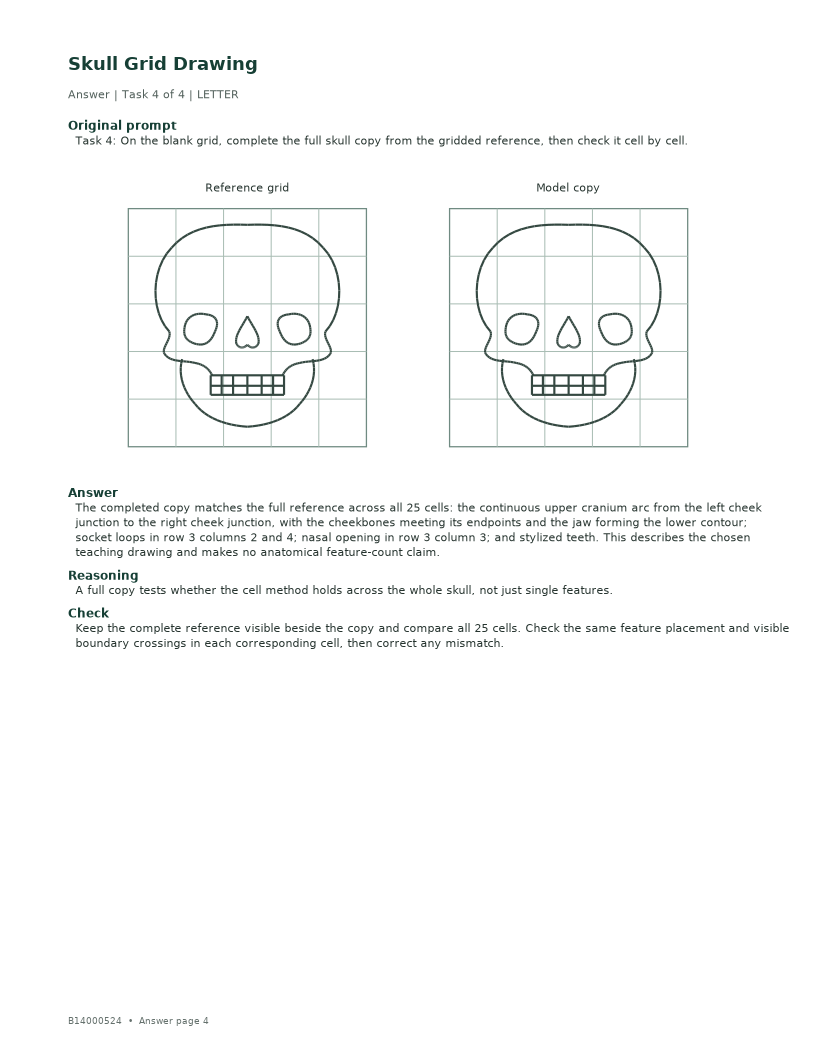
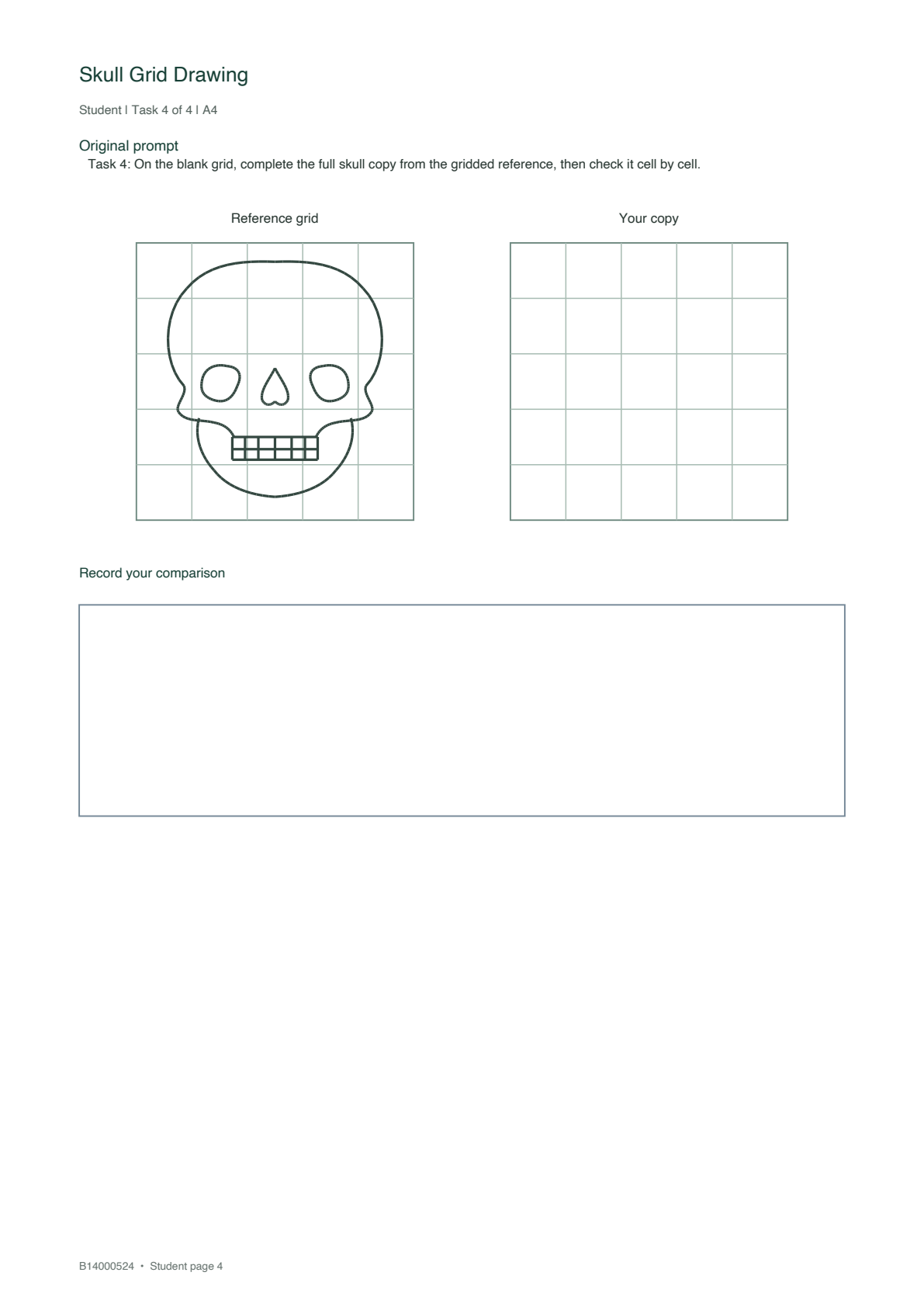
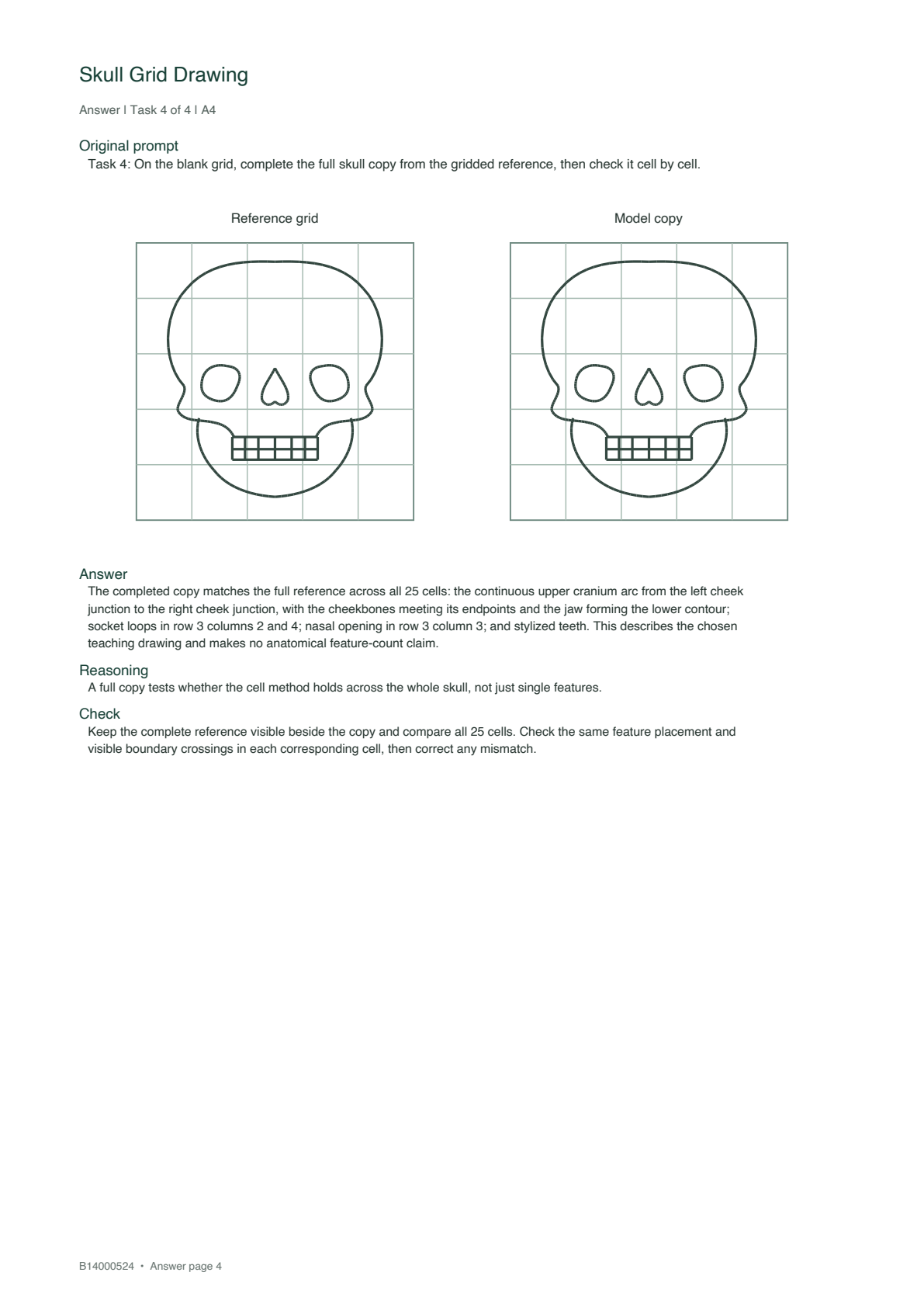
Task 4: On the blank grid, complete the full skull copy from the gridded reference, then check it cell by cell.
Show answer 4
The completed copy matches the full reference across all 25 cells: the continuous upper cranium arc from the left cheek junction to the right cheek junction, with the cheekbones meeting its endpoints and the jaw forming the lower contour; socket loops in row 3 columns 2 and 4; nasal opening in row 3 column 3; and stylized teeth. This describes the chosen teaching drawing and makes no anatomical feature-count claim.
A full copy tests whether the cell method holds across the whole skull, not just single features.
Check: Keep the complete reference visible beside the copy and compare all 25 cells. Check the same feature placement and visible boundary crossings in each corresponding cell, then correct any mismatch.
Useful checks
- Drawing the skull freehand and ignoring the grid cells. Copy one cell at a time, matching where edges enter and leave each cell boundary.
- Smoothing lines across cells before every cell is copied. Finish copying each cell first; smooth only after the cell-by-cell check passes.
- Placing a feature by eye instead of in its matching cell. Locate each feature by its cell on the reference, then draw it in the same cell on the blank grid.
Questions about this resource
Do I need to measure anything?
No. The grid cells are the frame; you match cell content and boundary crossings rather than measuring lengths.
What makes a copy correct?
Each cell on the blank grid holds the same skull content as the reference cell, and edges cross cell boundaries at the same points.