Free original lessons
Tiger Grid Drawing
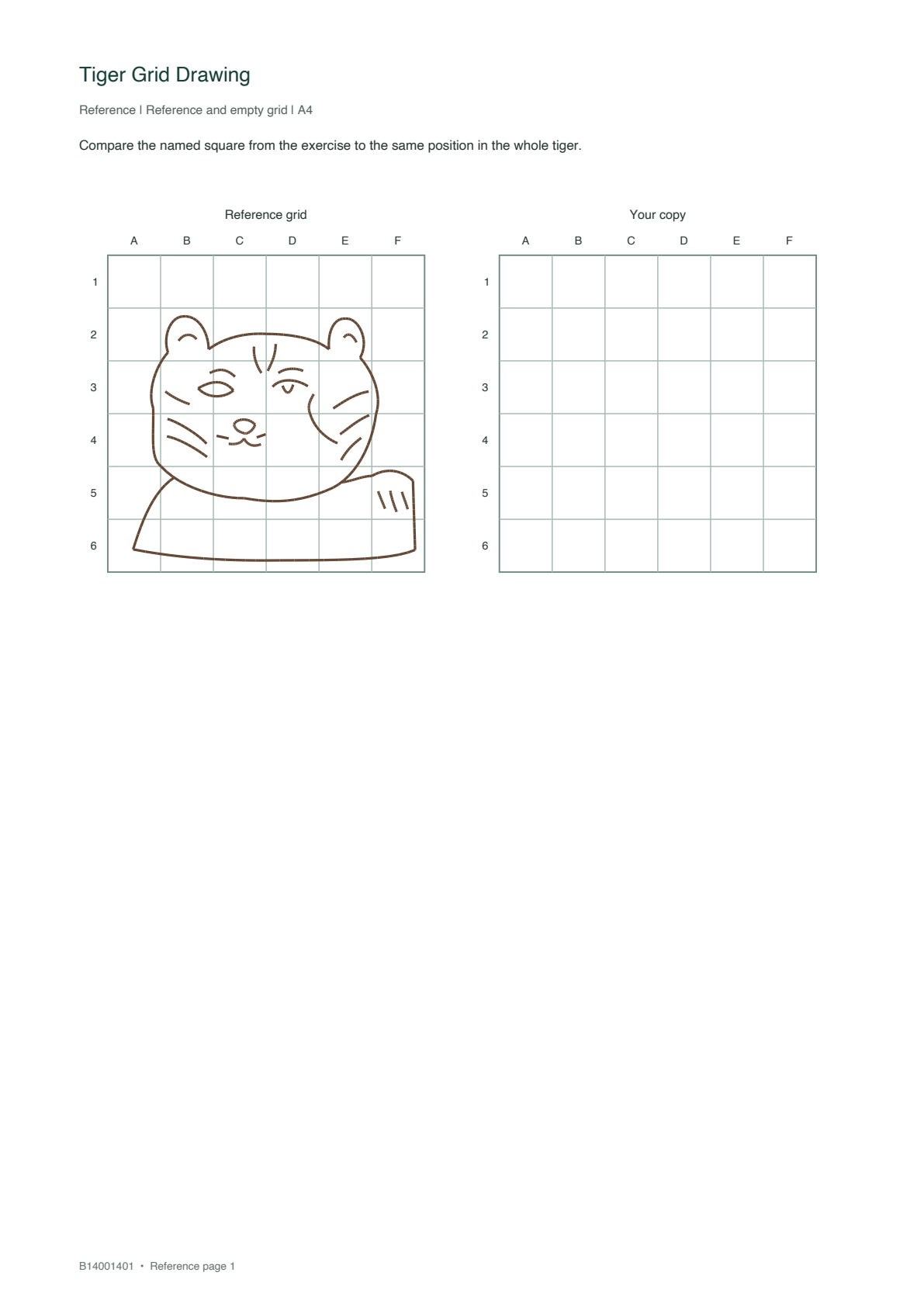
Grid copying means drawing one square at a time instead of trying to copy the whole tiger at once. You look at what crosses each square of the reference, draw only that part in the matching square of your blank grid, and check the result against the reference before moving on.
Letter & A4
PDF & SVG
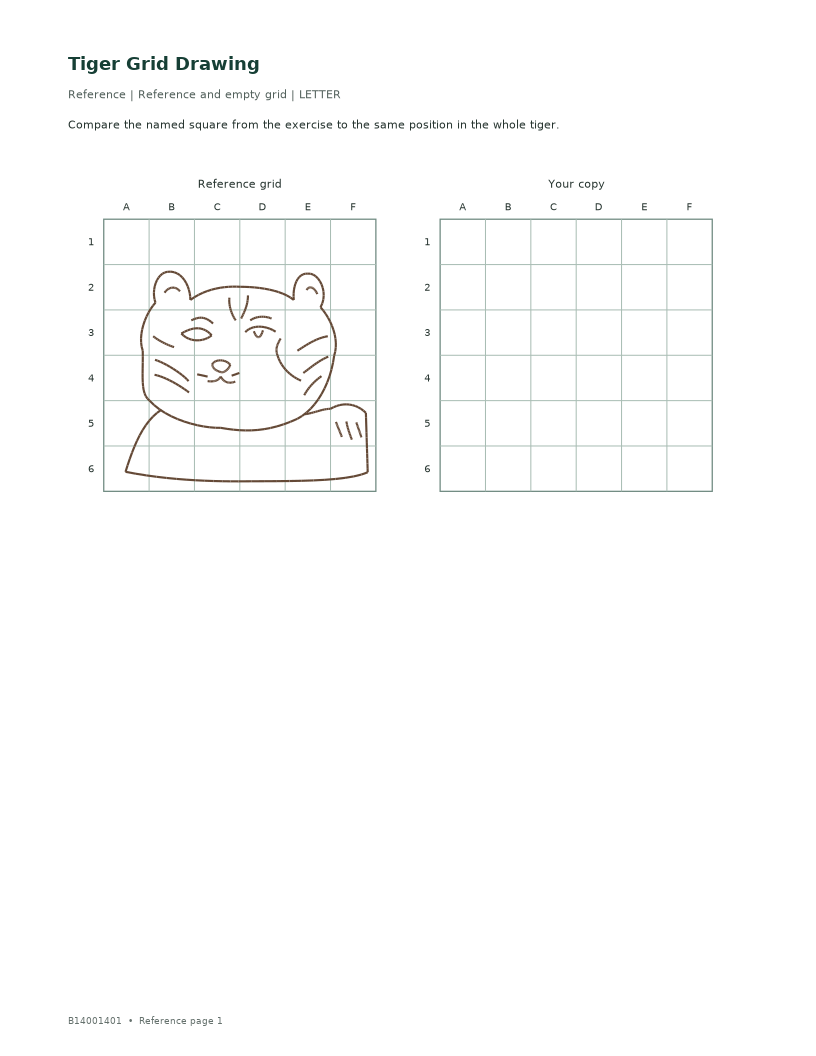
What a tiger grid-copy puzzle is
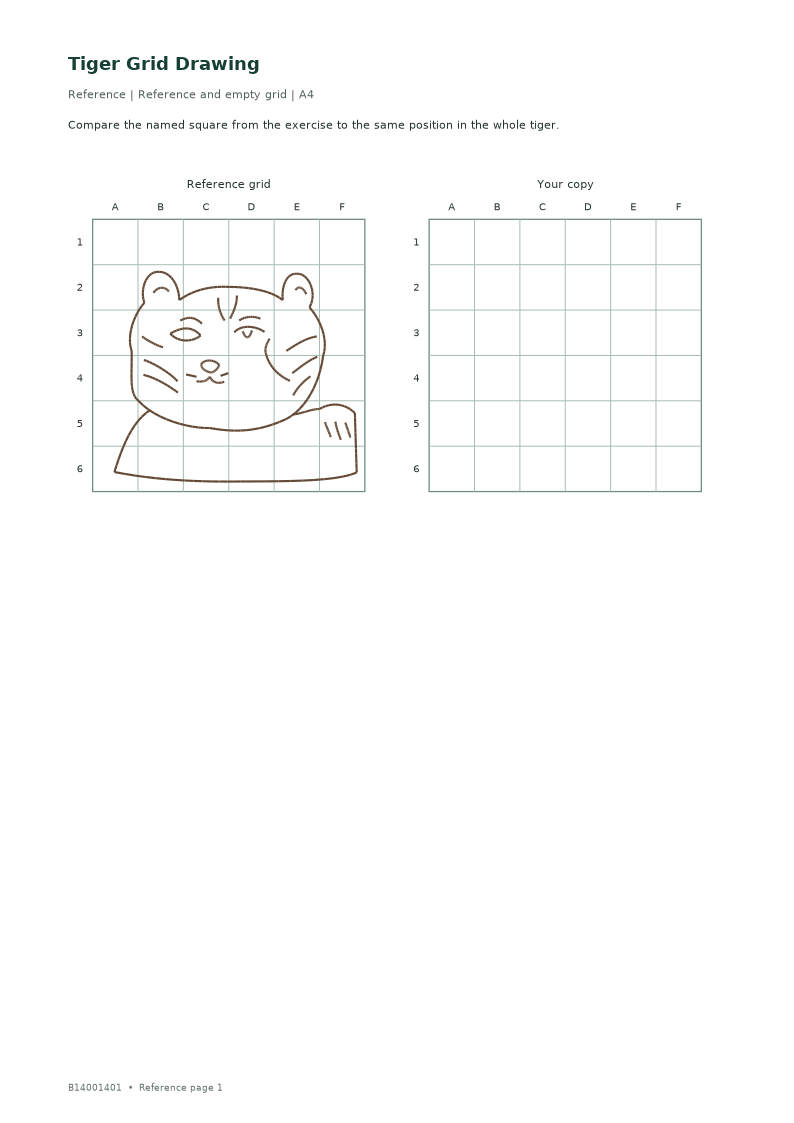
A tiger grid-copy puzzle gives you a reference picture of a tiger divided into squares, plus an empty grid with the same number of squares. Your job is to redraw the tiger square by square so the finished drawing matches the reference.
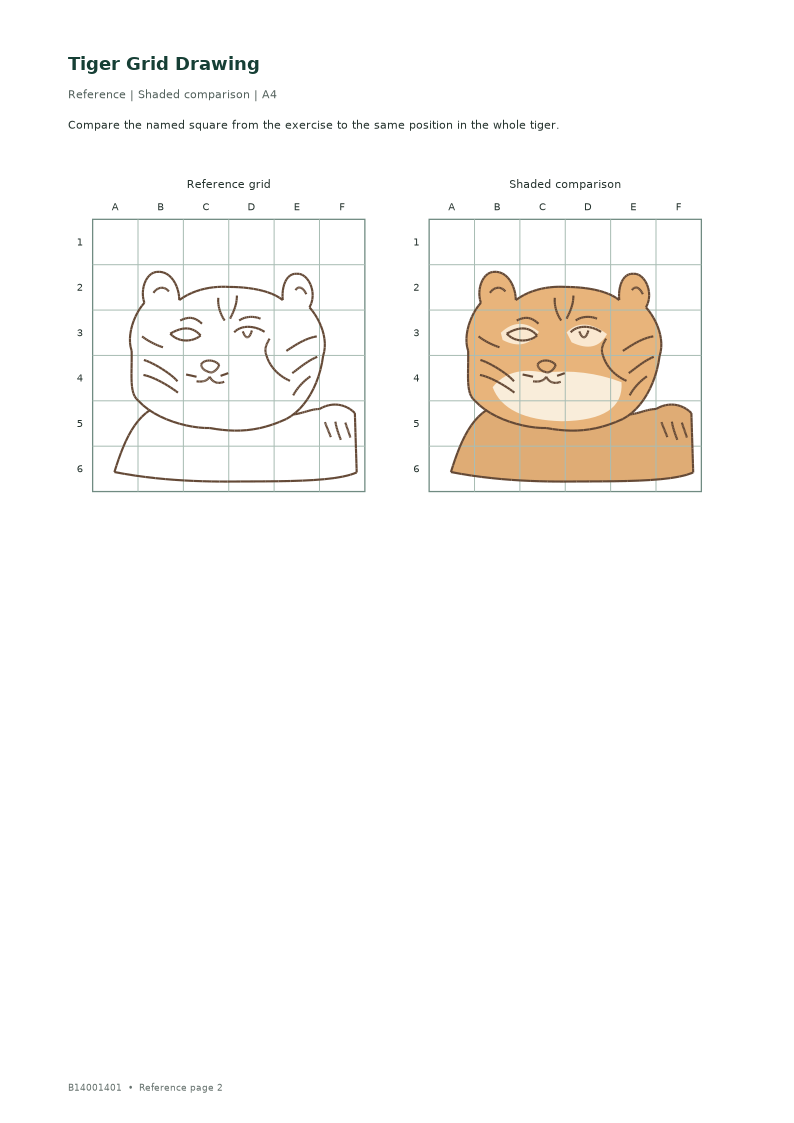
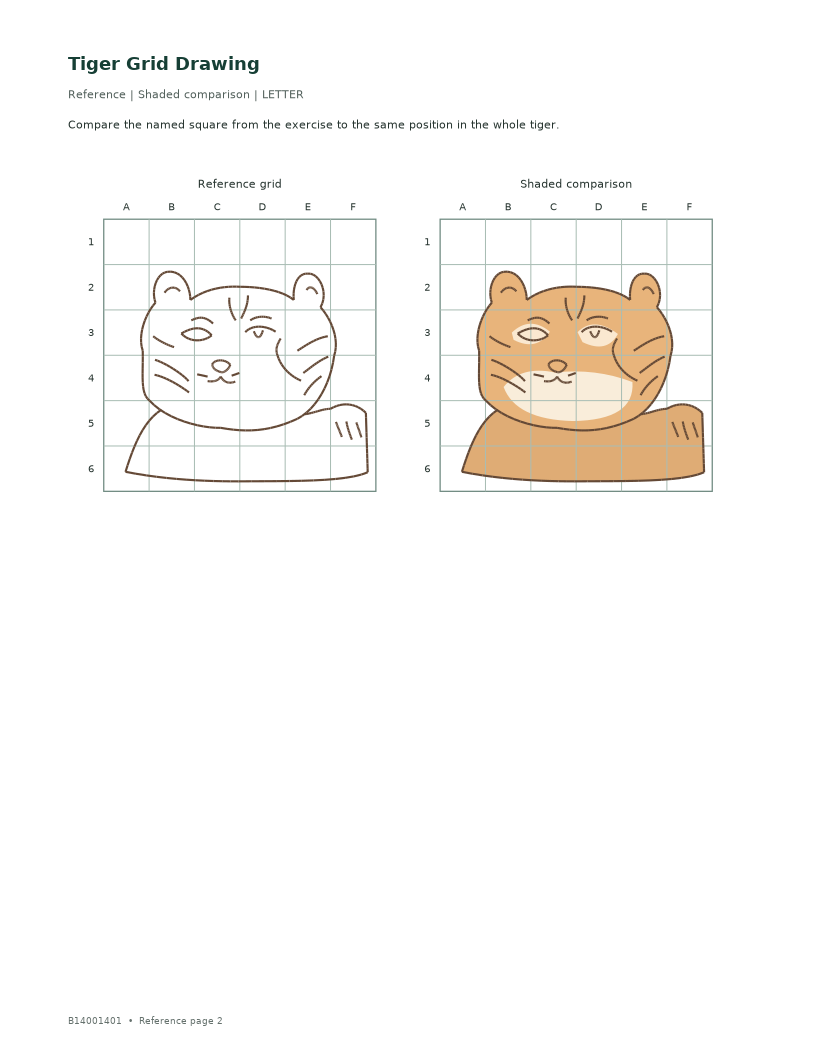
Use the letters across the top and numbers down the side to find each cell. The eye study uses D3. The four practice studies use B2, C4, B4 and F5. The shaded answer key shows one correct completed grid so you can compare your own work.
How to copy a tiger square by square
Step 1: Find the named square on the reference. Copy the marks asked for in the task. A neighboring contour can appear in the source crop because it continues from another part of the tiger. The model illustrates the selected features.
Step 2: Find the same square on your blank grid and draw only that content, starting with the largest shape and adding the smaller lines after it. Keep the drawing inside the square's edges unless the reference line clearly crosses into the next square.
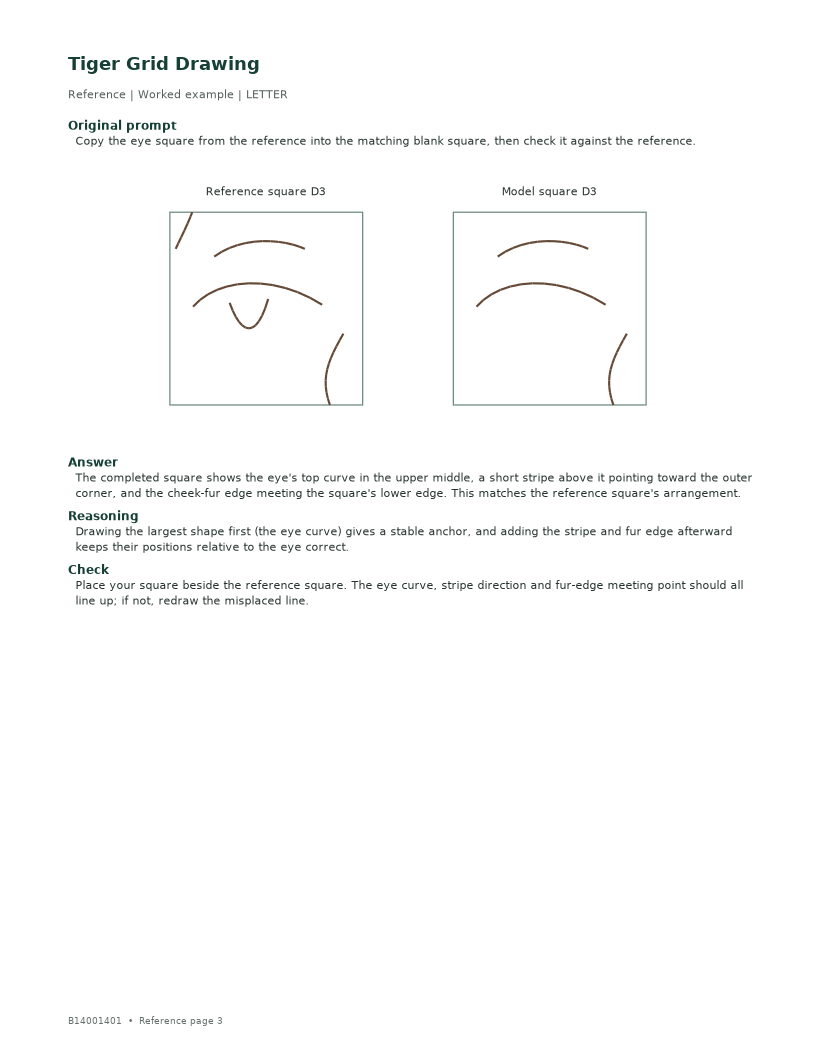
Worked example: copying the eye square
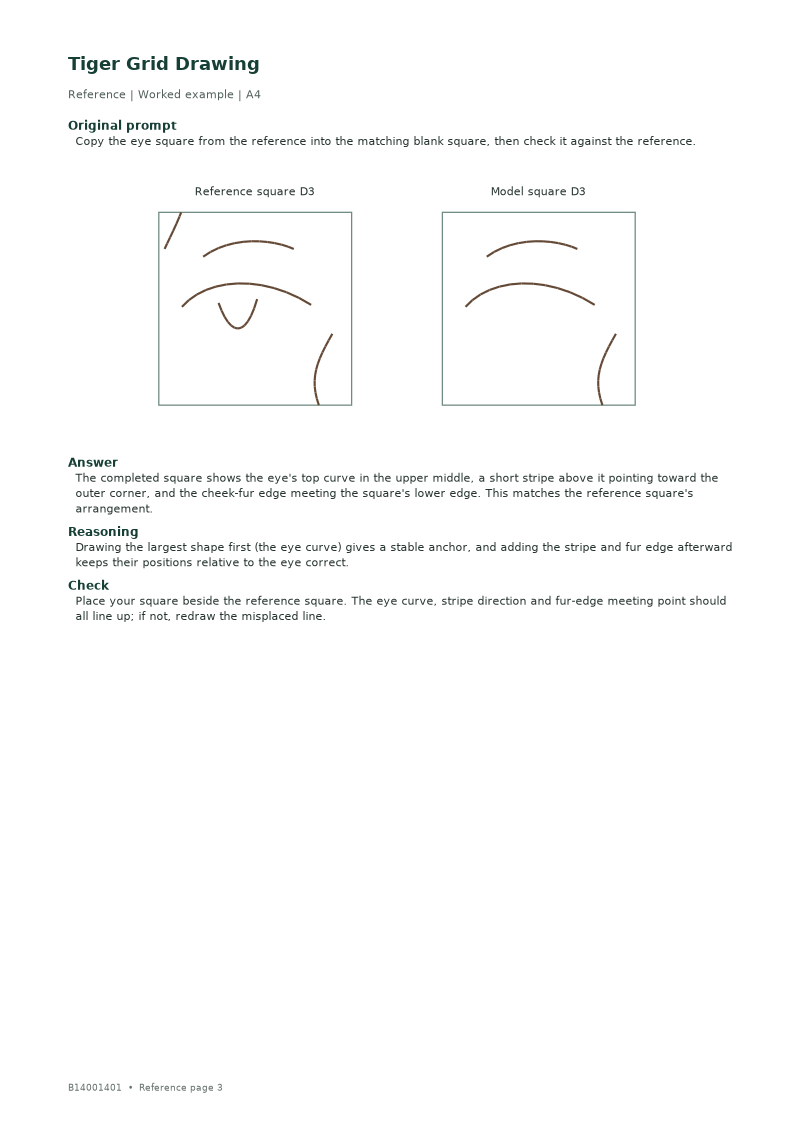
The reference square D3 contains the top of the eye on the tiger's left, a short dark stripe above it and the edge of the light cheek fur. In the matching blank square, first draw the eye's top curve, then the stripe and fur edge. The tiger's left appears on the right side as you look at the printed reference.
Check: compare your square with the reference square. The eye curve should sit in the same part of the square, the stripe should point the same way, and the fur edge should meet the square's edge at the same place. If any of these is off, adjust that line before continuing to the next square.
Practice tasks
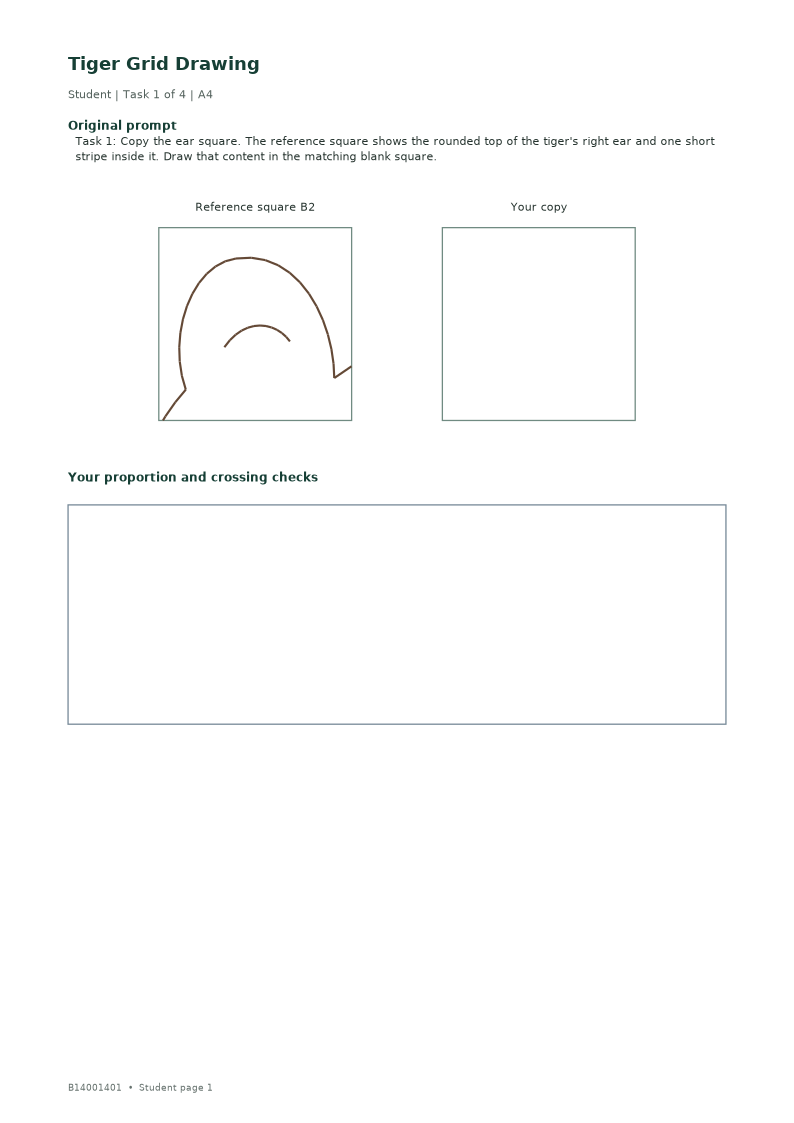
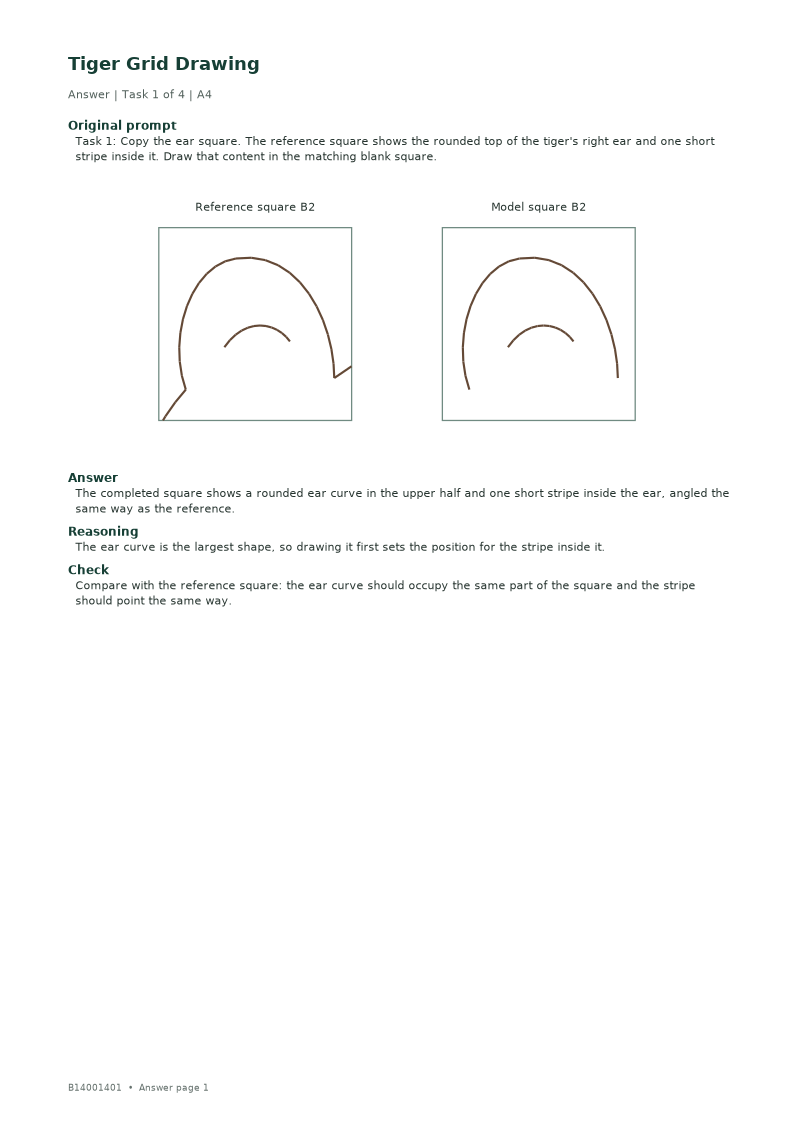
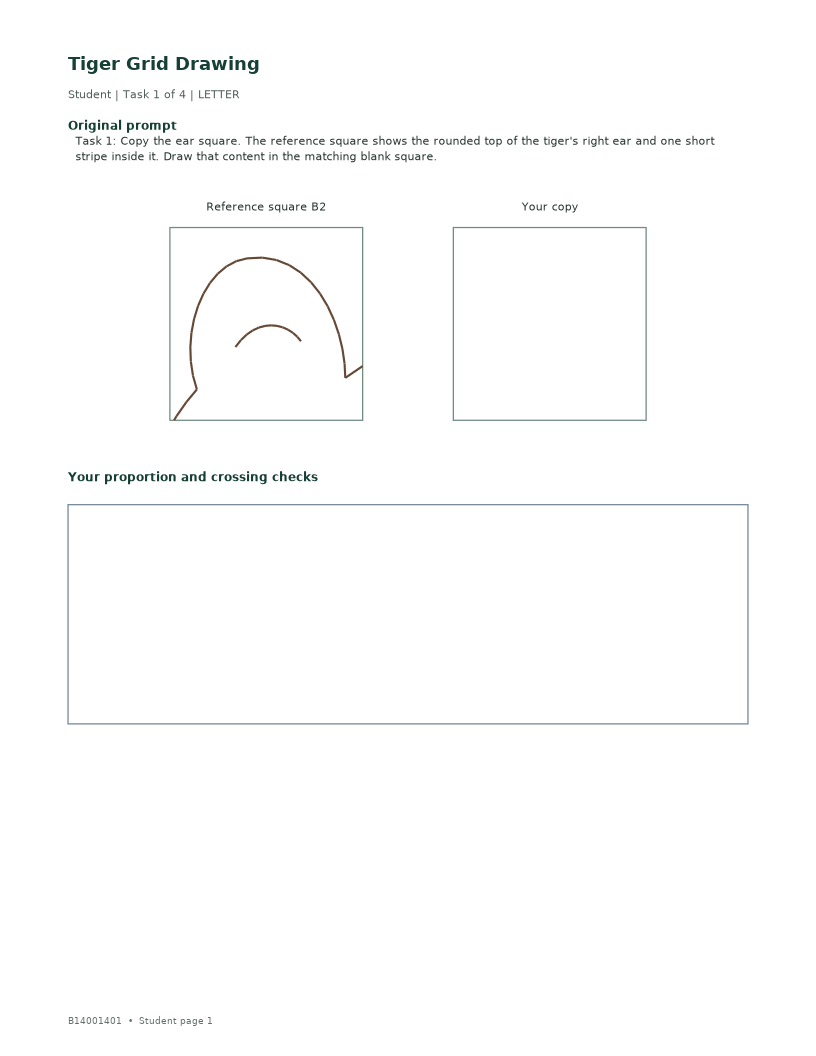
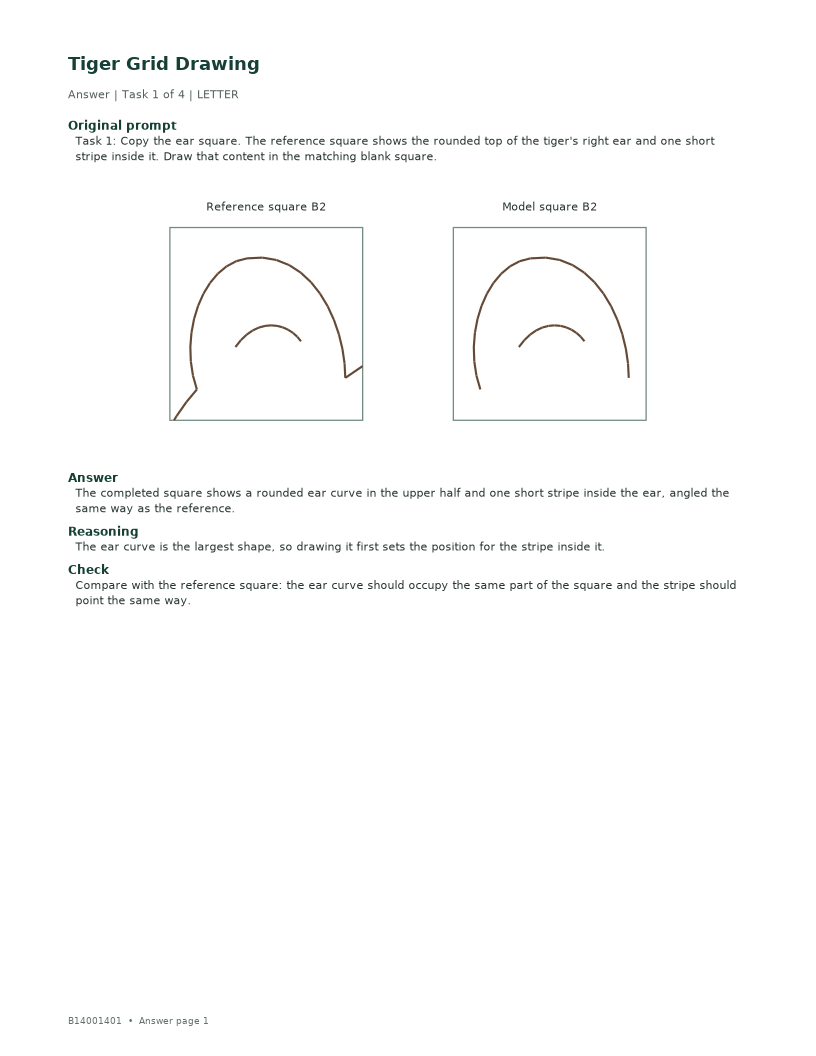
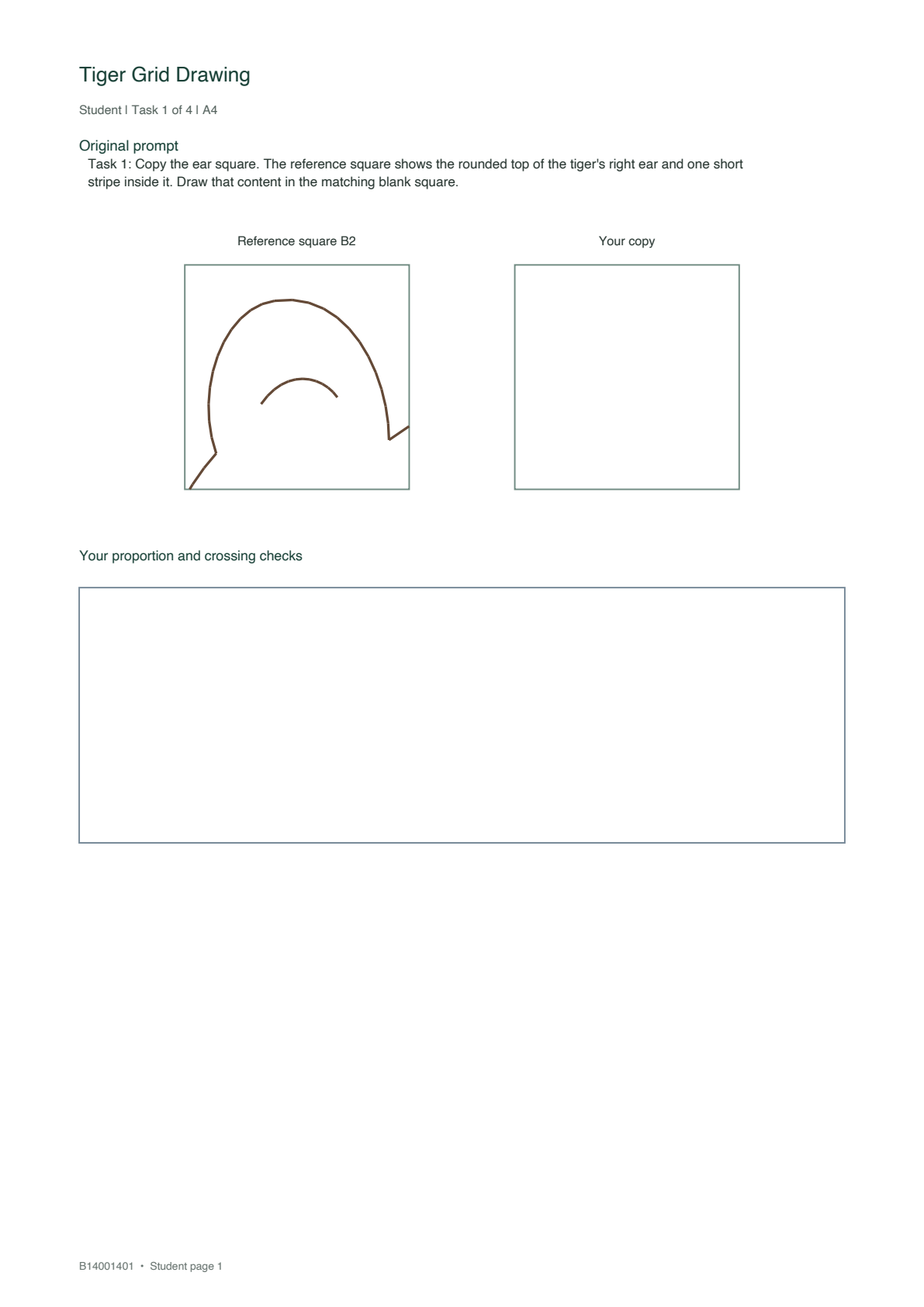
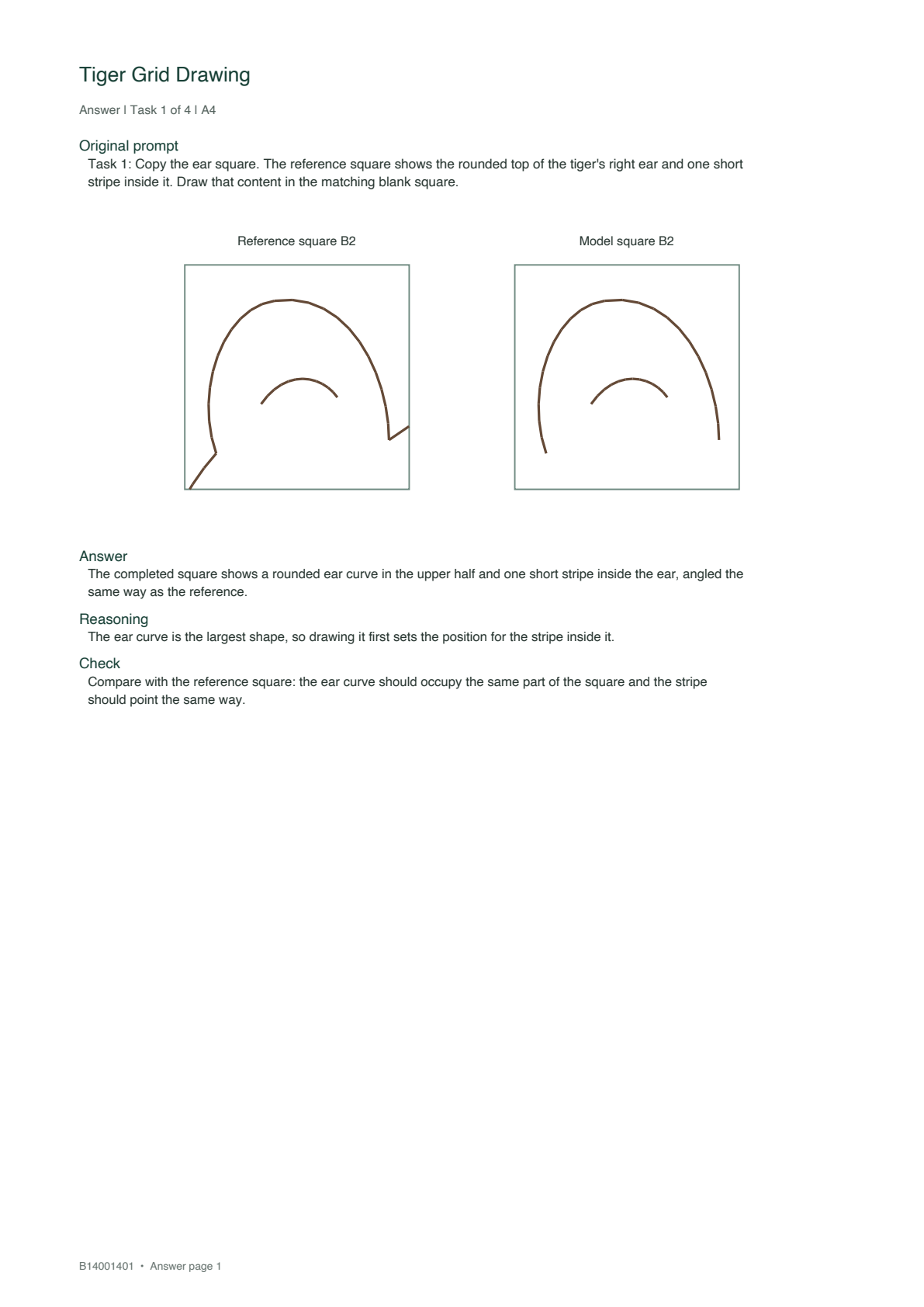
Task 1: Copy the ear square. The reference square shows the rounded top of the tiger's right ear and one short stripe inside it. Draw that content in the matching blank square, then check that the ear curve and stripe sit in the same positions as the reference.
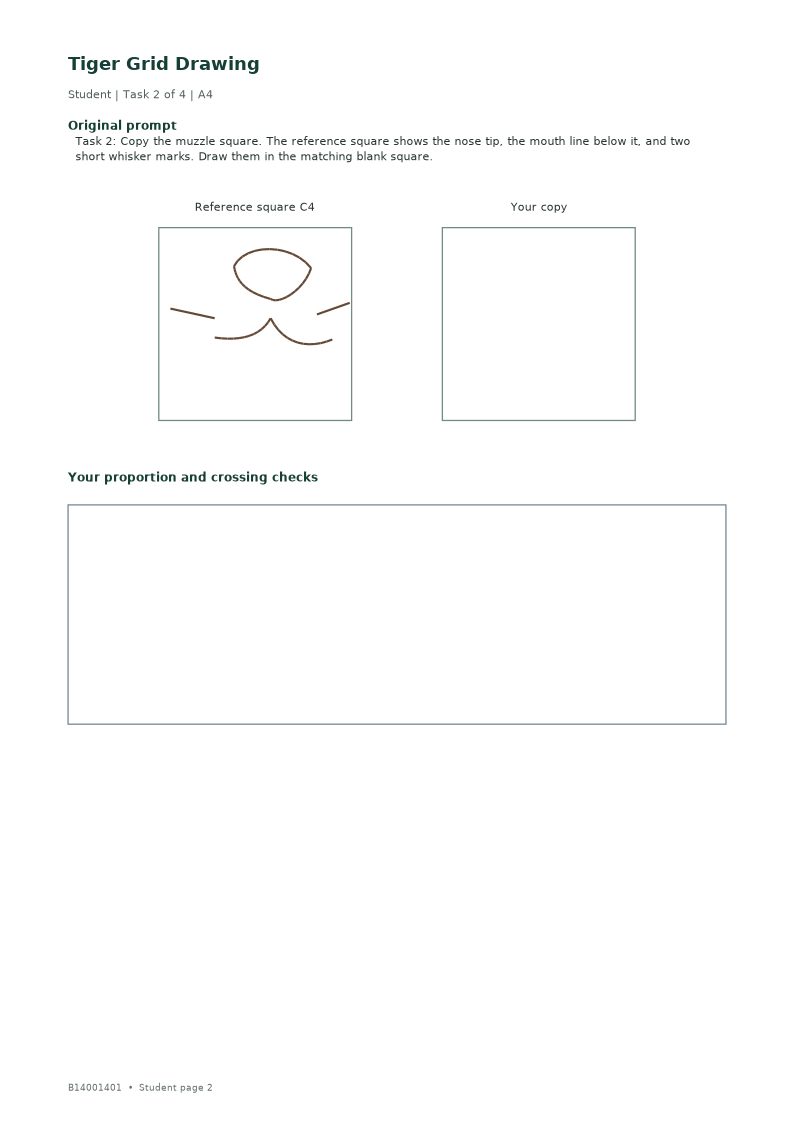
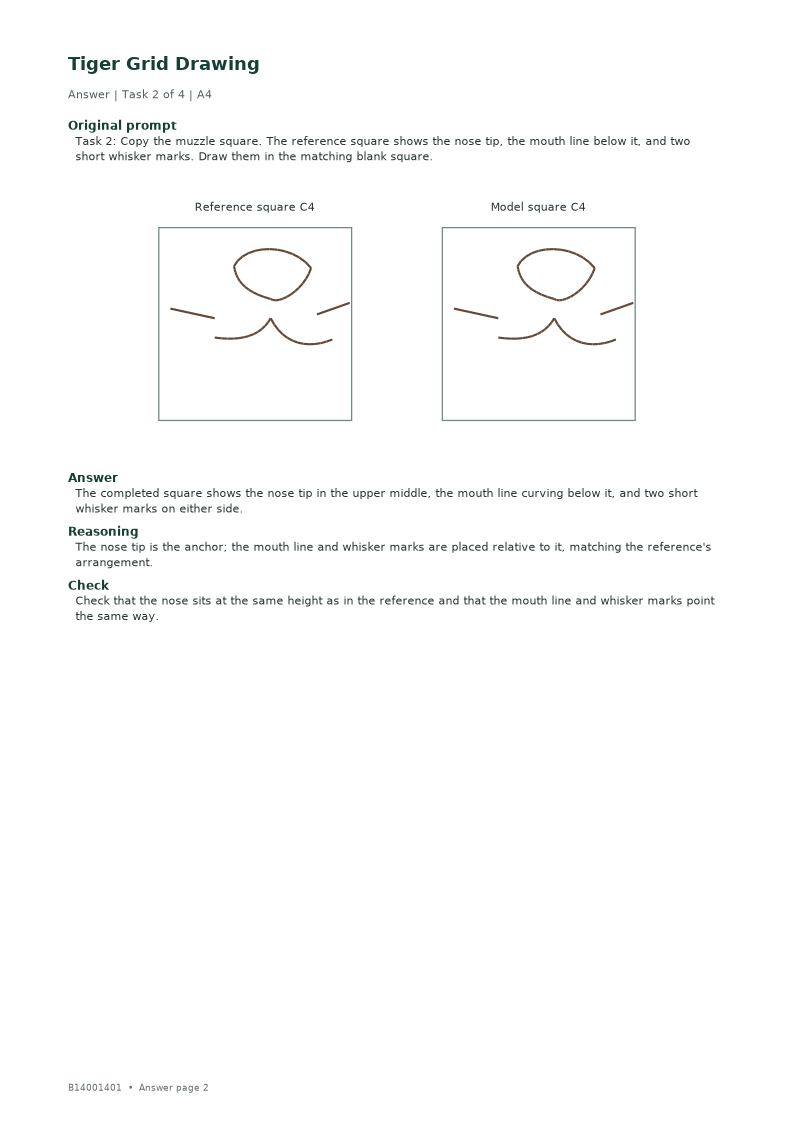
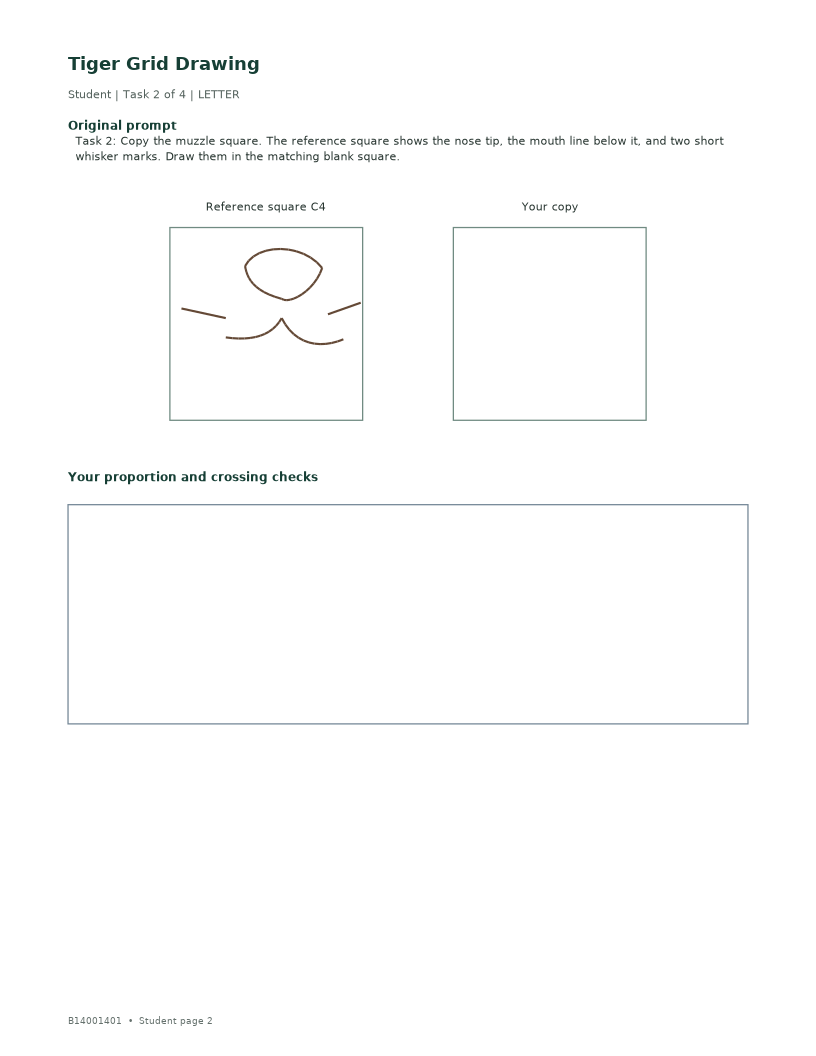
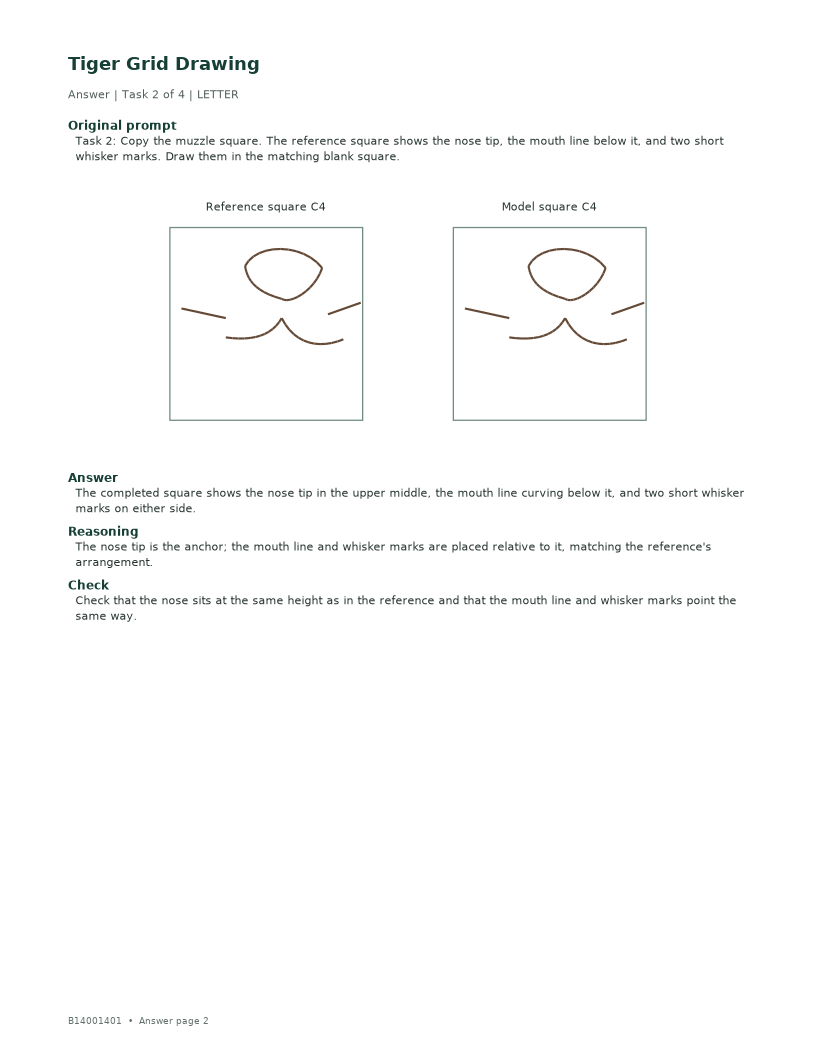
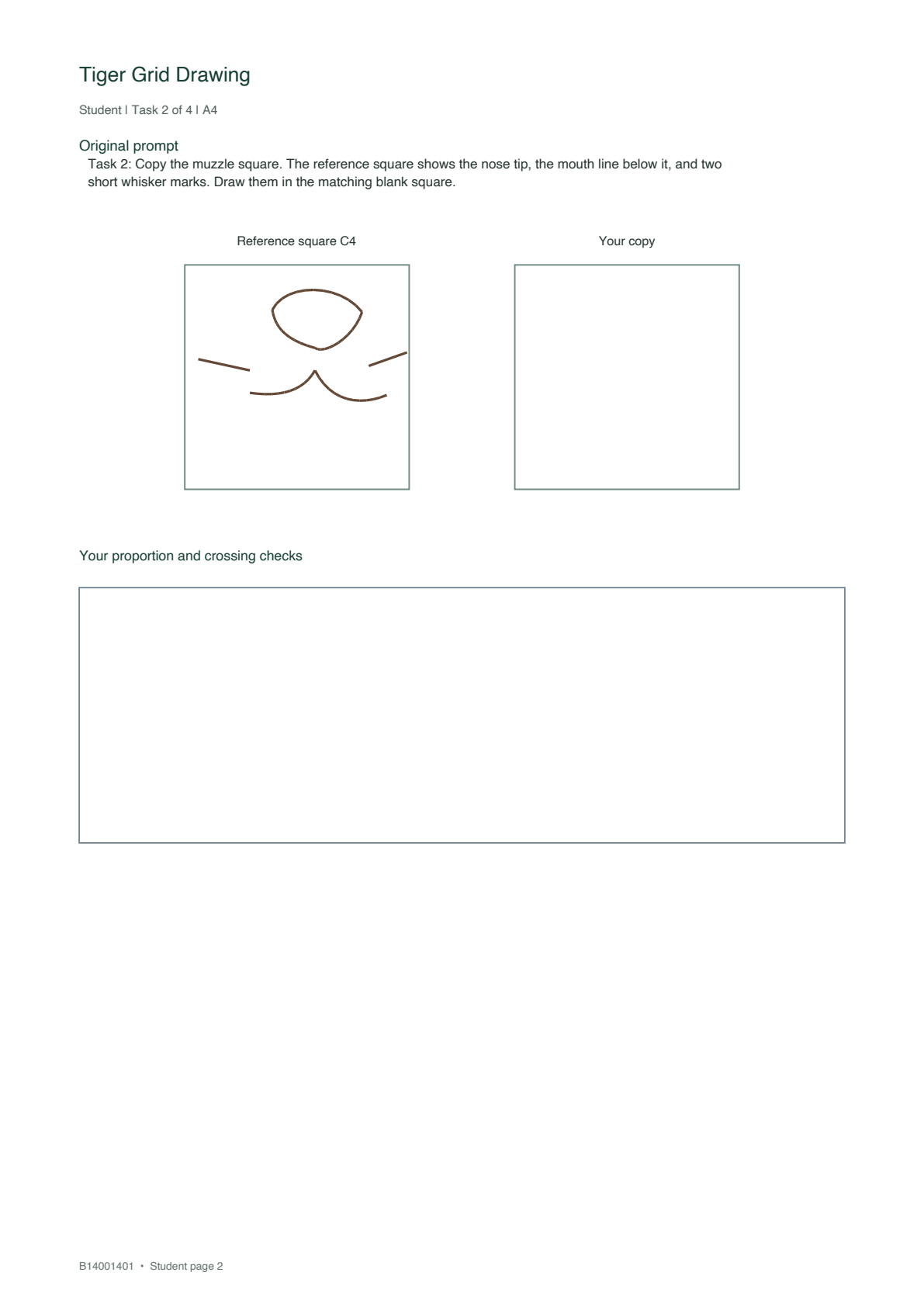
Task 2: Copy the muzzle square. The reference square shows the nose tip, the mouth line below it, and two short whisker marks. Draw them in the matching blank square, then check that the nose sits at the same height and the mouth line points the same way as the reference.
Practice tasks continued
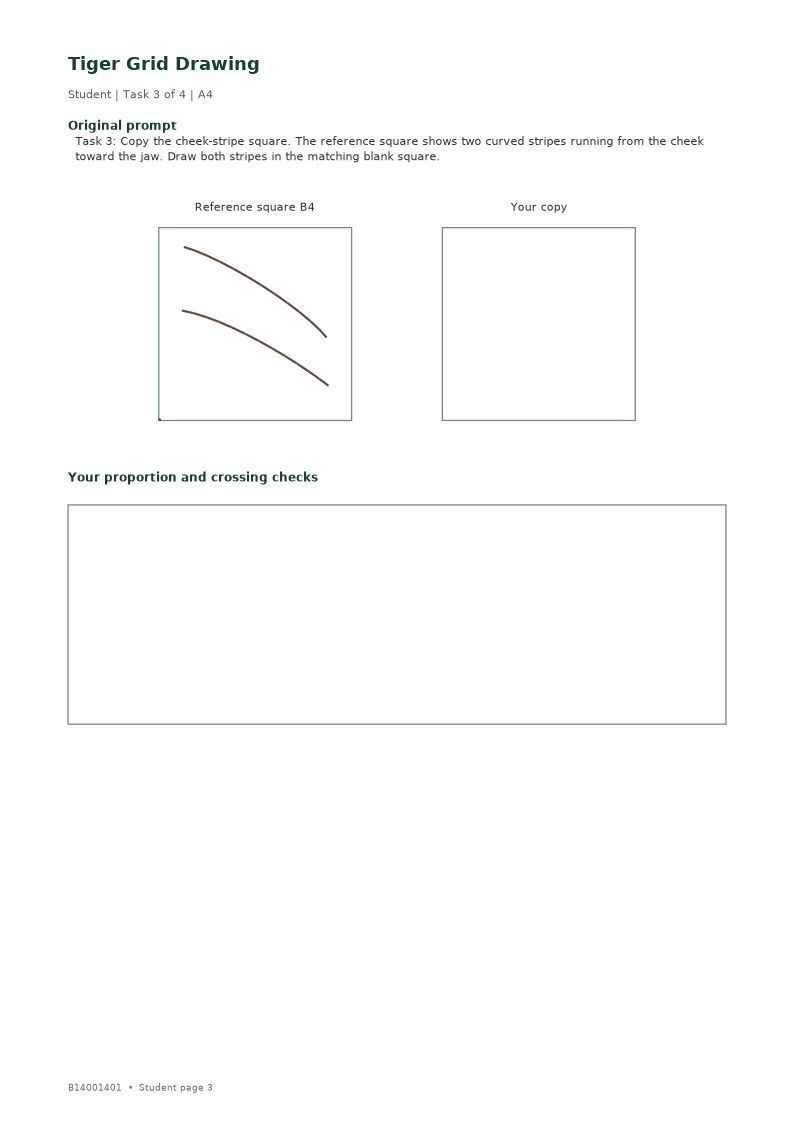
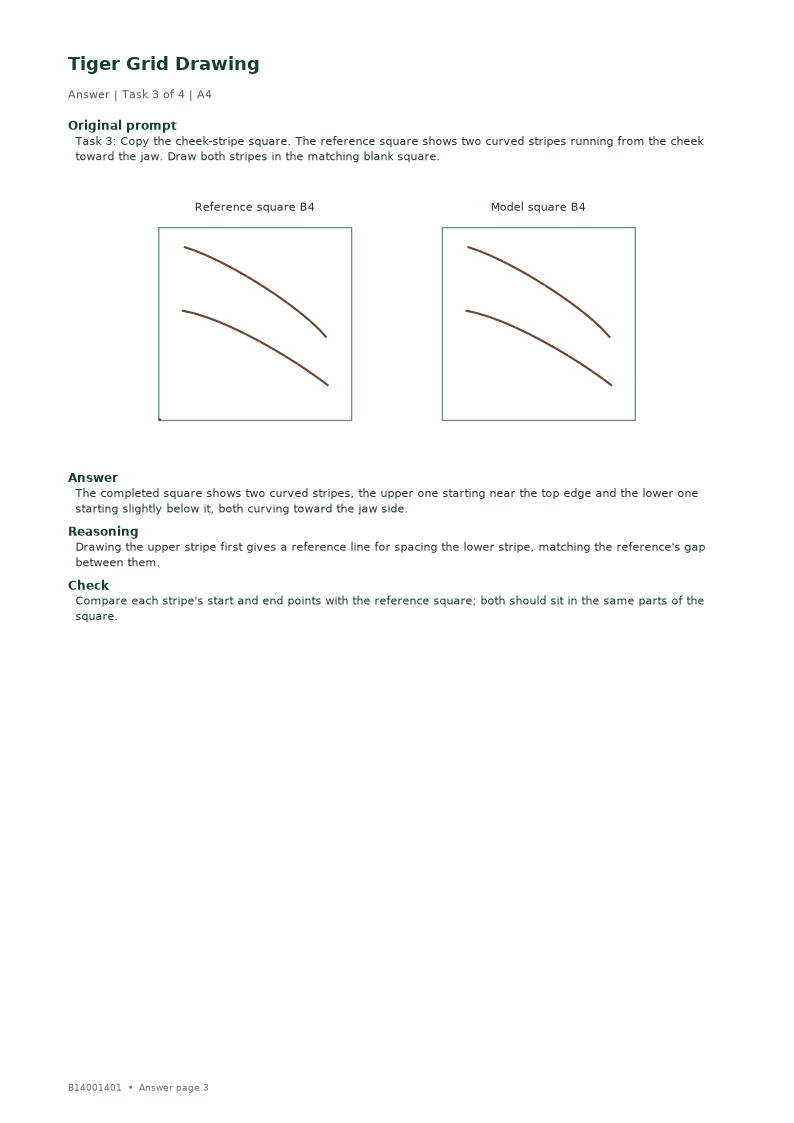
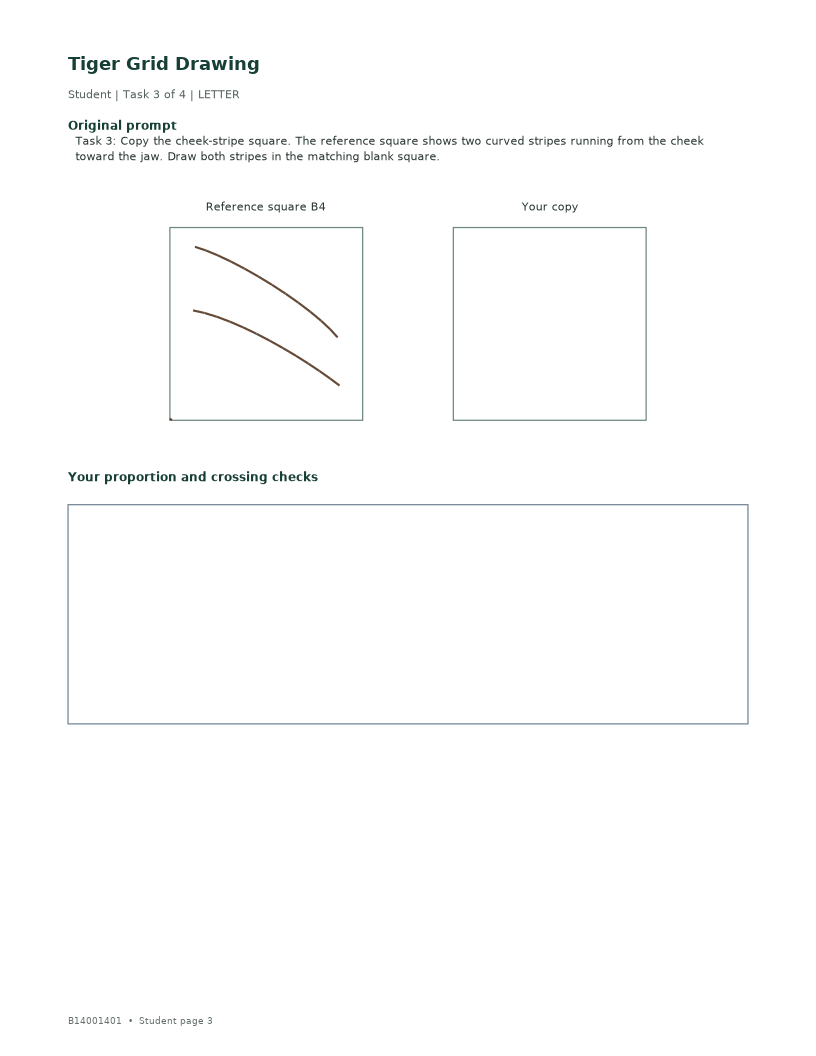
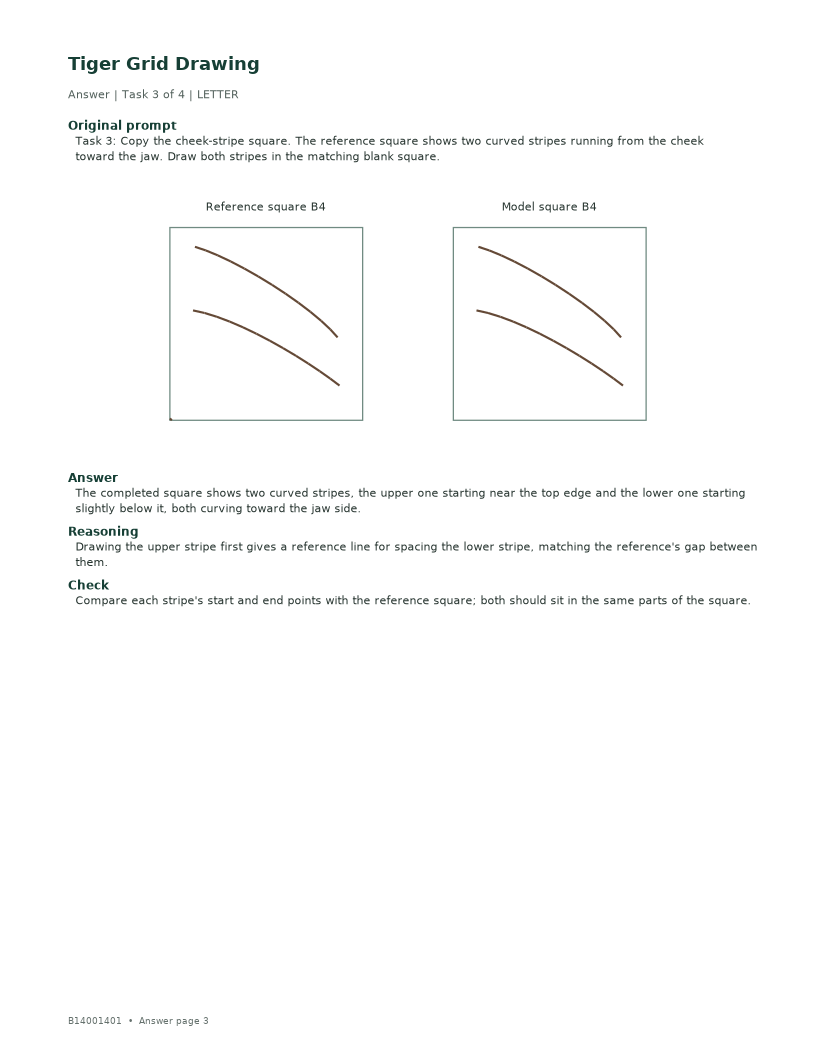
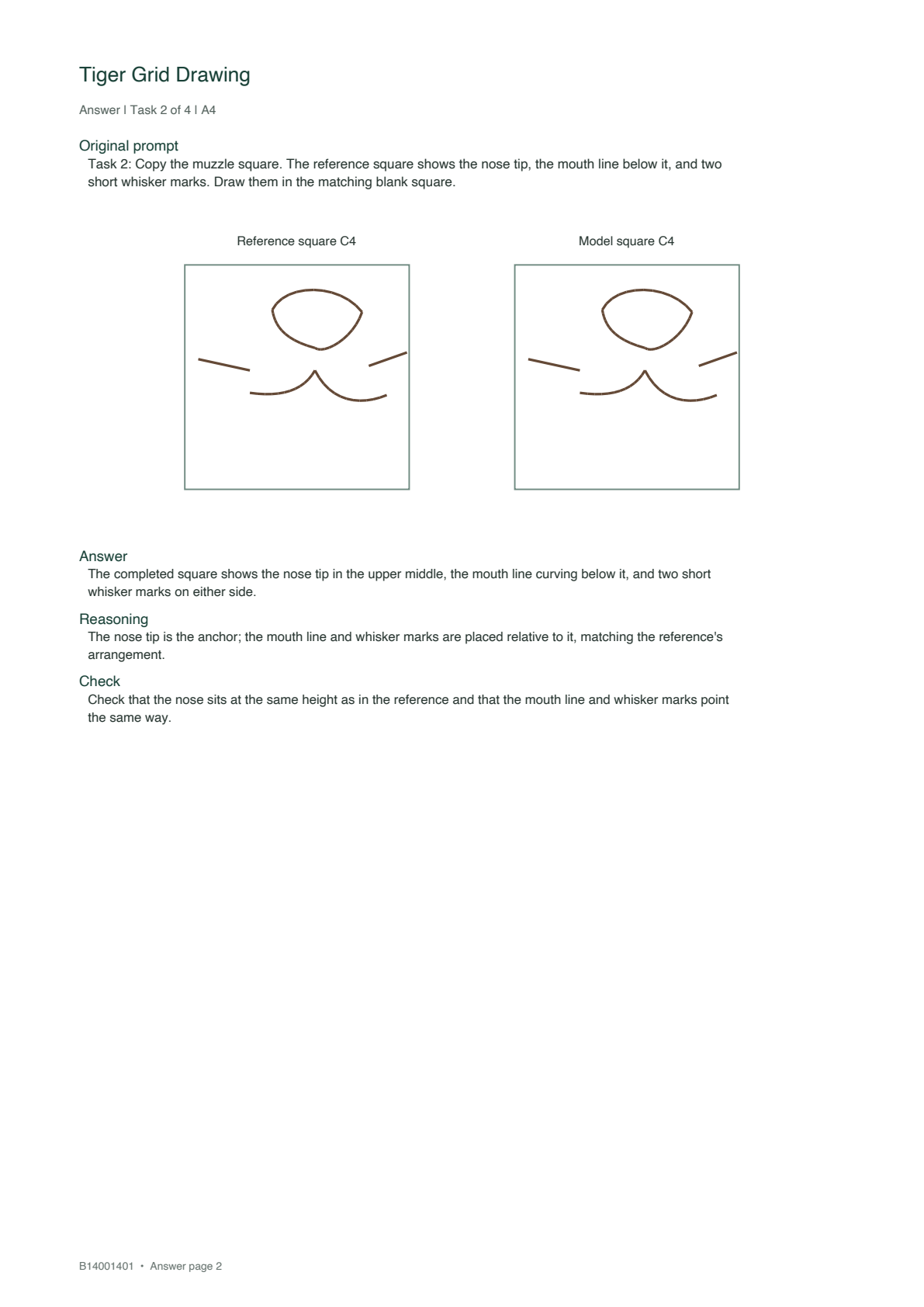
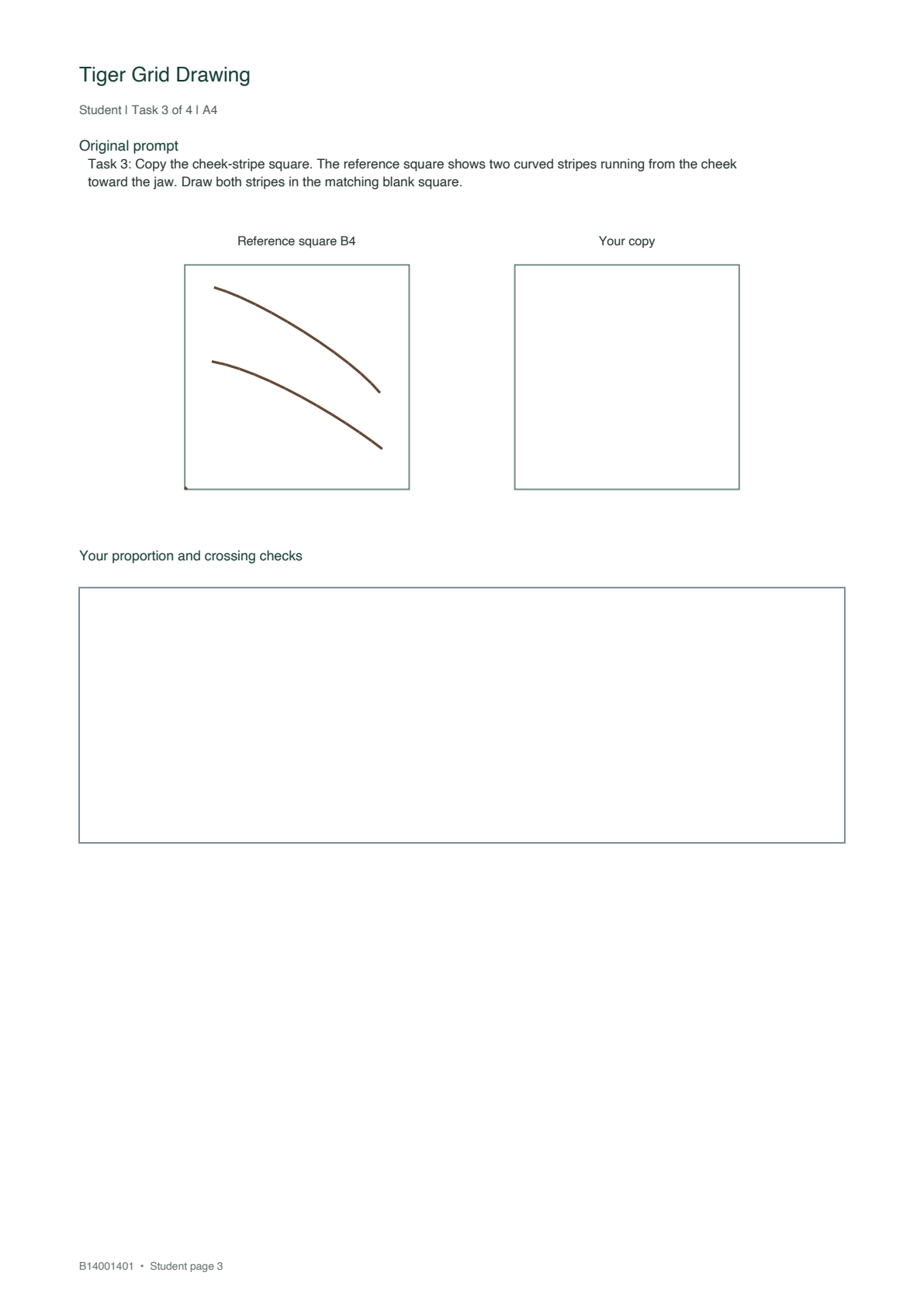
Task 3: Copy the cheek-stripe square. The reference square shows two curved stripes running from the cheek toward the jaw. Draw both stripes in the matching blank square, then check that each stripe starts and ends in the same part of the square as the reference.
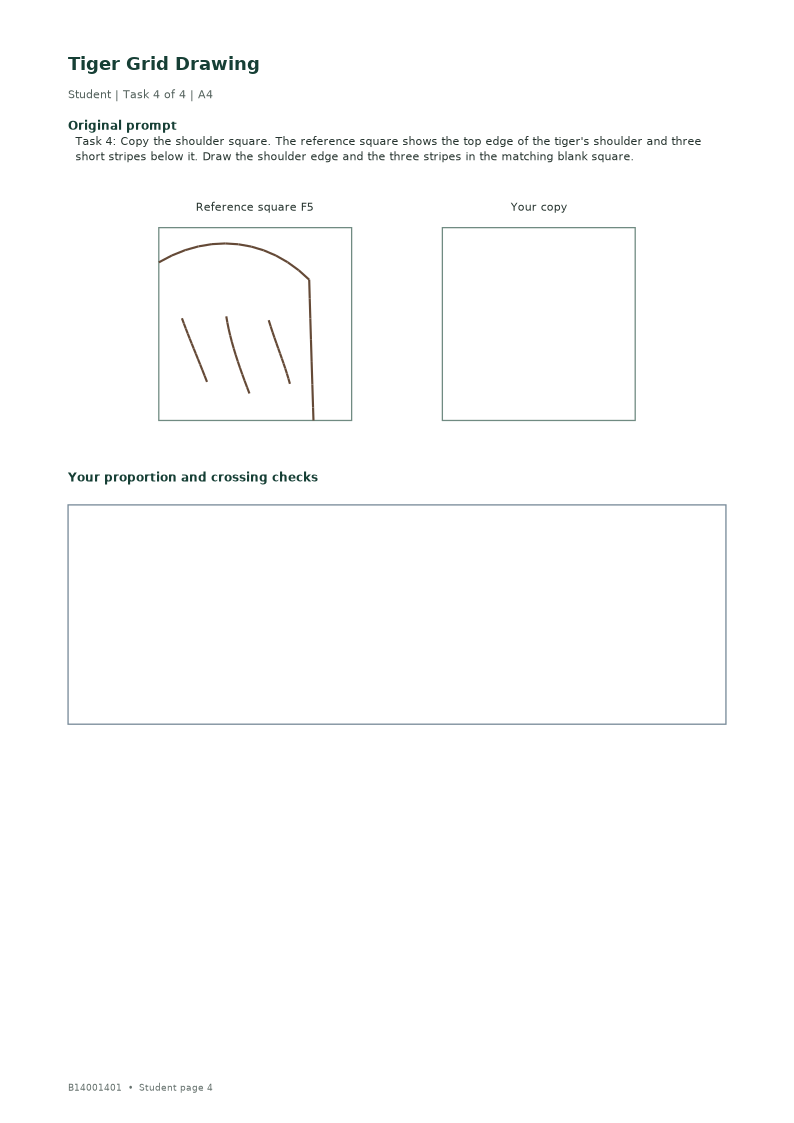
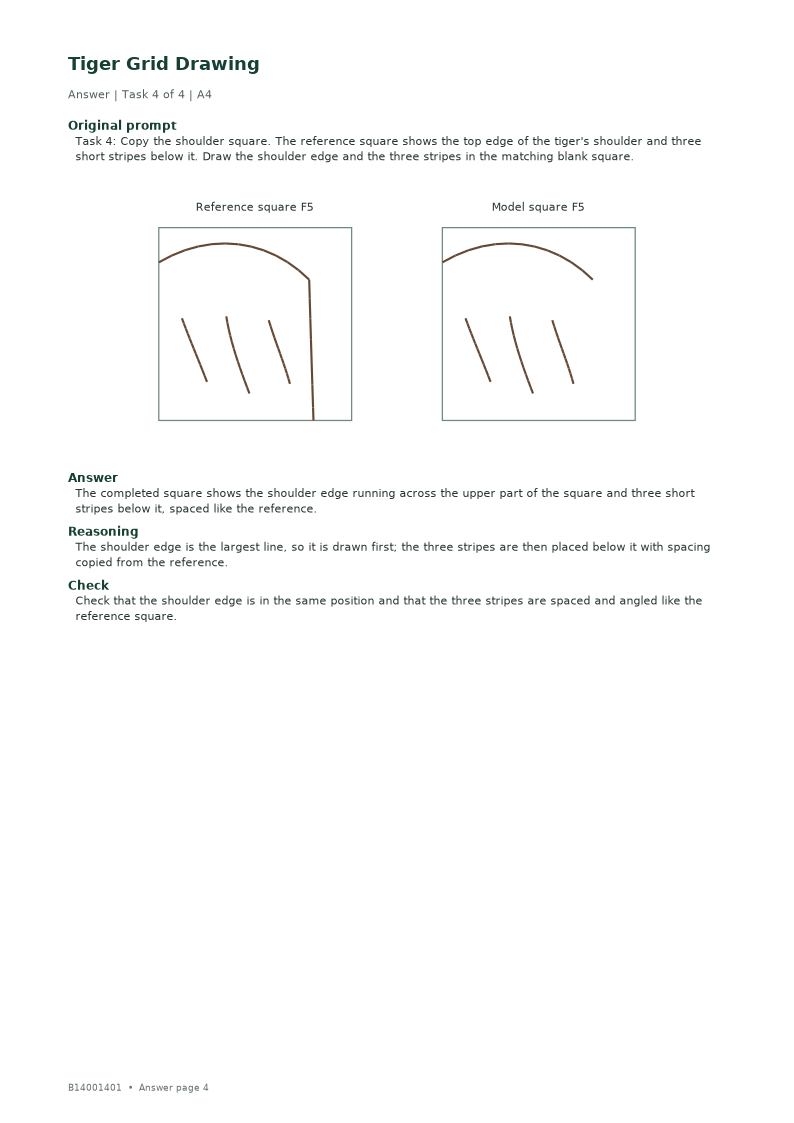
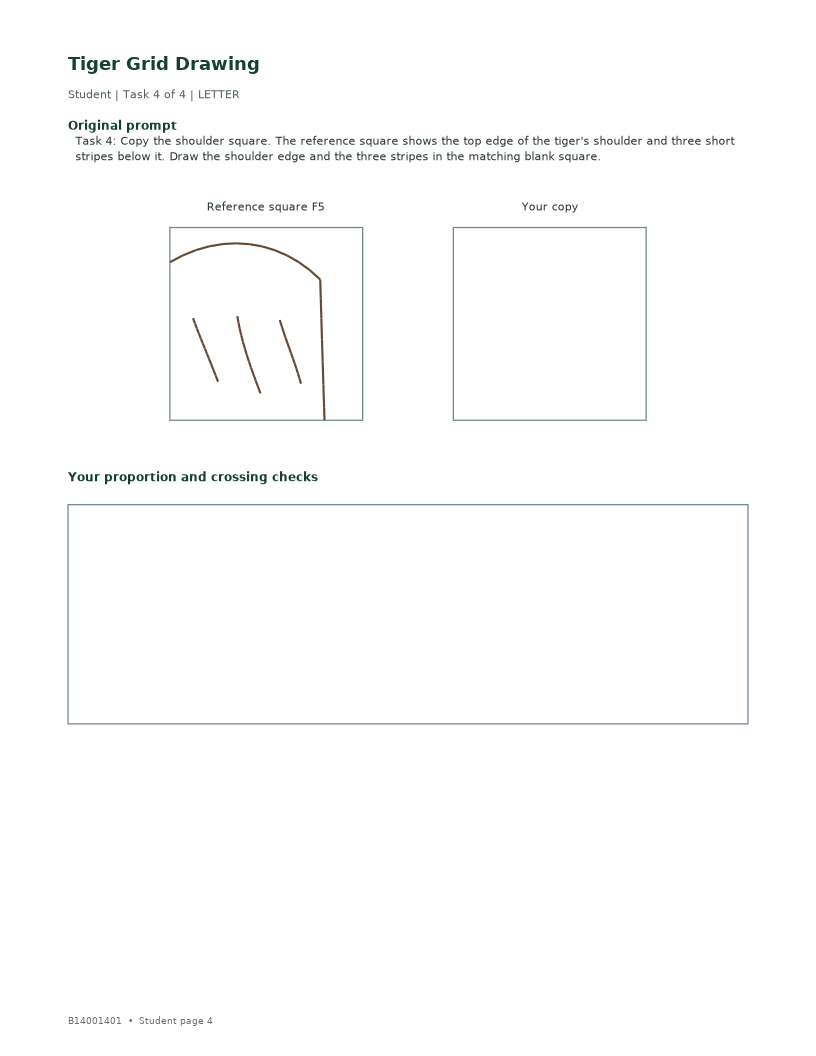
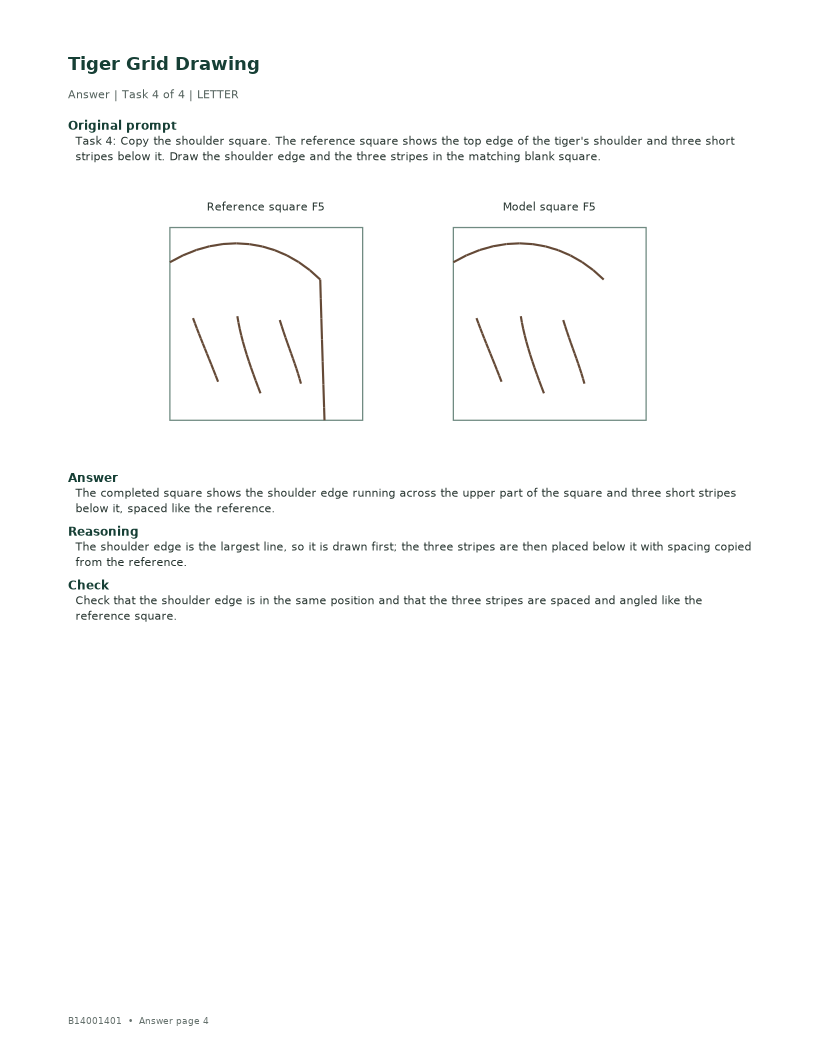
Task 4: Copy the shoulder square. The reference square shows the top edge of the tiger's shoulder and three short stripes below it. Draw the shoulder edge and the three stripes in the matching blank square, then check that the edge is in the same position and the stripes are spaced like the reference.
Download the complete resource pack
All individual SVG pages (22)
- A4 reference page 1
- A4 reference page 2
- A4 reference page 3
- A4 student page 1
- A4 student page 2
- A4 student page 3
- A4 student page 4
- A4 answer page 1
- A4 answer page 2
- A4 answer page 3
- A4 answer page 4
- LETTER reference page 1
- LETTER reference page 2
- LETTER reference page 3
- LETTER student page 1
- LETTER student page 2
- LETTER student page 3
- LETTER student page 4
- LETTER answer page 1
- LETTER answer page 2
- LETTER answer page 3
- LETTER answer page 4
Print at 100% / actual size. Use the stated scale on any schematic diagram; physical cutting templates are identified separately. A4 and US Letter are separate files. Free access, no signup; CC BY 4.0.
How to use these pages
- What a tiger grid-copy puzzle is
- How to copy a tiger square by square
- Worked example: copying the eye square
- Practice tasks
- Practice tasks continued
Worked example
Example: Copy the eye square from the reference into the matching blank square, then check it against the reference.
Answer: The completed square shows the eye's top curve in the upper middle, a short stripe above it pointing toward the outer corner, and the cheek-fur edge meeting the square's lower edge. This matches the reference square's arrangement.
Reasoning: Drawing the largest shape first (the eye curve) gives a stable anchor, and adding the stripe and fur edge afterward keeps their positions relative to the eye correct.
Check: Place your square beside the reference square. The eye curve, stripe direction and fur-edge meeting point should all line up; if not, redraw the misplaced line.
Four practice tasks and complete answers
Task 1
Task 1: Copy the ear square. The reference square shows the rounded top of the tiger's right ear and one short stripe inside it. Draw that content in the matching blank square.
Show answer 1
The completed square shows a rounded ear curve in the upper half and one short stripe inside the ear, angled the same way as the reference.
The ear curve is the largest shape, so drawing it first sets the position for the stripe inside it.
Check: Compare with the reference square: the ear curve should occupy the same part of the square and the stripe should point the same way.
Task 2
Task 2: Copy the muzzle square. The reference square shows the nose tip, the mouth line below it, and two short whisker marks. Draw them in the matching blank square.
Show answer 2
The completed square shows the nose tip in the upper middle, the mouth line curving below it, and two short whisker marks on either side.
The nose tip is the anchor; the mouth line and whisker marks are placed relative to it, matching the reference's arrangement.
Check: Check that the nose sits at the same height as in the reference and that the mouth line and whisker marks point the same way.
Task 3
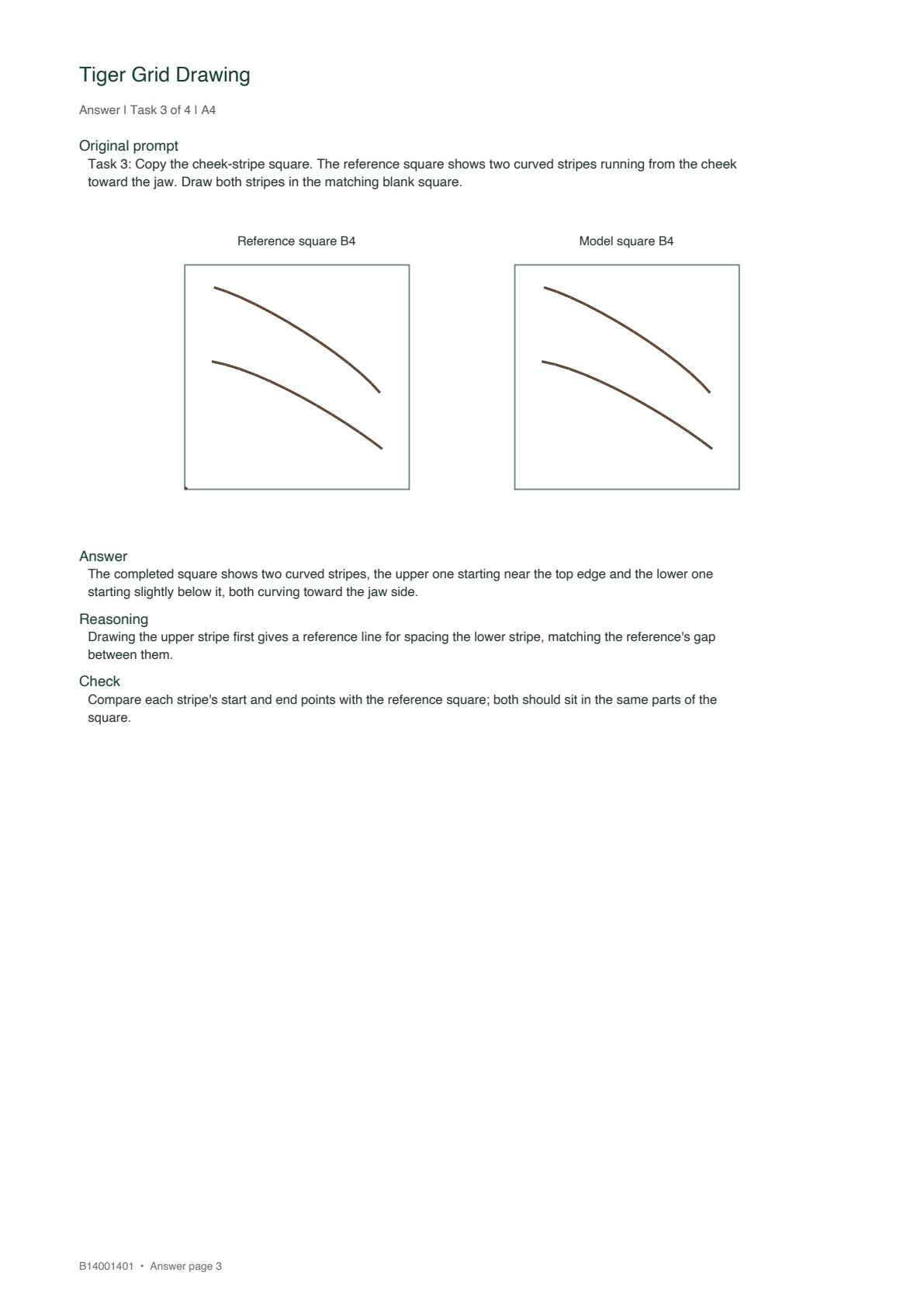
Task 3: Copy the cheek-stripe square. The reference square shows two curved stripes running from the cheek toward the jaw. Draw both stripes in the matching blank square.
Show answer 3
The completed square shows two curved stripes, the upper one starting near the top edge and the lower one starting slightly below it, both curving toward the jaw side.
Drawing the upper stripe first gives a reference line for spacing the lower stripe, matching the reference's gap between them.
Check: Compare each stripe's start and end points with the reference square; both should sit in the same parts of the square.
Task 4
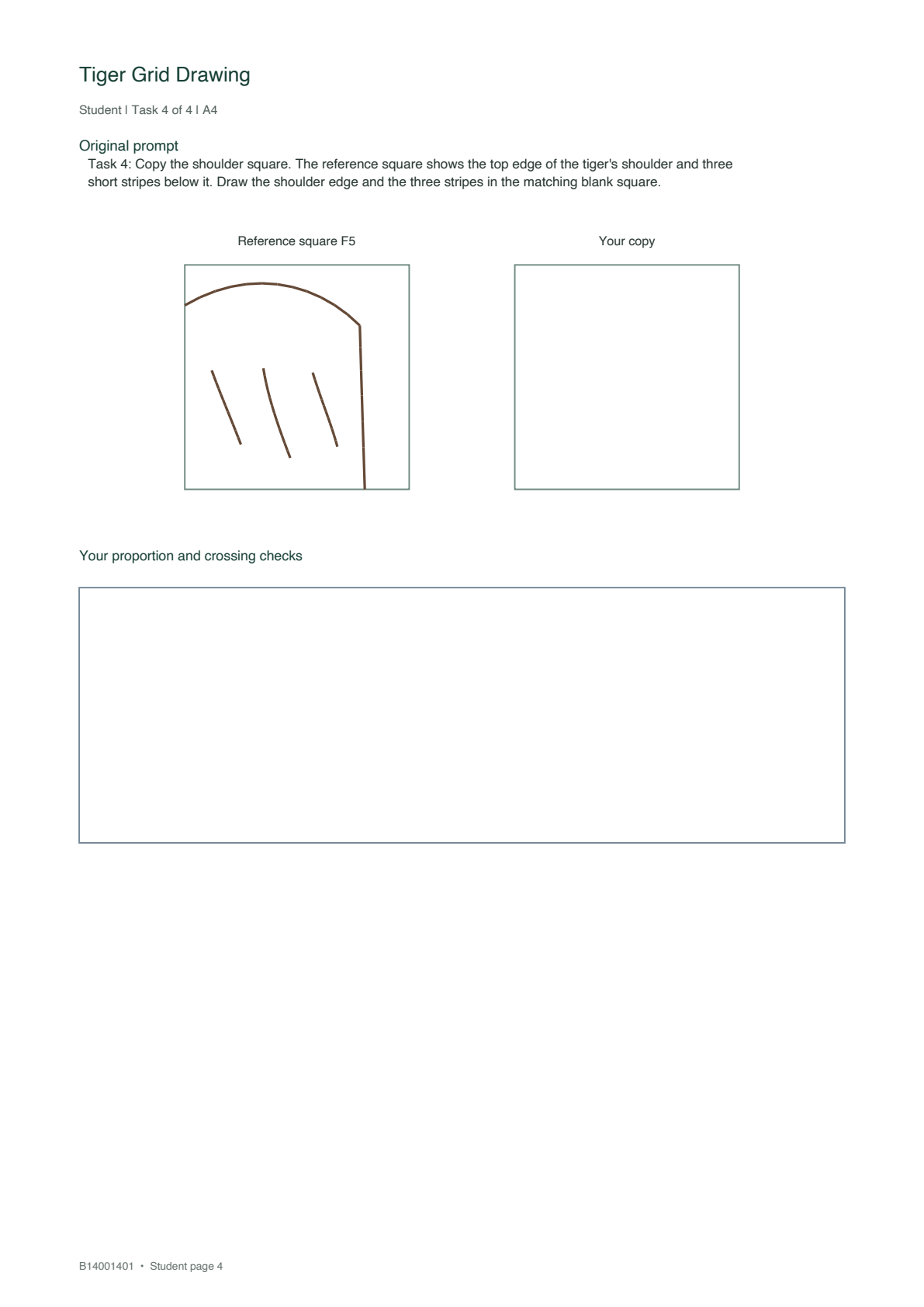
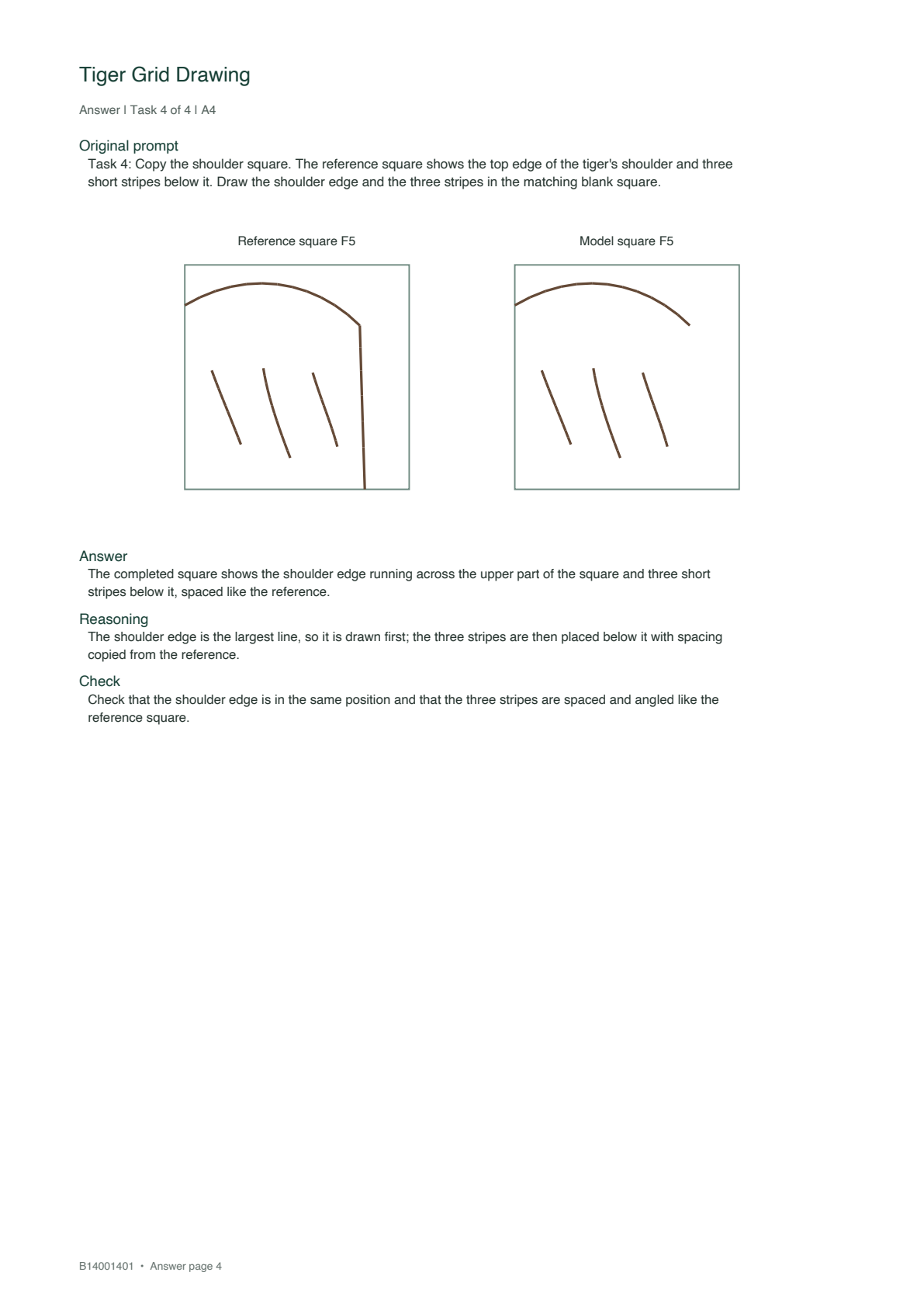
Task 4: Copy the shoulder square. The reference square shows the top edge of the tiger's shoulder and three short stripes below it. Draw the shoulder edge and the three stripes in the matching blank square.
Show answer 4
The completed square shows the shoulder edge running across the upper part of the square and three short stripes below it, spaced like the reference.
The shoulder edge is the largest line, so it is drawn first; the three stripes are then placed below it with spacing copied from the reference.
Check: Check that the shoulder edge is in the same position and that the three stripes are spaced and angled like the reference square.
Useful checks
- Drawing the whole tiger first and using the grid only afterward. Work one square at a time, finishing and checking each square before moving to the next.
- Letting lines drift across square edges when the reference line does not cross them. Compare where each line meets the square's edge with the reference and stop the line at the same point.
- Copying stripes without checking their direction. Note which way each stripe points in the reference square and match that direction in your square.
Questions about this resource
Do I need to measure the squares?
No. The squares are a locating guide; copy what is inside each square by eye and check against the reference.
What is the shaded answer key for?
It shows one correct completed grid so you can compare your finished drawing and spot misplaced lines.