Free nets and surface area worksheets for prisms, cubes and a square pyramid. Draw or read each net, add face areas and check the answer.
Choose Letter or A4, then download a student sheet first. Keep the separate reference or answer file closed until you have attempted the case. Every worksheet, SVG and answer is free without signup.
Choose your paper and download
Download paper size
Every worksheet and answer is free. No signup.
Free original resourceNS01
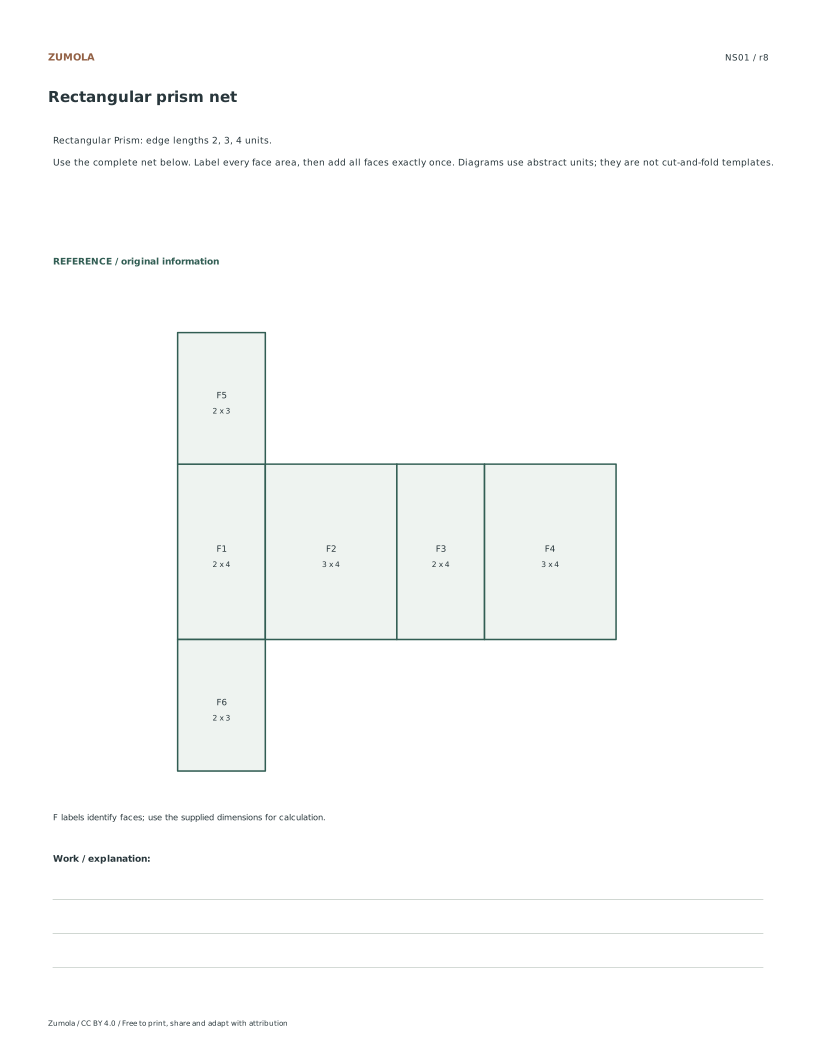
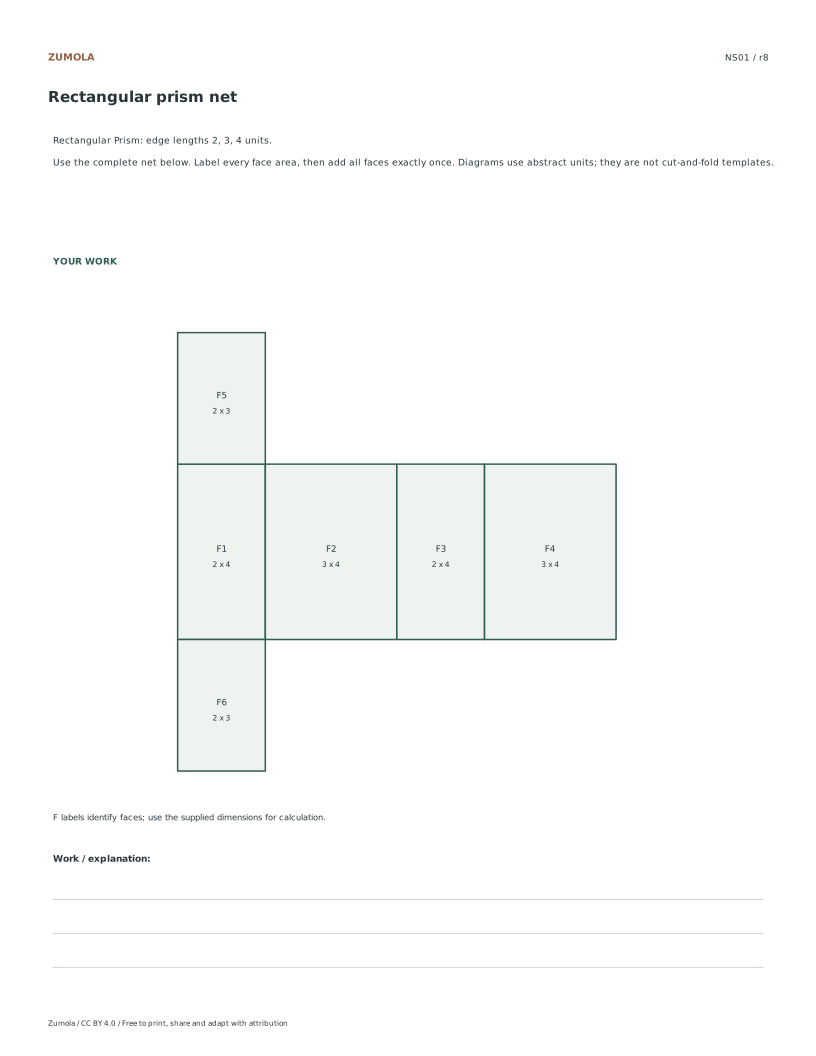
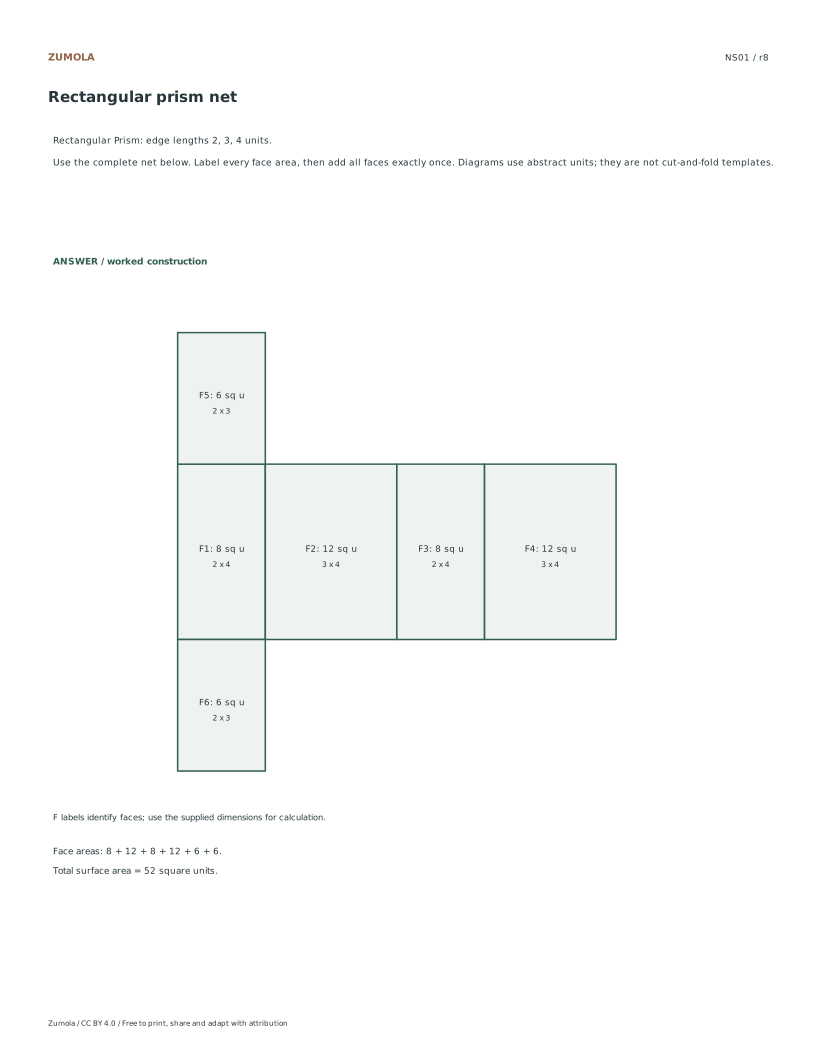
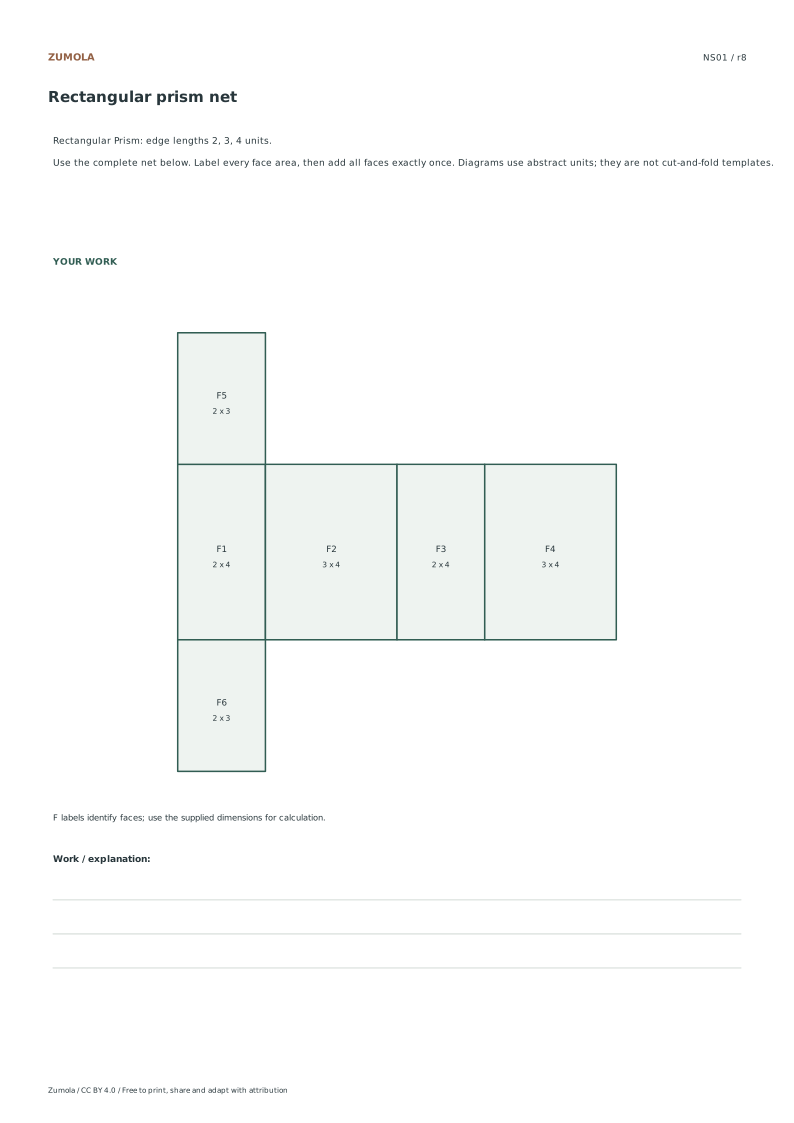
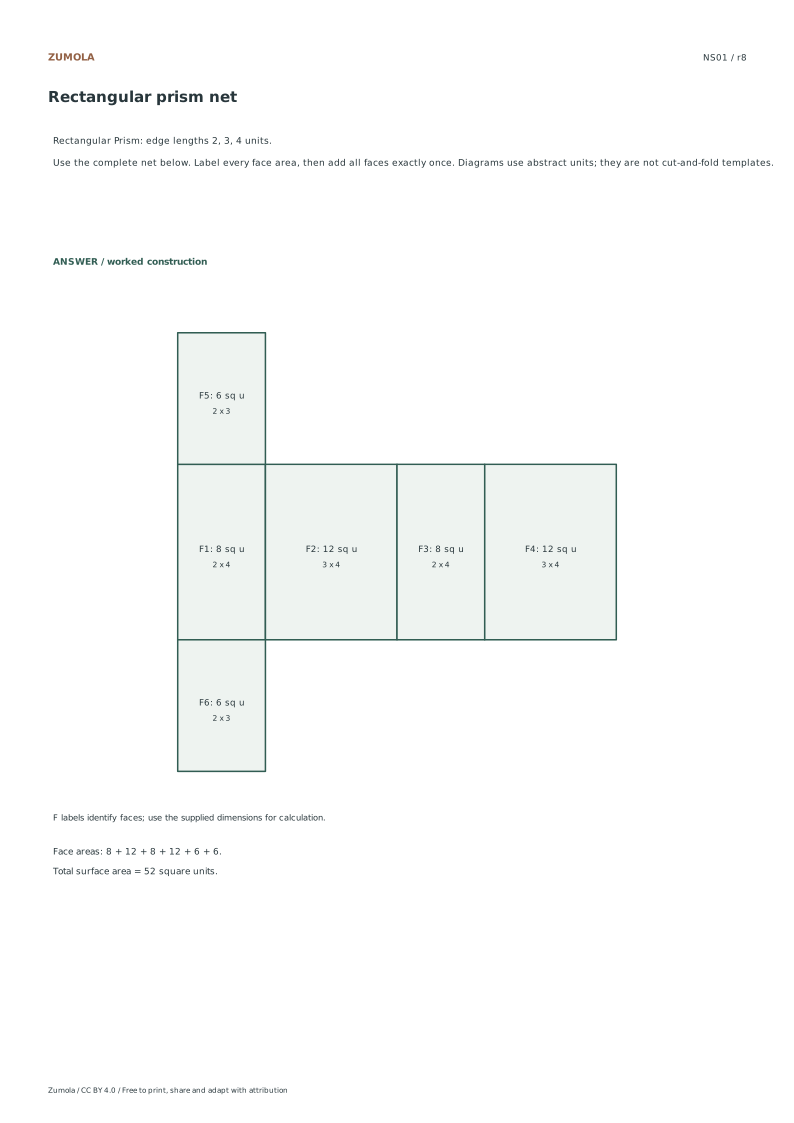
Rectangular prism net
Original worksheet collection. Letter or A4 PDF and editable SVG.
Use the complete net below. Label every face area, then add all faces exactly once. Diagrams use abstract units; they are not cut-and-fold templates.
NS02
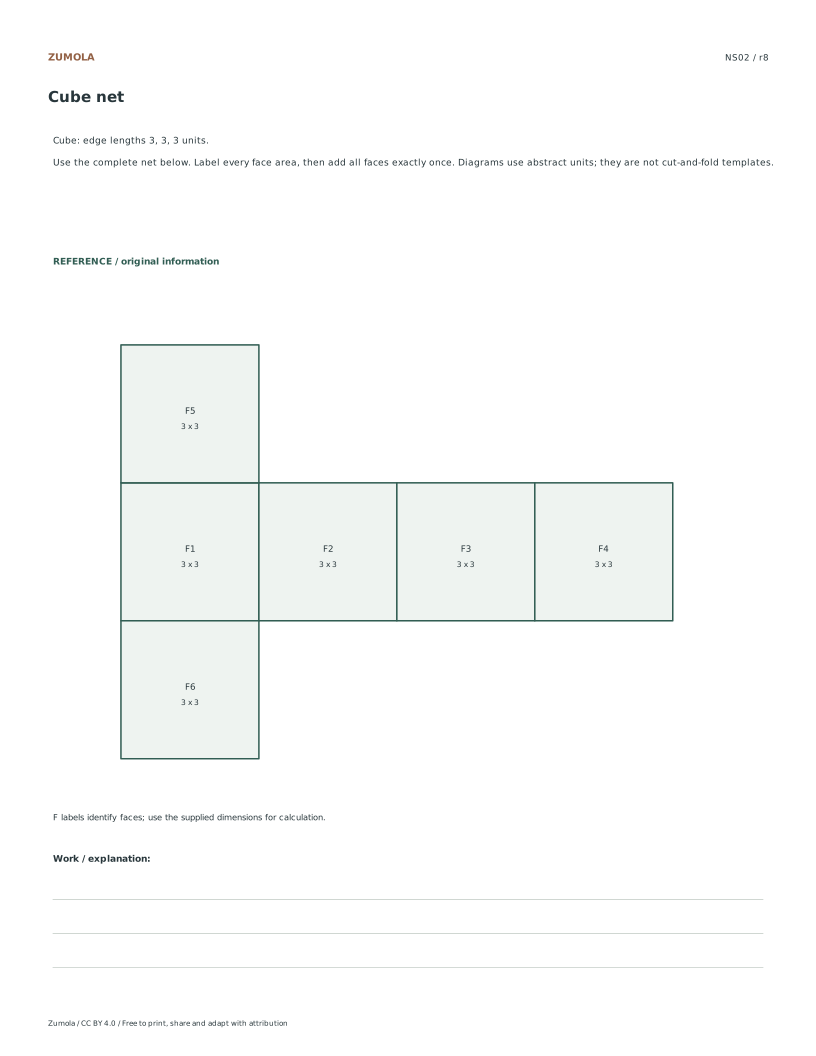
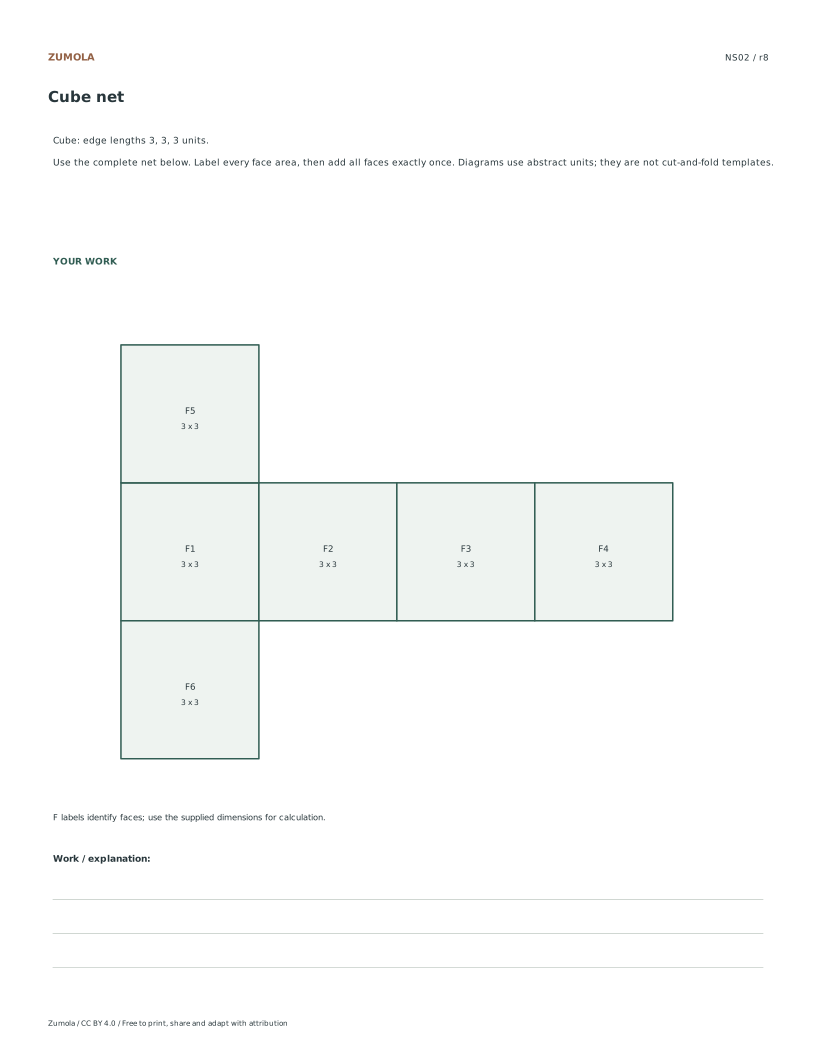
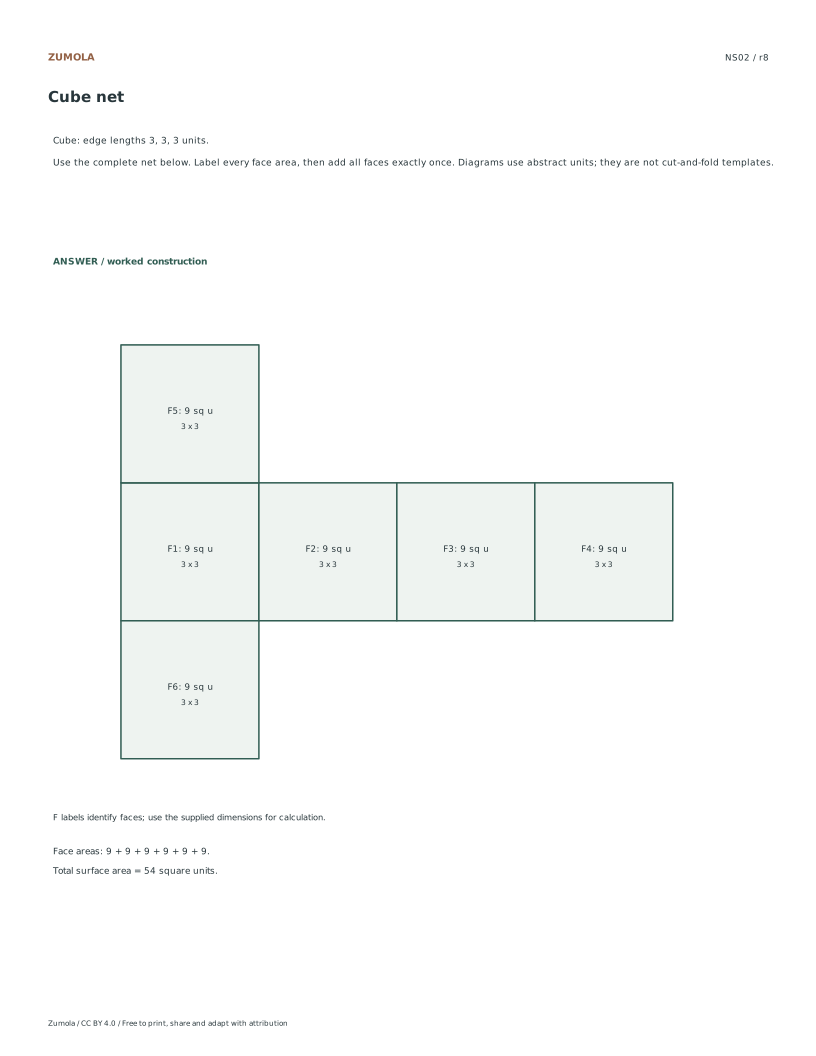
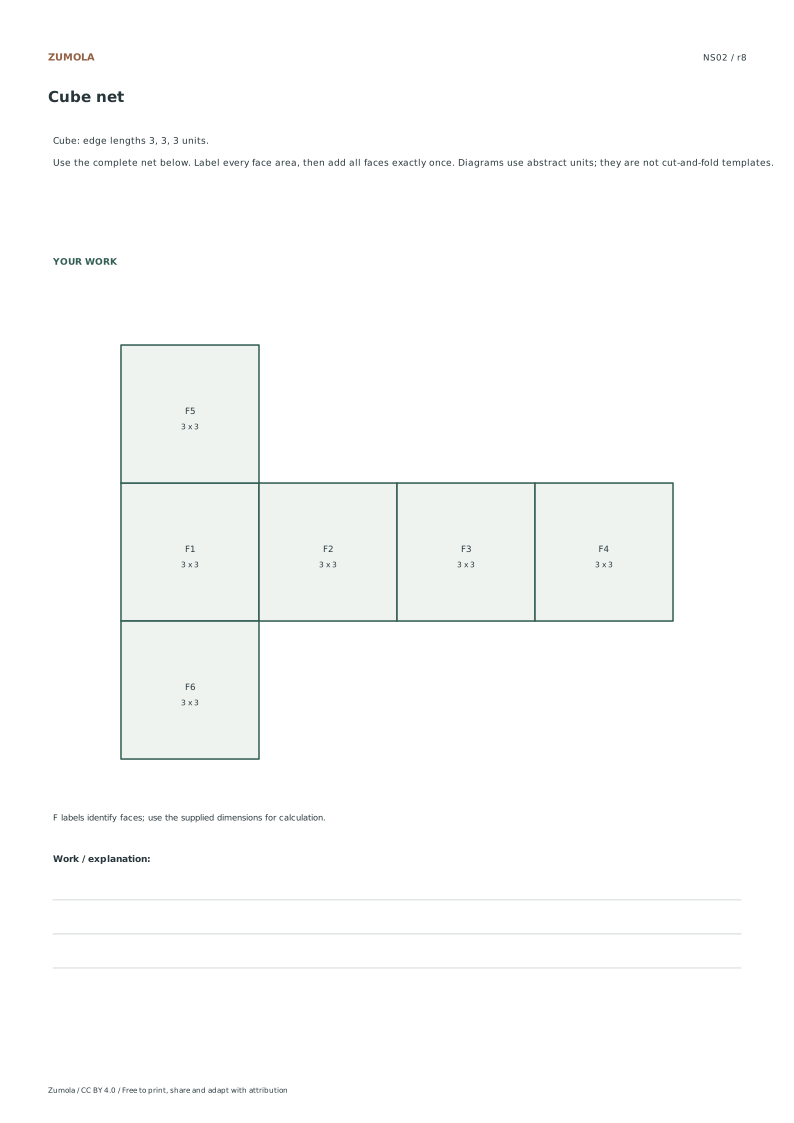
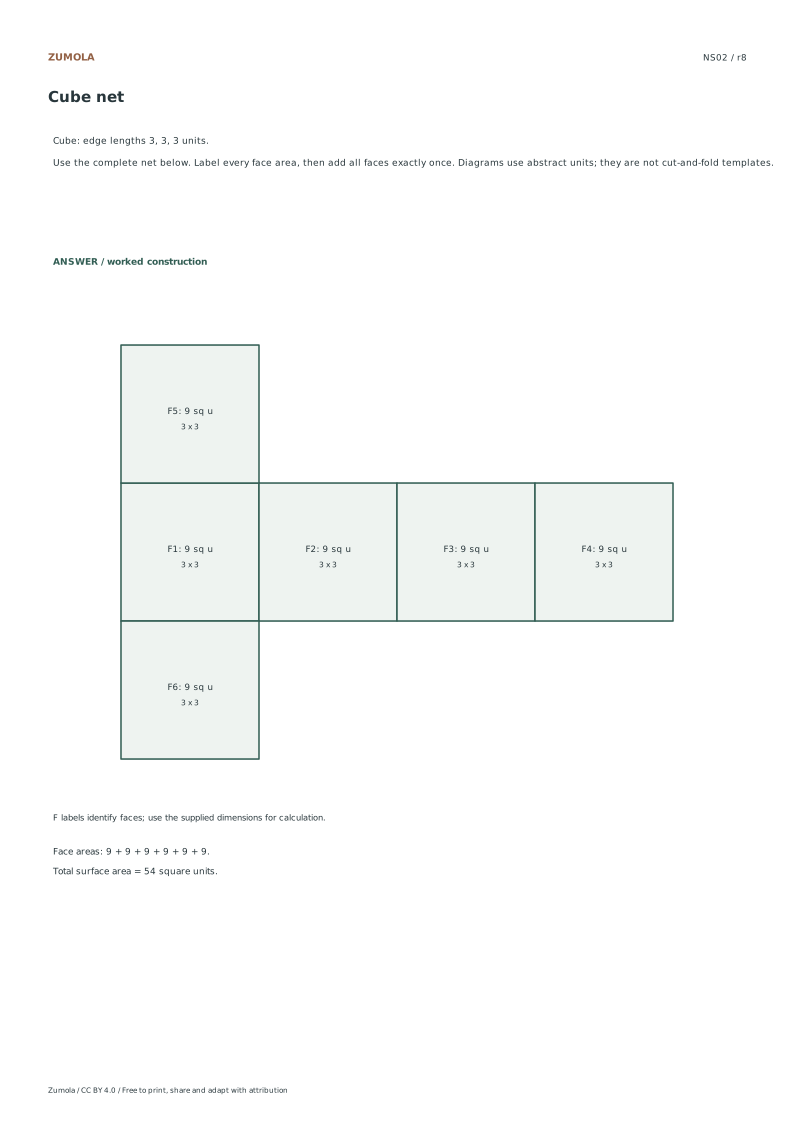
Cube: edge lengths 3, 3, 3 units.
Use the complete net below. Label every face area, then add all faces exactly once. Diagrams use abstract units; they are not cut-and-fold templates.
NS03
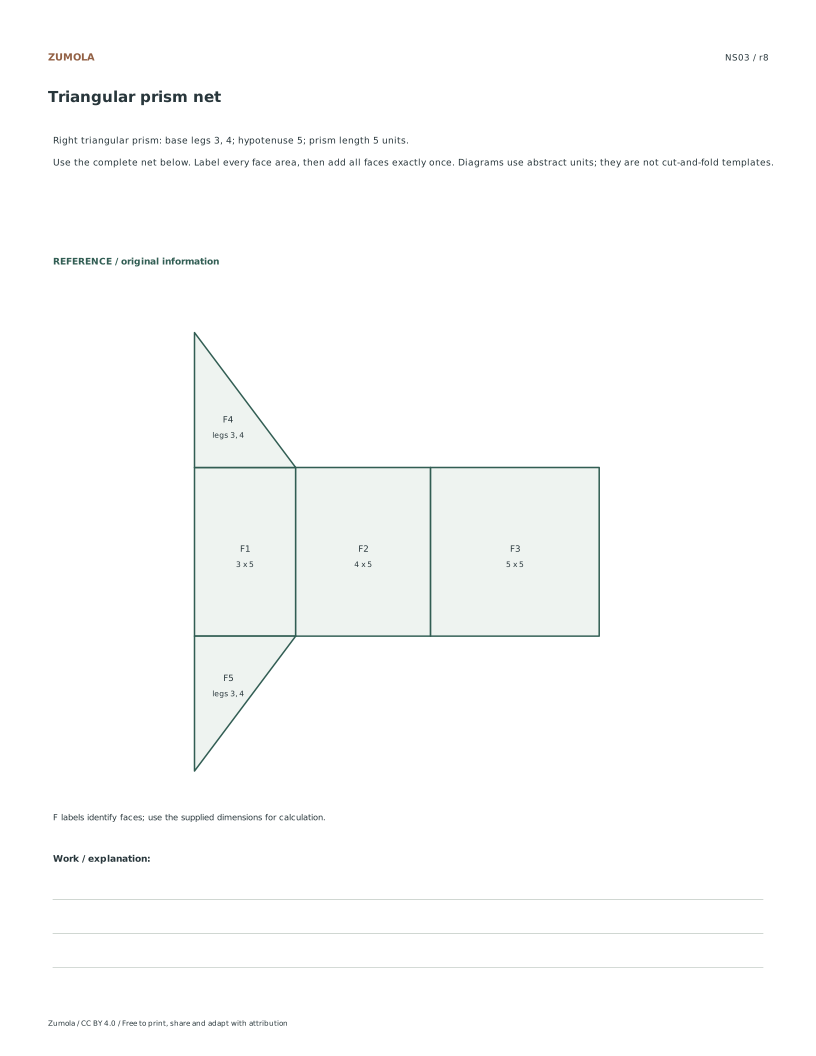
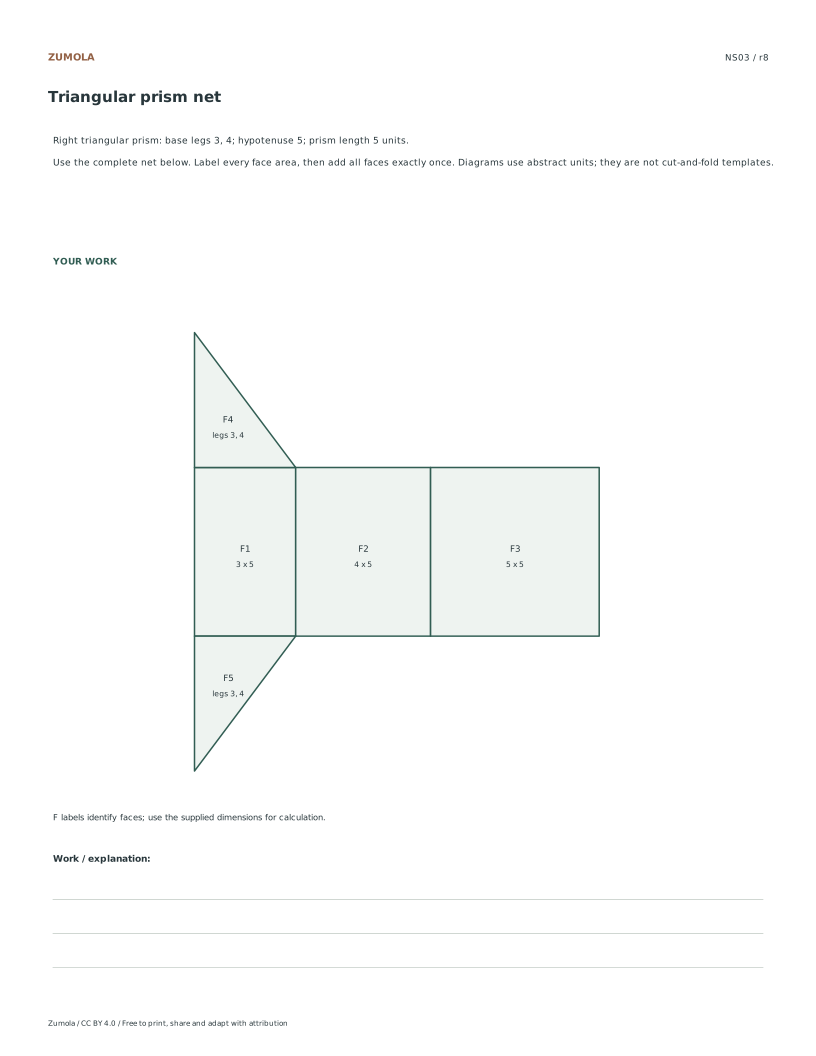
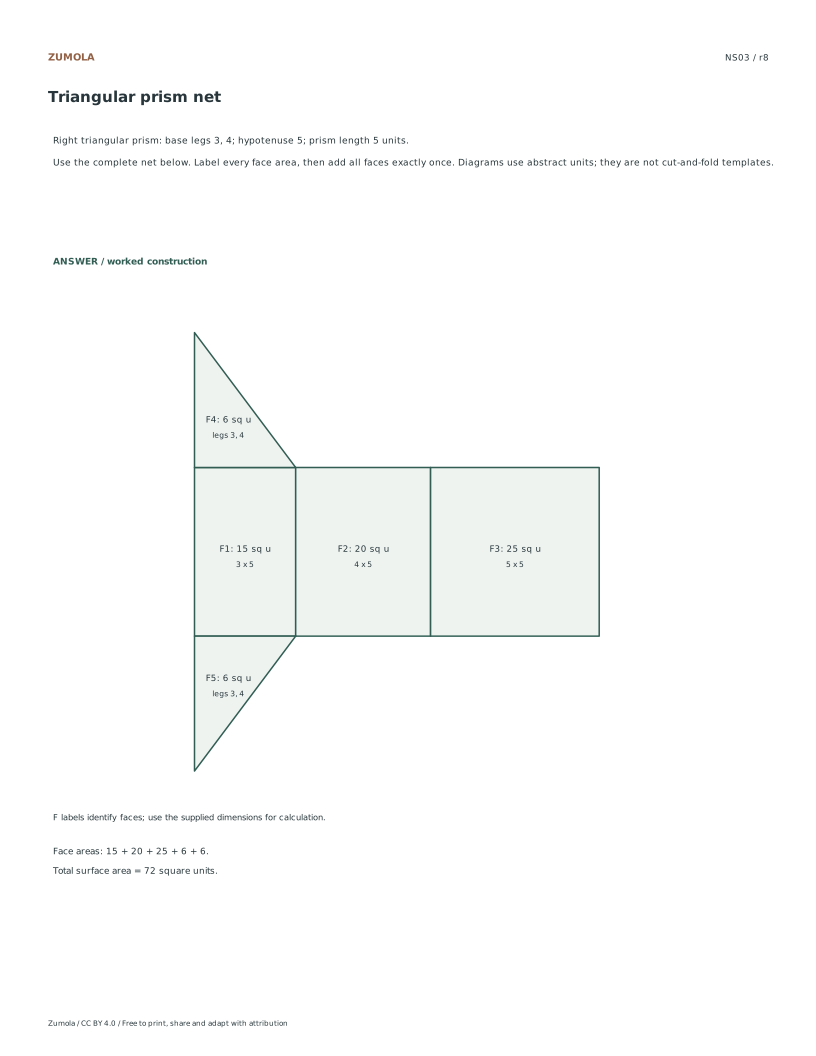
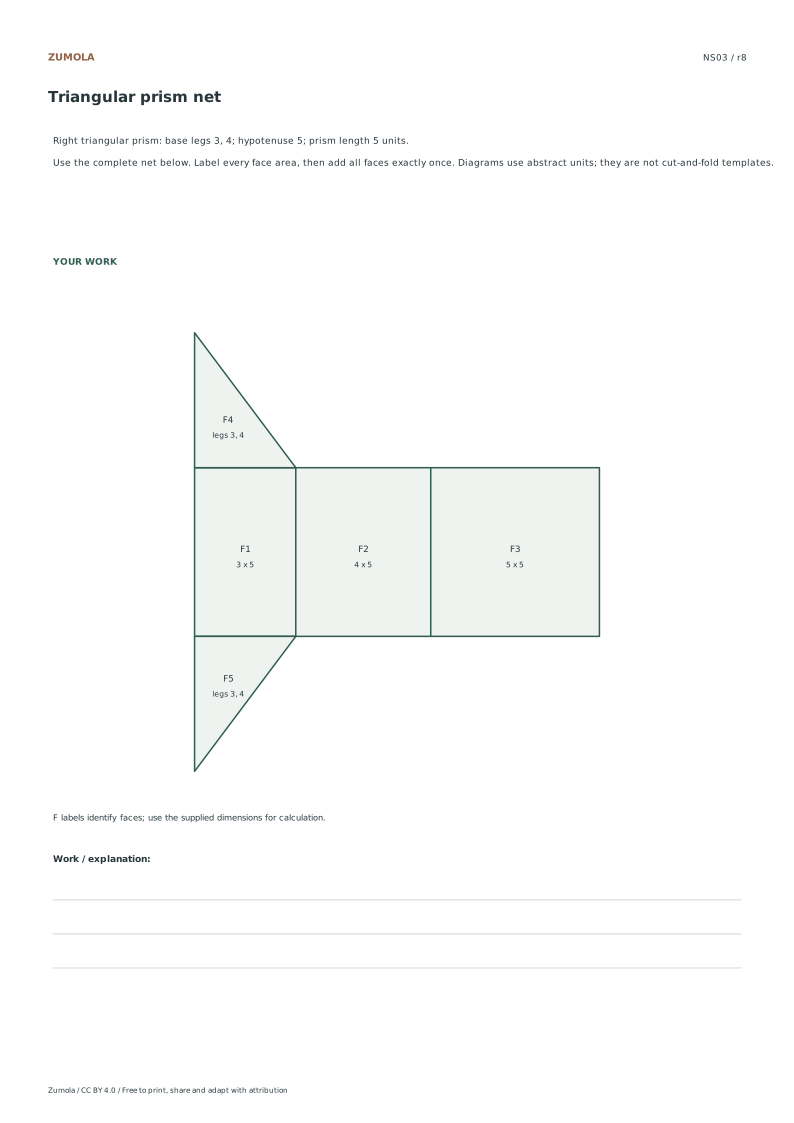
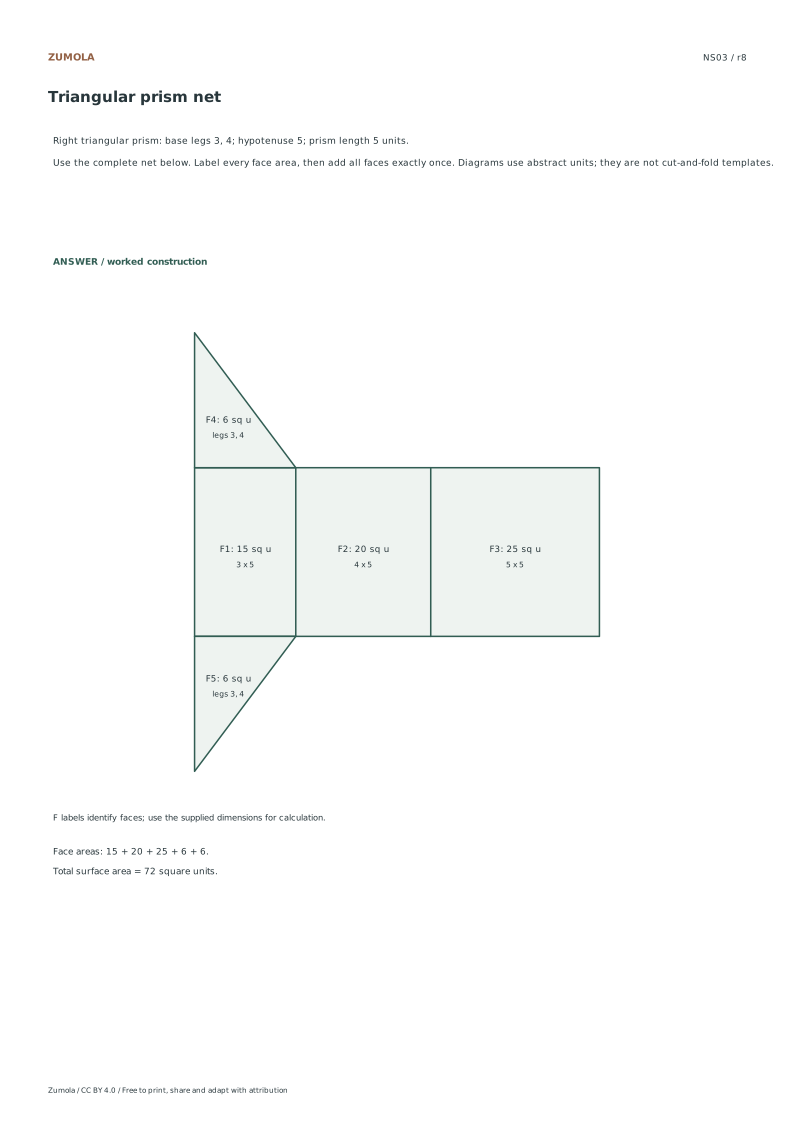
Right triangular prism: base legs 3, 4; hypotenuse 5; prism length 5 units.
Use the complete net below. Label every face area, then add all faces exactly once. Diagrams use abstract units; they are not cut-and-fold templates.
NS04
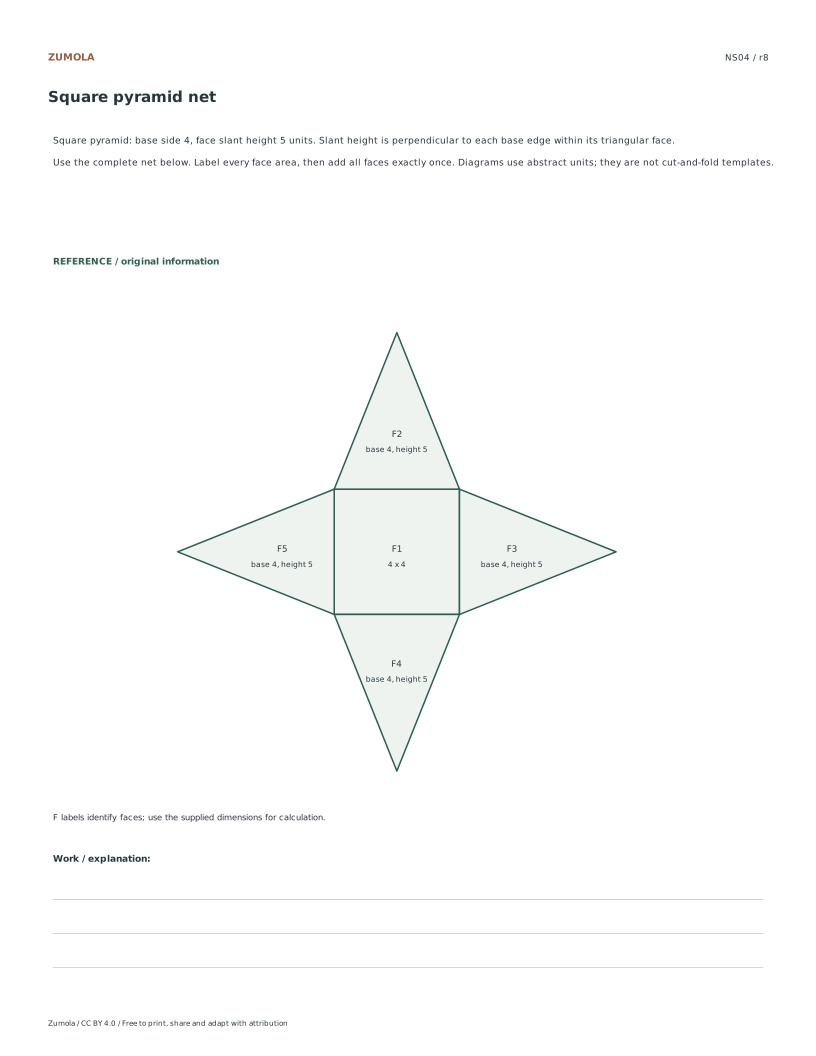
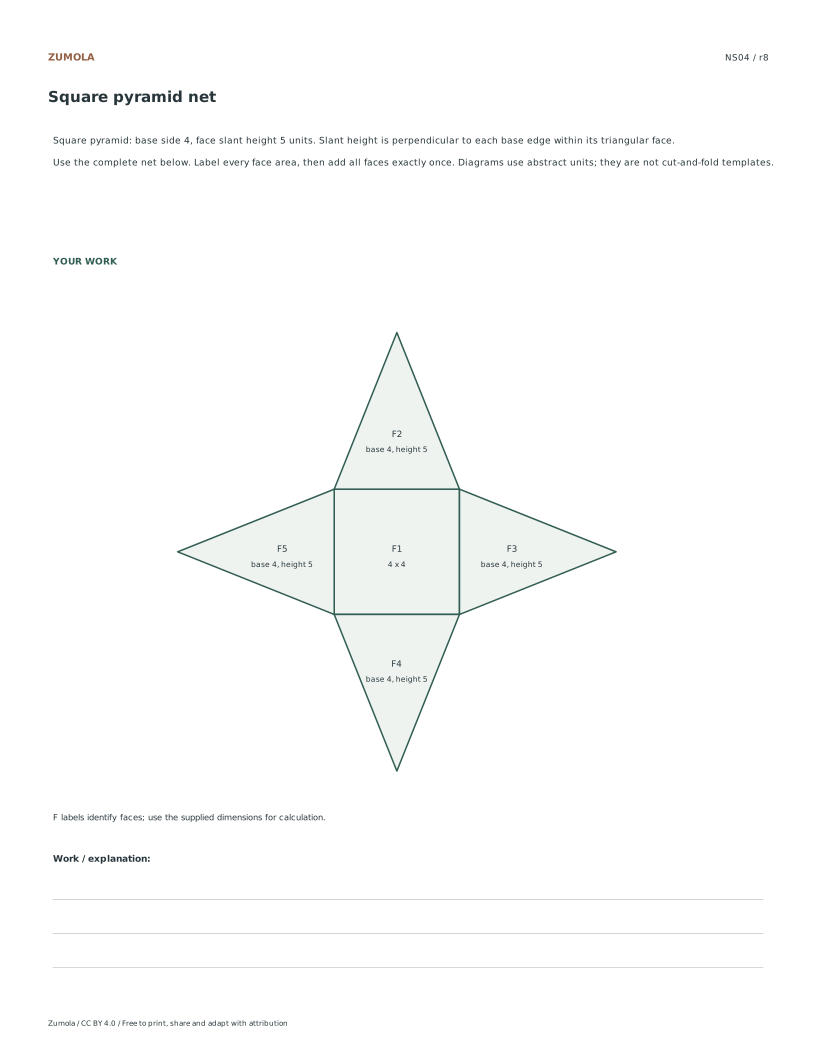
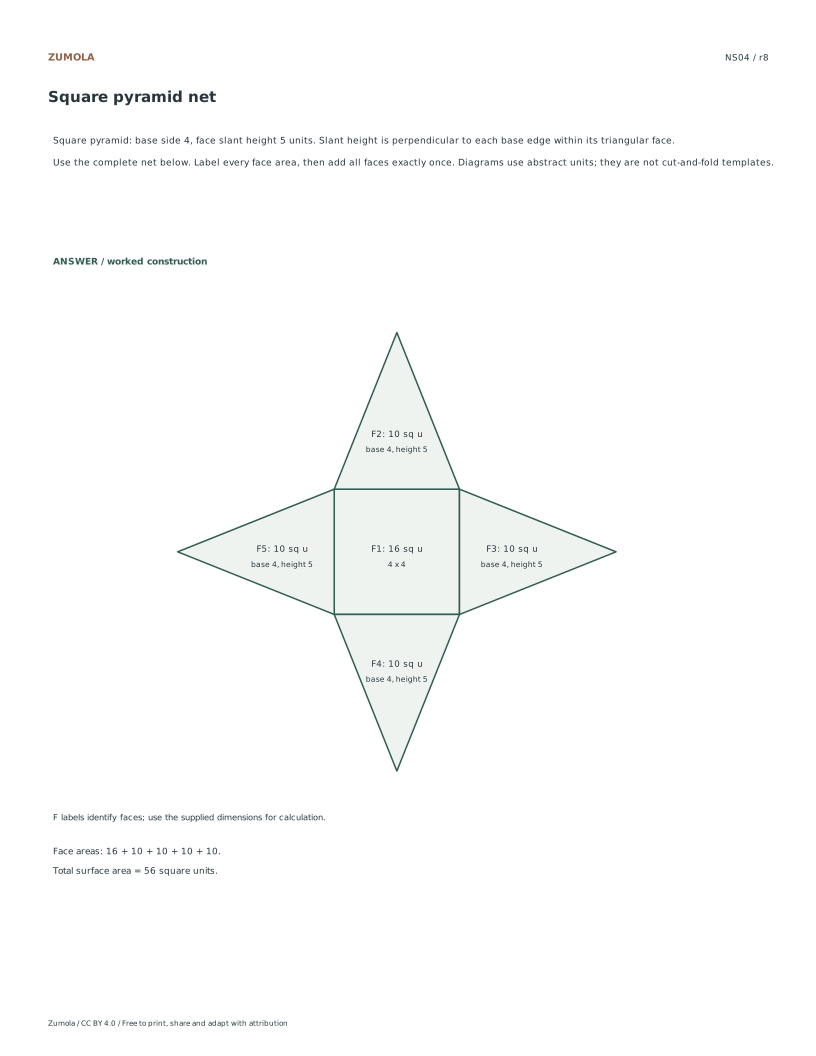
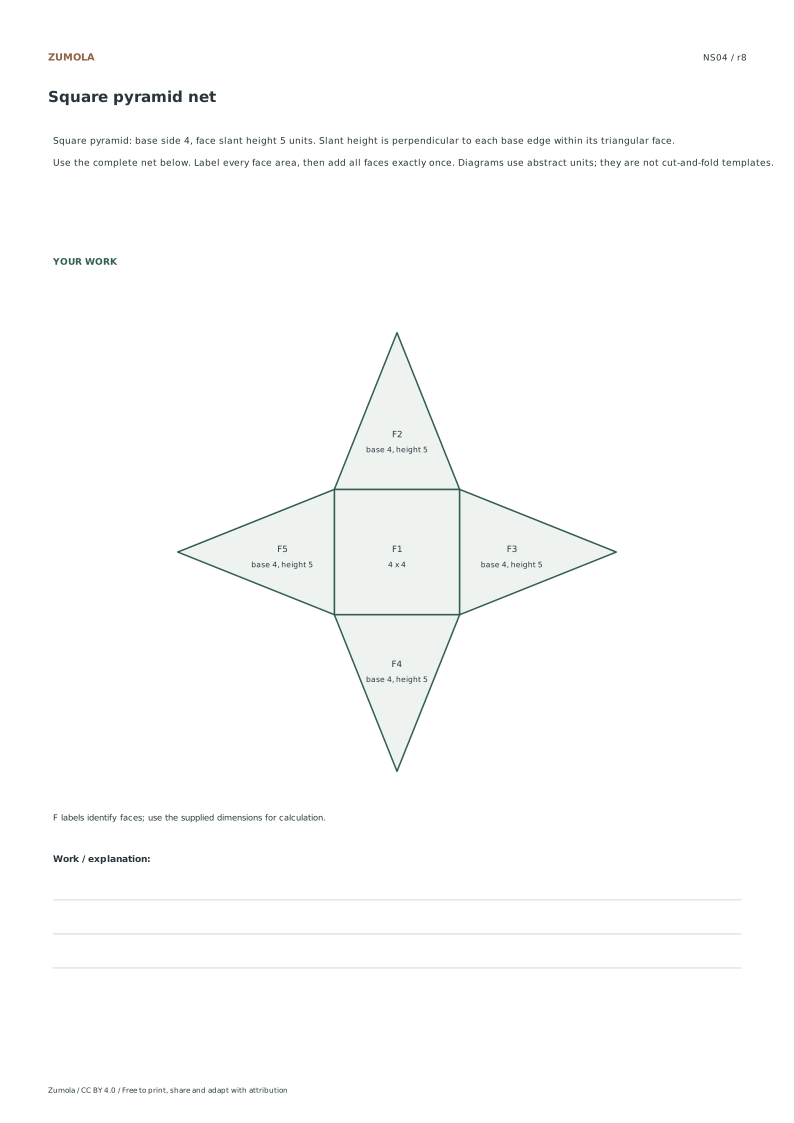
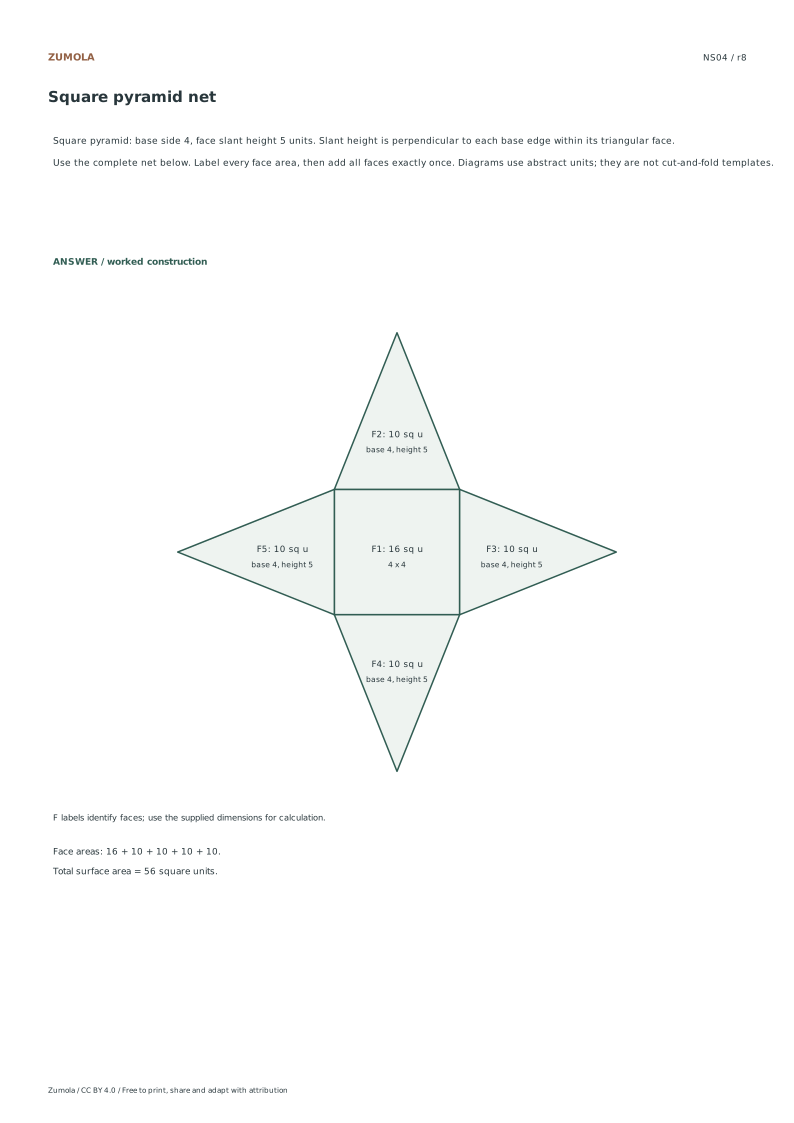
Square pyramid: base side 4, face slant height 5 units. Slant height is perpendicular to each base edge within its triangular face.
Use the complete net below. Label every face area, then add all faces exactly once. Diagrams use abstract units; they are not cut-and-fold templates.
Use the coordinates, dimensions and rules given for each case. Distances and areas are measured in grid units.
Check the first case
NS01: Rectangular prism net
Step
Worked result
1
Face areas: 8 + 12 + 8 + 12 + 6 + 6.
2
Total surface area = 52 square units.
The first case shows the checking pattern. Individual answer files contain the completed graph or net and result for every case.
Work through the graph
Reading a Net and Listing Faces
A net shows every face of a solid laid flat. For a rectangular prism with edges 2, 3, and 4, the six faces come in three pairs: two 2-by-3 faces (area 6 each), two 2-by-4 faces (area 8 each), and two 3-by-4 faces (area 12 each). Label each face on the net before adding. Write the six areas in order: 8, 12, 8, 12, 6, 6. Check that opposite faces match. This prevents double-counting or missing a face. The net is a diagram, not a cut-and-fold template; use the given edge lengths to compute each area.
Adding Face Areas Exactly Once
Surface area is the sum of all face areas. After labeling, add the six values once. For the 2-3-4 prism: 8 + 12 + 8 + 12 + 6 + 6 = 52 square units. For a cube with edge 3, all six faces are 9, so 9 + 9 + 9 + 9 + 9 + 9 = 54. For the right triangular prism with base legs 3 and 4, hypotenuse 5, and length 5, the faces are 15, 20, 25, and two triangles of 6 each: 15 + 20 + 25 + 6 + 6 = 72. For the square pyramid with base side 4 and slant height 5, the base is 16 and four triangles are 10 each: 16 + 10 + 10 + 10 + 10 = 56.
Using Slant Height and Triangular Faces
In a square pyramid net, each triangular face has base equal to the base side and height equal to the slant height. The slant height is perpendicular to the base edge within that triangular face. For base side 4 and slant height 5, each triangle area is (4 × 5) ÷ 2 = 10. The square base area is 4 × 4 = 16. Add the base and four triangles: 16 + 10 + 10 + 10 + 10 = 56 square units. Do not use the pyramid's vertical height for the triangle area; use the slant height given for the face. Label each triangle on the net before summing.
Checks that catch common errors
Watch for
Check instead
Counting a face twice or skipping a face when adding areas from the net.
Label every face on the net with its area first, then add the labeled values exactly once. For the 2-3-4 prism, the six labeled areas are 8, 12, 8, 12, 6, 6, giving 52 square units.
Using the pyramid's vertical height instead of the slant height to find triangular face areas.
The triangular face area uses the slant height perpendicular to the base edge within that face. With base side 4 and slant height 5, each triangle is (4 × 5) ÷ 2 = 10, and the total is 16 + 10 + 10 + 10 + 10 = 56 square units.
Assuming equal slopes alone mean lines are parallel without checking intercepts.
Distinct nonvertical lines are parallel only if slopes are equal and intercepts differ. Equal slopes with equal intercepts describe the same line. A slope product of 1 is not the parallel criterion; perpendicular lines have slope product -1.
Keep labels and margins readable
Choose the PDF that matches your paper. Print at Actual size / 100% and turn off Fit, Shrink and browser headers. SVG is editable but an editor can rescale it; the PDF is the simpler print route.
Useful answers
How do I find the surface area from a net?
Label each face on the net with its area, then add all face areas exactly once. For the rectangular prism with edges 2, 3, and 4, the face areas are 8, 12, 8, 12, 6, 6, and the total is 52 square units.
Why are there two triangles of area 6 in the triangular prism net?
The right triangular prism has two congruent triangular bases. With base legs 3 and 4, each triangle area is (3 × 4) ÷ 2 = 6. The rectangular faces are 15, 20, and 25, so the total is 15 + 20 + 25 + 6 + 6 = 72 square units.
Do equal slopes always mean two lines are parallel?
No. Distinct nonvertical lines are parallel only if their slopes are equal and their intercepts differ. If equal slopes also have equal intercepts, the equations describe the same line. Perpendicular lines have a slope product of -1, not 1.
Are the answer files and editable graphs free?
Yes. The individual student, reference and answer files plus collection packs are free without signup. Credit Zumola under CC BY 4.0 when sharing or adapting.
The diagrams and exercises on this page are original Zumola resources.
Your analytics choice
Optional Google Analytics helps us understand which free resources are useful. It is off until you allow it. Drawing tools and downloads work with either choice. Privacy details