Free original resources
Fraction Strips Printable: Shared-Whole Bars for Aligned Comparison
Make fraction strips that share one whole length so halves, thirds, quarters, sixths, eighths and twelfths line up for fair comparison.
Free resources
Letter & A4
PDF & SVG
Letter & A4
PDF & SVG
Make it yours.
Free · no signup · calculated in your browser
Your free printable kit.
Original reference, student practice and separate worked answers. No account or payment.
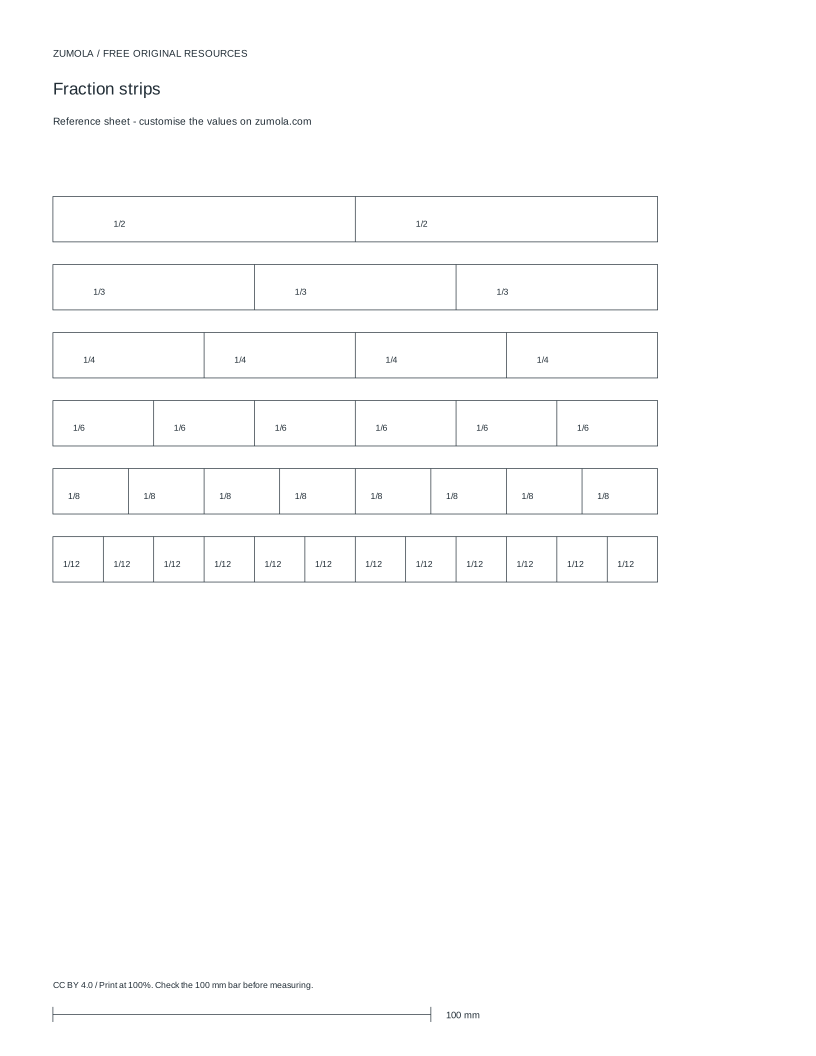
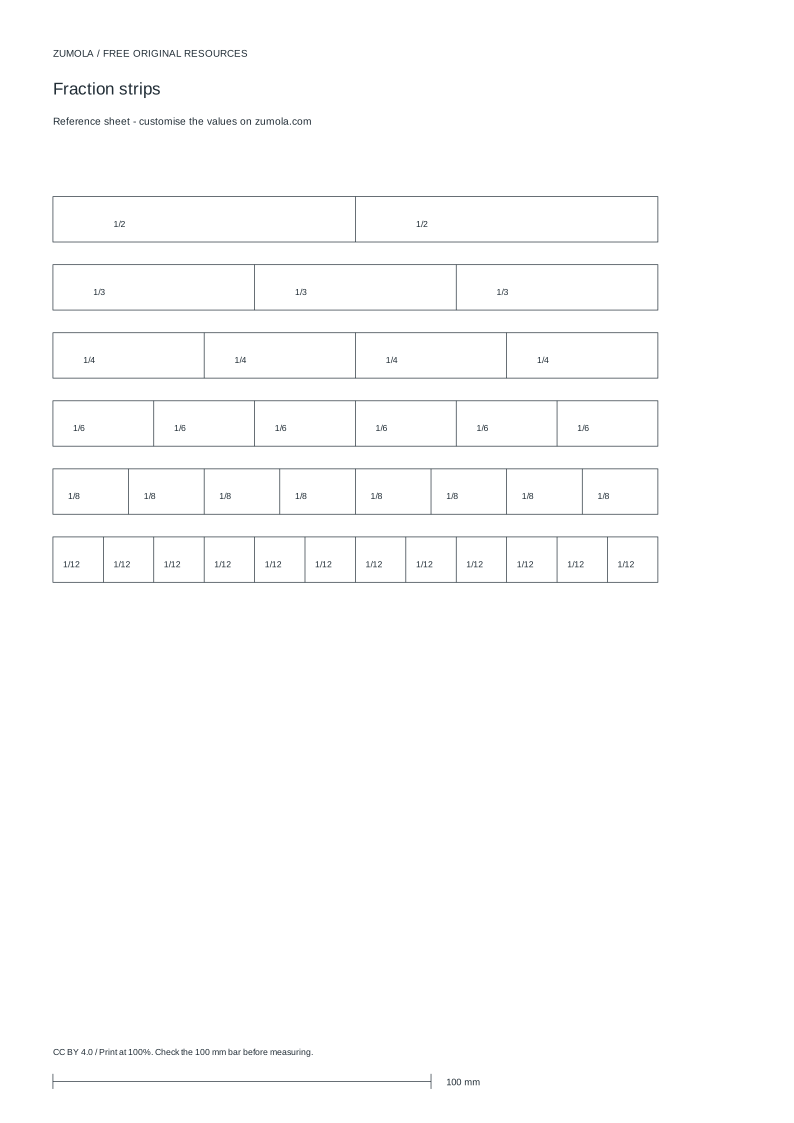
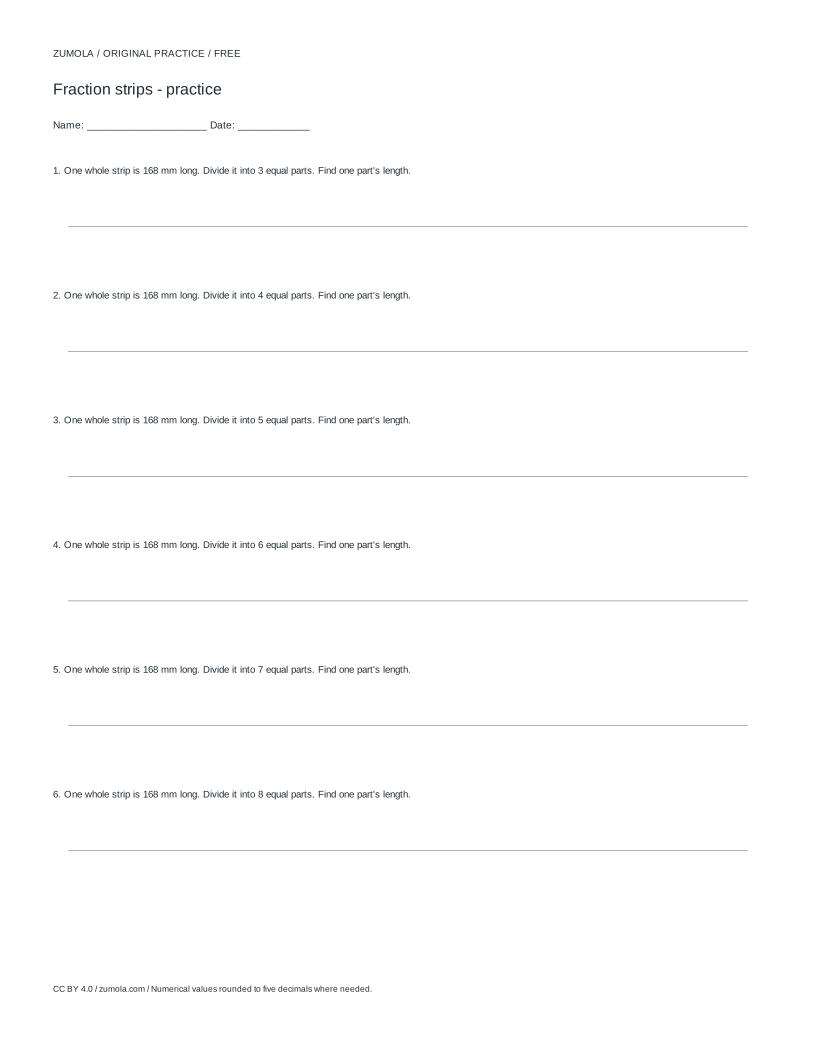
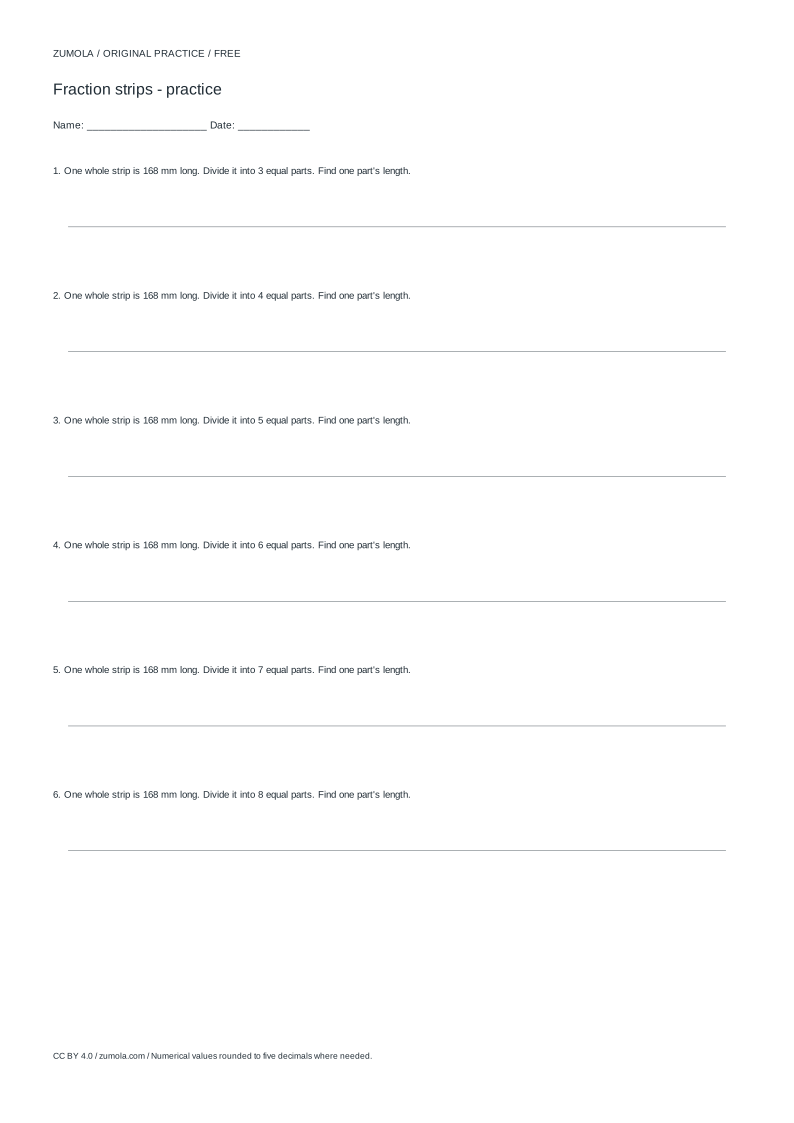
Practice worksheet
Worked answers / rubric
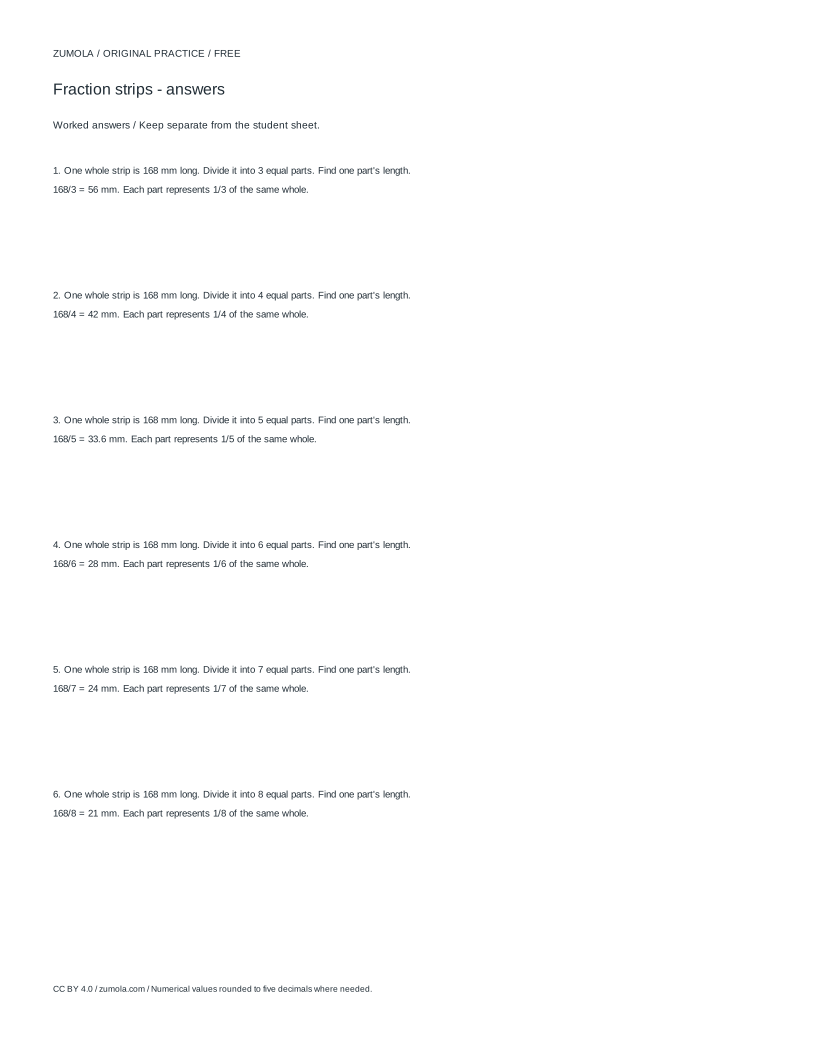
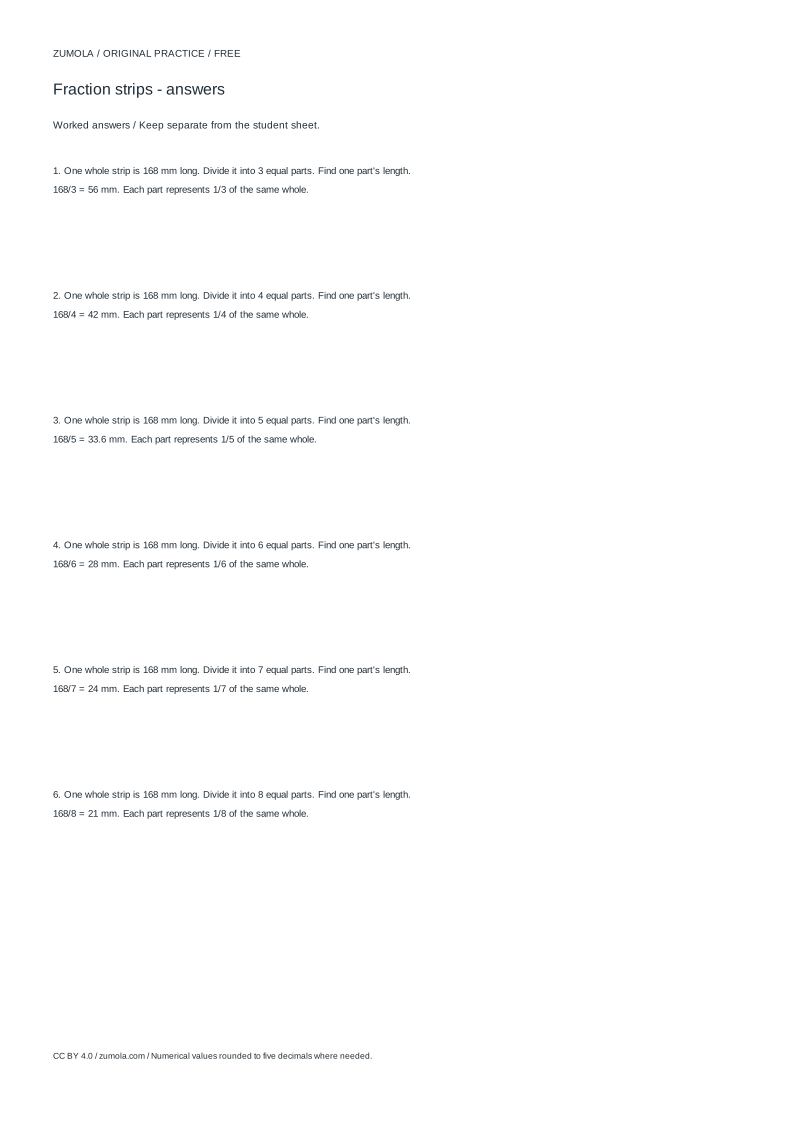
Print at Actual size / 100%. Check the calibration bar before using physical dimensions.
Fraction strips only compare fairly when every strip represents the same whole. This page explains how to build a set of bars with one common whole length, how to divide that length into equal parts for denominators 2, 3, 4, 6, 8 and 12, and how to align strips so equal and unequal fractions become visible. It also covers labeling choices, gray versus color sets, and the reasoning behind each comparison.
Why the Whole Must Stay Constant
A fraction describes part of one whole. If a half strip is longer than a third strip, comparing them tells you nothing about the fractions, only about the paper. Every strip in a set must therefore start at the same left edge and end at the same right edge. The whole length is fixed at 160 millimetres in the generator settings, so each strip is a 160 mm bar divided into equal parts.
The denominator sets the number of equal parts, not the size of the whole. A strip split into 2 parts has two 80 mm pieces; one split into 4 parts has four 40 mm pieces. Because the total stays 160 mm, a piece from the halves strip can be laid directly against pieces from other strips.
Keep the whole explicit when you hand out sheets. Write the whole length on the page or mark a shared start line, so learners do not trim strips to different lengths and then compare them by accident.
- Decide the denominators you need from 2, 3, 4, 6, 8 and 12.
- Print at 100% after checking a calibration bar, so the 160 mm whole is not scaled.
- Cut strips only along their outer edges, keeping the full 160 mm length intact.
- Stack strips with left edges aligned before comparing any two fractions.
Dividing One Whole into Equal Parts
Each strip is divided by its denominator. For 160 mm, halves are 80 mm, quarters are 40 mm, eighths are 20 mm and twelfths are about 13.33 mm. Thirds and sixths do not divide 160 mm into whole millimetres: thirds are about 53.33 mm and sixths about 26.67 mm. That is expected, because 160 is not divisible by 3.
The important check is equality within a strip, not whole millimetres. A thirds strip should have three parts of the same length, and a sixths strip six equal parts. When comparing across strips, use the shared whole and the part boundaries rather than measuring each piece with a ruler.
Labeling helps learners read a fraction as a count of parts. A labeled strip can show 1/3, 2/3 and 3/3 along the divisions, while an unlabeled strip supports estimation first. Gray sets reduce visual distraction; color sets help younger learners track one strip at a time.
- Divide the 160 mm whole by the denominator to find each part length.
- Mark divisions from the left edge so parts stay equal across the strip.
- Label numerators in order along the strip if labels are wanted.
- Check that the final part ends exactly at the right edge of the whole.
Aligning Strips to Compare Fractions
Place two strips with left edges and right edges matched. The longer shaded or marked region is the larger fraction. For example, 2/3 covers about 106.67 mm of the 160 mm whole, while 3/4 covers 120 mm, so 3/4 is larger. The comparison is valid because both fractions refer to the same 160 mm whole.
Equivalent fractions occupy the same length. One half is 80 mm; two quarters are 40 mm plus 40 mm, also 80 mm; four eighths are 4 times 20 mm, again 80 mm. Lining these up shows equivalence without multiplying.
Use a consistent reference line. If strips are stacked, align the left edge against a straight edge or the page margin. Comparing a strip that starts at a different point produces a false result even when the fractions are correct.
- Lay the strips on a flat surface with left edges on one line.
- Mark or shade the fraction on each strip from the left edge.
- Compare the right end of each marked region against the shared whole.
- Record the comparison using the same whole, for example 2/3 < 3/4 of 160 mm.
Labeled, Gray and Color Sets
A labeled set prints fraction names along the divisions, which supports reading and recording. An unlabeled set asks learners to count parts and name the fraction themselves. Gray strips keep attention on length and boundaries; color strips make it easier to separate one denominator from another when several are on the table.
Choose one style per activity so the comparison stays the focus. Mixing labeled and unlabeled strips in one comparison can confuse learners about whether the label or the length is the evidence. If you use color, keep the same color for the same denominator across the set.
Store each denominator as its own strip or small group. Keeping sets separate prevents a quarter piece from being mistaken for part of a thirds strip, and it makes the shared whole easier to check before every comparison.
- Pick labeled or unlabeled strips for the task.
- Pick gray or color to match the level of visual support needed.
- Keep one color per denominator if color is used.
- Before comparing, confirm every strip still spans the full 160 mm whole.
Try this example
Using strips that share a 160 mm whole, compare 2/3 and 3/4 and state which is larger.
Show the worked explanation
Two thirds of 160 mm is 2 times about 53.33 mm, which is about 106.67 mm. Three quarters of 160 mm is 3 times 40 mm, which is 120 mm. Both are measured from the same left edge of the 160 mm whole. Since 120 mm is longer than about 106.67 mm, 3/4 is larger than 2/3.
Common mistakes
- Comparing strips that were printed or cut to different lengths. Print at 100% after checking a calibration bar, and align left and right edges before comparing.
- Treating the thirds or sixths strips as wrong because their parts are not whole millimetres. Check that parts within each strip are equal; 160 mm divided by 3 is about 53.33 mm, which is expected.
- Reading a label as proof of size without checking the shared whole. Compare the marked lengths against the same 160 mm whole, then use the label to name the result.
Check your work
- Every strip spans the same 160 mm whole from a shared left edge to a shared right edge.
- Parts within each strip are equal, and the denominator matches the number of parts.
- Comparisons use the same whole and align strip edges before judging length.
- Labels, gray or color choices are used consistently within one activity.
- Explanations name the fraction and the shared whole rather than relying on label alone.
Questions before you start
Why do all fraction strips need the same whole length?
A fraction is part of one whole. If the wholes differ, the strip lengths reflect different totals, so the comparison is not about the fractions.
How long is each part on a 160 mm strip?
Halves are 80 mm, quarters 40 mm, eighths 20 mm and twelfths about 13.33 mm. Thirds are about 53.33 mm and sixths about 26.67 mm because 160 is not divisible by 3.
Should I use labeled or unlabeled strips?
Use labeled strips when learners need to read and record fraction names. Use unlabeled strips when the goal is counting equal parts and naming fractions from the model.