Free original resources
Fraction Models and Equivalence: Area and Number Line Worksheets
Connect fraction notation, shaded area models, and number lines to build equivalent fractions. Includes a worked example, common mistakes, and a drawing rubric.
Free resources
Letter & A4
PDF & SVG
Letter & A4
PDF & SVG
Make it yours.
Free · no signup · calculated in your browser
Your free printable kit.
Original reference, student practice and separate worked answers. No account or payment.
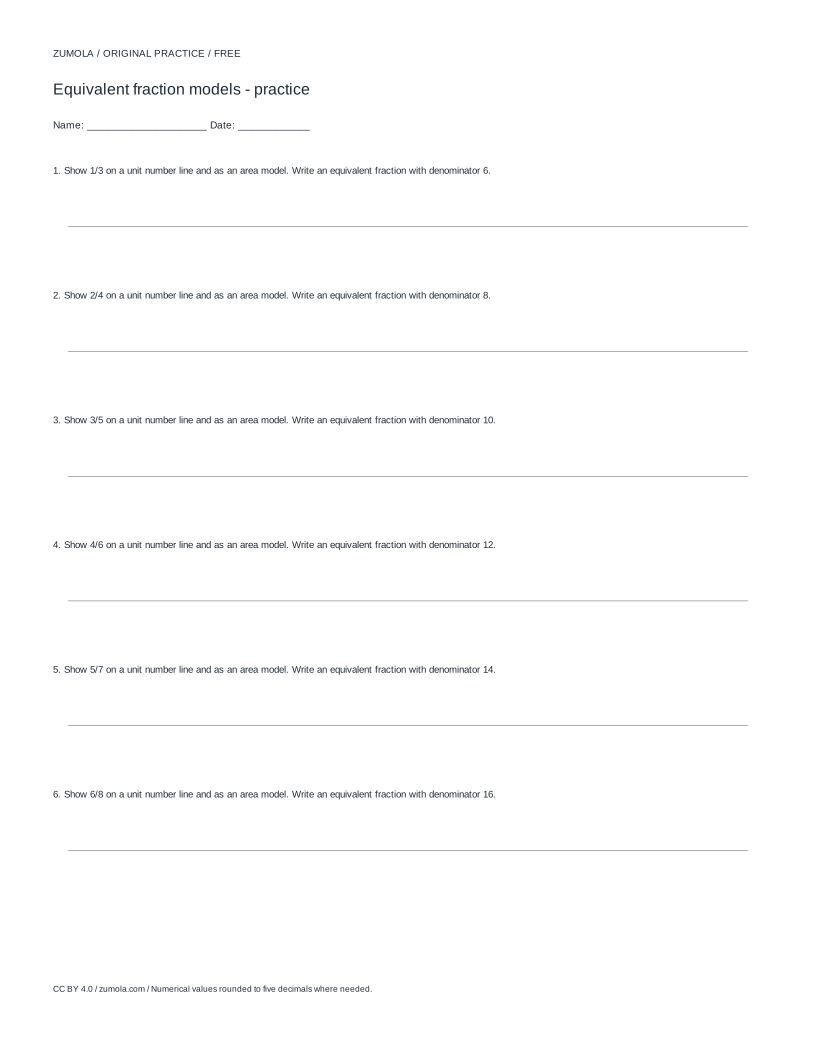
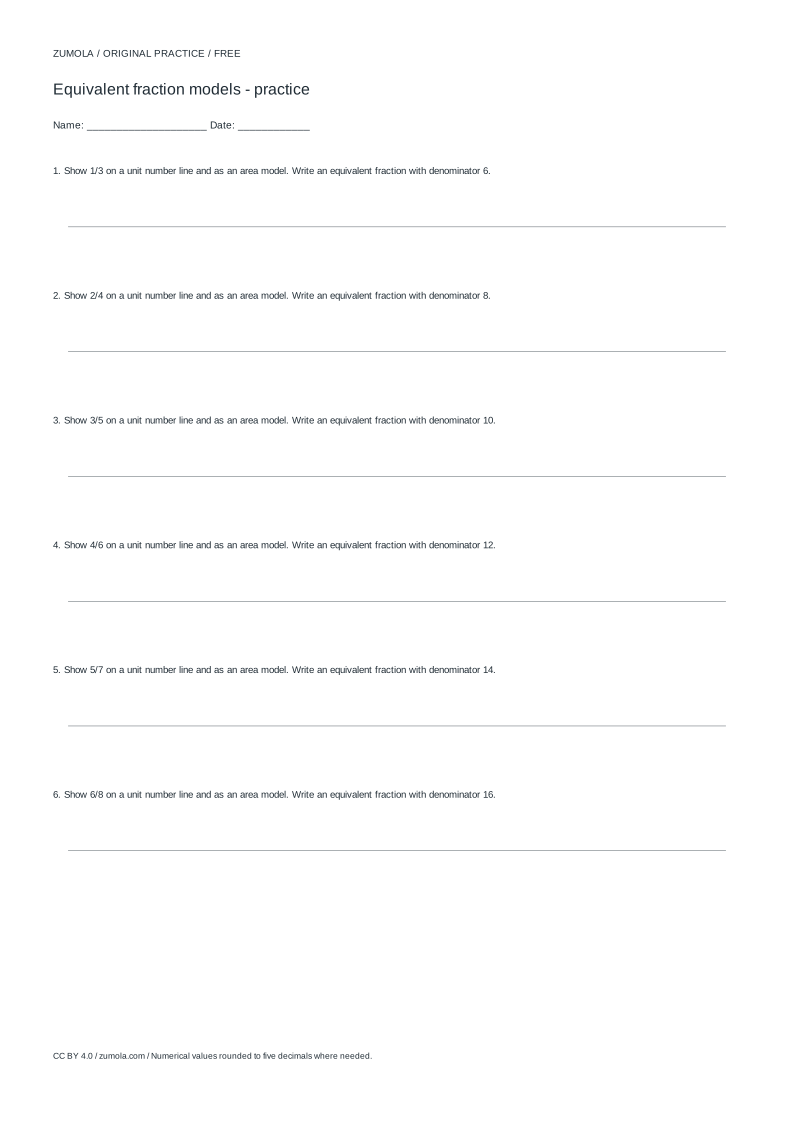
Practice worksheet
Worked answers / rubric
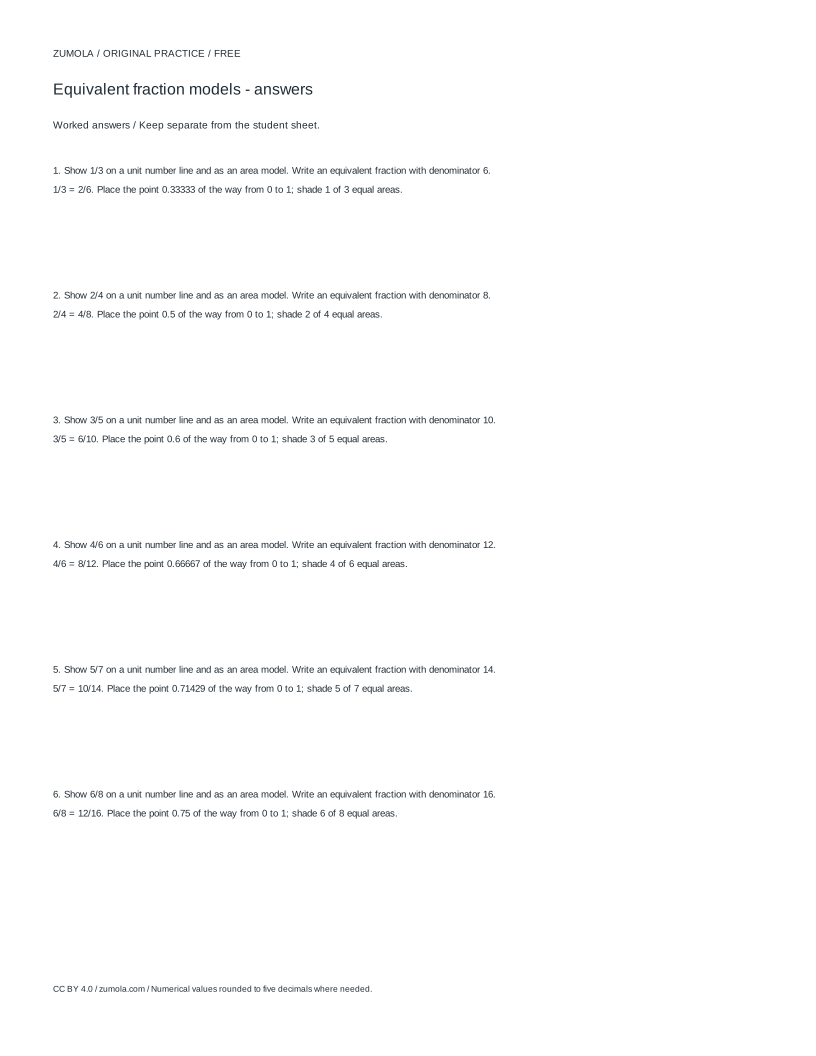
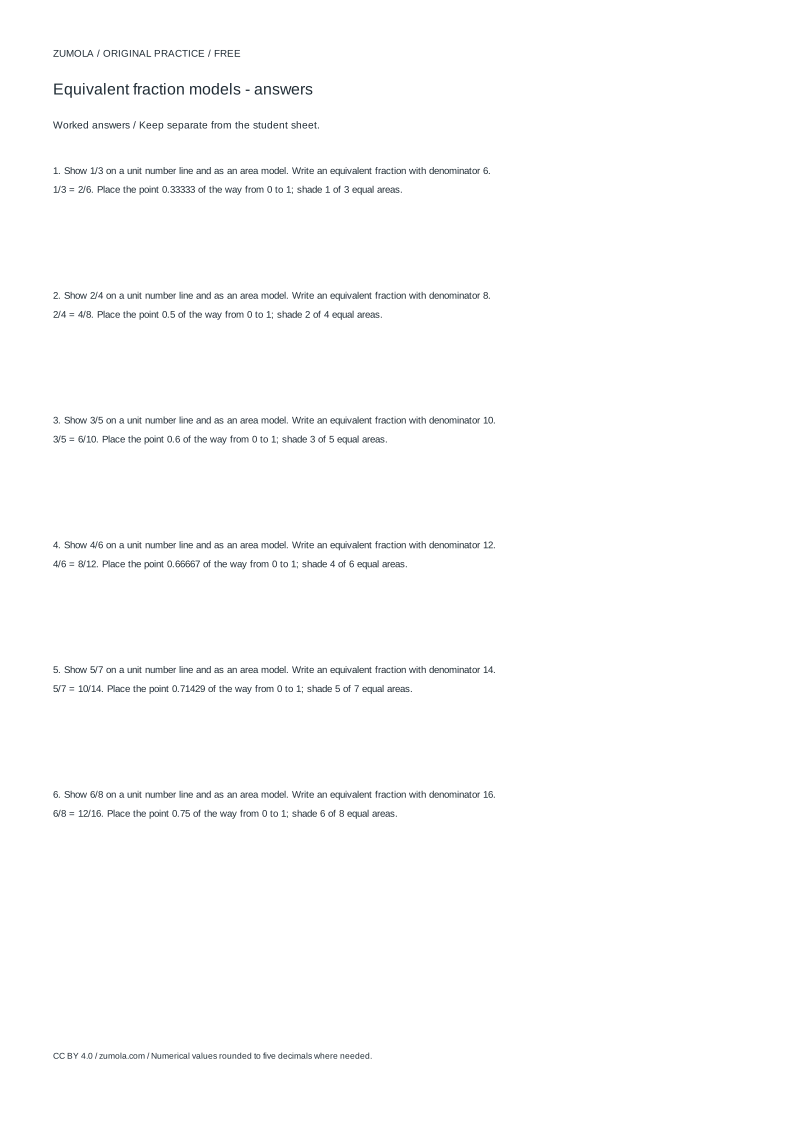
Print at Actual size / 100%. Check the calibration bar before using physical dimensions.
A fraction is easier to understand when the same quantity appears in more than one form. An area model shows a whole split into equal parts, with some parts shaded. A number line places that same value between whole numbers. This page explains how to link the written fraction, the shaded region, and the position on a line, then extend the idea to equivalent fractions. The method works for proper fractions and can be adapted to improper fractions by using more than one whole.
Reading an area model as a fraction
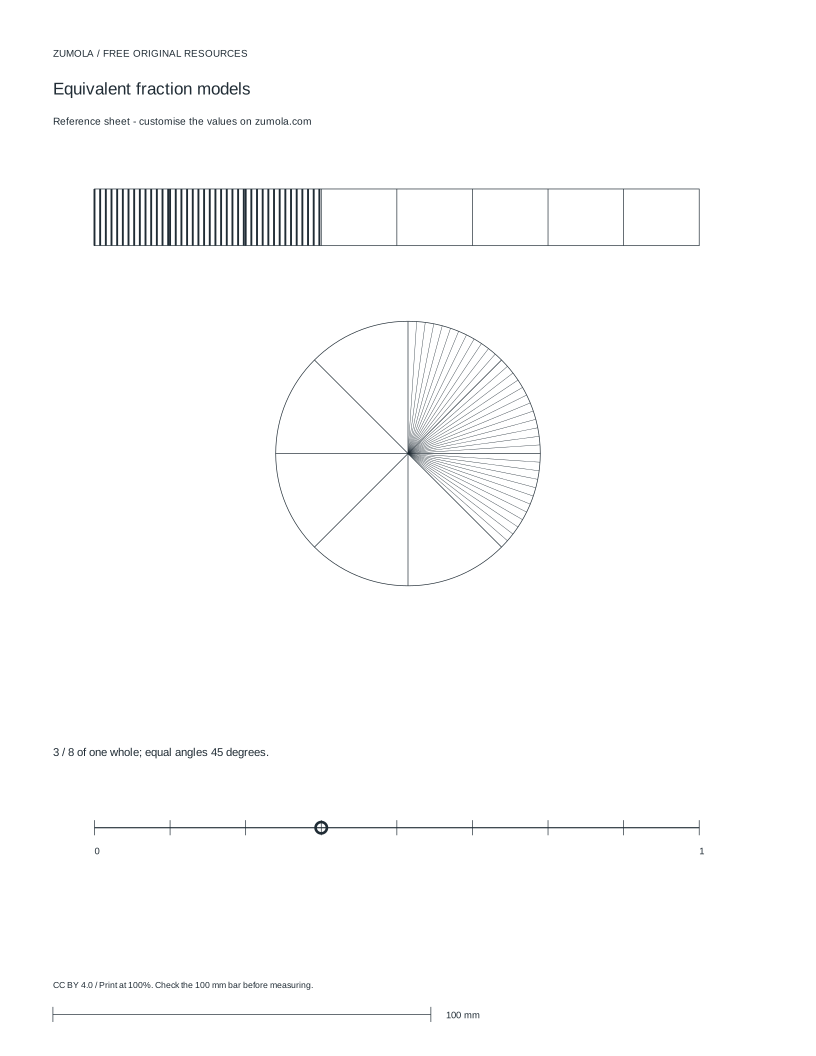
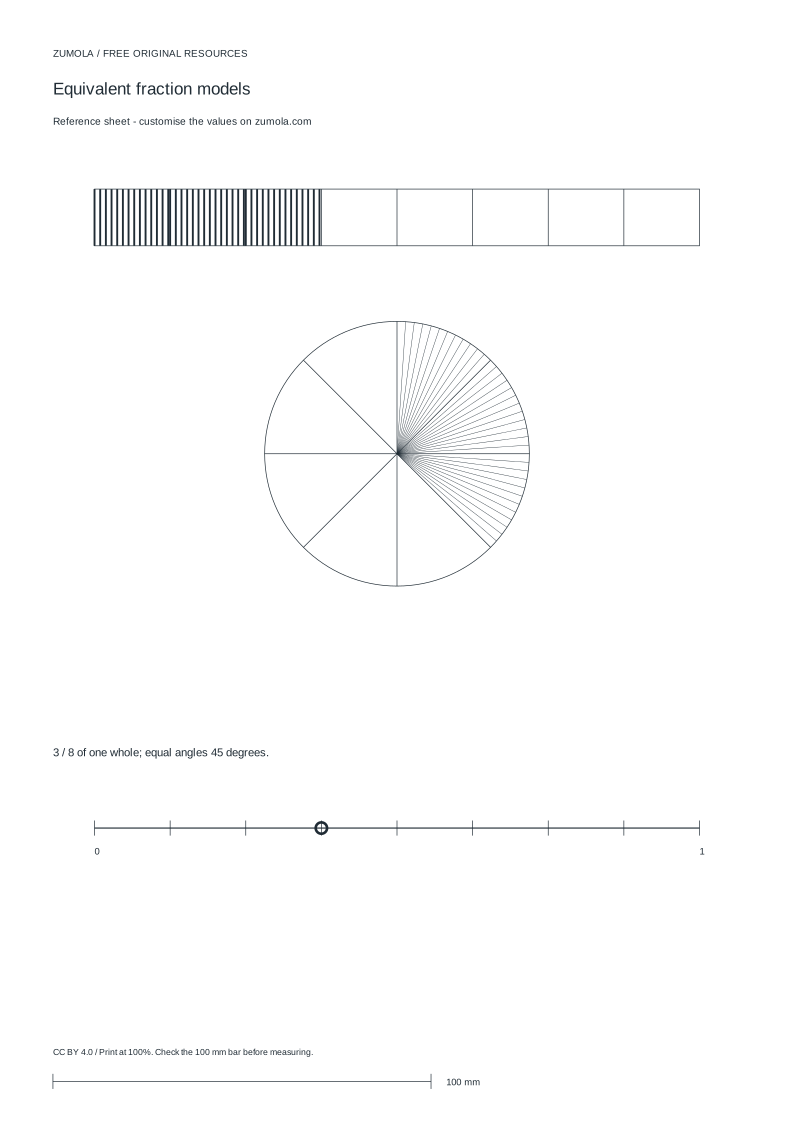
An area model starts with one whole shape, often a rectangle or circle, divided into equal parts. The denominator counts how many equal parts make the whole. The numerator counts how many of those parts are shaded or selected. If a circle is divided into 8 equal sectors and 3 are shaded, the fraction is 3/8. The key condition is equality: every part must have the same area, so the model is fair.
The whole must stay the same when you compare fractions. A shaded half of a small square and a shaded half of a large square are both 1/2 of their own whole, but they are not the same amount of area. When comparing two fractions, use wholes of identical size and split each into the stated number of equal parts.
For improper fractions, allow the shading to pass one whole. Two identical rectangles each split into 4 parts can show 7/4 by shading all 4 parts of the first rectangle and 3 parts of the second. The written fraction still means 7 equal parts of size 1/4.
- Decide the whole shape and keep its size fixed.
- Split the whole into the number of equal parts named by the denominator.
- Shade the number of parts named by the numerator.
- Write the fraction and check that shaded parts and total parts match the drawing.
Placing the same fraction on a number line
A number line from 0 to 1 can be divided into the same number of equal intervals as the denominator. For 3/8, mark 0 and 1, split the segment into 8 equal intervals, and count 3 intervals from 0. The point sits at 3/8. The area model and the number line describe the same value, so the shaded fraction and the marked point should agree.
Equal intervals matter as much as equal areas. If the gaps between marks differ, the line no longer represents equal parts and the position is unreliable. Use a ruler or a consistent spacing method so the intervals stay uniform.
The number line also makes ordering visible. Points further right are larger. This helps confirm comparisons such as 3/8 being less than 5/8, because 3 intervals from 0 is closer to 0 than 5 intervals.
- Draw a line and mark 0 and 1.
- Divide the segment into equal intervals matching the denominator.
- Count from 0 by the numerator to place the point.
- Compare the point with the shaded area model to confirm they represent the same fraction.
Building equivalent fractions with area models
Equivalent fractions name the same value with different numerators and denominators. Start with a shaded model, such as 3/8. Split every part into 2 equal smaller parts. The whole now has 16 equal parts, and the shaded region contains 6 of them, so 3/8 equals 6/16. The shaded area did not change; only the number of divisions changed.
This is why multiplying numerator and denominator by the same nonzero number preserves value. Each original part becomes several smaller parts, and the shaded region gains the same multiplier. The reverse works too: combining pairs of small parts reduces 6/16 to 3/8.
Use exact rational reasoning rather than rounded decimals when checking equivalence. For 3/8, the exact value is 0.375. A model split into 8 equal sectors with 3 shaded represents that value. Keep the arithmetic exact so small rounding differences do not create false conclusions.
- Shade a starting fraction in a whole shape.
- Split every part into the same number of smaller equal parts.
- Recount total parts for the new denominator and shaded parts for the new numerator.
- Check that the shaded area is unchanged and record the equivalent pair.
Checking your drawing before you rely on it
A fraction drawing can be correct in more than one visual style, so judge it against clear criteria rather than a single expected picture. The important checks are equal parts, correct counts, a consistent whole, and agreement between the written fraction and the drawing.
When printing a physical sheet, print at 100% and confirm scale with a calibration bar before measuring any drawn lengths. Measurements in millimetres apply only when explicitly stated; schematic math charts use abstract coordinate units, not physical sizes.
Keep the diagram focused on the mathematics: a fraction model is a mathematical diagram, and shading choices should clearly show the selected equal parts of the whole.
- Confirm all parts are equal in area or interval.
- Recount numerator and denominator directly from the drawing.
- Verify both compared fractions use the same whole size.
- Check the number line point matches the shaded fraction.
Worked example
A circle is divided into 8 equal sectors and 3 are shaded. The fraction is 3/8. On a number line from 0 to 1 split into 8 equal intervals, the point for 3/8 is 3 intervals from 0. Splitting each sector into 2 equal parts gives 16 total parts and 6 shaded parts, so 3/8 = 6/16. The exact decimal value is 0.375, and the shaded area is unchanged after splitting.
- Write 3/8 from 3 shaded of 8 equal parts.
- Mark 3 of 8 equal intervals on the number line.
- Split each part into 2 to get 6/16.
- Confirm the shaded area stayed the same.
Try this example
Draw and explain 3/8 using an area model and a number line, then produce one equivalent fraction.
Show the worked explanation
Divide a circle into 8 equal sectors and shade 3, giving 3/8. On a number line from 0 to 1 with 8 equal intervals, place the point 3 intervals from 0. Split each sector into 2 equal parts: 16 total parts, 6 shaded, so 3/8 = 6/16. The exact value is 0.375, and the shaded area is unchanged.
Common mistakes
- Dividing the whole into unequal parts and still calling them fractions of the whole. Redraw so every part has equal area or equal interval length before counting numerator and denominator.
- Comparing fractions drawn on wholes of different sizes. Use identical whole shapes for both fractions, then compare shaded parts or number line positions.
- Splitting only the shaded parts when building an equivalent fraction. Split every part of the whole by the same factor, then recount both total and shaded parts.
Check your work
- The whole shape is clearly defined and used consistently.
- All parts are equal in area or interval length.
- Numerator and denominator match the shaded or marked parts.
- The number line point agrees with the area model.
- Any equivalent fraction is produced by splitting or combining all parts equally.
- Labels and notation are clear enough for another reader to verify the counts.
Questions before you start
Why must the parts be equal in a fraction model?
The denominator means equal parts of one whole. Unequal parts do not represent the fraction named, so counts become misleading.
How do I show an improper fraction with an area model?
Use more than one identical whole. For 7/4, shade all 4 parts of one whole and 3 parts of a second whole split into 4 equal parts.
Can a fraction drawing look different and still be correct?
Yes. Shapes, colours, and layout can vary. Correctness depends on equal parts, accurate counts, a consistent whole, and agreement with the written fraction.