Free original lessons
One-Point Perspective Rubric
This sheet teaches how to score a one-point perspective drawing with a short rubric. You will read the criteria, study a scored example plate, then apply the same criteria to four practice drawings and check each answer against the stated reasoning.
Letter & A4
PDF & SVG
What the rubric scores
Score each criterion on the 0–3 bands below. Every scored drawing shows six receding edges and two front faces, so the edge and face scores can be checked against visible evidence.
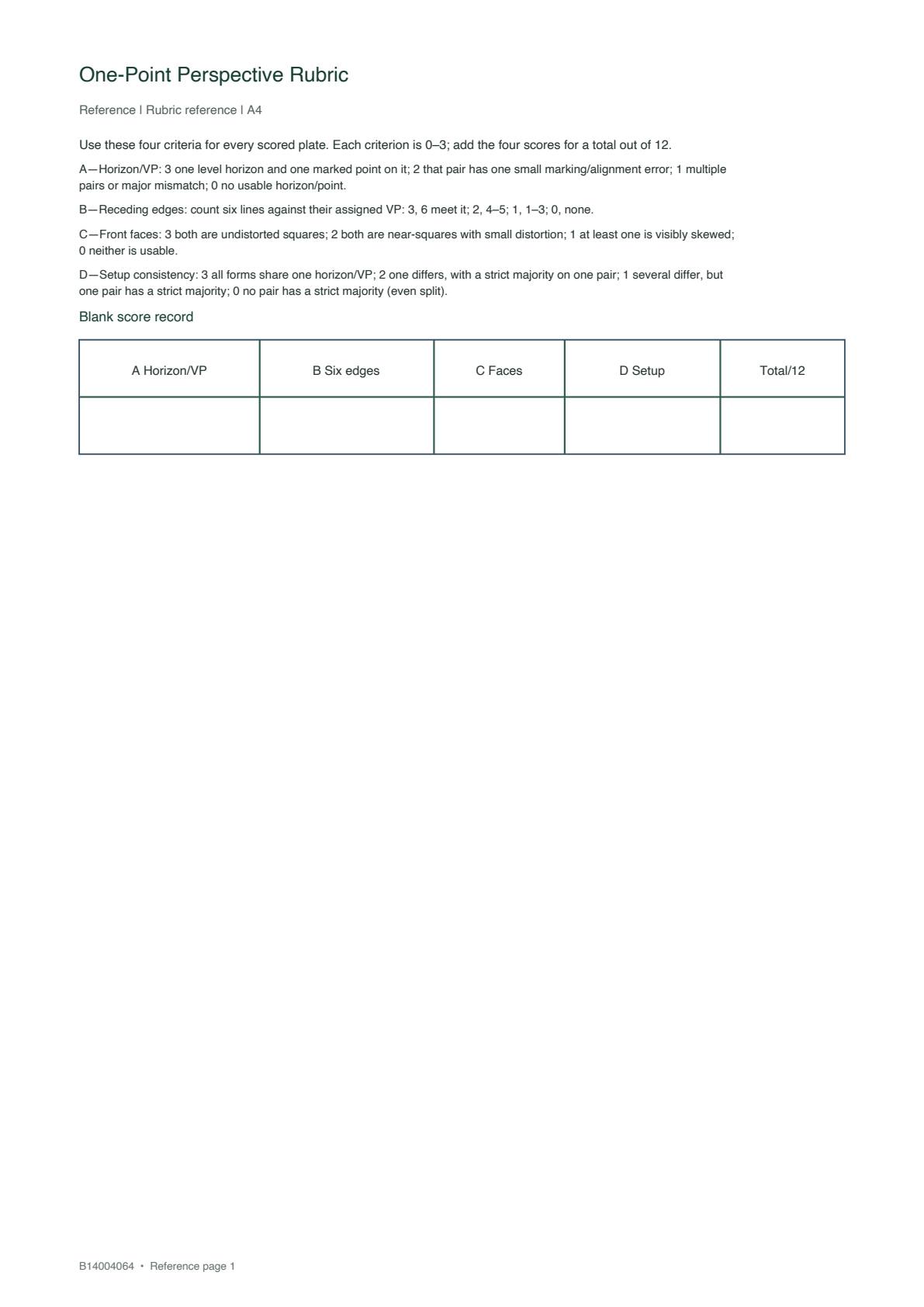
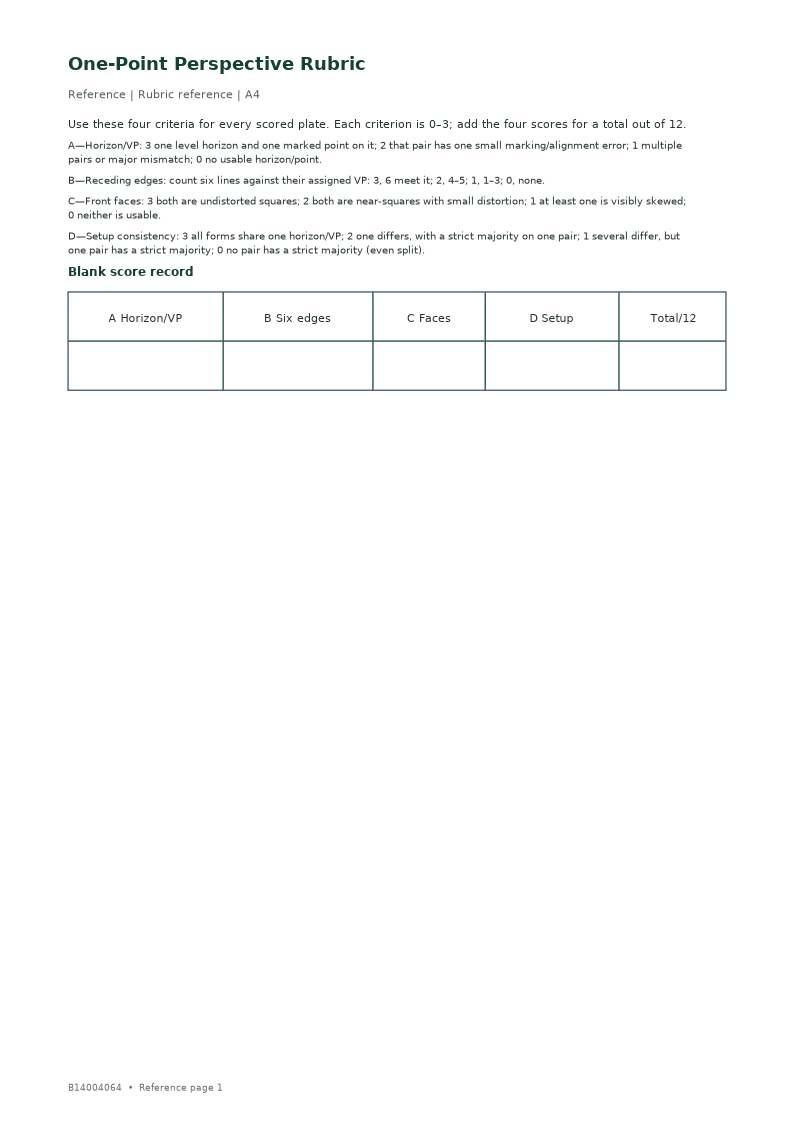
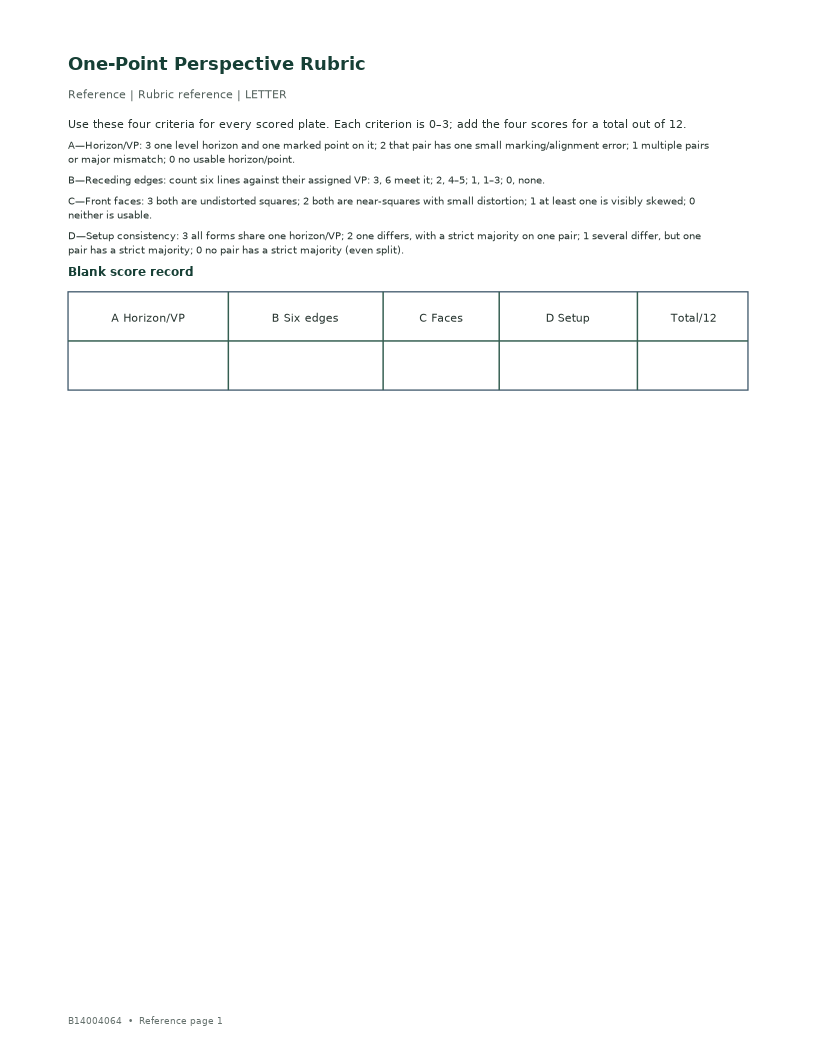
Criteria A–D score the horizon/VP, six depth edges against their assigned points, two front faces, and whether one setup governs the whole scene. For D, a setup must be used by a strict majority of forms; an even split scores 0.
Scored example plate
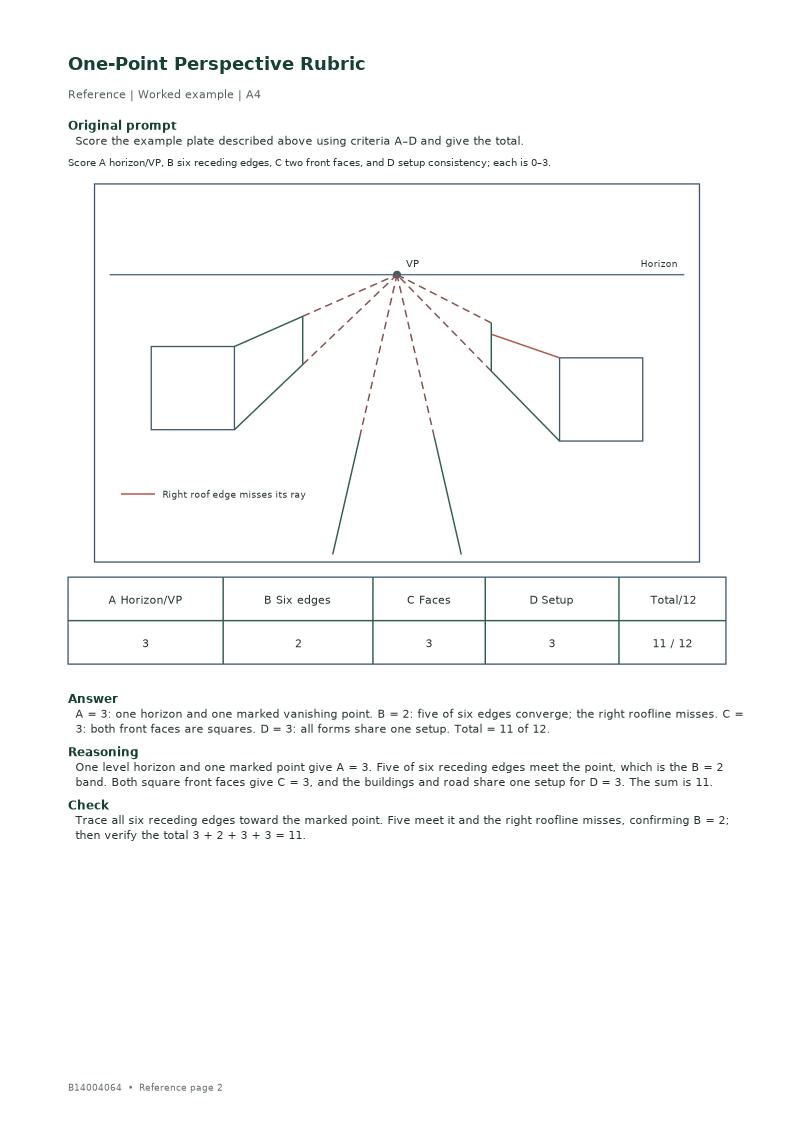
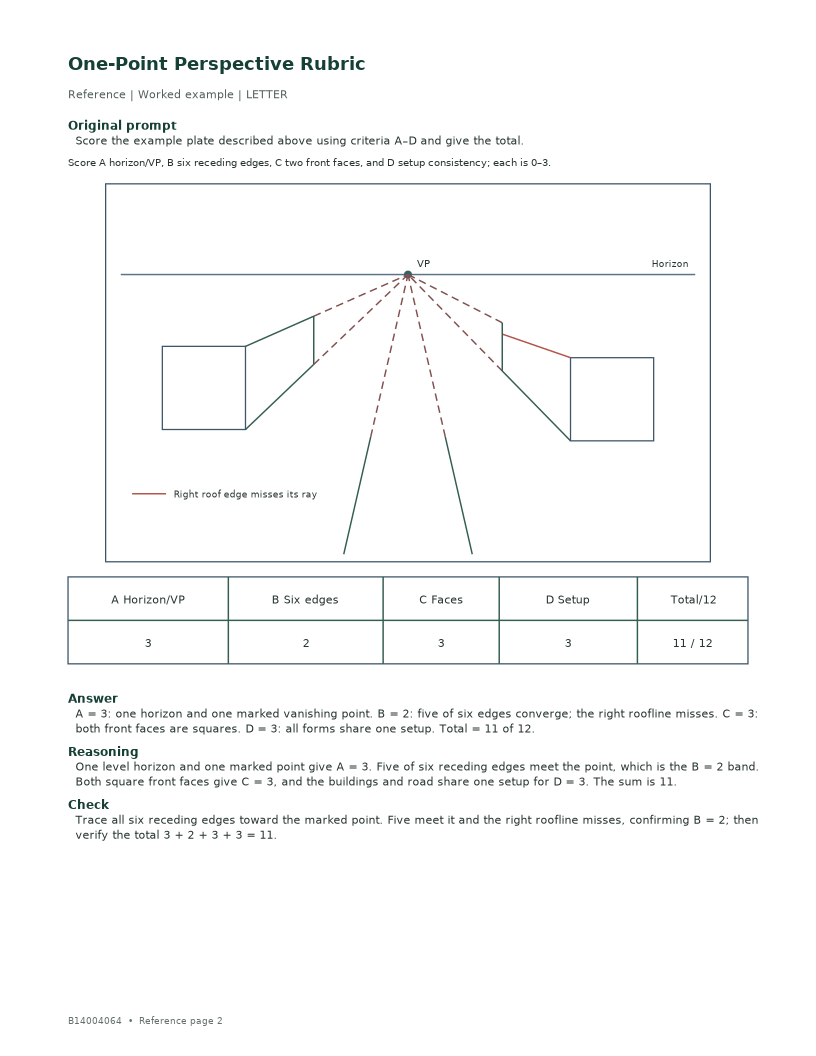
The worked plate shows two square-front buildings and two road edges. Its single level horizon and marked vanishing point define one setup. Of six scored receding edges, five meet the point; the right building’s roof edge is the one intentional miss.
Worked scores: A = 3, B = 2 (five of six receding edges meet the point), C = 3, D = 3; total = 11 of 12. A earns 3 because one level horizon and one marked point govern the scene. B earns 2 because the right building’s roof edge misses while the other five meet the point. C earns 3 because both front faces are squares. D earns 3 because both buildings and the road use the same setup.
How to apply the rubric
Use the same six-edge check for B on every plate. A missed receding edge lowers B. Judge D separately by checking whether one horizon and vanishing point govern the whole scene.
Practice tasks
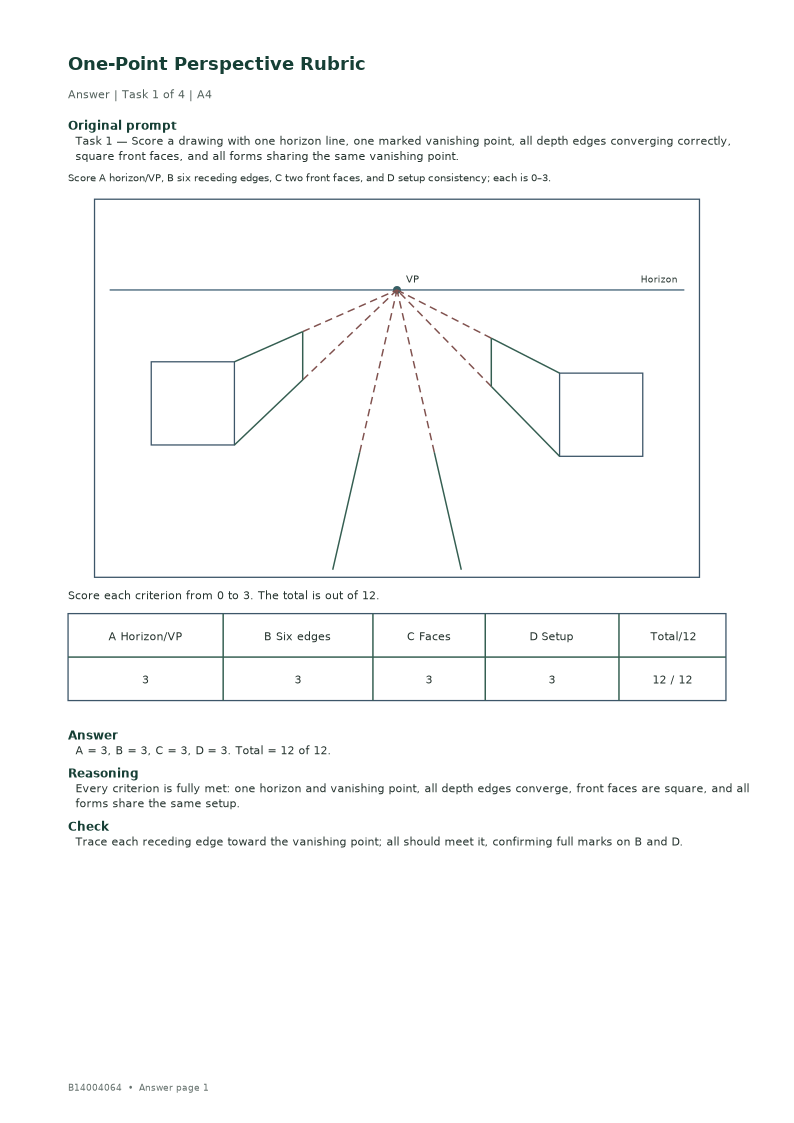
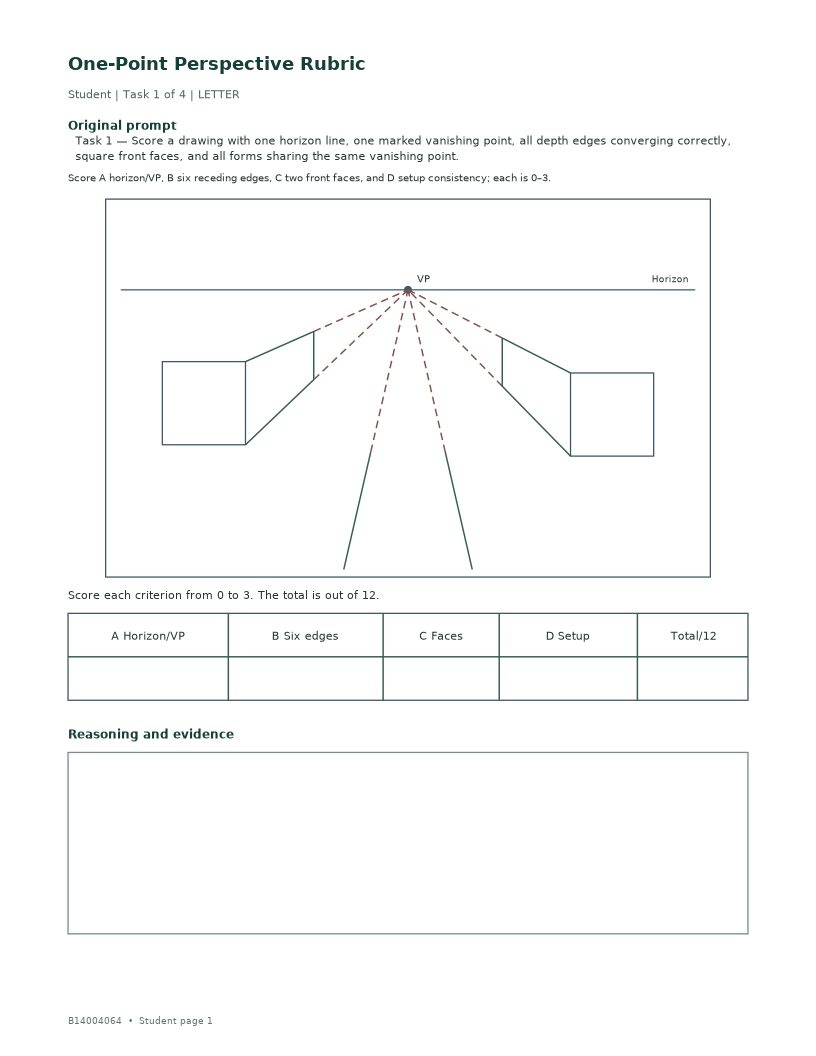
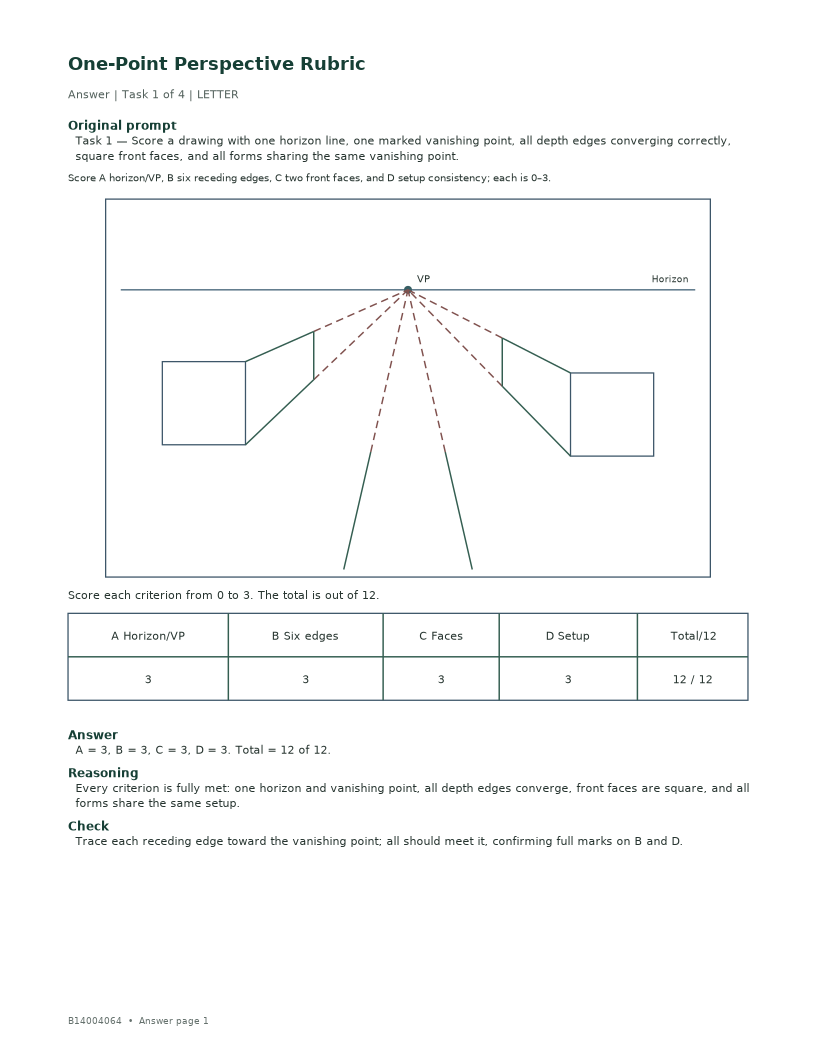
Task 1 — Score a drawing with one horizon line, one marked vanishing point, all depth edges converging correctly, square front faces, and all forms sharing the same vanishing point. Give each criterion a score, a reason, and the total.
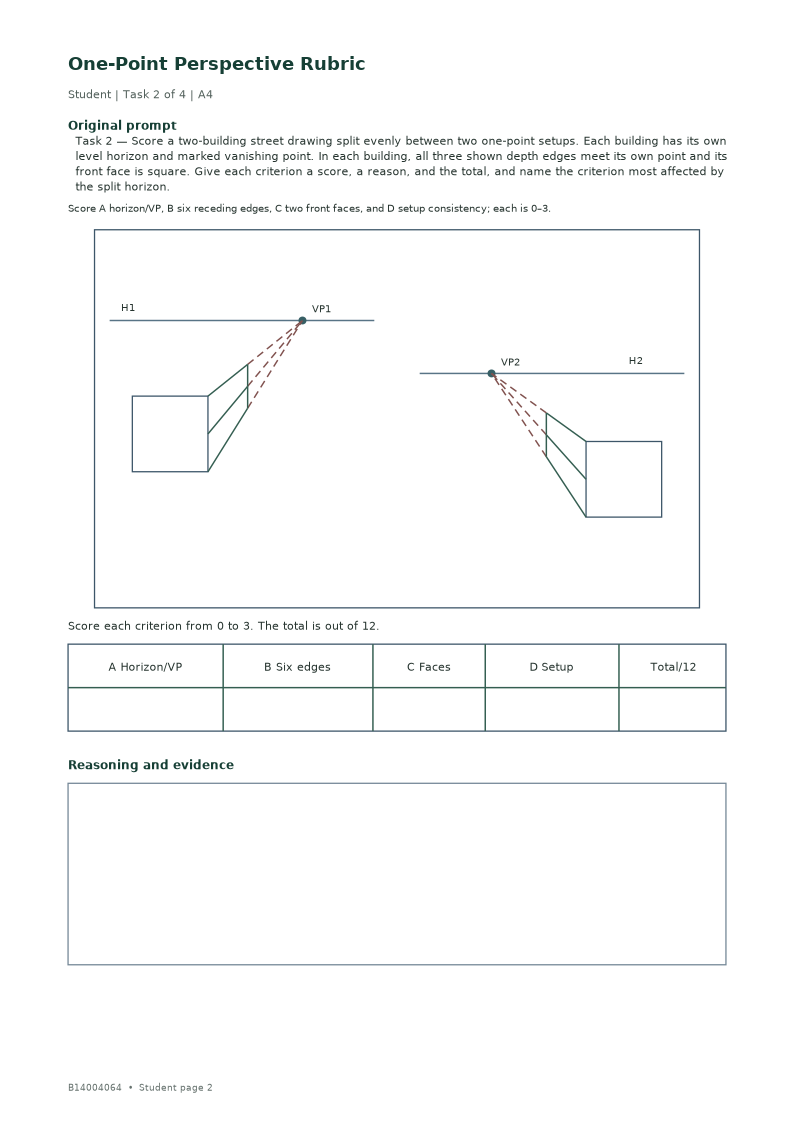
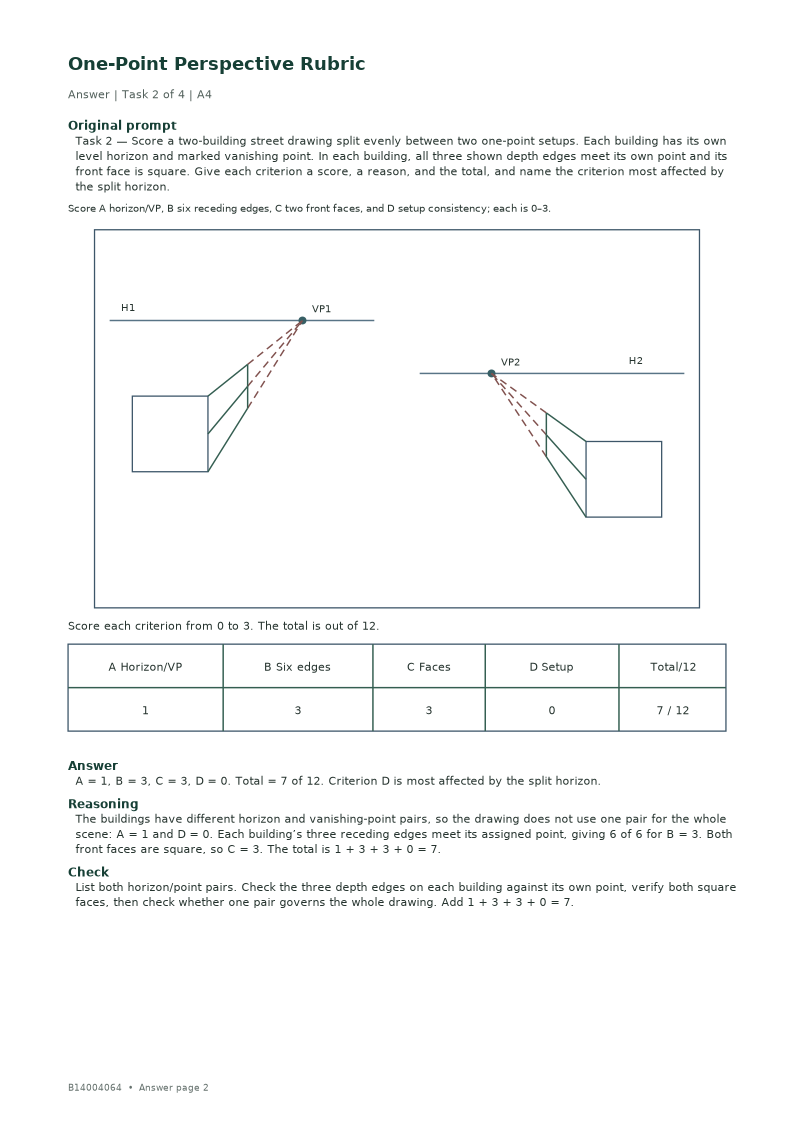
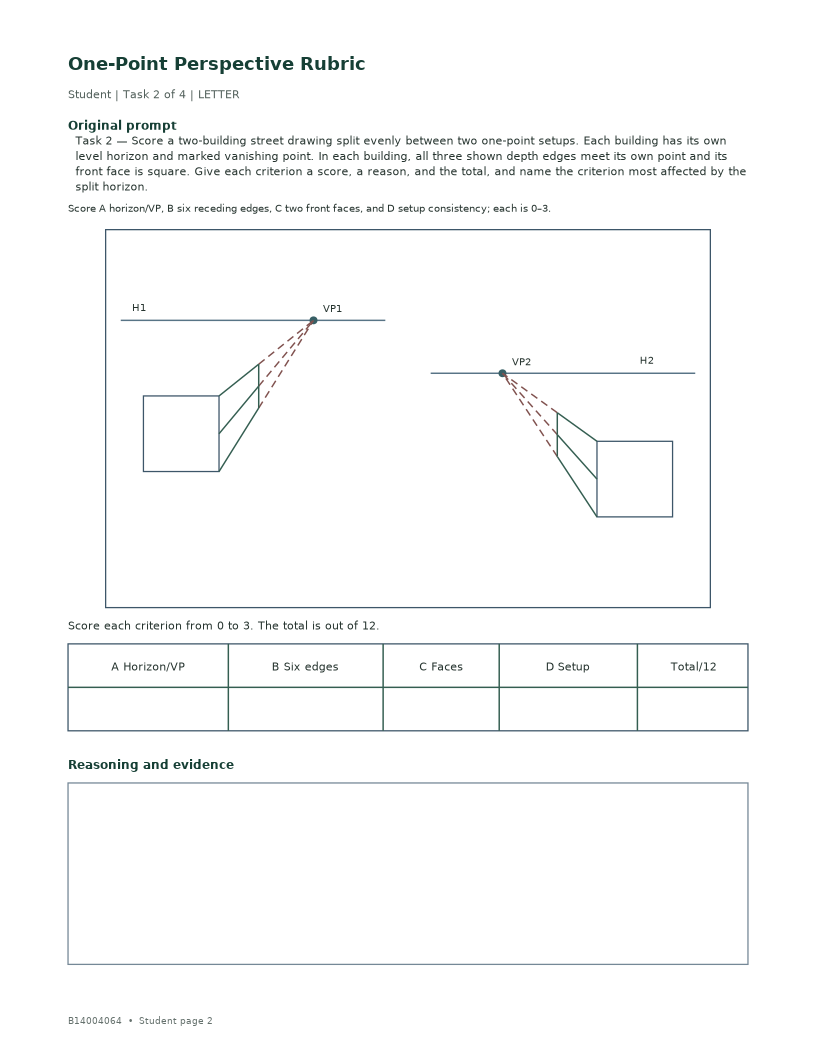
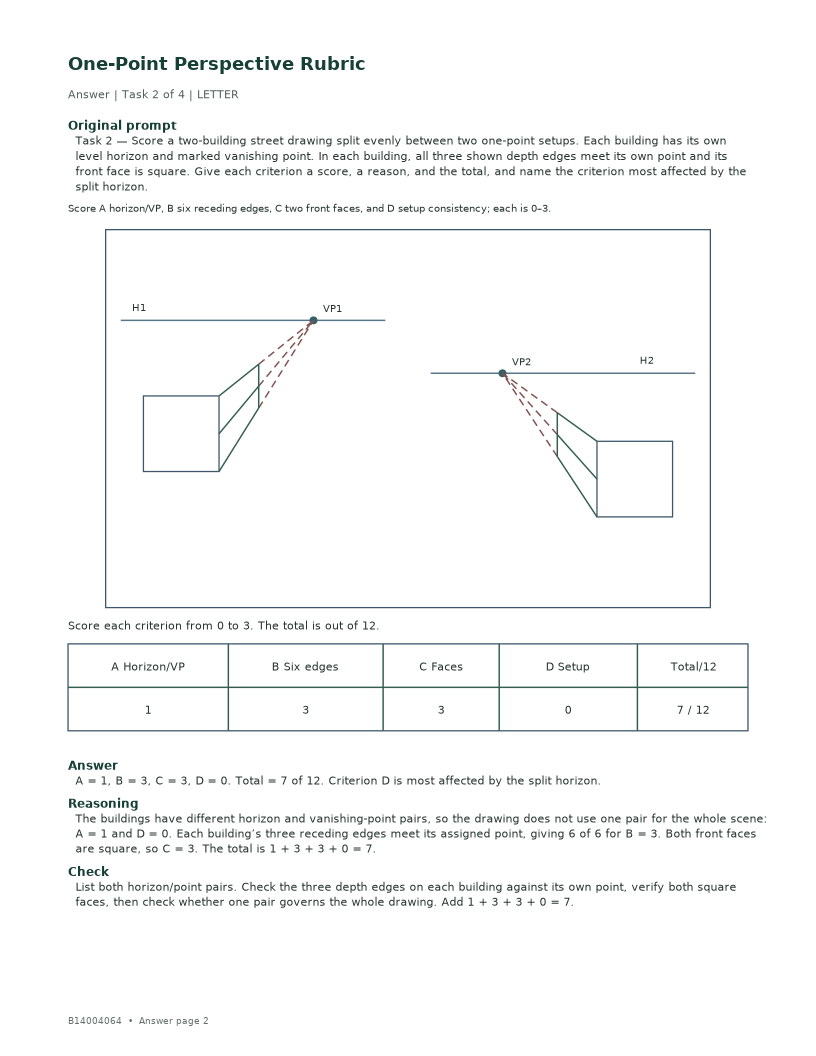
Task 2 — Score a two-building street drawing split evenly between two one-point setups. Each building has its own level horizon and marked vanishing point. In each building, all three shown depth edges meet its own point and its front face is square. Give each criterion a score, a reason, and the total, and name the criterion most affected by the split horizon.
Practice tasks (continued)
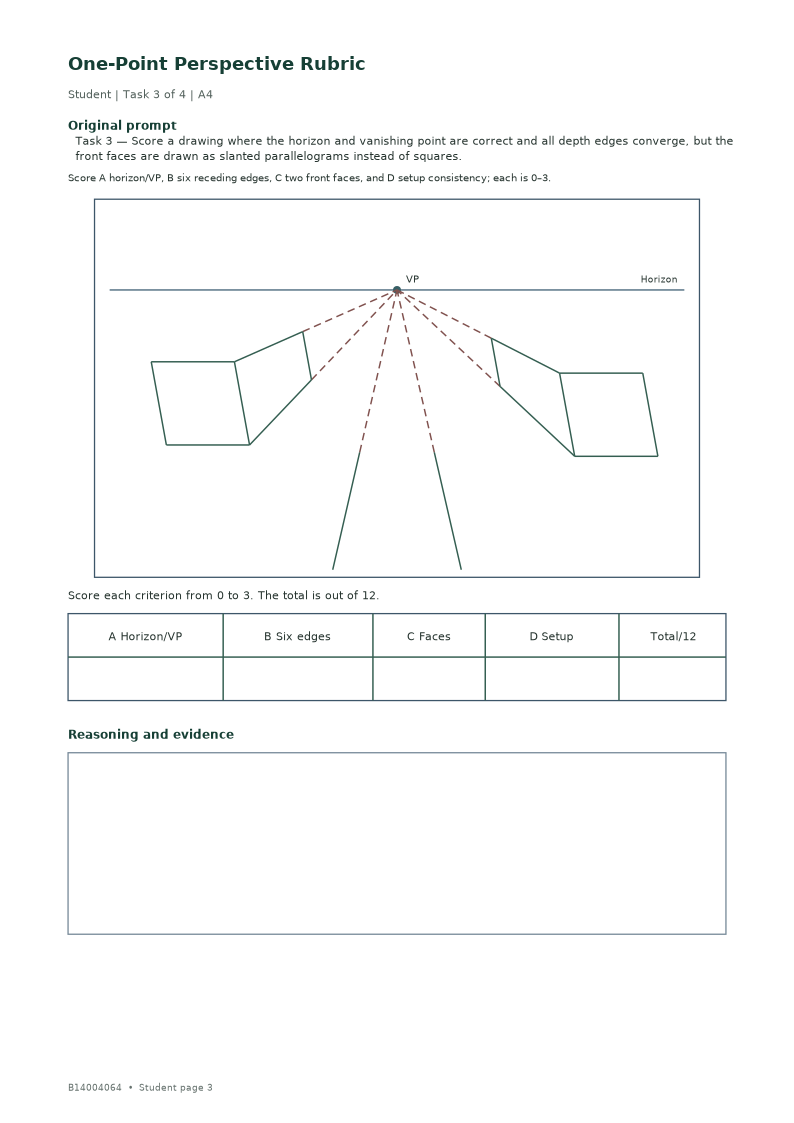
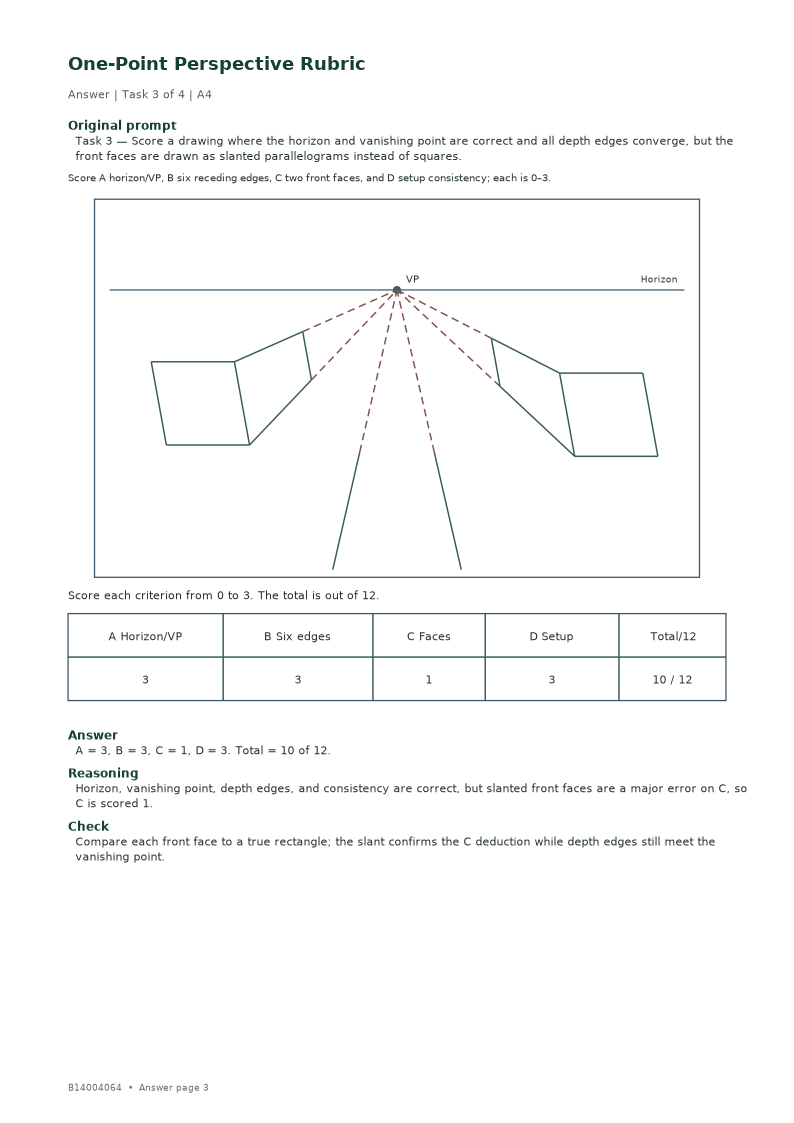
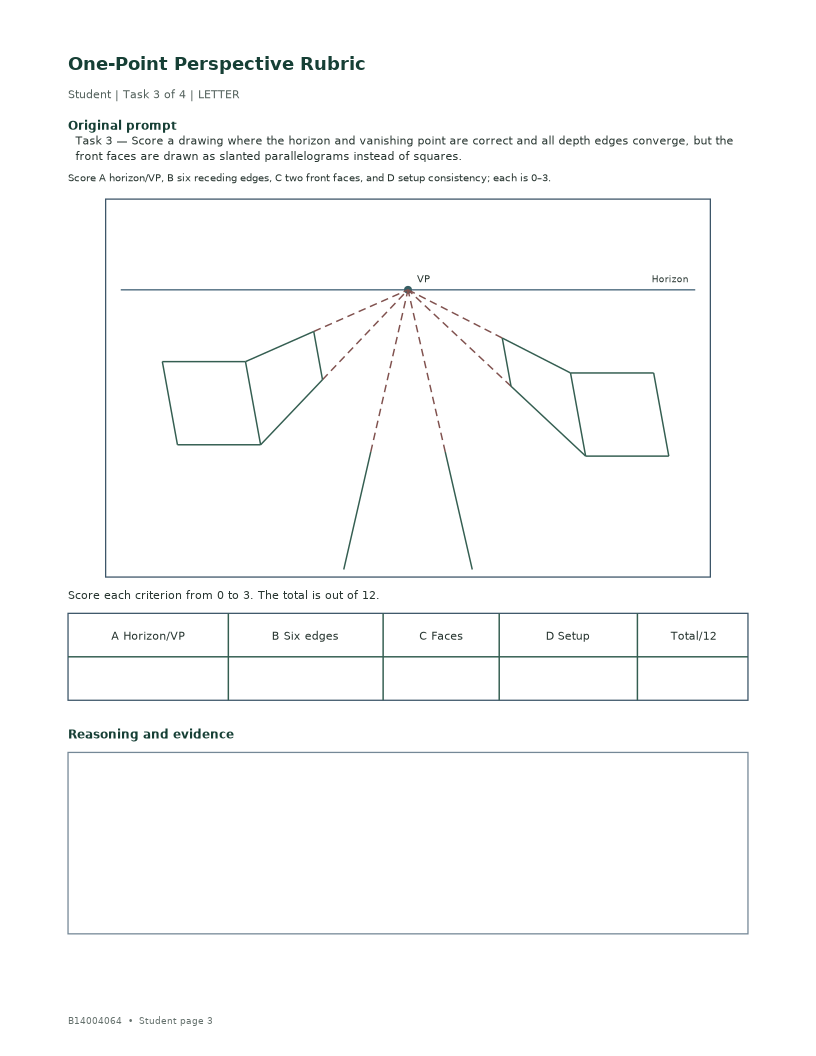
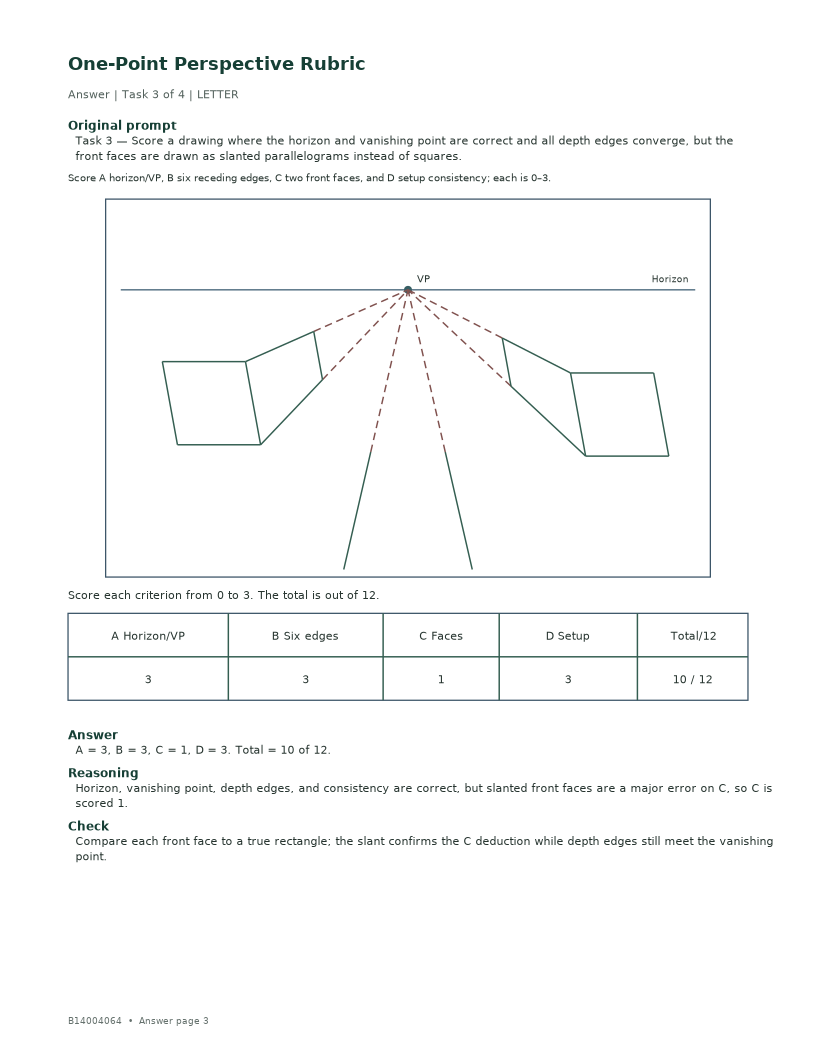
Task 3 — Score a drawing where the horizon and vanishing point are correct and all depth edges converge, but the front faces are drawn as slanted parallelograms instead of squares. Give each criterion a score, a reason, and the total.
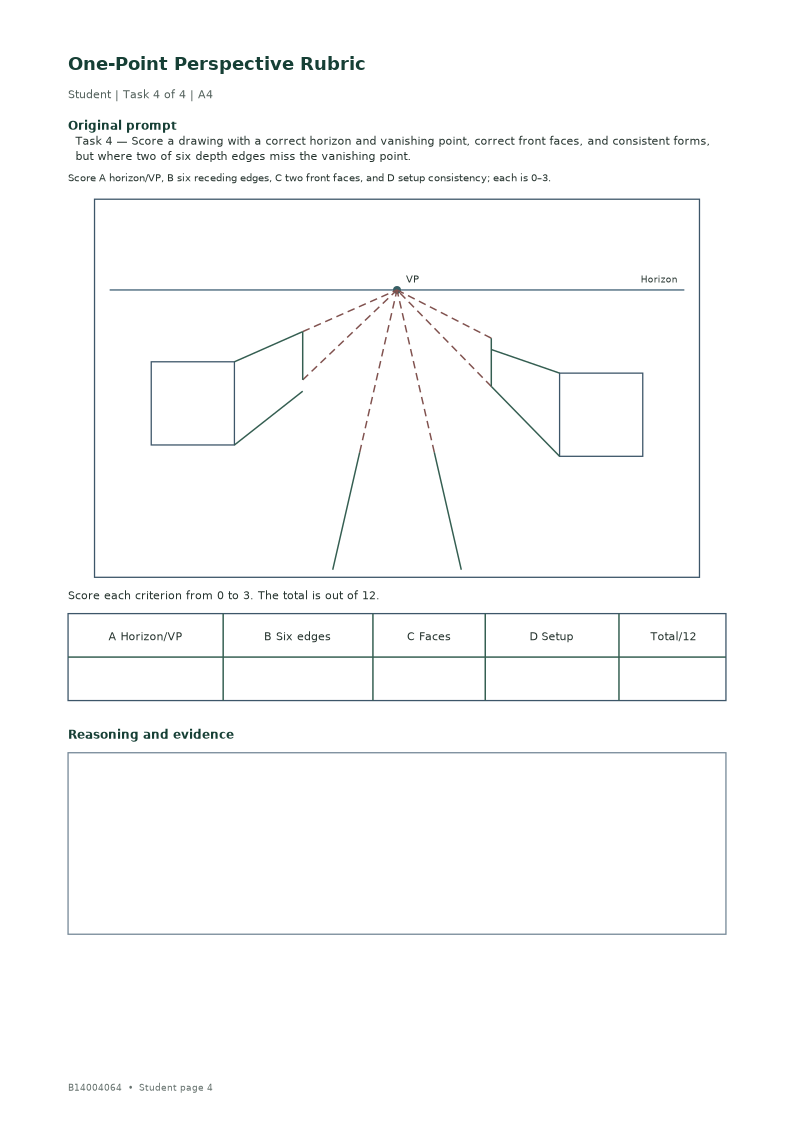
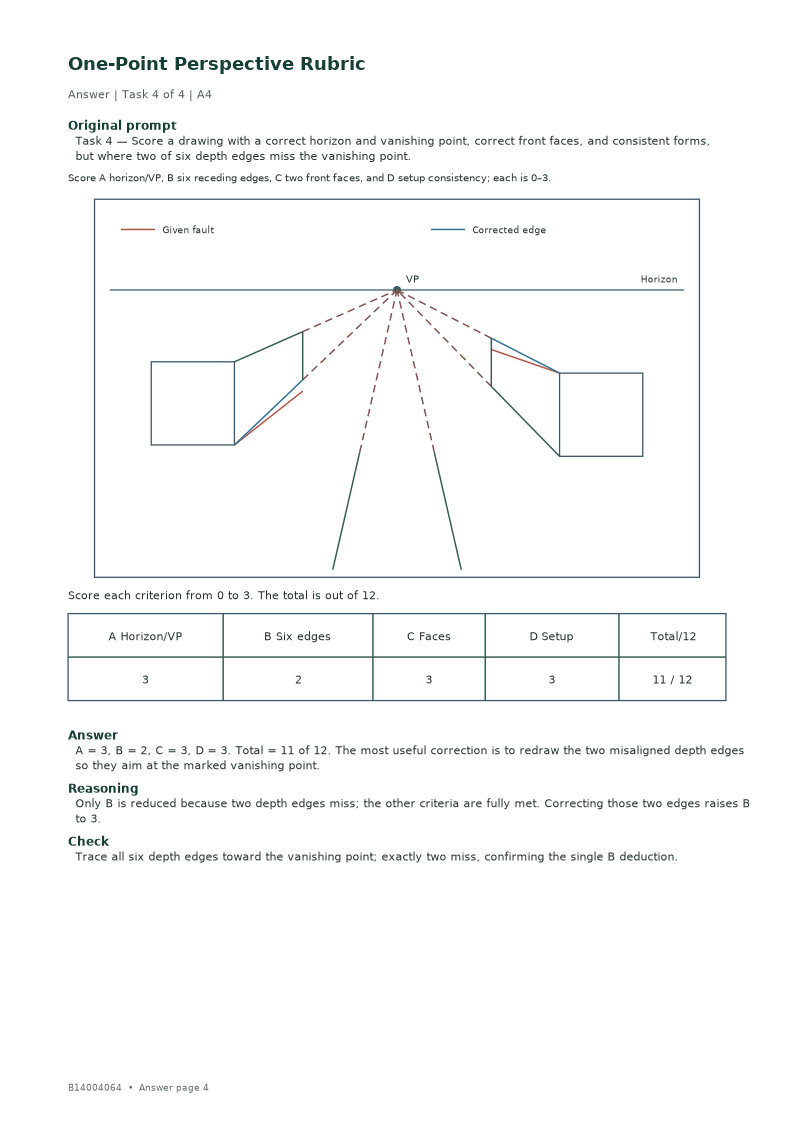
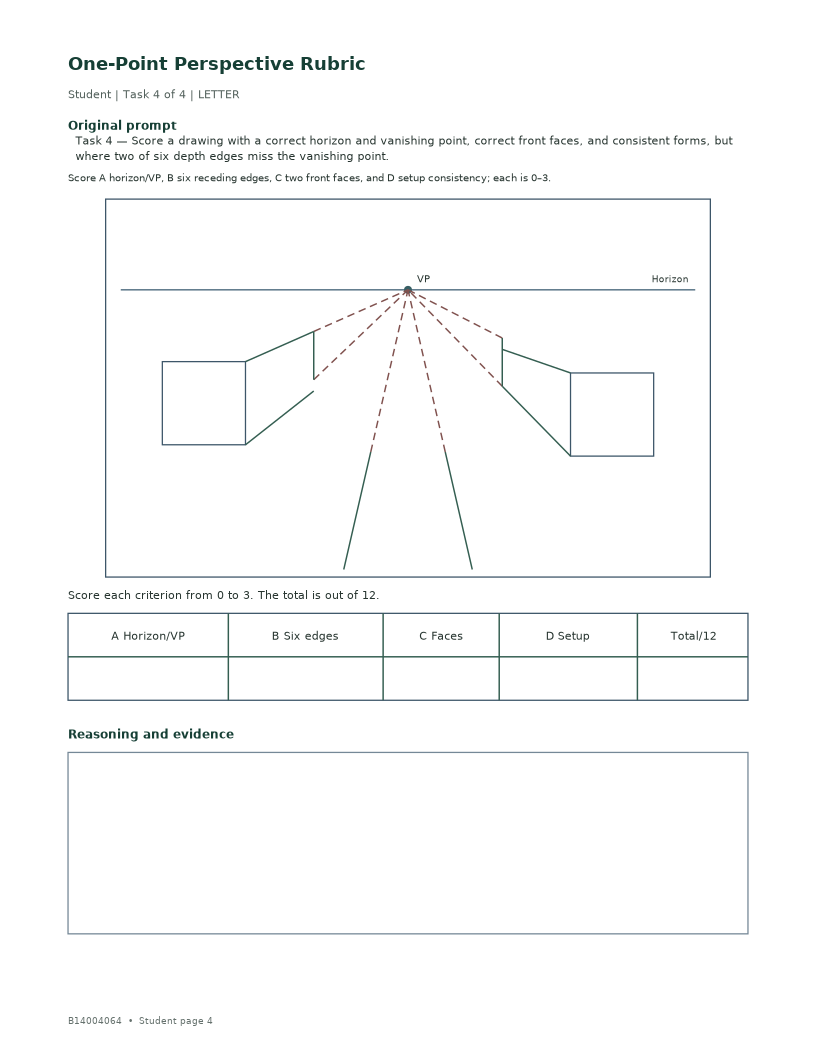
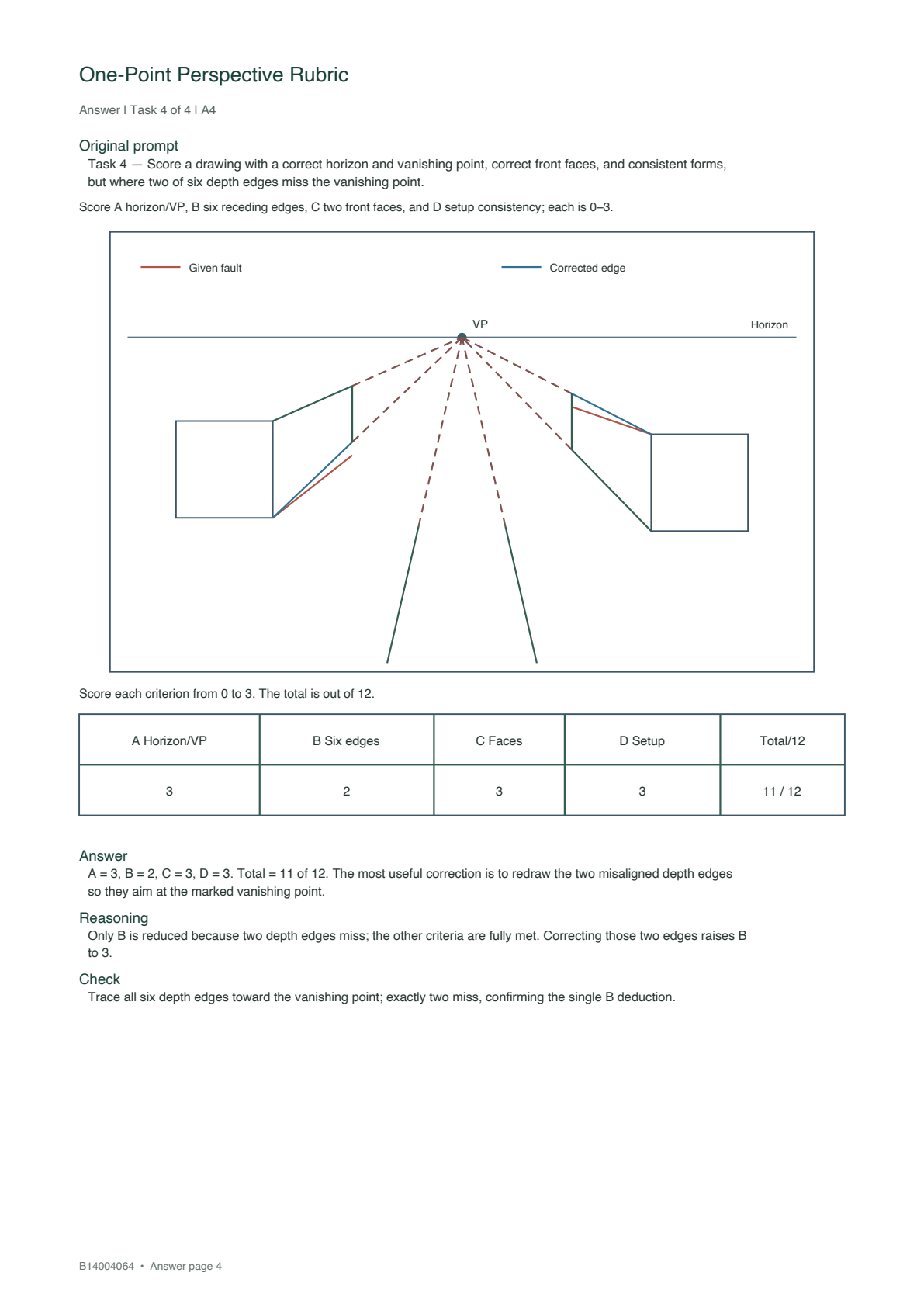
Task 4 — Score a drawing with a correct horizon and vanishing point, correct front faces, and consistent forms, but where two of six depth edges miss the vanishing point. Give each criterion a score, a reason, and the total, and state the single most useful correction.
Download the complete resource pack
All individual SVG pages (20)
- A4 reference page 1
- A4 reference page 2
- A4 student page 1
- A4 student page 2
- A4 student page 3
- A4 student page 4
- A4 answer page 1
- A4 answer page 2
- A4 answer page 3
- A4 answer page 4
- LETTER reference page 1
- LETTER reference page 2
- LETTER student page 1
- LETTER student page 2
- LETTER student page 3
- LETTER student page 4
- LETTER answer page 1
- LETTER answer page 2
- LETTER answer page 3
- LETTER answer page 4
Print at 100% / actual size. Use the stated scale on any schematic diagram; physical cutting templates are identified separately. A4 and US Letter are separate files. Free access, no signup; CC BY 4.0.
How to use these pages
- What the rubric scores
- Scored example plate
- How to apply the rubric
- Practice tasks
- Practice tasks (continued)
Worked example
Example: Score the example plate described above using criteria A–D and give the total.
Answer: A = 3: one horizon and one marked vanishing point. B = 2: five of six edges converge; the right roofline misses. C = 3: both front faces are squares. D = 3: all forms share one setup. Total = 11 of 12.
Reasoning: One level horizon and one marked point give A = 3. Five of six receding edges meet the point, which is the B = 2 band. Both square front faces give C = 3, and the buildings and road share one setup for D = 3. The sum is 11.
Check: Trace all six receding edges toward the marked point. Five meet it and the right roofline misses, confirming B = 2; then verify the total 3 + 2 + 3 + 3 = 11.
Four practice tasks and complete answers
Task 1
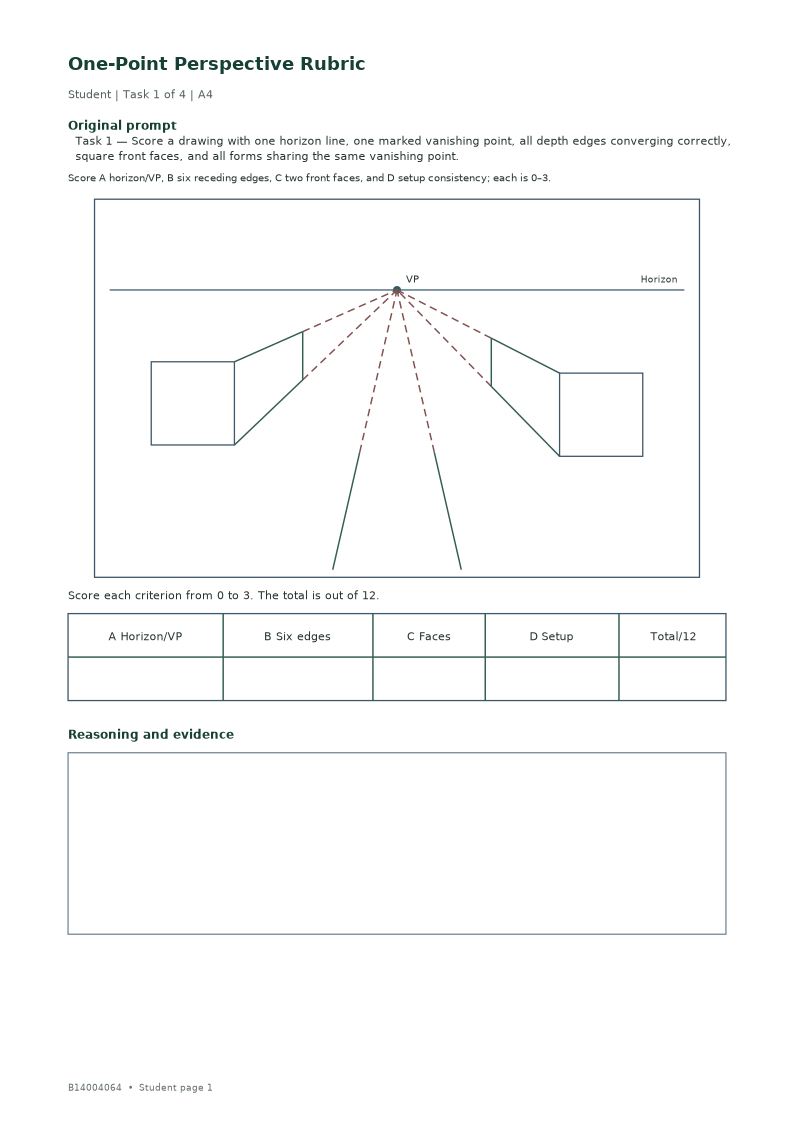
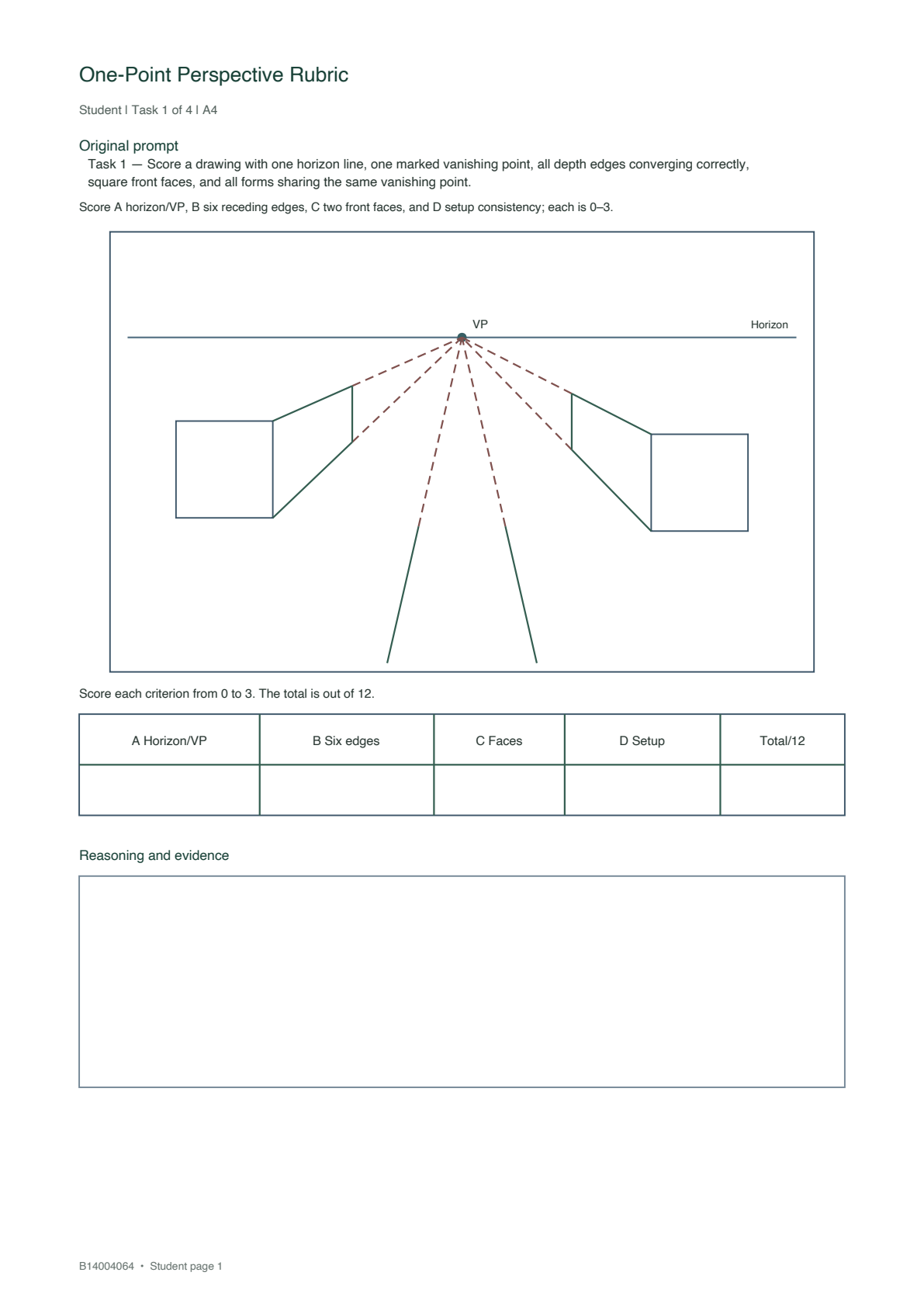
Task 1 — Score a drawing with one horizon line, one marked vanishing point, all depth edges converging correctly, square front faces, and all forms sharing the same vanishing point.
Show answer 1
A = 3, B = 3, C = 3, D = 3. Total = 12 of 12.
Every criterion is fully met: one horizon and vanishing point, all depth edges converge, front faces are square, and all forms share the same setup.
Check: Trace each receding edge toward the vanishing point; all should meet it, confirming full marks on B and D.
Task 2
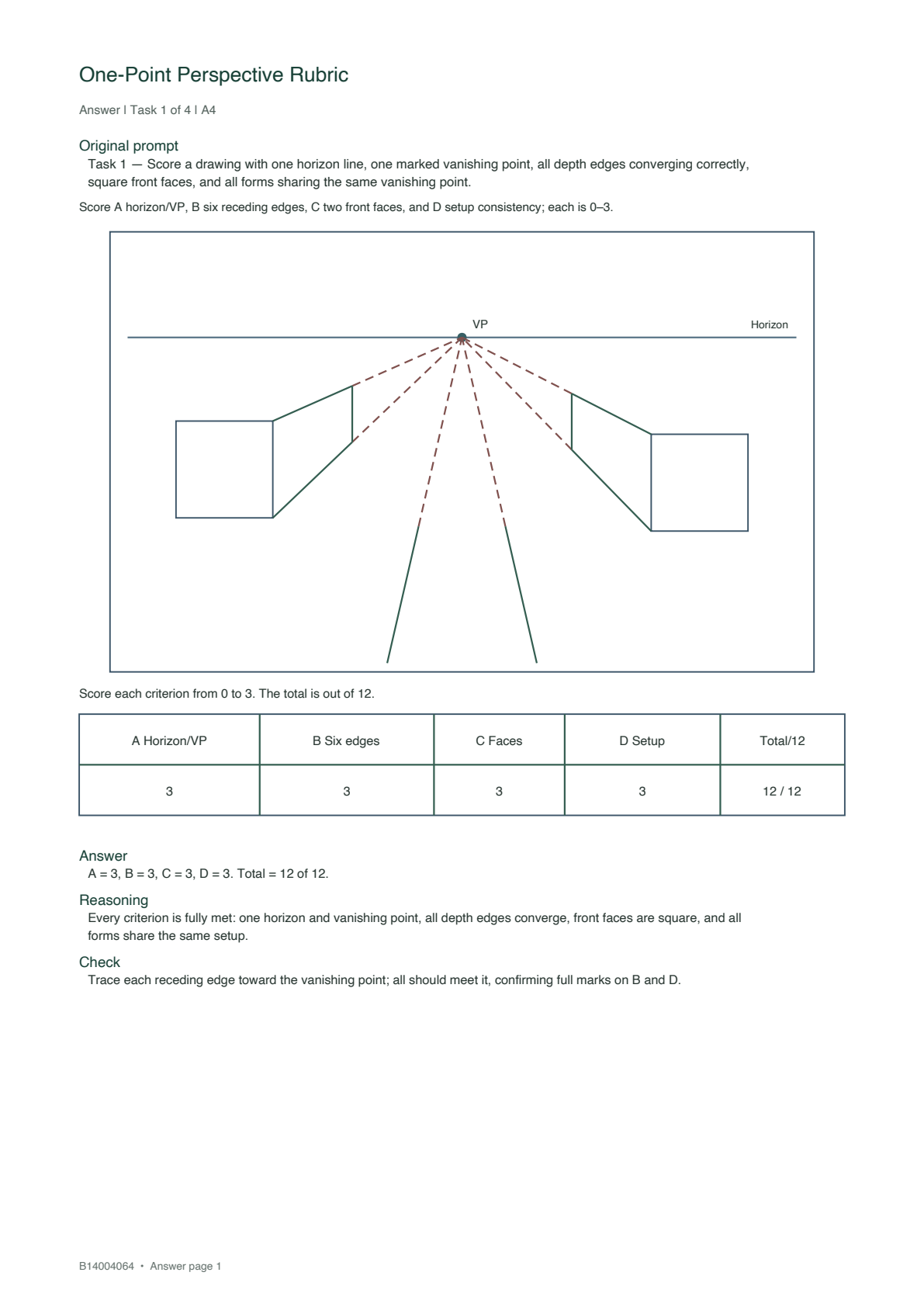
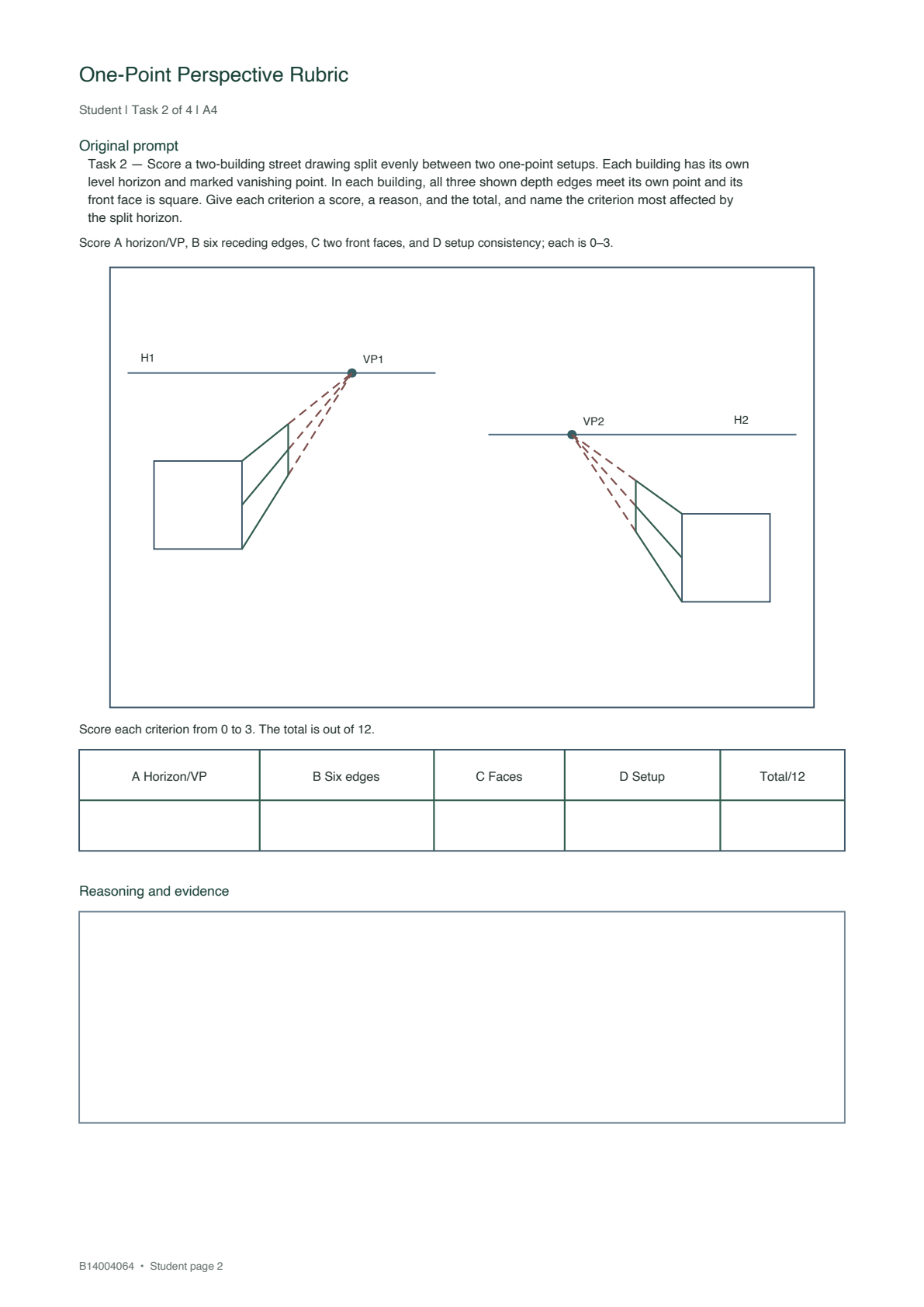
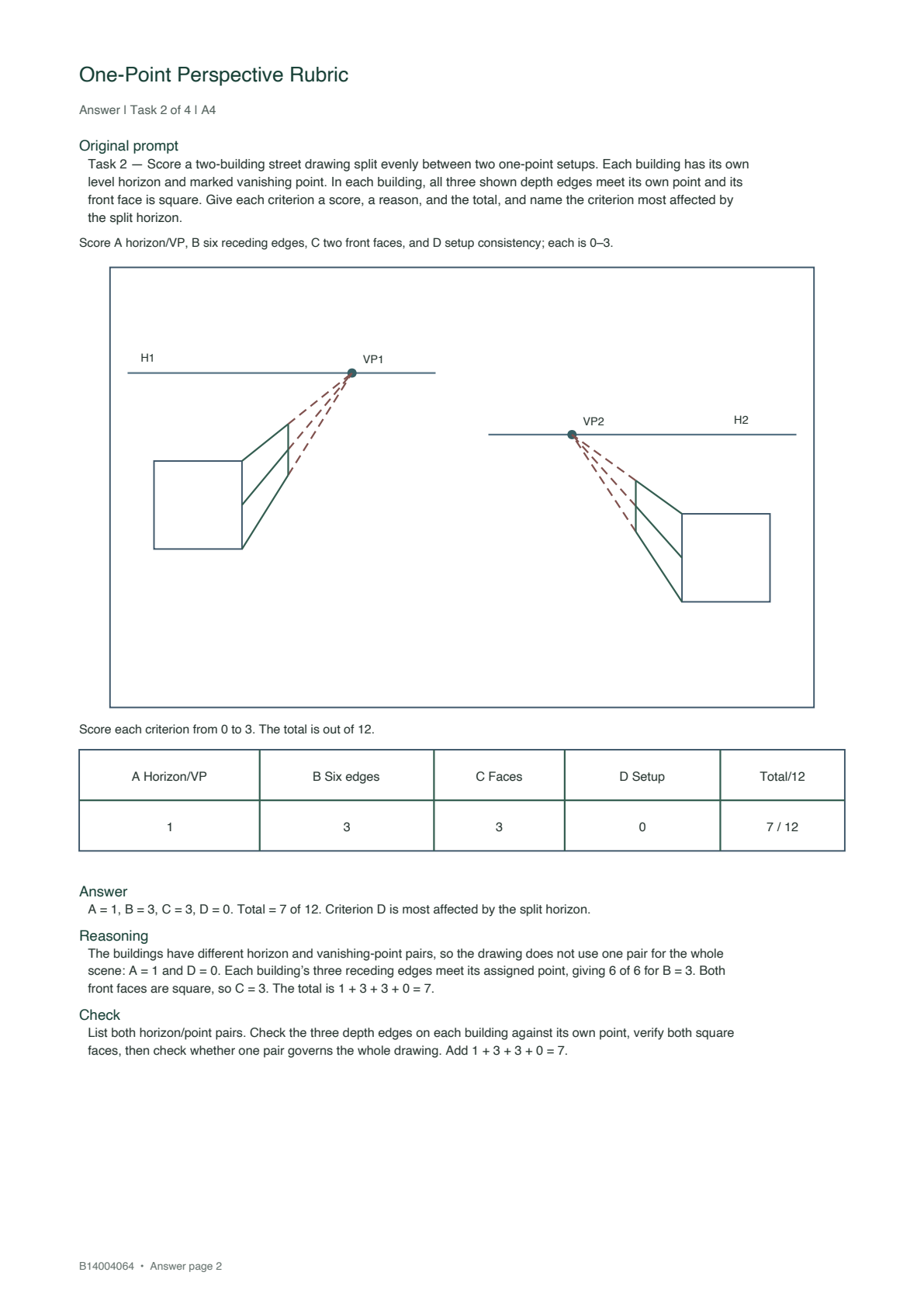
Task 2 — Score a two-building street drawing split evenly between two one-point setups. Each building has its own level horizon and marked vanishing point. In each building, all three shown depth edges meet its own point and its front face is square. Give each criterion a score, a reason, and the total, and name the criterion most affected by the split horizon.
Show answer 2
A = 1, B = 3, C = 3, D = 0. Total = 7 of 12. Criterion D is most affected by the split horizon.
The buildings have different horizon and vanishing-point pairs, so the drawing does not use one pair for the whole scene: A = 1 and D = 0. Each building’s three receding edges meet its assigned point, giving 6 of 6 for B = 3. Both front faces are square, so C = 3. The total is 1 + 3 + 3 + 0 = 7.
Check: List both horizon/point pairs. Check the three depth edges on each building against its own point, verify both square faces, then check whether one pair governs the whole drawing. Add 1 + 3 + 3 + 0 = 7.
Task 3
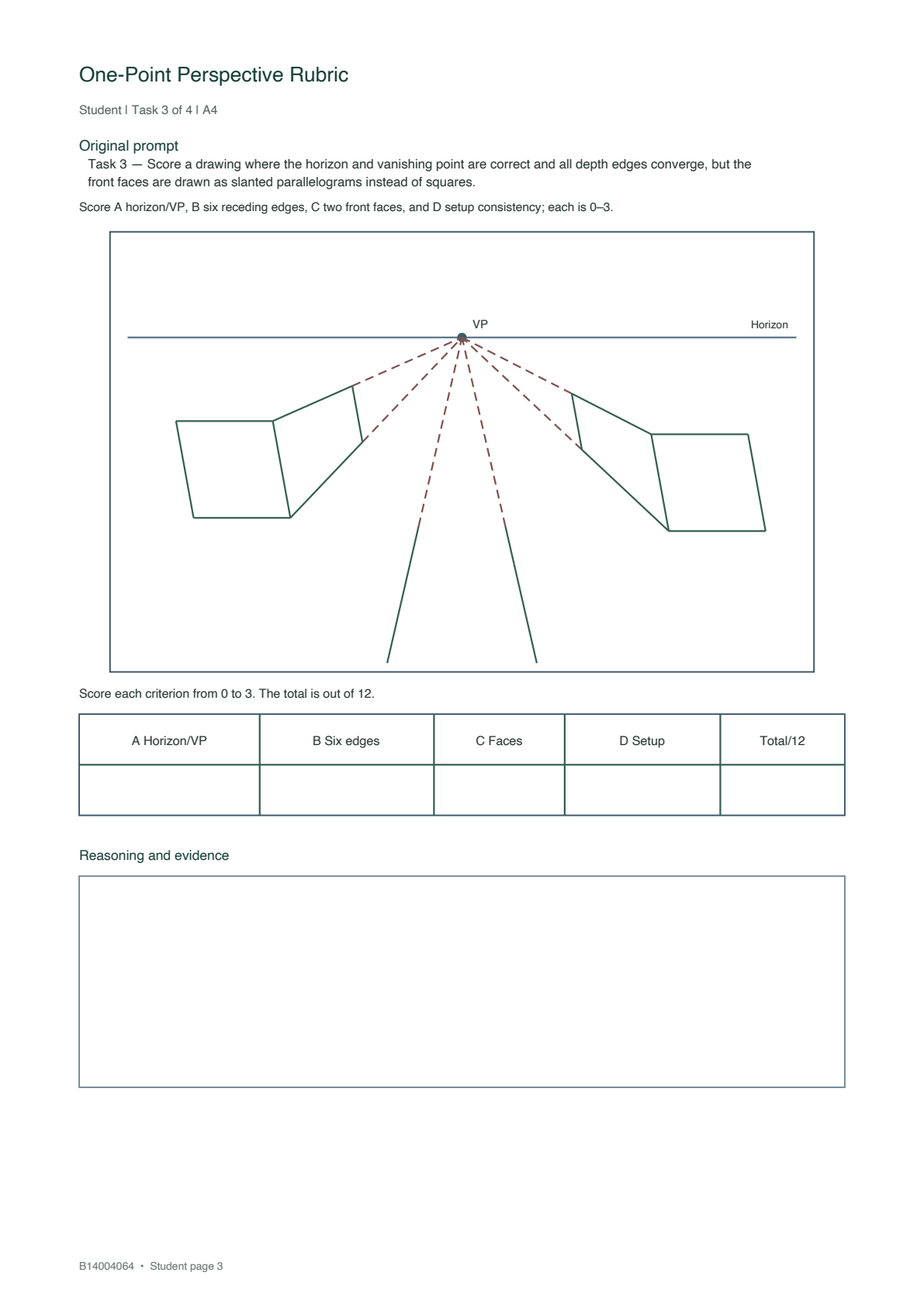
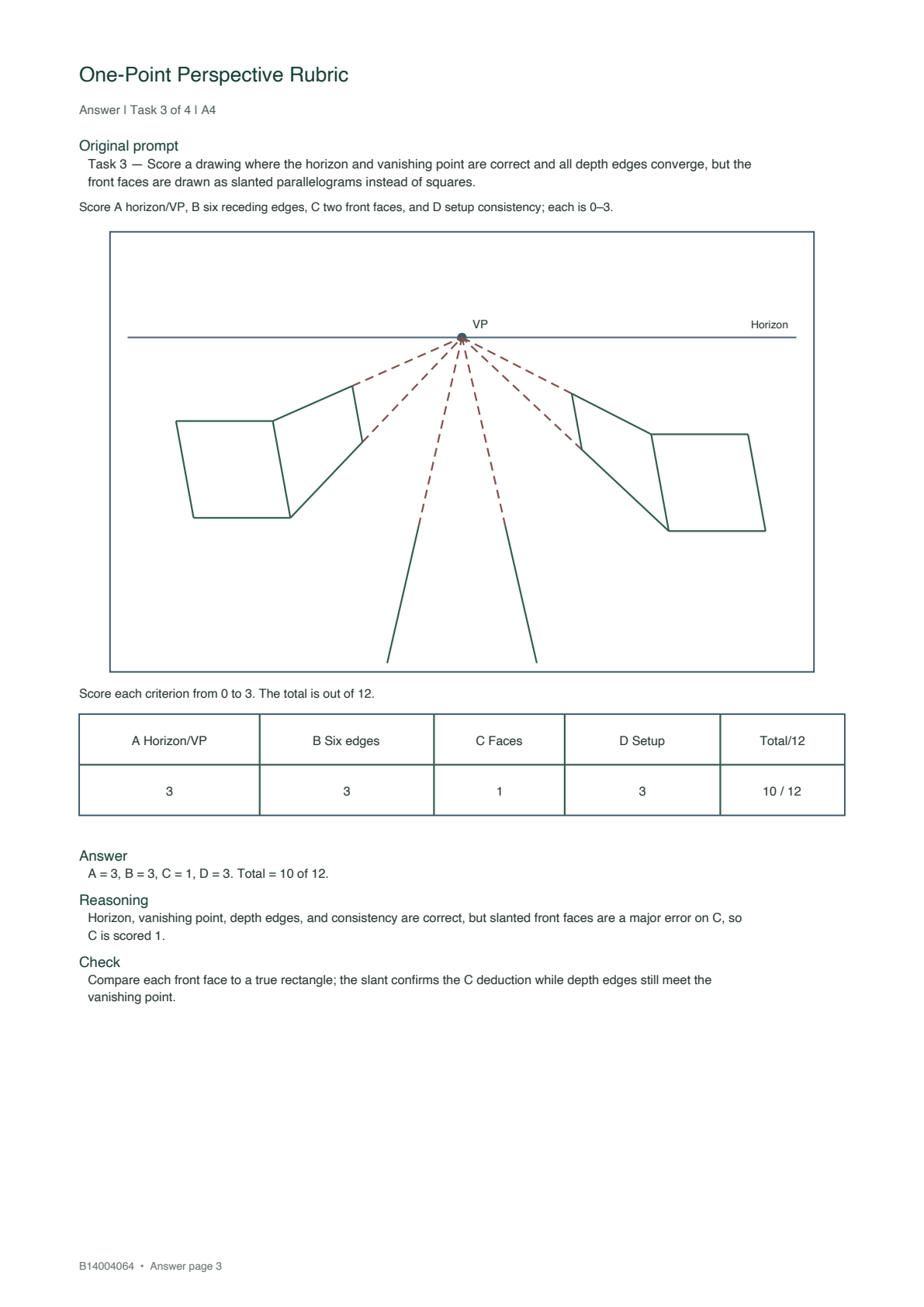
Task 3 — Score a drawing where the horizon and vanishing point are correct and all depth edges converge, but the front faces are drawn as slanted parallelograms instead of squares.
Show answer 3
A = 3, B = 3, C = 1, D = 3. Total = 10 of 12.
Horizon, vanishing point, depth edges, and consistency are correct, but slanted front faces are a major error on C, so C is scored 1.
Check: Compare each front face to a true rectangle; the slant confirms the C deduction while depth edges still meet the vanishing point.
Task 4
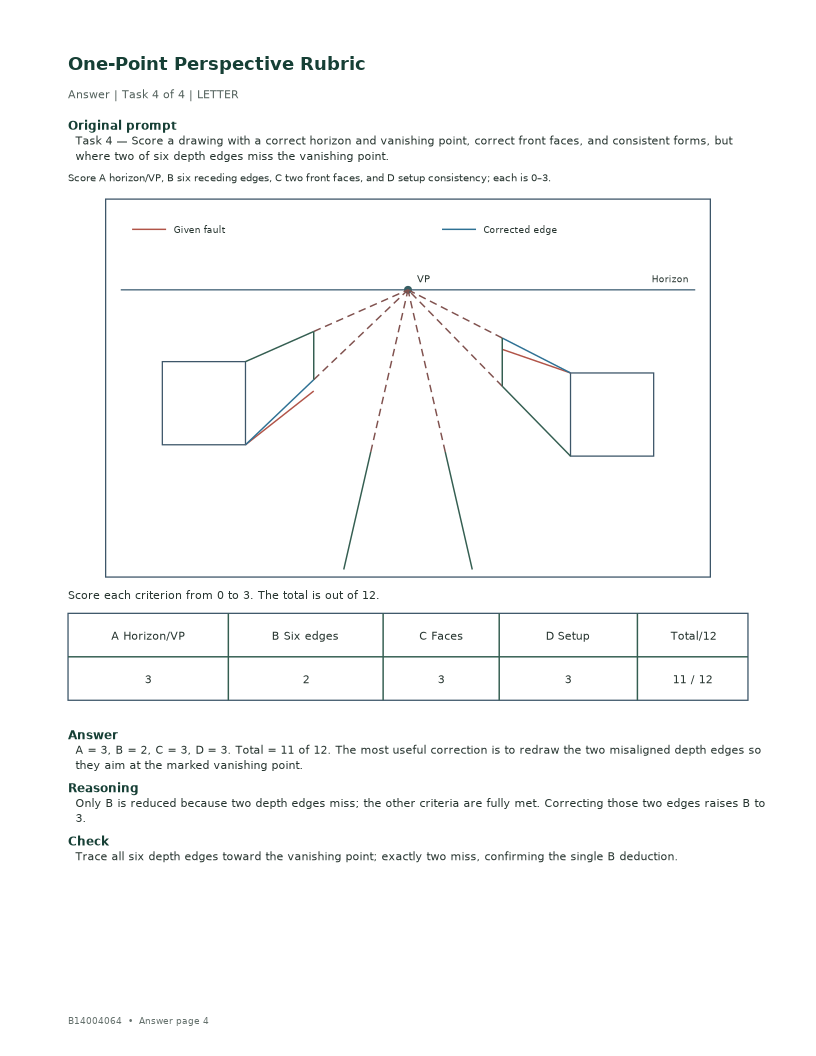
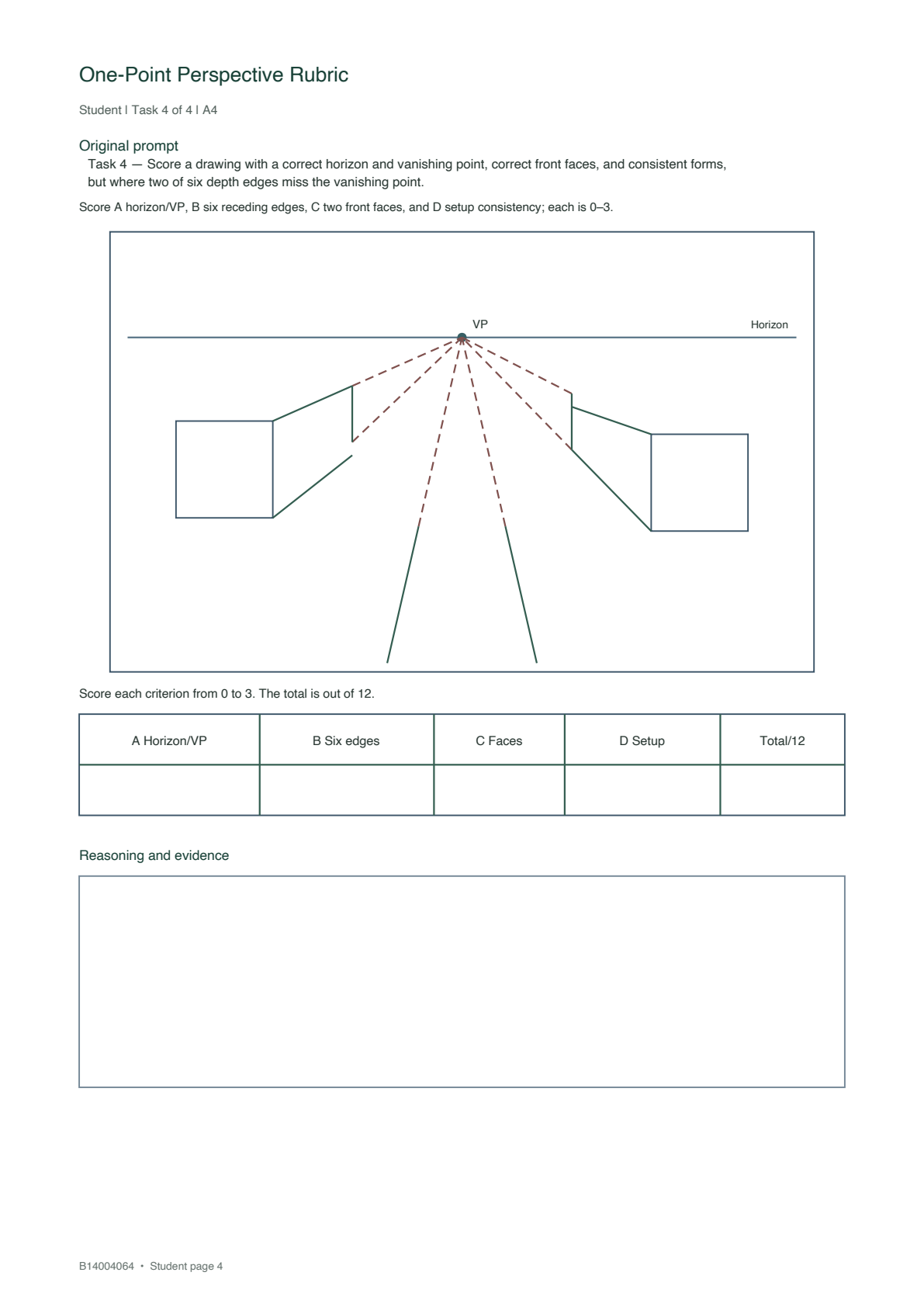
Task 4 — Score a drawing with a correct horizon and vanishing point, correct front faces, and consistent forms, but where two of six depth edges miss the vanishing point.
Show answer 4
A = 3, B = 2, C = 3, D = 3. Total = 11 of 12. The most useful correction is to redraw the two misaligned depth edges so they aim at the marked vanishing point.
Only B is reduced because two depth edges miss; the other criteria are fully met. Correcting those two edges raises B to 3.
Check: Trace all six depth edges toward the vanishing point; exactly two miss, confirming the single B deduction.
Useful checks
- Scoring consistency (D) as full marks when two horizon lines are present. Check that every form shares one horizon and one vanishing point before awarding D.
- Awarding full marks on B when a single depth edge misses the vanishing point. Trace each receding edge with a straight edge; any miss is a B deduction.
Questions about this resource
Why is the scale 0–3?
A four-level scale gives clear distinctions between absent, attempted, mostly correct, and correct, which is enough for a short rubric.
Do I need to draw to use this sheet?
No. The tasks ask you to score described drawings; drawing is only needed if you want to test the rubric on your own work.