Free original lessons
Perspective Drawing Rubric
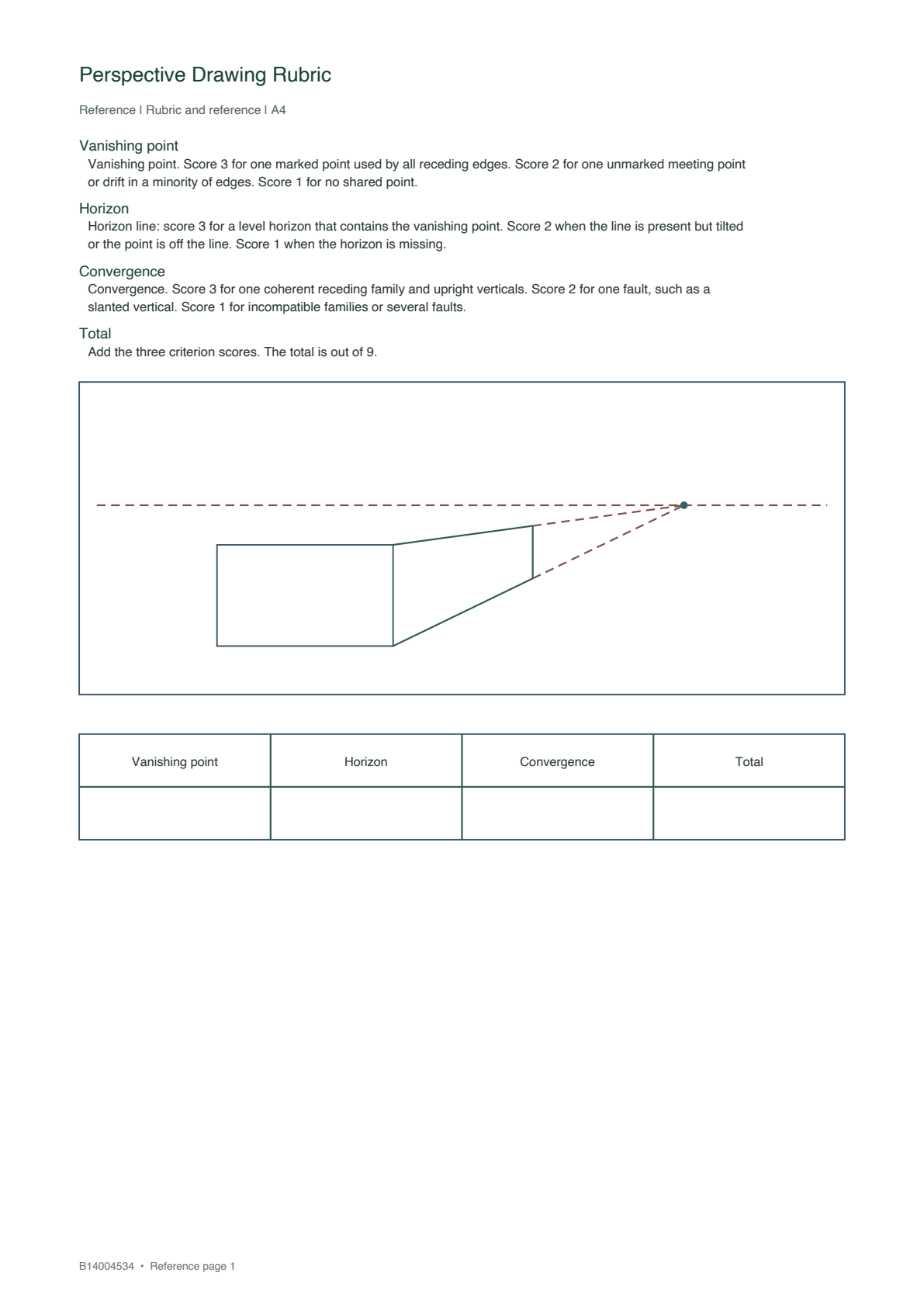
This pack is a scoring rubric for perspective drawings, not a drawing lesson. You judge a finished drawing on three criteria — vanishing point, horizon line, convergence — each scored in bands, then total the bands. The rubric is qualitative: you compare the drawing to the stated reference construction and record a band, not a measurement.
Letter & A4
PDF & SVG
How the rubric works
Each criterion has three bands: 3 = correct and consistent, 2 = present but inconsistent, 1 = missing or contradicting the reference. Score each criterion once, then add the three scores for a total out of 9.
Score against the reference construction shown in the task, not against taste. A drawing can be neat and still score low if its lines do not meet the stated vanishing point.
The three criteria and their bands
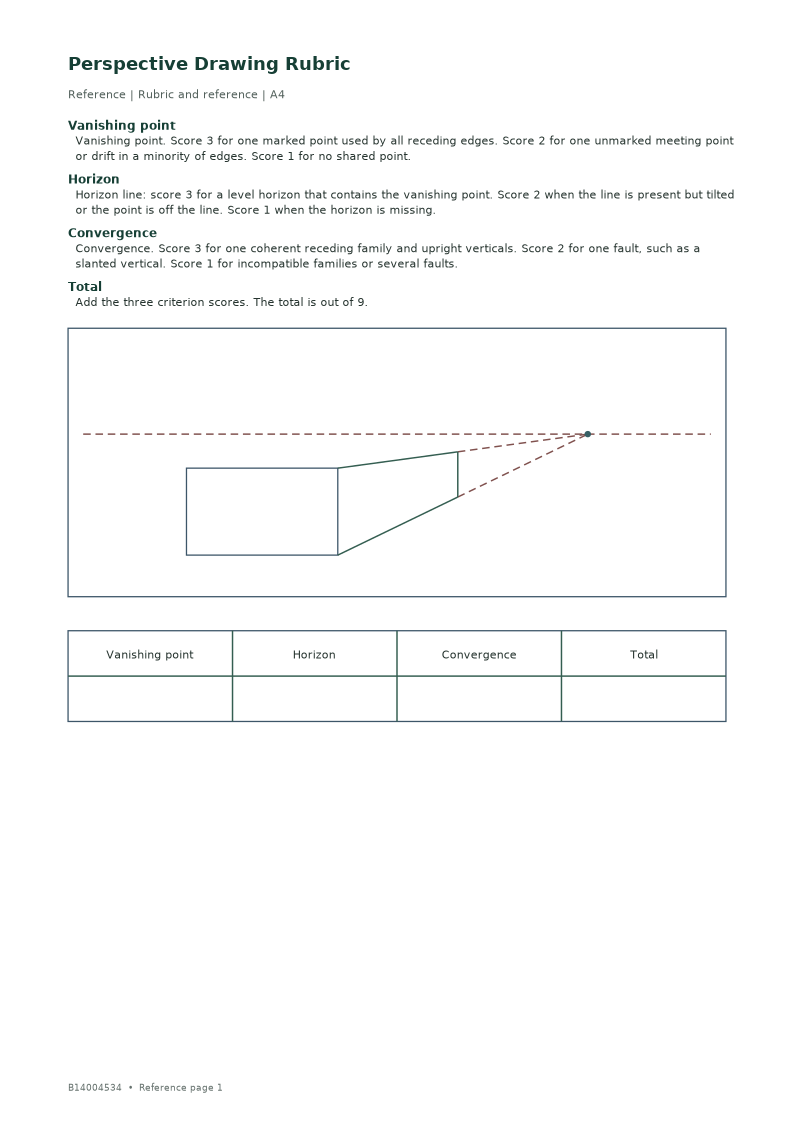
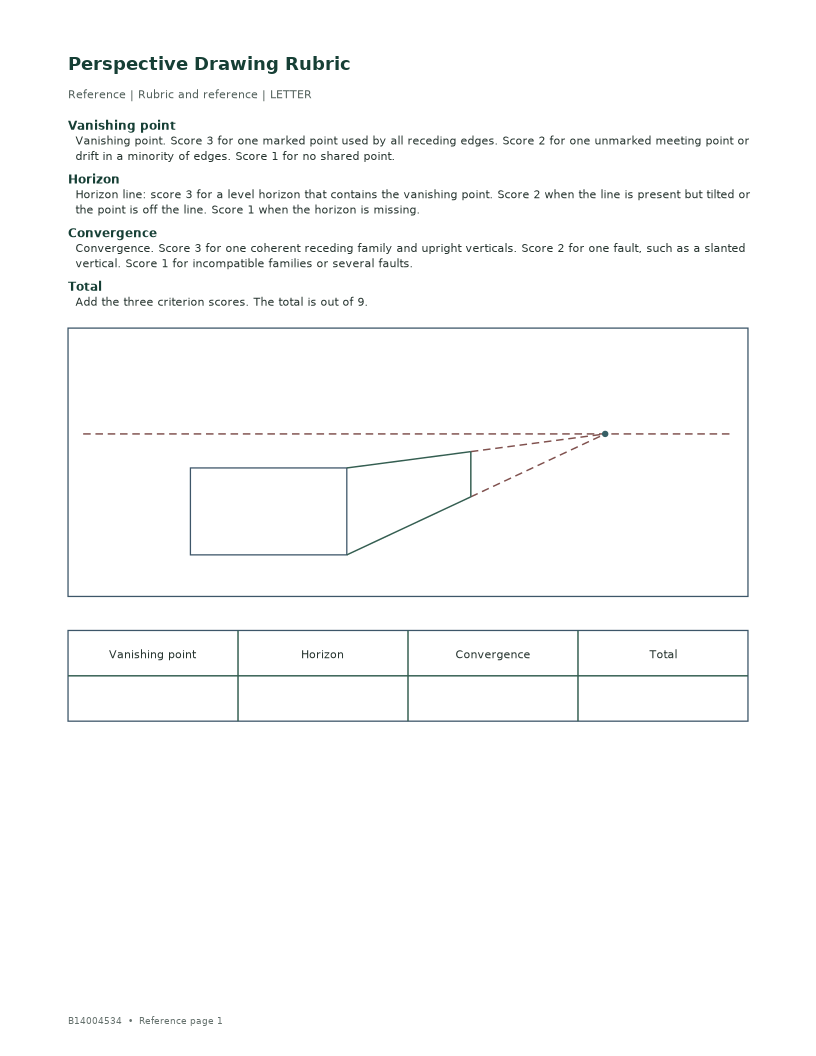
Vanishing point. Score 3 for one marked point used by all receding edges. Score 2 for one unmarked meeting point or drift in a minority of edges. Score 1 for no shared point.
Horizon line: score 3 for a level horizon that contains the vanishing point. Score 2 when the line is present but tilted or the point is off the line. Score 1 when the horizon is missing.
Worked example
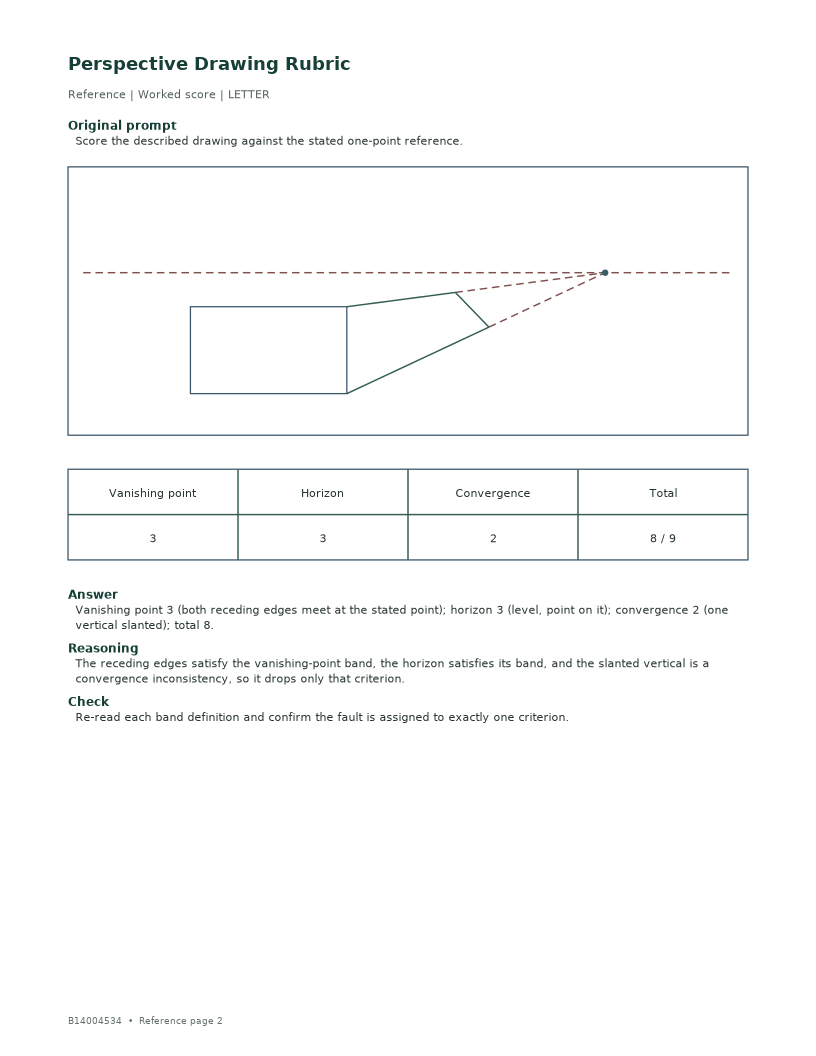
Reference: a one-point construction with a level horizon and one vanishing point on it; a box drawn with two receding edges aimed at that point.
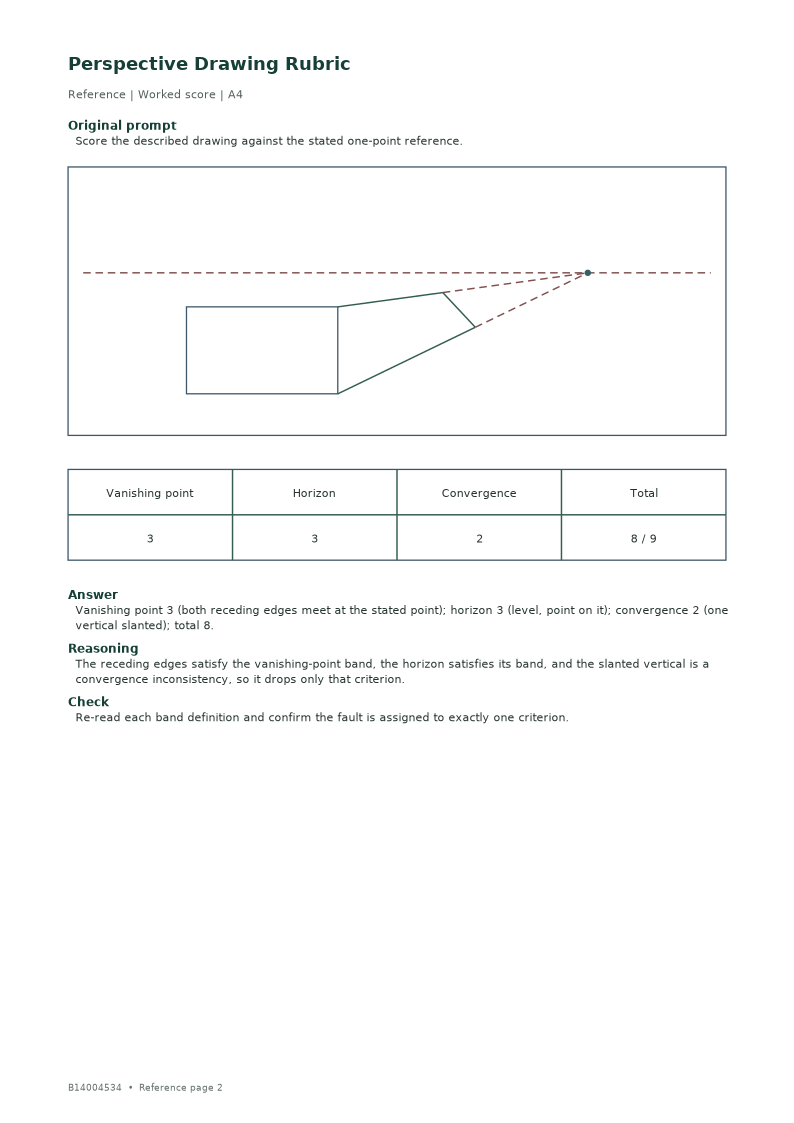
Scored drawing: both receding edges meet exactly at the point, the horizon is level and the point sits on it, but one vertical edge is drawn slanted. Vanishing point 3, horizon 3, convergence 2 — total 8. The slant is a convergence fault, not a vanishing-point fault, because the receding edges still meet correctly.
Practice tasks
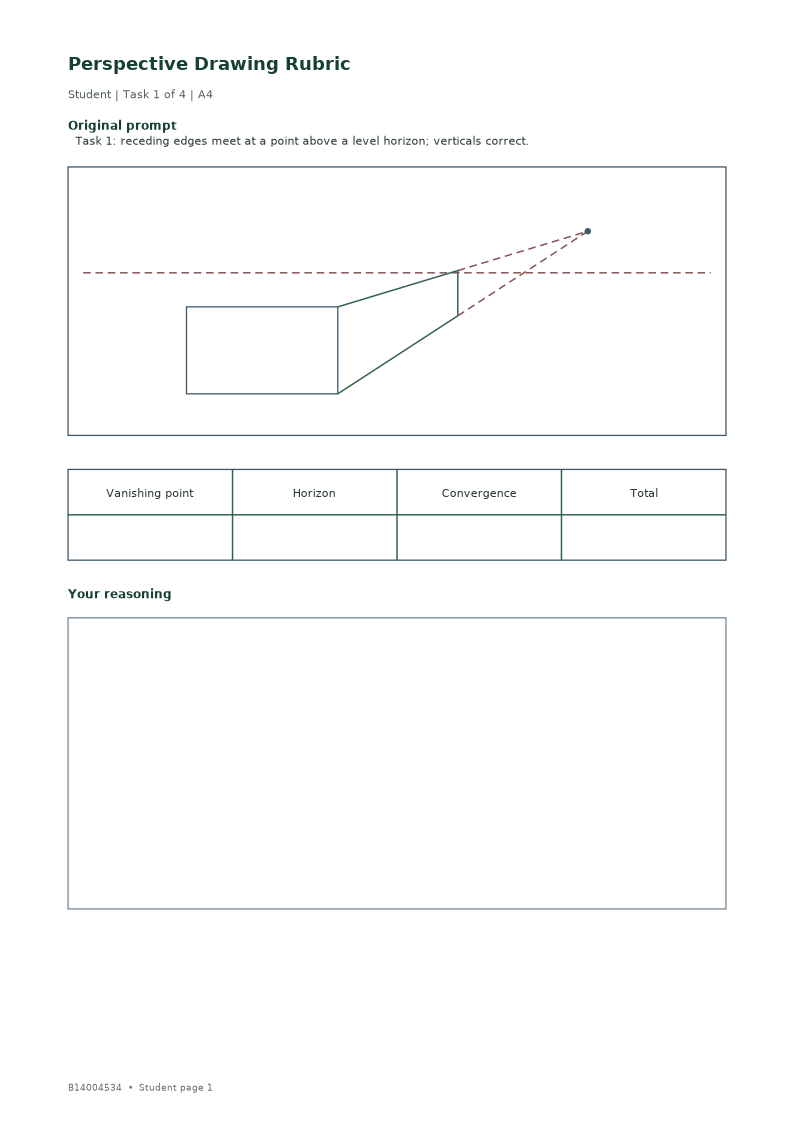
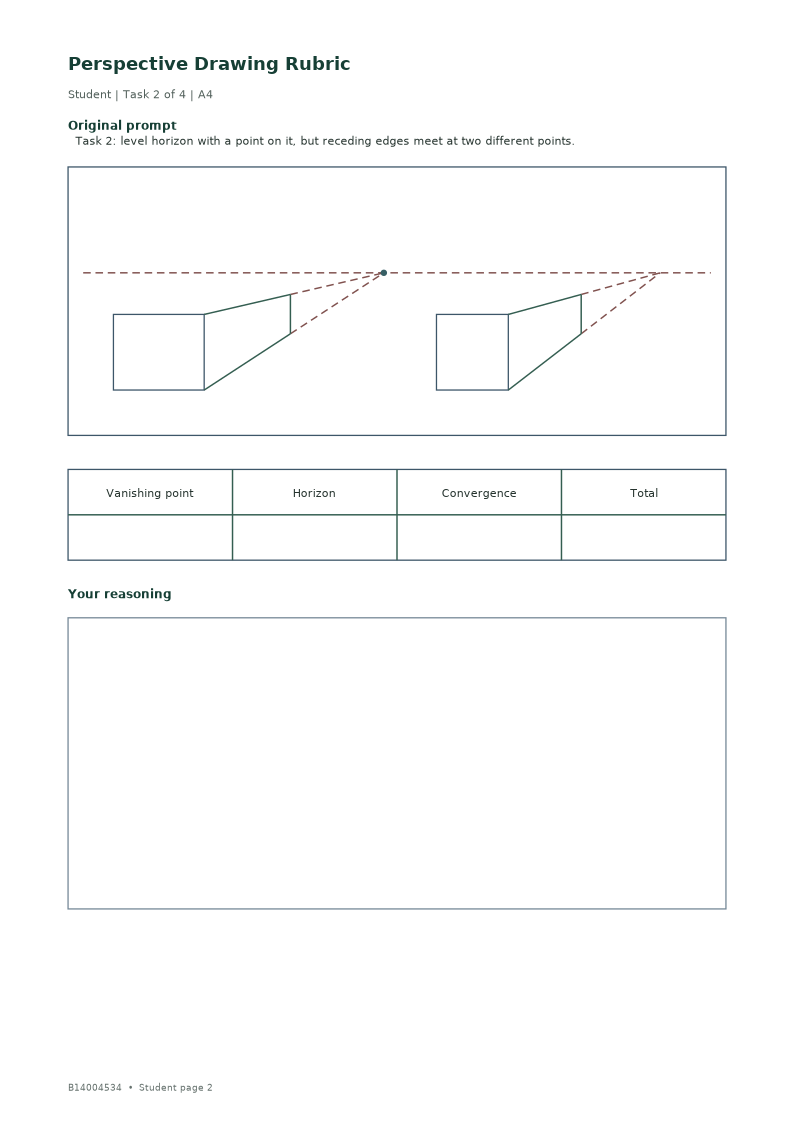
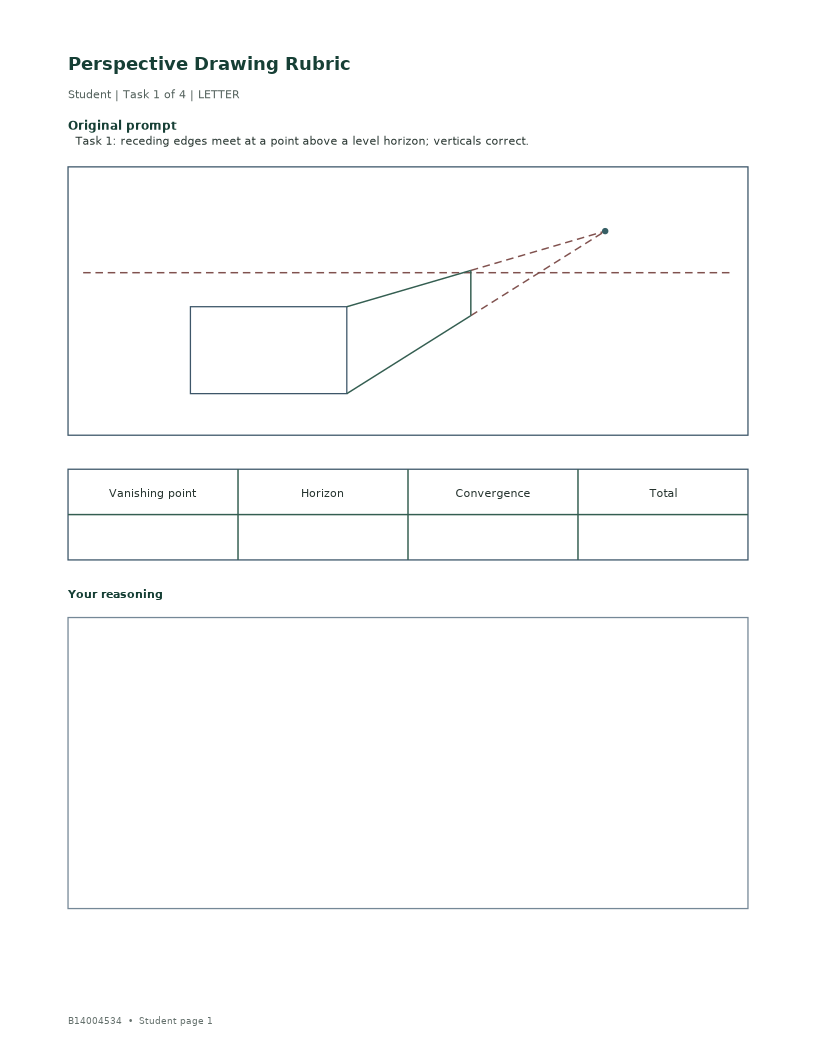
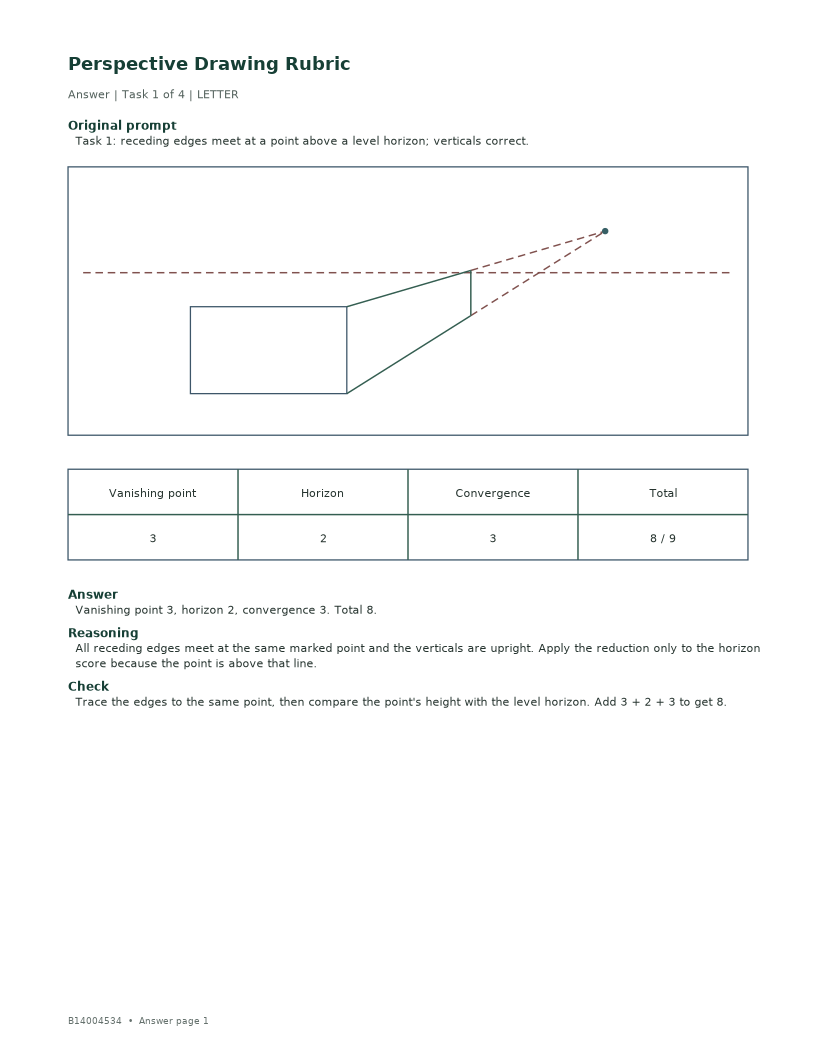
Task 1: score a drawing whose receding edges meet at a point that sits above a level horizon. Give each band and the total.
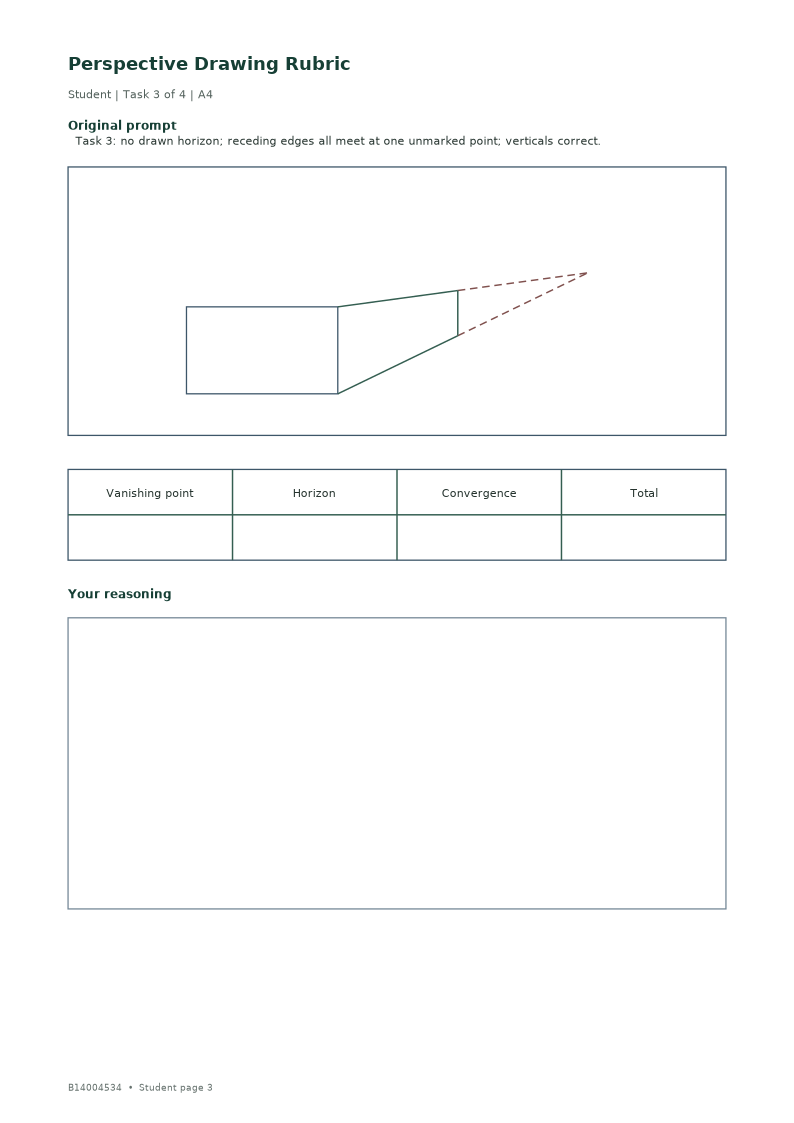
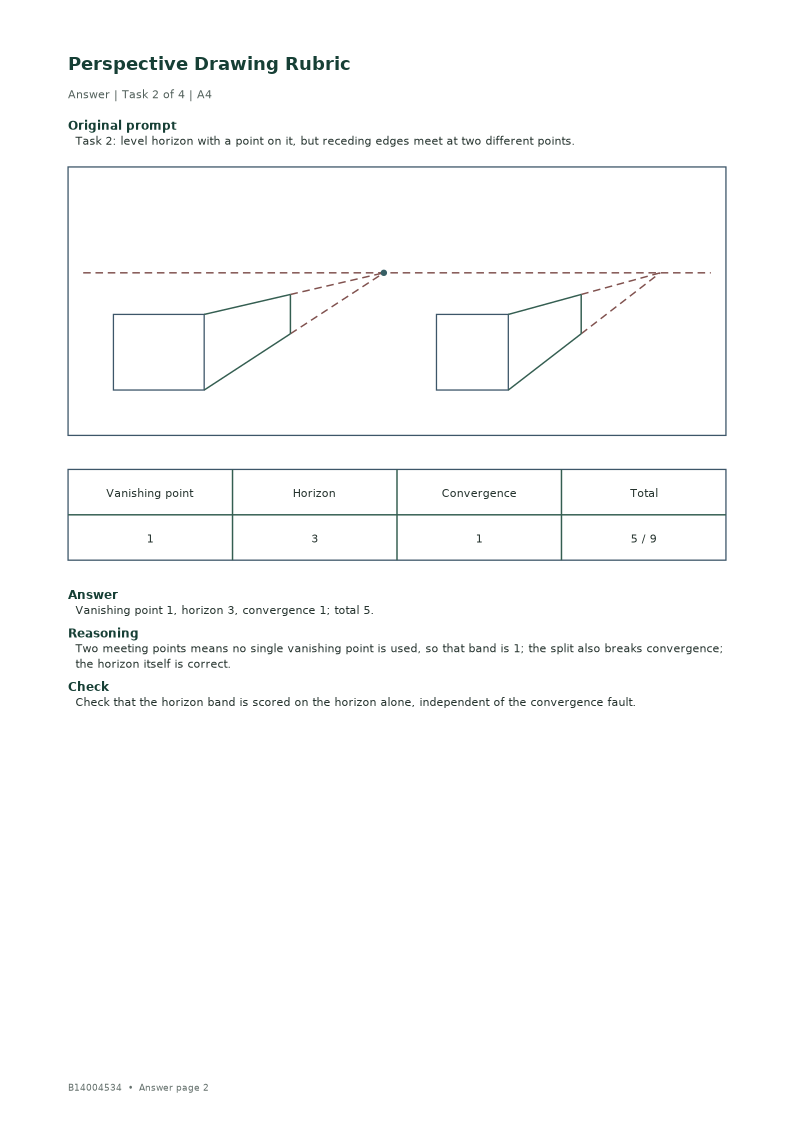
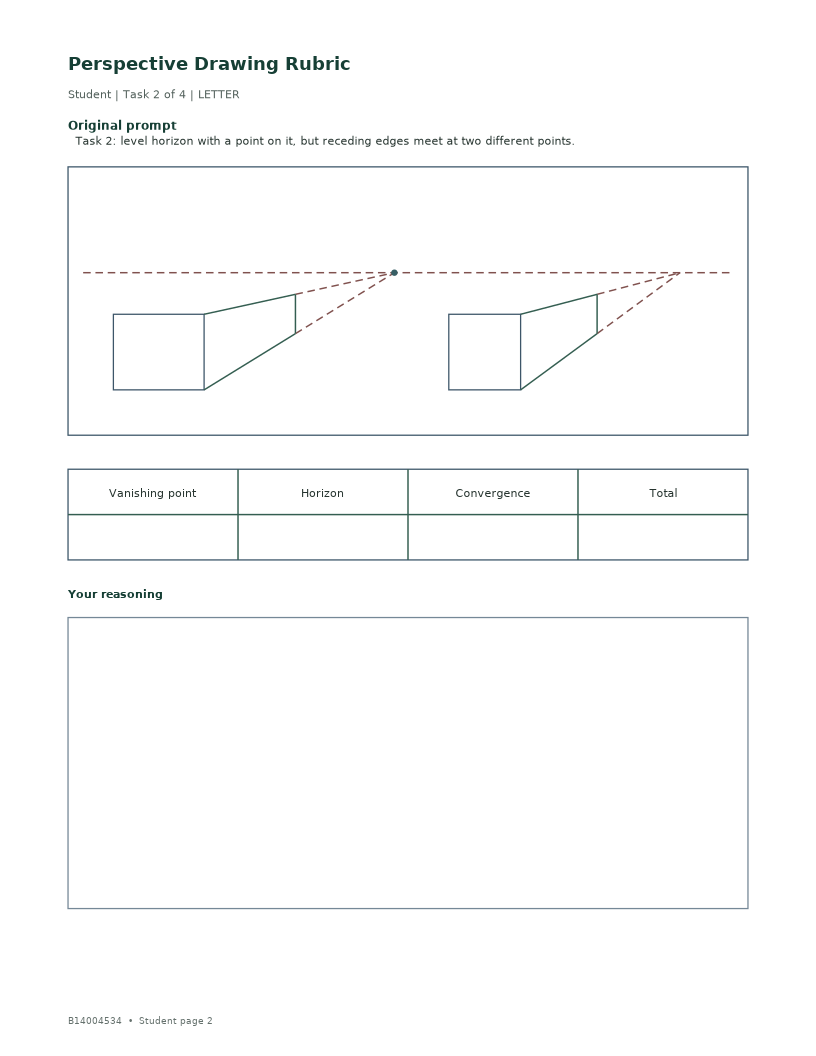
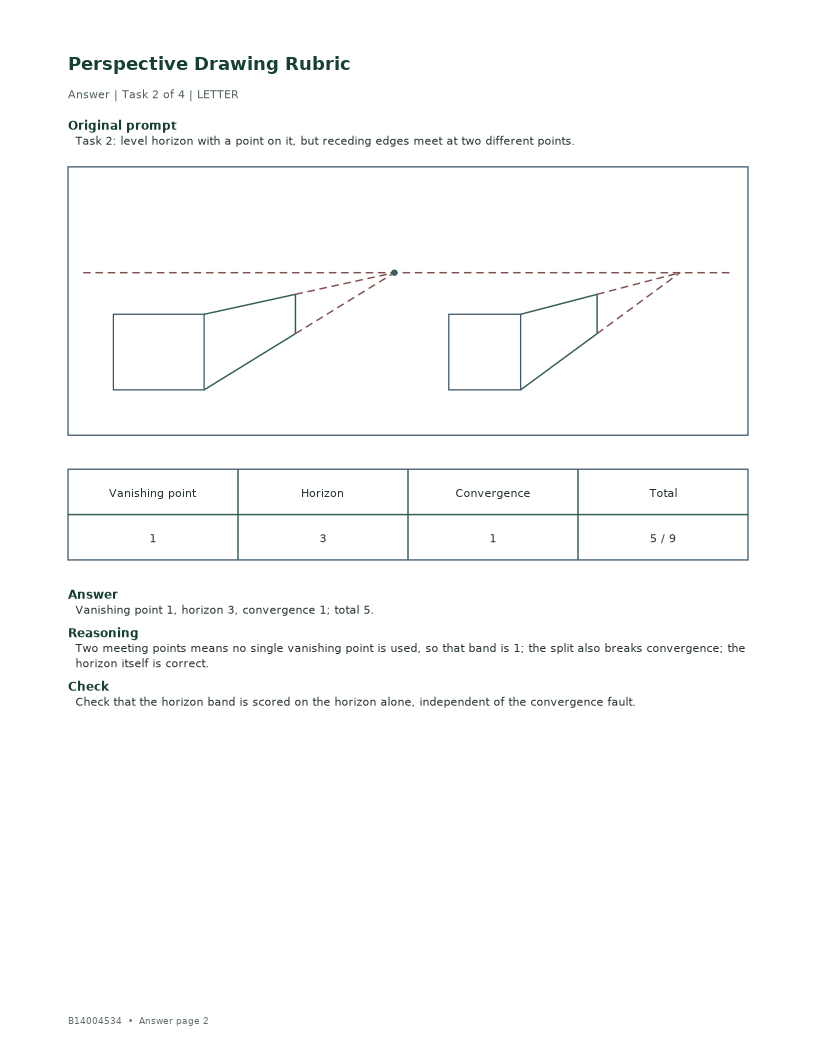
Task 2: score a drawing with a level horizon and a point on it, but whose receding edges meet at two different points. Give each band and the total.
Task 3 and Task 4
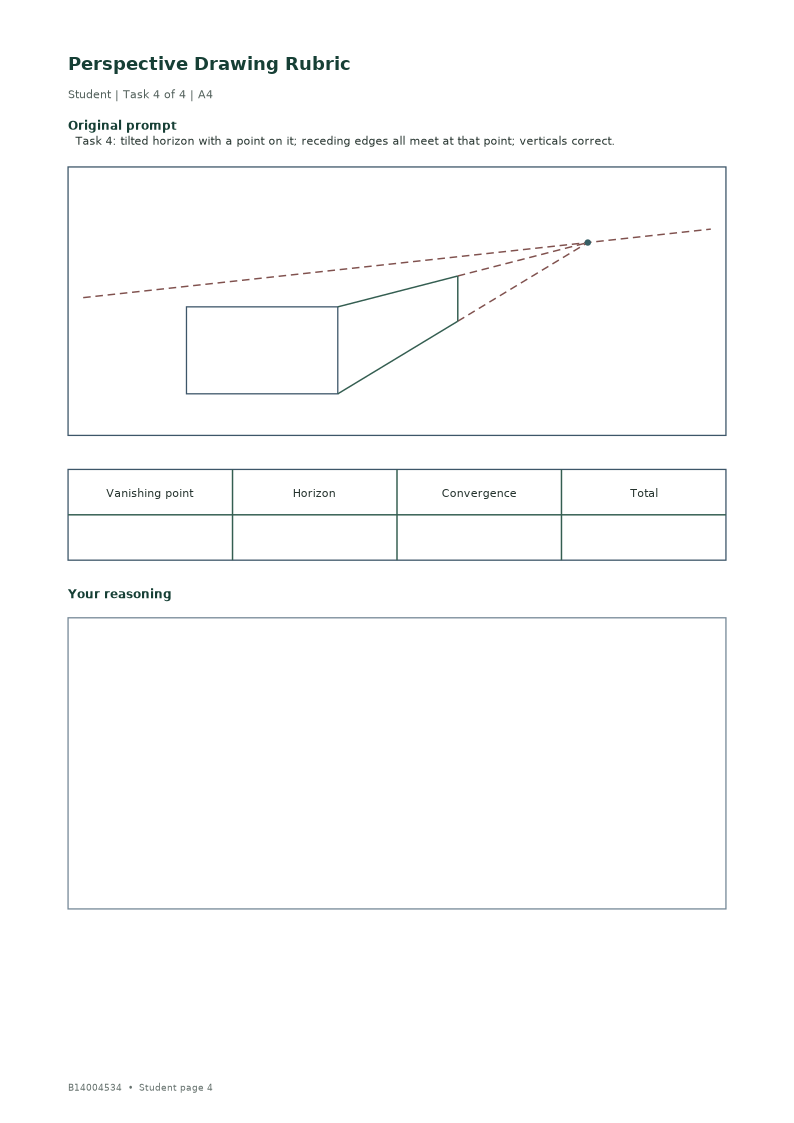
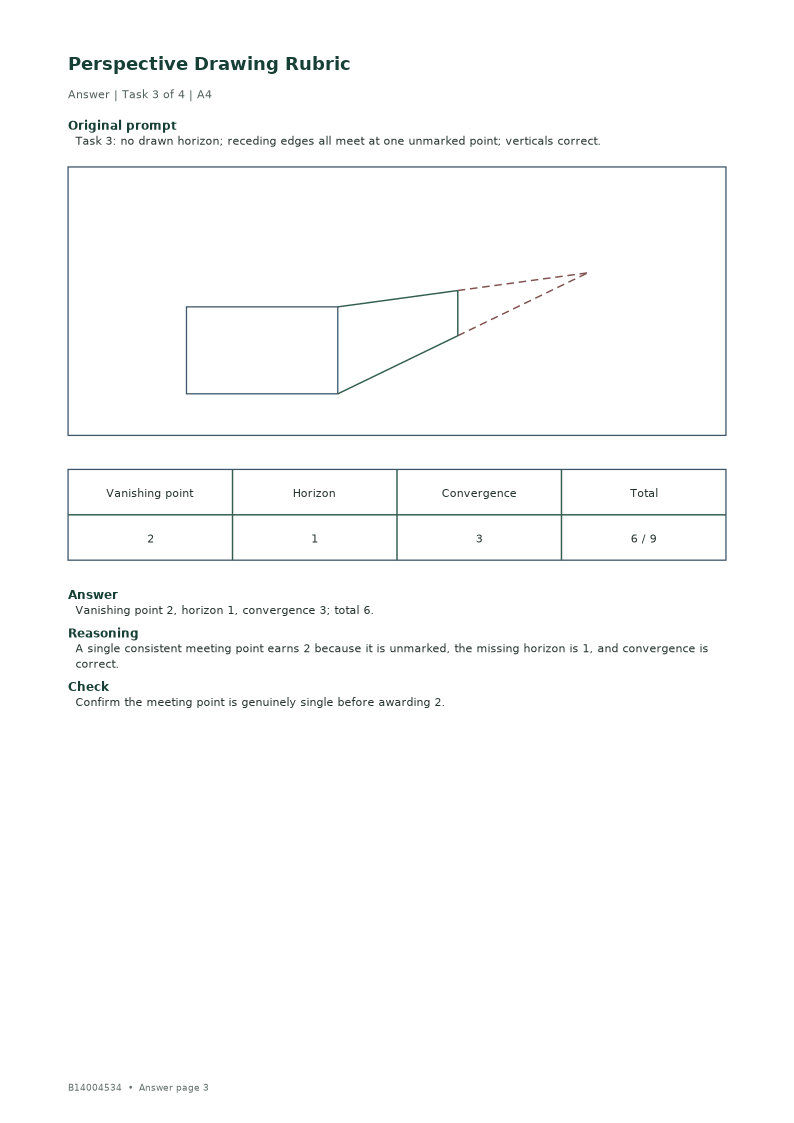
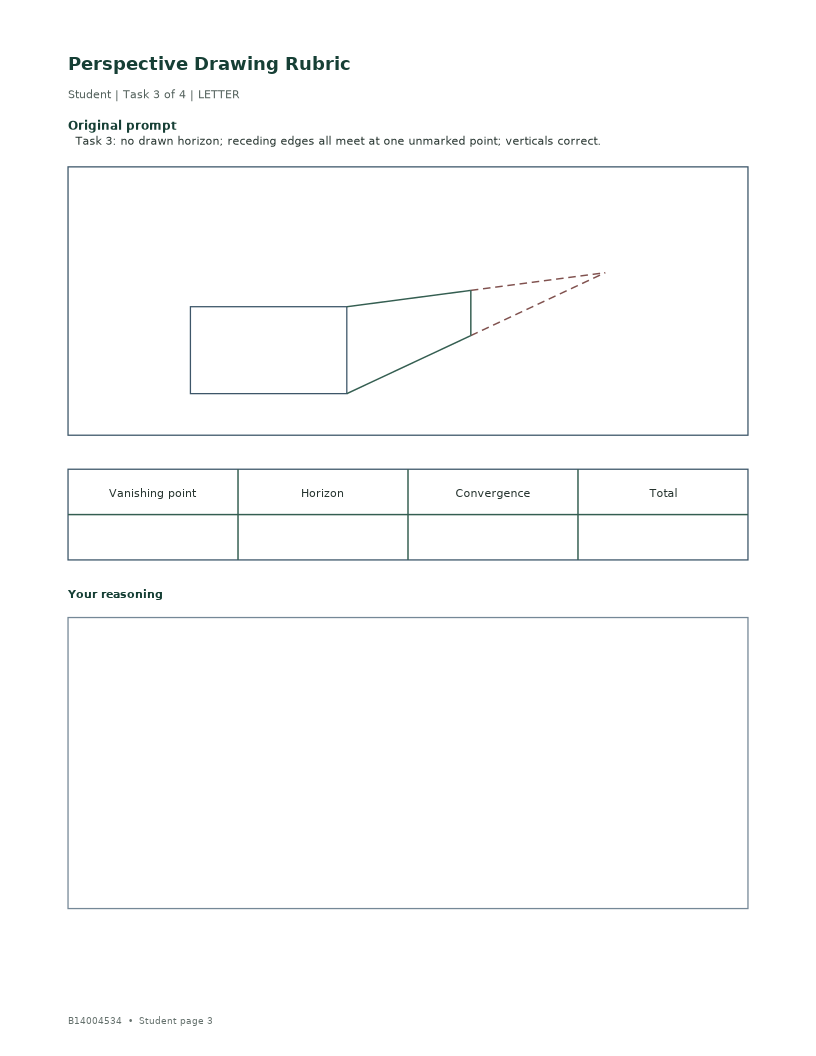
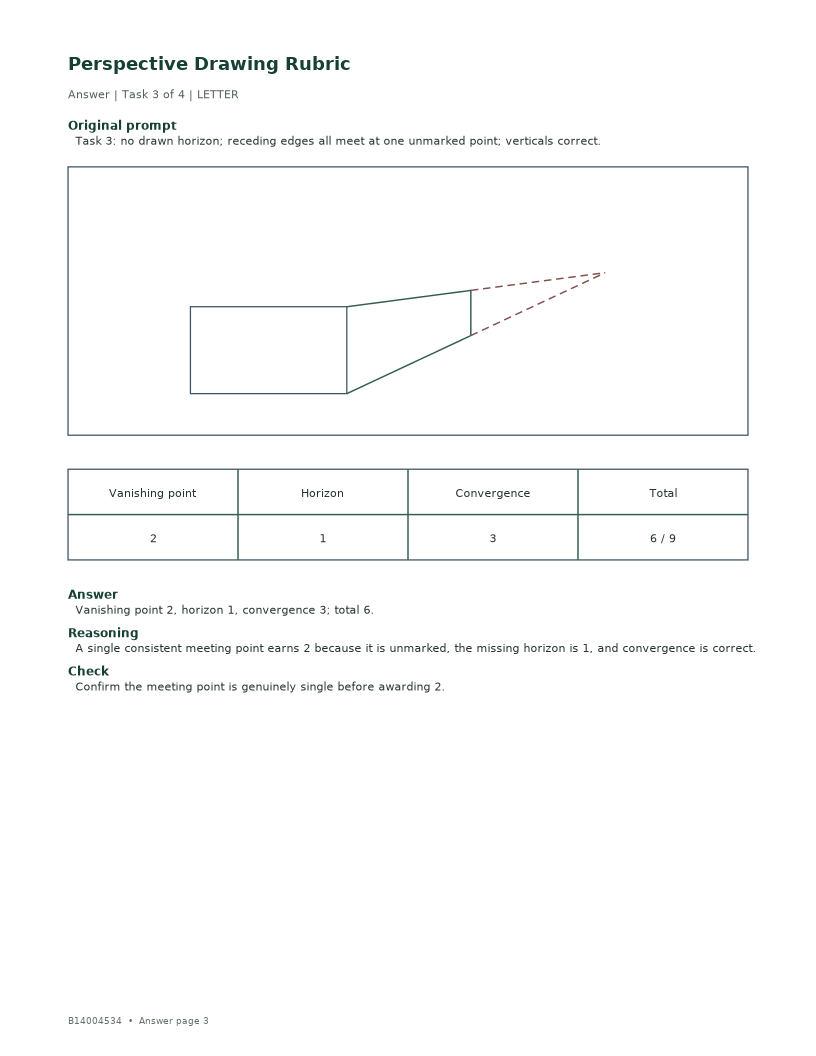
Task 3: score a drawing with no drawn horizon, receding edges that all meet at one unmarked point, and correct verticals. Give each band and the total.
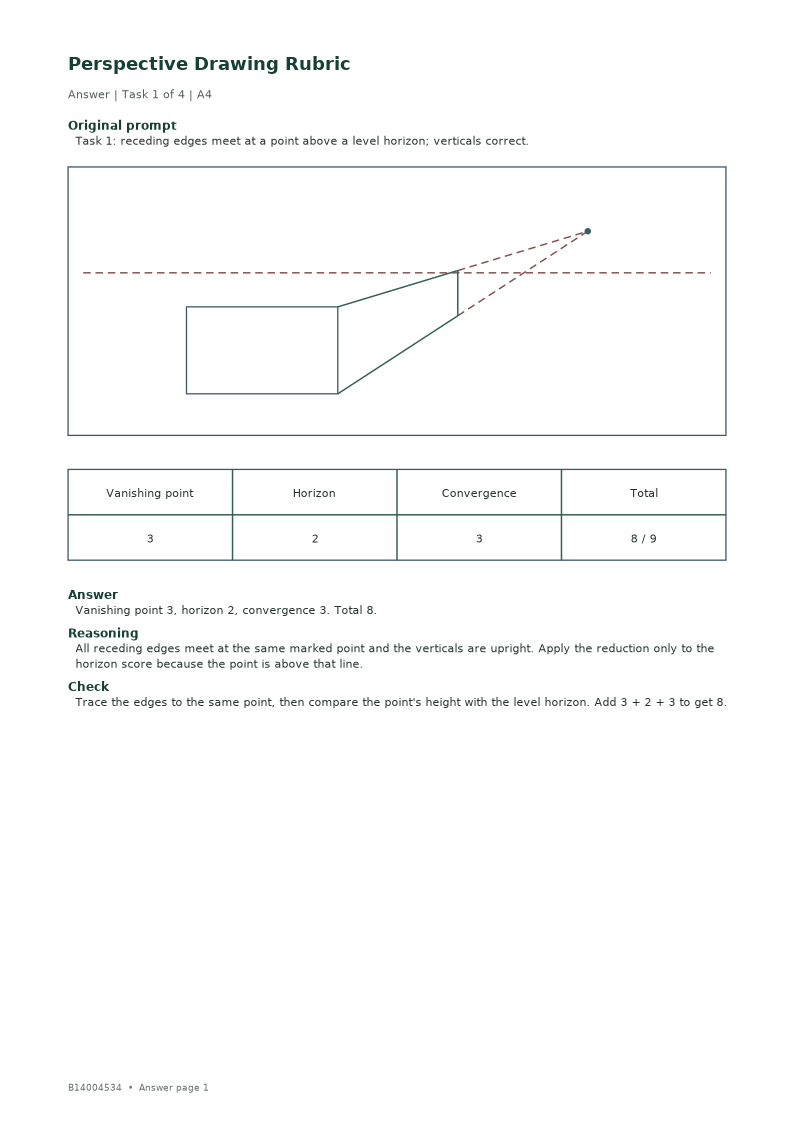
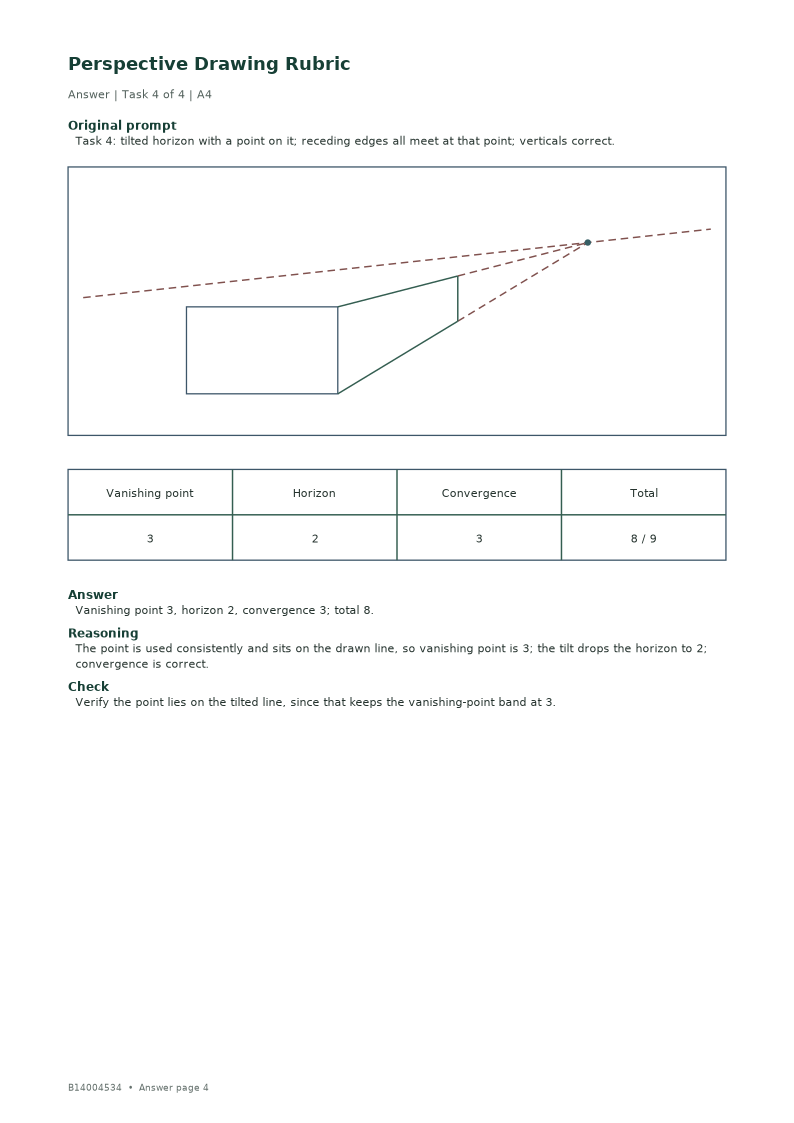
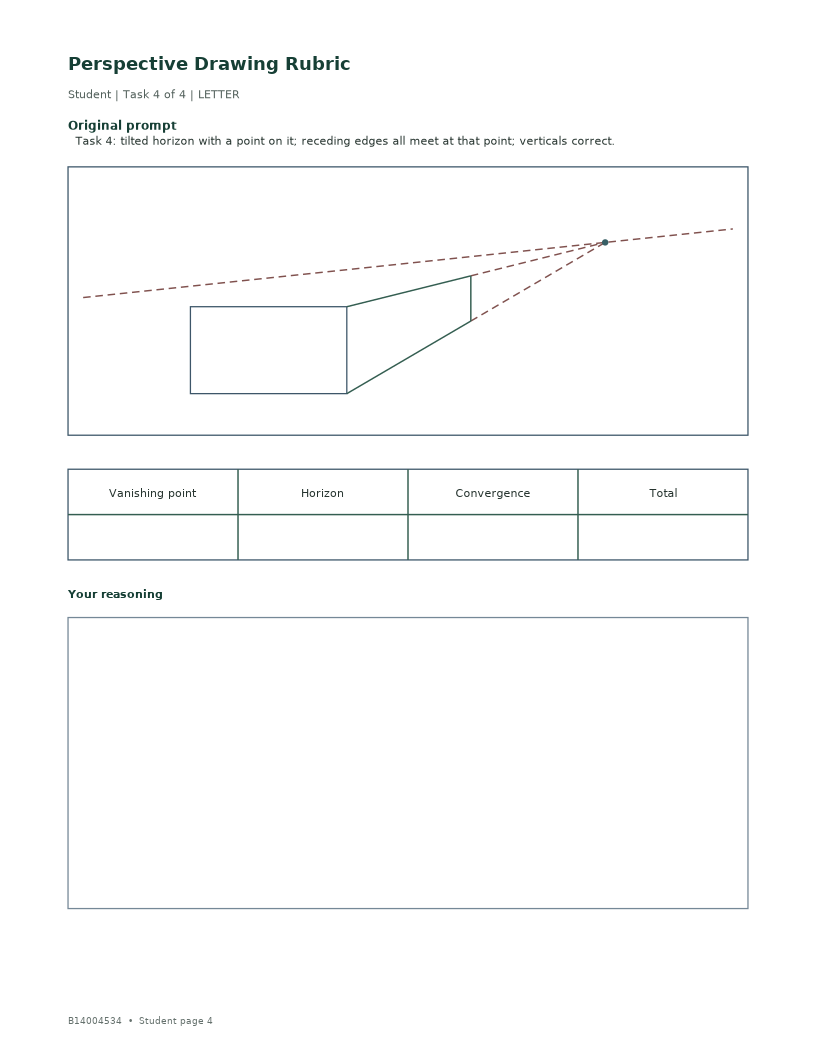
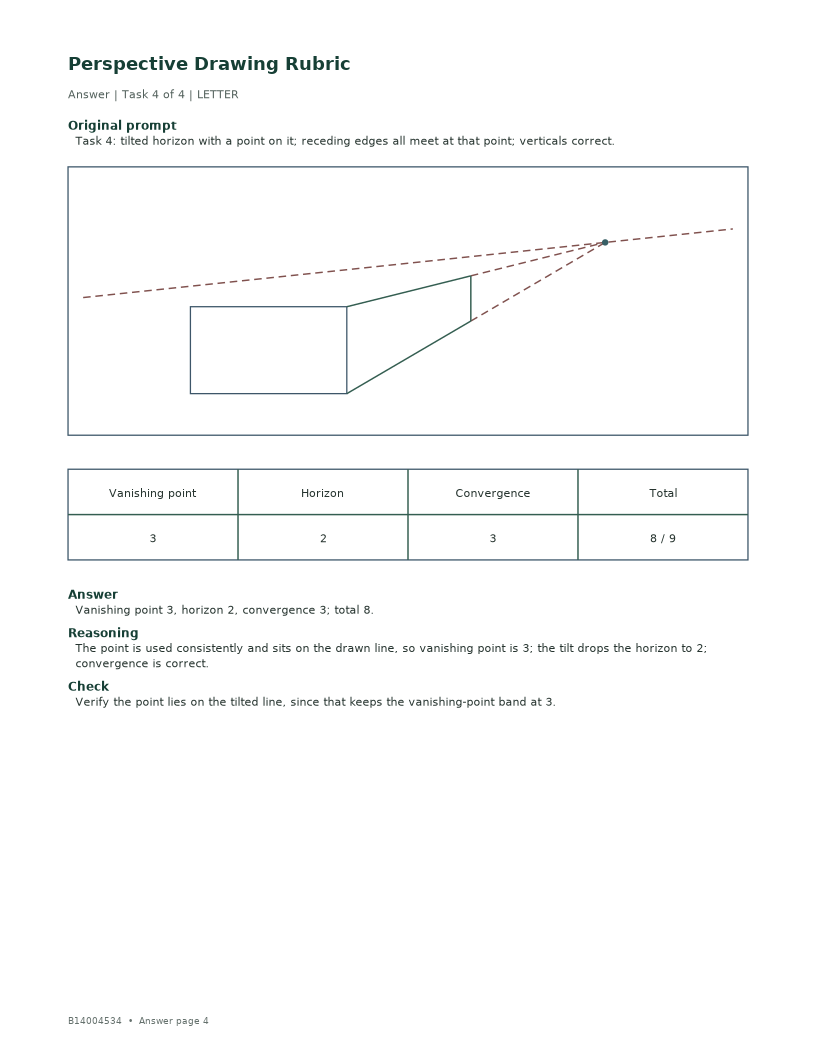
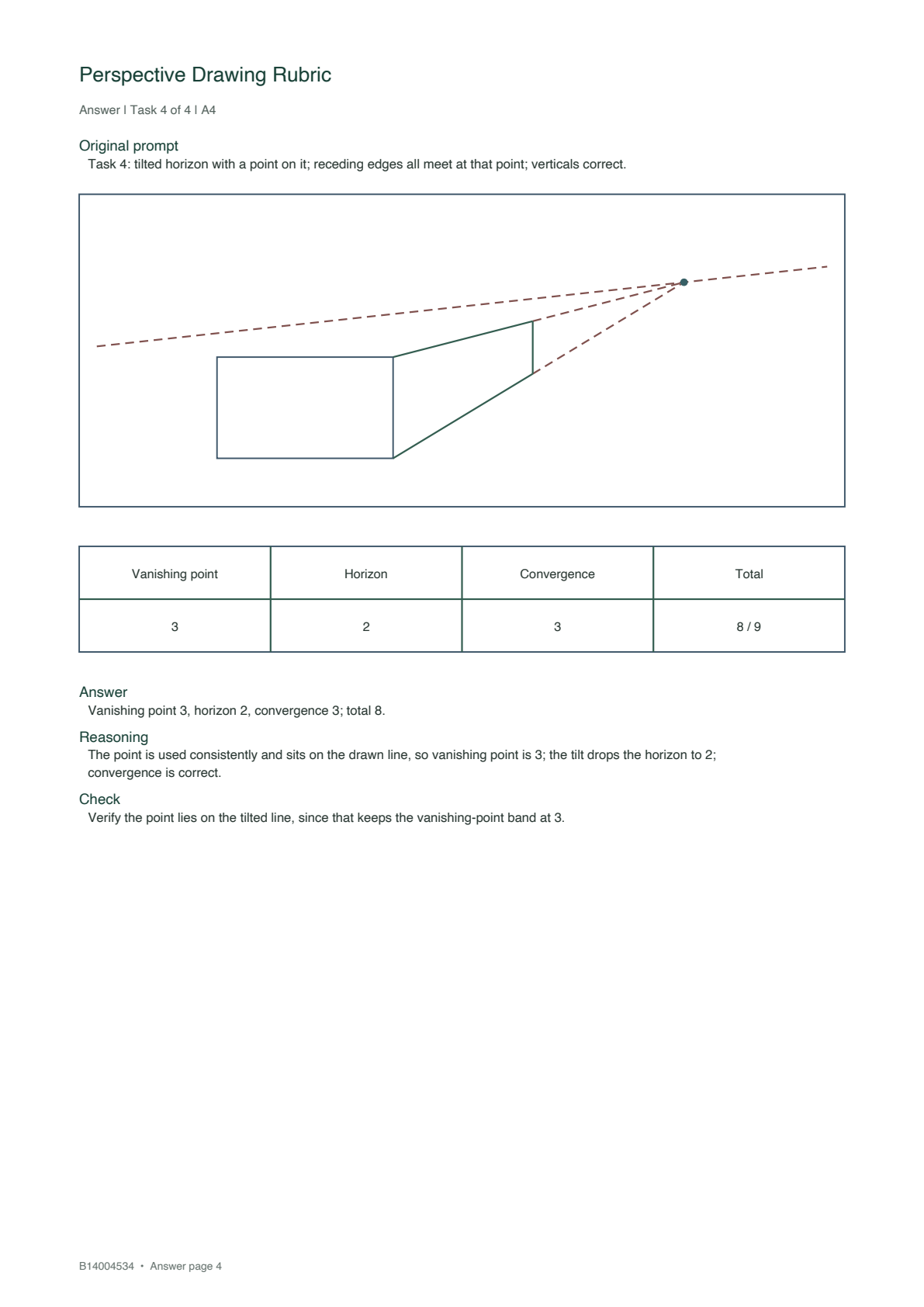
Task 4: score a drawing with a tilted horizon, a point on that tilted line, and receding edges that all meet at that point. Give each band and the total.
Download the complete resource pack
All individual SVG pages (20)
- A4 reference page 1
- A4 reference page 2
- A4 student page 1
- A4 student page 2
- A4 student page 3
- A4 student page 4
- A4 answer page 1
- A4 answer page 2
- A4 answer page 3
- A4 answer page 4
- LETTER reference page 1
- LETTER reference page 2
- LETTER student page 1
- LETTER student page 2
- LETTER student page 3
- LETTER student page 4
- LETTER answer page 1
- LETTER answer page 2
- LETTER answer page 3
- LETTER answer page 4
Print at 100% / actual size. Use the stated scale on any schematic diagram; physical cutting templates are identified separately. A4 and US Letter are separate files. Free access, no signup; CC BY 4.0.
How to use these pages
- How the rubric works
- The three criteria and their bands
- Worked example
- Practice tasks
- Task 3 and Task 4
Worked example
Example: Score the described drawing against the stated one-point reference.
Answer: Vanishing point 3 (both receding edges meet at the stated point); horizon 3 (level, point on it); convergence 2 (one vertical slanted); total 8.
Reasoning: The receding edges satisfy the vanishing-point band, the horizon satisfies its band, and the slanted vertical is a convergence inconsistency, so it drops only that criterion.
Check: Re-read each band definition and confirm the fault is assigned to exactly one criterion.
Four practice tasks and complete answers
Task 1
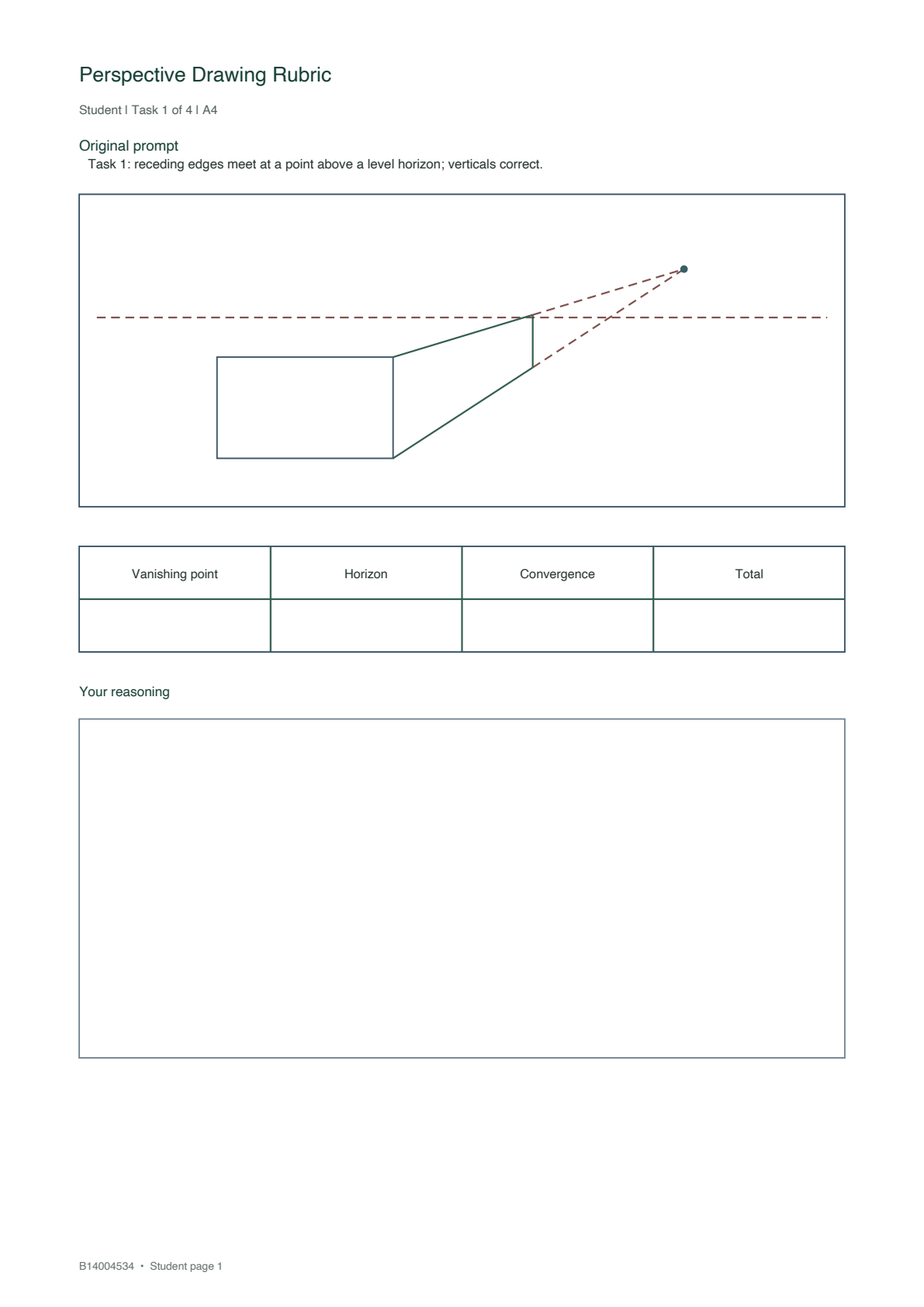
Task 1: receding edges meet at a point above a level horizon; verticals correct.
Show answer 1
Vanishing point 3, horizon 2, convergence 3. Total 8.
All receding edges meet at the same marked point and the verticals are upright. Apply the reduction only to the horizon score because the point is above that line.
Check: Trace the edges to the same point, then compare the point's height with the level horizon. Add 3 + 2 + 3 to get 8.
Task 2
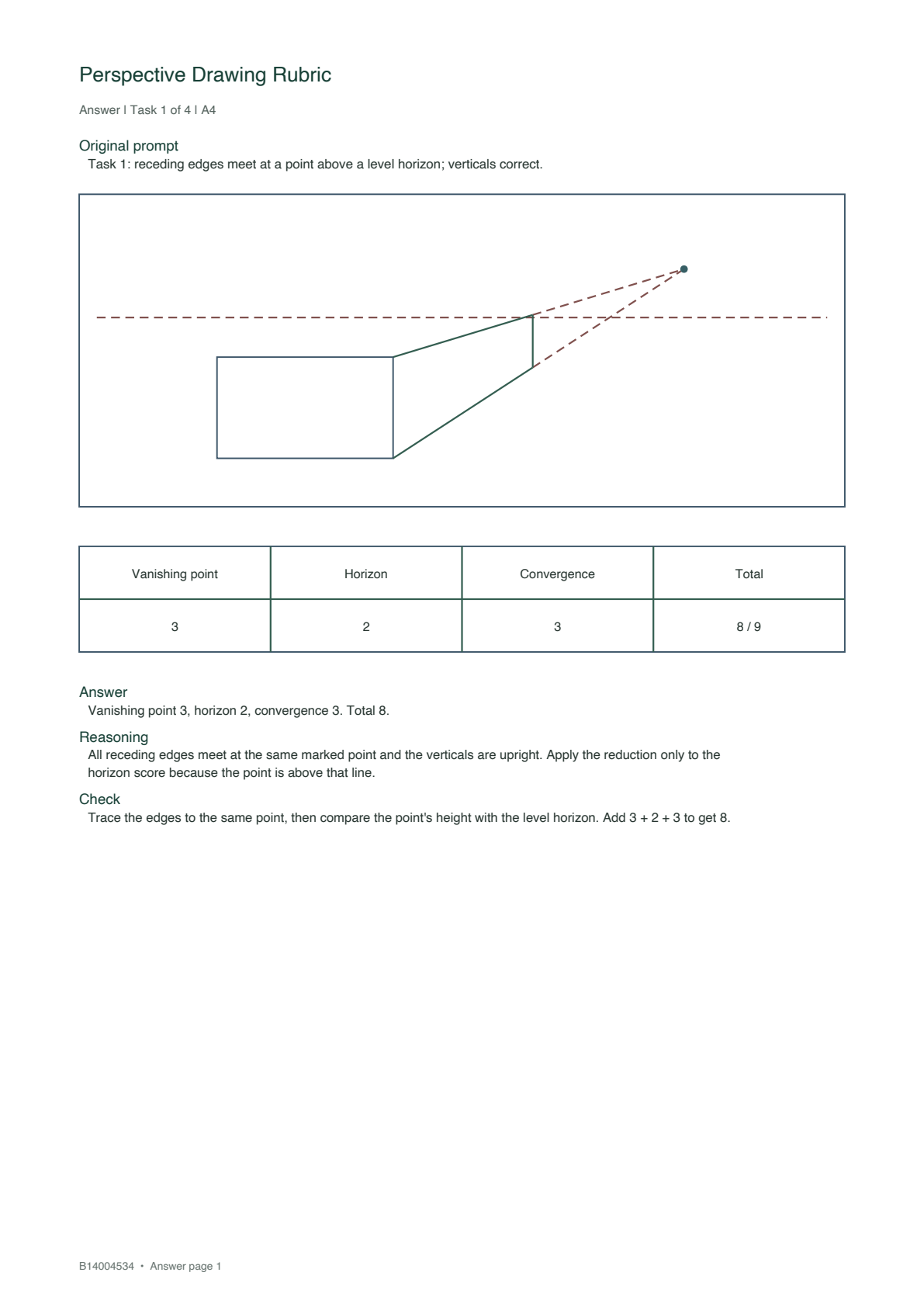
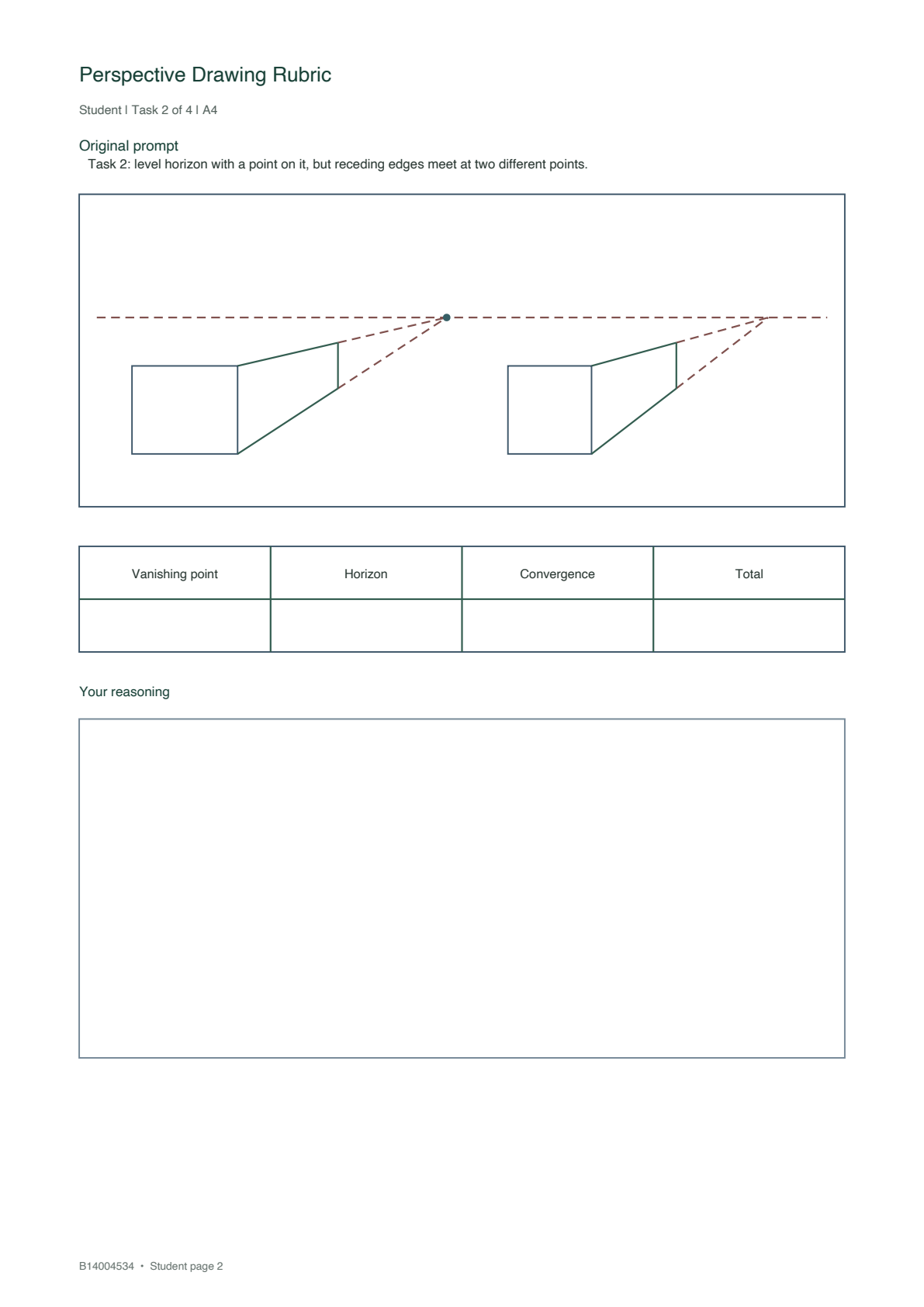
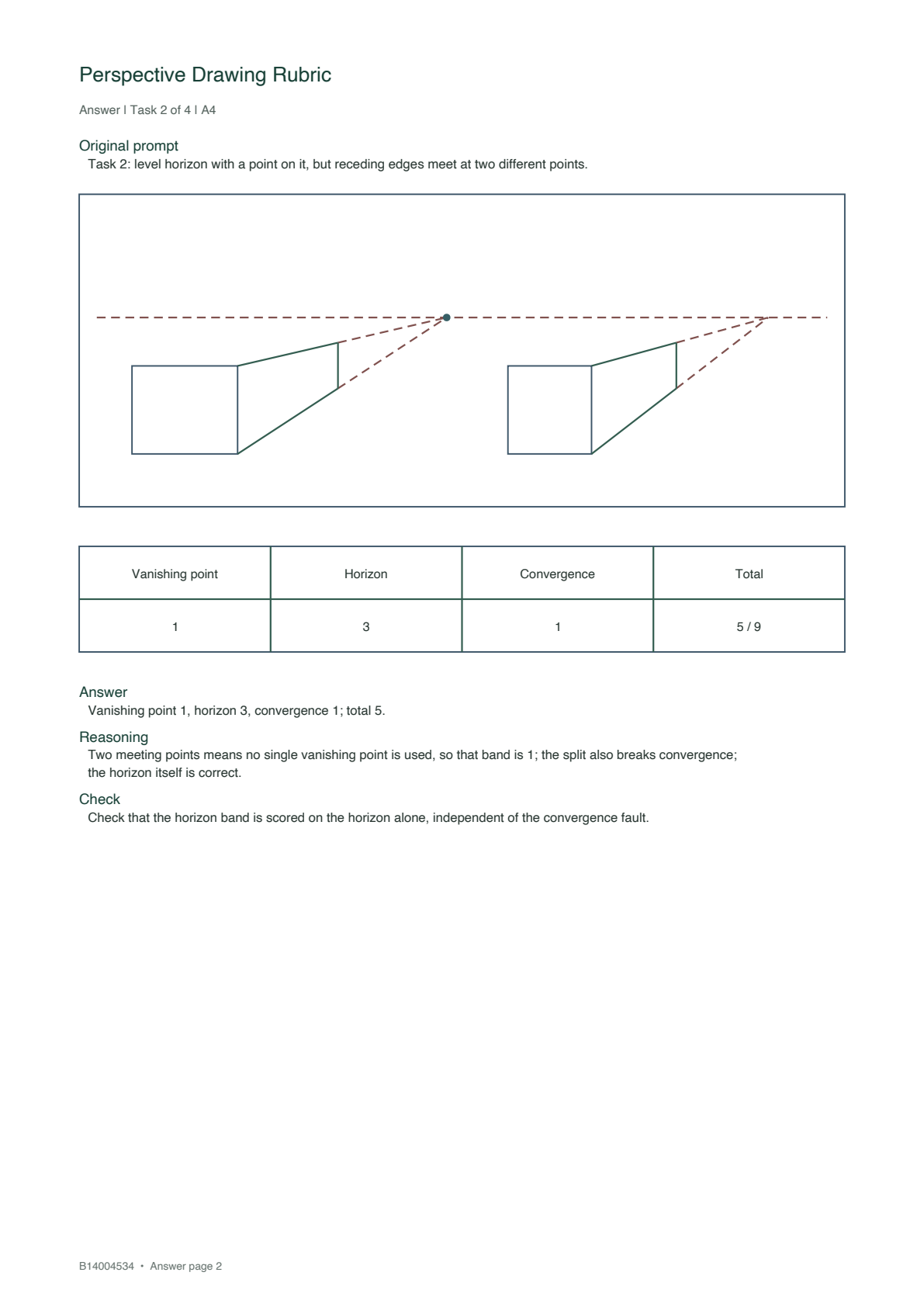
Task 2: level horizon with a point on it, but receding edges meet at two different points.
Show answer 2
Vanishing point 1, horizon 3, convergence 1; total 5.
Two meeting points means no single vanishing point is used, so that band is 1; the split also breaks convergence; the horizon itself is correct.
Check: Check that the horizon band is scored on the horizon alone, independent of the convergence fault.
Task 3
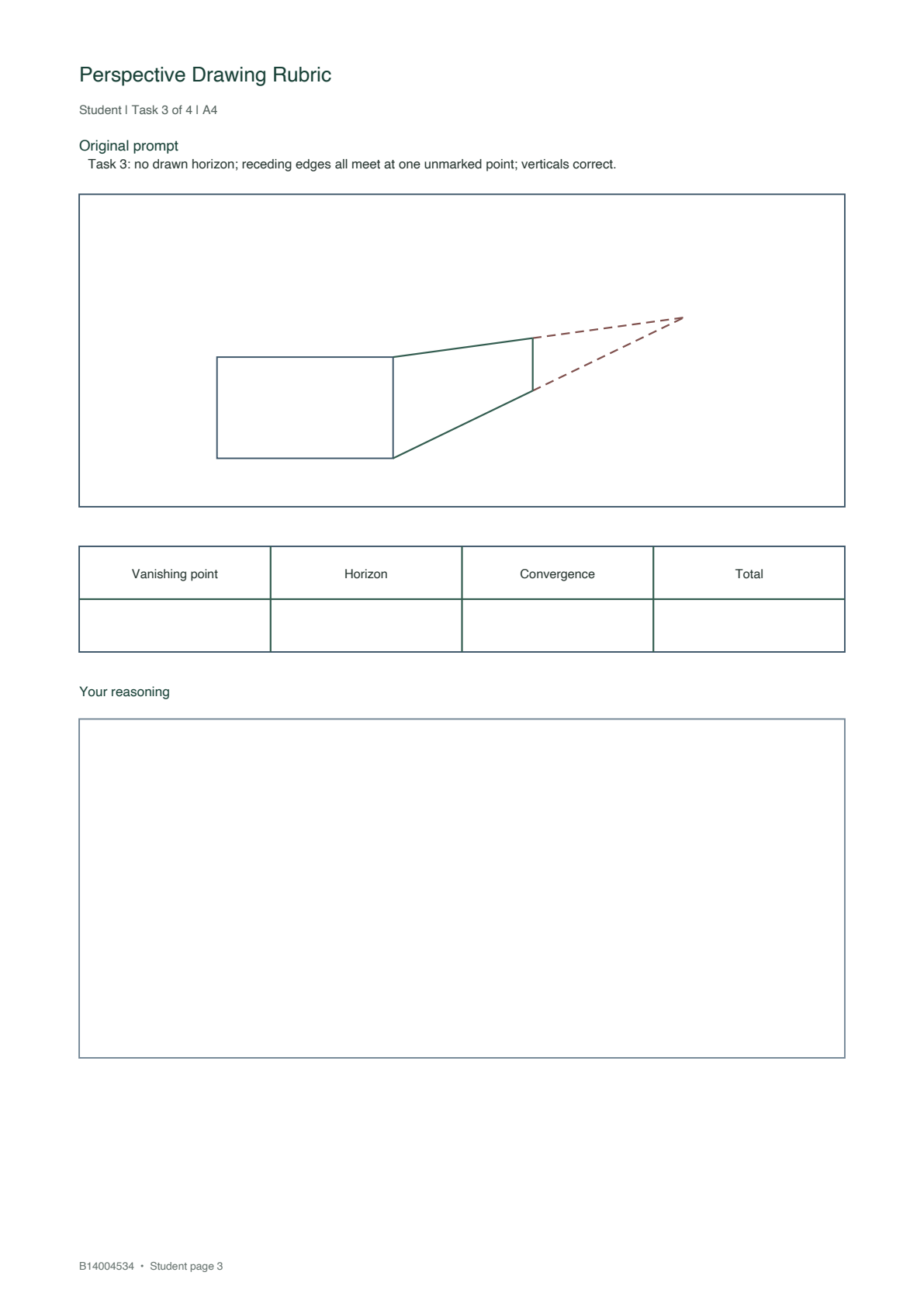
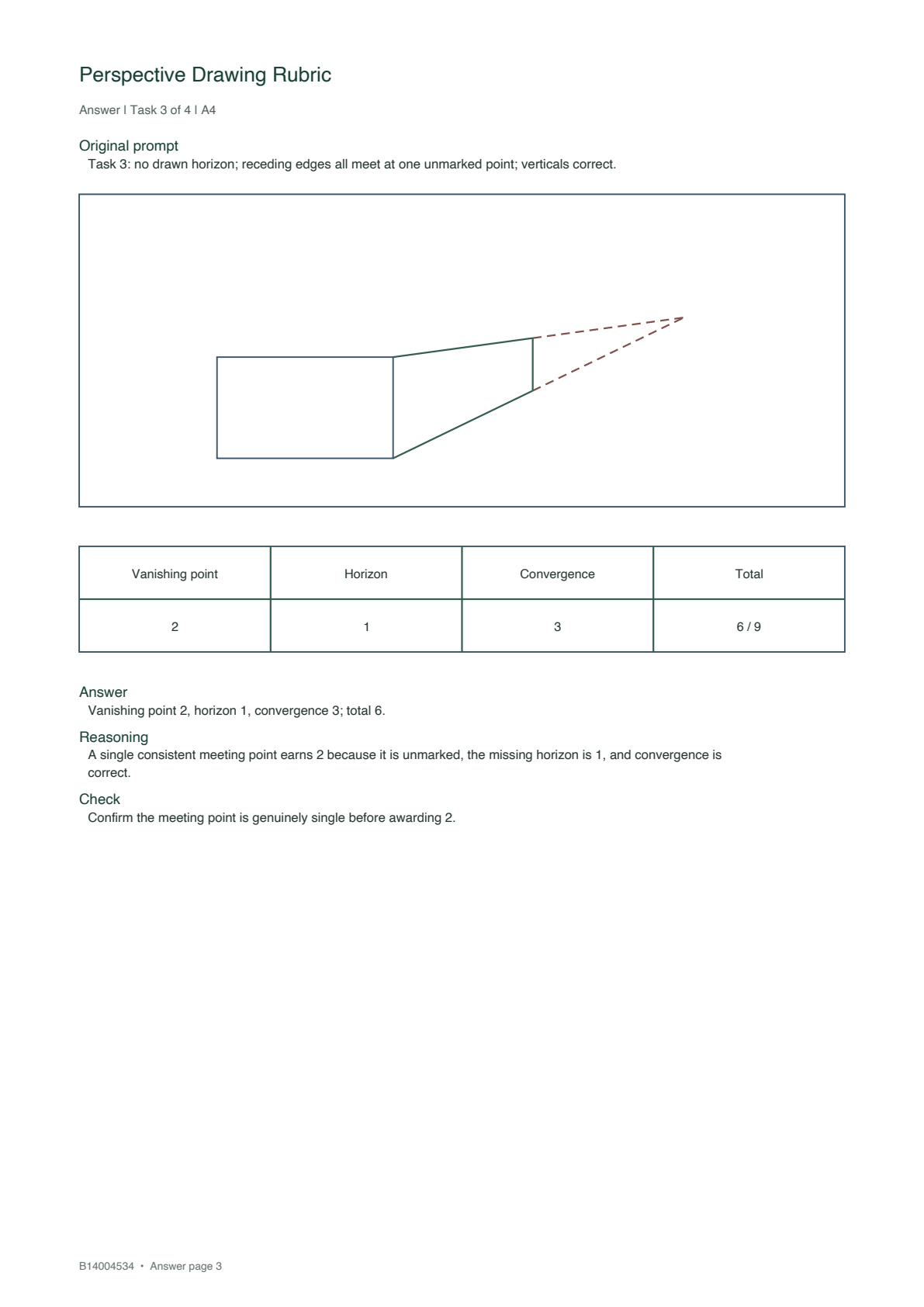
Task 3: no drawn horizon; receding edges all meet at one unmarked point; verticals correct.
Show answer 3
Vanishing point 2, horizon 1, convergence 3; total 6.
A single consistent meeting point earns 2 because it is unmarked, the missing horizon is 1, and convergence is correct.
Check: Confirm the meeting point is genuinely single before awarding 2.
Task 4
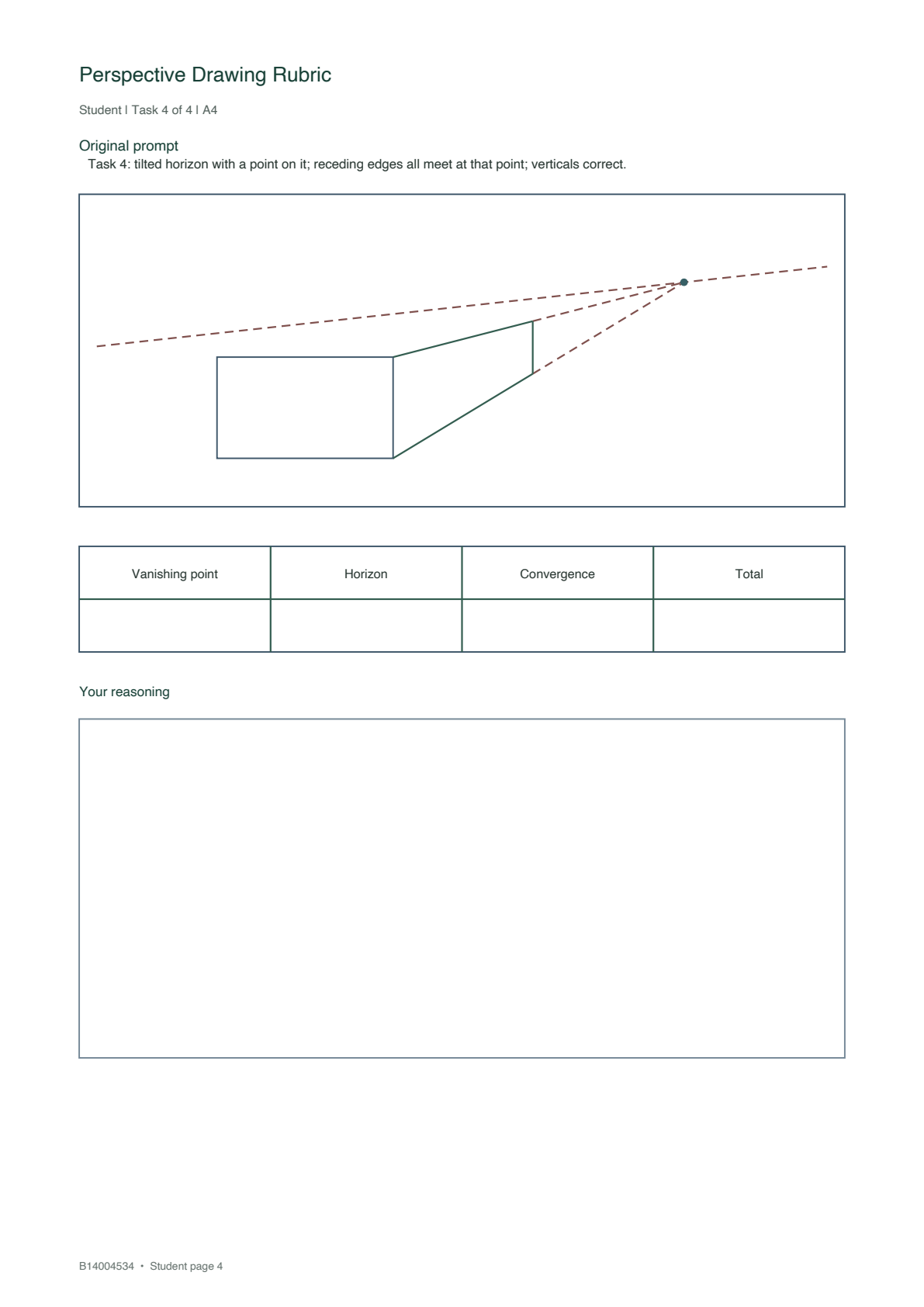
Task 4: tilted horizon with a point on it; receding edges all meet at that point; verticals correct.
Show answer 4
Vanishing point 3, horizon 2, convergence 3; total 8.
The point is used consistently and sits on the drawn line, so vanishing point is 3; the tilt drops the horizon to 2; convergence is correct.
Check: Verify the point lies on the tilted line, since that keeps the vanishing-point band at 3.
Useful checks
- Scoring the same fault twice, e.g. docking both vanishing point and convergence for one drifting edge. Assign each fault to the criterion whose band definition it breaks, then re-check the other two bands.
- Awarding horizon 3 when the vanishing point is off the horizon. The horizon band requires the point to sit on a level line; if it does not, the band is 2.
Questions about this resource
Is this a drawing lesson?
No. It is a scoring rubric sheet; the reference construction is given so scores can be checked, not taught from scratch.
Can I add more criteria?
The pack covers vanishing point, horizon and convergence only; adding criteria would change the task.