Free original resources
Whale Drawing: Build Body Mass, Head, and Tail Stock Proportions
Learn a four-stage whale drawing method: set a long broad body mass, place the small head and mouth, taper the tail stock into flukes, then add a flipper and limited contour accents.
Free resources
Letter & A4
PDF & SVG
Letter & A4
PDF & SVG
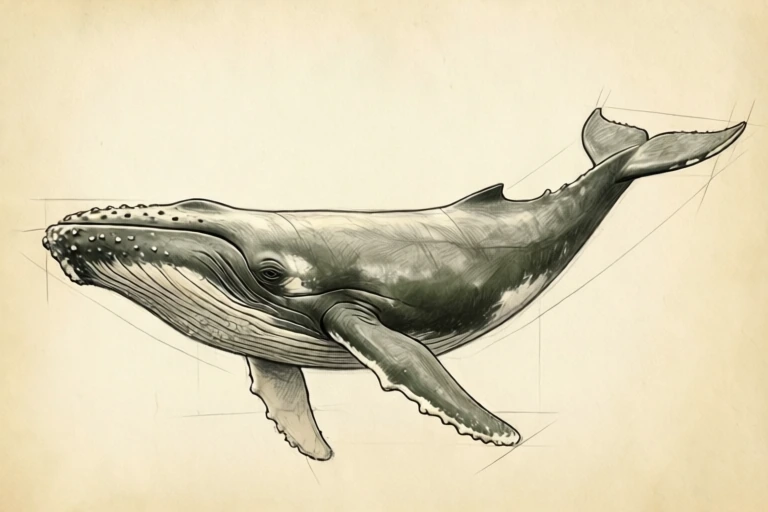
Build the drawing in four stages.
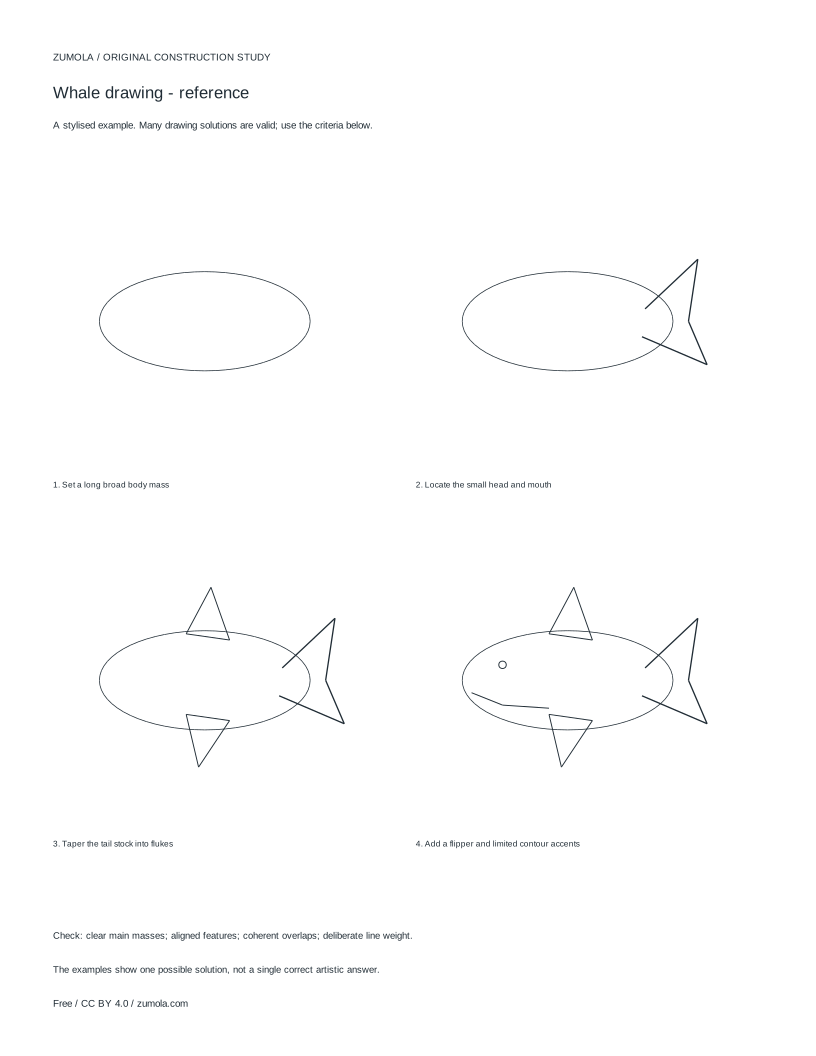
Your free printable kit.
Original reference, student practice and separate worked answers. No account or payment.
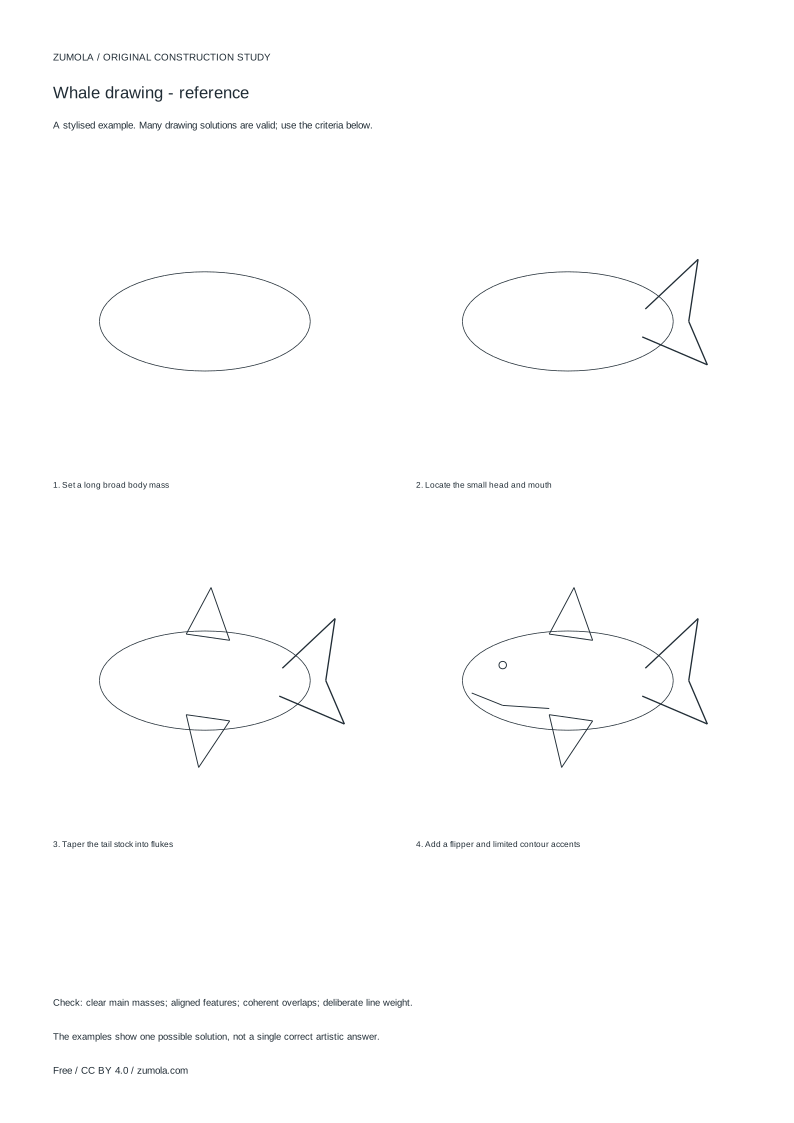
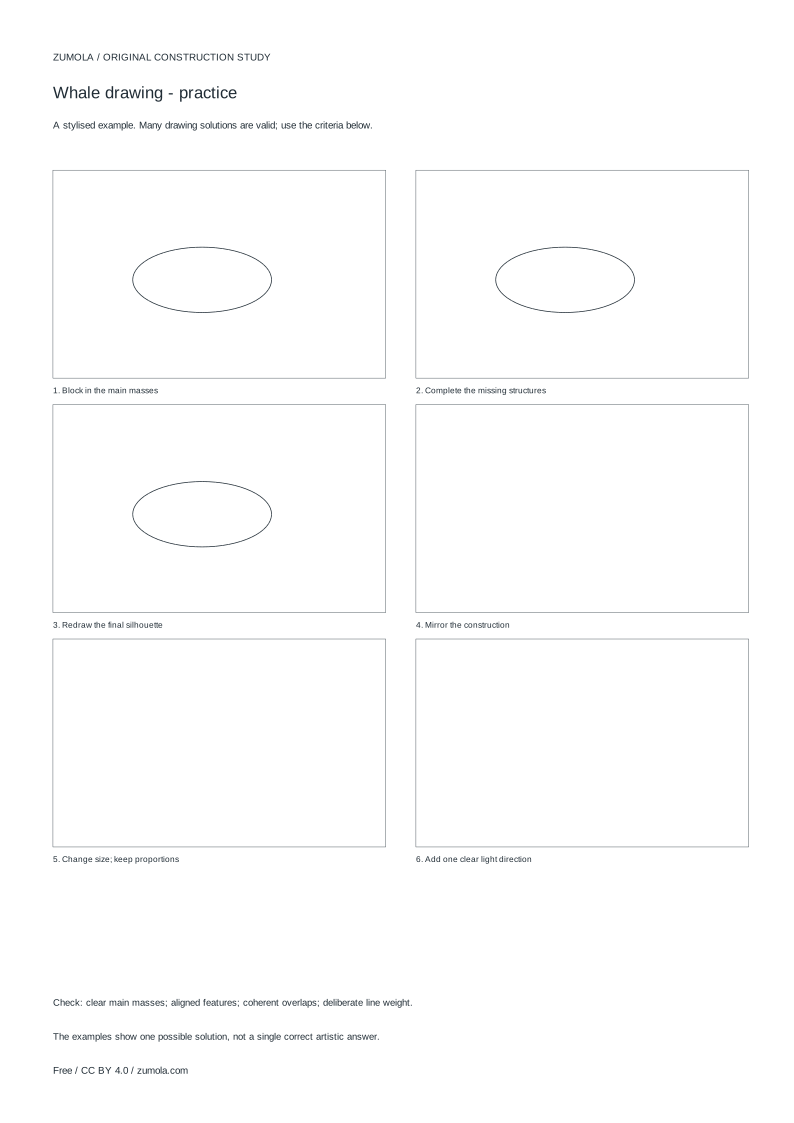
Practice worksheet
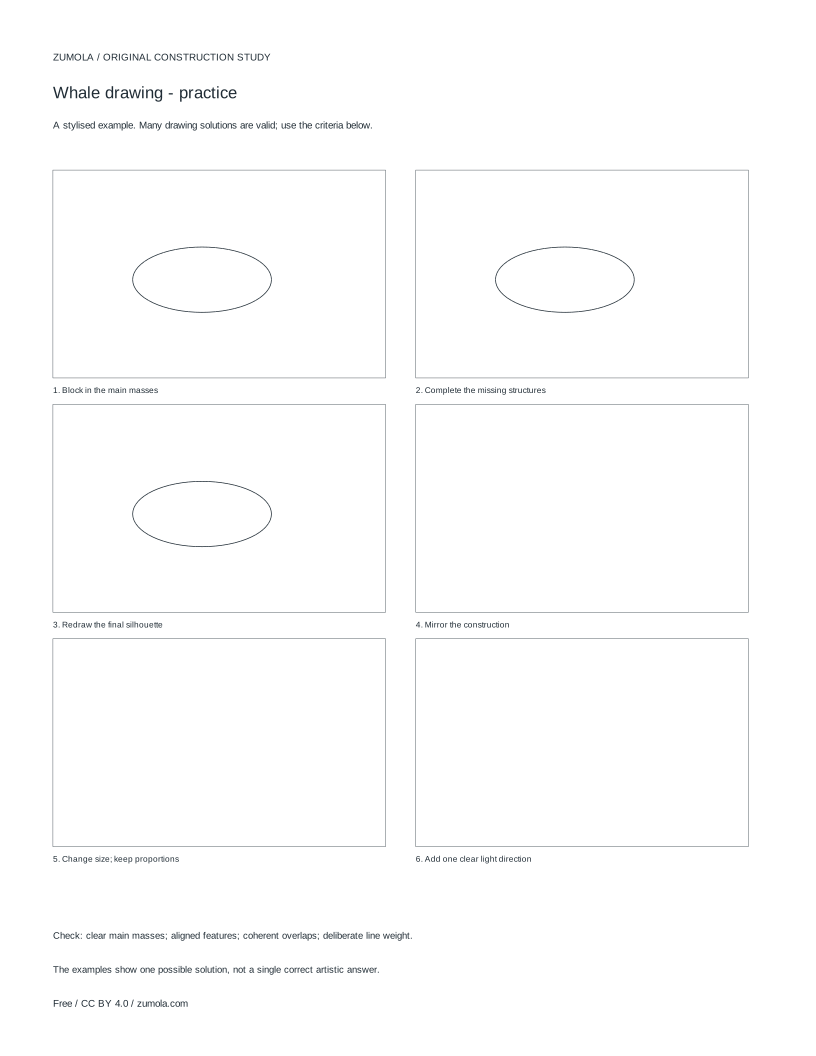
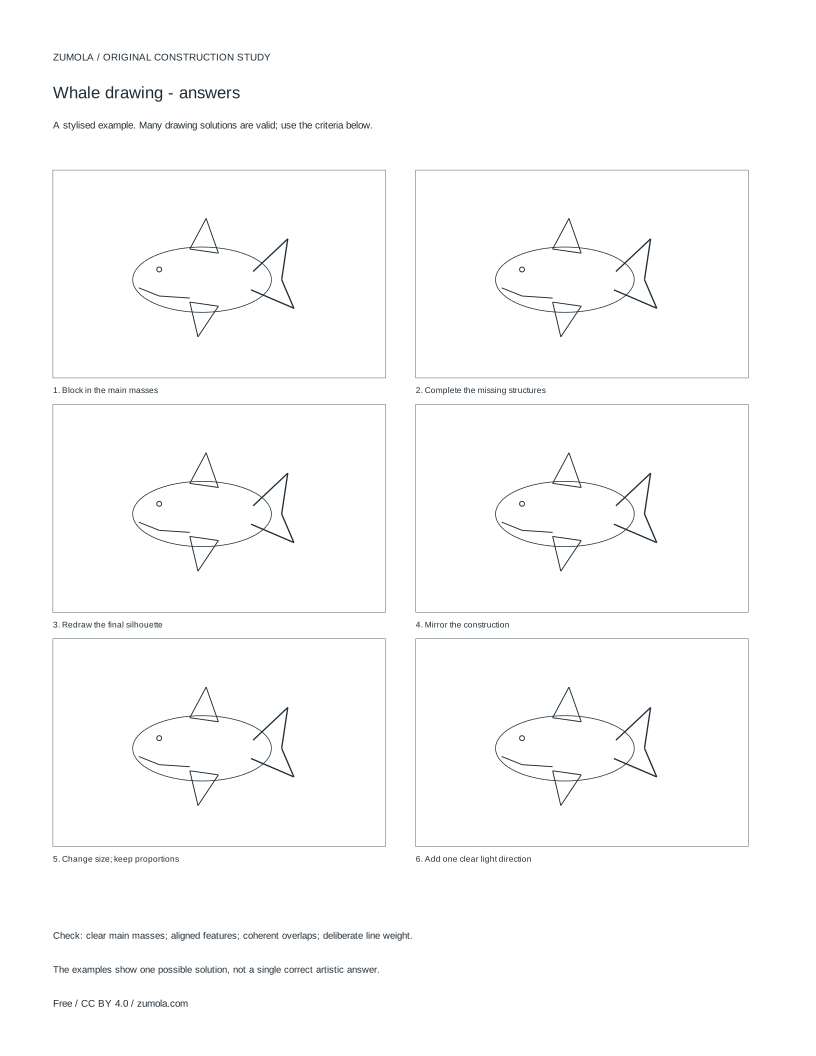
Worked answers / rubric
Print at Actual size / 100%. Check the calibration bar before using physical dimensions.
Whale drawings go wrong early, usually in proportion rather than detail. A whale reads as a whale because its body is long and broad, its head is small relative to that mass, and the tail stock narrows steadily before the flukes spread. This guide explains a construction order you can check at each stage, using simple measured comparisons instead of copying a finished outline. The approach is a stylised construction study, not anatomical or photorealistic instruction, and several valid artistic solutions exist.
Start with the long broad body mass
Begin with a single elongated shape rather than an outline of the whole animal. Draw a long horizontal oval or soft capsule for the main body, wider through the middle and slightly fuller toward the front. Decide the body length first, then set width as a fraction of it; for a humpback-style silhouette, a width around one quarter to one third of the length keeps the mass broad without becoming round.
Mark a centre line along the body. This line controls where the head, eye, flipper, and tail stock sit, so every later feature can be checked against it. Keep the construction light: these lines are guides, not final contours.
- Draw a horizontal centre line for the body axis.
- Add a long capsule around the line, fuller at the front third.
- Check width against length before adding anything else.
Locate the small head and mouth
The head should feel small against the body mass. Place it at the front end of the capsule, taking roughly one fifth to one quarter of the total length. A whale head drawing practice benefits from marking the mouth line before the eye: the mouth runs back from the snout along the lower edge of the head, and its length helps confirm the head is not oversized.
For a humpback whale drawing easy enough to read, keep the head simple and slightly rounded, with a shallow mouth curve. For a killer whale drawing, the head is more tapered and the mouth line sits lower, but the same proportion check applies: small head, long body.
- Mark the head length as about one fifth of the body.
- Draw the mouth line from the snout backward along the lower head edge.
- Place the eye above and behind the mouth line, not at the snout tip.
Taper the tail stock into flukes
The tail stock is the narrow section between the body and the flukes. It should taper gradually, not pinch suddenly. Draw two lines converging from the rear of the body toward a narrow point, then let the flukes spread horizontally from that point. The flukes are wider than the stock but should not exceed the body width dramatically.
Overlap matters here. The flukes sit behind the body mass, so their inner edges should be partly hidden by the tail stock. Draw the stock first, then the flukes, so the overlap reads correctly.
- Taper the rear body into a narrow tail stock.
- Draw the flukes spreading sideways from the stock end.
- Check that the flukes are wider than the stock but not wider than the body.
Add a flipper and limited contour accents
Place one flipper on the visible side, angled downward and slightly back from the head. Its length should be modest, roughly one sixth to one fifth of the body length. Keep the far flipper hidden or barely suggested to preserve the side view.
Finish with limited contour accents: a few lines for the mouth, eye, and flipper edge, plus light shading under the body. Avoid covering the whole animal in detail lines; the construction masses should still be readable. Compare main masses, feature placement, overlaps, and line weight rather than chasing an exact outline.
- Draw the near flipper angled down and back.
- Add the eye and mouth as short accents.
- Shade lightly beneath the body to suggest volume.
Try this example
Draw a side-view whale with a body length of 20 cm. Set the width, head length, flipper length, and tail stock taper using the proportions above.
Show the worked explanation
Body length 20 cm. Width at one quarter to one third gives 5 to about 6.7 cm; choose 6 cm. Head length at one fifth gives 4 cm. Flipper length at one sixth to one fifth gives about 3.3 to 4 cm; choose 3.5 cm. Taper the rear body into a narrow tail stock, then draw flukes wider than the stock but narrower than 6 cm. Check overlaps: flukes behind the stock, near flipper angled down and back.
Common mistakes
- Making the head too large relative to the body. Measure head length as about one fifth of total body length and redraw the mouth line before adding detail.
- Pinching the tail stock suddenly instead of tapering it. Draw two converging lines from the rear body to a narrow point, then attach the flukes behind that point.
- Drawing flukes wider than the body or in front of the tail stock. Keep flukes narrower than the body width and draw them after the stock so the overlap reads correctly.
Check your work
- Body mass is long and broad, with width between one quarter and one third of length.
- Head is small, about one fifth of body length, with the mouth line placed before the eye.
- Tail stock tapers gradually into flukes that are wider than the stock but narrower than the body.
- Near flipper is angled down and back, with the far flipper hidden or barely suggested.
- Contour accents are limited, and construction masses remain readable.
- Overlaps are correct: flukes behind the tail stock, flipper attached to the body side.
Questions before you start
How long should a whale body be compared with its width?
For a broad, readable silhouette, set width at roughly one quarter to one third of body length. Check this before adding the head or flukes.
Where should the eye sit on a whale drawing?
Place the eye above and behind the mouth line, not at the snout tip. Its position should sit within the small head area, roughly one fifth of the body length.
Can I use this method for a killer whale or whale shark side view drawing?
Yes, the proportion checks apply, but adjust the head shape: killer whales taper more, and whale sharks have a broader, flatter head. Keep the small-head-to-long-body relationship and taper the tail stock gradually.