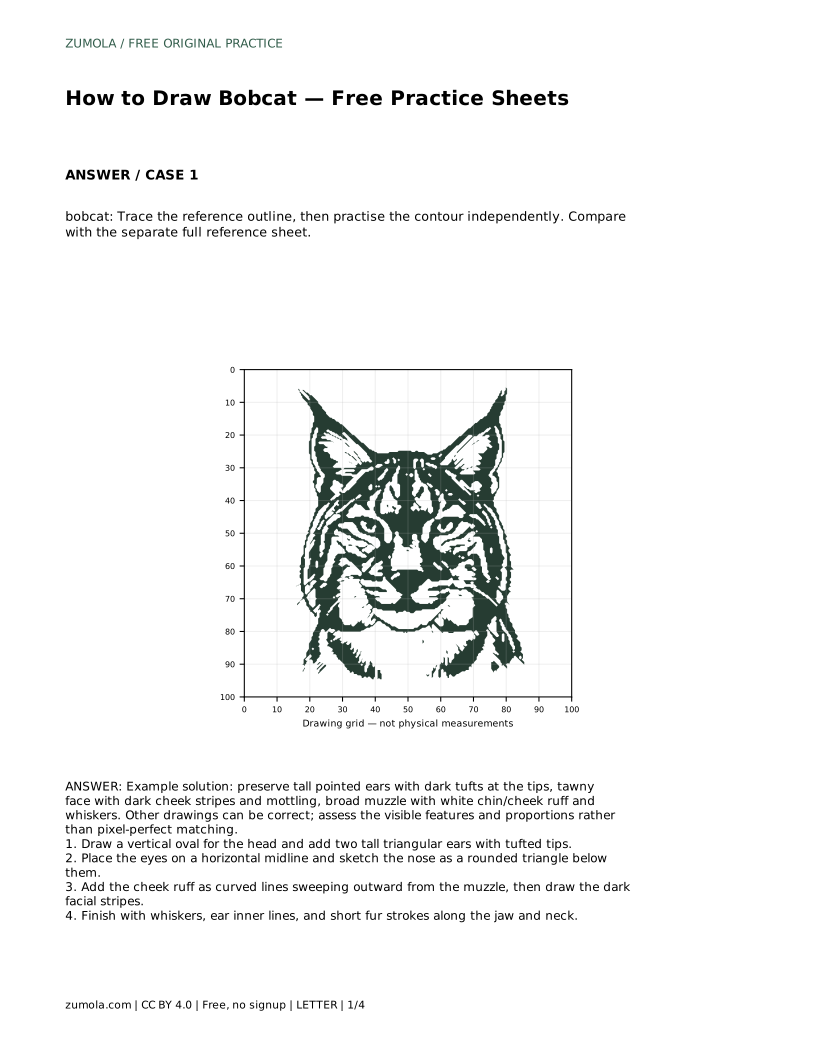
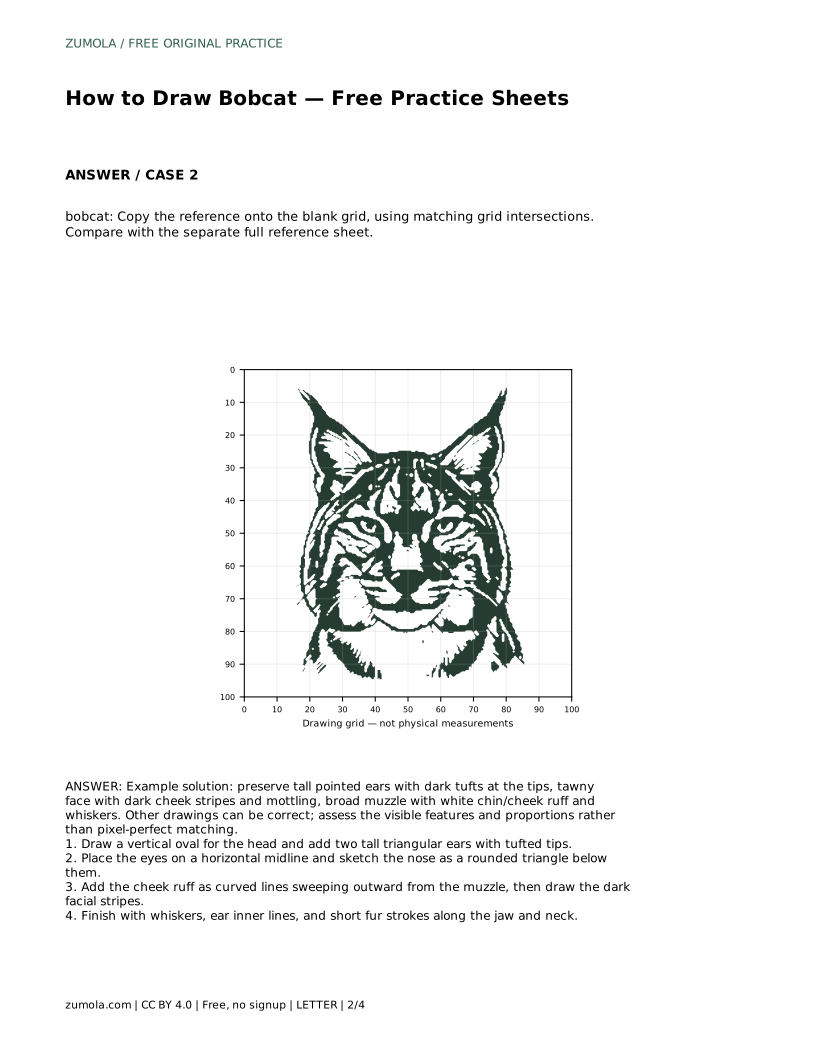
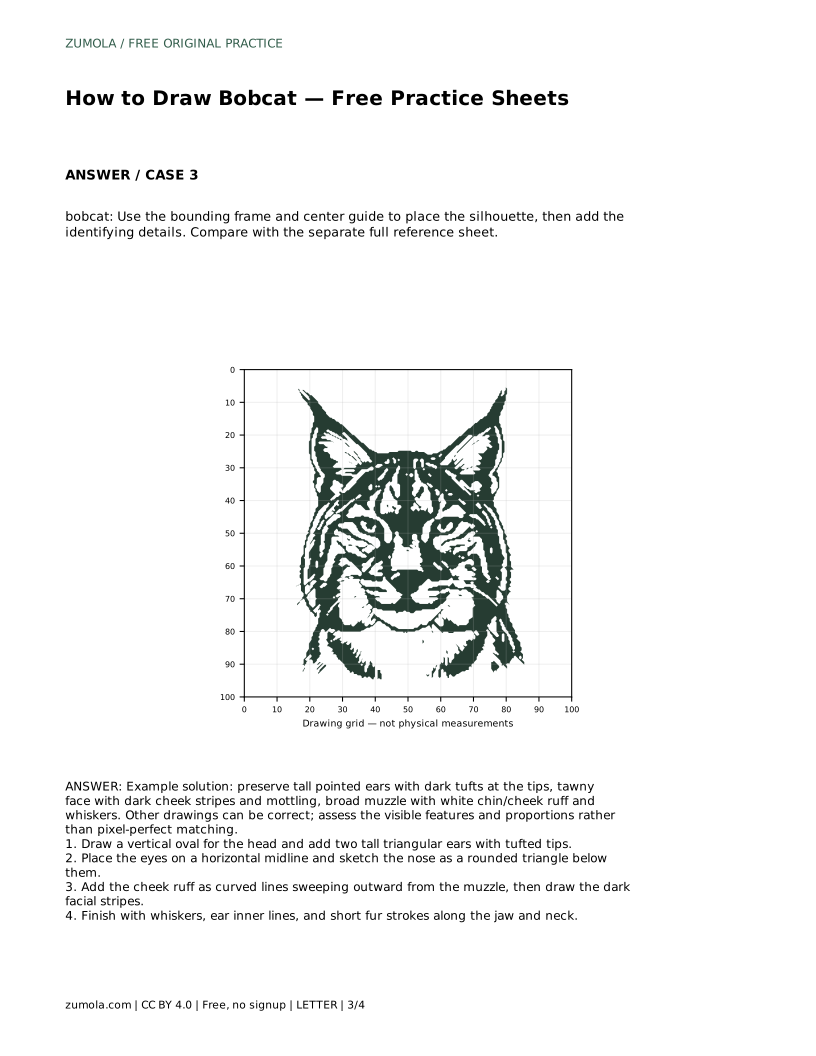
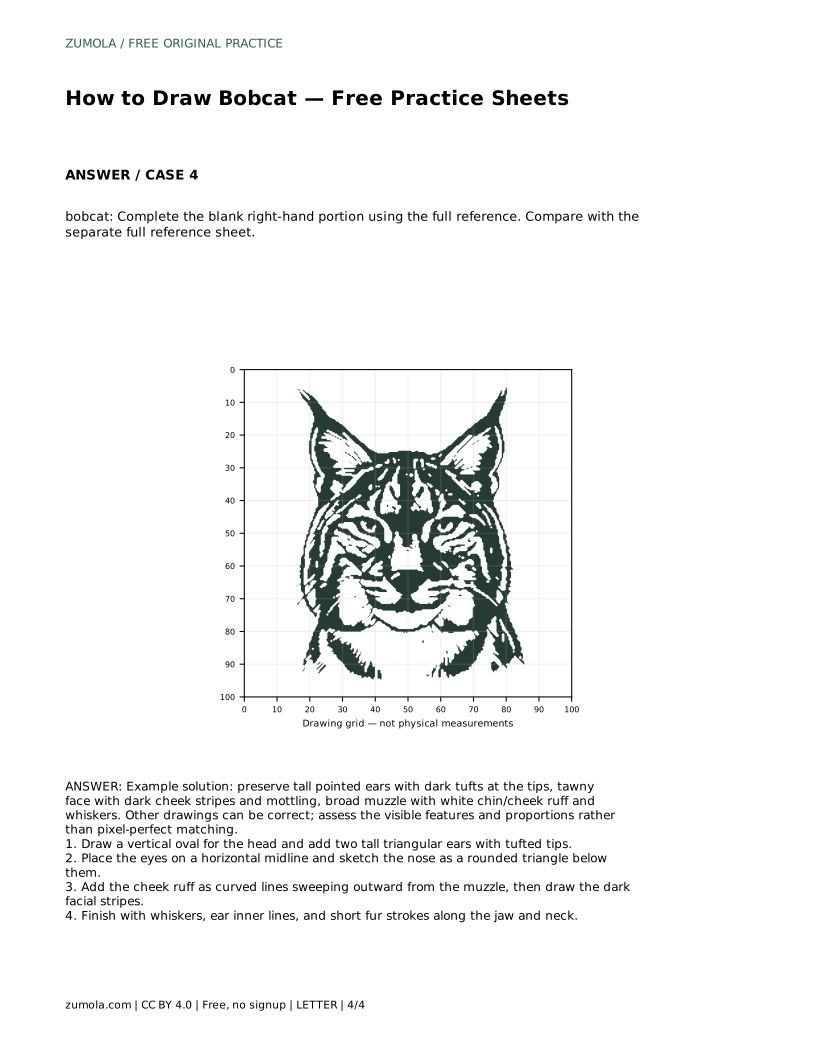
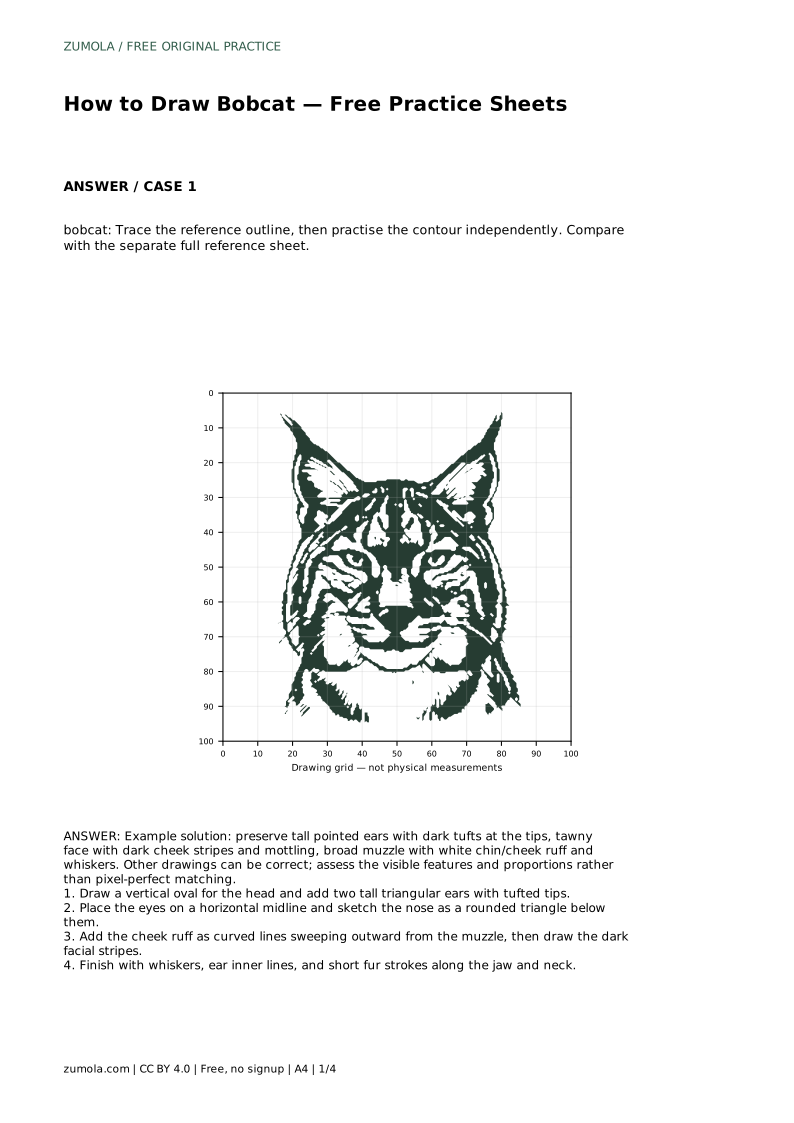
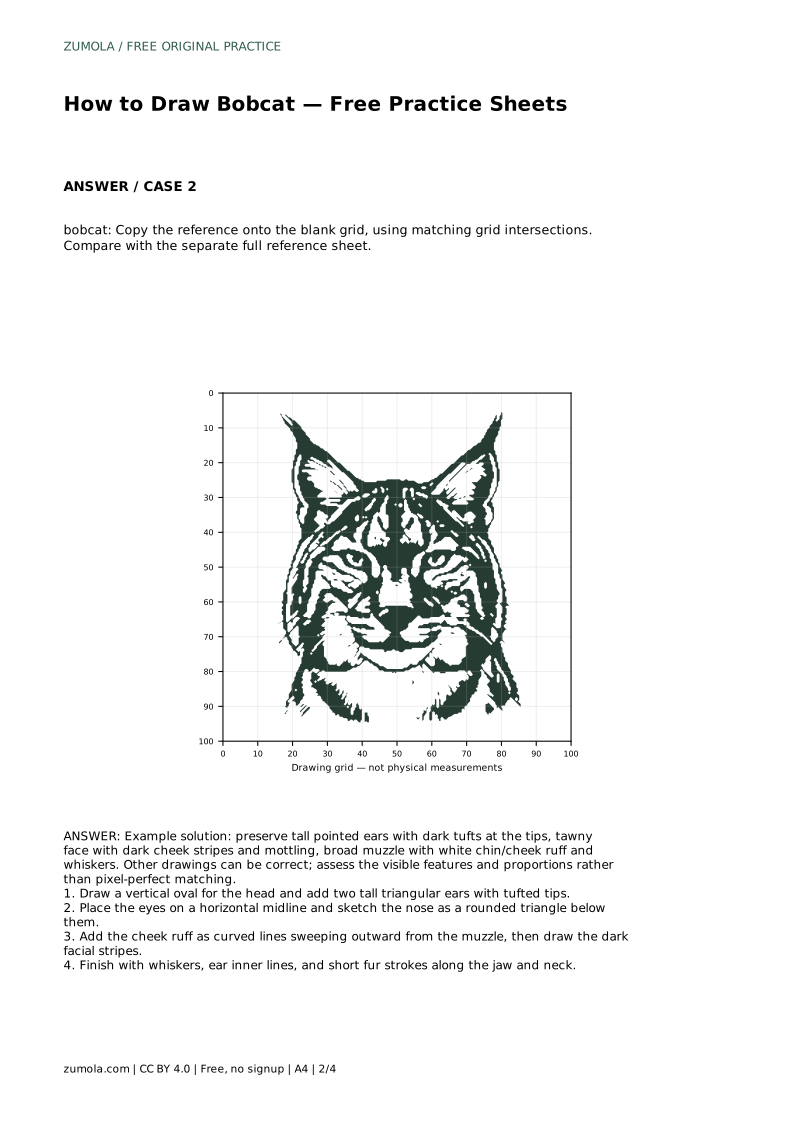
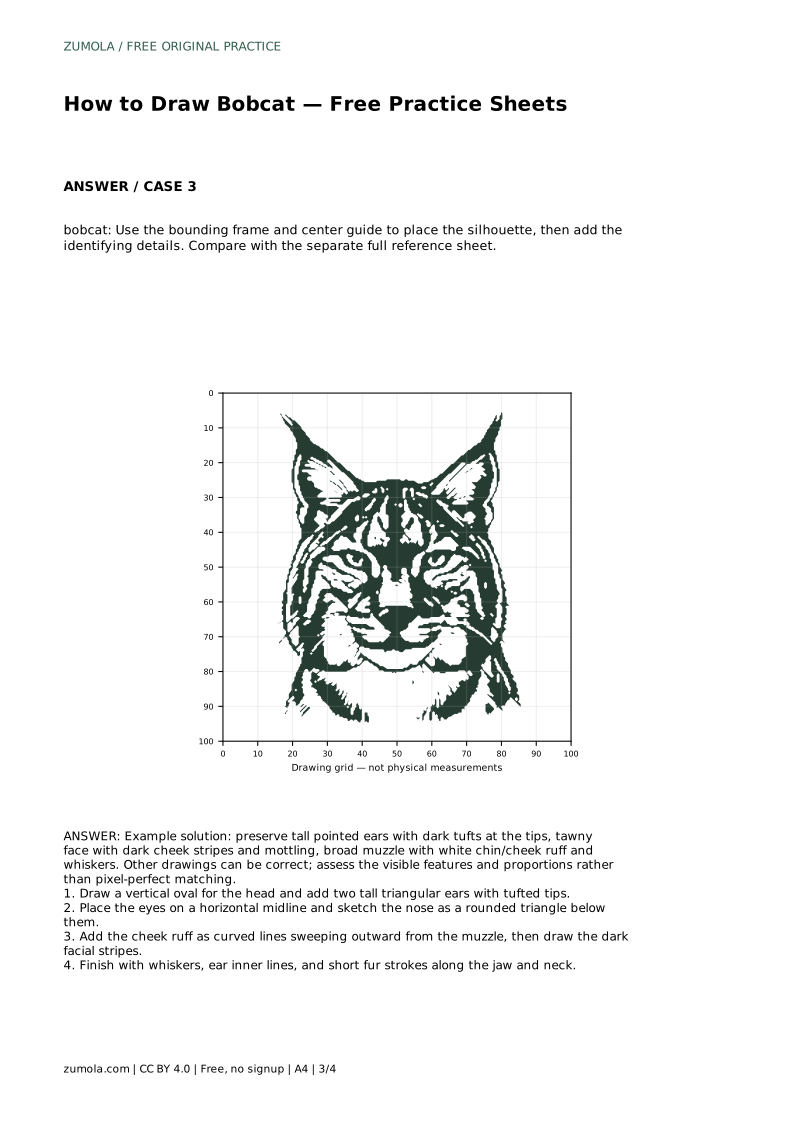
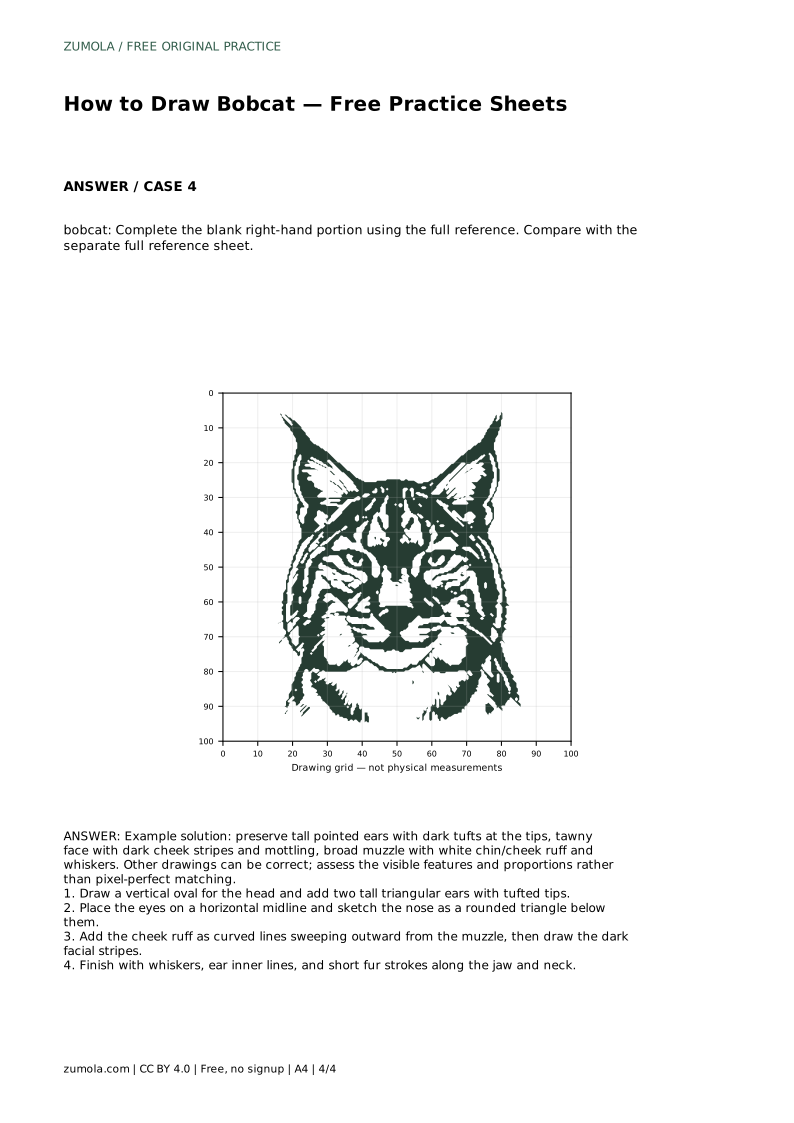
Reference diagrams
LETTER · Download PDF
A4 · Download PDF
Free original resources
Learn to draw a bobcat face by placing tall tufted ears, a broad muzzle, cheek ruff, and dark facial stripes. Includes tracing, grid, and frame practice sheets.
Four original cases, with reference diagrams, practice sheets and worked answers. Everything is free; no signup required.
LETTER · Download PDF
A4 · Download PDF
LETTER · Download PDF
A4 · Download PDF
LETTER · Download PDF
A4 · Download PDF
Use A4 or US Letter to match your printer. Use the stated values and conditions to solve each exercise; diagrams are not physical measuring rulers.
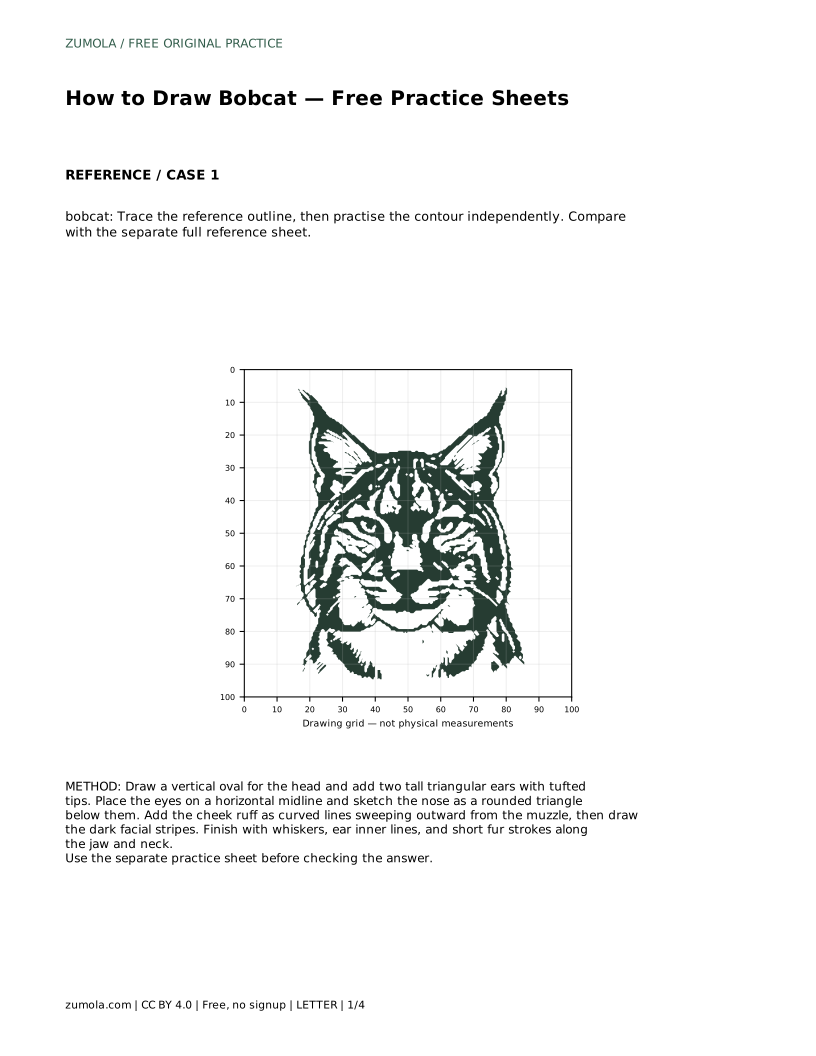
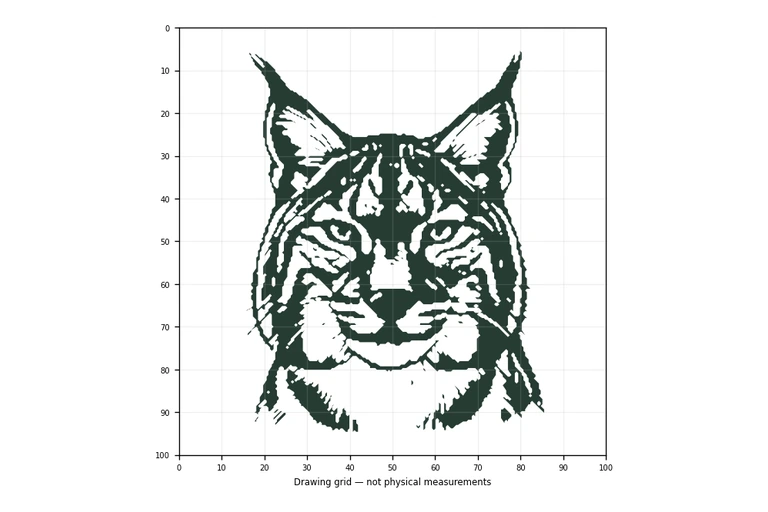
A bobcat face is recognizable before any fur texture is added: tall pointed ears with dark tips, a broad muzzle, a pale chin and cheek ruff, and dark stripes sweeping across the cheeks. This page explains how to build that face in a reliable order, then use the practice sheets to trace, copy, or complete the drawing. The goal is a clear, well-proportioned bobcat, not a pixel-perfect copy.
Begin with a vertical oval for the head. Keep it slightly wider at the bottom than at the top, because the cheek ruff will broaden the lower face later. Add two tall triangular ears above the oval. Bobcat ears are noticeably tall and pointed, and each tip carries a dark tuft. Place the ears so their bases sit on the upper curve of the head, with a small gap between them.
Check the ear height before adding details. If the ears look short, lengthen the triangles rather than widening them. Tall, narrow ears do more to identify a bobcat than any other single feature.
Draw a light horizontal midline across the oval. Place the eyes on this line, spaced roughly one eye-width apart. Below the eyes, sketch the nose as a rounded triangle pointing downward. The muzzle should be broad rather than narrow, so keep the nose and mouth area wide enough to support the cheek ruff on either side.
Add a short vertical line from the nose toward the mouth, then curve two lines outward to suggest the mouth. Keep these lines light so they can be adjusted after the ruff is drawn.
The cheek ruff is the pale, curved fur that sweeps outward from the muzzle. Draw it as curved lines flowing away from each side of the nose and mouth, widening the lower face. This ruff is a key bobcat feature and should look soft and outward-sweeping, not blocky.
Next, add the dark cheek stripes. These run across the cheeks, roughly following the direction of the ruff. Keep them as separate strokes rather than a solid block, and vary their length slightly. Add short fur strokes along the jaw and neck to soften the outline.
Finish the face with whiskers emerging from the muzzle, inner lines inside each ear, and a few short strokes suggesting mottling on the forehead. Keep whiskers light and slightly curved. Inner ear lines should follow the triangular shape rather than crossing it.
When the drawing is complete, compare it with the separate full reference sheet. Check the tall tufted ears, broad muzzle, pale chin and cheek ruff, dark cheek stripes, and whiskers. Different drawings can all be correct, so assess whether the visible features and proportions are present rather than whether every line matches.
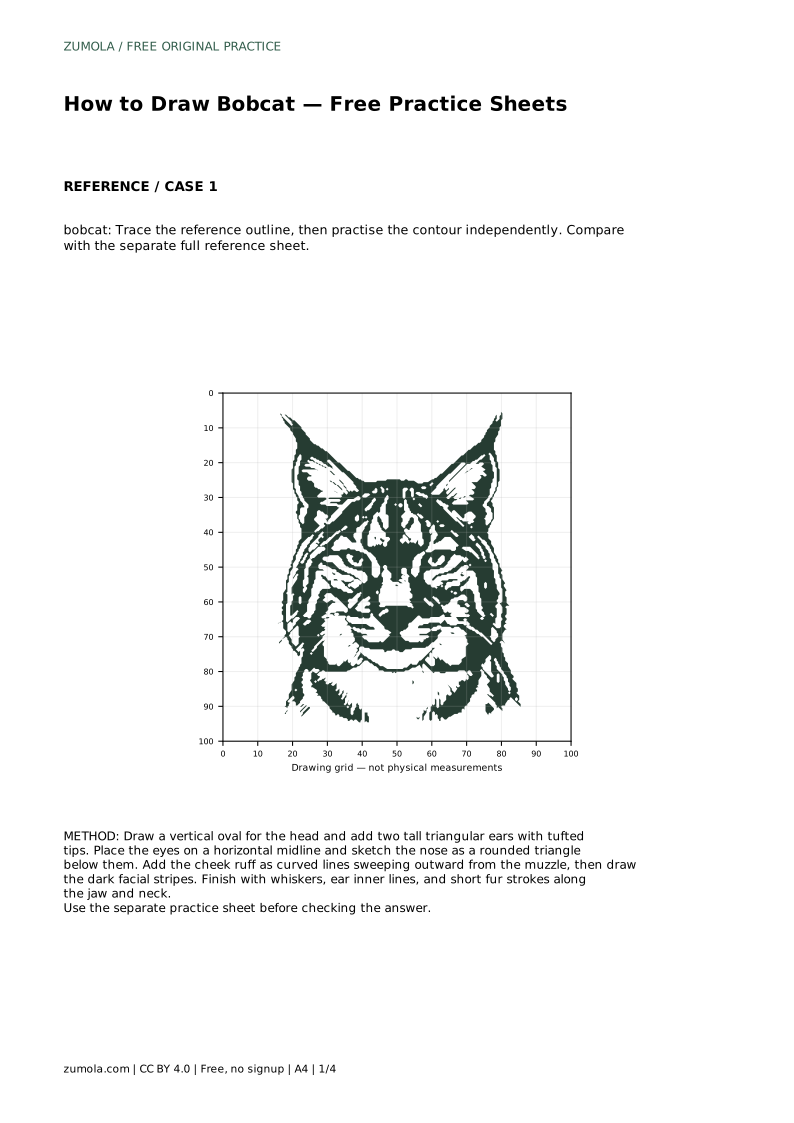
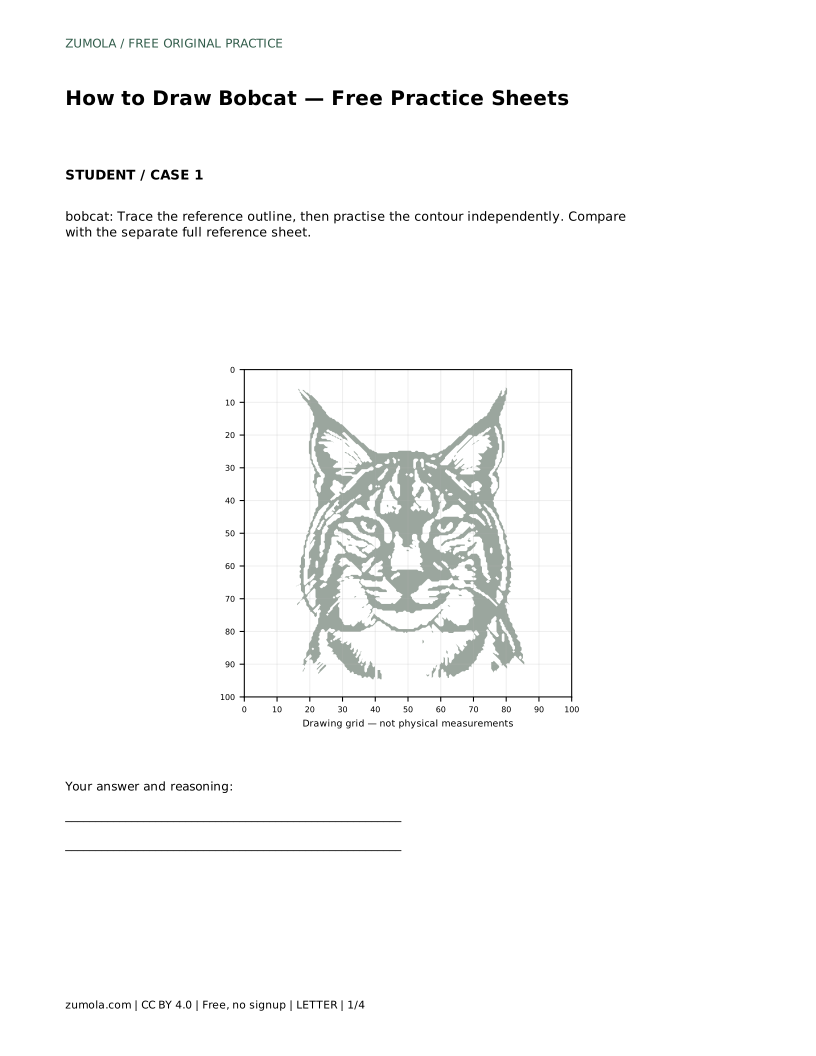
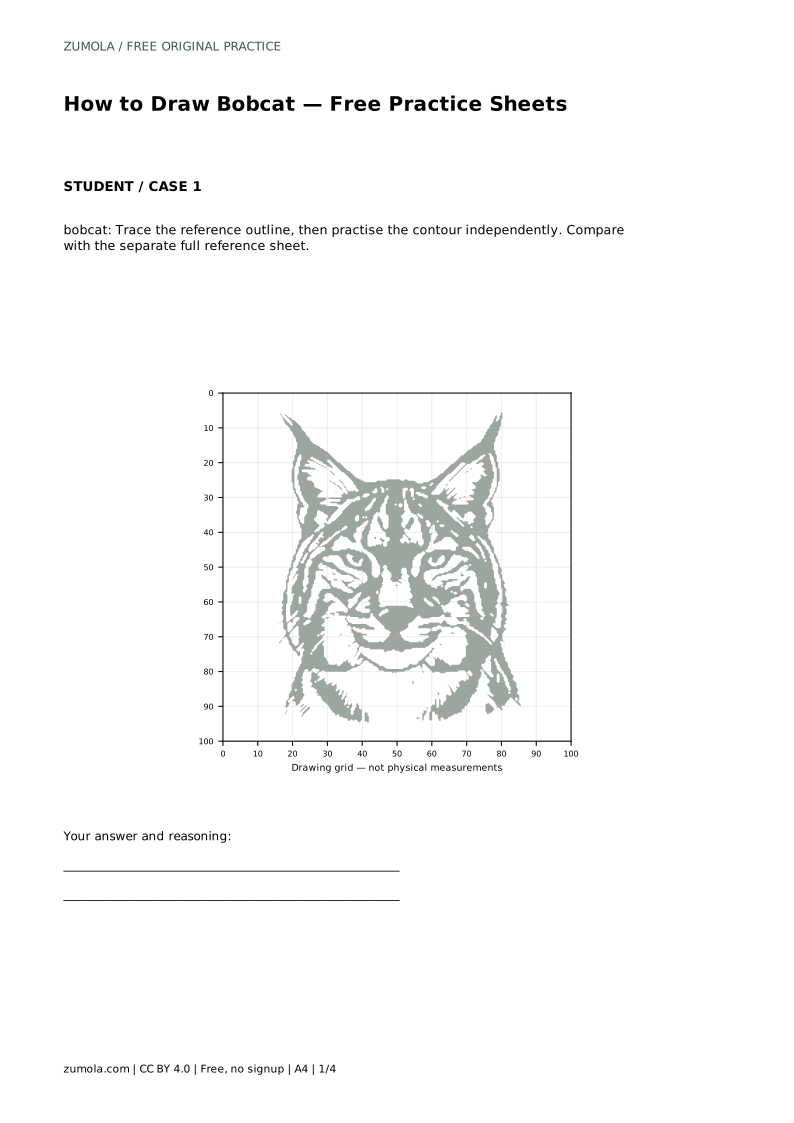
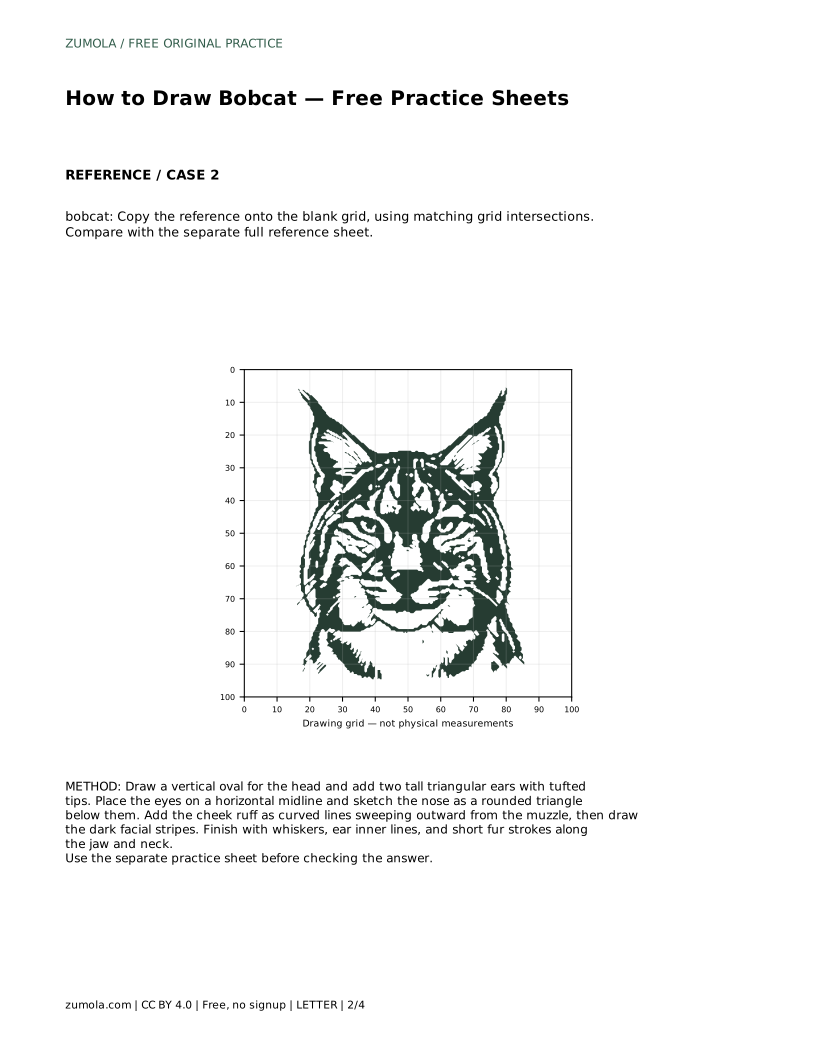
bobcat: Trace the reference outline, then practise the contour independently. Compare with the separate full reference sheet.
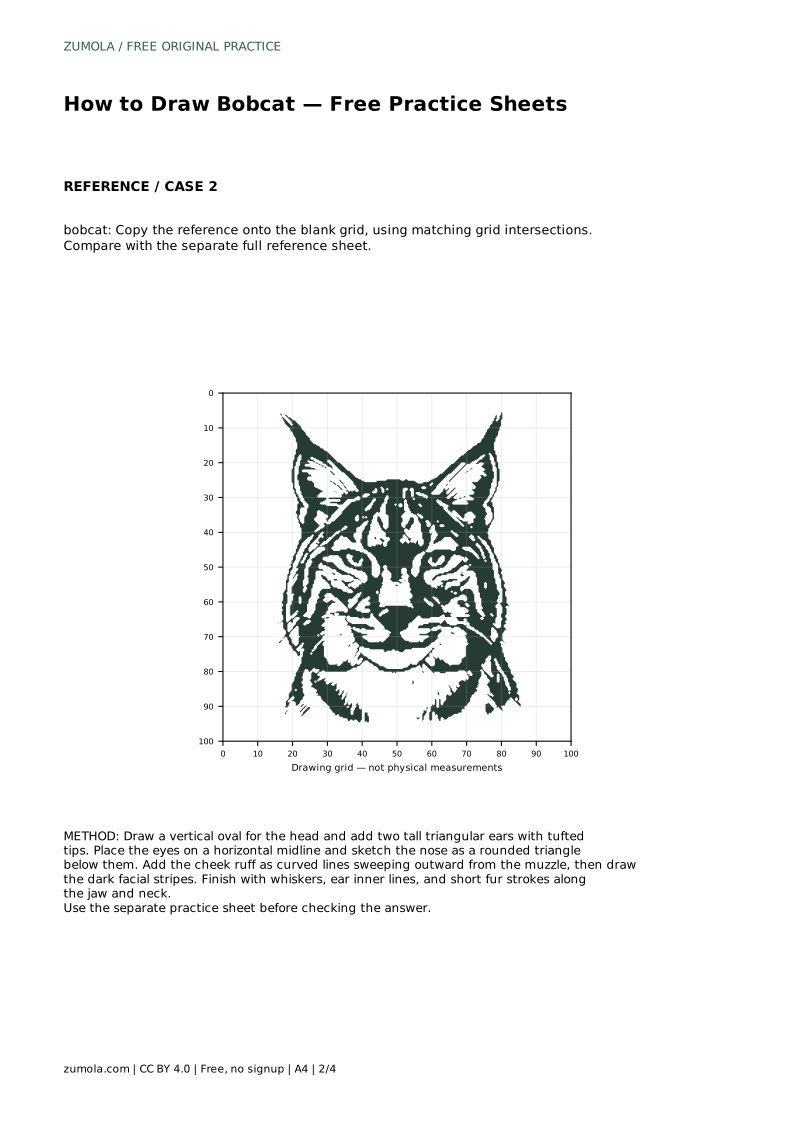
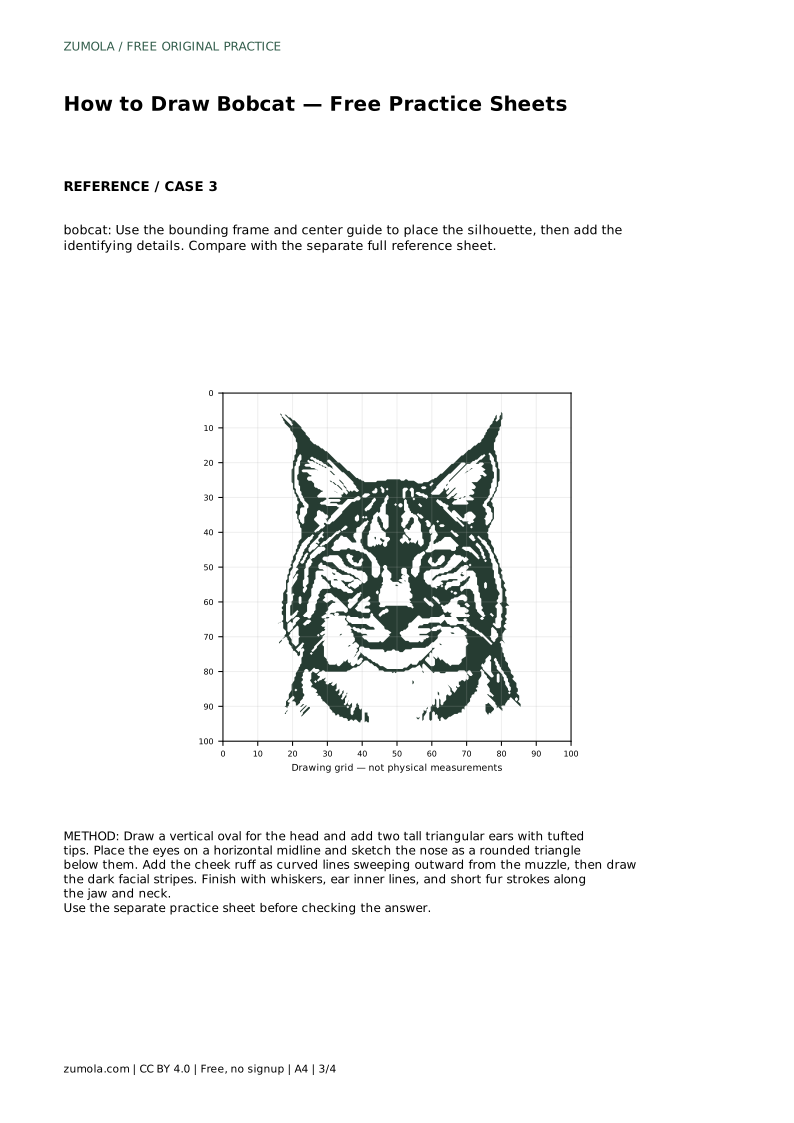
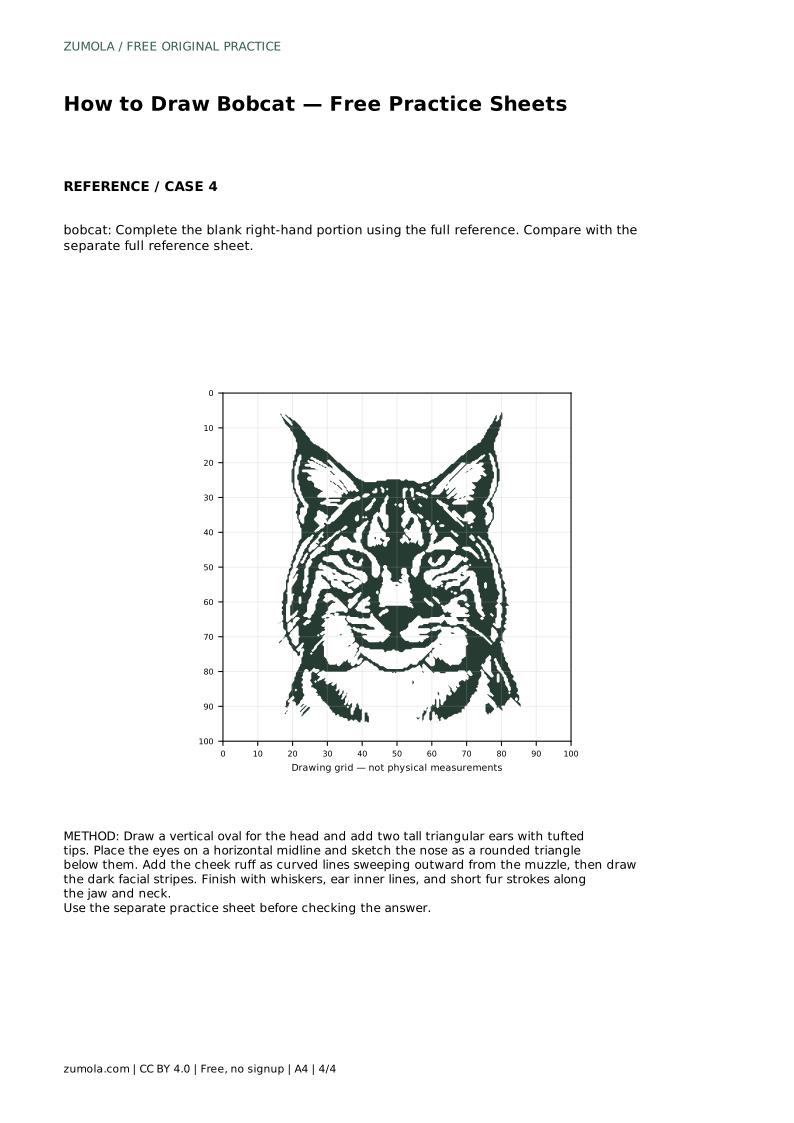
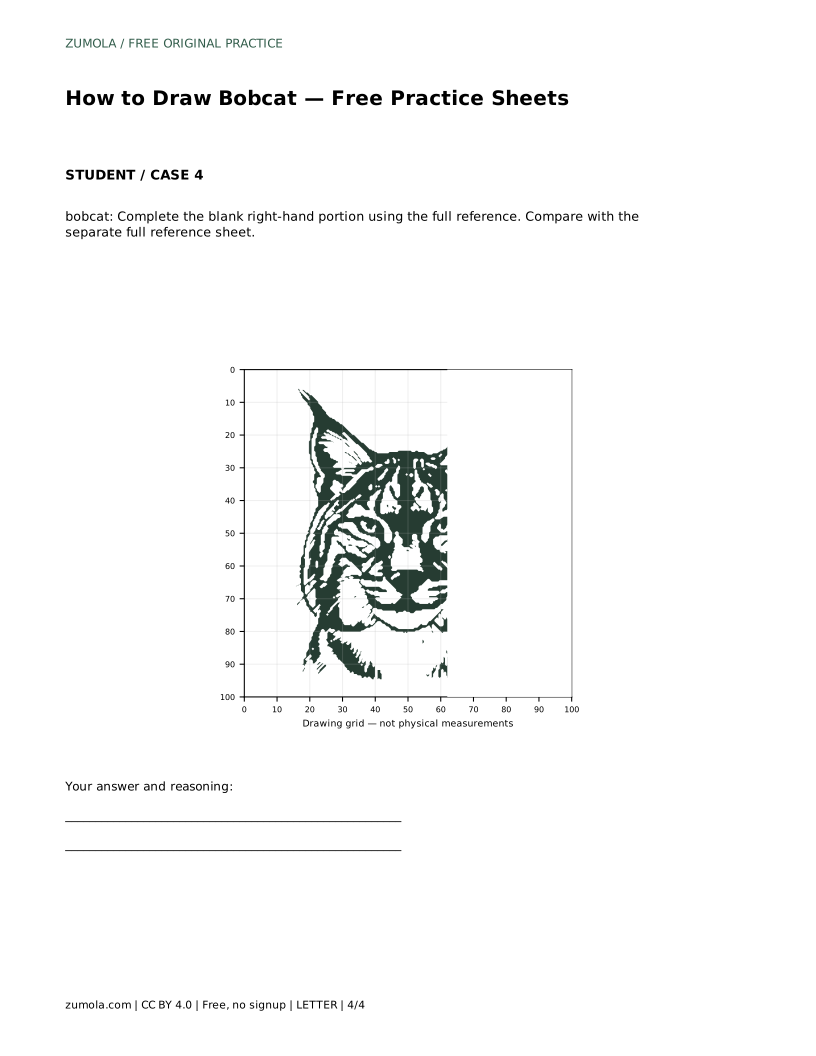
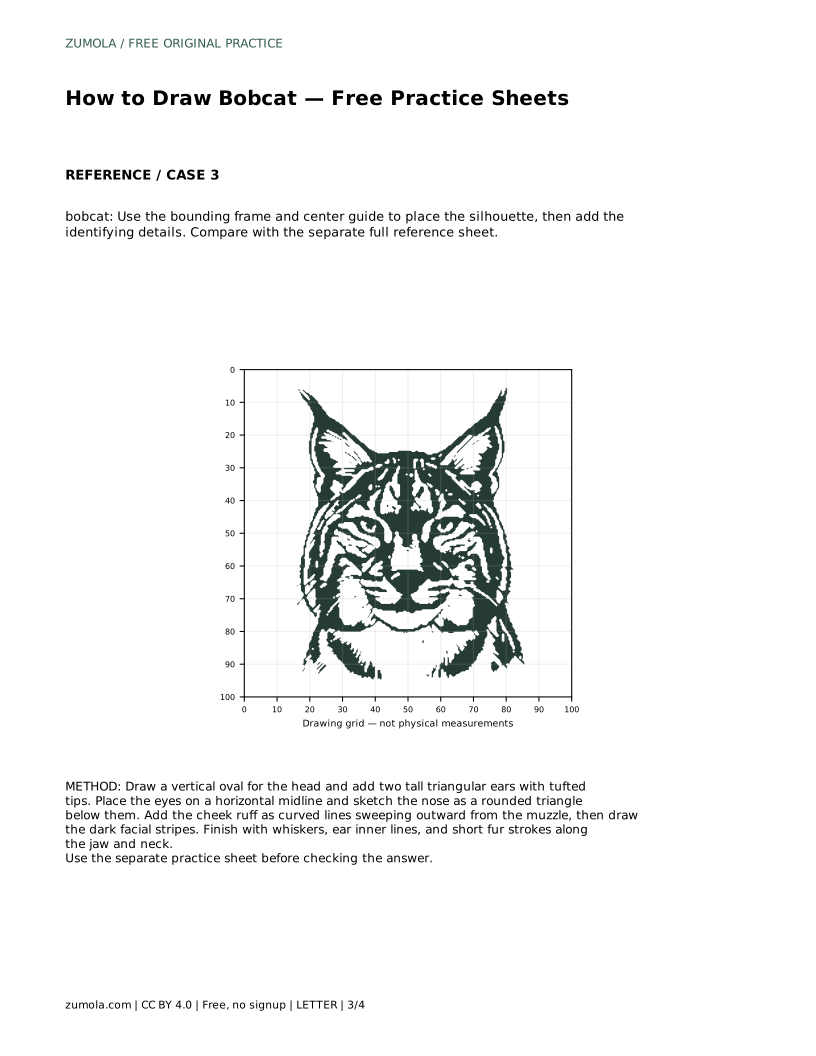
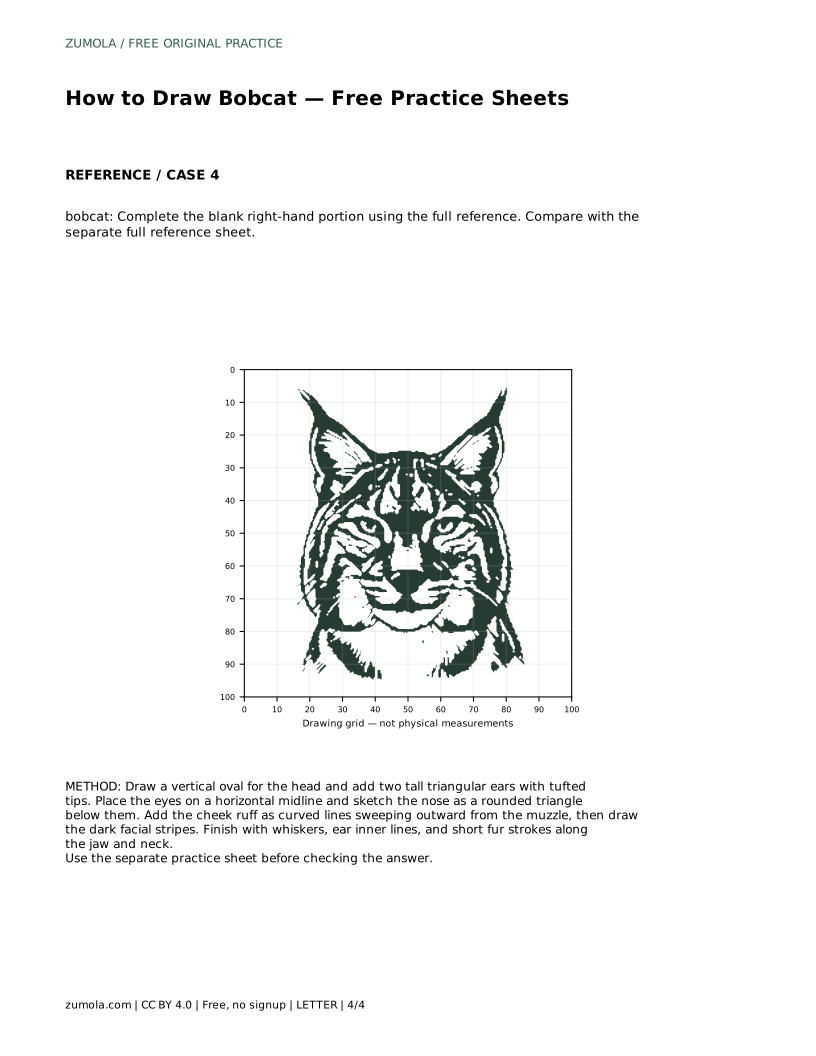
Example solution: preserve tall pointed ears with dark tufts at the tips, tawny face with dark cheek stripes and mottling, broad muzzle with white chin/cheek ruff and whiskers. Other drawings can be correct; assess the visible features and proportions rather than pixel-perfect matching. Draw a vertical oval for the head and add two tall triangular ears with tufted tips. Place the eyes on a horizontal midline and sketch the nose as a rounded triangle below them. Add the cheek ruff as curved lines sweeping outward from the muzzle, then draw the dark facial stripes. Finish with whiskers, ear inner lines, and short fur strokes along the jaw and neck.
No. Use the reference to check features and proportions. Different drawings can be correct if the tall tufted ears, broad muzzle, cheek ruff, dark stripes, and whiskers are visible and well placed.
Start with the tracing sheet to learn the outline, then move to the grid, frame, or blank-portion sheet to practise placing the features independently.
Tall pointed ears with dark tips, a broad muzzle, a pale chin and cheek ruff, dark cheek stripes, and whiskers. Fur texture is secondary to these shapes.
All drawing practice · Free coordinate paper
Original resources · CC BY 4.0 · Free for personal and classroom use with attribution.