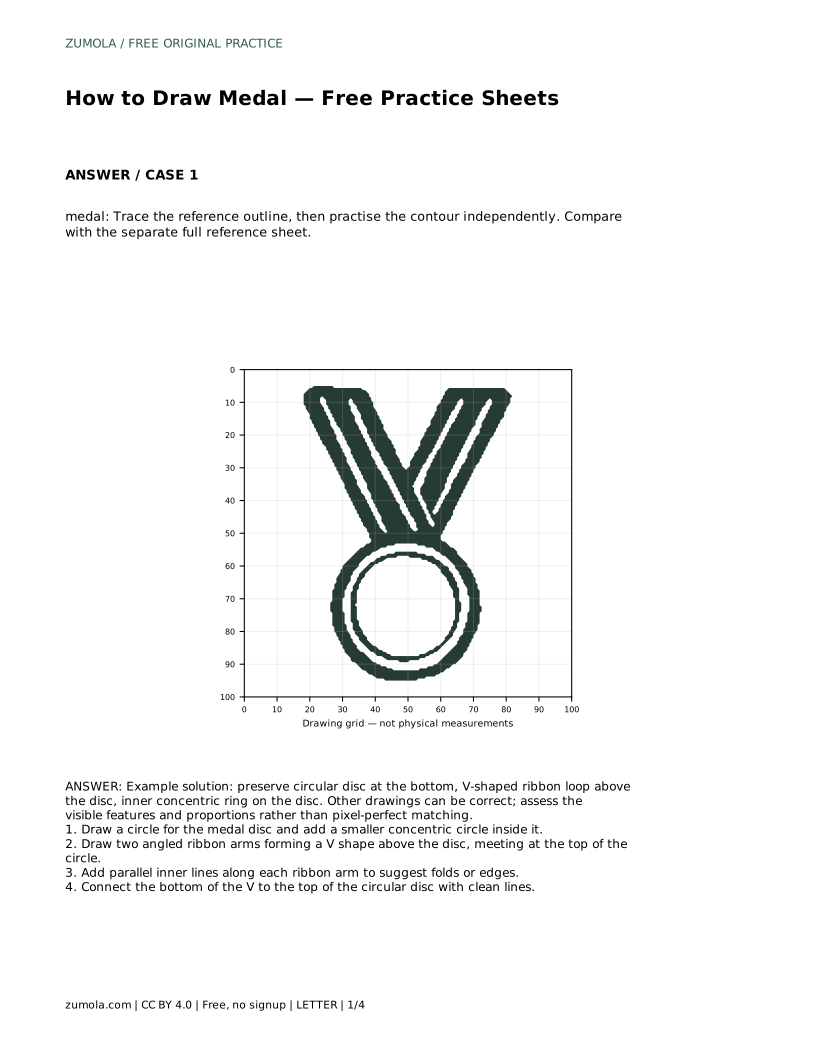
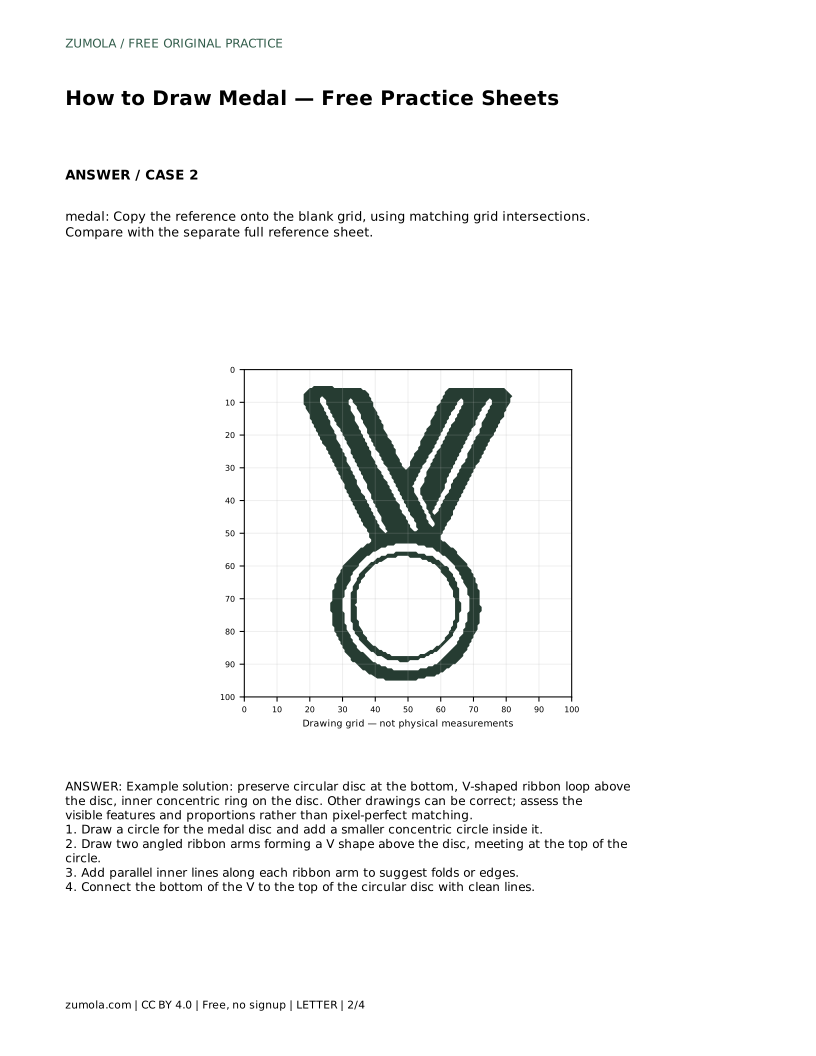
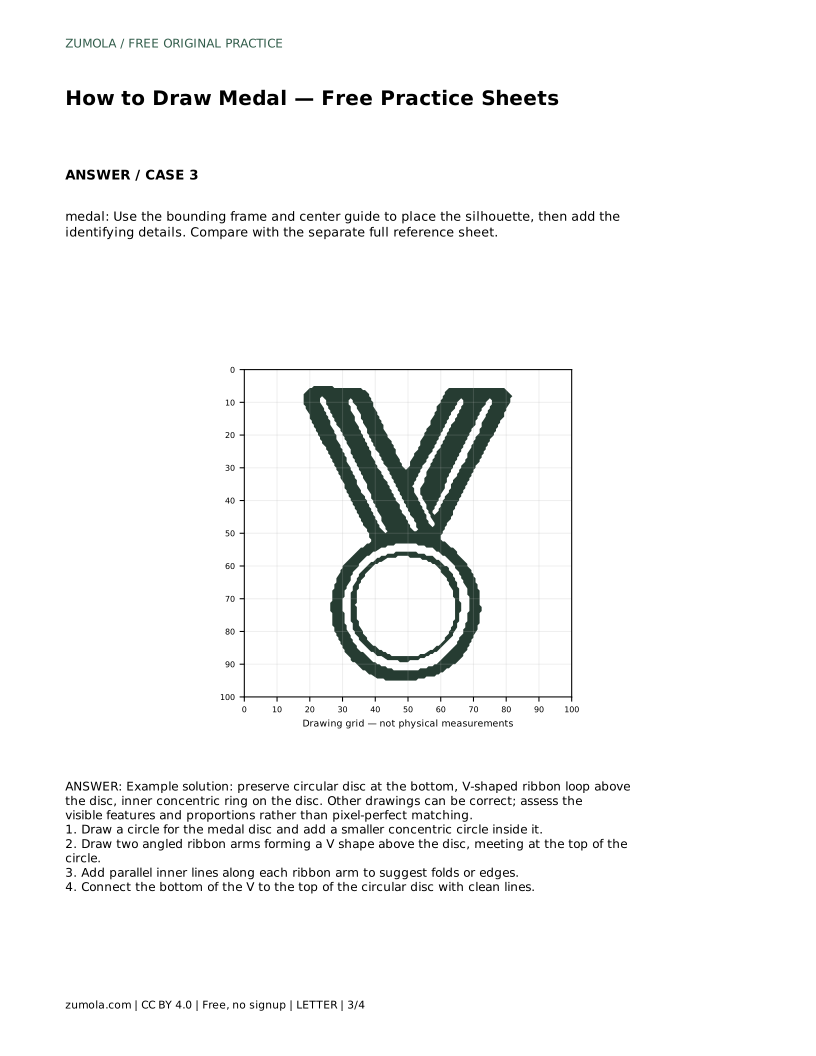
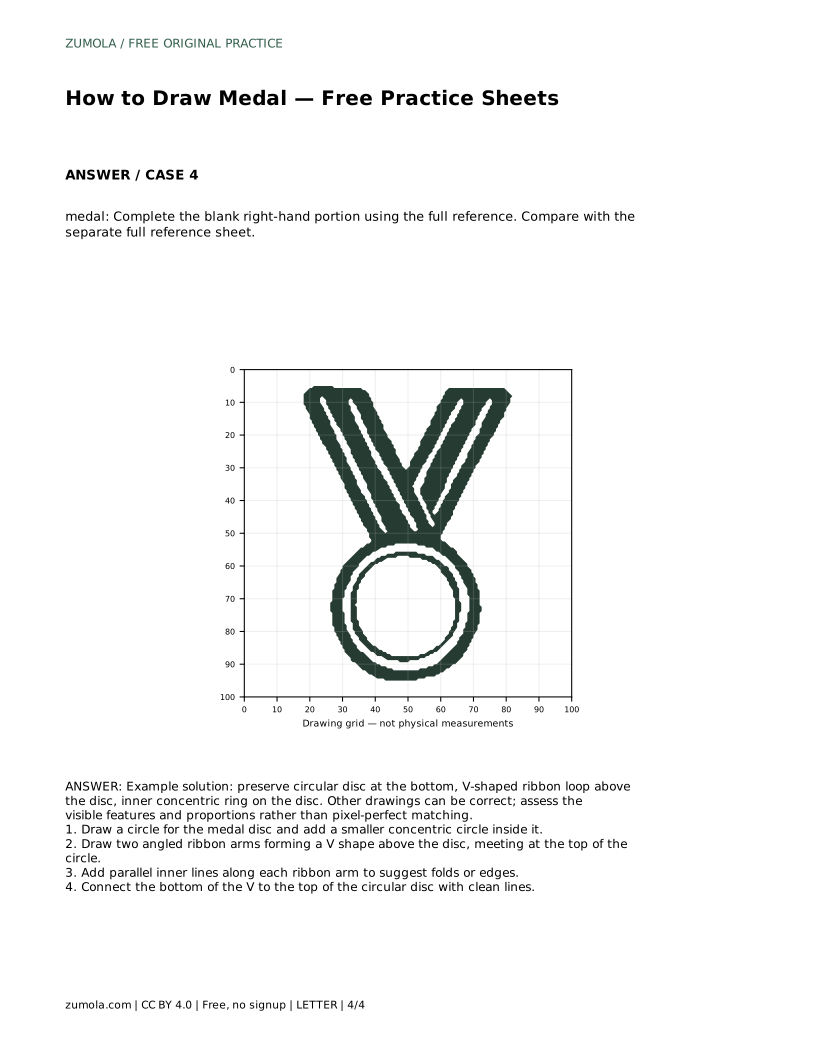
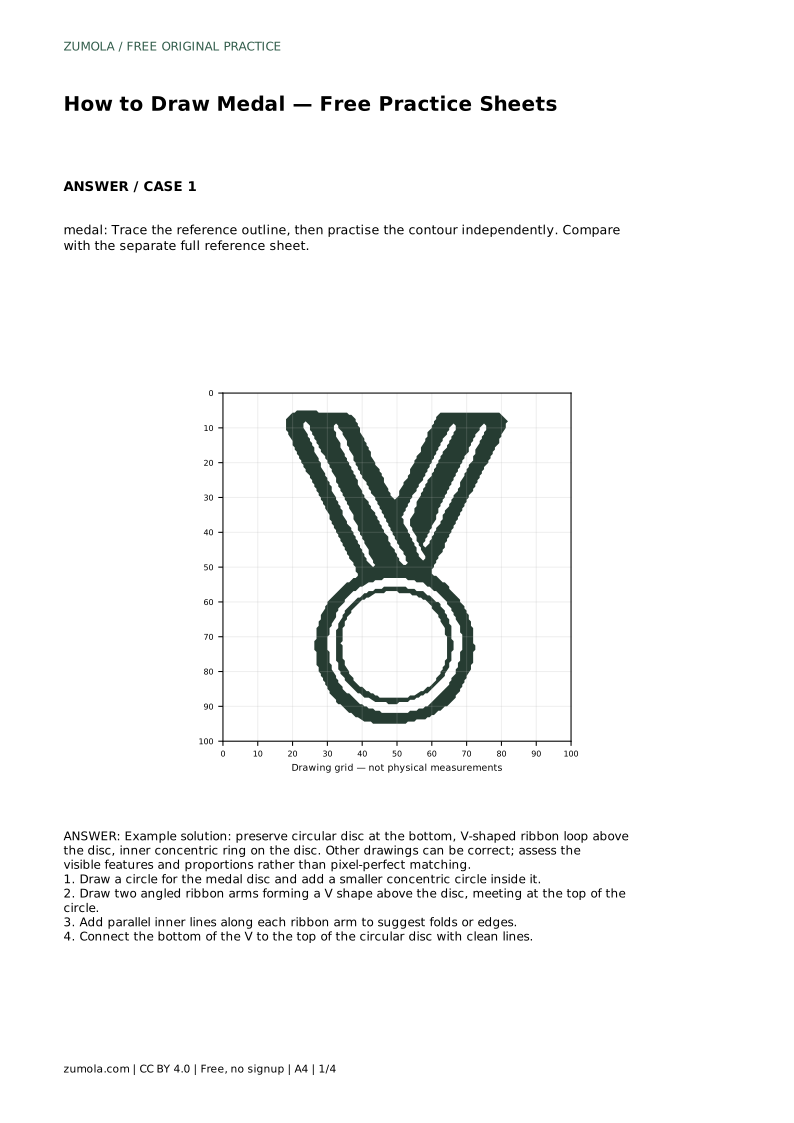
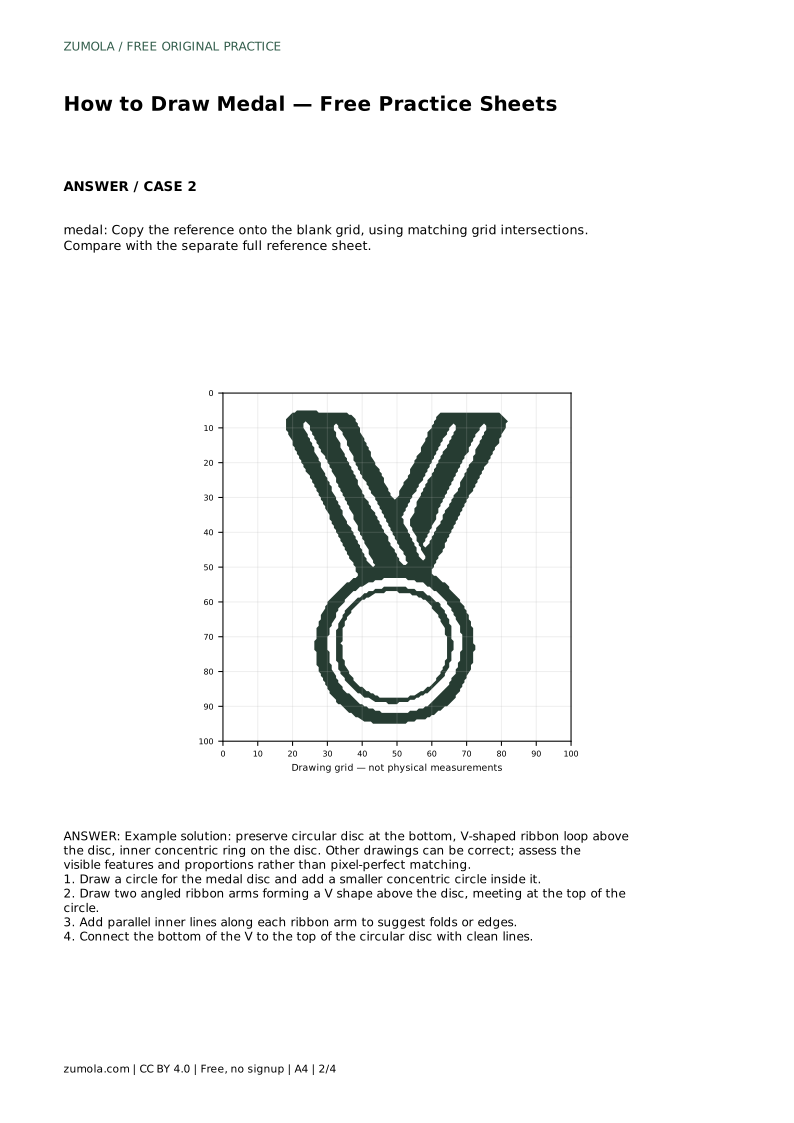
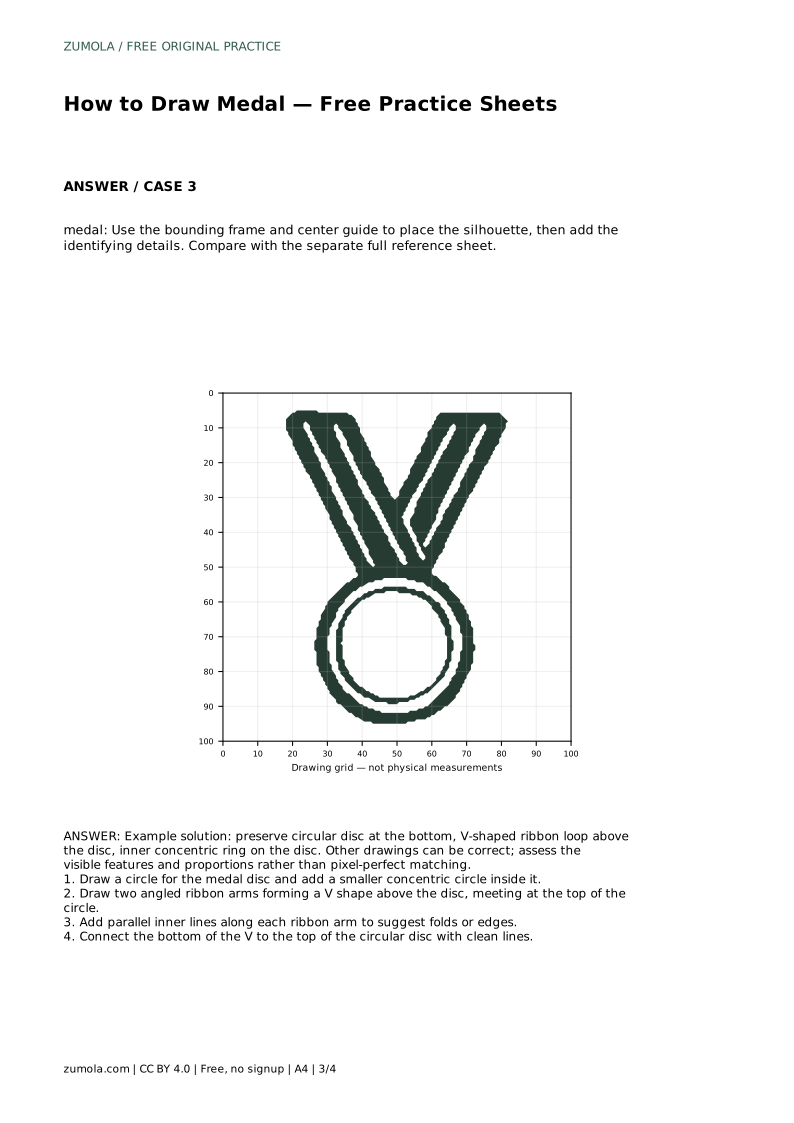
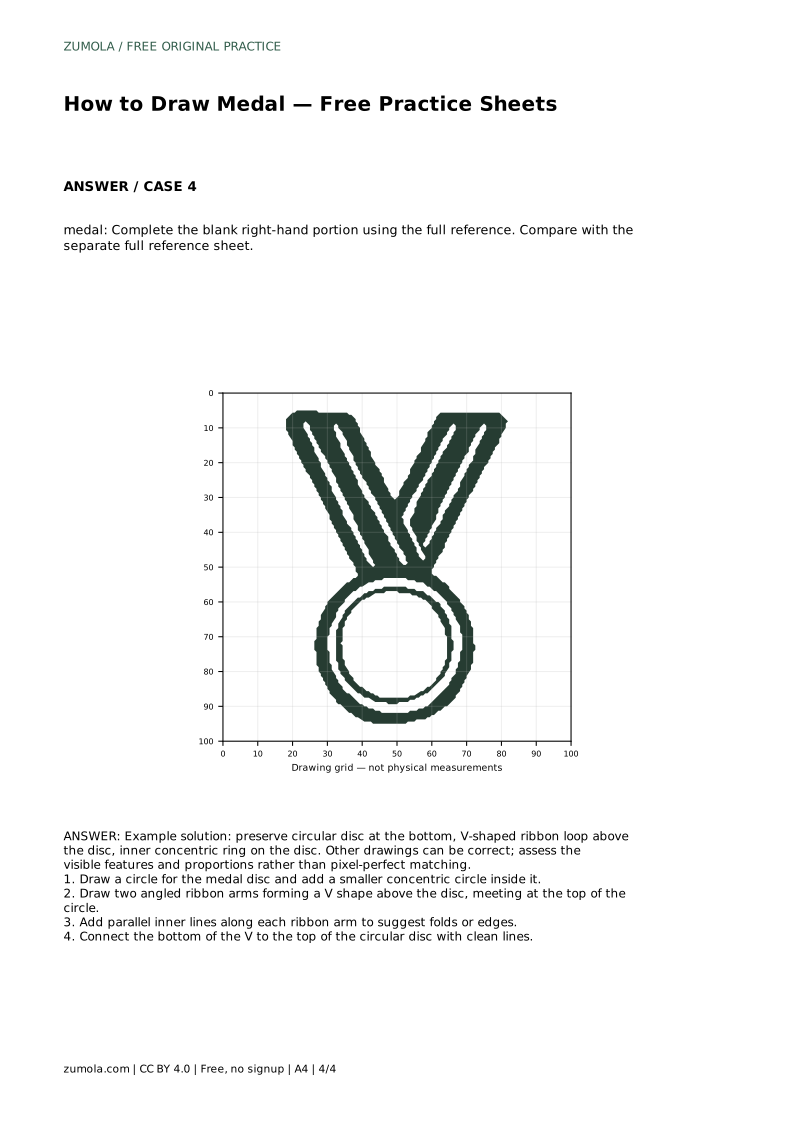
Reference diagrams
LETTER · Download PDF
A4 · Download PDF
Free original resources
Learn to draw a medal with a circular disc, concentric ring, and V-shaped ribbon. Trace, grid, and complete-the-drawing practice build accurate observation.
Four original cases, with reference diagrams, practice sheets and worked answers. Everything is free; no signup required.
LETTER · Download PDF
A4 · Download PDF
LETTER · Download PDF
A4 · Download PDF
LETTER · Download PDF
A4 · Download PDF
Use A4 or US Letter to match your printer. Use the stated values and conditions to solve each exercise; diagrams are not physical measuring rulers.
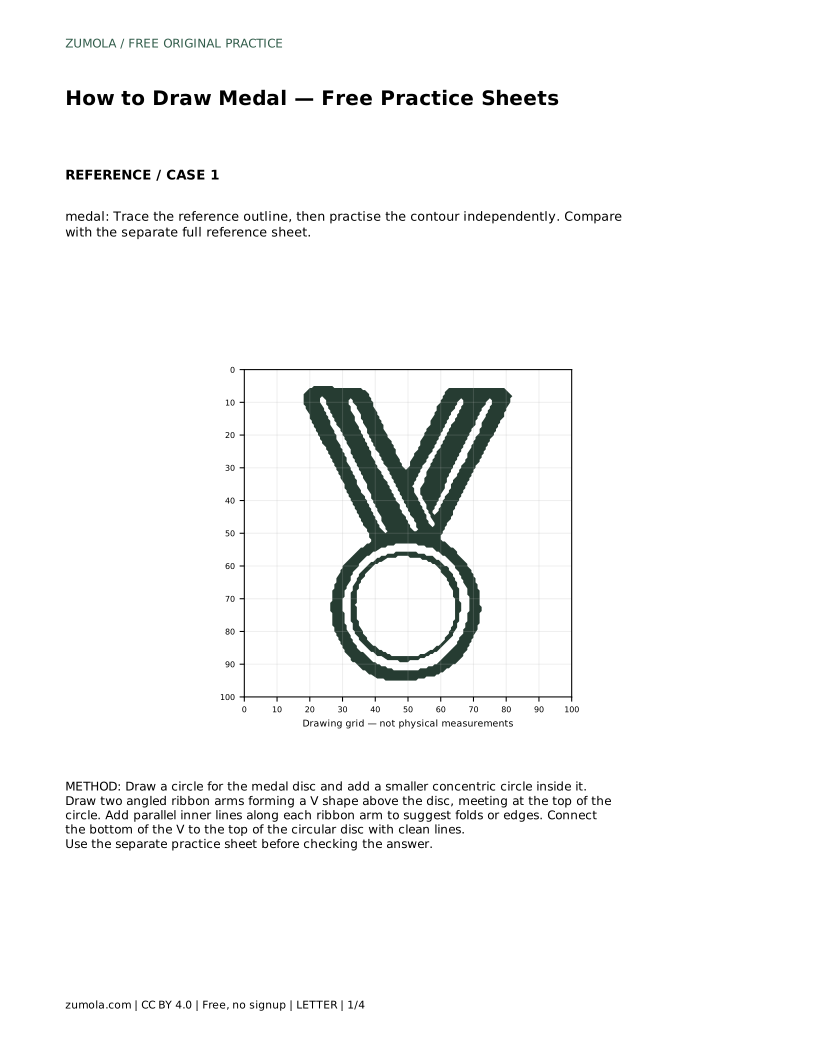
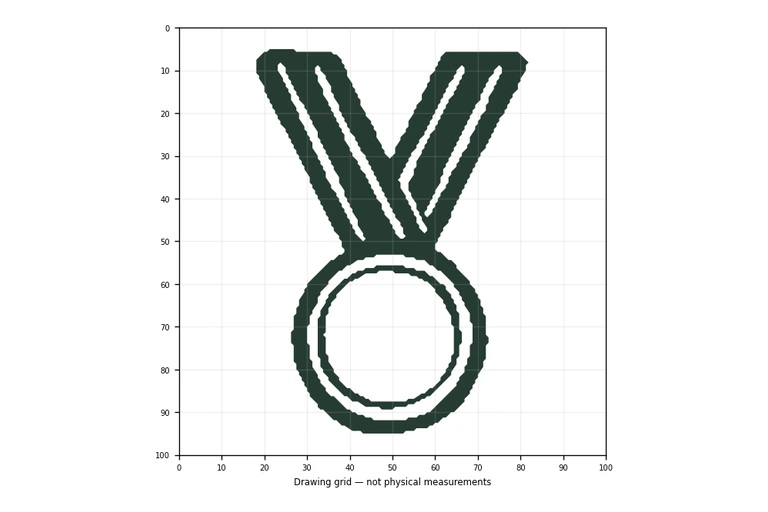
A medal drawing depends on a few clear shapes working together: a round disc, a smaller ring inside it, and a ribbon that forms a V above the disc. This page explains how to build those parts in order, then how to use tracing, grid, and partial-reference sheets to practise them. The goal is not a pixel-perfect copy. Different drawings can all be correct when the visible features and proportions hold together.
Start with the largest shape and work inward. The disc is a circle, and the inner ring is a smaller circle sharing the same centre. Keeping that shared centre is what makes the ring look deliberate rather than off to one side.
The ribbon sits above the disc. Its two arms angle outward and upward from the top of the circle, forming a V. Each arm can carry a parallel inner line to suggest a fold or edge. Finish by joining the bottom of the V cleanly to the top of the disc so the ribbon and medal read as one object.
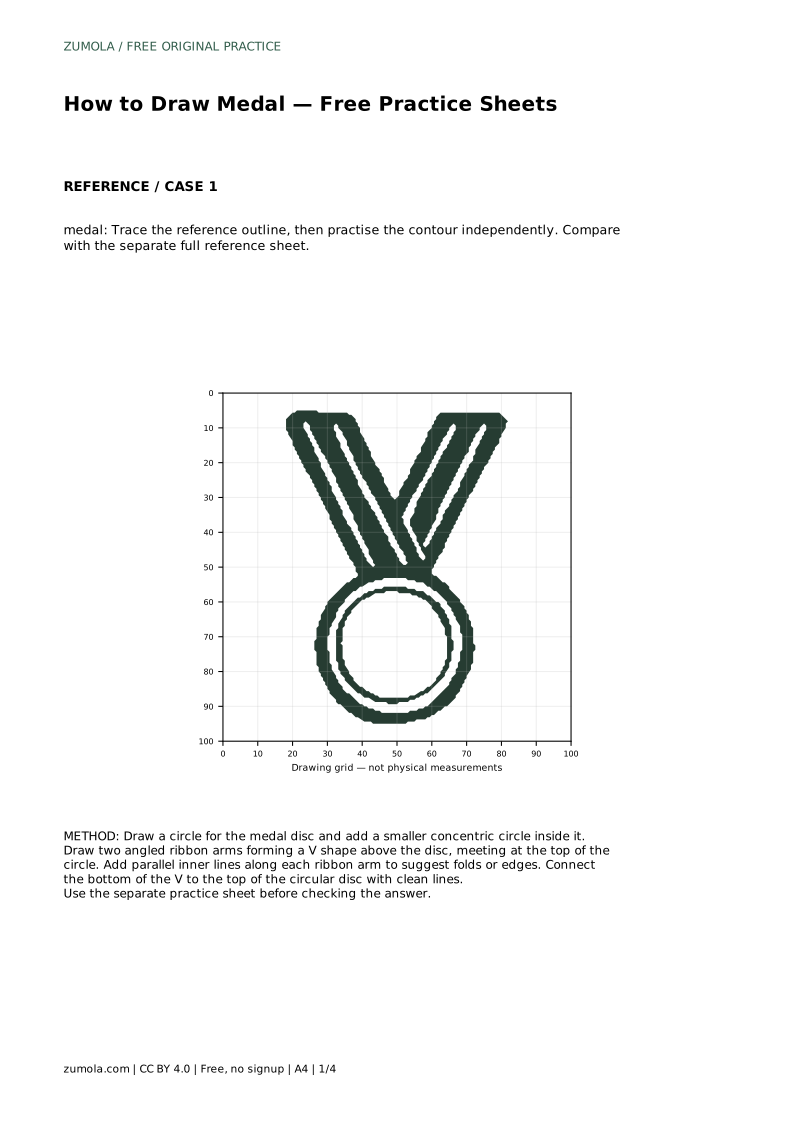
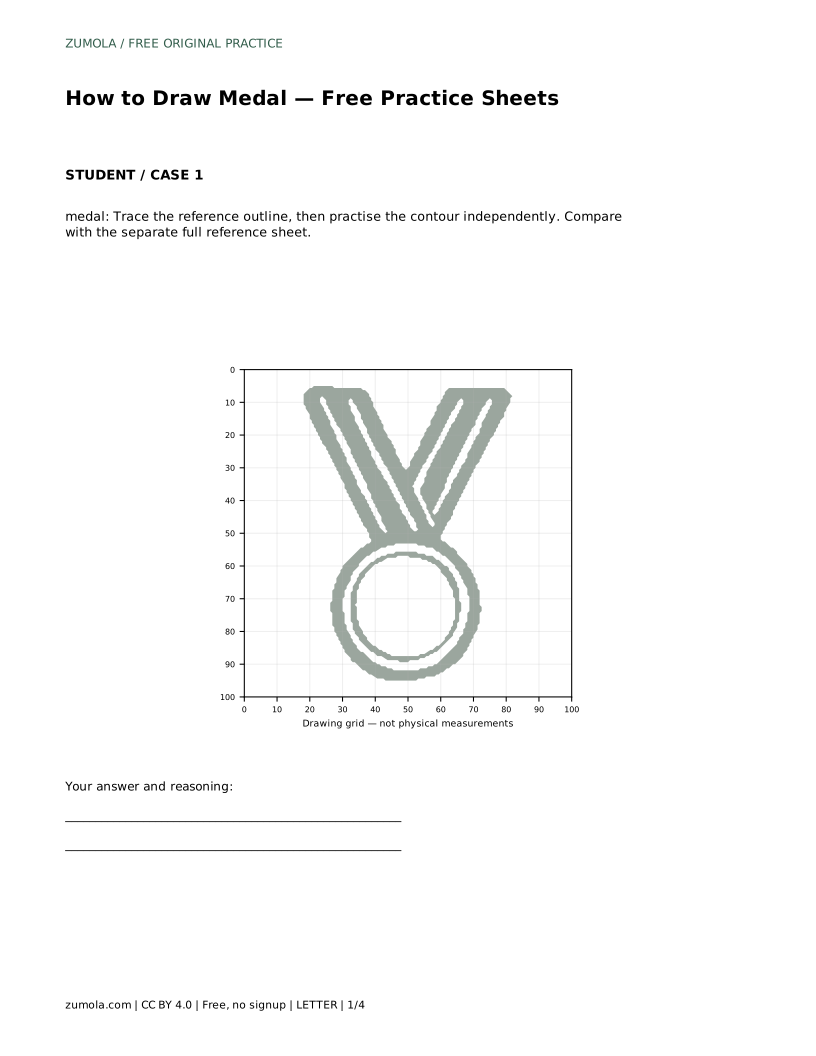
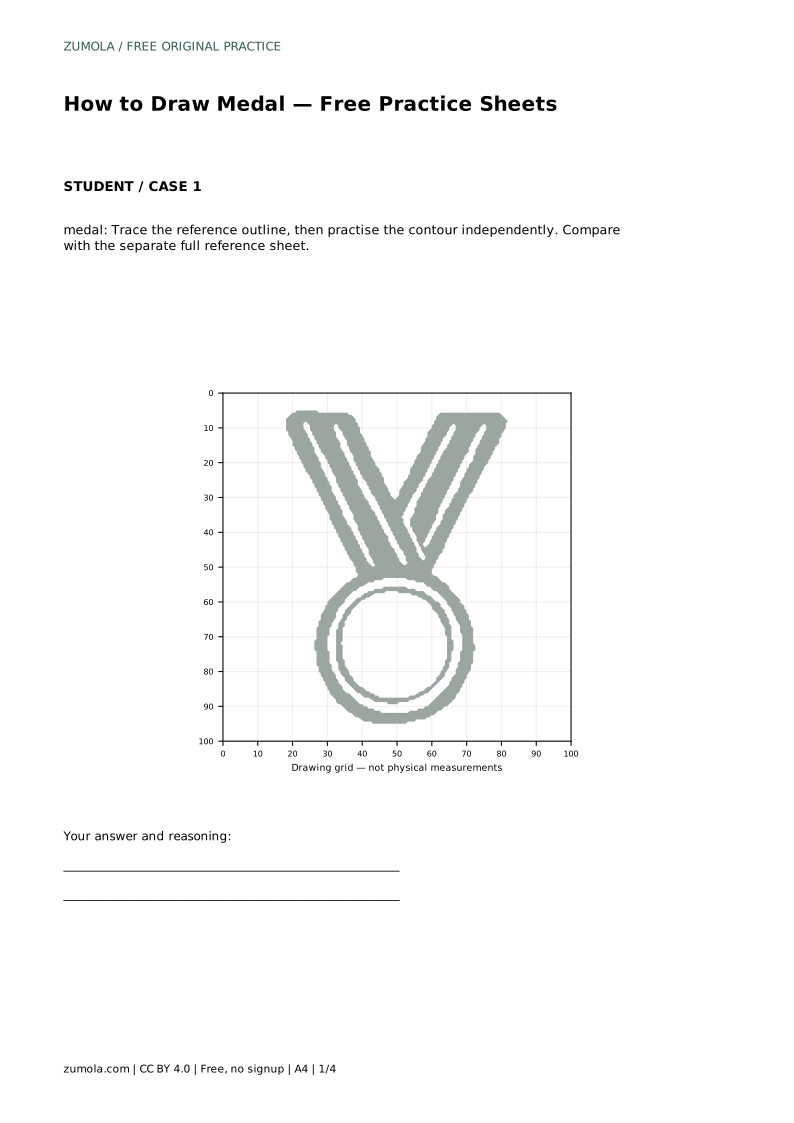
Tracing helps you feel the order of the shapes before drawing them freehand. Trace the reference outline first, then cover it and draw the contour independently. Compare your result with the separate full reference sheet rather than judging it from memory.
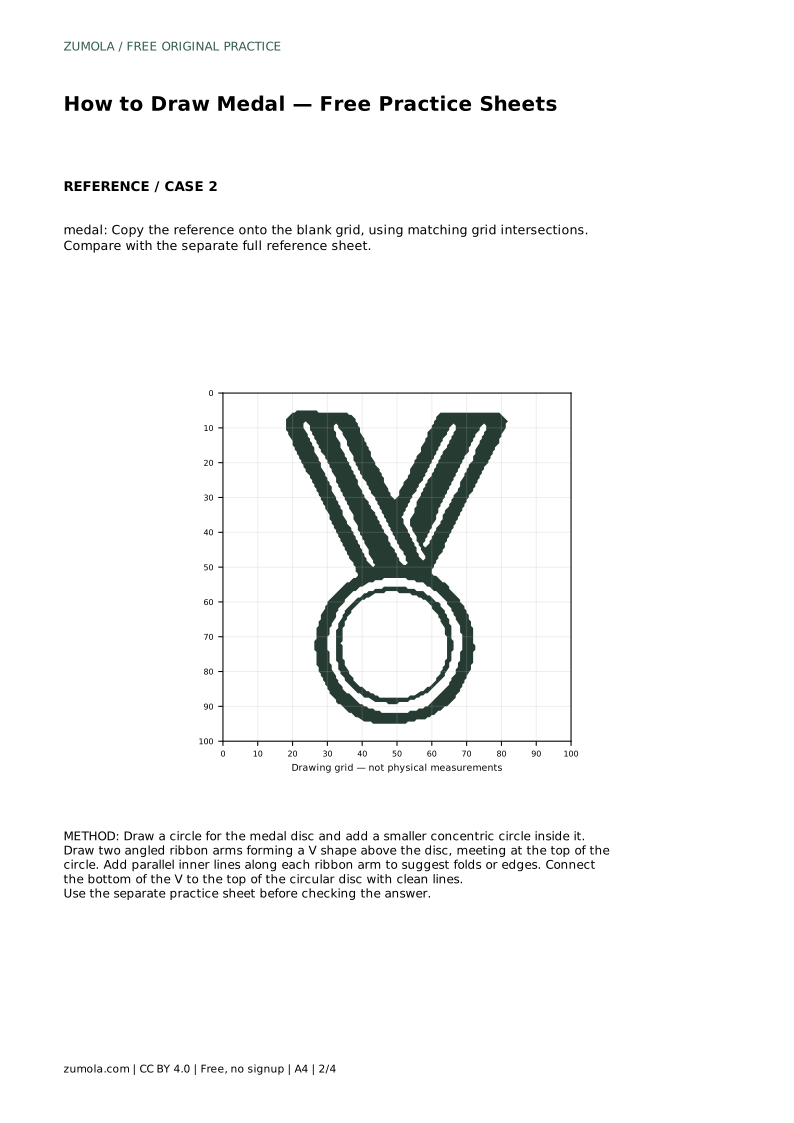
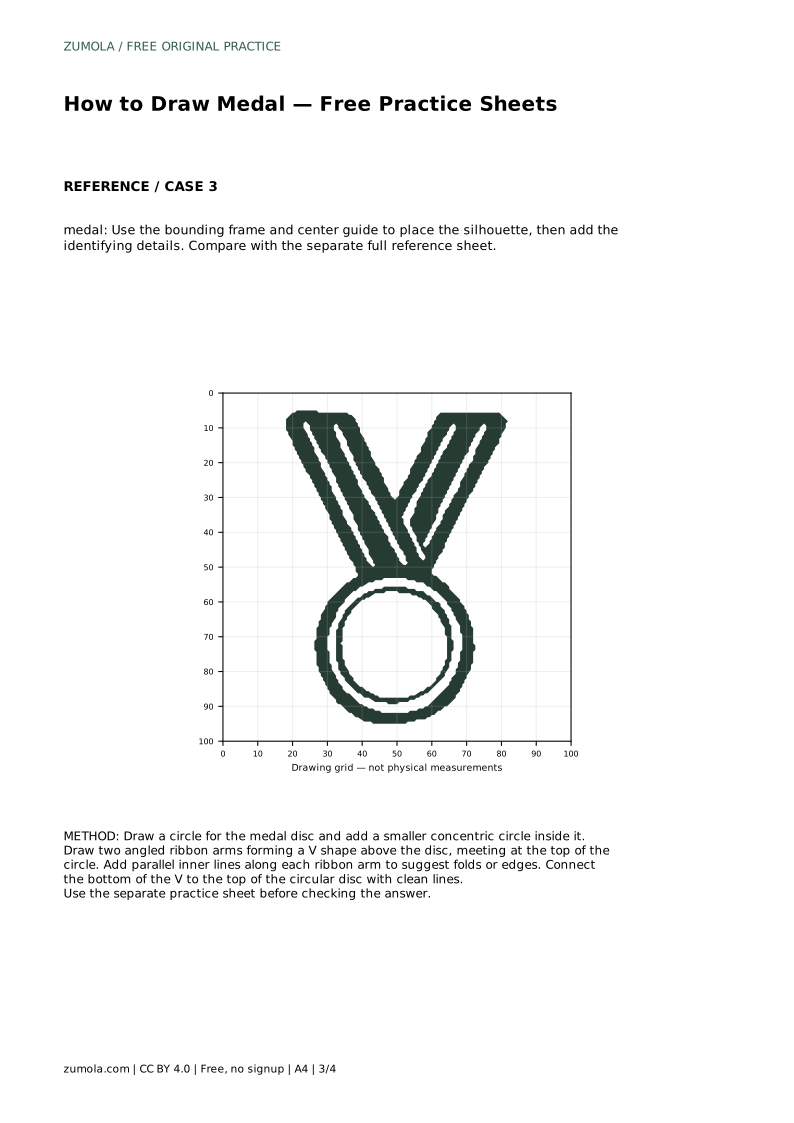
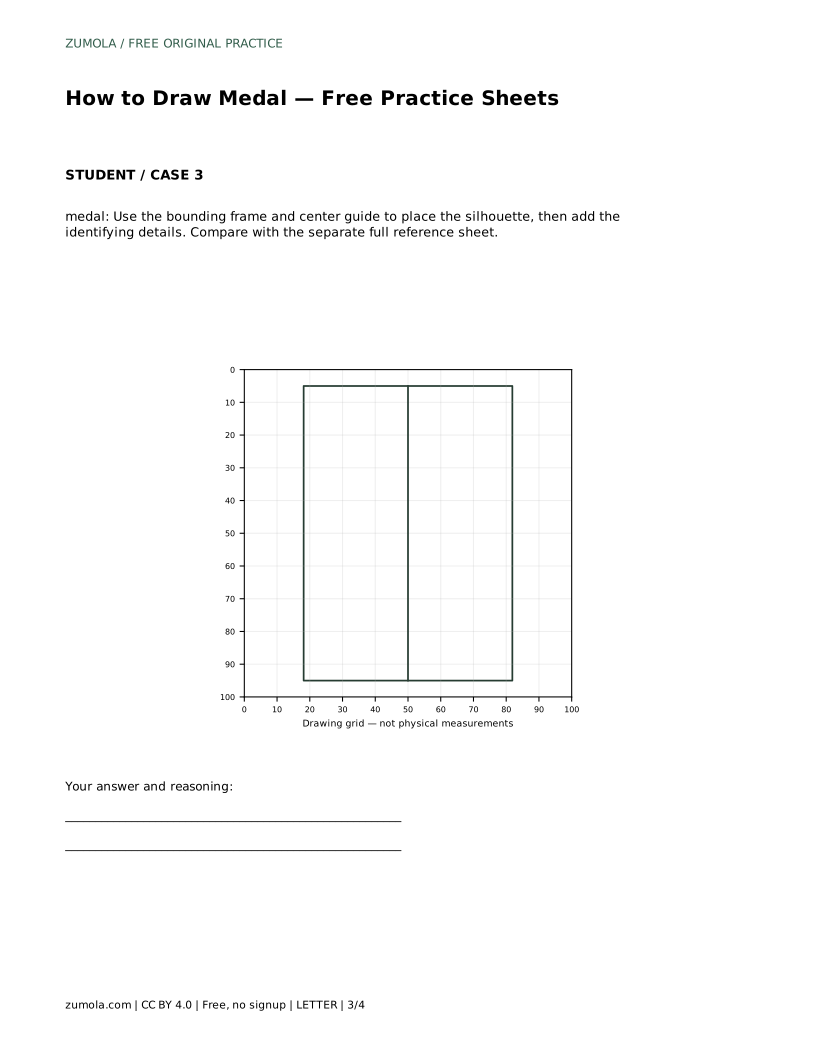
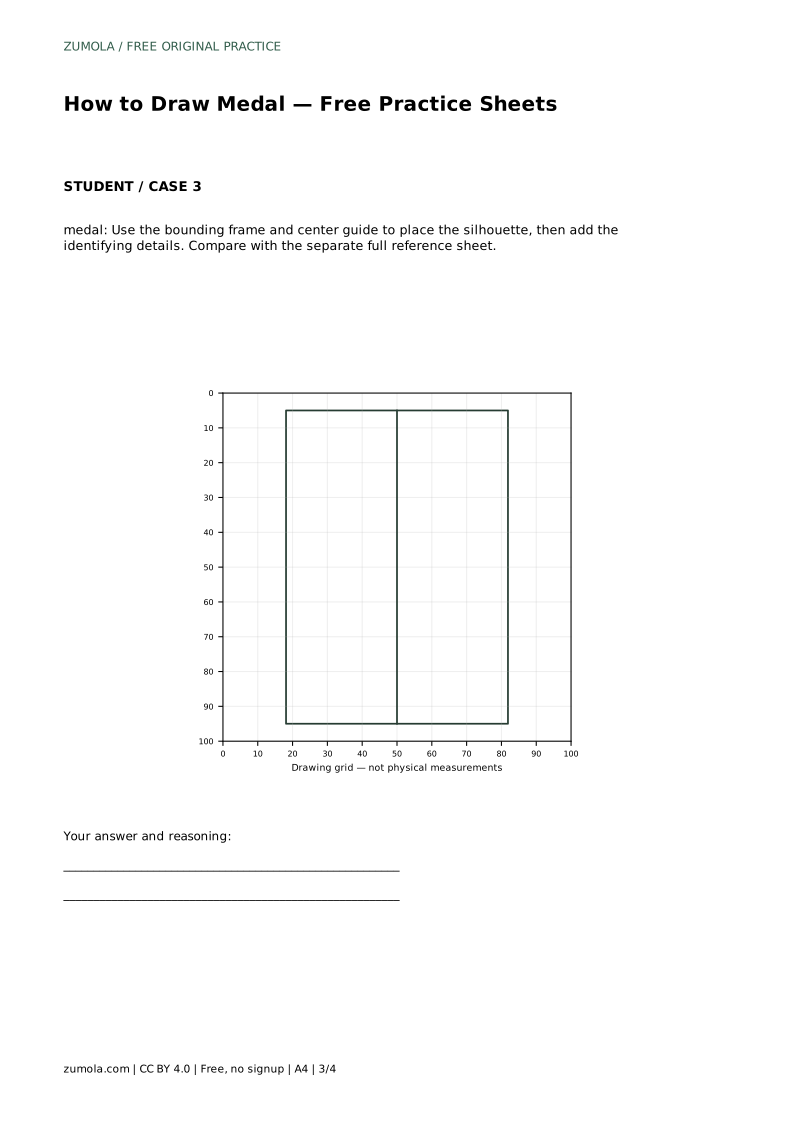
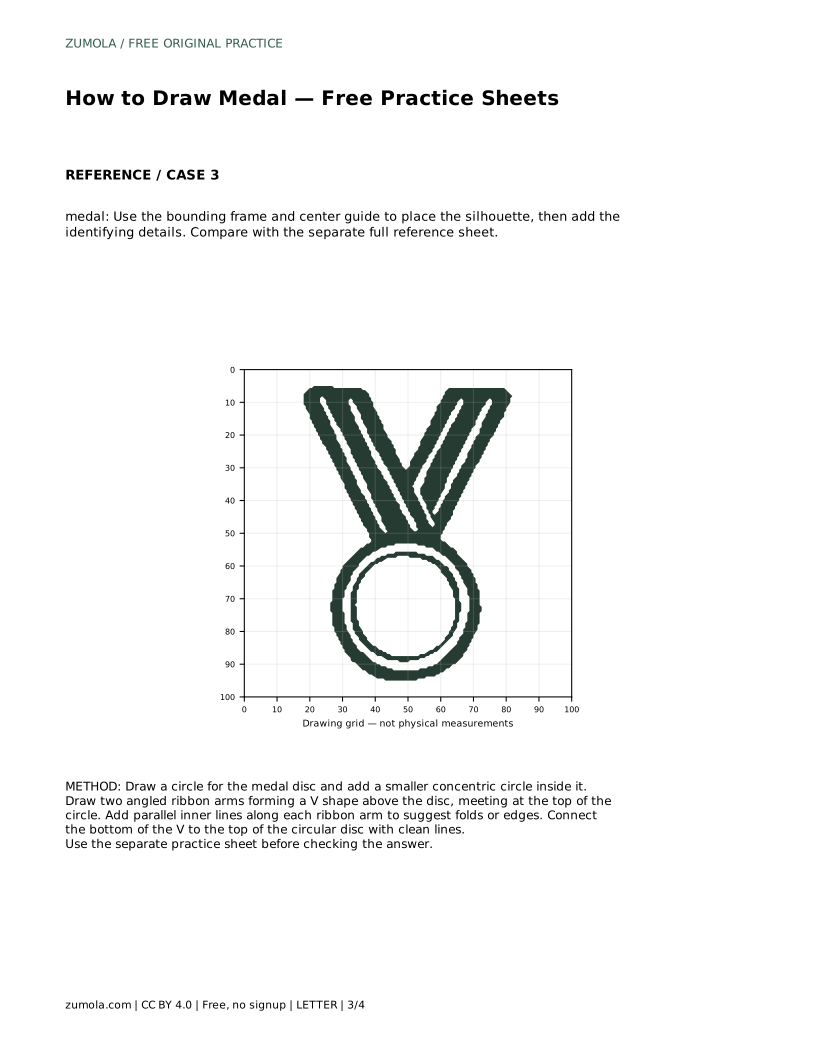
A blank grid lets you copy the reference by matching grid intersections. Place the disc and ribbon where the reference places them, then check the spacing between the two circles and the width of the V. The bounding frame and centre guide give you a starting position for the silhouette before you add the identifying details.
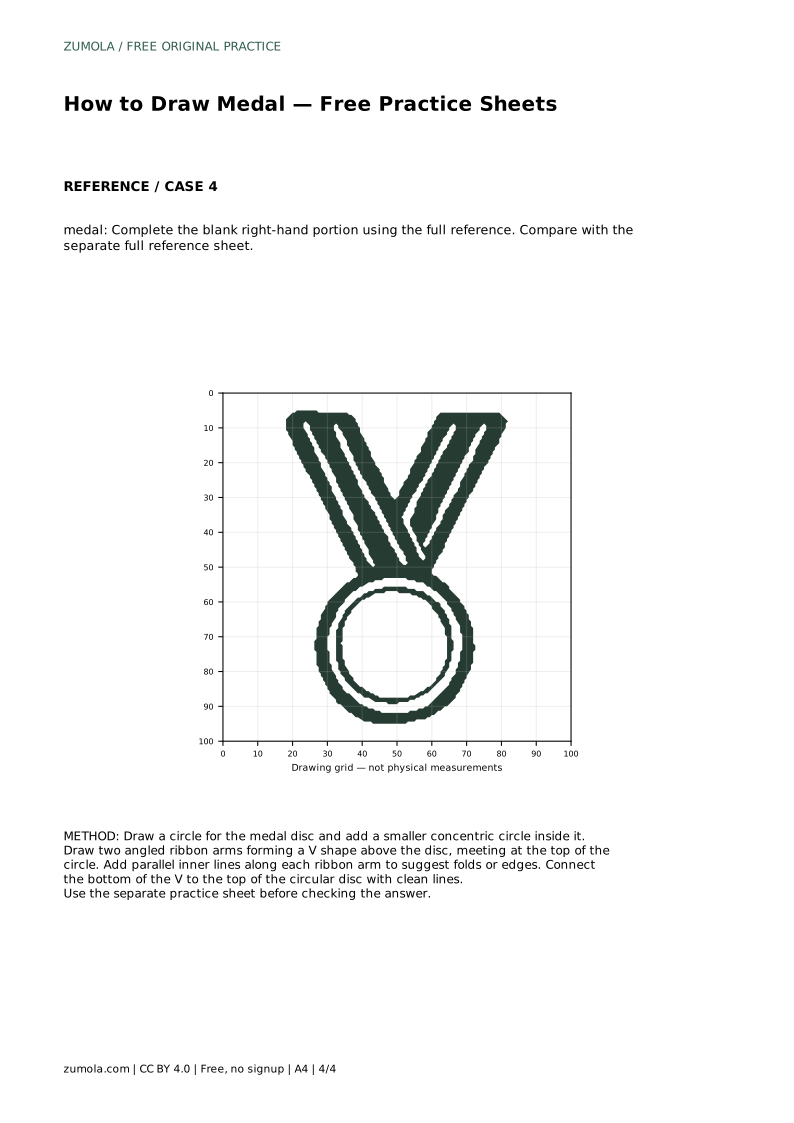
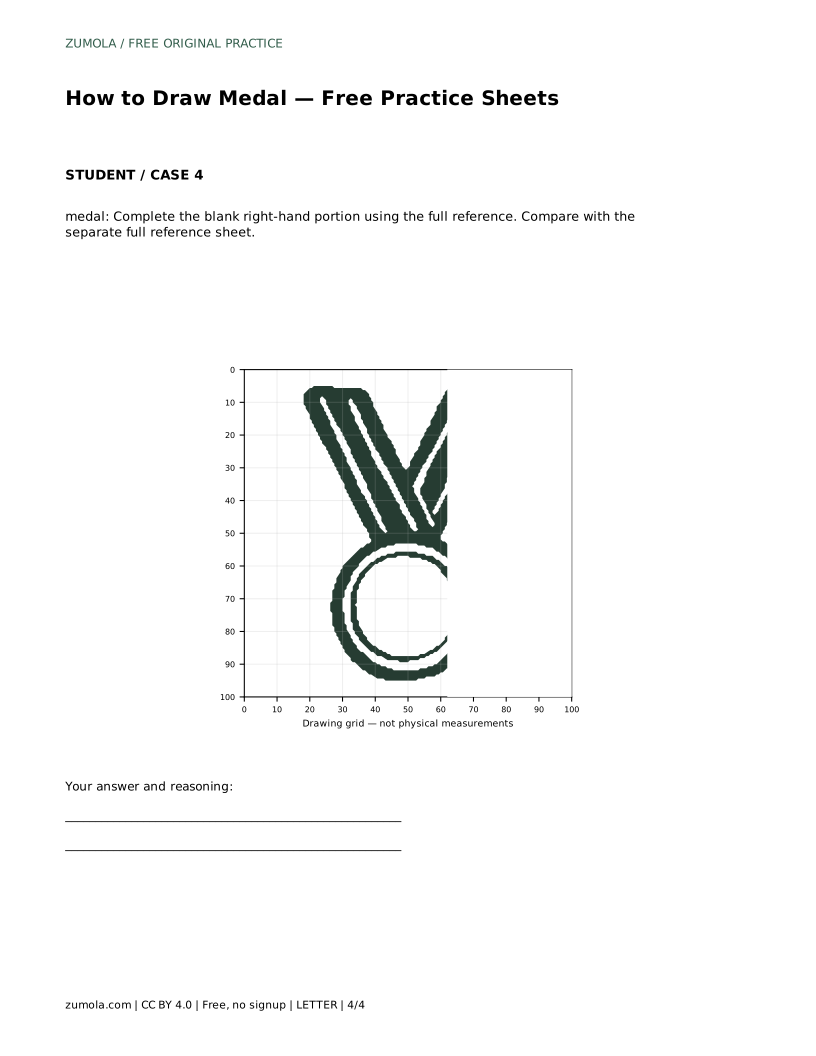
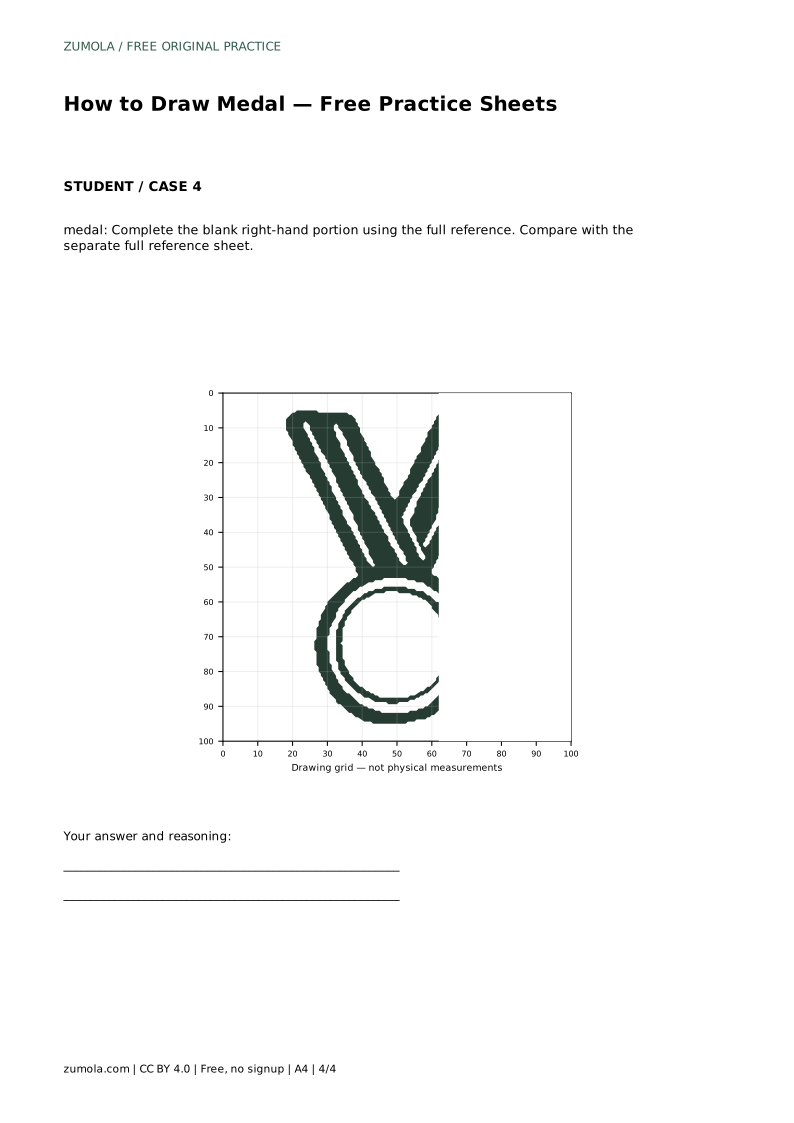
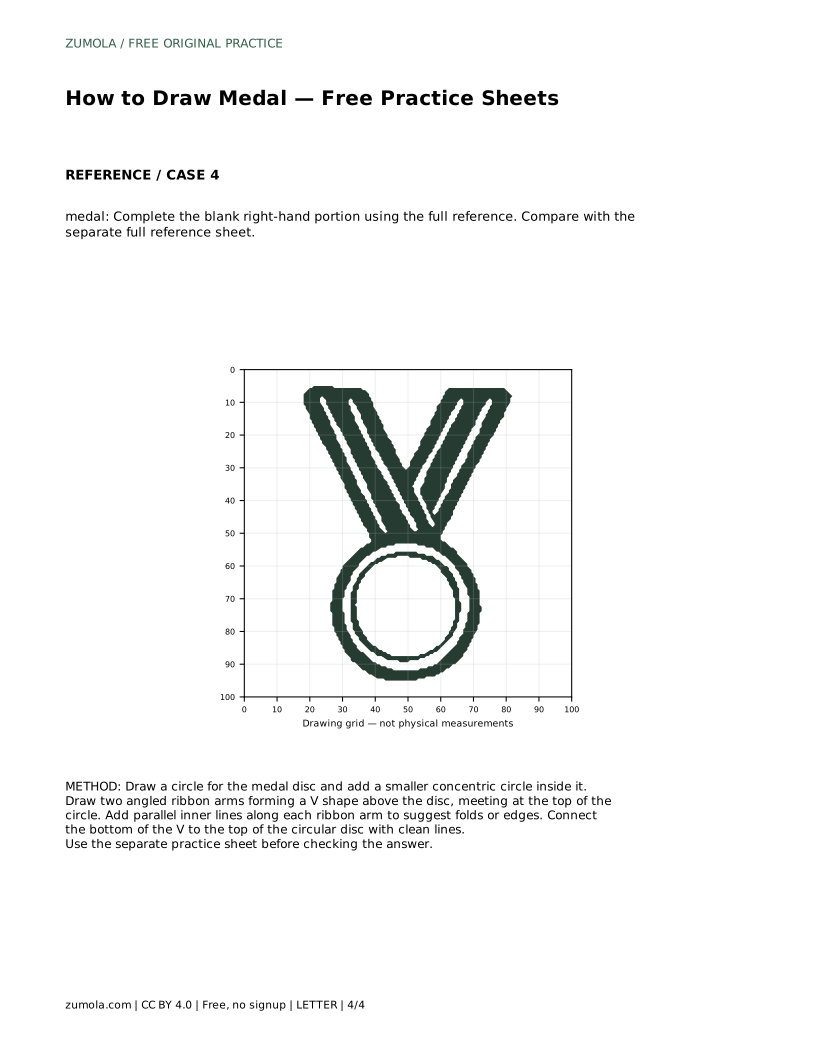
The partial sheet asks you to complete the blank right-hand portion using the full reference. Work from the visible left side outward, keeping the disc round and the ribbon arms balanced.
Compare the disc diameter with the height of the ribbon. If the ribbon looks too tall or too short, adjust the arms before adding inner lines. Check that the inner ring sits evenly inside the disc and that both ribbon arms reach the top of the circle at a similar angle.
Small corrections early are easier than fixing a finished drawing. Redraw a curve rather than patching it, and keep the connecting lines between ribbon and disc simple.
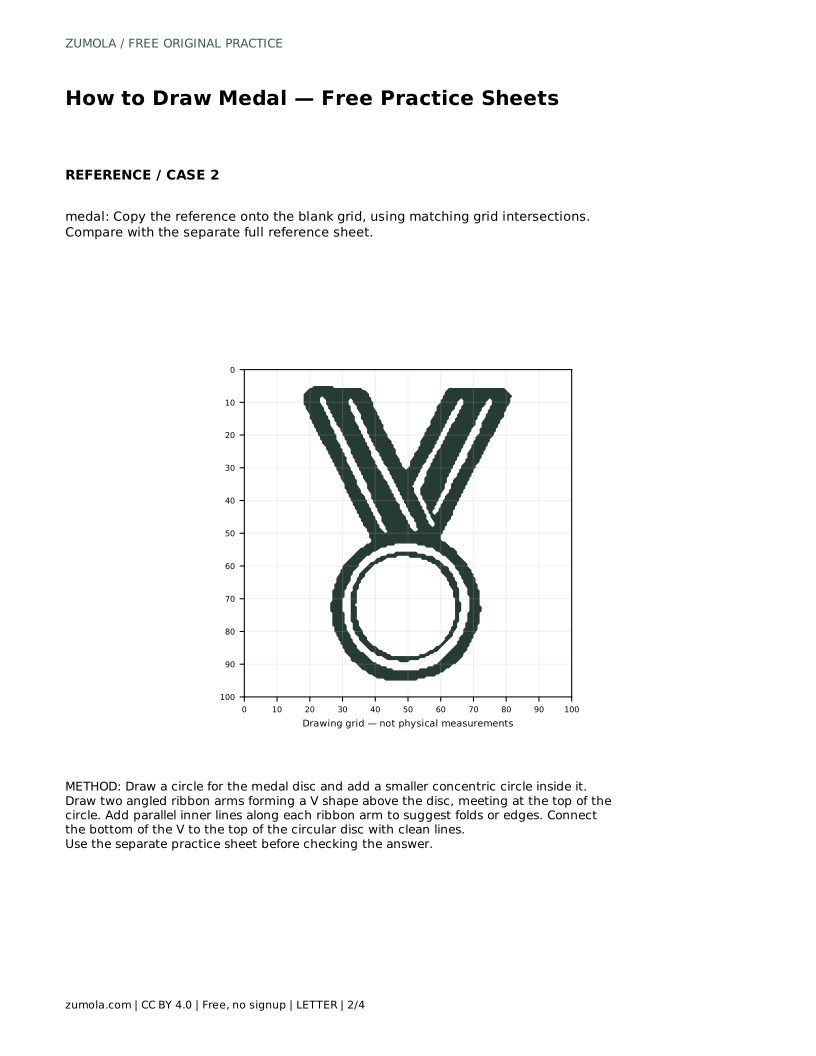
medal: Trace the reference outline, then practise the contour independently. Compare with the separate full reference sheet.
Example solution: preserve circular disc at the bottom, V-shaped ribbon loop above the disc, inner concentric ring on the disc. Other drawings can be correct; assess the visible features and proportions rather than pixel-perfect matching. Draw a circle for the medal disc and add a smaller concentric circle inside it. Draw two angled ribbon arms forming a V shape above the disc, meeting at the top of the circle. Add parallel inner lines along each ribbon arm to suggest folds or edges. Connect the bottom of the V to the top of the circular disc with clean lines.
No. Other drawings can be correct. Assess the visible features and proportions rather than pixel-perfect matching.
Start with tracing to learn the shape order, then move to the grid or partial sheet for independent practice.
Check the disc, the centred inner ring, and the balanced V-shaped ribbon before adding any extra detail.
All drawing practice · Free coordinate paper
Original resources · CC BY 4.0 · Free for personal and classroom use with attribution.