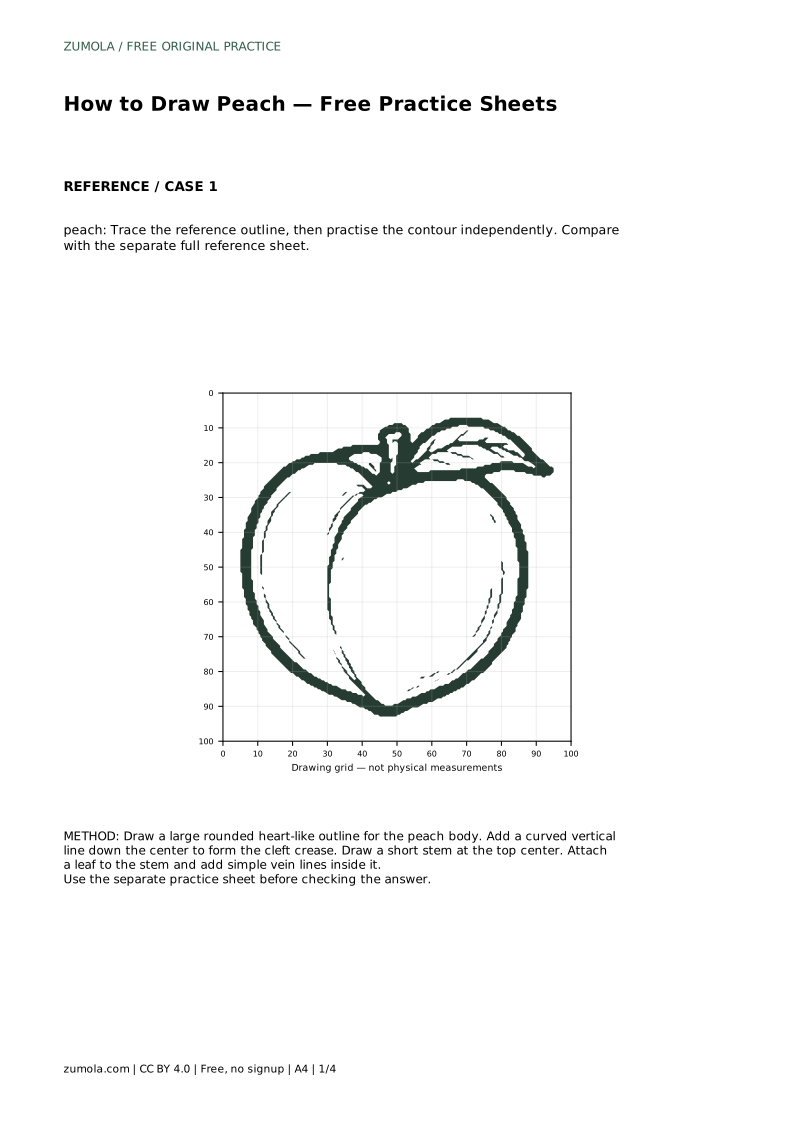
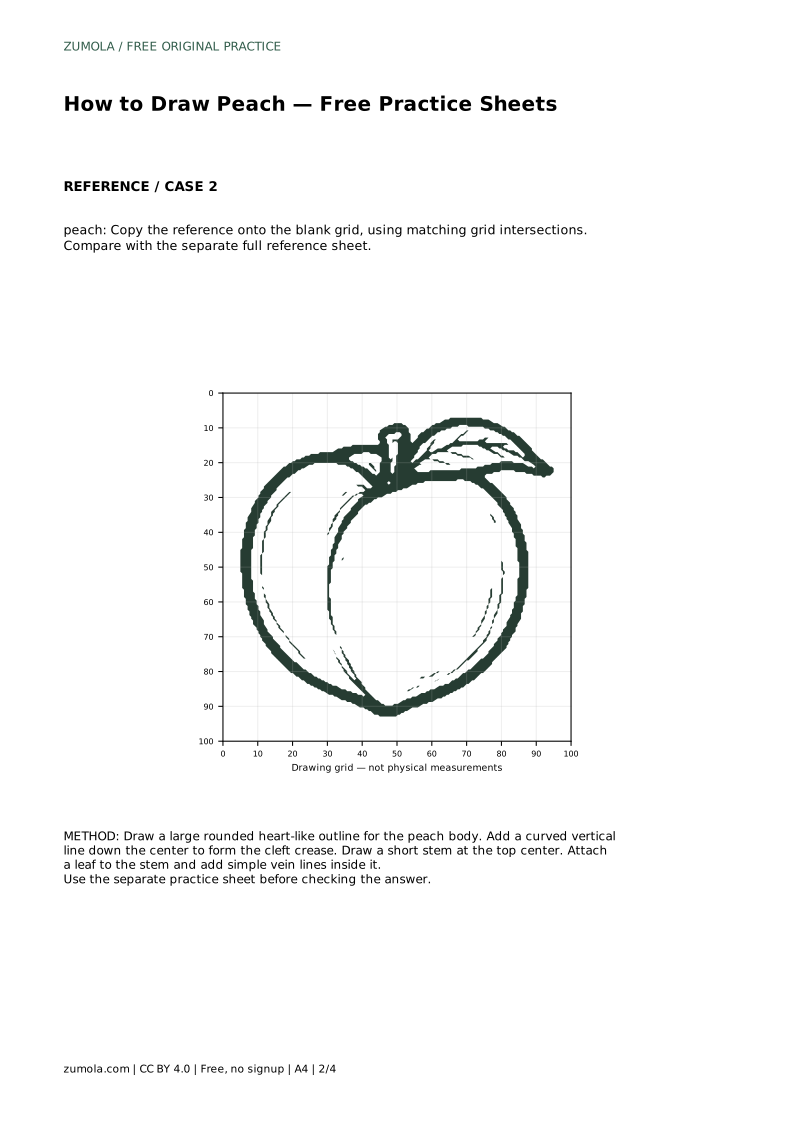
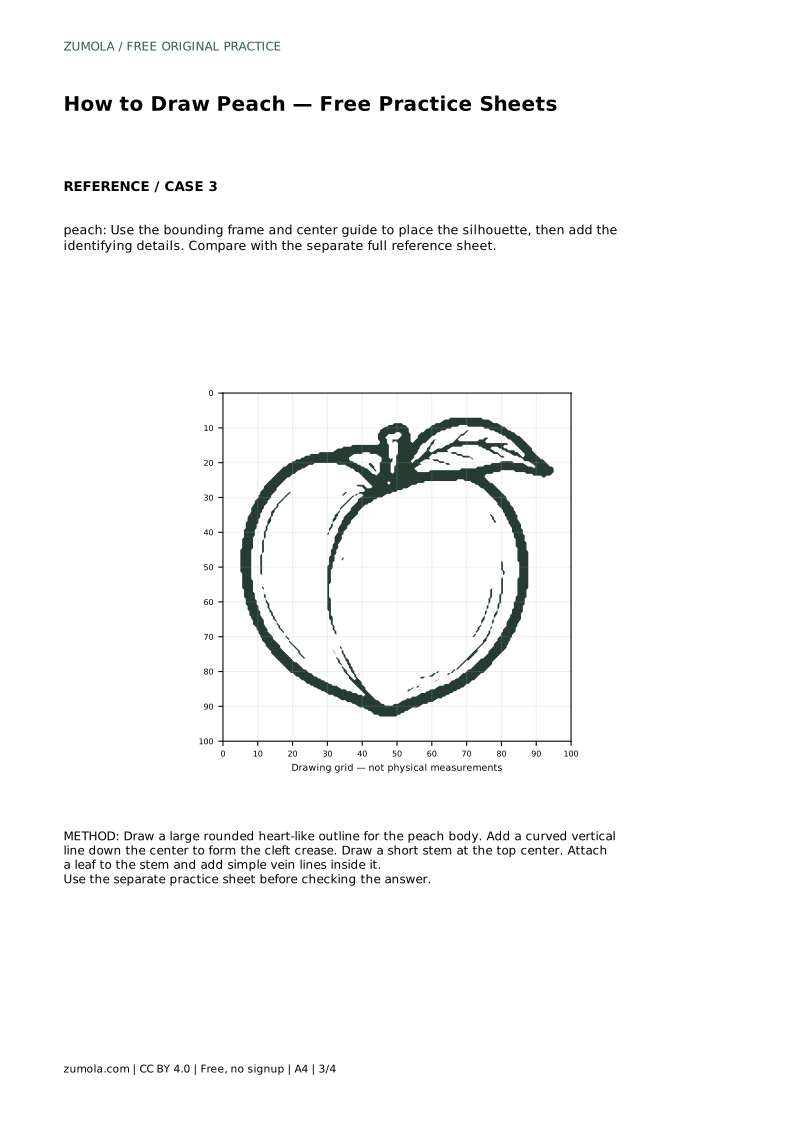
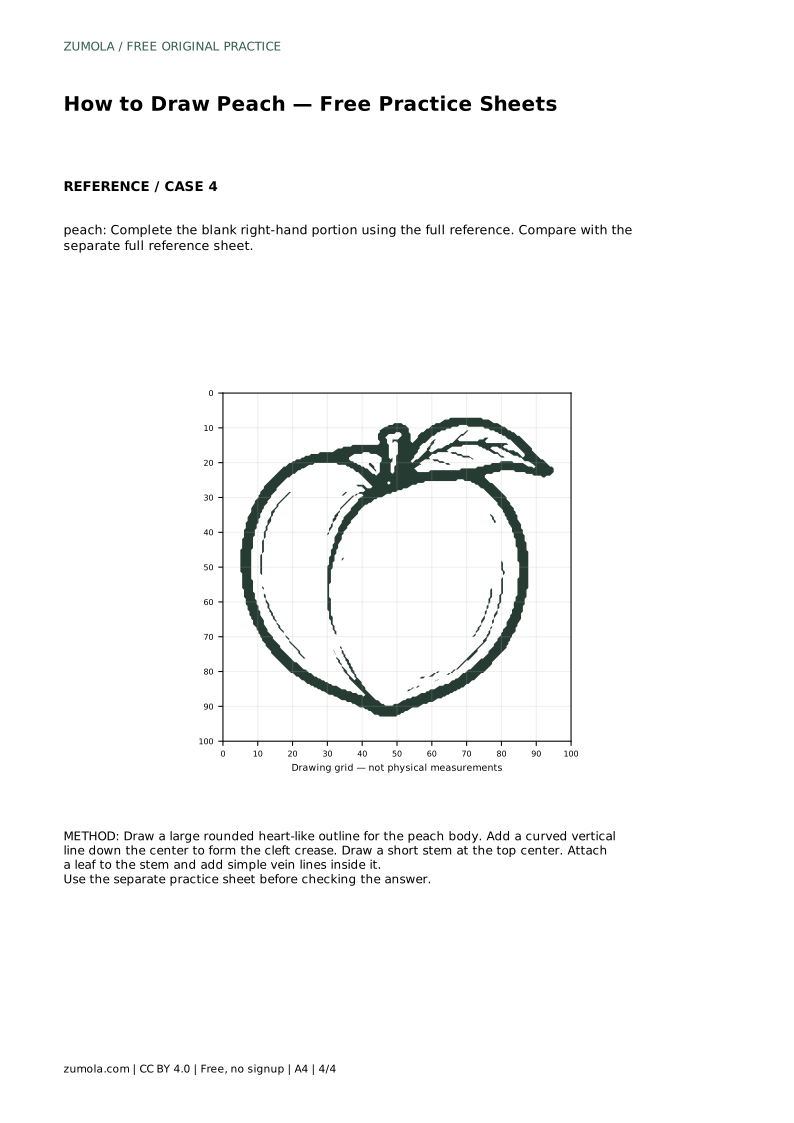
Reference diagrams
LETTER · Download PDF
A4 · Download PDF
Free original resources
Learn a simple peach drawing by building the rounded heart-shaped body, central cleft crease, stem, and leaf. Includes practice guidance and a fair assessment rubric.
Four original cases, with reference diagrams, practice sheets and worked answers. Everything is free; no signup required.
LETTER · Download PDF
A4 · Download PDF
LETTER · Download PDF
A4 · Download PDF
LETTER · Download PDF
A4 · Download PDF
Use A4 or US Letter to match your printer. Use the stated values and conditions to solve each exercise; diagrams are not physical measuring rulers.
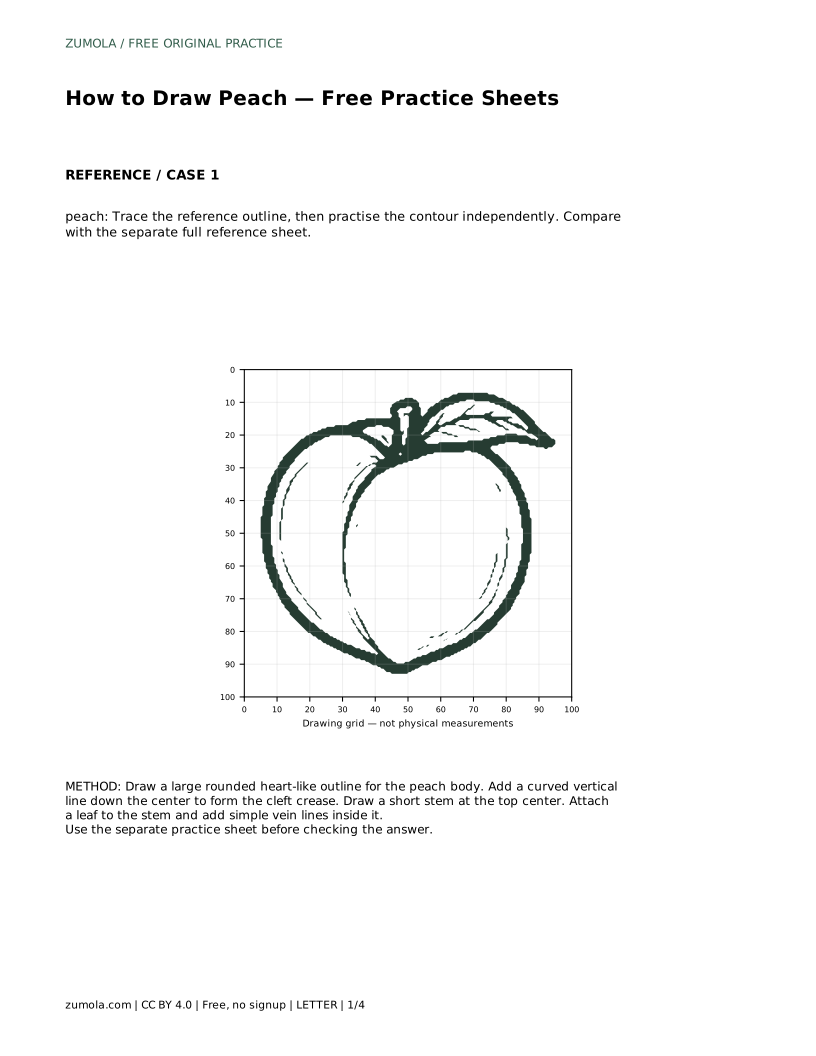
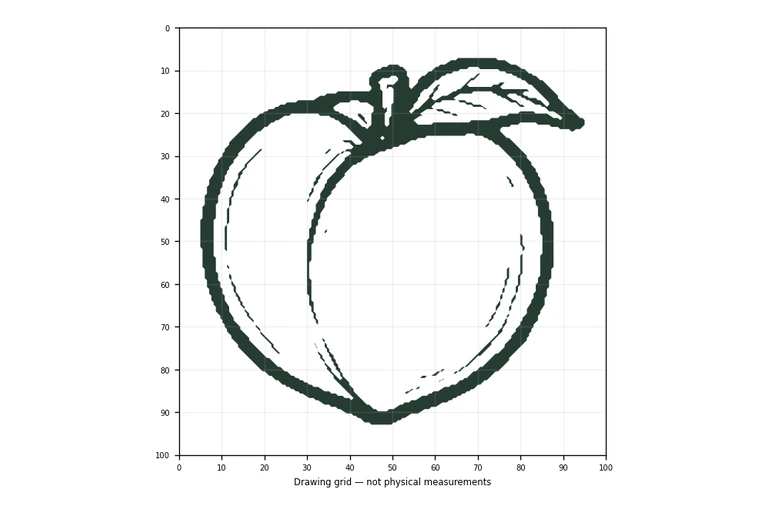
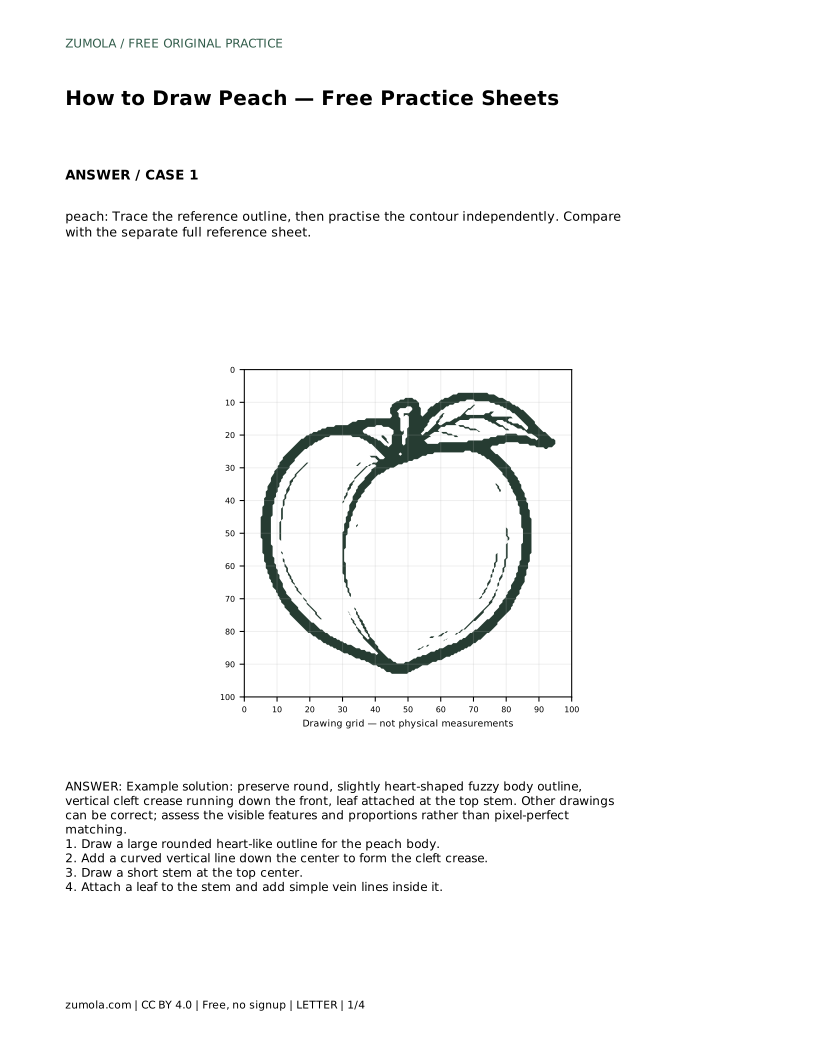
A peach is easy to recognize once you understand its basic construction: a round body that narrows slightly toward the top, a soft vertical crease down the front, and a short stem with a leaf. This page explains how to draw that structure step by step, then how to use tracing, grid, frame, and partial-reference practice sheets to build independence. The goal is not a pixel-perfect copy but a drawing that preserves the peach's visible features and believable proportions.
Begin with the largest shape. Draw a large rounded outline that is close to a heart but softened: wide through the middle, gently tapering toward the top, and slightly fuller on one side. Avoid making it a perfect circle or a sharp heart. The peach body should feel plump and slightly irregular.
Next, add the cleft crease. This is a curved vertical line running down the front of the body, not a straight cut through the whole fruit. Let it start near the top center and curve gently downward, stopping before the bottom edge. The crease gives the peach its characteristic form and helps the eye read the roundness of the fruit.
Place a short stem at the top center, where the two upper curves of the body meet. Keep it small relative to the fruit; a stem that is too long changes the balance of the drawing. The stem can be slightly angled, but it should clearly connect to the body.
Attach a leaf to the stem. A simple leaf shape with a pointed tip and a gentle curve works well. Add one central vein and a few short side veins inside the leaf. These lines are suggestions of structure, not a botanical diagram. Keep them light and simple so the leaf does not overpower the peach body.
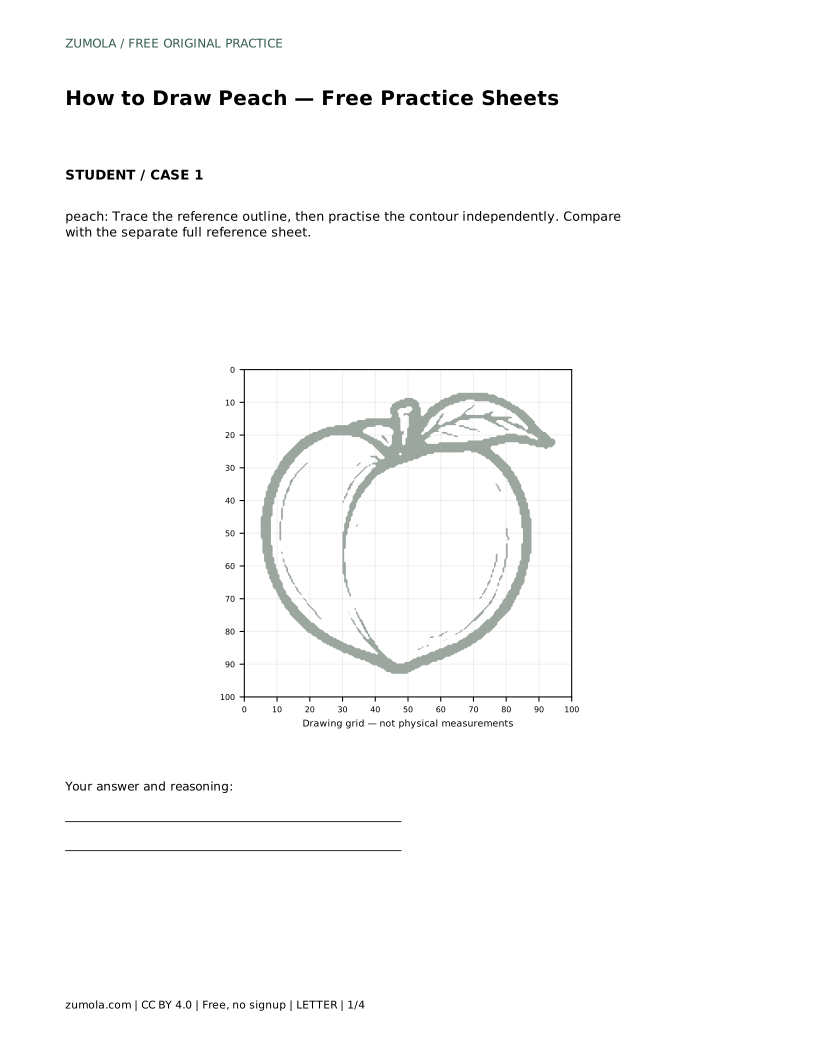
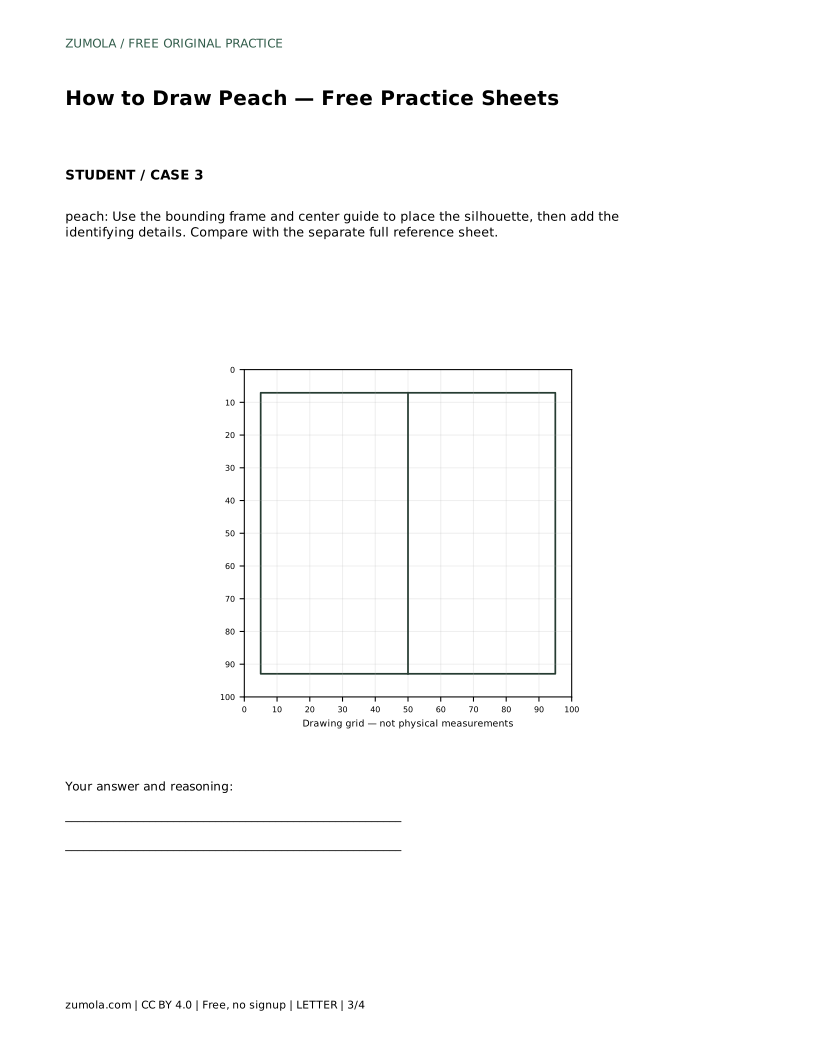
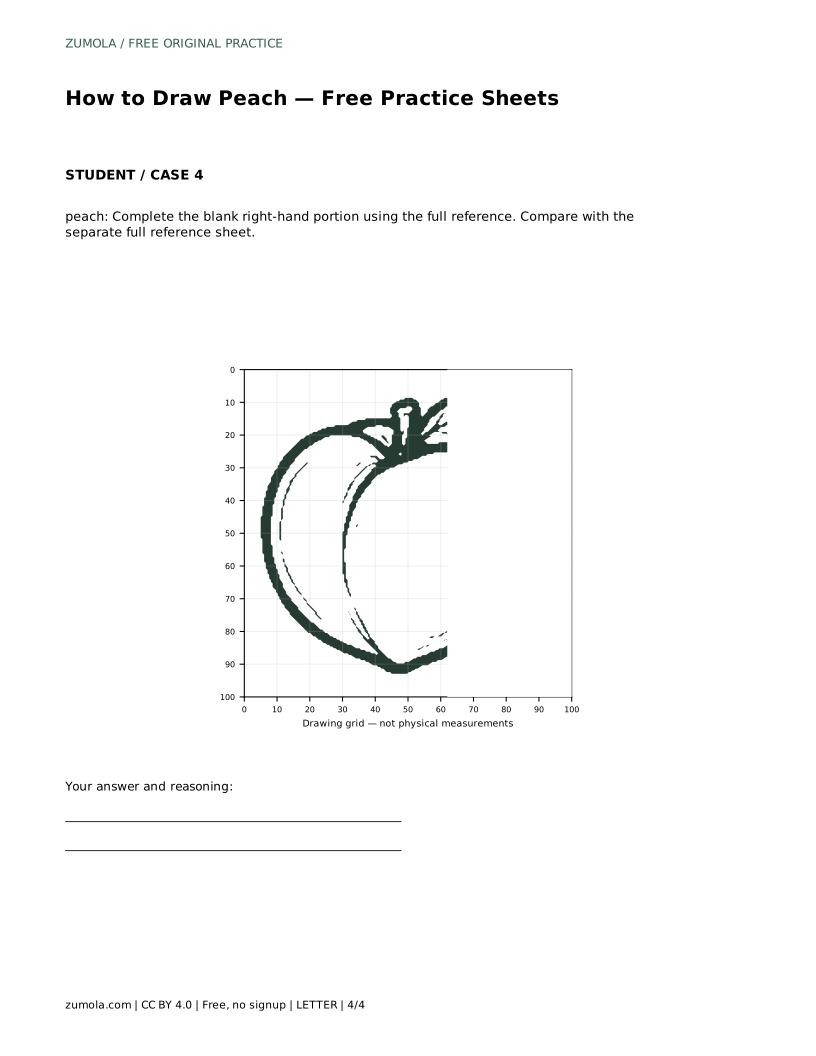
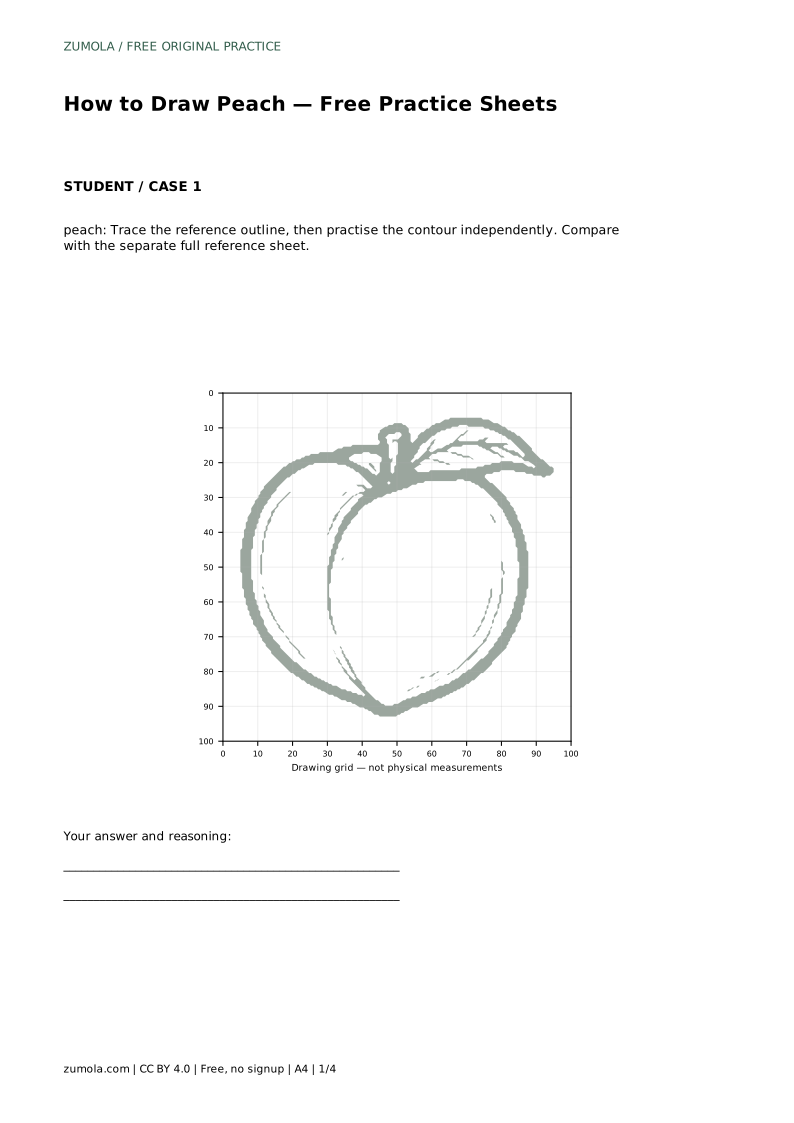
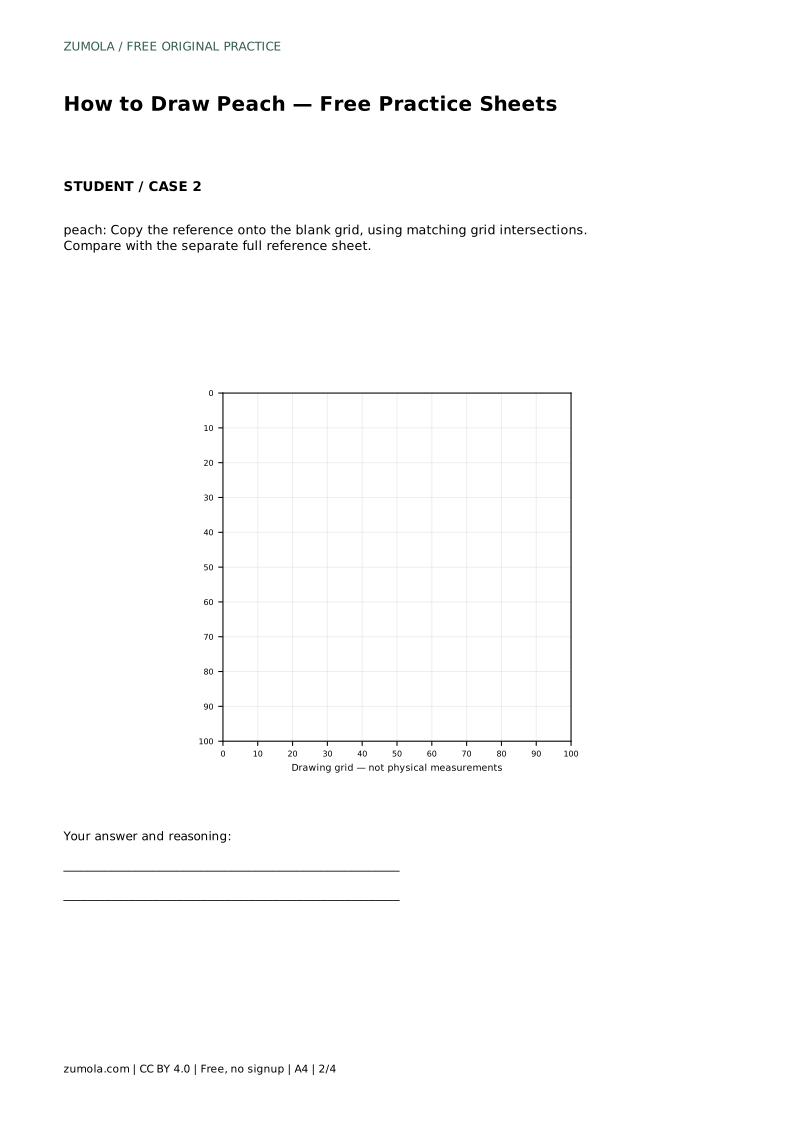
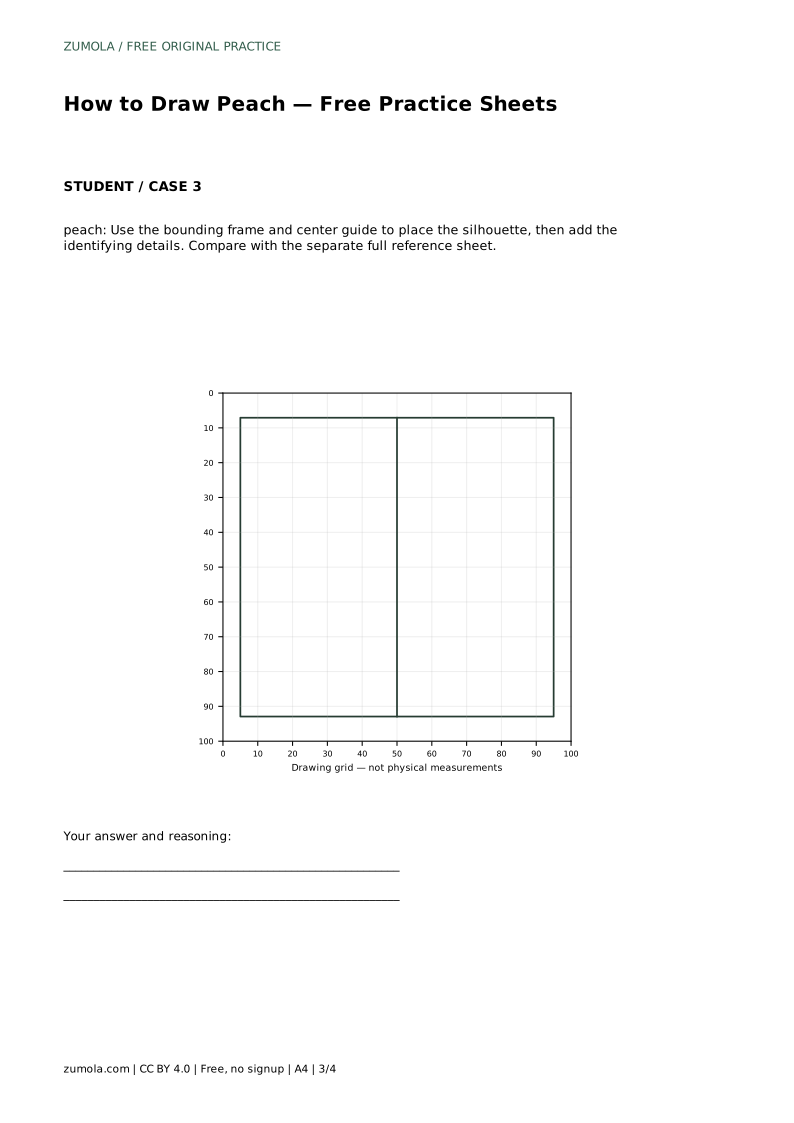
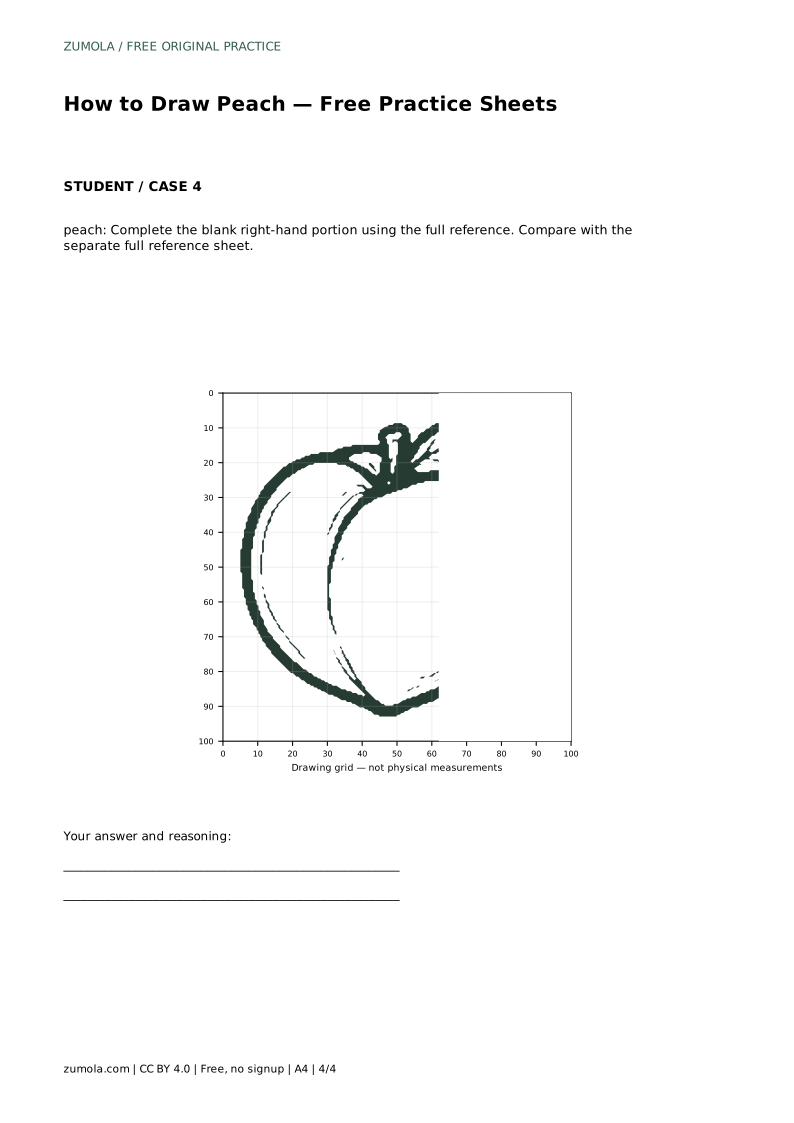
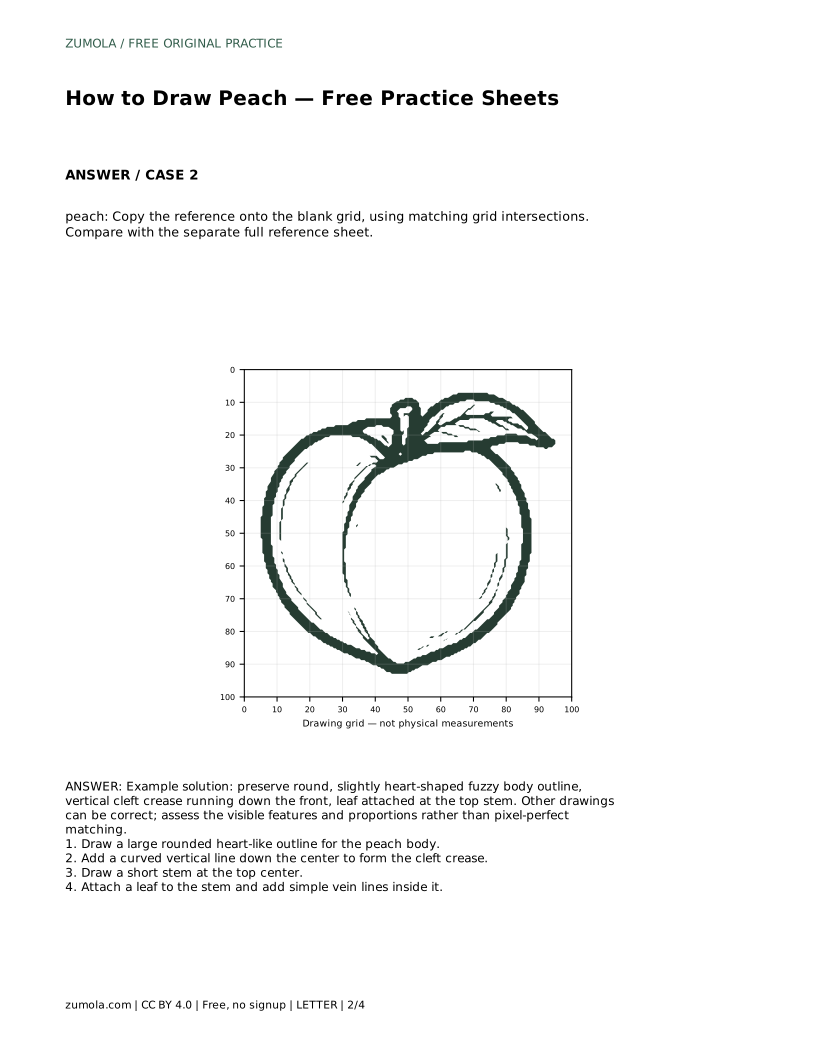
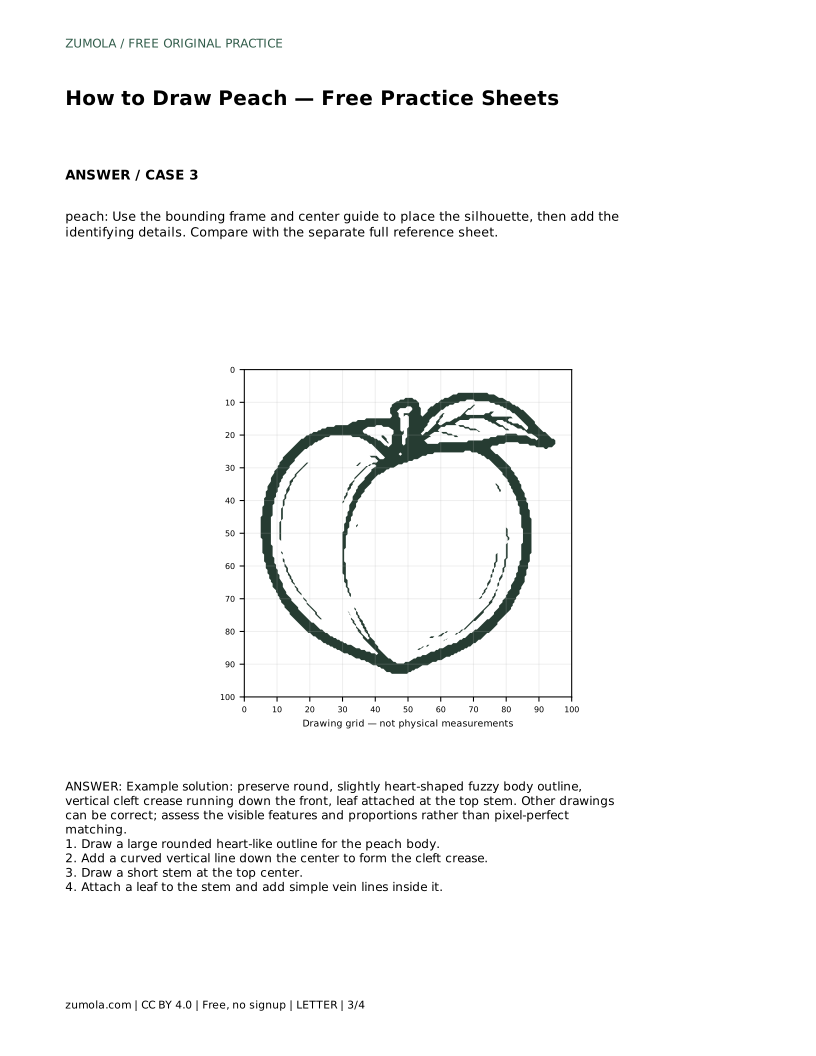
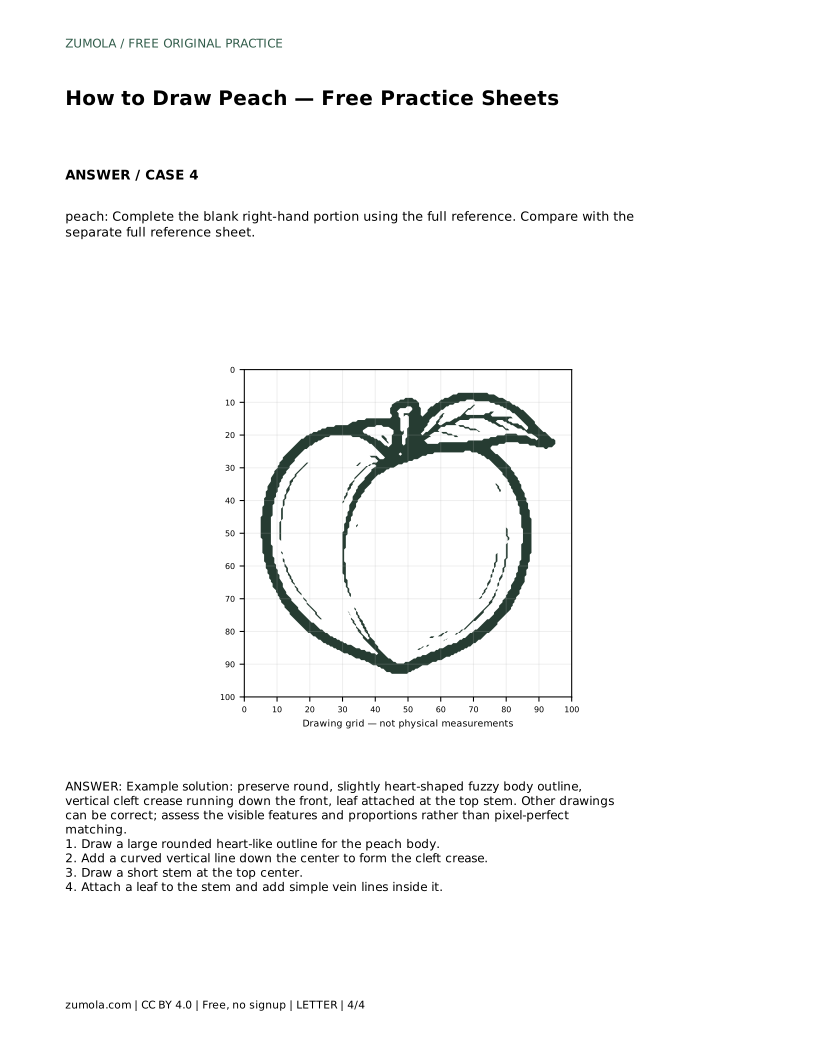
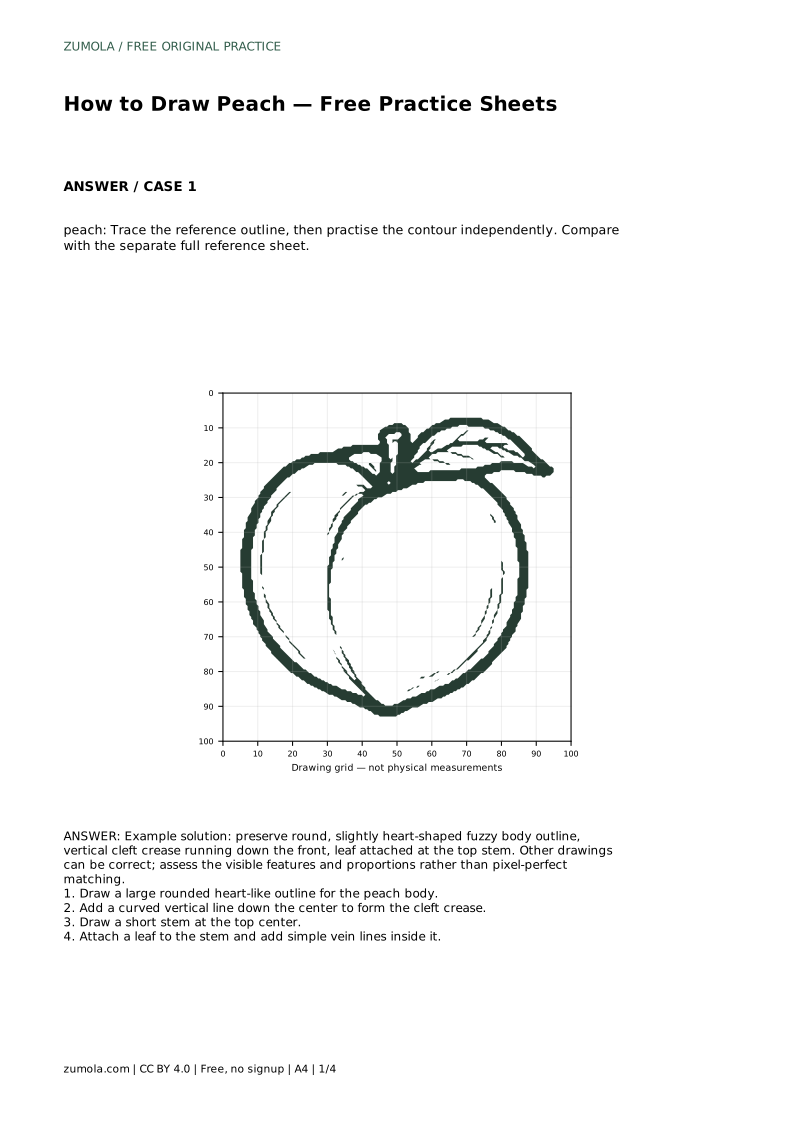
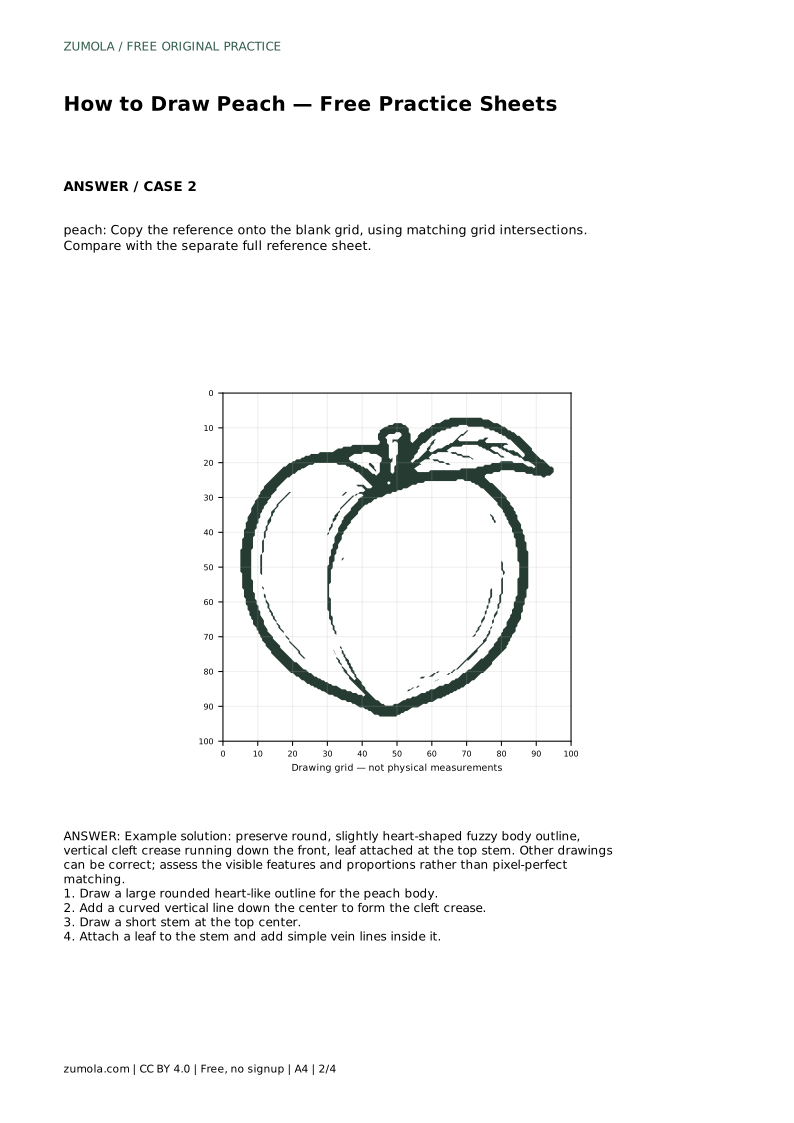
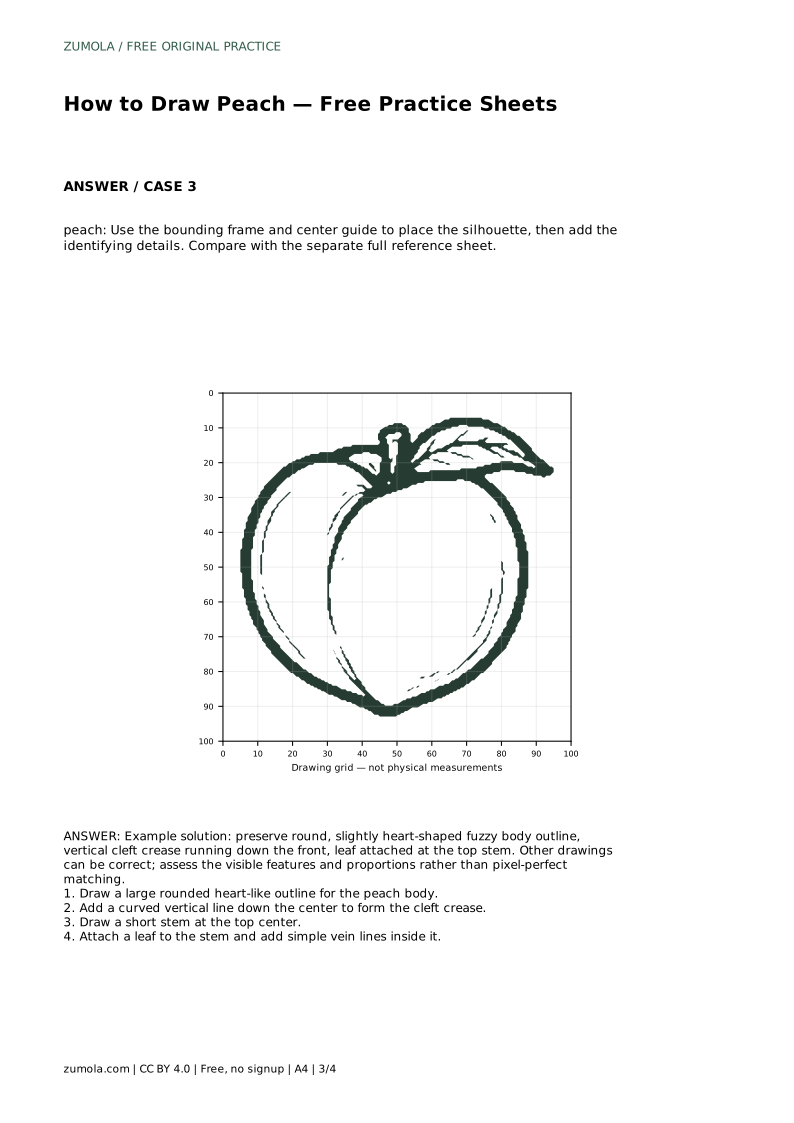
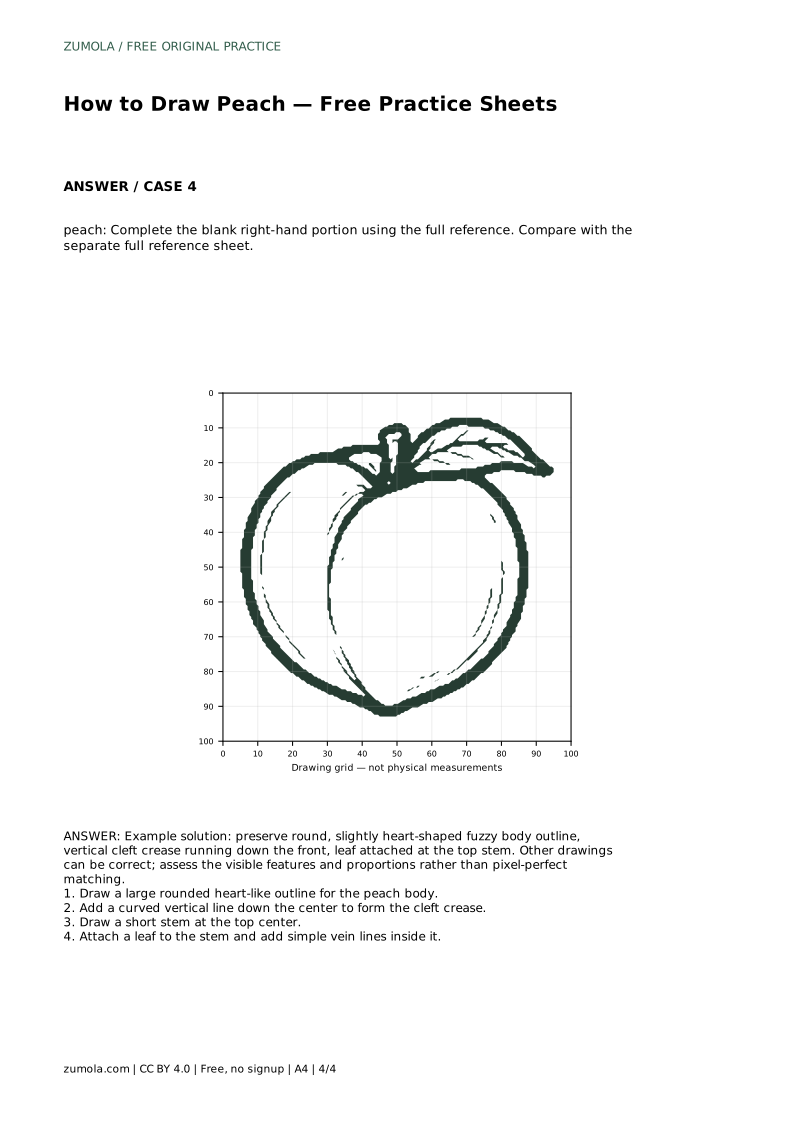
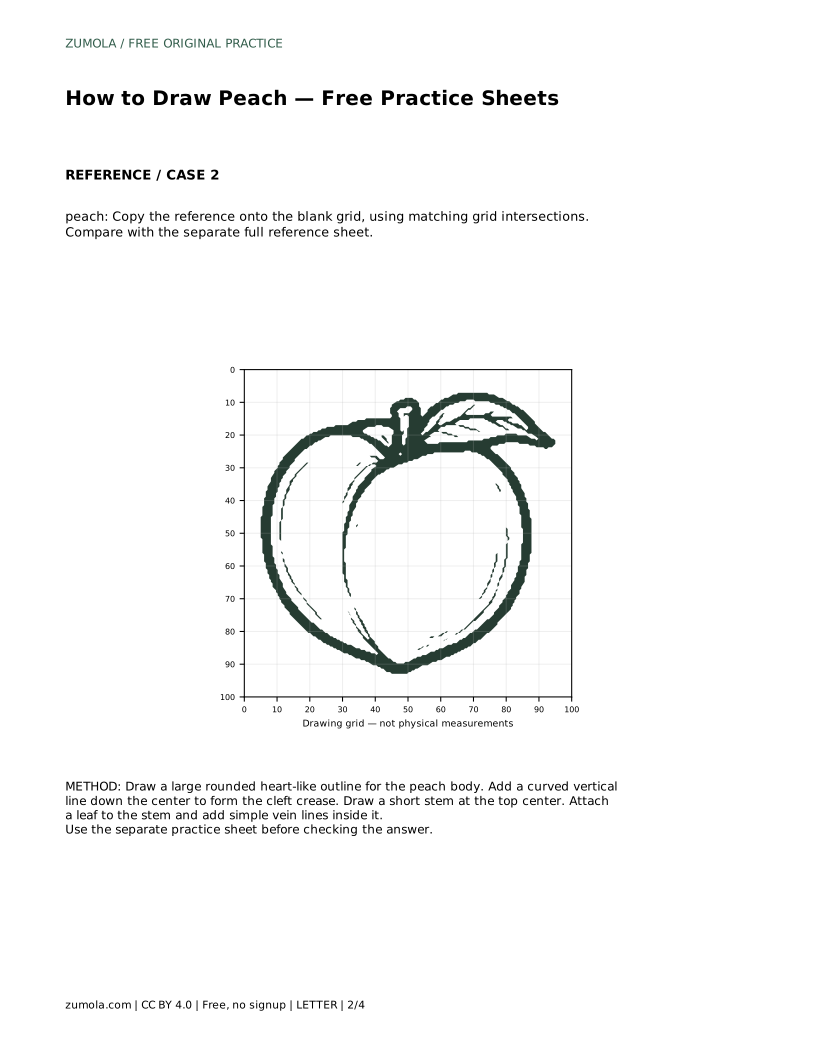
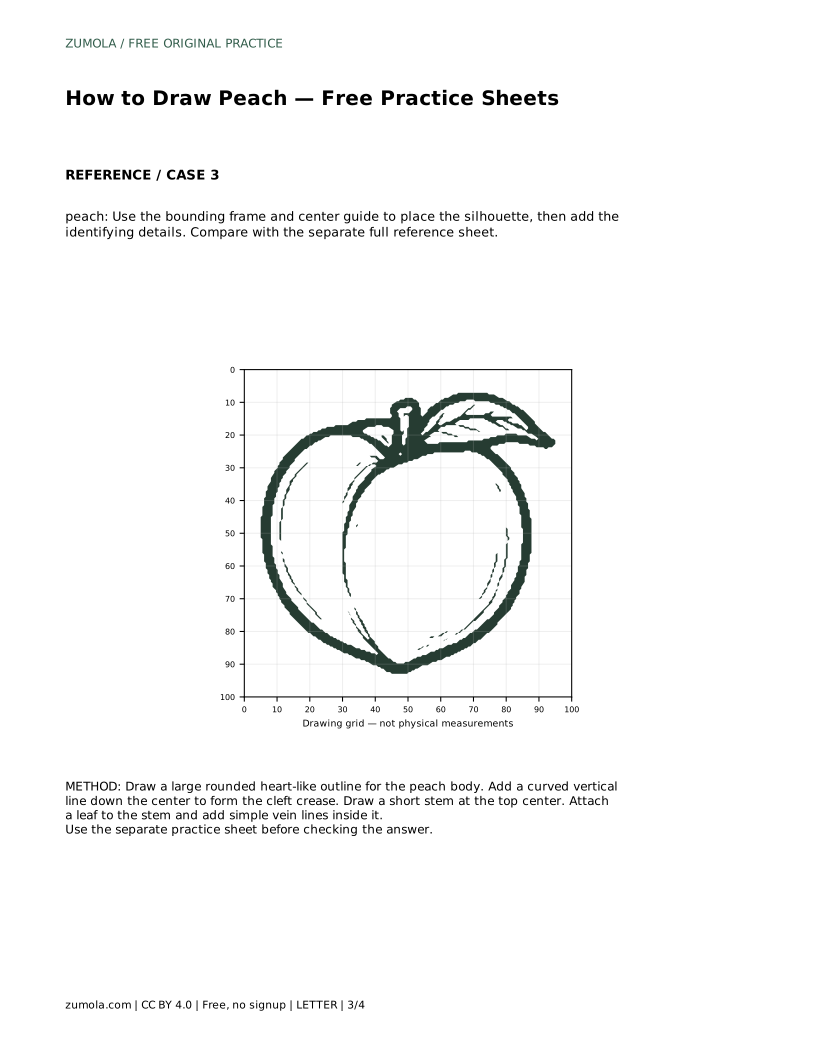
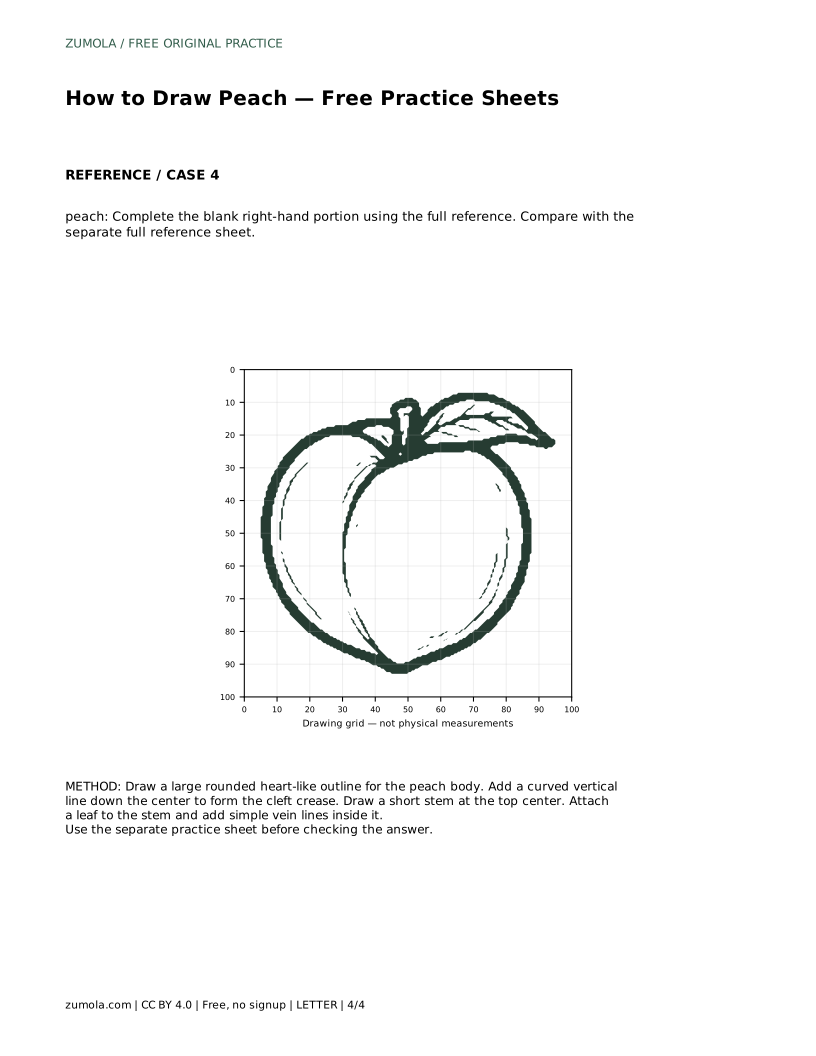
The tracing sheet asks you to follow the reference outline first, then practise the contour independently. Compare your freehand attempt with the separate full reference sheet. The grid sheet asks you to copy the reference onto a blank grid using matching grid intersections, which helps you judge placement and proportion. The frame-and-center-guide sheet asks you to place the silhouette using the bounding frame and center guide before adding identifying details. The partial-reference sheet gives you the full reference and asks you to complete the blank right-hand portion.
Each format trains a different skill: tracing builds familiarity with the contour, the grid builds proportional judgment, the frame builds placement, and the partial sheet builds completion from a reference. Use the format that matches the skill you want to practise, and compare your result with the full reference sheet rather than expecting an exact match.
Peach drawings have multiple valid outcomes. A drawing can be correct even if it is wider, narrower, or more tilted than the reference. Assess the visible features and proportions rather than pixel-perfect matching. Ask whether the body reads as round and slightly heart-shaped, whether the cleft crease runs down the front, whether the stem sits at the top center, and whether the leaf attaches to the stem with simple veins.
Use the rubric below to guide your self-check. If a feature is missing or misplaced, redraw that part rather than starting over. Small adjustments to the body outline or crease position often fix the overall read of the drawing.
peach: Trace the reference outline, then practise the contour independently. Compare with the separate full reference sheet.
Example solution: preserve round, slightly heart-shaped fuzzy body outline, vertical cleft crease running down the front, leaf attached at the top stem. Other drawings can be correct; assess the visible features and proportions rather than pixel-perfect matching. Draw a large rounded heart-like outline for the peach body. Add a curved vertical line down the center to form the cleft crease. Draw a short stem at the top center. Attach a leaf to the stem and add simple vein lines inside it.
No. Peach drawings have multiple valid outcomes. Preserve the round, slightly heart-shaped body, the vertical cleft crease, the top-center stem, and the attached leaf, then assess proportions rather than exact pixels.
Start with the tracing sheet to learn the contour, then move to the grid or frame sheet to practise placement and proportion without tracing.
Check the visible features: a rounded heart-like body, a curved vertical crease down the front, a short stem at the top center, and a leaf attached to the stem with simple veins.
All drawing practice · Free coordinate paper
Original resources · CC BY 4.0 · Free for personal and classroom use with attribution.