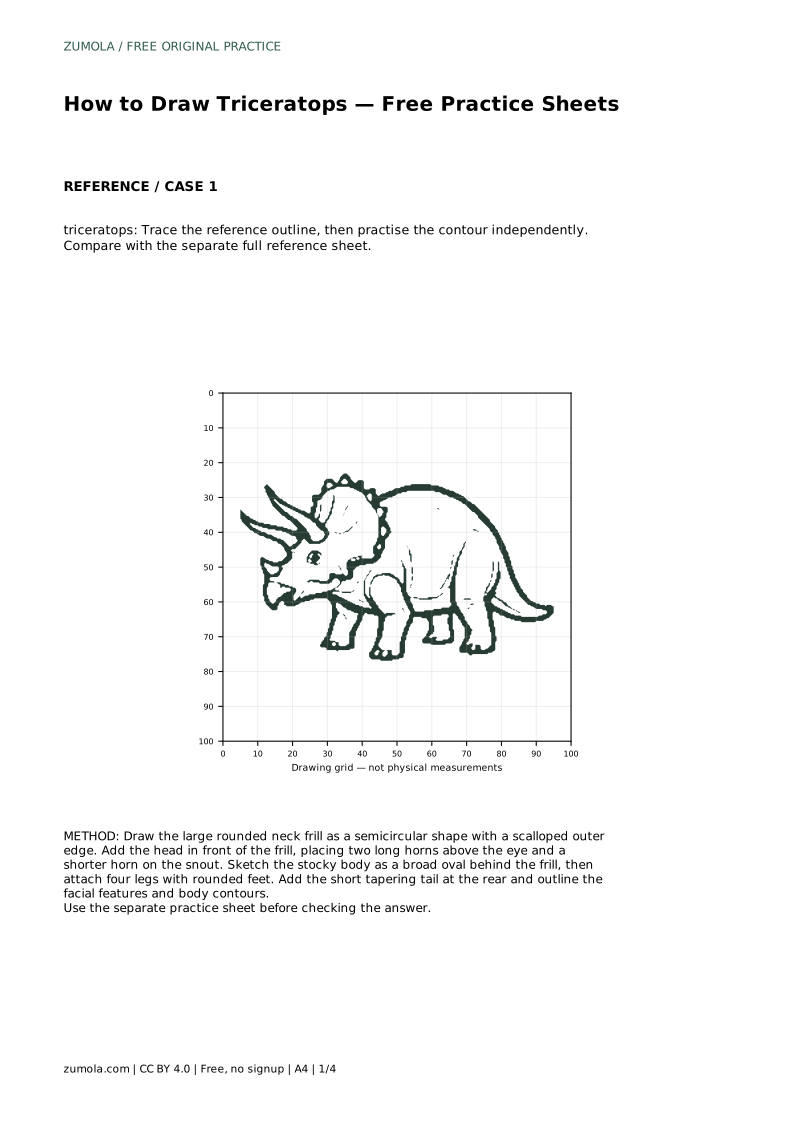
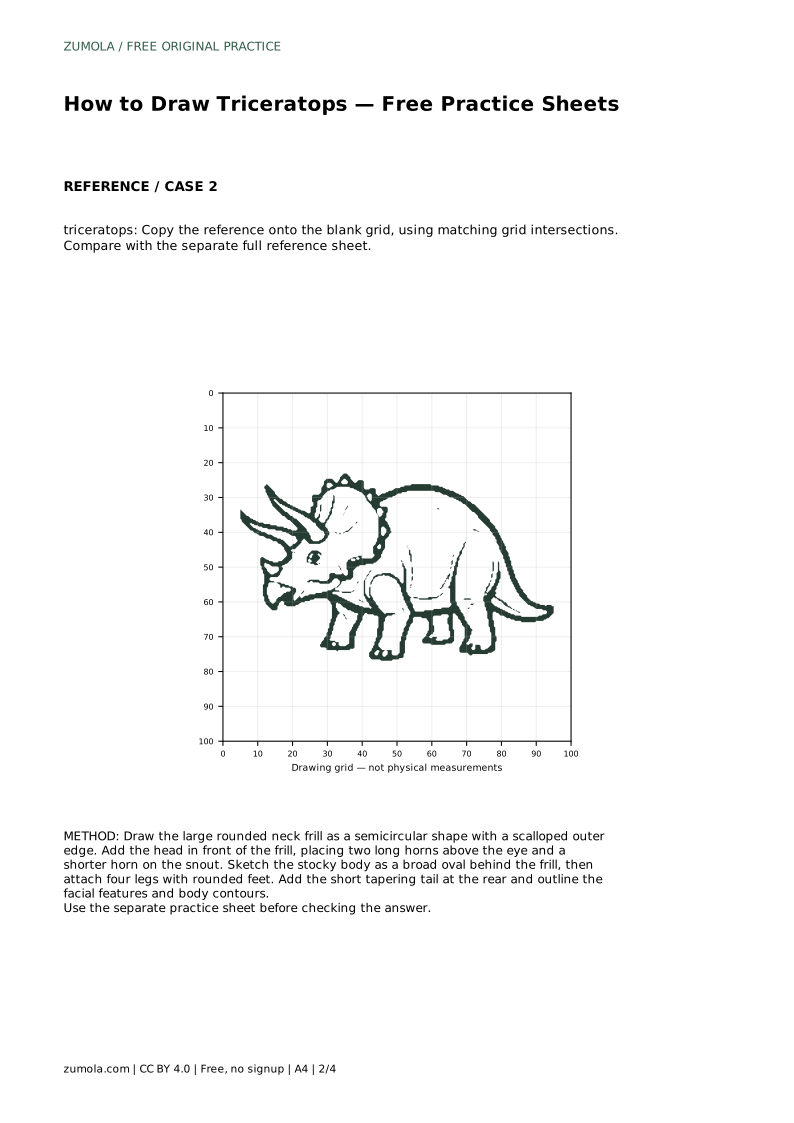
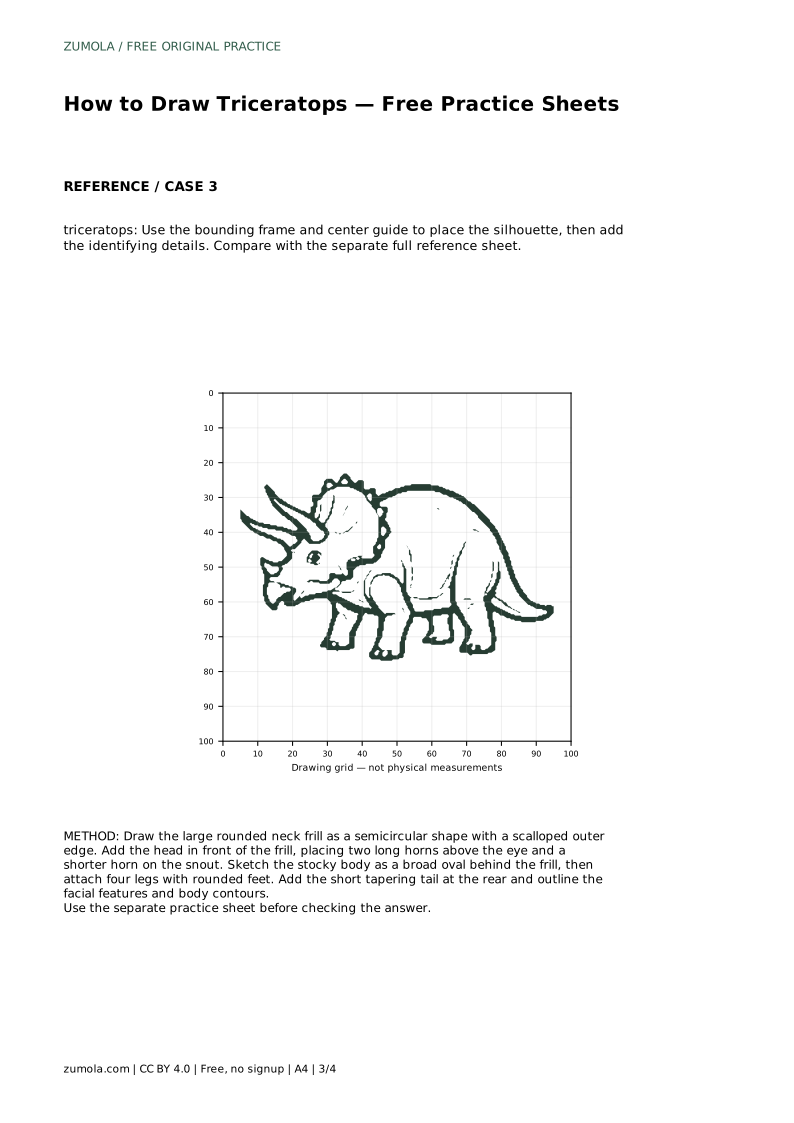
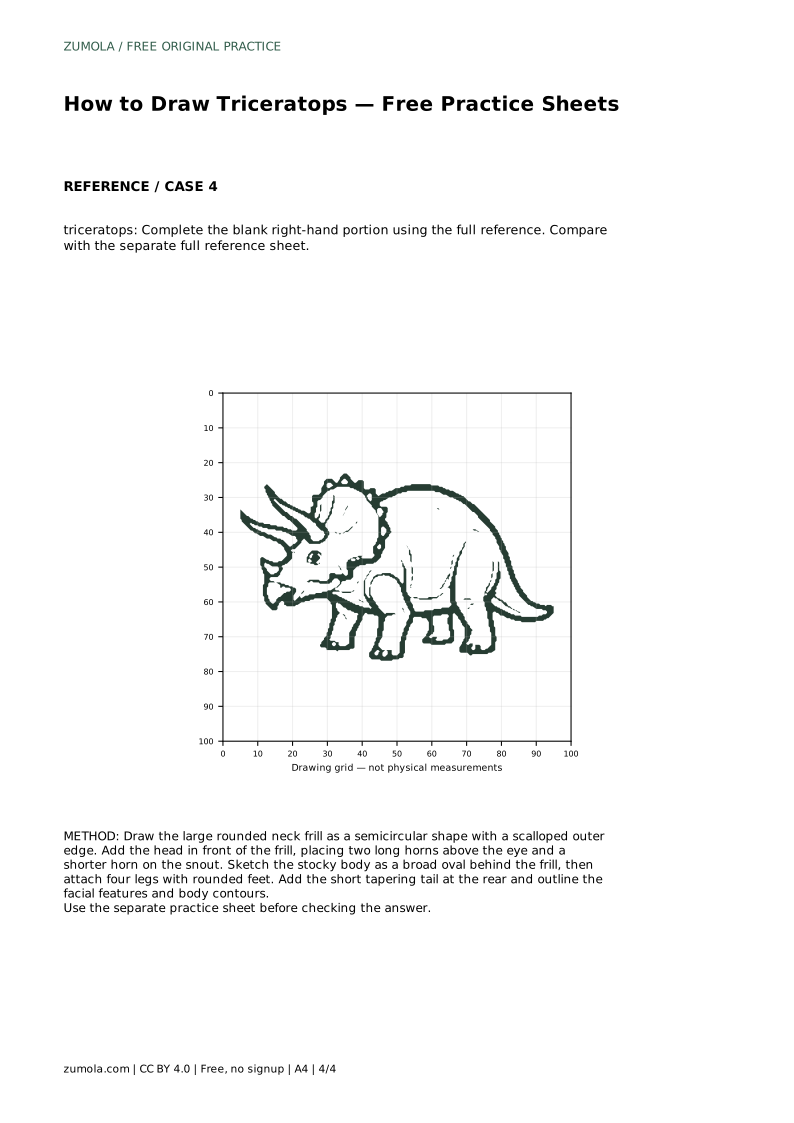
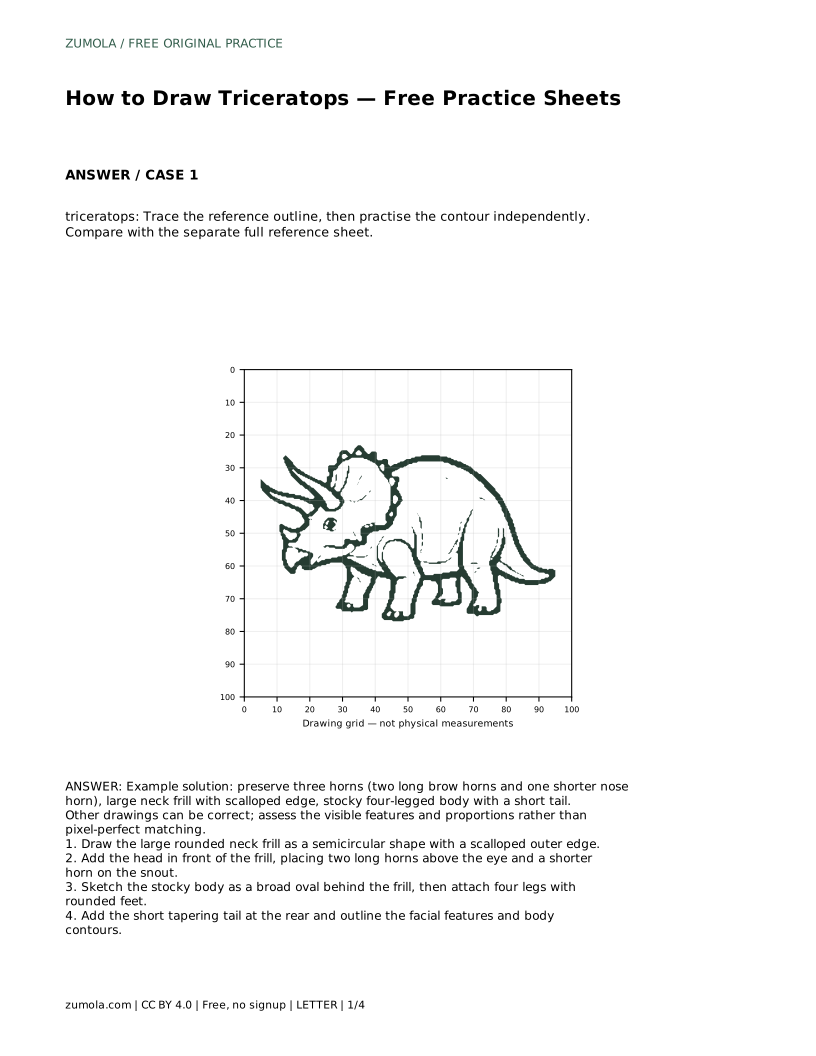
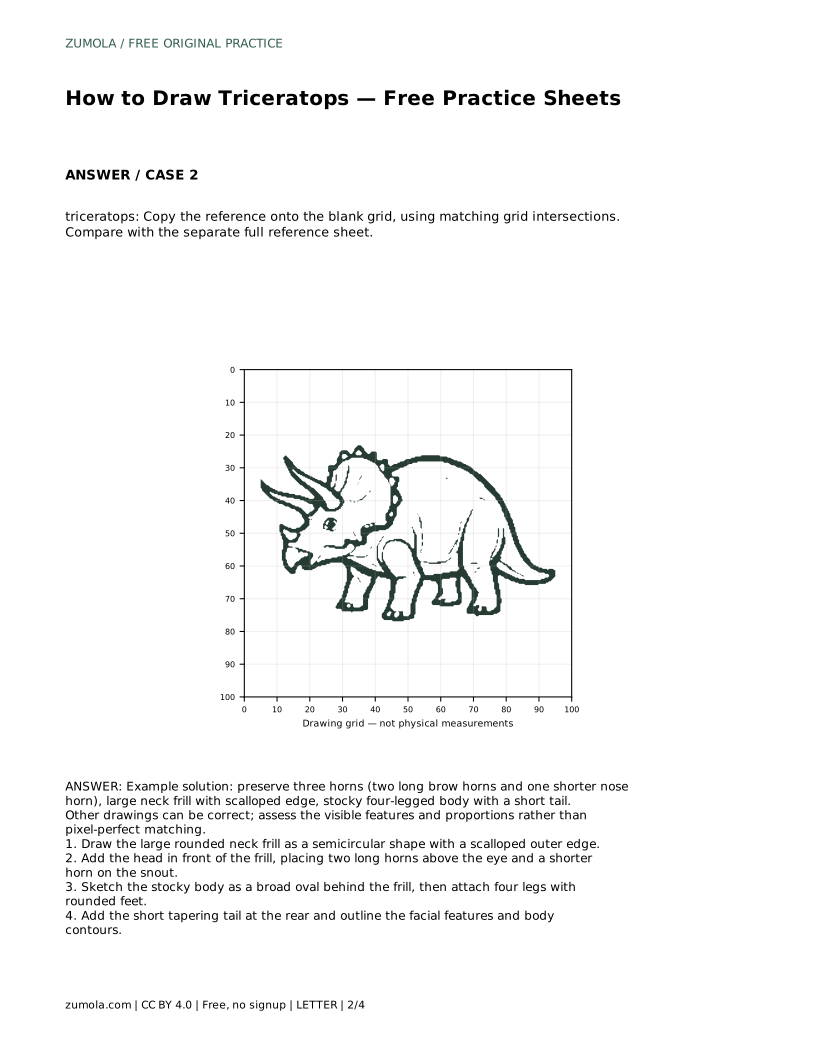
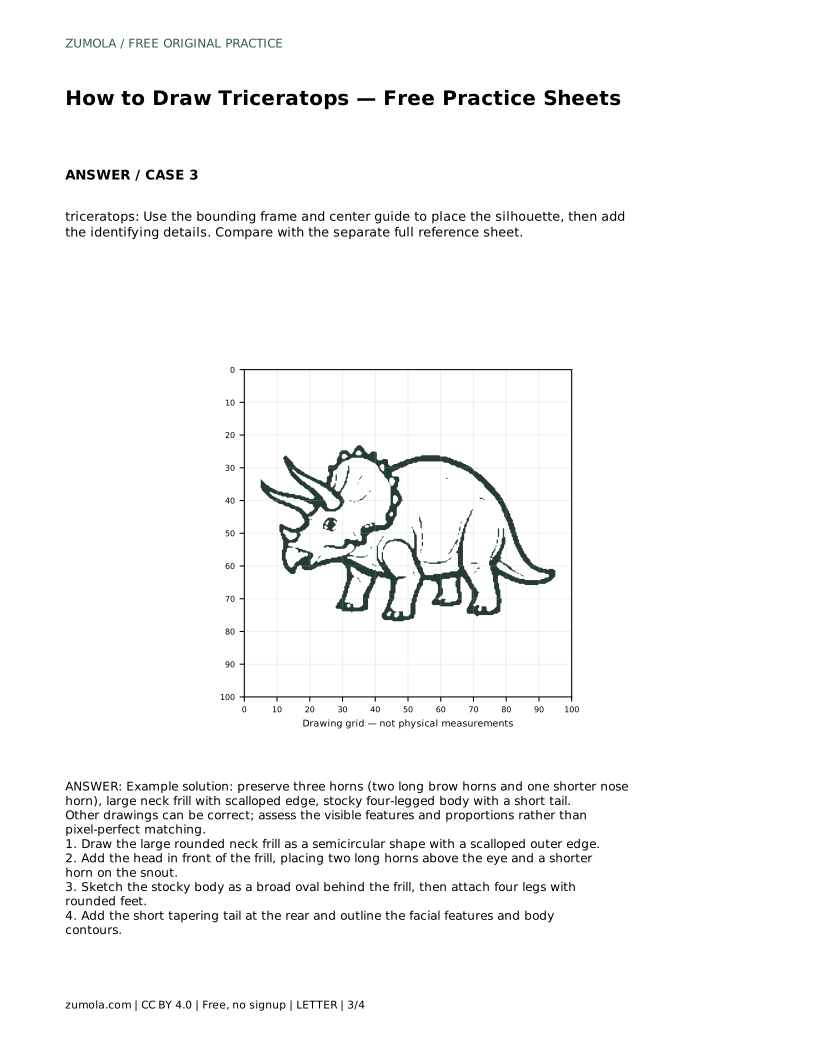
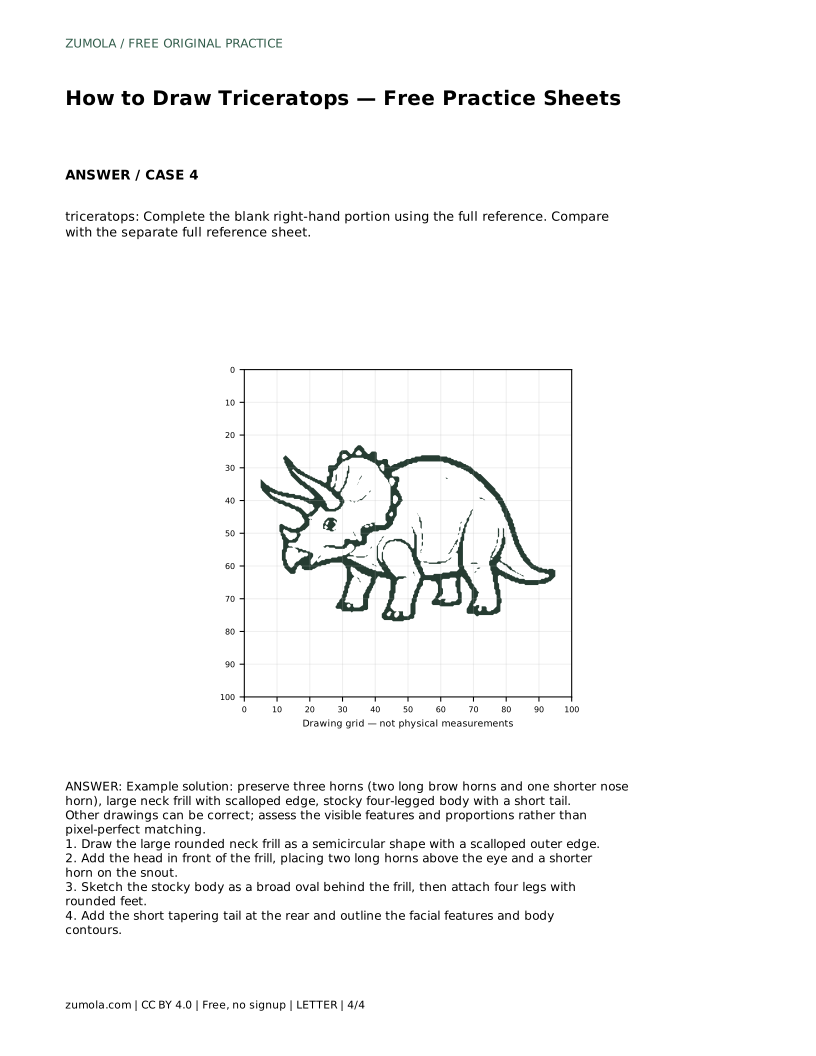
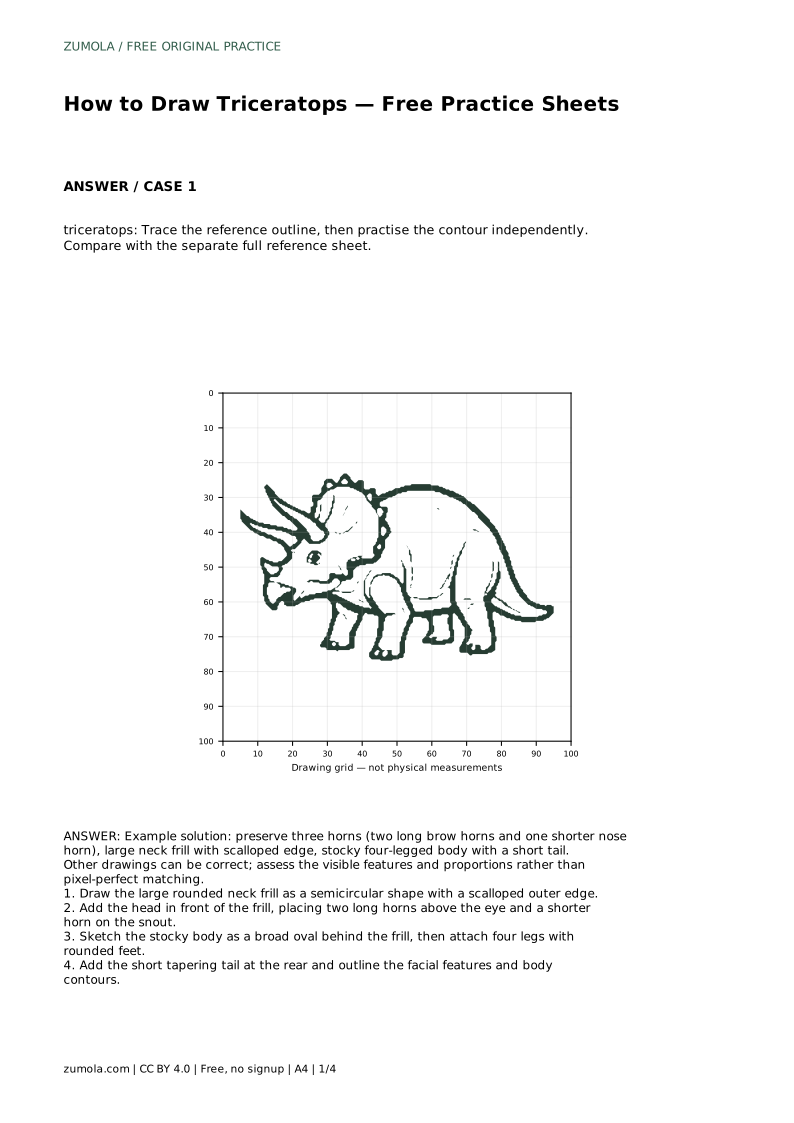
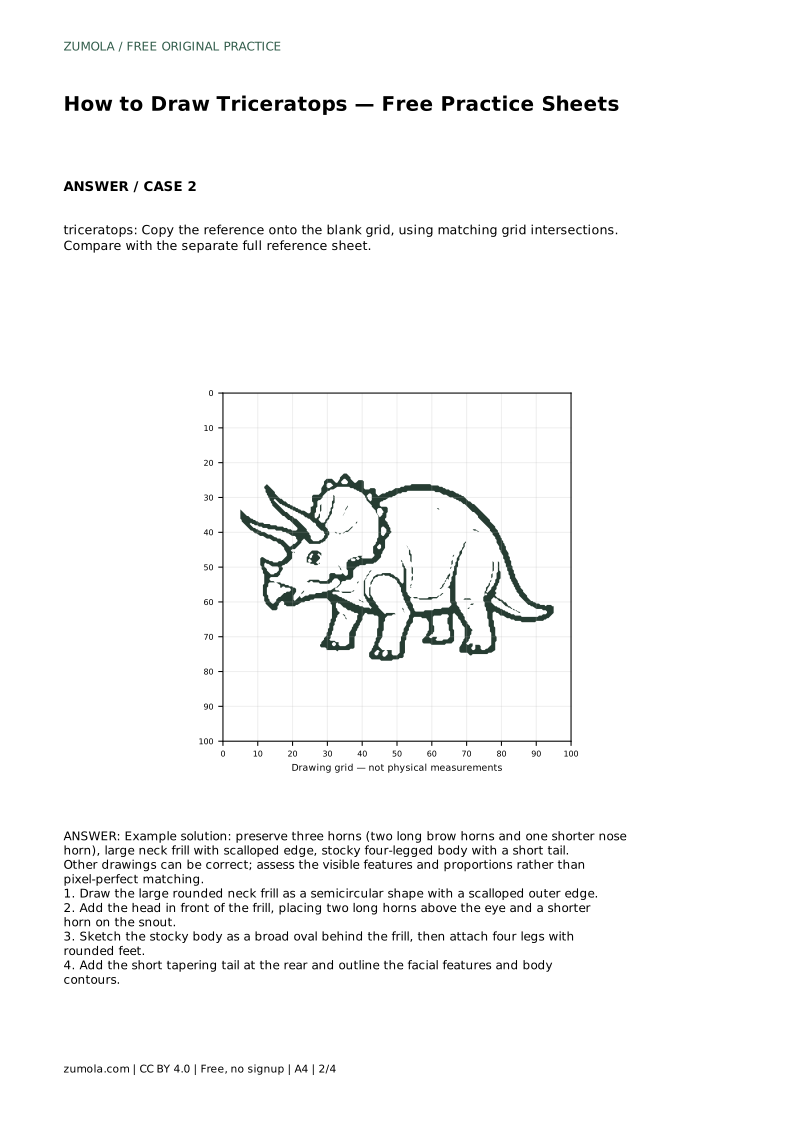
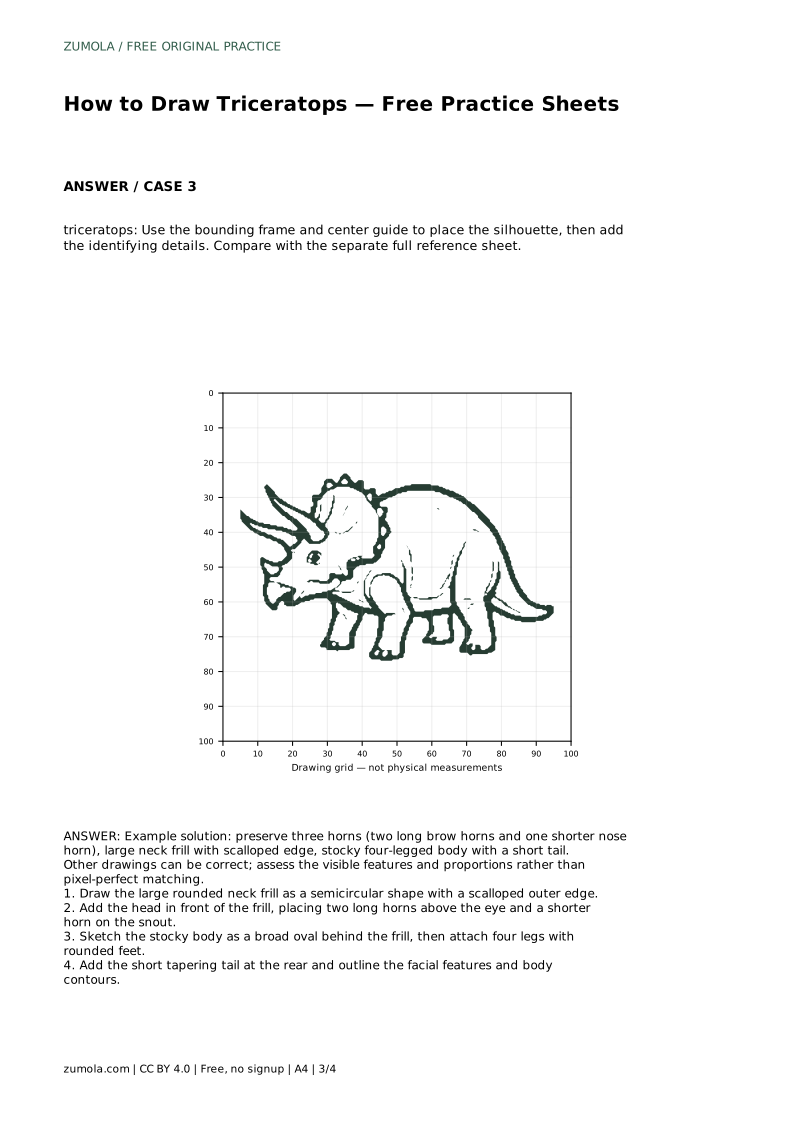
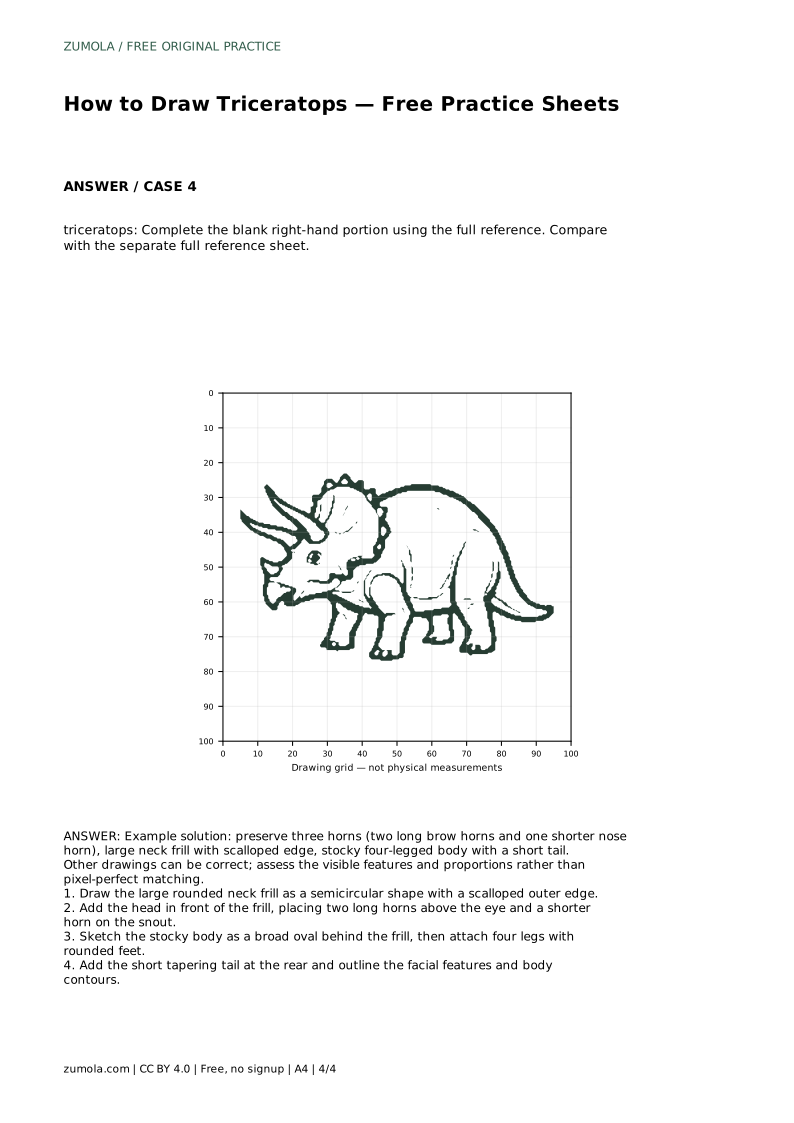
Reference diagrams
LETTER · Download PDF
A4 · Download PDF
Free original resources
Learn to draw a triceratops by building the scalloped neck frill, three horns, stocky body, four legs and short tail, then check proportions with a clear rubric.
Four original cases, with reference diagrams, practice sheets and worked answers. Everything is free; no signup required.
LETTER · Download PDF
A4 · Download PDF
LETTER · Download PDF
A4 · Download PDF
LETTER · Download PDF
A4 · Download PDF
Use A4 or US Letter to match your printer. Use the stated values and conditions to solve each exercise; diagrams are not physical measuring rulers.
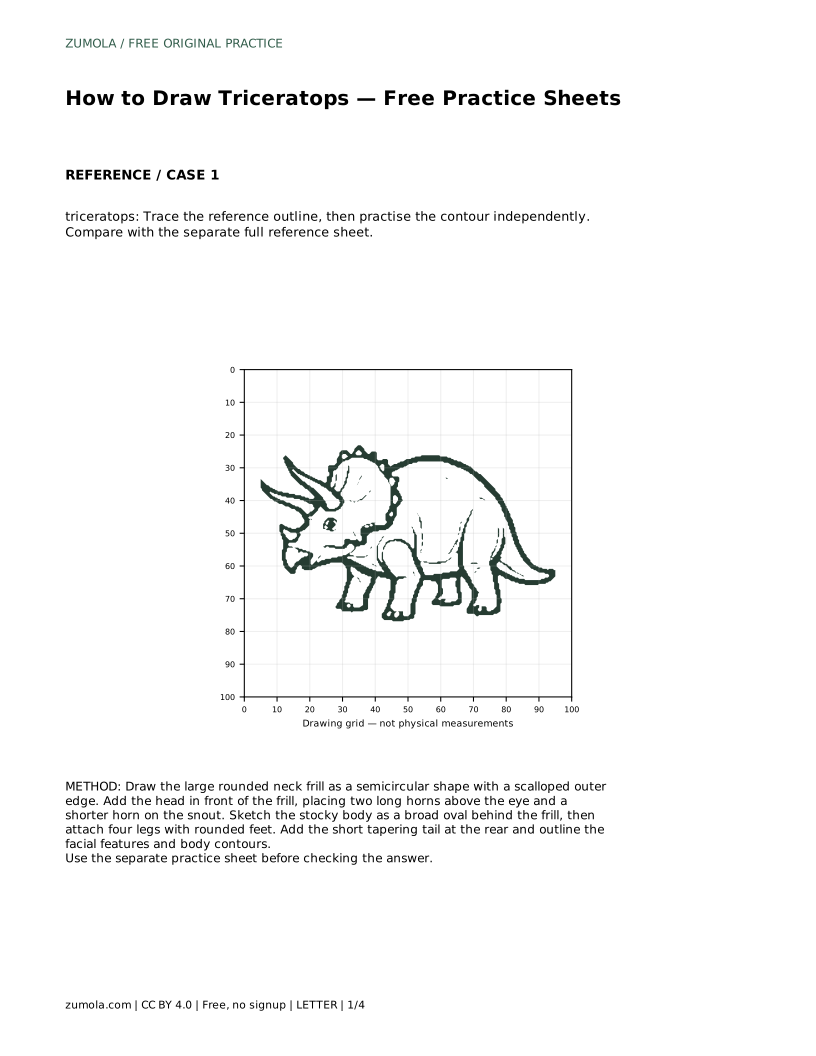
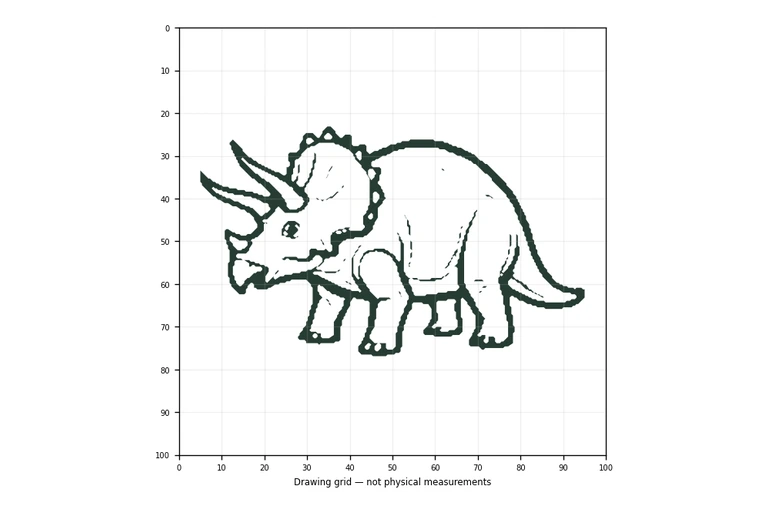
A triceratops is recognisable from a few strong shapes: a broad neck frill, three horns and a heavy four-legged body. This page shows how to build those shapes in order, so the head and frill sit correctly before you add legs and details. The method suits tracing, grid copying or free drawing, and the rubric helps you judge your own result fairly.
The neck frill is the largest single shape, so place it first. Draw a wide semicircle opening toward the body, with a gently scalloped outer edge. Keep the curve smooth rather than jagged; the scallops are shallow bumps, not deep points.
Set the head in front of the frill, overlapping its lower edge. The head is narrower than the frill and points forward. Place two long brow horns above the eye area, angled slightly outward and forward, and one shorter nose horn on the snout. Leave clear space between the brow horns so the head does not look crowded.
Behind the frill, sketch a broad oval for the body. A triceratops reads as heavy and low, so keep the oval wider than it is tall and avoid a long, slender torso. The frill should cover the front of this oval, hiding the neck.
Attach four legs beneath the body, two toward the front and two toward the rear. Give each leg a rounded foot and keep the legs fairly short and thick. Check that all four feet sit at roughly the same ground level; uneven feet make the animal look tilted.
Once the main shapes are in place, tidy the outline. Connect the frill to the body, smooth the leg joins and taper the tail. Keep the facial features simple: an eye, a mouth line and perhaps a few contour lines on the frill.
Compare your drawing with the reference sheet rather than chasing an exact match. Different angles and poses are valid. What matters is that the three horns, scalloped frill, stocky body, four legs and short tail are all visible and in sensible proportion to one another.
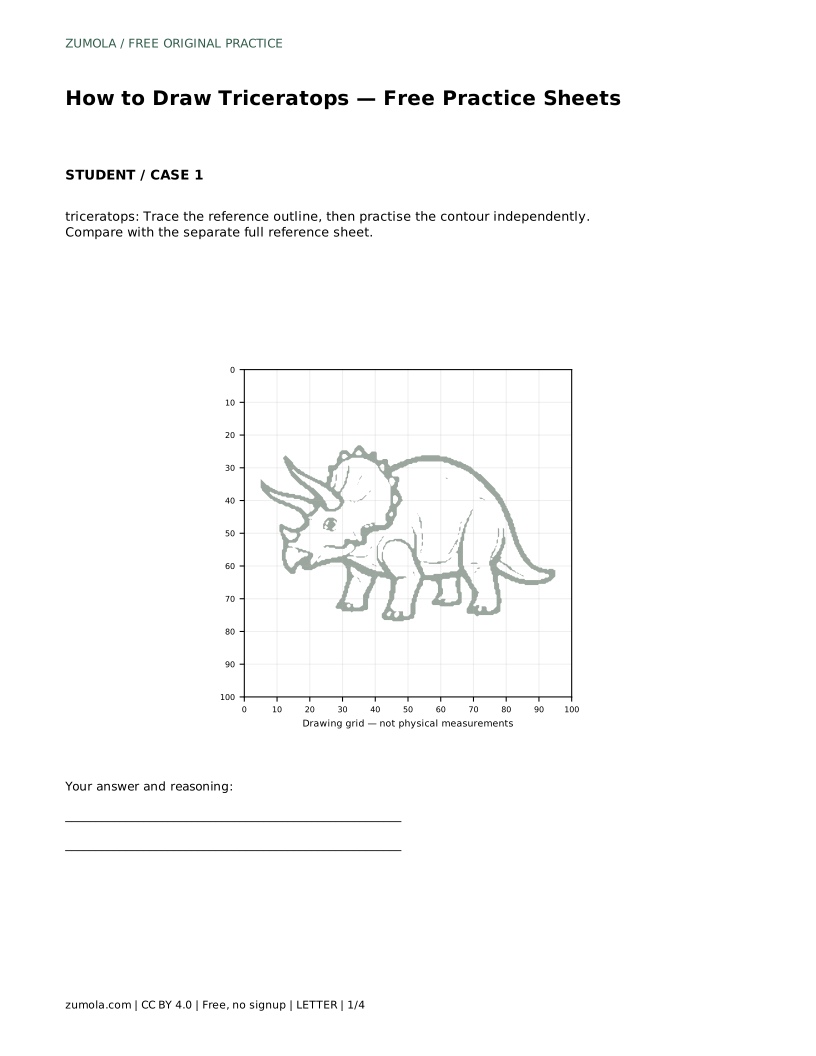
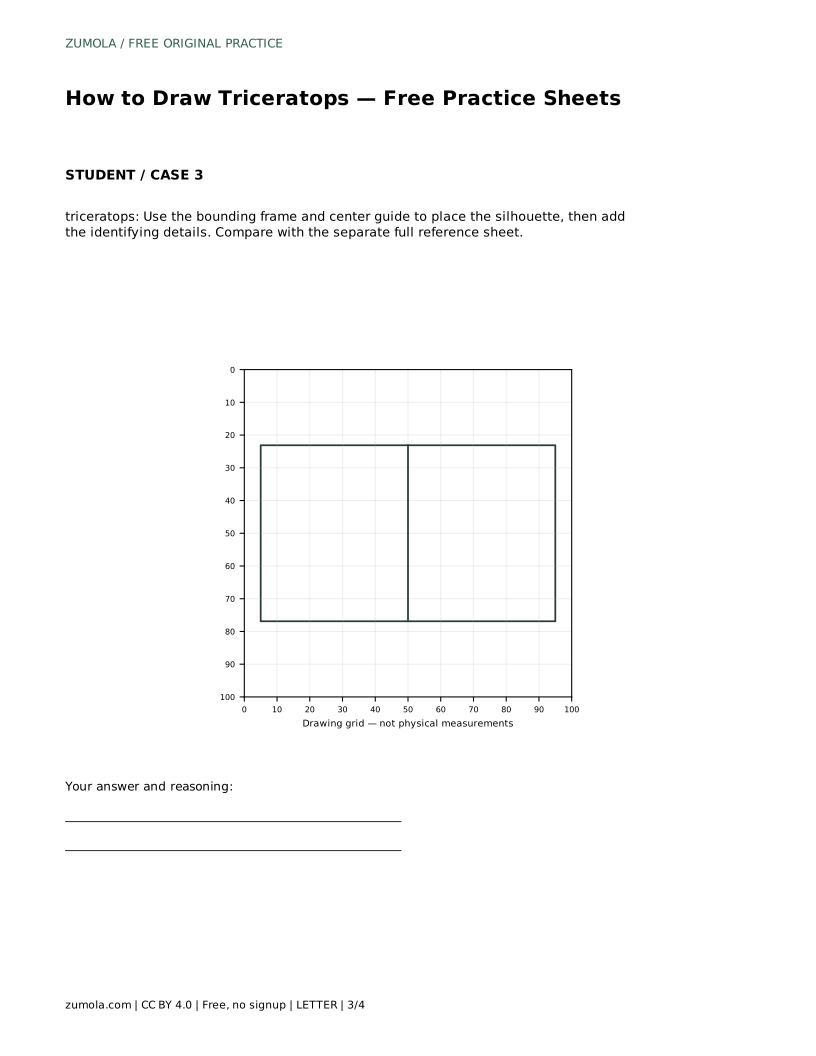
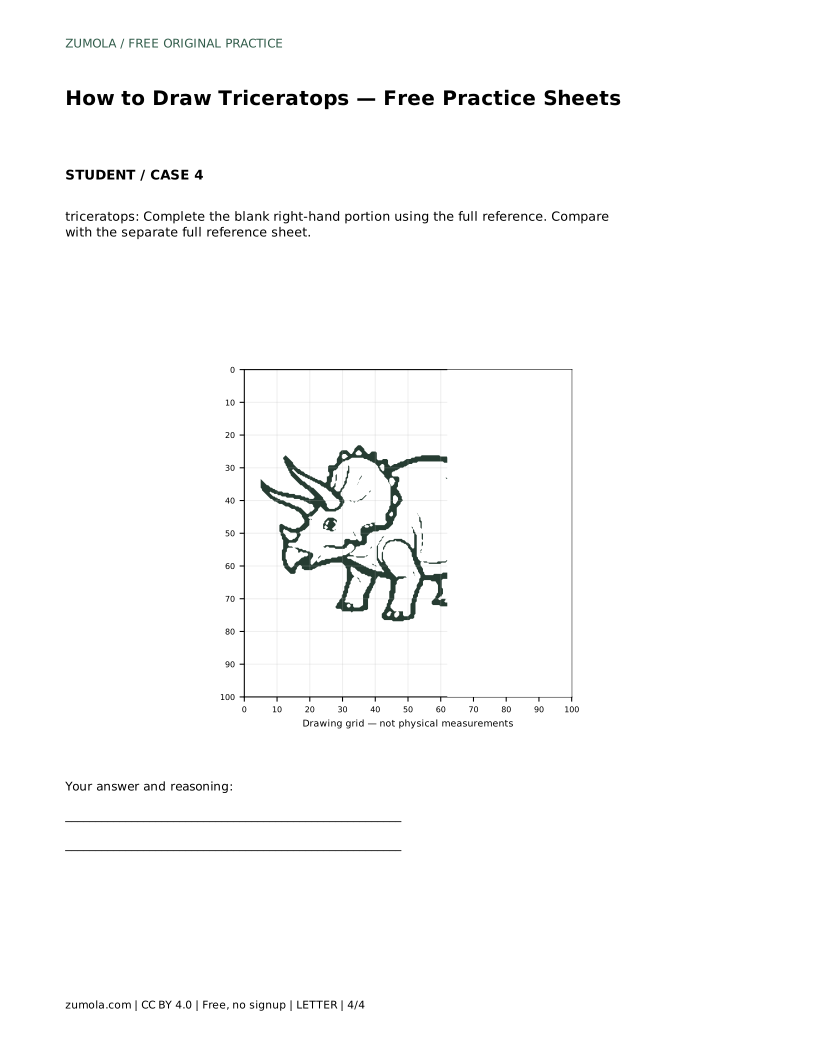
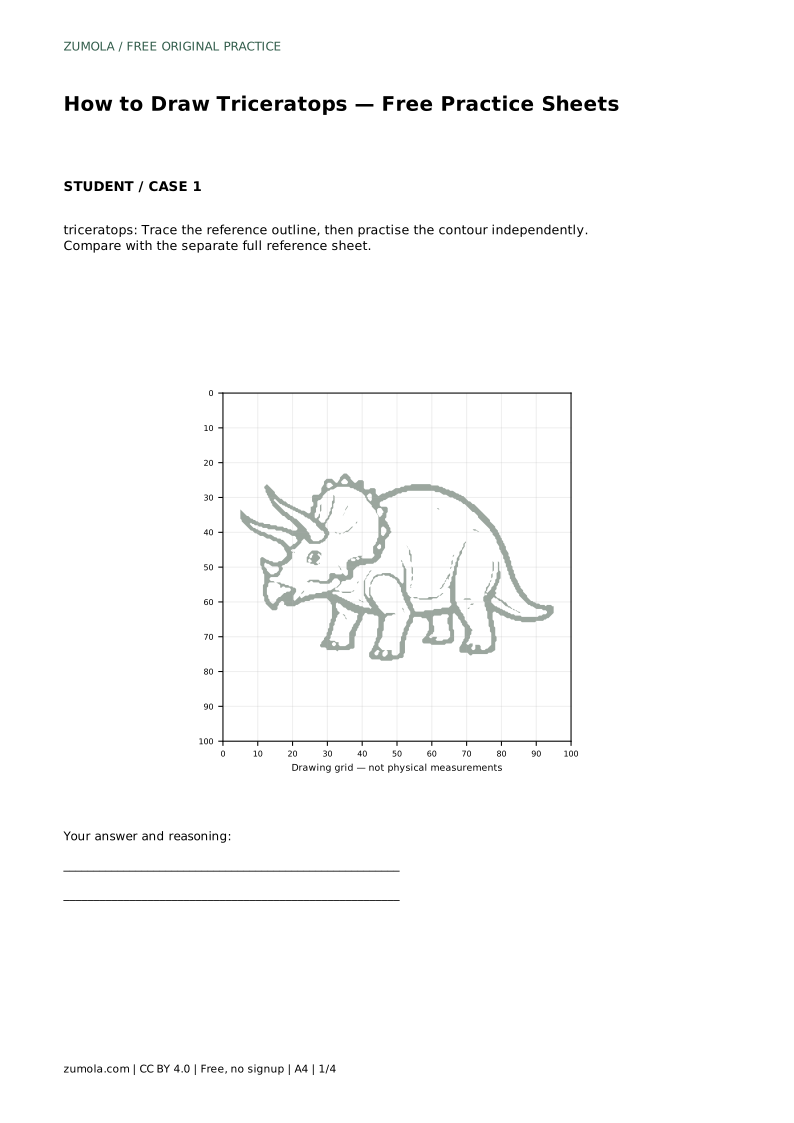
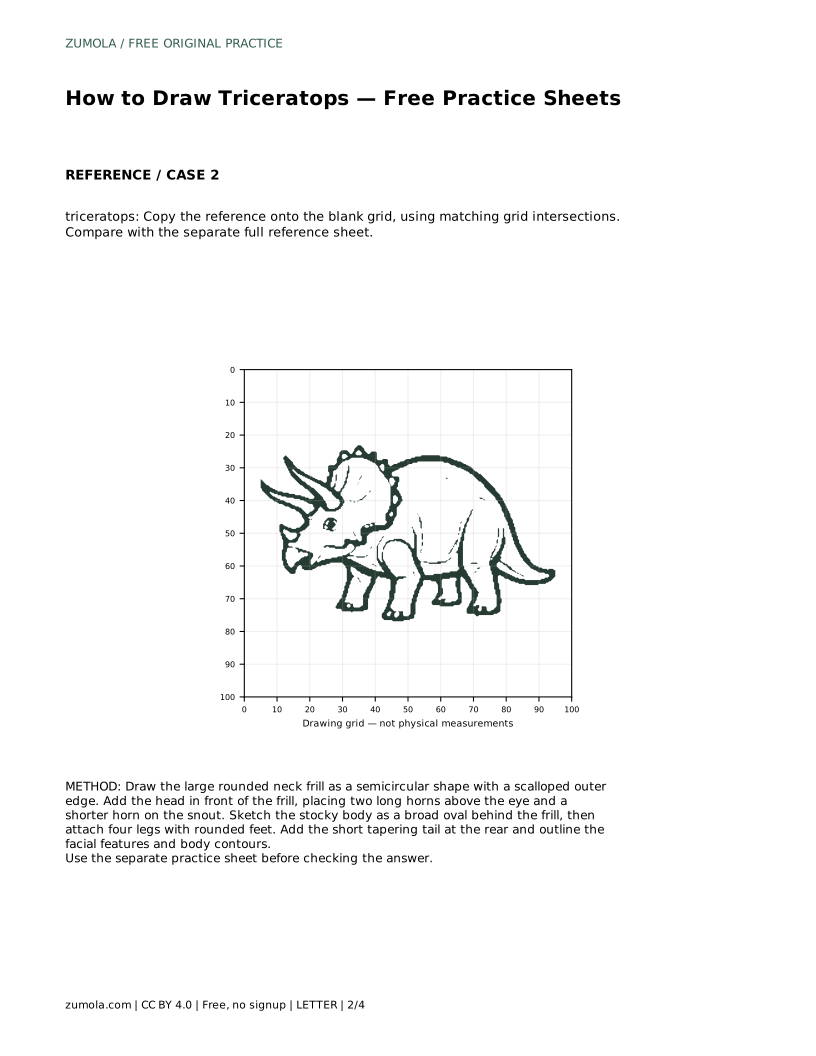
triceratops: Trace the reference outline, then practise the contour independently. Compare with the separate full reference sheet.
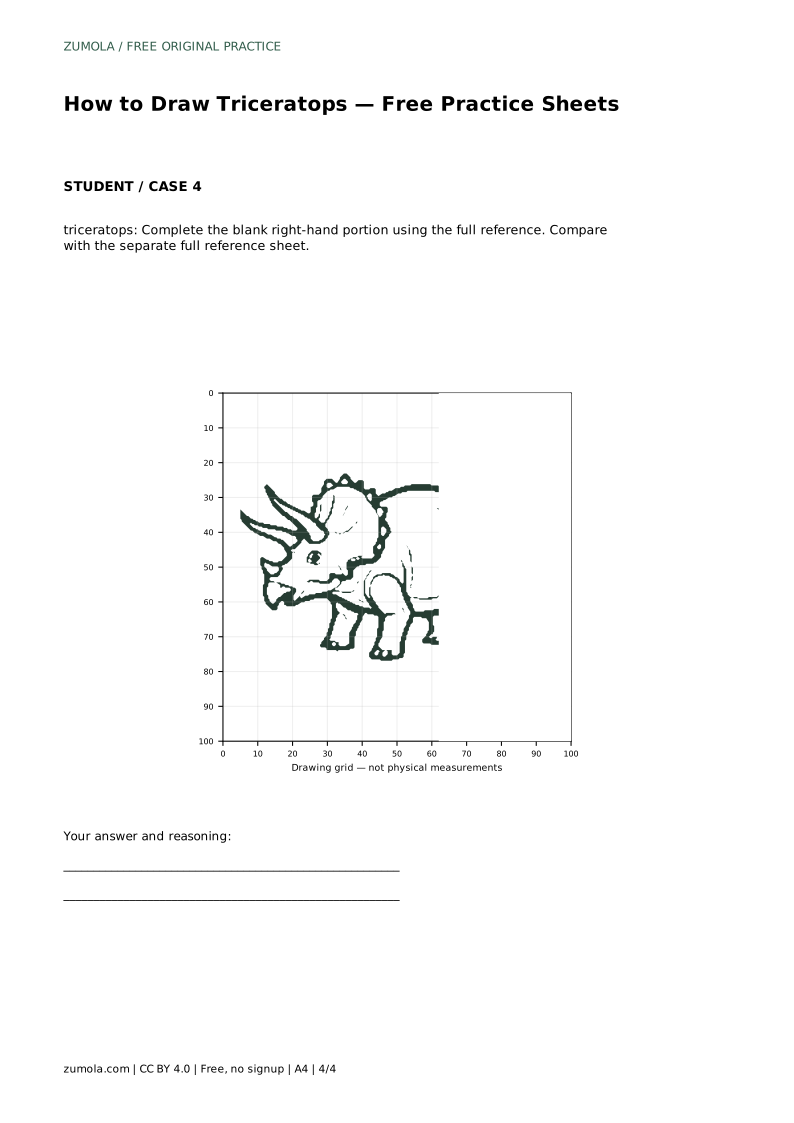
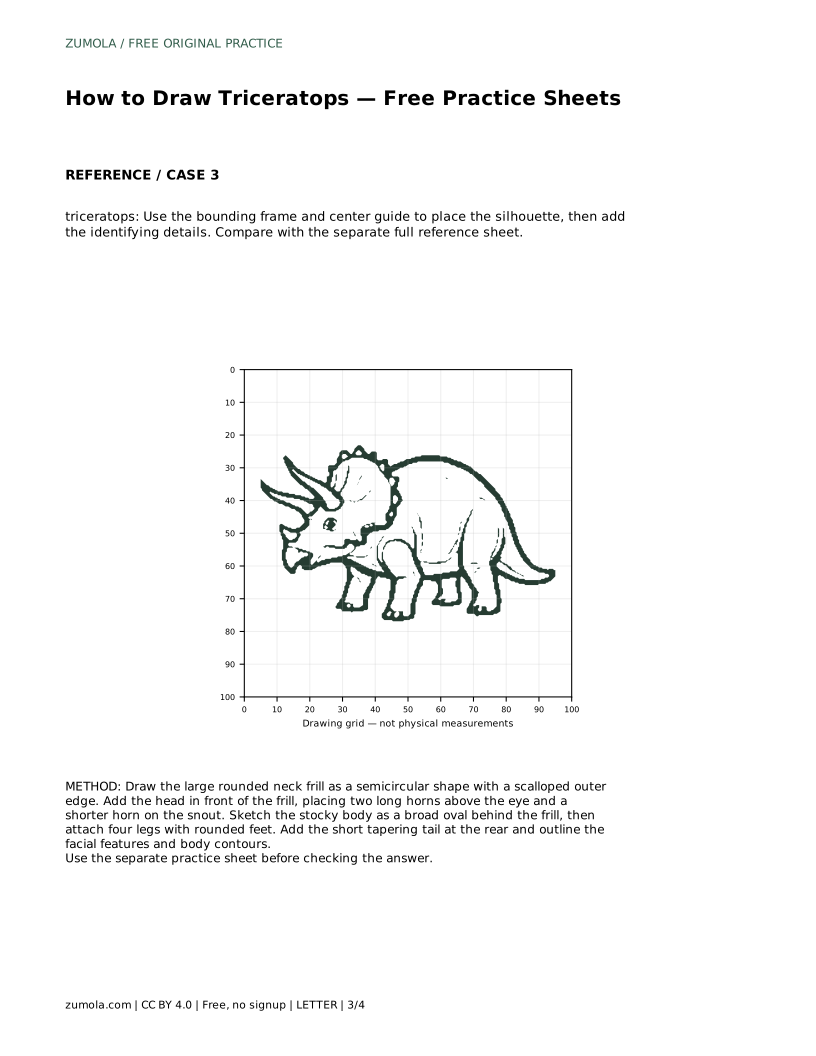
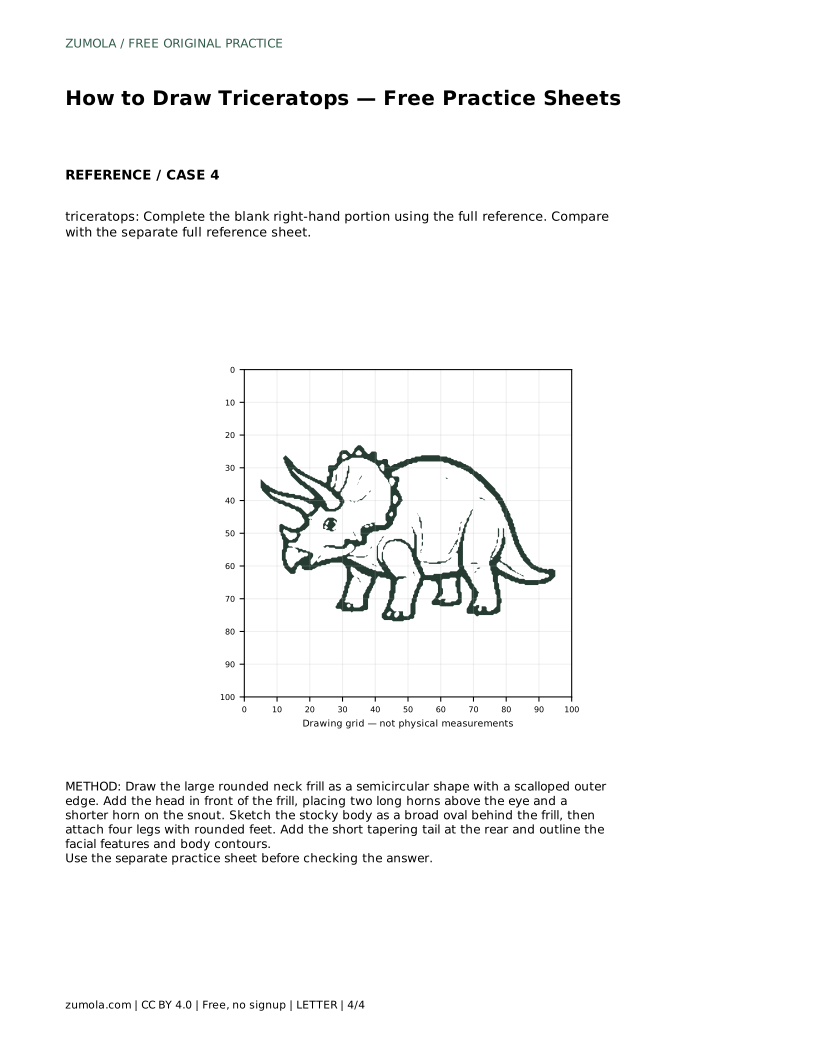
Example solution: preserve three horns (two long brow horns and one shorter nose horn), large neck frill with scalloped edge, stocky four-legged body with a short tail. Other drawings can be correct; assess the visible features and proportions rather than pixel-perfect matching. Draw the large rounded neck frill as a semicircular shape with a scalloped outer edge. Add the head in front of the frill, placing two long horns above the eye and a shorter horn on the snout. Sketch the stocky body as a broad oval behind the frill, then attach four legs with rounded feet. Add the short tapering tail at the rear and outline the facial features and body contours.
Show three: two long brow horns above the eye area and one shorter horn on the snout. Keeping that difference in length makes the drawing read correctly.
A scalloped edge helps identify the frill, but keep the bumps shallow. A smooth semicircle with small bumps is clearer than a deeply jagged outline.
Yes. The same order works from other angles: place the frill and head first, then the body, legs and tail. Check that the three horns and frill remain visible.
All drawing practice · Free coordinate paper
Original resources · CC BY 4.0 · Free for personal and classroom use with attribution.