Free original resources
Cow Drawing: Build a Standing Cow From Boxes, Shoulders and Horns
Learn a practical cow drawing method using a broad torso box, shoulder and hip landmarks, neck connection, legs and horns. Includes a rubric and common fixes.
Free resources
Letter & A4
PDF & SVG
Letter & A4
PDF & SVG
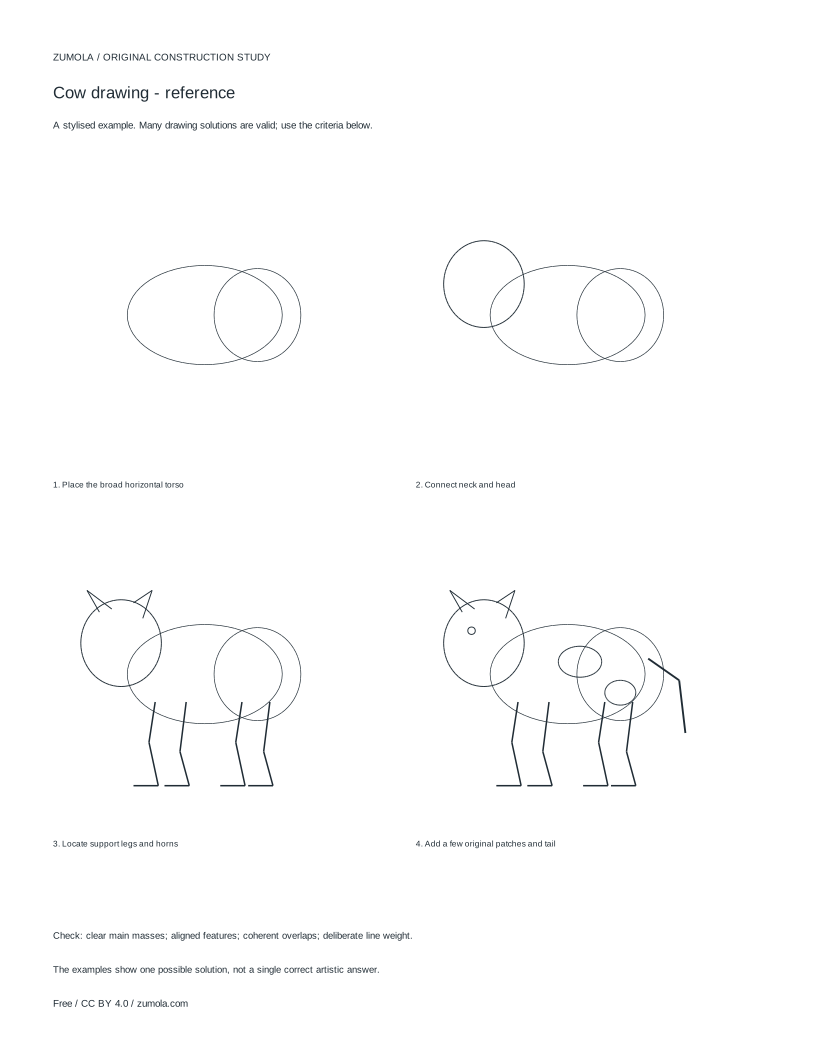
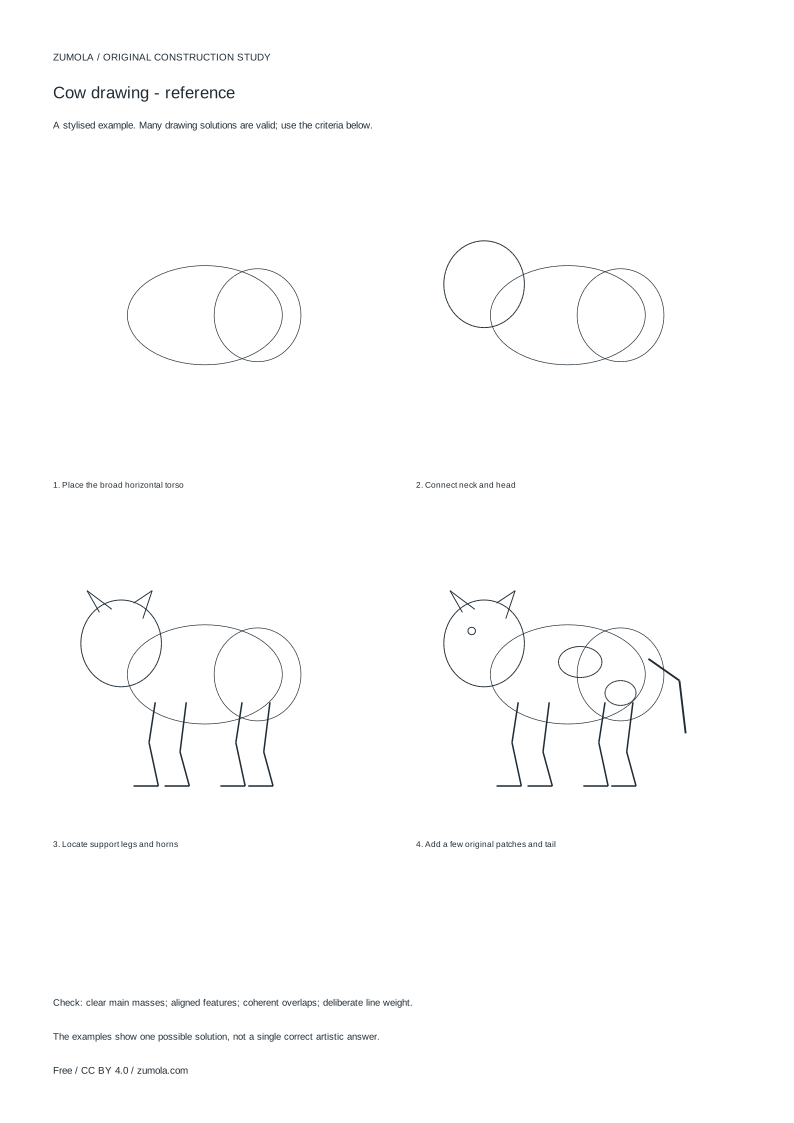
Build the drawing in four stages.
Your free printable kit.
Original reference, student practice and separate worked answers. No account or payment.
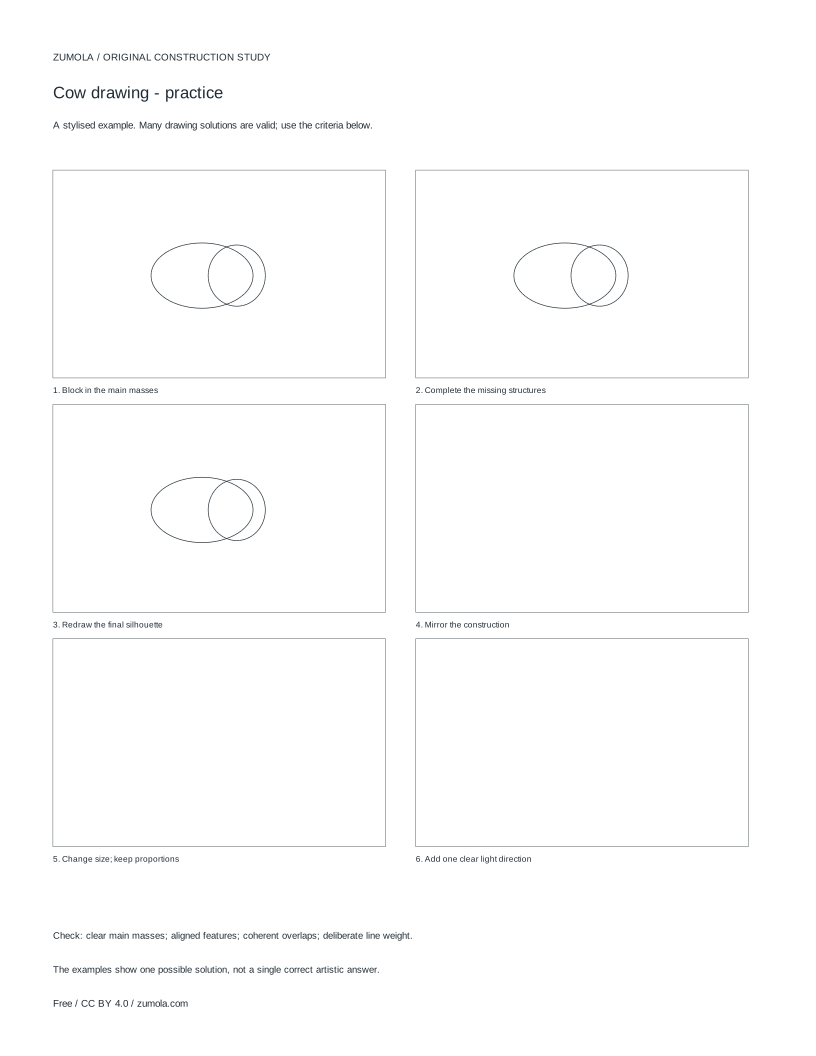
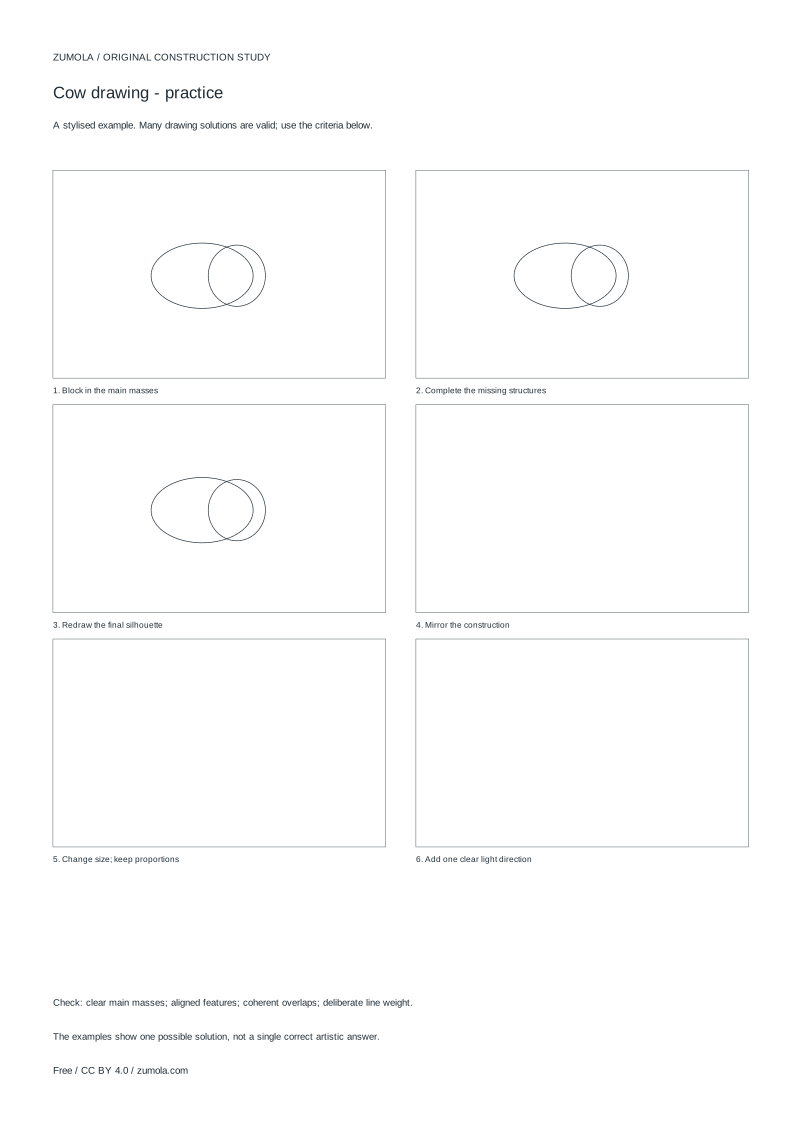
Practice worksheet
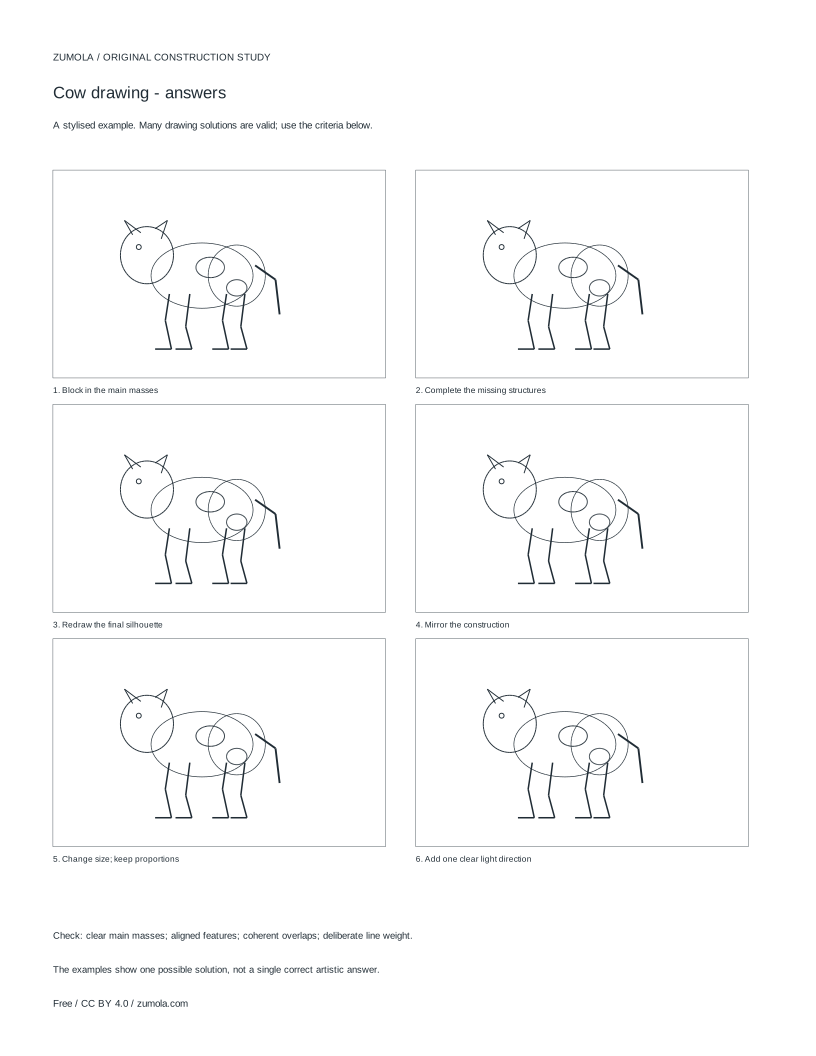
Worked answers / rubric
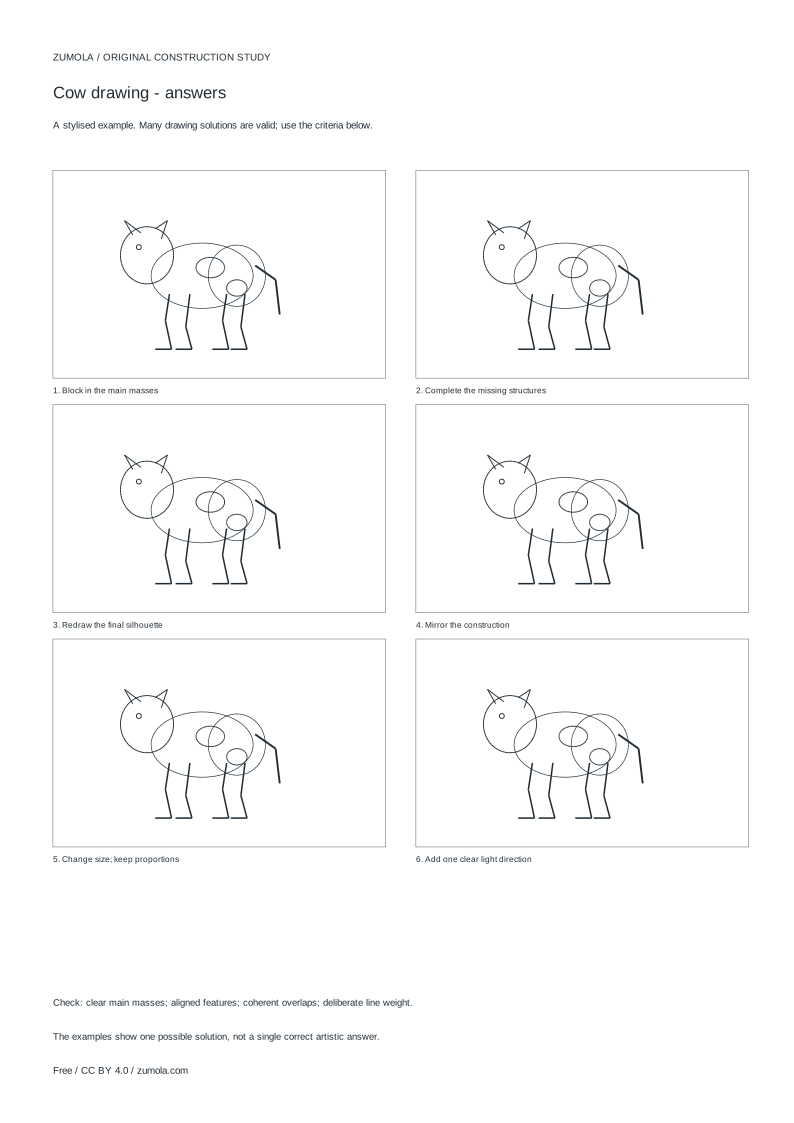
Print at Actual size / 100%. Check the calibration bar before using physical dimensions.
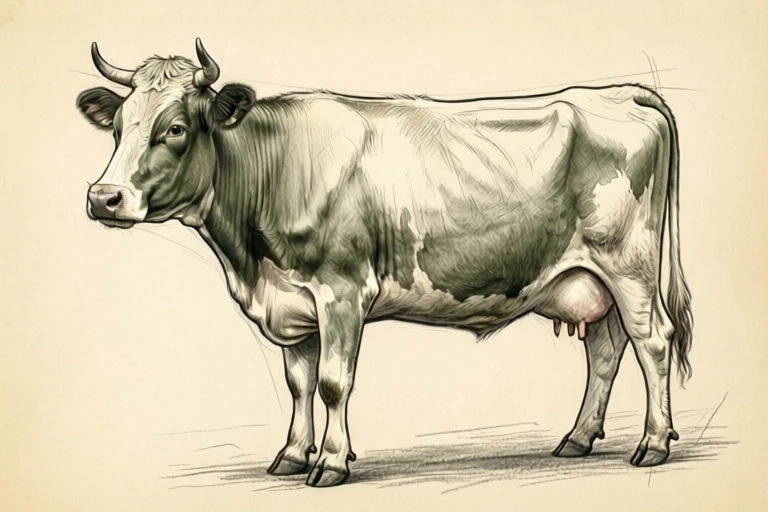
This guide shows a reliable way to draw a standing cow by building the body from simple masses before adding detail. You will place a broad horizontal torso, connect the neck and head, locate the legs and horns, then add a few original patches and a tail. The aim is a clear, stylised construction study, not a photorealistic or anatomical diagram. Work lightly at first so you can adjust proportions and overlaps before committing to darker lines.
Start With the Torso as a Broad Horizontal Box
Begin by drawing a wide, shallow box or rounded rectangle for the ribcage and belly. A cow's torso is long relative to its height, so keep the horizontal span clearly greater than the vertical depth. Tilt the box slightly if you want a sense of perspective, but keep the top and bottom edges roughly parallel.
Mark a shoulder point near the front upper corner and a hip point near the rear upper corner. These two landmarks control where the neck and hind legs attach. Light construction lines are useful here because you will erase or cover them later.
- Draw a wide horizontal box for the torso, wider than it is tall.
- Mark the shoulder near the front top corner and the hip near the rear top corner.
- Add a light centre line along the torso to keep left and right features balanced.
Connect the Neck and Head Without Losing the Body Shape
From the shoulder area, draw a short, thick neck that slopes forward and slightly down. The head sits at the end of this neck as a smaller box or wedge. Keep the head clearly smaller than the torso; a common error is making the head too large and losing the cow's heavy body character.
Place the muzzle at the front of the head and the ears to the sides. Check that the neck overlaps the torso edge rather than floating beside it. Overlap lines show which mass sits in front, which makes the drawing read as a single connected animal.
- Draw a short thick neck from the shoulder point toward the front.
- Attach a smaller head box or wedge at the neck end.
- Add the muzzle at the front and ears at the sides, checking that the neck overlaps the torso.
Locate Support Legs and Horns
A standing cow needs four legs that visibly support the body. Place the front legs below the shoulder area and the hind legs below the hip area. Draw each leg as a simple tapered column with a small joint bend, then add a hoof as a short block at the base. Keep the feet on a shared ground line so the stance looks stable.
Horns grow from the top of the head, above and behind the ears. Draw them as short curved forms that point outward and slightly up. Keep them modest in size so they do not dominate the head. If you draw a side view, only one horn may be fully visible, with the second partly hidden behind the head.
- Draw two front legs below the shoulder and two hind legs below the hip.
- Add a small joint bend and a short hoof block at each leg base.
- Place the feet on one ground line to confirm the cow is standing.
- Draw short curved horns above and behind the ears, allowing overlap where needed.
Add Patches, Tail and Final Line Weight
Add a few patches as simple closed shapes on the torso. Vary their size and position rather than copying a fixed pattern; patch layout is an artistic choice, not a fixed answer. Draw the tail from the rear of the torso, hanging down with a small tuft at the end.
Finally, review line weight. Use darker lines for the outer silhouette and lighter lines for internal construction and patch edges. Check that every overlap is intentional: neck over torso, legs under body, horns behind or above ears. Compare the main masses and feature placement before adding any extra detail.
- Draw a few closed patch shapes on the torso with varied sizes and positions.
- Add a tail from the rear of the torso with a small tuft at the end.
- Darken the outer silhouette and keep internal lines lighter.
- Check each overlap and compare the main masses before finishing.
Try this example
Draw a side-view standing cow using a torso box 8 cm wide and 4 cm deep, with the shoulder at the front top corner and the hip at the rear top corner.
Show the worked explanation
Draw the 8 cm by 4 cm box first, confirming it is twice as wide as deep. Mark the shoulder at the front top corner and the hip at the rear top corner. Add a short neck sloping forward from the shoulder, then a head smaller than the torso at the neck end. Place two front legs below the shoulder and two hind legs below the hip, with all four hooves on one ground line. Add short curved horns above the ears, a few closed patches inside the torso, and a tail from the rear. Darken the outer silhouette and keep construction lines light.
Common mistakes
- Making the torso too tall and narrow, so the cow looks like a different animal. Redraw the torso box so its horizontal span is clearly greater than its vertical depth, then recheck the shoulder and hip marks.
- Letting the head float beside the neck instead of connecting to it. Extend the neck so it overlaps the torso edge, then place the head at the neck end and redraw the join.
- Placing the feet on different levels so the standing pose looks unstable. Draw one light ground line first and place all four hoof blocks on it, adjusting leg length as needed.
Check your work
- The torso is clearly wider than it is deep, matching a broad horizontal body mass.
- The neck overlaps the torso and the head is smaller than the torso.
- Four legs are placed below the shoulder and hip areas, with hooves on a shared ground line.
- Horns sit above and behind the ears, with overlaps drawn intentionally.
- Patches are closed shapes inside the torso and vary in size and position.
- Outer silhouette lines are darker than internal construction lines.
Questions before you start
How do I keep the cow's proportions believable?
Compare the torso length to its depth and keep the head smaller than the torso. Check that the shoulder and hip marks sit near the top corners of the torso box before adding legs.
Can I draw a cow from the front instead of the side?
Yes. In a front view the torso appears narrower and the head is more central. Keep the same order: torso mass, neck and head, legs and horns, then patches and tail. Expect more overlap and less visible body length.
Do the patches need to match a real cow pattern?
No. Patch layout is an artistic choice. Use a few closed shapes with varied size and position, and keep them inside the torso outline so the body still reads clearly.