Free original resources
Lion Drawing: Build Shoulders, Mane and Muzzle in Four Stages
Learn a structured lion drawing method: place shoulder and pelvis masses, wrap the head in a mane shape, build the muzzle and legs, then refine edges and tail.
Free resources
Letter & A4
PDF & SVG
Letter & A4
PDF & SVG
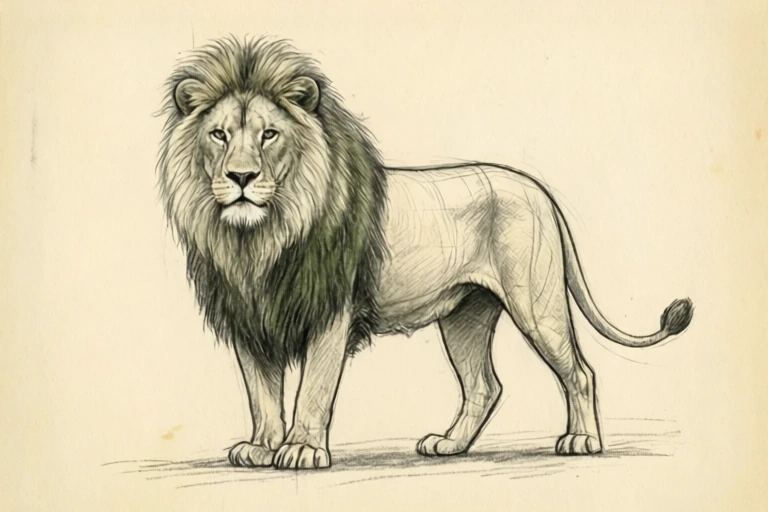
Build the drawing in four stages.
Your free printable kit.
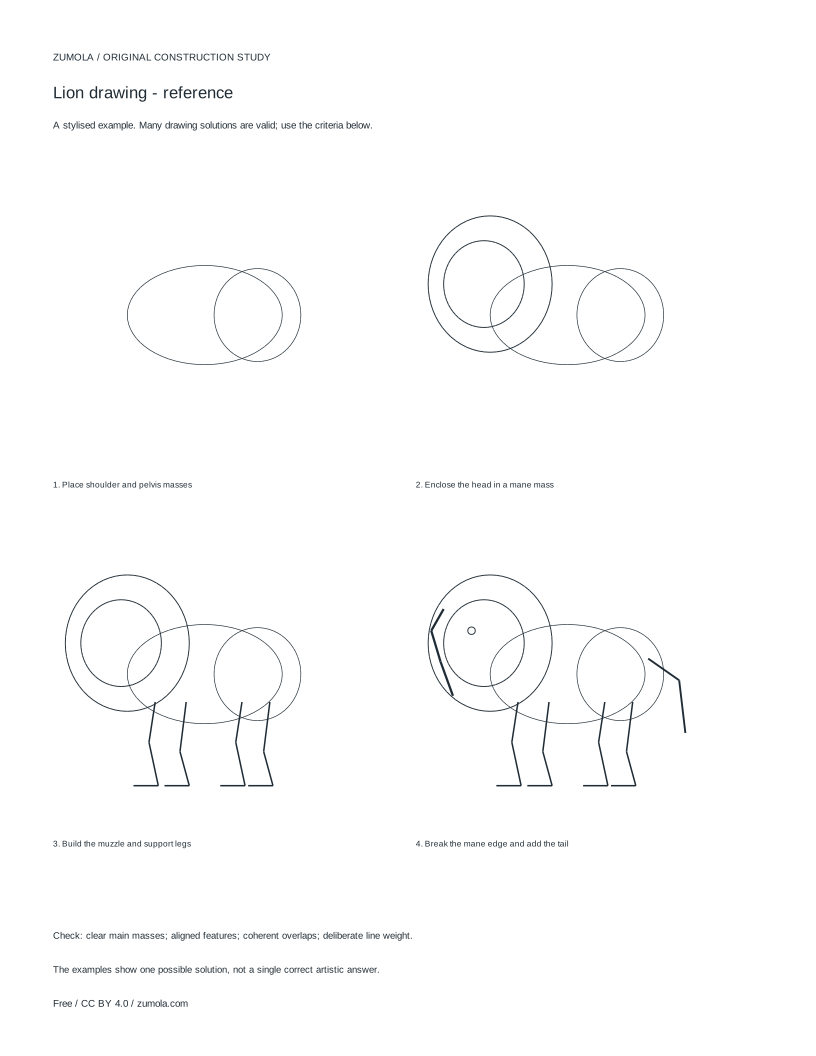
Original reference, student practice and separate worked answers. No account or payment.
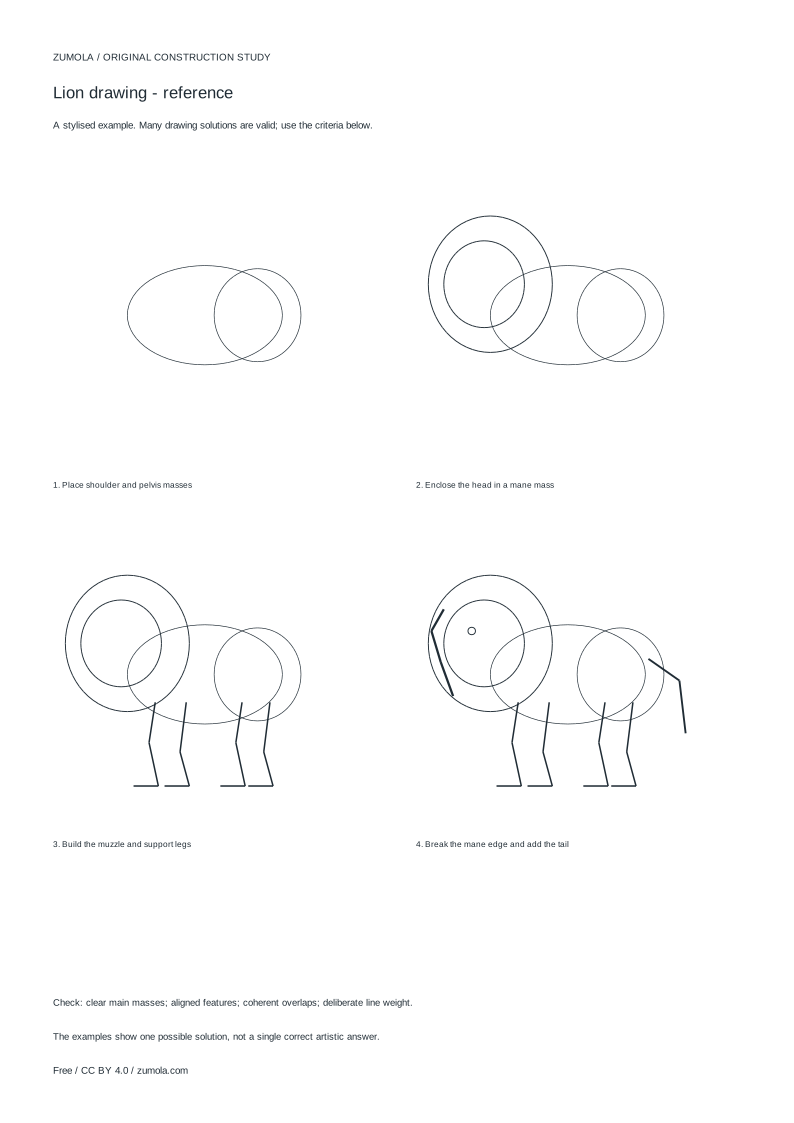
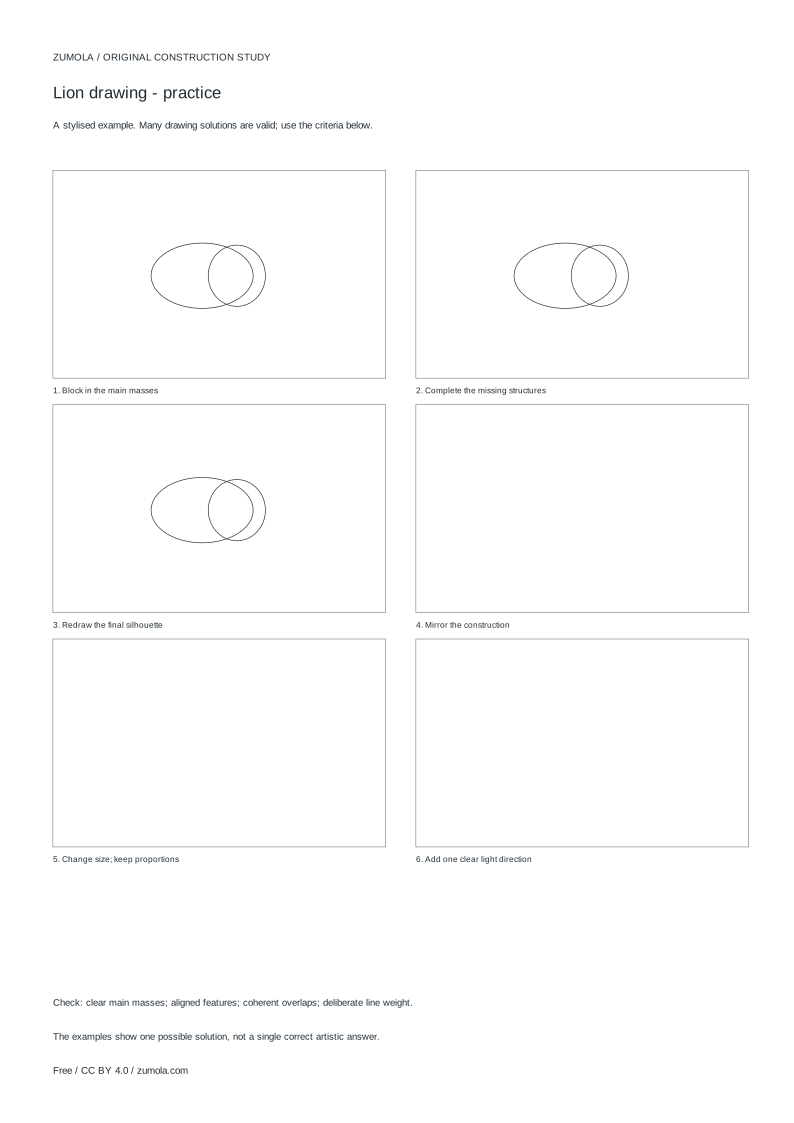
Practice worksheet
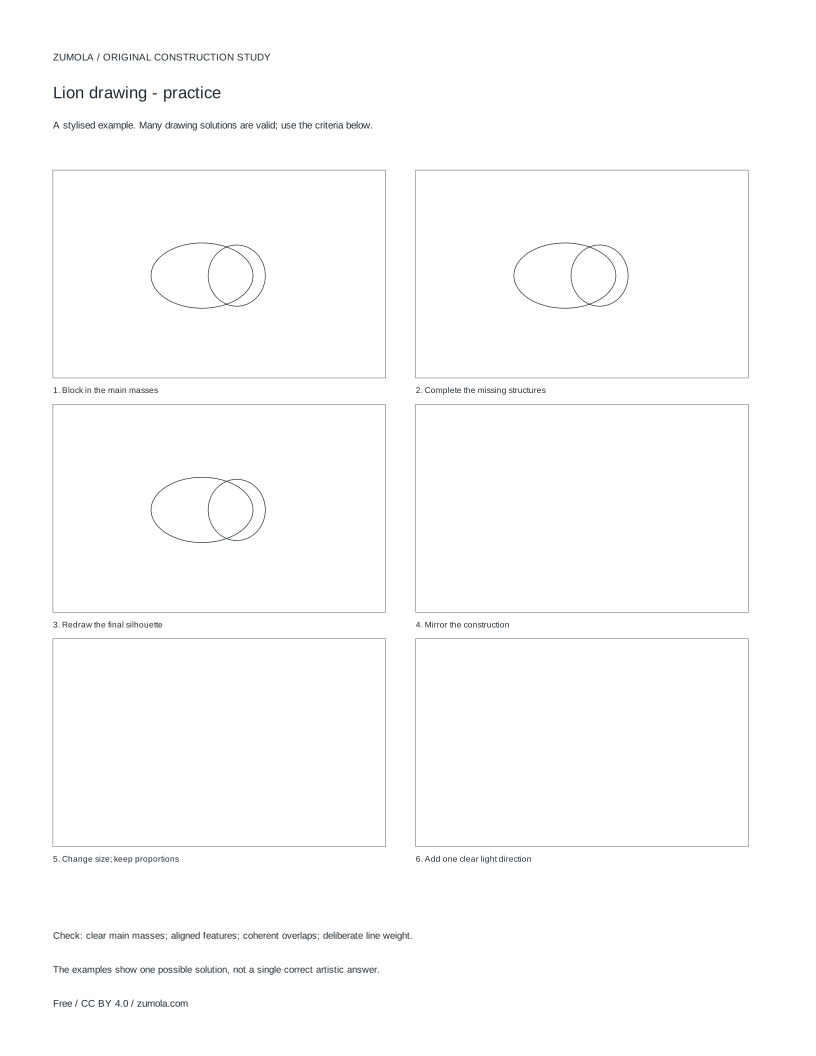
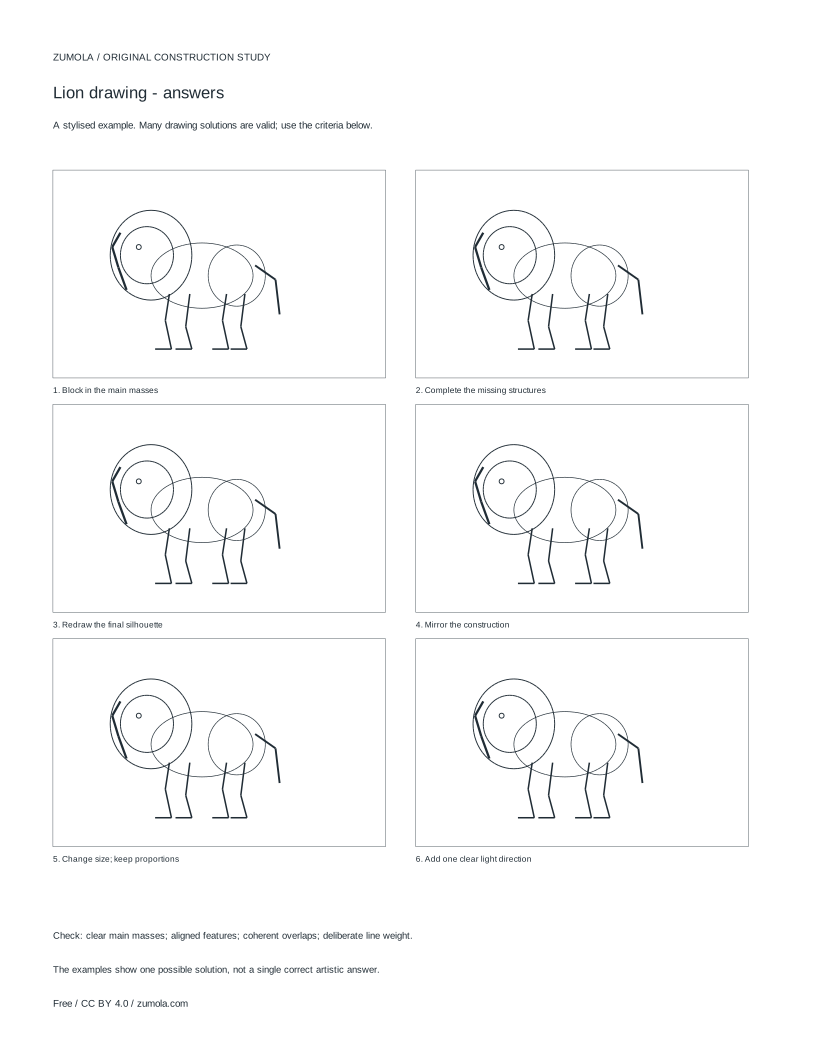
Worked answers / rubric
Print at Actual size / 100%. Check the calibration bar before using physical dimensions.
A lion drawing becomes manageable when you stop treating the animal as one outline and start stacking simple masses. This guide builds an ordinary lion from a shoulder block, a pelvis block, a wedge-shaped face and a mane that wraps around the skull. The aim is a clear, stylised construction study, not a photorealistic or anatomical diagram. Work lightly at first so later lines can overlap earlier ones without confusion.
Start with two body masses and a spine line
Begin on plain paper with a light pencil. Draw a rounded rectangle for the shoulder mass and a slightly smaller oval for the pelvis, leaving a gap between them roughly equal to one shoulder width. Join the two with a gentle curve for the spine, then add a second curve underneath for the belly. These four marks fix the lion's length and height before any detail appears.
The shoulder block matters most because the mane will sit on top of it. Keep the shoulder mass wider than the pelvis so the front of the animal reads as heavier. Check the gap: if the two masses touch, the body will look short; if the gap is much wider than one shoulder, the lion will look stretched.
- Draw a rounded rectangle for the shoulder mass.
- Draw a smaller oval behind it for the pelvis.
- Connect the tops with a spine curve and the undersides with a belly curve.
- Mark a light vertical line through the shoulder block as a centre guide for the head.
Wrap the head in a mane mass
Place the head inside a larger mane shape rather than drawing the face first. Sketch a rough circle or soft polygon around the head area, centred above the shoulder block. The mane should overlap the shoulder mass at the bottom, so its lower edge sits slightly in front of the shoulder line. This overlap is what makes the head look attached rather than floating.
Inside the mane, draw a wedge for the face: narrow at the nose, wider at the cheeks. The wedge points forward and slightly down. Keep the eyes roughly level with the middle of the wedge, not at the top. At this stage the mane is a single enclosed shape; the spiky edge comes later.
- Sketch a soft mane shape centred over the shoulder guide.
- Let the mane's lower edge overlap the shoulder mass.
- Draw a forward-pointing wedge inside the mane for the face.
- Place eye marks near the middle of the wedge and a nose mark at its tip.
Build the muzzle and support legs
Add a small rounded box at the front of the wedge for the muzzle, then a short line beneath it for the lower jaw. The muzzle should be narrower than the cheeks and sit low on the face. For the legs, draw two straight support lines from the shoulder block down to the ground and two from the pelvis. Add simple paw shapes at the base, keeping all four feet on one horizontal ground line.
Check the overlaps: the front legs should start behind the mane's lower edge, and the rear legs should sit under the pelvis oval. If a leg line crosses the belly curve, shorten it. Legs that are too long will make the body look small; compare leg length to body depth before adding thickness.
- Draw a small rounded muzzle box at the wedge tip.
- Add a short jaw line under the muzzle.
- Drop two support lines from the shoulder block and two from the pelvis.
- Place simple paws on a single ground line and trim any line that crosses the belly.
Break the mane edge and add the tail
Replace the smooth mane outline with a series of uneven points, keeping each point attached to the original shape so the mane still reads as one mass. Vary the point lengths; a uniform fringe looks like a collar. Add a tail curve from the pelvis, ending in a small tuft. Finally, adjust line weight: heavier lines along the shoulder and mane base, lighter lines for the face and tail.
Because art has many valid outcomes, judge the result by structure rather than exactness. Compare the main masses, feature placement, overlaps and line weight against your first light sketch. A drawing with a clear shoulder block, a mane that overlaps it, and feet on one ground line is working, even if the proportions differ from another version.
- Turn the smooth mane outline into uneven points attached to the same mass.
- Curve a tail from the pelvis and add a small tuft.
- Darken lines at the shoulder and mane base.
- Compare masses, feature placement, overlaps and line weight to the light sketch.
Try this example
Build a lion on paper where the shoulder block is 6 cm wide and the pelvis oval is 4 cm wide, with a gap of 6 cm between them.
Show the worked explanation
The body length from the front of the shoulder to the back of the pelvis is 6 + 6 + 4 = 16 cm. Centre the mane above the shoulder block, letting its lower edge overlap the shoulder line by about 1 cm. Draw the face wedge inside the mane, then drop two leg lines from the shoulder and two from the pelvis to one ground line. The gap equals the shoulder width, so the proportions stay balanced.
Common mistakes
- Drawing the face before the mane and shoulder masses. Place the shoulder block and mane shape first, then fit the face wedge inside the mane.
- Making the mane a flat circle that sits above the shoulder without overlapping it. Lower the mane's bottom edge so it crosses in front of the shoulder line.
- Putting the four paws on different levels. Draw one horizontal ground line first and place every paw on it.
Check your work
- Shoulder and pelvis masses are distinct and separated by a clear gap.
- The mane is one enclosed mass that overlaps the shoulder block.
- The face wedge points forward with eyes near its middle and a muzzle at the tip.
- All four paws rest on a single horizontal ground line.
- Mane points vary in length and stay attached to the mane mass.
- Line weight is heavier at the shoulder and mane base than on the face and tail.
Questions before you start
Should the lion's eyes sit at the top of the face wedge?
No. Place them near the middle of the wedge, with the muzzle box below. Eyes at the top leave no room for the forehead and make the face look compressed.
How wide should the gap between the shoulder and pelvis masses be?
About one shoulder width. A narrower gap shortens the body; a much wider gap stretches it.
Can I use this method for a lion cub?
Yes, with changes. Shrink the mane mass and widen the head relative to the body, but keep the shoulder block, pelvis oval and single ground line as the structure.