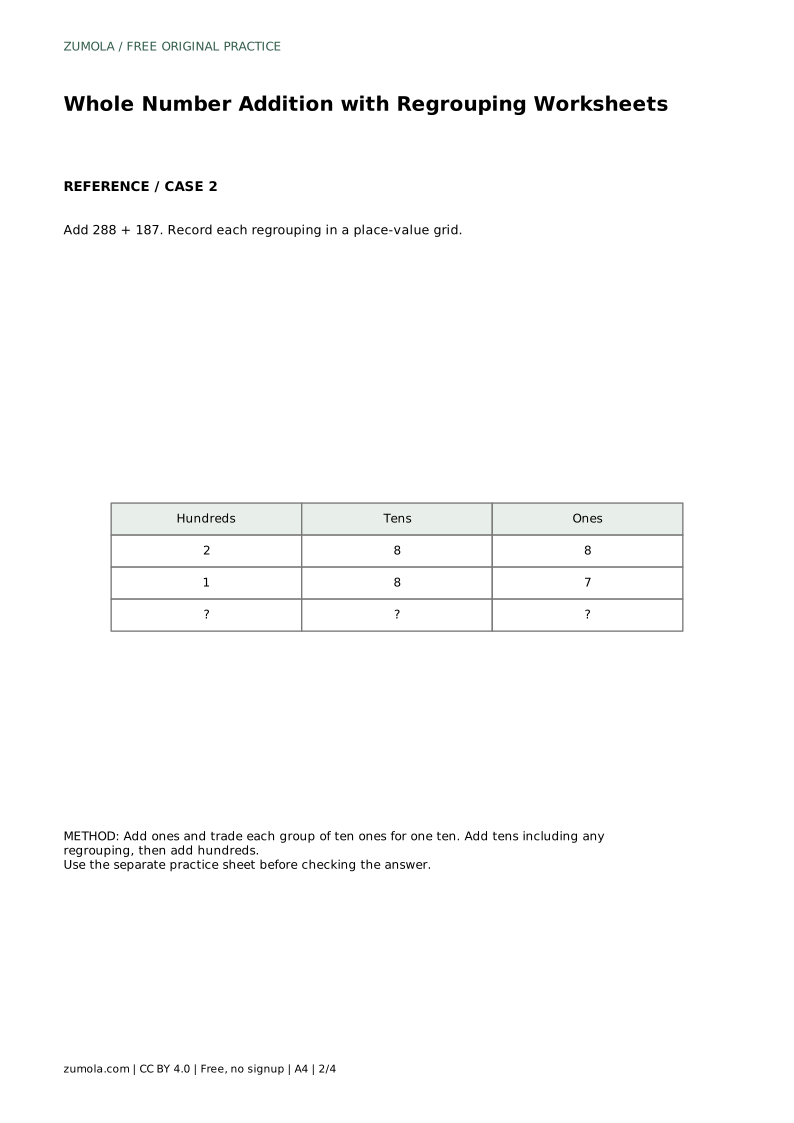
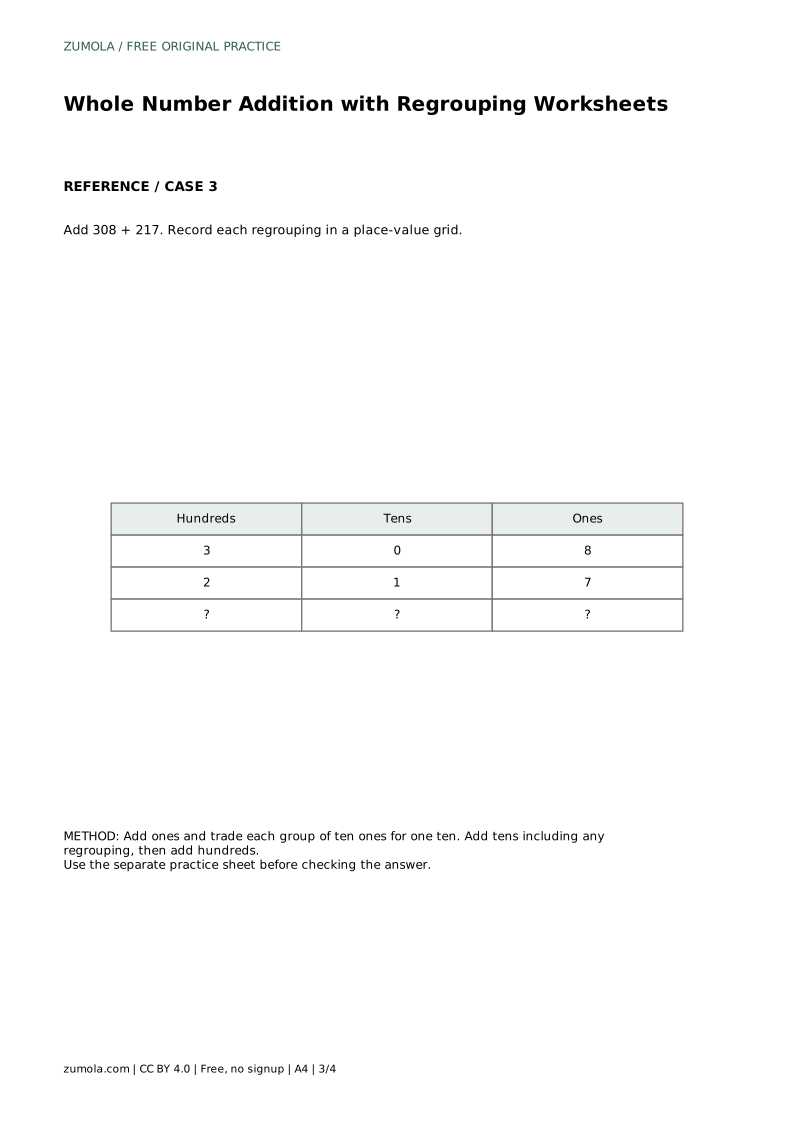
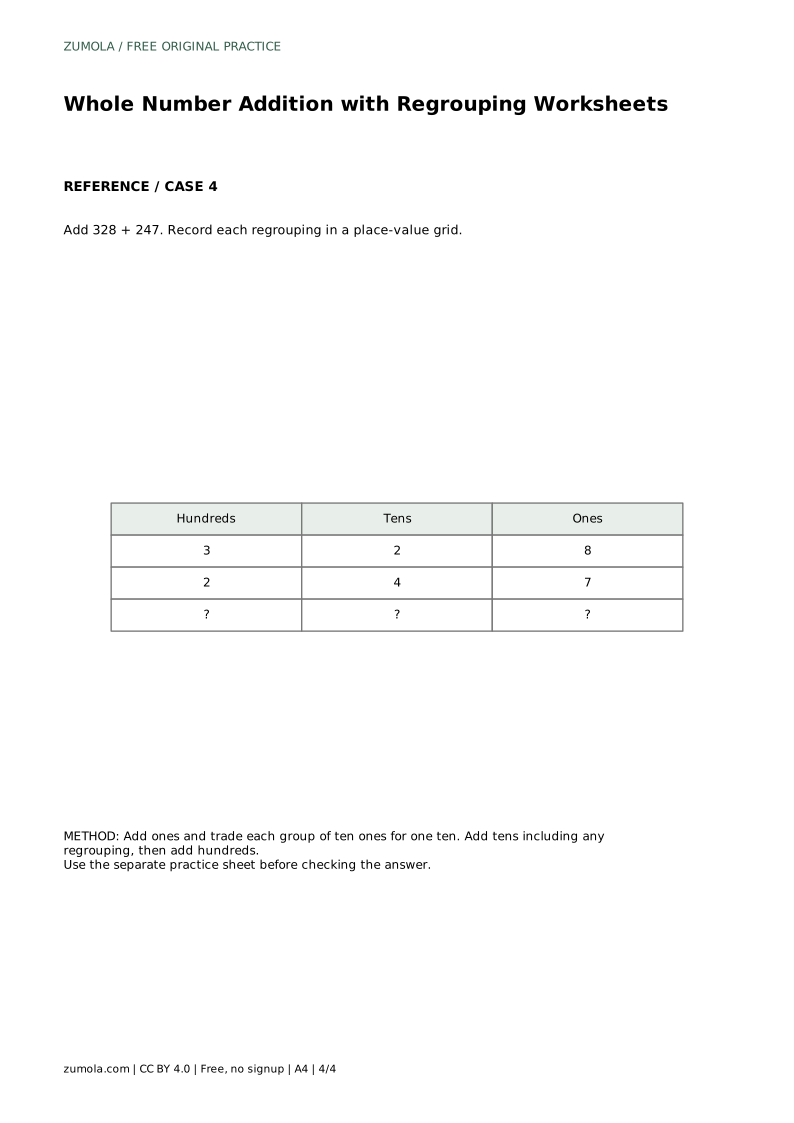
Reference diagrams
LETTER · Download PDF
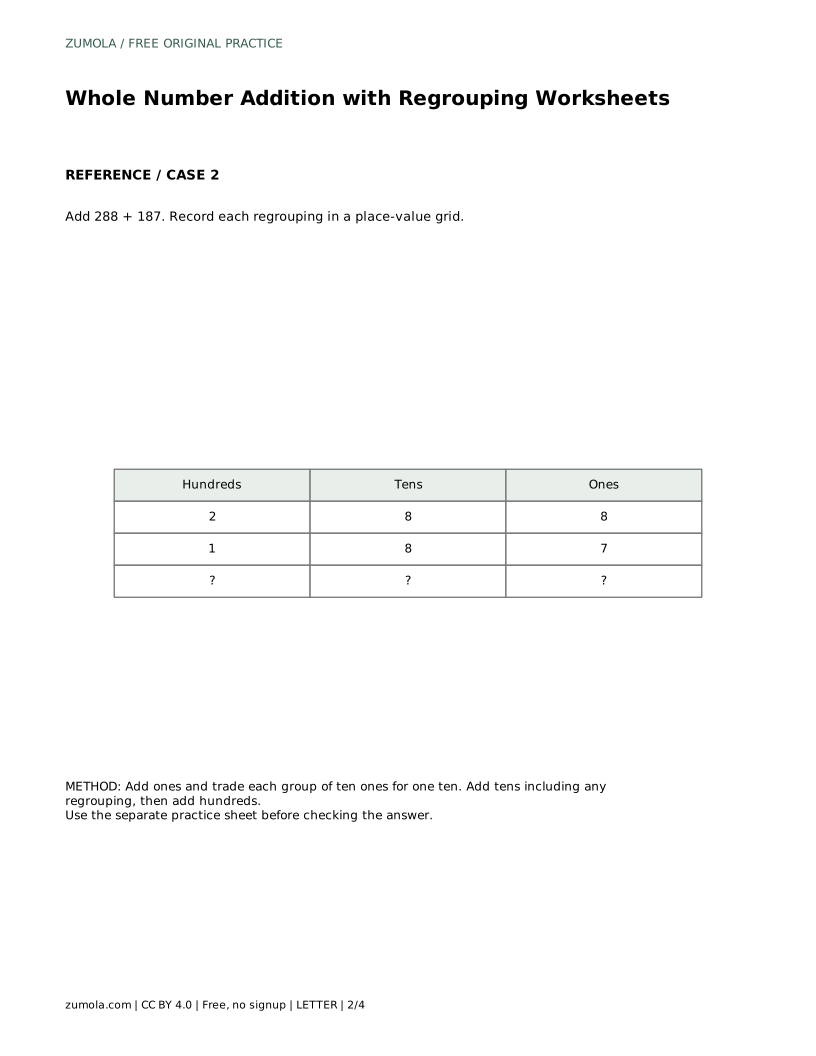
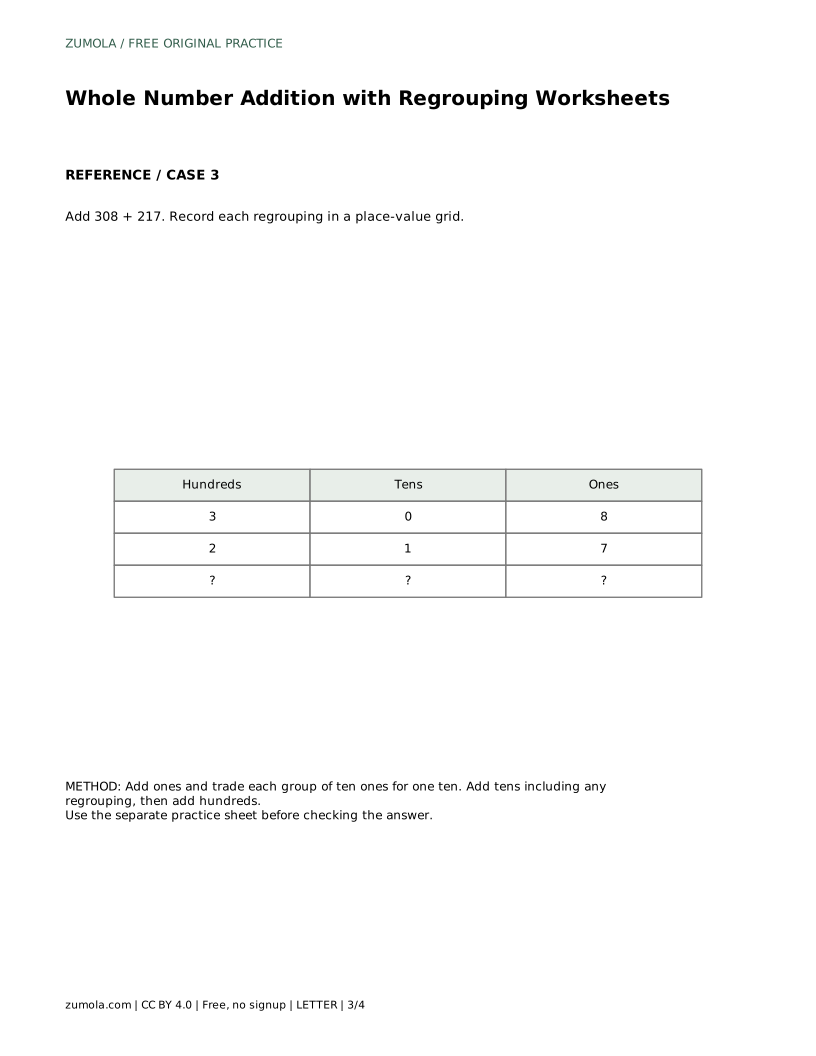
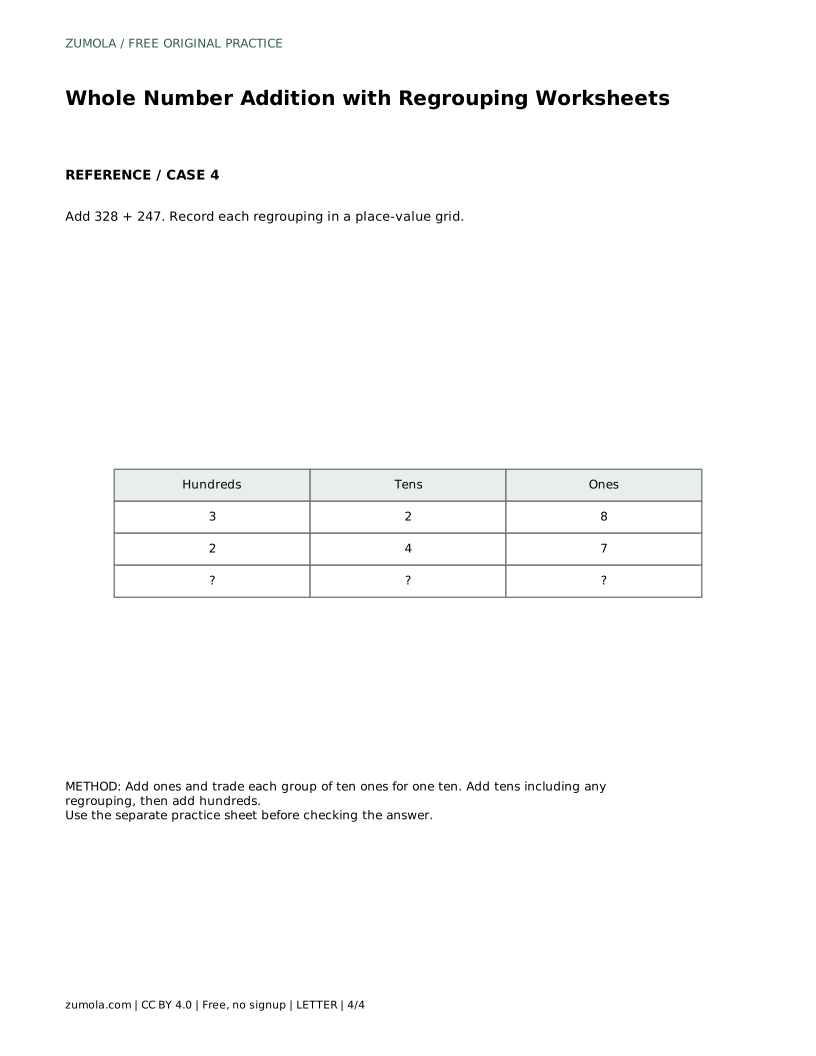
A4 · Download PDF
Free original resources
Teach three-digit addition with regrouping using place-value grids. Includes a worked example, common mistakes, FAQs, and a rubric for checking student work.
Four original cases, with reference diagrams, practice sheets and worked answers. Everything is free; no signup required.
LETTER · Download PDF
A4 · Download PDF
LETTER · Download PDF
A4 · Download PDF
LETTER · Download PDF
A4 · Download PDF
Use A4 or US Letter to match your printer. Use the stated values and conditions to solve each exercise; diagrams are not physical measuring rulers.
Adding three-digit numbers on grid paper keeps each digit in its correct place-value column, which makes regrouping visible and checkable. This page explains how to set up a hundreds-tens-ones grid, add column by column starting with the ones, and record each trade of ten ones for one ten or ten tens for one hundred. It is written for classroom or home instruction and pairs with printable grid worksheets.
Draw or use a grid with three columns labeled Hundreds, Tens, and Ones. Write the first addend so each digit sits in its own column, then write the second addend directly beneath it, aligning ones under ones, tens under tens, and hundreds under hundreds. Alignment is the whole point of grid paper: a digit written one column off changes the value by a factor of ten.
Leave a clear row below the addends for the sum. If you want to track regroupings, keep a small margin or extra row where you can note a carried ten or hundred. The grid does not do the arithmetic for you; it organizes the digits so each step is easy to see and check.
Always begin with the Ones column. Add the two ones digits. If the total is 10 or more, write the ones digit of that total in the Ones column of the sum row and carry one ten to the Tens column. If the total is 9 or less, write it directly with no regrouping.
Move to the Tens column and add the two tens digits plus any carried ten. Apply the same rule: totals of 10 or more produce a carried hundred. Finally add the Hundreds column, including any carried hundred. The final hundreds total is written in full, even if it is 10 or more, because there is no further column to carry into on a three-column grid.
A quick check is to add the same numbers in a different order or to estimate first. Rounding each addend to the nearest hundred gives a rough target: if the estimate and the exact sum are far apart, recheck the columns. You can also subtract one addend from the sum to see whether you recover the other addend.
Grid paper makes a second check easy: confirm that every digit is in the correct column and that each carried value was added exactly once. A carried ten belongs in the Tens column, not the Ones column, and a carried hundred belongs in the Hundreds column.
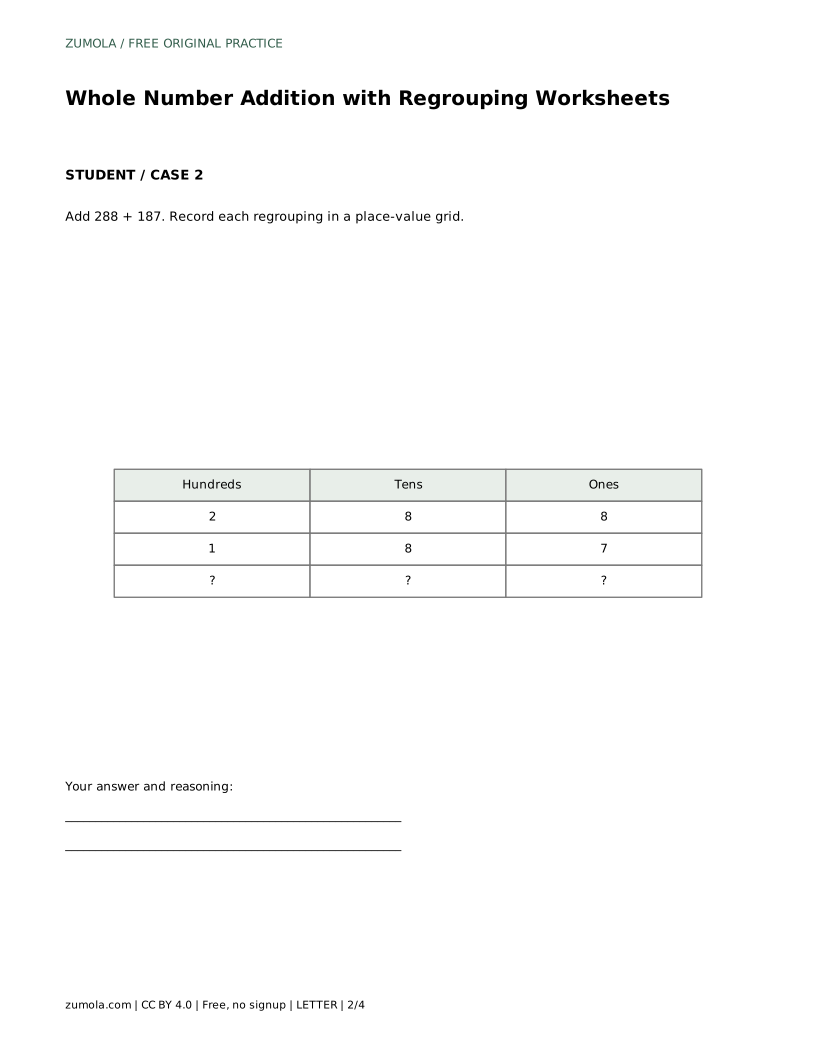
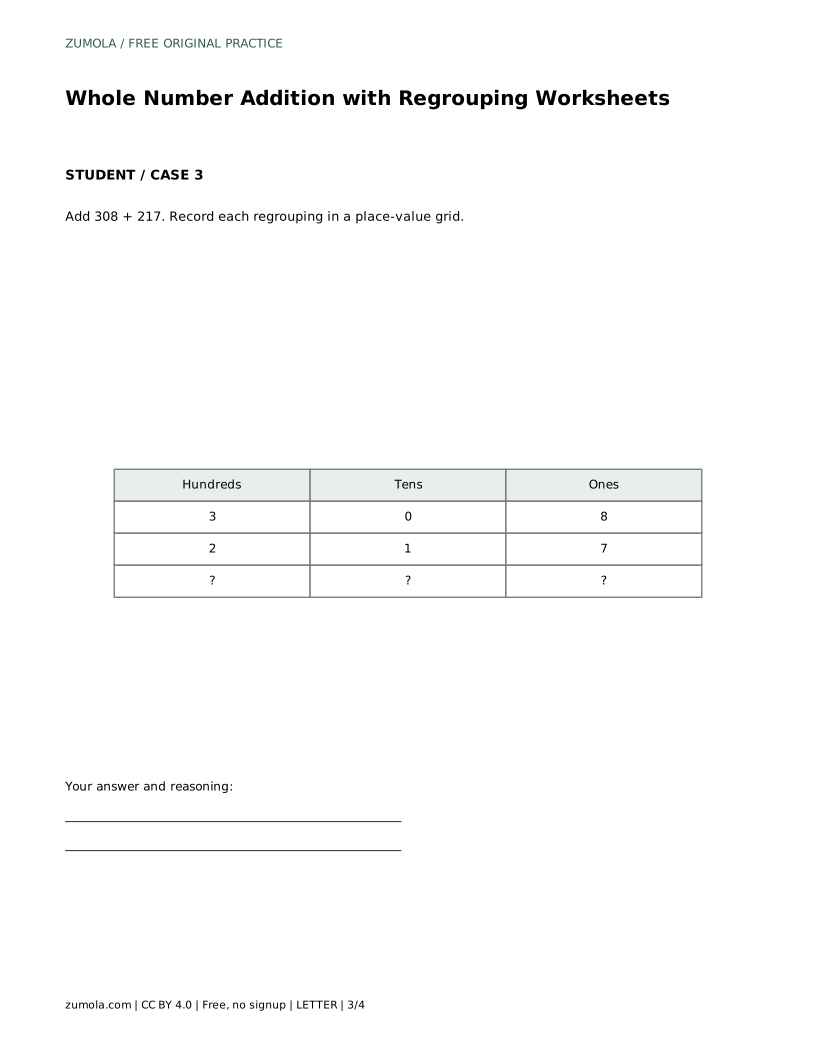
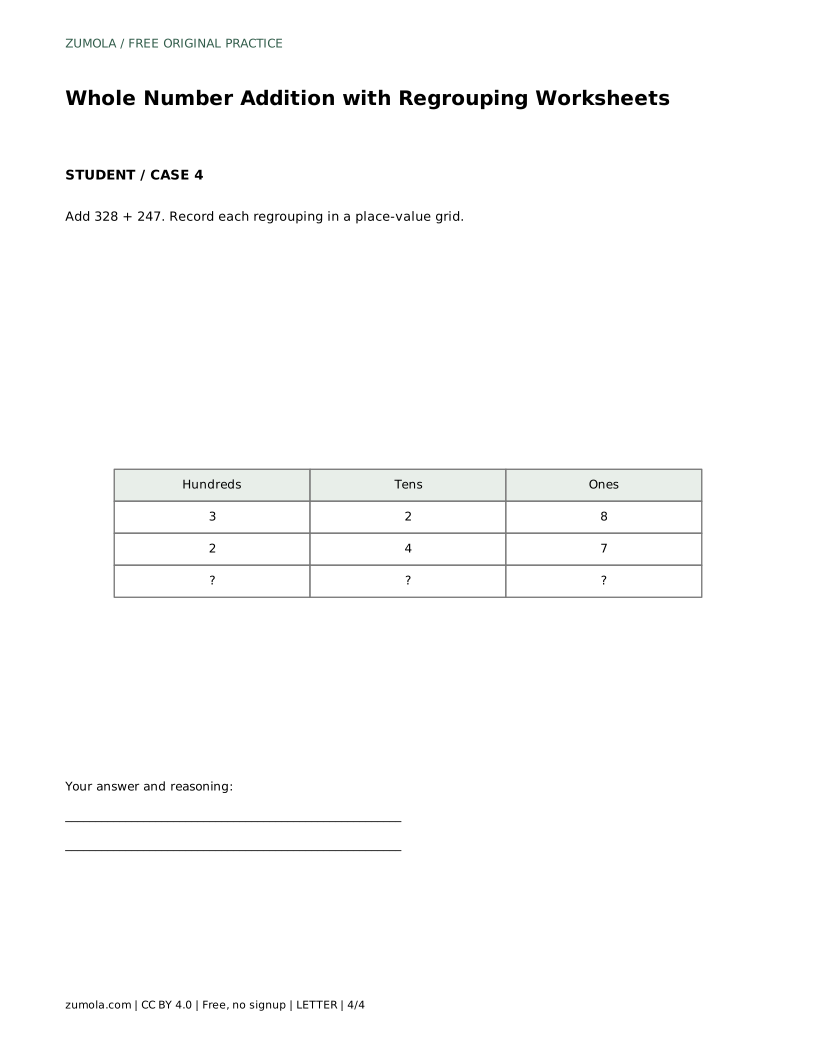
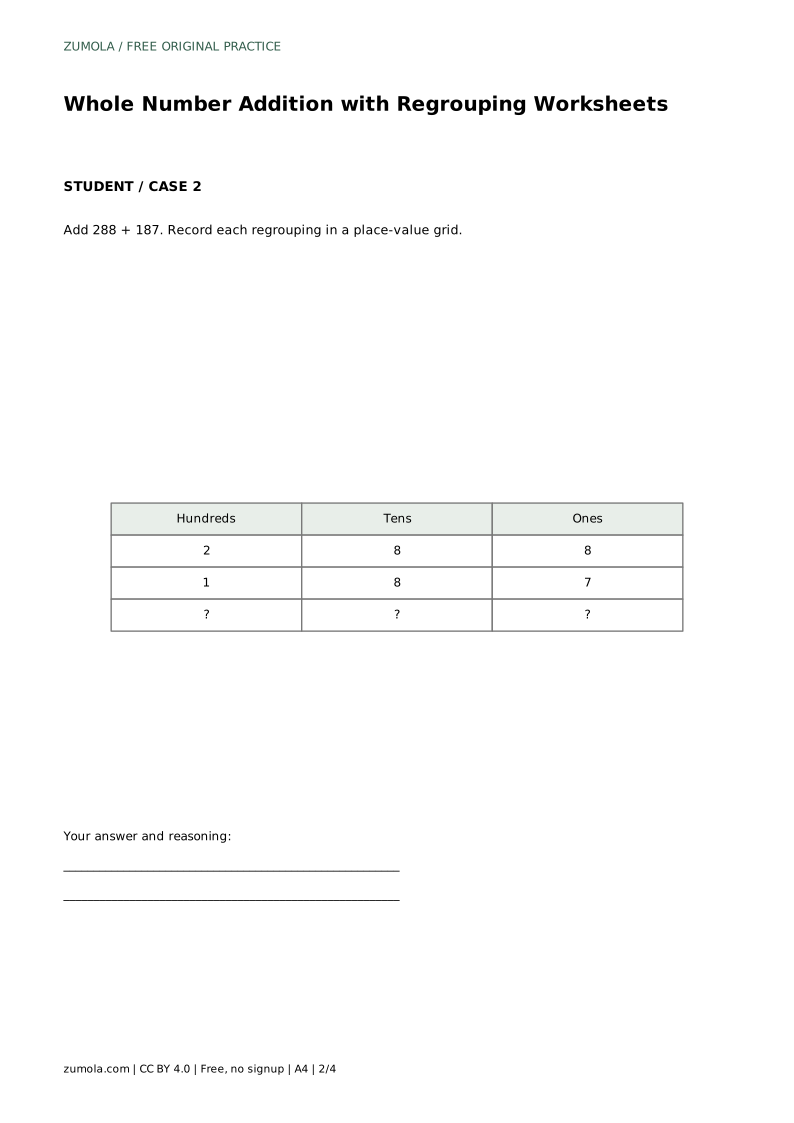
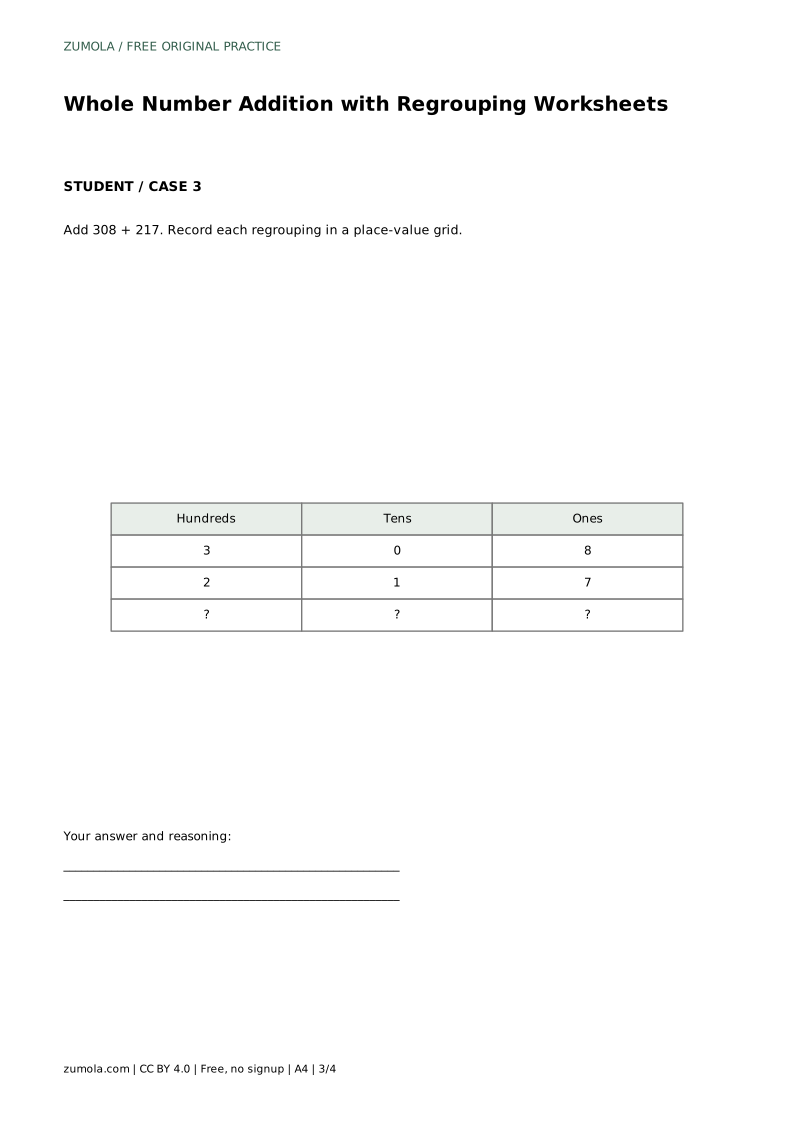
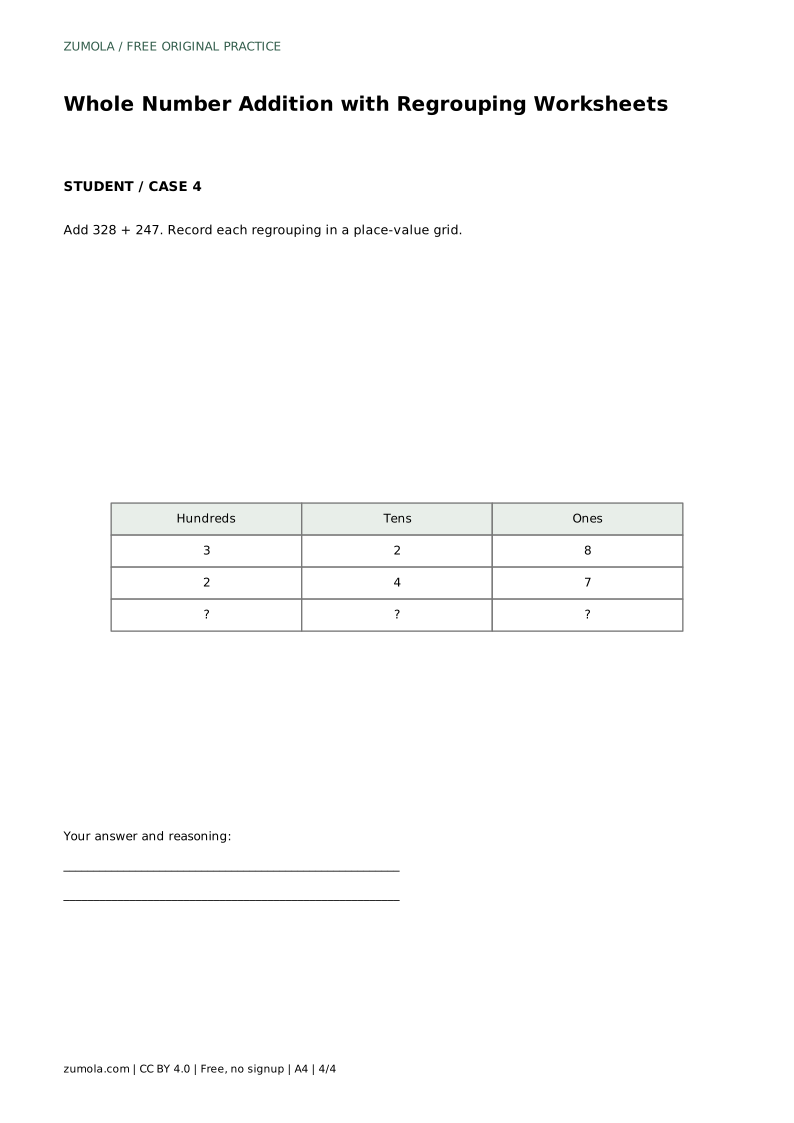
Because regrouping depends on the specific digits, do not assume every problem regroups in every column. Some addends regroup only in the ones column, some in both tens and ones, and some not at all. Read each problem on its own terms rather than applying one pattern to all.
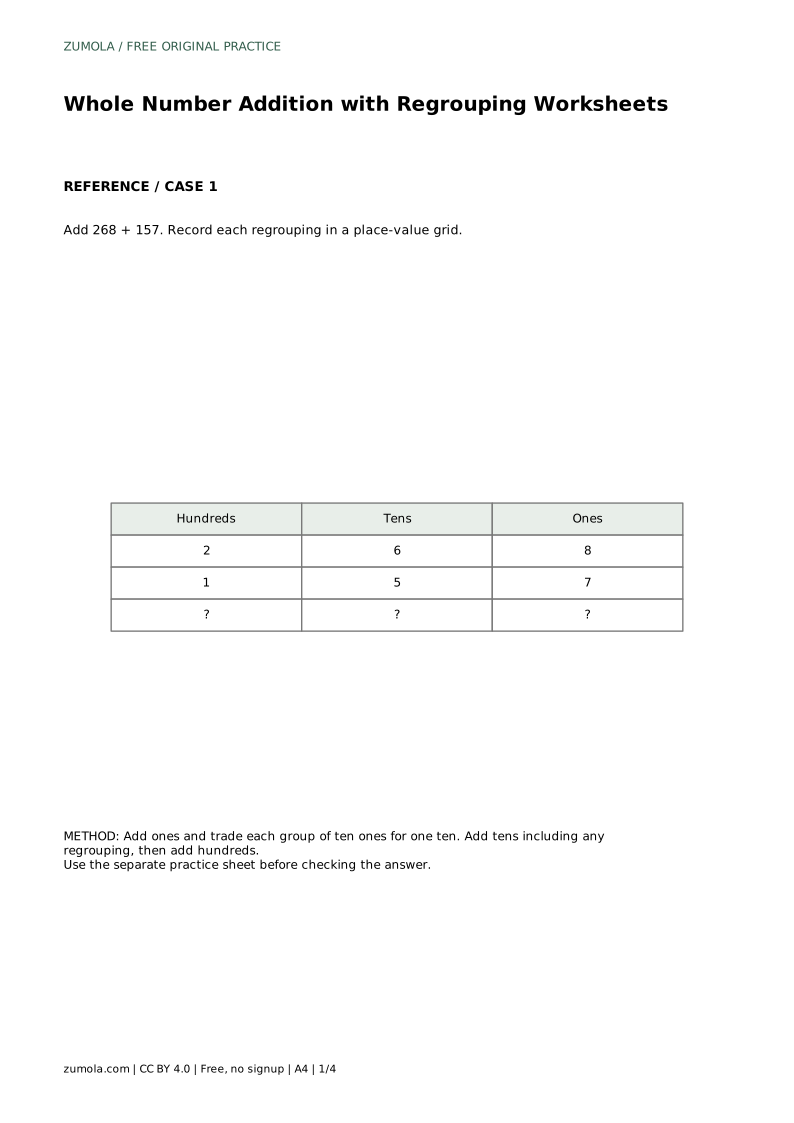
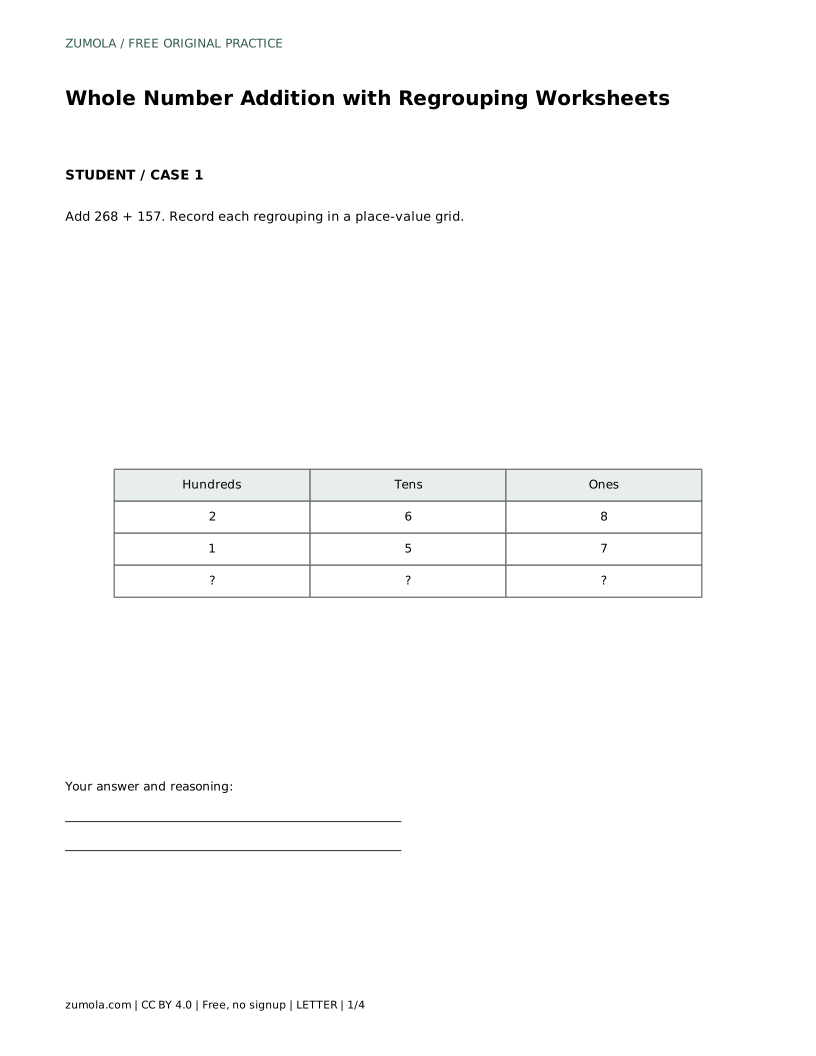
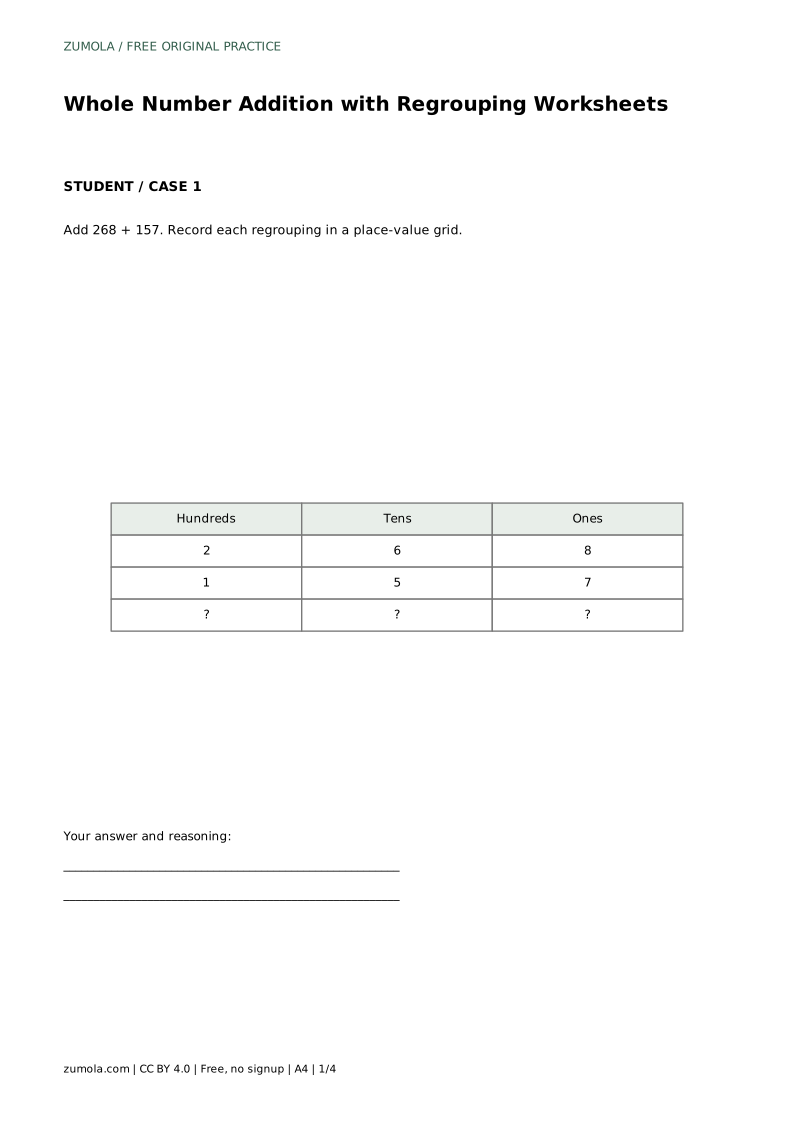
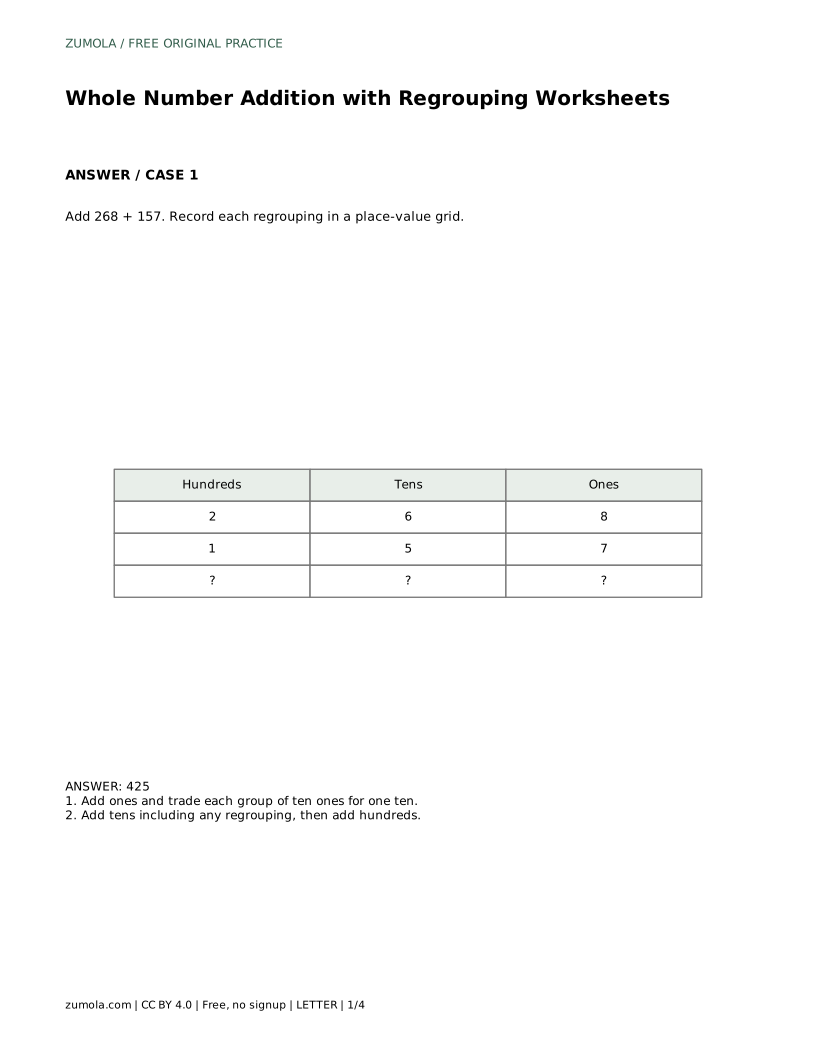
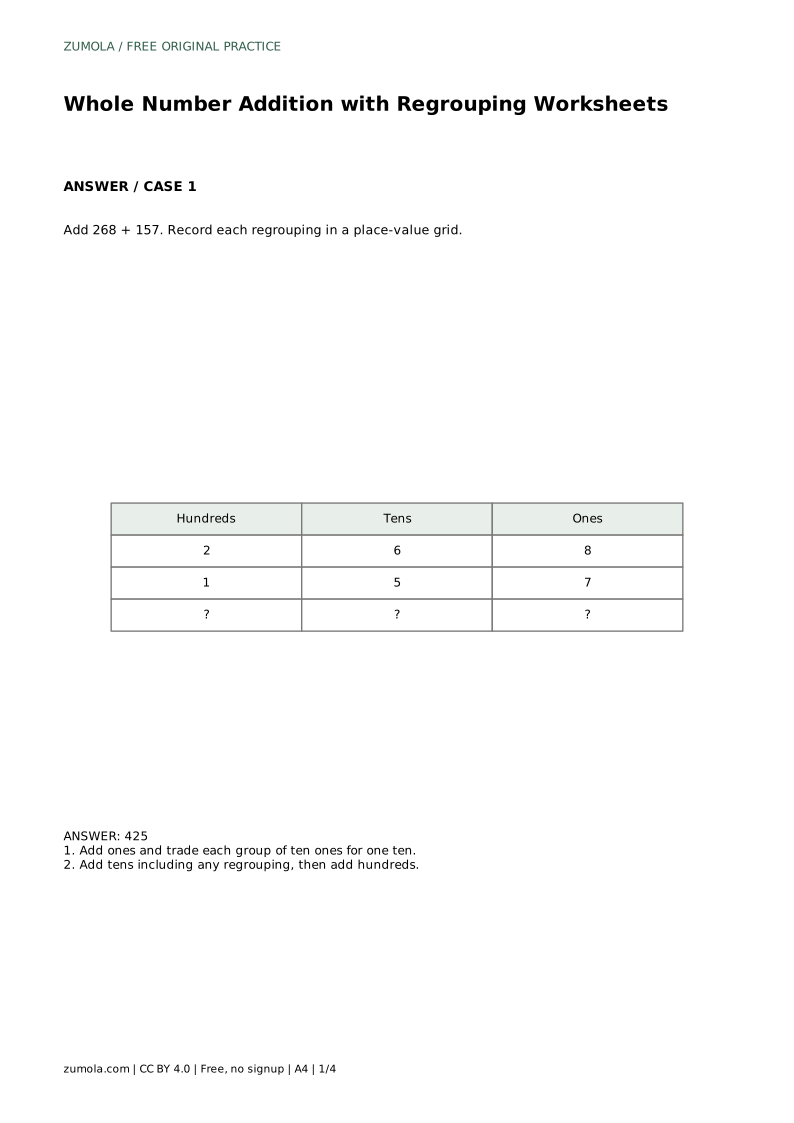
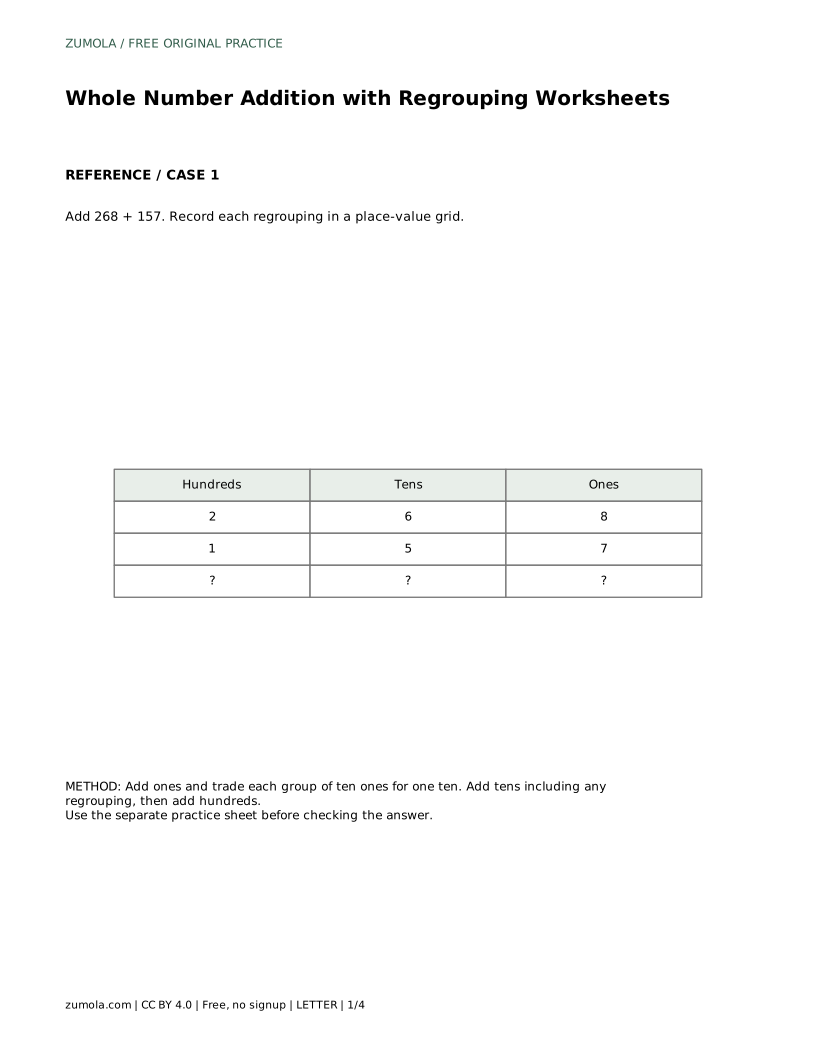
Add 268 + 157 on a place-value grid. Write 2, 6, 8 in the Hundreds, Tens, and Ones columns, then 1, 5, 7 beneath, aligned by place.
Ones: 8 + 7 = 15. Write 5 in the Ones column of the sum and carry 1 ten to the Tens column. Tens: 6 + 5 + 1 carried = 12. Write 2 in the Tens column and carry 1 hundred to the Hundreds column. Hundreds: 2 + 1 + 1 carried = 4. The sum is 425.
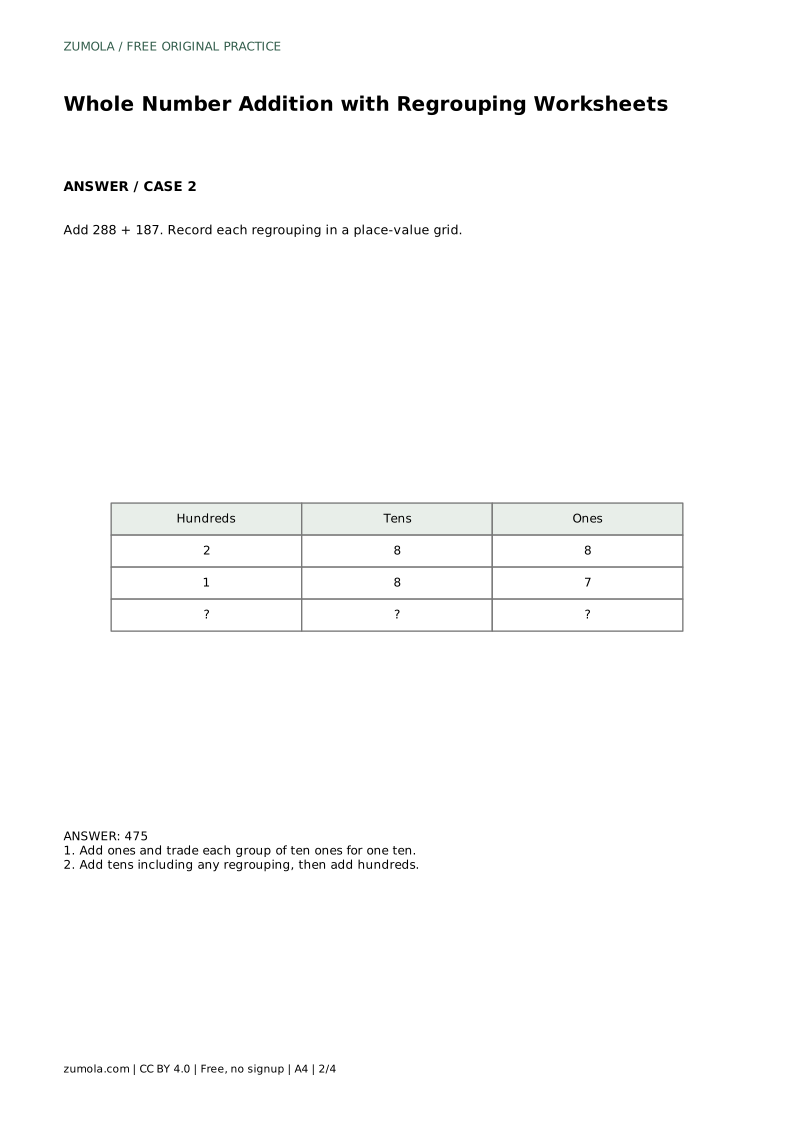
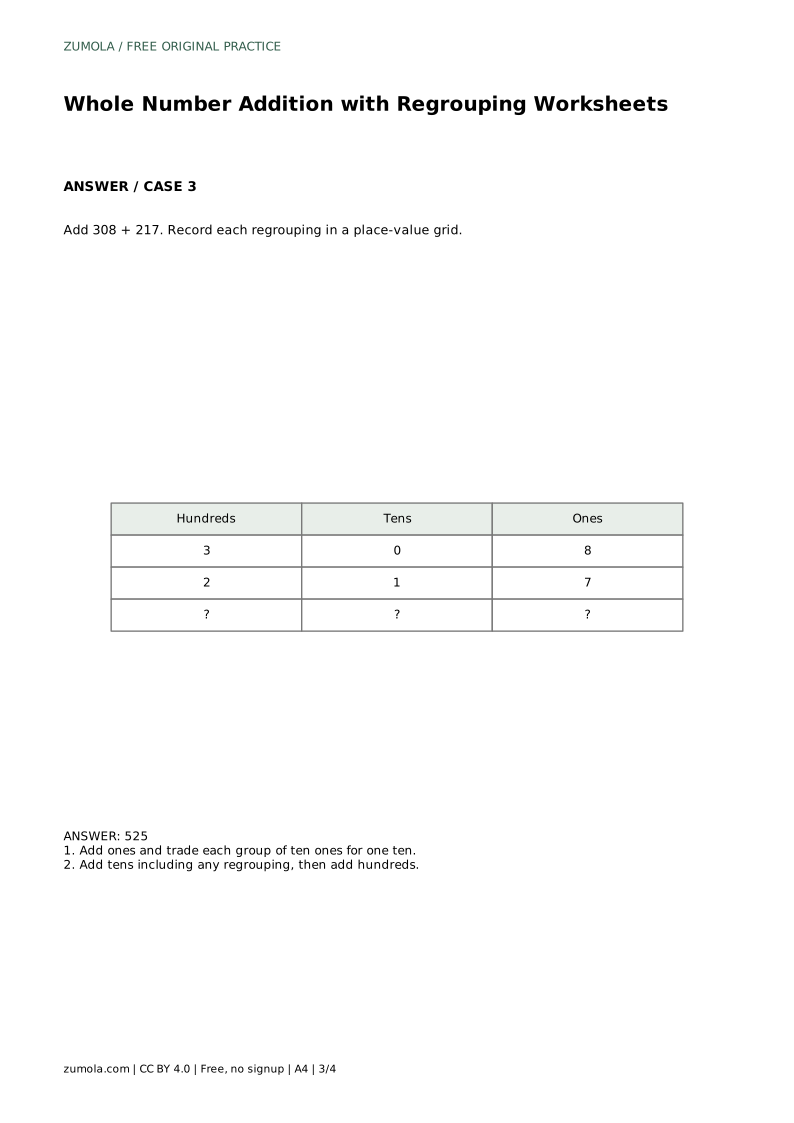
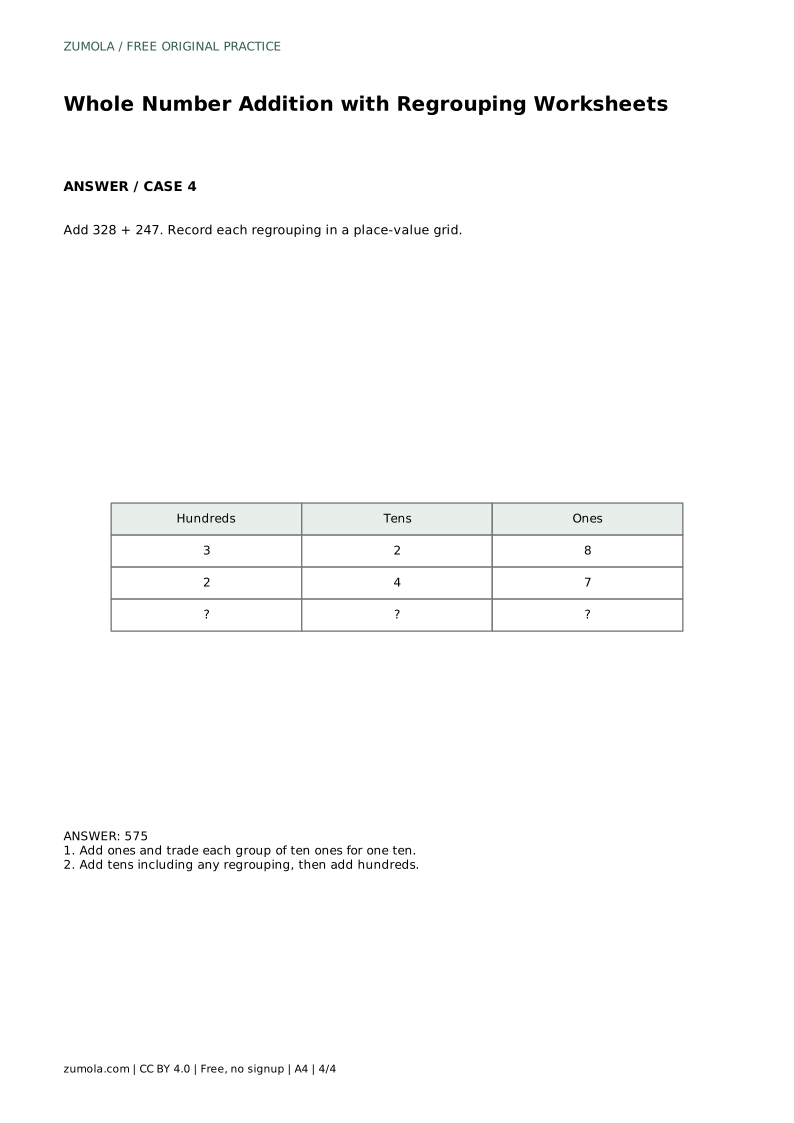
Add 268 + 157. Record each regrouping in a place-value grid.
425 Add ones and trade each group of ten ones for one ten. Add tens including any regrouping, then add hundreds.
It keeps each digit in its correct place-value column, so a carried ten or hundred is visibly placed where it belongs and alignment errors are easier to spot.
Write 0 in that column and carry 1 to the next column to the left. For example, 10 ones become 0 ones and 1 ten.
Yes. If the hundreds total is 10 or more, write the full total, such as 10, giving a four-digit sum. The grid simply extends one column to the left.
All math worksheets · Free coordinate paper
Original resources · CC BY 4.0 · Free for personal and classroom use with attribution.