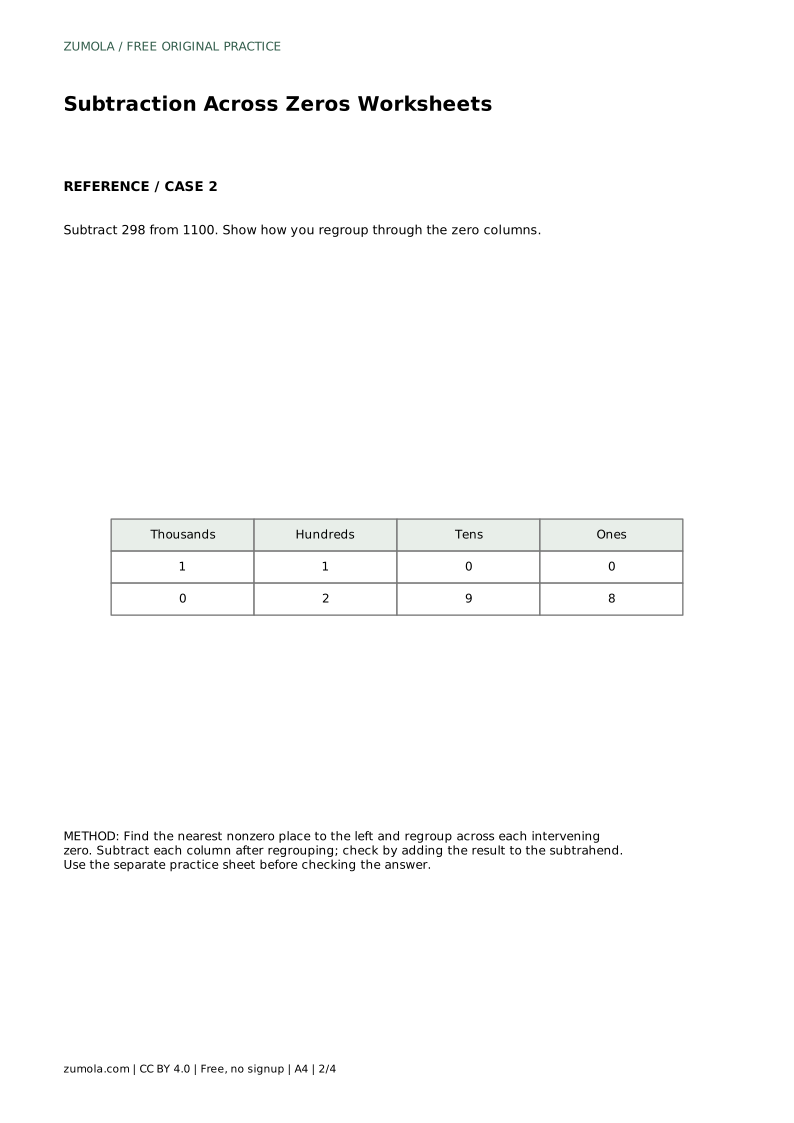
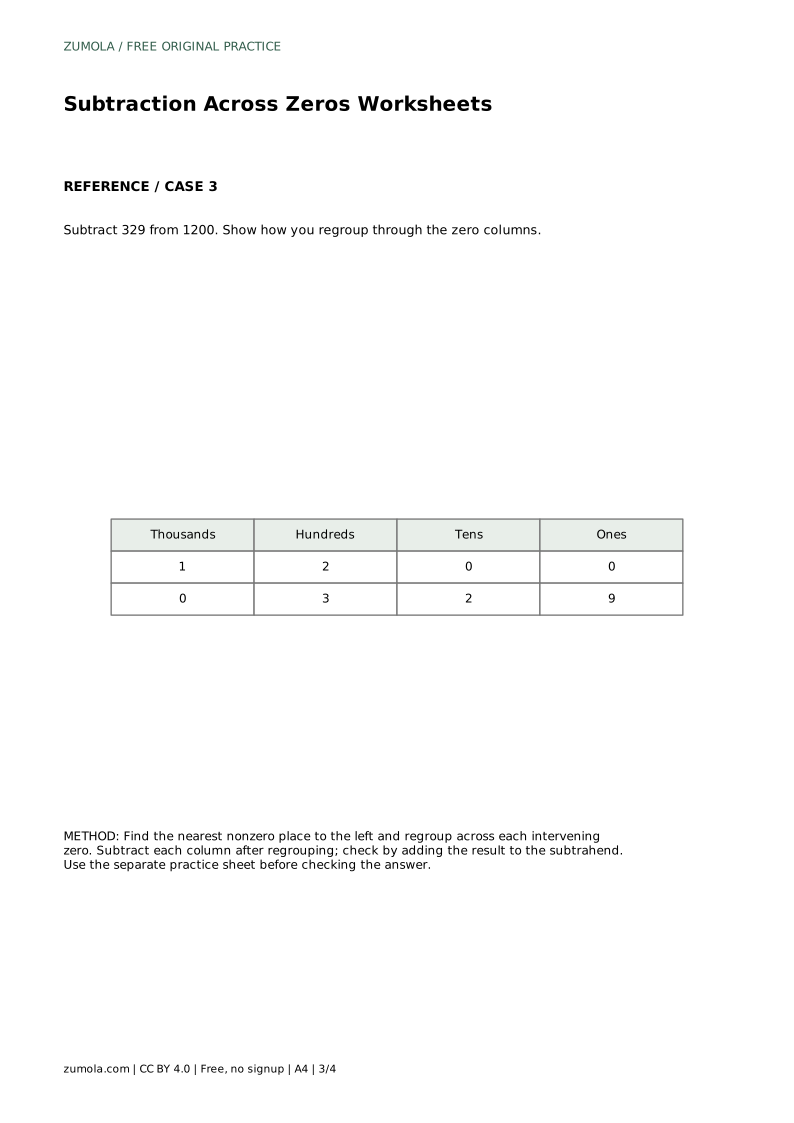
Reference diagrams
LETTER · Download PDF
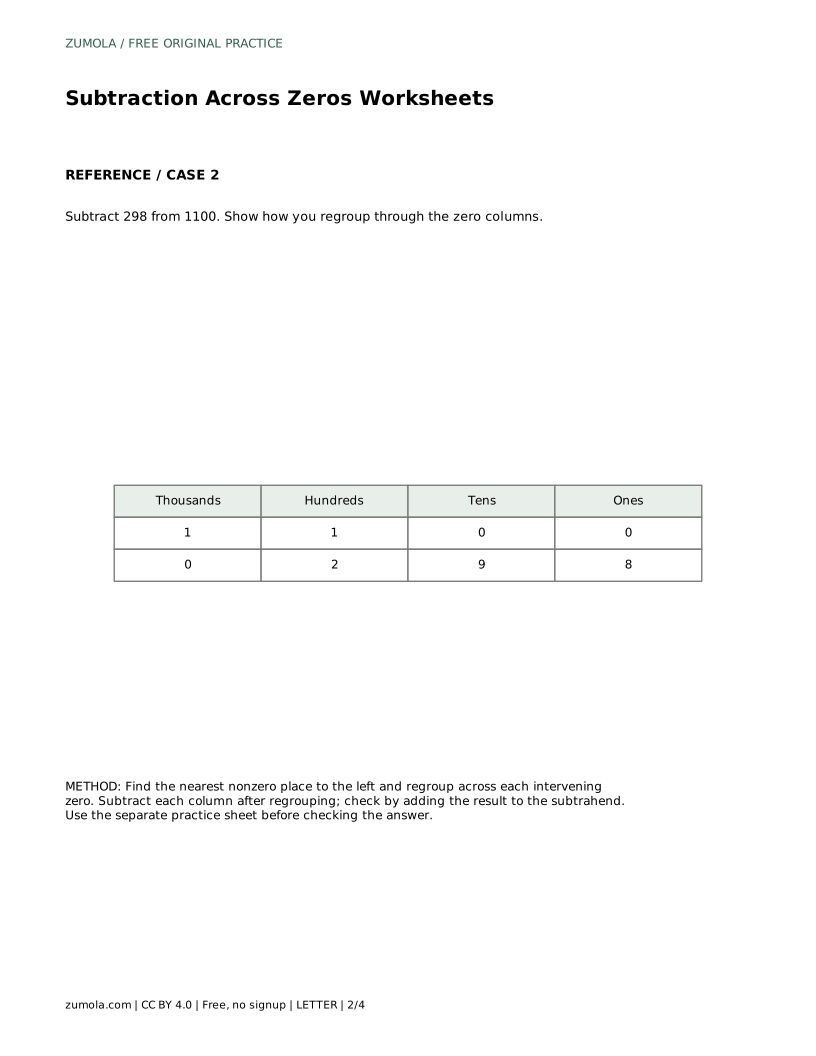
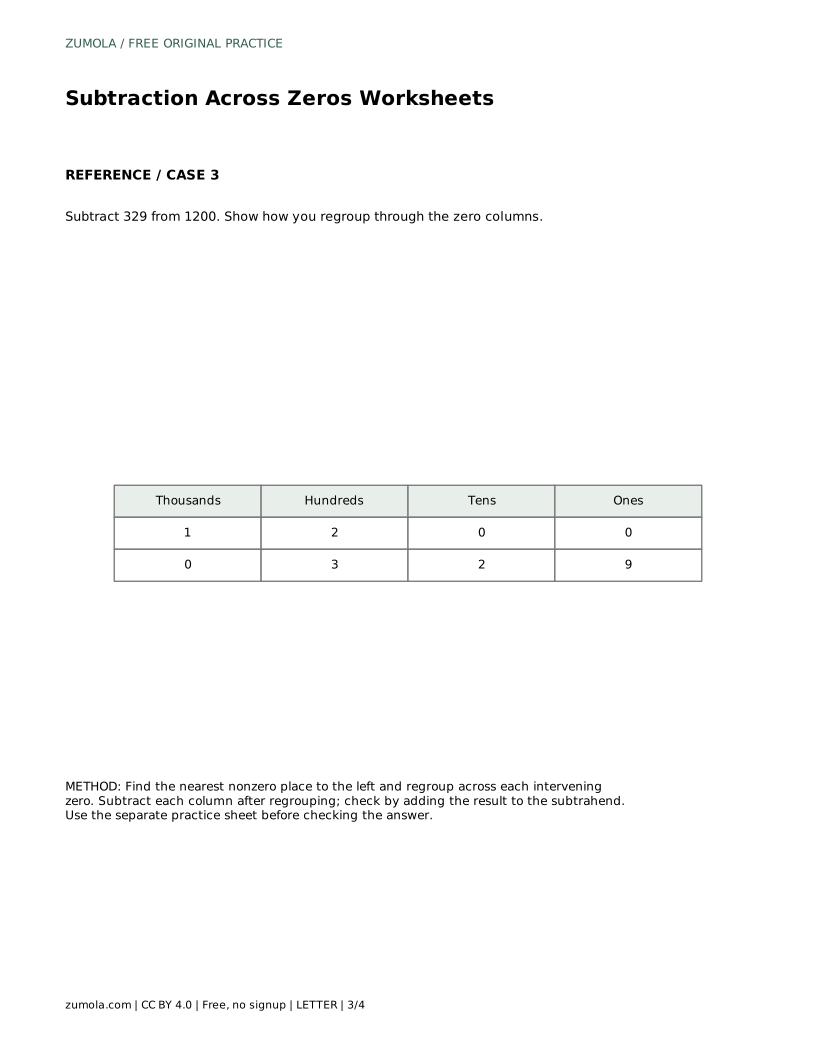
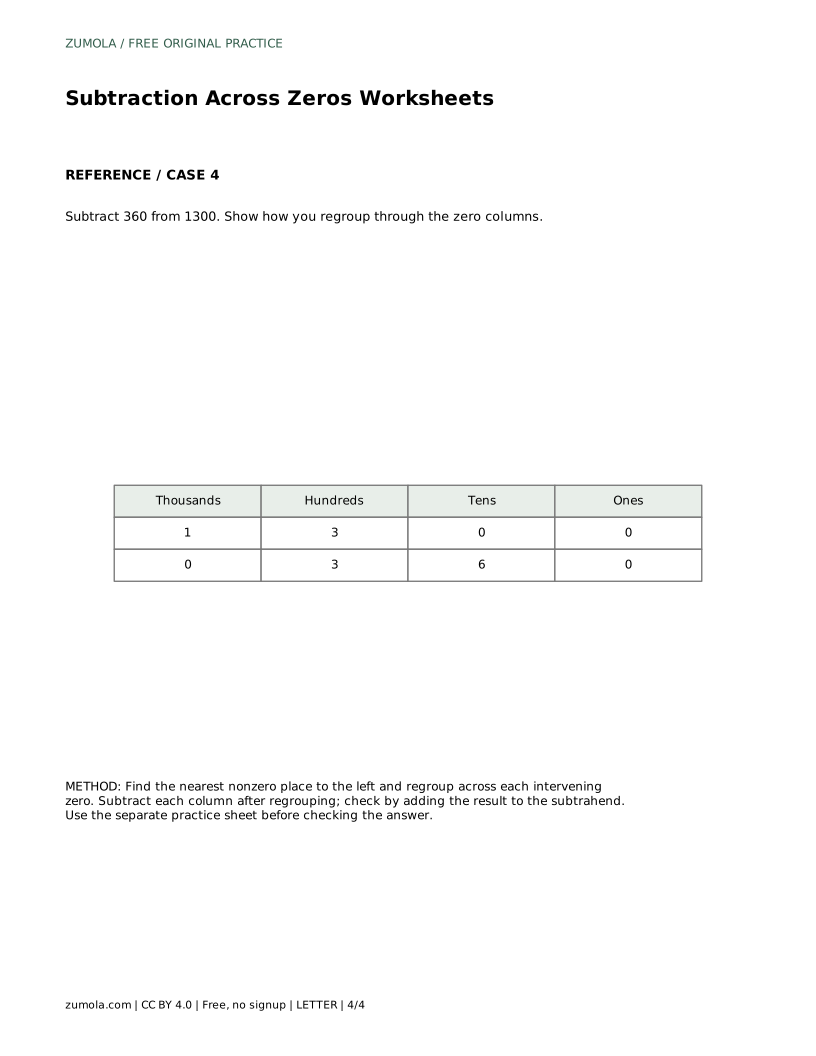
A4 · Download PDF
Free original resources
Teach subtraction across zeros with graph paper alignment. Regroup through zero columns, subtract column by column, and check by adding the result to the subtrahend.
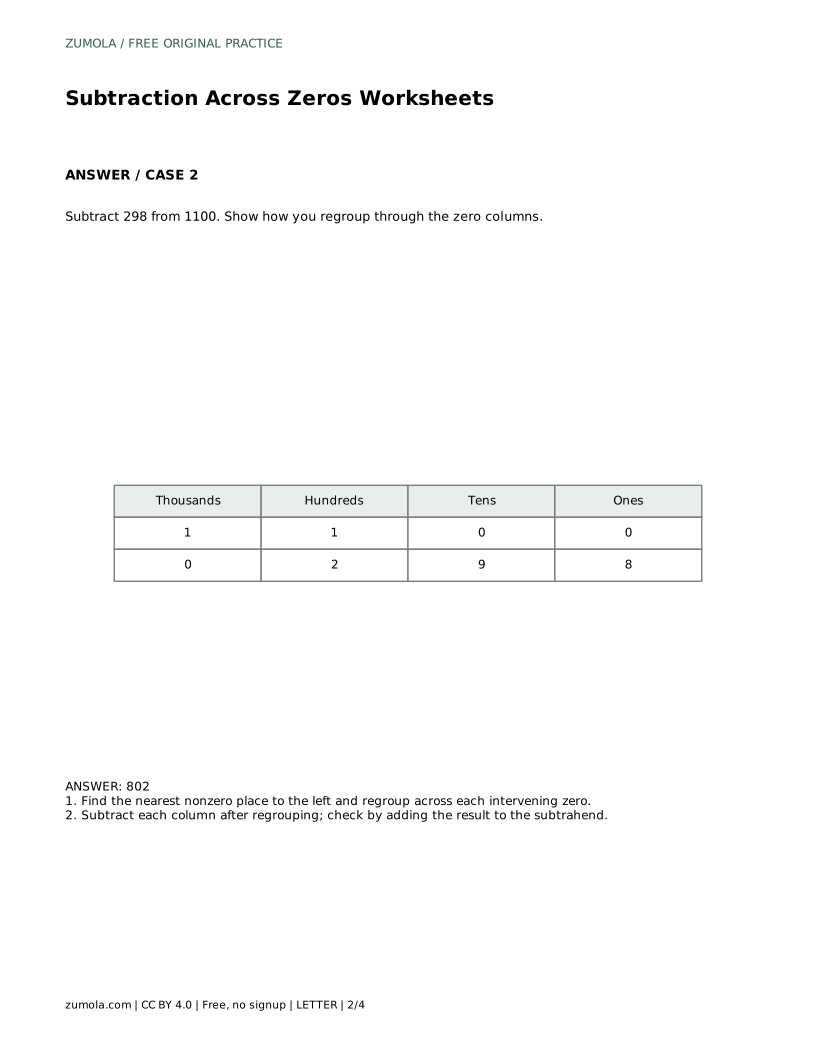
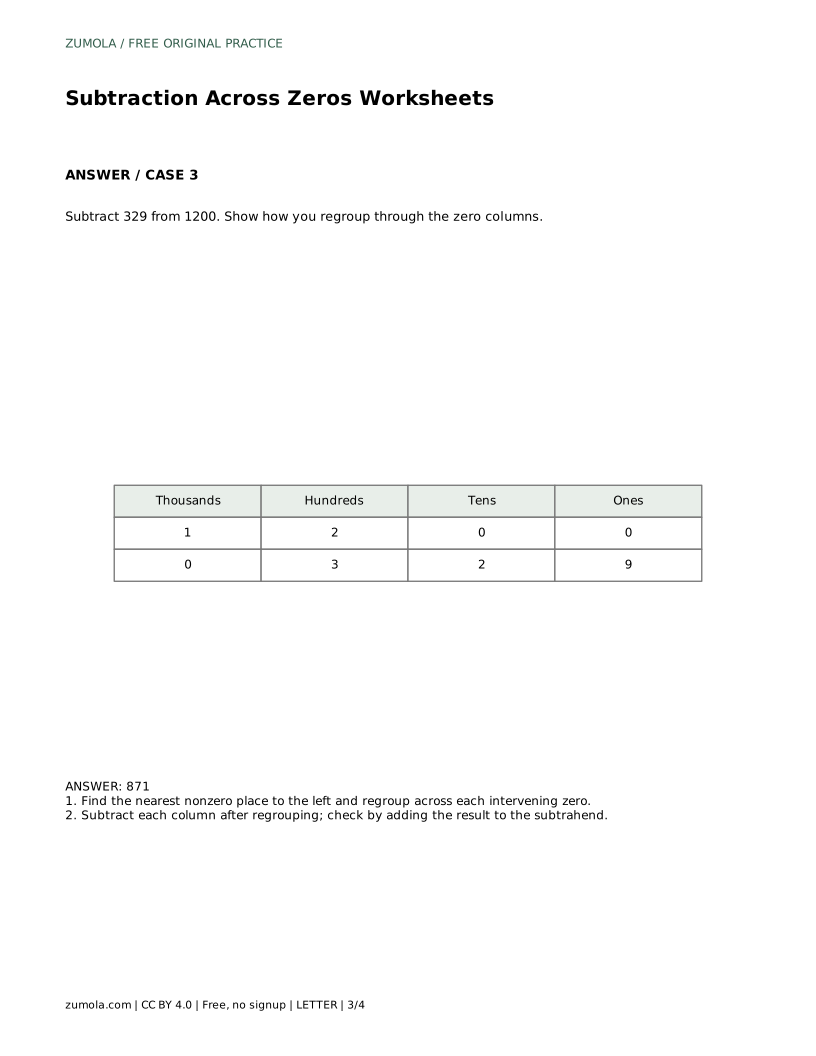
Four original cases, with reference diagrams, practice sheets and worked answers. Everything is free; no signup required.
LETTER · Download PDF
A4 · Download PDF
LETTER · Download PDF
A4 · Download PDF
LETTER · Download PDF
A4 · Download PDF
Use A4 or US Letter to match your printer. Use the stated values and conditions to solve each exercise; diagrams are not physical measuring rulers.
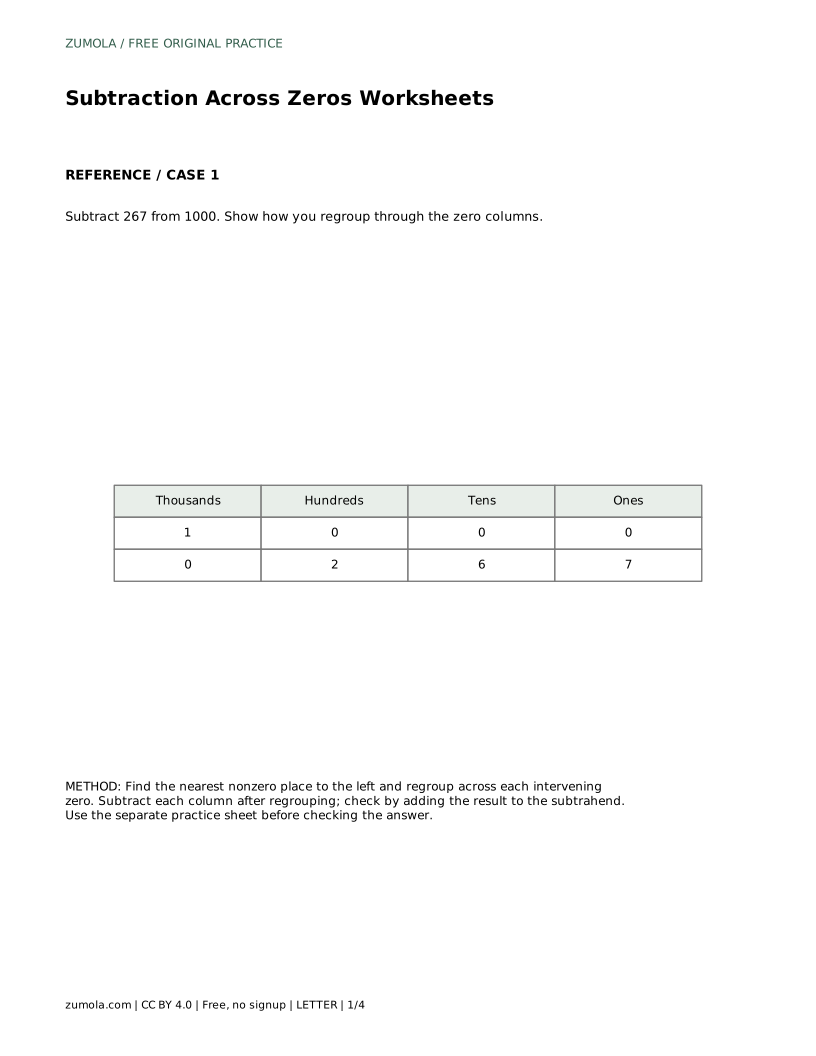
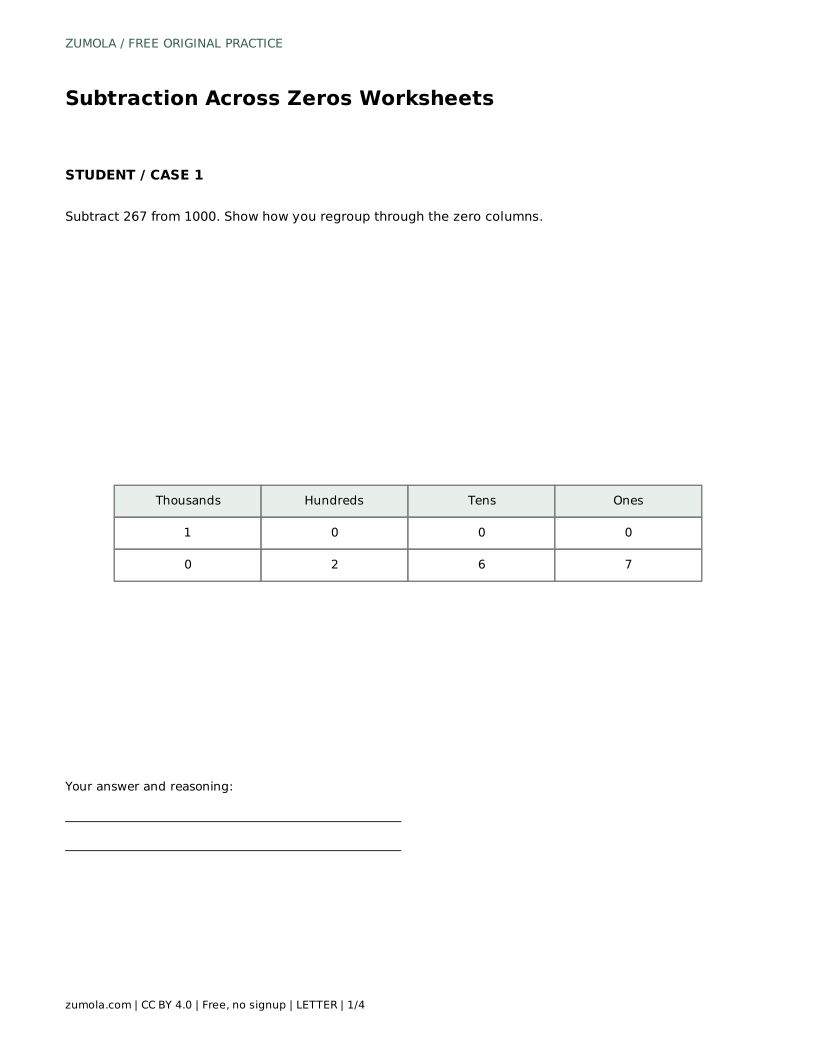
Subtracting across zeros is tricky because a zero column has nothing to lend. On graph paper, each digit sits in its own square, so place value stays visible while you regroup. This page shows how to borrow from the nearest nonzero place to the left, pass the regrouped value through each intervening zero, subtract column by column, and check the answer by adding it to the subtrahend. The worked example uses 1000 minus 267.
Graph paper gives every digit a fixed square, so the ones, tens, hundreds, and thousands columns line up without drifting. That matters when regrouping crosses zeros: you can see exactly which column is borrowing and which column is lending. Write the larger number on the top row and the smaller number directly below it, right-aligned so the ones digits share a column. Leave the thousands column for the top number only when the bottom number has fewer digits.
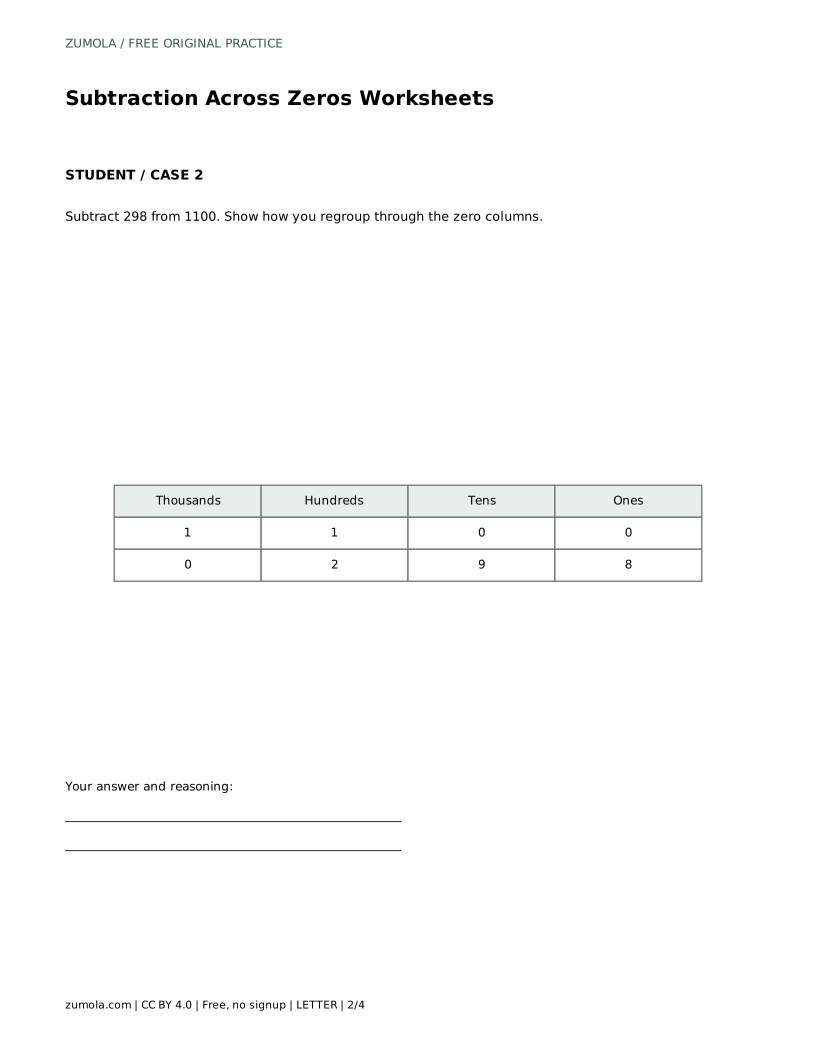
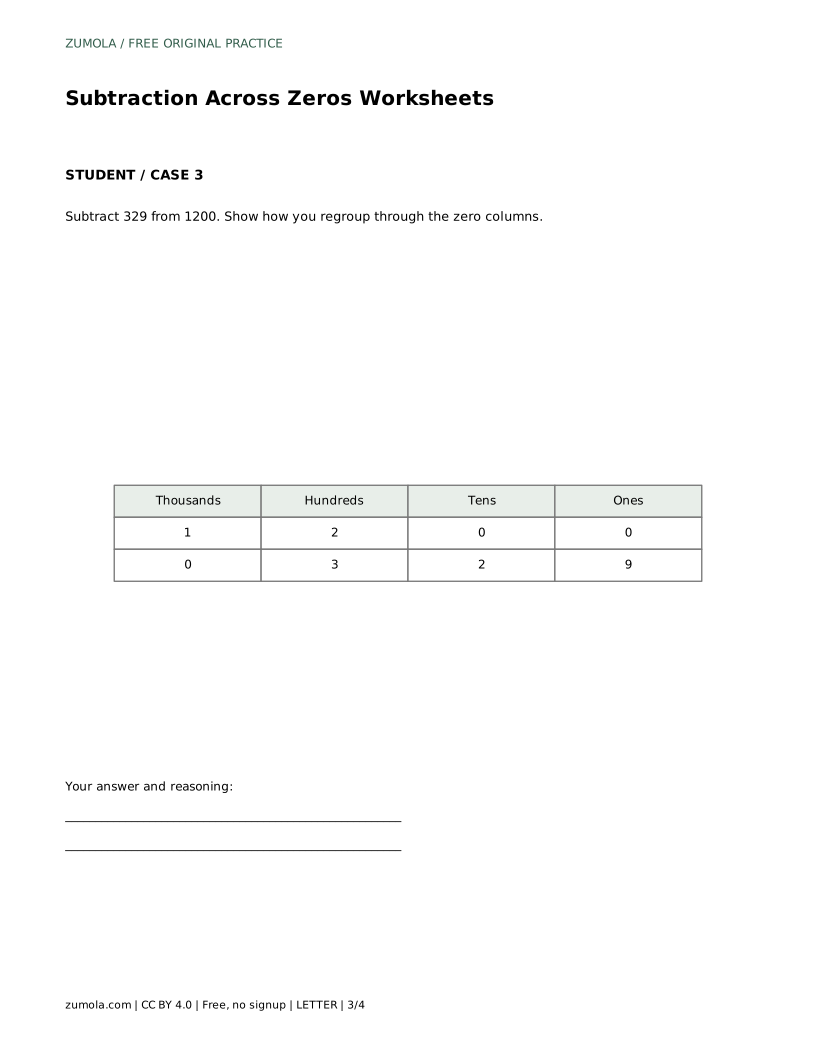
A zero column cannot lend anything by itself. To subtract in a column where the top digit is zero, look left to the nearest nonzero digit, regroup one unit from that place, and pass the value through each zero column until it reaches the column that needs it. On graph paper, mark the regrouped values above the original digits so the new column values stay readable.
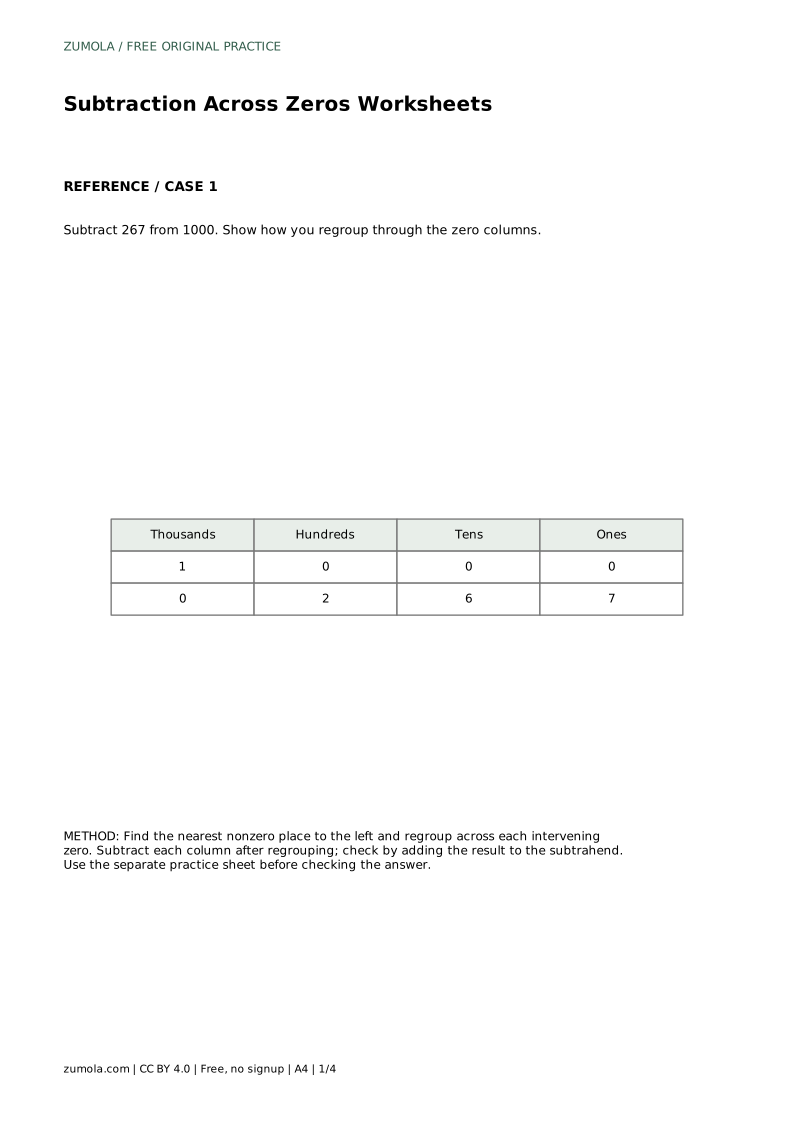
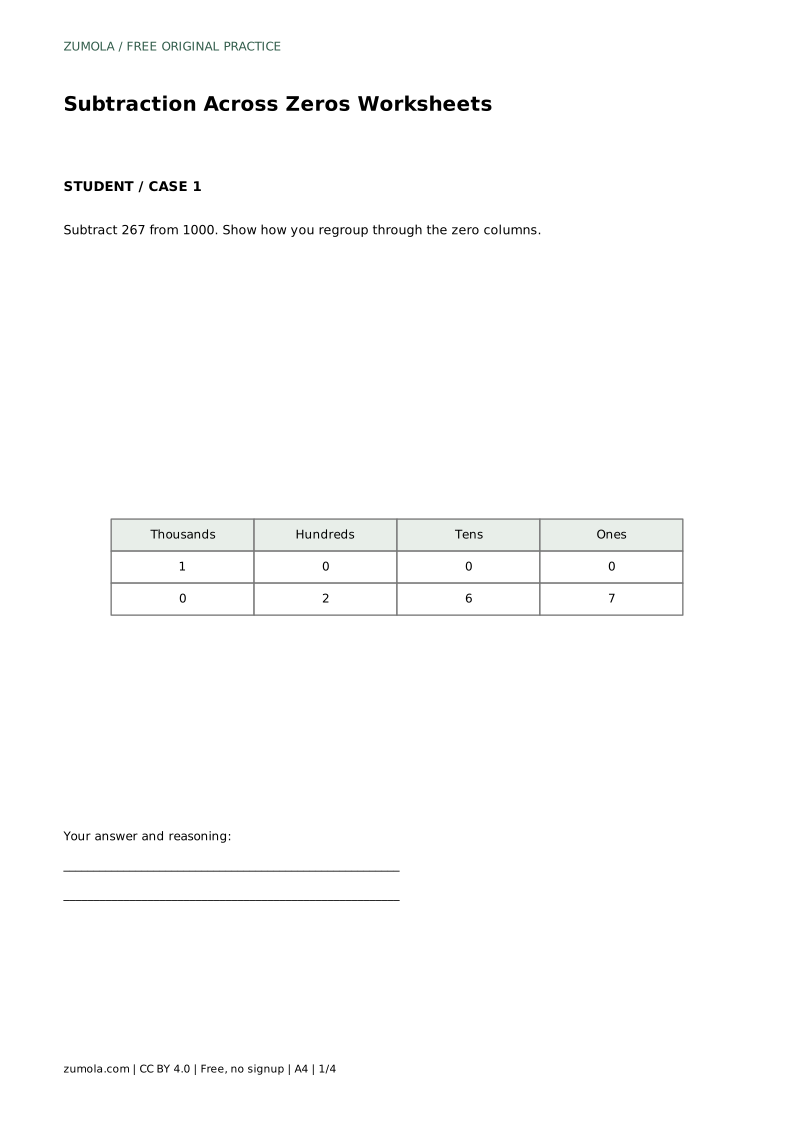
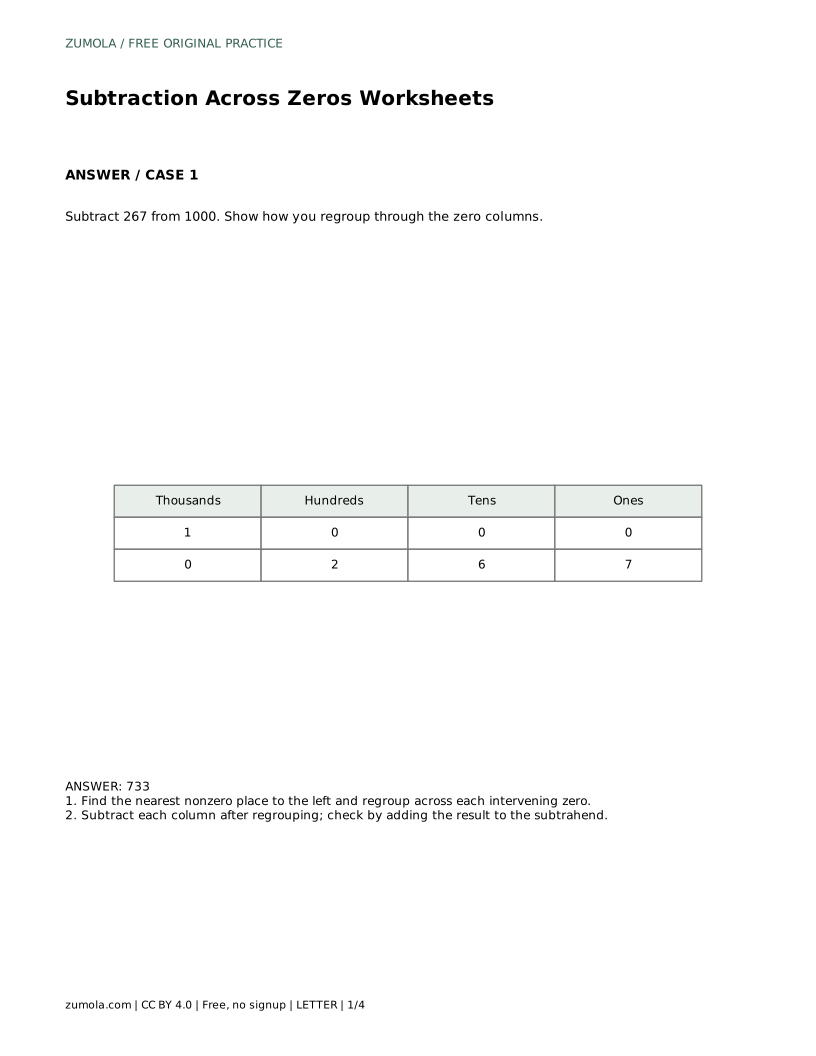
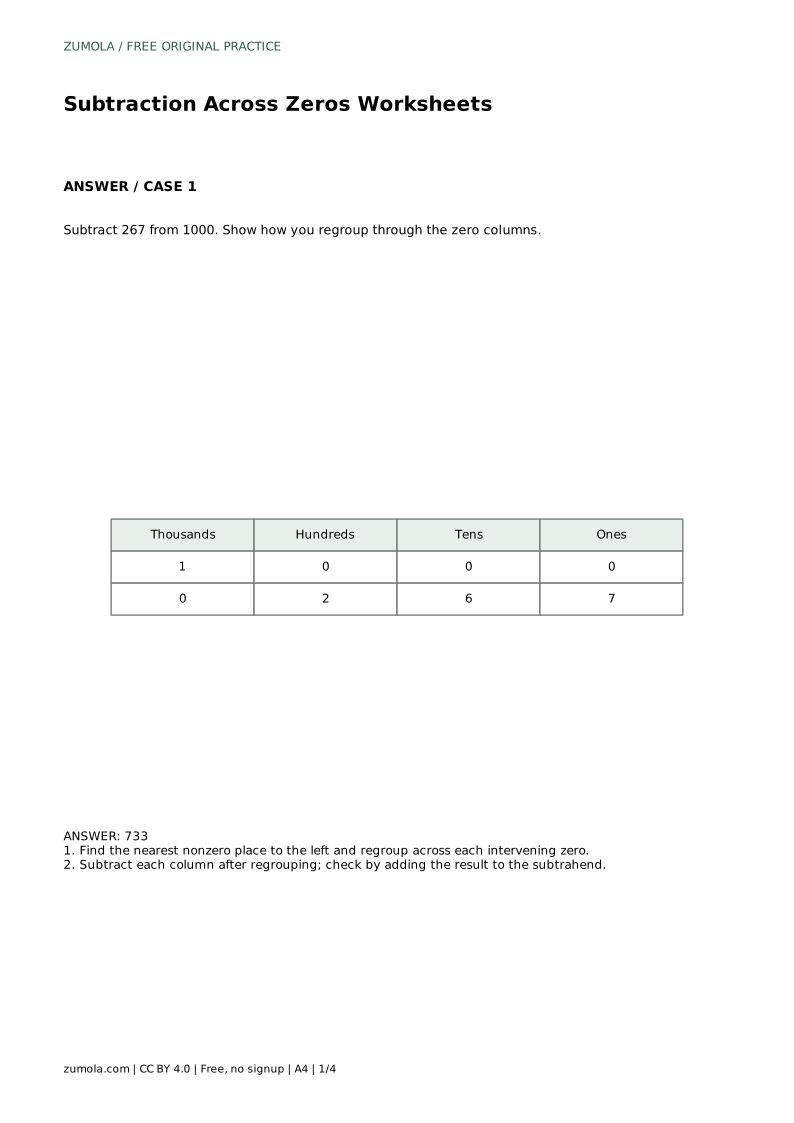
Set up 1000 on top and 267 below, right-aligned. The ones column is 0 minus 7, so regroup from the nearest nonzero place to the left. The thousands digit 1 is the nearest nonzero place. Regroup 1 thousand as 10 hundreds, then pass one hundred through the tens and ones columns: the hundreds column becomes 9, the tens column becomes 9, and the ones column becomes 10.
Now subtract column by column: ones 10 minus 7 equals 3; tens 9 minus 6 equals 3; hundreds 9 minus 2 equals 7; thousands 0 minus 0 equals 0. The result is 733. Check by adding 733 and 267: 3 plus 7 equals 10, write 0 and carry 1; 3 plus 6 plus 1 equals 10, write 0 and carry 1; 7 plus 2 plus 1 equals 10, write 0 and carry 1; the carried 1 gives 1000. The answer 733 is correct.
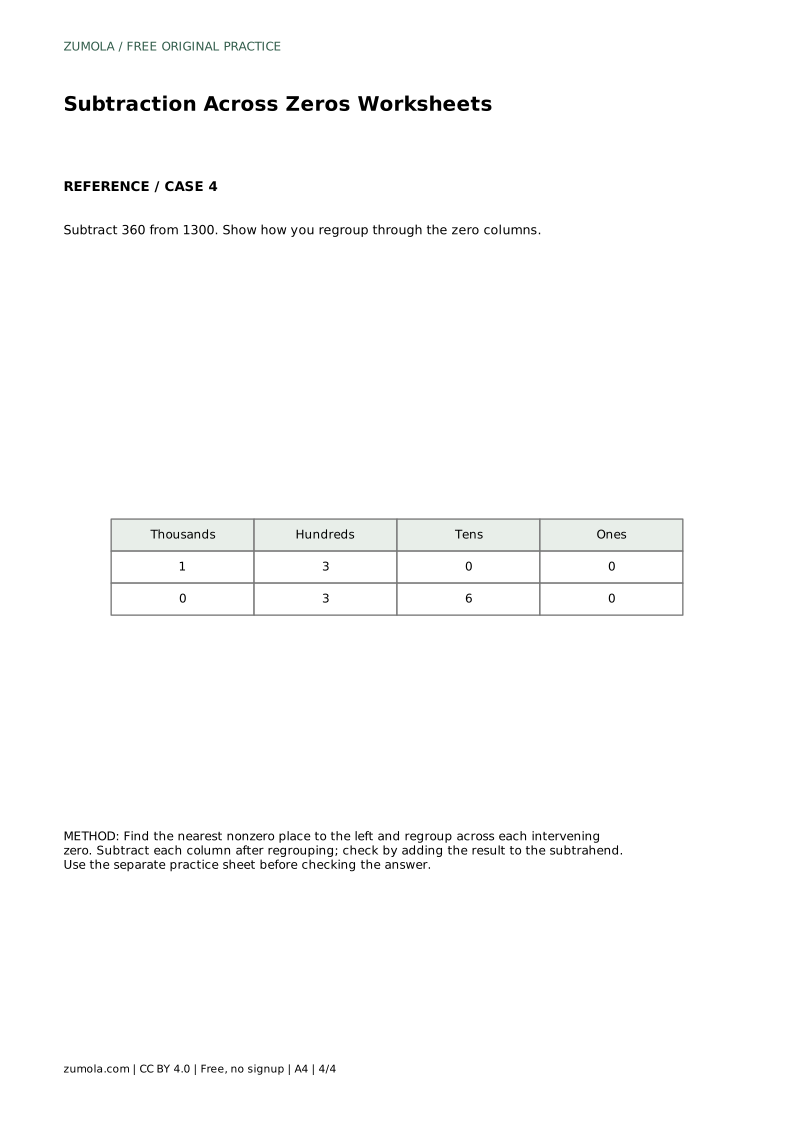
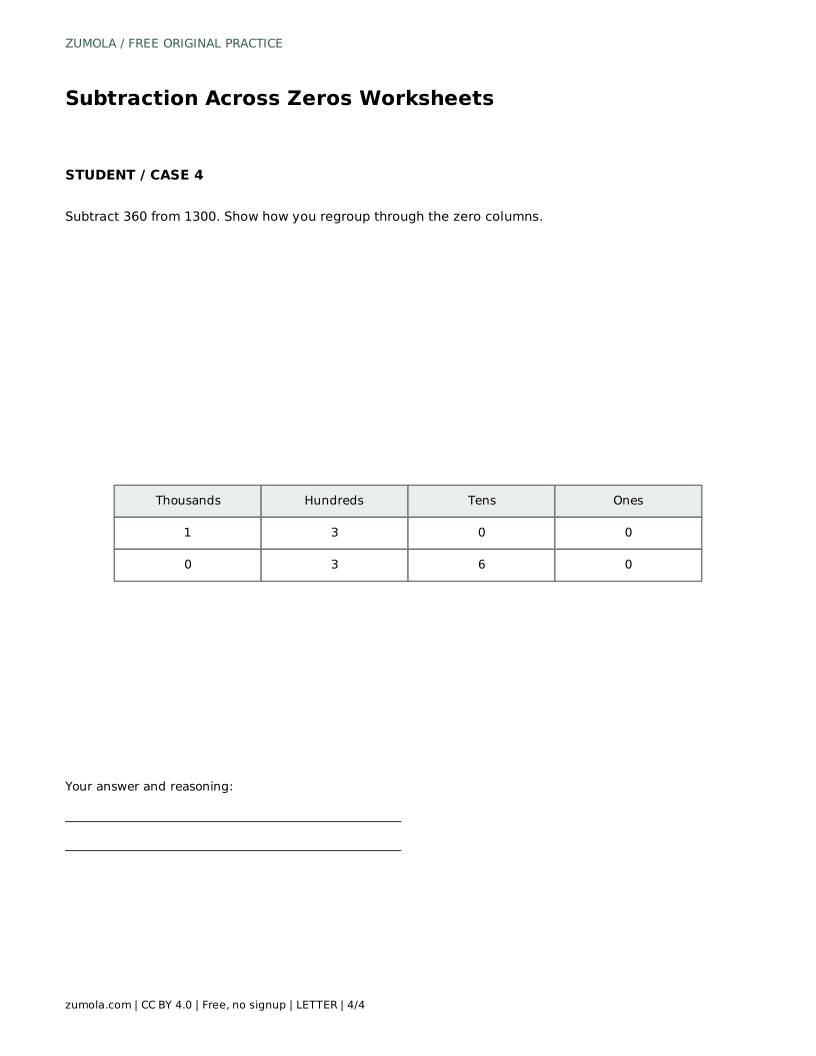
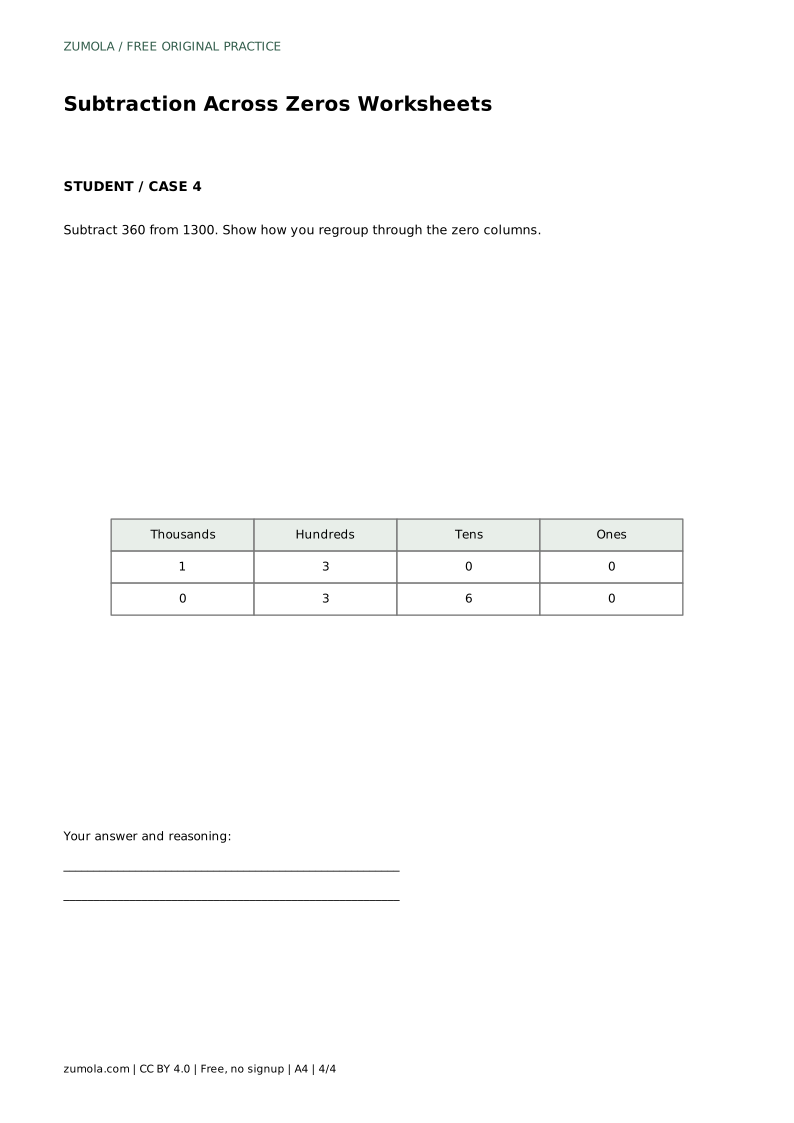
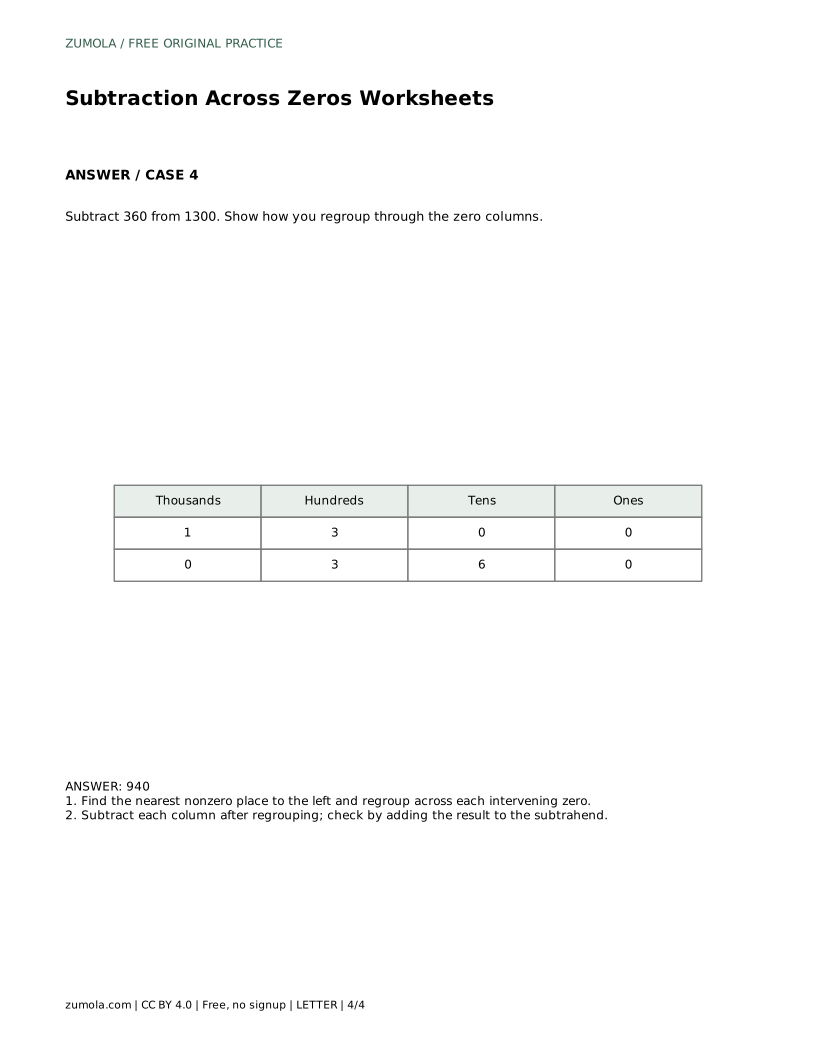
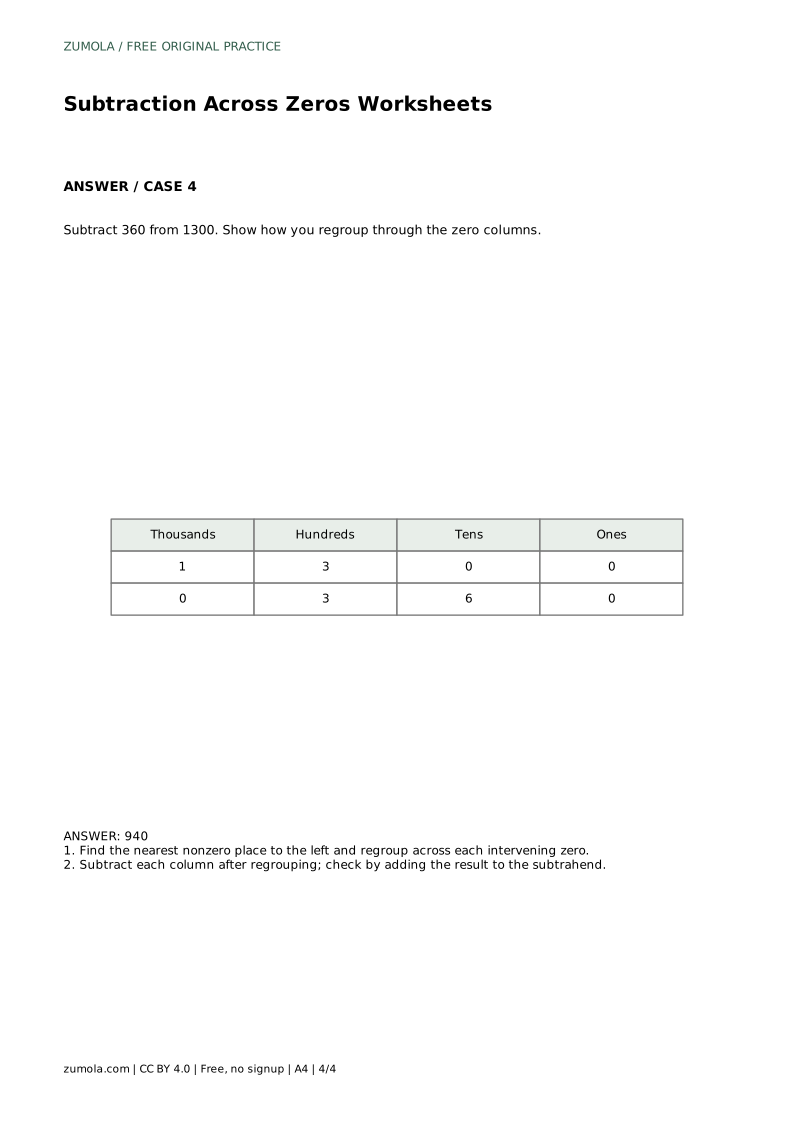
Not every problem crosses two zero columns. In 1300 minus 360, the ones column is 0 minus 0, so no regrouping is needed there. The tens column is 0 minus 6, which cannot be done, so regroup directly from the hundreds digit 3. The hundreds column becomes 2, and the tens column becomes 10. Then subtract: ones 0 minus 0 equals 0; tens 10 minus 6 equals 4; hundreds 2 minus 3 cannot be done, so regroup from the thousands digit 1, making the hundreds column 12 and the thousands column 0. Then 12 minus 3 equals 9, and the thousands column is 0. The result is 940.
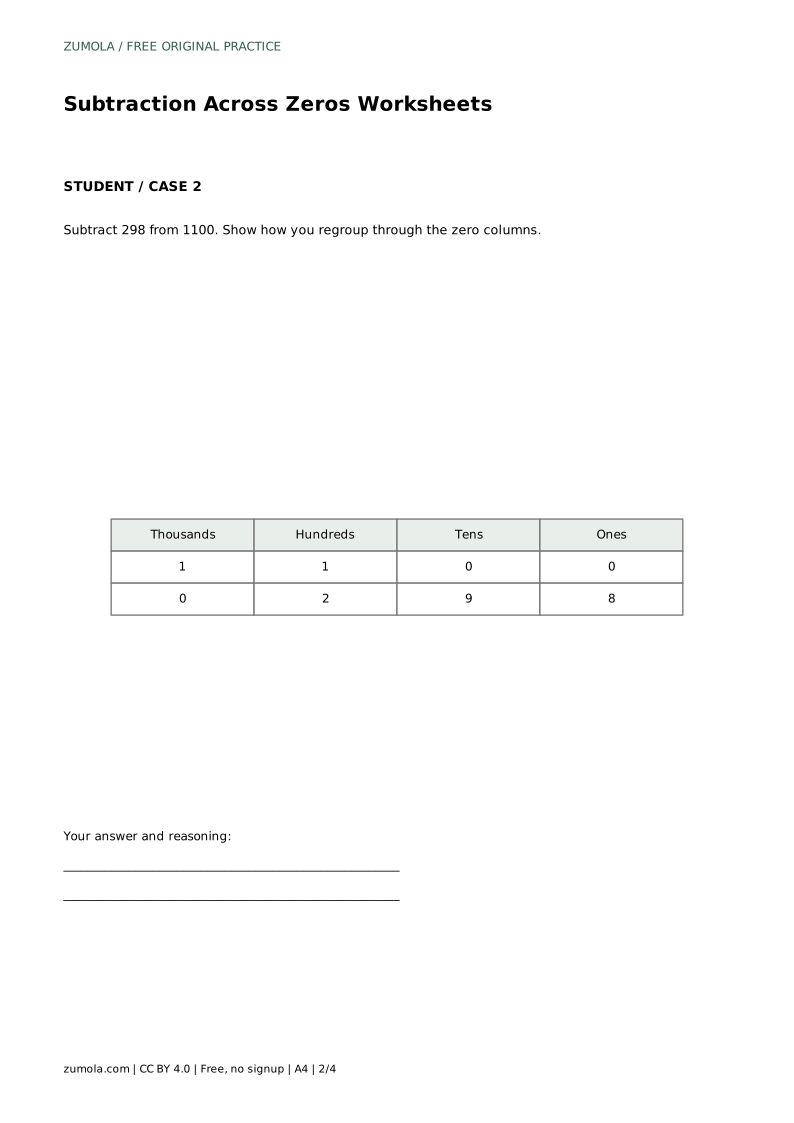
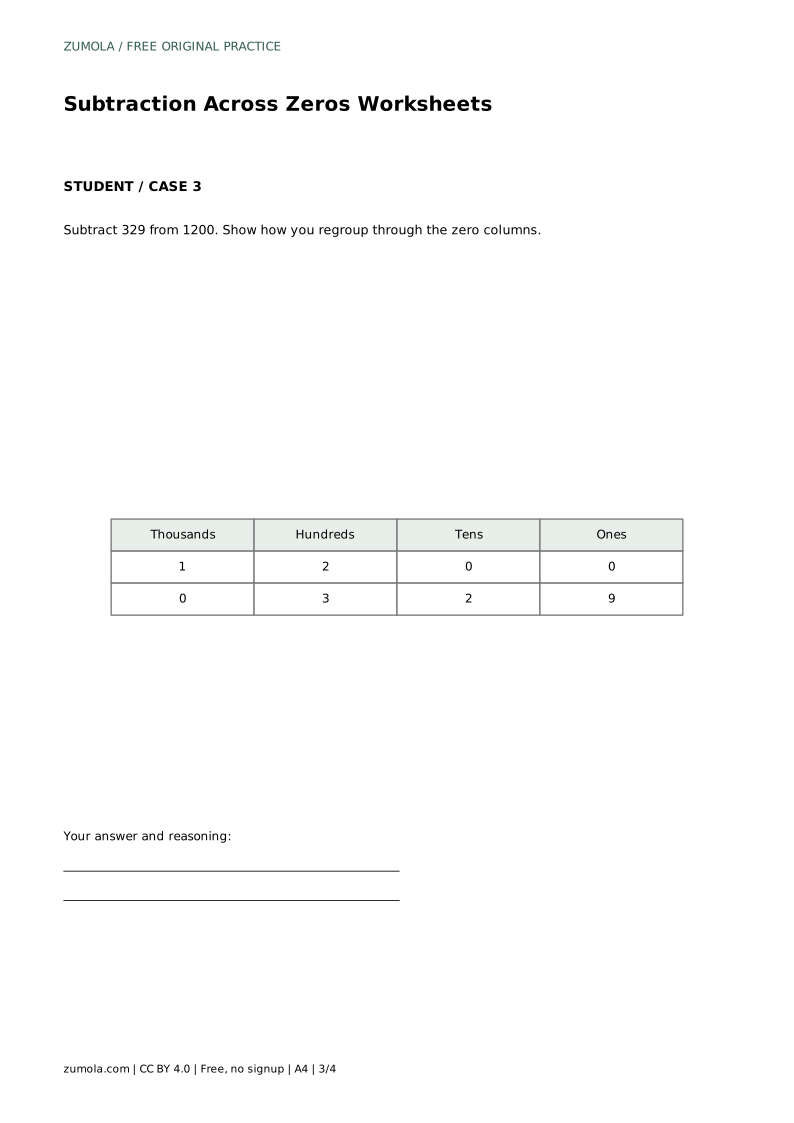
The key is to find the nearest nonzero place to the left of the column that needs to borrow. If that place is immediately to the left, no zero column is crossed. If zero columns sit between, each zero becomes 9 as the regrouped value passes through.
Subtract 267 from 1000. Show how you regroup through the zero columns.
733 Find the nearest nonzero place to the left and regroup across each intervening zero. Subtract each column after regrouping; check by adding the result to the subtrahend.
Regrouping one unit from the left gives 10 in the next column. That column lends 1 to the right, leaving 9, and the process repeats through each zero column.
No. Regroup only through the zero columns between the nearest nonzero place and the column that needs to borrow. If the nonzero place is immediately to the left, no zero column is crossed.
Add the result to the subtrahend. If the sum equals the original top number, the subtraction is correct.
All math worksheets · Free coordinate paper
Original resources · CC BY 4.0 · Free for personal and classroom use with attribution.