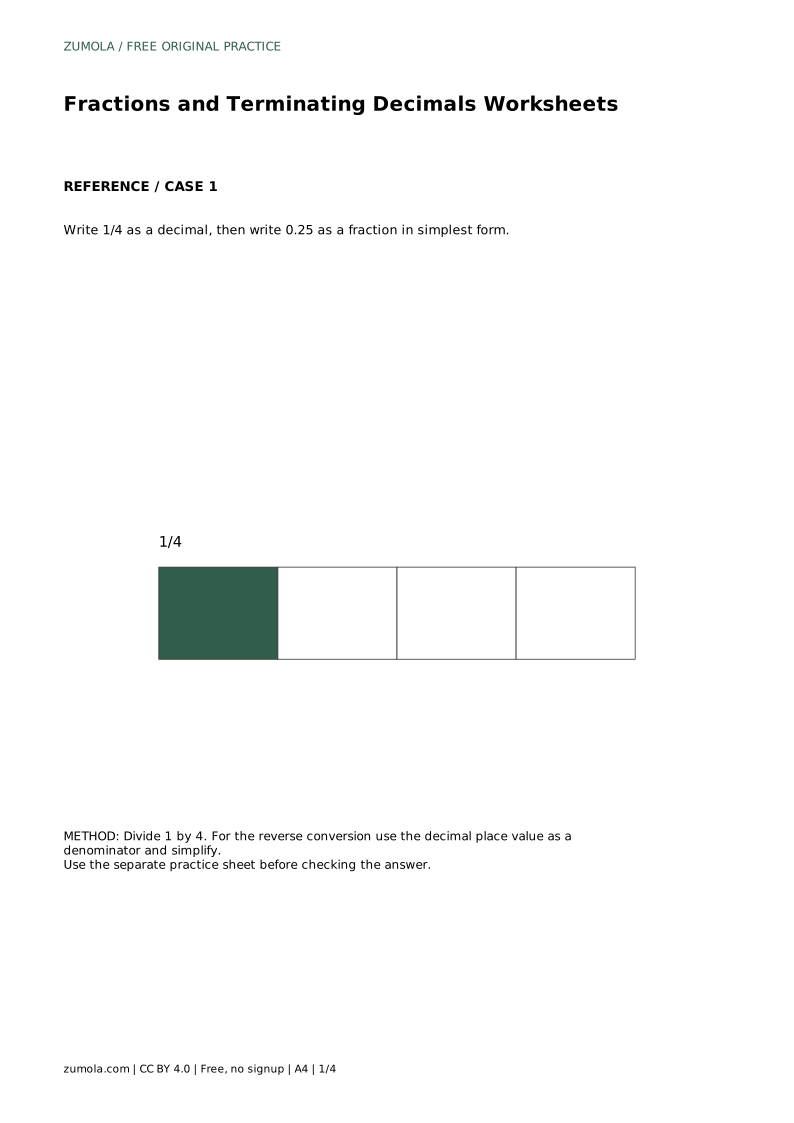
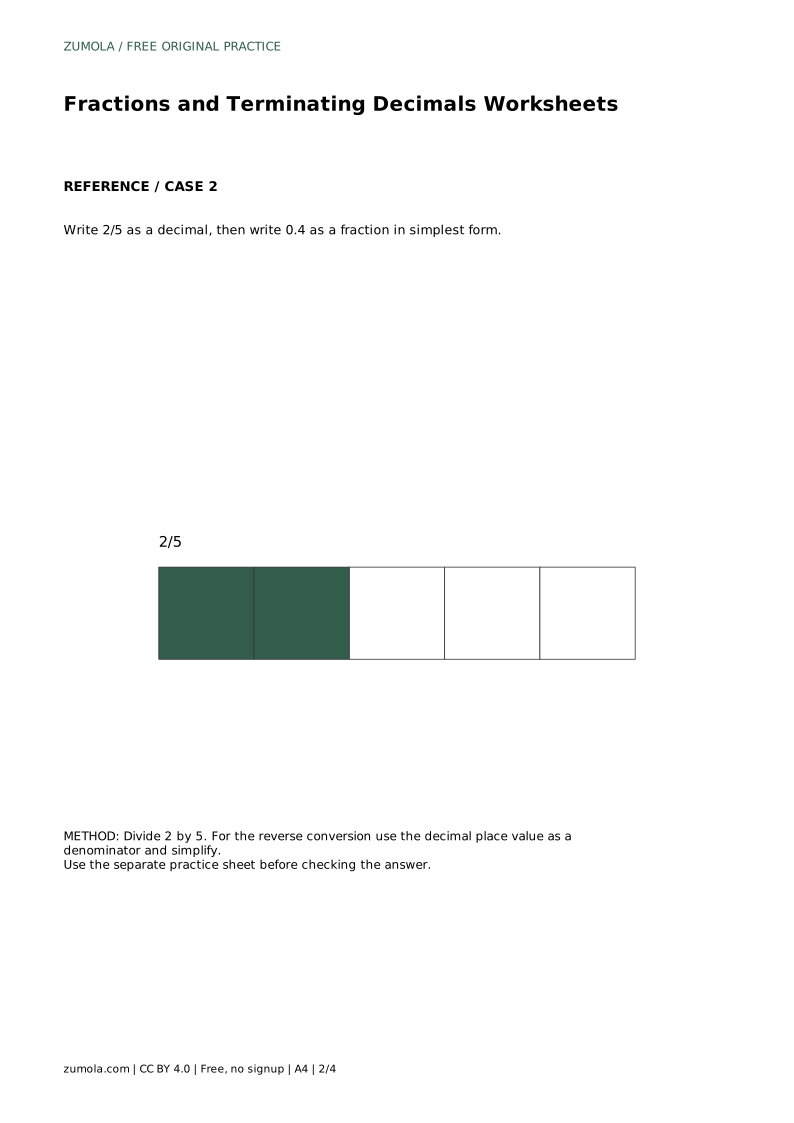
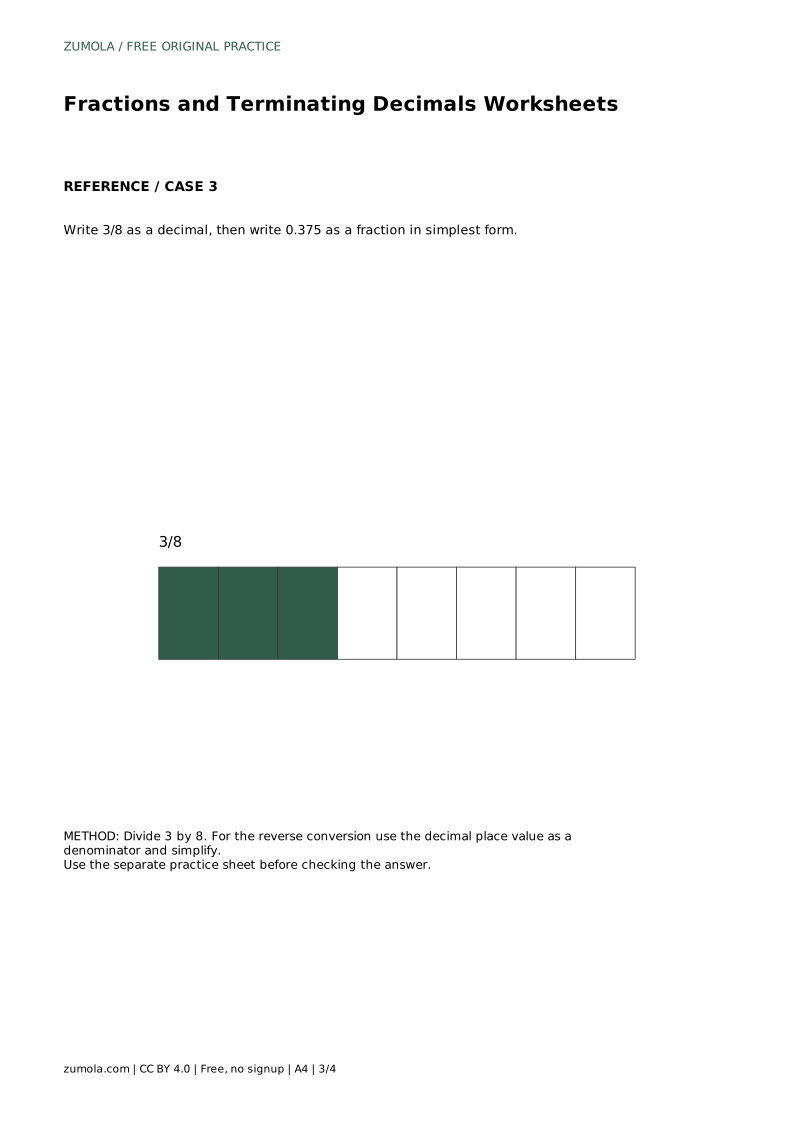
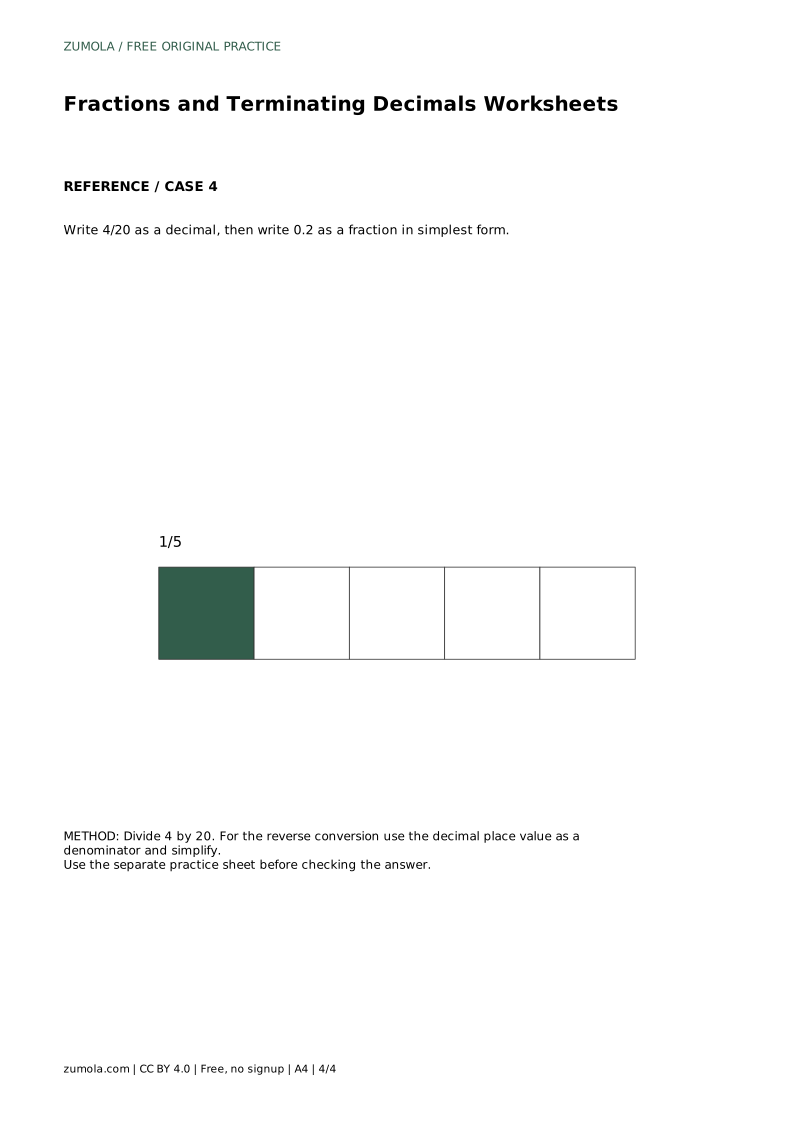
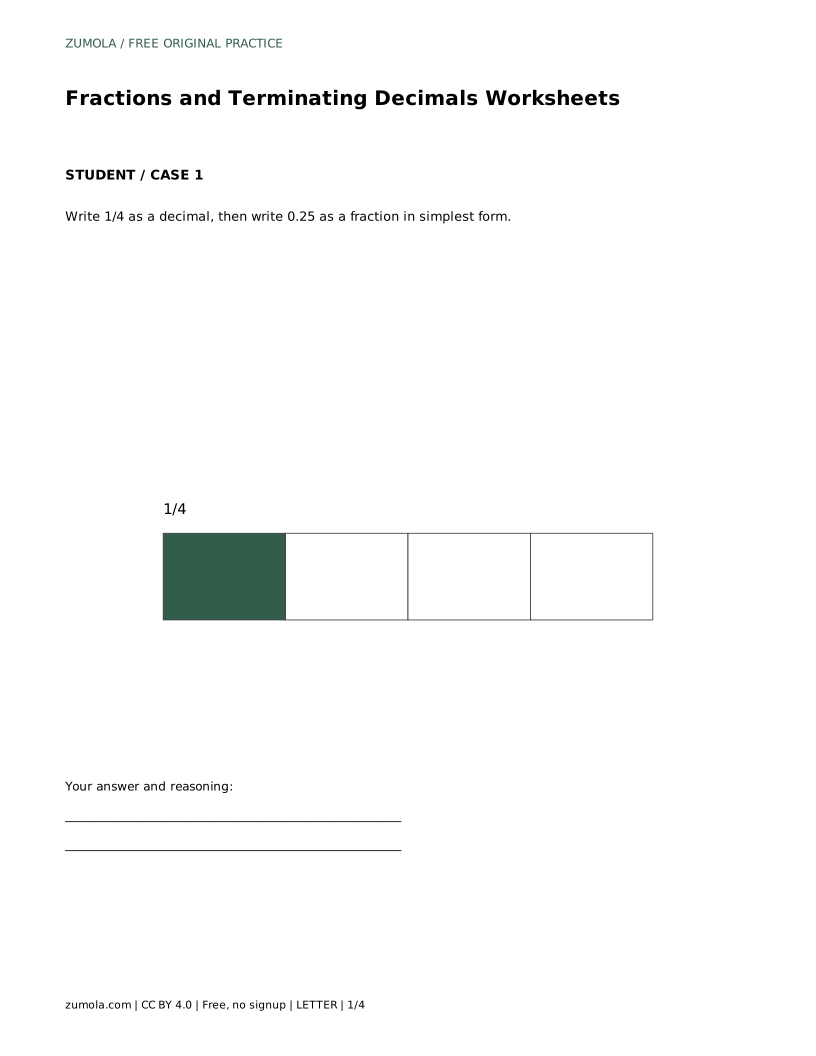
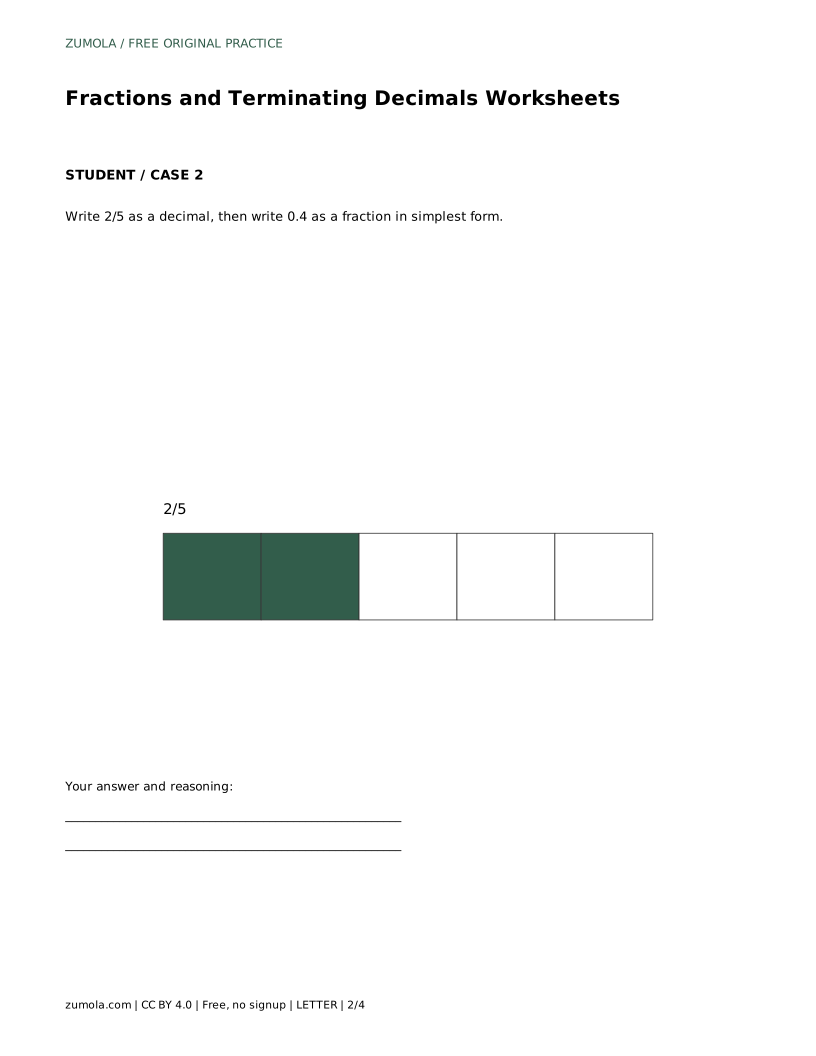
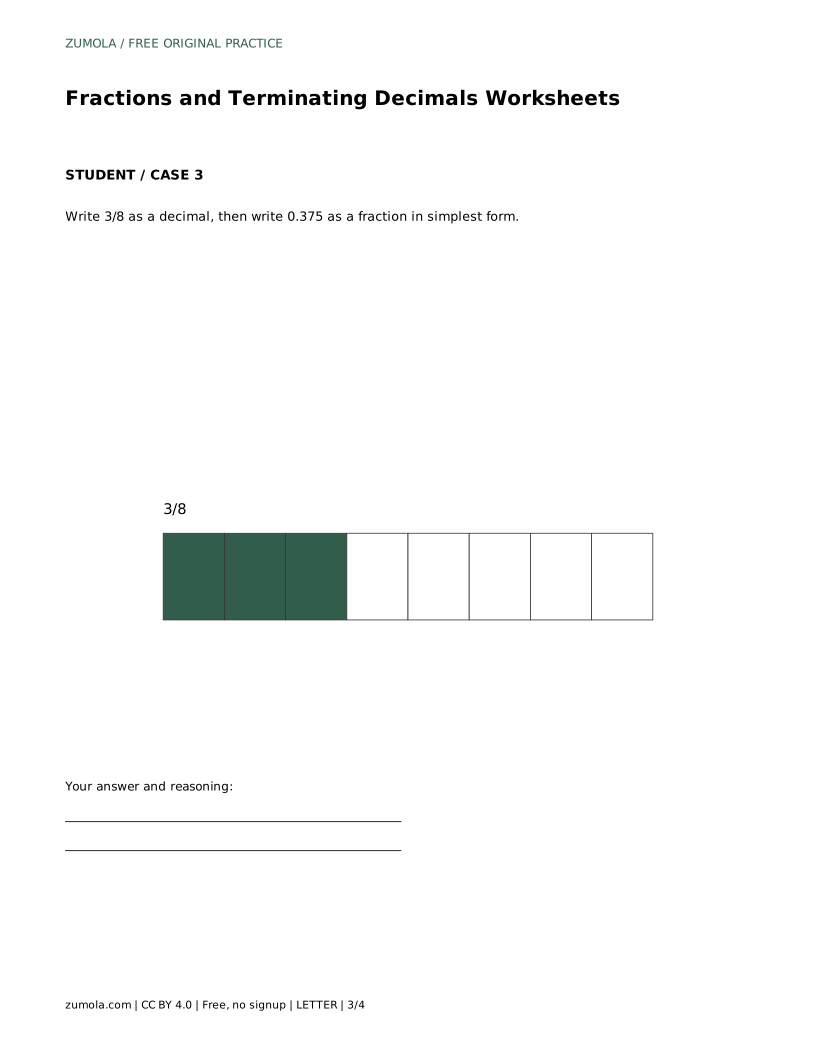
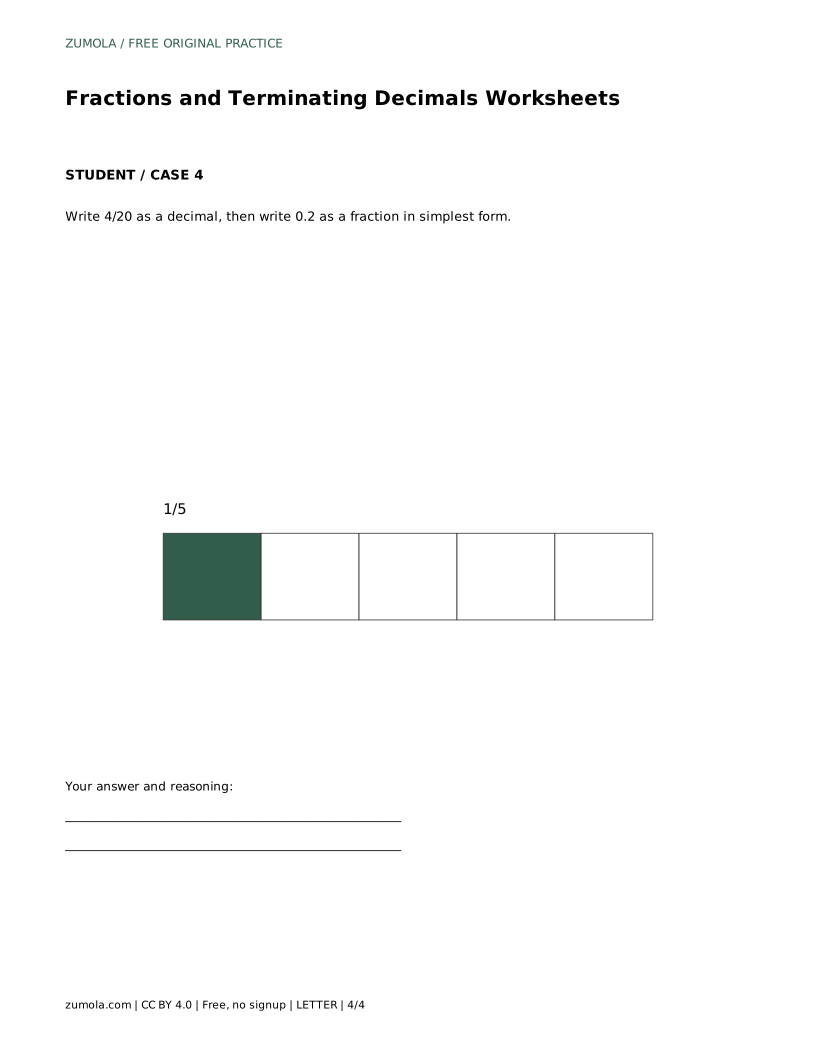
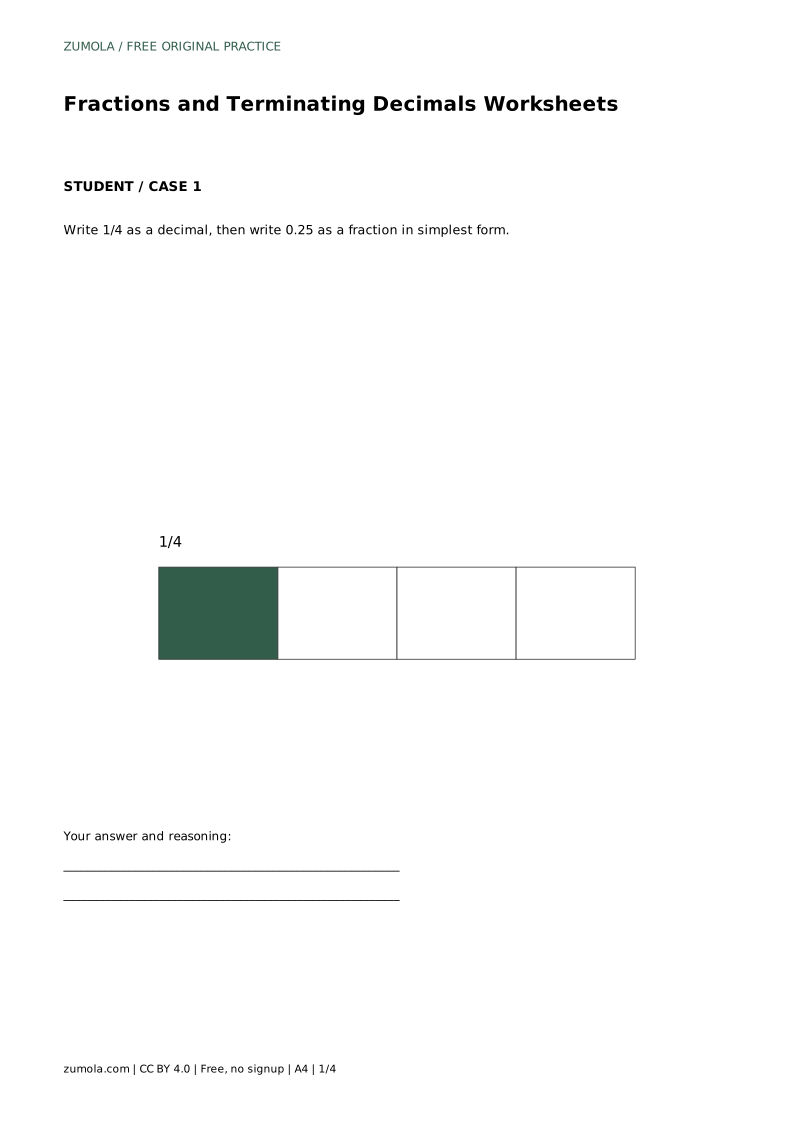
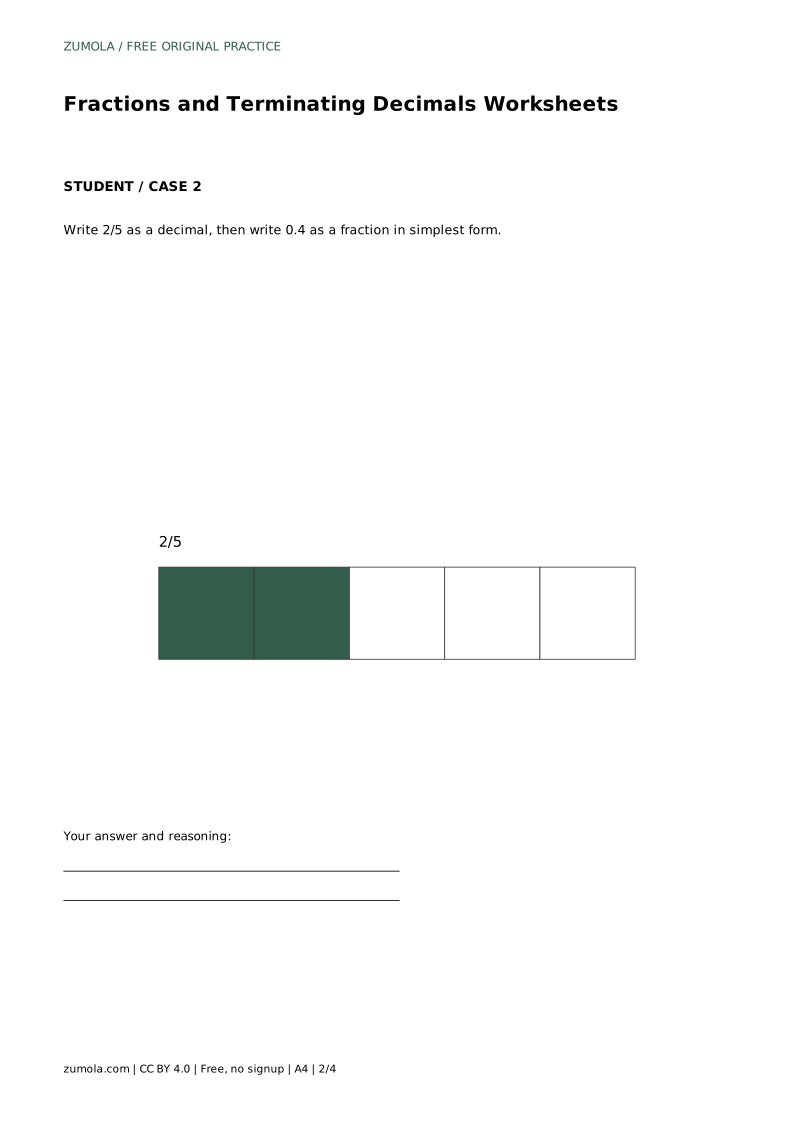
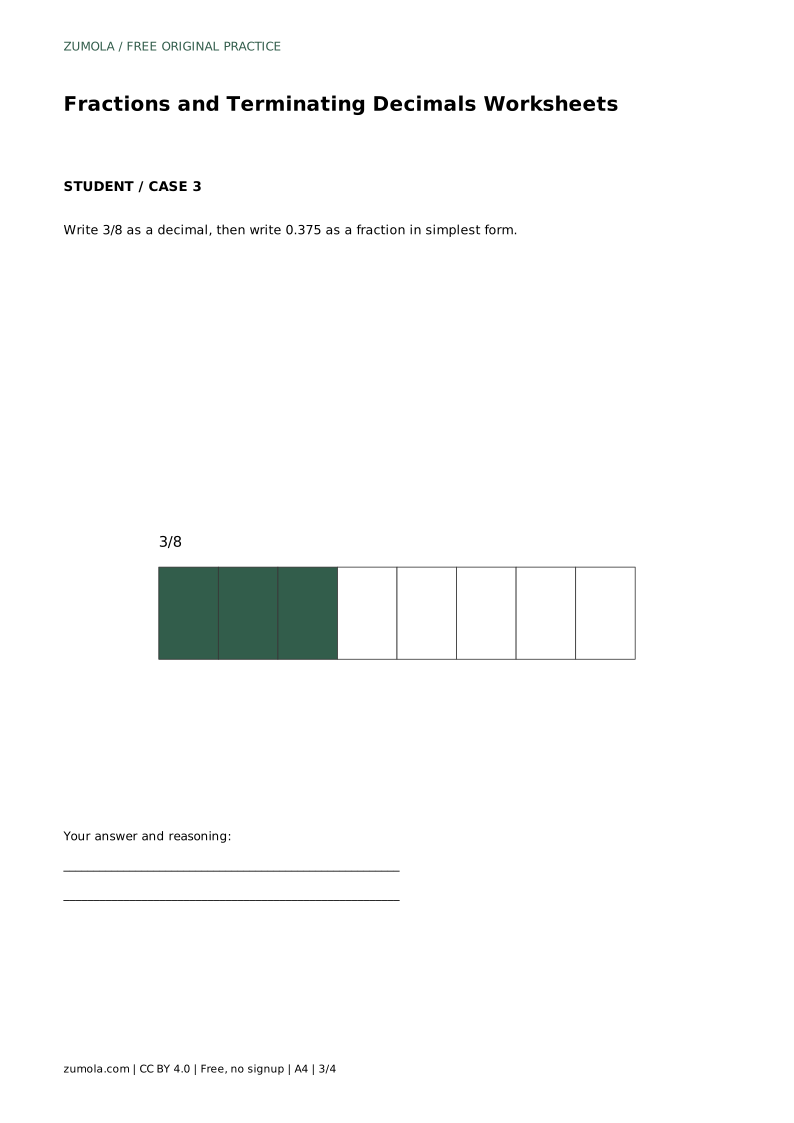
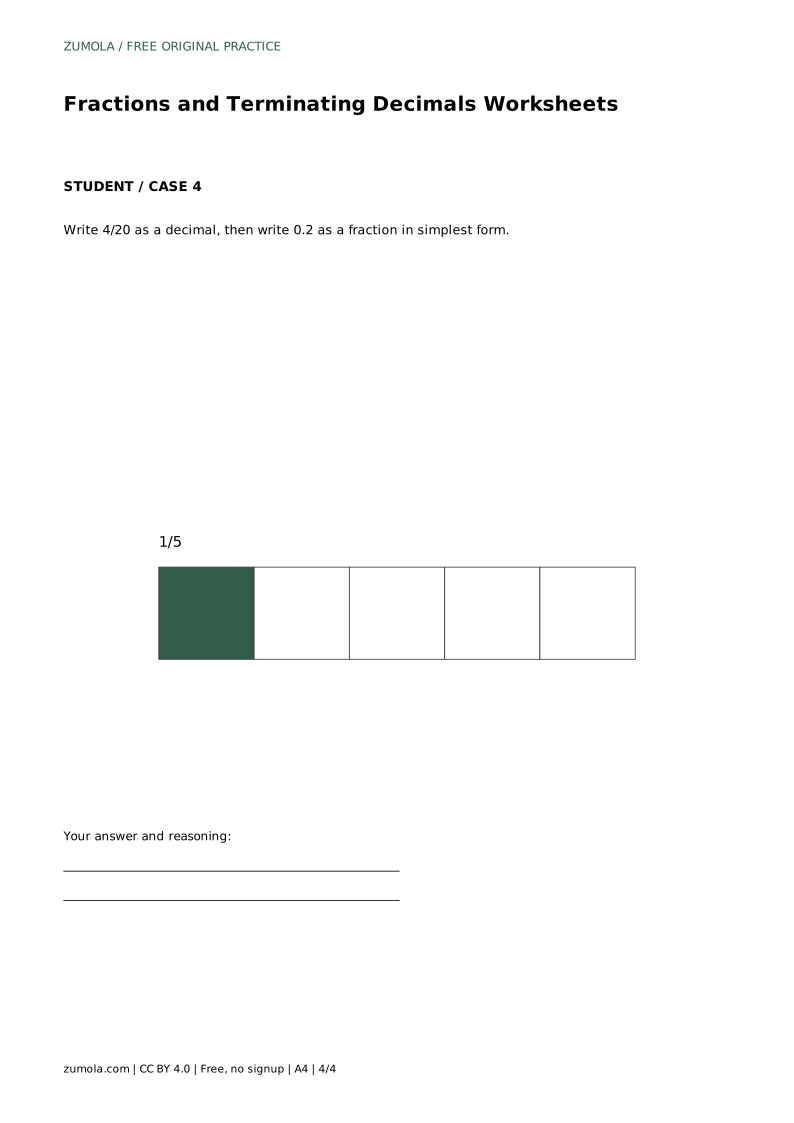
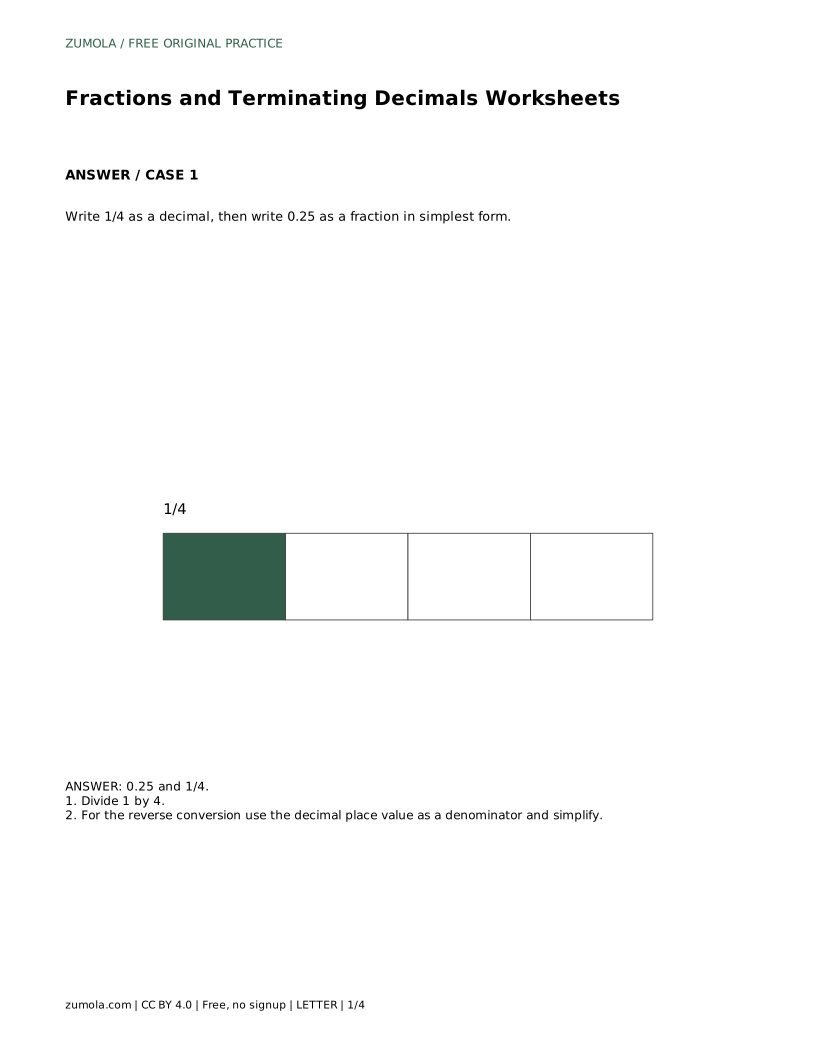
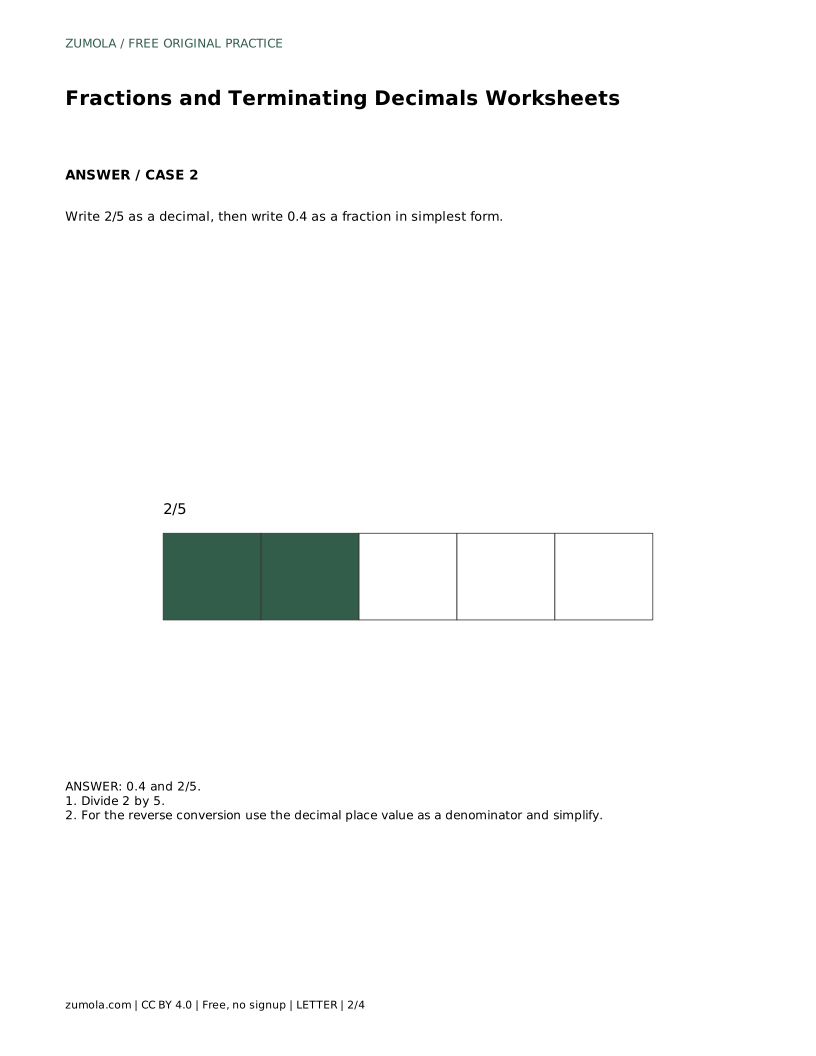
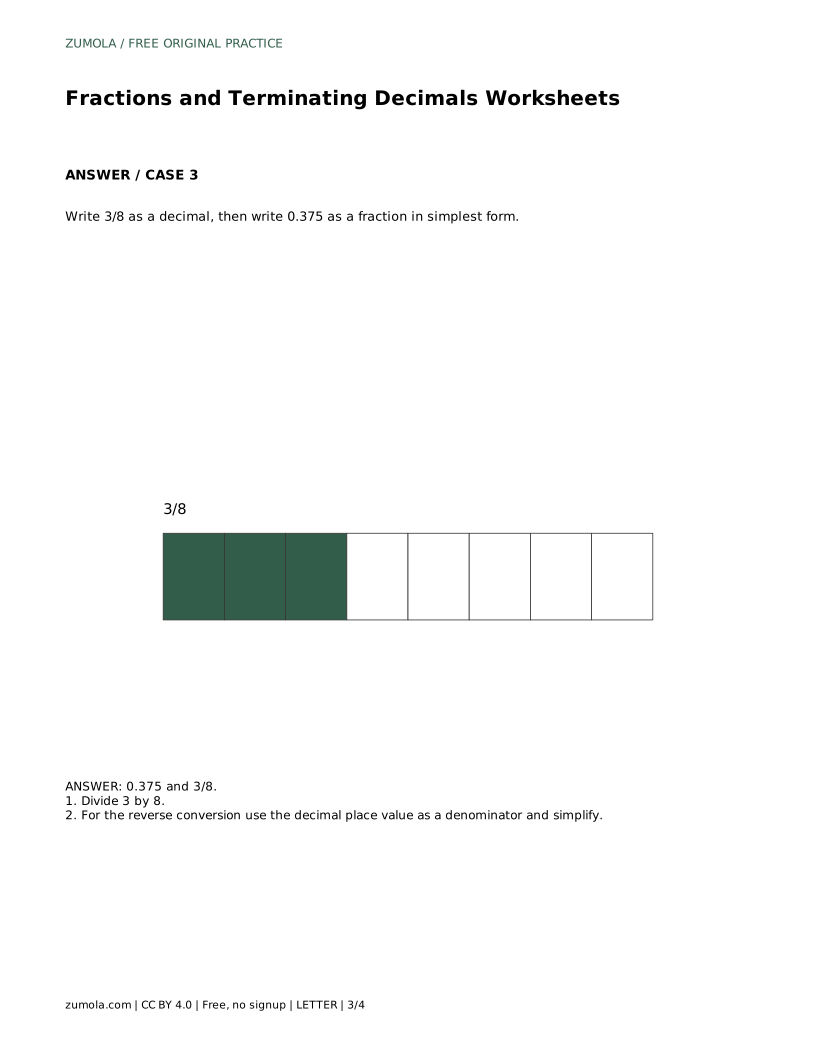
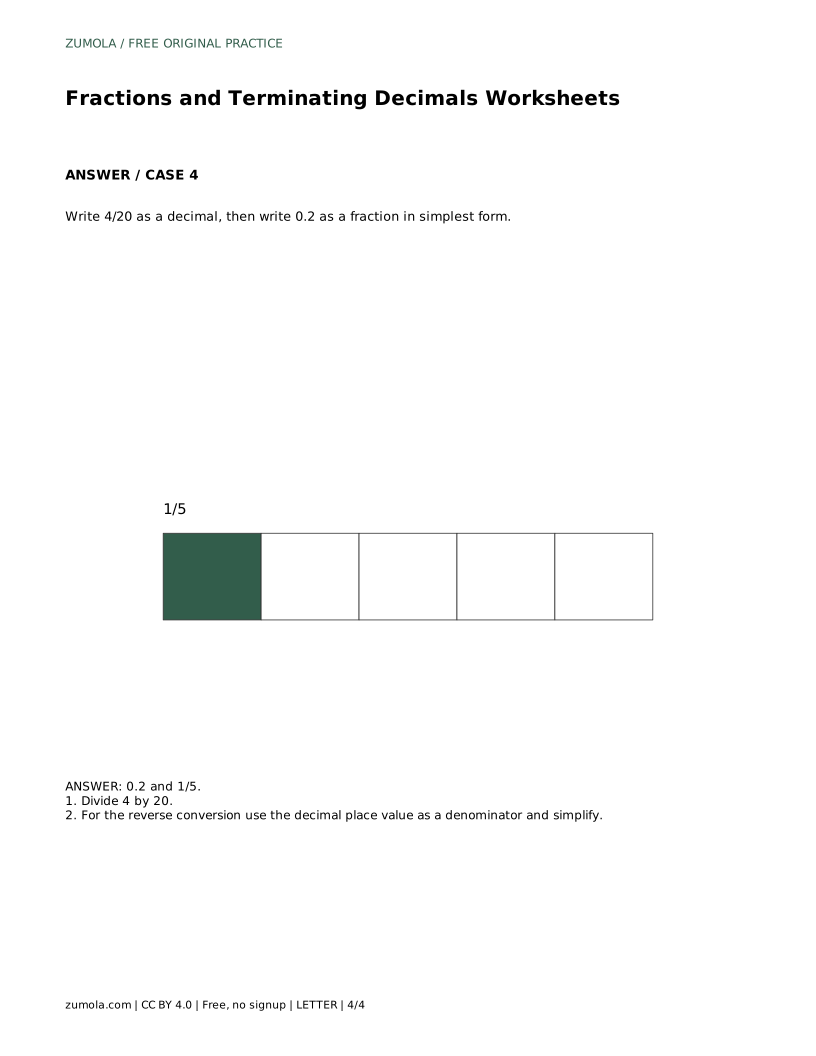
Reference diagrams
LETTER · Download PDF
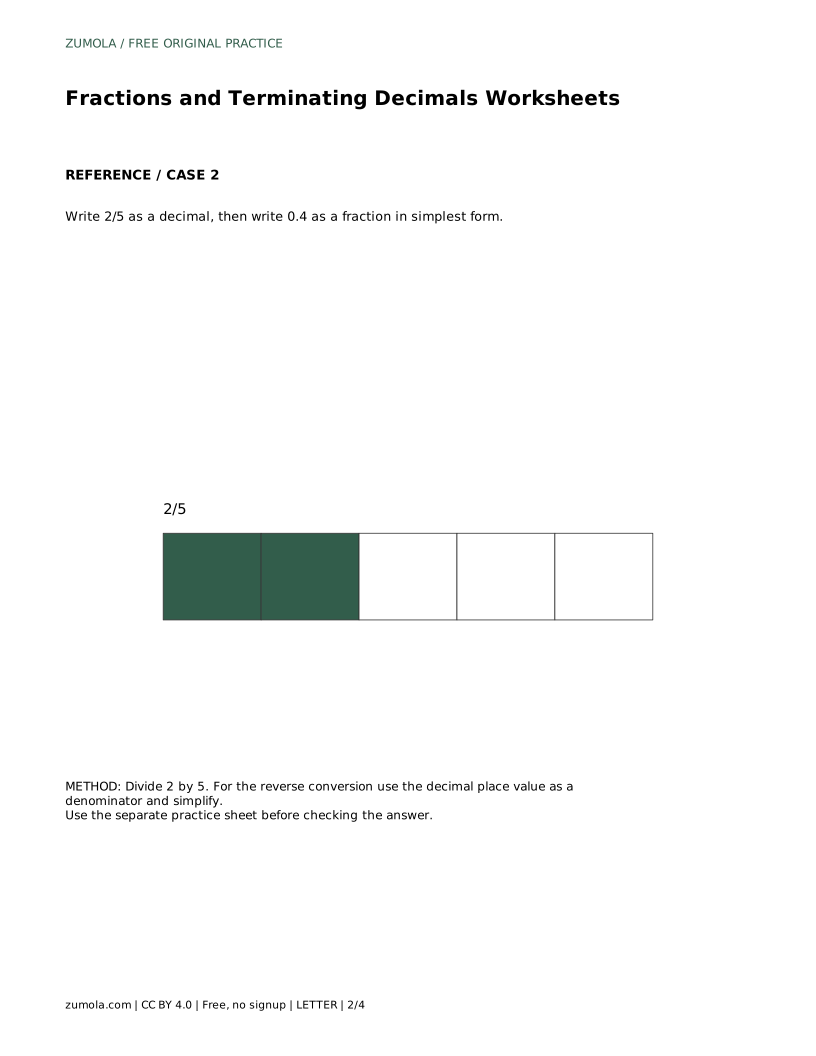
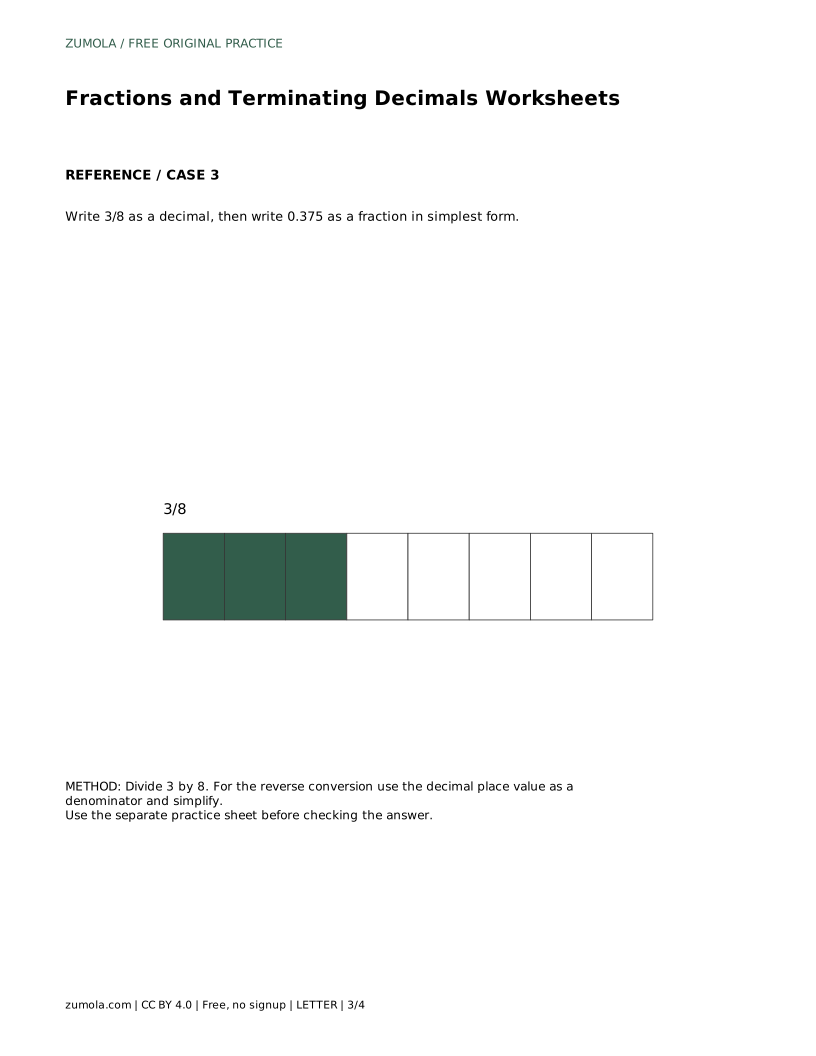
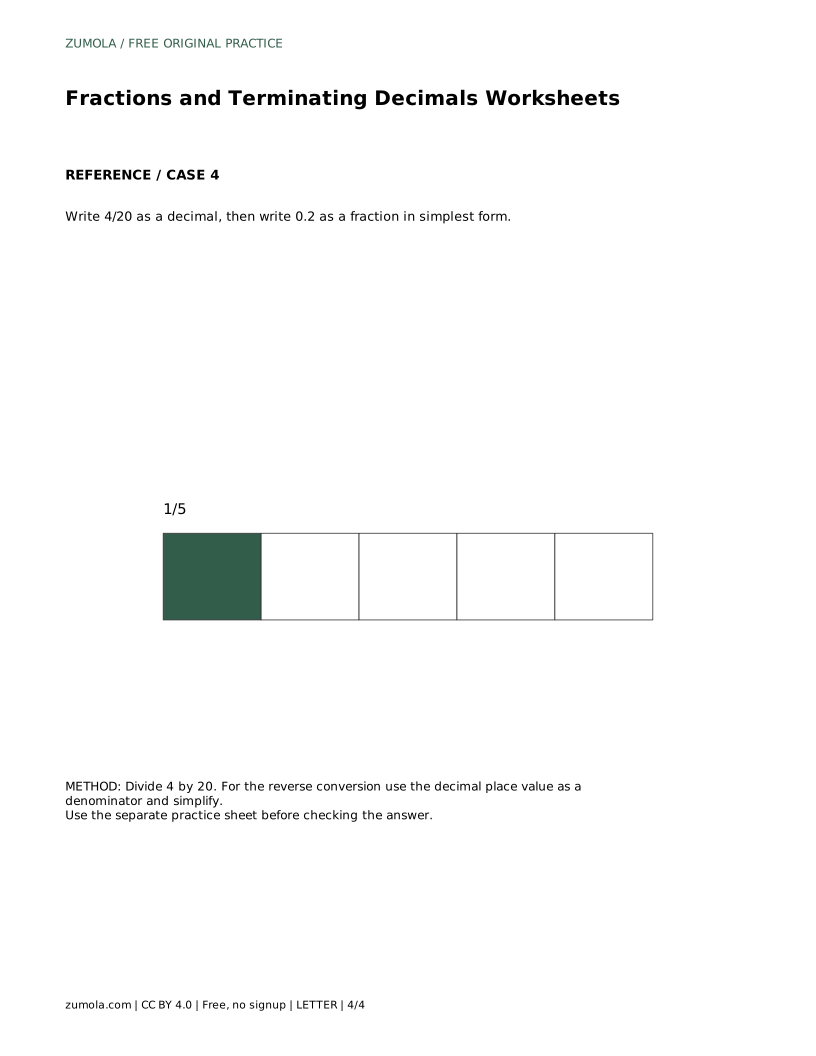
A4 · Download PDF
Free original resources
Teach fraction-to-decimal and decimal-to-fraction conversion with place-value reasoning, simplest-form checks, and a clear rubric for printable practice sheets.
Four original cases, with reference diagrams, practice sheets and worked answers. Everything is free; no signup required.
LETTER · Download PDF
A4 · Download PDF
LETTER · Download PDF
A4 · Download PDF
LETTER · Download PDF
A4 · Download PDF
Use A4 or US Letter to match your printer. Use the stated values and conditions to solve each exercise; diagrams are not physical measuring rulers.
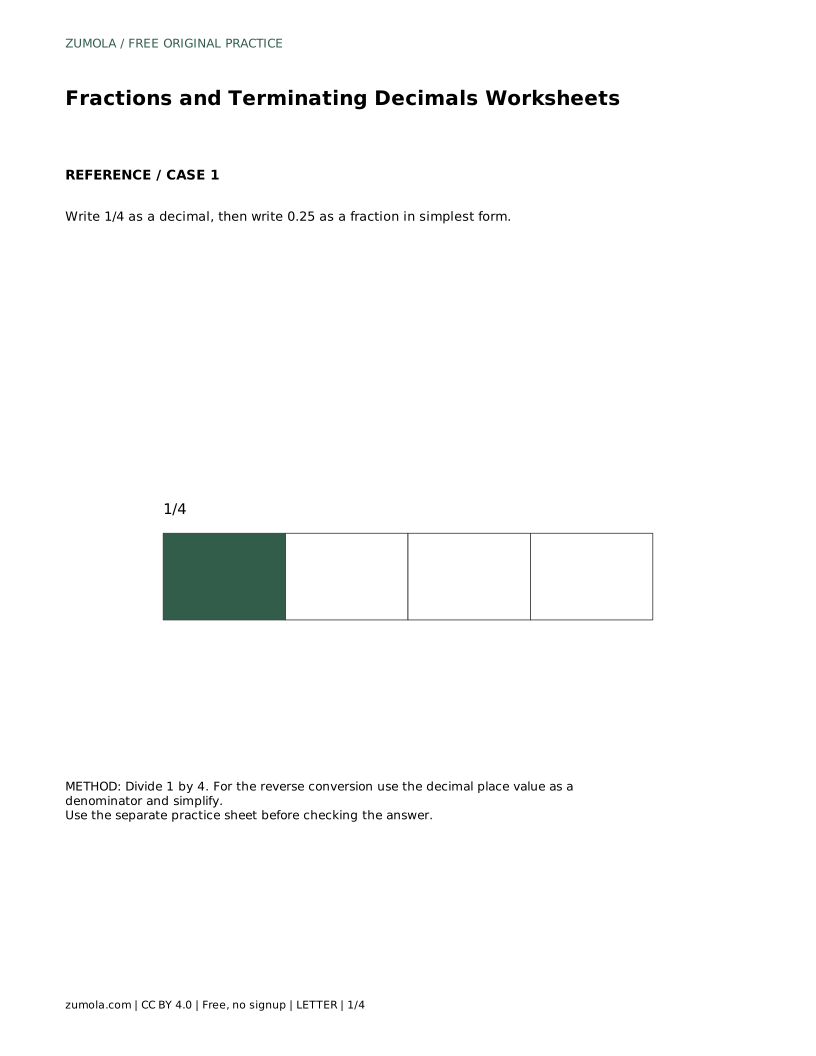
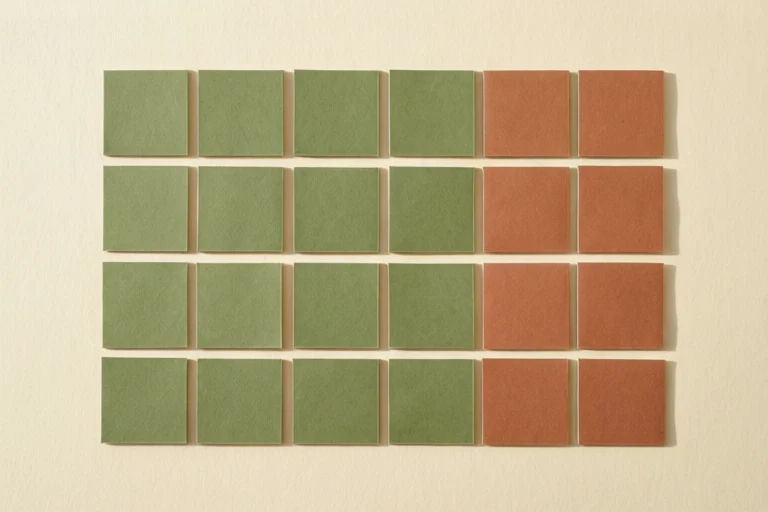
These worksheets focus on one precise skill: moving between a fraction and a terminating decimal, then returning to simplest form. Students divide numerator by denominator, read decimal place value as a denominator, and simplify. The work is checkable because each conversion can be reversed.
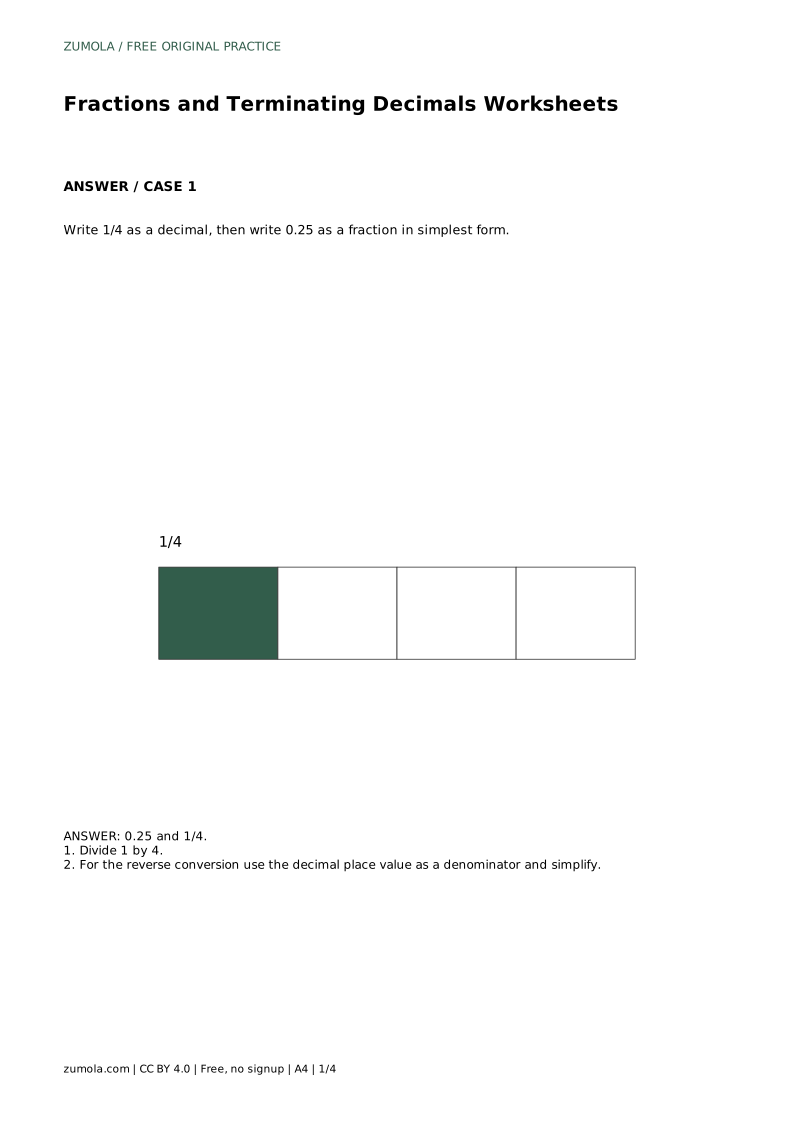
A fraction names a division: the numerator divided by the denominator. When that division ends, the decimal is terminating. For 1/4, divide 1 by 4 to get 0.25. The division ends because the remainder becomes zero.
Before dividing, ask whether the denominator in simplest form has only factors of 2 and 5. Those denominators produce terminating decimals; denominators with other prime factors repeat. Keep the focus on terminating cases here so students can confirm an exact endpoint rather than rounding.
A terminating decimal can be read aloud by place value. The digits after the point tell the numerator, and the last place tells the denominator. For 0.25, the last digit is in the hundredths place, so the fraction is 25/100.
Simplest form means dividing numerator and denominator by their greatest common factor. For 25/100, both share 25, giving 1/4. State the place-value denominator first, then simplify; skipping that step hides why the fraction is correct.
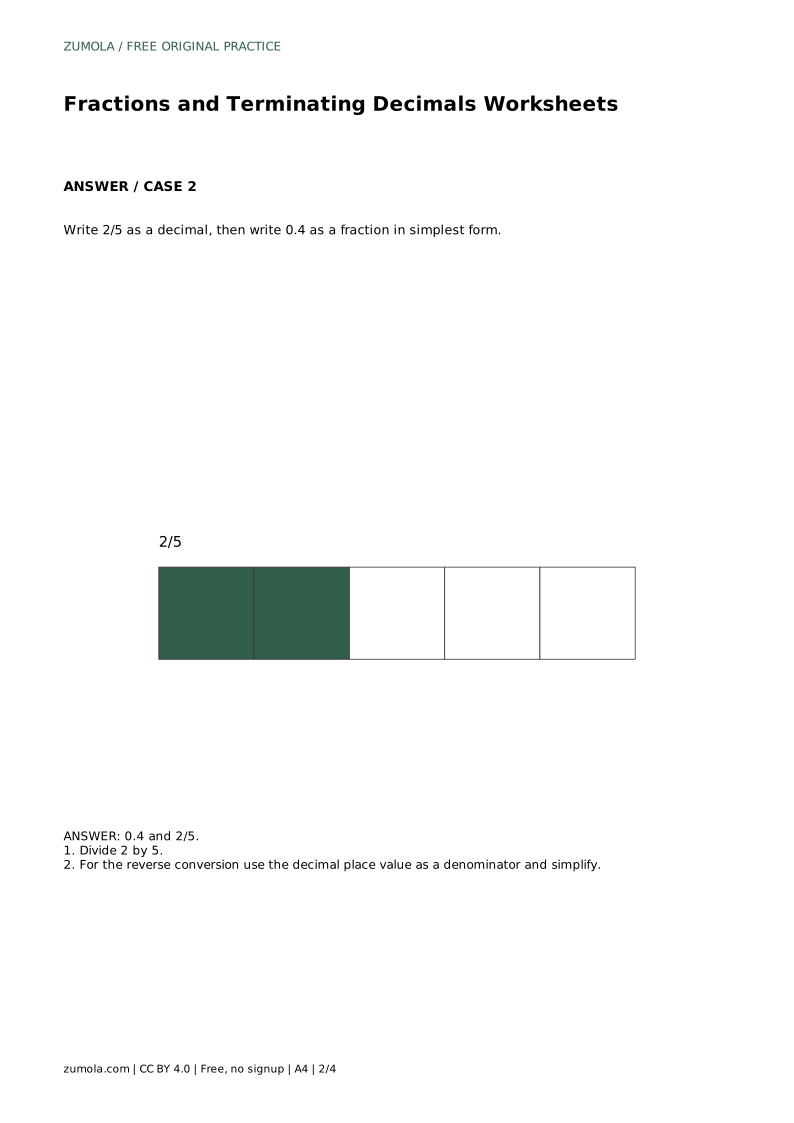
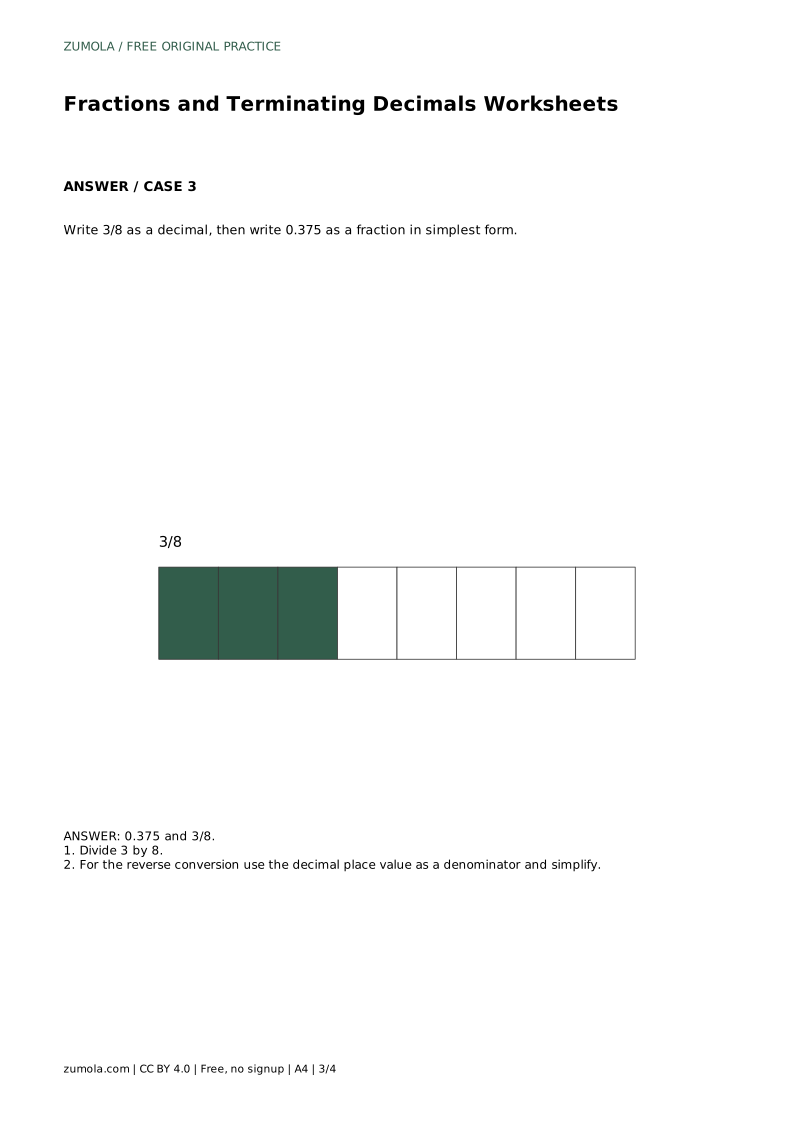
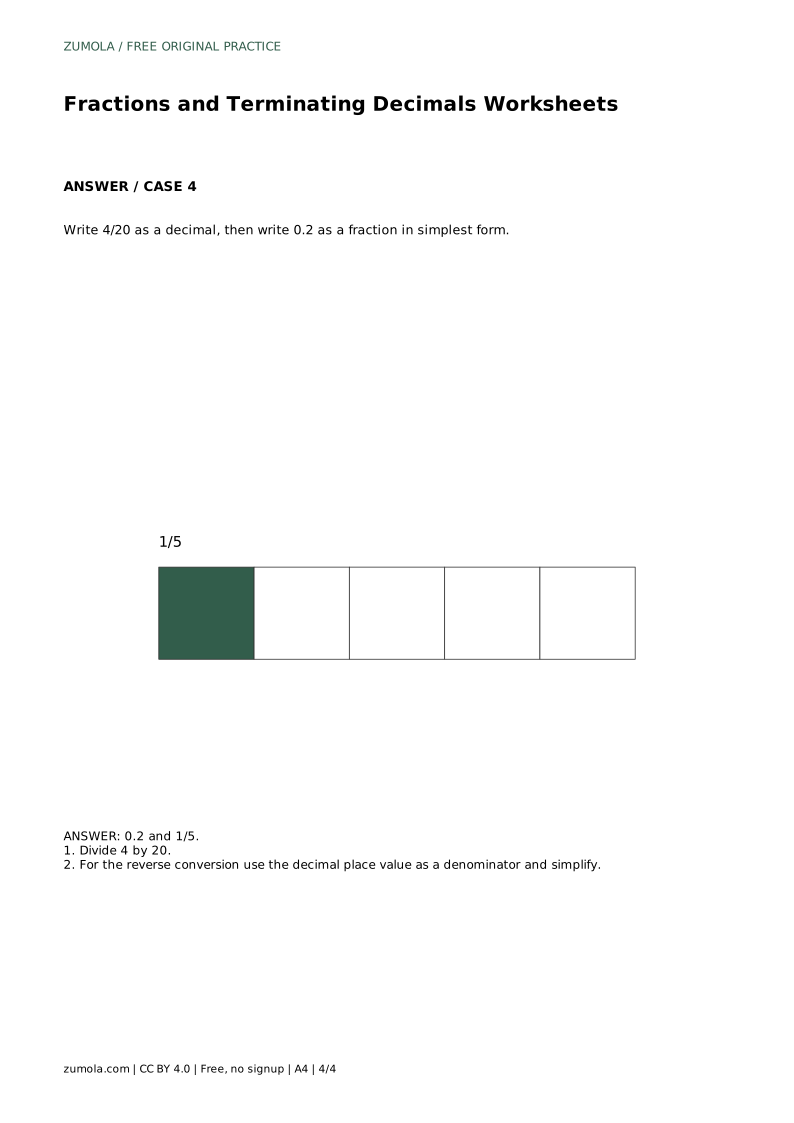
A fraction chart shows equal parts of one whole. Shade the part named by the fraction, then compare it with a decimal place-value strip divided into tenths or hundredths. The shaded lengths should match.
Art and diagram work can have several valid presentations, so judge clarity rather than an exact picture. A labeled bar, an accurate division layout, and a written simplification each count as evidence of understanding.
A useful sheet mixes both directions: fraction to decimal, then decimal to fraction in simplest form. Keep denominators small and terminating so students can finish by hand and check by reversing.
Write 1/4 as a decimal, then write 0.25 as a fraction in simplest form.
0.25 and 1/4. Divide 1 by 4. For the reverse conversion use the decimal place value as a denominator and simplify.
Put the fraction in simplest form. If the denominator has only 2 and 5 as prime factors, the decimal terminates.
Simplest form removes common factors, making the fraction easier to compare and use. The value stays the same.
Yes. Multiply the decimal by the denominator; the product should equal the numerator. Or convert the simplified fraction back by division.
All math worksheets · Free coordinate paper
Original resources · CC BY 4.0 · Free for personal and classroom use with attribution.