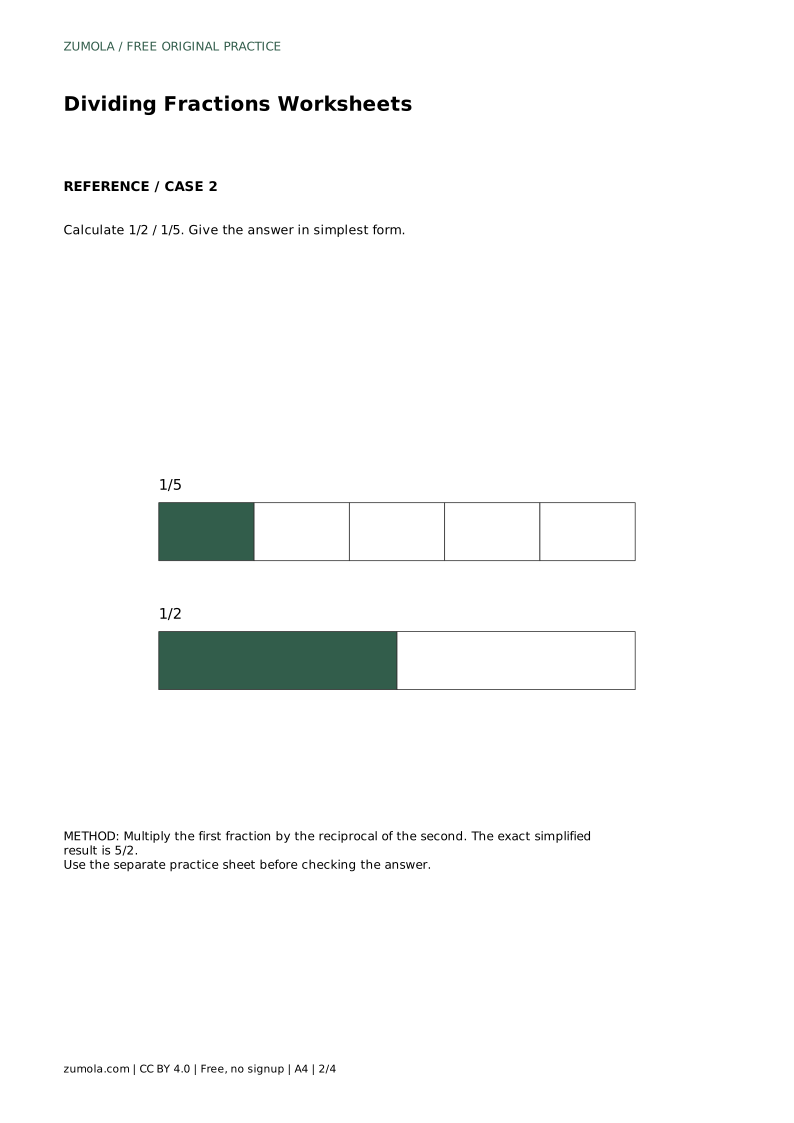
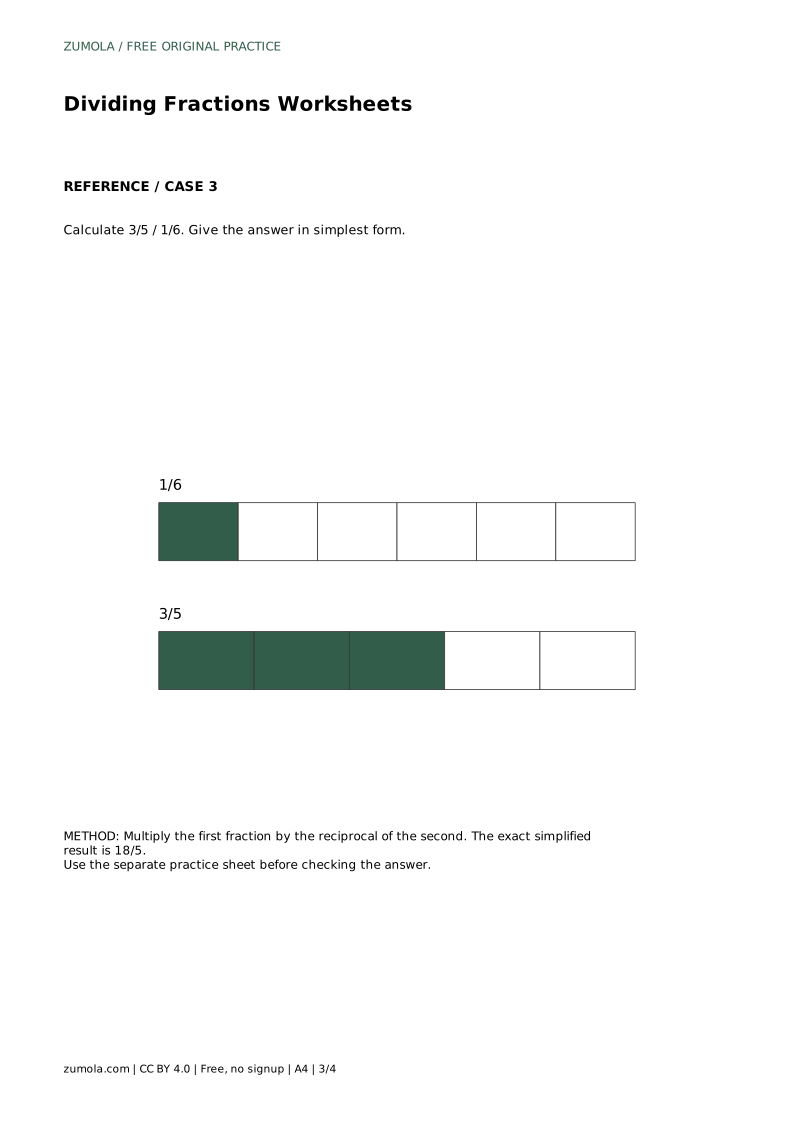
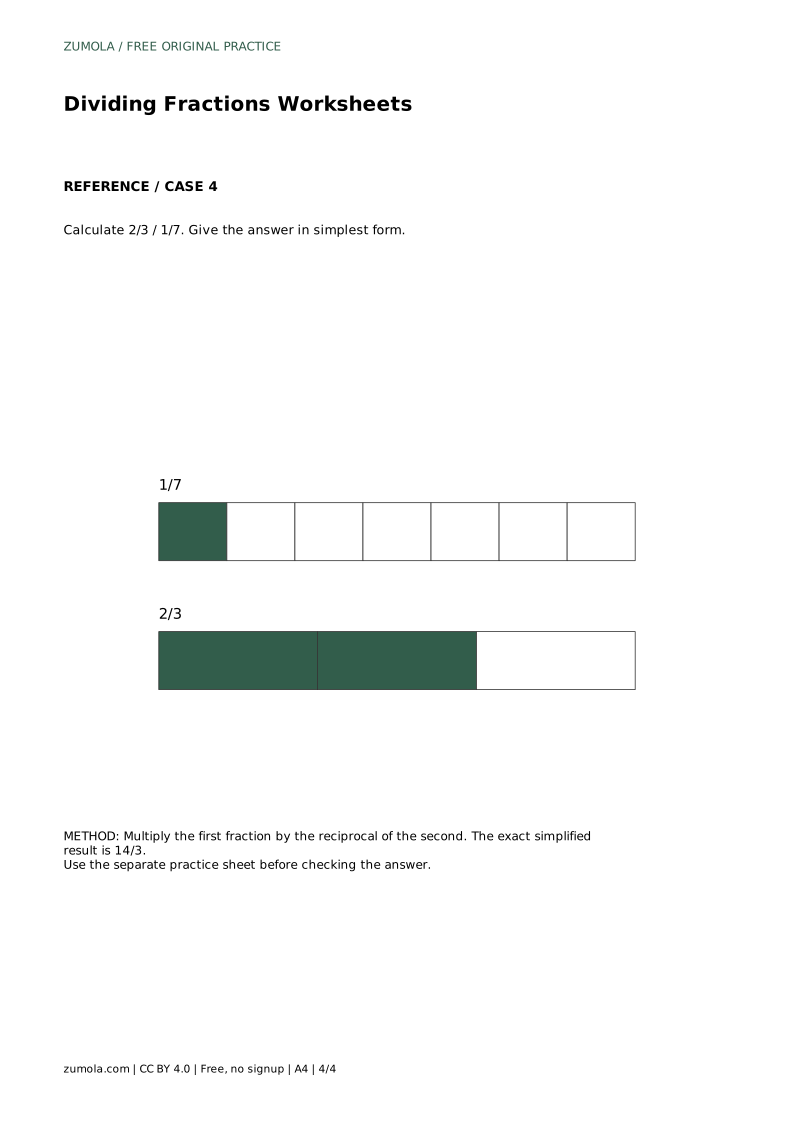
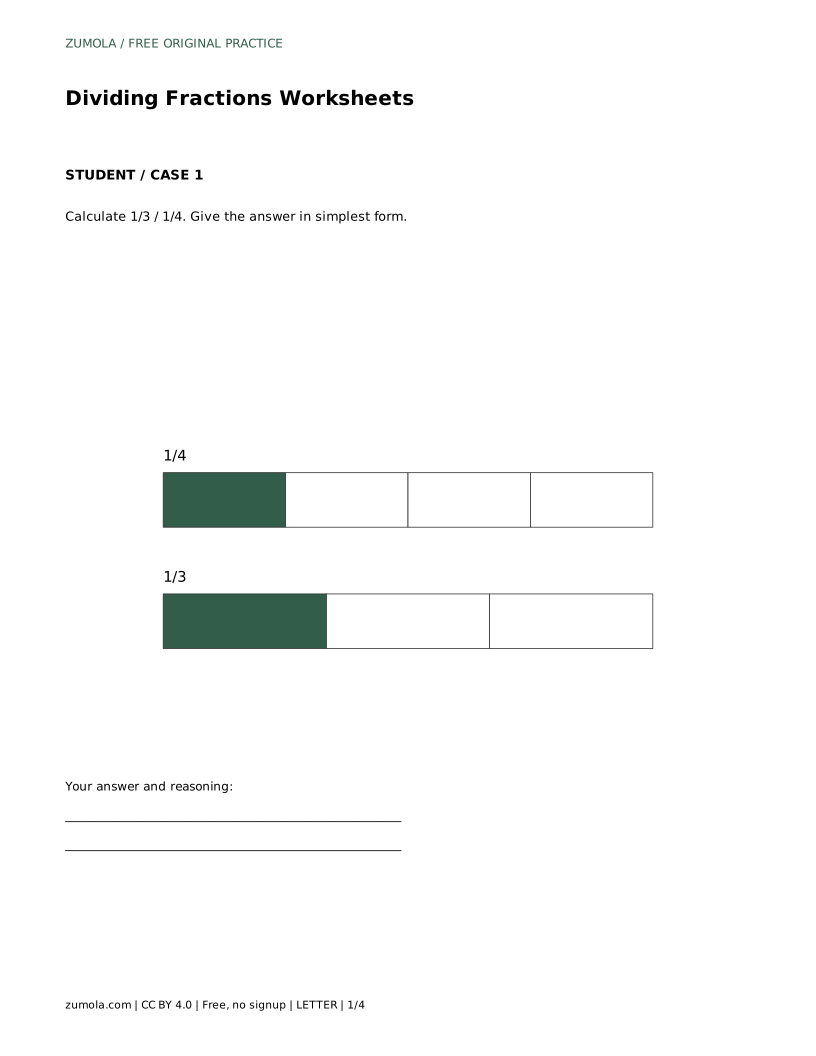
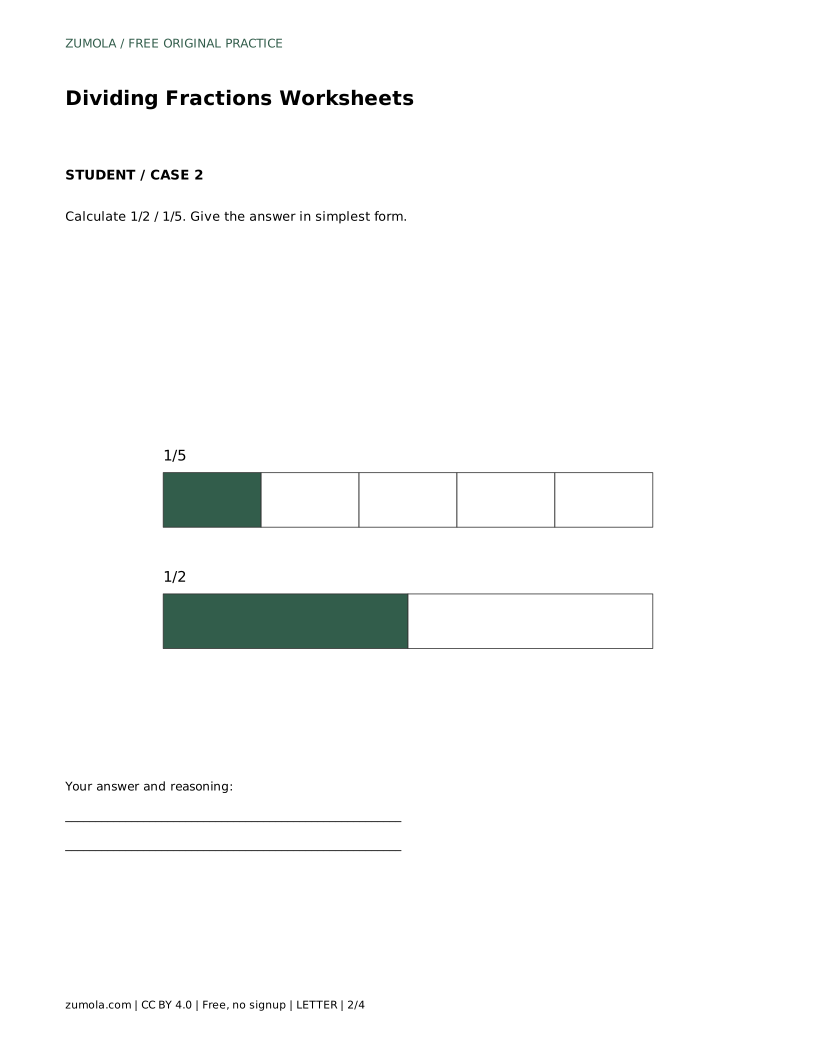
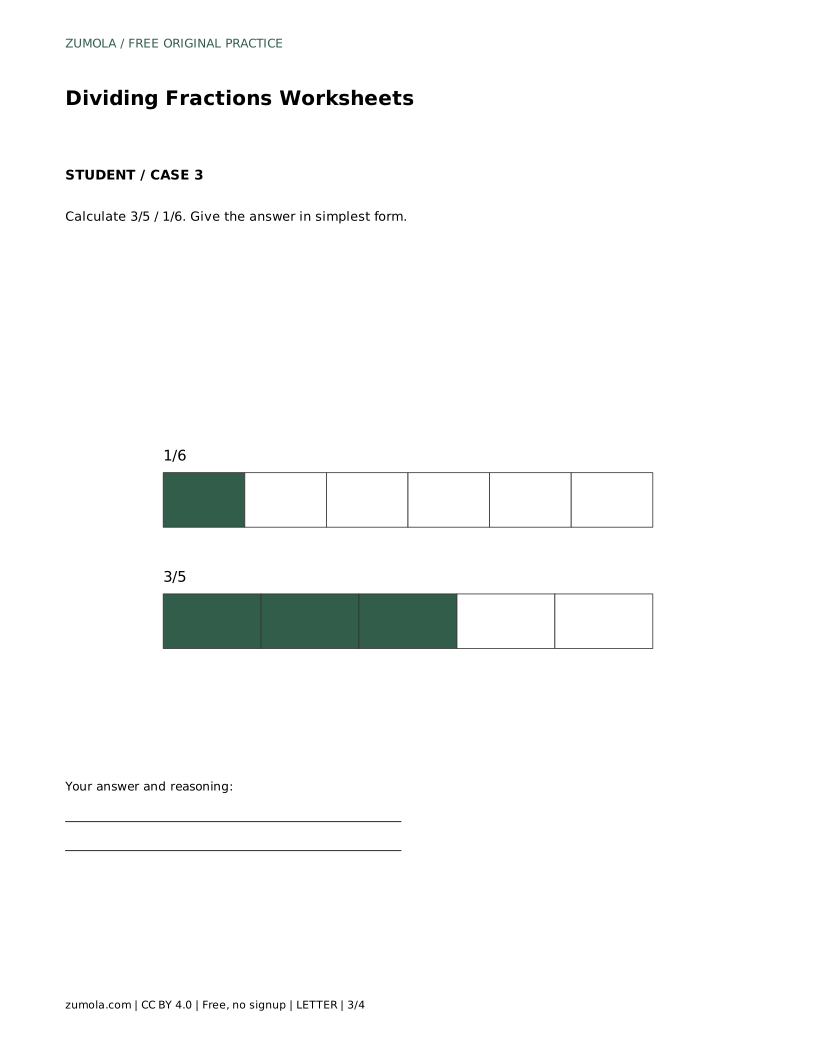
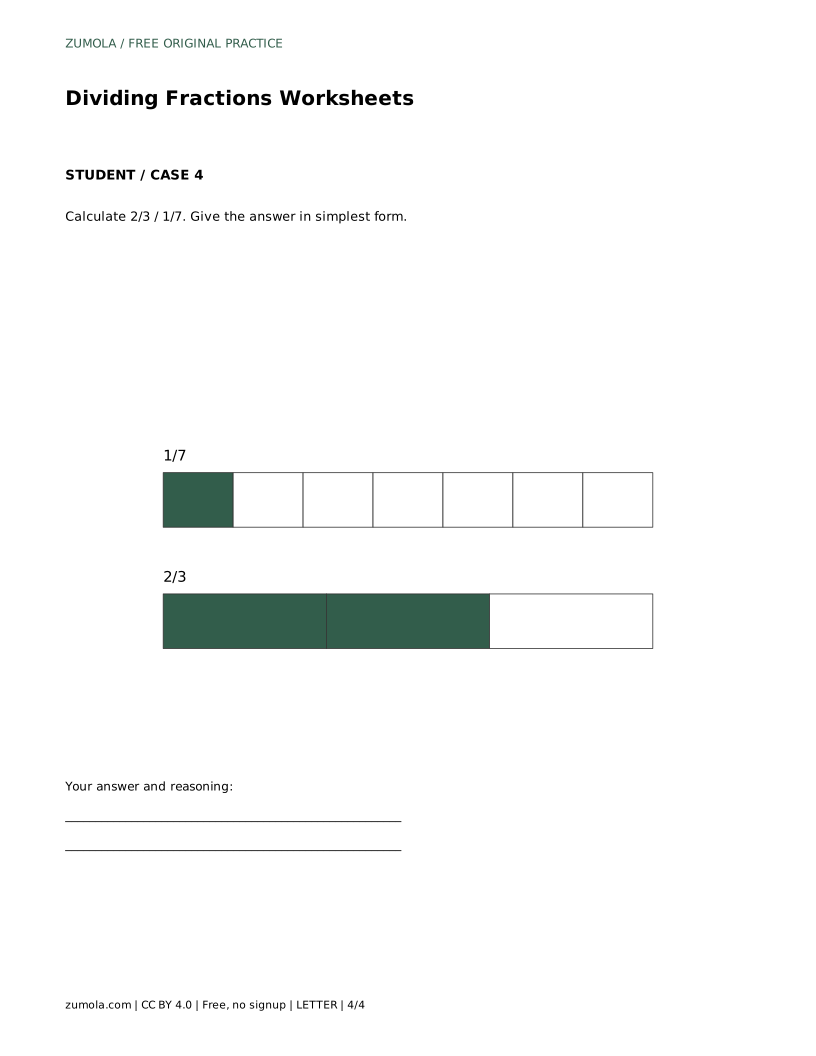
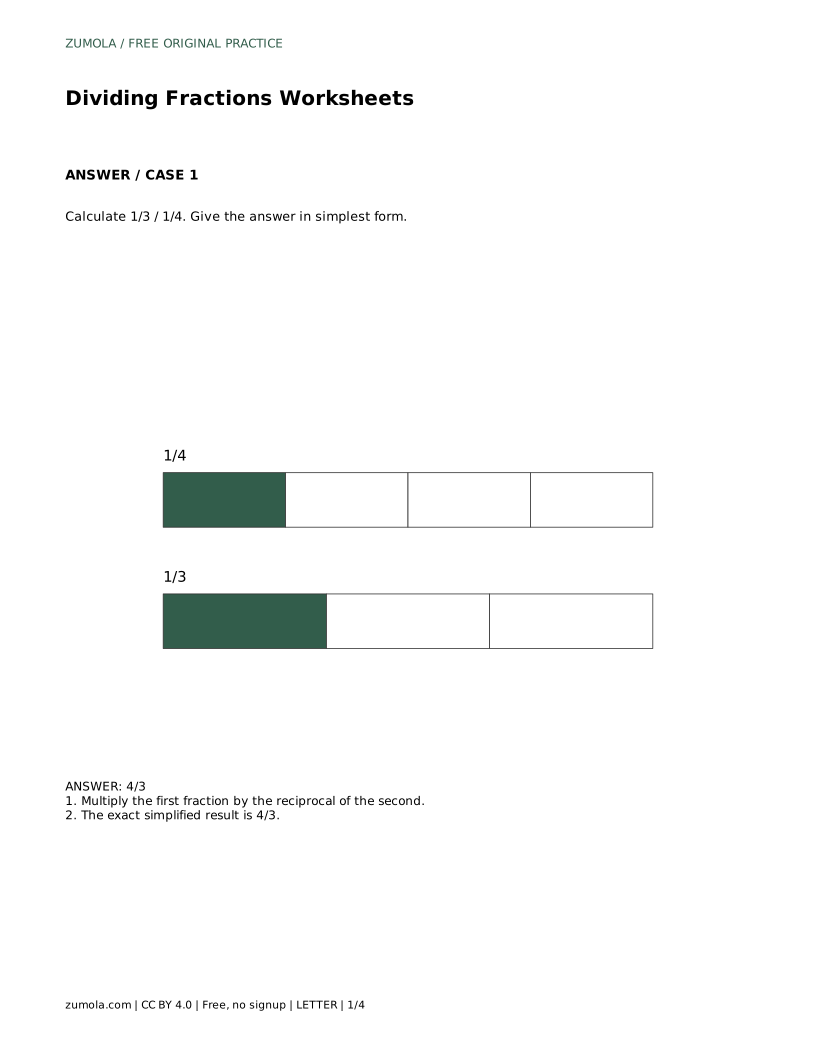
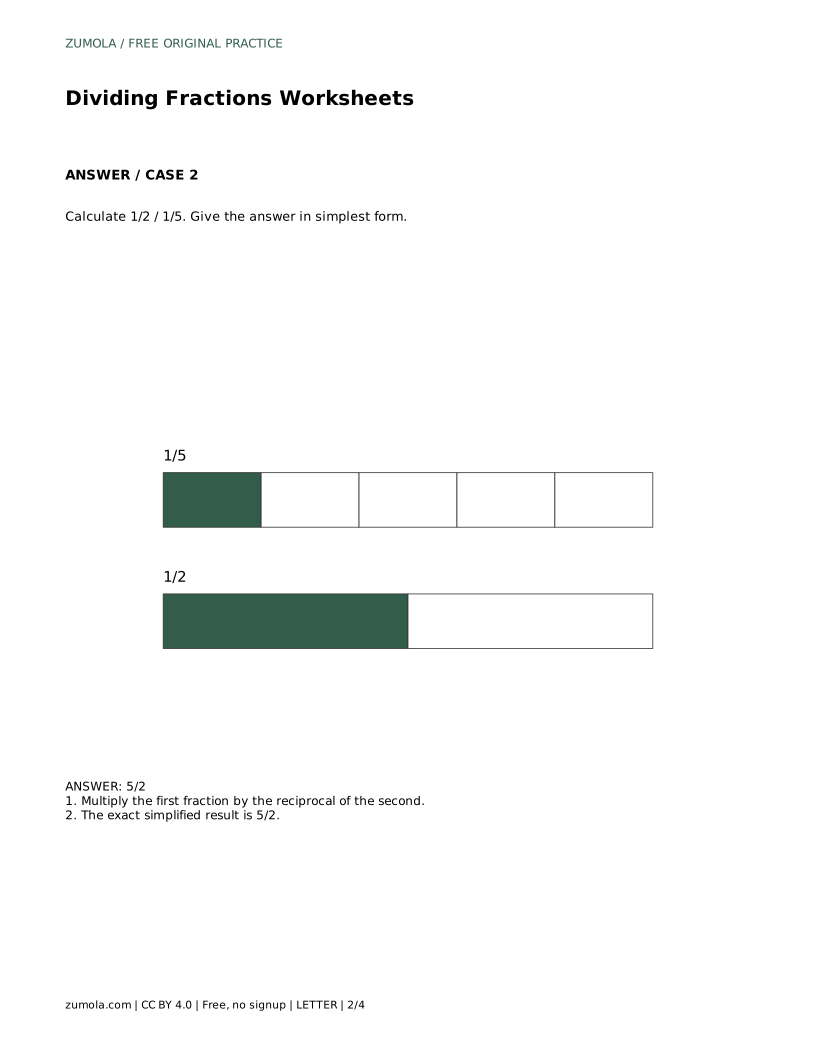
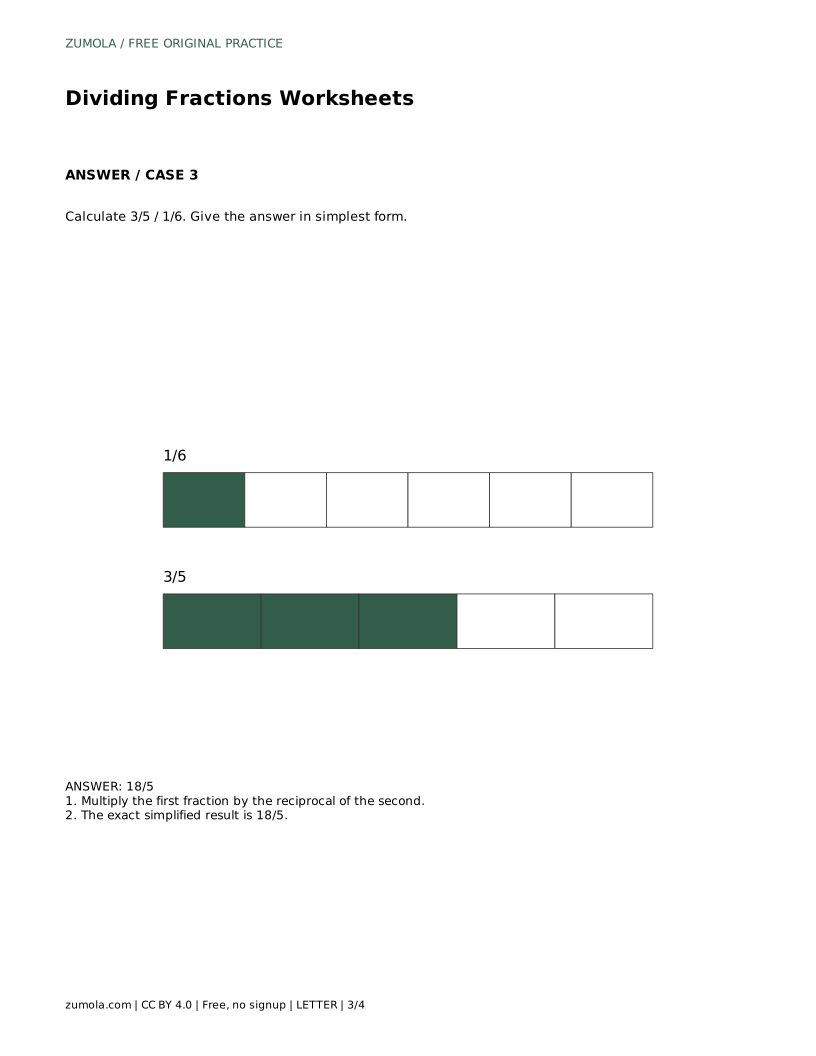
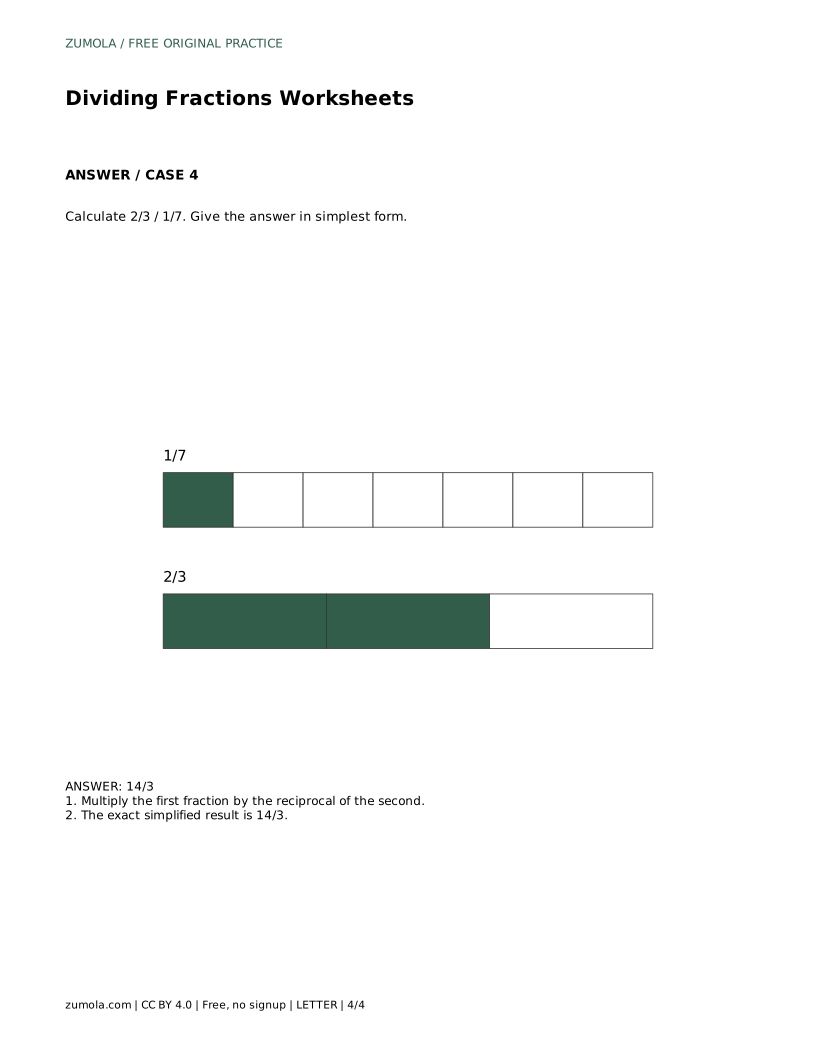
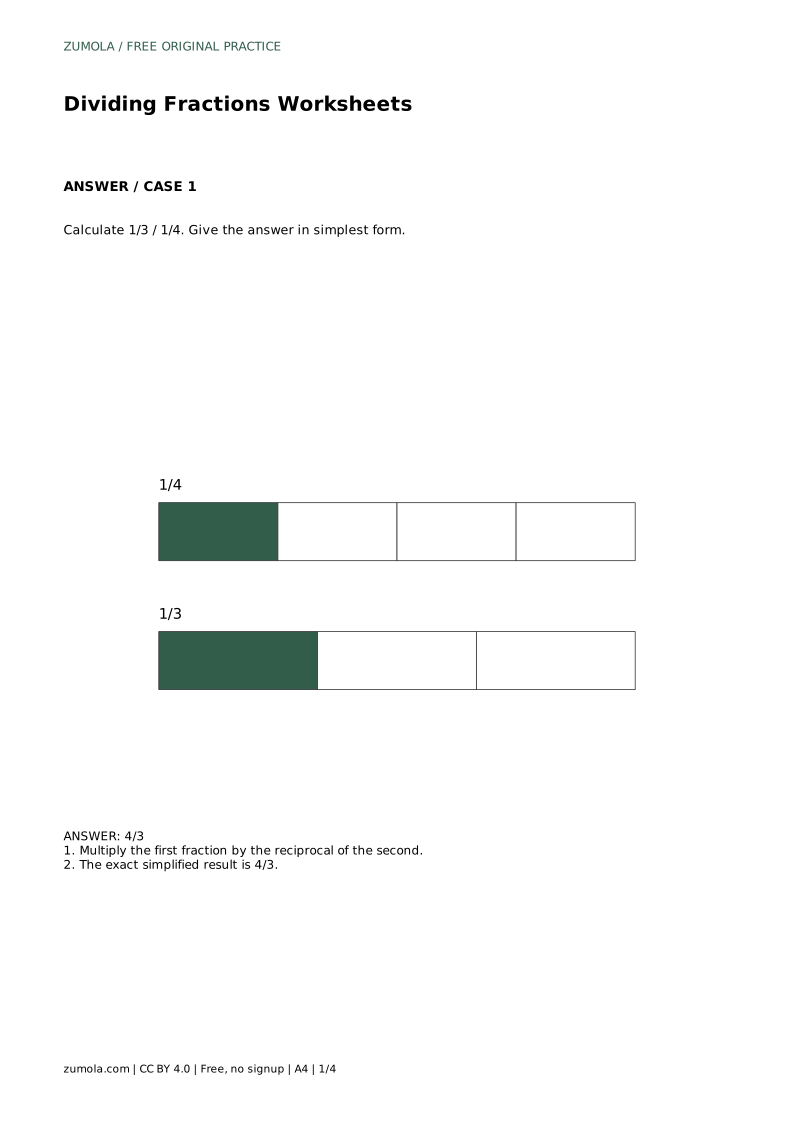
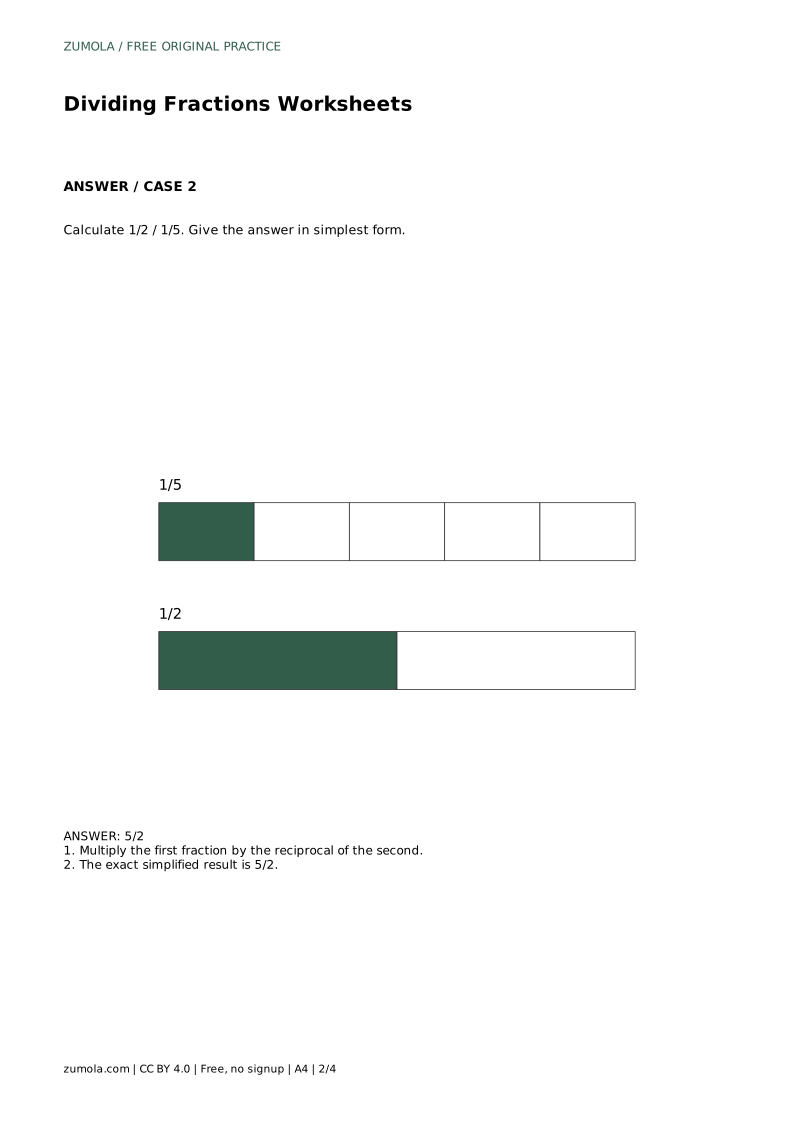
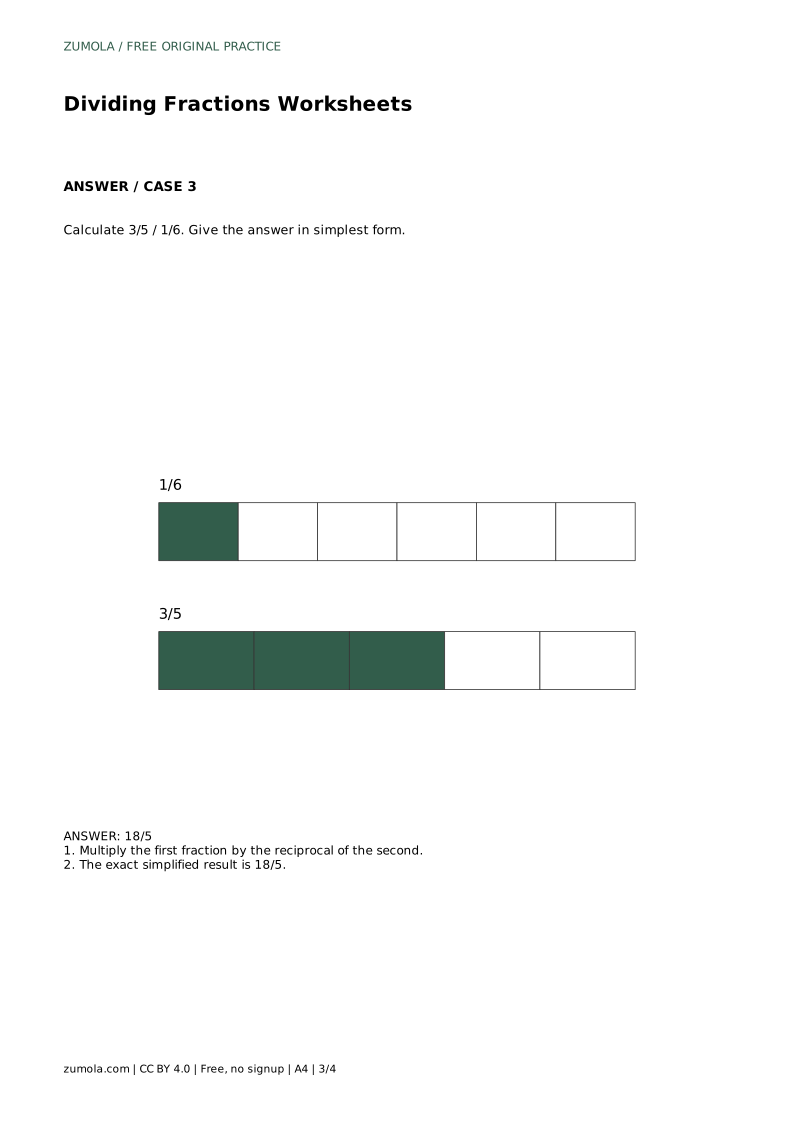
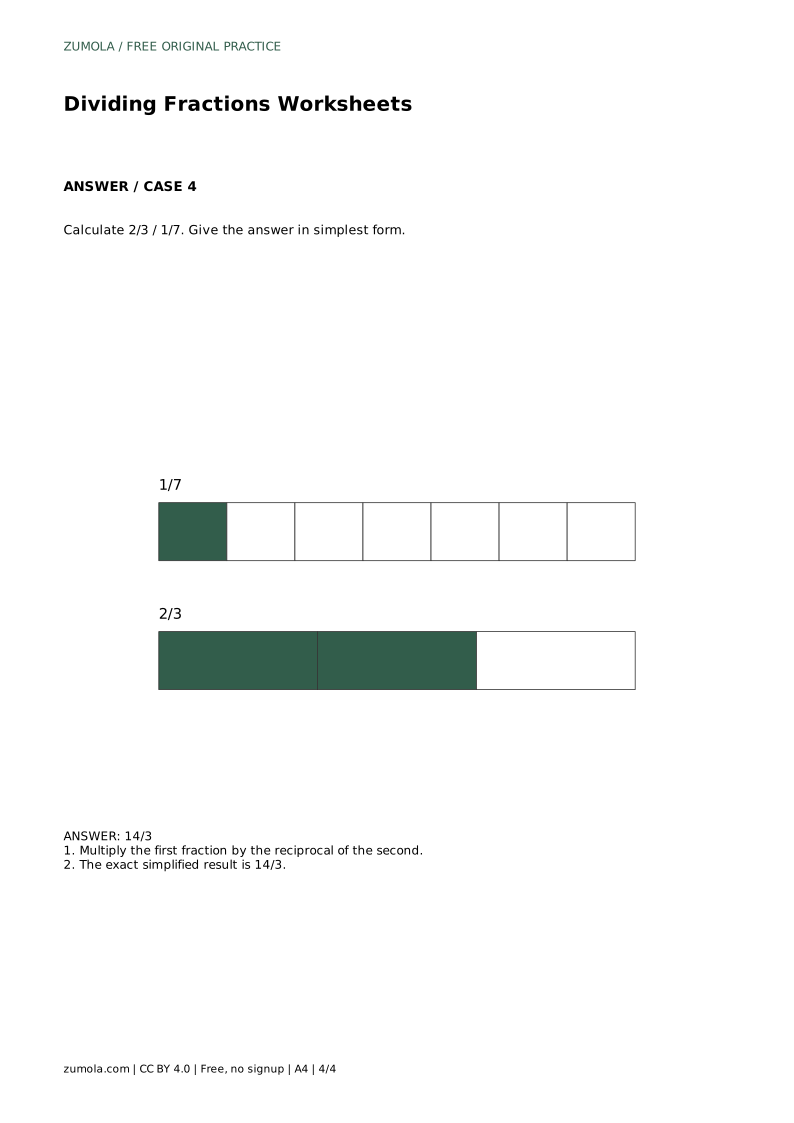
Reference diagrams
LETTER · Download PDF
A4 · Download PDF
Free original resources
Printable fraction-division practice that builds the reciprocal method step by step, with a worked example, common-error fixes, and a fair marking rubric.
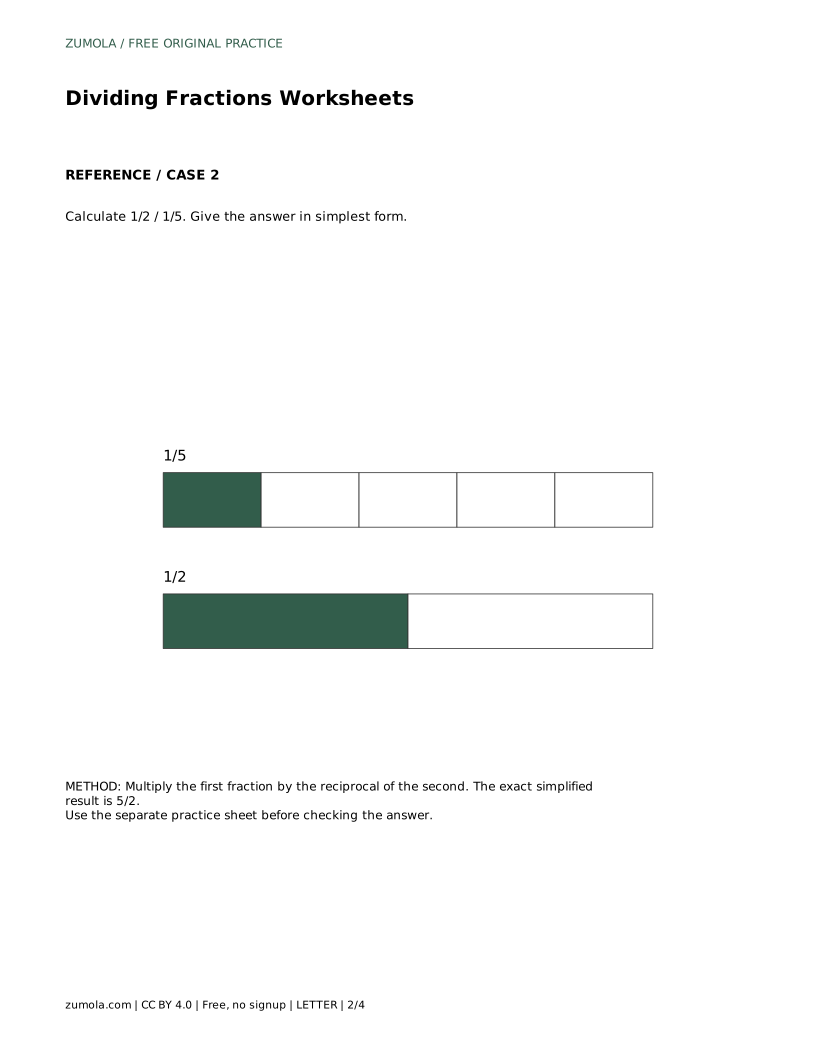
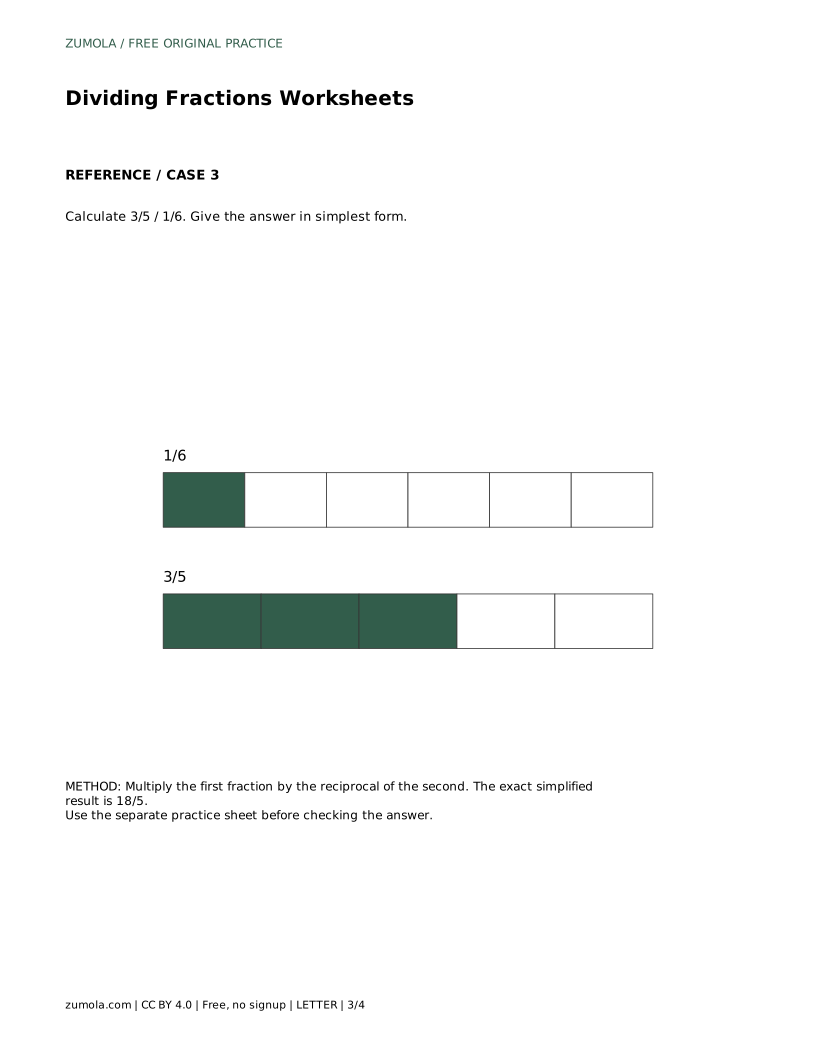
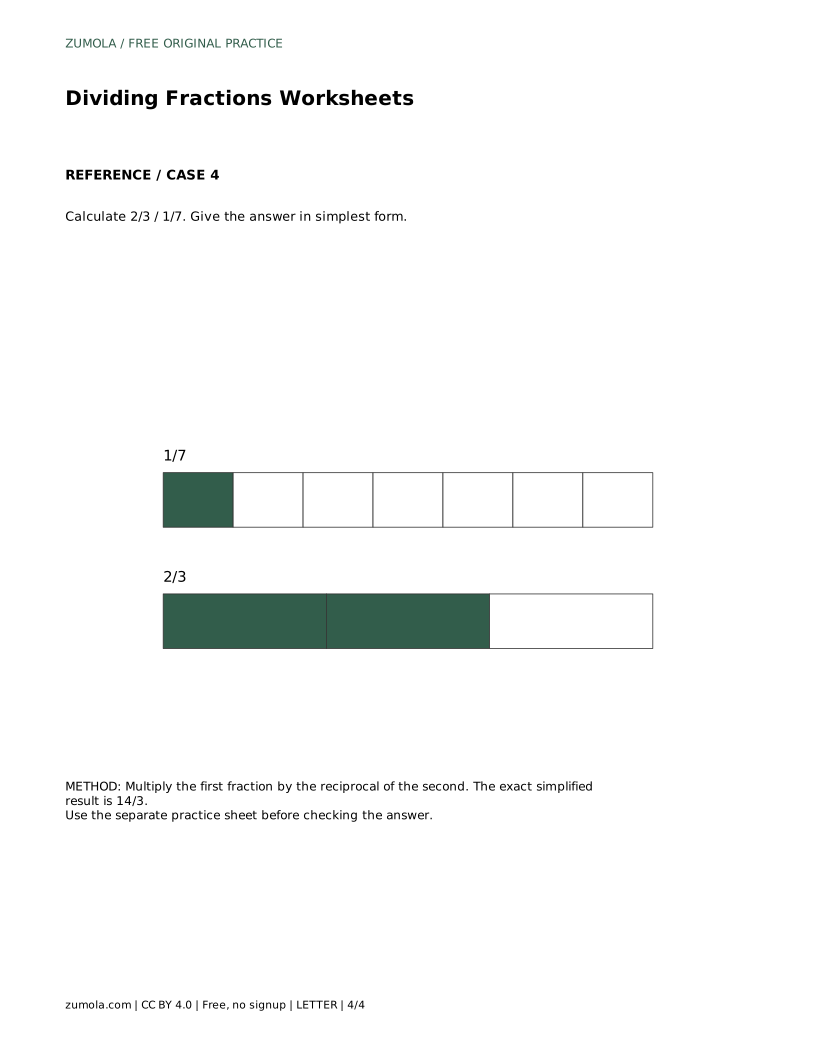
Four original cases, with reference diagrams, practice sheets and worked answers. Everything is free; no signup required.
LETTER · Download PDF
A4 · Download PDF
LETTER · Download PDF
A4 · Download PDF
LETTER · Download PDF
A4 · Download PDF
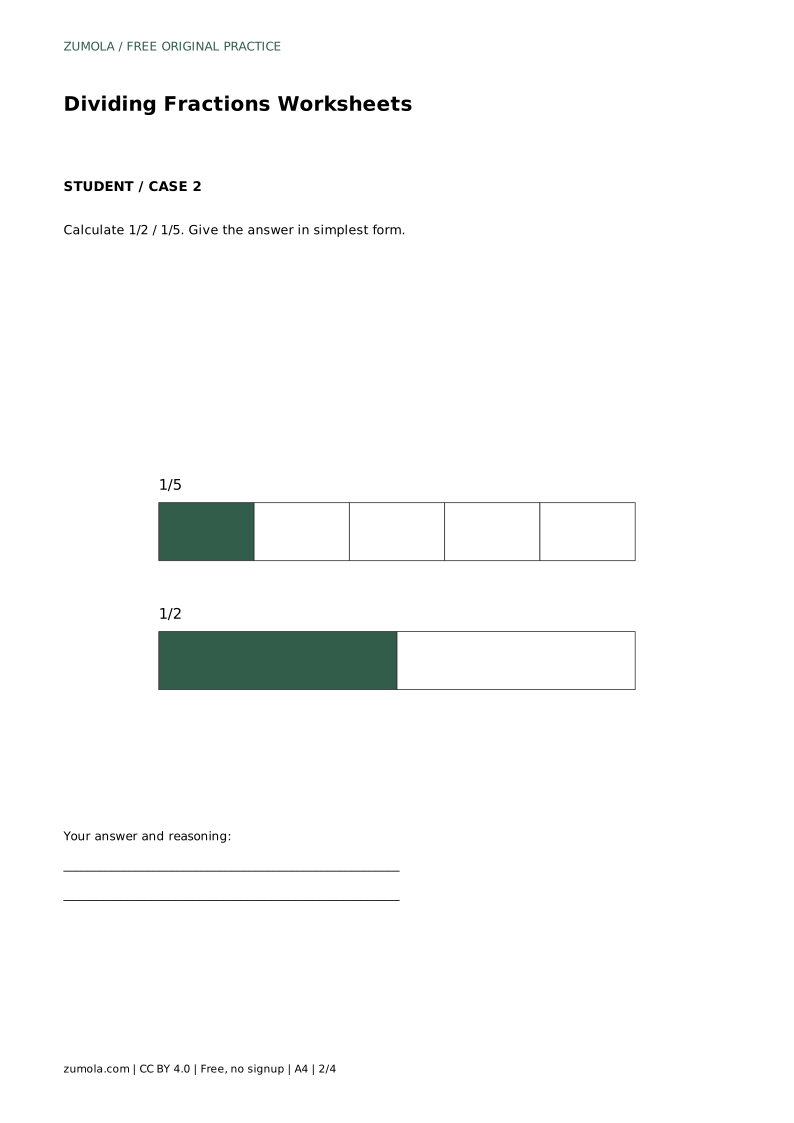
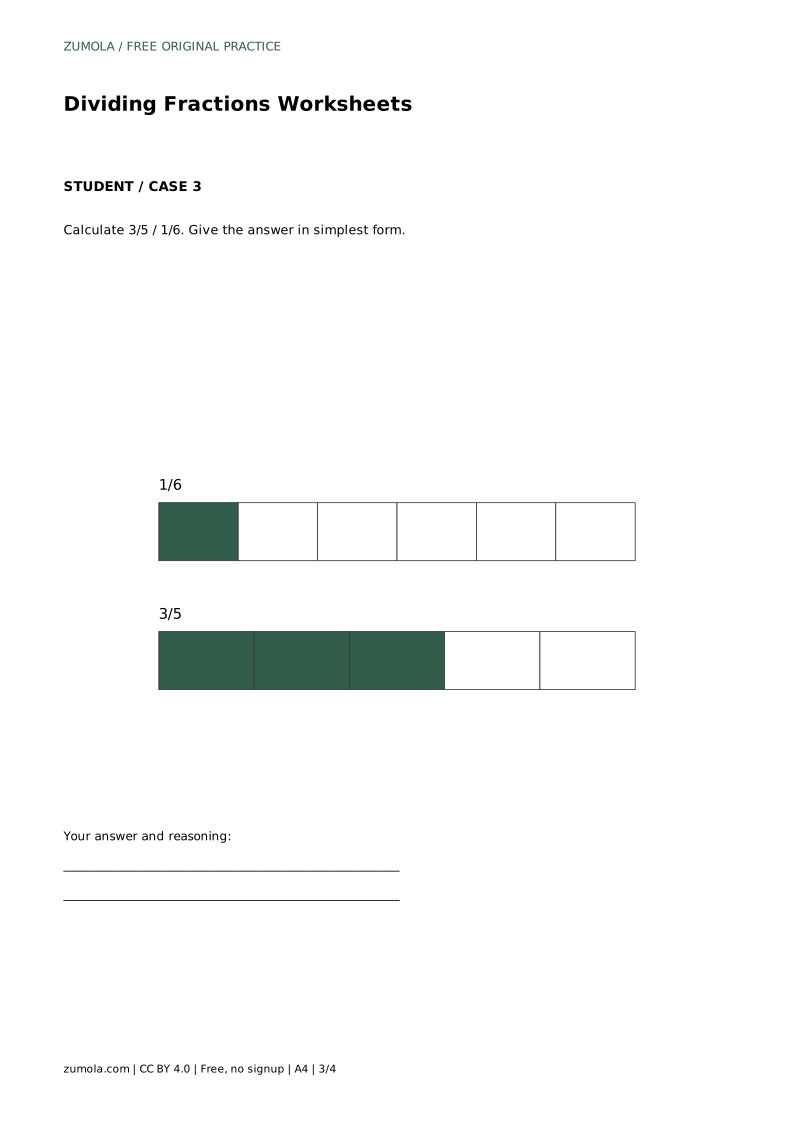
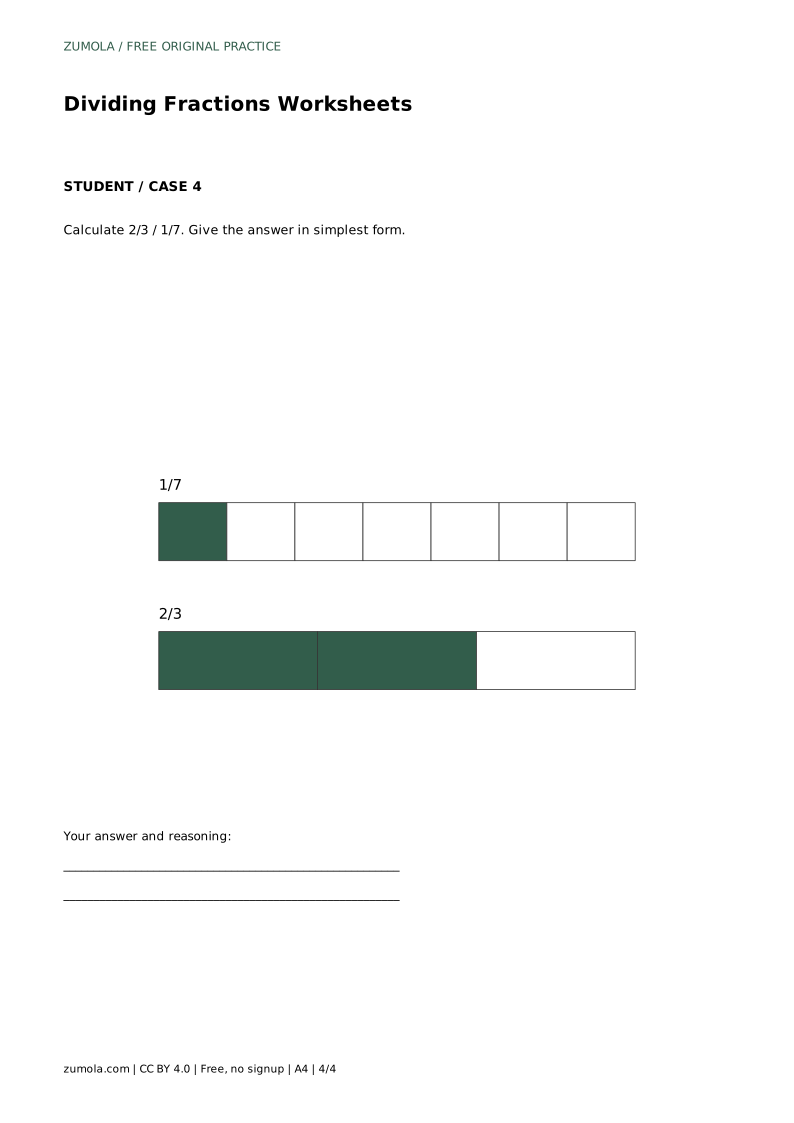
Use A4 or US Letter to match your printer. Use the stated values and conditions to solve each exercise; diagrams are not physical measuring rulers.
Dividing fractions confuses many learners because the rule looks like a trick. This page treats division by a fraction as a question about how many of the second fraction fit into the first, then connects that idea to multiplying by the reciprocal. The worksheets give short, exact fraction-division tasks in simplest form. Use the worked example below to model the reasoning before learners attempt independent items, and keep answers as improper fractions unless your own task explicitly asks for mixed numbers.
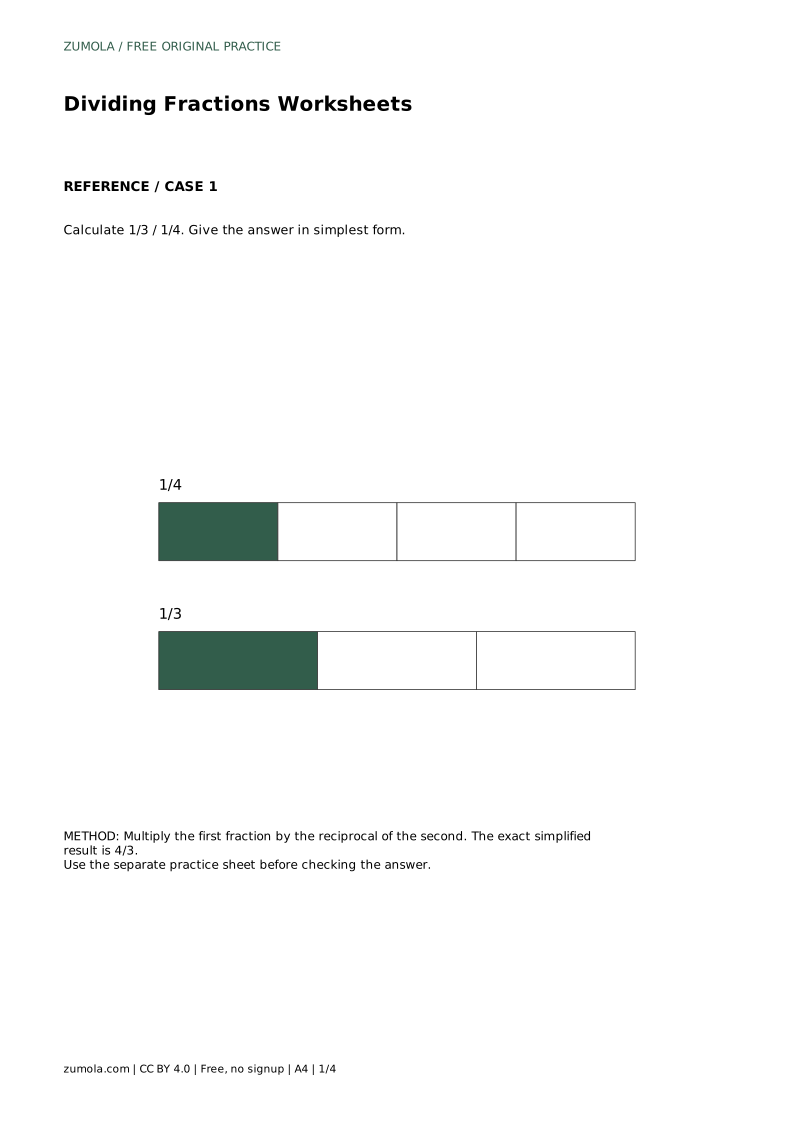
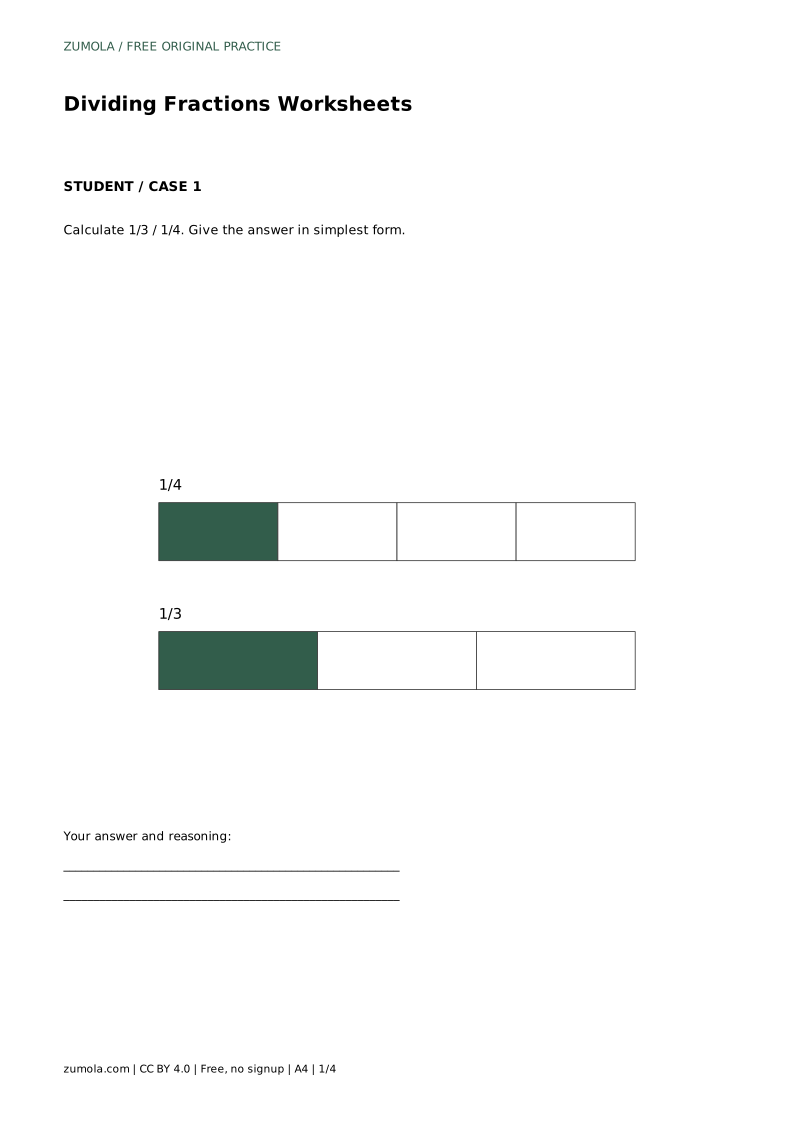
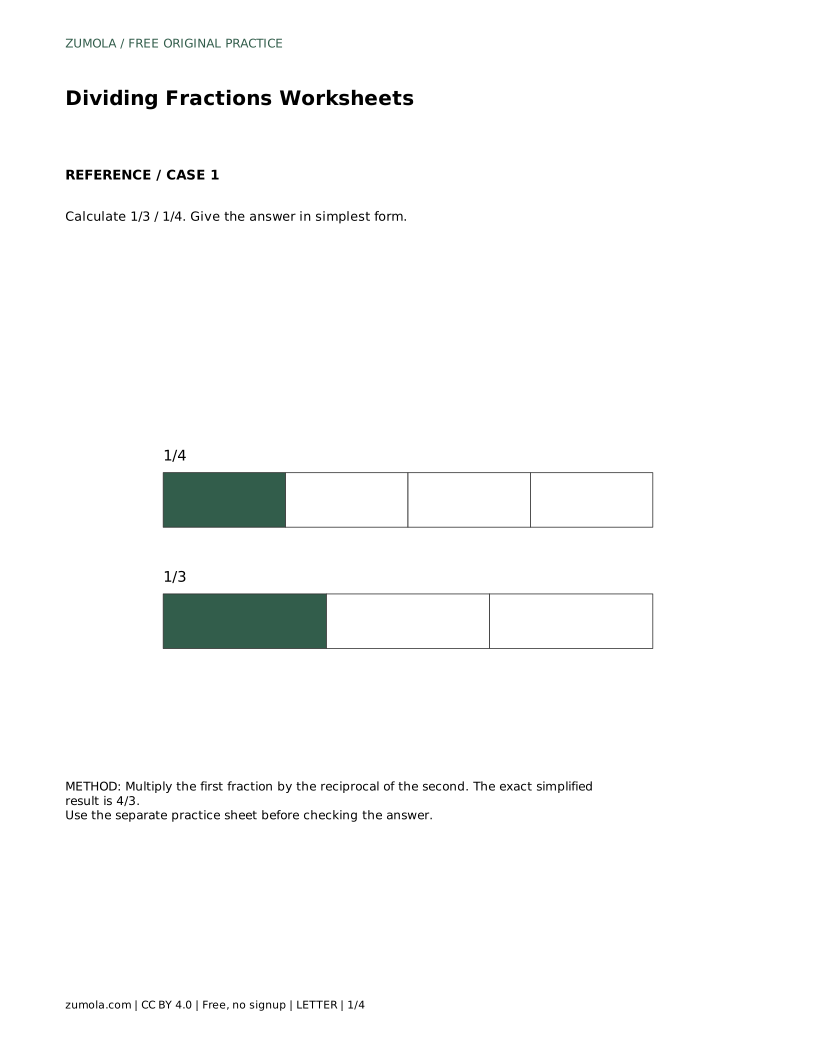
A division statement such as 1/3 divided by 1/4 asks how many groups of 1/4 fit into 1/3. Rewriting the division as multiplication by the reciprocal keeps the same value because dividing by a number is the same as multiplying by its multiplicative inverse. The reciprocal of 1/4 is 4/1, so 1/3 divided by 1/4 becomes 1/3 times 4/1.
Keep the order fixed: the first fraction stays as it is, and only the divisor is flipped. Multiplying across the numerators and across the denominators gives an exact fraction. Simplify by dividing numerator and denominator by their greatest common factor. If the result is improper, it is still a valid simplest-form answer unless the task requests a mixed number.
Work through 1/3 divided by 1/4 aloud. The divisor is 1/4, so its reciprocal is 4/1. Rewrite the task as 1/3 times 4/1. Multiply: 1 times 4 equals 4, and 3 times 1 equals 3. The result is 4/3, already in simplest form because 4 and 3 share no common factor greater than 1.
Check the reasonableness: one-third is a little more than one quarter, so the answer should be a little more than 1. The value 4/3 is about 1.33, which fits. Ask learners to state the reciprocal before multiplying; this separates the conceptual step from the arithmetic and makes errors easier to spot.
Pair each written answer with a quick estimate. For example, if the dividend is smaller than the divisor, the quotient is less than 1; if the dividend is larger, the quotient is greater than 1. This habit catches flipped-divisor mistakes without requiring a calculator.
Fraction division has one exact numerical answer for each expression, but learners can show valid reasoning in different ways. Mark the method and the result separately so a correct process with a small arithmetic slip is not treated the same as a flipped dividend. Use the rubric criteria below consistently across a set.
Calculate 1/3 / 1/4. Give the answer in simplest form.
4/3 Multiply the first fraction by the reciprocal of the second. The exact simplified result is 4/3.
No. An improper fraction in simplest form is a complete answer unless the task specifically asks for a mixed number.
Yes. Reducing common factors across the numerators and denominators can make the multiplication easier, but the final simplified value must match.
Write the whole number as a fraction over 1, then use its reciprocal. For example, dividing by 3 is multiplying by 1/3.
All math worksheets · Free coordinate paper
Original resources · CC BY 4.0 · Free for personal and classroom use with attribution.