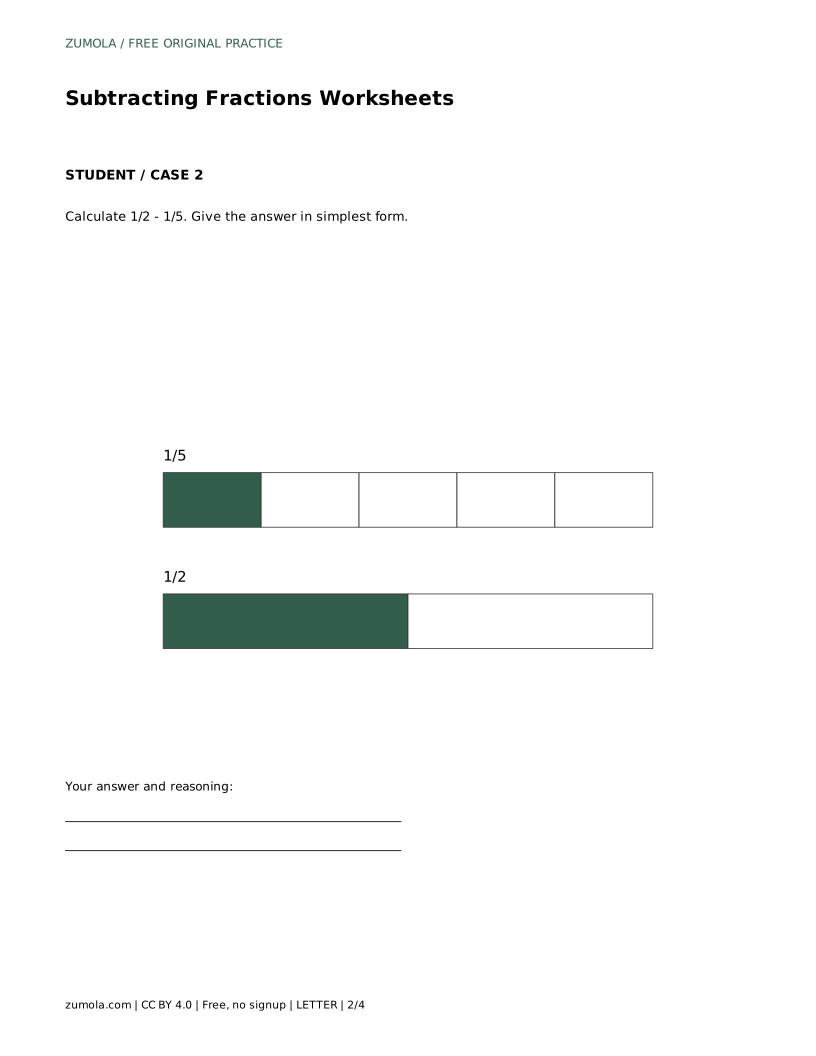
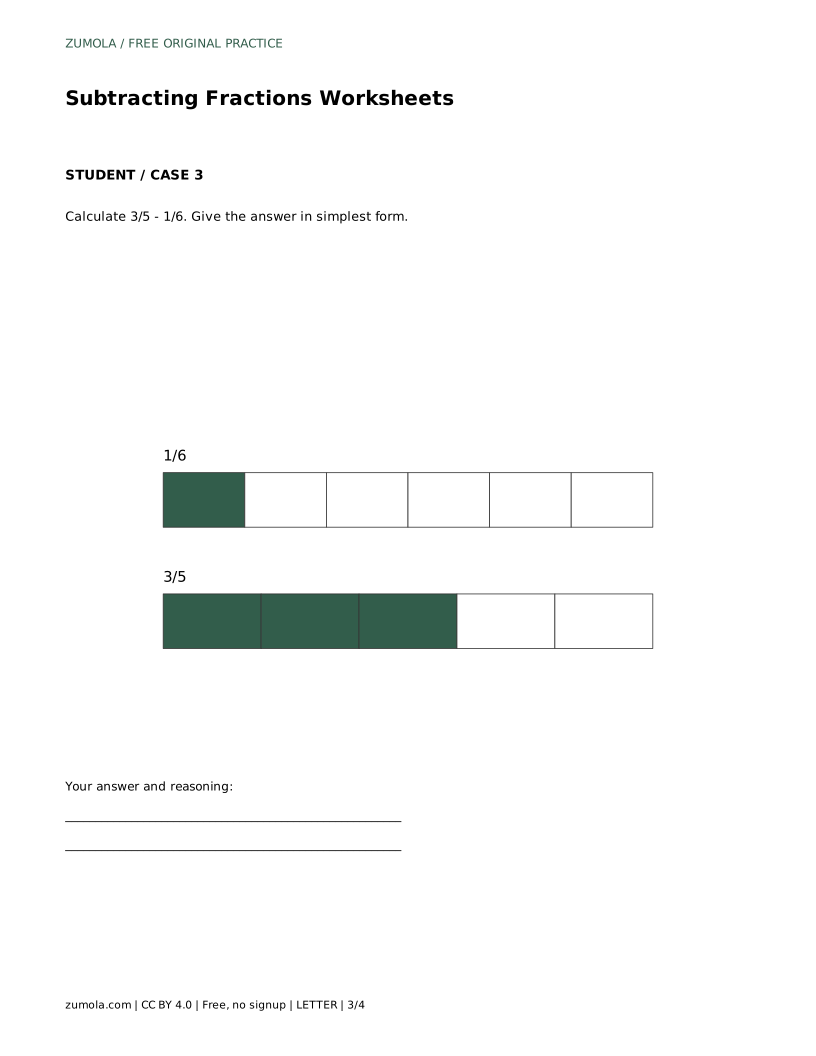
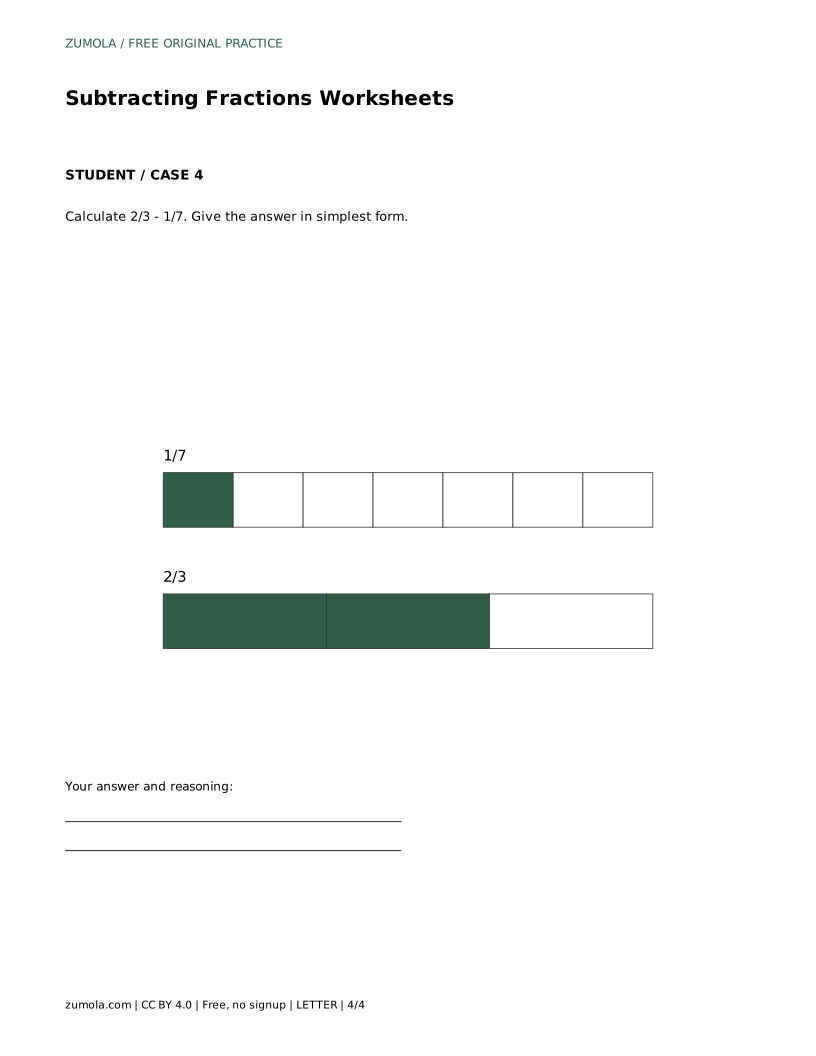
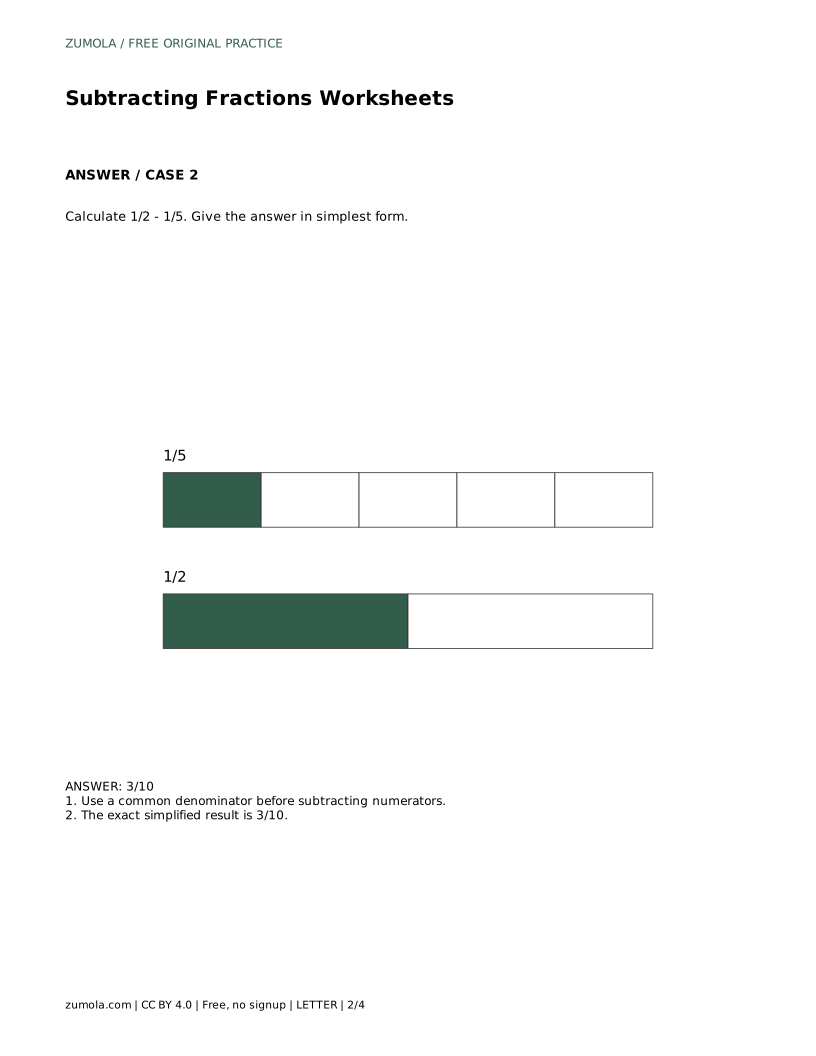
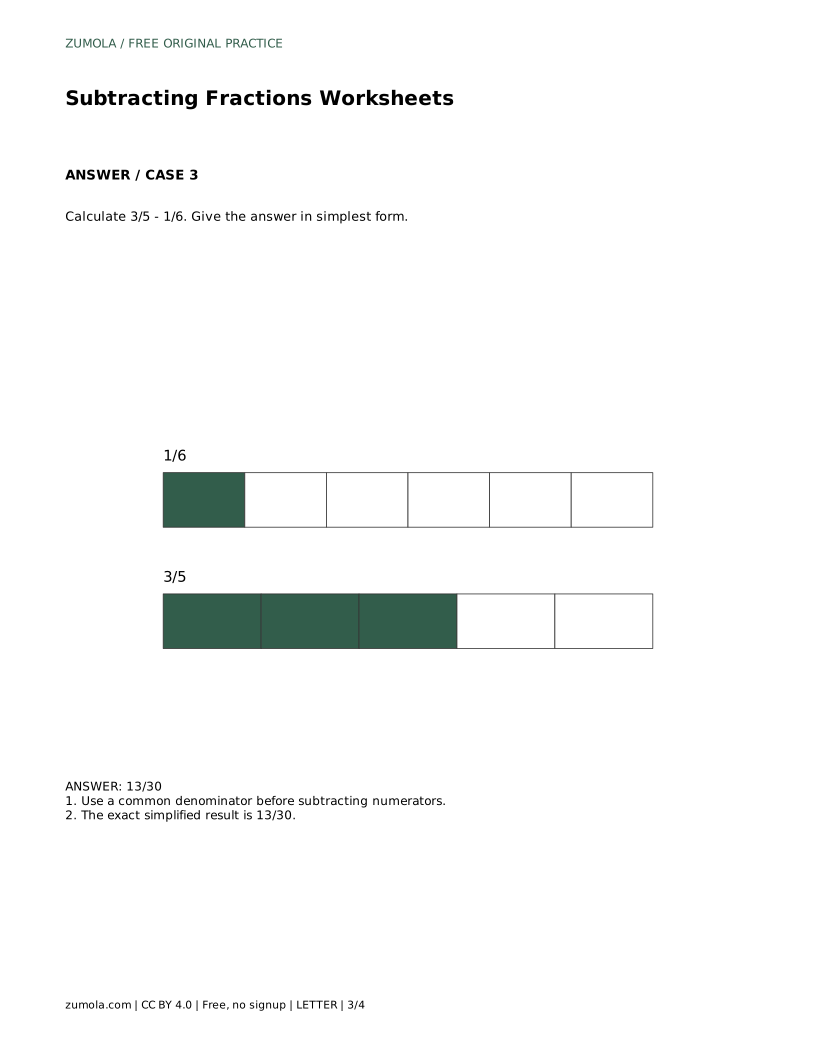
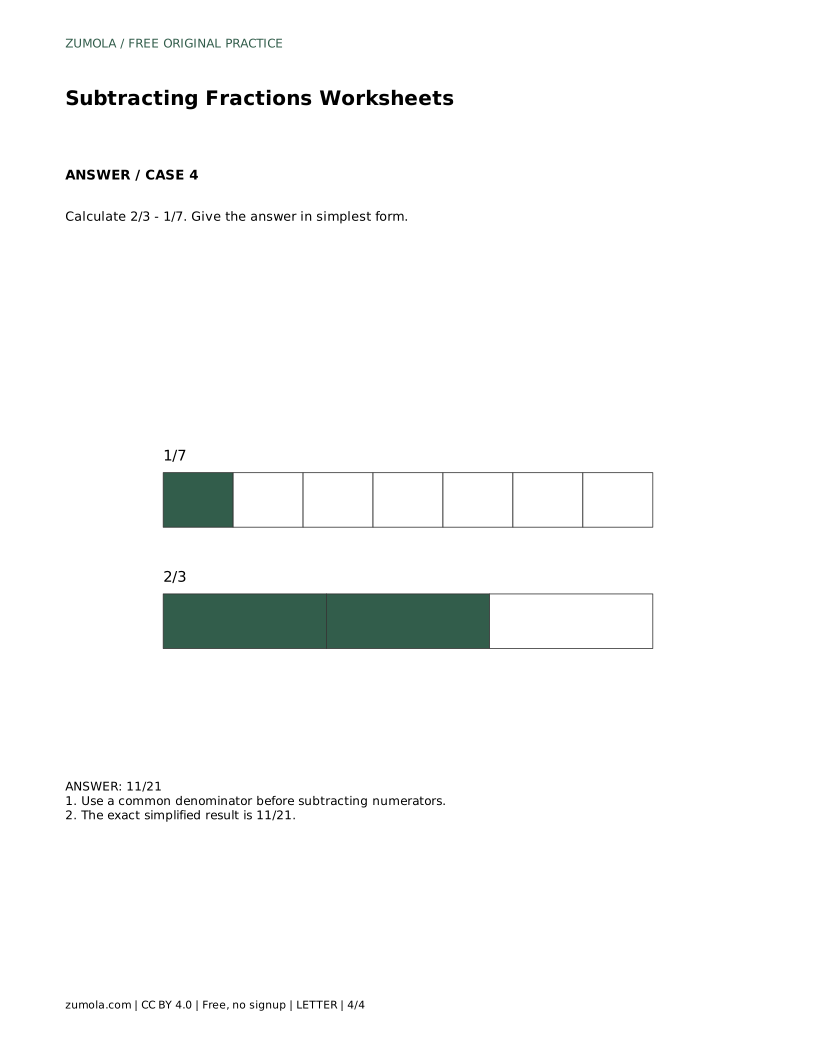
Reference diagrams
LETTER · Download PDF
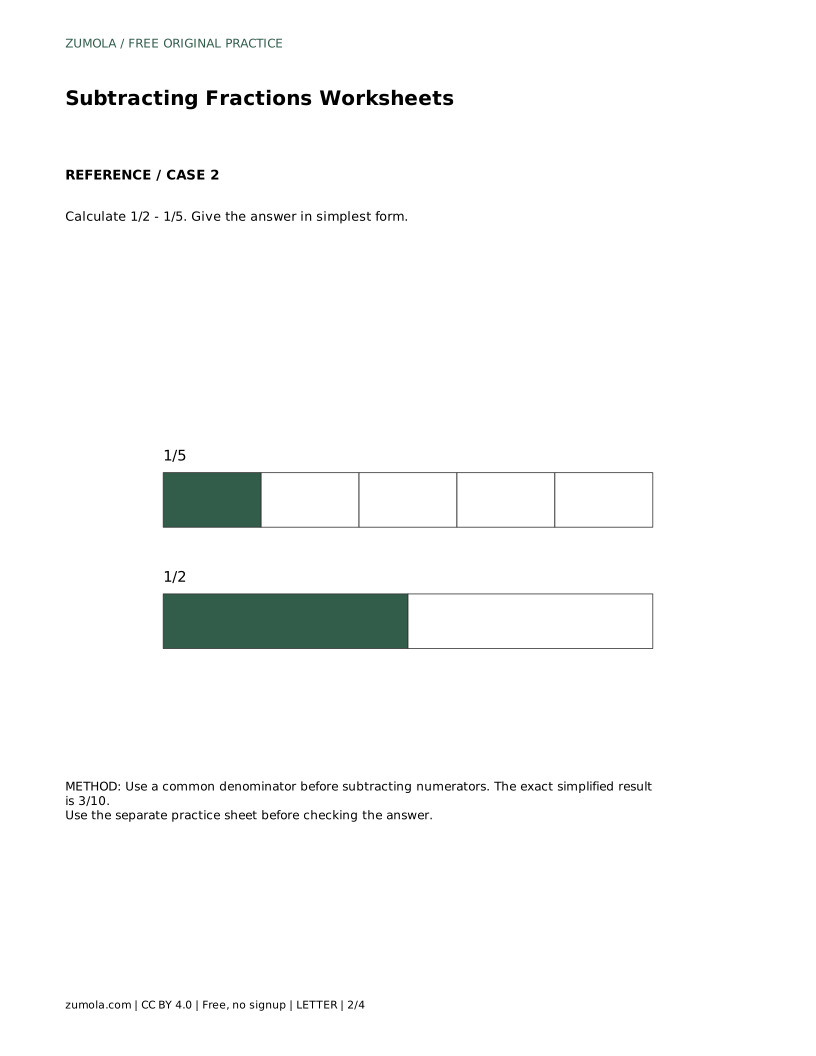
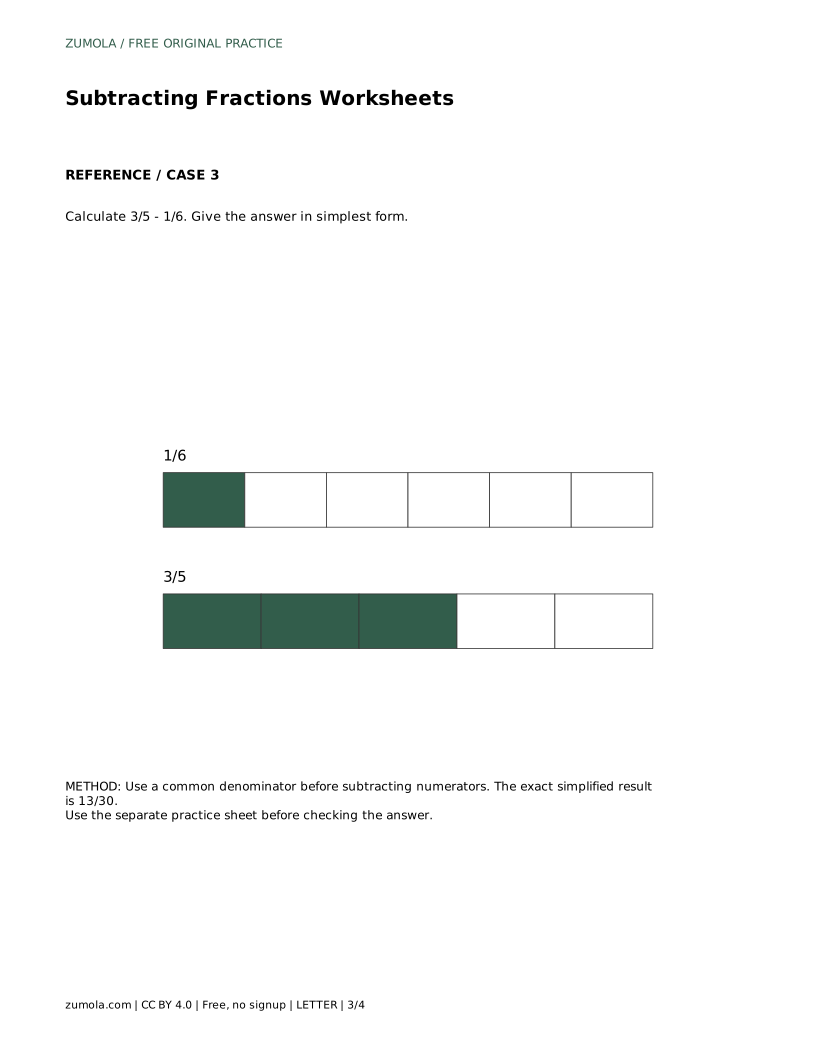
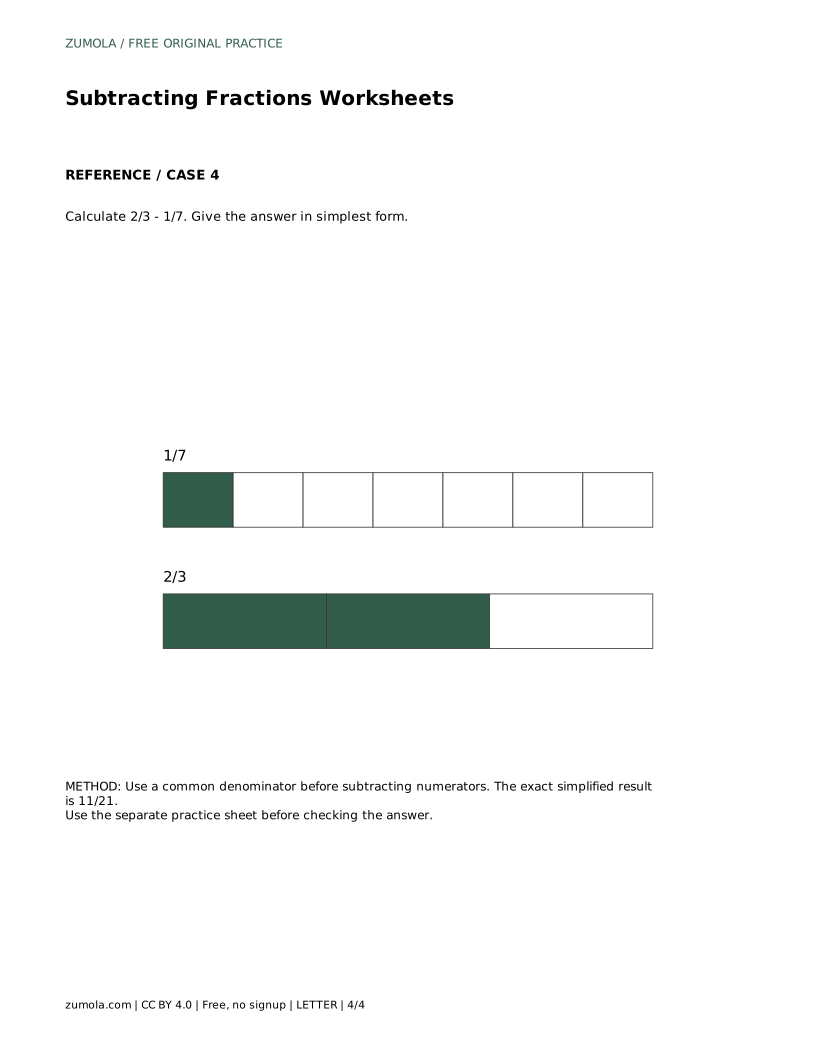
A4 · Download PDF
Free original resources
Teach fraction subtraction with common denominators, clear steps, a worked example, a marking rubric, and fixes for common errors.
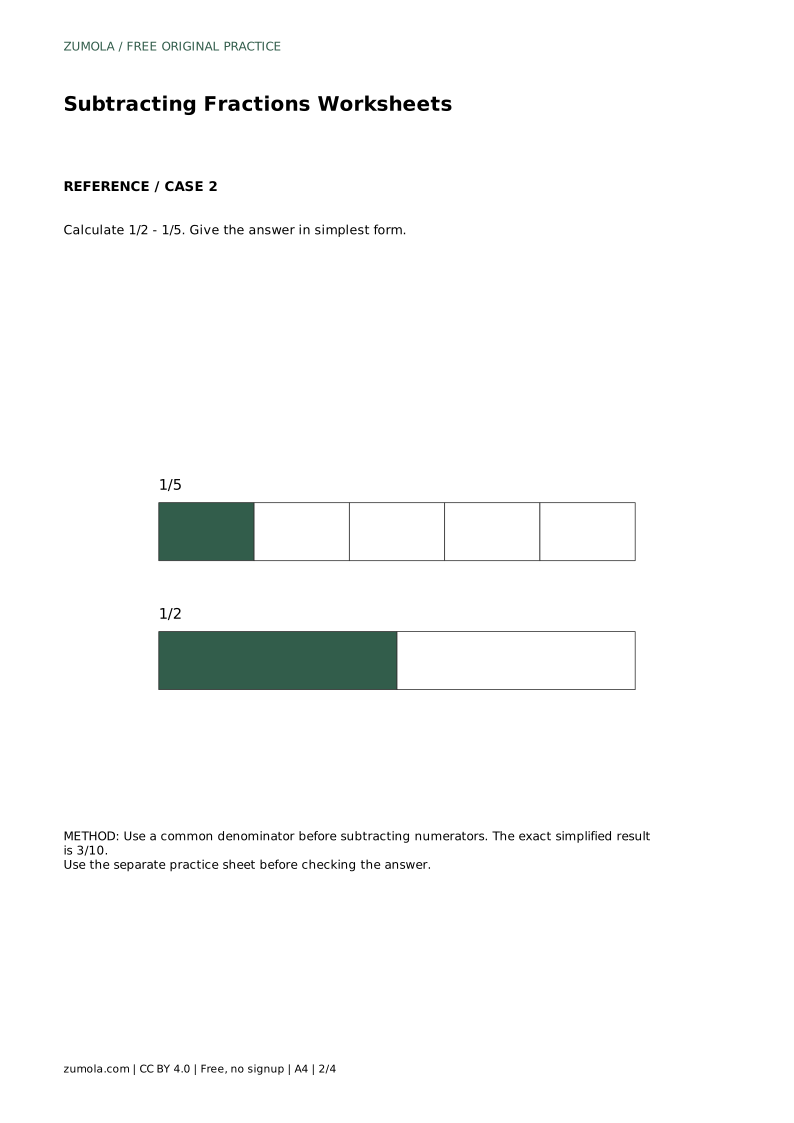
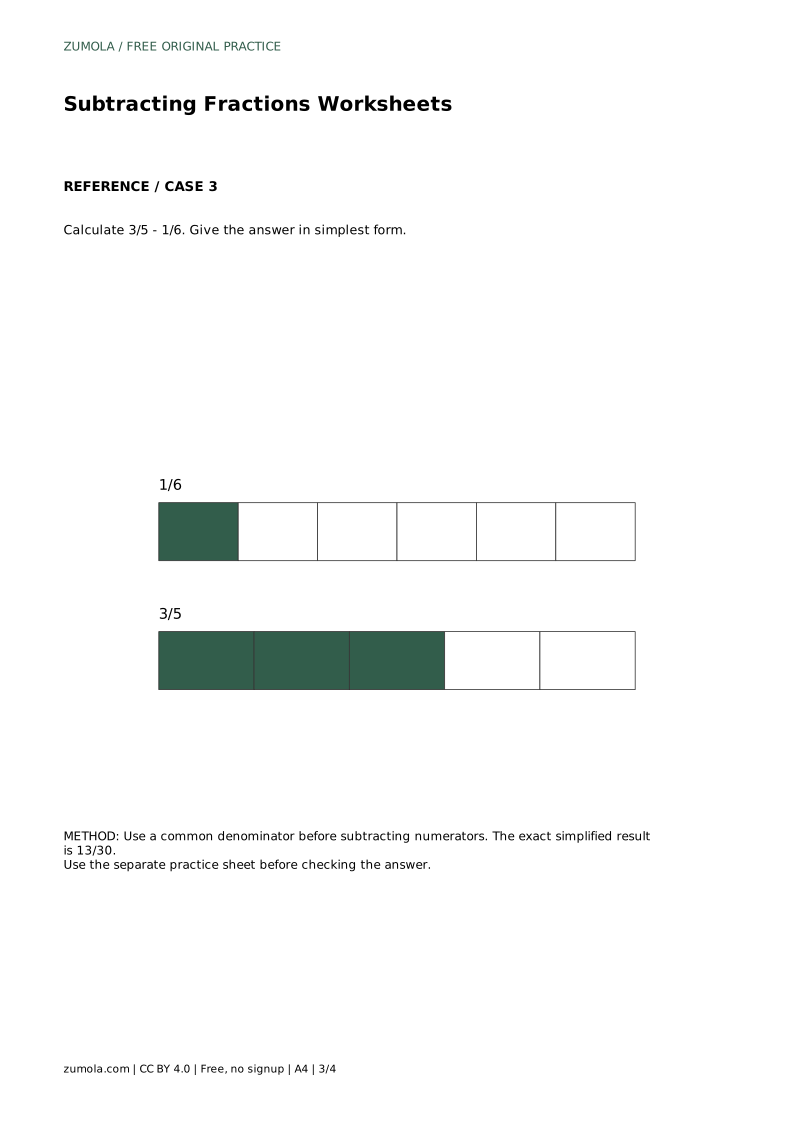
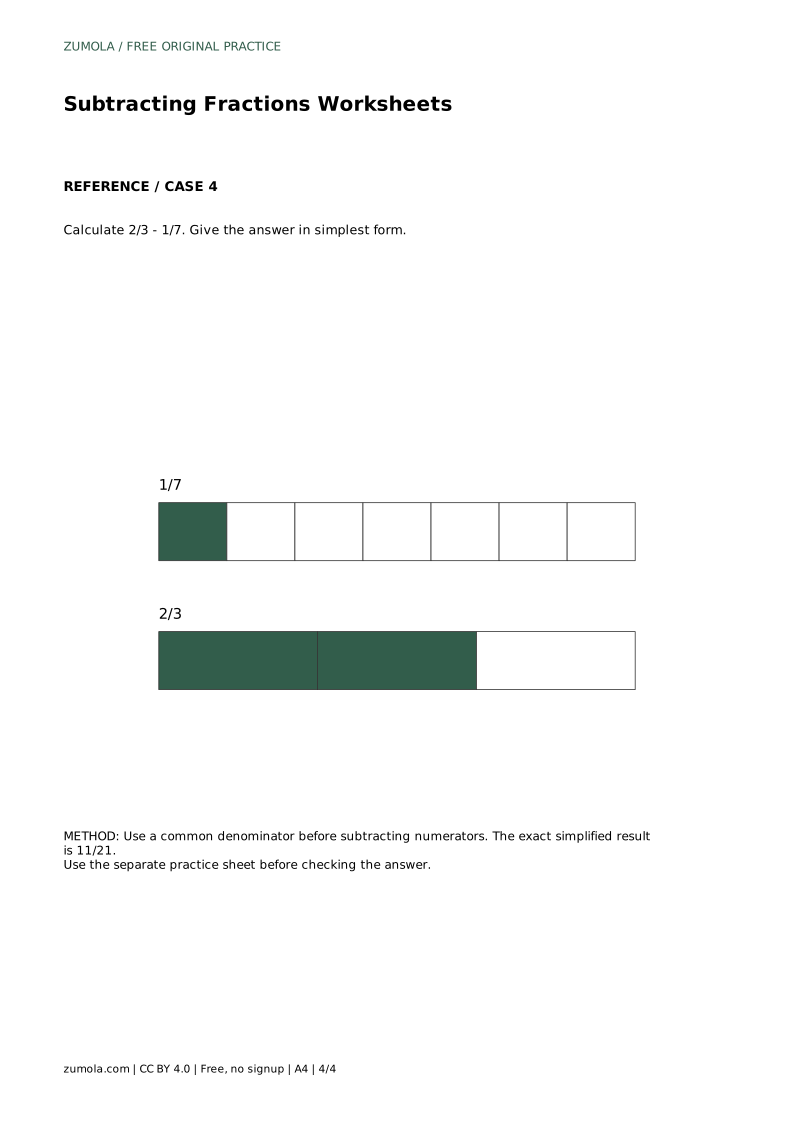
Four original cases, with reference diagrams, practice sheets and worked answers. Everything is free; no signup required.
LETTER · Download PDF
A4 · Download PDF
LETTER · Download PDF
A4 · Download PDF
LETTER · Download PDF
A4 · Download PDF
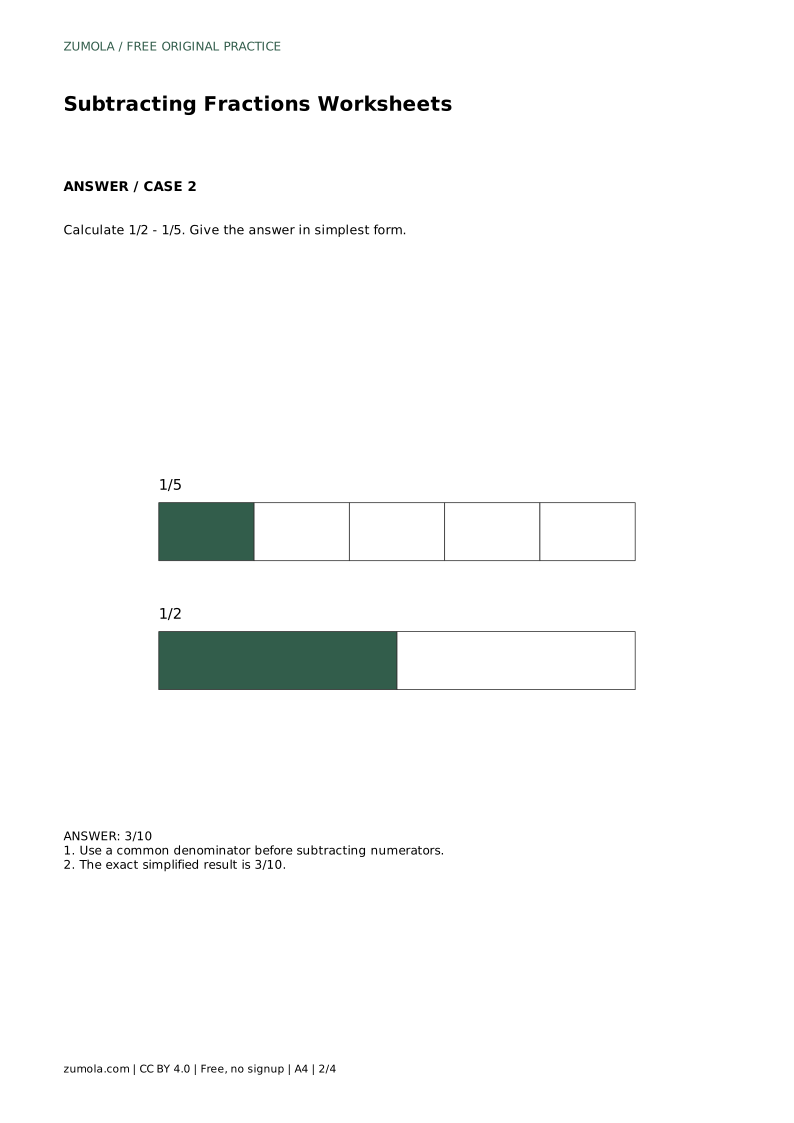
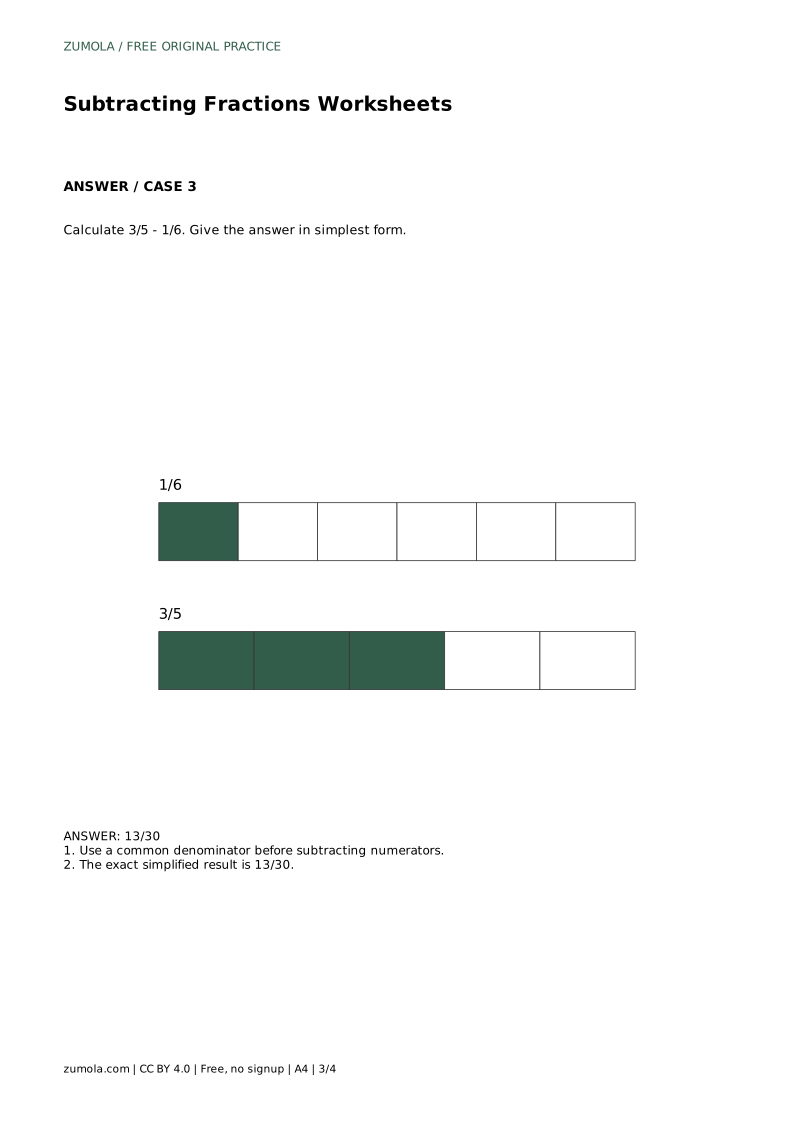
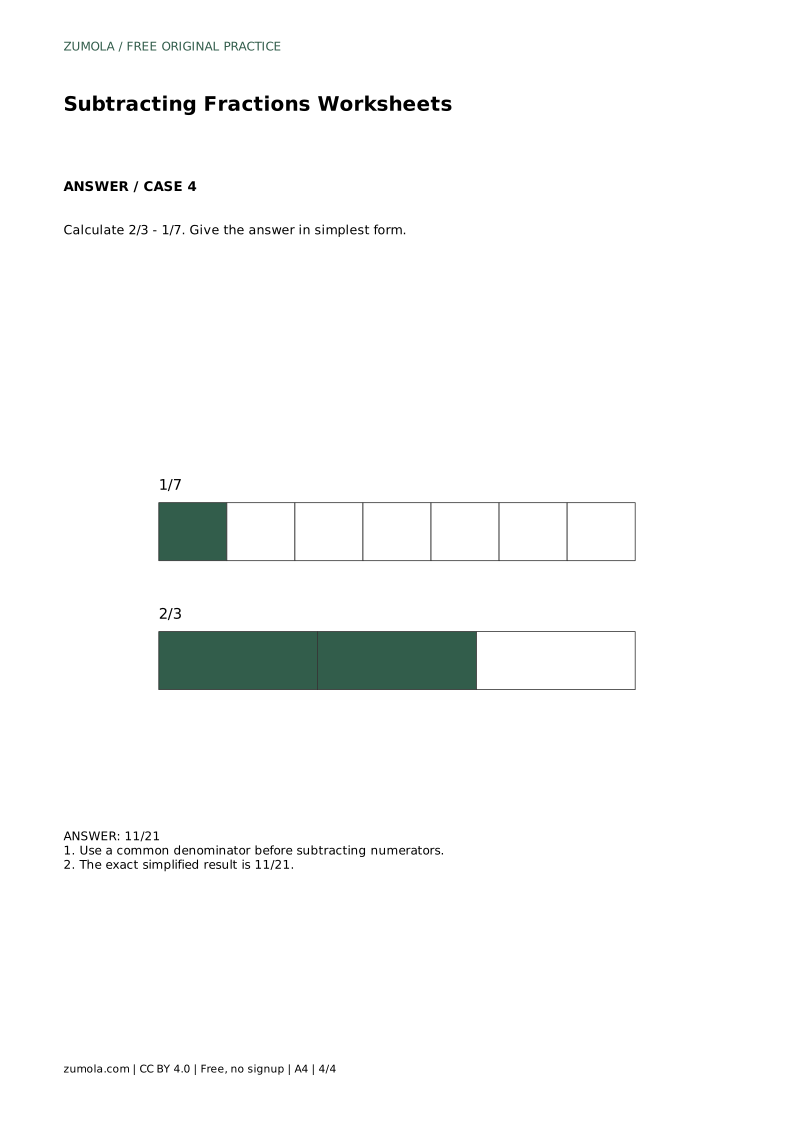
Use A4 or US Letter to match your printer. Use the stated values and conditions to solve each exercise; diagrams are not physical measuring rulers.
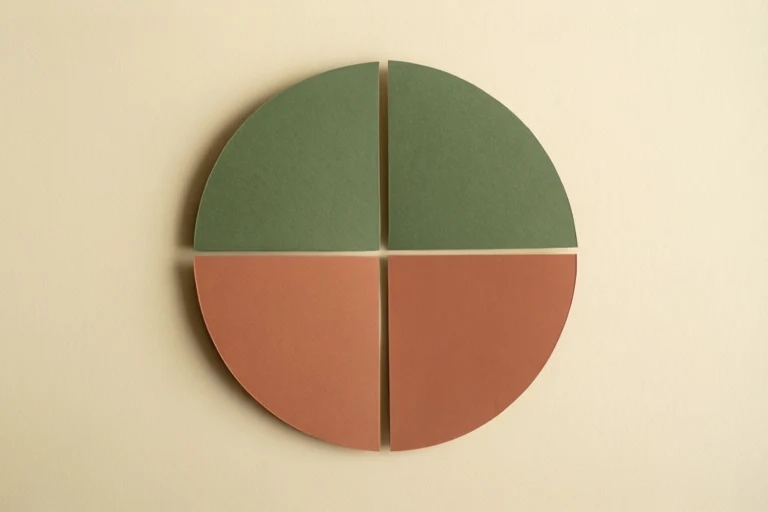
Subtracting fractions becomes reliable when learners slow down at two points: finding a shared denominator and simplifying the result. These worksheets focus on fractions with different denominators, so students practise rewriting each fraction before subtracting numerators. The method is exact arithmetic, not estimation. Encourage written working, because a correct answer with no visible denominator change is hard to diagnose when something goes wrong.
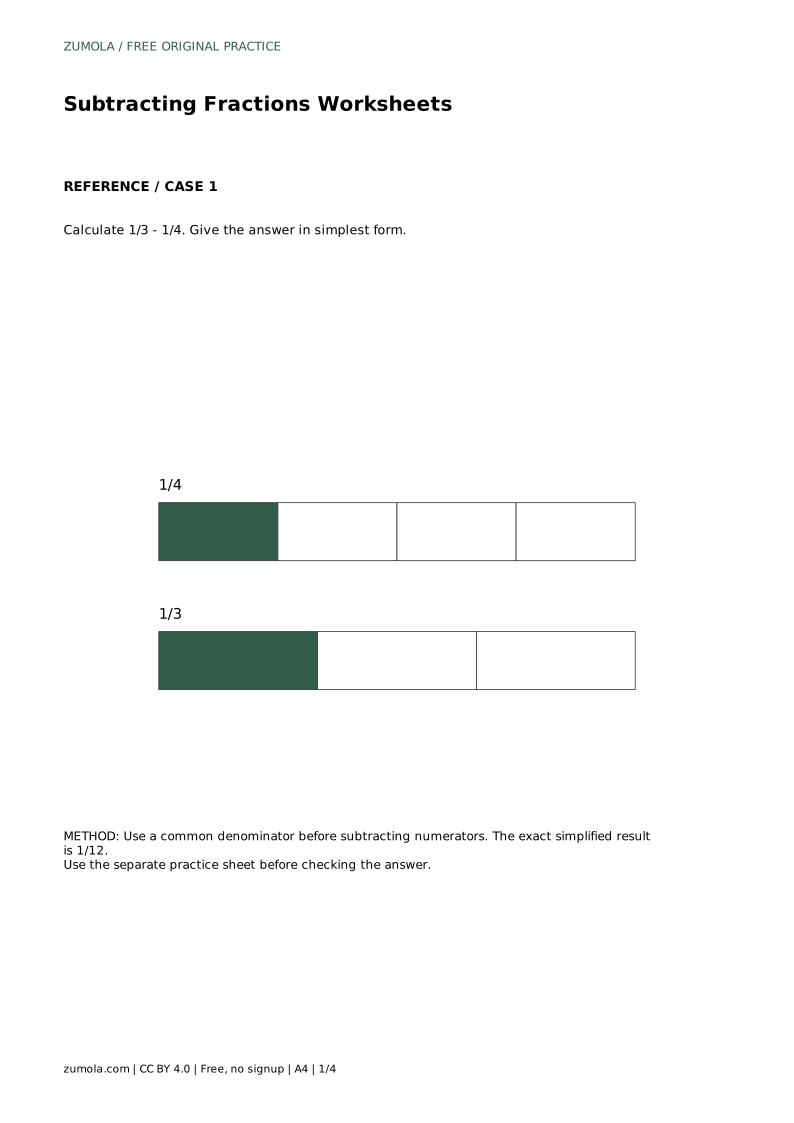
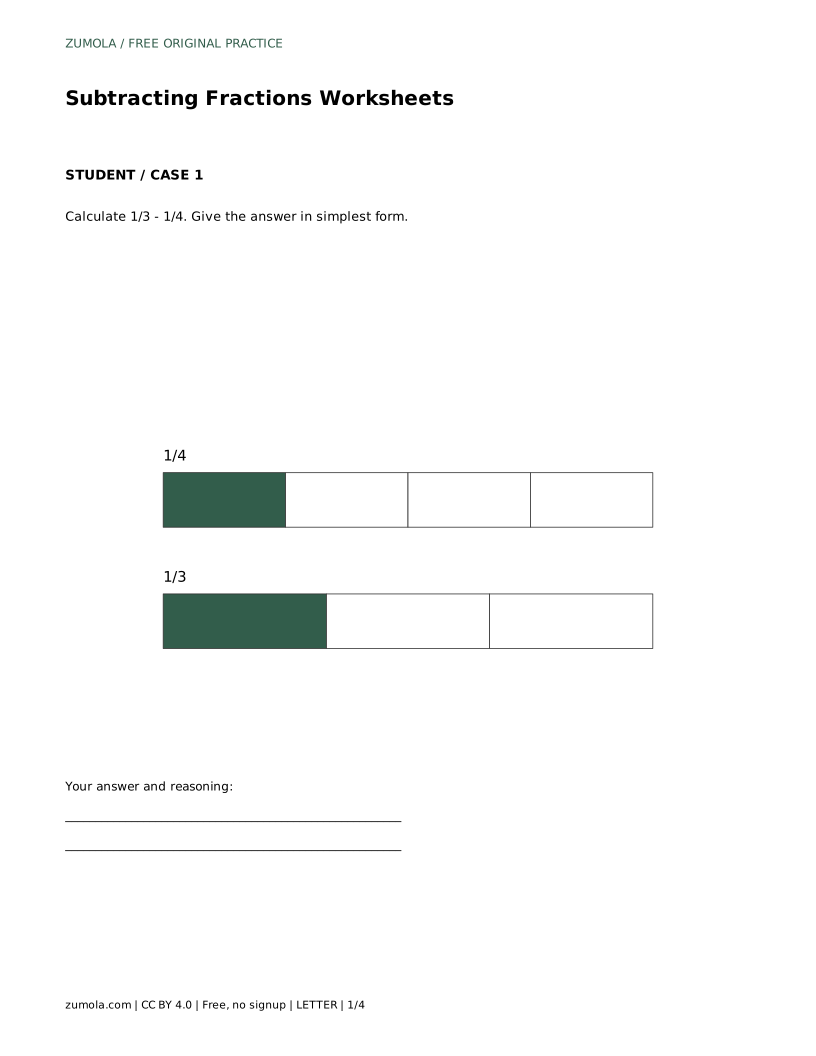
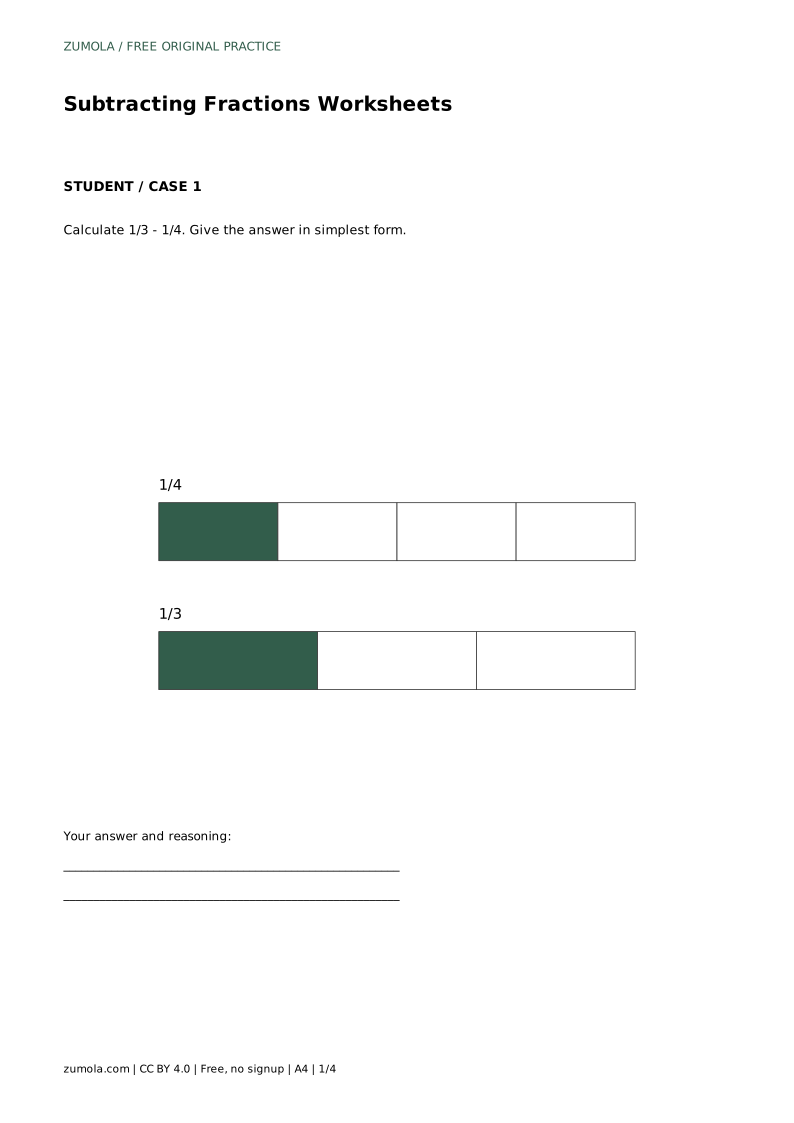
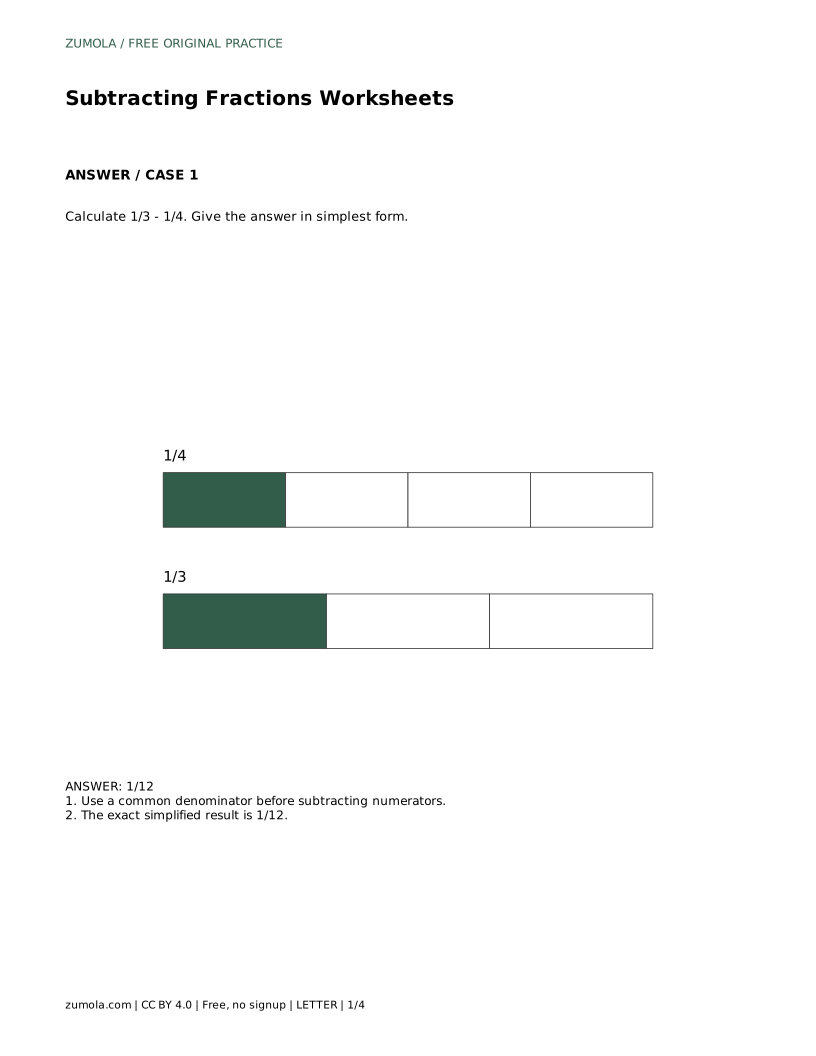
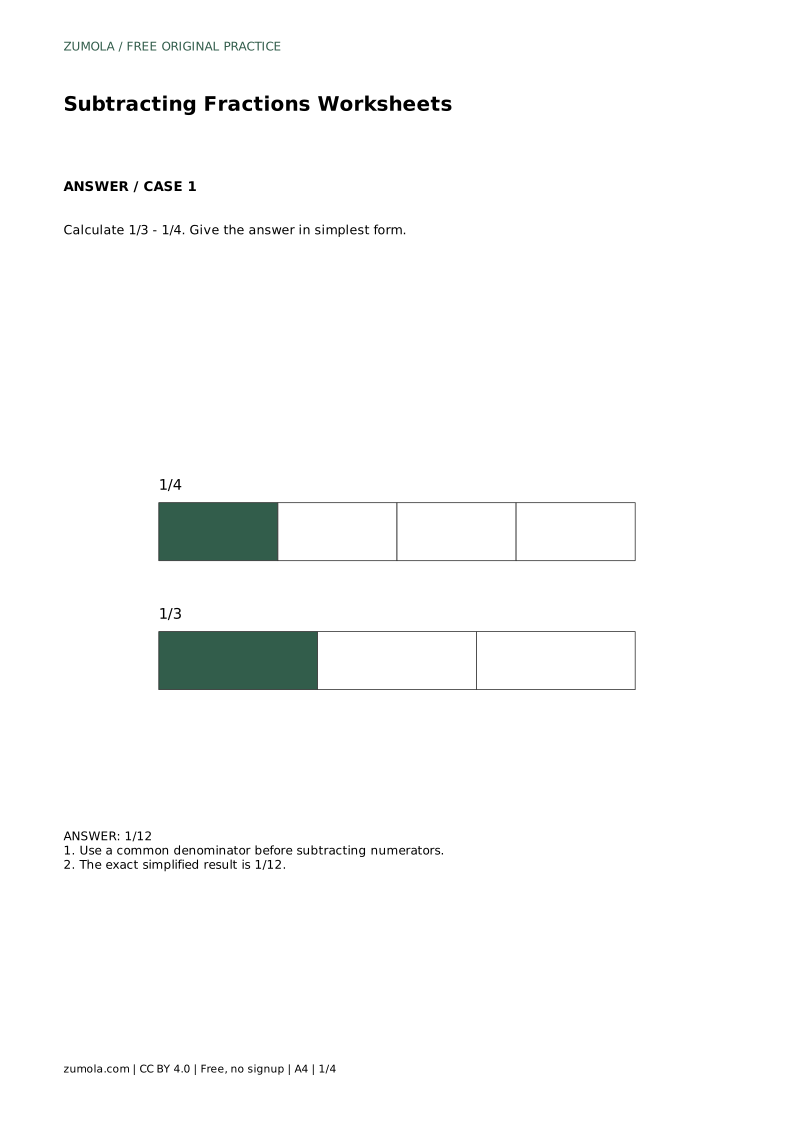
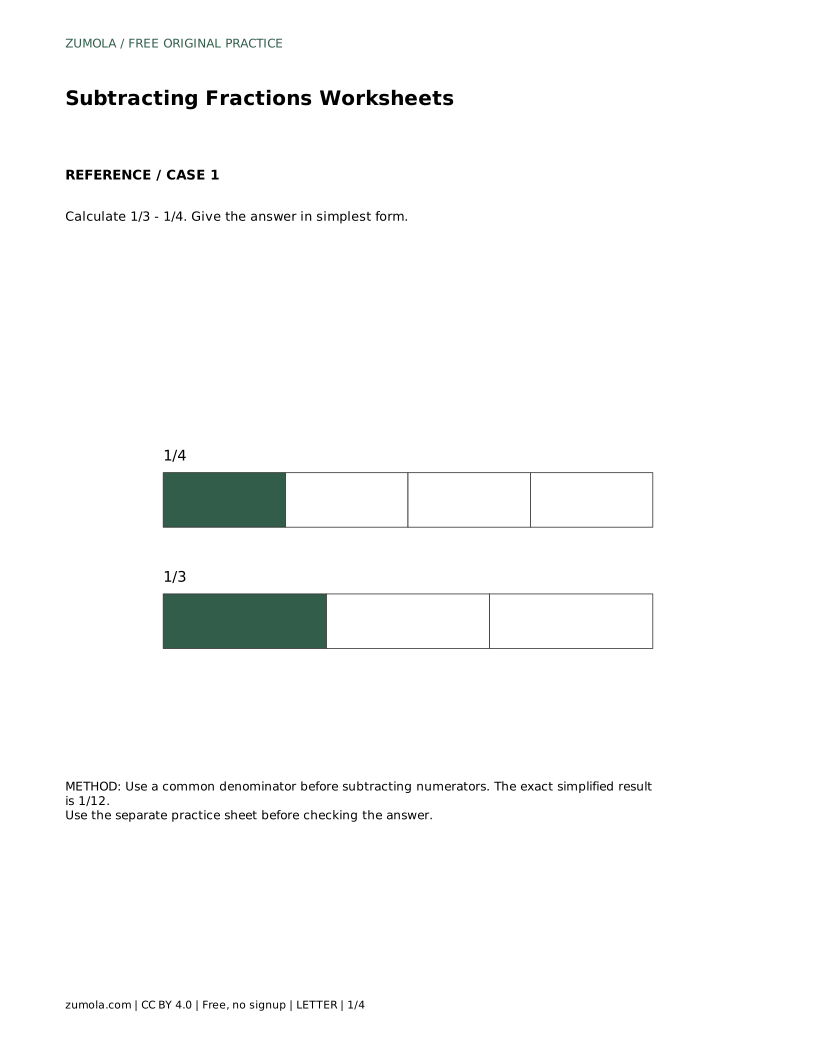
A fraction such as 1/3 means one of three equal parts. A fraction such as 1/4 means one of four equal parts. Those parts are different sizes, so you cannot subtract one part from the other directly. Rewriting both fractions with the same denominator turns them into counts of identical parts.
For 1/3 - 1/4, a common denominator is 12. Rewrite 1/3 as 4/12 and 1/4 as 3/12. Now subtract the numerators: 4 - 3 = 1, giving 1/12. The denominator stays 12 because the size of each part has not changed.
Use the same sequence for every subtraction, whether the denominators are small or larger. Writing the equivalent fractions on separate lines reduces copying errors and makes the final simplification easier to check.
If the first numerator is smaller than the second after rewriting, the result is negative. That is valid arithmetic, but check whether the task expects a positive answer from a larger first fraction.
Addition is the natural check for subtraction. If 1/3 - 1/4 = 1/12, then 1/12 + 1/4 should equal 1/3. Rewrite 1/4 as 3/12, add to get 4/12, and simplify to 1/3. The check confirms both the subtraction and the simplification.
A second check is to compare sizes. Since 1/3 is larger than 1/4, the answer must be positive. Since the two fractions are close in size, a small result such as 1/12 is plausible.
Art and diagram tasks may have several valid layouts. Mark the mathematical reasoning and the clarity of the working rather than expecting one identical page.
Calculate 1/3 - 1/4. Give the answer in simplest form.
1/12 Use a common denominator before subtracting numerators. The exact simplified result is 1/12.
Multiplying the denominators always gives a common denominator, but it may not be the smallest one. Either is acceptable if you simplify the final answer.
Yes. If the first fraction is smaller than the second, the result is negative. Check whether the task expects a positive result.
The denominator names the size of the parts. Once both fractions use the same part size, you are counting those parts, so only the count changes.
All math worksheets · Free coordinate paper
Original resources · CC BY 4.0 · Free for personal and classroom use with attribution.