Free original lessons
Drawing Tools Guide
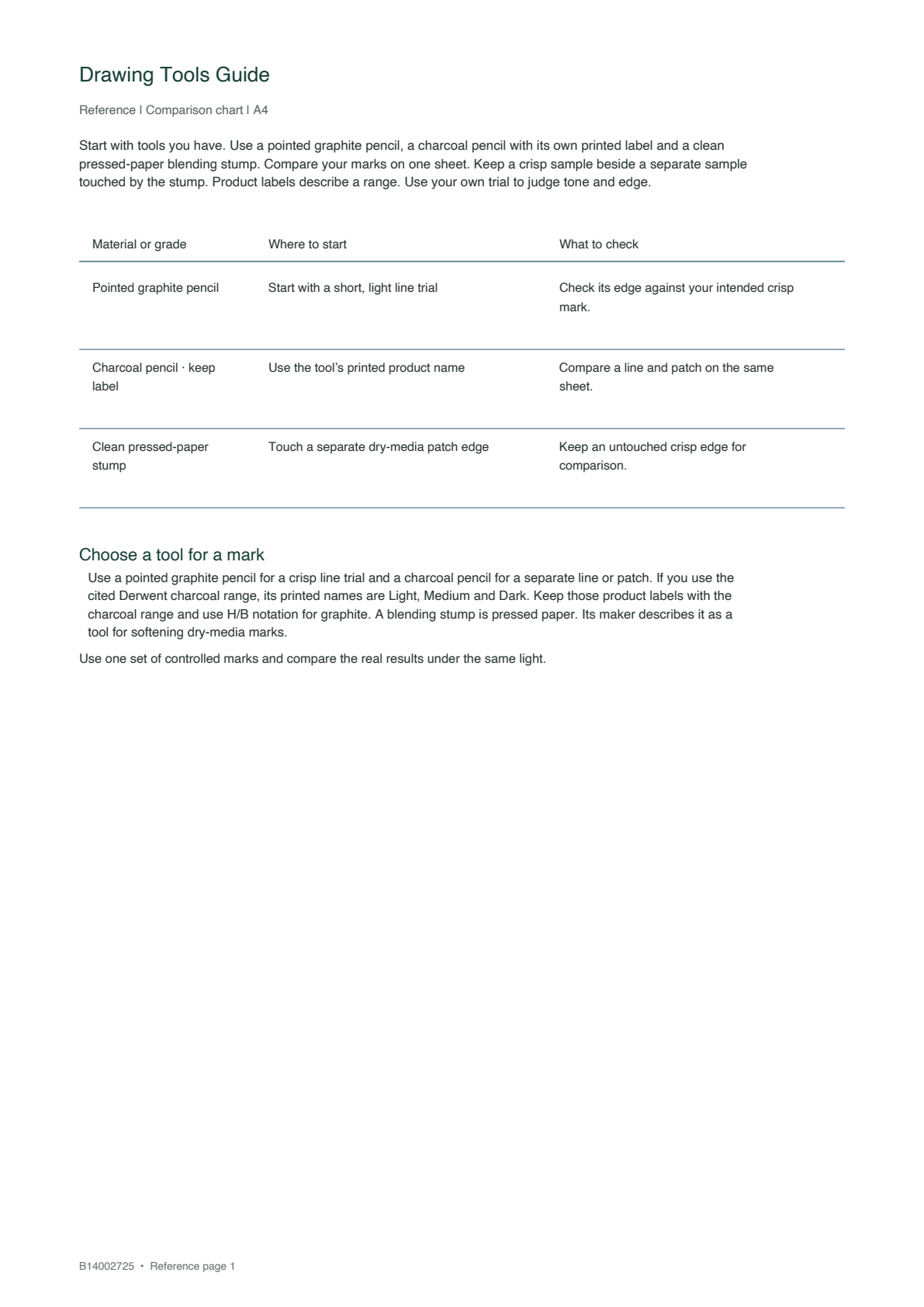
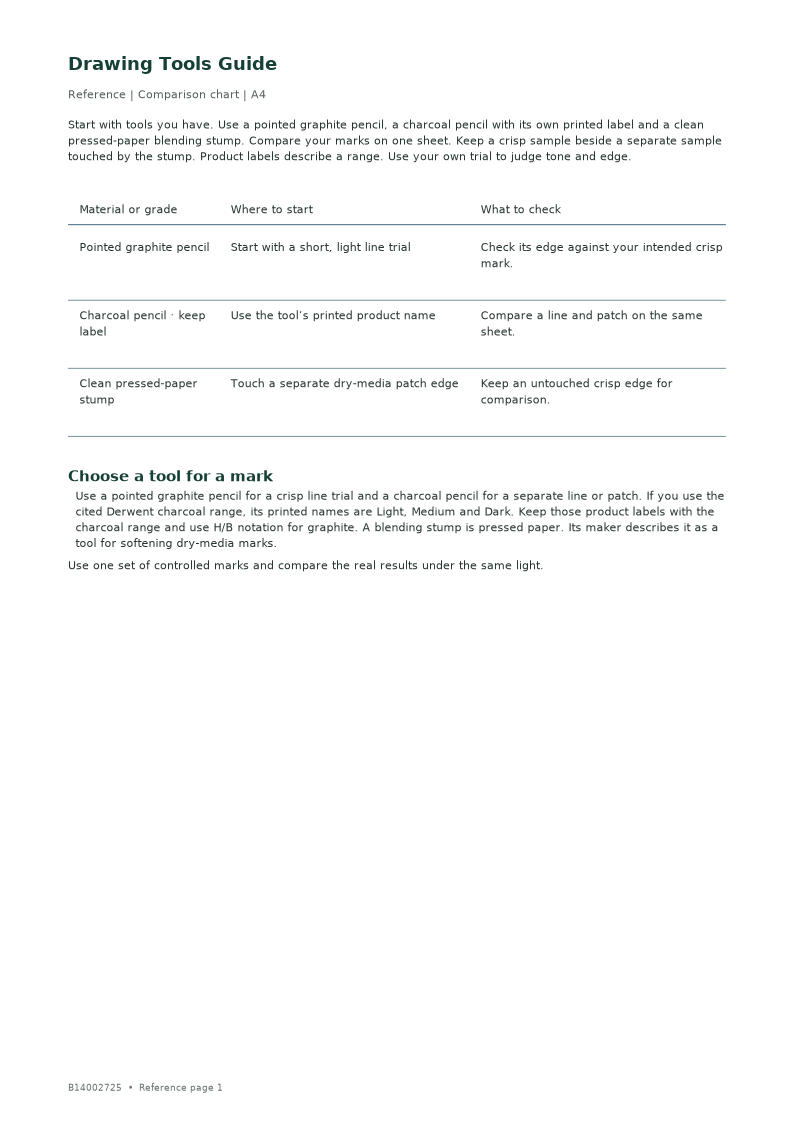
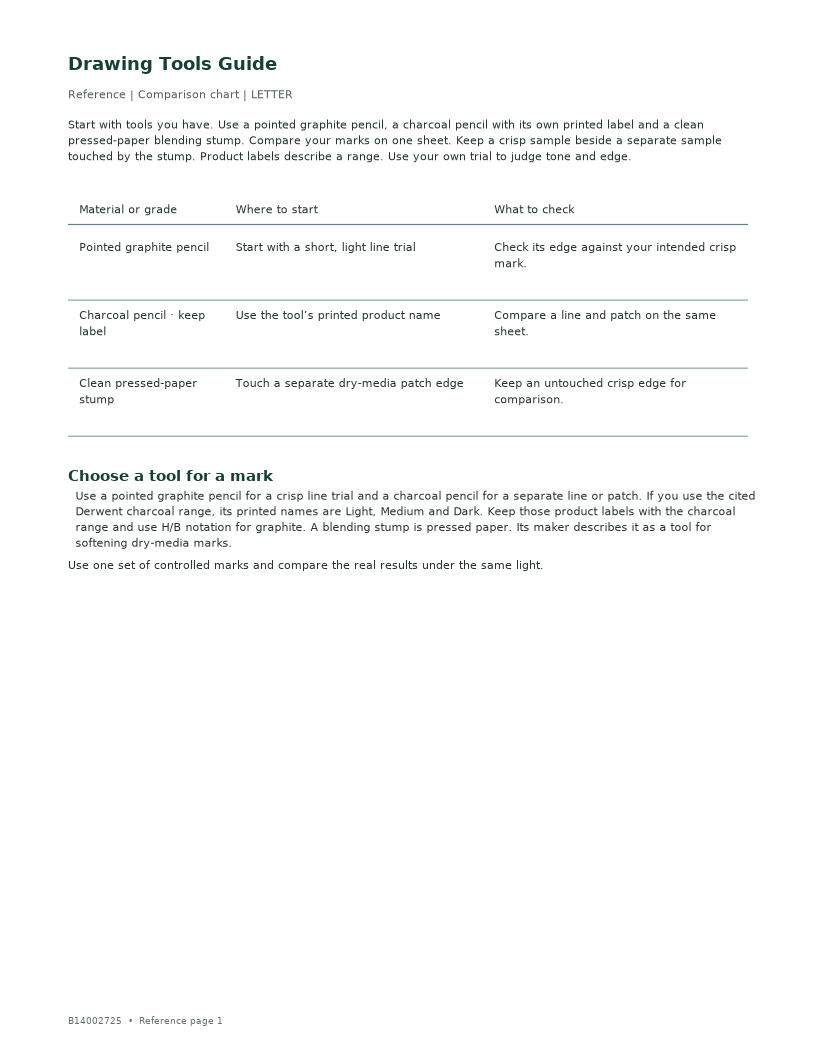
Start with tools you have. Use a pointed graphite pencil, a charcoal pencil with its own printed label and a clean pressed-paper blending stump. Compare your marks on one sheet. Keep a crisp sample beside a separate sample touched by the stump. Product labels describe a range. Use your own trial to judge tone and edge.
Letter & A4
PDF & SVG
Choose a tool for a mark
Use a pointed graphite pencil for a crisp line trial and a charcoal pencil for a separate line or patch. If you use the cited Derwent charcoal range, its printed names are Light, Medium and Dark. Keep those product labels with the charcoal range and use H/B notation for graphite. A blending stump is pressed paper. Its maker describes it as a tool for softening dry-media marks.
Keep the comparison controlled
Put samples on one sheet. Keep the surface and sample size similar when comparing tools, and write the actual product label beside each mark. Leave one patch edge crisp before trying the stump on a separate sample.
Use the visible result
A stump moves material already on the paper. The printed marks illustrate possible results for the shown tools. Choose a role from the mark you made and keep the untouched sample for comparison.
Download the complete resource pack
All individual SVG pages (20)
- A4 reference page 1
- A4 reference page 2
- A4 student page 1
- A4 student page 2
- A4 student page 3
- A4 student page 4
- A4 answer page 1
- A4 answer page 2
- A4 answer page 3
- A4 answer page 4
- LETTER reference page 1
- LETTER reference page 2
- LETTER student page 1
- LETTER student page 2
- LETTER student page 3
- LETTER student page 4
- LETTER answer page 1
- LETTER answer page 2
- LETTER answer page 3
- LETTER answer page 4
Print at 100% / actual size. Use the stated scale on any schematic diagram; physical cutting templates are identified separately. A4 and US Letter are separate files. Free access, no signup; CC BY 4.0.
How to use these pages
- Choose a tool for a mark
- Keep the comparison controlled
- Use the visible result
Worked example
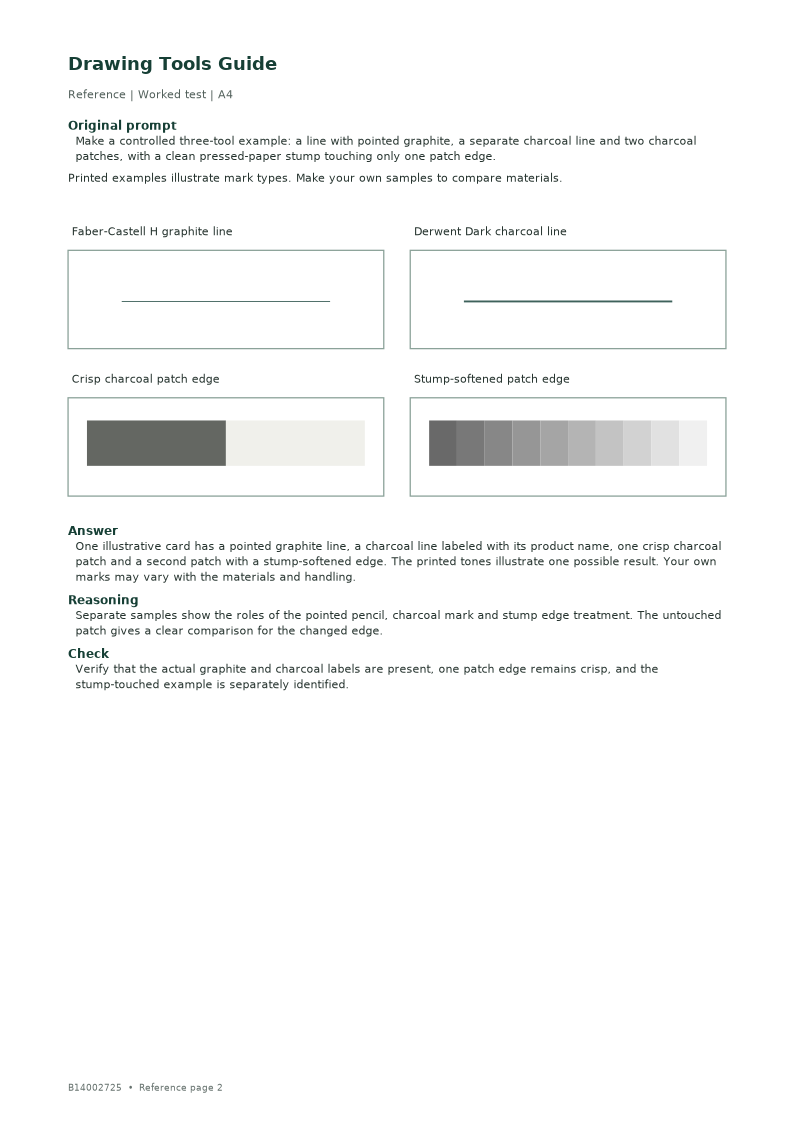
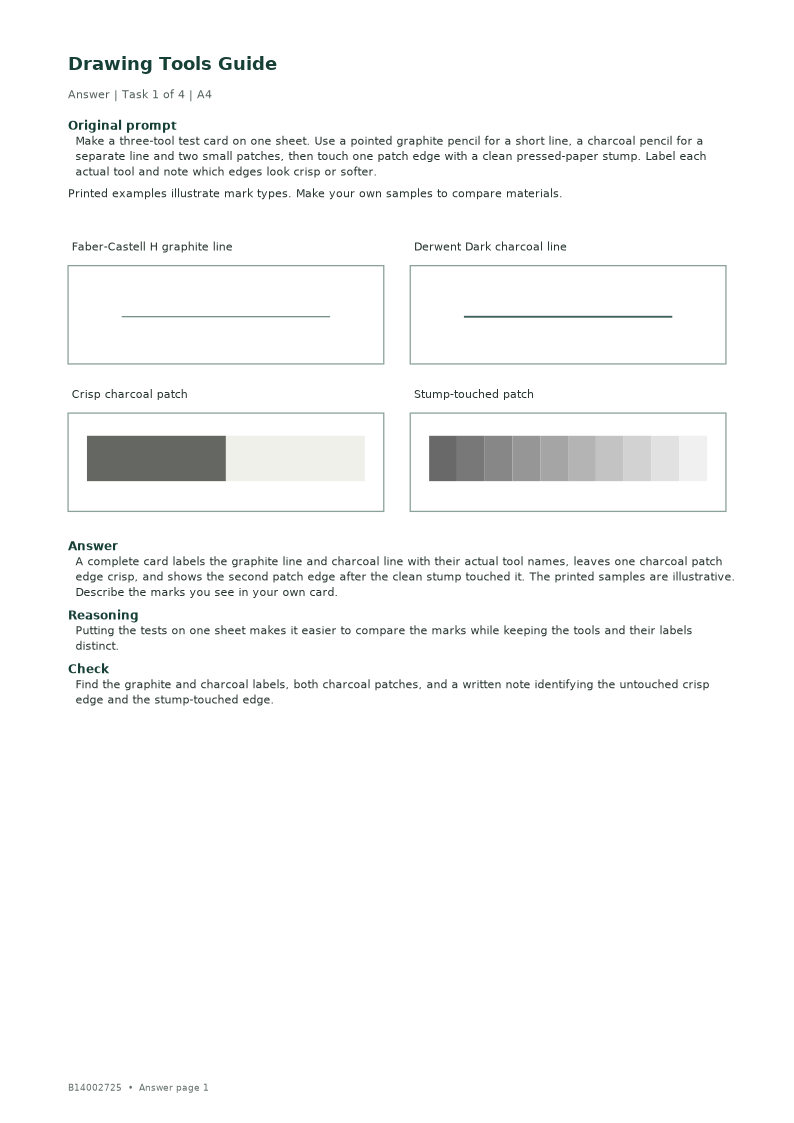
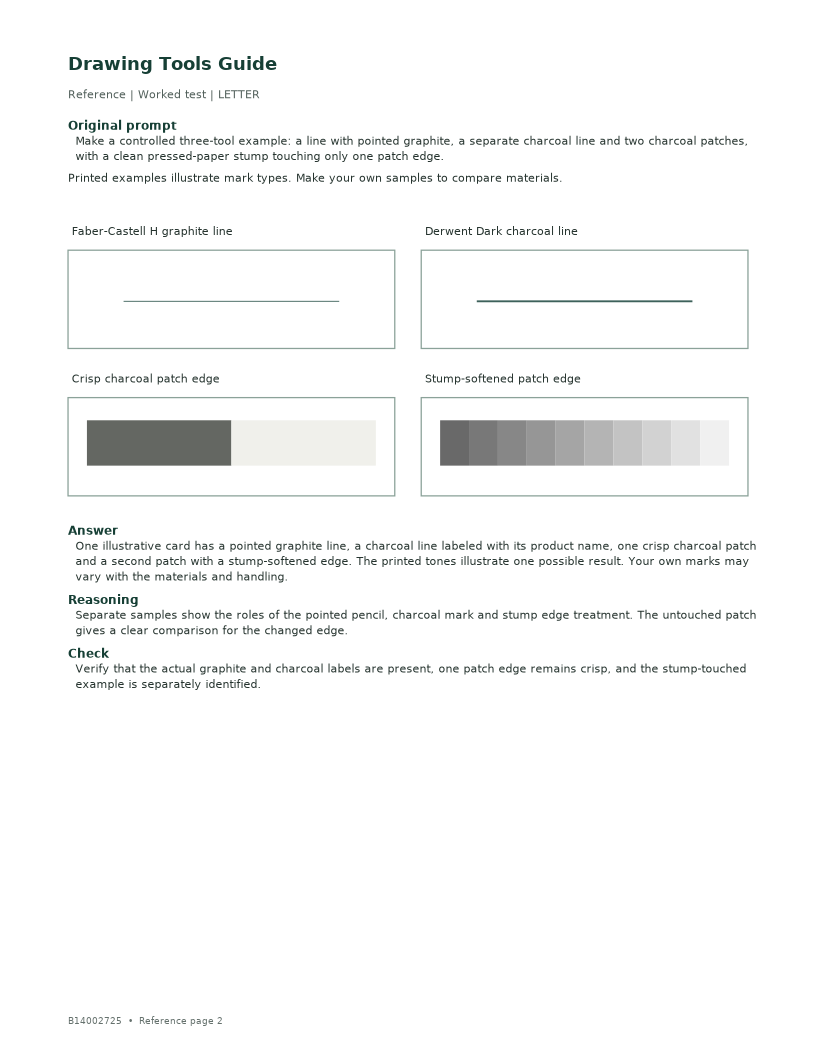
Example: Make a controlled three-tool example: a line with pointed graphite, a separate charcoal line and two charcoal patches, with a clean pressed-paper stump touching only one patch edge.
Answer: One illustrative card has a pointed graphite line, a charcoal line labeled with its product name, one crisp charcoal patch and a second patch with a stump-softened edge. The printed tones illustrate one possible result. Your own marks may vary with the materials and handling.
Reasoning: Separate samples show the roles of the pointed pencil, charcoal mark and stump edge treatment. The untouched patch gives a clear comparison for the changed edge.
Check: Verify that the actual graphite and charcoal labels are present, one patch edge remains crisp, and the stump-touched example is separately identified.
Four practice tasks and complete answers
Task 1
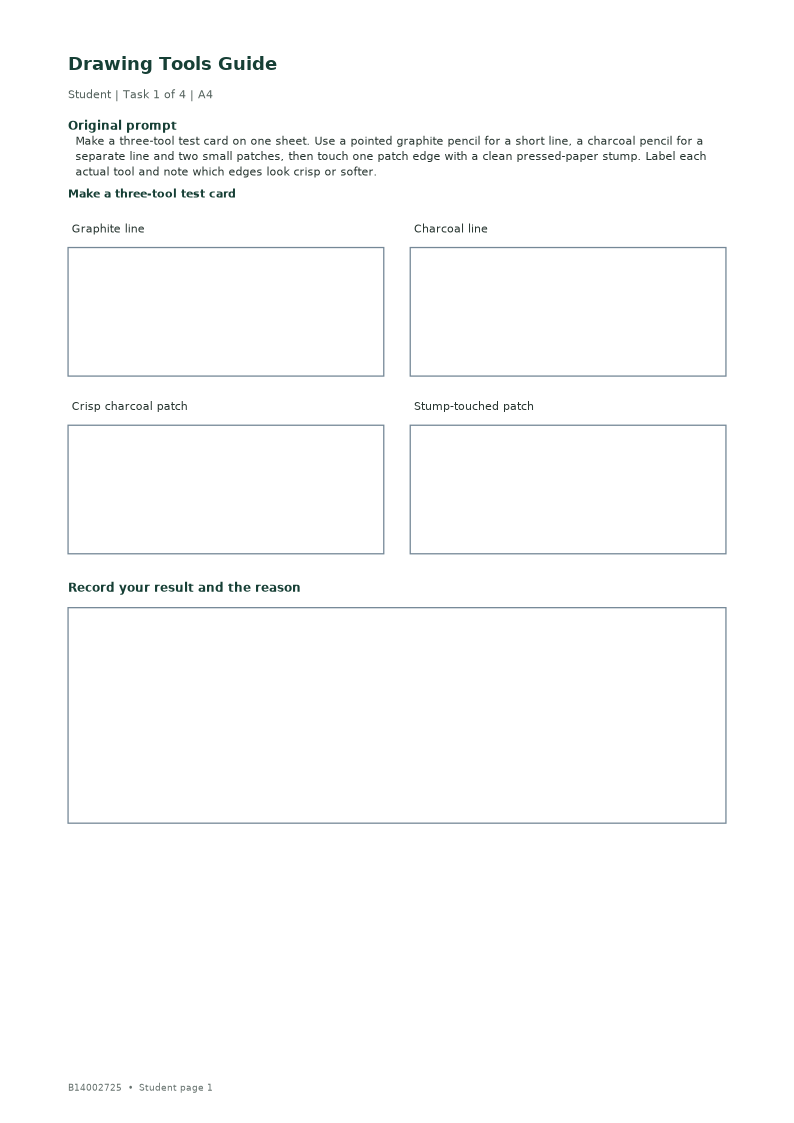
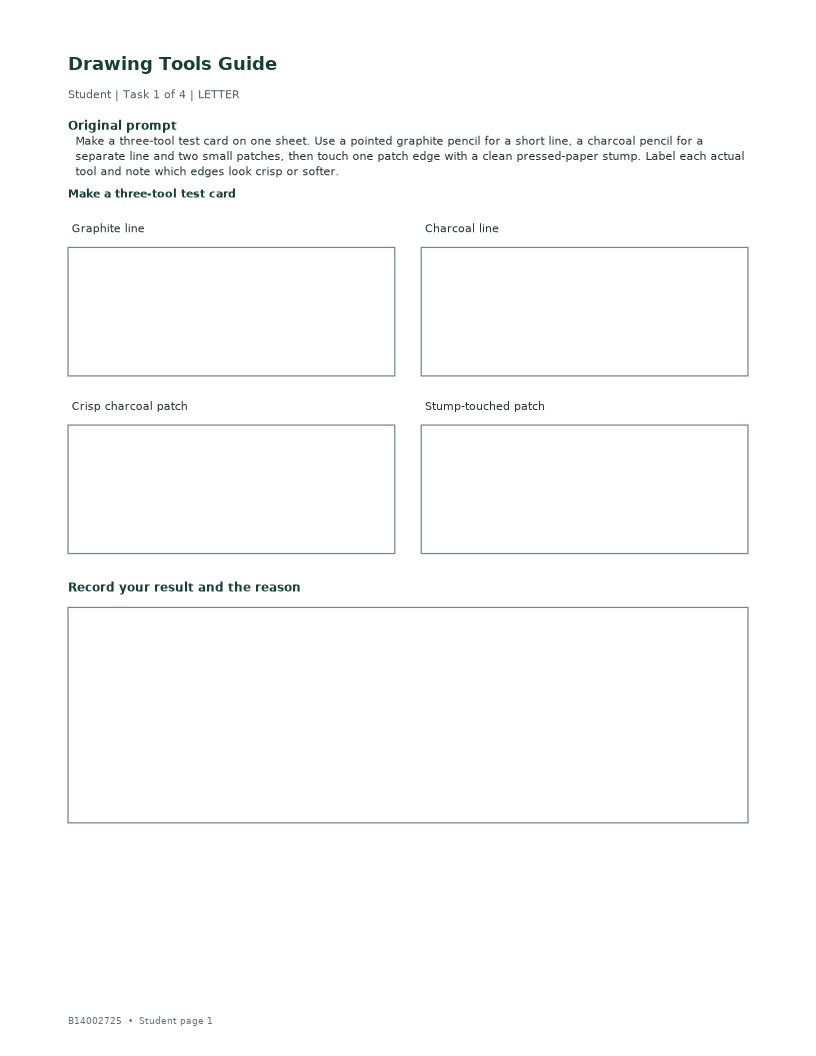
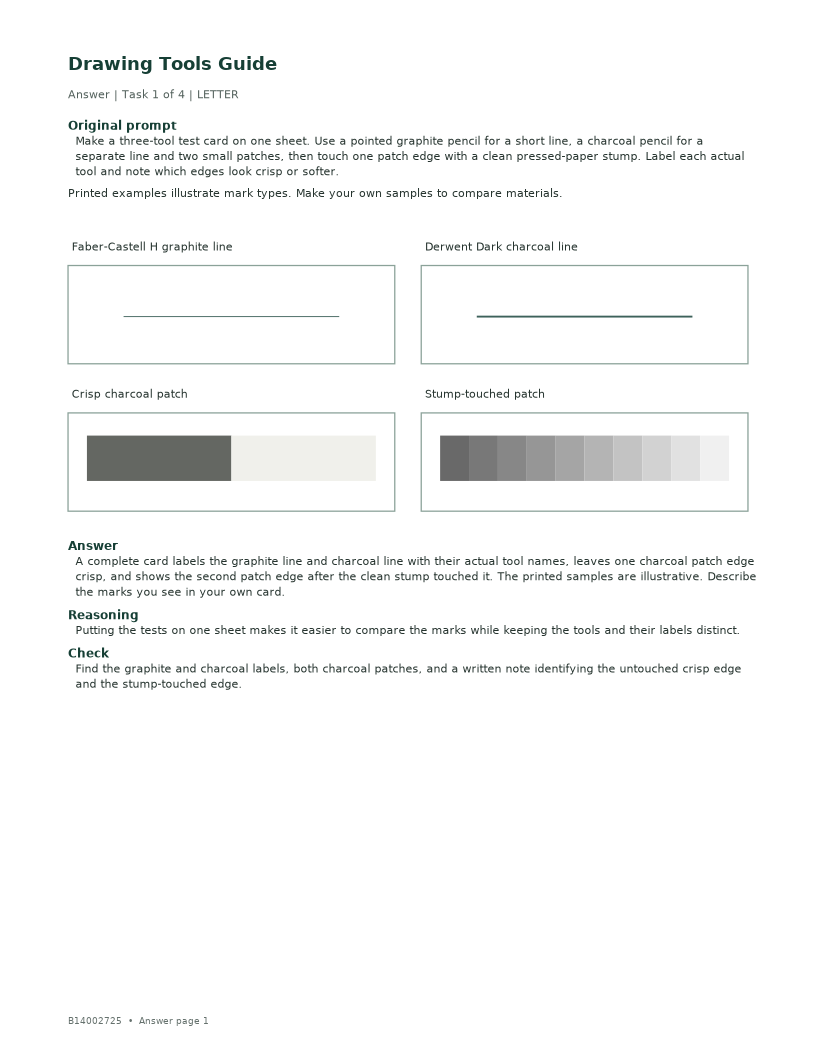
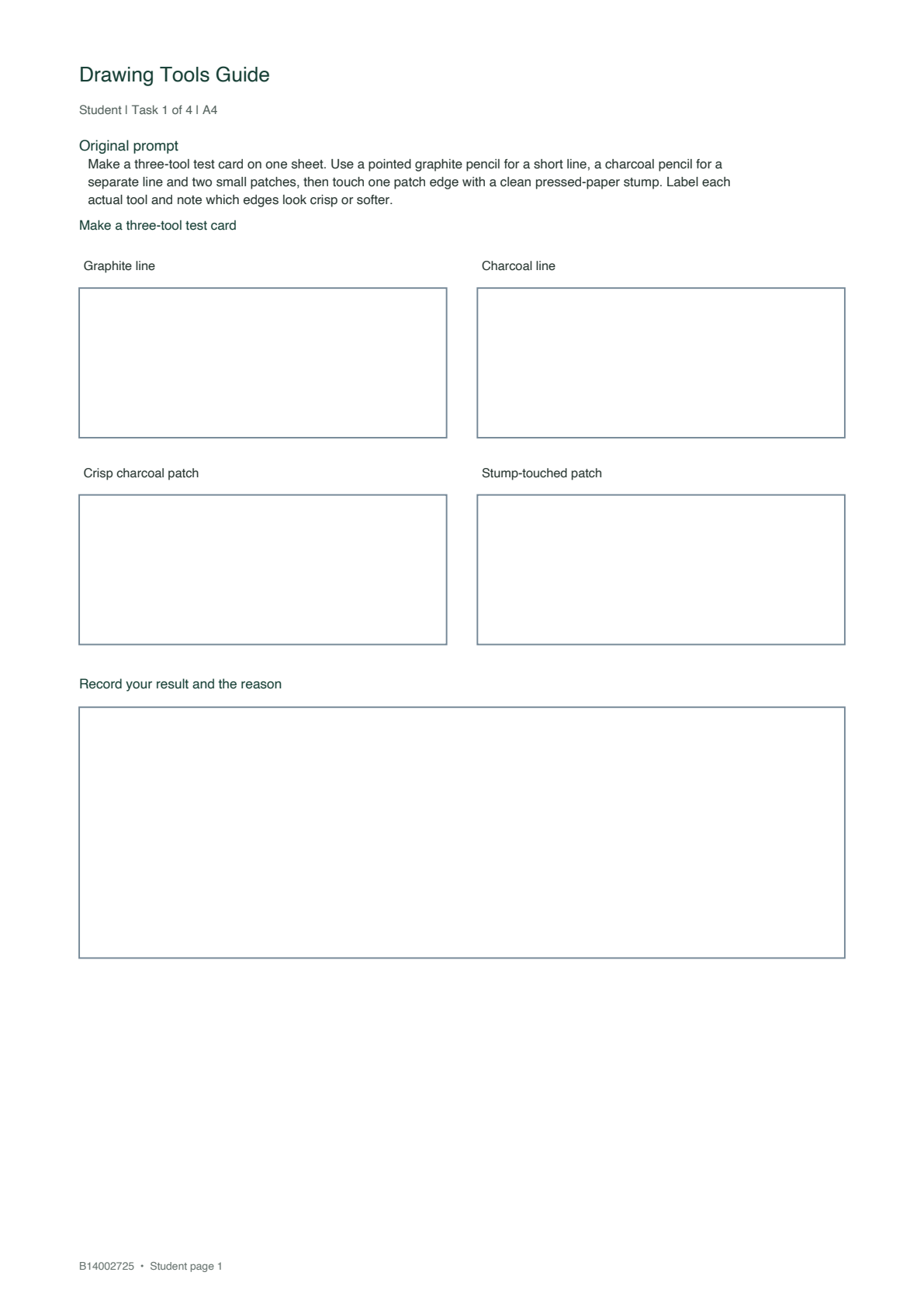
Make a three-tool test card on one sheet. Use a pointed graphite pencil for a short line, a charcoal pencil for a separate line and two small patches, then touch one patch edge with a clean pressed-paper stump. Label each actual tool and note which edges look crisp or softer.
Show answer 1
A complete card labels the graphite line and charcoal line with their actual tool names, leaves one charcoal patch edge crisp, and shows the second patch edge after the clean stump touched it. The printed samples are illustrative. Describe the marks you see in your own card.
Putting the tests on one sheet makes it easier to compare the marks while keeping the tools and their labels distinct.
Check: Find the graphite and charcoal labels, both charcoal patches, and a written note identifying the untouched crisp edge and the stump-touched edge.
Task 2
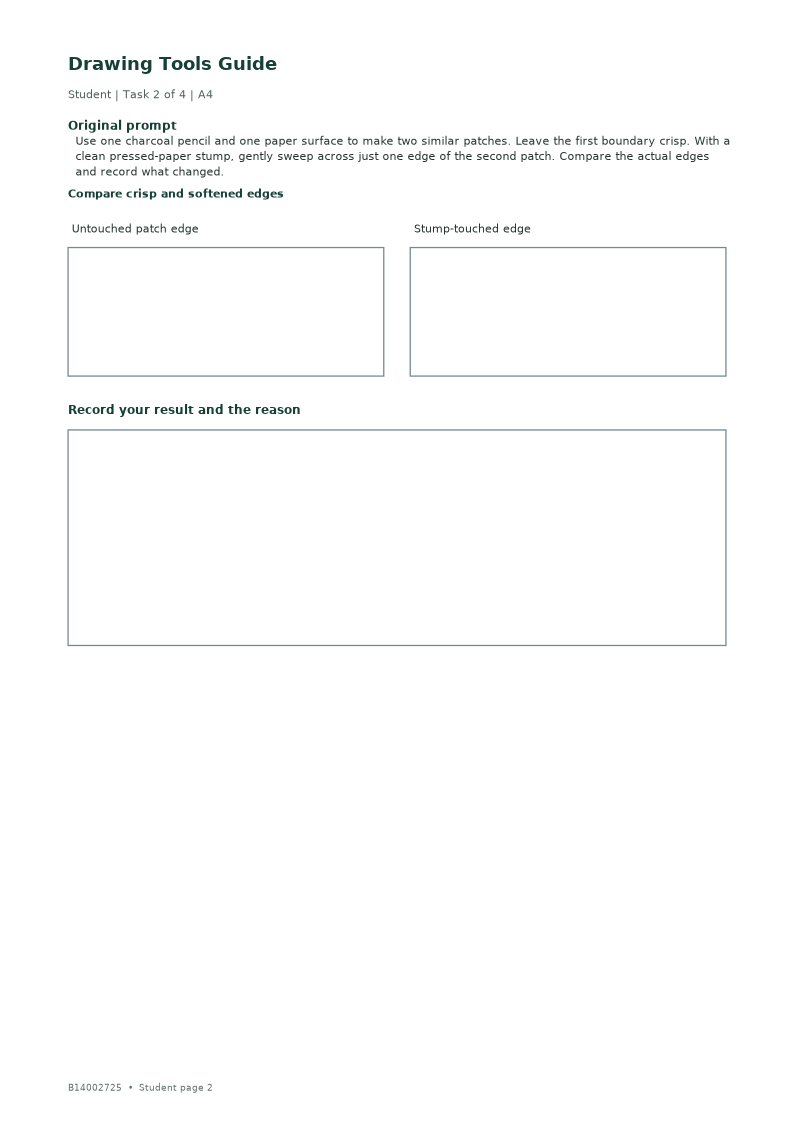
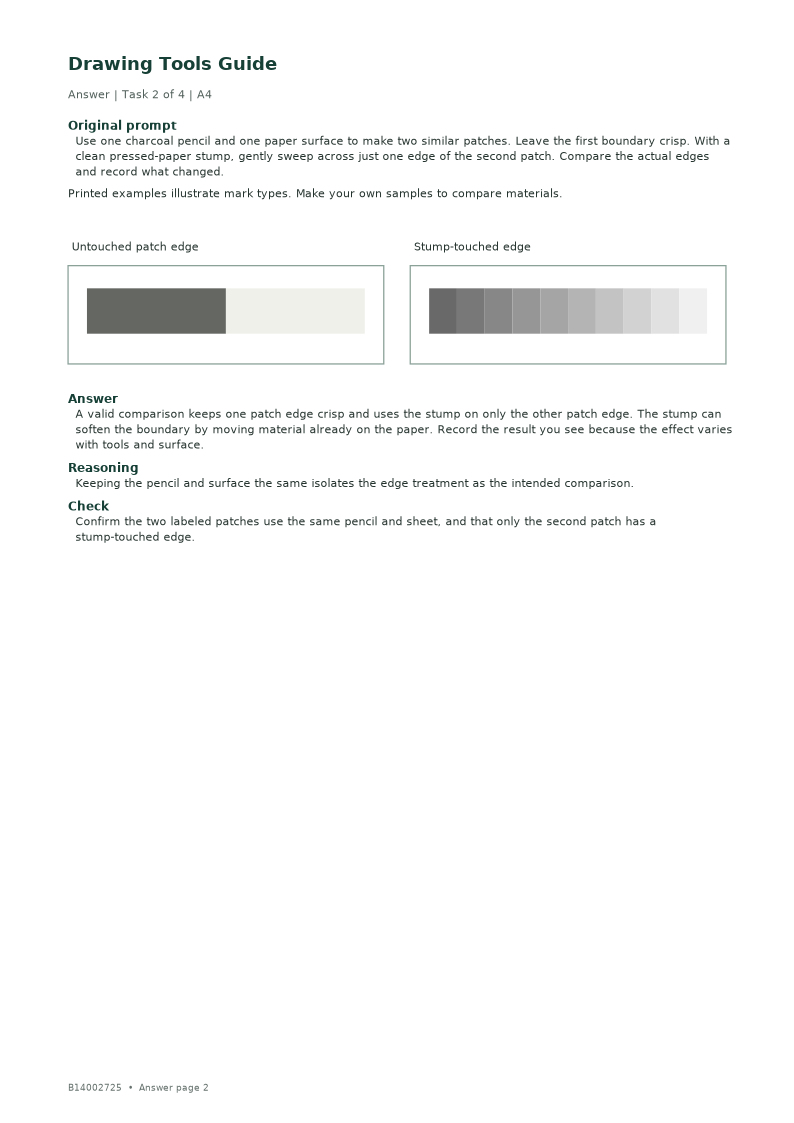
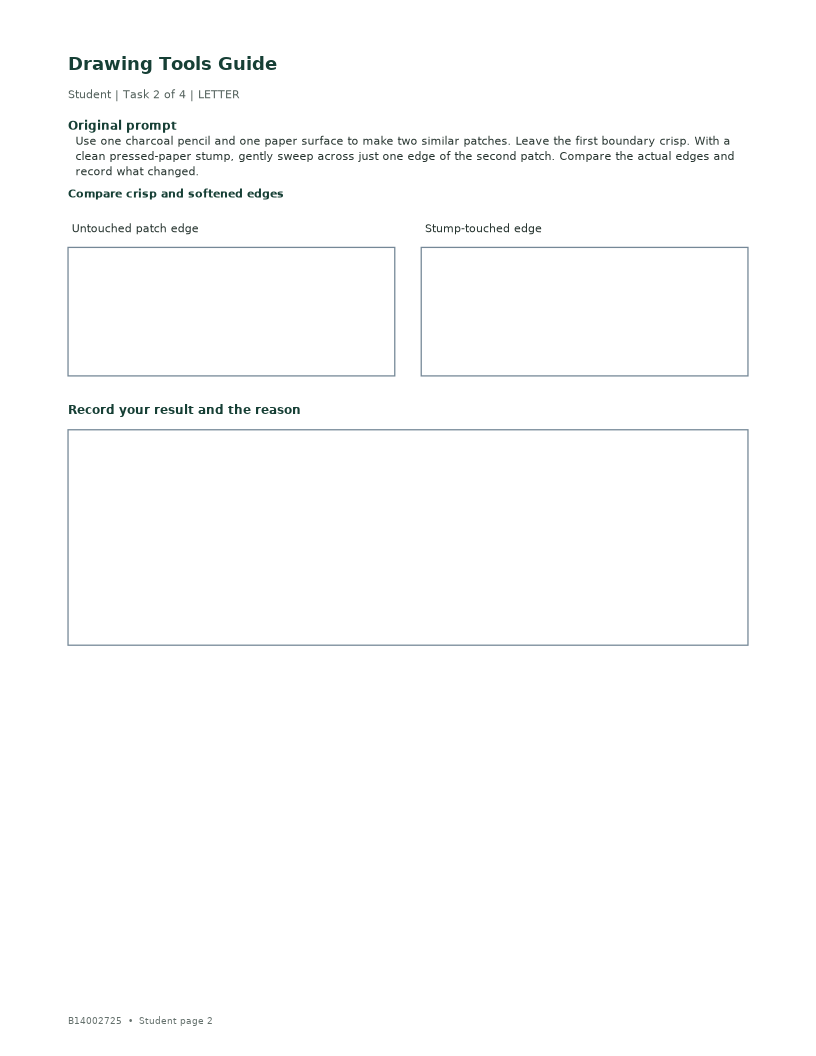
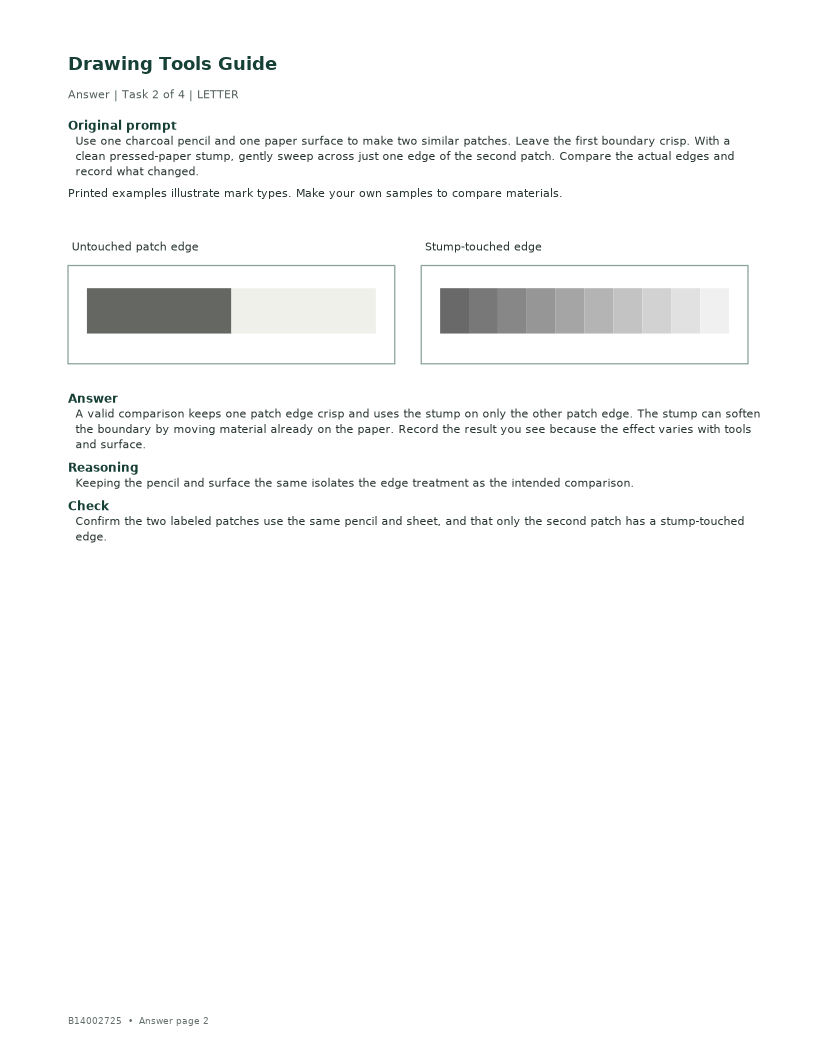
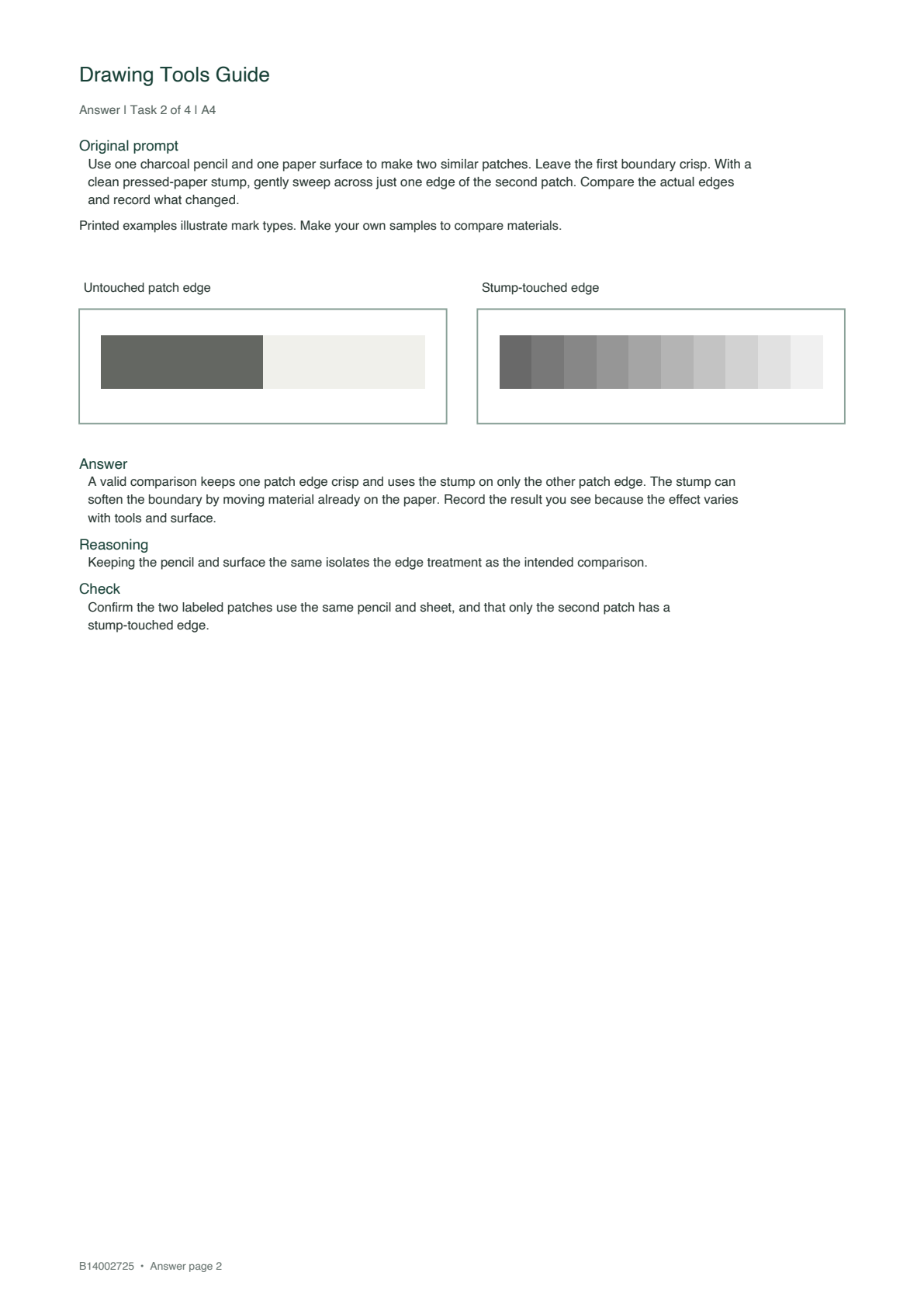
Use one charcoal pencil and one paper surface to make two similar patches. Leave the first boundary crisp. With a clean pressed-paper stump, gently sweep across just one edge of the second patch. Compare the actual edges and record what changed.
Show answer 2
A valid comparison keeps one patch edge crisp and uses the stump on only the other patch edge. The stump can soften the boundary by moving material already on the paper. Record the result you see because the effect varies with tools and surface.
Keeping the pencil and surface the same isolates the edge treatment as the intended comparison.
Check: Confirm the two labeled patches use the same pencil and sheet, and that only the second patch has a stump-touched edge.
Task 3
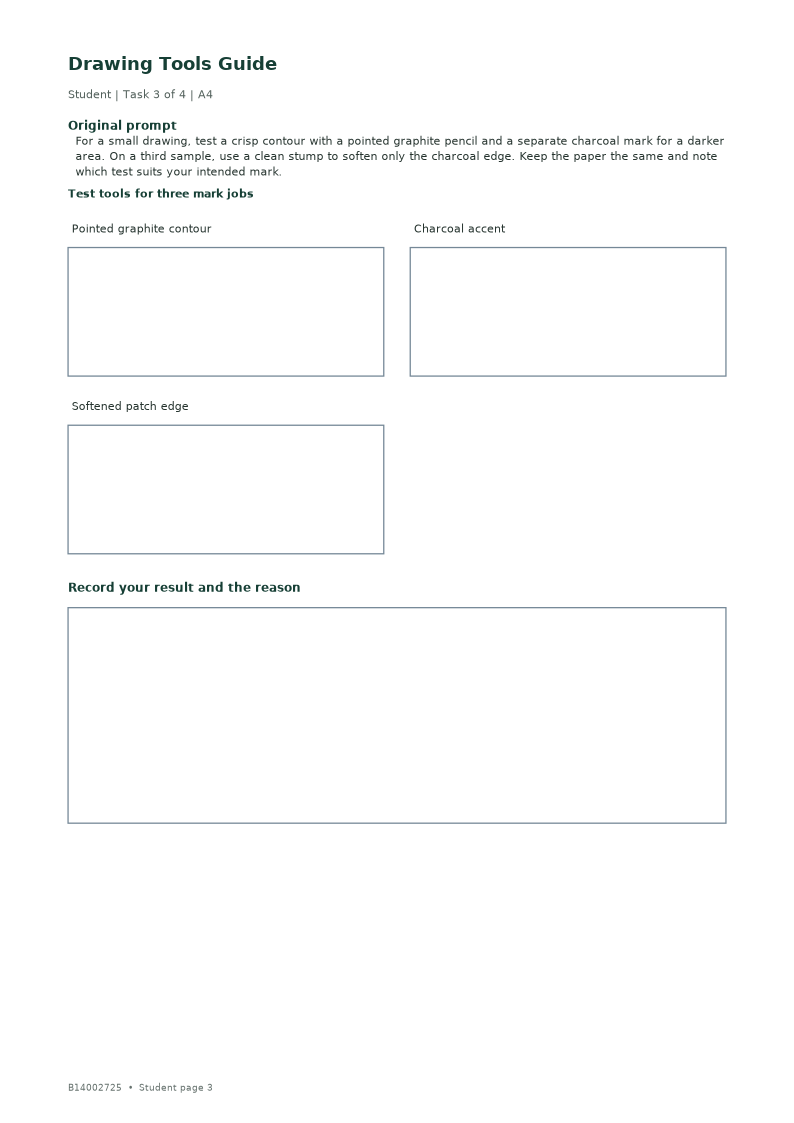
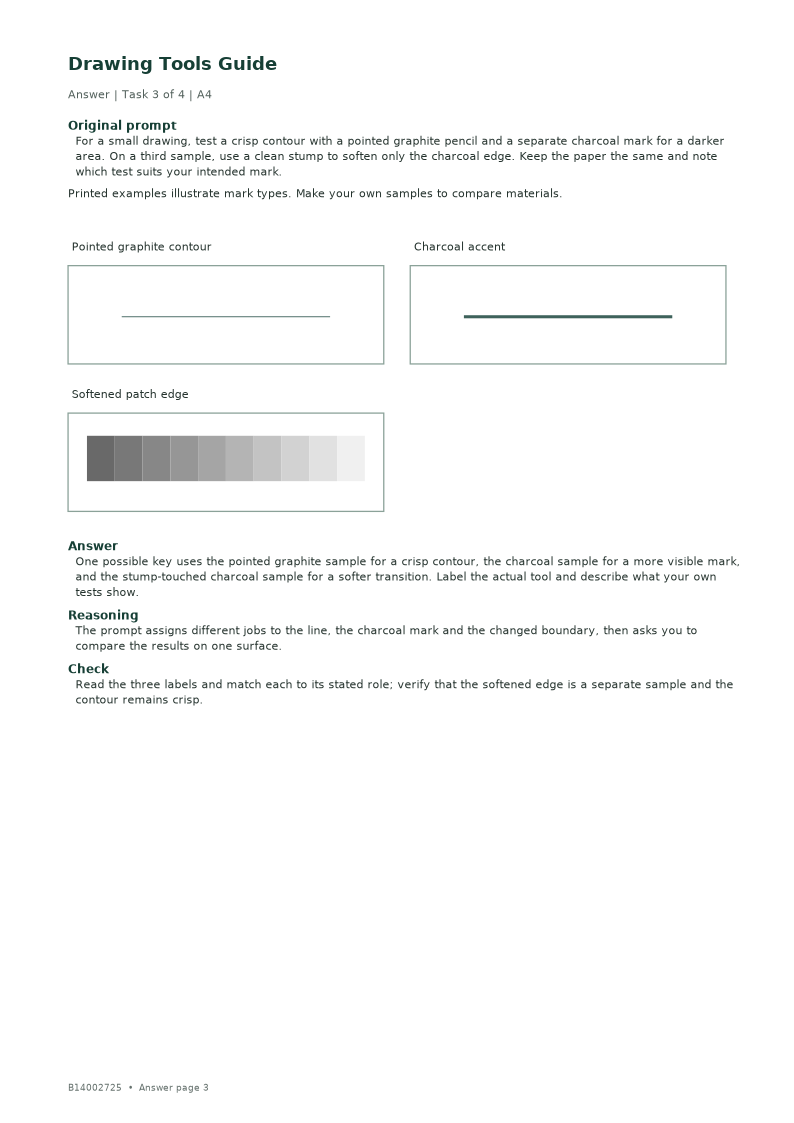
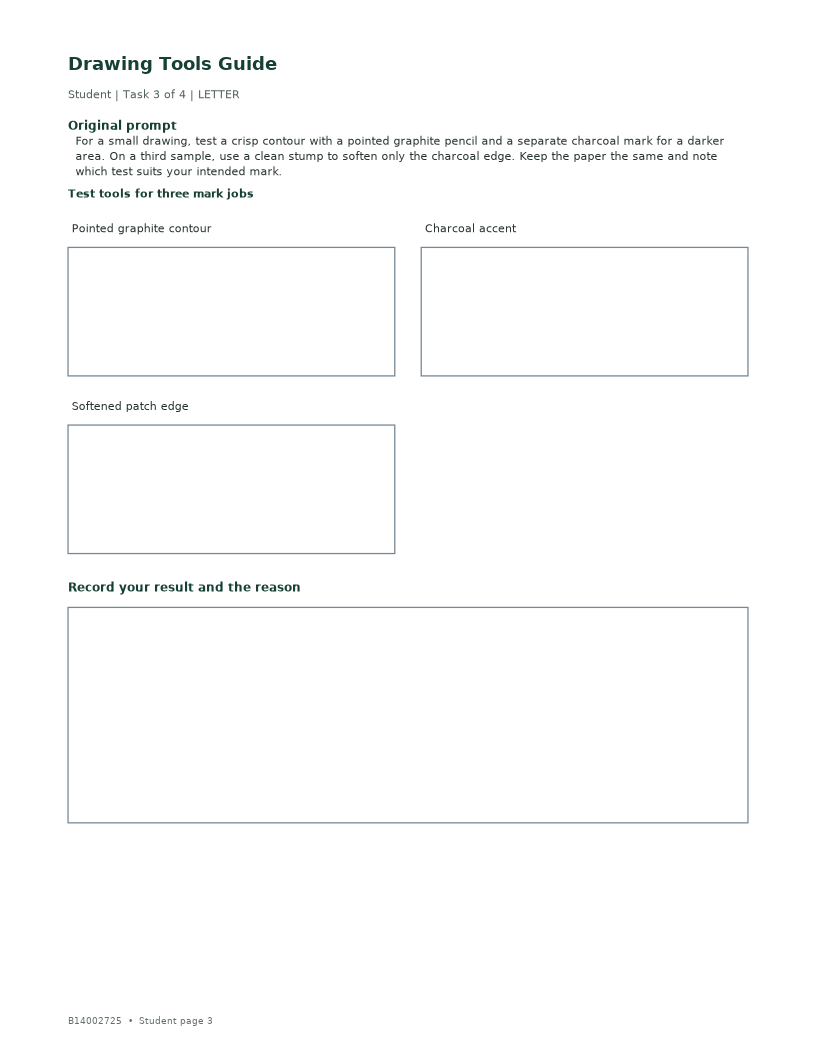
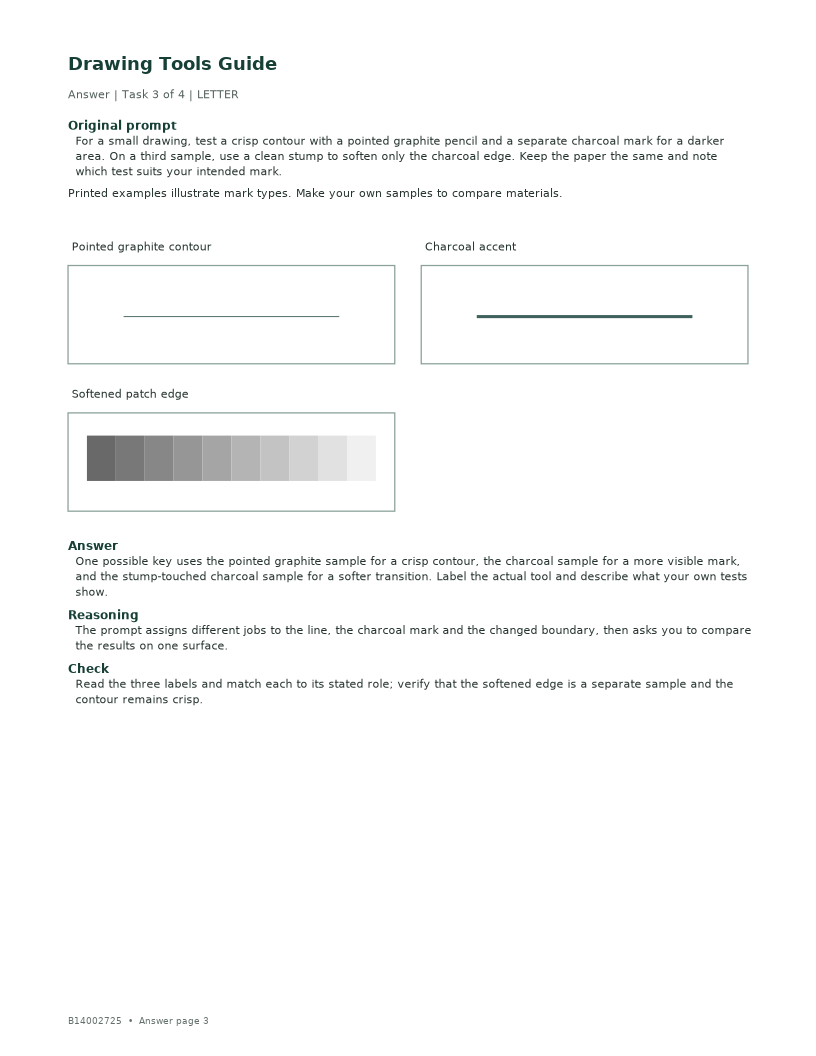
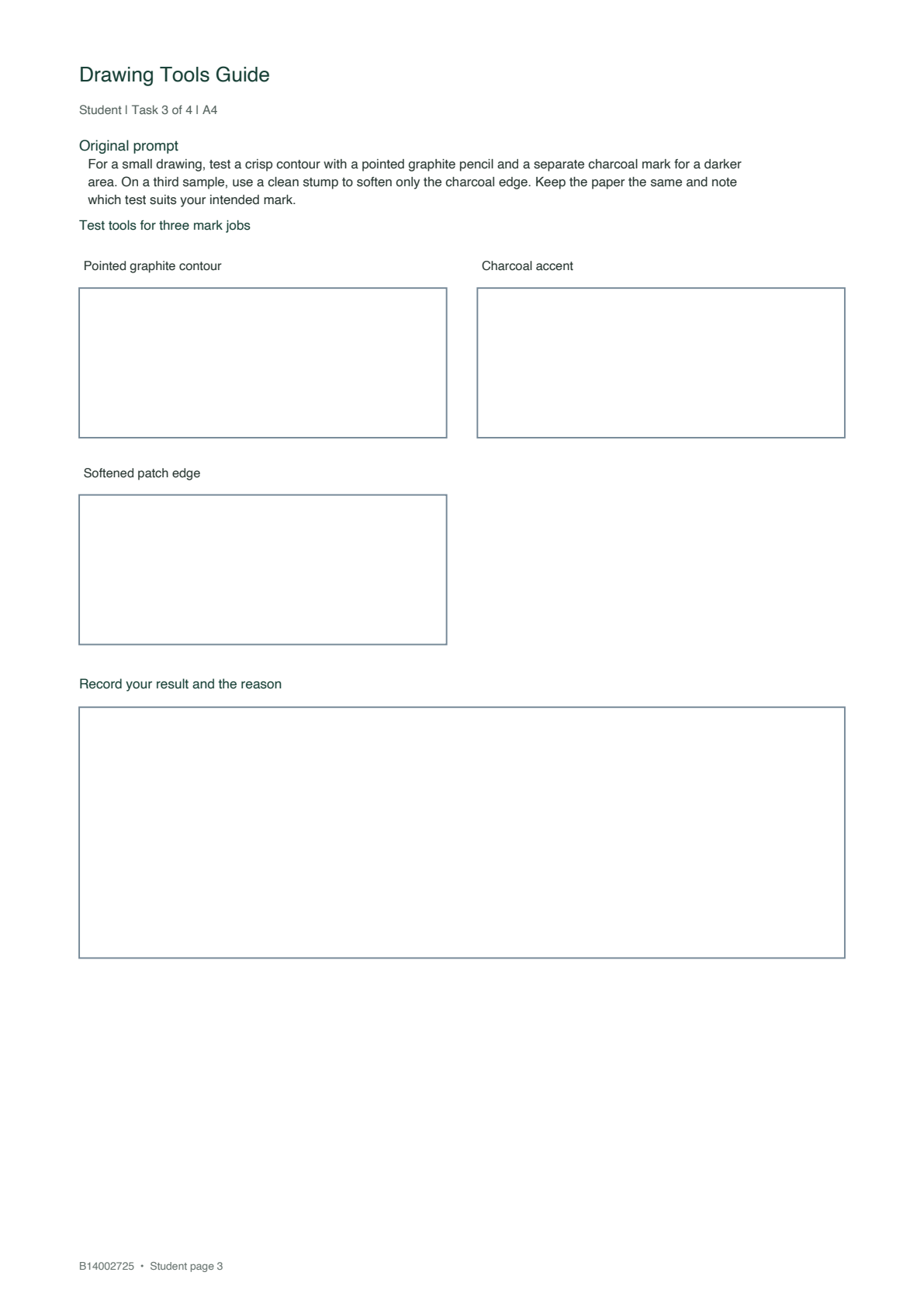
For a small drawing, test a crisp contour with a pointed graphite pencil and a separate charcoal mark for a darker area. On a third sample, use a clean stump to soften only the charcoal edge. Keep the paper the same and note which test suits your intended mark.
Show answer 3
One possible key uses the pointed graphite sample for a crisp contour, the charcoal sample for a more visible mark, and the stump-touched charcoal sample for a softer transition. Label the actual tool and describe what your own tests show.
The prompt assigns different jobs to the line, the charcoal mark and the changed boundary, then asks you to compare the results on one surface.
Check: Read the three labels and match each to its stated role; verify that the softened edge is a separate sample and the contour remains crisp.
Task 4
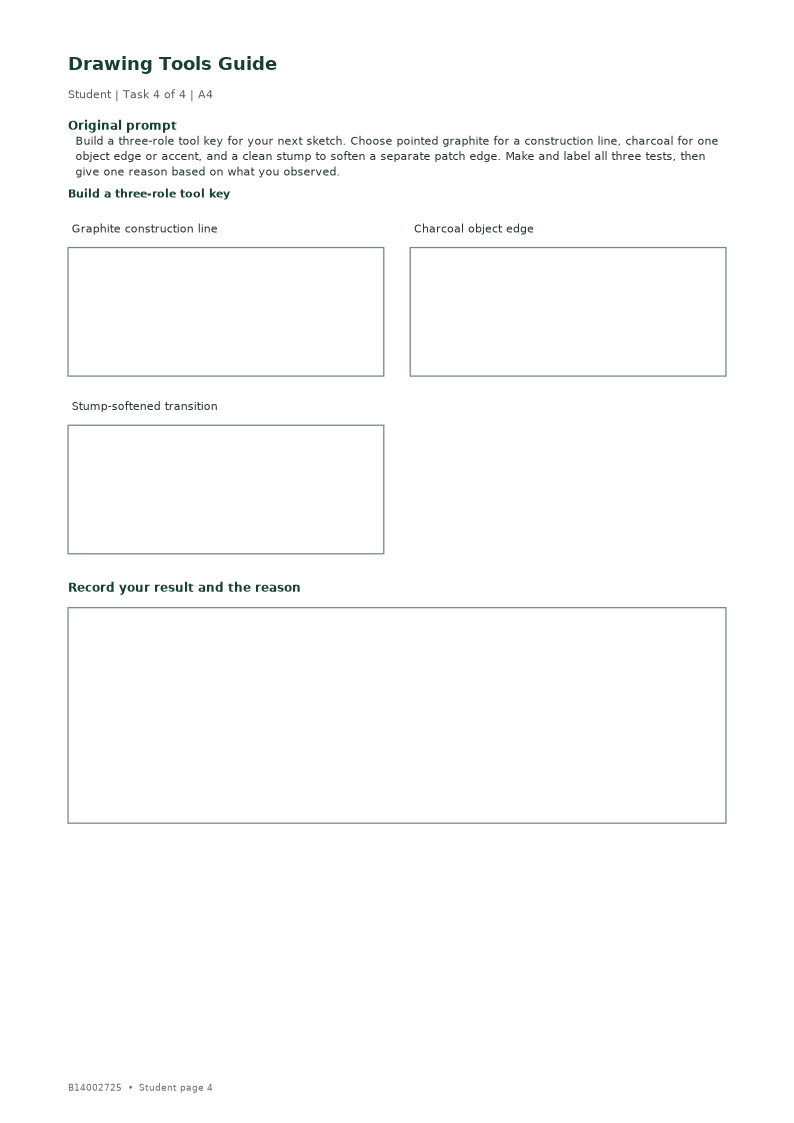
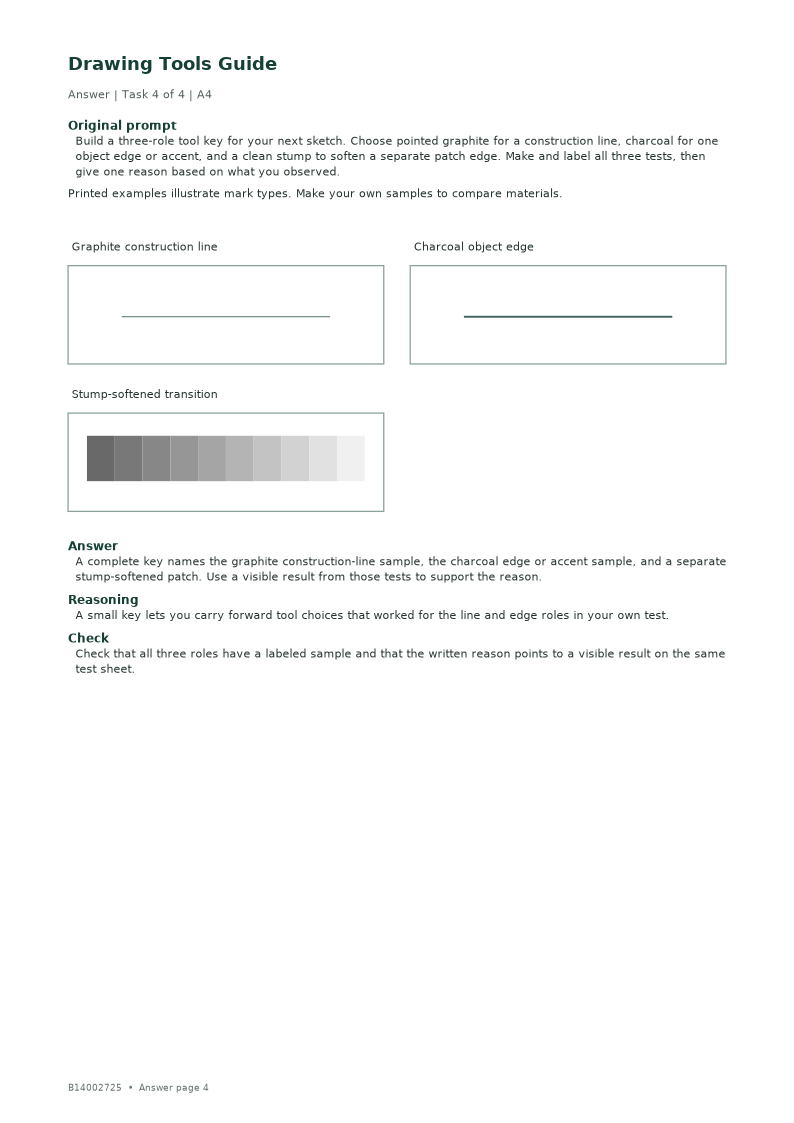
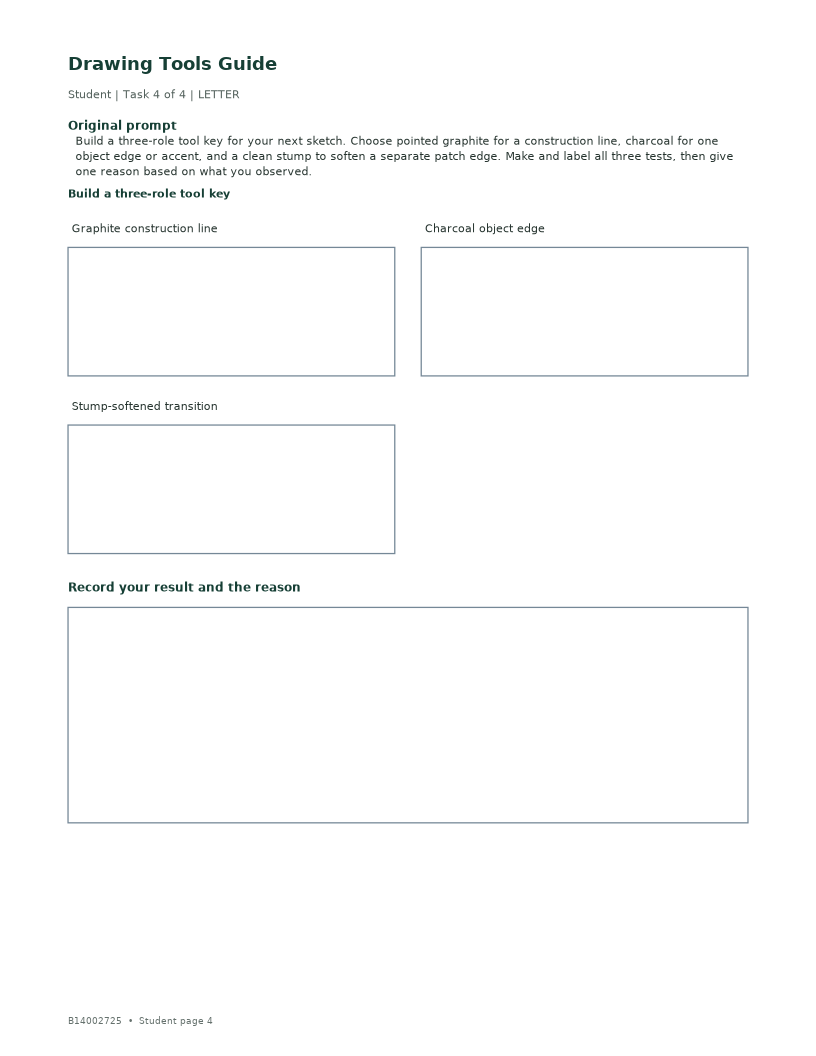
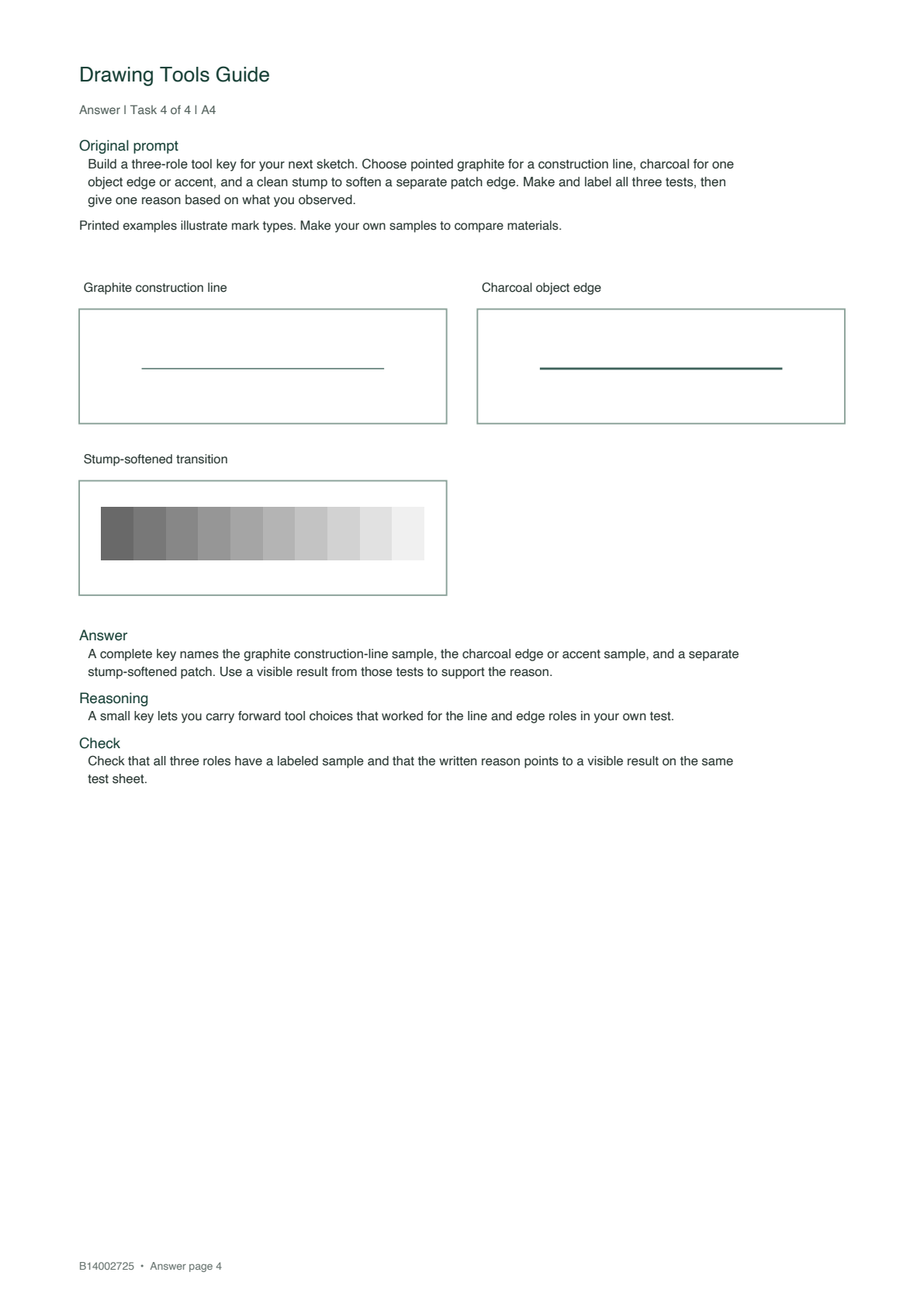
Build a three-role tool key for your next sketch. Choose pointed graphite for a construction line, charcoal for one object edge or accent, and a clean stump to soften a separate patch edge. Make and label all three tests, then give one reason based on what you observed.
Show answer 4
A complete key names the graphite construction-line sample, the charcoal edge or accent sample, and a separate stump-softened patch. Use a visible result from those tests to support the reason.
A small key lets you carry forward tool choices that worked for the line and edge roles in your own test.
Check: Check that all three roles have a labeled sample and that the written reason points to a visible result on the same test sheet.
Useful checks
- Blending both comparison patches before checking their edges. Leave one boundary untouched and apply the clean stump to only the separate test edge.
- Combining charcoal product names with graphite hardness grades. Copy the printed label and maker for each tool. Compare the actual samples within their own ranges.
Questions about this resource
How should I read charcoal Light, Medium and Dark labels alongside graphite H and B grades?
The cited charcoal pencil set uses Light, Medium and Dark within its product range. Keep those names with that charcoal set and graphite letters with graphite samples.
What does a blending stump do in this exercise?
The maker describes a pressed-paper stump for softening dry-media marks. Test it on a separate sample. Results vary with marks, surfaces and handling.