Free original resources
Cone Template Generator: Slant Height and Sector Angle from Radius and Height
Work out a cone's slant height, sector angle and arc length from base radius and height, then check the net before drawing it on paper.
Free resources
Letter & A4
PDF & SVG
Letter & A4
PDF & SVG
Make it yours.
Free · no signup · calculated in your browser
Solid outside edges are cut lines; shared face edges are folds. Use the seam tab where shown and tape the remaining joins from inside. Check the 100 mm calibration bar before cutting.
Your free printable kit.
Original reference, student practice and separate worked answers. No account or payment.
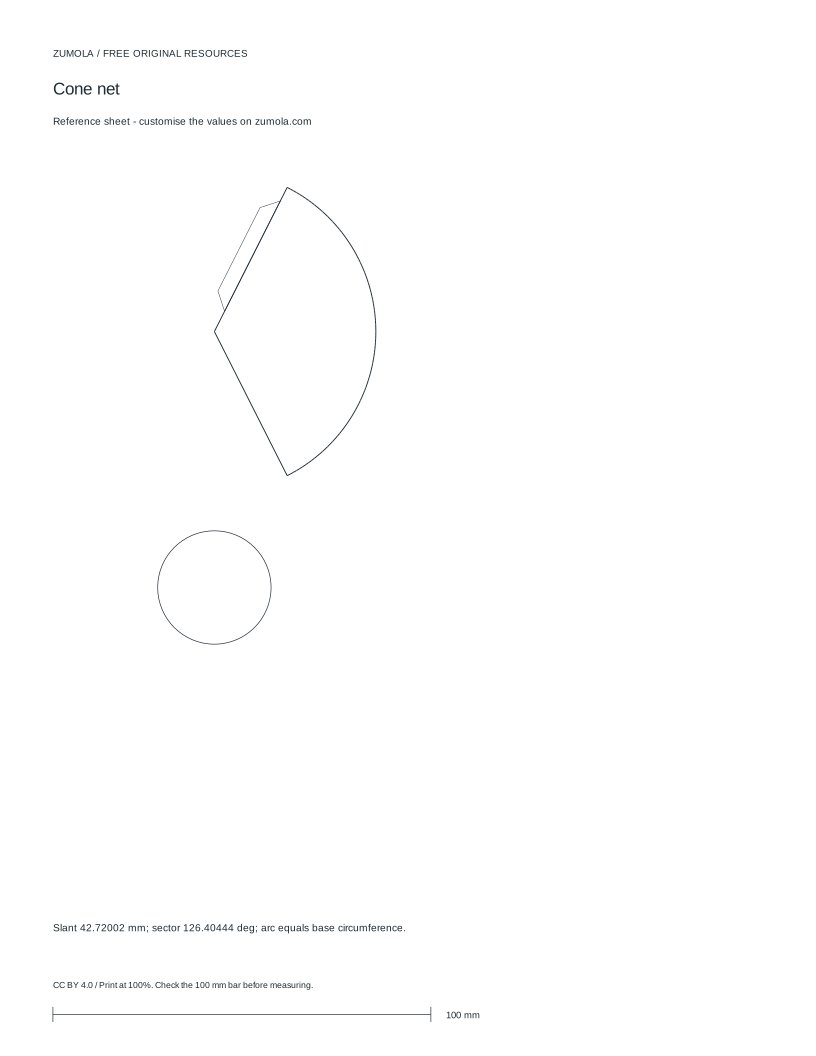
Practice worksheet
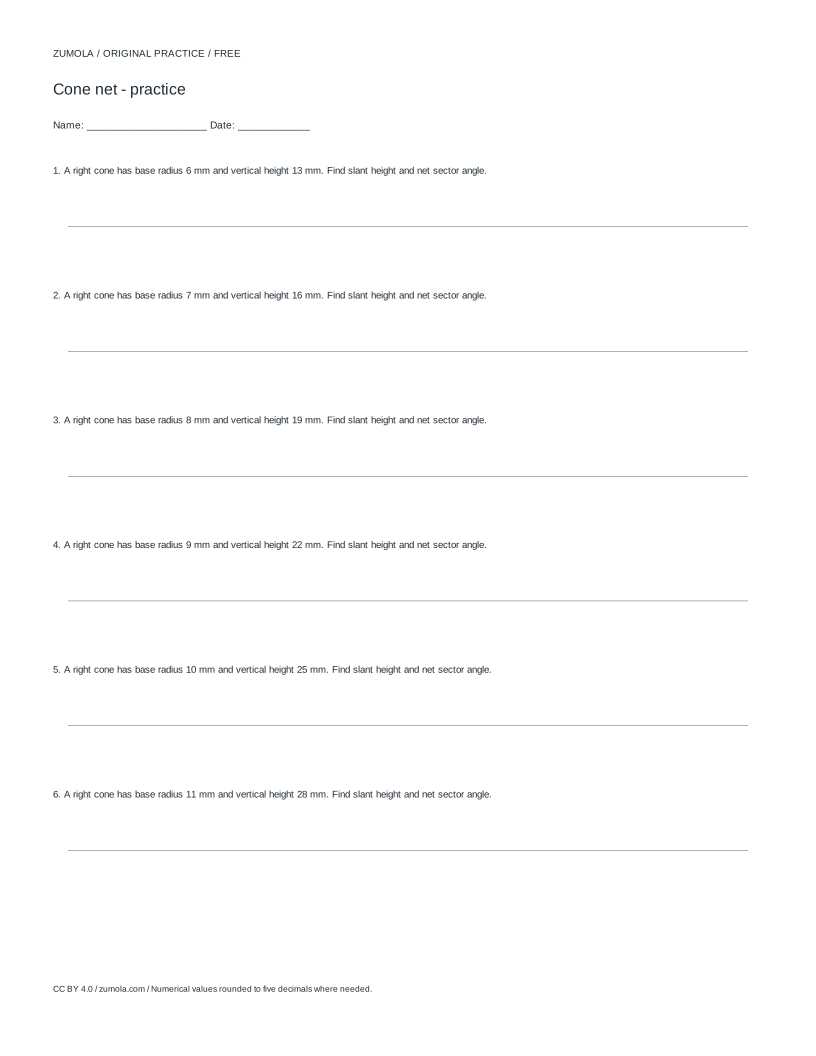
Worked answers / rubric
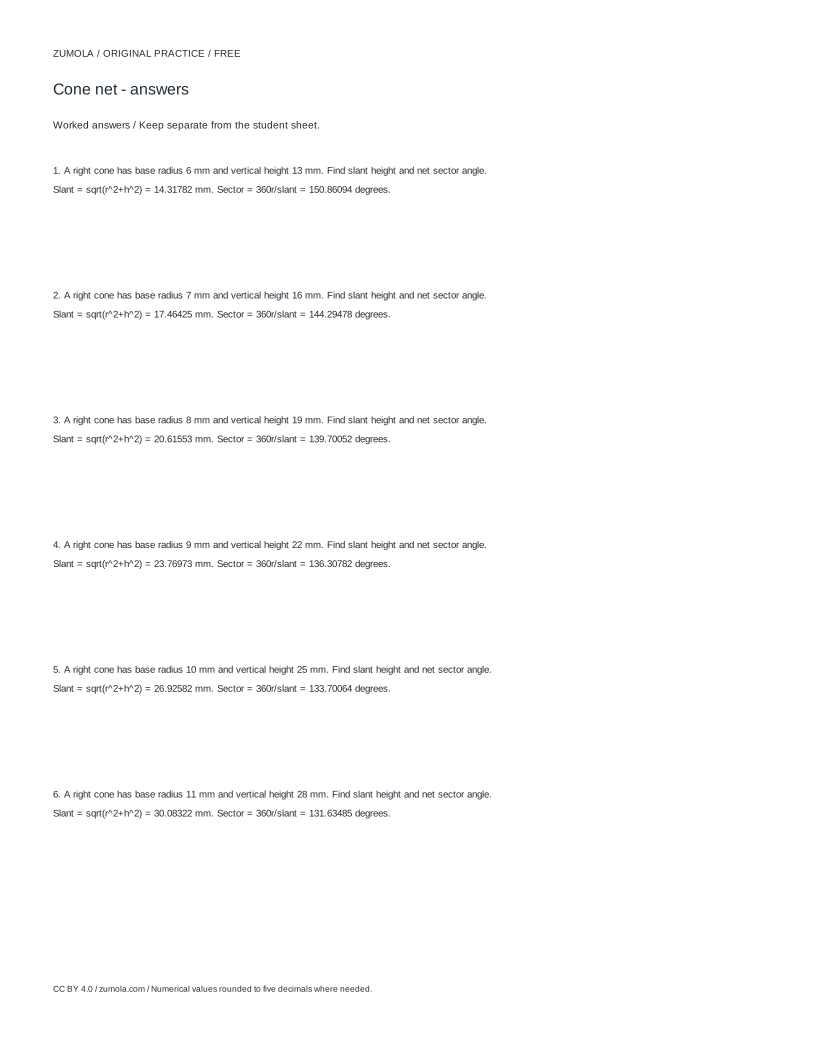
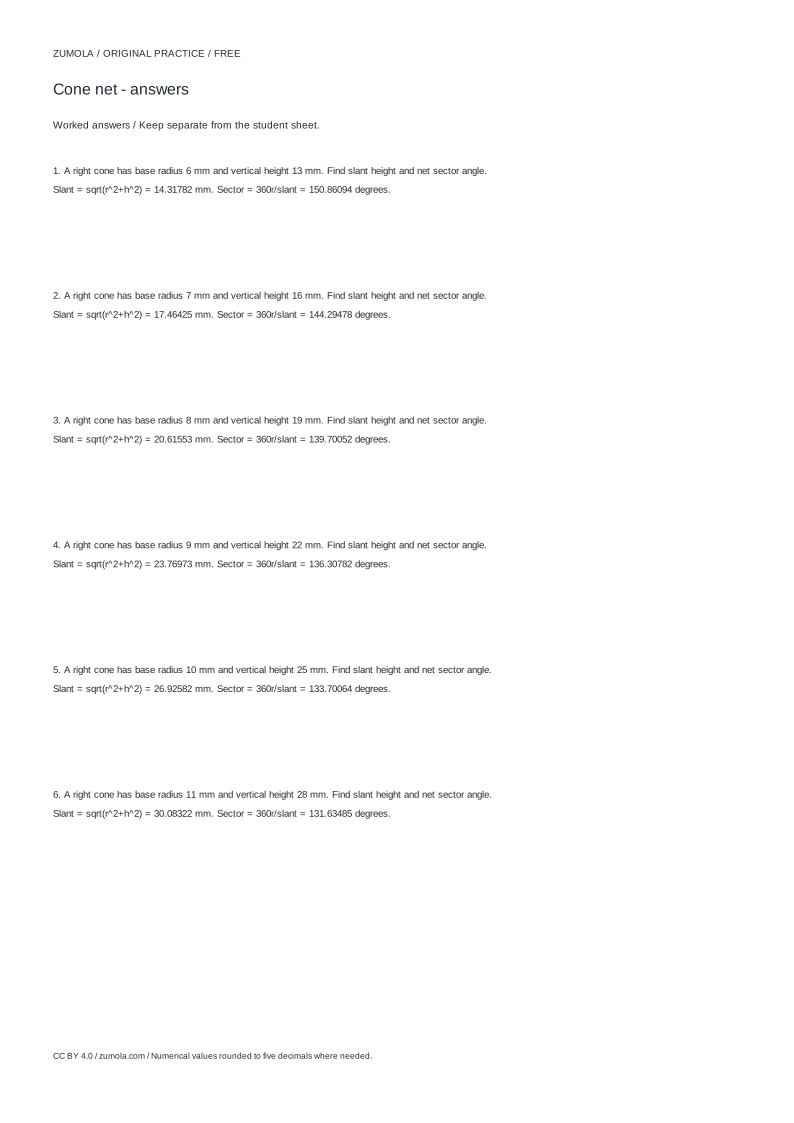
Print at Actual size / 100%. Check the calibration bar before using physical dimensions.
A cone net is a circular sector plus a base circle. To draw it accurately you need the slant height, which becomes the sector radius, and the sector angle, which wraps the arc to the base circumference. This page explains that method step by step, shows how to check the result, and gives a worked example using a 15 mm radius and 40 mm height.
From radius and height to the sector
Treat the cone as a right circular cone: the base is a flat circle of radius r, the apex sits directly above the centre, and the height h is measured perpendicular to the base. The slant height s is the straight distance from the apex to any point on the base rim. Because the height, the base radius and the slant form a right triangle, s = square root of (r squared plus h squared).
The curved surface unrolls into a circular sector whose radius equals s. The arc of that sector must equal the base circumference, 2 times pi times r. A full circle of radius s has circumference 2 times pi times s, so the sector angle in degrees is 360 times r divided by s. Equivalently, arc length divided by s gives the angle in radians.
The net therefore has two parts: the sector, drawn with radius s and the computed angle, and a separate base circle of radius r. The sector's straight edges are the two seams that meet when the cone is formed, and the arc becomes the base rim.
- Measure or choose the base radius r and the perpendicular height h in the same unit, for example millimetres.
- Compute the slant height: s = square root of (r squared plus h squared).
- Compute the base circumference: C = 2 times pi times r.
- Compute the sector angle: angle = 360 times r divided by s degrees.
- Draw the sector with radius s and that angle, then draw the base circle with radius r.
- Check that the sector arc length equals C before cutting.
Checking the net before you cut
Two checks catch most errors. First, the arc length of the drawn sector should match the base circumference. If you measured the sector angle with a protractor, small drawing errors shift the arc; compare the arc length to C and adjust the angle rather than the radius. Second, the outline must close: the sector's two straight edges and its arc form one continuous boundary, and the base circle is a separate closed shape.
The triangle condition matters too. The slant height must be longer than the base radius whenever the height is greater than zero, because s squared equals r squared plus h squared. If a calculation gives s equal to or smaller than r, the inputs or arithmetic are wrong. Also confirm the whole net fits the sheet: the sector spans at most 2s across, and the base circle needs 2r, so plan placement before drawing.
Keep units consistent. Mixing centimetres and millimetres changes every length by a factor of ten and produces a net that looks plausible but is the wrong size.
- Recompute s from r and h and compare with the value used to draw the sector.
- Multiply the sector angle by pi, divide by 180, and multiply by s to get arc length; compare with 2 times pi times r.
- Trace the sector boundary once to confirm it closes with no gap or overlap.
- Confirm the sector and base circle both fit inside the sheet with room for a glue tab.
Adding a tab and assembling
A glue tab is a narrow strip added along one straight edge of the sector, not along the arc. The arc becomes the base rim, so a tab there would interfere with joining the base. Add the tab to one radial edge and fold it inward before gluing the two radial edges together.
The base circle joins to the arc. A small tab around part of the base circle, or a tab along the arc, gives a surface to glue, but keep the tab narrow so it does not distort the rim. Score fold lines lightly before bending.
Artistic construction is not clinical anatomy: a paper cone is a geometric model, and its proportions follow the formulas above rather than any anatomical standard.
- Add a narrow tab along one radial edge of the sector and fold it.
- Bring the two radial edges together so the arc forms the rim, then glue.
- Attach the base circle to the rim, aligning the circumference carefully.
- Let the glue set before checking that the cone stands flat.
Worked example: r = 15 mm, h = 40 mm
With r = 15 and h = 40, r squared is 225 and h squared is 1600, so s squared is 1825 and s is about 42.72 mm. The base circumference is 2 times pi times 15, about 94.25 mm. The sector angle is 360 times 15 divided by 42.72, about 126.4 degrees.
Check the arc: 126.4 degrees in radians is about 2.206, and 2.206 times 42.72 is about 94.25 mm, matching the base circumference. The sector radius, 42.72 mm, is greater than the base radius, 15 mm, so the triangle condition holds.
Draw a sector of radius about 42.72 mm and angle about 126.4 degrees, add a base circle of radius 15 mm, and include a narrow tab on one radial edge.
- Square 15 to get 225 and 40 to get 1600; add to get 1825.
- Take the square root of 1825 to get s, about 42.72 mm.
- Compute 2 times pi times 15, about 94.25 mm, for the base circumference.
- Compute 360 times 15 divided by 42.72, about 126.4 degrees, for the sector angle.
- Verify arc length: about 2.206 radians times 42.72 mm is about 94.25 mm.
Printing at the right size
Print physical sheets at 100 percent only after checking a calibration bar, because scaling changes every dimension. Measure the printed bar against its stated length; if it is off, adjust the print settings rather than the template numbers.
Numbers shown in schematic math charts are abstract coordinate units, not physical lengths. Only the stated millimetre values describe the paper model.
- Print a calibration bar and measure it with a ruler.
- Confirm the print scale is 100 percent before printing the net.
- Measure the printed sector radius and base radius to confirm they match the intended values.
Try this example
Find the slant height, sector angle and arc length for a cone with base radius 15 mm and height 40 mm, then state the net parts.
Show the worked explanation
s = square root of (225 plus 1600) = square root of 1825, about 42.72 mm. Base circumference = 2 times pi times 15, about 94.25 mm. Sector angle = 360 times 15 divided by 42.72, about 126.4 degrees. Arc length = about 2.206 radians times 42.72 mm, about 94.25 mm, matching the base circumference. The net is a sector of radius about 42.72 mm and angle about 126.4 degrees plus a base circle of radius 15 mm, with a narrow tab on one radial edge.
Common mistakes
- Using the height as the sector radius instead of the slant height. Compute s = square root of (r squared plus h squared) and use s as the sector radius.
- Placing the glue tab along the arc. Put the tab on one radial edge so the arc stays clear for joining the base.
- Mixing units, such as radius in centimetres and height in millimetres. Convert both inputs to the same unit before calculating s, the circumference and the angle.
Check your work
- Slant height computed as the square root of r squared plus h squared, not copied from h.
- Sector angle computed as 360 times r divided by s and stated in degrees.
- Arc length checked against 2 times pi times r within a small drawing tolerance.
- Sector boundary traced as one closed outline with no gap or overlap.
- Glue tab placed on a radial edge, not on the arc.
- Base circle drawn separately with radius r and aligned to the arc rim.
- All lengths use one consistent unit, and the net fits the sheet.
Questions before you start
Why is the sector angle less than 360 degrees?
The sector arc must equal the base circumference, which is shorter than the full circle of radius s, so the angle is 360 times r divided by s, always less than 360 when h is greater than zero.
How do I check the net is correct before cutting?
Compare the sector arc length with 2 times pi times r, confirm the sector boundary closes, and check that s is greater than r.
Can I use any units?
Yes, provided radius and height share the same unit. The angle is unitless, while s and the circumference carry that unit.