Free original resources
Triangle Template Printable: Build Valid Triangles from Three Sides
Create a triangle template from three side lengths. Check the triangle inequality, compute height and angles, and print at 100% after verifying a calibration bar.
Free resources
Letter & A4
PDF & SVG
Letter & A4
PDF & SVG
Make it yours.
Free · no signup · calculated in your browser
Your free printable kit.
Original reference, student practice and separate worked answers. No account or payment.
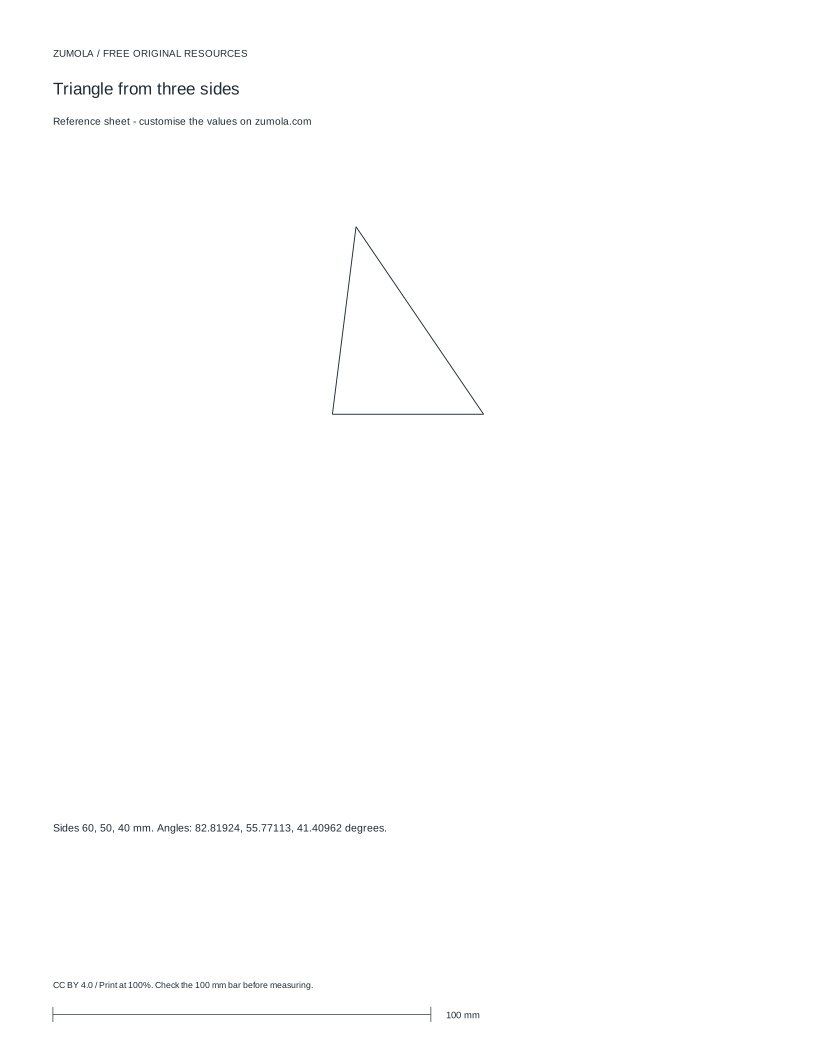
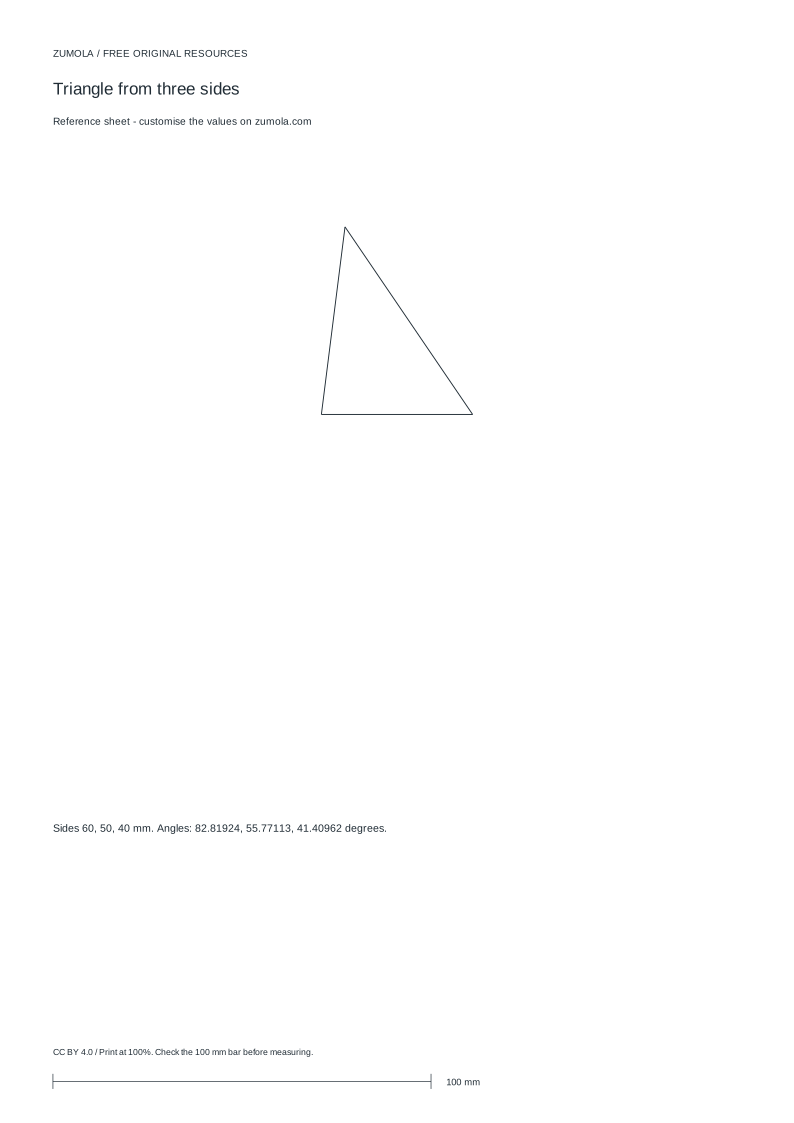
Practice worksheet
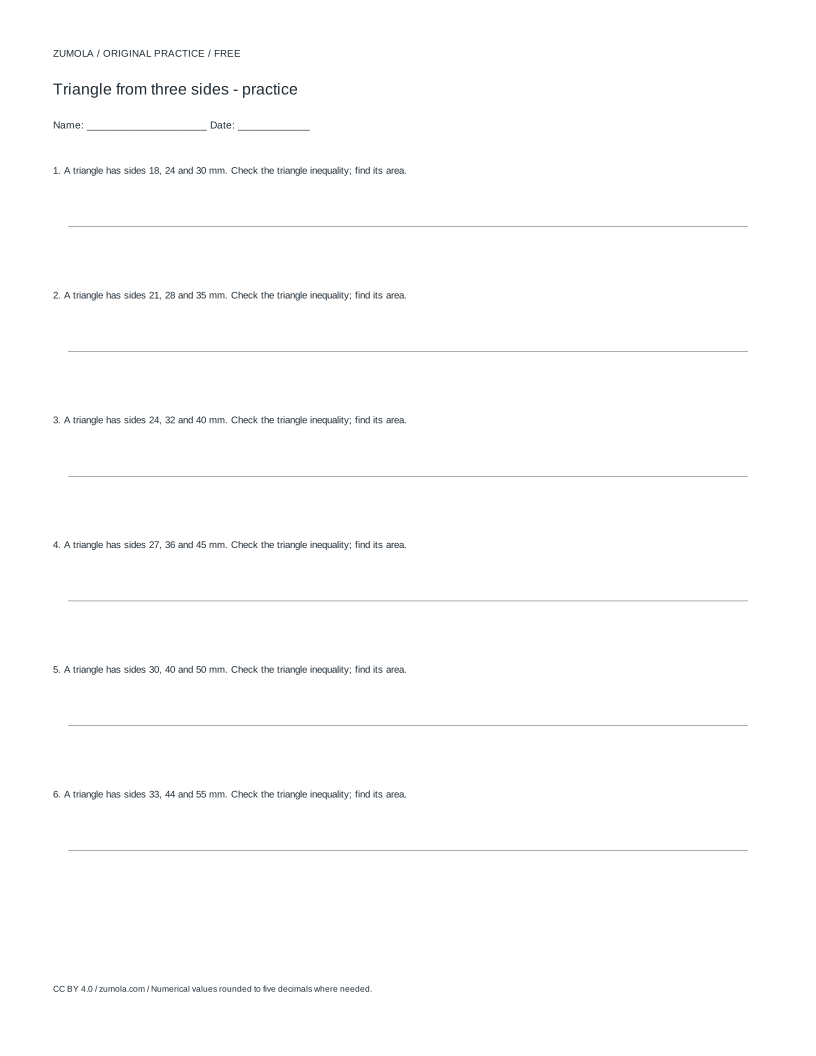
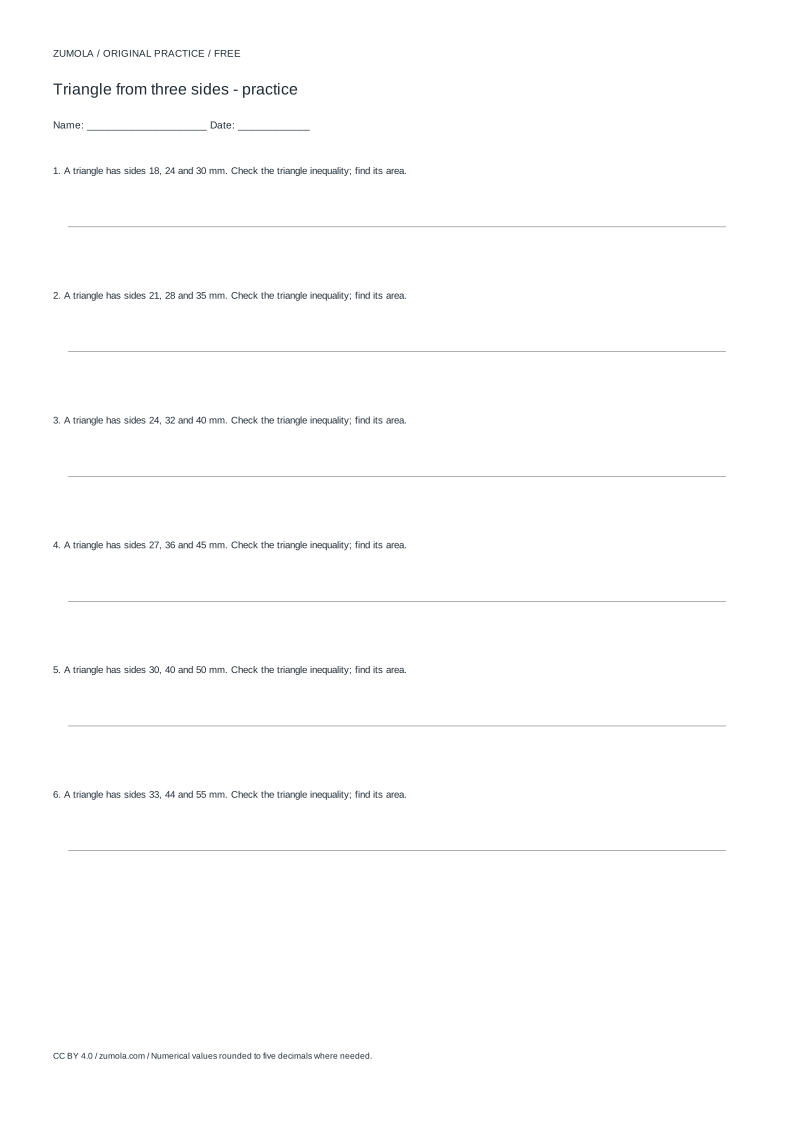
Worked answers / rubric
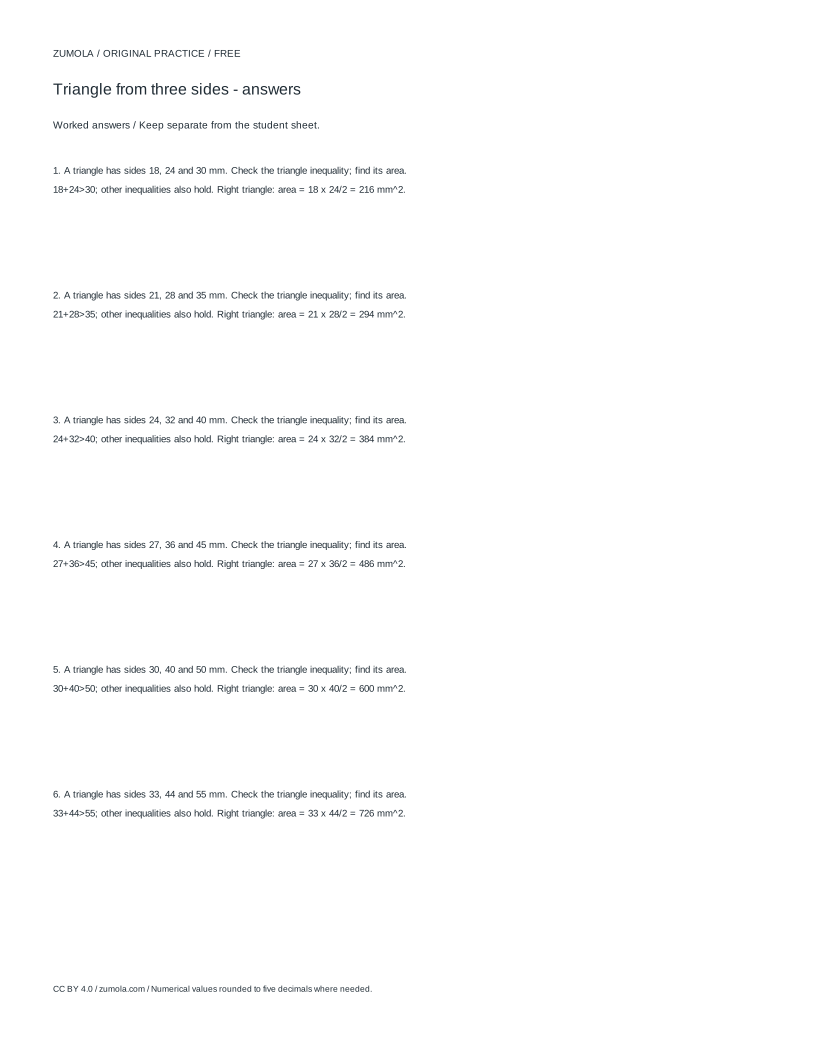
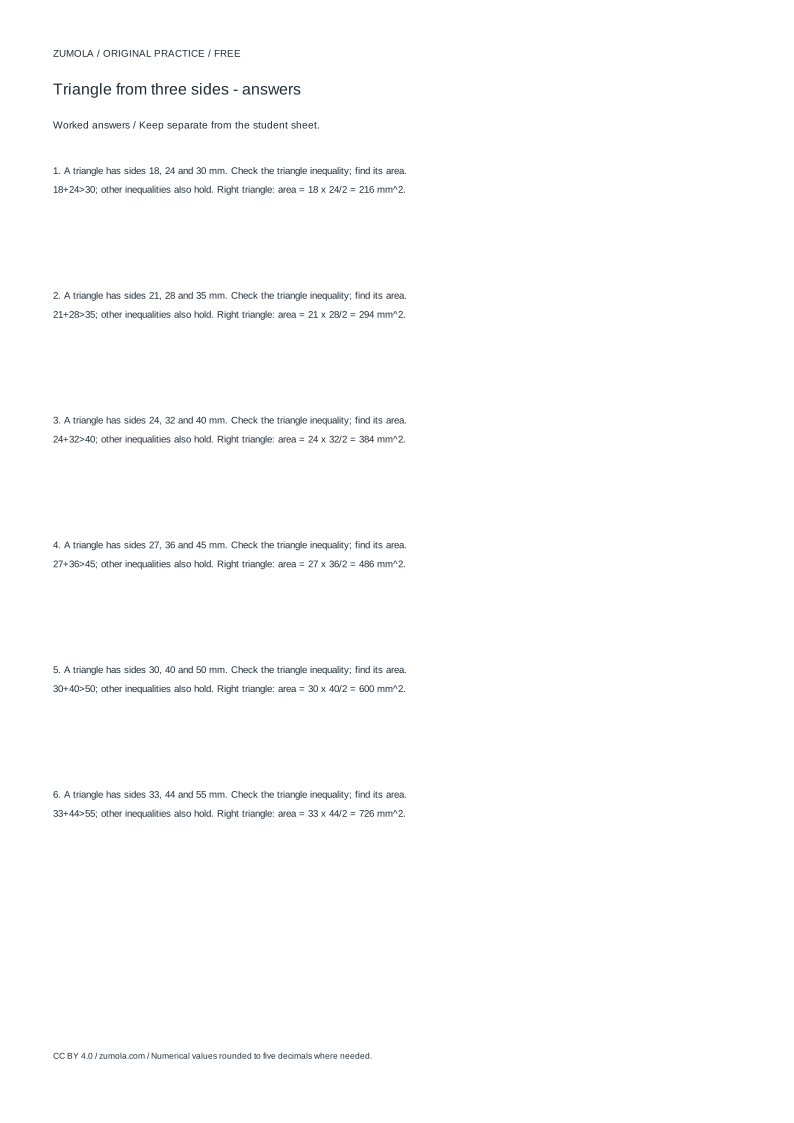
Print at Actual size / 100%. Check the calibration bar before using physical dimensions.
A triangle template is only useful if the three side lengths can actually form a closed triangle. This page explains the triangle inequality, how to derive height and angles from three sides, and how to lay out a printable template with a paste flap. You will also see how to reject impossible inputs before any paper is used. The method is geometric, not artistic, and every numerical example can be checked independently.
Check the triangle inequality before drawing
For any triangle with side lengths a, b, and c, each side must be shorter than the sum of the other two. Equivalently, the largest side must be less than the sum of the two smaller sides. If the largest side equals the sum, the three points lie on a straight line and the shape is degenerate, not a triangle. If the largest side is greater, no closed triangle exists.
Use the same unit for all three sides. Millimetres are convenient for printable templates because they avoid fractional inches. Before computing anything else, sort the sides so the largest is easy to identify. For sides 60 mm, 50 mm, and 40 mm, the largest is 60 mm and 50 + 40 = 90 mm, so 60 < 90 and the triangle is valid. A set such as 80 mm, 30 mm, and 40 mm fails because 80 > 30 + 40.
- Record the three side lengths in one unit, preferably millimetres.
- Identify the largest side.
- Add the two smaller sides.
- Reject the input if the largest side is greater than or equal to that sum.
- Proceed only when the largest side is strictly less than the sum.
Derive height, area, and angles from three sides
Once the sides are valid, the height relative to a chosen base can be found without drawing. Choose the base as side c. Heron's formula gives the area from the semiperimeter s = (a + b + c) / 2. For 60 mm, 50 mm, and 40 mm, s = 75 mm. The area is the square root of s(s − a)(s − b)(s − c), which is the square root of 75 × 15 × 25 × 35. That product is 984375, and its square root is about 992.16 mm². The height to base c is 2 × area / c, giving about 49.61 mm.
Angles follow from the law of cosines. The angle opposite side a satisfies cos A = (b² + c² − a²) / (2bc). With a = 60, b = 50, c = 40, cos A = (2500 + 1600 − 3600) / 4000 = 0.125, so A is about 82.82°. The other angles are about 55.77° and 41.41°, and they sum to 180° within rounding. These values describe the geometric triangle; they do not by themselves specify a printable layout.
- Compute the semiperimeter s = (a + b + c) / 2.
- Compute area with Heron's formula.
- Choose a base and compute height = 2 × area / base.
- Use the law of cosines for each angle.
- Check that the three angles sum to 180° within rounding.
Lay out a printable template with a paste flap
A printable triangle template needs a closed outline and, if it will be folded into a model, a paste flap along one edge. Draw the base at its true length, then mark the height perpendicular to the base at the correct position. The apex lies where the two remaining sides meet. Because the height alone does not locate the apex along the base, use the side lengths or angles to place it. A simple construction is to draw side c as the base, then draw arcs of radius a and b from the two endpoints; their intersection is the apex.
Add a paste flap outside one edge, not inside the triangle, so the finished face keeps its intended size. The flap width is a layout choice, not a geometric property of the triangle. Before printing, include a calibration bar of known length and measure it after printing. Print at 100% only after the bar measures correctly; scaling to fit a page changes every side length. If the required triangle does not fit the paper at true size, reject that size rather than shrinking it silently.
- Draw the base at true length.
- From each base endpoint, draw an arc with the adjacent side length.
- Mark the arc intersection as the apex and connect the three vertices.
- Add a paste flap outside one edge if the template will be folded.
- Print at 100% only after checking a calibration bar.
Try this example
A template uses sides 60 mm, 50 mm, and 40 mm. Check validity, compute the area and the height to the 40 mm base, and state one angle.
Show the worked explanation
The largest side is 60 mm and 50 + 40 = 90 mm, so 60 < 90 and the triangle is valid. The semiperimeter is 75 mm. Heron's product is 75 × 15 × 25 × 35 = 984375, so the area is about 992.16 mm². The height to the 40 mm base is 2 × 992.16 / 40, about 49.61 mm. The angle opposite the 60 mm side has cosine (50² + 40² − 60²) / (2 × 50 × 40) = 0.125, so it is about 82.82°.
Common mistakes
- Accepting a set where the largest side equals the sum of the other two. Treat equality as degenerate and reject it; require the largest side to be strictly less than the sum.
- Mixing units, such as two sides in centimetres and one in millimetres. Convert all three sides to the same unit before checking the inequality or computing height.
- Printing a template after a printer scales it to fit the page. Print at 100% and verify a calibration bar; if the true-size triangle does not fit, choose a smaller valid triangle instead of scaling.
Check your work
- The triangle inequality is checked with all sides in the same unit and equality is rejected.
- The area and height are derived from the three sides rather than assumed.
- The apex placement uses side lengths or angles, not height alone.
- Any paste flap is drawn outside the triangle outline.
- A calibration bar is checked before printing at 100%.
Questions before you start
Can any three positive lengths form a triangle?
No. The largest length must be strictly less than the sum of the other two. If it is equal or greater, no closed triangle exists.
Why does the height not fully determine the triangle?
Height fixes the perpendicular distance from apex to base but not where the apex sits along the base. Side lengths or angles are needed to place it.
Should the paste flap be included in the side length?
No. The flap is added outside the triangle outline. The three side lengths describe the finished triangular face, not the flap.