Free original resources
Heart Template Generator: Symmetric Cutouts and Fold Practice
Plan a symmetric heart cutout by width in millimetres, check the closed outline and fold line, and practise folding before cutting. Includes a rubric.
Free resources
Letter & A4
PDF & SVG
Letter & A4
PDF & SVG
Make it yours.
Free · no signup · calculated in your browser
Your free printable kit.
Original reference, student practice and separate worked answers. No account or payment.
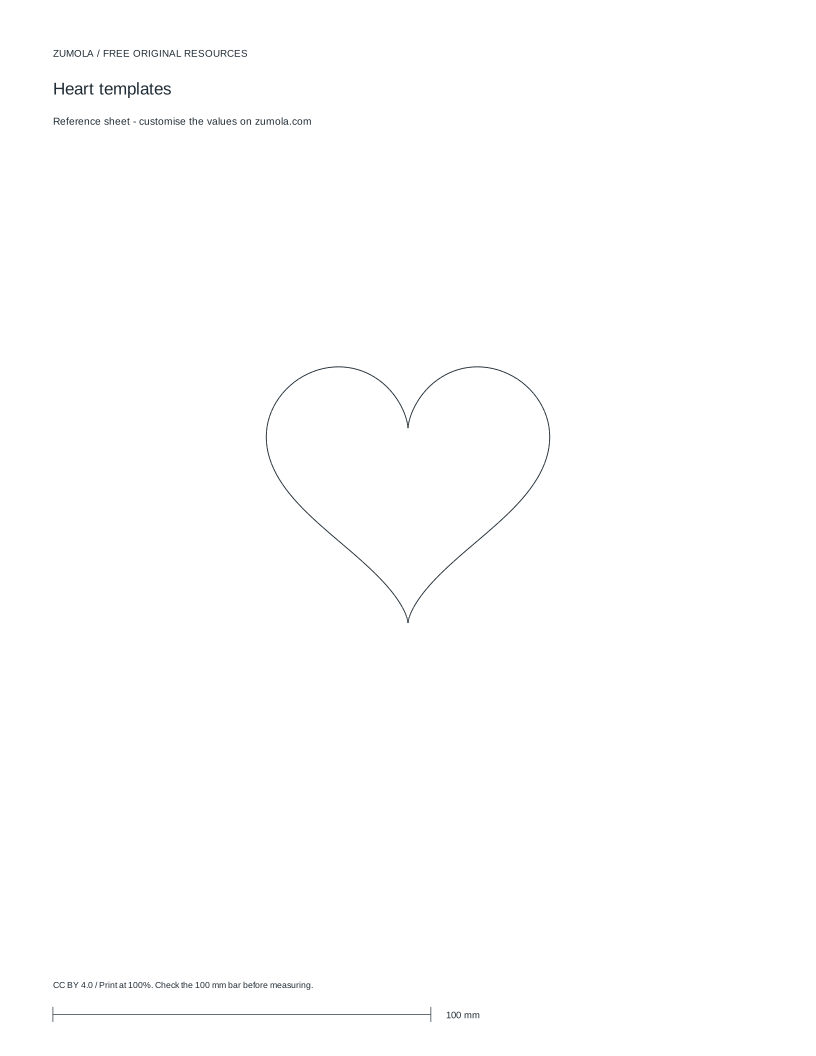
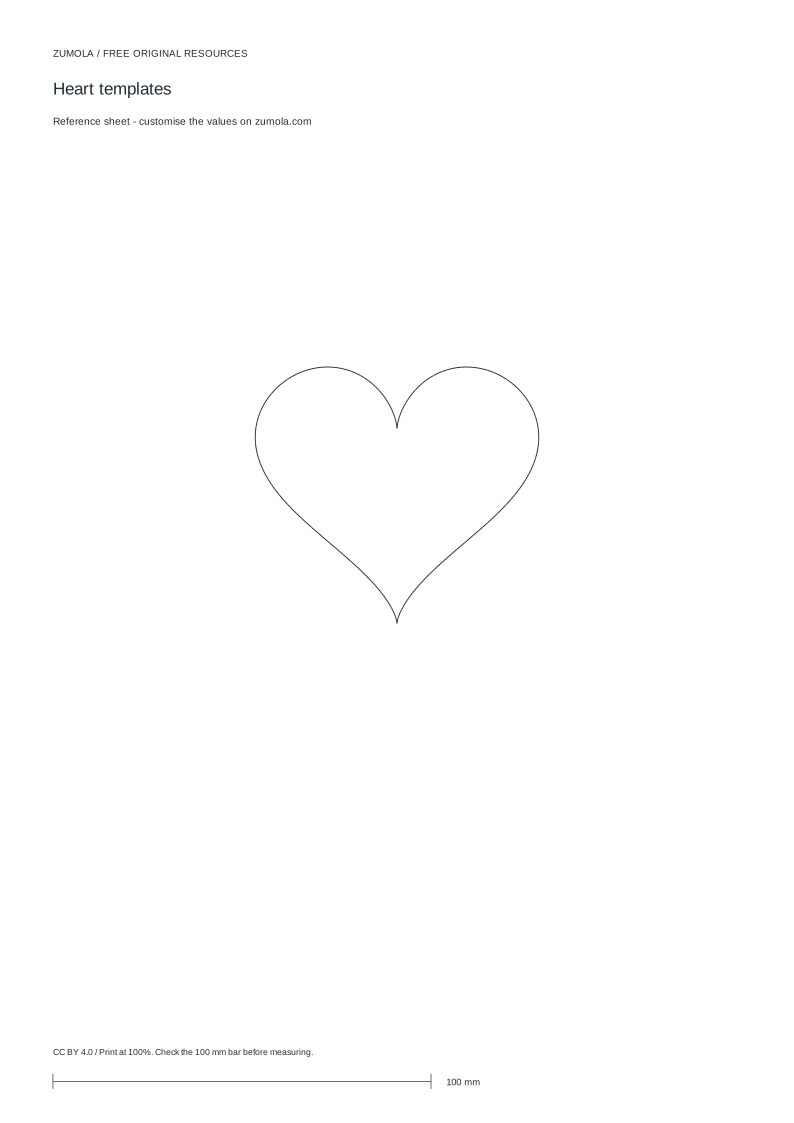
Practice worksheet
Worked answers / rubric
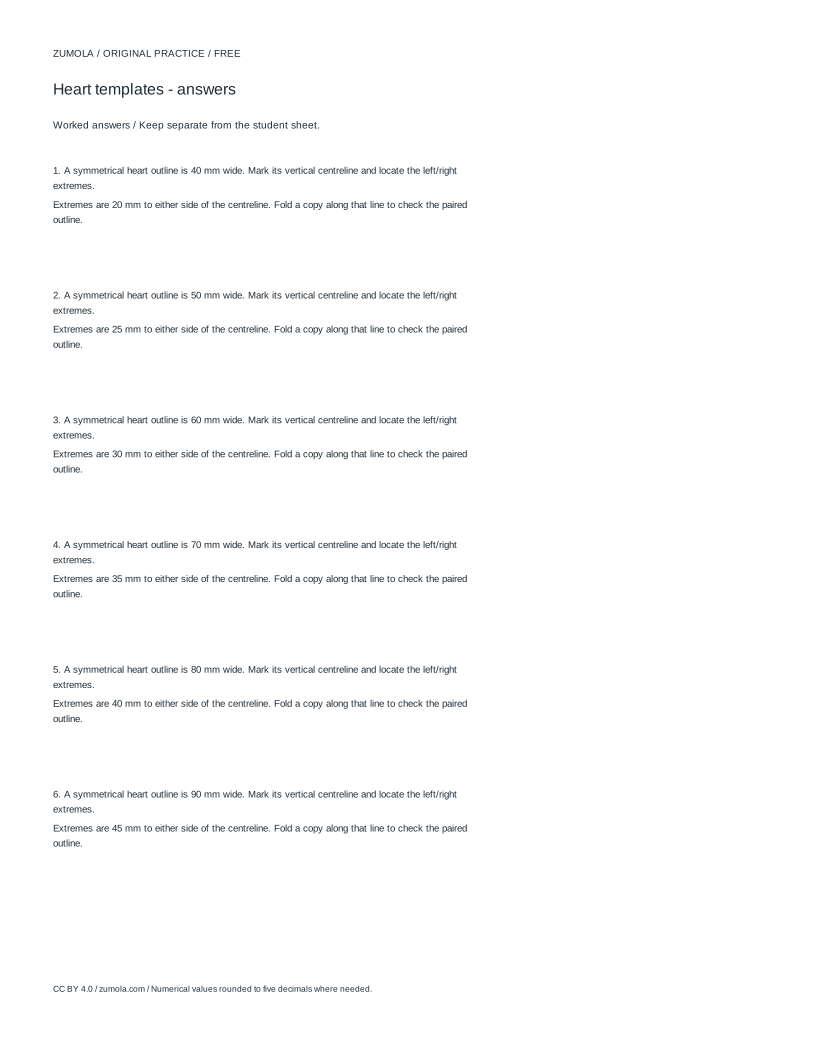
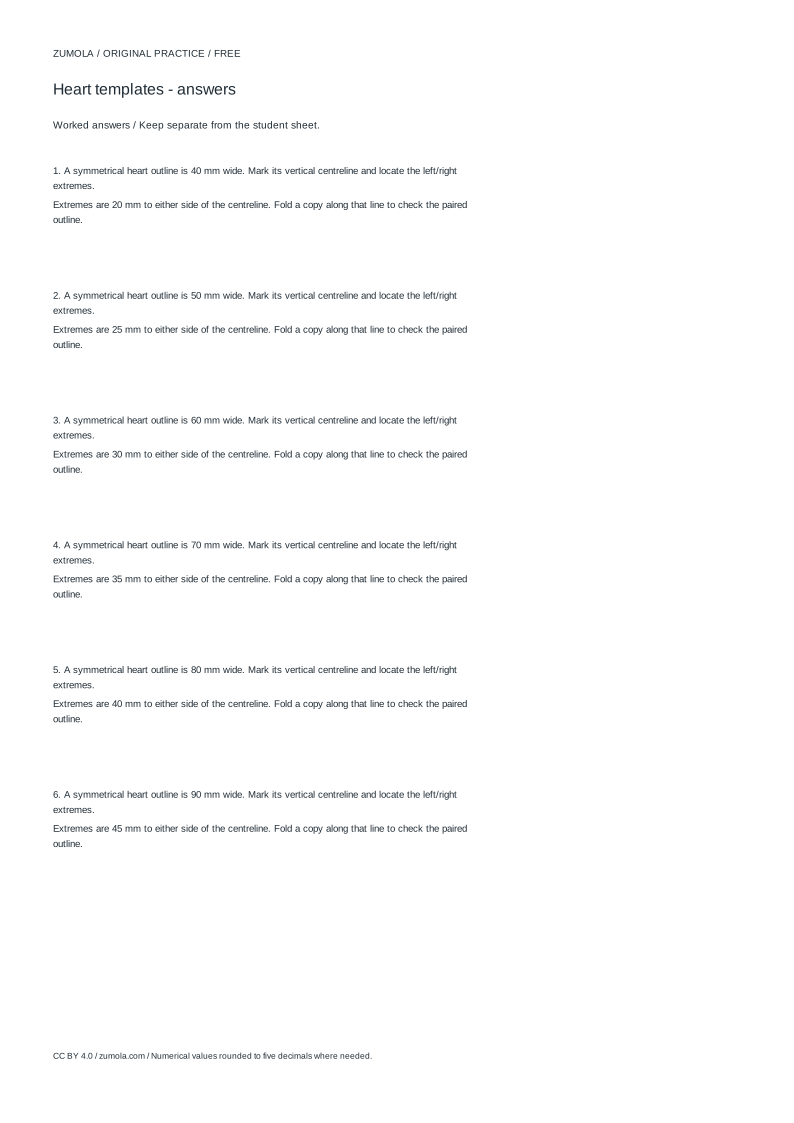
Print at Actual size / 100%. Check the calibration bar before using physical dimensions.
A heart template is easiest to trust when you can explain its geometry. This page shows how a symmetric heart outline is built from a chosen width, how to check that the outline closes, and how to use a fold line for mirror practice. Width is given in millimetres unless stated otherwise. The method below is conceptual: it describes the construction and the checks, not specific on-screen controls.
How a symmetric heart outline is constructed
Treat the heart as a mirror shape. Choose a width W in millimetres. The vertical centre line sits at W divided by 2, so a 75 mm heart has its centre line at 37.5 mm from either side. The two lobes are mirror images across that line, and the lower point lies on the same line.
A practical construction uses a closed path: start at the bottom point, curve up the left side, round the left lobe, dip into the centre notch, round the right lobe, and return down the right side to the bottom point. Every segment must meet the next at a shared point, otherwise the outline is open and cannot be cut as one piece.
The fold line is the vertical centre line. Folding along it should bring the left half onto the right half. If the halves do not align, the shape is not symmetric even if it looks heart-like.
- Decide the overall width W in millimetres and mark the centre line at W ÷ 2.
- Sketch one half only, from the bottom point up to the centre notch, keeping all curves on one side of the centre line.
- Mirror that half across the centre line so shared points meet exactly.
- Trace the full closed outline and confirm the start and end points coincide.
- Fold along the centre line and check that the two halves align before cutting.
Checking closure and the triangle condition
A closed outline means the last point equals the first point. In a heart, the bottom point is usually the natural start and finish. If the path ends a few millimetres away from where it began, the cut will leave a gap or a stray tab.
When you approximate curves with straight segments, each set of three consecutive points should satisfy the triangle inequality: the direct distance between the outer two points is no longer than the sum of the two segment lengths. If a middle point sits far off the line between its neighbours, the segment lengths will not add up and the outline will look kinked rather than smooth.
Keep units consistent. If width is 75 mm, all coordinates and segment lengths should be in millimetres. Mixing units is a common cause of an outline that appears closed on paper but is the wrong size.
- Mark the first and last point and compare them; they must match.
- Walk the outline and check each triple of points against the triangle inequality.
- Confirm every measurement uses the same unit, here millimetres.
- Reject any size whose outline cannot fit the paper you are using before printing.
Fold practice before cutting
Folding practice builds the habit of checking symmetry before scissors touch paper. Fold a plain sheet along a vertical line, draw half a heart against the fold, and cut through both layers. Unfolded, the result should be symmetric.
This is a construction exercise, not an anatomy lesson. A heart shape here is a decorative outline with two lobes and a lower point; it is not a diagram of a clinical organ. Multiple valid heart outlines exist, so judge the result with a rubric rather than expecting one exact answer.
Print physical sheets at 100% only after checking a calibration bar, so a 75 mm width on screen matches 75 mm on paper.
- Fold the sheet along a vertical line and press the crease firmly.
- Draw half the heart with its straight edge on the fold.
- Cut through both layers, keeping the fold intact.
- Unfold and compare the halves; adjust the drawing if they differ.
Sizes that do not fit
A heart wider than the printable area cannot be produced at full size on that sheet. Rather than shrinking silently, reject the size and choose a smaller width or a larger sheet. The same rule applies to other folded constructions: a rectangular box, cone, or cylinder each uses its own unfolding formula, and a size whose net exceeds the paper must be refused.
State the paper dimensions and the requested width explicitly so the fit check is verifiable. For example, a 75 mm heart needs at least 75 mm of usable width plus any margin you require.
- Record the usable paper width and height.
- Compare the requested heart width plus margins against the usable width.
- If it exceeds the paper, reject the size and choose a smaller width.
Worked check
A 75 mm heart has a centre line at 37.5 mm. If the left lobe reaches 30 mm from the centre line, the right lobe must also reach 30 mm, giving a total width of 60 mm at that height, which is within 75 mm. The bottom point sits on the centre line. Folding along 37.5 mm should align both halves.
Try this example
A 75 mm wide symmetric heart is drawn with its centre line at 37.5 mm. The left lobe reaches 30 mm from the centre line. What total width does that lobe pair span, and does it fit within 75 mm?
Show the worked explanation
Each lobe reaches 30 mm from the centre line, so the pair spans 30 + 30 = 60 mm. Since 60 mm is less than 75 mm, the lobe pair fits within the chosen width. The bottom point lies on the centre line at 37.5 mm, and folding along that line should align the halves.
Common mistakes
- Drawing both halves separately and hoping they match. Draw one half against the fold line, then mirror or cut through the fold so shared points meet exactly.
- Leaving the outline open at the bottom point. Check that the final point equals the first point before cutting.
- Requesting a width larger than the usable paper. Compare width plus margins to the paper size and reject sizes that do not fit.
Check your work
- The outline is closed, with the final point equal to the first point.
- The two halves are mirror images across the vertical centre line.
- All measurements use the same unit, millimetres in this example.
- The requested width plus margins fits within the usable paper.
- The fold line is marked and the folded halves align.
- The result is judged as a decorative outline, not clinical anatomy.
Questions before you start
What width does the heart use?
Width is given in millimetres unless stated otherwise; the example uses 75 mm, with the centre line at 37.5 mm.
How do I know the outline is closed?
The last point must equal the first point. Walk the path and confirm the start and end coincide.
Is this a medical heart diagram?
No. It is a decorative symmetric outline for cutting and folding practice, not clinical anatomy.