Free original resources
Diamond Grid Paper: Rhombus Cells for Symmetry and Pattern Practice
Make diamond grid paper with rhombus cells, then practise symmetry, repetition and diagonal counting. Includes a worked example, common mistakes and a rubric.
Free resources
Letter & A4
PDF & SVG
Letter & A4
PDF & SVG
Make it yours.
Free · no signup · calculated in your browser
Your free printable kit.
Original reference, student practice and separate worked answers. No account or payment.
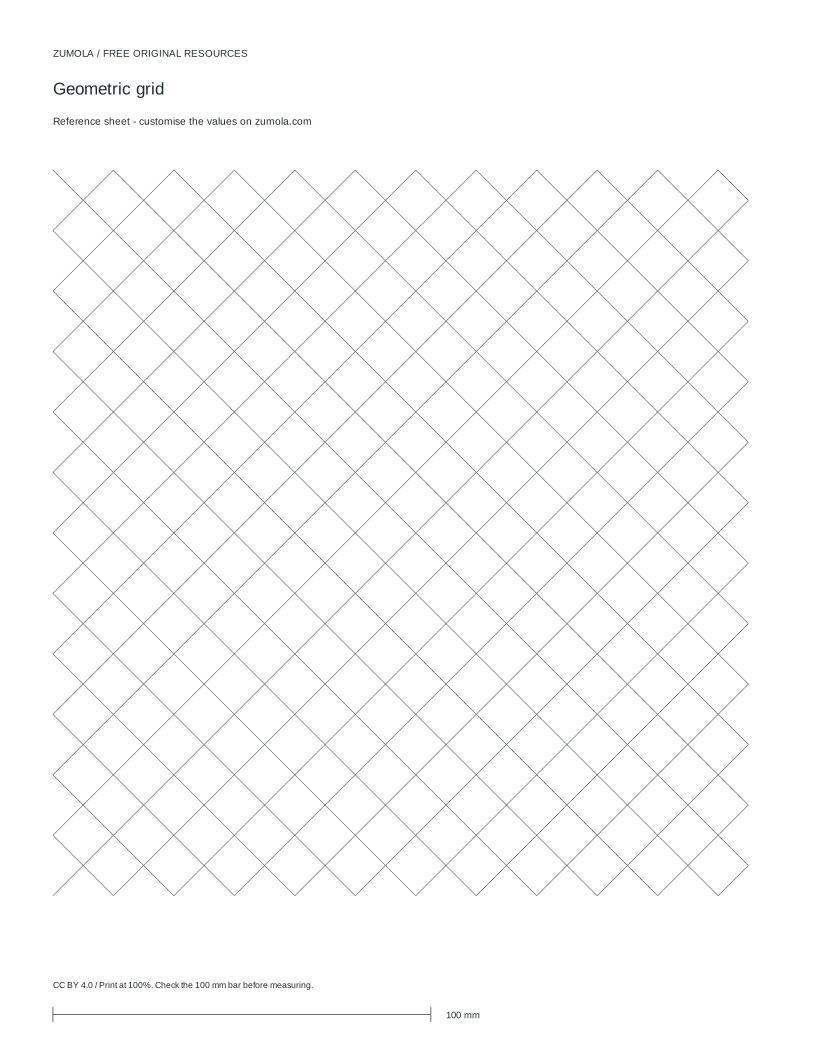
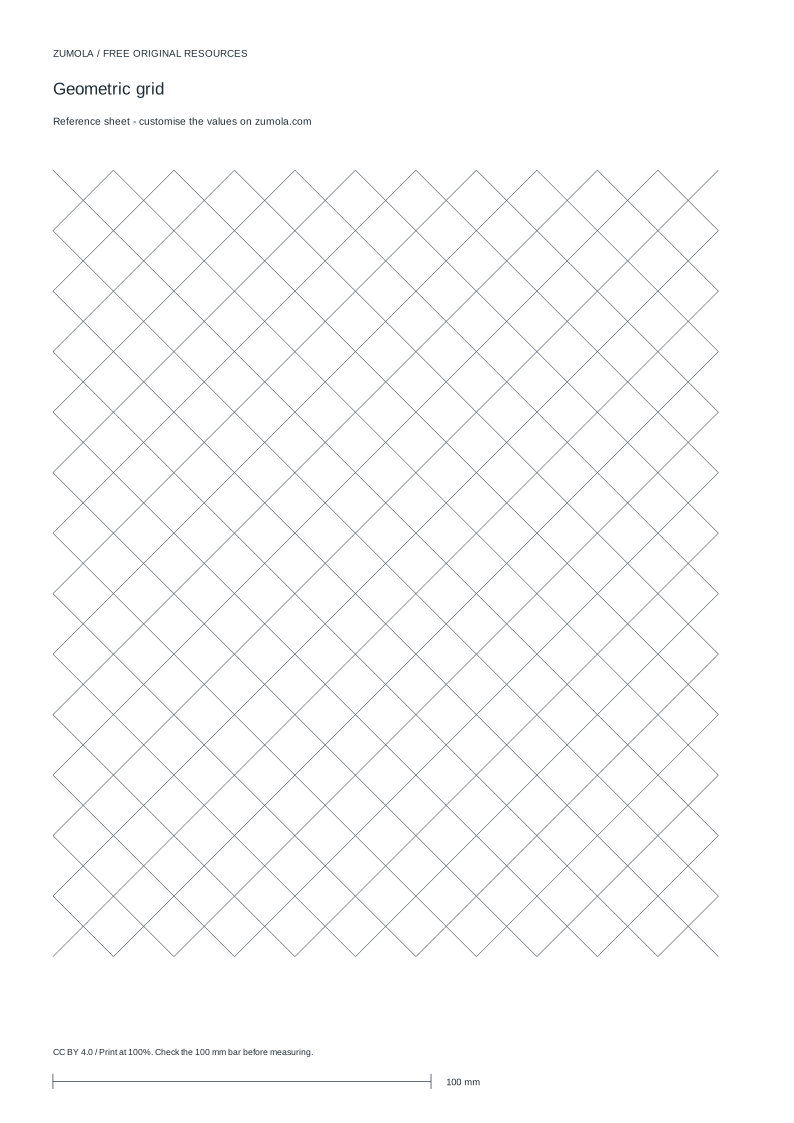
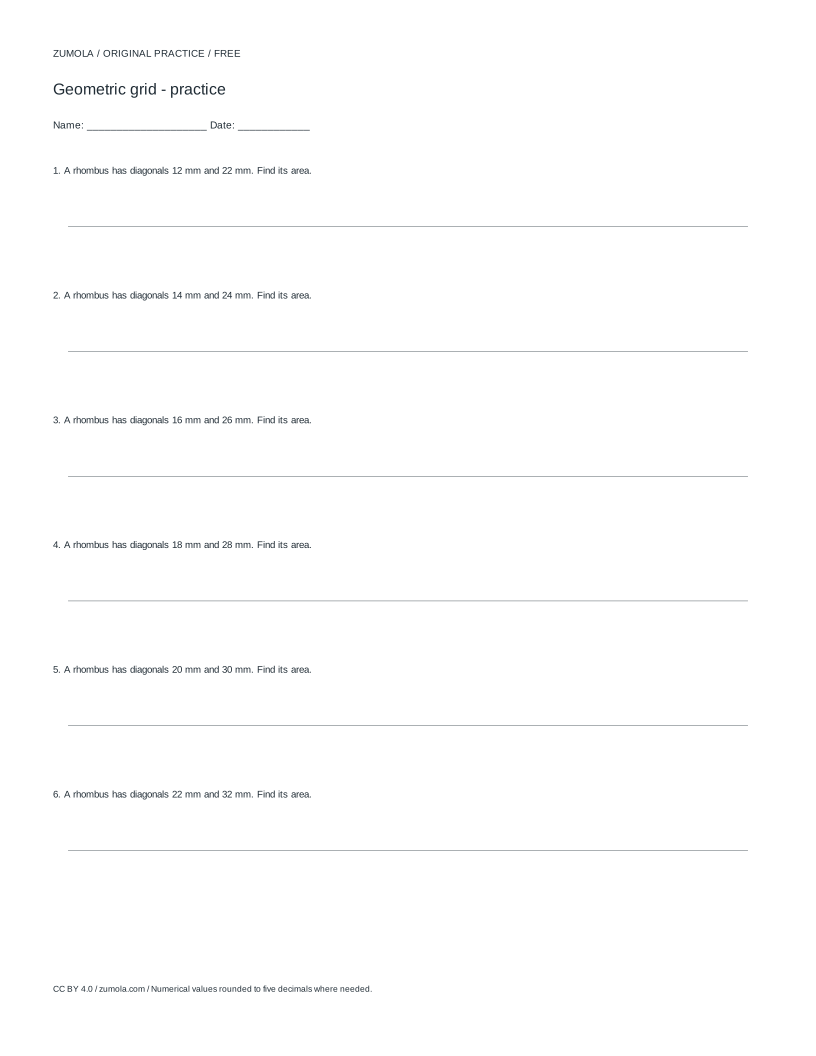
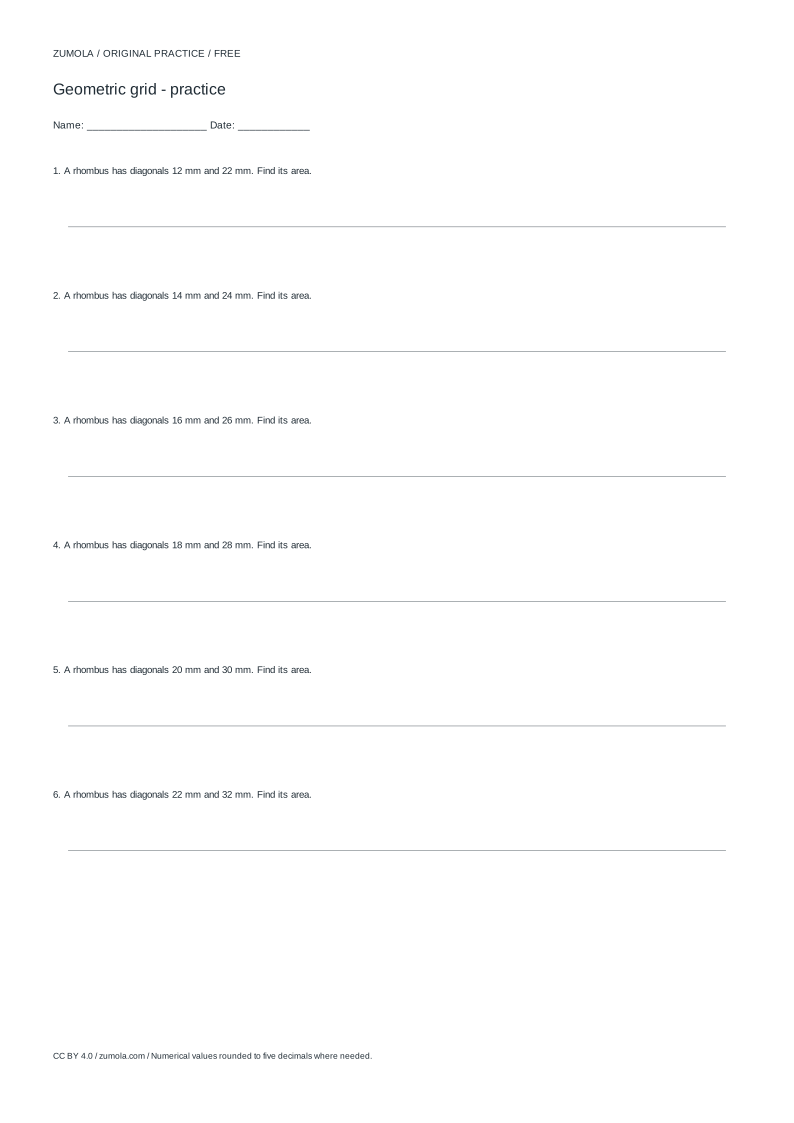
Practice worksheet
Worked answers / rubric
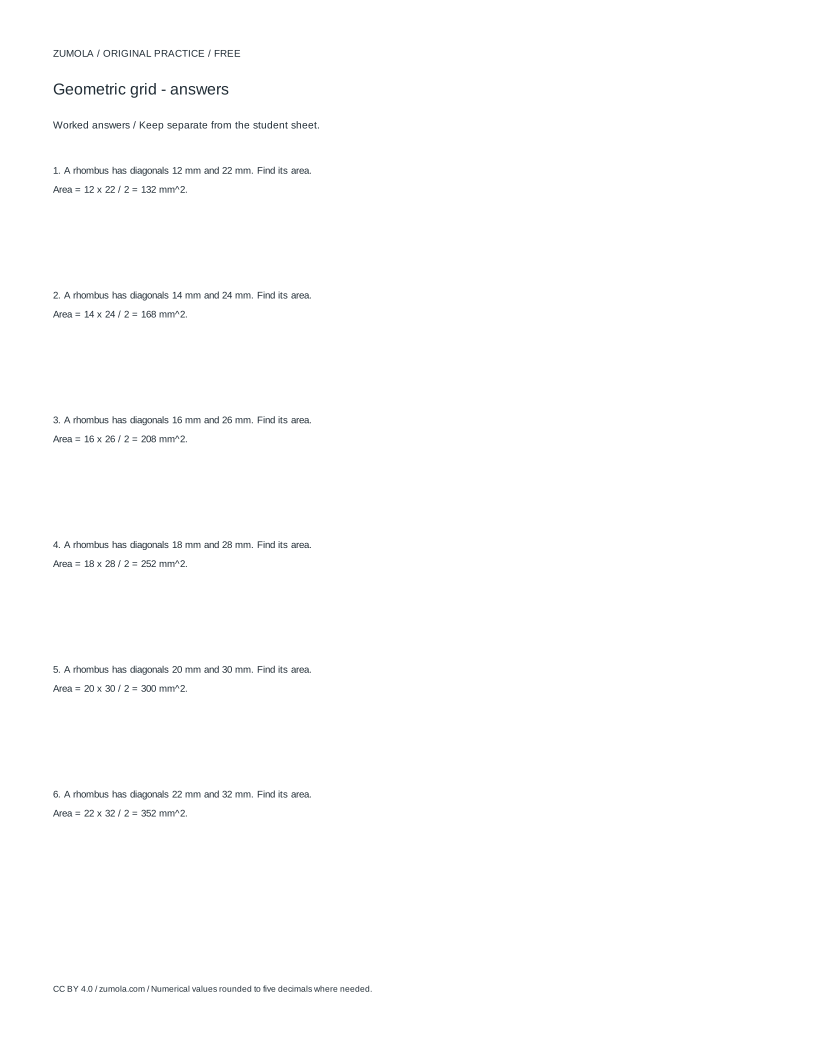
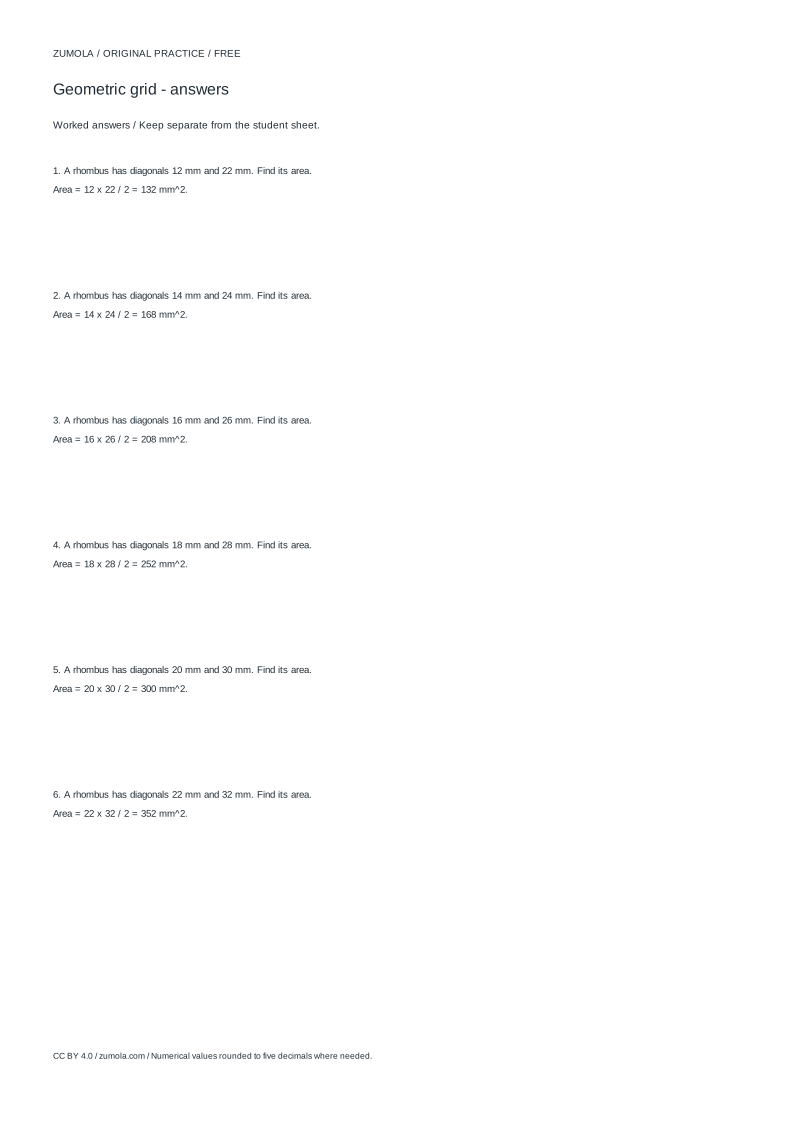
Print at Actual size / 100%. Check the calibration bar before using physical dimensions.
Diamond grid paper is ordinary graph paper turned so the cells read as rhombi. The cells are not squares unless the two diagonals are equal. This page explains how the grid is built, how to choose a diagonal ratio, and how to use the sheet for symmetry and repeating-pattern practice. It also shows a short worked example and a rubric you can apply to any finished pattern.
What a diamond grid actually is
A diamond grid is a visual orientation, not a separate kind of geometry. Each cell is a rhombus: four equal sides, with two diagonals that cross at right angles. The horizontal diagonal and the vertical diagonal can differ. When they are equal, the rhombus is a rotated square. When they differ, the cell is a non-square rhombus.
Width and height on a diamond grid refer to those diagonals, not to side lengths. Width is the horizontal diagonal; height is the vertical diagonal. A width of 16 mm and a height of 8 mm gives a diagonal ratio of 2. Each side is then the square root of 8 squared plus 4 squared, which is the square root of 80 mm, about 8.94 mm. Because the diagonals are unequal, the cell is not a square.
Two families of parallel lines make the grid. Each family is tilted from the horizontal, and the two families cross at 90 degrees. Tilting each family by 45 degrees in opposite directions still produces a 90-degree crossing between the line families. Describe the tilt of the lines, not a 45-degree crossing, to avoid confusion.
- Decide the diagonal ratio first: equal diagonals give rotated squares; unequal diagonals give stretched rhombi.
- Set width as the horizontal diagonal and height as the vertical diagonal, using the same physical unit for both.
- Check the side length with the Pythagorean relationship: side equals the square root of half-width squared plus half-height squared.
- Before printing, confirm the sheet is set to 100% and check a calibration bar with a ruler.
Using the grid for symmetry and repetition
Symmetry practice works well on rhombus cells because mirror lines can run along a diagonal, along a line family, or through cell centres. Ask learners to draw one motif, then reflect it across a chosen line and check that every vertex lands on a matching grid intersection. Rotational symmetry is also easy to test: rotate a motif by 180 degrees about a cell centre and see whether it maps onto itself.
Pattern repetition uses the grid as a counting frame. A motif can repeat every two cells horizontally and every three cells vertically, for example. Because the cells are rhombi, a step of one cell moves diagonally on the page, so counting must follow the grid lines rather than the page edges.
Keep the purpose clear: this is a drawing and geometry exercise, not an anatomy diagram. Decorative motifs and constructed shapes have many valid outcomes, so judge them with a rubric rather than looking for one exact answer.
- Mark the mirror line clearly before drawing the first motif.
- Draw the motif on grid intersections so reflections can be checked vertex by vertex.
- Record the repeat step as a number of cells in each grid direction.
- Compare the finished pattern with the rubric criteria rather than with a single model answer.
Choosing a ratio for the task
A ratio of 1 gives rotated squares and is the simplest choice for reflection work, because distances along both diagonals match. A ratio of 2 gives a noticeably elongated rhombus, useful when learners need to distinguish diagonal width from diagonal height. Very large ratios make cells thin and can make fine drawing awkward.
State the unit and the ratio on the sheet or in the task instructions. If a learner measures a cell and gets a side length rather than a diagonal, the ratio will appear wrong. Naming the measurement prevents that error.
- Write the width, height and unit at the top of the task.
- State whether the diagonals are equal or unequal.
- Choose a ratio that keeps cells large enough for the drawing tool being used.
Try this example
A learner sets a diamond grid with a horizontal diagonal of 16 mm and a vertical diagonal of 8 mm. Find the side length and state whether the cell is a square.
Show the worked explanation
Half of each diagonal is 8 mm and 4 mm. The side is the square root of 8 squared plus 4 squared, which is the square root of 80 mm, about 8.94 mm. The diagonals are unequal, so the rhombus is not a square.
Common mistakes
- Treating width and height as side lengths of the rhombus. Label them as the horizontal and vertical diagonals, and compute side length separately if needed.
- Calling the grid a 45-degree crossing because the line families are tilted 45 degrees. Say the line families are tilted 45 degrees from horizontal and cross each other at 90 degrees.
- Printing without checking scale, so measured diagonals do not match the stated millimetres. Print at 100% and verify a calibration bar with a ruler before using the sheet.
Check your work
- The mirror line or rotation centre is marked before drawing begins.
- Motif vertices sit on grid intersections so symmetry can be checked.
- The repeat step is stated in numbers of cells in each grid direction.
- Width and height are identified as diagonals, with the unit stated.
- The finished pattern is judged against the stated criteria, not against one exact answer.
Questions before you start
Is diamond grid paper the same as square graph paper?
Only when the two diagonals are equal, which makes each rhombus a rotated square. Unequal diagonals produce non-square rhombi.
What does a width-to-height ratio of 2 mean?
The horizontal diagonal is twice the vertical diagonal. For 16 mm and 8 mm, each side is about 8.94 mm, so the cell is not a square.
How should I check a finished symmetry pattern?
Use a rubric: correct mirror line, vertices on grid intersections, consistent repeat step, and a clear match between the original and its reflection.