Free printable resources · Original practice
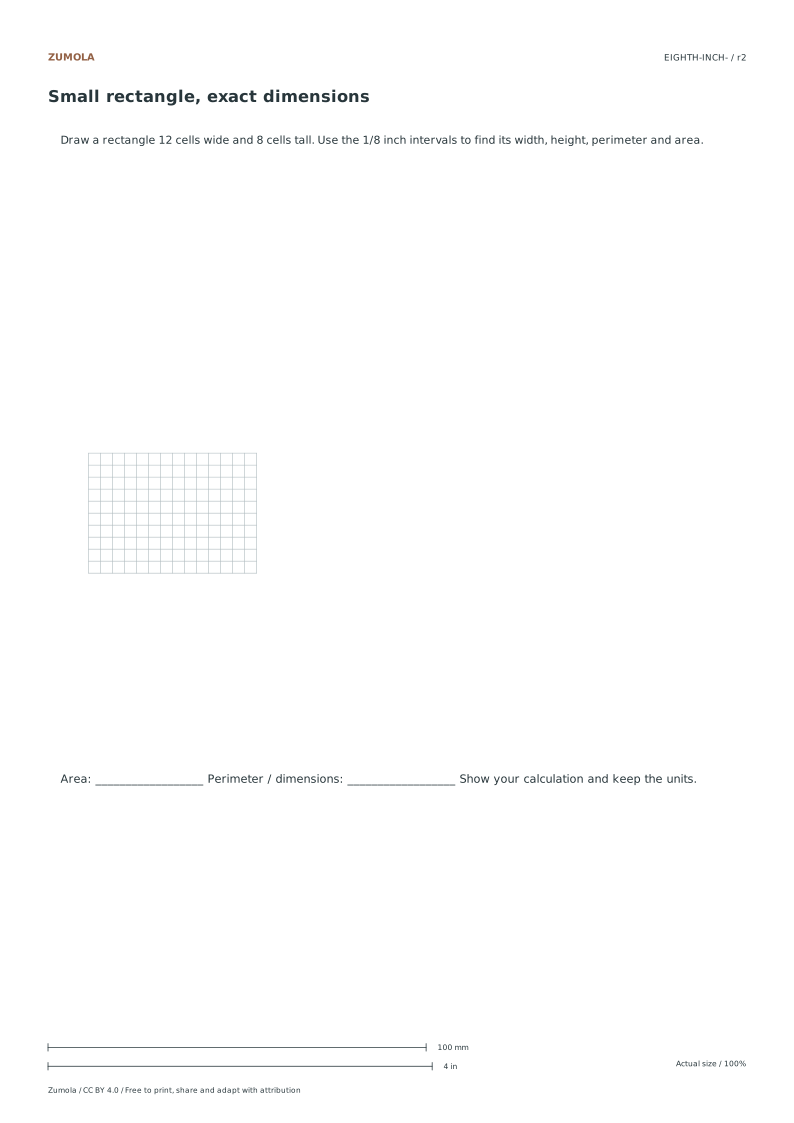
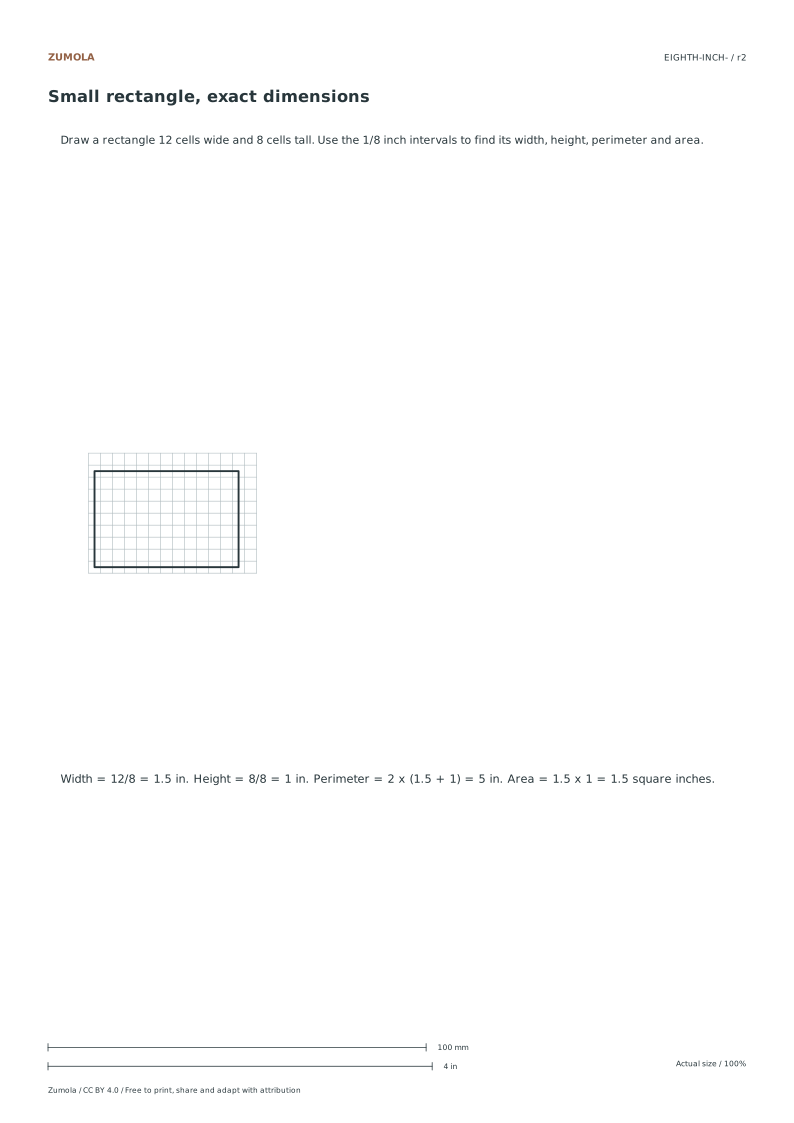
1/8 inch graph paper.
Keep the detail.
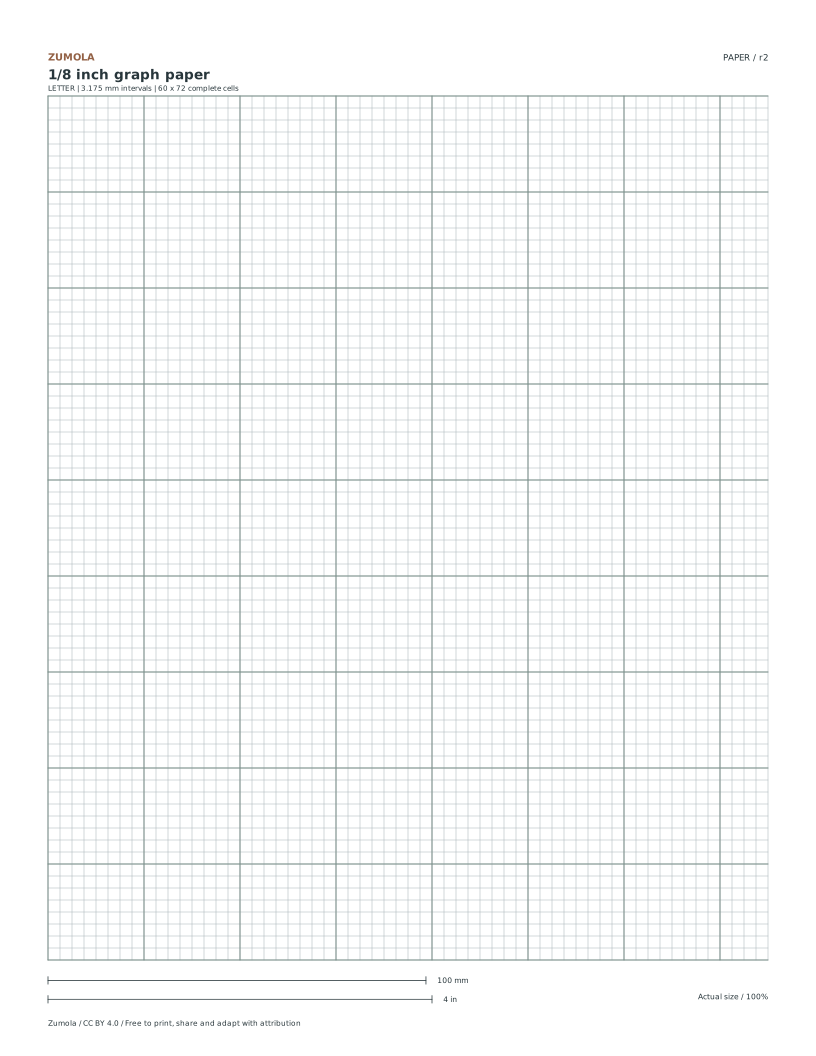
Eight fine intervals make one inch. Use a light 3.175 mm grid for small drawings, with a heavier line every inch to keep your place.
3.175 mm intervals.
One-inch major lines.
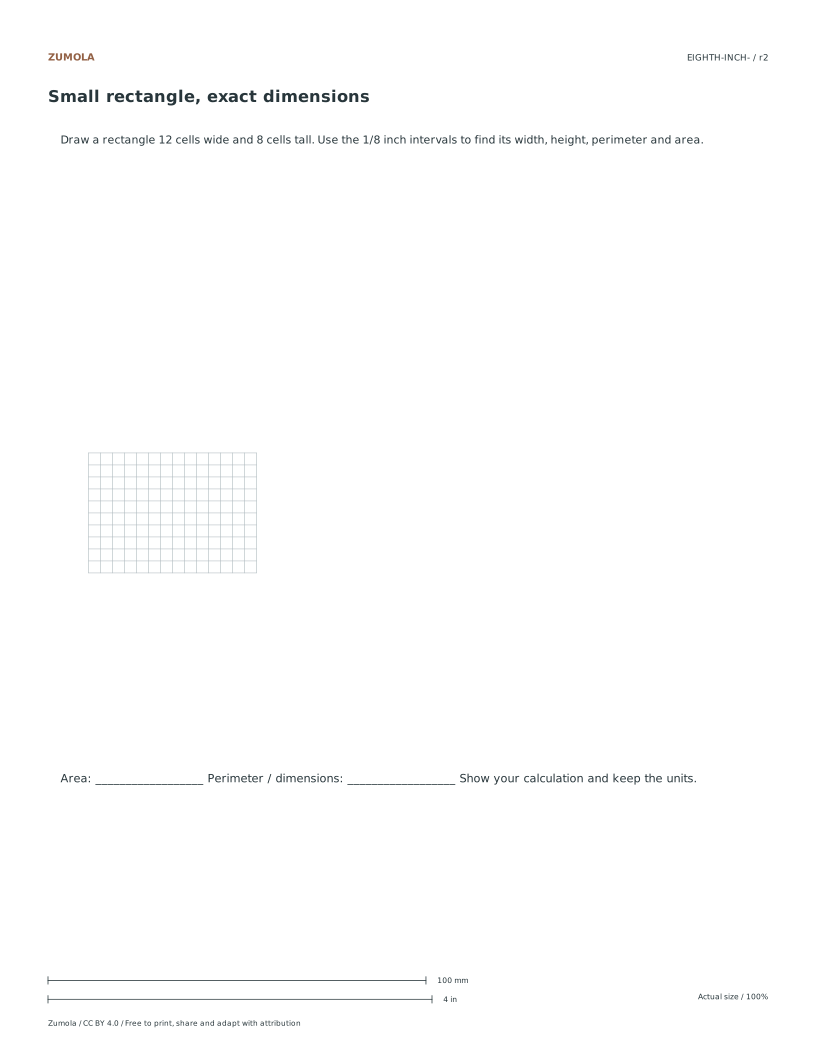
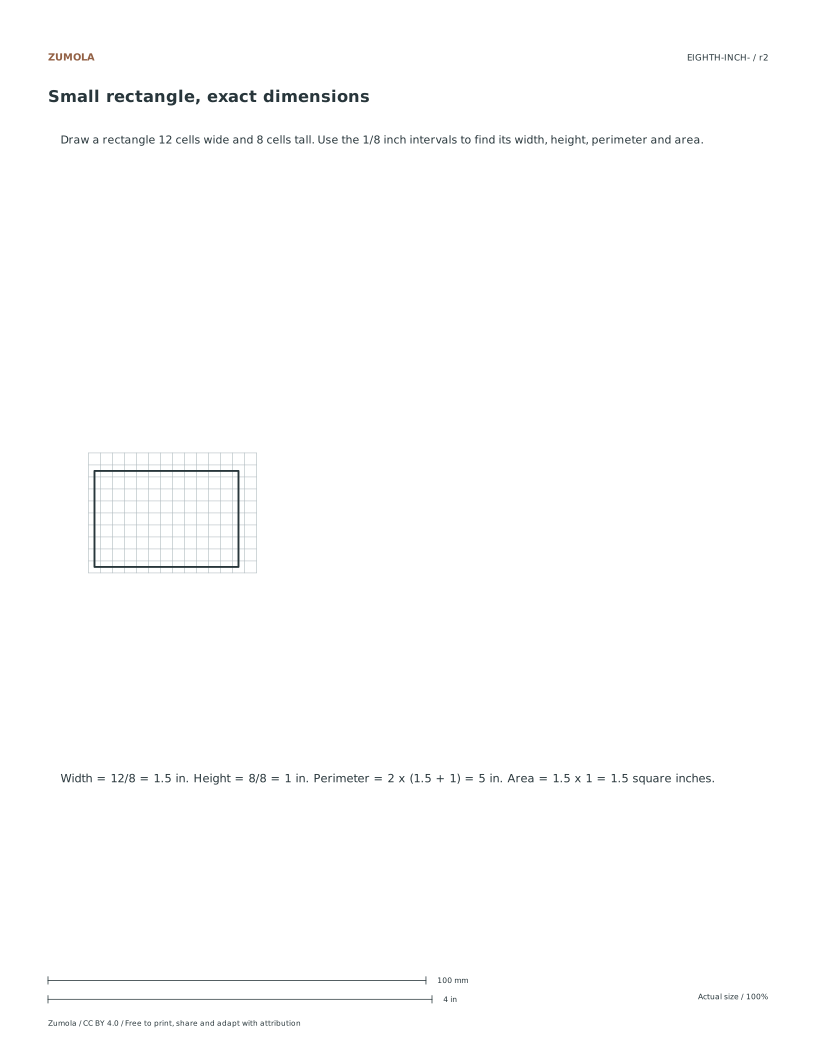
Measurement practice included.
More ways to practice
Reading a fine grid without losing count
At 1/8 inch per cell, one inch is eight cells. A dimension of 2 3/8 inches is therefore 19 cells, because 2 × 8 = 16 and 3/8 = 3, giving 16 + 3 = 19. The heavier inch lines act as checkpoints: after every eight light cells you should cross one heavy line. If you arrive at a heavy line after seven or nine cells, stop and recount before continuing.
Work in one direction at a time. Mark the start corner, count horizontally to the first heavy line, then continue to the target column. Repeat vertically. Recording each count beside the sketch lets you recheck later without redrawing.
- Identify the start corner and label it A.
- Convert each inch dimension to cells by multiplying whole inches by 8 and adding the fraction in eighths.
- Count horizontally, pausing at each heavy inch line to confirm the running total.
- Count vertically the same way and mark the opposite corner.
- Recheck both counts against your written totals before adding any internal lines.
A small bracket sketch with exact counts
A simple L-shaped bracket is a good fine-grid task because it has only two outer dimensions and one notch. Suppose the outline is 1 1/2 inches wide and 2 1/4 inches tall, with a 1/2 inch square notch removed from the top-right corner. In cells: width 12, height 18, notch 4 by 4.
Draw the outer rectangle first, then mark the notch from the top-right corner inward by four cells and down by four cells. The remaining outline should still align with heavy lines wherever a whole inch falls. If a corner lands between heavy lines when it should sit on one, the count is wrong.
- Mark the outer rectangle at 12 cells wide and 18 cells tall.
- From the top-right corner, count 4 cells left and 4 cells down to locate the notch.
- Connect the notch edges and erase the removed corner segment.
- Confirm the left edge is 18 cells and the bottom edge is 12 cells by counting again.
- Label each side with its inch value and cell count.
Checking scale before you measure
Before trusting any measurement, print a calibration bar at 100% and compare it with a ruler. If the bar is short or long, the grid spacing will be wrong and every count will misrepresent physical size. Do not scale to fit; adjust the print setting instead.
After printing, measure across eight light cells. They should span one inch. Also check that the heavy lines appear every eight cells across the full usable area, not just near the centre. A sheet that drifts will show uneven gaps between heavy lines.
- Print the calibration bar at 100% and compare it with a ruler.
- Measure eight light cells and confirm they equal one inch.
- Check heavy-line spacing at the left, centre, and right of the sheet.
- Only then begin counting cells for your sketch.
Try this example
Sketch an L-shaped bracket 1 1/2 inches wide and 2 1/4 inches tall with a 1/2 inch square notch at the top-right corner, using 1/8 inch cells.
Show the worked explanation
Width 1 1/2 inches = 12 cells. Height 2 1/4 inches = 18 cells. Notch 1/2 inch = 4 cells each way. Draw the outer rectangle 12 by 18 cells, then remove a 4 by 4 cell square from the top-right corner. Recheck: the left edge should count 18 cells and the bottom edge 12 cells, and the notch edges should each be 4 cells.
Common mistakes
- Counting the starting line as cell one and adding an extra cell at the end. Count intervals between lines, not lines themselves; eight intervals make one inch.
- Assuming a printed sheet is exactly to scale without checking. Compare a calibration bar with a ruler before measuring any sketch.
- Letting the notch corner drift off the heavy-line checkpoints. Recount from the nearest heavy line to the notch corner and correct before drawing internal edges.
Check your work
- Every dimension is converted to cells using 8 cells per inch.
- Heavy inch lines are used as checkpoints during counting.
- The notch is measured from a named corner, not estimated.
- Side labels show both inch value and cell count.
- A calibration check is completed before physical measurement.
Questions before you start
How many 1/8 inch cells fit in one inch?
Eight cells, because each cell is one eighth of an inch wide.
Why do heavy lines matter on a fine grid?
They mark whole inches, so you can confirm your running count every eight light cells.
Can I use this grid for a dimension like 2 3/8 inches?
Yes. Convert to 19 cells: 2 × 8 = 16, plus 3 for the 3/8, giving 19.