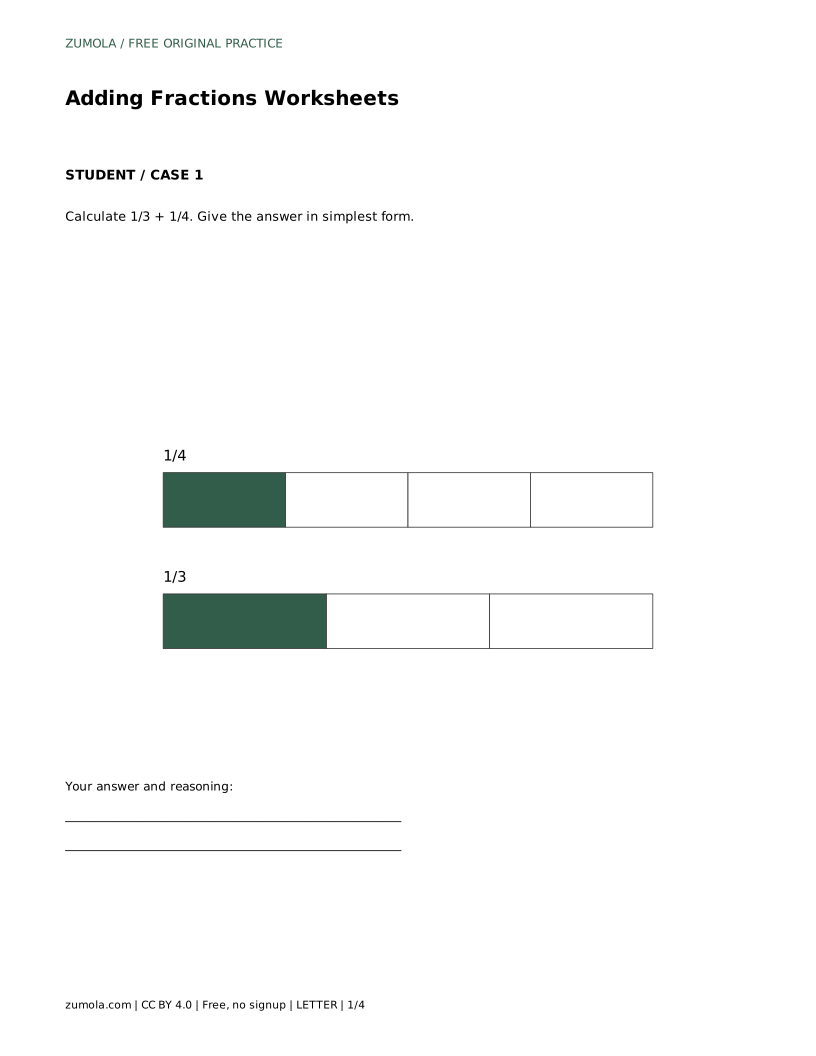
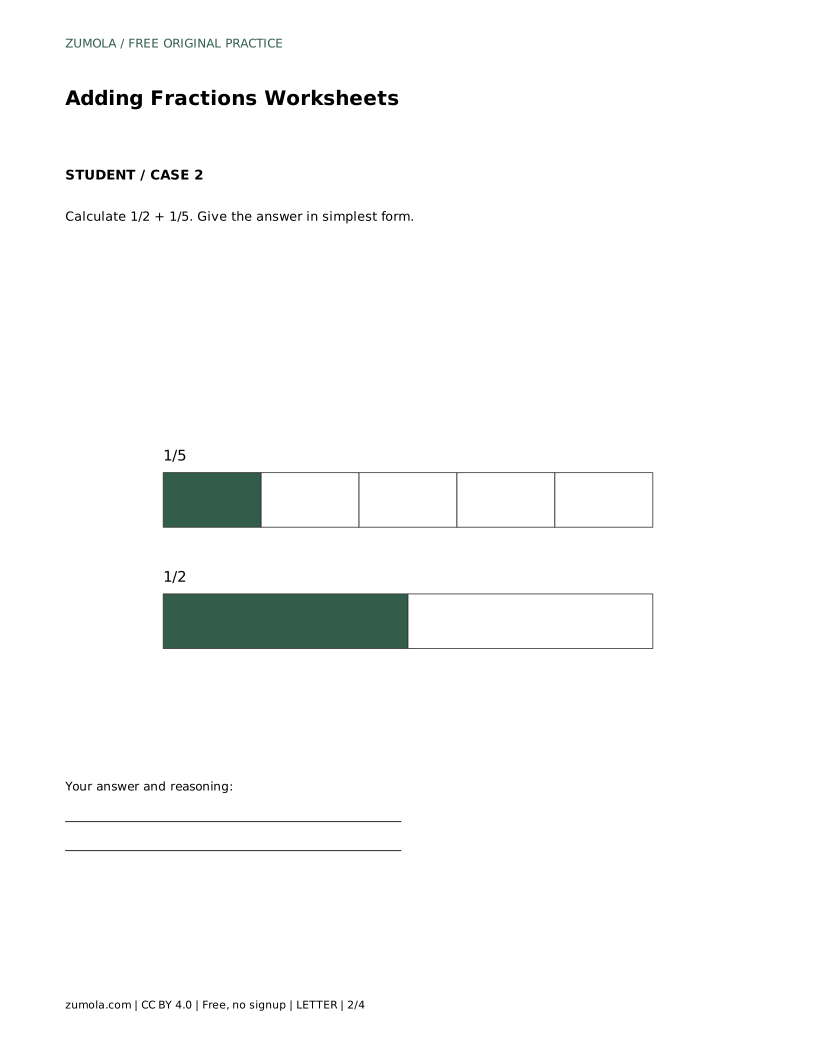
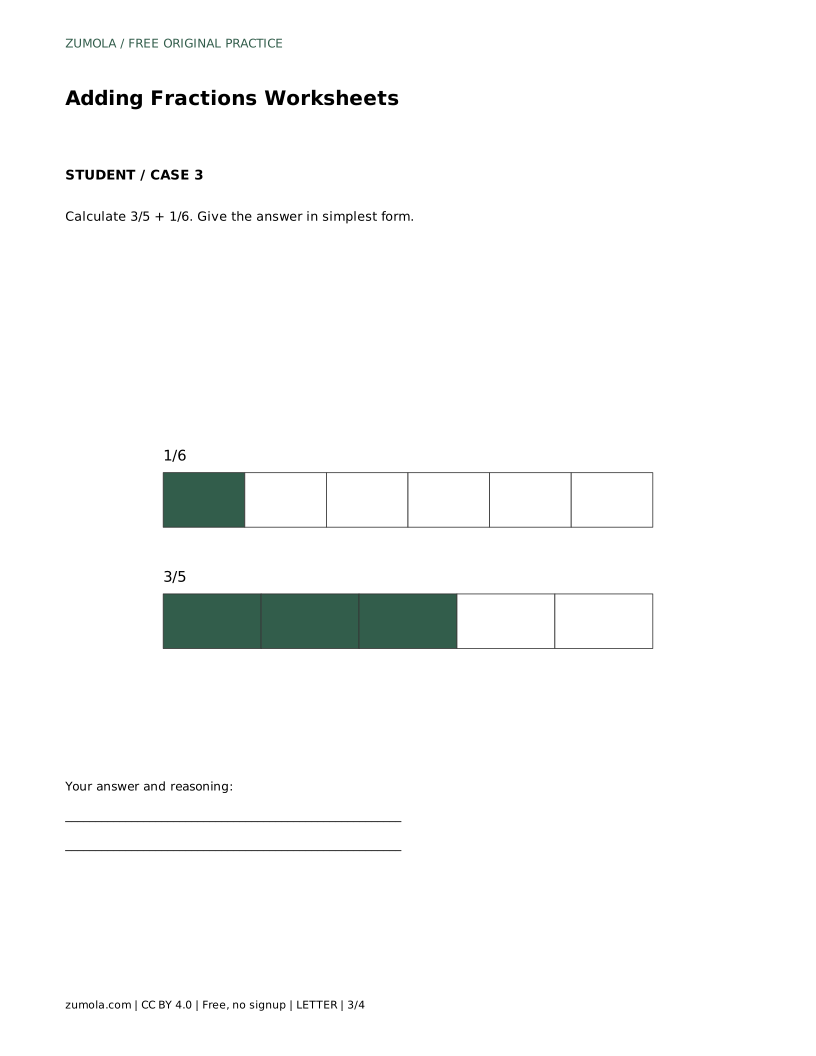
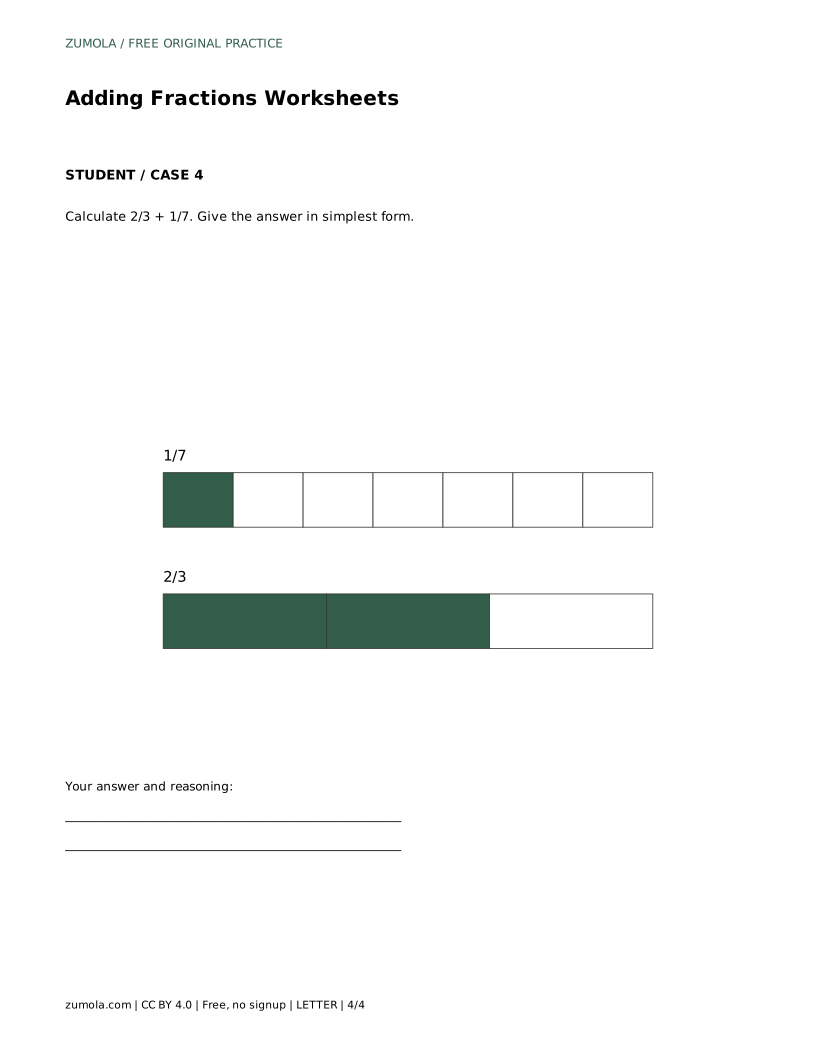
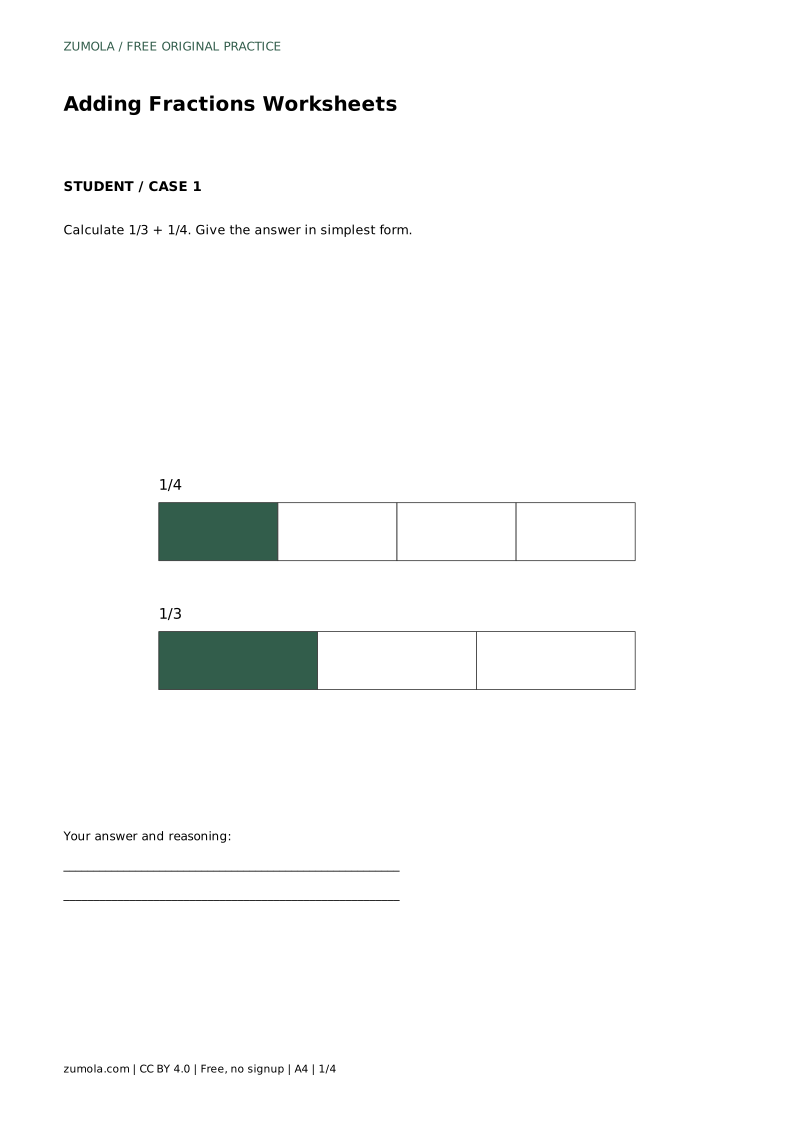
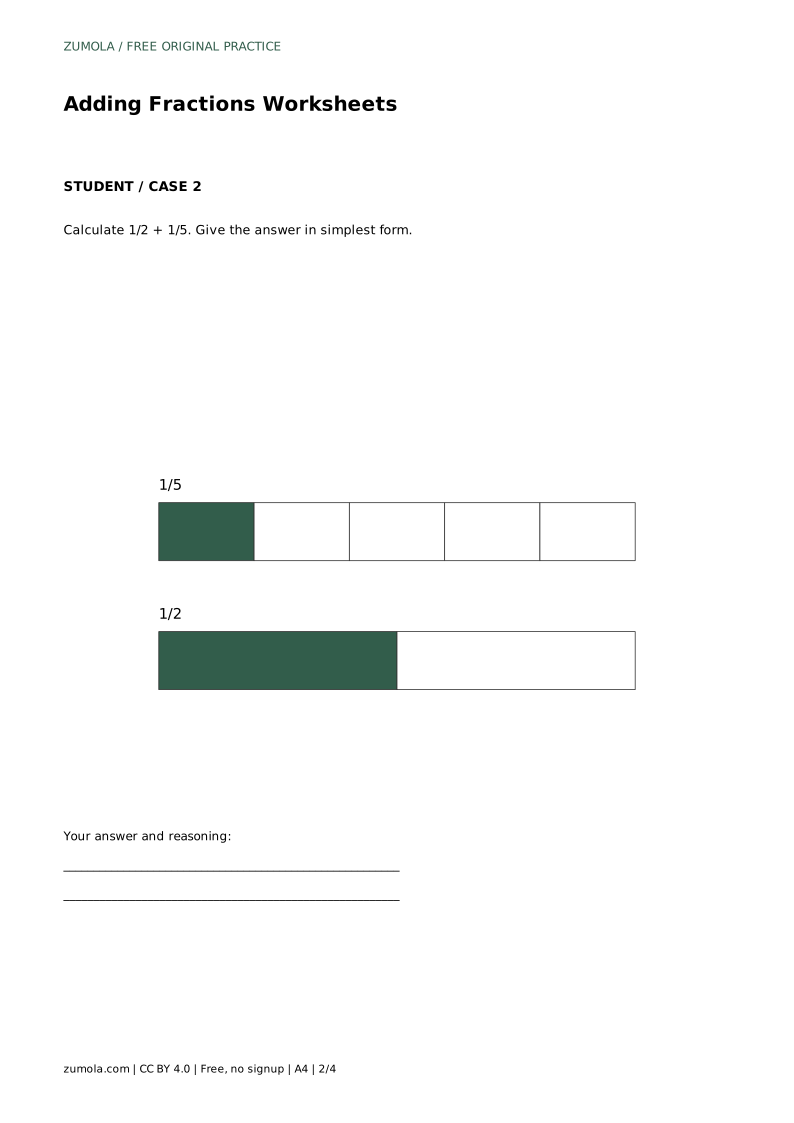
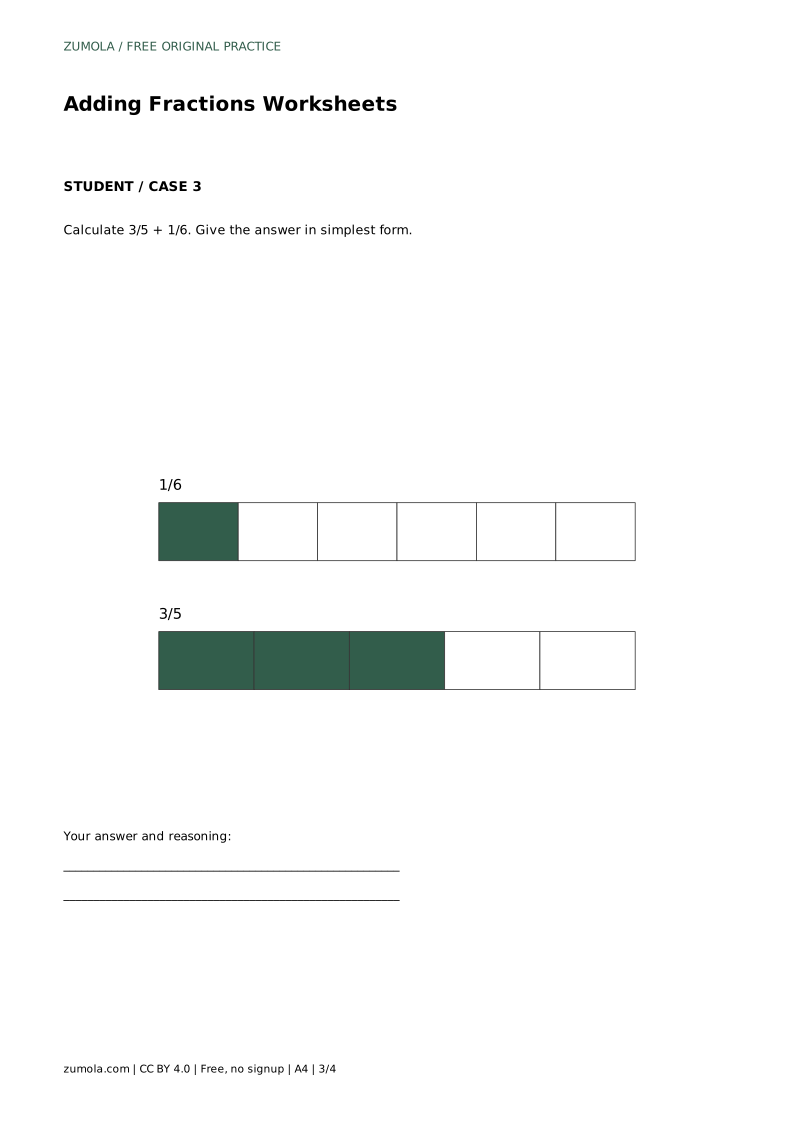
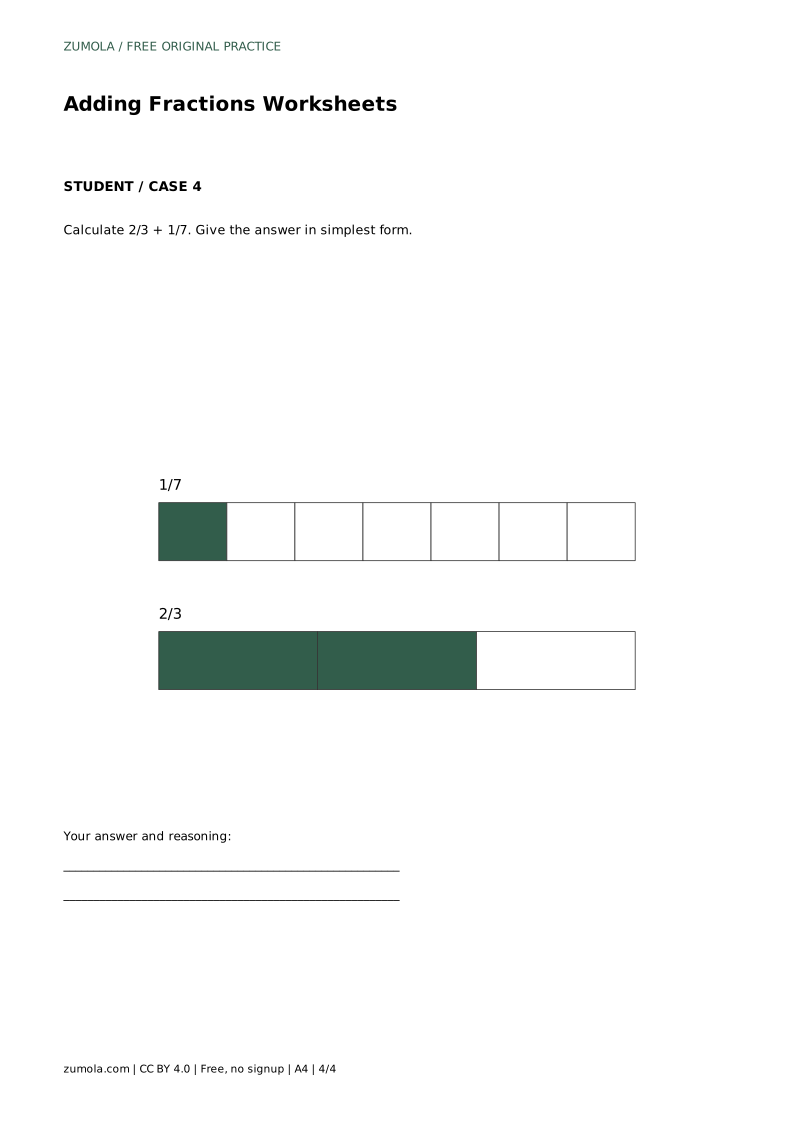
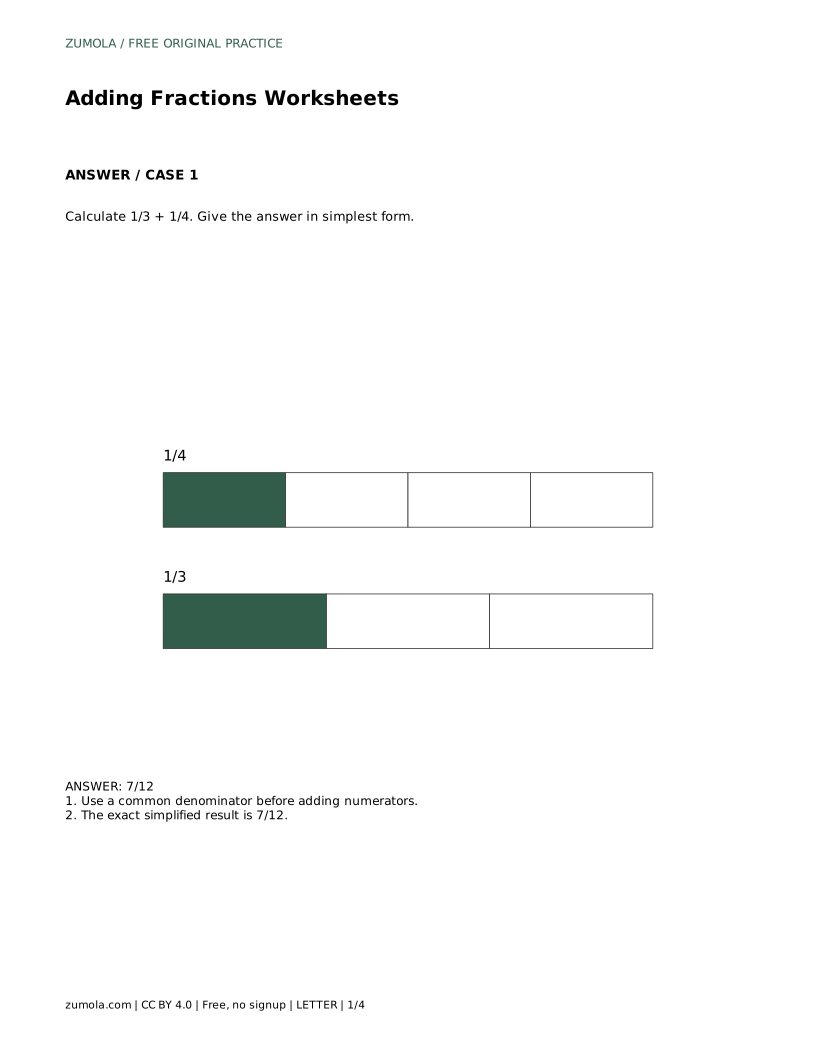
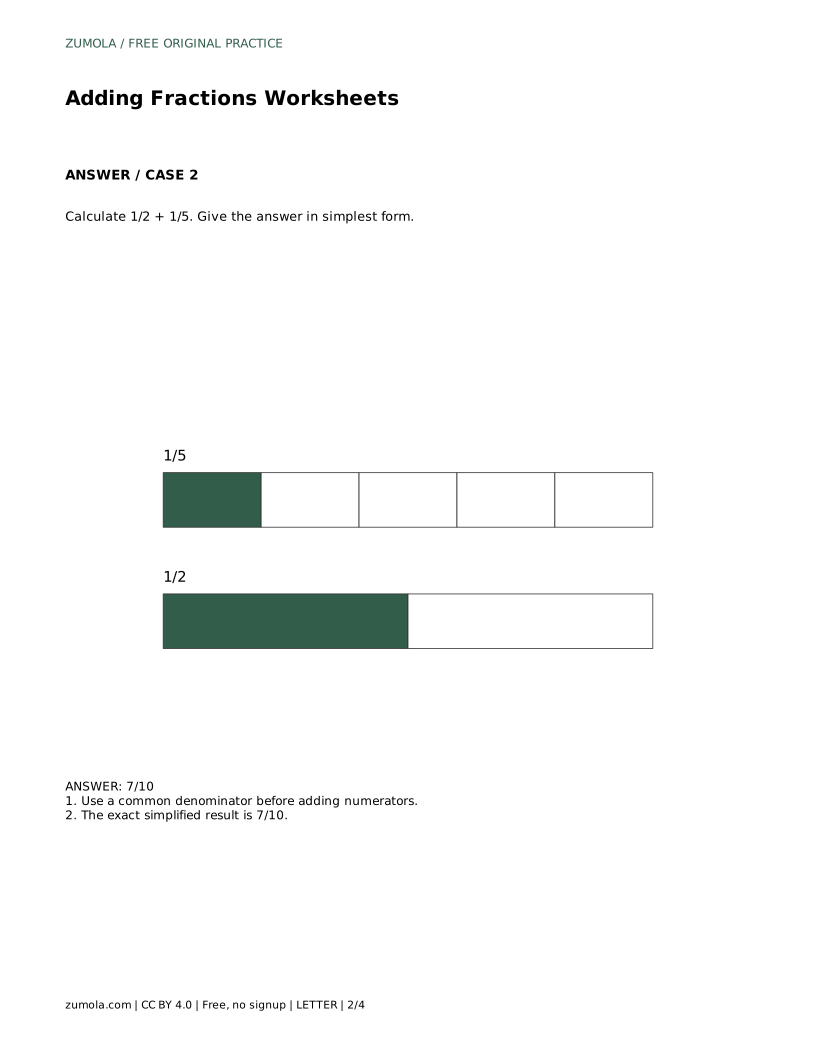
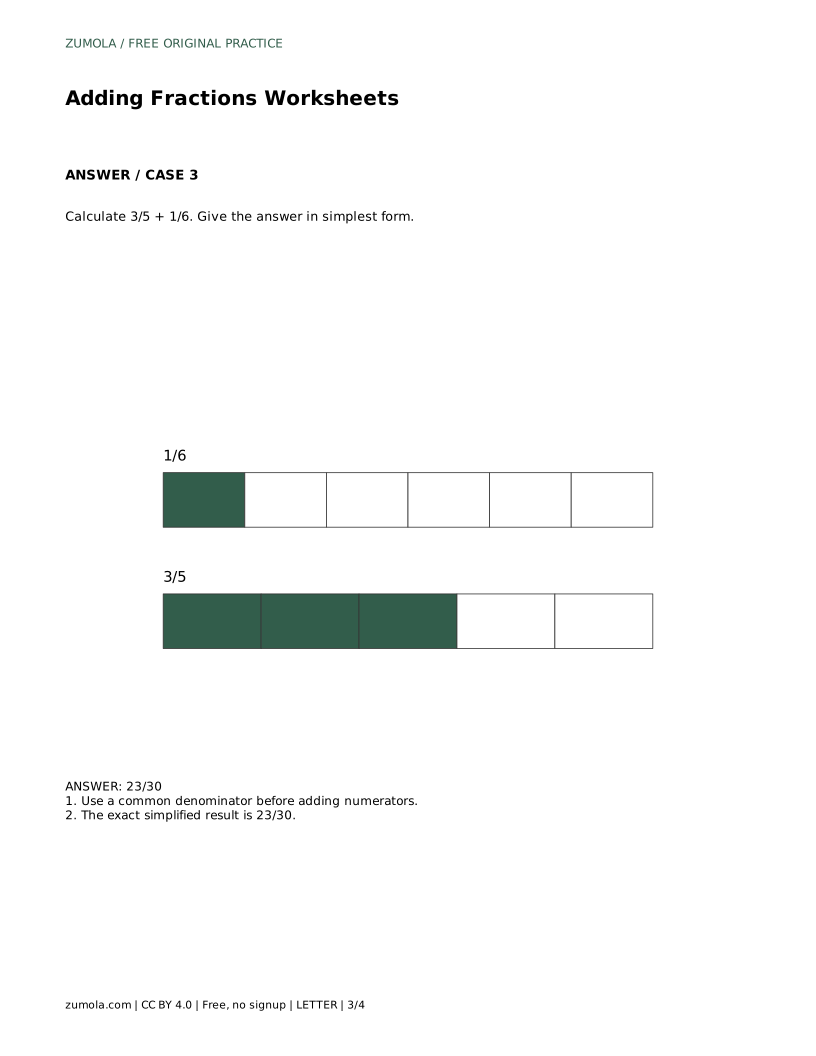
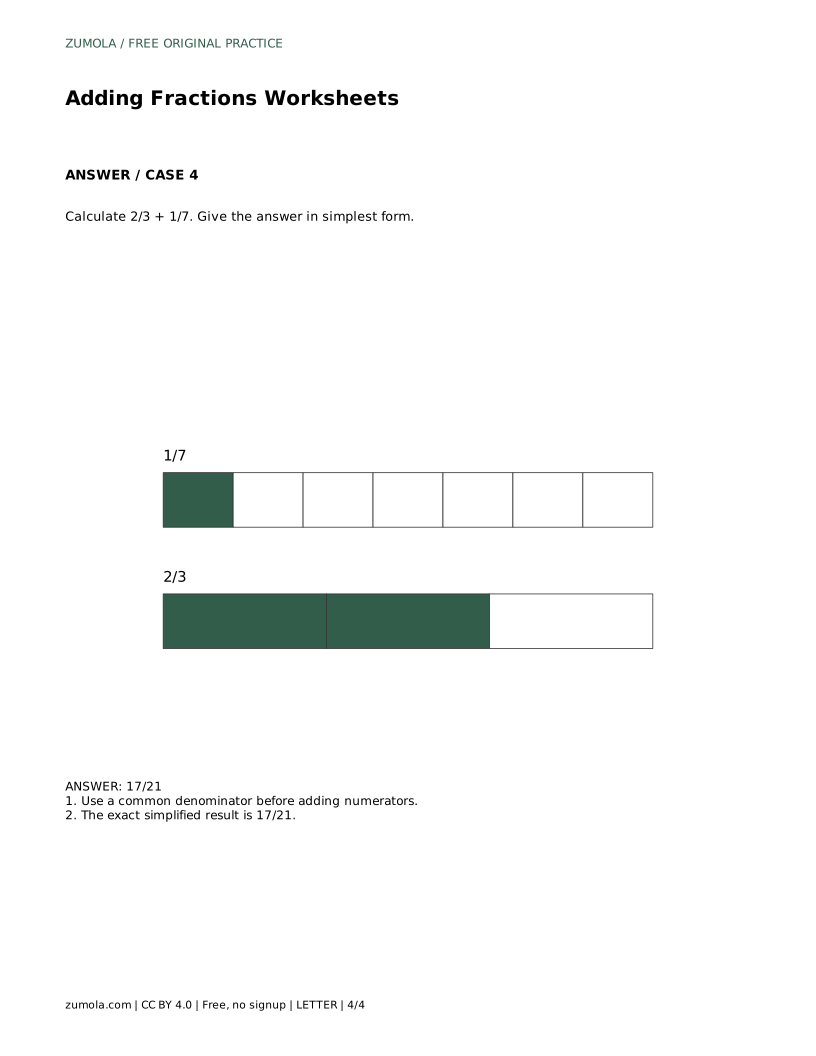
Reference diagrams
LETTER · Download PDF
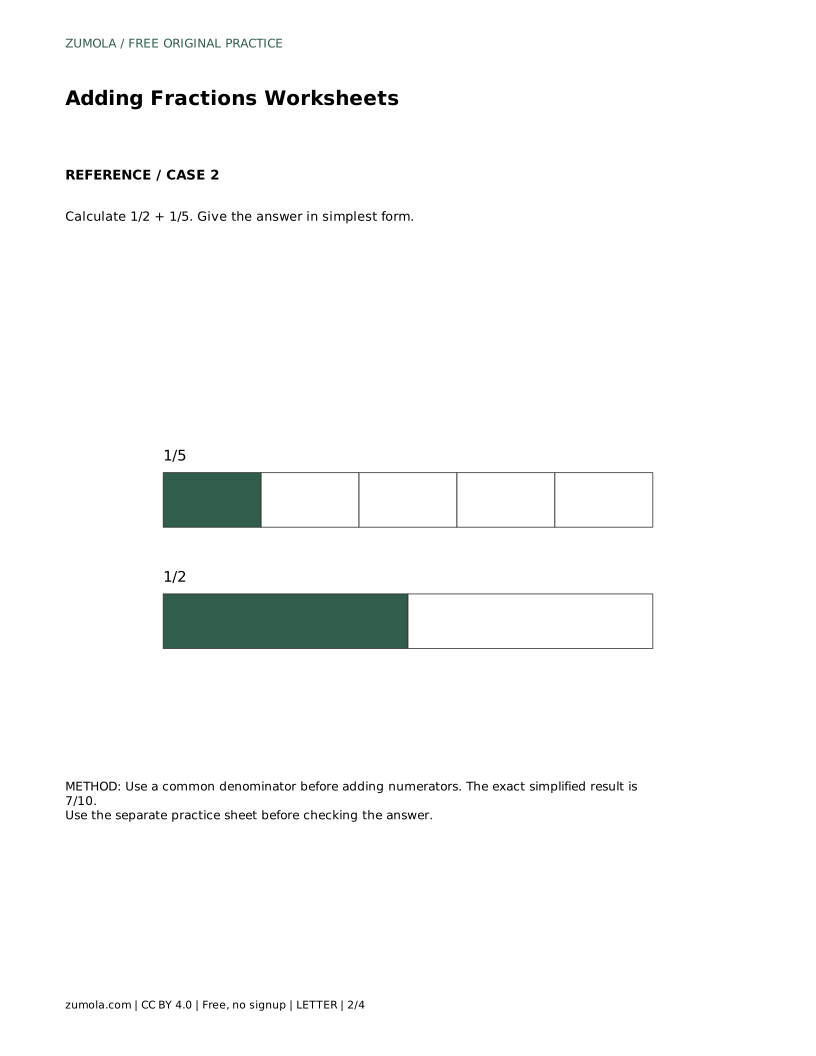
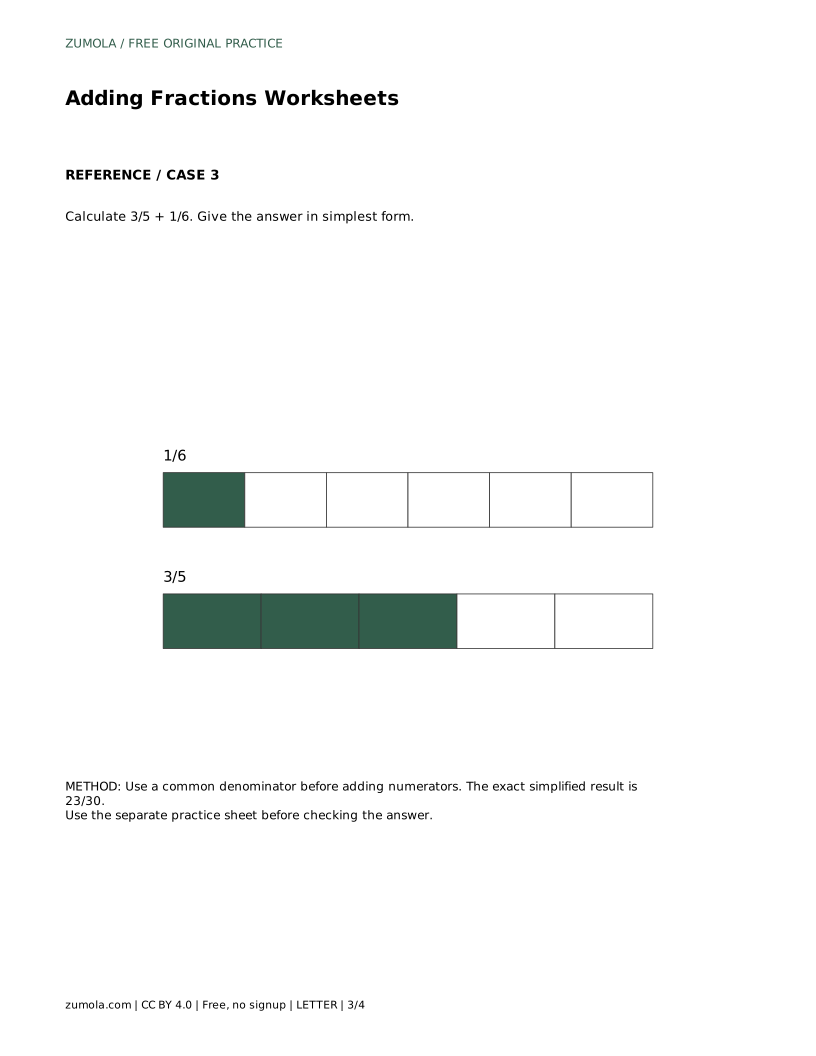
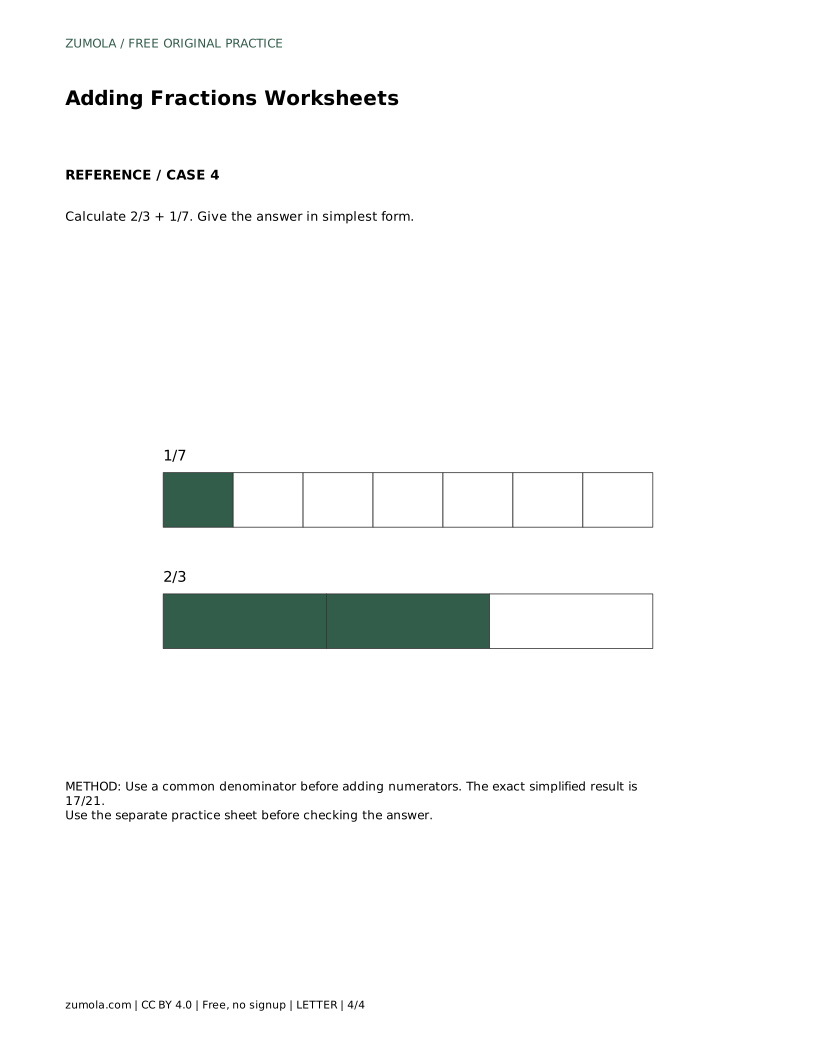
A4 · Download PDF
Free original resources
Teach fraction addition with common denominators, clear worked steps, a practice rubric, and correction guidance for simplifying sums correctly.
Four original cases, with reference diagrams, practice sheets and worked answers. Everything is free; no signup required.
LETTER · Download PDF
A4 · Download PDF
LETTER · Download PDF
A4 · Download PDF
LETTER · Download PDF
A4 · Download PDF
Use A4 or US Letter to match your printer. Use the stated values and conditions to solve each exercise; diagrams are not physical measuring rulers.
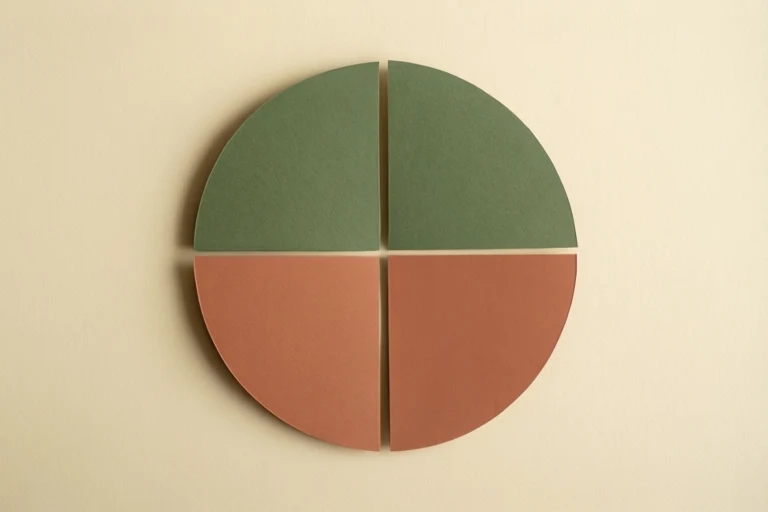
Adding fractions is not the same as adding whole numbers. The numerators count parts, but only parts of the same size can be combined. This page explains how to rename fractions so their denominators match, add the numerators, and simplify the result. It uses one complete example and then gives practical ways to check work, avoid common errors, and judge a finished worksheet response fairly.
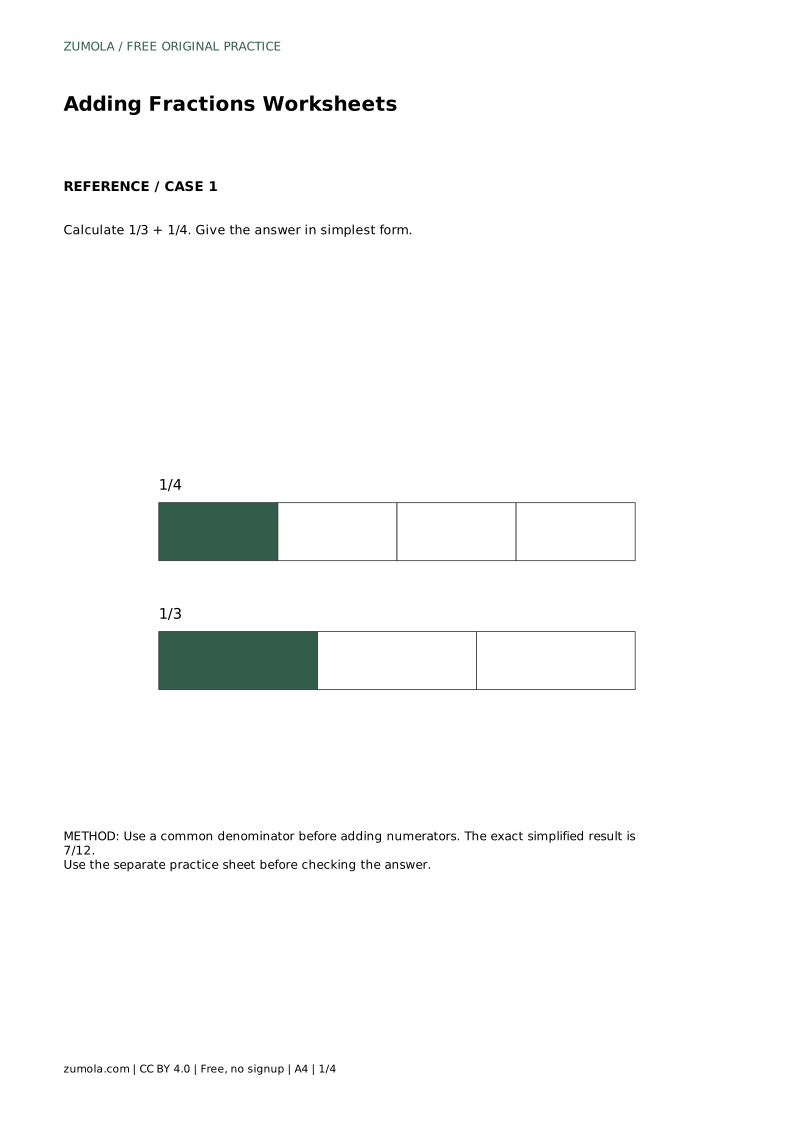
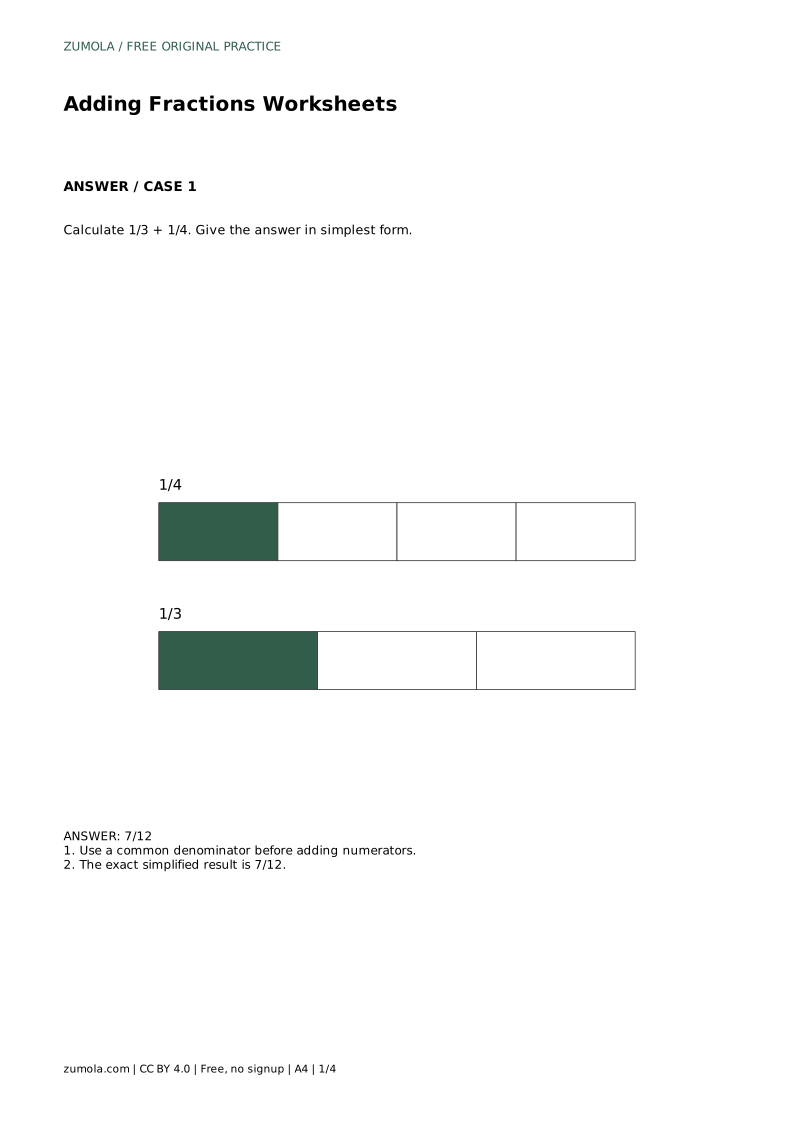
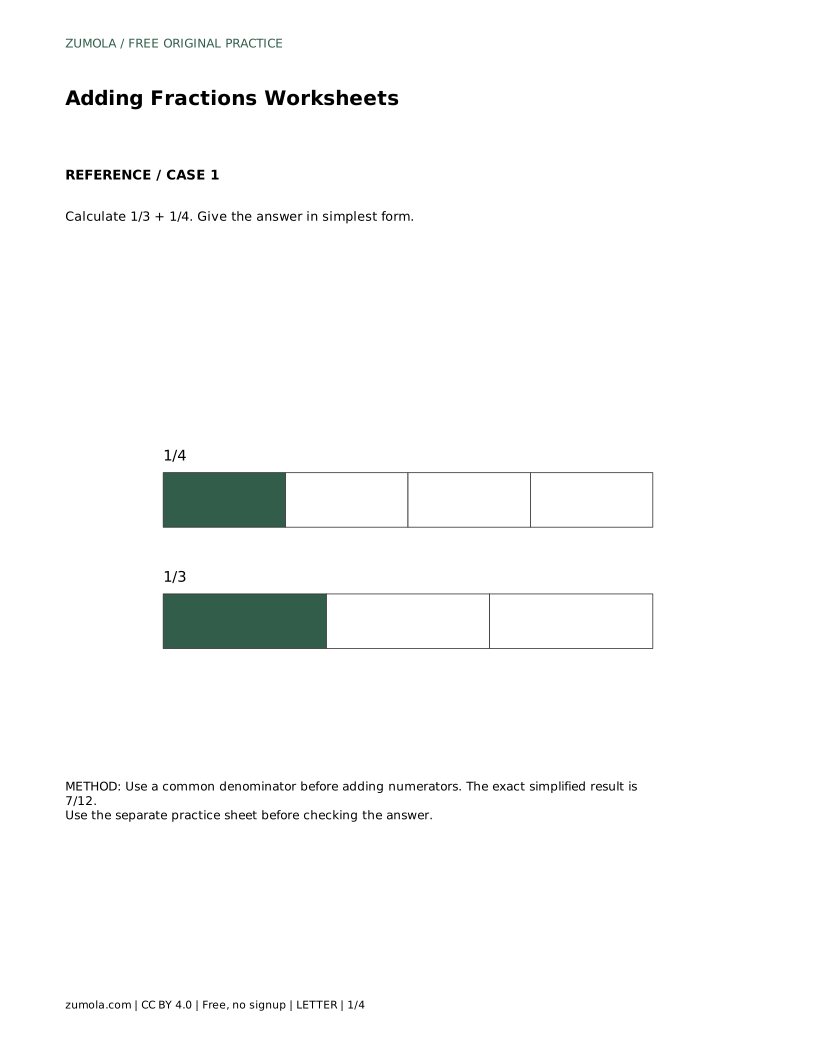
A fraction such as 1/3 means one part when a whole is split into three equal parts. A fraction such as 1/4 means one part when the same whole is split into four equal parts. Those parts are different sizes, so 1/3 and 1/4 cannot be counted together directly. Renaming both fractions with a shared denominator makes the parts the same size.
A common denominator is any number divisible by both original denominators. The least common denominator is the smallest such number, but it is not the only valid choice. For 1/3 and 1/4, 12 works because 12 is divisible by both 3 and 4. Multiply the numerator and denominator of each fraction by the same factor so the value stays unchanged.
For 1/3 + 1/4, the denominators are 3 and 4. Their least common multiple is 12. Rename 1/3 as 4/12 by multiplying numerator and denominator by 4. Rename 1/4 as 3/12 by multiplying numerator and denominator by 3. Now both fractions describe twelfths, so add the numerators: 4 + 3 = 7. The sum is 7/12.
Check whether 7/12 is in simplest form. The factors of 7 are 1 and 7. The factors of 12 are 1, 2, 3, 4, 6, and 12. The only shared factor is 1, so 7/12 cannot be reduced further. The answer is exactly 7/12.
Estimate before calculating. One third is a little more than 0.3, and one fourth is 0.25, so the sum should be a little more than 0.55. Since 7/12 is about 0.58, the result is reasonable. Estimation catches errors such as adding denominators or forgetting to rename one fraction.
A second check is to reverse the addition. If 1/3 + 1/4 = 7/12, then 7/12 minus 1/4 should equal 1/3. Rename 7/12 and 1/4 as twelfths: 7/12 minus 3/12 equals 4/12, which simplifies to 1/3. This confirms the sum.
Fraction addition can be solved by different valid routes, such as using the least common denominator or another common multiple. A rubric should judge the reasoning and the final simplified value rather than require one particular intermediate line. It should also distinguish a correct method with an arithmetic slip from a misunderstanding of denominators.
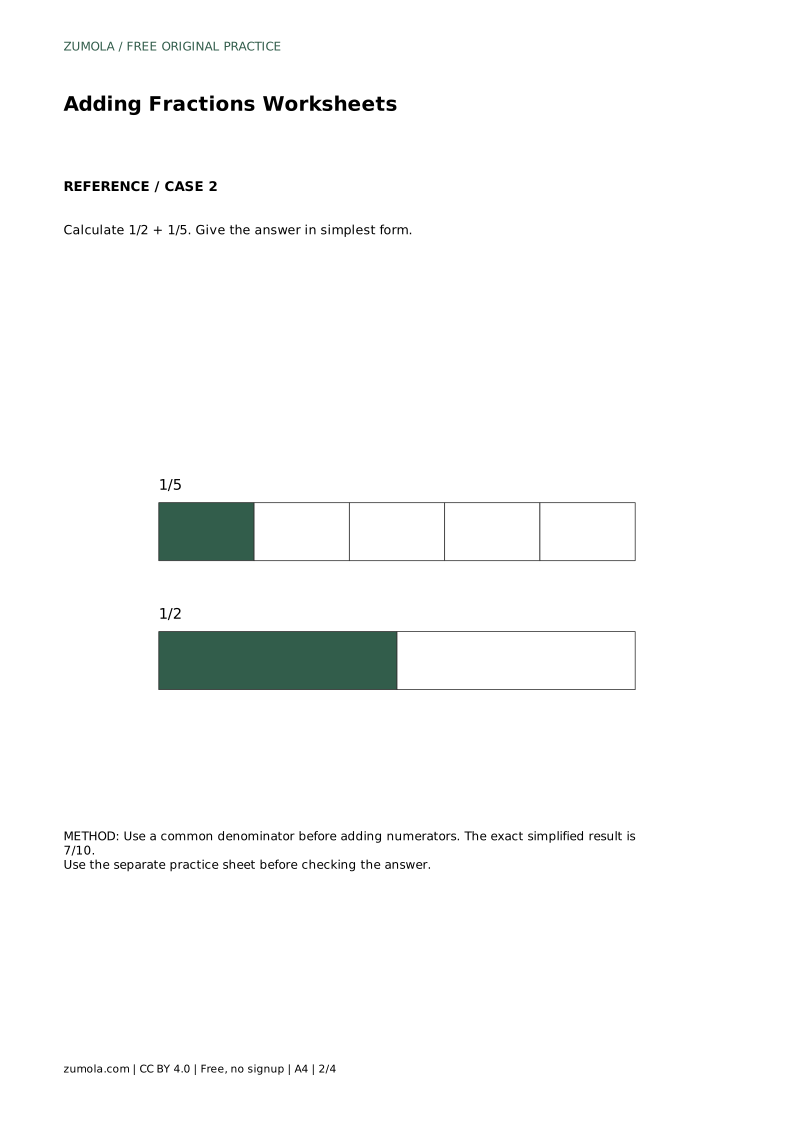
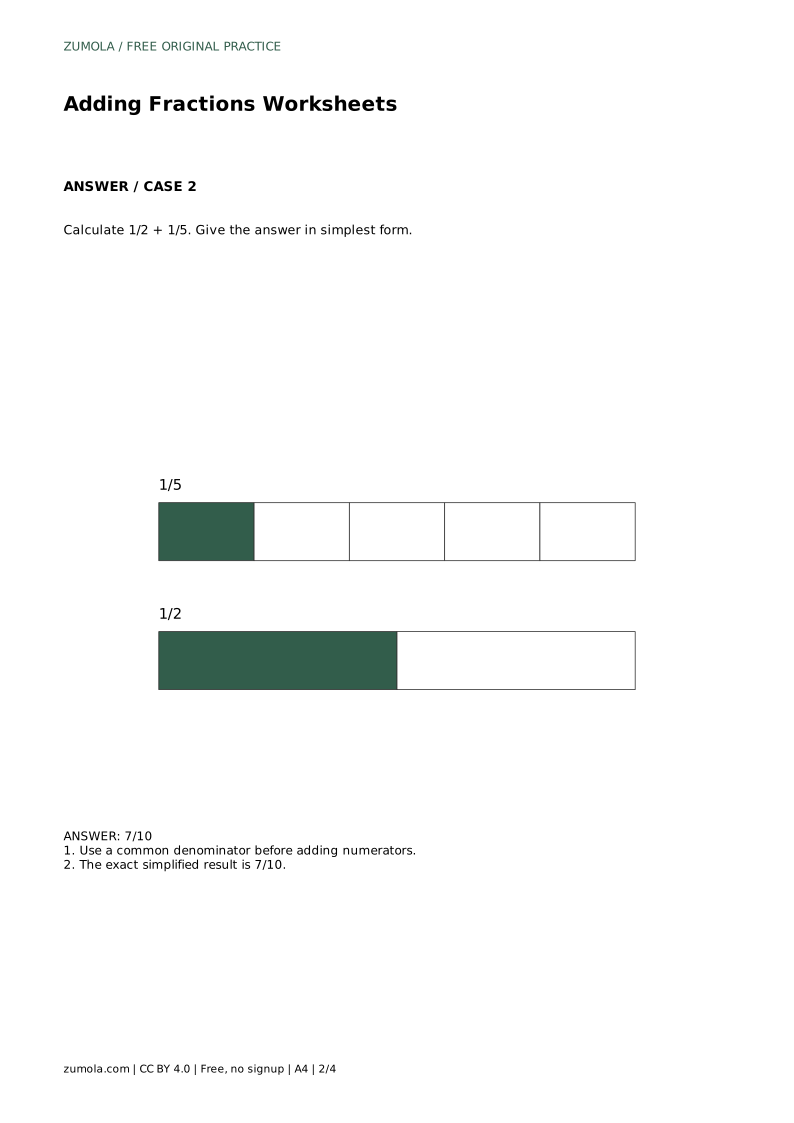
Try 1/2 + 1/5. The denominators 2 and 5 have least common multiple 10. Rename 1/2 as 5/10 and 1/5 as 2/10. Add the numerators: 5 + 2 = 7, so the sum is 7/10. Since 7 and 10 share no factor greater than 1, the answer is already simplest.
Do not assume every pair of denominators needs multiplying together. Sometimes one denominator divides the other, and sometimes the least common multiple is smaller than the product. Always identify a shared multiple before renaming.
Calculate 1/3 + 1/4. Give the answer in simplest form.
7/12 Use a common denominator before adding numerators. The exact simplified result is 7/12.
Yes. Any common multiple of the denominators works. The least common multiple usually keeps the numbers smaller, but a larger common multiple still gives the same simplified sum.
Multiplying both by the same nonzero factor is equivalent to multiplying by 1 in fraction form, so the fraction's value does not change.
The numerator and denominator have no common factor greater than 1. For 7/12, the only shared factor is 1.
All math worksheets · Free coordinate paper
Original resources · CC BY 4.0 · Free for personal and classroom use with attribution.